Quadrant marked mesh patterns in 123-avoiding permutations
Dun Qiu, Jeffrey B. Remmel

TL;DR
This paper investigates the distribution of quadrant marked mesh pattern matches in 123-avoiding permutations, extending previous work on other pattern-avoiding classes, and provides recurrence relations and combinatorial insights.
Contribution
It introduces explicit recurrence relations and combinatorial explanations for the distribution of mesh pattern matches in 123-avoiding permutations, a new class not previously analyzed.
Findings
Derived recurrence relations for counting pattern matches.
Provided closed-form generating functions for distributions.
Offered combinatorial explanations for coefficients in generating functions.
Abstract
Given a permutation in the symmetric group , we say that matches the quadrant marked mesh pattern in if there are at least points to the right of in which are greater than , at least points to the left of in which are greater than , at least points to the left of in which are smaller than , and at least points to the right of in which are smaller than . Kitaev, Remmel, and Tiefenbruck systematically studied the distribution of the number of matches of in 132-avoiding permutations. The operation of reverse and complement on permutations allow one to translate their results to find the distribution of the number of…
Click any figure to enlarge with its caption.
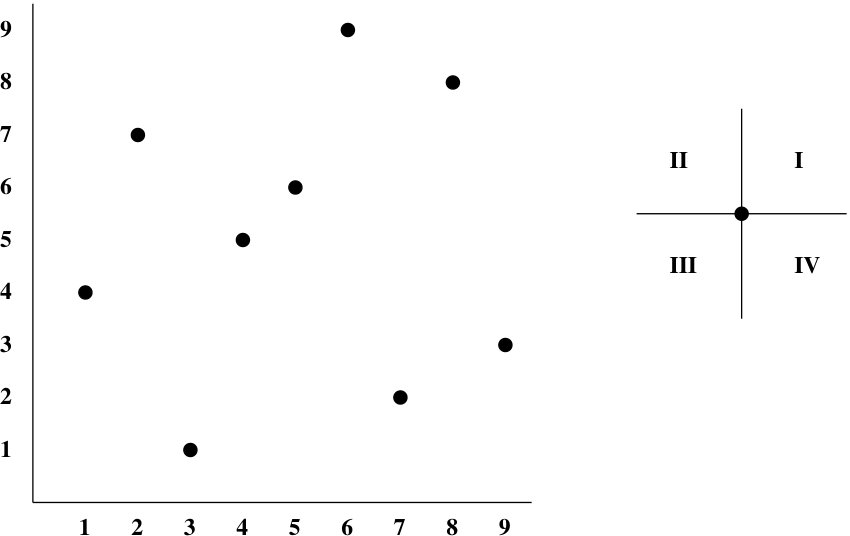 Figure 1
Peer Reviews
No public reviews on file for this paper yet. If you reviewed it on a platform where reviews are public (OpenReview, ICLR, NeurIPS, ICML), you can paste yours below so the community can read it here.
Videos
No videos yet. Explain this paper in a talk, walkthrough, or lecture? Add one.
\publicationdetails
1920182123297
Quadrant marked mesh patterns in 123-avoiding permutations
Dun Qiu
Jeffrey Remmel
Department of Mathematics, University of California San Diego, La Jolla, USA
(2017-5-2; 2017-10-3; 2018-6-26)
Abstract
Given a permutation in the symmetric group , we say that matches the quadrant marked mesh pattern in if there are at least points to the right of in which are greater than , at least points to the left of in which are greater than , at least points to the left of in which are smaller than , and at least points to the right of in which are smaller than . Kitaev, Remmel, and Tiefenbruck systematically studied the distribution of the number of matches of in 132-avoiding permutations. The operation of reverse and complement on permutations allow one to translate their results to find the distribution of the number of matches in 231-avoiding, 213-avoiding, and 312-avoiding permutations. In this paper, we study the distribution of the number of matches of in 123-avoiding permutations. We provide explicit recurrence relations to enumerate our objects which can be used to give closed forms for the generating functions associated with such distributions. In many cases, we provide combinatorial explanations of the coefficients that appear in our generating functions.
keywords:
permutation statistics, marked mesh pattern, Catalan number, Dyck path
1 Introduction
Given a sequence of distinct integers, let be the permutation founded by replacing the -th smallest integer that appears in by . For example, if , then . Given a permutation in the symmetric group , we say that the pattern occurs in provided there exist such that . We say that a permutation avoids the pattern if does not occur in . Let denote the set of permutations in which avoid . In the theory of permutation patterns, is called a classical pattern. See Kitaev (2011) for a comprehensive introduction to patterns in permutations.
The main goal of this paper is to study the distribution of quadrant marked mesh patterns in 123-avoiding permutations. The notion of mesh patterns was introduced by Brändén and Claesson (2011) to provide explicit expansions for certain permutation statistics as, possibly infinite, linear combinations of (classical) permutation patterns. This notion was further studied in Avgustinovich et al. (2013); Hilmarsson et al. (2015); Kitaev and Liese (2013); Kitaev and Remmel (2012a); Úlfarsson (2015). Kitaev and Remmel (2012a) initiated the systematic study of distribution of quadrant marked mesh patterns on permutations. The study was extended to 132-avoiding permutations by Kitaev et al. (2012, 2015a, 2015b). Kitaev and Remmel (2012b, 2013) also studied the distribution of quadrant marked mesh patterns in up-down and down-up permutations.
Let be a permutation written in one-line notation. We will consider the graph of , , to be the set of points for . For example, the graph of the permutation is pictured in Figure 1. Then if we draw a coordinate system centered at a point , we will be interested in the points that lie in the four quadrants I, II, III, and IV of that coordinate system as pictured in Figure 1. For any , where is the set of natural numbers, and any , we say that matches the quadrant marked mesh pattern in if in , there are at least points in quadrant I, at least points in quadrant II, at least points in quadrant III, and at least points in quadrant IV relative to the coordinate system which has the point as its origin. For example, if , the point matches the marked mesh pattern since, in relative to the coordinate system with the origin at , there are 3 points in quadrant I, 1 point in quadrant II, 2 points in quadrant III, and 2 points in quadrant IV. Note that if a coordinate in is 0, then there is no condition imposed on the points in the corresponding quadrant. Another way to state this definition is to say that matches the marked mesh pattern in if there are at least points to the right of in which are greater than , at least points to the left of in which are greater than , at least points to the left of in which are smaller than , and at least points to the right of in which are smaller than .
In addition, we shall consider the patterns where . Here when a coordinate of is the empty set, then for to match in , it must be the case that there are no points in relative to the coordinate system with the origin at in the corresponding quadrant. For example, if , the point matches the marked mesh pattern since, in relative to the coordinate system with the origin at , there are 6 points in quadrant I, 2 points in quadrant II, no points in quadrants III and IV. We let denote the number of such that matches in . For example, for , since and match in .
Next we give some examples of how the (two-dimensional) notation of Úlfarsson (2015) for marked mesh patterns corresponds to our (one-line) notation for quadrant marked mesh patterns. For example,
[TABLE]
[TABLE]
Given a permutation , it is a natural question to study the distribution of quadrant marked mesh patterns in . That is, one wants to study generating function of the form
[TABLE]
where for any ,
[TABLE]
For any we let denote the coefficient of in . Given a permutation , we let the reverse of , , be defined by , and the complement of , , be defined by . It is easy to see that the family of generating functions , , and can be obtained from the family of generating functions .
Kitaev et al. (2012, 2015a, 2015b) systematically studied the generating functions . Since is closed under inverses, there is a natural symmetry on these generating functions. That is, we have the following lemma.
Lemma 1**.**
(Kitaev et al. (2012)) For any ,
[TABLE]
In Kitaev et al. (2012), Kitaev, Remmel and Tiefenbrick proved the following.
Theorem 1**.**
((Kitaev et al., 2012, Theorem 4))
[TABLE]
and, for ,
[TABLE]
Theorem 2**.**
((Kitaev et al., 2012, Theorem 15))
[TABLE]
For ,
[TABLE]
Theorem 3**.**
((Kitaev et al., 2012, Theorem 8)) For ,
[TABLE]
By Lemma 1, so the remaining two cases of where and exactly one of is not zero is covered by the following theorem.
Theorem 4**.**
((Kitaev et al., 2012, Theorem 12))
[TABLE]
For ,
[TABLE]
and
[TABLE]
In Kitaev et al. (2015a), Kitaev, Remmel, and Tiefenbruck used the results above to cover the cases where and exactly two of are not zero. For example, they proved the following.
Theorem 5**.**
For all ,
[TABLE]
Theorem 6**.**
For all ,
[TABLE]
Finally, in Kitaev et al. (2015b), Kitaev, Remmel, and Tiefenbruck used these results to find generating functions to obtain similar recursions for for arbitrary .
The situation for the generating functions is different. First of all it is easy to see that is closed under the operation reverse-complement. Thus we have the following lemma.
Lemma 2**.**
For any ,
[TABLE]
Next it is obvious that if there is a in such that matches where , then contains an occurrence of . Thus there are no permutations that can match a quadrant marked mesh pattern where . Thus if , then . Our first major result is that for all such that ,
[TABLE]
We will prove this result by using a bijection of Krattenthaler (2001) between and , the set of Dyck paths of length , and a bijection of Elizalde and Deutsch (2003) between and . It is easier to compute the generating functions of the form , so we will use them to compute . The only generating functions of the form where that were computed by Kitaev et al. (2012, 2015a, 2015b) were the generating functions of the form given in Theorem 2 above. However their techniques can be used to compute when for arbitrary and . By Lemma 2, so that such computations will cover all the cases of where exactly one of and equals zero. Thus to complete our analysis of when , we need only compute generating functions of the form which we will compute by other methods.
As it was pointed out in Kitaev et al. (2012), avoidance of a marked mesh pattern without quadrants containing the empty set can always be expressed in terms of multi-avoidance of (possibly many) classical patterns. Thus, among our results we will re-derive several known facts in permutation patterns theory as well as several new results. However, our main goals are more ambitious aimed at finding distributions in question.
The outline of this paper is as follows. In Section 2, we shall review the bijections of Krattenthaler (2001) and Elizalde and Deutsch (2003). In Section 3, we shall prove (15). In Section 4, we shall prove that
[TABLE]
and
[TABLE]
so that as far as constant terms and the degree terms that occur in the polynomials of the form , they reduce to constant terms and the degree terms that appear in polynomials of the form which were analyzed in Kitaev et al. (2012, 2015a, 2015b). we shall also prove some general results about the coefficients of the highest power of that occur in the polynomials . In Section 5, we shall show how to compute generating functions of the form . In Section 6, we will show how to compute generating functions of the form . Finally, in Section 7, we will show how to compute generating functions of the form and .
2 Bijections from and to Dyck paths on an Lattice
Given an square, we will label the coordinates of the columns from left to right with and the coordinates of the rows from top to bottom with . A Dyck path is a path made up of unit down-steps and unit right-steps which starts at and ends at and stays on or below the diagonal . The set of Dyck paths on an lattice is denoted by . Given a Dyck path , we let
[TABLE]
be the return positions of , and we let be the number of return positions of . For example, for the Dyck path
[TABLE]
shown on the right in Figure 2, and .
It is well known that for all , , where is the Catalan number. Krattenthaler (2001) gave a bijection between and . Later, Elizalde and Deutsch (2003) gave a bijection between and . The main goal of this section is to review these two bijections because the recursions that we can derive from these bijections will help us develop recursions that allow us to compute generating functions of the form .
2.1 The bijection
In this subsection, we describe the bijection of Krattenthaler (2001) between and . Given any permutation , we write it on an table by placing in the column and row, reading from bottom to top. Then, we shade the cells to the north-east of the cell that contains . Then the path is the path that goes along the south-west boundary of the shaded cells. For example, this process is pictured in Figure 2 in the case where . In this case, .
Given , we say that is a left-to-right mininum of if for all . It is easy to see that the left-to-right minima of correspond to peaks of the path , i.e. they occupy cells along the inside boundary of the that correspond to a down-step immediately followed by a right-step . We call such cells, the outer corners of the path. Thus we shall often refer to the left-to-right minima of the as the set of peaks of , and ’s which are not left-to-right minima as the non-peaks of . For example, for the permutation pictured in Figure 2, there are peaks, , and non-peaks, . The horizontal segments of the path are the maximal consecutive sequences of ’s in . For example, in Figure 2, the lengths of the horizontal segments, reading from top to bottom, are . We will be interested in the set of numbers that lie to the north of each horizontal segments in . For instance, in our example, is the set associated with the first horizontal segment of , is the set of numbers associated with the second horizontal segment of , etc.. Because is a 132-avoiding permutation, it follows that set of numbers above a horizontal segment must occur in increasing order. That is, since the cell immediately above the first right-step of the horizontal segment must be occupied with the least element in the set associated to the horizontal segment, then the remaining numbers must appear in increasing order if we are to avoid 132.
We shall also label the diagonals that go through corners of squares that are parallel to and below the main diagonal with starting at the main diagonal. In this way, each peak of the permutation corresponds to a diagonal. In the example in Figure 2, we have peak on the diagonal, peaks on the diagonal and peak on the diagonal.
The map is easy to describe. That is, given a Dyck path , we first mark every cell corresponding to a peak of the path with a “”. Then we look at the rows and columns which do not have a cross. Starting from the left-most column, that does not contain a cross, we put a cross in the lowest possible row without a cross that lies above the path. In this ways we will construct a permutation . This process is pictured in Figure 3.
Details that is a bijection can be found in Krattenthaler (2001). However, given that is a bijection, the following properties are easy to prove.
Lemma 3**.**
Given any Dyck path , let . Then the following hold.
- (1)
For each horizontal segment of , the set of numbers associated to form a consecutive increasing sequence in and the least number of the sequence sits immediately above the first right-step of . Hence the only decreases in occur between two different horizontal segments of . 2. (2)
The number is in the column of last right-step before the first return. 3. (3)
Suppose that is a peak of and the cell containing is on the -diagonal. Then there are elements in the graph in the first quadrant relative to coordinate system centered at .
Proof.
(1) easily follows from our description of the bijections and .
For (2), we consider two cases. First if , then must start out so that the first outer corner of is in row reading from bottom to top, which must be occupied by so that is in the column of the last right-step before the first return. If is the least element of , then there are right-steps in the first steps of . The outer corners in the first steps of must all be occupied by numbers greater than . Thus we can only place the numbers in the columns above the horizontal segments that occur in the first steps of . After we place numbers in the outer corners of the first steps, we always place ’s in the lowest row that is above the path starting from the left-most column. This means that we will place ’s in the rows , before we place a in row , reading from bottom to top. It follows that the position of the in row is in column .
For (3), suppose that is a peak of and is in the -diagonal. This means that the right-step that sits directly below in is the right-step in and is preceded by down-steps. Hence there are rows above in the graphs of . There are elements that are associated with the horizontal segments to the left of which means by the time that we get to in the construction of from , there are elements to the left of in which are larger than . Hence there must be exactly elements to the right of in which are larger than . ∎
2.2 The bijection
In this section, we will describe the bijection given by Elizalde and Deutsch (2003). Given any permutation , is constructed exactly as in the previous section. Figure 4 shows an example of this map, from to the Dyck path DDRDDRRRDDRDRDRRDR.
Given any Dyck path , we construct as follows. First we place an “” in every outer corner of . Then we consider the rows and columns which do not have a . Processing the rows from top to bottom and the columns from left to right, we place an in the empty row and empty column. This process is pictured in Figure 5. The details that is a bijection between and can be found in Elizalde and Deutsch (2003).
We then have the following lemma about the properties of this map.
Lemma 4**.**
Let and . Then the following hold.
- (1)
For each horizontal segment of , the least element of the set of numbers associated to sits directly above the first right-step of and the remaining numbers of the set form a consecutive decreasing sequence in . 2. (2)
* can be decomposed into two decreasing subsequences, the first decreasing subsequence corresponds to the peaks of and the second decreasing subsequence corresponds to the non-peaks of .* 3. (3)
Suppose that is a peak of and the cell containing is on the -diagonal. Then there are elements in the graph in the first quadrant relative to coordinate system centered at .
Proof.
It is easy to see that parts (1) and (2) follow from the construction of . The proof of part (3) is the same as the proof of part (3) of Lemma 3. ∎
3 General results about and
In this section, we shall prove several general results about the generating functions and .
First suppose that . Then since in a 123-avoiding permutation , no can have elements in the first and third quadrants in relative to the coordinate system centered at , it follows that matches in if and only if it matches in . Thus
[TABLE]
Similarly, one can prove that
[TABLE]
Next suppose that is a Dyck path in and consider the differences between and . Clearly, the elements corresponding to the outer corners of are the same in both and , thus and have the same peaks. The only difference is how to order the non-peaks. Note that, by construction, the non-peaks in and cannot match a quadrant marked mesh pattern of the form . That is, a non-peak of must have at least one element occurring in the third quadrant of relative to the coordinate system centered at , namely, the least element of the set associated with the horizontal segment whose associated set contains . A similar statement holds for . Now suppose that the number is a peak of . Thus sits directly above the first right-step of some horizontal segment of in the graph of . By Lemma 3, if the cell containing is in the -diagonal, then in , there are exactly -elements in the first quadrant relative to the coordinate system centered at . It is easy to see that the number of elements in the second quadrant in relative to coordinate system centered is where is the sum of lengths of the horizontal segments to the left of and, hence, the number of elements in the fourth quadrant in relative to coordinate system centered is equal to . However, by Lemma 4, the exact same statement holds for in the graph relative to the coordinate system center at . It follows that for any , matches in if and only if matches in . For example, Figure 6 illustrates this correspondence. It follows that the map shows that for all and ,
[TABLE]
Combining the remarks above with Lemma 2, we have the following theorem.
Theorem 7**.**
For any and ,
[TABLE]
It follows that the only generating functions of the form that cannot be reduced to generating functions of the form are generating functions of the form . In the series of papers of Kitaev et al. (2012, 2015a, 2015b), the only generating functions of the form that were computed were the generating functions of the form given in Theorem 2. Our main interest in this paper is to compute generating functions of the form for . Thus we will show how to compute generating functions of the form for and of the form for .
4 The coefficients of , and the highest power of in polynomials
Before we compute the generating functions, we shall prove some general results about the constant terms and the coefficients of the highest power of in the polynomials in this section.
4.1 The coefficients of and in polynomials
Since the coefficients of in polynomials of the form and can be found from the coefficients of in polynomials of the form , we start out with an observation about the coefficients of and in polynomials of the form .
Theorem 8**.**
[TABLE]
and
[TABLE]
Proof.
For (22), note that any permutation in avoiding the pattern must also avoid the pattern . Thus to prove (22), we need to show that any permutation in avoiding the pattern must also avoid the pattern . We know that only the peaks of can match patterns of the from . Thus we must show that if the peaks of do not match , then the non-peaks of do not match either.
To show this, we appeal to part (a) of Lemma 3. That is, we know that on each horizontal segment of , the elements in the columns above form a consecutively increasing sequence in . But it is easy to see that if , then in the graph of , the number of elements in quadrant relative to the coordinate system centered at is greater than or equal to the number of elements in quadrant relative to the coordinate system centered at for . Thus if the peak corresponding to the horizontal segment does not match , then no other element associated with can match . For example, Figure 7 illustrates this observation for the horizontal segment corresponding to the set . Thus we have proved that if the peaks of do not match , then the non-peaks of do not match either.
To prove (23), suppose that is such that there is exactly one that match . We claim that must be a peak. That is, by our argument above, if sits above a horizontal segment of , then the peak corresponding to must match as long as matches . Thus if is the only element of that matches , then it must be a peak and hence it also matches . Clearly, there cannot be two elements of that match as this would imply that these two elements of would match . Thus (23) follows. ∎
Thus we have the following corollary.
Corollary 1**.**
[TABLE]
and
[TABLE]
We note that Kitaev et al. (2012, 2015a, 2015b) have many results on special cases of the coefficients of and in polynomials of the form .
4.2 The coefficients of the highest power of that occurs in the polynomials
By our results in the Section , to analyze the coefficients of the highest power of that occurs in the polynomials , we need only consider two cases. Namely, we need to analyze the coefficients of the highest power of that occurs in polynomials of the form and we need to analyze the coefficients of the highest power of that occurs in polynomials of the form .
We shall start with analyzing the coefficients of the highest power of in polynomials of the form . Clearly, in any permutation , none of the numbers or can match . It follows that the highest possible power of that can occur in is and its coefficient can be non-zero only if . Moreover, if matches in , then . It follows that if , then
- (a)
must be in positions , 2. (b)
must be in positions , and 3. (c)
must be in positions .
These observations lead to the following theorem.
Theorem 9**.**
If , then
[TABLE]
Proof.
Suppose .
To have a where , we need only have be any rearrangement of , which reduces to an element of which we can choose in ways, be any rearrangement of , which reduces to an element of which we can choose in ways, and be any rearrangement of , which is in which we can choose in ways.
∎
In the special case where , we have the following corollary.
Corollary 2**.**
If , then
[TABLE]
If we are considering the pattern , we can do a similar analysis. The only difference is that for the numbers to match in a 123-avoiding permutation , they must all be peaks of so that these numbers must occur in decreasing order. Thus we have the following theorem.
Theorem 10**.**
For any ,
[TABLE]
In the special case where , we have the following corollary.
Corollary 3**.**
[TABLE]
Notice that the numbers that match the pattern are on the diagonal under the maps and which means that they also have nothing in their first quadrant. Thus we have the following corollary.
Corollary 4**.**
[TABLE]
Next we continue our analysis of the coefficients of the highest power of that can occur in polynomials of the form . We start by considering the special case where . Again, the highest power of that can occur in is if .
Theorem 11**.**
For all ,
[TABLE]
Proof.
Given , if matches , it must be the case that is a peak and there are numbers larger than in . Thus if we want , then the numbers must be peaks and appear between the position and position. Moreover, there should be numbers in the first rows, of which numbers appear before the numbers and numbers appear after the numbers . In Figure 8, the position of the numbers are marked red while the position of the numbers are marked blue. The numbers must appear in decreasing order since they are all peaks. The numbers in the blue region must reduce to a -avoiding permutation of size with an additional restriction that the numbers in the last columns must be increasing. Thus, we must count the number of Dyck paths of length that end in right-steps which is also equal to the number of standard tableaux of shape which is equal to by the hook formula for the number of standard tableaux. This fact is also proved by Forder (1961); Shapiro (1976).
Thus we have Q_{n,132}^{(k,\ell,\emptyset,0)}(x)\big{|}_{x^{n-k-\ell}}=\frac{k+1}{k+\ell+1}\binom{k+2\ell}{\ell}.
∎
Theorem 12**.**
For and ,
[TABLE]
Proof.
Assume that and . Then for to match in , must be a peak of and must have numbers to its right in which are smaller than , numbers to its left in which are larger than , and numbers to its right in which are larger than . It follows that the maximum power of that can appear in is . Now if , then the numbers must be peaks and appear between the position and position in decreasing order. These positions are marked red in Figure 9(a). There should be numbers in the first rows, of which numbers appear before the numbers and numbers appear after the numbers ; and there should be numbers in the last columns, of which numbers appear under the numbers and numbers appear above the numbers . In Figure 9(a), the position of these numbers are marked blue. The numbers in the blue region must reduce to a -avoiding permutation of size with an additional restriction that the numbers in the last columns and top rows (region in Figure 9(a)) must be increasing. It is easy to see that under the map such permutations correspond to Dyck paths in the join of the blue regions as pictured in Figure 9(b). There have to be no peaks in region since the numbers in region are in an increasing order. It follows that the coefficient of in equals the number of Dyck paths of length which pass through the points , and in Figure 9(b). For each such path , we can uniquely associate two paths and where starts at and goes to the point , and starts at and goes to the point . By our results in the previous theorem the number of such is and the number of such is . It follows that Q_{n,132}^{(k,\ell,\emptyset,m)}(x)\big{|}_{x^{n-k-\ell-m}}=\frac{(k+1)^{2}}{(k+\ell+1)(k+m+1)}\binom{k+2\ell}{\ell}\binom{k+2m}{m}.
Since , the theorem follows. ∎
5 The functions of form $Q_{123}^{(k,\ell,0,m)}(t,x)=Q_{123}^{(k,\ell,\emptyset,m)}(t,x)\
=Q_{132}^{(k,\ell,\emptyset,m)}(t,x)$
In this section, we shall show how we can compute generating functions of the form . In this case, it is easier to compute generating functions of the form . To do this, we will start by computing the marginal distributions , , and . Then we can find expressions for , , and in terms of the marginal distributions , , and
. Finally we show how we can express in terms of the distributions , , and .
Recall that Kitaev et al. (2012) proved that
[TABLE]
and for ,
[TABLE]
By Lemma 1, we have that . Thus to complete our computations of the marginal distributions we need only compute when .
Let be the set of such that . Then the graph of each has the structure showed in Figure 10(a). That is, in , the numbers to the left of , , have the structure of -avoiding permutation, the numbers to the right of , , have the structure of -avoiding permutation, and all the numbers in lie above all the numbers in . If we apply the map to such permutations, then for , will be a Dyck path of the form in Figure 10(b) where the smaller Dyck path structures and correspond to -avoiding permutation structures and .
Now assume that . Then we can derive a simple recursion for based on the position of in a permutation . That is, suppose and and are as pictured in Figure 10. Clearly does not match in . Then we have two cases.
- Case 1.
.
Then elements in cannot match in since no element of has elements to its right which are larger than it. However, an element in matches in if and only if it matches in . Thus such permutations contribute to . 2. Case 2.
.
Then elements in match in if and only if the corresponding element matches in the reduction of . An element in automatically has elements in the graph in the second quadrant relative to the coordinate system centered at , namely, the elements in so that matches in if and only if is a peak of , or, equivalently, if and only if matches in . Thus such permutations contribute to .
It follows that for ,
[TABLE]
Multiplying both sides of the equation by and summing for gives that
[TABLE]
Thus, we have the following theorem.
Theorem 13**.**
[TABLE]
For ,
[TABLE]
We list the first terms of function for .
[TABLE]
We note that if matches in , then must be a peak of which has at least one element to its left which is larger than . However, it is easy to see from our description of , the every peak except the first one in satisfies this condition. However such peaks are just the descents of so that .
[TABLE]
Next we consider where both and are nonzero. Again we will develop a simple recursion for based on the position of in . That is, let and . Again does not match in . Then we have two cases.
- Case 1.
.
Then no element in cannot match in since no element of has elements to its left which are larger than it. An element in matches in if and only if it matches in . Thus such permutations contribute to . 2. Case 2.
.
For an element in , since the number is to its right and larger than it, matches in if and only if, in the reduction of , the corresponding element matches . An element in automatically has elements to its left which are larger than it so that matches in if and only if it matches in . Thus such permutations contribute to .
It follows that for ,
[TABLE]
Multiplying both sides of the equation by and summing for gives that
[TABLE]
Thus, we have the following theorem.
Theorem 14**.**
For all ,
[TABLE]
We list the first terms of function for .
[TABLE]
[TABLE]
If one compares the polynomials and , one observes that they are equal for . Thus we make the following conjecture.
Conjecture 1**.**
For all , we have
[TABLE]
We have verified the conjecture for by directly computing the generating functions. That is, we can prove that
[TABLE]
However, it is not obvious from the corresponding recursions for and that these two polynomials are equal.
Next we consider the generating functions where .
When , there is no element of a that can match in . Thus in such cases. Thus assume that and is such that . Clearly cannot match in . We then have 3 cases.
- Case 1.
.
Clearly no in can match since it cannot have elements to its left which are larger than it. A matches in if and only if it matches in . Thus such permutations contribute to . 2. Case 2.
.
For each peak , there are numbers in which are to its right and smaller than it so that matches in if and only if, in the reduction of , its corresponding element matches . For each peak , there are numbers in which are to its left and larger than it so that matches in if and only if matches in . Thus such permutations contribute to . 3. Case 3.
.
For each peak , there are numbers in which are to its right and smaller than it so that matches in if and only if, in the reduction of , its corresponding element matches . Clearly no element of can match since it cannot have elements to its right which are smaller than it. Thus such permutations contribute to .
It follows that for ,
[TABLE]
Multiplying both sides of the equation by and summing for gives that
[TABLE]
Note the first term of the last term on the right-hand side of the equation above is , so we can bring to the other side and solve to obtain the following theorem.
Theorem 15**.**
For all ,
[TABLE]
where
[TABLE]
We list the first terms of function for .
[TABLE]
We are now in position to compute the generating functions in the case where . Again, we shall show that the polynomials satisfy simple recursions.
When , there is no element of a that can match in . Thus in such cases. Thus assume that and is such that . Clearly cannot match in . We then have 3 cases.
- Case 1.
.
Clearly no in can match since it cannot have elements to its left which are larger than it. A matches in if and only if it matches in . Thus such permutations contribute to . 2. Case 2.
.
For each peak , there are numbers in which are to its right and smaller than it. Moreover, the number is to its right and is larger than it. Thus matches in if and only if, in the reduction of , its corresponding element matches . For each peak , there are numbers in which are to its left and larger than it so that matches in if and only if matches in . Thus such permutations contribute to . 3. Case 3.
.
For each peak , there are numbers in which are to its right and smaller than it and the number is to its right. Thus matches in if and only if, in the reduction of , its corresponding element matches . Clearly no element of can match since it cannot have elements to its right which are smaller than it. Thus such permutations contribute to .
It follows that for ,
[TABLE]
Multiplying both sides of the equation by and summing for gives that
[TABLE]
and we have the following theorem.
Theorem 16**.**
For all ,
[TABLE]
We list the first few terms of function for and .
[TABLE]
[TABLE]
[TABLE]
From the functions list above, we see the coefficient of the biggest power of , , satisfies that Q_{n,132}^{(a,k,\emptyset,\ell)}(x)\big{|}_{x^{n-a-\ell}}=\frac{(a+1)^{2}}{(a+k+1)(k+\ell+1)}\binom{a+2k}{k}\binom{a+2\ell}{\ell} as predicted by Theorem 12.
6 Quadrant marked mesh patterns and hills of
In this section, we want to study the generating function where . Note that by part (c) of Lemma 3, a can match in if and only if is a peak of which is on the diagonal (main diagonal). In terms of the Dyck path , this is the number of steps which start and end on the main diagonal which are called hills of the Dyck path by Deutsch (1999); Deutsch and Shapiro (2001). We will call such , the hills of . Moreover, if where , then there can be no hills in as one can see from Figure 10.
First we shall show that satisfies a simple recursion. We have two cases.
- Case 1.
.
In this case matches which contributes an and a where matches in if and only if matches in . Thus such permutations contribute to . 2. Case 2.
where .
In this case no element of matches and a in matches
in if and only if matches in . Thus such permutations contribute to .
It follows that for ,
[TABLE]
Multiplying both sides of the equation by and summing for gives that
[TABLE]
Thus,
[TABLE]
Now we calculate for the case when and . Notice by Lemma 1,
. Thus .
First we shall show that satisfies a simple recursion. Clearly, if , no element in a can match . If , then we have two cases.
- Case 1.
where .
In this case, even in the case where , cannot match . Moreover if , then no element in can match . For any in , all the elements in are to its left and are greater than or equal to . Thus, a in matches in if and only if matches in . Thus such permutations contribute to . 2. Case 2.
where .
In this case no element of matches . For any in , all the elements in are to its left and are greater than or equal to so that such a automatically has elements to its left which are larger than . Thus, a in matches in if and only if matches in . Thus such permutations contribute to .
It follows that for ,
[TABLE]
Multiplying both sides of the equation by and summing for gives that
[TABLE]
Thus, we have the following theorem.
Theorem 17**.**
[TABLE]
For ,
[TABLE]
and
[TABLE]
For ,
[TABLE]
By Corollary 4, we know that the highest power of that appears in is and that
[TABLE]
We start out by listing the first 10 terms in for .
[TABLE]
It is known that the sequence \{Q_{n,132}^{(\emptyset,0,\emptyset,0)}(x)\big{|}_{x^{0}}\}_{n\geq 1} is the Fine numbers which is sequence A000957 in the On-line Encyclopedia of Integer Sequences (OEIS) of Sloane . Similarly, \{Q_{n,132}^{(\emptyset,0,\emptyset,0)}(x)\big{|}_{x^{1}}\}_{n\geq 1} is sequence A065601 in the OEIS. However the sequence \{Q_{n,132}^{(\emptyset,0,\emptyset,0)}(x)\big{|}{x^{2}}\}_{n\geq 2} which starts out
does not appear in the OEIS. This counts the number of Dyck paths with exactly hills. Nevertheless, it is easy to compute the generating function for the sequence by taking the second derivative of with respect to , dividing it by , and setting . In this case, the generating function is .
The sequence \{Q_{n,132}^{(\emptyset,1,\emptyset,0)}(x)\big{|}{x^{0}}\}_{n\geq 1} which starts is sequence A000958 in the OEIS and counts the number of ordered rooted trees with edges having the root of odd degree. None of sequences \{Q_{n,132}^{(\emptyset,k,\emptyset,0)}(x)\big{|}{x^{0}}\}_{n\geq 1} where appear in the OEIS. None of sequences \{Q_{n,132}^{(\emptyset,k,\emptyset,0)}(x)\big{|}{x^{1}}\}_{n\geq 1} where appear in the OEIS. In both cases, we can easily compute the generating functions of these sequences.
We list the first terms of function for .
[TABLE]
From the functions list above, we see the coefficient of the biggest power of satisfies that
Q_{n,123}^{(\emptyset,k,\emptyset,\ell)}(x)\big{|}_{x^{n-k-\ell}}=C_{k}C_{\ell} as predicated by Corollary 4.
7 The functions and for
In this section, we will discuss how to compute the generating functions and
for . These generating functions cannot be reduced to so that we will use the map to develop recursions for such functions. Since we are considering quadrant marked mesh patterns where neither the first nor third quadrants need to be empty, this means both peaks and non-peaks can match such patterns.
We start by considering generating functions of the form . In this case, it will be useful to separately track peaks and non-peaks. Thus if , then we will say that matches the pattern if is a peak of and it matches the pattern or is a non-peak of and it matches the pattern . We write -mch for short of pattern match, then we define
[TABLE]
and
[TABLE]
Clearly, .
First we will compute . When , in the generating function
, the variable is used to keep track of the number of peaks in and the variable is used to keep track of the number of non-peaks of . Since the number of peaks and non-peaks in any add up to , we can write in terms of which tracks the number of peaks. That is,
[TABLE]
When and are not both nonzero, we need to analyze the difference between where a Dyck path in and on the lift of the path , , which is the Dyck path . The lifting operation is pictured in Figure 11. It is easy to see that the peaks of and are labeled with the same numbers under . Since we label the rows and columns that do not contain peaks from left to right with the numbers of non-peaks in decreasing order under the map , it is easy to see that will be in the column of the first non-peak and that all the remaining shifts over one to the next column that does not contain a peak. This is illustrated in Figure 11.
The change in the labeling of the non-peaks is as follows. It is easy to see from Figure 11 in the red cells in the case where and . It is easy to see that the action of lift does not change the number of elements in the second quadrant of the peak numbers; but increases the number of elements in the second quadrant of the non-peak numbers by since the number is in the second quadrant of the non-peaks. In addition, the action of lift creates a new non-peak, namely, . For our convenience, we write for the permutation .
With the lift action, we can apply the Dyck path recursion for permutations in . For any permutation , we suppose that the first return of the Dyck path of is located after the column. Then we can partition according to the structure before the return on a height trapezoid and a Dyck path structure after the return as illustrated in Figure 12(a). Note that if is in , then is a peak of if and only if it is peak of .
We first calculate the function for . We can develop simple recursions for . Note that when , then no peak in a can match so that .
Next assume that . We are tracking the number of peaks matching by and tracking the number of non-peaks by in the polynomial . We will classify the permutations according to the column of the first return of . If the first return of occurs in column of , then we shall partition into and as pictured in Figure 12. We then have three cases.
- Case 1.
.
In this case, is a peak and the path starts out . Thus does not match in in this case. For any in , is always an element which is to the left of which is larger than so that matches in if and only if matches in . Thus such permutations contribute
to . 2. Case 2.
In this case, the only thing that has changed with respect to matches of for peaks and the matches of for non-peaks in moving to from is that we have one more non-peak. Clearly, no peak of that is in can match because it will automatically have less than elements to the left which is larger than it. Moreover, for any in , the elements in the are elements to the left of which are larger than so that a peak of matches in if and only if matches in . Thus such permutations contribute to . 3. Case 3.
.
Again, the only thing that has changed with respect to matches of for peaks and the matches of for non-peaks in moving to from is that we have one more non-peak. A peak of that is in automatically matches since all the elements in are to the left of and greater than . Thus such permutations contribute to
.
It follows that for ,
[TABLE]
Multiplying both sides of the equation by and summing for gives that
[TABLE]
Simplifying the equation gives
[TABLE]
where
[TABLE]
and
[TABLE]
However, it is easy to see using our recursions for that
[TABLE]
so that
[TABLE]
Next we will calculate the function for . In this case, we are tracking the number of non-peaks matching by and tracking the number of peaks by . We will classify the permutations according to the column of the first return of . If the first return of occurs in column of , then we shall partition into and as pictured in Figure 12. We then have three cases.
- Case 1.
.
In this case is a peak and the path starts out . For any in , is always an element which is to the left of which is larger than so that matches in if and only if matches in . Thus such permutations contribute to . 2. Case 2.
.
In this case, the only thing that has changed with respect to matches of for peaks and the matches of for non-peaks in moving to from is that we have one more non-peak which is in the first row. This new non-peak will be to the left of and larger than any non-peak in . None of the non-peaks in match in since no element in has elements to its left. For any in , all the elements in are elements to the left of and larger than so that a non-peak of matches in if and only if matches in . Thus such permutations contribute to . 3. Case 3.
.
Again, the only thing that has changed with respect to matches of for peaks and the matches of for non-peaks in moving to from is that we have one more non-peak which is in the first row. This new non-peak will be to the left of and larger than any non-peak in . For any remaining non-peak in , it will match in if and only if its corresponding non-peak matches in . A non-peak of that is in automatically matches since all the elements in are to the left of and greater than . Thus such permutations contribute to .
It follows that for ,
[TABLE]
From this recursion, one can compute in essentially the same way that we computed
that
[TABLE]
Next we will show that the polynomials satisfy a simple recursion for any that involve the polynomials and . We first consider the case when . We will classify the permutations according to the column of the first return of . If the first return of occurs in column of , then we shall partition into and as pictured in Figure 12. We then have two cases.
- Case 1.
.
In this case no peak in can match . Thus in , we need only track the number of non-peaks which match . The new non-peak that is created in going from to has no elements to its left which are greater than it so it cannot match since . However the new non-peak is larger than and to the left of any other non-peak in . Thus for all the remaining non-peaks in , they match in if and only if they match in . Since all the elements of are larger than and to the left of all the elements in , a peak in matches in if and only it matches in and a non-peak in matches in if and only it matches in . It follows that such permutations contribute to . 2. Case 2.
.
By our analysis in Case 1, each non-peak in , except the new non-peak created in going from to , matches in if and only if it matches
in . Each peak in matches in if and only if it matches in . Every peak in matches in and every non-peak matches in . It follows that such permutations contribute to .
It follows that
[TABLE]
Multiplying both sides of the equation by and summing for gives that
[TABLE]
Similarly, for , we can do similar analysis and obtain that
[TABLE]
Theorem 18**.**
For all , we have
[TABLE]
[TABLE]
When ,
[TABLE]
for ,
[TABLE]
Finally, we have
[TABLE]
We list the first few terms of function for .
[TABLE]
[TABLE]
7.1 The function
In this section, we will show how to compute for small values of and . In this case, we have not been able to obtain simple recursions for the polynomials because the process of going from to is not nicely behaved with respect to elements in the fourth quadrant of the graph of centered at an element when . However, in this case, we establish formulas for the coefficients of , and by direct counting arguments.
Suppose that . It is easy to see that no number in the top rows or the left-most columns in the graph of can match in . Similarly, it is easy to see that no number in the bottom rows or right-most columns in the graph of can match in . Given in , consider the graph of of relative to the coordinate system centered at the point . Since is 123-avoiding, cannot have elements in both its first and third quadrant. is a peak if and only if it has no elements in its third quadrant and is non-peak if and only if it has at least one element in its third quadrant and no element in its first quadrant. Now suppose that is a peak that is not in the top -rows or the left-most columns and is not in bottom rows or right-most columns. The elements in its first quadrant are the elements to the north-east of . Since has no elements in its third quadrant, it follows that the elements of in the first columns must all be in the second quadrant for and the elements in bottom rows of must all be in the fourth quadrant for . Thus matches . Next suppose that is a non-peak that is not in the top -rows or the left-most columns and is not in bottom rows or right-most columns. Then has no elements in its first quadrant and the elements in its third quadrant are the elements south-west of . Again it follows that the elements of in the top rows must all be in the second quadrant for and the elements in right-most columns of must all be in the fourth quadrant for . Thus matches . For example, in Figure 13, we have pictured this situation in the case where and where the red cells represent the cells that are not in the top -rows or the left-most columns and are not in bottom rows or right-most columns. Thus we have the following theorem.
Theorem 19**.**
For any -avoiding permutation , matches in if and only if, in the graph of , does not lie in the top rows or the bottom rows and it does not lie in the left-most columns or the right-most columns. Thus
[TABLE]
Thus, for any permutation , Theorem 19 tells that we need to count the numbers in the rectangle that are obtained by deleting the top rows and bottom rows and deleting the left-most columns and the right-most columns. We have pictured this region in red and its complement in blue in Figure 14. We shall call the blue area the -frame area and the corners the -corner area. Now suppose that and in the graph of , there are elements in the -corner area and a total of numbers in the -frame area. In Figure 14, we have labeled the rectangles in the -frame area that are not part of the -corner area as starting at the top and proceeding clockwise. Suppose that in there are elements in region , elements in region , elements in region , elements in region , elements in region , elements in region , elements in region , and elements region . Then and since there are elements of in the top rows and elements of in the bottom rows. Similarly, and since there are elements in the left-most columns and elements in the right-most columns. Adding these equation together we see that
[TABLE]
Thus we have the following theorem.
Theorem 20**.**
For any , and , suppose there are numbers in the -corner area and numbers in the -frame area the graph of . Then
[TABLE]
When , .
Theorem 20 tells us that for each , the coefficients Q_{123}^{(0,k,0,\ell)}(t,x)\big{|}_{t^{n}} have at most terms since the numbers in the -corner area can only range from [math] to . In particular, the coefficient Q_{123}^{(0,k,0,\ell)}(t,x)\big{|}_{t^{n}x^{n-2(k+\ell)+r}} equals the number of permutations in with numbers in the -corner area in the graph of . Figure 15 shows the squares in the -corner regions that we must consider for the generating functions , , , , and , respectively. In the next few subsections, we shall present and analyze the coefficients in such generating functions based on these observations.
7.1.1 Q_{123}^{(0,1,0,0)}(t,x)\big{|}_{t^{n}x^{n-2}} and Q_{123}^{(0,1,0,0)}(t,x)\big{|}_{t^{n}x^{n-1}}
A formula for the generating function was calculated in Section . It follows from Theorem 20 that there are exactly two terms in the polynomial for any . Our next theorem shows that we can explicitly calculate these two terms.
Theorem 21**.**
For , Q_{123}^{(0,1,0,0)}(t,x)\big{|}_{t^{n}x^{n-2}}=C_{n}-C_{n-1} and Q_{123}^{(0,1,0,0)}(t,x)\big{|}_{t^{n}x^{n-1}}=C_{n-1}. Hence,
[TABLE]
Proof.
By Theorem 20, to calculate the coefficients of function , we only need to enumerate the -avoiding permutations based on how many elements in the graph of lie in -corner area. In other words, referring to Figure 15(a), the permutations in whose graphs have a number in square contribute to the coefficient of in and the permutations in whose graphs have no element in square contribute to the coefficient of in . Let be the number of permutations in whose graph has a number in square . Then since counts those such that which means that the corresponding Dyck path has a peak at position . All such paths start out with . Thus, Q_{123}^{(0,1,0,0)}(t,x)\big{|}_{t^{n}x^{n-1}}=C_{n-1}. This means that the number of permutations in which do not have an element in square in its graphs is . Thus Q_{123}^{(0,1,0,0)}(t,x)\big{|}_{t^{n}x^{n-2}}=C_{n}-C_{n-1}. It follows that
[TABLE]
7.1.2 Q_{123}^{(0,2,0,0)}(t,x)\big{|}_{t^{n}x^{n-4}}, Q_{123}^{(0,2,0,0)}(t,x)\big{|}_{t^{n}x^{n-3}} and Q_{123}^{(0,2,0,0)}(t,x)\big{|}_{t^{n}x^{n-2}}
It follows from Theorem 20 that there are exactly three terms in the polynomial for any . Our next theorem shows that we can explicitly calculate these three terms.
Theorem 22**.**
For ,
[TABLE]
Proof.
To find the coefficients of function , we need to enumerate the -avoiding permutations that have [math], or numbers in the -corner area as pictured in Figure 15(b). Let be the number of permutations in whose graphs have numbers in -corner area, colored blue in the picture, then in , is the coefficient of , is the coefficient of and is the coefficient of .
In this case, we can use inclusion-exclusion to count the number of permutations whose graph has exactly elements in the -corner area. We will labels the cells in -corner area as pictured in Figure 15(b). For , we let be the number of permutations in such that there is an element in each square of in the graph of . Then it is easy to see by inclusion-exclusion that
[TABLE]
The problem is reduced to computing , , , , and . From the proof of Theorem 21, we have . For , we are counting the number of permutations such that which means that has a peak at position . Any such path must start with and then we can remove the at steps 2 and 3 and obtain a Dyck path of length . Thus . For , we are counting the number of such that . It is easy to see for for such , is 123-avoiding if and only if is 123-avoiding so that . For , we are counting the permutations such that such that . It follows that since otherwise 123 would occur in . Thus . For , we are counting the permutations such that such that and . Hence . It follows that
[TABLE]
It is technically possible to write the generating function in terms of the generating function of the Catalan numbers, , like we did in Theorem 21. However the formula is messy so that we will not write it down here.
7.1.3 Q_{123}^{(0,1,0,1)}(t,x)\big{|}_{t^{n}x^{n-4}},\ Q_{123}^{(0,1,0,1)}(t,x)\big{|}_{t^{n}x^{n-3}} and Q_{123}^{(0,1,0,1)}(t,x)\big{|}_{t^{n}x^{n-2}}
To find the coefficients of function , we need to enumerate the -avoiding permutations that have [math], or numbers in the -corner area as pictured in Figure 15(c). Let be the number of permutations in whose graphs have numbers in -corner area, colored blue in the picture, then in , is the coefficient of , is the coefficient of and is the coefficient of .
Theorem 23**.**
For ,
[TABLE]
Proof.
The four cells in the blue area are still denoted by , , and , though the positions these cells are different from Figure 15(b). For , we let be the number of permutations in such that there is an element in each square of in the graph of . Then
[TABLE]
Thus we must compute , , , , and , which are different from Theorem 22. Assume that . By our previous results, . For , we are counting the number of such that . The only such is so that . For , we are counting the number of such that . The only such is so that . For , we are counting the number of such that . Clearly if we remove 1 from such a permutation and reduce the remaining numbers of , we obtain a 123-avoiding permutation in . Thus . For , we are counting the number of such that and which is impossible for . For , we are counting the number of such that and . For such , we can remove and to and reduce the remaining numbers by to obtain a 123-avoiding permutation in . Thus .
It follows that for ,
[TABLE]
Theorem 23 gives the coefficient of in for . One can easily compute the required coefficients at to obtain that
[TABLE]
7.1.4 Q_{123}^{(0,2,0,1)}(t,x)\big{|}_{t^{n}x^{n-6}},\ Q_{123}^{(0,2,0,1)}(t,x)\big{|}_{t^{n}x^{n-5}},\ Q_{123}^{(0,2,0,1)}(t,x)\big{|}_{t^{n}x^{n-4}}
and Q_{123}^{(0,2,0,1)}(t,x)\big{|}_{t^{n}x^{n-3}}
In this section, we shall sketch the proof of the following theorem.
Theorem 24**.**
For ,
[TABLE]
Proof.
To count the coefficients of function , we need to enumerate the -avoiding permutations that have [math], , or numbers in the -corner area. Referring to Figure 15(d), let be the number of permutations in whose graphs have numbers in -corner area, colored blue in the picture, then in , is the coefficient of , is the coefficient of , is the coefficient of and is the coefficient of .
There are cells in the blue area denoted by , , , , , , , , in Figure 15(d). For any , we let denote the number of such that there is an element in each cell of in the graph of . Let . Then it follows from inclusion-exclusion that
[TABLE]
To compute , we must compute for 9 sets of size 1. To compute , we must compute for 18 allowable sets of size 2. To compute , we must compute for 6 allowable sets of size 3. It is tedious, but not difficult to carry out required calculations. For space reasons, we will not provide explanations for each , but we will simply list the results of our calculations.
For ,
[TABLE]
[TABLE]
[TABLE]
[TABLE]
Theorem 24 gives the coefficient of in for . One can easily compute
for to obtain the following:
[TABLE]
7.1.5 $Q_{123}^{(0,2,0,2)}(t,x)\big{|}{t^{n}x^{n-8}},\ Q{123}^{(0,2,0,2)}(t,x)\big{|}{t^{n}x^{n-7}},\ Q{123}^{(0,2,0,2)}(t,x)\big{|}_{t^{n}x^{n-6}},\
Q_{123}^{(0,2,0,2)}(t,x)\big{|}{t^{n}x^{n-5}}Q{123}^{(0,2,0,2)}(t,x)\big{|}_{t^{n}x^{n-4}}$
In this section, we will sketch the proof of the following theorem.
Theorem 25**.**
For ,
[TABLE]
Proof.
To count the coefficients of function , we need to enumerate the -avoiding permutations that have [math], , , or numbers in the -corner area. Referring to Figure 15(e), let be the number of permutations in whose graphs have numbers in -corner area, colored blue in the picture, then in , is the coefficient of , is the coefficient of , is the coefficient of , is the coefficient of and is the coefficient of .
There are cells in the blue area denoted by letters in Figure 15(e). For any , we let denote the number of such that in the graph of , there is an element in each square of . We let , then by inclusion-exclusion,
[TABLE]
There are huge number positions and combination of positions in the -corner area. Since the selected letters should be in different rows and columns, we need to consider combinations for calculation each , i.e. singletons to calculate , pairs to calculate , groups of size to calculate and groups of size to calculate , totally separate calculations. Again we shall simply list the results of the relevant calculations that we carried out. We use the results that we have calculated for the cases that were covered in Theorem 24 and only calculate the new combinations in this proof. We use “New” to represent the sum of the new computations.
[TABLE]
N_{C,E}(n),N_{O,H}(n),N_{B,I}(n),N_{L,N}(n),N_{G,A}(n),N_{G,P}(n),N_{J,A}(n),N_{J,P}(n),N_{G,B}(n),N_{G,L}(n),\\ {\color[rgb]{1,1,1}\definecolor[named]{pgfstrokecolor}{rgb}{1,1,1}\pgfsys@color@gray@stroke{1}\pgfsys@color@gray@fill{1}N_{J,E}(n),}N_{J,E}(n),N_{J,O}(n)=k-2,\\ N_{C,H}(n),N_{I,N}(n),N_{C,L}(n),N_{I,O}(n),N_{C,P}(n),N_{I,P}(n),N_{O,D}(n),N_{L,M}(n)=1,\\ N_{K,P}(n),N_{O,A}(n),N_{L,A}(n),N_{O,B}(n),N_{L,E}(n),N_{O,E}(n),N_{B,L}(n),N_{O,L}(n)=C_{n-2},\\ N_{K,A}(n),N_{K,B}(n),N_{K,E}(n),N_{F,O}(n),N_{F,L}(n)=C_{n-3},\ \ N_{K,F}(n)=C_{n-4},\\ N_{C,F}(n),N_{K,H}(n),N_{F,I}(n),N_{K,N}(n),N_{C,I}(n),N_{C,J}(n),N_{H,J}(n),N_{G,I}(n),N_{N,G}(n),\\ N_{C,M}(n),N_{D,I}(n),N_{C,N}(n),N_{H,I}(n),N_{G,D}(n),N_{J,M}(n),N_{G,J}(n),N_{G,M}(n),N_{J,D}(n),\\ N_{K,D}(n),N_{K,M}(n)=0,
so
[TABLE]
To calculate , other than calculating the new combinations in the enumerations, we calculate the cases by symmetry. Notice that there are columns and rows, namely, column and row in the -corner area, marked in Figure 15(e). In any combination of three letters, we are taking columns and rows. We let be the contribution that we are taking letters from the columns and rows , then by symmetry of -avoiding permutations,
[TABLE]
Then we calculate the cases:
[TABLE]
[TABLE]
To calculate , we need to use all the columns and rows in the -corner area. To make things easier, we only consider the collections of -letter groups that avoid . We have
and
N_{A,J,G,O}(n),N_{I,B,G,P}(n),N_{E,J,C,P}(n),N_{A,J,O,H}(n),N_{A,N,G,L}(n),N_{I,N,C,H}(n),N_{M,B,G,L}(n),\\ {\color[rgb]{1,1,1}\definecolor[named]{pgfstrokecolor}{rgb}{1,1,1}\pgfsys@color@gray@stroke{1}\pgfsys@color@gray@fill{1}N_{J,E}(n),}N_{E,J,O,D}(n),N_{I,B,O,H}(n),N_{E,N,C,L}(n)=0, so
[TABLE]
With all , , and calculated, one can apply inclusion-exclusion and obtain that for ,
[TABLE]
Note that we have a lower bound, for these formulas, which is because when , since permutation matches both the positions and .
Theorem 25 gives the coefficient of in for . We calculated the initial coefficients by a computer program to obtain the following:
[TABLE]
The reference list from the paper itself. Each links out to its DOI / PubMed record.
- 1Avgustinovich et al. (2013) S. Avgustinovich, S. Kitaev, and A. Valyuzhenich. Avoidance of boxed mesh patterns on permutations. Discrete Applied Mathematics , 161(1-2):43–51, 2013.
- 2Brändén and Claesson (2011) P. Brändén and A. Claesson. Mesh patterns and the expansion of permutation statistics as sums of permutation patterns. The Electronic Journal of Combinatorics , 18(2):5, 2011.
- 3Deutsch (1999) E. Deutsch. Dyck path enumeration. Discrete Mathematics , 204(1-3):167–202, 1999.
- 4Deutsch and Shapiro (2001) E. Deutsch and L. Shapiro. A survey of the fine numbers. Discrete Mathematics , 241(1-3):241–265, 2001.
- 5Elizalde and Deutsch (2003) S. Elizalde and E. Deutsch. A simple and unusual bijection for dyck paths and its consequences. Annals of Combinatorics , 7(3):281–297, 2003.
- 6Forder (1961) H. G. Forder. Some problems in combinatorics. The Mathematical Gazette , 45(353):199–201, 1961.
- 7Hilmarsson et al. (2015) Í. Hilmarsson, I. Jónsdóttir, S. Sigurdardóttir, L. Vidarsdóttir, and H. Úlfarsson. Wilf-classification of mesh patterns of short length. The Electronic Journal of Combinatorics , 22(4):P 4–13, 2015.
- 8Kitaev (2011) S. Kitaev. Patterns in permutations and words . Springer Science & Business Media, 2011.