
TL;DR
This paper presents a straightforward method for constructing various polyhedra, including dodecahedra, tetrahedra, cubes, and octahedra, using PVC pipes and standard fittings, making geometric models accessible.
Contribution
It introduces a practical approach for building polyhedral models with common materials, simplifying educational and demonstration purposes.
Findings
Constructed multiple polyhedra using PVC pipes and fittings.
Demonstrated the feasibility of creating geometric models with standard materials.
Provided step-by-step methods for assembly.
Abstract
We describe how to construct a dodecahedron, tetrahedron, cube, and octahedron out of pvc pipes using standard fittings.
Click any figure to enlarge with its caption.
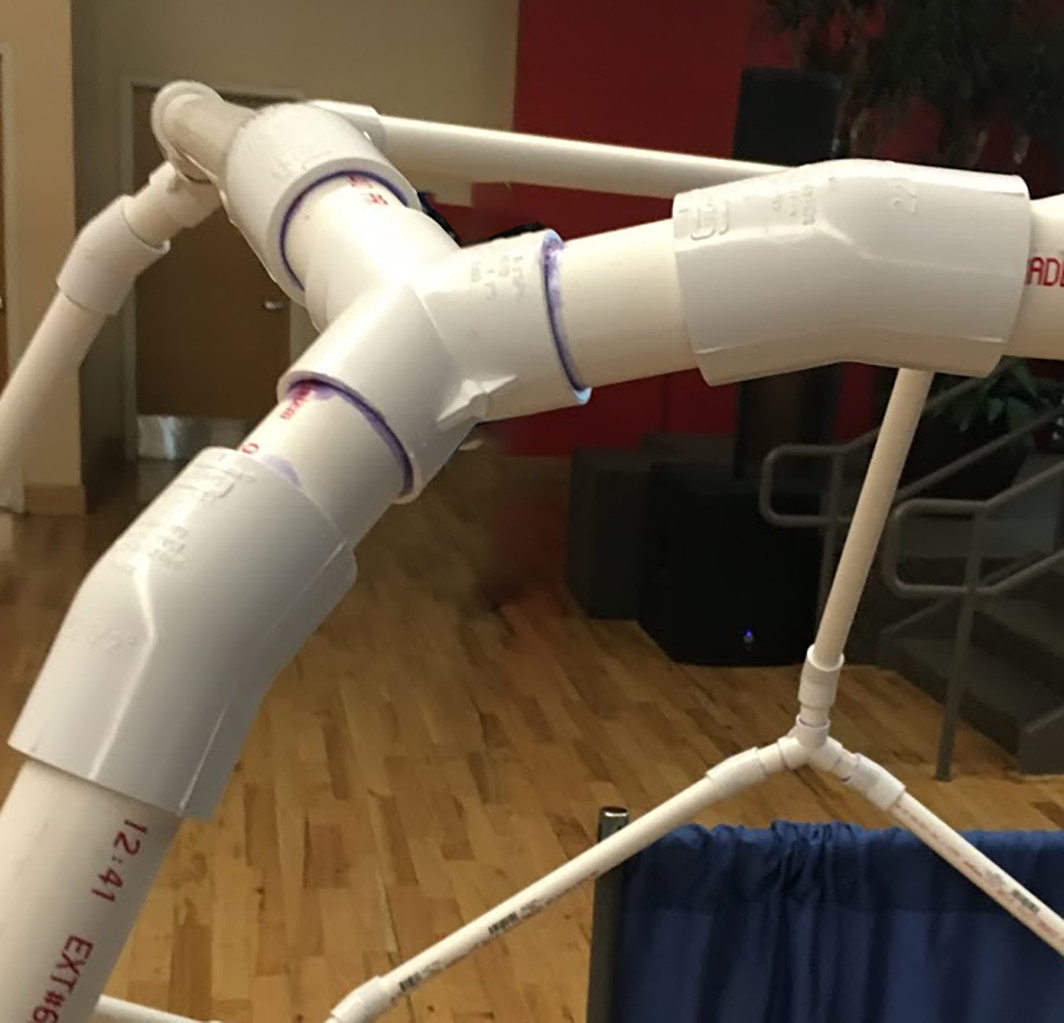 Figure 1
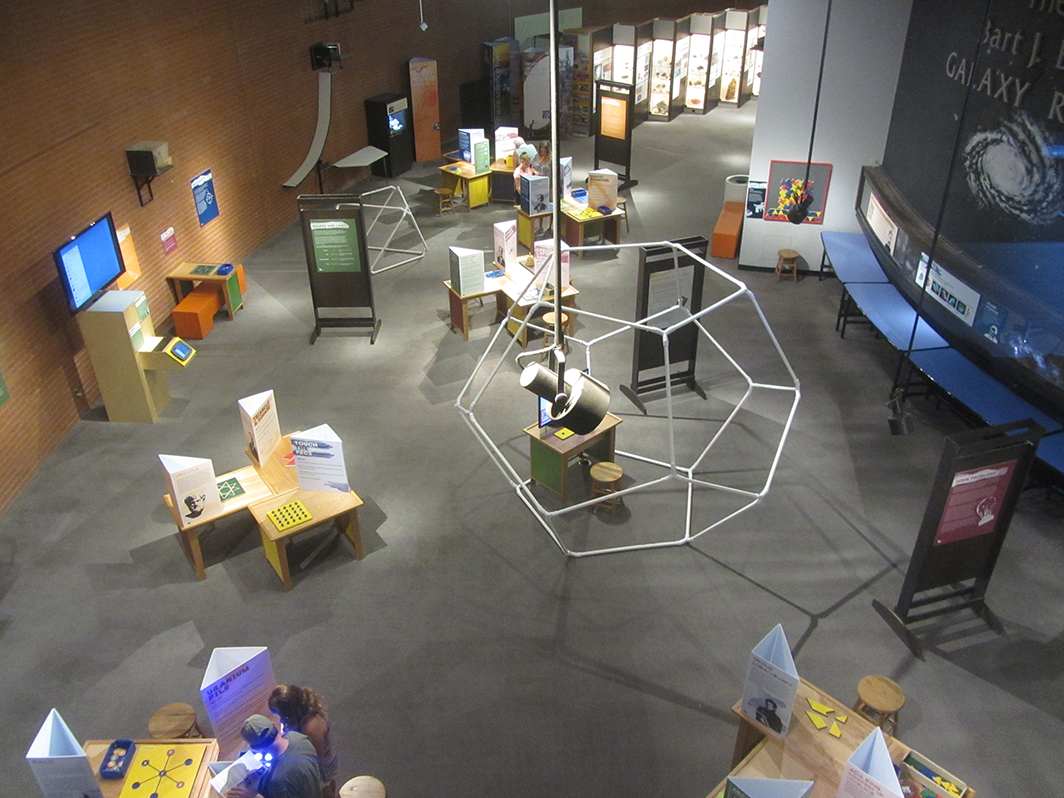 Figure 2
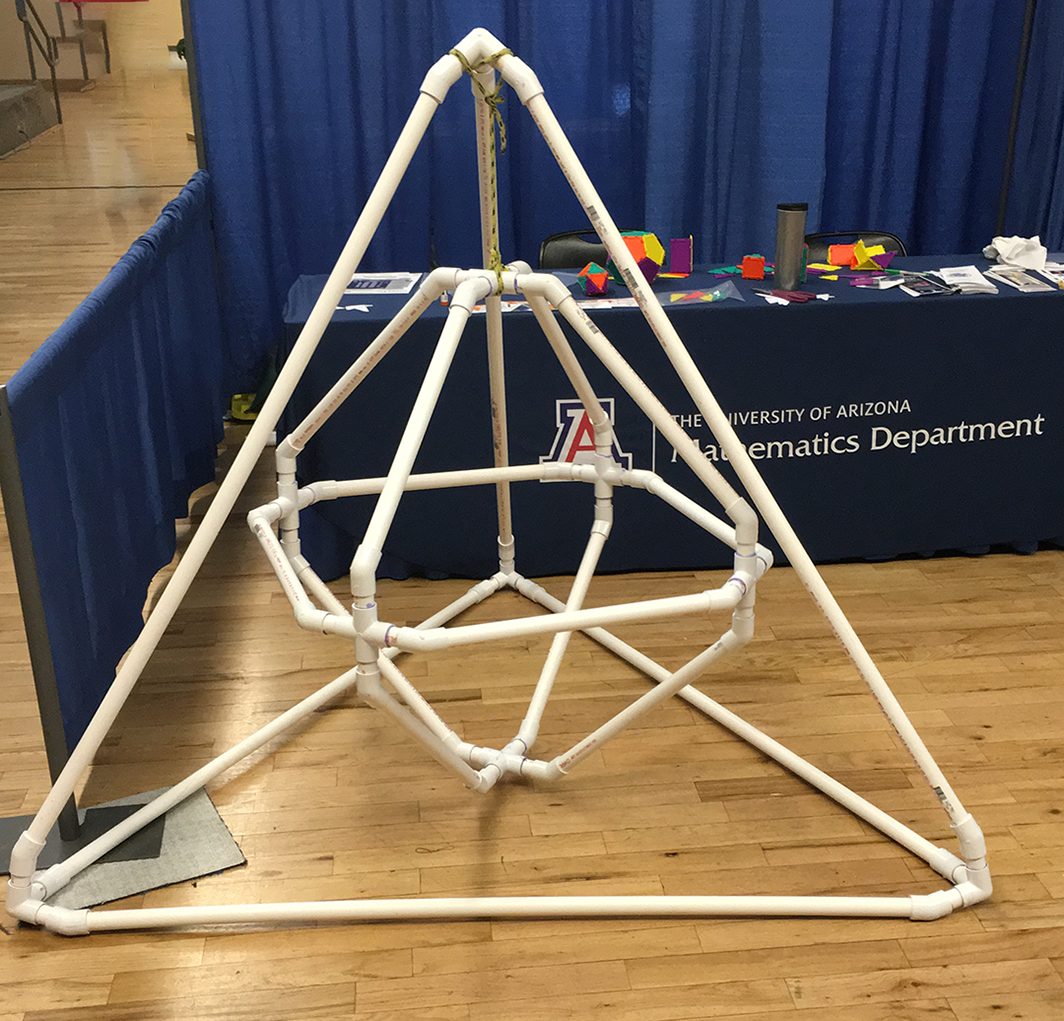 Figure 3
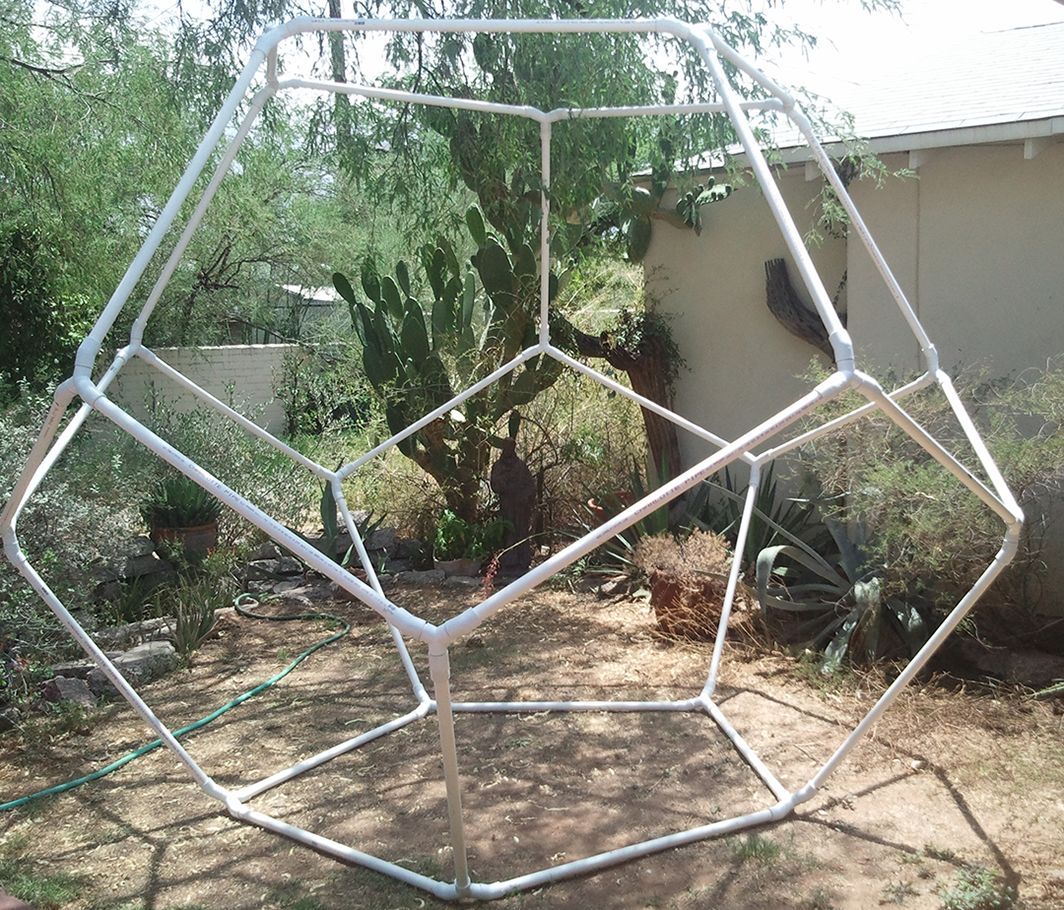 Figure 4
Peer Reviews
No public reviews on file for this paper yet. If you reviewed it on a platform where reviews are public (OpenReview, ICLR, NeurIPS, ICML), you can paste yours below so the community can read it here.
Videos
No videos yet. Explain this paper in a talk, walkthrough, or lecture? Add one.
Taxonomy
TopicsPolymer Science and PVC
PVC Polyhedra
David Glickenstein
University of Arizona, Tucson, AZ 85721 Partially funded by NSF DMS 0748283.
Abstract
We describe how to construct a dodecahedron, tetrahedron, cube, and octahedron out of pvc pipes using standard fittings.
1 Introduction
I wanted to build a huge dodecahedron for a museum exhibit. What better way to draw interest than a huge structure that you can walk around and through? The question was how to fabricate such an object? The dodecahedron is a fairly simple solid, made up of edges meeting in threes at certain angles that form pentagon faces. We could have them 3D printed. But could we do this with “off-the-shelf” parts?
The answer is yes, as seen in Figure 1. The key fact to consider is that each vertex corner consists of three edges coming together in a fairly symmetric way. Therefore, we can take a connector with three pipe inputs and make the corner a graph over it. In particular, if we take a connector that takes three pipes each at 120 degree angles from the others (this is called a “true wye”) and we take elbows of the appropriate angle, we can make the edges come together below the center at exactly the correct angles.
2 What is the correct elbow angle?
Suppose the wye has three length 1 pipes connected to it and the actual vertex is below the vertex of the wye. Let and be the endpoints of two of the wye segments. Then the segment is of length since it is opposite a 120 degree angle in the triangle We know that the angle at vertex has the angle of a regular pentagon, which is degrees. Thus the length of segment is
[TABLE]
The needed angle at the elbow (in degrees) is
[TABLE]
We can get an elbow that is 22.5 degrees (which is half of 45 degrees). That would be off by about 1.5 degrees, so the angles for the pentagons are actually off by 3 degrees, which is The length of is then
[TABLE]
Thus the actual vertices are times the distance from the elbow to the center of the wye. Ours is 2.5 inches, and so the actual vertices are inches from the center of the wye. Furthermore, given whatever length we have of the tube, the actual vertices will be an additional inches on each side. A close-up of the vertex joint can be seen in Figure 2.
3 More platonic solids
There are actually four platonic solids: the tetrahedron, the cube, the octahedron, the dodecahedron, and the icosahedron. The vertices of a cube can be purchased at a plumbing supply shop. We can also make the octahedron and a tetrahedron with careful consideration.
For a regular tetrahedron, we compute similarly
[TABLE]
and the needed elbow is If we use a three-way cube coupling, the angle with the vertex is
[TABLE]
So with this we just need an elbow of
[TABLE]
This is not too far from 22.5 degrees.
For an octahedron, it can be verified that what is needed is simply a four-way plus connector and 45 degree elbows. These can actually be purchased at most large hardware/home improvement stores. The tetrahedron and octahedron can be seen in Figure 3
4 Make your own dodecahedron
If you want to make your own dodecahedron, here is a quick inventory and size calculator. Wikipedia is a good resource for some of these numbers [4]. Since the dodecahedron has 20 vertices, you will need 20 true wyes and 60 twenty-two and half degree elbows. You will then need 60 small lengths of PVC to connect the wyes and elbows, and you will want to use PVC glue to make the connections strong. Then you will need 30 edges of roughly the same length (it is very forgiving). To calculate the lengths, you need to decide how large you want your dodecahedron to be.
Consider a dodecahedron with edge length We have the following:
[TABLE]
So to have a dodecahedron that sits ft. tall, we need edge length of ft. Also, the height of the second row of vertices (highest height to enter from) would be about ft. Inside the dodecahedron we would have around feet in diameter to stand. The dodecahedron itself takes up a diameter of ft. The base of the dodecahedron takes up a diameter of ft.
5 Epilogue
The exhibit Proofs, Puzzles, and Patterns: Explore the World of Mathematics [3, 2] opened at Flandrau Science Center in October 2015, as seen in Figure 4. The PVC dodecahedron was a hit, but in the end it was not sturdy enough for the exhibit floor. The dodecahedron and other polyhedra have found use in traveling exhibits by Bruce Bayly and his Mathematics Road Show [1] as well as at some other enrichment locations. It is a great group activity to put together the dodecahedron, and takes only around 10 minutes.
Acknowledgement 1
The author would like to thank the staff at Flandrau Science Center for their help and support in the construction of the Proofs, Puzzles, and Patterns exhibit, especially Bill Plant, Shiloe Fontes, and Kellee Campbell, Neil McSweeney, and Shipherd Reed; Greg McNamee for all of his work on the panels for the exhibit; Marta Civil for her providing most of the puzzles aspect of the exhibit; and Bruce Bayly, who is credited with the first picture and who first assembled the PVC dodecahedron for the author in his own back yard, and who has been a huge encouragement throughout.
The reference list from the paper itself. Each links out to its DOI / PubMed record.
- 1[1] Arizona Math Road Show. http://math.arizona.edu/outreach/programs/az-math-roadshow .
- 2[2] R. Peiffer. Flandrau Exhibition Goes Beyond the Mere Facts in Math. UA News, May 23, 2016.
- 3[3] Puzzles, Proofs, and Patterns: Experience the World of Mathematics. Flandrau Science Center, Tucson, AZ. http://flandrau.org/exhibits/puzzles .
- 4[4] Dodecahedron. http://en.wikipedia.org/wiki/Dodecahedron .