Study of the upper-critical dimension of the East model through the breakdown of the Stokes-Einstein relation
Soree Kim, Dayton G. Thorpe, Juan P. Garrahan, David Chandler,, YounJoon Jung

TL;DR
This study explores how dynamical fluctuations and the breakdown of the Stokes-Einstein relation in supercooled liquids depend on dimensionality, suggesting that the East model exhibits non-mean-field behavior up to very high dimensions, possibly infinite.
Contribution
It provides evidence that the East model's upper critical dimension is at least above 10, indicating hierarchical dynamics persist in all finite dimensions.
Findings
Decoupling indicates non mean-field behavior in the East model.
The upper critical dimension of the East model may be infinite.
Hierarchical dynamics exist in the East model across all finite dimensions.
Abstract
We investigate the dimensional dependence of dynamical fluctuations related to dynamic heterogeneity in supercooled liquid systems using kinetically constrained models. The -dimensional spin-facilitated East model with embedded probe particles is used as a representative super-Arrhenius glass forming system. We investigate the existence of an upper critical dimension in this model by considering decoupling of transport rates through an effective fractional Stokes-Einstein relation, , with and the diffusion constant of the probe particle and the relaxation time of the model liquid, respectively, and where encodes the breakdown of the standard Stokes-Einstein relation. To the extent that decoupling indicates non mean-field behavior, our simulations suggest that the East model has an upper critical dimension which is at least above…
Click any figure to enlarge with its caption.
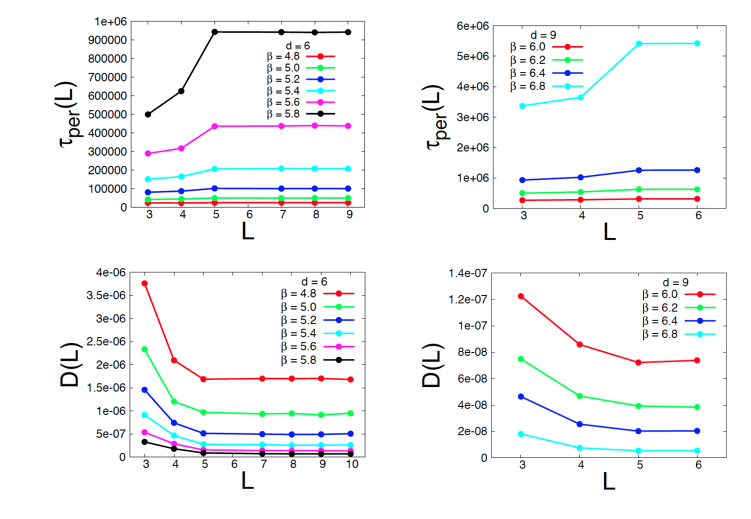 Figure 6
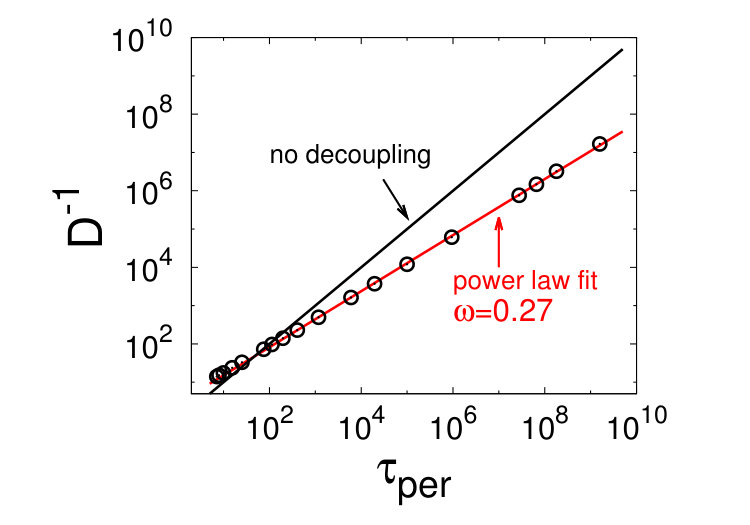 Figure 2
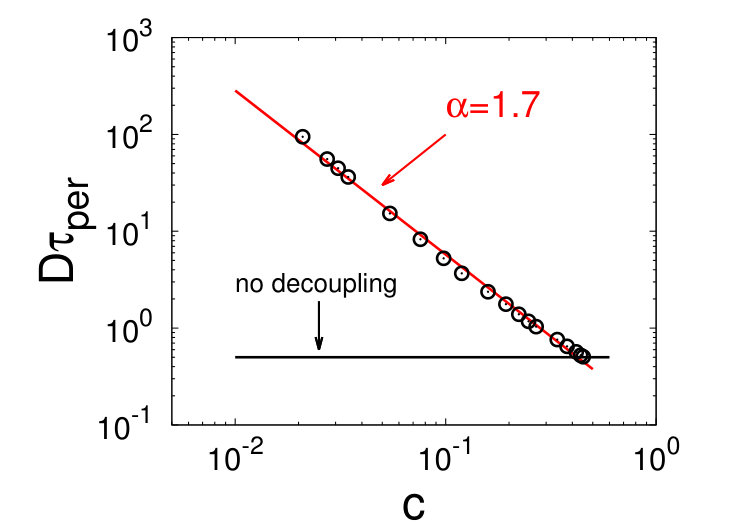 Figure 3
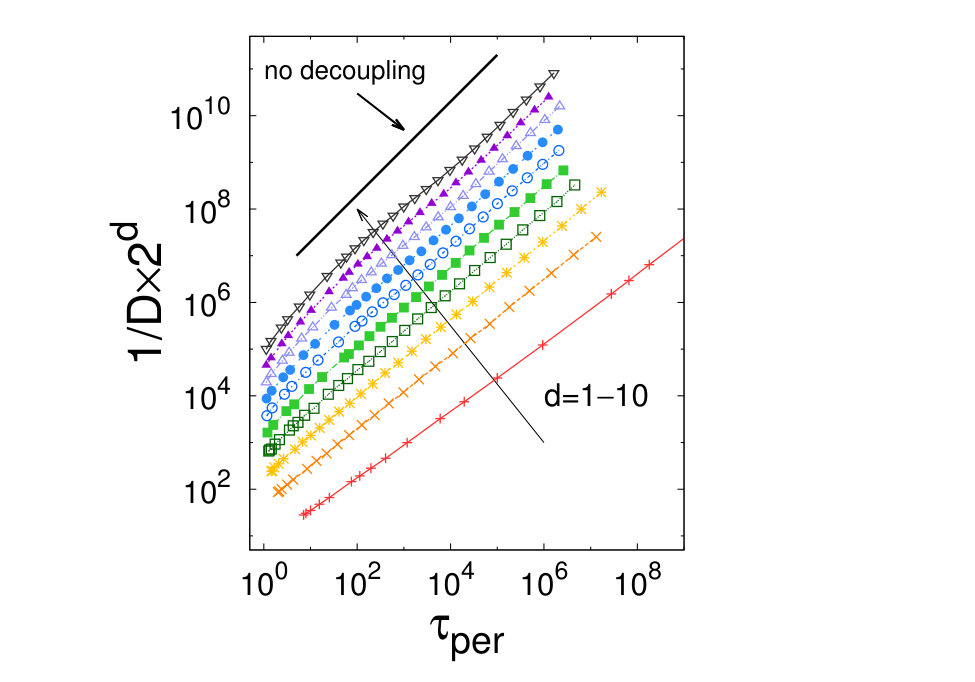 Figure 4
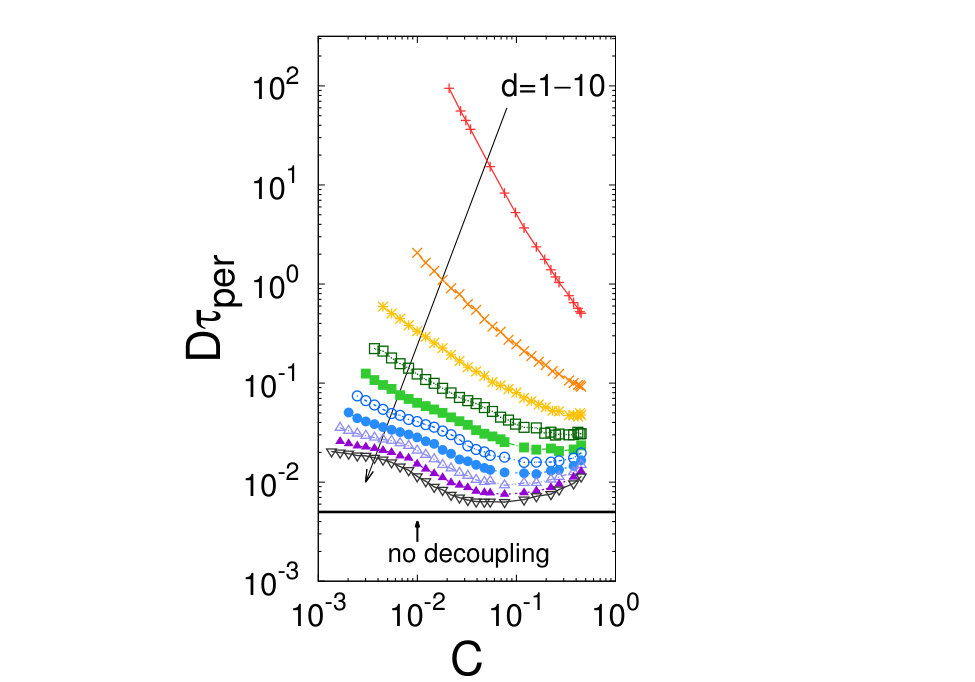 Figure 5
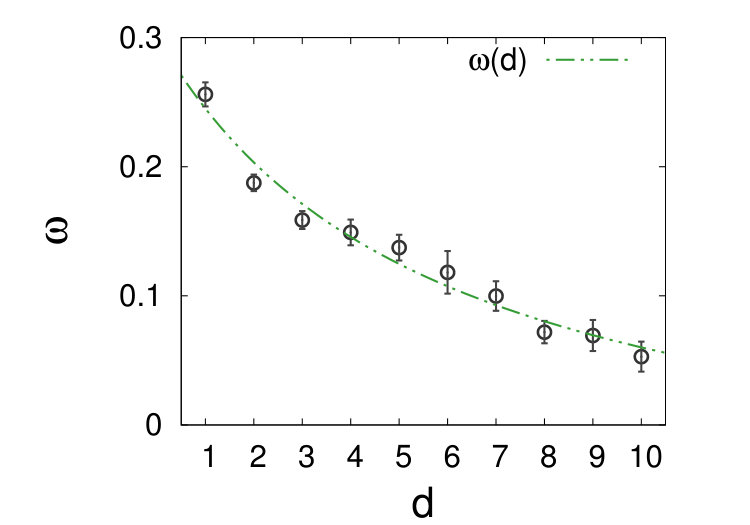 Figure 6
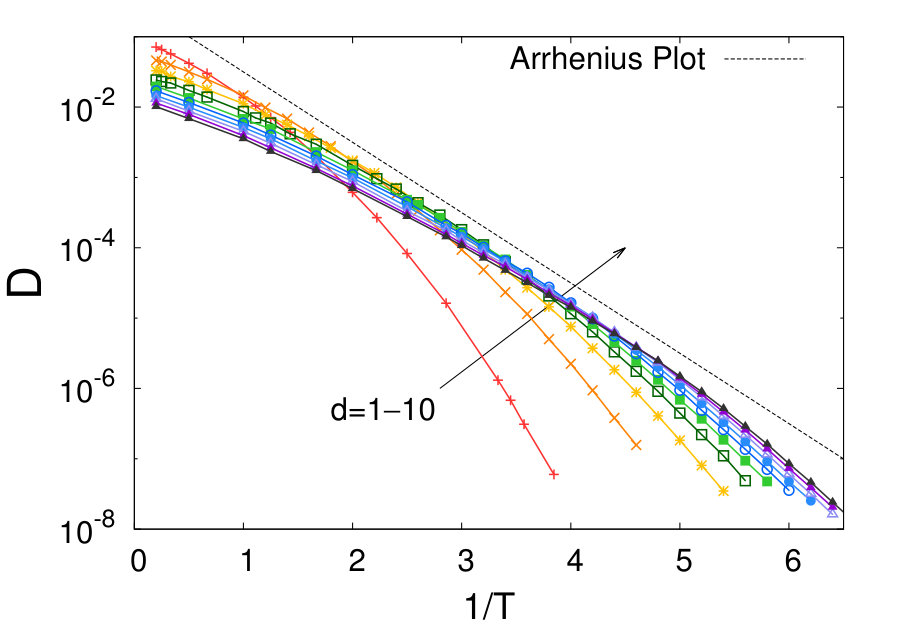 Figure 7
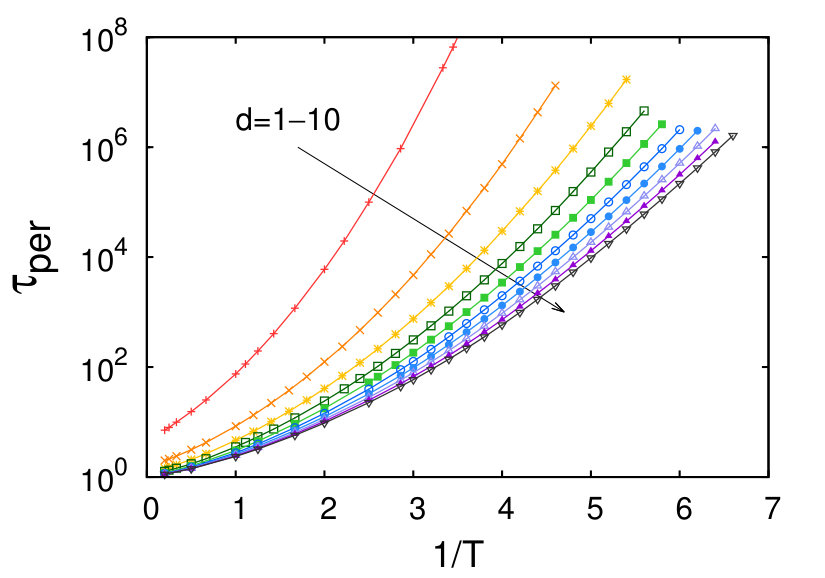 Figure 8
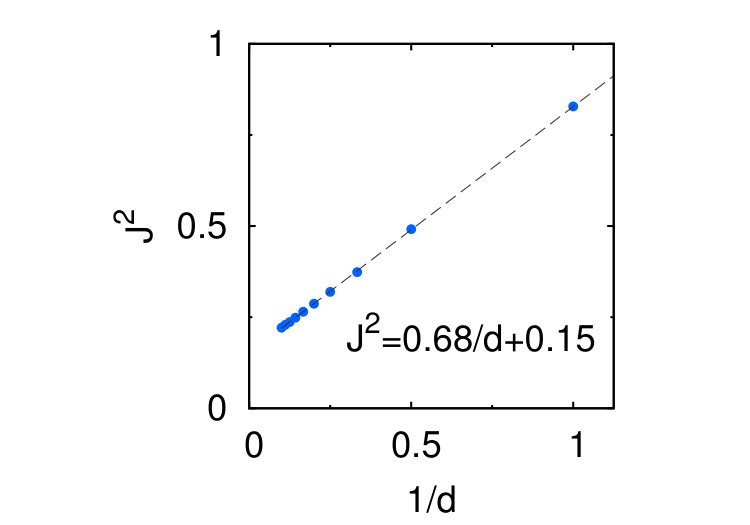 Figure 9
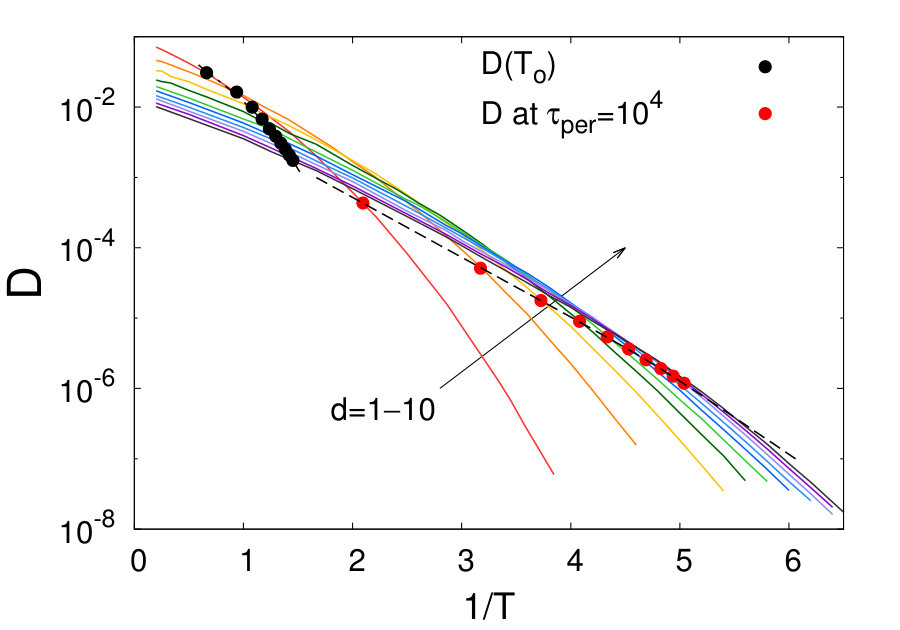 Figure 10
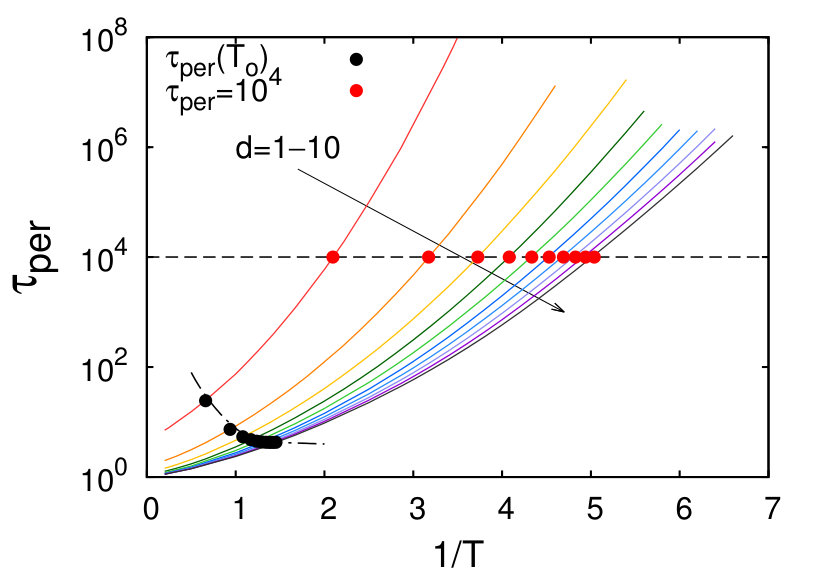 Figure 11
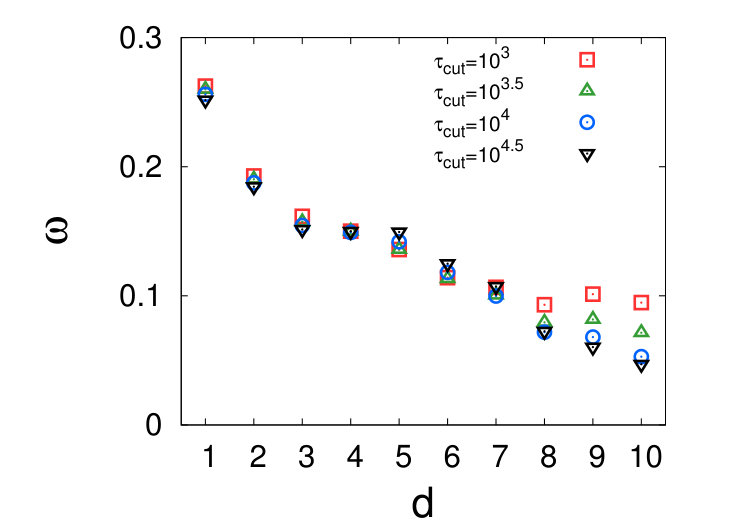 Figure 12
Peer Reviews
No public reviews on file for this paper yet. If you reviewed it on a platform where reviews are public (OpenReview, ICLR, NeurIPS, ICML), you can paste yours below so the community can read it here.
Videos
No videos yet. Explain this paper in a talk, walkthrough, or lecture? Add one.
Study of the upper-critical dimension of the East model through the breakdown of the Stokes-Einstein relation
Soree Kim
Equal contribution
Department of Chemistry, Seoul National University, Seoul 08826, Republic of Korea
Dayton G. Thorpe
Equal contribution
Department of Chemistry, University of California, Berkeley, California 94720, USA
Juan P. Garrahan
School of Physics and Astronomy, University of Nottingham, Nottingham, NG7 2RD, UK
David Chandler
Department of Chemistry, University of California, Berkeley, California 94720, USA
YounJoon Jung
Department of Chemistry, Seoul National University, Seoul 08826, Republic of Korea
Abstract
We investigate the dimensional dependence of dynamical fluctuations related to dynamic heterogeneity in supercooled liquid systems using kinetically constrained models. The -dimensional spin-facilitated East model with embedded probe particles is used as a representative super-Arrhenius glass forming system. We investigate the existence of an upper critical dimension in this model by considering decoupling of transport rates through an effective fractional Stokes-Einstein relation, , with and the diffusion constant of the probe particle and the relaxation time of the model liquid, respectively, and where encodes the breakdown of the standard Stokes-Einstein relation. To the extent that decoupling indicates non mean-field behavior, our simulations suggest that the East model has an upper critical dimension which is at least above , and argue that it may be actually be infinite. This result is due to the existence of hierarchical dynamics in the East model in any finite dimension. We discuss the relevance of these results for studies of decoupling in high dimensional atomistic models.
I Introduction
The East model and its higher dimensional generalizations Jäckle and Eisinger (1991); Ritort and Sollich (2003); Berthier and Garrahan (2005); Ashton et al. (2005) describes the cooperative relaxation dynamics of glass formers through a simple facilitation mechanism. This simple model captures fundamental features of the dynamics close to the glass transition, such as super-Arrhenius growth of the relaxation time Sollich and Evans (1999), dynamic heterogeneity Garrahan and Chandler (2002), transport decoupling Jung et al. (2004, 2005); Berthier et al. (2005); Blondel and Toninelli (2014), the existence of space-time transitions Merolle et al. (2005); Garrahan et al. (2007), thermodynamic anomalies under cooling Keys et al. (2013) and melting of ultrastable glasses Gutiérrez and Garrahan (2016). (For reviews on the glass transition problem see for example Ediger et al. (1996); Berthier and Biroli (2011); Biroli and Garrahan (2013)).
The theoretical perspective on the glass transition that emerges from the study of the East model and other kinetically constrained models (KCMs) - sometimes called dynamic facilitation (DF) theory - is one of fluctuation dominance in the dynamics with a very limited role played by the thermodynamics of glass formers (see Chandler and Garrahan (2010) for a review). This contrasts with theoretical approaches based on mean-field theory, in particular that of the random first-order transition (RFOT) perspective (see Lubchenko and Wolynes (2007); Parisi and Zamponi (2010) for reviews). Within RFOT, mean-field becomes exact above an upper critical dimension Biroli and Bouchaud (2007); Franz et al. (2011, 2012) where the fluctuations due to heterogeneous dynamics become irrelevant. In particular, a recent computational study of hard sphere dynamics in large dimensions Charbonneau et al. (2013) tested this prediction by considering the violation of the Stokes-Einstein relation, with numerical results that seemed compatible with an absence of transport decoupling - and thus mean-field behavior - for dimensions . These numerical observations in hard spheres prompted us to consider in detail the problem of dimensional dependence of decoupling in the East model where it is expected that the hierarchical non mean-field dynamics would be present at all dimensions Ashton et al. (2005).
In this work we study in detail by means of extensive numerical simulations the transport properties of the East model in dimensions to . By careful consideration of long-time limits and finite size effects, we argue that the upper critical dimension of the East model is larger than , the largest dimension we study. This would be compatible with the expectation that dynamics is actually fluctuation dominated at all dimensions. We do so by considering the relation between structural relaxation time and diffusion rate , which in the normal liquid state obeys the mean-field like Stokes-Einstein relation (SER), . Departure from this relation, termed transport “decoupling” Ediger (2000), is a manifestation of fluctuating, non mean-field, dynamics. Like in previous works Swallen et al. (2003); Jung et al. (2004); Schweizer (2007); Swallen et al. (2009) we characterize the breakdown of the SER in terms of a “fractional” SER, , with encoding the degree of violation of the standard SER. We show that for the East model , and therefore the relevance of dynamical fluctuations, for all dimensions between and .
The paper is organized as follows: In Sec. II, we introduce the models generalization of the East model to study their SER. In Sec. III, we present our results on the upper critical dimension of the East models in various spatial dimensions. We carefully analyze our results by performing finite size effects in Sec. IV. In Sec. V, we investigate possible correlations between enduring kinks and various timescales. In Sec. VI we conclude by connecting our results to the observations in atomistic simulations of Ref. Charbonneau et al. (2013).
II Model and simulation details
We study the East Jäckle and Eisinger (1991); Ritort and Sollich (2003) model generalised to arbitrary dimensions Ritort and Sollich (2003); Berthier and Garrahan (2005); Ashton et al. (2005), with the addition of probe particles Jung et al. (2004, 2005) in order to study transport dynamics. The East model is a two state lattice model with a dynamic constraint. The energy function of the system is defined,
[TABLE]
represents an unexcited and immobile state while represents the excited state that allows motion. There are no energetic interactions between lattice sites and therefore the thermodynamic properties of the model are trivial. However, there are kinetic constraints that control the dynamics of the system. The flipping rates at lattice site are defined, and . The kinetic constraint is a facilitation function that regulates the flipping events according to
[TABLE]
where is the unit vector in the -the direction of a hypercubic lattice of dimension . The kinetic constraint above allows a spin flip at a given site only if at least one of its nearest neighbours in the specified directions is in the excited state. For one dimension, only sites to the East of an excitation can flip (and thus the name of the model); in two dimensions only sites to the North or East of an excitation, and so forth.
The scarcity of excitations in equilibrium at low temperatures makes the dynamics of the East model slow and glassy. The model is conveniently studied numerically with continuous-time Monte Carlo algorithm and the Monte Carlo with absorbing Markov chains methods Bortz et al. (1975); Ashton et al. (2005). To check for finite size effects, we increase the size of the system until the physical quantities measured differ less than 1%. We set total simulation times to be 50100 times the relaxation time. We vary the temperature of the system to cover over 6 orders of magnitude in the relaxation times. We average physical quantities over 10\sim$$10^{3} independent trajectories.
To calculate diffusion constants for particles through a supercooled liquid, we add probe particles to our model system, cf. Refs. Jung et al. (2004, 2005); Berthier et al. (2005). The probe particles occupy a site on the East model lattice, but we neglect the back reaction on the East model dynamics, or their mutual interaction. After each Monte Carlo sweep, each probe particle attempts to move to a neighboring site. To mimic the effect of jamming in a supercooled liquid, a probe particle can only move if it is on an excited site of the underlying East model, and to satisfy detailed balance, they can only move if their target site is also excitated. We then determine the diffusion constant from the mean-square displacements of the probe particles as, , where .
III Dimensional dependence of the breakdown of the Stokes-Einstein relation in the East model
We now investigate the properties of transport decoupling in the East model as we vary dimensionality. If an upper critical dimension exists for the East model, then for the SER will be obeyed. For this purpose we calculate the structural relaxation times and the diffusion constants for dimensions to .
We use the mean persistence time of the system, , for the relaxation time. The persistence time, , is the waiting time at which the first flip event occurs from a randomly chosen time Jung et al. (2004). The persistence time can be interpreted as the decay time of self-intermediate scattering function in the limit of large wavevector Berthier and Garrahan (2005). Using the mean persistence time, the relaxation time in different dimensions can be compared without wavevector dependence.
Fig. 1 shows that the mean persistence time undergoes super-Arrhenius growth for dimensions one through 10. At fixed temperature, decreases as dimension is increased. As expected Sollich and Evans (1999); Garrahan and Chandler (2003); Ashton et al. (2005); Berthier and Garrahan (2005); Chleboun et al. (2014), the leading dependence on inverse temperature is quadratic. In order to connect with the DF phenomenology we fit with the “parabolic” form Elmatad et al. (2009); Keys et al. (2011)
[TABLE]
where , and are the fitting parameters. is the onset temperature above which the dynamics is heterogeneous and is the relaxation time at the onset temperature. We find that is inversely proportional to the spatial dimension, . This fit provides evidence that the dynamics in the East model is hierarchical and therefore super-Arrhenius in all dimensions. Our fit is similar to that of Ref. Ashton et al. (2005). The dependence we find is also consistent with the rigorous analysis of Ref. Chleboun et al. (2014) which gives the asymptotically exact result of , where is .
Figure 2 shows the corresponding numerical results for the diffusion constant of the probe particles as a function of temperature for the different dimensions. While less pronounced than for , the diffusion constant is still super-Arrhenius at all dimensions, which gets less pronounced as dimension is increased.
While both the mean persistence times and the diffusion constants both show super-Arrhenius behavior, the decrease of the diffusion rate is less pronounced than the increase of the relaxation time and there is transport decoupling in the model Jung et al. (2004). In Ref. Jung et al. (2004) it was originally observed that the observed decoupling in the 3 could be fit with a fractional Stokes-Einstein relation (fSER), , in analogy with the way decoupling is usually described in phenomenological observations Swallen et al. (2003). More recent simulations, first presented in Ref. Jung et al. , and which we reproduce in Fig. 3, extended the range of that of Ref. Jung et al. (2004) for over nine orders of magnitude. The range of conditions considered in Fig. 3 is the range of variation in that is accessible to reversible glass-forming melts. For that range, the graphed results can be fit with a fSER, with . The value of the exponent is consistent with those used to fit experimental data,Swallen et al. (2003) and it is consistent with value first considered in Ref. Jung et al. (2004).
Diffusion of a probe particle in the East model was also studied rigorously in Ref. Blondel and Toninelli (2014). There it was found that in the limit very low temperature the inequality holds, where and is the equilibrium concentration of excited sites, . While this implies breakdown of SER, it excludes fSER as because grows faster than any power of upon lowering temperature . While heuristics suggest is suggested in the theoretical work, the best fit, shown in Fig. 3, gives instead . Overall, Figs. 3 and 3 show that a fSER works extremely well as an effective description of decoupling in the relevant temperature range, and prohibitively long simulations would be required to fully clarify the scaling at vanishing temperatures Jung et al. .
Decoupling between mean persistence times and diffusion constants is also found in higher dimensions. In Fig. 4 we show both against , in order to test the validity of a fSER, and as a function of , to test higher dimensional versions of the asymptotic scaling of Ref. Blondel and Toninelli (2014). From both representations the presence of decoupling up to dimension is evident.
We obtain the fSER exponent by linear fitting. The value of for the higher dimensions considered is sensitive to the exact fitting procedure used. To minimize the error and to investigate the systems in the low temperature limit, we use only data where the mean persistence time is longer than MC sweeps. We then recalculate removing one data point at a time from the high temperature end of the data, stopping when we have only five data points left. We define the error bar as half of the difference between the maximum exponent and the minimum exponent from the varying number of data points we used. Our results for the fSER exponent are shown in Fig. 5.
At a minimum, this result demonstrates that the East model violates standard SER up through 10 dimensions. The degree of violation, , also appears to be decaying very slowly, consistent with the hypothesis that the upper critical dimension may be infinite. The decay of versus does not fit well to a line. As an alternative, we consider, , similar to Eq. 3. This form fits reasonably well. Although fitting four free parameters to 10 data points is far short of a proof, it demonstrates that the data do not simply extrapolate to a finite upper critical dimension. To ensure that we have reached the long time limit in all dimensions, we vary the minimum persistence time at which we begin fitting the asymptotic slope. Fig. 5 shows that the slopes appear to have plateaued at the cutoff we have chosen, but that lower choices would have given meaningfully different results. Other systems, including hard spheres, could be subject to similar sources of error.
IV Finite size effects and Asymptotic behavior
To ensure the reliability of our results in high dimensions, we check for possible finite size effects. Fig. 6 shows the system size dependence of the values of and . In the case of , there are no significant finite size effects when and is near the values we used for the data already reported. For , the difference between and is less than for each temperature. For , however, the difference between and is more pronounced at about 30% at the lowest temperature. For , the difference between and is less than 2% for each temperature. Similar to the case of , for , the difference is much lager and it is about 30% at the lowest temperature. Based on these results, our model system does not show significant finite size effects up to . Even though does show stronger finite size effects at low temperatures, this does not affect the conclusion from the numerics that the upper critical dimension of the East model is greater than , neither the slowly decreasing value of with dimension.
We also check that our data is in the asymptotic region compared to the onset of the heterogeneous dynamics. To confirm whether we have reached the proper asymptotic limits in various dimensions, we try the following variations in the fitting. First, we can introduce an onset temperature by defining, at . is defined as the temperature at which the effective barrier to relaxation becomes order of . are marked as black dots in Fig. 7. It seems that is on the order of 10-100 as we vary dimension. It is interesting to note that although becomes lower with , gets shorter as increases. This result comes from the fact that as the dimensionality increases, the super-Arrhenius nature of the relaxation time becomes less pronounced. Also, we can choose our cut-off time, , so that only the data points are used for the asymptotic limit fitting. When , the system is in the asymptotic region and is not sensitive to the choice of , Fig. 5. Note that is at least 1000 times larger than at every dimension considered.
V Discussion
We have shown that transport decoupling occurs in the East model for all dimensions between and . This decoupling can be quantified by means of an effective fSER. As expected, the higher the dimension the less striking fluctuation effects, which in turn manifests as decoupling becoming less pronounced. Nevertheless it is still present at all the dimensions we simulated, which suggests that the East model has no finite upper critical dimension above which the hierarchical character of the dynamics disappears.
Related to this weakening of the effect of fluctuations is a decrease of the onset temperature with dimensionality. Again this is as expected: one needs to go to comparatively lower temperatures as dimension is increased to see heterogeneous dynamics. A consequence is that one could erroneously conclude that the East model has become mean-field at some dimension by simply comparing decoupling at some fixed temperature at different dimensions, so that that temperature is in the heteorogeneous dynamics regime at lower dimension but on the homogeneous regime at higher dimension. Additionally, simulating sufficiently large systems is obviously quite challenging, and here we have taken great care to demonstrate the our simulation results are not hampered by finite size effects.
Out results here should also be compared to the observation of decoupling in hard spheres in high dimension of Ref. Charbonneau et al. (2013). As in that work we find that SER breaks down, but decoupling gets attenuated as dimension increases. In contrast to Ref. Charbonneau et al. (2013) we do not see a recovery of the SER at dimension , but decoupling in the East model persists up to at least. Given the weak nature of the decoupling, it is possible that in the more challenging setting of the hard-sphere system it is difficult to distinguish weak from zero decoupling. Secondly, comparing diffusion constants across dimensions requires very careful analysis of finite size effects, such as the one we are able to do for the simpler case of the East model. Thirdly, the onset temperature decreases (and equivalently, the onset packing fraction increases) with increasing dimension, meaning that heterogeneous dynamics may not be apparent in high dimensional simulations simply because the challenging computational nature of reaching the necessary temperatures or densities.
Acknowledgements
The work was supported by Samsung Science and Technology Foundation under Project Number SSTF-BA1601-11. DGT was supported by the National Science Foundation Graduate Research Fellowship under Grant No. DGE 1106400.
The reference list from the paper itself. Each links out to its DOI / PubMed record.
- 1Jäckle and Eisinger (1991) J. Jäckle and S. Eisinger, Z. Phys. B 84 , 115 (1991) . · doi ↗
- 2Ritort and Sollich (2003) F. Ritort and P. Sollich, Adv. Phys. 52 , 219 (2003).
- 3Berthier and Garrahan (2005) L. Berthier and J. P. Garrahan, J. Phys. Chem. B 109 , 3578 (2005).
- 4Ashton et al. (2005) D. J. Ashton, L. O. Hedges, and J. P. Garrahan, J. Stat. Mech.: Theor. Exp. , P 12010 (2005).
- 5Sollich and Evans (1999) P. Sollich and M. R. Evans, Phys. Rev. Lett. 83 , 3238 (1999).
- 6Garrahan and Chandler (2002) J. P. Garrahan and D. Chandler, Phys. Rev. Lett. 89 , 035704 (2002).
- 7Jung et al. (2004) Y. Jung, J. P. Garrahan, and D. Chandler, Phys. Rev. E 69 , 061205 (2004).
- 8Jung et al. (2005) Y. Jung, J. P. Garrahan, and D. Chandler, J. Chem. Phys. 123 , 084509 (2005).