On the behavior of causal geodesics on a Kerr-de Sitter spacetime
Jos\'e F\'elix Salazar, Thomas Zannias

TL;DR
This paper investigates the behavior and completeness of causal geodesics in Kerr-de Sitter spacetime, revealing similarities with Kerr spacetime and highlighting the effects of ring singularities on geodesic paths.
Contribution
It provides a comprehensive analysis of causal geodesics in Kerr-de Sitter spacetime, establishing their completeness properties and the influence of ring singularities.
Findings
Causal geodesics avoiding the ring singularity are complete.
Geodesics hitting the ring singularity are primarily equatorial.
The ring singularity exhibits a repulsive effect on geodesics.
Abstract
We analyze the behavior of causal geodesics on a Kerr-de Sitter spacetime with particular emphasis on their completeness property. We set up an initial value problem (IVP) whose solutions lead to a global understanding of causal geodesics on these spacetime. Causal geodesics that avoid the rotation axis are complete except the ones that hit the ring-like curvature singularity and those that encounter the ring singularity are necessary equatorial ones. We also show the existence of geodesics that cross or lie on the rotation axis. The equations governing the latter family show the repulsive nature of the ring singularity. The results of this work show, that as far as properties of causal geodesics are concerned, Kerr-de Sitter spacetimes behave in a similar manner as the family of Kerr spacetimes.
Click any figure to enlarge with its caption.
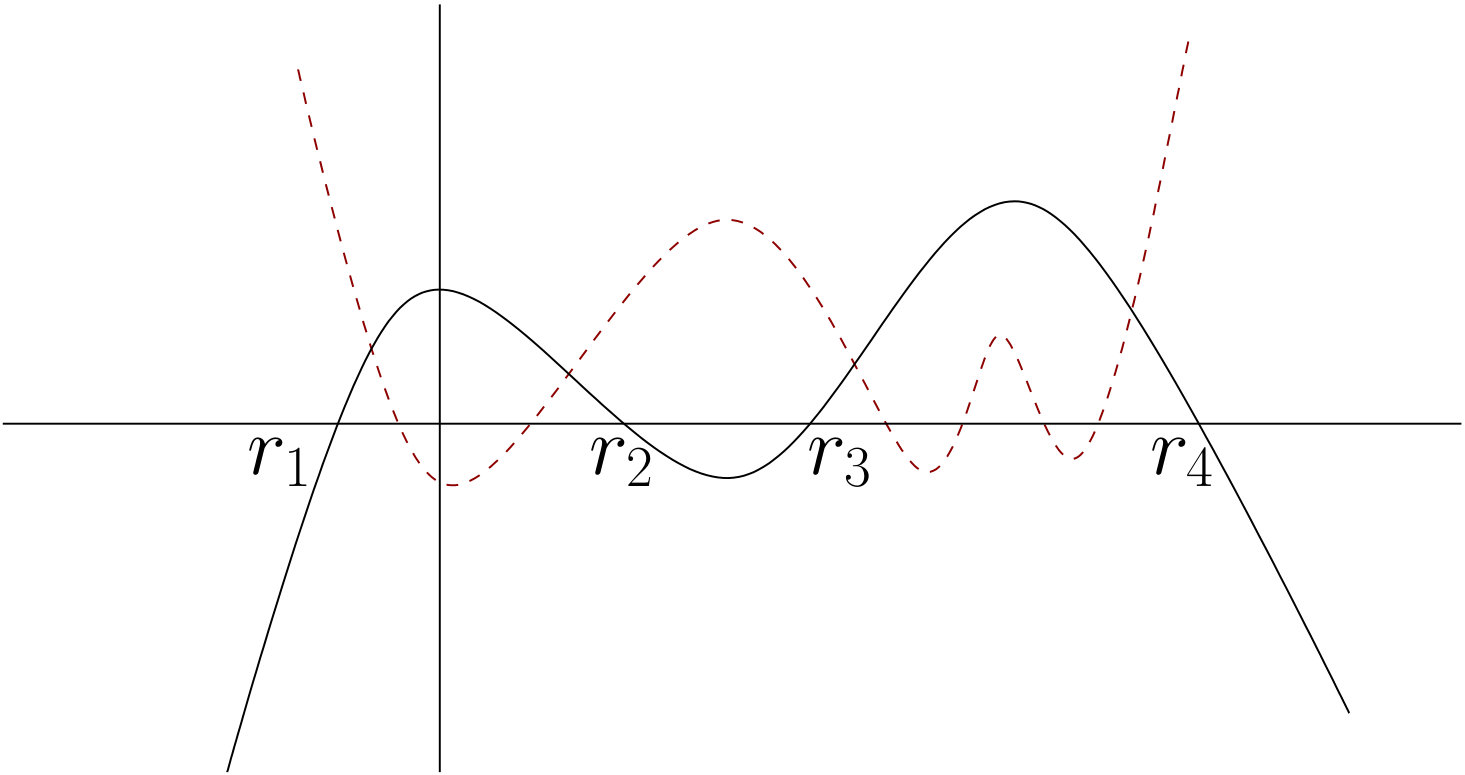 Figure 1
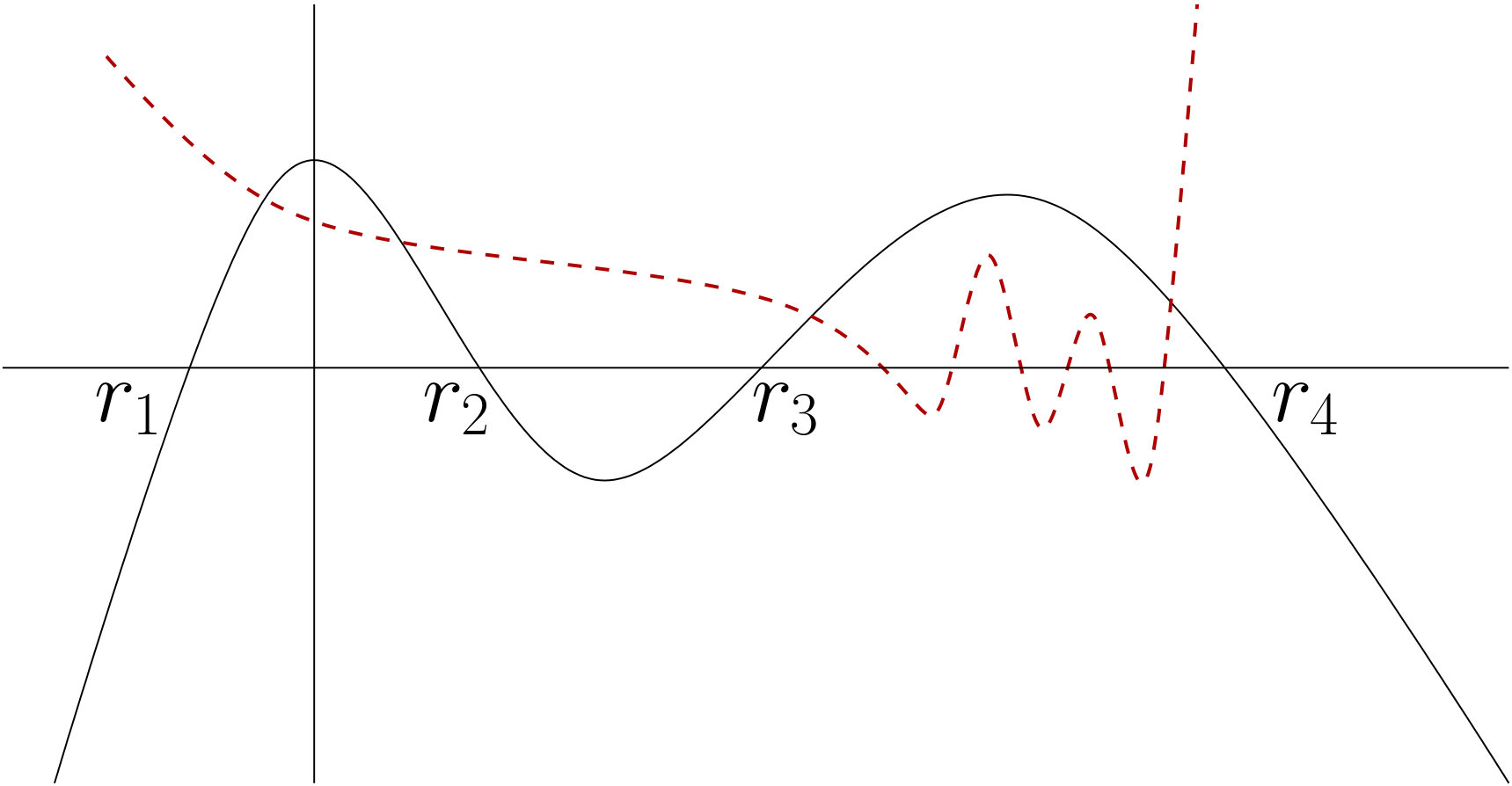 Figure 2
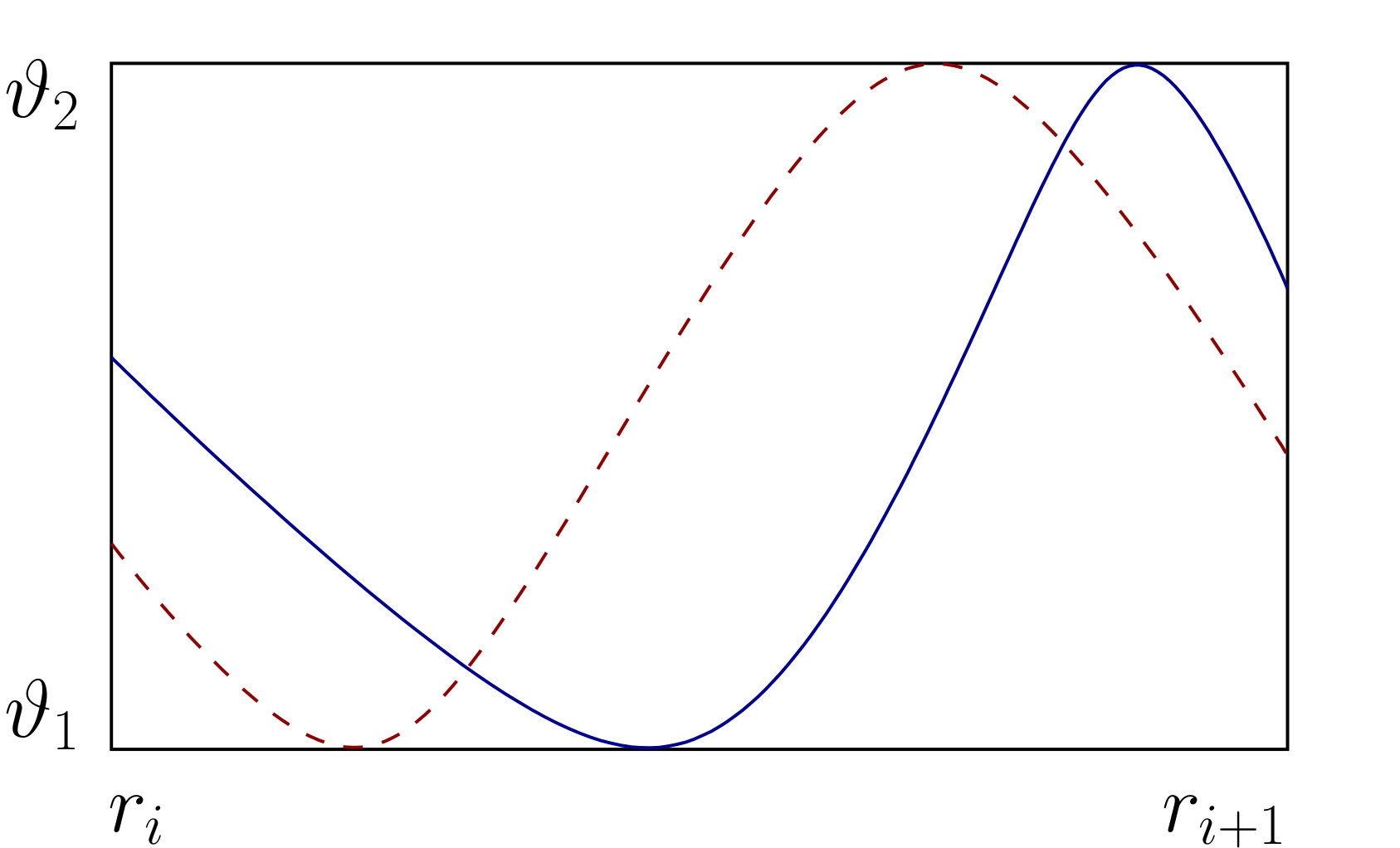 Figure 3
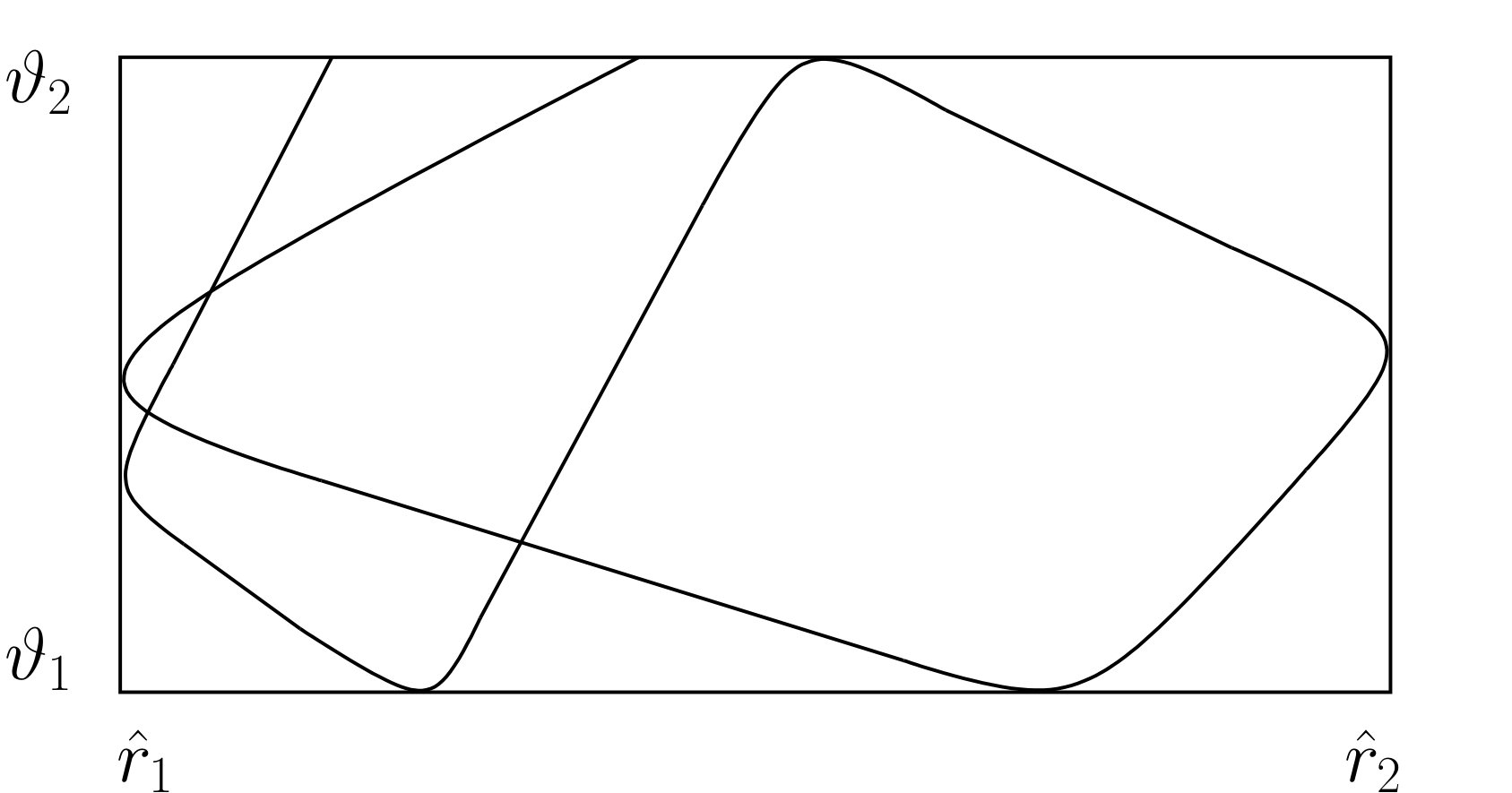 Figure 4
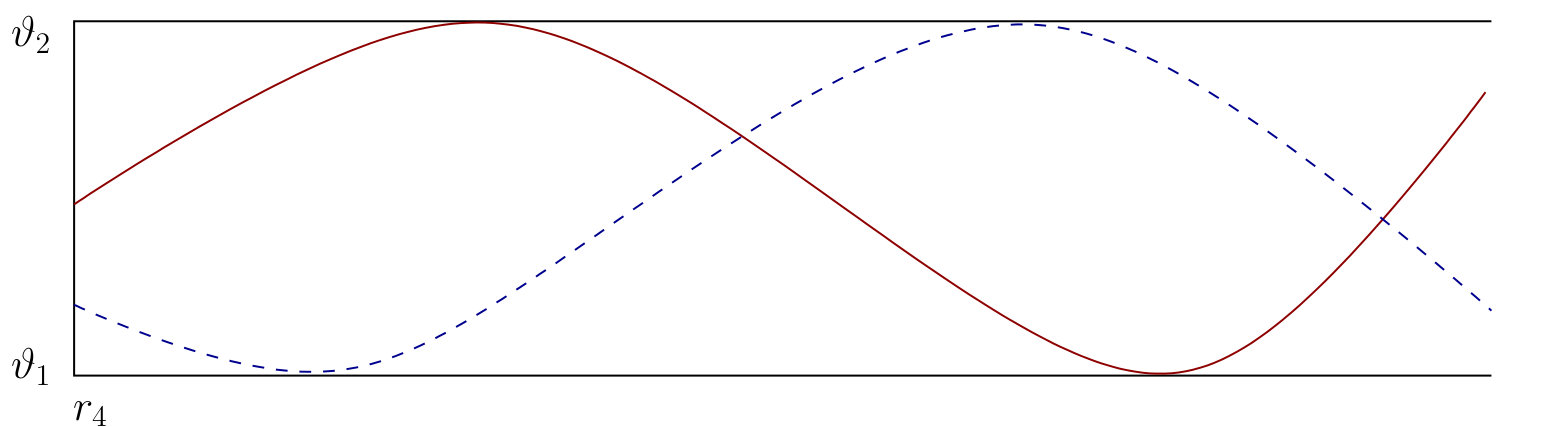 Figure 5
Peer Reviews
No public reviews on file for this paper yet. If you reviewed it on a platform where reviews are public (OpenReview, ICLR, NeurIPS, ICML), you can paste yours below so the community can read it here.
Videos
No videos yet. Explain this paper in a talk, walkthrough, or lecture? Add one.
On the behavior of causal geodesics on a Kerr-de Sitter spacetime
J. Felix Salazar and Thomas Zannias
Instituto de Física y Matemáticas, Universidad Michoacana de San Nicolás de Hidalgo,
Edificio C-3, Ciudad Universitaria, 58040 Morelia, Michoacán, México.
[email protected], [email protected]
Abstract
We analyze the behavior of causal geodesics on a Kerr-de Sitter spacetime with particular emphasis on their completeness property. We set up an initial value problem (IVP) whose solutions lead to a global understanding of causal geodesics on these spacetime. Causal geodesics that avoid the rotation axis are complete except the ones that hit the ring-like curvature singularity and those that encounter the ring singularity are necessary equatorial ones. We also show the existence of geodesics that cross or lie on the rotation axis. The equations governing the latter family show the repulsive nature of the ring singularity. The results of this work show, that as far as properties of causal geodesics are concerned, Kerr-de Sitter spacetimes behave in a similar manner as the family of Kerr spacetimes.
pacs:
04.20.-q,04.40.-g, 05.20.Dd
I Introduction
Recent observations of type Ia supernovae Riess , Perlm suggest that we may live in a universe possessing a positive cosmological constant . Even though the data constrain in the tiny range and thus its effects on the galactic and sub-galactic structures are negligible, nevertheless a non vanishing influences the large scale structure of the universe. The conformal boundary of any spacetime solution of Einstein’s equations in the presence of is spacelike, timelike or null depending whether is positive, negative or zero and this property of influences the asymptotic structure of a spacetime modeling an isolated gravitating system. As a consequence, properties of gravitational radiation, the definition of Bondi four momentum, asymptotic symmetries etc have to be made compatible with the spacelike or timelike character of . For a recent discussion on these problems consult Ast and further references within.
A non vanishing can also affect the end state of the complete gravitational collapse of a bounded system and thus issues regarding the cosmic censorship conjecture, the precise definition of a black hole have also to be re-accessed (for recent work on these problems see for instance Shap , Lake ).
Exact solutions of the Einsteins equations in the presence of a -term offer valuable insights into the dynamics of the theory. Fortunately a non trivial family of such solutions has been discovered long ago by Carter Car1 ,Car2 . It is a three parameters family characterized by where is interpreted as the mass of the solution and as a rotation parameter ( for recent advances supporting these interpretations of , consult refs. Tod , Chr2 )). For the solutions are referred as the Kerr-de Sitter, for as Kerr-anti de-Sitter, for , they reduce to the Kerr family while for , they describe the Schwarzschild-(anti) de Sitter family.
For particular values of , Gibbons and Hawking GibHaw1 interpreted the Kerr-de Sitter solution as describing a black hole in an asymptotically de Sitter background. The structure of this type of black holes is different than the structure of the asymptotically flat family of Kerr black holes. The former may possess up to four horizons, two of them are cosmological while the other two are the inner and outer black hole horizons enclosing a ring-like singularity (see for instance discussion in GibHaw1 ,Mat1 ). Clearly the structure of these black holes is distinct to those exhibited by a Kerr black hole.
In a recent work LakZan , it was shown that depending upon the values of the parameters111 The analysis in LakZan , assumed a tiny value of and ranges for and describing astrophysical sources. However, the classification discussed in LakZan is actually independent of these restrictions. , the Kerr-de Sitter family of spacetimes can describe :
a) a black hole embedded within two cosmological horizons,
b) an extreme black hole that find itself within a pair of cosmological horizons,
c) a configuration where the inner, the outer and one of the cosmological horizons coincide,
d) a spacetime where the outer black hole horizon coincides with one of the cosmological horizons.
e) a ring like curvature singularity enclosed within two cosmological horizons222 In this classification, the term horizon should be understood as a Killing horizon..
These result show that the family of Kerr-de Sitter spacetimes bears a close resemblance to the Reissner-Nordstrom-de Sitter family. The Reissner-Nordstrom-de Sitter family, is a three parameter family of spherically symmetric solutions of the Einstein-Maxwell- system characterized by the mass parameter , the electric charge and a non vanishing . Depending upon the values of the Einstein-Maxwell-de Sitter family describe spacetimes whose horizon structure is identical to the spacetimes in the categories above and the reader is refereed to Bril for further discussion of the Einstein-Maxwell-de Sitter family.
Although the Kerr-de Sitter family of spacetimes has been the subject of many investigations, these investigations were restricted to a Kerr-de Sitter spacetimes that describe a black hole within a pair of cosmological horizons, i.e. spacetimes belonging to the category a). Geodesics motion has been the focus of many of these investigations. For instance equatorial geodesics have been discussed in Stuc1 Stuc2 Stuc3 while null geodesics studied in Kra1 ,Kra2 ,Kra3 . In ref.Laz , solutions of the geodesic equations in Kerr-de Sitter and Kerr-anti-de Sitter spacetimes in terms of Weierstrass elliptic and Kleinian functions were presented. The work in Laz has some intersection with the present work and further ahead we shall comment on the two approaches.
In this paper we study causal geodesics on a Kerr-de Sitter spacetime belonging to one of the categories listed above. We introduce a Boyer-Lindquist chart which even though covers a limited region of any Kerr-de Sitter spacetime, nevertheless the relatively simple form of the metric permit us to gain insights on the behavior of causal geodesics. In this work, the region covered by a Boyer-Lindquist chart will be referred as a Carter’s block333In the analysis of the Kerr metric, a Carter’s block is nothing more than a Boyer-Lindquist block (this terminology used widely in ref. Neil ). Since in this work the background spacetime is a Kerr-de Sitter and in order to avoid confusion, we refer to these blocks as Carter’s blocks. and this region is contained within Killing horizons or a Killing horizon and the asymptotic regions. Relative to Boyer-Lindquist coordinates, the Hamilton-Jacobi equation for geodesic motion is completely separable and through the first integrals we set up an initial value problem (IVP) whose solutions describe geodesics within a Carter s block. Via an analysis of the solutions of this IVP, we show that any causal geodesics with an initial point off the rotation axis or the ring singularity, exhibits one of the following behaviors:
-
the geodesics is complete and remains within a single Carter s block
-
the geodesics within a finite amount of affine parameter reaches a Killing horizon and subsequently is continued as a geodesic through the Killing horizon into an adjacent Carter s block
-
the geodesics only asymptotically (ie only after infinite amount of affine parameter) reaches a Killing horizon
-
the geodesic within a finite amount of the affine parameter runs into the ring singularity.
Moreover we show that the only causal geodesics that reach the ring singularity are necessarily equatorial ones and these geodesics require only a finite amount of affine time to reach the ring singularity. We also examine the properties of geodesics that either cross or lie entirely on the rotation axis. For this analysis, we introduce a local coordinate system that covers the rotation axis and show that there exist geodesics that cross the rotation axis. Although we believe that these geodesics are complete, we have been unable to provided a proof of this property. Geodesics that lie entirely on the axis satisfy a relatively simple set of equations and through an analysis of these equations we present evidences regarding the repulsive nature of the ring singularity. We find that no geodesics can pass through the ring singularity unless their “energy parameter‘ is greater than some minimum value which is determined by the height of a repulsive effective potential. The structure of this effective potential differs from the potential associated to the familiar Kerr case.
The results of this work show, that causal geodesics on a Kerr-de Sitter spacetime behave in a manner analogous to those for the case of Kerr (see the fundamental paper by Carter ref. Car3 also ref. Neil ). For instance, while for the Kerr background, the function , with and plays an important role in the description of geodesics, we find that for the case of Kerr-de Sitter it is the function where and that play an analogous role. For the case of , the regions where is positive exhibits more diversity in comparison to the case of a Kerr background, but nevertheless the qualitative behavior of causal geodesics for both backgrounds are those outlined in above. On the other hand, since for both backgrounds the real roots of determine the location of Killing horizons, clearly a non vanishing can change drastically the structure of the spacetime as the classification shows.
The plan of the paper is as follows: In the next section, a brief introduction to the family of Kerr-(anti) de Sitter spacetimes is presented and in section the first integrals of geodesic motion on Kerr- (anti) de Sitter spacetimes are derived. The derivation begins with the separability of the Hamilton-Jacobi equation in a local Boyer-Lindquist coordinates. Based on these first integrals, in section , we define a suitable initial value problem (IVP) whose solutions shed light on the behavior of causal geodesics. In section , we construct the principal null vector fields and based on these fields we introduce generalized Finkelstein coordinates. Relative to these coordinates the metric is free of coordinate singularities and using these coordinates we study the continuation of causal geodesics through Killing horizons. Finally the last section of the paper deals with geodesics crossing or lying entirely on the rotation axis and in the conclusion section a brief discussion of future work is outlined. In the two Appendixes some technicalities regarding the IVP problem of section are addressed.
II The Kerr-(anti) de Sitter metric
In this section and for orientation purposes, we provide a brief introduction to the Kerr-(anti) de Sitter family of metrics (for additional discussion and references, the reader is referred to refs. GibHaw1 ,Mat1 ,Chr1 ,Olz ). In local Boyer-Lindquist coordinates, this family is described by:
[TABLE]
[TABLE]
where corresponds to Kerr-de Sitter metric, the Kerr-anti de Sitter family and the Kerr metric. The -coordinate takes its values over the real line, the angular coordinates vary in the familiar range, while is restricted to a suitable open set of the real line to be made precise further bellow. The fields and are commuting Killing fields with the zeros of determining the location of ergospheres while the zeros of the rotation axis. Algebraic manipulations via grt , show that the two independent Weyl scalar invariants for (1) have the form:
[TABLE]
[TABLE]
where are the components of the dual of the Weyl tensor. These invariants, show that the curvature of (1) becomes unbounded as i.e. as the ring (, ) is approached.
Coordinate singularities in the components of occur along the rotation axis ie at and these singularities444Notice that for and for particular values of the rotation parameter , a peculiar coordinate singularity arises at the zeros of or (and) at the zeros of . However for these singularities are absent. also can be removed by introducing generalized Kerr-Schild coordinates or suitable local coordinates (see section ). Singularities in the components of (1) also occur at the roots of the quartic equation and these are also coordinate singularities marking the location of Killing horizons. Depending upon the parameters the quartic equation may admit up to four distinct real roots and the well studied Kerr-de Sitter spacetime corresponds to a particular choice of so that admits four distinct real roots. However, as discussed in LakZan , other choices of the parameters lead to less than four real roots or to situations where some roots are double or exhibit higher multiplicity. This in turn leads to Kerr-de-Sitter spacetime admitting one or more degenerate Killing horizons. Extendability of the metric across these singularities will be discussed in section
In the next section, we derive the first integrals of geodesic motion relative to Boyer-Lindquist coordinates. Our choice of the Boyer-Lindquist coordinates has been motivated by the relatively simple form of the metric which in turn leads to simple forms for the first integrals for geodesic motion. The draw back of these coordinates lies in the property that geodesics reach the Killing horizons and thus are required to be continued through these horizons a process discussed in section
For the continuation of geodesics through Killing horizons, it is convenient to introduce the notion of a Carter’s block555see footnote . A Carter’s block, denoted here after as , is a spacetime covered by a single Boyer-Lindquist chart so that the metric is described by (1) but now the -coordinate take its values in the open interval where and are consecutive roots666 The emphasis in the present work is devoted to the case where even though in many occasions we quote results valid for the case . Without further notice consecutive real roots of are denoted by , and for the case where admits four distinct real roots these roots are taken in the form: of . The maximal extension of a Kerr-(anti) de Sitter spacetime is obtained by assembling Carters block in the same manner as we obtain the maximal extension of the Kerr manifold by assembling distinct Boyer-Lindquist blocks (see for instance Car3 , Neil ).
Notice however that in general, more than three blocks are required to build the maximal extension of a Kerr-(anti) de Sitter spacetime. For instance, if the parameters are chosen so that admits four real roots then any block can be specified by restricting the values of the in one of the intervals: . In this case five building blocks are needed for the construction of the maximally extended spacetime. The block where or , define the two asymptotic blocks while the block with is the block that contains the ring singularity. When admits multiple roots (or roots in the complex plane), the number of Carters blocks required for the construction of the maximal extension are reduced as well.
III Separability of the Hamilton-Jacobi equation
In this section, we consider an arbitrary block and show that the Hamilton-Jacobi equation for geodesics motion is completely separable. Although this separability property has been discussed in the literature, for completeness purposes, we provide a brief discussion leading to the construction of the first integrals of geodesic motion.
For an arbitrary block , we write the metric in (1) in the form:
[TABLE]
where:
[TABLE]
[TABLE]
The non vanishing components of the inverse metric are:
[TABLE]
[TABLE]
where
[TABLE]
The equations of geodesics motion can be derived from the Hamiltonian function777For a more thorough discussion of this Hamiltonian and the associated Hamilton-Jacobi equation within the framework of a symplectic phase space see for instance (O1 ,O2 , O3 )
[TABLE]
subject to the constraint with the rest mass of the test particle while describes zero zero rest mass particles. Accordingly, the Hamilton-Jacobi equation has the form
[TABLE]
and the symmetries of the background metric, suggest the ansatz
[TABLE]
where are constants. Substituting this ansatz into (10), we find after some algebra:
[TABLE]
[TABLE]
Multiplying this equation by , setting and remembering that we get:
[TABLE]
Since is a constant, after rearrangement we obtain
[TABLE]
[TABLE]
where the separation constant is the Carter s constant (denoted by in Carters original paper Car3 ). We introduce the functions , and write these equations in the form:
[TABLE]
[TABLE]
[TABLE]
The function in the limit that agrees with eq in Carters paper provided is replaced by and moreover introduce a new constant by . Moreover at the same limit, the function reduces to eq in Carters paper888Altough, Carter in Car3 separated the Hamilton-Jacobi equation on a Kerr-Newmann background relative to a Finkelstein coordinate system nevertheless the functions and appearing in eqs in his paper, in the limit of vanishing and electric charge, agree with equations (17, 18)..
The separability of the Hamilton-Jacobi implies that timelike or null geodesics on the background of (1) are described by:
[TABLE]
[TABLE]
[TABLE]
Rearranging the first two equations, we get an equivalent system
[TABLE]
[TABLE]
[TABLE]
[TABLE]
which describe the behavior of timelike () or null () geodesics relative to an arbitrary block .
For any initial point999For the moment, we assume that this initial point is off the rotation axis and off the ring singularity. For initial points on the axis or on the ring singularity see discussion in section and the conclusion section. in and set of constants subject to the restriction that and , the system defines an initial value problem (IVP) and the focus of this work is to analyze solutions of this IVP with particular emphasis on their completeness property. If is a solution of representing a timelike or a null geodesic, then it is a complete geodesic if it can be extended (as a geodesic) to unbounded values of the affine parameter . However, it is not clear that every solution of is a complete geodesic. Even if the block under consideration is free of the ring singularity, an obstruction to their extendebility to all may arise due to the fact that the geodesic runs into the boundary of (recall for any , the coordinate takes its values in intervals of the form ). We shall deal with these problems in the next section, but here we discuss a few properties of the functions , that will be useful further ahead.
Upon introducing a new constant via
[TABLE]
can be written as
[TABLE]
[TABLE]
Clearly if , then diverges to as ie as the rotation axis is approached. Therefore if , ie is off the axis and the constants have been chosen so that , then continuity arguments imply that there exist a neighborhood of such that is positive on and . Positivity of is a necessary condition for the existence of solutions of (25) and properties of these solutions depend upon the value of the constant .
Suppose first that , then from (28) it follows that and as long as , any solution of (25) oscillate around the equatorial plane. If however , and the parameters are chosen appropriately, then can be made non vanishing on the entire interval . In this case, solutions of (25) are related to spherical polar and polar geodesics (often referred as orbits), and at the end of this section we shall comment on these type of geodesics (orbits).
For the choice , one family of solutions of (25) is described by which leads to the family of equatorial geodesics. Moreover since the equatorial plane, is a closed, totally geodesic submanifold consisting of fixed points of the isometry that sends and leaves the other Boyer-Lindquist coordinates intact (see discussion in Neil ), it follows that if any solution of (25) has the property that if at , then the entire geodesic lies on the equatorial plane. Therefore non trivial solutions of (25) having either lie entirely on the equatorial plane or do not intersect it.
Finally for , no solution of can cross or touch the equatorial plane but it can be shown easily that there exist solutions that are confined either to lie “above“ or to lie entirely “bellow‘ the equatorial plane.
We now consider the radial function . Using the form of in (1), we find:
[TABLE]
[TABLE]
which shows for and , asymptotically ie as , is positive and thus timelike geodesics may reach the asymptotic region (in contrast to the case where ). For , and , null geodesics can also reach the asymptotic region without imposing any restrictions upon or upon the Carters constant .
Since motion in the radial direction takes place only in intervals where , therefore the location of the real roots of the equation are very important. Following Carter, we introduce the function via so that can be written as and this representation allows us to correlate the roots of to those of .
Let first be a real root of and let one of the constants be different than zero101010For the case where the roots of are identical to that of and we shall not examine this case any further.. The relation: implies and thus is always positive except when: or when . Although the constraint seems to be restrictive, actually there exist causal geodesics characterized by and at the end of the next section, we mention some of their properties. Excluding for the moment the case, it follows that at any root of , always except for the particular case where and in this event as well.
Let now be any real root111111The possibility that all roots of are complex it is not a-priori excluded. In such event, and for , the function is positive definite over the entire real line of and let again at least one of the is different than zero. From , we conclude that necessarily which means that any real root of occurs in intervals where Whenever and share a common root denoted by then this is also a root of . Moreover if this is a simple root of then is a simple root of In sum, whenever on , then may have zeros on while in the case where on then no roots of lie on (although the possibility that both are roots of it is not excluded). Plots of the functions and are shown and various possibilities regarding their roots are indicated in Figs.1 and 2.
The properties of the functions and are very useful and here as a first application we show that if a timelike or null geodesic hits the ring singularity then necessarily it is an equatorial geodesic.
This important conclusion has been proven by Carter for the case of a Kerr (or Kerr-Newman) ring singularity and here we show that the inclusion of a positive does not spoil this property. In order to prove this property, at first we construct the other two components of any causal geodesics relative to an arbitrary Carters block by making use of eqs. (22, 23).
If is any solutions of , then by integrating (22, 23) along this solution, we obtain:
[TABLE]
[TABLE]
[TABLE]
[TABLE]
where we used the property that the affine parameter along obeys:
[TABLE]
Setting aside for the moment problems of convergence, the right hand side of (31,32), provide a (formal) solution of (22, 23) once a solutions of is a-priori known.
In order to show that only particular families of equatorial geodesics can reach the ring singularity, it is sufficient to consider geodesics on the block that contains the ring singularity ie the block specified by the condition that . Let represents an arbitrary (possibly a segment of a) timelike or a null geodesic within this block, that hits the ring singularity. This means that there exist an so that and . These condition imply and and continuity arguments require and . However a look at (28) and (30) shows that and and a compatibility between these two conditions is obtained by the choice: . Since for , the condition implies that at , then the totally geodesic property of the equatorial plane, implies that this geodesic is indeed an equatorial geodesic. Thus only equatorial causal geodesics can reach the ring singularity and in the next section we show that only finite amount of the affine parameter is required by these geodesics to reach the ring singularity.
The capture of equatorial geodesics by the ring singularity raises the interesting issue of characterizing these geodesics. All equatorial geodesics have , but it is not true that all geodesics with are necessarily equatorial ones as can be easily seen from the structure of . Moreover not all equatorial geodesics are captured by the singularity. Does therefore, exist a relation (or relations) upon which guarantees capture of the geodesic by the ring singularity? Do the set of captured geodesics constitute a set of “measure zero‘ or they define an open set on the parameter space? As far as we are aware, these problems are open even for the case of the Kerr singularity and thus providing an answer would be a worthwhile project.
We finish this section by discussing particular families of causal geodesics that are natural consequences of the special structure of . At first, one may look for geodesics that satisfy for all , ie geodesics that are confined to move on an coordinate surface. Clearly, if they exist, they satisfy:
[TABLE]
The condition combined with imply that such geodesics (often referred as orbits) if they exist, they lie on blocks where . Restricting in such domains, then the three conditions in (34) should determine and place restrictions upon the constants for the ocurrene of such orbits. Closely related to spherical orbits are polar orbits or polar spherical orbits. These again are geodesics having the property that are crossing the north and south part of rotation axis at least once while spherical polar orbits are restricted to move at a fixed coordinate surface and thus cross the rotation axis infinitely many times. Conditions for the occurrence of spherical polar orbits are described by except that for these orbits is required to be positive on the entire interval Conditions for the occurrence of polar orbits are not so straightforward to state and in the Appendix we discuss some of the problems associated with the existence of polar orbits. It is worth pointing out that for a Kerr background, both of these type of orbits exists and we expect to occur also for the case of a Kerr-de Sitter, although we are not aware of any result towards this direction (some pertinent comments about spherical polar orbits have been made in ref Laz ). In the last section of this paper, we prove the existence of causal geodesics that cross the rotation axis but beyond this assertion existence of the geodesics mentioned above needs to proven.
Finally we discuss briefly causal geodesics characterized by . From it follows that such geodesics if exist, are confined on blocks where . Returning to equations (22, 23) and setting , it follows that these geodesics are lying on the two-surface referred as a polar plane through . Since on any block with , the coordinate field is timelike, these geodesics are necessary timelike or null. They can be thought as the analogue of the timelike geodesics sneaking from the white hole region into the black hole region via the bifurcation two sphere associated with the intersection of the past and future event horizon of a Schwarzschild black hole. In the section we discuss further properties of Kerr-de Sitter spacetimes where the analogues to the Schwarzschild case would become clearer.
IV On the Completeness of Carter’s-Blocks
In this section, we study solutions of by first formulating a suitable IVP. For this, we begin with an arbitrary block and choose a point within this block subject to the restrictions: and ie it is not part of the rotation axis121212By the definition of a Carter’s block, note that always . neither lies on the ring singularity. Moreover we choose the constants131313For the following analysis, we keep them fixed except whenever it is stated explicitly. so that and . With these choices, there exists an open, connected set in the plane containing and so that on this , are bounded, and strictly positive. Strict positivity of , implies that and are continuously differentiable on . The precise form of the domain depends upon the nature of the block under consideration and upon the constants . The associated boundary of is defined as the set of points141414Notice that boundary points may include points where but is non vanishing. The reason for this inclusion is explained in the text. where or . Both and play an important role in the continuation of the solutions of and for this reason we examine in details their properties.
The assumption that is off the rotation axis combined with , imply that at least when , always exist an interval so that and in . Besides the interval , we need to specify an open interval around so that is positive. Once these intervals have been specified, their cartesian product151515For this section, the plane is equipped with the product topology rather the more familiar metric topology arising from the Euclidean metric of the plane. Even though these two topologies are equivalent, the former is more suitable for establishing existence and uniqueness of IVP, for details, see for instance ref. ODES . defines the domain .
In this section, we take either by assuming or if by restricting the remaining in a manner that . In the Appendix II, we deal with the special case where the constants have been chosen so that on the entire interval .
Under these conditions outlined above, we first consider an interior block so that in . If and then necessarily on and thus for any and , the domain and have the form:
[TABLE]
[TABLE]
Here, even though and , we include and as part of since equations have been derived relative to a Boyer-Lindquist coordinates where is non vanishing161616 In the present work, we treat the system (22-25) as defined only relative to a specific block and in particularly the “radial“ like eq. (24) valid for . Many of the geodesics reach the boundary of the block ie reach Killing horizons and they must be continued through these horizons and one of the purposes of this work, is to discuss in details this continuation process. In the interesting approach of ref. Laz the emphasis has been restricted to causal geodesics confined on a specific Carters block, and the analysis in Laz contains many fine details of geodesic motion in both Kerr-de Sitter and Kerr-anti de Sitter..
For the case where , then and and thus and are identical to those in (35, 36) except that on . The structure of and for the cases where but or which imply , can be easily inferred from (35, 36).
It should be mentioned that for and for the case where admits four distinct real roots , then for . Moreover, from , it is not difficult to show that there exist parameters where all four different boundaries can be realized. However, if the parameters are chosen so that the roots and coalesce, then the region where disappears and thus one left with the two asymptotic blocks where .
We now consider a block where on and here the enumeration of all and becomes a more tedious job since may admit roots in . Bellow, we discuss only those , that lead to different continuation modes for the solutions of the IVP defined by (41).
If the equation admits two roots in the interior of so that on , then for any and we take and its boundary in the form:
[TABLE]
[TABLE]
If admits another pair of roots within then and are as in (37, 38) with the exception that are replaced by . For the case where is positive on , then and are identical as those in (35, 36). (In Figs. (1,2) graphs of and with the intervals of positivity and roots are shown.)
For completeness, we briefly discuss the case where , and thus and . Since in , there is the possibility that admits a root in the interior of so that on . In this case and are as in (37) and (38) with the exception that is replaced by . Notice that here is necessary a double root of while can be a single of a higher multiplicity root of . A variation of this setting corresponds to the case where is double root of so that is positive on and and in this case the associated and are easily inferred.
Finally we discuss the case of the asymptotic block . For this block (and for ), it follows from that is positive on and thus and have the form:
[TABLE]
[TABLE]
For the case where is the other asymptotic block ie , then is as above except that is replaced by and some inequalities are reversed.
With the above preliminary work on the possible domains , we now consider the (IVP):
[TABLE]
where is one of the domains defined above and at first we restrict attention to the positive sign171717Had we have chosen a different combination of signs in (24-25) the following analysis remains intact for these choices as well. in (24-25) (however, as we shall see shortly both signs in (24-25) play an important role in the continuation of maximal solutions of this IVP).
Since the functions and are non vanishing, bounded and continuously differentiable on any in (41), theorems on the existence, uniqueness and continuation of solutions of IVP’s, affirm the existence of a unique solution with a maximal interval so that the exist and belong to (see for instance ODES , section and in particular Theorem ). Of a crucial importance for the problem of geodesic completeness is the nature of the interval . If , then is an inextendible to the right solution of (41) and for this solution, the system (31, 32) can be integrated yielding an inextendible to the right geodesic ie a geodesic defined for all By construction this part of the geodesic remains within the block181818 Similar analysis holds for the solutions of defined on a maximal domain of the form: . For the case where , the solution is left inextendible and an integration of (31, 32) along this solution yields a left inextendible geodesic defined in . A geodesic is complete if it is simultaneously left and right inextendible. For simplicity, in the main text, we restrict our attention to the maximal interval of the form: . . If on the other hand , then the solution can be continued into larger intervals and the mode of this continuation will be discussed further ahead.
Whether is bounded or unbounded depends upon the multiplicity of the zeros of the functions and . The role of the multiplicity of the zeros of and , it can be seen by noting that along any solution of (41), we have:
[TABLE]
Therefore, if for a particular solution it turns out that or (-and) are simple root of , respectively , then (42) converges. If however either or are roots of higher multiplicity then and in that event the solution approaches the boundary points or only asymptotically ie as and clearly no continuation of the solution is required.
It is worth mentioning that for the case where is one of the asymptotic blocks, say the block specified by: and the solution runs into the asymptotic region, ie , then (42) combined with the asymptotic form of shows that for timelike geodesics necessary and the divergence is logarithmic, while for the case of null geodesics and the integral in (42) diverges linearly.
We now discuss in details the continuation of maximal solutions of (41) for the case where the domain is described by (35). Since for this , on , any maximal solution either reaches a point on or reaches a point on as . If the first possibility occurs, then is necessary finite, and the solution reaches the boundary of the block in the sense . However this situation does not generates geodesic incompletness since the solution can be continued as a solution of (24-25) into an adjacent block. in order to pursue this continuation, we need to embed the Carters block into a larger spacetime domains and technicalities of this embedding will be discussed in the next section.
If the second possibility occurs, ie the solution reaches a point on for , then since at this part of the boundary, the solution can be continued in a smooth manner through the point as a solution of the IVP:
[TABLE]
Since , it is not any longer true that both are continuously differentiable in an open vicinity of the initial point: and thus the existence and uniqueness of a solution of (43) needs to be looked upon carefully. As it turns out, the fact that has a simple zero at permits us to prove an existence and uniqueness property of the IVP in (43) and all details calculations leading to this conclusion are discussed in the Appendix .
Based on the results of this Appendix, there exist a maximal interval of existence , where the solution of (43) is defined in and it is monotonically decreasing. Here again , is a boundary point and depending upon the nature of this new boundary point, the solution either can be continued in an adjacent block or will be reflected once a point on is reached.
Notice that in this continuation process, we assumed that and are simple zeros of . If this assumption fails ie has double or higher order zero at (or and at ), then the boundary point is approached only asymptotically ie as . Since however only a finite amount of affine parameter is required for the solution to reach a point on , therefore the solution leaves the block under consideration and thus a point on cannot be reached by a solution of (41) with an initial point . In Fig.3. we sketch the behavior of solutions (24-25) for two cases of initial conditions.
We now discuss the continuation of solutions of the IVP (41) for the case where and are still described by (35) resp. (36) but now and share a common root. If we assume that this root is and moreover it is a simple root of and thus a simple root of , then again the solution either reaches a point on or reaches a point on . For the case where is a simple zero of , the solution can be continued by employing the same IVP as in (43) coupled with the analysis of the Appendix , while for the case where the solution reaches a point on and even though , the solution does not exhibit a turning point at . This failure, is due to the fact and clearly does not belong to the block under consideration. However, the solution can be continued into adjacent block and details of this continuation will be discussed in the next section.
For the case where is a double or higher order root of then requires an infinite amount of affine parameter to reach a point on and thus no further continuation is required191919 Ought to be mentioned, if the solution reaches a point on since , then a continuation into an adjacent block is required.. Although here we discussed the case where and similar continuations modes for the maximal solutions of (41) hold for the case where and correspond to the case and or and we shall not discuss them any further.
We now consider the continuations of maximal solutions of (41) for the case where and are described by (37) resp. (38). For this case, any maximal solution , either reaches a point on or reaches a point on . If the first possibility occurs and , the solution can be continued as a solution of the IVP defined in (43) coupled with the results of Appendix , while for the second possibility, and as long as , the solution can be continued as a solution of the IVP:
[TABLE]
Structurally this IVP exhibits the same deficiencies as the IVP in (43) with the function playing the same role as played in (43). The results of the Appendix are also applicable for this IVP. Accordingly, there exist a unique solution defined on a maximal interval . As long as and are single roots of resp. , then (and of all solutions (41)) get trapped within via multiple reflection upon . In Fig.4 a sketch of solutions curves and their continuations through the boundary are indicated.
In the event that some of the roots or are double or of higher multiplicity, still the solutions is trapped. If for instance are simple zeros and is a double zero, then the solution after multipole reflections at and reaches asymptotically ie as approaches a point on the boundary A similar scenario holds if for instance is a double zero and are simple zeros.
We do not discuss the continuation processes for the case where and share a common root since the continuation of solutions are of the form already discussed earlier on, but rather we concentrate on the continuation of solutions of (41) for the case where and are described by (39) resp. by (40) ie are defined in the asymptotic block specified by . Since is positive definite on any maximal solution that reaches the asymptotic region it does so asymptotically ie . Moreover solution of (41) can either reach the asymptotic region after reflections upon the boundary or upon or return to the point on the boundary. In Fig. 5, a solutions curves defined on the asymptotic block specified by: ,are plotted.
Finally we consider the block that harbor the ring singularity . As we have already seen, only equatorial causal geodesics reach points on the ring singularity. Here we show that such geodesics reach the ring singularity within a finite amount of the affine parameter. For that, let ( a solution of (41) having the property i.e. the solution hits the ring singularity. For this solution (42) implies that only a finite amount of is required for the solution to teach the ring singularity. Accordingly timelike or null geodesics that hit the ring singularity are necessary incomplete.
The so far analysis shows that for the various domains introduced earlier on, the solutions of the IVP (41) either remain trapped within the block for all or they reach within finite amount of affine parameter the boundaries of the block, defined by , (or-and ). In the first case, by integrating (22, 23) along these solutions we concluded that there exist complete causal geodesics that remain within a Carters block while for the second possibility these solutions are required to be continued across Killing horizons and this issue will be discussed in the next sections. For the case where the block harbors the ring singularity, there exist solutions of (42) that reach the ring singularity in a finite amount of affine parameter and these geodesics are incomplete. In the next section we show that geodesics that run into the boundaries of a Carters block can be continued further so they become complete, modulo of course those that run into the ring singularity.
V Null geodesics on Kerr de Sitter
In this section, first we show that any Carter s block can be embedded into a larger Kerr-de Sitter region so that the boundaries (or-and ) become Killing horizons. This can be done by introducing ingoing (respectively outgoing) Finkelstein coordinates and these coordinates, like for the case of ordinary Kerr, are based on the principal null geodesics congruences admitted by a Kerr-de Sitter metric.
We recall that for an arbitrary block , the equations describing null geodesics are obtained from (19-25) by setting . For the study of these geodesics, we again employ the parameter and introduce new parameters defined via:
[TABLE]
so that for the functions and take the form:
[TABLE]
[TABLE]
We now choose the constants so that
[TABLE]
where the condition fixes the angle (or angles) so that . With these choices, , and thus (19-25) reduce to
[TABLE]
Using the freedom in the choice of , we absorb the factor into the new affine parameter (still denote by ) and choose the negative sign in the “radial equation“. We thus lead into a simple set of equations:
[TABLE]
which can be integrated explicitly. The solutions define a preferred family of ”ingoing” null geodesics referred as the the principal (ingoing) family. Using these geodesic congruence we define ingoing Finkelstein coordinates via
[TABLE]
ie remain constant along members of the principal (ingoing) family. Transforming the Kerr-de Sitter metric in (1) to these new coordinates , we get
[TABLE]
[TABLE]
where now is regular across the zeros of . We let the coordinates to run over the entire real line and define the extended Kerr-de Sitter metric to be described by (52). The resulting spacetime, has an irremovable ringlike curvature singularity at and a removable coordinate singularity along the rotation axis . Different Carters blocks can be embedded into spacetime region covered by this ingoing coordinate and the process is similar for the case of Kerr (for a thorough discussion regarding these embeddings consult: Neil ).
In these ingoing coordinates, the Killing fields take the form and a computation based on , shows that
[TABLE]
and thus for , it follows that is spacelike as . Since can be rescaled, we remove this freedom demanding that in the limit of , the field reduces to the standard form a de Sitter like form. As for the case of the Kerr metric, an analysis of the invariant shows the existence of non trivial ergospheres and we expect the existence of Killing horizons at the ”interior” of these ergospheres. In order to locate these Killing horizons, we consider the combination with a smooth function and require to be timelike and future pointing. These condition demand
[TABLE]
and thus causal future directed timelike fields of the form do not exist in the regions where .
We now show that the set of points: where stand for the real roots of , are null hypersurfaces. For this we note that the normal vector of any hypersurface, has the form:
[TABLE]
where stand for the contravariant components of relative to coordinates. Noting that
[TABLE]
the claim that any hypersurface is a null hypersurface follows202020 The term is well defined over the entire domain of validity of the ingoing chart and this coupled with the fact left hand side of (56) is an analytic function relative to ingoing coordinates shows that the claim does not based on Boyer-Lindquist coordinates. The latter have been used only as an intermediate step..
For each real root of , let the constants
[TABLE]
where in above evaluation at is understood. Using these , let the Killing field
[TABLE]
which becomes null precisely over the hypersurfaces. In fact these null hypersurfaces are Killing horizons and their surface gravities212121Our convention for the surface gravity follows Wald s book ref.Wald . satisfy:
[TABLE]
where both sides of these relations are evaluated on the root of . Since , we get:
[TABLE]
The contravariant components of in the coordinates can be evaluated using the transformation (51) and we find that
[TABLE]
and thus (60) yield:
[TABLE]
Writing where are the roots of , the evaluation of the right hand side at becomes trivial and yields:
[TABLE]
where the derivative of is evaluated at . It can be checked that the this in the limit of reduces to the standard form of the surface gravity for the Killing horizons of the Kerr black hole (compare with the results in Wald s book Wald ). Moreover, (63) shows that any Killing horizon corresponding to a double or higher multiplicity root of is degenerate.
Although above we employed ingoing coordinates to extend the metric in (1) across the zeros of , an identical extension can be performed employing outgoing coordinates. For these coordinates, we return to and choose the positive sign in the ”radial” equation. With this choice, outgoing coordinates are defined via
[TABLE]
Transforming again the metric in (1) in outgoing coordinates, we get an expression analogous to (52), with the only exception that the sign in the cross terms and are reversed.
We now use these coordinates to discuss the extendability of causal geodesics that run into Killing horizons. For this let an arbitrary block specified by the condition , and let us eliminate the Boyer-Lindquist coordinates in favor of ingoing coordinates where now take their values over the entire real line. Moreover we transform equations into ingoing coordinates and after some algebra we find:
[TABLE]
[TABLE]
[TABLE]
A similar computation shows that relative to the outgoing coordinates, take the form:
[TABLE]
[TABLE]
[TABLE]
Let now , be the coordinate representation of a causal geodesic relative to an arbitray Carters block and let respectively with , be the coordinate representation of the same geodesic relative to ingoing-outgoing coordinates. We assume that this geodesic has the property that for runs into the Killing horizon in the sense that . As we have seen in the previous section for this geodesic:
a) either , and thus
b) or , and is a simple zero of .
Suppose for a particular choice of the constants the geodesic , satisfies condition (a). In that event, equations (65) and (68) can be written as:
[TABLE]
[TABLE]
The choice of the positive sign in (71) implies that becomes unbounded while the choice of the negative sign implies that has finite value222222This behavior reflects the fact in one branch of of the horizon the -coordinate takes its values in , while on the other branch the coordinate becomes unbounded.. Similar conclusions, hold for the case of equation (72) with the notable difference that in this case becomes finite in the branch of the horizon where becomes unbounded and vice versa. Moreover, since as , equation (65) has the same singular part as that of equation (66), therefore exhibits the same behavior as in the limit and the same conclusion holds for and at the same limit.
Let now for a particular geodesic is finite. That means defines a point on the horizon. This point coupled with the system (65-67) is sufficient to extend uniquely as a geodesic into an adjacent block. For this extension, we integrate (65-67) taking as the initial point and maintaining the same as those that determine for . This is a well defined operation and extends smoothly the geodesic into the adjacent block.
If on the other hand for a particular geodesic turns out that is finite then the same argument as above holds. Here the geodesic is outgoing and defines a point on the horizon. This point coupled with the system ( 68-70) is sufficient to extend uniquely as a geodesic into an adjacent block based on the same reasoning and procedure as above.
Finally we suppose that for particular the geodesic , obeys condition (b). Since now is a single zero of it follows that is a single zero of and thus is necessary finite. If as above, respectively with , are the coordinate representation of this geodesics in terms of ingoing resp. outgoing coordinates, then by appealing to (65) and (68) and eliminating the affine parameter in in favor of the variable , it follows that as the right hand sides of (65) and (68) diverge simultaneously at and . This however means that the geodesic reaches a point on the bifurcation sphere of the Killing horizon. Strictly this bifurcation two-sphere it is not part of the spacetime manifold if the latter is identified with the chart of validity of the ingoing-outgoing coordinates. It can be added into the manifold by introducing local “Kruskal type coordinates“ to cover an open vicinity of the intersecting horizons and eventually adding the bifurcation sphere in the same manner as for the case of a non extreme Kerr black hole (see for instance discussion in ref.Car3 , Neil ).
The construction of “Kruskal type coordinates“ covering the neighborhood of a non degenerate Killing horizons is cumbersome, and will not be discussed here. Nevertheless we have checked that causal geodesics reaching this sphere can be continued in the same manner as for the case of a non extreme Kerr. This includes in particularly the null generators of the non degenerate Killing horizons which even though are incomplete relative to ingoing or outgoing Finkelstein coordinates their extention through the bifurcation sphere tenders them geodesicaly complete.
In summary, causal geodesics that are reaching bifurcation spheres associated with the intersection of -Killing horizons can be extended smoothly as geodesics into an adjacent blocks and incomplete null geodesics generators of these horizon are extended so that they become complete. Detailed discussion of the construction of “Kruskal type coordinates“ for the bifurcating horizons within the Kerr-de Sitter and their properties will be addressed elsewhere.
VI Geodesics on the axis
In section , we considered an arbitrary block and have chosen the initial point off the rotation axis and off the ring singularity and the subsequent analysis dealt with the behavior of such geodesics. In this section, we deal with geodesics that either pass through or are constrained to lie along the rotation axis. Since however, either Boyer-Lindquist or ingoing-outgoing coordinates are pathological along the axis, at first we cure this pathology by introducing local coordinates that cover the rotation axis and so that the metric is manifestly regular there.
We recall first, that in a coordinate free language, the rotation axis is defined as the zeros of the axial Killing field and it is a closed, totally geodesic submanifold that may consist of several disconnected components (for a discussion and properties of totally geodesic submanifolds see for instance Neil ). If we employ ingoing coordinates then along the axis and clearly the components of are singular along the axis. We restore regularity of the components by introducing local coordinates via
[TABLE]
where is the Jacobian determinant. From this transformation it follows
[TABLE]
and if stand for the coordinate components of relative to the chart (see (52)), we write:
[TABLE]
where:
[TABLE]
Expressing this two-metric in terms of the local coordinates we get:
[TABLE]
which is regular at . Moreover it is seen easily that the coefficient of the term in the right handside of (75) vanishes as the axis is approached which implies that the metric in (52) when expressed in terms of is regular near and on the axis . Furthermore from (73), it follows that
[TABLE]
which implies that relative to the new coordinates, one component of the axis, denoted by , is the set:
[TABLE]
We now use the local chart to study geodesics near and on the axis. The transformation (73) implies that the coordinate components of a geodesic away from the axis satisfy:
[TABLE]
[TABLE]
[TABLE]
where and are given by (67), (66) with the understanding that in the right hand side of these equations should be eliminated in favor of the -coordinates.
One family of solutions of (80, 81, 82) represent geodesics that cross the axis. Since along the axis, such geodesics must have: a conclusion that we already arrived in section . Moreover, we choose the other constants so that and are positive on and near the axis. Positivity of on and near the axis is guaranteed provided while from it is not difficult to arrange positivity of for any on the axis. Since and are vanishing as the axis is approached, we may neglect their contribution in (80) and thus we get from (80)
[TABLE]
whose solution232323In the above and in the following equations the symbol signifies that only leading terms are reported, higher order terms that are vanishing as the axis is approached have been neglected. has the form where is a non vanishing constant. This solution in turn implies and with and with these local solutions, (81) and (82) can be integrated. Clearly the resulting solution represents a geodesic that passes through the axis. Are these geodesics complete? Since they are not equatorial and thus necessary avoid the ring singularity, one expects that indeed they are. However a proof of this property it is not obvious since the local coordinate chart employed above covers only a vicinity of the axis.
Another important problem associated with geodesics intersecting the axis, concerns polar or polar spherical geodesics ie geodesics that cross more than once the polar axis. The Kerr metric admits such geodesics (see for instancce Tso , The ), but does this property holds for the case of Kerr de Sitter metric? Once again one expects an affirmative answer but as far as we are aware a detailed proof is lacking. We are hoping to return to these problems in a future work.
Geodesics that are restricted to lie on the axis satisfy a simpler set of equations. The requirement that a geodesic lies on the axis demand
[TABLE]
But (80) implies that along the axis
[TABLE]
and these eqs combined with ( 27) implies that along the axis, provided . This condition coupled with gives and thus we find the following equations obeyed by along the axis:
[TABLE]
These equations in the limit of vanishing agree with the equations derived by Carter in ref. Car4 . For , the solutions of that system can be expressed in terms of elementary functions. The second equation implies that a multiple of can be taken as an affine parameter and the first equation depending upon the roots of involves only elementary integrals. For a great deal about the behavior of the solutions can be obtained from the second equation which can be written in the form:
[TABLE]
which can be interpreted as describing the motion of a fictitious particle moving in one dimension under the action of the potential . For , the potential exhibits a repulsive barrier in the sense that particles injected from one asymptotic region will reach the other asymptotic region provided that they have sufficient “energy“ to overcome the height of the barrier. In that respect Kerr-de Sitter behaves as ordinary Kerr ie the ring like singularity for both spacetimes appears to be repulsive. However it is worth to mention that for the Kerr-de Sitter is a quartic polynomial, and here there is the possibility that particles states can get trapped between the local maxima of and this effect is absent for the case of ordinary Kerr. We shall discuss these implications in a future work.
VII Discussion
In this work, we presented an analysis of timelike and null geodesics on an arbitrary Kerr-de Sitter spacetime and a key ingredient for this analysis was the IVP defined in (41). Even though this IVP is defined relative to a Carters block equipped with Boyer-Lindquist coordinates, nevertheless we have been able to show that these geodesics can be continued in an unambiguous manner through the Killing horizons. Our method, in the limit applies to the description of geodesics for a Kerr background and in a sense the method complements the original treatment of Carter Car3 .
The results of the present paper offer only a first glimpse on the behavior of causal geodesics on a Kerr-de Sitter spacetime. A detailed analysis of the behavior of these geodesics is a problem of immense complexity. Even the comparatively simpler problem of the behavior geodesics on a Kerr background has been adequately understood only after intense scrutiny for number of years by many people (for an update on the current state of the development on the behavior of geodesics on Kerr consult the monograph by Neil Neil ). In contrast, the behavior of geodesics on a Kerr-de Sitter is largely unexplored territory. The present work offers a few tools for further exploration. Based on the present analysis, we may address issues like the global behavior of these geodesics. Where are the endpoints of these causal geodesics? An analysis of this problem requires an understanding the global structure of Kerr-de Sitter and the nature of their maximal analytical extension. Judging from the complicated nature of the Carter-Penrose conformal diagrams of the rotation axis (GibHaw1 ,Mat1 ) one expects a complicated global structure and as far as we are aware that problems is still open.
Furthermore the present analysis offers tools for a systematic investigation of specific families of geodesics such as equatorial geodesics, spherical causal geodesics or polar orbits We hope to discuss their properties in a future work.
The behavior of causal geodesics on a Kerr-de Sitter offers insights regarding cosmic censorship within the cosmological domain. This connection arises by noting that the family of Kerr-de Sitter includes spacetimes where observers find themselves enclosed within a pair of cosmological horizons and exposed to the influence of the ring-like curvature singularity. Is this ring like singularity visible by static observers? An investigation of that problem is of interest, although it is a problem of considerable mathematical difficulty. The difficulty arises from the fact that the IVP defined in (41) becomes singular when the initial point is chosen on the ring singularity and thus the well known theorems regarding the existence and uniqueness of solutions of this IVP break down. Here the situation is analogous to the problem of predicting the nature of causal geodesics emanating from the shell focusing singularity in the Bondi-Tolman collapse (see for instance ref.OS and references therein). While for the case of a shell focusing singularity, null geodesics with non vanishing angular momenta are emerging from the singularity, it would be worth while to investigate whether geodesics with non vanishing emerge from the ring singularity of a Kerr-de Sitter (or a Kerr) spacetime.
Acknowledgements.
We thank the members of the relativity group at the Universidad Michoacana for stimulating discussions. Special thanks are due to O. Sarbach for his interest in this work and for his constructive criticism. T.Z would like to thank Kayll Lake for many discussions on Kerr and Kerr de Sitter spacetimes and for his help to evaluate curvature invariants using GRTensorII. The research of T.Z was supported in part by CONACyT Grant No. 271904 and by a CIC Grant from the Universidad Michoacana, Mexico, J.F.S thanks CONACyT for a post-graduate Fellowship.
VIII Appendix I
In this Appendix, we address the issue of the existence and uniqueness of solutions of the IVP problem defined in (43) or the closely related IVP defined in (44). We recall that we run into these IVPs during the process of continuation of solutions through the boundary of a given domain . We treat first the case of (43) which for the readers convienience we rewrite this IVP:
[TABLE]
As we stressed in the main text since which implies that fails to be continuously differentiable in an open vicinity of the point: we cannot apply standard existence and uniqueness theorems for IVPs to conclude the existence of a unique solution. Here we show that as long as has a simple zero at and has a turning point at , exists an and unique functions satisfying (88).
In order to establish this property, at first based on , we can in an open vicinity of eliminate the parameter in favor of and thus consider the equivalent system:
[TABLE]
Since has a simple zero at , we write:
[TABLE]
for some smooth positive function for on some interval .
Using this expansion in (89), we find that the function: satisfies:
[TABLE]
Since the right hand side of this equation is smooth and strictly positive in the open vicinity of , exists an interval and a unique, smooth and positive for , function that satisfies on the above IVP. This in turn implies that the unique function satisfies and on the IVP described by (89).
We can easily now show that these considerations lead to the establishing a unique solution of (88). Indeed from the knowledge of and we define:
[TABLE]
and adjust the constant so that the inverse function satisfies . Next, we introduce242424Strictly we should write , but with the usual ambush of notation we drop the hat. and it is clear by constriction the pair of functions defined above is a smooth solution of (88).
A similar type of analysis, holds for the case of the IVP defined in (44). As long as has a simple root at , then the above analysis can be repeated with been replaced by and eventually conlclude the existence of a unique solution for the IVP defined in (44).
IX Appendix II
In this second appendix, we consider the IVP posed in (43) but currently assuming that the constants have been chosen so that on the entire interval . Positivity of on can be imposed since under the assumption , it follows from (28) that
[TABLE]
It can be verified, that for and say , we can arrange matters so that the positive root satisfies and thus the function can be positive on the entire interval . Our goal in this appendix, is to offer a few comments on the solutions of the IVP:
[TABLE]
under the assumption that is nowhere vanishing on . For simplicity, we assume that is restricted to a block subject to and admits two positive, simple roots with on . For this case, we eliminate the affine parameter in (94) in favor of , and we find that satisfies:
[TABLE]
Since the right hand side of this equation is bounded and continuously differentiable on , any solutions of this IVP can be extended up to the boundaries , or , . If for instance, we consider the positive sign in (94), and thus the positive sign in (95), then if the solution reaches the component of the boundary, in the sense for an , then from the results of Appendix , we continue the for as the unique solution of the IVP:
[TABLE]
From the results of Appendix , this is a well defined IVP whose solution can be extended until it reaches either of the components or of the boundary. In the former case the solution can be continued in the familiar manner while for the latter case the solution reaches a point on the rotation axis and here the results of section are applicable.
It is worth however to point out one family of solutions of the IVP (94), or the equivalent (95). Suppose that there exist initial data so that a solution of (95) satisfy:
a) exist for all
b) has a turning point at an
then this solution is part of a polar orbit that crosses the north axis at , the south axis at and it is bounded by . Although this argument implies that polar orbits should exist, needless to say more work is needed to reveal their properties. We hope to return to these issue in a future work.
The reference list from the paper itself. Each links out to its DOI / PubMed record.
- 1(1) A. G. Riess et al., Astrophys.J. 116, 1009 (1998).
- 2(2) S. Perlmutter et al., Astrophys. J. 517, 565 (1999).
- 3(3) A. Ashtekar, B. Bonga and A. Kesavan, Asymptotics with a positive cosmological constant: I. Basic framework. Class. Quantum Grav. 32, 025004,(2015).
- 4(4) D. Markovic, S. Shapiro, Gravitational Collapse with a Cosmological Constant Phys.Rev. D 61, 084029, (2000).
- 5(5) K. Lake, Gravitational Collapse of Dust with a Cosmological Constant Phys. Rev. D 62, 027301, (2000).
- 6(6) B. Carter, Commun. Math. Phys. 17, 233. (1970).
- 7(7) B. Carter, in Black Holes, (Gordon and Breach , New York. (1973)).
- 8(8) L. B. Szabados and P. Tod, “A positive Bondi–type mass in asymptotically de Sitter spacetimes,” ar Xiv:1505.06637 [gr-qc].