Hanle model of a spin-orbit coupled Bose-Einstein condensate of excitons in semiconductor quantum wells
S. V. Andreev, A. V. Nalitov

TL;DR
This paper develops a theoretical model for a driven-dissipative spin-orbit coupled Bose-Einstein condensate of indirect excitons in semiconductor quantum wells, drawing analogies with the Hanle effect and aligning with recent experimental observations.
Contribution
It introduces a novel theoretical framework for spin-orbit coupled exciton condensates, incorporating effects of boson stimulated scattering and exchange interactions, and compares with recent experimental data.
Findings
Model reproduces spontaneous spatial coherence and polarization textures.
Agreement with recent experimental observations.
Discusses effects of in-plane magnetic fields on the system.
Abstract
We present a theoretical model of a driven-dissipative spin-orbit coupled Bose-Einstein condensate of indirect excitons in semiconductor quantum wells (QW's). Our steady-state solution of the problem shares analogies with the Hanle effect in an optical orientation experiment. The role of the spin pump in our case is played by boson stimulated scattering into the linearly-polarized ground state and the depolarization occurs as a result of long-range exchange interaction between electrons and holes. Our theory agrees with the recent experiment [A. A. High et al., Phys. Rev. Lett. 110, 246403 (2013)], where spontaneous emergence of spatial coherence and polarization texture have been observed. As a complementary test, we discuss a configuration where an external magnetic field is applied in the structure plane.
Click any figure to enlarge with its caption.
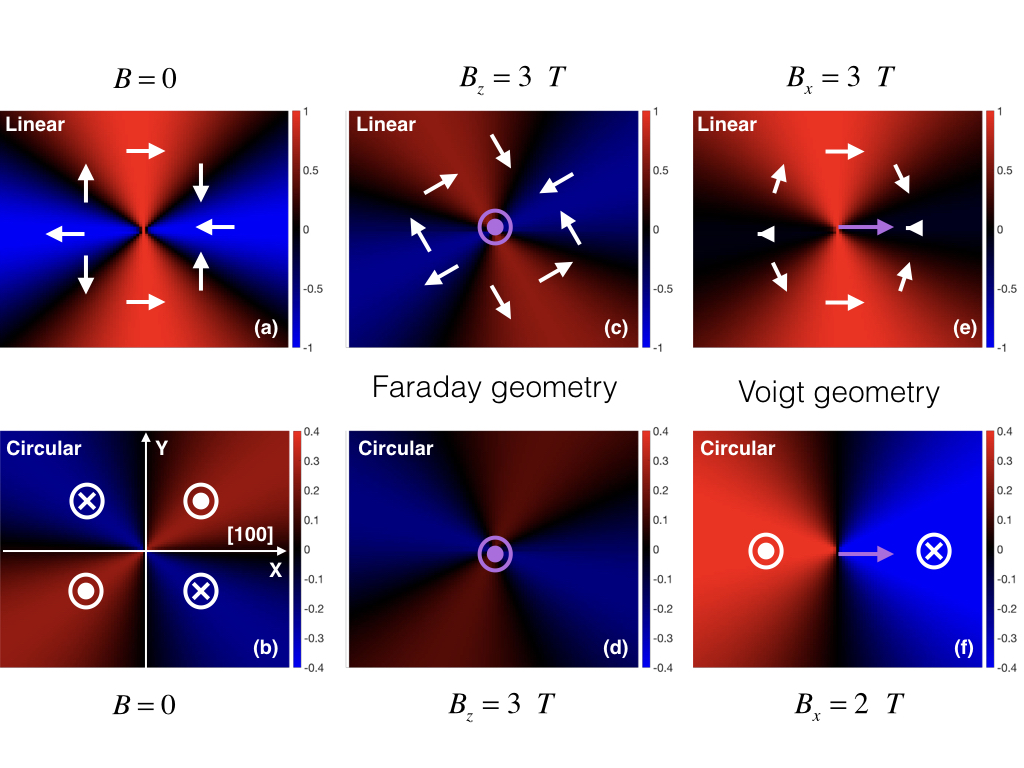 Figure 1
Peer Reviews
No public reviews on file for this paper yet. If you reviewed it on a platform where reviews are public (OpenReview, ICLR, NeurIPS, ICML), you can paste yours below so the community can read it here.
Videos
No videos yet. Explain this paper in a talk, walkthrough, or lecture? Add one.
Hanle model of a spin-orbit coupled Bose-Einstein condensate of excitons
in semiconductor quantum wells
S. V. Andreev
ITMO University, St. Petersburg 197101, Russia
University of Bordeaux, LOMA UMR-CNRS 5798, F-33405 Talence Cedex, France
A. V. Nalitov
Physics and Astronomy School, University of Southampton, Highfield, Southampton SO171BJ, United Kingdom
(17 mars 2024)
Résumé
We present a theoretical model of a driven-dissipative spin-orbit coupled Bose-Einstein condensate of indirect excitons in semiconductor quantum wells (QW’s). Our steady-state solution of the problem shares analogies with the Hanle effect in an optical orientation experiment. The role of the spin pump in our case is played by boson stimulated scattering into the linearly-polarized ground state and the depolarization occurs as a result of exchange interaction between electrons and holes. Our theory agrees with the recent experiment [A. A. High et al., Phys. Rev. Lett. 110, 246403 (2013)], where spontaneous emergence of spatial coherence and polarization textures have been observed. As a complementary test, we discuss a configuration where an external magnetic field is applied in the structure plane.
pacs:
Valid PACS appear here
††preprint: APS/123-QED
Spin-orbit (SO) coupled Bose-Einstein condensation (BEC) has been under intense investigation in atomic gases during the past few years Pitaevskii . A key feature of this new type of BEC is the macroscopic occupation of single-particle states with non-zero momentum Lin2011 , with dramatic consequences for possible quantum phases and transitions between them. Among theoretically predicted are the stripe phase Li2012 ; Ketterle , the thermodynamically stable meron Wilson , and the many-body ”cat” state GalitskiReview . Practical implementation of the latter could pave the way towards fault tolerant quantum computation at room temperature Galitski2008 .
In solids the bosonic quasiparticles which display the SO interaction are excitons and polaritons - bound electron-hole pairs in a semiconductor media coupled to light Ivchenko . Important distinction of these systems from their atomic counterpart is their driven-dissipative character. In most cases polaritonic condensates are strongly out-of-equilibrium, behaving essentially as lasers. In contrast, excitons can establish a kinetic equilibrium with respect to the interactions needed for formation of a Bose-Einstein condensate Ivanov . Promising candidates for creation and manipulation of interacting degenerate Bose gases in semiconductors are the so-called indirect excitons, formed of spatially separated electrons and holes ButovReview .
Recently, spontaneous onset of extended spatial coherence and polarization textures have been observed in the photoluminescense (PL) of indirect excitons in coupled semiconductor quantum wells (QW’s) High . The textures at different locations in the QW plane appear simultaneously at the same critical temperature and their orientation is pinned to the crystallographic axes. Whereas the former observation suggests a second-order phase transition ScaleInvariance , the latter fact allows one to unambiguously identify the SO interaction as playing a crucial role in these phenomena High ; SpinTextures . Until now, however, no link between formation of an exciton condensate in the momentum space and the spin texture has been established.
The present paper is aimed at filling this gap in the understanding of exciton BEC. We propose an ideal gas model of SO coupled exciton condensates accounting for the radiative decay and incoherent pumping from an external reservoir. The emergent physics is reminiscent of the Hanle effect, which consists in suppression of the spin polarization induced by a continuous wave (cw) circularly polarized laser in a transverse magnetic field Hanle ; OO . In our case, stimulated scattering of excitons into the linearly-polarized ground state (GS) is followed by coherent precession (”depolarization”) of the condensate pseudo-spin in an effective magnetic field due to the electron-hole exchange interaction. The stationary configuration (pseudo-spin rotation angle) is determined by the balance between the radiative decay rate and the pumping from the reservoir. The model can be straightforwardly generalized to account for an external magnetic field. In the Faraday configuration (the magnetic field is applied perpendicularly to the structure plane) our theory reproduces the rotation of the linear polarization texture observed in the experiment High . As a complementary test of our model, we discuss the Voigt geometry (in-plane magnetic field).
Our starting point is the following single-particle SO-coupled Hamiltonian
[TABLE]
which is obtained by the Kronecker summation of the corresponding Dresselhaus Hamiltonians for the constituent electrons and holes Andreev2 . Here is the exciton kinetic energy and is the angle between the exciton wavevector and the crystal axis (chosen as the -axis). The lowest energy eigenstates of the Hamiltonian (1) are the plane waves, characterized with the dispersion
[TABLE]
and the following spin structure
[TABLE]
The dispersion (2) has a characteristic minimum at . The -dependent part in corresponds to the bright exciton state and can be used to construct a pseudo-spin which defines the polarization of the light emitted by the exciton (here is the Pauli vector). Thus, the linear polarization degrees are given by and with the frame being rotated by with respect to . One can easily see that the light emitted by the state (3) is polarized along the wavevector .
In the work High a vortex of linear polarization and a four-leaf circular polarization texture have been observed around the localized bright spots (LBS’s) in the exciton PL pattern. The bright spots are characterized by high intensities and partially suppressed coherence of the exciton PL. As has been recently pointed out by one of us Andreev2 , an LBS surrounded by a coherent spin-polarized halo represents an exciton cloud trapped in an external potential. The potential can be assumed to be of a harmonic type
[TABLE]
with being the harmonic oscillator frequencies. Below we present an ideal gas model of an SO-coupled exciton condensate in the 2D harmonic trap (4), where we let for simplicity. The model reproduces the main features observed in the experiment.
The two-body interactions, while not being explicitly taken into account in our calculations, ensure the important relation
[TABLE]
between the characteristic momentum relaxation time and the lifetime of excitons. In an SO-coupled gas of semiconductor electrons the elastic collisions are known to play an important role in the relaxation of spin according to the Dyakonov-Perel scenario Dyakonov ; Glazov . Frequent collisions slow down the relaxation of an artificially created spin polarization. In our model, instead of an external optical pumping we assume a cold reservoir of unpolarized electrons and holes, which bind into (initially) unpolarized excitons. In a bosonic ensemble of excitons being in dynamical equilibrium with the cold bath the condition (5) favours spontaneous formation of a metastable Bose-Einstein condensed phase Pitaevskii . Crucially, due to the coupling of the exciton spin to the momentum, encoded in the Hamiltonian (1), thermalization and condensation occurs both in momentum and spin subspaces. As a result, an equilibrium GS has more complex structure than just the usual lowest-energy state of the harmonic oscillator, typical for the potential (4). In the limit of strong SO coupling , where is the harmonic oscillator length, the GS wavefunction can be obtained as follows. In the momentum space representation the harmonic potential can be regarded as a kinetic energy operator of a fictitious particle moving in the potential energy landscape (2). The corresponding Schrodinger equation reads
[TABLE]
By using the substitution with given by (3) and integrating out the angular degree of freedom, we obtain
[TABLE]
Developing the radial motion in equation (7) in the vicinity of we have for the eigenenergies:
[TABLE]
where and are the radial and the orbital integer quantum numbers, respectively. The new ground state corresponds to and is described by the following wavefunction
[TABLE]
In the coordinate space the GS wavefunction reads
[TABLE]
with now being the polar angle of the radius-vector . The spin structure of the ground state (9) at the angle in the -space is reproduced in (10) at the angle . The pseudospin constructed from the bright part of (10) lies in the QW plane and rotates by when going around the LBS. In terms of the quantities and this corresponds to the vortex of linear polarization observed in the experiment [Fig. 1 (a)].
In order to obtain a finite circular polarization we need to go beyond the equilibrium model (1) and account for the driven-dissipative nature of the system. In fact, our assumption of the kinetic equilibrium (5) by no means implies a full thermodynamic equilibrium. The SO coupling results in formation of a linearly-polarized condensate (9), but relaxation with respect to -independent spin interactions may take time longer than the exciton lifetime . Among those latter type of interactions are the long-range electron-hole exchange and the Zeeman interaction with an external magnetic field. These interactions are thus expected to yield a dynamical correction
[TABLE]
to the Hamiltonian (1). Here and with being the electron (hole) g-factors, is the Bohr magneton and is the long-range exchange constant Bir . The in-plane heavy-hole g-factor is assumed to be equal to zero (we neglect possible random stresses typical for the samples of moderate quality Andreev4 ).
A proper description of the spin dynamics of a 4-component system in the presence of decay and coherent pumping from a reservoir can be done by using the Lindblad equation for the spin density matrix
[TABLE]
where is the condensate lifetime (in general, ),
[TABLE]
with being defined by (3), and is the stimulated scattering rate being proportional to the number of particles in the condensate. In Eq. (12) we assume the condition (5) and
[TABLE]
where is the exciton spin coherence time. In the steady-state configuration one has
[TABLE]
which yields a system of 16 coupled linear equations on the matrix elements of . The 3 components of the exciton pseudo-spin and the related linear and circular polarization degrees can then be obtained by using the formulas
[TABLE]
where .
The results of solution of Eq. (15) are presented in Fig. 1. The observed phenomenology is reminiscent of the Hanle effect in an optical orientation experiment OO . The role of the spin pump in our case is played by the boson stimulated scattering into the linearly-polarized GS [Fig. 1 (a)]. The long-range exchange interaction between the electrons and holes acts as an effective magnetic field of the magnitude oriented along the -axis in the structure plane. This field rotates the condensate pseudo-spin, so that the latter acquires a non-zero component along the growth direction [Fig. 1 (b)]. The rotation angle in the steady-state configuration (15) is determined by the balance between the radiative decay of the condensate and the pump from the reservoir. An external magnetic field applied along the -axis (Faraday geometry) rotates the pseudo-spin component lying in the structure plane [Fig. 1 (c)], which yields the rotation of the linear polarization vortex observed in the experiment High .
The effect of an in-plane magnetic field (Voigt geometry) is more subtle. Measurements of the exciton polarization in this configuration could provide a good test of our theory. As an example we show transformation of the linear [Fig. 1 (e)] and circular [Fig. 1 (f)] polarization textures by a magnetic field along the -axis with T and T, respectively. The field enhances the absolute degree of the circular polarization [simultaneously transforming the four-leaf spatial pattern into a two-leaf one] and destroys the negative part of .
Let us now briefly discuss a possible effect of the two-body interactions on the properties of the ground state. A net repulsive interaction is expected to result in population of the states with larger angular momentum and extrusion of the condensate to the peripheric region of the trap as to reduce the density in the center Santos . On the other hand, if one of the interaction channels admits a resonance, an increase of the chemical potential in the center may result in formation of a condensate of biexcitons, distinguished from the exciton condensate by a suppressed coherence of the emitted light Andreev3 . In practice, both effects may be present simultaneously, complementing each other. An interplay between the SO interaction and resonant pairing of bosons is a challenging question which will be addressed in our future studies of many-body quantum phases of excitons.
To conclude, we have shown that the experimentally observed polarization textures in the PL of indirect excitons can be interpreted in terms of the SO-coupled exciton Bose-Einstein condensation. Our theory suggests a new mechanism of spontaneous formation of the spin polarization in semicondutors, which one can dub ”boson stimulated spin pumping”. In the absence of full thermodynamic equilibrium the dynamics of the condensate spin can be described by the Hanle-like equation on the spin density matrix (12). The model can be adopted to the atomically thin layered materials Novoselov , as well as to high-quality semiconductor microcavities Snoke .
S.V. thanks M. Glazov for his remarks. This work has been supported by the Government of the Russian Federation (Grant 074-U01) through ITMO Postdoctoral Fellowship scheme.
Références
- (1) L. P. Pitaevskii and S. Stringari, Bose-Einstein condensation and superfluidity, Oxford (2016).
- (2) Y.-J. Lin et al., Nature 471, 83 (2011).
- (3) Yun Li, Lev P. Pitaevskii and Sandro Stringari, Phys. Rev. Lett. 108, 225301 (2012).
- (4) The stripe phase has recently been observed experimentally, see Jun-Ru Li, Jeongwon Lee, Wujie Huang, Sean Burchesky, Boris Shteynas, Furkan Cagi Top, Alan O. Jamison and Wolfgang Ketterle, Nature 543, 91 (2017).
- (5) Ryan M. Wilson, Brandon M. Anderson, and Charles W. Clark, Phys. Rev. Lett. 111, 185303 (2013).
- (6) V. Galitski and I. B. Spielman, Nature 494, 49 (2013).
- (7) T. D. Stanescu, B. Anderson, and V. Galitski, Phys. Rev. A 78, 023616 (2008).
- (8) E. L. Ivchenko, Optical Spectroscopy of Semiconductor Nanostructures (Alpha Science International, Harrow, U.K., 2005).
- (9) In this work we assume the excitonic gases formed of thermalized electrons and holes. In principle, the typical lifetime of an indirect exciton is sufficiently long for cooling of the photoexcited excitons down to the temperature of the cold lattice. The cooling process occurs via emission of LA phonons, and the interactions redistribute the energy according to the equilibrium thermodynamics [L. V. Butov, A. L. Ivanov, A. Imamoglu, P. B. Littlewood, A. A. Shashkin, V. T. Dolgopolov, K. L. Campman, and A. C. Gossard, Phys. Rev. Lett. 86, 5608 (2001); A. L. Ivanov, J. Phys.: Condens. Matter 16, S3629 (2004)].
- (10) L. V. Butov, J. Phys.: Condens. Matter 19, 295202 (2007).
- (11) A. A. High, A. T. Hammack, J. R. Leonard, Sen Yang, L. V. Butov, T. Ostatnicky, M. Vladimirova, A. V. Kavokin, T. C. H. Liew, K. L. Campman, and A. C. Gossard, Phys. Rev. Lett. 110, 246403 (2013).
- (12) S. V. Andreev, A. A. Varlamov, and A. V. Kavokin, Phys. Rev. Lett. 112, 036401 (2014).
- (13) A. V. Kavokin, M. Vladimirova, B. Jouault, T. C. H. Liew, J. R. Leonard, and L. V. Butov, Phys. Rev. B 88, 195309 (2013); D. V. Vishnevsky, H. Flayac, A. V. Nalitov, D. D. Solnyshkov, N. A. Gippius, and G. Malpuech, Phys. Rev. Lett. 110, 246404 (2013).
- (14) W. T. Z. Hanle, Phys. 30, 93 (1924).
- (15) Optical Orientation, ed. by F. Meyer and B. P. Zakharchenya (North-Holland, Amsterdam, 1984).
- (16) S. V. Andreev, Phys. Rev. B 94, 165308 (2016).
- (17) M. Dyakonov, V. Perel, Sov. Phys. Solid State 13, 3023 (1972).
- (18) M. Glazov, E. Ivchenko, J. Exp. Theor. Phys. 99, 1279 (2004).
- (19) G. L. Bir and G. E. Pikus, Symmetry and Strain-induced Effects in Semiconductors (Wiley/Halsted Press, New York, 1974).
- (20) S. V. Andreev, B. R. Namozov, A. V. Koudinov, Yu. G. Kusrayev, and J. K. Furdyna, Phys. Rev. B 80, 113301 (2009).
- (21) S. Sinha, R. Nath and L. Santos, Phys. Rev. Lett. 107, 270401 (2011).
- (22) S. V. Andreev, Phys. Rev. B 92, 041117(R) (2015); S. V. Andreev, Phys. Rev. B 94, 140501(R) (2016).
- (23) A. K. Geim and I. V. Grigorieva, Nature (London) 499, 419 (2013).
- (24) Y. Sun, P. Wen, Y. Yoon, G. Liu, M. Steger, L. N. Pfeiffer, K. West, D. W. Snoke, and K. A. Nelson, Phys. Rev. Lett. 118, 016602 (2017).
The reference list from the paper itself. Each links out to its DOI / PubMed record.
- 1(1) L. P. Pitaevskii and S. Stringari, Bose-Einstein condensation and superfluidity , Oxford (2016).
- 2(2) Y.-J. Lin et al. , Nature 471 , 83 (2011).
- 3(3) Yun Li, Lev P. Pitaevskii and Sandro Stringari, Phys. Rev. Lett. 108 , 225301 (2012).
- 4(4) The stripe phase has recently been observed experimentally, see Jun-Ru Li, Jeongwon Lee, Wujie Huang, Sean Burchesky, Boris Shteynas, Furkan Cagi Top, Alan O. Jamison and Wolfgang Ketterle, Nature 543 , 91 (2017).
- 5(5) Ryan M. Wilson, Brandon M. Anderson, and Charles W. Clark, Phys. Rev. Lett. 111 , 185303 (2013).
- 6(6) V. Galitski and I. B. Spielman, Nature 494 , 49 (2013).
- 7(7) T. D. Stanescu, B. Anderson, and V. Galitski, Phys. Rev. A 78 , 023616 (2008).
- 8(8) E. L. Ivchenko, Optical Spectroscopy of Semiconductor Nanostructures (Alpha Science International, Harrow, U.K., 2005).