Mellin and Wiener-Hopf operators in a non-classical boundary value problem describing a L\'evy process
Anthony Hill

TL;DR
This paper studies a non-classical boundary value problem for a Lévy process generator, using Mellin and Wiener-Hopf operators to analyze boundedness, kernel triviality, and invertibility conditions.
Contribution
It introduces a novel approach combining Mellin and Wiener-Hopf operators to analyze boundary value problems for Lévy process generators with boundary singularities.
Findings
Derived conditions for boundedness of the operator between Bessel potential spaces.
Proved the operator has a trivial kernel under certain conditions.
Determined when the operator is Fredholm and calculated its index.
Abstract
Markov processes are well understood in the case when they take place in the whole Euclidean space. However, the situation becomes much more complicated if a Markov process is restricted to a domain with a boundary, and then a satisfactory theory only exists for processes with continuous trajectories. This research, into non-classical boundary value problems, is motivated by the study of stochastic processes, restricted to a domain, that can have discontinuous trajectories. To make this general problem more tractable, we consider a particular operator, , which is chosen to be the generator of a certain stable L\'evy process restricted to the positive half-line. We are able to represent as a (hyper-) singular integral and, using this representation, deduce simple conditions for its boundedness, between Bessel potential spaces. Moreover, from energy estimates,…
Click any figure to enlarge with its caption.
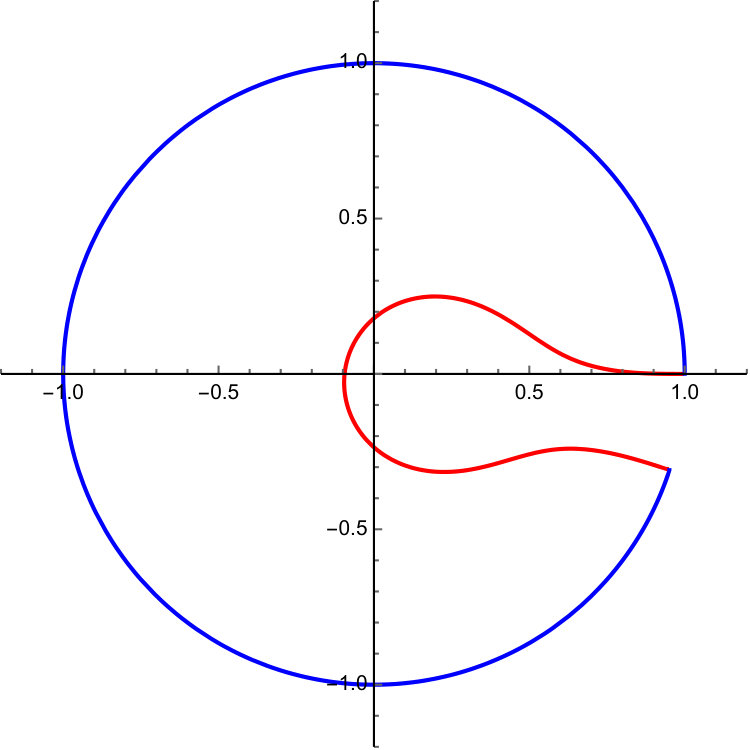 Figure 1
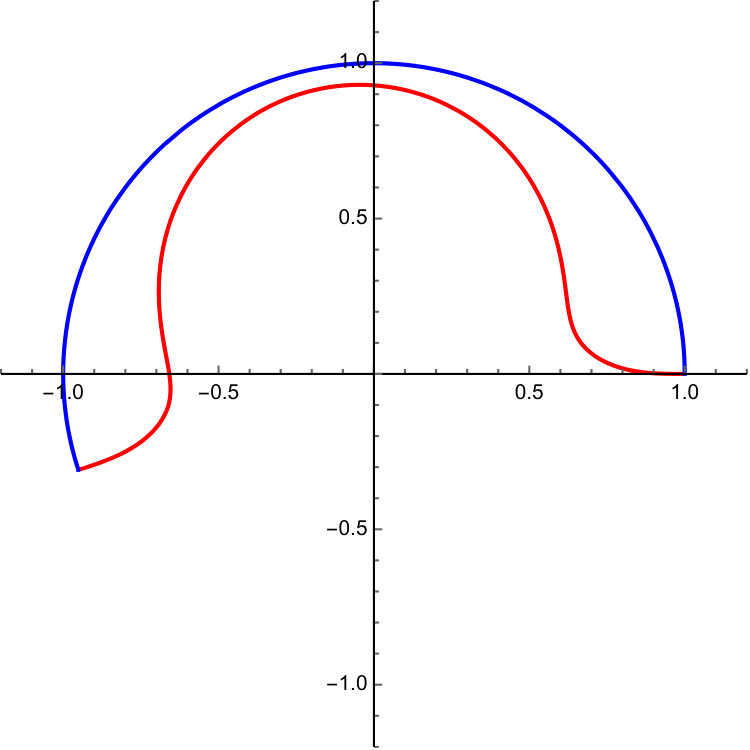 Figure 2
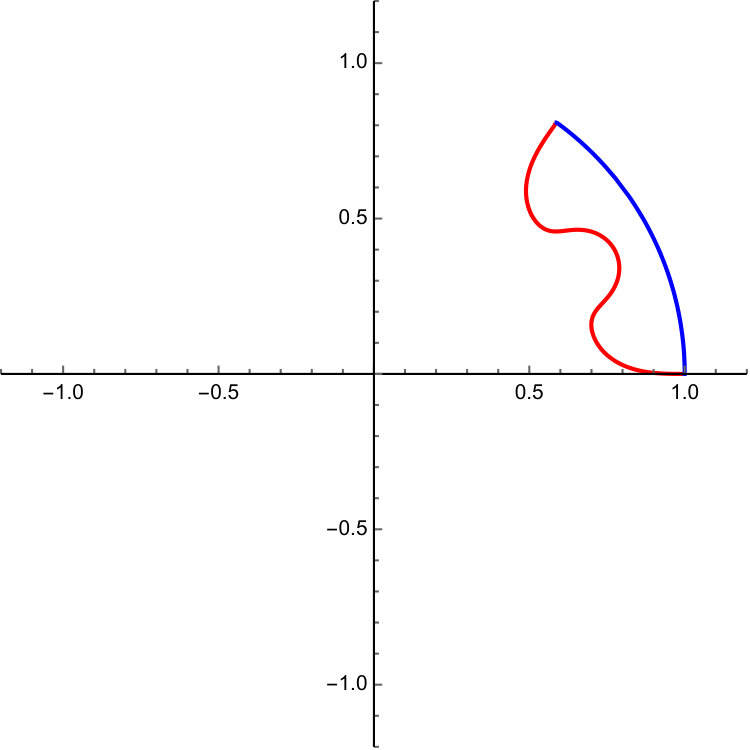 Figure 3
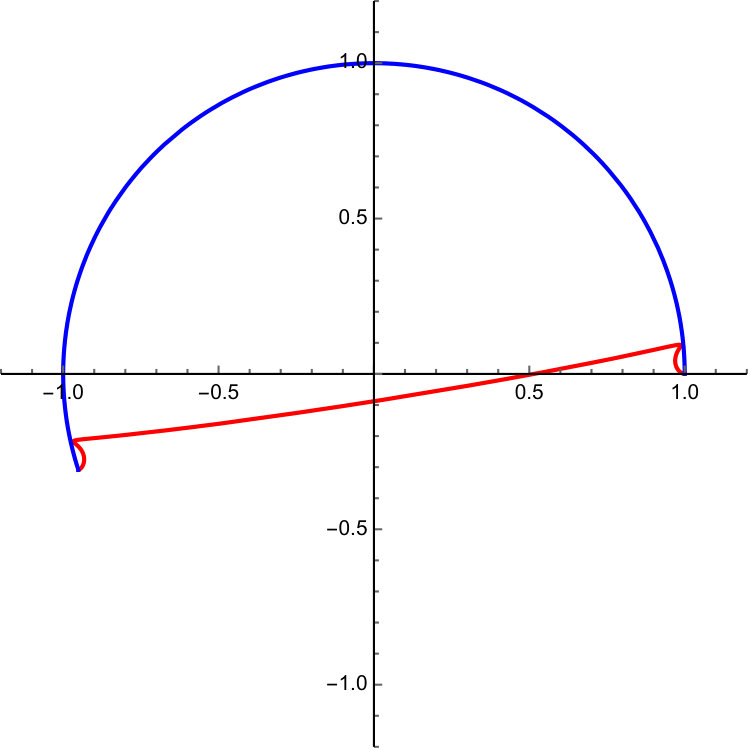 Figure 4
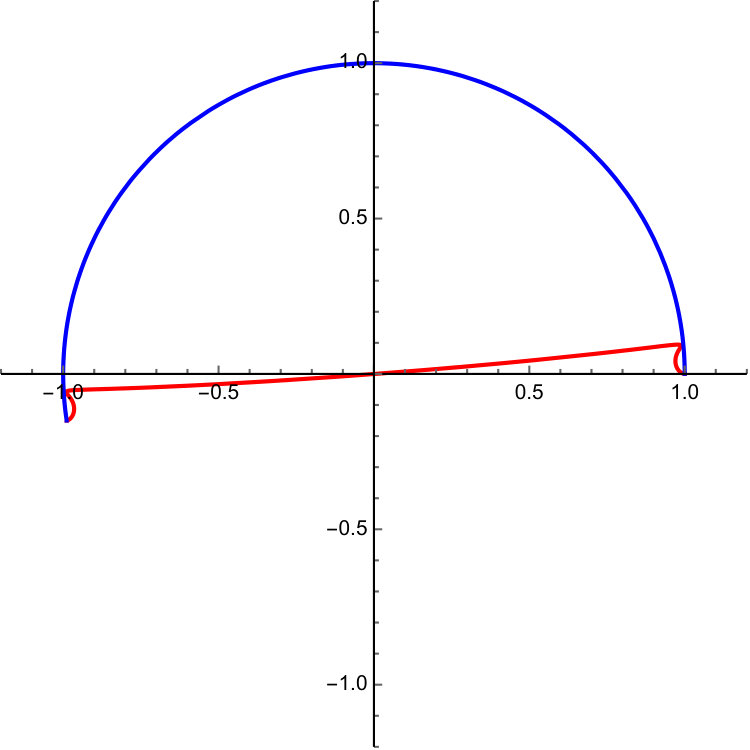 Figure 5
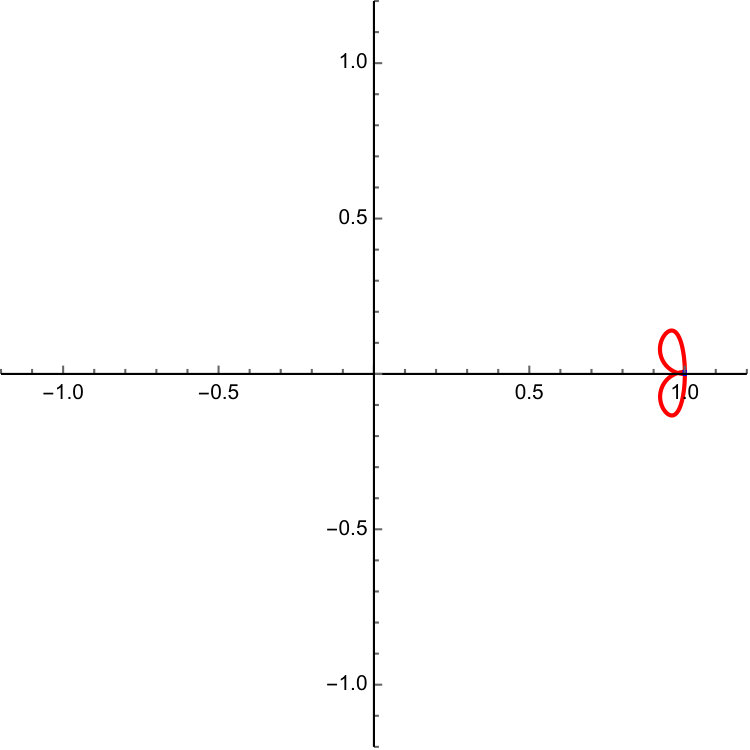 Figure 52
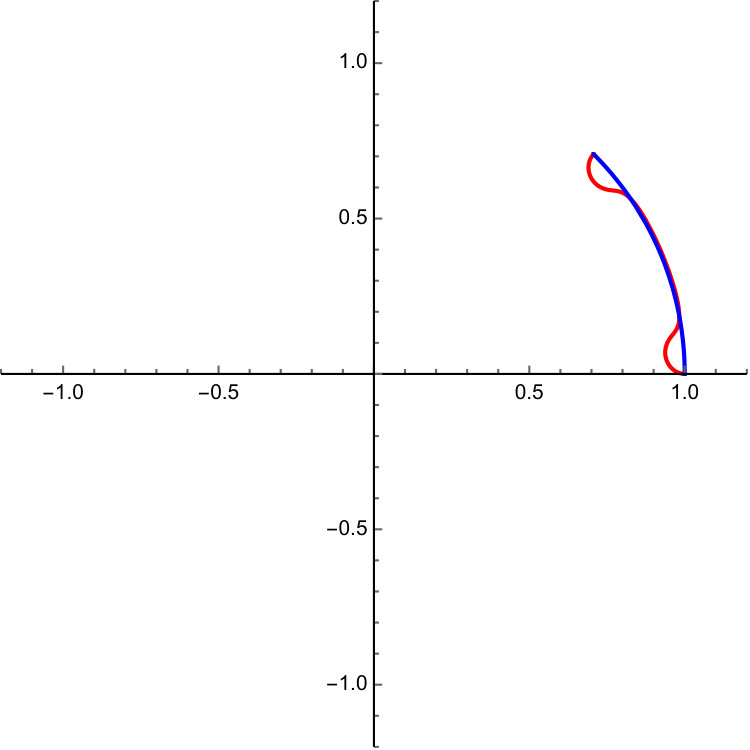 Figure 54
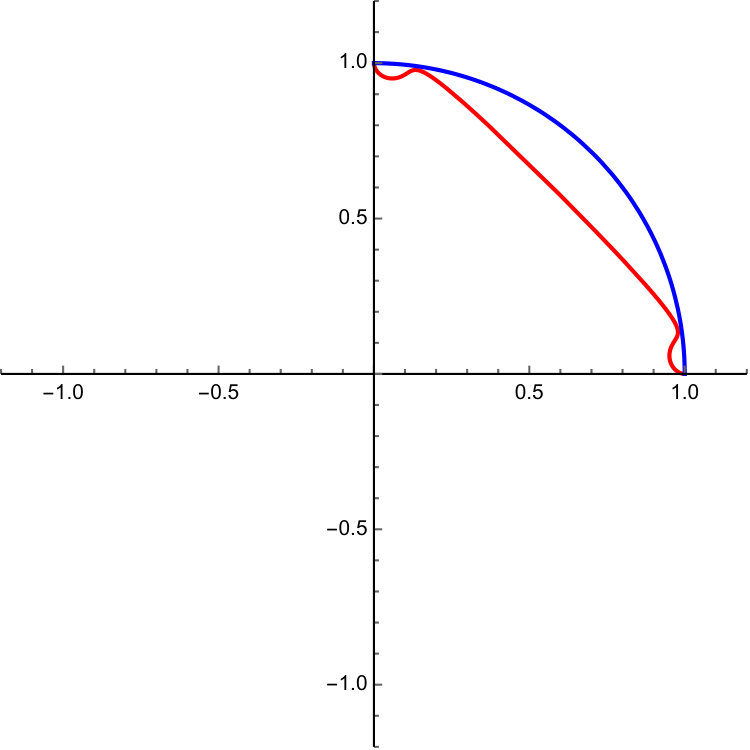 Figure 56
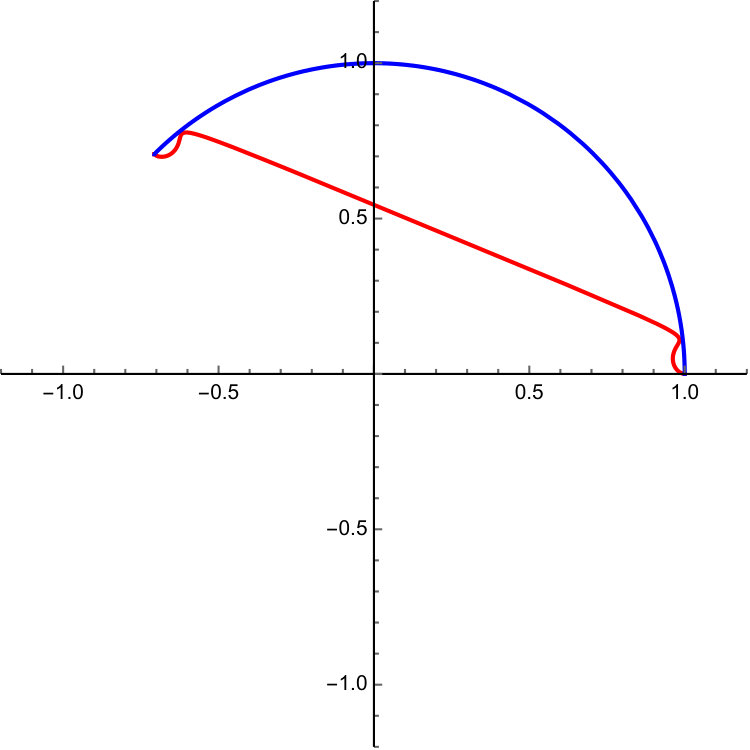 Figure 58
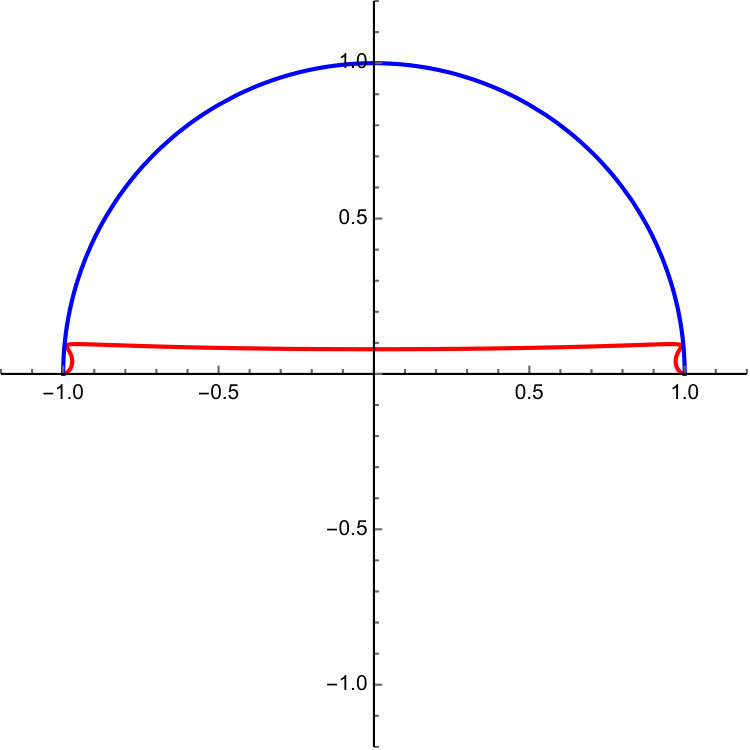 Figure 6
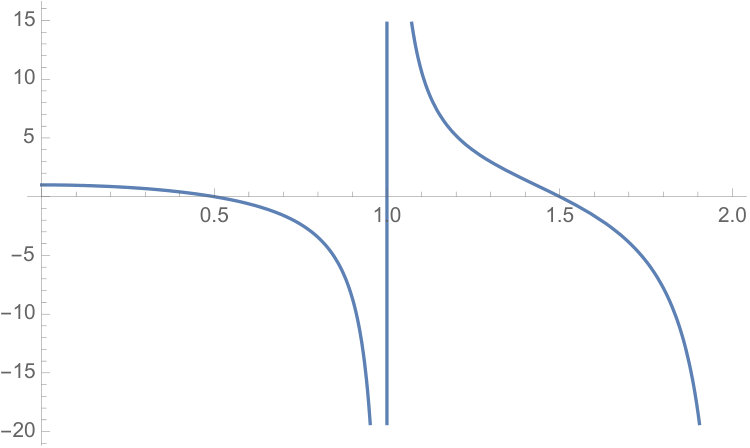 Figure 11
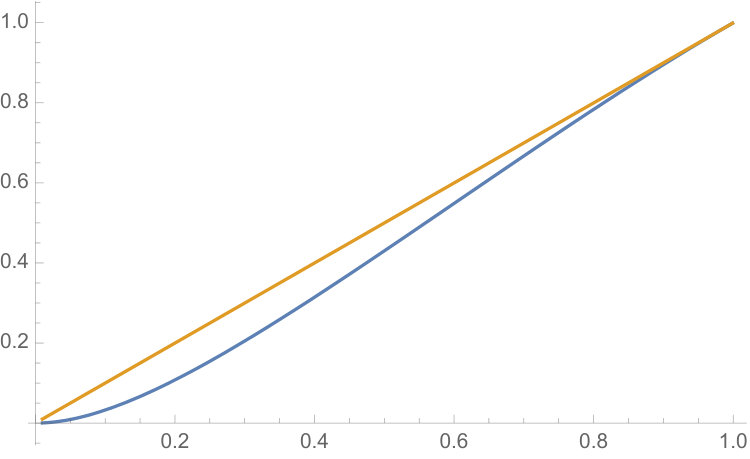 Figure 12
Peer Reviews
No public reviews on file for this paper yet. If you reviewed it on a platform where reviews are public (OpenReview, ICLR, NeurIPS, ICML), you can paste yours below so the community can read it here.
Videos
No videos yet. Explain this paper in a talk, walkthrough, or lecture? Add one.
Taxonomy
Topicsadvanced mathematical theories · Advanced Mathematical Theories and Applications · Spectral Theory in Mathematical Physics
Mellin and Wiener-Hopf operators in a non-classical boundary value problem describing a Lévy process
Anthony Christopher Hill
A thesis presented for the degree of
Doctor of Philosophy
Department of Mathematics
King’s College London
March 2017
Abstract
Markov processes are well understood in the case when they take place in the whole Euclidean space. However, the situation becomes much more complicated if a Markov process is restricted to a domain with a boundary, and then a satisfactory theory only exists for processes with continuous trajectories. This research, into non-classical boundary value problems, is motivated by the study of stochastic processes, restricted to a domain, that can have discontinuous trajectories. We demonstrate that the singularities, for example delta functions, that might be expected at the boundary, are mitigated, using current probability theory, by what amounts to the addition of a carefully chosen potential.
To make this general problem more tractable, we consider a particular operator, , which is chosen to be the generator of a certain stable Lévy process restricted to the positive half-line. We are able to represent as a (hyper-) singular integral and, using this representation, deduce simple conditions for its boundedness, between Bessel potential spaces. Moreover, from energy estimates, we prove that, under certain conditions, has a trivial kernel.
A central feature of this research is our use of Mellin operators to deal with the leading singular terms that combine, and cancel, at the boundary. Indeed, after considerable analysis, the problem is reformulated in the context of an algebra of multiplication, Wiener-Hopf and Mellin operators, acting on a Lebesgue space. The resulting generalised symbol is examined and, it turns out, that a certain transcendental equation, involving gamma and trigonometric functions with complex arguments, plays a pivotal role. Following detailed consideration of this transcendental equation, we are able to determine when our operator is Fredholm and, in that case, calculate its index. Finally, combining information on the kernel with the Fredholm index, we establish precise conditions for the invertibility of .
Acknowledgements
I would like to thank King’s College London, for the opportunity, in my retirement, to study for a Ph.D. in pure mathematics. However, above all, I am indebted to my inspirational supervisor, Prof. Eugene Shargorodsky, for so freely sharing his huge mathematical experience, and for the many hours he has invested in helping me begin to understand this challenging, but very rewarding, problem.
Contents
List of Figures
- 7.1 Symbol plot for and .
- 7.2 Symbol plot for and .
- 7.3 Symbol plot for and .
- 8.1 Symbol plot for and .
- 8.2 Plot of versus .
- 8.3 Symbol plot for and .
- 8.4 Symbol plot for and .
- 8.5 Symbol plot for and .
- 8.6 Symbol plot for and .
- 8.7 Symbol plot for and .
- 8.8 Symbol plot for and .
- 9.1 Graph of for and .
All figures were produced in Student Edition.
Chapter 1 Introduction
1.1 Preamble
We begin by defining some key concepts central to this research. References for all the results stated in this section without proof can be found in a combination of [14] and [37].
The Fourier Transform on the Schwartz space, , of rapidly decaying infinitely differentiable functions is given by
[TABLE]
The Fourier transform is invertible on the Schwartz space, and its inverse is given by
[TABLE]
can be extended to , the space of tempered distributions corresponding to the Schwartz space.
For any , we define
[TABLE]
We define the Bessel potential space
[TABLE]
We note that for any and is a Banach space. Moreover, both the Schwartz space and the space of infinitely smooth functions with compact support are dense in .
We are interested in the half-line and, accordingly, we define
[TABLE]
Of course, by definition, we have .
Let denote the space of infinitely differentiable functions on with compact support in , and let denote the characteristic function of the sets respectively.
It will also be useful to let denote the restriction operator from to . In addition, we let denote an arbitrary extension operator from to and be the particular extension by zero. We now define
[TABLE]
with norm
[TABLE]
Of course, if then
[TABLE]
so that acts as the identity on the space .
Assuming , it will also convenient to define
[TABLE]
When working with the Fourier transform, we define
[TABLE]
so that, for example, for a given we have , for all .
Suppose . We say that is a Fourier multiplier if, for all , we have and
[TABLE]
where the constant is independent of . The set of all such Fourier multipliers is denoted by .
If , then the operator extends continuously to a bounded operator on . This extension is called a Fourier convolution operator with symbol , and is denoted by . Moreover, we let denote the corresponding Wiener-Hopf operator.
We now define the operator by
[TABLE]
for any . It is easy to show that
[TABLE]
so that is bounded. In addition, is invertible and its inverse is given by
[TABLE]
for any .
The operator is called the Mellin transform, and it is given explicitly by
[TABLE]
and moreover, its inverse, , can be written as
[TABLE]
Let . Then the operator
[TABLE]
is bounded on , and is called the Mellin convolution operator with symbol .
We will be particularly interested in integral operators of the form
[TABLE]
where the kernel satisfies the integrability condition
[TABLE]
It is easy to show (see, for example, p. 174, [14], for the case ) that
[TABLE]
If the kernel satisfies the integrability condition (1.7), then the associated integral operator is a Mellin convolution operator, say , where the symbol is given by the formula
[TABLE]
That is, the symbol of the integral operator is the Mellin transform of its kernel .
We will need to consider fractional powers of complex numbers. To make the complex argument, , single valued we insist that
[TABLE]
That is, we assume that the cut in the complex plane is along the negative horizontal axis.
Thus, given , we can write
[TABLE]
and define
[TABLE]
Finally, for any and we define
[TABLE]
It is immediately clear from definition (1.10), that for any and ,
[TABLE]
However, suppose that and . Then the relationship
[TABLE]
does hold universally.
Remark 1.1**.**
Suppose . Then, for ,
[TABLE]
provided
[TABLE]
*Of course, condition (1.12) is automatically satisfied if and have (non-trivial) imaginary parts of opposite sign.
Suppose . The following useful results are immediate consequences of Remark 1.1:
[TABLE]
1.2 The problem
1.2.1 Introduction
Markov processes play a central role in a wide range of applications in physical sciences and engineering, biology and medicine, industry, finance and business, and in other fields. They are especially well understood in the case where the the process takes place in the complete Euclidean space, . However, the situation becomes considerably more complicated if a Markov process is restricted to a domain with a boundary. For, in that case, a satisfactory theory exists only for processes, such as Brownian motion, with continuous trajectories. Further significant complications arise for Markov processes with jumps. Informally, at least, these difficulties are best understood by the observation that a process with continuous paths can leave a domain only by passing through its boundary, whilst a process with discontinuous trajectories can jump into the complement of the domain without ever hitting the boundary.
The wider context for this work is a large class of Markov processes – namely the so-called Feller and (hence) Lévy processes. (For more details on Feller and Lévy processes, see Appendix B.) It follows from a well known result of Ph. Courrège that the generator of a Feller process in is a pseudodifferential operator. Moreover, this pseudodifferential operator can be represented as a sum of a second order partial differential operator and an integro-differential operator with a Lévy kernel (see [27]). It turns out that each term in this representation has a simple probabilistic interpretation. The second order differential operator describes the diffusion part, the first order terms are related to the drift, the zero order term is responsible for the killing part and, finally, the Lévy kernel describes the jumps of the paths.
An important example of a linear partial differential operator with constant coefficients is , where is the Laplacian. It is straightforward to show that
[TABLE]
and thus the symbol of is .
This research is concerned with non-classical boundary-value problems for elliptic pseudodifferential operators. Such problems can often be associated with Feller and Lévy processes [3], [27]. For example, the generator of the symmetric -stable Lévy process in is the fractional Laplacian [10], [47] which can be defined by
[TABLE]
Unlike the Laplacian, the fractional Laplacian is a non-local operator. In a discrete setting, say the lattice , we can think of the fractional Laplacian as random walk in which a particle may experience arbitrarily long jumps, albeit with a small probability, [47]. There are at least ten equivalent definitions of the fractional Laplacian, see [31], and it can be very useful to interchange them. Indeed, suppose , then we can also write
[TABLE]
where the constant depends only on and .
Finally, we make special note of an excellent survey paper, [10], that details applications as disparate as crystal dislocation, finance and water waves, where the fractional Laplacian is playing an important role.
Let . In 1938, M. Riesz [36] showed that the correct boundary condition for the Dirichlet problem for the fractional Laplacian is not the customary but rather the balayage condition:
[TABLE]
Heuristically, the difference between the Laplacian and the fractional Laplacian can be described very simply in terms of stochastic processes. For the Laplacian, inside a smooth boundary, the process paths follow Brownian motion and are therefore continuous (almost surely). On the other hand, the paths for the fractional Laplacian are right continuous with left limits, or càdlàg. In this case, the first hitting of will not occur (almost surely) at the boundary , but rather somewhere in . That is to say, the process will jump over the boundary (almost surely).
1.2.2 Truncation
Let us consider a general pseudodifferential operator . Of course, the definition of depends on the Fourier transform, which acts on the whole of . Now suppose that our domain of interest is some set .
Starting from , an obvious way forward is to extend any functions defined on by zero to the whole of , apply the pseudodifferential operator and then restrict back to . To make this more precise, suppose that are functions spaces defined on . Let denote the operator of restriction from to . Then for any function space , we define
[TABLE]
Similarly, we define to be the operator of extension, by zero, from to . Hence, we can write
[TABLE]
Unfortunately, this simple approach can have some difficult consequences. For example, it may be the case that the extended function is discontinuous on the boundary of , and this may cause singularities in . Indeed, even when and , it may happen that . An example of this is given in Appendix A.
1.2.3 Transmission conditions
One way to mitigate the singularities at the boundary of the domain, , caused by truncation, is to consider pseudodifferential operators that satisfy the transmission condition, see [20], on . Indeed, we say that satisfies the transmission condition if
[TABLE]
There is an equivalent condition on the symbol of the operator described in local coordinate systems in a neighbourhood of . The transmission condition is widely applicable and there is a well developed theory, notably [5], for elliptic boundary value problems. (See also [21].)
Unfortunately, the fractional Laplacian does not satisfy the transmission condition. Moreover, this is a characteristic of Feller processes. The generator of a subordinate diffusion does not have the transmission condition [26]. So, in the context of Feller processes, the transmission condition is too restrictive. Fortunately, there is a theory of boundary value problems for elliptic pseudodifferential operators in the absence of the transmission condition. This work was pioneered by M.I. Vishik and G. Eskin, see [14], in the 1960’s. The main tool is the Wiener-Hopf factorization.
In a series of recent papers, see for example [22, 23], Grubb has adopted a more general transmission condition. Indeed, we say that satisfies the transmission condition if
[TABLE]
In Appendix C, we consider the fractional Laplacian, , acting on the domain . It can be shown that the fractional Laplacian satisfies the transmission condition with . To accommodate the singularities that arise at the boundary, this approach seeks solutions to the Dirichlet problem in the so-called Hörmander space, , defined for , as
[TABLE]
where .
If then, see Section 2.8.7, p.158, [45], we can identify with . Hence,
[TABLE]
On the other hand, if then functions from may have a jump at . This gives rise to a singularity at when the operator is applied.
In summary, Grubb presents a useful approach, combining the power of Wiener-Hopf factorisation with a more general transmission condition, that works well for fractional powers of elliptic operators. In this research, we take a parallel, but rather different, path where we perturb the equation, by adding a carefully chosen potential, before solving the Dirichlet problem. It turns out that this will allow us to seek solutions in (the more conventional) Bessel potential spaces.
1.2.4 Adding a potential term
The Dirichlet form, see [33], associated with is given by
[TABLE]
or, equivalently,
[TABLE]
where, see for example [31], the positive constant is given by
[TABLE]
If and , we can write
[TABLE]
Dirichlet forms relating to the symmetric stable Lévy process on a domain have been studied by a number of authors. See, for example, Bogdan et al. [4], Chen and Kim [6], Chen and Song [7], Guan and Ma [24, 25].
The generator of the Dirichlet form (1.15) is known as the regional fractional Laplacian, and can be written as
[TABLE]
For more details see, for example, [24, 25]. Of course, if is the whole of , then , and we simply recover equation (1.14).
Using a weak representation of (1.16), in their Corollary 7.7, Guan and Ma [24] consider a Dirichlet boundary value problem in , where the boundary value defined on is continuous. They show that, subject to several technical qualifications, there exists a unique (low regularity) solution in for all in the range , where denotes the space of continuous bounded functions on .
In preparation for this research, we now express the regional fractional Laplacian directly in terms of the operator .
Let us define
[TABLE]
and then, for , we have
[TABLE]
since if then , and if .
In other words,
[TABLE]
So, if , then, from equation (1.18),
[TABLE]
where denotes the characteristic function of the set .
Hence, we can write the regional fractional Laplacian, purely in terms of , as
[TABLE]
It will be useful to think of the term as an added potential to the (truncated) operator .
1.2.5 Transcendental equation
As an example, let us now consider equation (1.19), in the case and . We denote by and respectively. Let denote the Heaviside step function.
Then, see equation (2.34), p. 23, [14],
[TABLE]
where , for any .
Noting that , we can write
[TABLE]
and hence deduce
[TABLE]
Thus, after some calculation, we have the simple result that
[TABLE]
and
[TABLE]
Hence, from equation (1.19),
[TABLE]
if and only if
[TABLE]
Of course, as expected, given the homogeneity of , we have the immediate solution .
Later, in this research, we consider an “inhomogeneous” variant of the fractional Laplacian. We shall see that calculations involving the Fourier transform are considerably more complex. However, the transcendental equation (1.21) will reappear and, moreover, will play a critical role. (See Chapter 9 and, particularly, equation (9.7).)
1.2.6 Problem statement
Equation (1.19) provides the central motivation for this current research. Indeed, given a pseudo-differential operator , acting on , we will, in general, consider the operator
[TABLE]
We shall demonstrate now that the operator is always “less singular” than itself. Let be any extension of . Then, by definition, and
[TABLE]
where is the commutator given by
[TABLE]
Of course, is of lower order than , if has a degree of smoothness.
In summary, the perturbed operator has the simple form
[TABLE]
Moreover, it can be determined purely in terms of a restriction, to the domain , of an appropriate interaction between and over .
Remark 1.2**.**
It is easy to see that the representation on the right-hand side of (1.23) is independent of the extension . Indeed, suppose that are two extensions of . Then, by definition, . Moreover,
[TABLE]
The genesis of this research is the simple realisation that adding the potential term, , actually does improve the situation. This is because the leading singular terms of and cancel each other at . Appendix A details a simple illustrative example of this phenomenon.
So, the resulting (perturbed) operator is “less singular” than either the truncated operator or the multiplier when viewed separately. (In passing, we note that the cancellation of singularities will not occur if the coefficient of is a constant different from 1.)
Given the above analysis, the underlying problem, in abstract terms, is to develop a theory of boundary value problems for operators which are sums of pseudodifferential operators and “fine-tuned potentials”, which when taken together are less singular than the corresponding pseudodifferential operators considered on their own. In this research, to make the problem more tractable, we shall consider a particular elliptic pseudodifferential operator chosen because it possesses two important characteristics, namely:
- (a)
All the richness intrinsic to the fractional Laplacian; 2. (b)
Representative of a large class of operators.
For additional simplicity, we shall restrict our attention to one spatial dimension. However, it worth remarking that even one-dimensional problems of this kind can have important applications in various fields including financial mathematics (non-Gaussian market models).
Finally, suppose . Let denote the pseudodifferential operator of order , with symbol
[TABLE]
Our (simplified) problem is to investigate the solvability of the equation
[TABLE]
where for a given . We assume that
[TABLE]
since, in this case, is a Banach space and we can also apply the techniques and results of harmonic analysis.
1.2.7 Outline of this research
From equations (1.24) and (1.25), we note our operator of interest, , is defined via the Fourier transform. In Chapter 2, we formulate , acting on a restriction of the Schwartz space , as a singular integral. Using this representation, in Chapter 3, we establish conditions under which the operator , acting on Bessel potential spaces, is bounded. Moreover, at least for the case , we also determine sufficient conditions for to have a trivial kernel. Later, in Chapters 7 and 8, this latter result is generalised to any satisfying the constraint .
We begin with the case of lower regularity, where . In Chapters 4 and 5, we reformulate the problem in , in terms of an operator algebra containing multiplication, Mellin and Wiener-Hopf operators. Our goal is to establish precise conditions under which is Fredholm, and then calculate its index. A significant part of the index calculation, see Chapter 6, involves a certain transcendental equation, which includes terms containing gamma functions with complex arguments.
The analysis for is completed in Chapter 7, where we determine the range of parameters for which the Fredholm index is zero. Given this, and the trivial kernel results, we are able to establish the conditions under which is invertible. Of course, Fredholm theory in the multi-dimensional case requires invertibility of the one-dimensional operator.
In Chapter 8, the case of higher regularity, namely , is examined using the methods established previously. To improve readability, and also because of its significant technical complexity, we delay detailed examination of the transcendental equation until Chapter 9. Finally, areas of possible future research are discussed in Chapter 10.
1.3 Key results
Suppose , and let denote the characteristic function of the interval . Let the space be as defined in (1.3).
The operator can be represented as a (hyper-)singular integral operator.
Theorem 1.3**.**
Suppose . Let and define . Then, for ,
[TABLE]
Moreover,
[TABLE]
*for a certain function , which is for small and as .
Remark 1.4**.**
We have the following explicit representation
[TABLE]
*where is a modified Bessel function of the second kind of order . See, for example, Chapter 10, [34].
Under certain conditions is bounded and has a trivial kernel.
Theorem 1.5**.**
Suppose and . If either
- (a)
** 2. (b)
.
Moreover, if and either
- (i)
** 2. (ii)
,
*then has a trivial kernel.
Remark 1.6**.**
*The condition that for to have a trivial kernel is not as restrictive as it might appear. Under appropriate conditions, we will be able to determine sufficent conditions for to have a trivial kernel for any in the range , using the result (above) for .
Let . Then, it turns out that the following transcendental equation, see (1.21), will play a pivotal role in our analysis:
[TABLE]
Indeed, if and , we prove that equation (1.21) has no solution. On the other hand, if and , we prove that equation (1.21) has a unique solution of the form , where only depends on and satisfies .
Finally, via a calculation of the Fredholm index, we establish conditions for the invertibility of .
Theorem 1.7**.**
*Suppose and . Then the operator is invertible.
Theorem 1.8**.**
*Suppose and . Then the operator is invertible.
*On the other hand, if and , then has a trivial kernel and is Fredholm with index equal to .
Chapter 2 Singular integral representation
In this chapter we examine the operator given in equation (1.25) in more detail. We consider its action on the restriction of the Schwartz space to the positive half-line, and formulate a singular integral representation.
Suppose , and let denote the characteristic function of the interval .
2.1 Main result
Theorem 2.1**.**
Suppose . Let and define . Then, for ,
[TABLE]
Moreover,
[TABLE]
*for a certain function , which is for small and as .
Remark 2.2**.**
We have the following explicit representation
[TABLE]
*where is a modified Bessel function of the second kind of order . See, for example, Chapter 10, [34].
Remark 2.3**.**
*Consider the integral operator representation for given by equation (2.1) in Theorem 2.1. Suppose is fixed and let . Then, in a small neighbourhood of the integrand has a singularity which is (typically) of order . In particular, if then the integral is hypersingular. Nonetheless, even in this case, the limit as does exist and is finite. It turns out that this is due to a cancellation, arising from the fact that the weight is symmetric about .
*On the other hand, the double integral in equation (2.2) in the inner product has a weaker singularity of order . We will show that, for all , the double integral exists, in the conventional sense, and is finite.
Definition 2.4**.**
Suppose . Then we define
[TABLE]
In particular, given , the function is bounded. Given , we further define
[TABLE]
2.2 Proof of main result
Lemma 2.5**.**
Suppose . Let and define . Then, for ,
[TABLE]
Proof.
We have and . Moreover, from equation (1.23),
[TABLE]
From Lemma 2.20,
[TABLE]
On the other hand, by Lemma 2.19
[TABLE]
Thus, combining these results
[TABLE]
Finally, from Lemma 2.17,
[TABLE]
This completes the proof of the lemma.
∎
Lemma 2.6**.**
Suppose . Let and define . Then,
[TABLE]
Proof.
Suppose . From Remark 2.11, is for small , and for large . Moreover, for all finite .
From Definition 2.4,
[TABLE]
Hence
[TABLE]
Interchanging the roles of and
[TABLE]
Using Fubini’s theorem, and adding equations (2.4) and (2.5),
[TABLE]
Our method of proof is to take the limit in equation (2.6) as . For the left-hand side we use the Dominated Convergence Theorem, and for the right-hand side we use the Monotone Convergence Theorem.
Firstly, consider the left-hand side.
[TABLE]
where is as for , and is as for .
Hence, u(x)\big{[}\chi_{[0,1]}(x)g(x)+C\big{]}\in L_{1}[0,\infty).
Therefore, by the Dominated Convergence Theorem,
[TABLE]
On the other hand, for the right-hand side as ,
[TABLE]
by a routine application of the Monotone Convergence Theorem. This completes the proof of the lemma.
∎
2.3 Supporting lemmas
An infinitely differentiable function is said to be a Bernstein function if
[TABLE]
It is easy to verify directly from this definition that is a Bernstein function if .
Any Bernstein function can be written in the standard Lévy-Khinchine representation, see equation (12), p. 6, [28],
[TABLE]
where is a Radon measure on such that .
From 3.434, p. 361, [17], we have
[TABLE]
provided and . Taking and gives
[TABLE]
Rearranging
[TABLE]
In other words, in the standard form representation of the Bernstein function , for , we take and
[TABLE]
Remark 2.7**.**
If we take in equation (2.7), and make the change of variable in the right-hand side, we obtain the following result:
[TABLE]
*as given in Example 5.9, p. 97, [18], for relativistic stable subordinators.
We say that a function is negative definite if for all and we have
[TABLE]
In particular, we note that is negative definite.
Now since is a Bernstein function, we see immediately that , for , is also a continuous negative definite function. See, for example, [28]. Moreover, from equation (2.7) and Lemma 2.1, p. 7, [28], we have the general representation
[TABLE]
Lemma 2.8**.**
Suppose . Then
[TABLE]
where m(y):=\displaystyle\dfrac{\alpha}{\Gamma(1-\alpha)}\,\int^{\infty}_{0}\dfrac{1}{\sqrt{4\pi s}}\exp\bigg{(}-\dfrac{y^{2}}{4s}\bigg{)}\,e^{-s}s^{-1-\alpha}\,ds.
Proof.
From equation (2.7)
[TABLE]
Now define
[TABLE]
so that
[TABLE]
From Lemma 2.9, we have
[TABLE]
Hence
[TABLE]
∎
Lemma 2.9**.**
Suppose , then
[TABLE]
Proof.
By a change of variable from the standard formula , we have
[TABLE]
Hence
[TABLE]
Therefore, it remains to show that
[TABLE]
But from 3.896 2, p. 488, [17], we have
[TABLE]
So, taking and
[TABLE]
∎
Finally, we recall that the function defined in Lemma 2.8 is given by
[TABLE]
We now derive a simple closed-form expression for .
Lemma 2.10**.**
Suppose is as defined in Lemma 2.8. Then
[TABLE]
where is a modified Bessel function of the second kind of order . See, for example, Chapter 10, [34].
Proof.
From 3.478 4, p. 372, [17], we have
[TABLE]
provided and . We take and . Hence
[TABLE]
So, finally
[TABLE]
noting that for . (See 10.27.3, [34].)
∎
We now give a detailed consideration of the function .
By Lemma 2.10, for
[TABLE]
where the constant only depends on . From 10.25.2, 10.27.4 and 10.31.1 [34], . Moreover, from 10.40.2, [34], for , the function , together with its derivatives, is bounded and as .
On the other hand, if then, from 10.25.2 and 10.27.4, [34]
[TABLE]
where .
Similarly, for , from 10.31.1, [34]
[TABLE]
where .
Let be such that
[TABLE]
If then
[TABLE]
with a similar result for .
Given the above analysis, the following remark details the essential characteristics of the function .
Remark 2.11**.**
From Lemma 2.9, it is easy to see that and for all finite . Moreover, for
[TABLE]
*where and, together with their derivatives, are bounded and as .
*Finally, for , we have for small and as .
We will refer to Remark 2.11 several times both in this chapter and Chapter 3, where it will play a central role on the discussion on boundedness of the operator .
Lemma 2.12**.**
Suppose and (fixed) . Then
[TABLE]
where is given in Definition 2.4.
Proof.
Suppose and (fixed) . Then
[TABLE]
But
[TABLE]
Hence,
[TABLE]
∎
Remark 2.13**.**
*It turns out that we could take in the right-hand side of the equation in Lemma 2.12 as there is, in fact, only a weak singularity at the origin. Indeed, by Remark 2.11, for small and hence the integrand is . Provided then , and hence the integral exists in the conventional sense.
Lemma 2.14**.**
Suppose and . Let . Then, for ,
[TABLE]
Proof.
Let . Then
[TABLE]
But
[TABLE]
and the required result follows immediately.
∎
Lemma 2.15**.**
Suppose and . Let and define . Then there exists a strictly positive constant and a function , both independent of , such that
[TABLE]
where is as for , and is as for .
Proof.
We now define:
[TABLE]
Then and
[TABLE]
Moreover, noting that , we define
[TABLE]
Clearly, .
Our goal now is to determine point-wise estimates for . Suppose, initially that . Then, from Definition 2.4 and Lemma 2.14,
[TABLE]
where
[TABLE]
But
[TABLE]
On the other hand,
[TABLE]
In summary, for ,
[TABLE]
where .
Now suppose that . Then, from Lemma 2.14,
[TABLE]
where and are as defined previously but now, of course, the value of is in a different range.
Now
[TABLE]
On the other hand,
[TABLE]
In summary, for ,
[TABLE]
Remark 2.16**.**
*Estimates (2.8) and (2.9) are independent of .
∎
Lemma 2.17**.**
Suppose is as defined in Lemma 2.8, and the pseudo-differential operator has symbol , where . Then, for all ,
[TABLE]
Proof.
Let denote . Then
[TABLE]
where we have used Lemma 2.18 to justify the change in order of and integration with respect to .
So now applying the inverse transform to both sides
[TABLE]
This completes the proof of the lemma.
∎
Lemma 2.18**.**
Suppose and . Then
[TABLE]
is integrable over .
Proof.
Firstly, we integrate with respect to and define
[TABLE]
Now if , then . On the other hand, if then . Hence, for certain positive constants and ,
[TABLE]
But
[TABLE]
and
[TABLE]
for certain positive constants and . Hence
[TABLE]
and the required result now follows directly from Tonelli’s theorem. ∎
Lemma 2.19**.**
Suppose is as defined in Lemma 2.8 and the pseudodifferential operator has symbol , where . Then for all and ,
[TABLE]
Proof.
Choose any , and define such that
[TABLE]
Then, from Lemma 2.17
[TABLE]
But in , and hence in .
On the other hand, since , the right-hand side of equation (2.11) converges to
[TABLE]
Thus, letting , we obtain
[TABLE]
But since was arbitrary
[TABLE]
This completes the proof of the lemma.
∎
Lemma 2.20**.**
Suppose is as defined in Lemma 2.8 and the pseudodifferential operator has symbol , where . Then for ,
[TABLE]
Proof.
Choose any , and let be as defined in the proof of Lemma 2.19. Then, from Lemma 2.19
[TABLE]
But in , and hence in .
On the other hand, the right-hand side of equation (2.12) converges to
[TABLE]
Thus, letting , we obtain
[TABLE]
But since was arbitrary
[TABLE]
This completes the proof of the lemma. ∎
Chapter 3 Trivial kernel
3.1 Main result
Theorem 3.1**.**
Suppose and . If either
- (a)
** 2. (b)
.
Moreover, if and either
- (i)
** 2. (ii)
,
*then has a trivial kernel.
Remark 3.2**.**
*The condition that for to have a trivial kernel is not as restrictive as it might appear. Under appropriate conditions, we will be able to determine sufficent conditions for to have a trivial kernel for any in the range , using the result (above) for .
3.2 Proof of main result
The proof of the boundedness of the operator is given in Lemma 3.3. For and respectively, Lemmas 3.7 and 3.8 establish sufficient conditions for to have a trivial kernel.
Lemma 3.3**.**
Suppose and . If
- (a)
; 2. (b)
,
where the space is as defined in (1.3), Section 1.1.
Proof.
Suppose initially that or . Our first step is to show that , and to do this we use the representation for given in (1.25).
Firstly, suppose that . Then, from Lemma 2.20 and Remark 2.11,
[TABLE]
where , and their derivatives, are bounded and as . Hence, from Lemmas 3.9 and 3.10, is bounded from to , provided .
On the other hand, if then again, from Lemma 2.20 and Remark 2.11,
[TABLE]
where , and their derivatives, are bounded and as . With the additional use of Lemma 3.11, the boundedness of from to now follows as in the case .
The case follows similarly, providing that, in our use of Lemma 3.9, we note the constraint that . Also, if and hence , we use Theorem 4.2.2(ii), p. 203, [46] in place of Lemma 3.10. But for , we can identify with , see Section 2.8.7, p. 158, [45], and the proof for is thus complete.
It remains to consider the case .
We let be such that
[TABLE]
Suppose or , as or respectively. Then we can define
[TABLE]
and hence write
[TABLE]
Then, by construction, . Moreover, if we assume , then . Therefore, see, for example, Lemma 1.15, p. 55, [41], we have . Hence, it remains to consider acting on .
But, from equation (1.23), it is therefore enough to show that is bounded from the one-dimensional subspace of , or if , spanned by to .
Let be any smooth function defined on such that if , and if . From equation (2.2), for we have
[TABLE]
since if . (Indeed, and implies that and .)
We note that is smooth on and decays exponentially as . Hence, as required. Finally, boundedness follows immediately since the linear operator is defined on a one-dimensional space. This completes the proof for the ranges and .
Finally, to complete the proof of the lemma, we note that boundedness for the exceptional value follows directly by interpolation. See, for example, Chapter 1, [45].
∎
Remark 3.4**.**
Suppose and . Then, from the proof of Lemma 3.3, given any we can write
[TABLE]
*where and , with .
*Since is dense in , see Section 2.10.3, p. 231, [44], this allows us to approximate arbitrarily closely by a sequence with and, importantly, for each .
Remark 3.5**.**
From Lemma 2.10, we have the following explicit representation
[TABLE]
Now for any , we define the functional
[TABLE]
From Remark 4.2, p. 62, [14],
[TABLE]
is an equivalent norm on . Moreover, see Remark 2.11, we have
[TABLE]
*It is easy to show that is, in fact, a norm on for .
Lemma 3.6**.**
Suppose and . Further let the sequence in be such that
[TABLE]
Then
[TABLE]
Proof.
From Remark 3.5,
[TABLE]
Therefore,
[TABLE]
∎
Lemma 3.7**.**
Suppose and . Then
[TABLE]
In particular, if then .
Proof.
Since , we have the continuous embedding
[TABLE]
Moreover, as we have and thus from Lemma 3.3,
[TABLE]
is bounded.
Let then, from Plancherel and Cauchy-Schwartz, we have the estimate
[TABLE]
Since is dense in , see Section 2.9.3, p. 220, [44], and there exists a sequence in such that
[TABLE]
Hence
[TABLE]
That is,
[TABLE]
and from Lemma 3.6,
[TABLE]
Hence, from Lemma 2.6,
[TABLE]
Finally, if then, see Remark 3.5, we have .
∎
Lemma 3.8**.**
Suppose and . Then
[TABLE]
In particular, if then .
Proof.
For , we define
[TABLE]
so that . As previously, if then, from Plancherel and Cauchy-Schwartz, we have the estimate
[TABLE]
Moreover, since and from Lemma 3.3, the operator
[TABLE]
is bounded. In addition, and .
From Remark 3.4, there exists a sequence in such that
[TABLE]
Therefore, as ,
[TABLE]
Hence
[TABLE]
That is,
[TABLE]
and, since , from Lemma 3.6,
[TABLE]
Hence, from Lemma 2.6,
[TABLE]
Finally, if then, see Remark 3.5, we have .
∎
3.3 Supporting lemmas
Lemma 3.9**.**
Let and . Then the multiplication operator
[TABLE]
Proof.
The first case we consider is . Then and the required result follows directly from the proof of Proposition 1, Section 2.8.6, [45]. In other words, if then
[TABLE]
Secondly, suppose that , and let . Then we will show that is bounded. Note that and . Therefore, using an equivalent norm on , see Chapter 1, p. 6, [46],
[TABLE]
Hence, is bounded. In the same way, the result for , for any follows by induction.
Moreover, the proof of the lemma for any follows by interpolation. See, for example, Chapter 1, [45].
Finally, we consider the remaining case . From the first case, it is clear that is bounded. Hence, it is sufficient to show that is bounded. Since , this operator is adjoint to which is bounded by the first case. This completes the proof of the lemma.
∎
Lemma 3.10**.**
Let and . Then
[TABLE]
is bounded.
Proof.
The result is clearly true for .
We now use proof by induction on . Suppose result is true for , for all and all . Then, we shall prove it is also true for .
Let . Then, using the inductive hypothesis,
[TABLE]
It remains to consider the term .
If , then by the inductive hypothesis,
[TABLE]
Finally, if , then by Lemma 3.9,
[TABLE]
In summary, for and all and , we have
[TABLE]
This completes the proof by induction for .
Hence, by interpolation, the required result follows for all .
∎
Lemma 3.11**.**
Suppose and . Then for any and , the map
[TABLE]
from is bounded.
Proof.
We proceed by induction on .
Suppose and let . Since the function is bounded for , the map , from is bounded.
Now suppose the result is true for some . We shall prove it is also true for . Suppose and let us define
[TABLE]
Then, a routine calculation gives
[TABLE]
where
[TABLE]
For each of and , the function in parentheses on the right-hand side is of the correct form for the inductive hypothesis. Moreover, taking and in Lemma 3.9,
[TABLE]
Then, using the inductive hypothesis, but only including the term if ,
[TABLE]
This completes the proof by induction for . Hence, by interpolation, the required result holds for all .
∎
Corollary 3.12**.**
Suppose and . Then for any and , the map
[TABLE]
from is bounded.
Proof.
Suppose . We write
[TABLE]
and the required result now follows directly from Lemmas 3.11 and 3.9.
∎
Chapter 4 Operator algebra - Part I
4.1 Introduction
This chapter details the first step in describing our problem in the context of an operator algebra of multiplication, Mellin and Wiener-Hopf operators acting on . The results calculated here act as the starting point for the second, and final, step given in Chapter 5.
Throughout this chapter we assume the problem constraints and . Moreover, we suppose that . (However, where appropriate, we shall also prove variants of certain results that apply in the case of higher regularity, namely .)
The discontinuity of the function , at , gives rise to a delta function on the boundary. For, if denotes the Dirac delta function then, see Lemma 4.1, we have:
[TABLE]
Terms, as above, involving the trace value pose a significant difficulty. However, it will be seen that we can combine such terms with the “added” potential to form expressions including the factor . These differences can then be reformulated as a composition of certain multiplication, Mellin and Wiener-Hopf operators. Such conversions are a significant part of the analysis of this present chapter.
Since our ultimate objective is a reformulation of our problem in , we introduce
[TABLE]
From Lemma 4.3, with supp . Therefore, we have
[TABLE]
This relationship will prove essential in dealing with the Wiener-Hopf operators. For example, we show in Lemma 4.21 that
[TABLE]
where the Wiener-Hopf operator has symbol .
Our goal in this chapter is to reformulate equation (1.25) in the form
[TABLE]
where the operator is compact.
In doing so, we provide precise determinations of the multiplication symbols , the Mellin symbols and the symbols of the pseudodifferential operators . Since, our ultimate goal is to a calculate the Fredholm index of the corresponding operator, along the way we will effectively discard any compact operators - as the Fredholm index is invariant under compact perturbations.
Finally, we note that, by hypothesis, . In Chapter 5, we apply the operator to each side of equation (4.1), to obtain our required formulation in . (See, in particular, Lemma 4.5.) In this sense, the value of the results from the current chapter will only be apparent later. Accordingly, they are described here as interim results.
4.2 Problem reformulation
As an initial step in reformulating equation (1.25), we define
[TABLE]
Since has order , is a pseudodifferential operator of order . Of course, as , has negative order. We now recast equation (1.25) in terms of the operator .
In passing, and looking ahead to the case of higher regularity, we also define
[TABLE]
From Lemma 4.1,
[TABLE]
Moreover,
[TABLE]
since . (See Example 1.3, p. 10, [14].)
Hence, with these substitutions, equation (1.25) becomes
[TABLE]
Let us now define
[TABLE]
Then, we can write
[TABLE]
where
[TABLE]
Hence, equation (1.25) becomes
[TABLE]
We will see subsequently that the function appearing in the potential term, in equation (4.7), can also be expressed appropriately in terms of . Moreover, it turns out that the difference can be described in terms of the composition of a multiplication, Mellin and Wiener-Hopf operators. Finally, we are able to calculate both and explicitly, using special functions.
4.3 Interim results
It will now be convenient to introduce certain functions. We have
[TABLE]
as defined in 13.1.2, [1] or 9.210, [17]. (We use the notation for any .)
Following 13.1.3, [1] and 9.210 2, [17], we also introduce the confluent hypergeometric function
[TABLE]
for and , * provided * . In the exceptional case that , the corresponding expression for includes a logarithmic term. (See, for example, 13.1.6, [1]).
It turns out that it will be sufficient for our purposes to assume and . Then, see Lemma 4.12, for ,
[TABLE]
where , and together with their derivatives, are bounded and as . Moreover, with for .
Finally, we let be a small parameter.
With these preparations complete, we are now ready to examine the individual summands in the left-hand side of equation (4.7).
4.3.1 First term
Consider the term . From equations (4.2) and (4.6), and hence, we can write
[TABLE]
since, by Lemma 4.3, and supp .
Thus, in the notation of equation (4.1),
[TABLE]
4.3.2 Middle term
Now consider the middle term, . From Lemma 4.9
[TABLE]
where the constant only depends on , and is given by equation (4.11) in the statement of Lemma 4.9 as
[TABLE]
From Lemma 4.12,
[TABLE]
where and, together with its derivatives, is bounded and as . Moreover, with for .
Hence, we can write
[TABLE]
where
[TABLE]
Firstly, we will show that is compact. Now
[TABLE]
By Lemma 4.6, defines a bounded operator from to . Moreover, , since it and its derivatives are bounded, smooth and as . Finally, the compactness of follows directly from Lemma 4.32.
It remains to consider
[TABLE]
and it is convenient to write
[TABLE]
noting that with for .
On the other hand, from Lemma 4.13 and Appendix D,
[TABLE]
where . Moreover, from Lemma 4.23
[TABLE]
where has the symbol . From Lemma 4.17, is a Mellin convolution operator with symbol .
Thus, in the notation of equation (4.1), we have
[TABLE]
and
[TABLE]
4.3.3 Final term
It remains to consider the last term, . From Lemma 4.29,
[TABLE]
where and, together with their derivatives, are bounded and as .
Hence, we can write
[TABLE]
where
[TABLE]
We will now show that are compact operators.
Firstly, consider . We note that the compactness of from follows immediately from Lemma 4.32.
Secondly, we will show is compact. We can write
[TABLE]
By Lemma 4.6. defines a bounded operator from to . Since , from Lemma 3.10, the operator is bounded on . Moreover, , since it and its derivatives are bounded, smooth and as . Finally, the compactness of follows directly from Lemma 4.32.
Thirdly, we will show is compact. We can write
[TABLE]
Let . We note that , since it is smooth, assumes the value zero at and decays exponentially. Therefore, defines a bounded operator from to . Since , from Lemma 3.9, the operator is bounded. As . Moreover, and its derivatives are bounded, smooth and as , and thus the operator is bounded on by Lemma 3.10. Finally, is bounded and rank one, and is therefore compact.
4.3.4 Summary
So, in summary, taking , we have the required representation
[TABLE]
where the operator is compact. The symbols and for , are given by equations (4.10), (4.3.1) and (4.3.2) respectively.
Purely for convenience, these results are also repeated here:
[TABLE]
4.4 Supporting lemmas
Lemma 4.1**.**
Suppose and . If then
[TABLE]
Proof.
We first show that if , then . Take any . Then
[TABLE]
which gives the required result, since was arbitrary.
Since , the value is well-defined. (See Section 2.9, [44].) Therefore, by continuity
[TABLE]
This completes the proof of the lemma.
∎
If , we have the following equivalent of Lemma 4.1.
Lemma 4.2**.**
Suppose and . If then
[TABLE]
Proof.
We first show that if , then . From the proof of Lemma 4.1,
[TABLE]
Since , the values and are well-defined. (See, for example, Section 2.9, [44]). Therefore, by continuity
[TABLE]
as required.
∎
Lemma 4.3**.**
Suppose and . Let
[TABLE]
*Then with supp .
Proof.
Let . Since , we have for some . Hence
[TABLE]
But and, therefore, .
Since, by hypothesis, , from Section 2.10.3, p. 232, [44], we have . Now since
[TABLE]
then, see Theorem 1.9, p. 52, [41], we have and .
This completes the proof of the lemma.
∎
The following counterpart of Lemma 4.3 applies in the case of higher regularity, namely .
Lemma 4.4**.**
Suppose and . Let . Then with supp .
Proof.
The proof follows the method used in the proof of Lemma 4.3.
∎
Lemma 4.5**.**
Suppose and . Let be an arbitrary extension operator. Then is bounded from to , and does not depend on the choice of extension . Moreover,
[TABLE]
Proof.
From Theorem 1.12, p. 54, [41], the pseudodifferential operator is bounded from to . In addition, its symbol admits an analytic continuation with respect to to the lower complex half-plane such that
[TABLE]
Therefore, from Theorem 1.10, p. 53, [41], is continuous from to , and does not depend on the choice of the extension .
Finally, by Remark 1.11, p. 53 [41], we also have
[TABLE]
This completes the proof of the lemma.
∎
Lemma 4.6**.**
Suppose and . If then the map given by
[TABLE]
is bounded.
Proof.
Firstly, we note that . Moreover, since is a Banach algebra. (See Section 2.8.3, Remark 3, p. 146, [45].) Hence, and
[TABLE]
Bur \varphi(x)(u(x)-u(0))\big{|}_{x=0}=0, and hence by Corollary 3.4.3, p. 210, [45],
[TABLE]
Finally, we note that
[TABLE]
since , and thus by the Sobolev embedding theorem.
∎
Remark 4.7**.**
*Using the same method of proof as Lemma 4.6, it is easy to show that if , then the map , as defined above, is also bounded.
Lemma 4.8**.**
Suppose . Then, for ,
[TABLE]
where and denote the modified Bessel function and confluent hypergeometric function respectively.
Proof.
By definition, for ,
[TABLE]
From 3.771 2, p. 445, [17], we have
[TABLE]
provided and . Hence, taking we have
[TABLE]
Finally, since , see 10.39.6, [34], we have
[TABLE]
This completes the proof of the lemma.
∎
Lemma 4.9**.**
Suppose . Then
[TABLE]
where the constant depends only on , and is given by
[TABLE]
Proof.
Now, by definition, we have
[TABLE]
Using Lemma 4.8, we can write
[TABLE]
This completes the proof of the lemma.
∎
Lemmas 4.10 and 4.11 are the counterparts of Lemma 4.9 for the operator .
Lemma 4.10**.**
Suppose . Then
[TABLE]
where the constant , defined in equation (4.11), depends only on .
Proof.
Now, by definition, we have
[TABLE]
Using Lemma 4.8, and noting that , we can write
[TABLE]
This completes the proof of the lemma.
∎
Lemma 4.11**.**
Suppose . Then
[TABLE]
where the constant , defined in equation (4.11), depends only on .
Proof.
Firstly, we note that
[TABLE]
Now, by definition, we have
[TABLE]
Hence, from equation (4.4),
[TABLE]
This completes the proof of the lemma.
∎
Lemma 4.12**.**
Suppose and . Then, for ,
[TABLE]
where , and their derivatives, are bounded and as . Moreover, with for . Finally,
[TABLE]
Proof.
Suppose with . From 13.1.3, [1], . Moreover, from 13.5.2, [1], for the function , together with its derivatives, is bounded and as .
On the other hand, we can write (see 13.1.3, [1]),
[TABLE]
where . Let be such that
[TABLE]
Then, for , we have
[TABLE]
where and, together with its derivatives, is bounded and as . Moreover, with for .
Now, see 13.5.6 and 13.5.8, [1],
[TABLE]
Finally, the proof for each of the remaining cases, , follows in a similar manner, but using the logarithmic solution described in 13.1.6, [1].
∎
In the following two lemmas, we make use of a Mellin integral operator with kernel . See Section 1.1 for more details. In addition, the operator is discussed in Appendix D.
Lemma 4.13**.**
Suppose and . Then
[TABLE]
where and
[TABLE]
Proof.
From Appendix D equation (D.6), taking ,
[TABLE]
Now consider the operator . We have
[TABLE]
where
[TABLE]
∎
Remark 4.14**.**
*Lemma 4.15 is the counterpart of Lemma 4.13 in the case that . We note, in particular, that the required boundary condition, , means we will not consider the case and .
Lemma 4.15**.**
Suppose and with . Then
[TABLE]
where and
[TABLE]
Proof.
From Appendix D equation (D.7), taking and ,
[TABLE]
and the proof now follows as Lemma 4.13.
Finally, we note, in passing, that if , then
[TABLE]
and we simply have
[TABLE]
∎
Lemma 4.16**.**
*Suppose . Let denote the Mellin integral operator with kernel , as defined in (1.6). Then is bounded on if the function belongs to , where .
Proof.
By definition, see (1.6), the action of the operator on is given by
[TABLE]
We now define , and hence can write
[TABLE]
By definition,
[TABLE]
Applying the norm to equation (4.14) we have
[TABLE]
which completes the proof of the lemma.
∎
Lemma 4.17**.**
Suppose and . Then the Mellin integral operator with kernel
[TABLE]
is bounded on . Moreover, see (1.8), has symbol
[TABLE]
where denotes the Mellin transform.
Proof.
From Lemma 4.16, to prove boundedness on it is enough to show that
[TABLE]
We will make use of the following result, see 5.12.3, [34],
[TABLE]
where denotes the beta function. Now
[TABLE]
From (1.8), to calculate the symbol, we take the Mellin transform of the kernel:
[TABLE]
as required. This completes the proof of the lemma.
∎
Suppose a function . Then we define the total variation, as
[TABLE]
where the supremum is taken over all partitions of . We denote the set of all bounded functions on with finite total variation by . See [11, 37]. We note, in passing, that this set is a Banach space under the norm
[TABLE]
One important motivation for the study of functions of bounded variation, see, for example, Proposition 4.2.2, p. 200, [37], is the inclusion
[TABLE]
The following remark describes a useful way to demonstrate that certain functions have bounded variation on .
Remark 4.18**.**
Suppose is bounded, and differentiable almost everywhere with . Since we can write
[TABLE]
it is easy to see that
[TABLE]
*Therefore, .
Lemma 4.19**.**
Suppose , and define the function
[TABLE]
Then is continuous and bounded on , and has bounded variation.
Proof.
Since , by 5.2.1, [34], the functions are continuous for , and have no zeroes. Hence, is continuous on .
Moreover, from 5.11.12, [34], we have the following asymptotic
[TABLE]
Thus, as , the function is continuous and bounded on .
In terms of the digamma function, , see 5.2.2, [34],
[TABLE]
From 5.11.2, [34], as , and we have
[TABLE]
Since , it clear that .
Finally, from Remark 4.18, has bounded variation on .
∎
Remark 4.20**.**
Suppose . We note from Lemma 4.17, that the kernel , of the Mellin integral operator , satisfies the conditions
[TABLE]
*If, in addition, and then, from Lemma 4.19, and its proof, the symbol is continuous, with bounded variation, as varies over . Moreover, .
*From inclusion (4.15), is a Fourier -multiplier. Hence, see equation (1.5), is a Mellin convolution operator.
We will make extensive use of Remark 4.20 in subsequent chapters.
Lemma 4.21**.**
Suppose and . Let . Then
[TABLE]
where has the symbol .
Proof.
We have . Hence
[TABLE]
∎
If , we have the following counterpart to Lemma 4.21.
Lemma 4.22**.**
Suppose and . Let . Then
[TABLE]
where has the symbol .
Proof.
The proof follows as Lemma 4.21, but using Lemma 4.4 instead of Lemma 4.3.
∎
Lemma 4.23**.**
Suppose and . Let and . Then
[TABLE]
where has the symbol .
Proof.
From Lemma 4.1 and the definition of , we have
[TABLE]
Moreover,
[TABLE]
Applying the Fourier transform, see Appendix D,
[TABLE]
Noting that we have
[TABLE]
But since supp ,
[TABLE]
which completes the proof of the lemma.
∎
Lemmas 4.25 and 4.26 are the counterparts of Lemma 4.23 for the case of higher regularity, namely .
Remark 4.24**.**
Let denote the Heaviside step function. We note, in preparation for Lemma 4.25, that if , then
[TABLE]
Lemma 4.25**.**
Suppose and with . Let and . Then
[TABLE]
*where has the symbol .
Proof.
Firstly, suppose that . Then, , and we simply have
[TABLE]
since and . Noting the result in Remark 4.24, this completes the proof for .
We now consider the case . From Lemma 4.2, with , and the definition of we have
[TABLE]
since .
Now , and hence . Therefore,
[TABLE]
Moreover,
[TABLE]
Applying the Fourier transform, see Appendix D, and using the expressions recently established for and ,
[TABLE]
But
[TABLE]
and . Thus, we have
[TABLE]
But since supp ,
[TABLE]
which completes the proof of the lemma.
∎
Lemma 4.26**.**
Suppose and , with . Let and . Then
[TABLE]
*where has the symbol .
Proof.
As in Lemma 4.25, we have
[TABLE]
and
[TABLE]
Moreover,
[TABLE]
Applying the Fourier transform, see Appendix D, and using the expression above for ,
[TABLE]
But, using the expression above for , and collecting the terms containing ,
[TABLE]
Thus, we have
[TABLE]
But since supp ,
[TABLE]
which completes the proof of the lemma.
∎
Lemma 4.27**.**
Suppose . Then
[TABLE]
*where the constant only depends on , and is given by equation (4.11) in the statement of Lemma 4.9.
Proof.
We being by noting the following standard results:
[TABLE]
See, for example, Chapter I, Section 2, [14], with an appropriate correction for the different constant used in the Fourier transform definitions.
Since
[TABLE]
we have
[TABLE]
Hence, for ,
[TABLE]
∎
The following result is the counterpart of Lemma 4.27 for the operator .
Lemma 4.28**.**
Suppose . Then
[TABLE]
where the constant only depends on , and is given by equation (4.11) in the statement of Lemma 4.9.
Proof.
Following the method of proof of Lemma 4.27, it is easy to show that
[TABLE]
The required result now follows, as Lemma 4.27, but now using Lemma 4.10.
∎
Lemma 4.29**.**
Suppose . Then, for , we can write
[TABLE]
*where , and together with their derivatives, are bounded and as .
Proof.
From Lemma 4.27, for , we have
[TABLE]
for some constant . Noting that
[TABLE]
contributes to both and , the required result now follows directly from Lemma 4.12.
∎
Remark 4.30**.**
Similarly, if and , then for , we can write
[TABLE]
*where , and together with their derivatives, are bounded and as .
On the other hand, if , then for , we can write
[TABLE]
*where , and together with their derivatives, are bounded and as .
Lemma 4.31**.**
Suppose and . Then
[TABLE]
is compact for all and all .
Proof.
Since , it is enough to prove that
[TABLE]
is compact for all and all . From Section 3.3.1, p. 195, [45], the multiplication operator
[TABLE]
is bounded.
Suppose supp , where is a bounded open set. Let and denote the operations of restriction to , and extension by zero from respectively. Let denote the inclusion map
[TABLE]
Then, we have the operator identity
[TABLE]
where on the left-hand side we note that and, on the right-hand side, we simply assume .
But from Section 2.9.1, p. 166, [45], the restriction is bounded and from Section 3.4.3, Remark 2, p. 211, [45], the extension operator is also bounded. Moreover, from Section 4.3.2, Remark 1, p. 233, [45], the inclusion map is compact. Hence, is compact, as required.
∎
Lemma 4.32**.**
Suppose and . Let . Then
[TABLE]
is compact for any .
Proof.
Since, by hypothesis, is a Banach algebra. (See Section 2.8.3, Remark 3, p. 146, [45].) Thus
[TABLE]
is a bounded operator for all . In particular, it has operator norm
[TABLE]
Since is dense in , we can approximate arbitrarily closely by a sequence . Finally, from Lemma 4.31, the operator is compact for each , and hence is compact, as required.
∎
Chapter 5 Operator algebra - Part II
5.1 Main result
From Section 1.2.6, our (initial) problem is to investigate the solvability of the equation
[TABLE]
where , for a given , under the assumptions and lower regularity, namely . Moreover, see Remark 4.14, we further assume that .
In Lemma 4.3 we defined
[TABLE]
so that with .
Theorem 5.1**.**
Suppose and . Then we can recast the equation in the form
[TABLE]
where
[TABLE]
*and the operator , acting on , is compact.
*The constant is given in equation (4.11), and the smooth compactly supported function is discussed in Lemma 4.12.
5.2 Introduction
We have seen in Section 4.3 that equation (1.25) can be written as (see equation (4.1) with )
[TABLE]
where the given function and the operator is compact.
In this section, we present a formulation in of the form
[TABLE]
where the operator , acting on , is compact. The function is defined by
[TABLE]
where by Lemma 4.5, does not depend on the choice of the extension .
The subsequent analysis will show that, after the application of the operator , some of the terms in equation (5.1) represent compact operators on .
We now consider the action of the operator on the individual summands on the left-hand side of equation (5.1) in turn.
Remark 5.2**.**
*In this chapter we will make repeated use of Proposition 5.3.4, p. 267, [37], concerning the compactness on of the operator and the commutator . In all cases where we use this result the symbols and will be continuous on and have bounded variation, thus ensuring the applicability of Proposition 5.3.4, ibid. For more details, see Lemma 4.19 and 5.24.
5.3 Term by term analysis
5.3.1 First term
For the first term, from equation (4.10), we have
[TABLE]
where
[TABLE]
Note that, from equation (4.3.2),
[TABLE]
Our goal is to show that
[TABLE]
because then the operator
[TABLE]
is bounded on and has rank one, and is therefore compact.
We note that and for . Let be such that
[TABLE]
Then, see Lemmas 4.17 and 5.17,
[TABLE]
Since is the inverse Fourier transform of an integrable function it is continuous and vanishes at infinity. Hence . Thus, if , using Lemma 5.3, the required result follows immediately.
It remains to consider the case . Set , so that . Then, from Lemma 5.21, for any ,
[TABLE]
subject only to the condition
[TABLE]
Hence, see Lemma F.1, , and so, after applying the operator , we have
[TABLE]
Therefore, as , again from Lemma 5.3,
[TABLE]
and hence,
[TABLE]
as required, since .
5.3.2 Second term
Using (4.3.1), we have
[TABLE]
where the pseudodifferential operator has symbol . Hence, by Lemma 4.5
[TABLE]
Now has symbol , which is clearly a Fourier multiplier. (See Lemma 5.22.) Therefore, in the notation of equation (5.2),
[TABLE]
5.3.3 Third term
Now from (4.3.2) we have
[TABLE]
Let us define
[TABLE]
so that we need to consider
[TABLE]
since and . We note that the pseudodifferential operator has order .
If , then from Lemma 5.3, the operator is bounded.
On the other hand, if , we can write
[TABLE]
where
[TABLE]
Since . Moreover, as , the operator , with symbol , has order [math].
From Lemma 5.15, , and from Lemma 5.9, is bounded. Therefore, the operator
[TABLE]
is bounded from .
So now, using Lemma 3.10, each of the three operators in the identity
[TABLE]
is bounded on .
Moreover, the compactness of the operator involving the commutator term follows directly from Lemma 5.4. Thus, it remains to consider .
Firstly, suppose that . Then, using Lemma 5.6,
[TABLE]
From Lemma 5.6, is compact. Moreover, the pseudodifferential operator has order , and hence is compact on .
By Remark 4.20, the symbols of both and take the value zero at . Hence, is compact on , from Proposition 5.3.4 (i), p. 267, [37].
So, in summary, if then
[TABLE]
where has symbol
[TABLE]
and the operator , acting on , is compact.
Similarly, in the case that , then we can again apply Lemma 5.6, noting that the operator has order .
[TABLE]
The compactness of on follows exactly as in the case . Moreover,
[TABLE]
is compact on , from Proposition 5.3.4 (i), p. 267, [37].
So, in summary, if then
[TABLE]
where the operator , acting on , is compact.
The case follows similarly, except that we now apply Lemma 5.8. In particular, we note that the operator has order . Hence, as in the case discussed above,
[TABLE]
is compact on , from Proposition 5.3.4 (i), p. 267, [37].
Finally, the case follows in the same way, and for the case , there is nothing to prove.
Hence, using Lemma 4.17, in the notation of equation (5.2) we have,
[TABLE]
Note that a routine application of Lemma 5.22 confirms that is a Fourier multiplier.
5.3.4 Summary
Our base assumptions are that
[TABLE]
So, finally, subject to condition (5.7), the formulation given by equation (5.2) becomes
[TABLE]
where the operator , acting on , is compact and
[TABLE]
and the constant is given by
[TABLE]
5.4 Mellin operator boundedness
We have noted previously, see Lemma 4.17, that the Mellin integral operator with kernel
[TABLE]
is bounded on .
Lemma 5.3**.**
Suppose and . If , then
[TABLE]
*is bounded.
Proof.
The special case follows directly from Lemma 4.17.
Now suppose that . Let . Then, using an equivalent norm on ,
[TABLE]
In other words, the operator is bounded for any .
Let . Choose any such that . Then we have boundedness on by interpolation between and .
∎
5.5 Multiplication operator commutator
Suppose and . Then, see Lemma 4.5,
[TABLE]
is bounded from to , and does not depend on the choice of extension .
Lemma 5.4**.**
Let and . Then
[TABLE]
is compact for all .
Proof.
Since , the commutator is a pseudodifferential operator of order , and thus
[TABLE]
From Lemma 4.31,
[TABLE]
is compact for and all . Therefore, with ,
[TABLE]
and then taking ,
[TABLE]
are both compact.
In summary,
[TABLE]
Therefore, by interpolation, see [8],
[TABLE]
is compact for all . ∎
5.6 Pseudodifferential and Mellin operators
Remark 5.5**.**
*Lemma 5.6 and 5.8 describe the action of the operator on the Mellin integral operator , since this is sufficient for our purposes. However, it is clear that these results also hold for a wider class of Mellin operators. Indeed, we can replace by a general Mellin convolution operator, with symbol , such that , and whose kernel, , satisfies the two conditions in (5.14).
Lemma 5.6**.**
Suppose . Then
[TABLE]
*where is compact.
On the other hand, if then
[TABLE]
*where is compact.
Proof.
We first consider the case where .
Suppose . Then, from Lemma 5.16
[TABLE]
where is bounded for and .
Moreover, from Lemma 5.15, for
[TABLE]
Hence
[TABLE]
Now, for ease of notation, define
[TABLE]
Hence, we can write
[TABLE]
where has order [math]. For the case , it now remains to prove the compactness of the two operators on the right-hand side of equation (5.12).
From Proposition 5.3.4(i), p. 267, [37],
[TABLE]
is compact. Therefore,
[TABLE]
is compact. But
[TABLE]
is bounded for all . So, taking , we obtain by interpolation that
[TABLE]
is compact.
Similarly, from Proposition 5.3.4(i), p. 267, [37], is compact. Therefore,
[TABLE]
is compact. This completes the proof for the case .
Now suppose that .
Suppose and write where . Our starting point is equation (5.12), where for the pseudodifferential terms we replace r by s, and for the Mellin operators we replace the pair and by and respectively. Hence
[TABLE]
From Proposition 5.3.4(i), p. 267, [37],
[TABLE]
is compact. Therefore,
[TABLE]
is compact.
Similarly,
[TABLE]
is compact. But, in addition, from Proposition 5.3.4 (ii)1, p. 267, [37],
[TABLE]
is compact and so, finally,
[TABLE]
is compact. In summary,
[TABLE]
is compact. From equation (5.13)
[TABLE]
But since , we have
[TABLE]
Rearranging
[TABLE]
where . Since is compact, it follows that is compact.
Finally, we note that
[TABLE]
But, since , the commutator is compact on by Proposition 5.3.4 (ii)1, p. 267, [37]. Hence is compact.
This completes the proof of the lemma.
∎
Remark 5.7**.**
*In passing, we note that there is a minor inaccuracy in the proof of Proposition 5.3.4 (i) p. 267, [37].
The sum in the display formula 9 lines below (5.7) might not, in fact, be identically zero. However, by Proposition 4.2.10, p. 204, [37], it can be made arbitrarily small, so that for any , we can choose such that
[TABLE]
*On the other hand, can be represented as the sum of a compact operator and an operator of norm . Therefore, can be represented as the sum of a compact operator and an operator of arbitrarily small norm. That is, is also compact. 111This correction to the proof was confirmed in a personal communication from Prof. Steffen Roch on 1st November 2016.
We note that for and any the Mellin integral operator has a symbol that vanishes at . For a fixed , it will be convenient to define a composite Mellin operator to be any linear combination of operators , as varies. Clearly, by its construction, any composite Mellin operator also has a symbol that vanishes at .
Lemma 5.8**.**
Suppose . If
- (a)
, then ; 2. (b)
, then ,
where is compact, and
[TABLE]
for certain composite Mellin operators . (The sum in the expression for always has finitely many terms.)
Proof.
Firstly, suppose . Since
[TABLE]
part follows directly from Lemma 5.11.
Secondly, suppose and . Then, we write
[TABLE]
Hence, from part and Lemma 5.6,
[TABLE]
which completes the proof of part .
∎
Lemma 5.9**.**
Suppose and . Let be an arbitrary extension operator. Then is bounded from to , and does not depend on the choice of the extension . Moreover,
[TABLE]
Proof.
We follow the approach taken in Lemma 4.5. Let us define the symbol
[TABLE]
Then, see Lemma 5.16, with , it is a routine calculation to show that is a Fourier multiplier. But, directly from the definition of Bessel potential spaces, we have
[TABLE]
is bounded. Thus, the pseudodifferential operator is bounded from to .
In addition, its symbol admits an analytic continuation with respect to to the lower complex half-plane () such that
[TABLE]
Therefore, from Theorem 1.10, p. 53, [41], is continuous from to , and does not depend on the choice of extension .
Finally, by Remark 1.11, p. 53, [41], we also have
[TABLE]
This completes the proof of the lemma.
∎
Lemma 5.10**.**
Let be a pseudodifferential operator whose symbol satisfies the condition , for certain constants and . Suppose . Then
[TABLE]
Proof.
[TABLE]
∎
We have noted previously, see Remark 4.20, that the Mellin integral operator with kernel
[TABLE]
is bounded on . Moreover, the function belongs to for all .
Lemma 5.11**.**
Let . Suppose satisfies the two conditions
[TABLE]
Then, for all ,
[TABLE]
In other words, on applying the operator , we have and .
Proof.
Firstly, we note that
[TABLE]
Now let us define
[TABLE]
and thus
[TABLE]
where the constant only depend on .
Since supp , from Theorem 16.11, p. 213, [29], to prove that we can differentiate through the integral sign, it remains to show that
[TABLE]
is dominated, uniformly for all , by an integrable function over the range . But, clearly
[TABLE]
where the constant only depends on .
Hence, for ,
[TABLE]
This completes the proof of the lemma.
∎
Lemma 5.11 allows us to change the order of (repeated) differentiation and integration, within a certain class of Mellin integral operators. It will be useful to consider an extension of this result to include “fractional” differentiation.
Suppose and . We write
[TABLE]
Then, as (5.8), [40], we define
[TABLE]
where from (5.3) ibid.,
[TABLE]
But from (7.4) ibid.,
[TABLE]
and thus
[TABLE]
In other words, we can consider the fractional operator to be the composition of a certain Riemann-Liouville integral of order with a (conventional) differential operator of order .
Hence, we would now like to show that we can change the order of integration in the following iterated integral:
[TABLE]
Lemma 5.12**.**
Suppose the kernel, , of a Mellin integral operator satisfies the two conditions in (5.14). Let and . Then, for ,
[TABLE]
Proof.
It is convenient to define
[TABLE]
Let , and thus
[TABLE]
since . (The constant only depends on and .)
Hence
[TABLE]
∎
We have the following immediate Corollary of Lemma 5.12.
Corollary 5.13**.**
Suppose the kernel, , of a Mellin integral operator, , satisfies the two conditions in (5.14). Let and . Then, from Lemma 5.12 and the Fubini-Tonelli Theorem, we can change the order of integration in the following iterated integral:
[TABLE]
Remark 5.14**.**
Combining Corollary 5.13 with Lemma 5.11, we see that when applying the operator to Mellin integral operators whose kernels satisfy the two conditions in (5.14), we can reverse the order of and (Mellin) integration for all .
With these preparations complete, we can now compute the action of on our class of Mellin integral operators.
Lemma 5.15**.**
Suppose the kernel, , of a Mellin integral operator satisfies the two conditions in (5.14). Let . Then, for and ,
[TABLE]
In other words, on applying the operator , we have and .
Proof.
For ,
\displaystyle\quad r_{+}(iD_{t})^{\nu}l_{+}\int^{\infty}_{0}K\bigg{(}\dfrac{t}{\tau}\bigg{)}r_{+}\varphi(\tau)\,\dfrac{d\tau}{\tau}
[TABLE]
This completes the proof of the lemma.
∎
Lemma 5.16**.**
Suppose , and is given by
[TABLE]
Then is bounded for all . Moreover,
[TABLE]
and is a Fourier -multiplier.
Proof.
The boundedness of will follow immediately once the limits of at [math] and are established. Of course, it is elementary to verify that .
Now suppose . Then, for ,
[TABLE]
From the Mikhlin multiplier theorem, to show that is a Fourier -multiplier, it remains to show that is bounded.
From the definition of , we have
[TABLE]
and thus
[TABLE]
Hence \xi c^{\prime}_{r}(\xi)\big{|}_{\xi=0}=0.
Now suppose that . Then, writing
[TABLE]
we have
[TABLE]
Thus,
[TABLE]
This completes the proof of the lemma.
∎
5.7 Supporting lemmas
Lemma 5.17**.**
Suppose that with for . Let be such that if . Then
[TABLE]
*for all .
Proof.
Let denote the kernel of the Mellin integral operator .
Firstly, suppose . Then
[TABLE]
On the other hand, if then
[TABLE]
This completes the proof of the lemma.
∎
If , for any , it will be convenient to define
[TABLE]
Lemma 5.18**.**
Let and . Then is bounded away from for all finite . Moreover, as
[TABLE]
Finally, and, for , we have .
Proof.
If , then is the inverse Fourier transform of an integrable function, and hence is continuous and vanishes at infinity.
Now suppose that . Initially, we assume that , for some and , noting that the case follows in a similar manner. Changing the variable of integration, we obtain
[TABLE]
Now,
[TABLE]
Moreover, it is easy to see that the above estimate also applies in the limit as . The case follows similarly.
On the other hand
[TABLE]
In addition, the above estimate also holds in the limit as , provided we exclude the case . See Lemma G.1.
Hence, is bounded away from for all finite . Moreover, as
[TABLE]
Finally, by Lemma G.1, and, for , we have .
∎
Lemma 5.19**.**
Let and . Define
[TABLE]
Then, for any ,
[TABLE]
Proof.
Firstly, we note from equation (5.16) and the definition of that
[TABLE]
But from Lemma 5.18, is bounded away from for all finite , and as
[TABLE]
Moreover, is , and
[TABLE]
as .
Hence, if
[TABLE]
So, finally
[TABLE]
This completes the proof of the lemma.
∎
We now the consider the case of lower regularity. If , for any , we let
[TABLE]
Given definition (5.18), the following corollary and lemma are the counterparts, for lower regularity, of Lemmas 5.18 and 5.19 respectively.
Corollary 5.20**.**
Let and . Then is bounded away from for all finite . Moreover, as
[TABLE]
and and .
Proof.
Let us define and . Then, if we recast Lemma 5.18 in terms of and , we obtain Corollary 5.20, with and in place of and respectively.
∎
Lemma 5.21**.**
Let and . Define
[TABLE]
Then, for any
[TABLE]
Proof.
Firstly, we note that
[TABLE]
Now let us define and . Then, if we recast Lemma 5.19 in terms of and , we obtain Lemma 5.21, with and in place of and respectively.
∎
Lemma 5.22**.**
Suppose are such that and . Let be given by
[TABLE]
Then is a Fourier multiplier.
Proof.
The conditions and ensure that is bounded.
We now assume that each of and is non-zero, noting that in the special cases where at least one of these exponents is zero, the same method of proof applies. A routine calculation gives
[TABLE]
For , it is easy to see that
[TABLE]
On the other hand, suppose . Then
[TABLE]
Hence, is a Fourier multiplier, by the Mikhlin multiplier theorem.
∎
Following [12, 37], we let denote the algebra of all continuous and piecewise linear functions on , and the algebra of all piecewise constant functions on , with only finitely many discontinuities. Further, for , let and represent the closure of and in respectively.
Remark 5.23**.**
We note that a number of the results that we use from [12, 37], require that a given Wiener-Hopf symbol belongs to either or . Fortunately, we have the following inclusions:
- (a)
The set of all continuous functions on with bounded variation is contained in . See, for example, Proposition 5.1.2 (iii), p. 261, **[37]**. 2. (b)
The set of all (piecewise) continuous functions on with bounded variation is contained in . See, for example, Proposition 5.1.4 (ii), p. 261, **[37*]**. *
Lemma 5.24**.**
Let the function be as defined in Lemma 5.22. Then and is continuous.
Proof.
From Lemma 5.22, the function is continuous and bounded on .
As in Lemma 5.22, we assume that each of is non-zero, noting that in the remaining special cases, the same method of proof applies. From the proof of Lemma 5.22, we have
[TABLE]
As , we have . Since we are assuming that , is integrable in a neighbourhood of .
As , we have or , as either or . Hence, is integrable near , and thus .
Fiinally, from Remark 4.18, we have , as required.
∎
Chapter 6 Fredholm analysis
6.1 Introduction
Suppose . Our goal is to establish the conditions under which the operator
[TABLE]
acting on is Fredholm. It will be sufficient, for our purposes to assume that, for , we have continuous on , and continuous on . In addition, see Lemmas 4.19, 5.24 and Remark 5.23, we may suppose that the symbols have bounded variation.
Later in this chapter, we will apply these general results to the specific set of symbols , derived earlier in Chapter 5, for the case of lower regularity .
We detail the method originally developed by Duduchava [11, 12], and later reviewed in [37]. Indeed, our starting point is Corollary 5.5.10, p. 290 [37]. To use this important result most effectively, we will combine it with Theorems 5.5.3, 5.5.4 and 5.5.7 as given in pp. 279 to 290, ibid. In preparation for this, the following remark addresses some important points on notation.
Remark 6.1**.**
*We adopt the convention that Mellin and Wiener-Hopf operators are given by and , with symbols and respectively. However, in [37], this convention is reversed. (So that, for example, in Theorem 5.5.3, p. 279, ibid, the symbol is used to describe a Wiener-Hopf operator.)
Moreover, in [37], the Fourier transform is defined using the opposite sign convention. (C.f. Equation (1.1) and equation (4.9), p. 199, [37].) So, if we denote this alternative Fourier transform by , then, by a routine calculation
[TABLE]
*On the other hand, both here and in [37], the Mellin transform is defined identically. (C.f. Equation (1.4) and equation (4.27), p. 203, [37].)
*In our case, we note the multiplication symbol and the Mellin symbol are both continuous on and respectively. On the other hand, whilst the Wiener-Hopf symbols, , are continuous for all finite , we do allow .
We note that Theorem 5.5.4, p. 281, [37], makes use of the operator , see equation (4.18), p. 201, [37], with the important property that . Therefore,
[TABLE]
Hence, any operator of the form
[TABLE]
is invertible if and only if
[TABLE]
Let denote the characteristic functions of the positive and negative half-lines respectively. Then trivially, any operator of the form
[TABLE]
is invertible if and only if
[TABLE]
6.1.1 Loop functions
Finally, in the light of Theorem 5.5.7, p. 286, [37] and observation (6.1), it will be convenient, in our notation, to define
[TABLE]
where .
It is easy to verify that
[TABLE]
The function , defined by equation (6.2), traces out an arc of a circle, dependent only on and the function values , in the complex plane, as varies from to . Indeed, if we assume, without loss of generality, that and , then a routine calculation shows that
[TABLE]
where the constants and only depend on , and are given by
[TABLE]
Moreover, if then
[TABLE]
so that the sign of the imaginary part of is determined simply by the sign of . In other words, if then the circular arc is below the interval and if it is above. Finally, in the special case that the arc degenerates precisely to the interval in the complex plane.
6.2 The contour and symbol
We now follow Duduchava, see p. 520, [12], and using his notation we define
[TABLE]
Then we consider the contour , which can be described as
[TABLE]
where the order of the six segments indicates the direction to be taken.
On each of the six segments of , two of the variables in the triple are fixed, whilst the third varies over its permitted range. The precise definition, including orientation, of each segment of the contour is as follows:
Remark 6.2**.**
There is a typographical error in the statement of Theorem 5.5.7, pp. 286, 287, [37]. 111This was confirmed in a personal communication from Prof. Steffen Roch on 13th October 2016. The right hand side of the display formula in the second line on p. 287 should read
[TABLE]
instead of
[TABLE]
With these preparations complete, we are now in a position to restate Corollary 5.5.10, p. 290, [37], in a more convenient form.
From Theorem 5.5.3, [37], we require the functions
[TABLE]
to be non-zero. In addition, from Theorem 5.5.7, [37], we require the values
[TABLE]
to be non-zero.
Similarly, from Theorem 5.5.4, [37] we require the functions
[TABLE]
to be non-zero. In addition, from Theorem 5.5.7, [37], we require the values
[TABLE]
to be non-zero.
Finally, from Theorem 5.5.7, [37], we require the functions
[TABLE]
to be non-zero. In addition, again from Theorem 5.5.7, [37], we require the values
[TABLE]
to be non-zero.
We now define the generalised symbol by:
Then it is easy to see, from the above results, that as the triple traverses the contour forms a closed loop in the complex plane.
Hence, we can re-write Corollary 5.5.10, p. 290, [37] as:
Theorem 6.3**.**
The operator
[TABLE]
is Fredholm on if and only if
[TABLE]
Remark 6.4**.**
In the case that is a Fredholm operator on , then, see Theorem 3.2, p. 521, [12], the index of is given by
[TABLE]
*In particular, if the winding number of is zero, then has Fredholm index equal to zero.
We now verify Remark 6.4 in a simple case. Let us define the symbol
[TABLE]
Then, see Chapter 1, Section 8, [16], the Wiener-Hopf operator , acting on , has the following properties:
- (a)
is right-invertible; 2. (b)
is spanned by the set .
Hence, and is a Fredholm operator with index .
On the other hand, if we now calculate the generalised symbol of , using equations (6.8), (6.6), (6.7), (6.4), (6.5) and (6.9) respectively, we obtain:
But since , it is easy to see that as the triple traverses the contour , the function can be represented by simply .
Moreover, a routine calculation shows that
[TABLE]
and, thus, we have validated the formula given by (6.10), in the special case that .
6.3 Generalised symbol - lower regularity
Suppose that and .
We are interested in the solvability of the equation (5.8)
[TABLE]
where the operator , acting on , is compact and from (5.3.4)
[TABLE]
and the constant is given by
[TABLE]
Our immediate goal is to show that the operator
[TABLE]
acting on is Fredholm.
Finally, purely for notational convenience, we define
[TABLE]
6.3.1 Segment
Firstly, we note that
[TABLE]
Hence,
[TABLE]
Therefore, on the segment , for , we have
[TABLE]
From Lemmas 6.6 and 6.8, we have
[TABLE]
Similarly, from Lemmas 6.7 and 6.8, we have
[TABLE]
But , and thus and have a common factor
[TABLE]
So, we are interested in establishing the precise conditions under which the quadruple is not a solution of the following transcendental equation
[TABLE]
Let us now define
[TABLE]
and
[TABLE]
Then, the transcendental equation (6.11) simply becomes
[TABLE]
6.3.2 Segment
Similarly, on , for , we have
[TABLE]
and on , for ,
[TABLE]
Hence,
[TABLE]
6.3.3 Segment
On for ,
[TABLE]
and on , for ,
[TABLE]
Note that on and the parameter varies between [math] and but, of course, in an opposite sense. So, in summary,
[TABLE]
6.3.4 Segment
Finally, on , for ,
[TABLE]
Hence,
[TABLE]
and this completes the review of the contour .
6.3.5 Summary
Note that the preceding analysis of the segments of the contour has shown that is constant on the segments and . Therefore, it remains to consider on . But from subsection 6.3.3, we can combine to give a new segment (say), where now the parameter varies from to . (Note that, as expected, the symbol is continuous at on the new segment .)
By construction, we observe that is continuous on . Indeed, from subsection 6.3.1, on the segment
[TABLE]
with limits at respectively.
The condition that on gives rise to the transcendental equation
[TABLE]
where and .
Finally, on we have
[TABLE]
with limits for .
Remark 6.5**.**
*It turns out that we are in the subalgebra described by Duduchava, Section 3.2, p. 524, [12]. In other words, the generators of the algebra are simply of the form and , rather than , and individually.
6.4 Supporting lemmas
Lemma 6.6**.**
Suppose , and the symbol is given by
[TABLE]
Then
[TABLE]
and
[TABLE]
Thus, the symbol has a (single) discontinuity at .
Proof.
It is easy to see that for all . Therefore
[TABLE]
As , we have . Hence .
On the other hand,
[TABLE]
Moreover
[TABLE]
This completes the proof of the lemma.
∎
Lemma 6.7**.**
Suppose the symbol is given by
[TABLE]
Then, if ,
[TABLE]
and
[TABLE]
*Thus, the symbol has a (single) discontinuity at .
Proof.
We write
[TABLE]
Hence
[TABLE]
and, if ,
[TABLE]
Finally, we consider the behaviour of near , and note that
[TABLE]
and the required results follow immediately.
∎
Lemma 6.8**.**
Suppose and . Let
[TABLE]
Then
[TABLE]
Proof.
Let . Then
[TABLE]
∎
Chapter 7 Index and invertibility
7.1 Main results
Theorem 7.1**.**
*For all satisfying the conditions and , the winding number of the generalised symbol \big{(}A_{\alpha,p,s},\,\Gamma_{M}\big{)} in the complex plane is [math]. Hence, the operator , defined on , has Fredholm index equal to zero.
Theorem 7.2**.**
Suppose and . Then the operator is invertible.
7.2 Proof of first main result
The constraints are
[TABLE]
Let fall within their admissible ranges and be fixed. From Chapter 6, we know that the generalised symbol can be represented by a closed contour in the complex plane given by the union of the two curves, and .
Indeed, from Section 6.3.3 we have,
[TABLE]
Now
[TABLE]
From Section 6.3.1, for ,
[TABLE]
where
[TABLE]
and .
Let us now choose the values
[TABLE]
as the set of parameters used to define the model contour.
Note that the values for and given in (7.4) satisfy the constraints described in condition (7.1). Moreover, , and thus
[TABLE]
With the chosen values for and , equation (7.3) becomes
[TABLE]
But by Lemma 9.20, with and , we have
[TABLE]
Moreover, by Lemma 9.24, with and ,
[TABLE]
noting that and .
Hence, we have the estimate
[TABLE]
So, from (7.5) and (7.6), the model contour, formed by the union of the sections and , is wholly contained in the disc of radius centred on the point in the complex plane. Hence, the winding number of the model contour must be zero.
But, given any set of parameters satisfying the constraints and , the associated contour can be continuously deformed into the model contour, and from Theorem 9.1, does this without ever crossing the origin. Hence, the two contours must have the same winding number, namely, zero.
Therefore, see Remark 6.4, the operator , defined on , has Fredholm index equal to zero. This completes the proof of the first theorem.
To complete this discussion on winding number, we now give three numerical examples of symbol plots for fixed and , with taking the values and , in turn. See Figures 7.1, 7.2 and 7.3 respectively. The contour is the union of the curves and , where forms part of the unit circle. As expected, in each case, it has winding number equal to zero.
Secondly, we set .
Finally, we take .
7.3 Proof of second main result
Suppose and . Let . Then, see Lemma 4.3,
[TABLE]
and with supp . Indeed, see Lemma 4.21, we can also write
[TABLE]
Moreover, from Theorem 7.1, the operator
[TABLE]
defined on , has Fredholm index equal to zero.
By Theorem 5.1,
[TABLE]
where , defined on , is a compact operator.
The operators and are both invertible. Therefore,
[TABLE]
since the Fredholm index is stable under compact perturbations.
On the other hand, from Theorem 3.1, the operator (is bounded and) has a trivial kernel. The following lemma will allow us to to generalise this result from to the full range .
Lemma 7.3**.**
111This result was an indirect communication, via a third party, from Vladimir Pilidi to Eugene Shargorodsky.
Let be Banach spaces such that () is continuously and densely embedded into (into , respectively). Suppose is Fredholm, , and
[TABLE]
Then
[TABLE]
Proof.
Since the above embeddings are dense, , . The operator is Fredholm, . Let
[TABLE]
Since
[TABLE]
we have
[TABLE]
Since
[TABLE]
we conclude that , . Hence the inclusions (7.9) are in fact equalities.
∎
To complete the proof of the second main result, we now consider (the dimension of) , for the cases and respectively.
Firstly, suppose . Then, for , we define
[TABLE]
and
[TABLE]
Then () is continuously and densely embedded into (into , respectively). Moreover, is Fredholm, , and
[TABLE]
Therefore, by Lemma 1,
[TABLE]
That is,
[TABLE]
Secondly, suppose . Then, for , we define
[TABLE]
and
[TABLE]
We can now repeat the argument made above, for the case , to show that
[TABLE]
So, finally, the operator is invertible.
Chapter 8 Higher regularity
8.1 Problem definition
Suppose and . We now assume . Let denote the pseudodifferential operator of order , with symbol, see (1.24),
[TABLE]
Our problem is to investigate the solvability of equation (1.25)
[TABLE]
where for a given , subject to the boundary condition
[TABLE]
8.2 Reformulation
As a first step in reformulating equation (1.25), it will be convenient to define
[TABLE]
where .
Let denote the Dirac delta function and let denote the characteristic function of . Now , see Example 1.3, p. 10, [14], and . Therefore, , and we can write
[TABLE]
Moreover, from Lemma 4.2, we have the identity,
[TABLE]
Using the boundary condition (8.1) and equation (8.2)
[TABLE]
Hence, we can rewrite equation (1.25) as
[TABLE]
We now define
[TABLE]
and hence
[TABLE]
where we set
[TABLE]
Moreover, from Lemma 4.4, we have with supp .
Then, it follows directly from (8.3), that equation (1.25) becomes
[TABLE]
8.3 Operator algebra - initial step
Our starting point for this section is equation (8.6). We remark that the given function . In a subsequent section, we shall apply the operator to each side of equation (8.6), since our ultimate goal is a formulation in .
For the time being however, we recast equation (8.6) in the form
[TABLE]
where is compact. (The definition of the space , for , is given in (1.3).)
In equation (8.7), for the functions are known. Moreover, for is the symbol of a Mellin convolution operator and is a pseudodifferential operator. We shall denote the symbol of by . We now examine the individual summands in the left-hand side of equation (8.6).
8.3.1 First term
Consider the term . From equation (8.4), and hence, we can write
[TABLE]
since, by Lemma 4.4, and supp .
Thus, in the notation of equation (8.7),
[TABLE]
8.3.2 Middle term
Now consider the middle term, . It will be convenient to write
[TABLE]
Middle term - first part
From Lemma 4.11,
[TABLE]
where the constant only depends on , and is given by equation (4.11) in the statement of Lemma 4.9 as
[TABLE]
From Lemma 4.12,
[TABLE]
where and, together with their derivatives, are bounded and as . (We can set to be identically zero unless .) Moreover, with for .
Hence, we can write
[TABLE]
where
[TABLE]
Firstly, we will show that , is compact. Now
[TABLE]
Since , by Remark 4.7, the map defines a bounded operator from to . Moreover, , since it and its derivatives are bounded, smooth and as . The compactness of the operator now follows immediately from Lemma 4.32.
Secondly, we will show that , is compact. Now
[TABLE]
Since , by Remark 4.7, the map defines a bounded operator from to . Further, from Corollary 3.12, defines a bounded operator from to . Finally, , since it and its derivatives are bounded, smooth and as . The compactness of the operator now follows immediately from Lemma 4.32.
It remains to consider , and it is convenient to write
[TABLE]
noting that with for .
On the other hand, from Lemmas 4.13 and 4.15,
[TABLE]
where . Moreover, from Lemmas 4.25 and 4.26
[TABLE]
where has the symbol . From Lemma 4.17, is a Mellin convolution operator with symbol .
Thus, in the notation of equation (8.7), we have
[TABLE]
and for
[TABLE]
Middle term - second part
From Lemma 4.10
[TABLE]
where the constant only depends on , and is given by equation (4.11) in the statement of Lemma 4.9 as
[TABLE]
From Lemma 4.12,
[TABLE]
where and, together with their derivatives, are bounded and as . (We can set to be identically zero unless .) Moreover, with for .
Hence, we can write
[TABLE]
where
[TABLE]
From the earlier part of this section, is compact.
It remains to consider the operator .
Firstly, suppose that . Then we can write
[TABLE]
Since , by Remark 4.7, the map defines a bounded operator from to . Further, from Lemma 3.10, the operator is bounded on . Now is bounded, smooth and has compact support. Finally, for , the compactness of the operator now follows immediately from Lemma 4.31.
Secondly, suppose that . Then we can write
[TABLE]
Since , by Remark 4.7, the map defines a bounded operator from to . Further, from Lemma 3.9, the operator is bounded from to . Now is bounded, smooth and has compact support. Finally, for , the compactness of the operator now follows immediately from Lemma 4.31.
In other words, for , the operator is also compact.
8.3.3 Final term
It remains to consider the last term, . From Lemma 4.28
[TABLE]
where the constant only depends on .
Suppose and . Then, from Remark 4.30,
[TABLE]
where and, together with their derivatives, are bounded and as .
Hence, we can write
[TABLE]
where
[TABLE]
Since, by assumption, , the compactness of the operators and now follows in the same manner as Section 4.3.3.
It remains to consider the case .
The analysis proceeds as for the case , but, see Remark 4.30, we need also to consider a term of the form , where and, together with its derivatives, is bounded and as .
For , let us consider the map
[TABLE]
We write
[TABLE]
where
[TABLE]
We will show that and represent compact operators.
Firstly, consider . From Remark 4.7, defines a bounded operator from to . By Lemma 3.11, the operator is bounded on . Moreover, , since it and its derivatives are bounded, smooth and as . Finally, the compactness of the operator , now follows directly from Lemma 4.32.
Secondly, consider . Since , we can choose such that . We note that because it, and its first derivative, take the value [math] at , and it is smooth with exponential decay. By Lemma 3.9, the operator is bounded from to . Further, by Corollary 3.12, the operator is bounded from . Moreover, and its derivatives are bounded, smooth and as , and thus the operator is bounded on by Lemma 3.10. Finally, is bounded and rank one, and is therefore compact.
8.3.4 Summary
So, in summary, taking , we have the required representation
[TABLE]
where the symbols and for and are given by equations (8.10) and (8.3.1), (8.3.2) respectively, and the operator is compact.
8.4 Operator algebra - final step
We have seen in Section 8.3 that equation (1.25) can be written as (see equation (8.7) with )
[TABLE]
where the given function , and the operator is compact.
In this section, we present a formulation in of the form
[TABLE]
where the operator , acting on , is compact. The function is defined by
[TABLE]
where by Lemma 4.5, does not depend on the choice of the extension .
The subsequent analysis will show that, after the application of the operator , some of the terms in equation (8.11) represent compact operators on .
We now consider the action of the operator on the individual summands on the left-hand side of equation (8.11) in turn.
8.4.1 First term
We assume and note, from equation (8.10), that the first term is only present if . Indeed, in this case, we have
[TABLE]
where
[TABLE]
Note that, from equation (8.3.2),
[TABLE]
Our goal is to show that
[TABLE]
because then the operator
[TABLE]
is bounded on . Moreover, it has rank one and is therefore compact.
We note that and for . Let be such that
[TABLE]
Then, see Lemmas 4.17 and 5.17,
[TABLE]
Since is the inverse Fourier transform of an integrable function it is continuous and vanishes at infinity. Hence . Thus, if , using Lemma 5.3, the required result follows immediately.
It remains to consider the case . Set , so that . Then, from Lemma 5.19, for any ,
[TABLE]
subject only to the condition
[TABLE]
Hence, using the method of proof in Lemma F.1, , and so, after applying the operator , we have
[TABLE]
Therefore, as , again from Lemma 5.3,
[TABLE]
and hence,
[TABLE]
as required, since .
8.4.2 Second term
We assume . Using (8.3.1), we have
[TABLE]
where the pseudodifferential operator has symbol . Hence, by Lemma 4.5
[TABLE]
Now has symbol , which is clearly a Fourier multiplier. (See Lemma 5.22.) Therefore, in the notation of equation (8.12),
[TABLE]
8.4.3 Third term
Now from (8.3.2) we have
[TABLE]
Let us define
[TABLE]
so that we need to consider
[TABLE]
since and . We note that the pseudodifferential operator has order .
If , then from Lemma 5.3, the operator is bounded.
On the other hand, if , we can write
[TABLE]
where
[TABLE]
Since . Moreover, as , the operator , with symbol , has order [math].
From Lemma 5.15, , and from Lemma 5.9, is bounded. Therefore, the operator
[TABLE]
is bounded from .
So now, using Lemma 3.10, each of the three operators in the identity
[TABLE]
is bounded on .
Moreover, the compactness of the operator involving the commutator term follows directly from Lemma 5.4. Thus, it remains to consider .
Firstly, suppose that . Then, using Lemma 5.6,
[TABLE]
From Lemma 5.6, is compact. Moreover, the pseudodifferential operator has order , and hence is compact on .
By Remark 4.20, the symbols of both and take the value zero at . Hence, is compact on , from Proposition 5.3.4 (i), p. 267, [37].
So, in summary, if then
[TABLE]
where has symbol
[TABLE]
and the operator , acting on , is compact.
Similarly, in the case that , then we can again apply Lemma 5.6, noting that the operator has order .
[TABLE]
The compactness of on follows exactly as in the case . Moreover,
[TABLE]
is compact on , from Proposition 5.3.4 (i), p. 267, [37].
So, in summary, if then
[TABLE]
where the operator , acting on , is compact.
The case follows similarly, except that we now apply Lemma 5.8. In particular, we note that the operator has order . Hence, as in the case discussed above,
[TABLE]
is compact on , from Proposition 5.3.4 (i), p. 267, [37].
For the case we observe that has order , and the analysis proceeds as for .
Finally, the cases and follow in the same way, and for the case , there is nothing to prove.
Hence, using Lemma 4.17, in the notation of equation (5.2) we have,
[TABLE]
Note that a routine application of Lemma 5.22 confirms that is a Fourier multiplier.
8.4.4 Summary
Our base assumptions are that
[TABLE]
So, finally, subject to condition (8.17), the formulation given by equation (8.12) becomes
[TABLE]
where the operator , acting on , is compact and
[TABLE]
and the constant is given by
[TABLE]
8.5 Generalised symbol
We now follow the approach taken in Chapter 6 and examine the generalised symbol defined on the contour .
8.5.1 Segment
Firstly, we note that
[TABLE]
Hence,
[TABLE]
Therefore, on the segment , for , we have
[TABLE]
From Lemmas 6.6 and 6.8, we have
[TABLE]
Similarly, from Lemmas 6.7 and 6.8, we have
[TABLE]
But , and thus and have a common factor
[TABLE]
So, we are interested in establishing the precise conditions under which the quadruple is not a solution of the following transcendental equation
[TABLE]
Let us now define
[TABLE]
and
[TABLE]
where and .
Then, the transcendental equation (8.20) simply becomes
[TABLE]
8.5.2 Segment
Similarly, on , for , we have
[TABLE]
and on , for ,
[TABLE]
Hence,
[TABLE]
8.5.3 Segment
On for ,
[TABLE]
and on , for ,
[TABLE]
Note that on and the parameter varies between [math] and but, of course, in an opposite sense. So, in summary,
[TABLE]
8.5.4 Segment
Finally, on , for ,
[TABLE]
Hence,
[TABLE]
and this completes the review of the contour .
8.5.5 Summary
Note that the preceding analysis of the segments of the contour has shown that is constant on the segments and . Therefore, it remains to consider on . But from subsection 8.5.3, we can combine to give a new segment (say), where now the parameter varies from to . (Note that, as expected, the symbol is continuous at on the new segment .)
By construction, we observe that is continuous on . Indeed, from subsection 8.5.1, on the segment
[TABLE]
with limits at respectively.
The condition that on gives rise to the transcendental equation
[TABLE]
where and .
Finally, on we have
[TABLE]
with limits for .
8.6 Index and invertibility
As previously, we set
[TABLE]
Then, see Chapter 9, we note the critical importance of the the following transcendental equation, see (9.7), which, for convenience, we repeat here:
[TABLE]
From Lemma 9.10, if is fixed, and is considered to vary, then the above equation has a unique solution for . Moreover, this solution can be expressed in the form , where only depends on and satisfies .
For example, if , Figure 8.1 shows that when , or equivalently , our operator is not Fredholm.
Given , we can readily determine a good estimate for using Mathematica®. Indeed, Figure 8.2 shows the graph of this estimate for , as varies over the range . The straight line shown on the plot is simply to highlight the fact that , and as tends to , the difference tends to [math].
In the special case that , equation (9.7) reduces to
[TABLE]
and, in this case, we obtain .
8.6.1 Main results
Theorem 8.1**.**
*For all satisfying the conditions and , the winding number of the generalised symbol \big{(}A_{\alpha,p,s},\,\Gamma_{M}\big{)} in the complex plane is . Hence, the operator , defined on , has Fredholm index equal to .
*On the other hand, if , the operator has Fredholm index equal to [math].
Theorem 8.2**.**
*Suppose and . Then the operator is invertible.
*On the other hand, if and , then has a trivial kernel and is Fredholm with index equal to .
8.7 Proof of first main result
The constraints are
[TABLE]
Let fall within their admissible ranges and be fixed. From Section 8.5, it is easy to show that the generalised symbol can be represented by a closed contour in the complex plane given by the union of the two curves, and .
Indeed, from Section 8.5.3 we have,
[TABLE]
Now
[TABLE]
From Section 8.5.1, for ,
[TABLE]
where
[TABLE]
and .
8.7.1 The case
Firstly, we consider the case where , and we will show that the winding number of the model contour is [math].
Assume , and let us choose
[TABLE]
as the set of parameters used to define the first model contour. Note that these values lie within the set of admissible constraints given in condition (8.25).
Now , and hence by Lemma 9.20, with and ,
[TABLE]
Moreover, , and thus
[TABLE]
Since and , we can write
[TABLE]
and similarly
[TABLE]
Hence, we have the following elementary expansions for
[TABLE]
and
[TABLE]
Combining these estimates
[TABLE]
On the other hand, for any , we have
[TABLE]
Hence, since ,
[TABLE]
So, for sufficiently small , the model contour, formed by the union of the curves and , is wholly contained in the disc of radius centred on the point in the complex plane. Hence, for , the winding number of the model contour, given by and , must be [math].
We now give a plot of the model contour, see Figure 8.3, where we take . As discussed, the contour is contained in a circle with centre with radius .
The following four plots, see Figures 8.4, 8.5, 8.6 and 8.7 show increasing in steps of and, at the same time, decreasing by . In each case, the plot confirms that the winding number of the contour is zero.
Finally, we recall that, for , we have . Hence, if and we have . As expected, the winding number of the contour in Figure 8.7 is [math].
8.7.2 The case
Let us first return to our example with and . We now take , so that .
Clearly, the winding number of the contour in Figure 8.8 is not zero and, moreover, must take the value .
We now consider the general case where , and we will show that the winding number is, in fact, .
Again assume , and let us now choose
[TABLE]
as the set of parameters used to define the second model contour. Note that these values lie within the set of admissible constraints given in condition (8.25).
Now , and hence by Lemma 9.20, with and ,
[TABLE]
Moreover, , and we have the following elementary expansions for
[TABLE]
and
[TABLE]
Combining these estimates
[TABLE]
On the other hand, since , the curve traverses, in a clockwise direction, the complete unit circle apart from a small neighbourhood near the point in the complex plane. By choosing sufficiently small, we can ensure that the omitted portion lies wholly within the disk of radius centred on .
Since the model contour, formed by the union of the curves and , forms a closed loop, for sufficiently small , it encircles the origin once, in a clockwise direction, plus an additional component that is wholly contained in the disc of radius centred on the point in the complex plane. Hence, the winding number of the model contour, for , is equal to .
8.7.3 Conclusion
Given any set of parameters satisfying the constraints and , the associated contour can be continuously deformed into the model contour, and from Theorem 9.2, does this without ever crossing the origin. Hence, the two contours must have the same winding number, namely, .
By a similar argument, the winding number is constant, and equal to [math] in the case that .
Therefore, see Remark 6.4, the operator , defined on , has Fredholm index equal to if , and index [math] if . This completes the proof of the first theorem.
8.8 Proof of second main result
Suppose and . Then, from Theorem 3.1, the operator is bounded, where
[TABLE]
Now let . Further choose an arbitrary , with . Then, we can write
[TABLE]
where and, clearly, . That is, . In other words, has co-dimension in .
We now define
[TABLE]
so that with supp . Indeed, the operator
[TABLE]
is an isomorphism for . (See Lemma 4.22 and the proof of Lemma 4.21.) Let be the image of under . Then has co-dimension in . Hence, we can write
[TABLE]
where has dimension .
Let be the (bounded) operator defined by
[TABLE]
We have shown, in Section 8.7, that is Fredholm, and
- (i)
if then ; 2. (ii)
if then .
Of course, our interest is in the operator
[TABLE]
which can usefully be considered as the restriction of to .
Let be the linear operator defined by
[TABLE]
Then has rank one, and is therefore compact. In particular, . On the other hand, it is clear that . Hence,
[TABLE]
Thus, if then , and if then .
Repeating the argument from Section 7.3,
[TABLE]
To complete the proof of the second main result, we now consider (the dimension of) , for the cases and respectively.
Firstly, suppose . Then, from Theorem 3.1, , for .
Secondly, suppose . Then, for or , we define
[TABLE]
and
[TABLE]
Then () is continuously and densely embedded into (into , respectively). Moreover, is Fredholm, , and
[TABLE]
Therefore, by Lemma 1,
[TABLE]
That is,
[TABLE]
Thirdly, suppose . We now define
[TABLE]
and
[TABLE]
We can now repeat the argument made above, for the case , to show that
[TABLE]
So, finally, if and , then the operator is invertible.
On the other hand, if and , then has a trivial kernel and is Fredholm with index equal to .
Chapter 9 Transcendental equation
9.1 Main results
Following Chapter 6, let \big{(}A_{\alpha,p,s},\,\Gamma_{M}\big{)} denote the generalised symbol and associated contour of the operator
[TABLE]
defined on . Then, see Theorem 6.3, is Fredholm if and only if
[TABLE]
In the case , from Chapter 6, we have the following constraints on the values of and :
[TABLE]
Similarly, from Section 8.5, for higher regularity, we will assume
[TABLE]
Theorem 9.1**.**
For all satisfying the conditions and , we have
[TABLE]
Theorem 9.2**.**
For all satisfying the conditions and , we have
[TABLE]
unless and , where only depends on and satisfies .
9.2 Background
We have seen in Chapter 6 that as varies over , the symbol forms a closed loop in the complex plane. This loop comprises two components. The first lies on the unit circle, and the second is given in terms of certain transcendental functions.
Let us define
[TABLE]
and
[TABLE]
where or , as or respectively, and . It is easy to see that is independent of the choice of , and it will be convenient for us to assume that .
From Chapter 6 and Section 8.5, for the cases and respectively, in order to show that
[TABLE]
it is enough to show that the transcendental equation
[TABLE]
has no solutions for and varying subject to either the constraints (9.1) or (9.2).
It will be convenient to begin by considering the transcendental equation when . Moreover, from the simple relationships
[TABLE]
it is easy to see that if is a solution quadruple, then so is . Therefore, having the required result for , it remains to consider the case .
Finally, we note that and depend only the difference , rather than and independently. Accordingly, we define
[TABLE]
Of course, we are interested in either or .
From equation (9.3) with ,
[TABLE]
From equation (9.4) with ,
[TABLE]
Now , see 5.5.3, [34]. Hence, taking , we can re-write the equation as
[TABLE]
If and , it turns out, see Lemma 9.10, that equation (9.7) has a unique solution of the form , where only depends on and satisfies .
Remark 9.3**.**
In this chapter we will do several computations involving the function . For and , we shall write
[TABLE]
to indicate that
[TABLE]
*for some . (Of course, if , then . See (1.9).)
9.3 Proof of main results
Theorem 9.4**.**
Suppose and . Define
[TABLE]
and
[TABLE]
- (a)
*If and , then . * 2. (b)
*If and , then . * 3. (c)
*If and , then . * 4. (d)
If and , then .
In other words, the transcendental equation has no solutions for and .
Proof.
See Lemmas 9.6, 9.7, 9.8 and 9.9 for the proof of cases and respectively.
∎
Theorem 9.5**.**
Suppose and . Let and be as defined previously in (9.8) and (9.9) respectively.
- (a)
*If and , then there exists a unique such that , with . * 2. (b)
*If and , then . * 3. (c)
*If and , then . * 4. (d)
If and then .
In other words, for a given , the transcendental equation has a unique solution in the range and , which occurs when and . (In particular, if , then the equation has no solutions for and .)
Proof.
See Lemmas 9.10 and 9.11 for the proof of cases and respectively. For case we use Lemma 9.8 if , and Lemma 9.12 if . Finally, for case , see Lemma 9.13.
∎
Lemma 9.6**.**
If and , then .
Proof.
Suppose that is fixed and . We note that if then the left-hand side of equation (9.7) becomes infinite, whilst the right-hand side is finite. Moreover, if , then the left-hand side is bounded above by zero, whereas the right-hand side is strictly positive. In other words, equation (9.7) can have no solutions for in the range .
If , it easy to see that
[TABLE]
Now suppose that . It is trivially obvious that is an (inadmissible) solution of equation (9.7). But since, from Lemma 9.15, the derivative of the left-hand side, with respect to , is strictly negative we see immediately that
[TABLE]
On the other hand, suppose that . Then, by Lemma 9.15, the left-hand side of equation (9.7) is a strictly decreasing function of over this range. But if , then
[TABLE]
Hence, if and , then .
∎
Given that we have proved there are no solutions to the transcendental equation for , for the case , it remains to consider the case . (See Section 9.2.)
From equation (9.3) and Remark 4.20, we have
[TABLE]
On the other hand, from Lemma 9.24
[TABLE]
Lemma 9.7**.**
If and , then
[TABLE]
Proof.
Firstly, we find an upper bound for . Define
[TABLE]
so that . Now
[TABLE]
Since , we have
[TABLE]
In other words, we can find a uniform upper bound for by taking and .
Secondly, we determine a lower bound for . By Lemma 9.24
[TABLE]
So finally,
[TABLE]
That is, for and , we have , as required.
∎
Lemma 9.8**.**
Let and . If or , then
[TABLE]
Proof.
Let us define
[TABLE]
so that , if or . Hence, from Lemma 9.30,
[TABLE]
We now find an upper bound for . Let , so that
[TABLE]
Then, since , see, for example, 4.21.37, [34], a routine calculation gives
[TABLE]
and
[TABLE]
Since , we must have . As , , and we can determine an upper bound for by finding an upper bound for .
But , and thus
[TABLE]
So, finally
[TABLE]
∎
Lemma 9.9**.**
If and , then
[TABLE]
Proof.
We have
[TABLE]
On the other hand,
[TABLE]
Using the identity , (see 5.5.3, [34]),
[TABLE]
Hence, noting that , we have
[TABLE]
In other words, , for some , where
[TABLE]
To find an upper bound for we note that since , from Corollary 9.28, and therefore,
[TABLE]
We now use the identity (1.625 9, p. 59, [17])
[TABLE]
in conjunction with the result from Lemma 9.26, to compute and in turn.
Since , from Corollary 9.28, we can write
[TABLE]
where and .
But and hence
[TABLE]
and, thus, .
In summary, since , with , we have
[TABLE]
as required.
∎
In the case that , the transcendental equation (9.7) always has a unique root , where . (Lemmas 9.16 and 9.17 provide the details for and respectively.)
Lemma 9.10**.**
Suppose . If and , then , unless .
Proof.
From equation (9.7), we can re-write equation as
[TABLE]
We define
[TABLE]
Firstly, suppose .
If then, by Lemma 9.16, unless .
If then, by a routine calculation,
[TABLE]
On the other hand, and hence, .
If the the left-hand side of equation (9.7) is infinite, the right-hand side is finite and, again, the required result follows.
Finally, if then . We now apply Lemma 9.15, and the required result follows if we can show that
[TABLE]
But, for ,
[TABLE]
Now suppose .
If or then, by a routine calculation,
[TABLE]
On the other hand, and hence, .
If the the left-hand side of equation (9.7) is infinite, the right-hand side is finite and, again, the required result follows.
Finally, if then, by Lemma 9.17, unless .
∎
Lemma 9.11**.**
Suppose . If and , then .
Proof.
Firstly, we find an upper bound for . Define
[TABLE]
so that . Now
[TABLE]
Therefore, using the identity , see 5.5.3, [34],
[TABLE]
From Lemma 9.23,
[TABLE]
In other words, we can find a uniform upper bound for by taking and .
Secondly, we determine a lower bound for . As in the proof of Lemma 9.7,
[TABLE]
So finally,
[TABLE]
That is, for and , we have , as required.
∎
Lemma 9.12**.**
Suppose . If and , then
[TABLE]
Proof.
Let . Then
[TABLE]
Hence, from Remark 9.29 with ,
[TABLE]
Therefore, .
We now determine bounds for . Let . Then
[TABLE]
Then, as in the proof of Lemma 9.8, a routine calculation gives
[TABLE]
and
[TABLE]
Of course, for we have . Moreover, if then . Hence, if , which follows directly from Lemma 9.32.
So, finally
[TABLE]
which completes the proof of the lemma. ∎
Lemma 9.13**.**
If and , then
[TABLE]
Proof.
We follow the method taken in Lemma 9.9, and repeat the result
[TABLE]
but now . However, we can write
[TABLE]
Therefore,
[TABLE]
Noting that , and using the approach of Lemma 9.9,
[TABLE]
where .
On the other hand, by a routine calculation,
[TABLE]
and thus
[TABLE]
Therefore,
[TABLE]
This completes the proof of the lemma.
∎
9.4 Supporting lemmas
Remark 9.14**.**
In the lemmas that follow we will be considering various derivatives of combinations of gamma functions of real and complex arguments. Suppose . Then, see 6.1.23, p. 256 and 6.3.1, p. 258, [1],
[TABLE]
*where denotes the digamma function.
Suppose . Then from 6.4.1, p. 260, [1], we have
[TABLE]
*In particular, the function is concave and strictly increasing.
For the purposes of Lemmas 9.15, 9.16 and 9.17 we define
[TABLE]
Lemma 9.15**.**
Suppose that one of the following three conditions hold:
- (a)
; 2. (b)
; 3. (c)
.
Then
[TABLE]
Proof.
The assertion that follows immediately from the observation that if then , and if then .
Since , we have
[TABLE]
We will now prove that if one of the conditions (a), (b) or (c) holds then
[TABLE]
Firstly, suppose . Then
[TABLE]
follows directly from the concavity of for , since .
For the remaining two cases we note that
[TABLE]
see 6.3.5, p. 258, [1].
Hence, for ,
[TABLE]
noting that .
Finally, for ,
[TABLE]
noting that .
Hence, assuming that one of the conditions (a), (b) or (c) holds, then from (9.10),
[TABLE]
since .
Since ,
[TABLE]
This completes the proof of the lemma.
∎
Lemma 9.16**.**
Suppose . Then, for any given , there exists a unique , depending only on , such that
[TABLE]
Proof.
Suppose . Hence, , and thus . Therefore,
[TABLE]
Hence, for any given , the function is continuous for all . Moreover,
[TABLE]
On the other hand,
[TABLE]
The existence of now follows directly from the Intermediate Value Theorem, and Lemma 9.15 guarantees its uniqueness.
∎
Lemma 9.17**.**
Suppose . Then, for any given , there exists a unique , depending only on , such that
[TABLE]
Proof.
Choose any such that .
Further, assume that satisfies . Then, and . Therefore,
[TABLE]
Hence, for any given , the function is continuous for all . Moreover,
[TABLE]
On the other hand,
[TABLE]
The existence of now follows directly from the Intermediate Value Theorem, and Lemma 9.15 guarantees its uniqueness.
∎
Lemma 9.18**.**
Suppose where . Then
[TABLE]
Proof.
Since , it is easy to show that
[TABLE]
Finally, since , we have
[TABLE]
and the required result follows immediately.
∎
Remark 9.19**.**
Under the same hypotheses as Lemma 9.18, we can similarly show that
[TABLE]
Lemma 9.20**.**
Suppose and . Then
[TABLE]
Proof.
To simplify the exposition, let us define
[TABLE]
Then, since we have
[TABLE]
Further let
[TABLE]
Then, since (6.3.9, p. 259, [1]), by Remark 9.19,
[TABLE]
This completes the proof of the lemma.
∎
Lemma 9.21**.**
Suppose and . Then
[TABLE]
Proof.
It is easy to see that
[TABLE]
This completes the proof of the lemma.
∎
Lemma 9.22**.**
Suppose . Then the function
[TABLE]
strictly increases as increases.
Proof.
It is easy to see that
[TABLE]
This completes the proof of the lemma.
∎
Lemma 9.23**.**
Suppose . Then the function
[TABLE]
strictly decreases as increases.
Proof.
It is easy to see that
[TABLE]
Since for , it is enough to show that . We note the identity
[TABLE]
and that is increasing for . Since , see 6.3.8, p. 259, [1], we have
[TABLE]
But, see 6.3.2, 6.3.3, p. 258, [1],
[TABLE]
Hence, finally,
[TABLE]
for . This completes the proof of the lemma.
∎
Lemma 9.24**.**
Suppose . Define
[TABLE]
Then
[TABLE]
Proof.
From 4.21.37, [34],
[TABLE]
Therefore
[TABLE]
Hence
[TABLE]
∎
Lemma 9.25**.**
Suppose and . Then, for fixed ,
[TABLE]
Proof.
From Section 44.11, p. 455, [35],
[TABLE]
Since
[TABLE]
the required result follows immediately.
∎
Lemma 9.26**.**
Suppose and . Then
[TABLE]
for some .
Proof.
From 6.1.27, p. 256, [1],
[TABLE]
Now
[TABLE]
We note from 8.363 3, p. 903, [17], that
[TABLE]
Using this result, with equation (9.12), we can write
[TABLE]
as required.
∎
Lemma 9.27**.**
Suppose and . Define
[TABLE]
Then
[TABLE]
Proof.
Since , we can determine a lower bound for by writing
[TABLE]
On the other hand, to determine an upper bound we note that
[TABLE]
∎
We now give a corollary of Lemma 9.26, in the case .
Corollary 9.28**.**
If we assume in Lemma 9.26, then the integer , and we have the estimate
[TABLE]
Proof.
See equation (9.11) and Lemma 9.27.
∎
On the other hand if we need to add to an extra condition.
Remark 9.29**.**
Similarly, if then
[TABLE]
Moreover, if , then
[TABLE]
so that, in particular, if and then
[TABLE]
*as previously.
Lemma 9.30**.**
Suppose and . Then
[TABLE]
Proof.
From equation (9.12),
[TABLE]
for some . We now use the fact that to show that .
Let us define
[TABLE]
Then, it is easy to see that
[TABLE]
since , and the function is strictly increasing for . But
[TABLE]
and because , we have
[TABLE]
Using the relationship
[TABLE]
see 6.3.5, p. 258, [1], we have the estimate
[TABLE]
Therefore
[TABLE]
Hence, .
Noting that is increasing and is decreasing,
[TABLE]
where the function
[TABLE]
Clearly . On the other hand, from 6.3.5, p. 258, [1],
[TABLE]
Noting that , we have
[TABLE]
because by 6.4.1, p.260, [1]. Hence is convex and, therefore,
[TABLE]
So, now we have the lower bound
[TABLE]
Finally, combining this result and Corollary 9.28, with , we have the final estimate
[TABLE]
∎
Lemma 9.31**.**
Suppose and . Then
[TABLE]
Proof.
Firstly, by Jordan’s inequality
[TABLE]
So, setting gives
[TABLE]
Secondly, is concave function for , with and . Hence
[TABLE]
Thirdly, is concave function for , with and . Hence
[TABLE]
Finally, using estimates (9.13), (9.14) and (9.15) in turn,
[TABLE]
∎
Lemma 9.32**.**
Suppose and . Define . Then
[TABLE]
Proof.
[TABLE]
But since , we have and thus, .
Similarly given , we have and thus . Therefore,
[TABLE]
∎
Chapter 10 Future research
The backdrop for this research is the goal of developing a theory of boundary value problems for operators which are sums of pseudodifferential operators and “fine-tuned potentials”, which are less singular than the original (unperturbed) pseudodifferential operators. As we have seen, the generators of Lévy processes in domains are a rich source of interesting models. Indeed, in this thesis, we have taken a first step by studying, in detail, a particular one-dimensional operator on the half-line. In passing, we note again the usefulness of Mellin operators in this work.
Even in one spatial dimensional, there are further significant opportunities for research. These include both consideration of a wider class of elliptic operators and the analysis of the related problem on a bounded domain. It is worth remarking that even one-dimensional models have important applications in various fields, including non-Gaussian market models in financial mathematics.
The second major future phase of this research is to extend the work done in one dimension to the -dimensional case, where the region of interest becomes a half-space. In addition, it will be interesting to consider the natural generalisation to systems of equations.
In summary, this thesis is simply a (promising) beginning… Many useful techniques have been developed which, no doubt, will be reusable in a wider context. However, there remains much to do, and many challenges lie ahead!
Appendix A Simple example
We define the homogeneous fractional Laplacian by
[TABLE]
Our goal in this appendix is to consider , for the range , acting in one spatial dimension, in some detail. Indeed, we will critically examine both the difficulties caused by truncation, see Section 1.2.2, and, on the other hand, the improvements offered by adding a potential term, as described in Section 1.2.4.
Let , so that . Since , we have , and hence is continuous and as . Therefore,
[TABLE]
since . (See, for example, Theorem 3.1, p. 47, [39].)
Let . Our first goal is to construct such that . Indeed, let be such that
[TABLE]
and set
[TABLE]
Since , we have
[TABLE]
But, see Lemma 4.1,
[TABLE]
Of course, , and thus . Hence, , for any polynomial . Therefore, is continuous and vanishes at infinity. So,
[TABLE]
and all its derivatives, are continuous and vanish at infinity.
It remains to consider .
Now , see Appendix E, and from Section 17.23, p. 1119, [17] or Example 3.1, equation (3.14), p. 38, [14],
[TABLE]
Applying the inverse Fourier transform, and taking ,
[TABLE]
since , see 5.5.1, [34].
Hence
[TABLE]
But since , we have , as required.
As before, we assume . Our second goal is to show that the leading singular terms of and , near , cancel each other, and thus, see equation (1.19),
[TABLE]
is less singular than either of and , when considered separately.
Now, from equation (1.18), for ,
[TABLE]
But, see for example [31], the positive constant is given by
[TABLE]
Therefore, noting that , for ,
[TABLE]
So, comparing equations (A.2) and (A.3), we see that the leading singular terms of and , near , cancel each other, as required.
Appendix B Feller and Lévy processes
Useful background on the material in this appendix can be found in [27, 42, 43]. Our starting point is a probability space. Let be a non-empty set, and let denote a - on . Further, suppose that is a probability measure defined on . Then the triple is called a probability space.
Suppose is a Borel set. Then we can define a stochastic process by the quadruple , where is a random variable. We call the state space. The mappings , for , are called the paths of the process. We will be interested in families of stochastic processes indexed by the state space, sometimes called universal processes. More precisely, we will consider for each , the stochastic process , where .
Let denote the set of bounded Borel functions on . Then, given a universal process, we can define a family of operators acting on by
[TABLE]
In particular, given a Borel set , we can define the transition function , for , to be
[TABLE]
Intuitively, the transition function is the probability of being in the set at time , starting at time 0 from a point .
Let denote the Borel -field over . Then it is easy to see that, for fixed , the mapping is a probability measure on . Hence, the operator can be represented as
[TABLE]
Similarly, let us define
[TABLE]
We call the family a semigroup of Markovian kernels if for all , and any Borel set we have
[TABLE]
In other words, the Chapman-Kolmogorov equations
[TABLE]
hold. In this case, it follows that is a semigroup of linear operators on with
[TABLE]
valid for all . Since , we always have is the identity map. A universal process is called a Markov Process when its transition function satisfies equation (B.1).
Suppose we have a Markov process , and the associated semigroup of linear operators . The it is easy to show that the operator is a contraction on . It is also useful to consider the action of on the Banach space , equipped with the supremum norm, consisting of all continuous functions on that vanish at infinity. We say that a semigroup of linear operators on is a Feller semigroup if it meets the following three conditions:
- (i)
is a linear contraction; 2. (ii)
, i.e. the semigroup is strongly continuous; 3. (iii)
implies .
A Markov process is called a Feller process when its corresponding semigroup is a Feller semigroup.
Let be a stochastic process defined on a probability space . We say that has independent increments if for each , and , the random variables are independent. Moreover, we say that it has stationary increments if, for each , the random variables and are equal in distribution.
A Lévy process is a Feller process with independent and stationary increments which is continuous in probability. That is, for all and all ,
[TABLE]
It is sometimes helpful to think of a Lévy process as a continuous analogue of a random walk [47]. The most well known examples of Lévy processes are Brownian motion and the Poisson process. Lévy processes whose paths are almost surely non-decreasing are called subordinators. See, for example, [32].
The generator of the symmetric -stable subordinator is the fractional Laplacian, which may be defined as
[TABLE]
For more details, see Example 5.8, p. 96 [18].
Similarly, see Example 5.9, p. 97, [18], the generator of the (killed) relativistic -stable subordinator is the pseudodifferential operator
[TABLE]
This class of Lévy processes is also discussed in Remark 2.7.
Appendix C Hörmander space
In Section 1.2.3, we briefly reviewed the approach taken in [22, 23], using the -transmission condition and Hörmander spaces. The goal of this appendix is to consider a particular example to explore these ideas in more detail.
The following material is taken from a presentation entitled “Boundary problems for fractional Laplacians and other fractional-order operators”, given by Gerd Grubb in March 2016. The main changes shown here are due to notational differences, differing Fourier transform conventions and, where appropriate, further explanation.
We suppose that , and let be a pseudo-differential operator of fractional order. In general, given an open set , with a suitably smooth boundary, we are interested in the Dirichlet problem
[TABLE]
where is given. The novel aspect here, in our terms, is that the solution , if it exists, is sought in the so-called Hörmander space . (See Section 1.2.3 for the definition of .)
Theorem C.1**.**
*Let on and suppose . Then the Dirichlet problem (C.1) has a unique solution .
Proof.
The operator has symbol . We have the factorisation
[TABLE]
where and .
We set . (The reason for this counter-intuitive definition will become clear later. See (C.2).) Then we define , and we can write
[TABLE]
Since (\big{\langle}\xi^{\prime}\rangle-i(\xi_{n}+i\tau)\big{)}^{t}=(\big{\langle}\xi^{\prime}\rangle+\tau-i\xi_{n}\big{)}^{t} is analytic for , from Theorem 1.9, p. 52, [41], for any ,
[TABLE]
is bounded and, moreover, has inverse . In particular, we note that preserves support in .
Similarly, as (\big{\langle}\xi^{\prime}\rangle+i(\xi_{n}-i\tau)\big{)}^{t}=(\big{\langle}\xi^{\prime}\rangle+\tau+i\xi_{n}\big{)}^{t} is analytic for , from Theorem 1.10, p. 53, [41], for any ,
[TABLE]
is bounded, where is the extension operator. In particular, we note from Remark 1.11, p. 53, [41], that .
The model Dirichlet problem is
[TABLE]
where, by hypothesis, for some , and we seek a solution . Now
[TABLE]
But, it is easy to see from Remark 1.11, p. 53, [41], that and thus (C.4) can be reduced to
[TABLE]
where
[TABLE]
We note that, by Theorem 1.10, p. 53, [41], is independent of the choice of the extension .
Now suppose that (C.5) has two solutions and with . Let . Then
[TABLE]
Hence, see (C.2), on , and thus . In other words, if a solution to (C.5) does exist, then it is unique.
But now it is easy to see, by direct substitution, that (C.5) has the solution
[TABLE]
Thus, (C.4) has a unique solution , and it lies in
[TABLE]
which is known as Hörmander’s space. In particular, we note that if then functions in the space may have a jump at . This gives rise to a singularity when the operator is applied.
∎
Remark C.2**.**
The following relationships, see [22, 23], provide a useful characterisation of :
[TABLE]
*where the term only applies if .
Appendix D Fractional Calculus
The goal of this appendix is summarise some useful components of the Fractional Calculus. The authoritative text on this subject is Samko et al., [40]. However, given that this book is out of print, supplementary technical references are taken from a more recent work by Diethelm [9].
Suppose . Then, from equation (2.16), p. 33, [40], we have the following formula for the -fold integral
[TABLE]
where, of course, . This provides the motivation for the following definition.
Let . The Riemann-Liouville fractional integral of order with lower limit is defined for locally integrable functions as
[TABLE]
See Definition 2.1, equation (2.17), p. 33, [40]. (Also, Definition 2.1, p. 13, [9].)
In particular, as expected, we have
[TABLE]
Moreover, fractional integration has the property that
[TABLE]
see equation (2.21), p. 34, [40]. (See also Corollary 2.3, p. 14, [9].)
Suppose and . We now define the Caputo fractional derivative of order with lower limit as
[TABLE]
for sufficiently smooth functions . (See Definition 3.1, p. 49, [9].) In the special case that , we have
[TABLE]
Suppose . Then
[TABLE]
Similarly, if , then
[TABLE]
In summary,
[TABLE]
and
[TABLE]
Finally, let . Then, for ,
[TABLE]
as given in equation (7.1), p. 137, [40].
Appendix E Fourier transform results
As previously, we define the Fourier Transform on the Schwartz space, , of rapidly decaying infinitely differentiable functions by
[TABLE]
Let denote the corresponding space of tempered distributions. Then, see equation (2.28), p. 22, [14], the Fourier transform of is the tempered distribution , such that
[TABLE]
As [14], for , we adopt the convention that .
From 17.23, p. 1118, [17], we have
[TABLE]
Hence, given the identities and , we can easily deduce
[TABLE]
Appendix F Technical lemma
Suppose . It will be convenient to define
[TABLE]
Further, let be such that
[TABLE]
Further take such that , . (That is, on supp , and on supp .)
Given these definitions, the key result of this Appendix is:
Lemma F.1**.**
Suppose and . Then
[TABLE]
Proof.
We have
[TABLE]
From Lemma F.6,
[TABLE]
Moreover, from Lemma F.8,
[TABLE]
But, from Lemma 5.21,
[TABLE]
and the required result follows immediately.
∎
Our first task is to prove Lemma F.6. We begin with a definition.
Definition F.2**.**
Let . Then, we say that , if is smooth on and if
[TABLE]
*for certain constants , that only depend on .
Remark F.3**.**
Let be a pseudodifferential operator with symbol , for some . Then, for ,
[TABLE]
where
[TABLE]
Lemma F.4**.**
Suppose for some . Then the kernel, , satisfies
[TABLE]
*for and . Thus, for , the kernel is a smooth function which is rapidly decaying as .
Proof.
Let . Then, from (F.2),
[TABLE]
Since , we have the upper bound
[TABLE]
and hence, , provided .
Therefore, its inverse Fourier transform is bounded. In other words,
[TABLE]
∎
Remark F.5**.**
For ,
[TABLE]
*By the definition of and , if then . Therefore, from Lemma F.4, the integral kernel is smooth, bounded and rapidly decaying as .
Similarly,
[TABLE]
*and the integral kernel is smooth, bounded and rapidly decaying as .
Lemma F.6**.**
Suppose and . Then
[TABLE]
Proof.
Since is the inverse Fourier transform of an integrable function, it is bounded, continuous and tends to zero as .
From Remark F.5, the kernels of the integral operators and are smooth, bounded and rapidly decaying as . Hence result.
∎
Finally, we prove Lemma F.8. We begin with a simple result.
Lemma F.7**.**
[TABLE]
Proof.
By definition,
[TABLE]
where . Since is the inverse Fourier transform of an integrable function, it is continuous for all . Now
[TABLE]
so that, from equation (A.1), for ,
[TABLE]
But since equals zero in a neighbourhood of , we see immediately that is continuous with compact support in .
Finally, since for any ,
[TABLE]
the required result follows directly by induction on .
∎
Lemma F.8**.**
Suppose . Then
[TABLE]
Proof.
From Lemma F.7, . Hence, see Theorem 3.1, p. 47, [39],
[TABLE]
Finally, , as required.
∎
Appendix G A certain integral
Suppose and . Then we define
[TABLE]
Lemma G.1**.**
Suppose and . Then
[TABLE]
and
[TABLE]
Proof.
We begin the proof with some observations that will prove useful.
Suppose and . Then, if ,
[TABLE]
If and , then
[TABLE]
[TABLE]
We note that , see 15.1.2, [34]. Hence, if , then
[TABLE]
If we take in (G.4), then
[TABLE]
Since the integrand of admits an analytic continuation to the upper complex half-plane, it is easy to see, from Cauchy’s theorem, that
[TABLE]
where is the upper unit semicircle.
Similarly,
[TABLE]
On the other hand, we will now show that , is unbounded as . Indeed,
[TABLE]
where
[TABLE]
We can write
[TABLE]
Since , we have
[TABLE]
Similarly,
[TABLE]
Noting that ,
[TABLE]
Thus, combining equations (G.6) and (G),
[TABLE]
as , where
[TABLE]
Of course, given , the coefficient if and only if .
∎
Remark G.2**.**
On the other hand, it is easy to show that
[TABLE]
and similarly,
[TABLE]
*Therefore, , as , confirming the result in Lemma G.1.
The reference list from the paper itself. Each links out to its DOI / PubMed record.
- 1[1] M. Abramowitz and I. A. Stegun, Handbook of Mathematical Functions , Dover Publications, Inc., New York, 1970.
- 2[2] R. A. Adams, Sobolev Spaces , Academic Press, New York, 1975.
- 3[3] D. Applebaum, Lévy Processes and Stochastic Calculus , Cambridge Studies in Advanced Mathematics, Cambridge University Press, Cambridge, 2004.
- 4[4] K. Bogdan, K. Burdzy and Z.-Q. Chen, Censored stable processes , Probab. Theory Relat. Fields 127(1) (2003), 89-152.
- 5[5] L. Boutet de Monvel, Boundary problems for pseudodifferential operators , Acta Math. 126 (1971), 11-51.
- 6[6] Z.-Q. Chen and P. Kim, Green function estimate for censored stable processes , Probab. Theory Relat. Fields 124 (2002), 595-610.
- 7[7] Z.-Q. Chen and R. Song, Hardy inequality for censored stable processes , Tohoku Math. J. 55 (2003), 439-450.
- 8[8] M. Cwikel, Real and complex interpolation and extrapolation of compact operators , Duke Math. J. 65(2) (1992), 333-343.