Quantum Spin Lenses in Atomic Arrays
A. W. Glaetzle, K. Ender, D. S. Wild, S. Choi, H. Pichler, M. D., Lukin, and P. Zoller

TL;DR
The paper introduces quantum spin lenses that coherently focus delocalized spin excitations in atomic arrays to single atoms, enabling advanced quantum information processing and entanglement distribution.
Contribution
It proposes Hamiltonians for quantum spin lenses in inhomogeneous spin models realizable with Rydberg atoms and trapped ions, including linear, non-linear, and multifocal variants.
Findings
Quantum spin lenses can focus delocalized excitations to single atoms.
Non-linear lenses enable conditional focusing based on excitation number.
Multifocal lenses can generate and distribute entanglement across atomic arrays.
Abstract
We propose and discuss `quantum spin lenses', where quantum states of delocalized spin excitations in an atomic medium are `focused' in space in a coherent quantum process down to (essentially) single atoms. These can be employed to create controlled interactions in a quantum light-matter interface, where photonic qubits stored in an atomic ensemble are mapped to a quantum register represented by single atoms. We propose Hamiltonians for quantum spin lenses as inhomogeneous spin models on lattices, which can be realized with Rydberg atoms in 1D, 2D and 3D, and with strings of trapped ions. We discuss both linear and non-linear quantum spin lenses: in a non-linear lens, repulsive spin-spin interactions lead to focusing dynamics conditional to the number of spin excitations. This allows the mapping of quantum superpositions of delocalized spin excitations to superpositions of spatial spin…
Click any figure to enlarge with its caption.
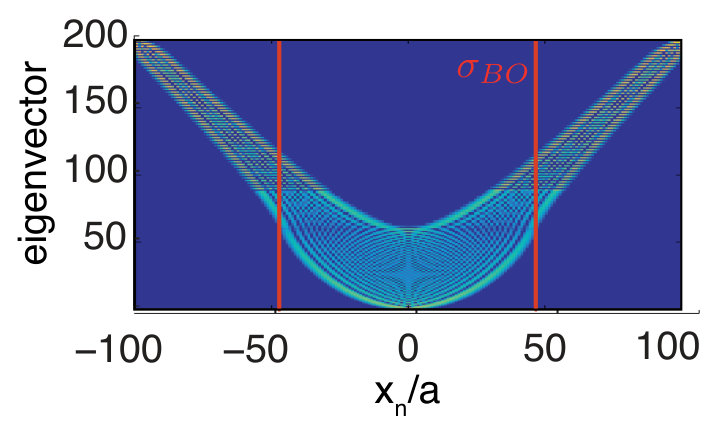 Figure 1
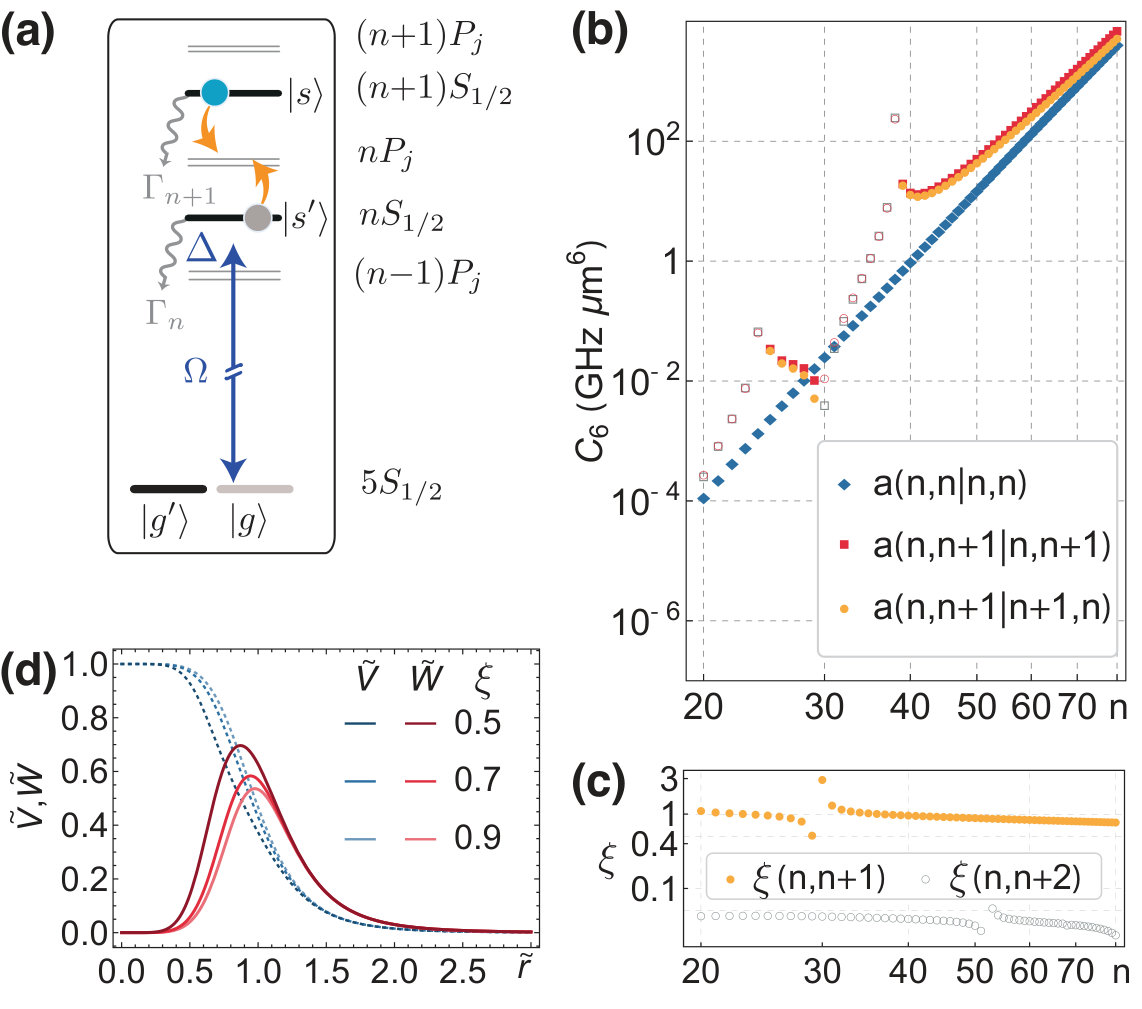 Figure 2
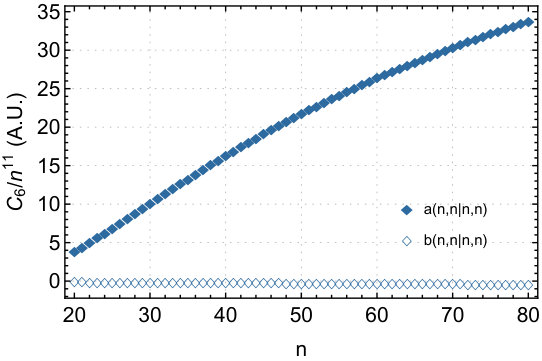 Figure 3
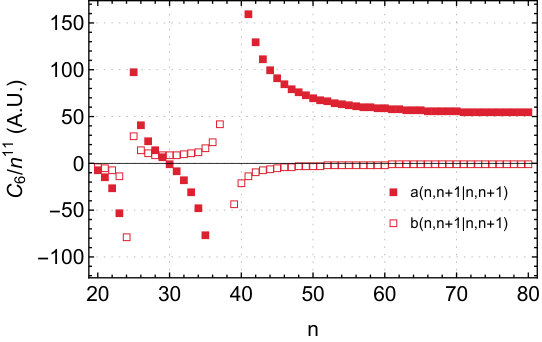 Figure 4
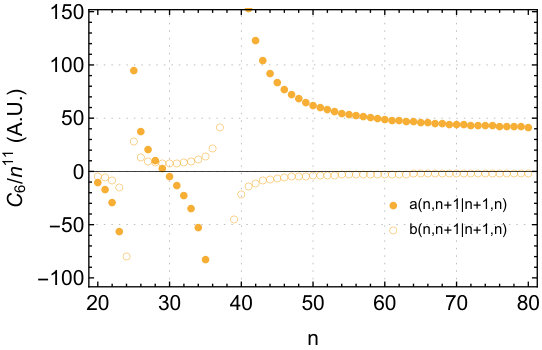 Figure 5
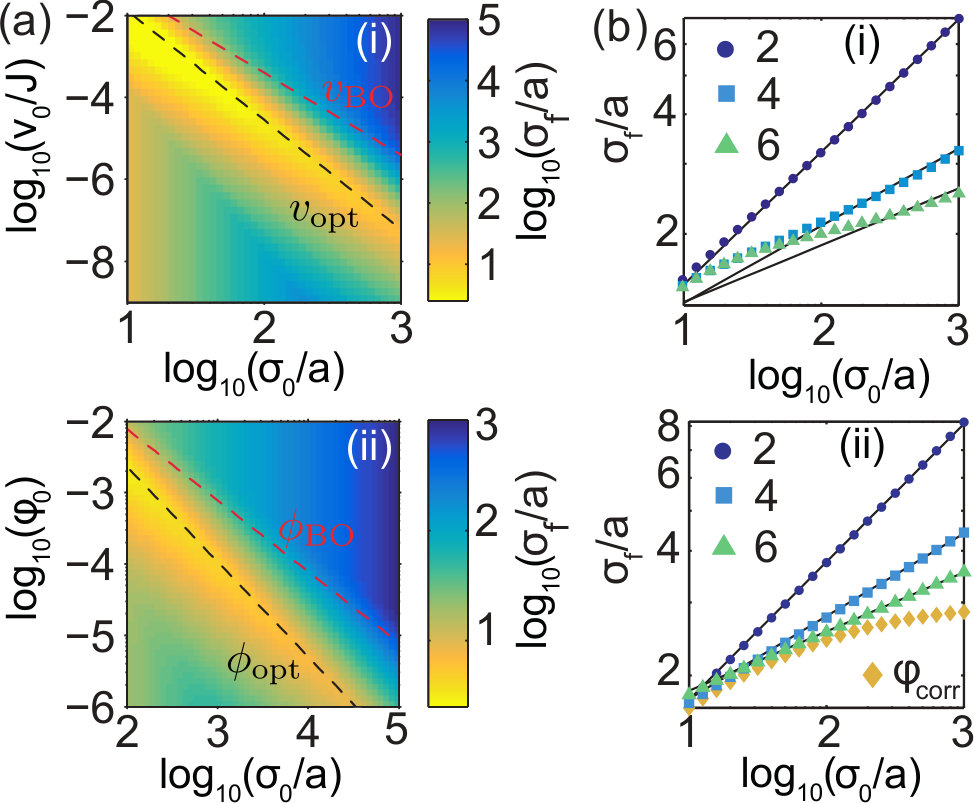 Figure 6
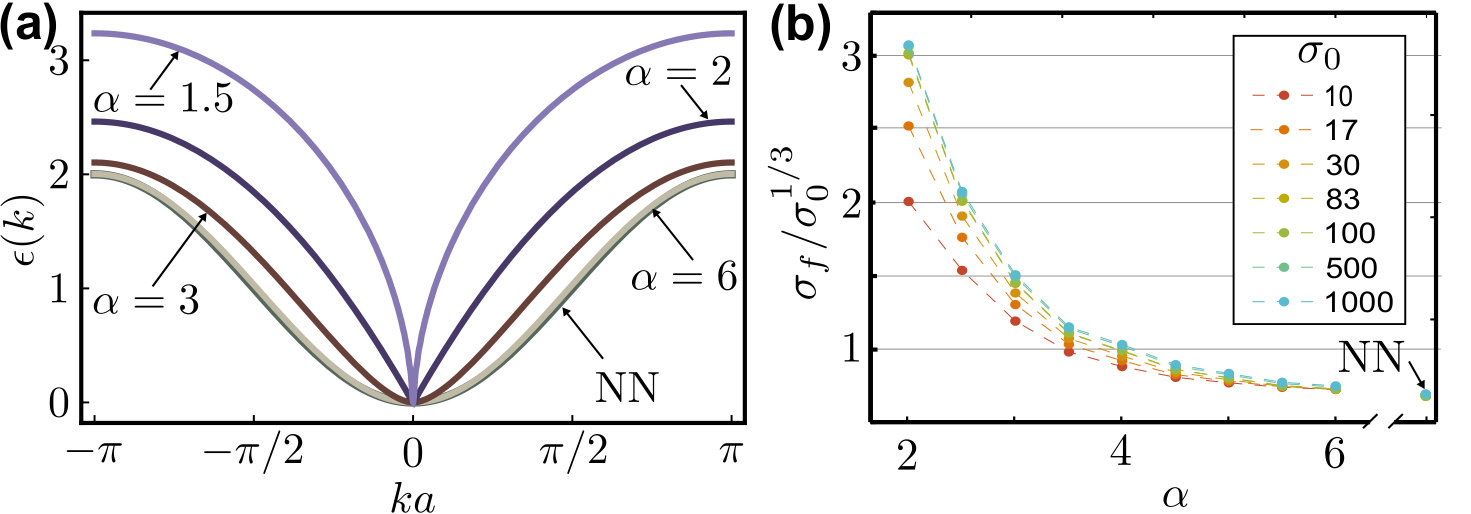 Figure 7
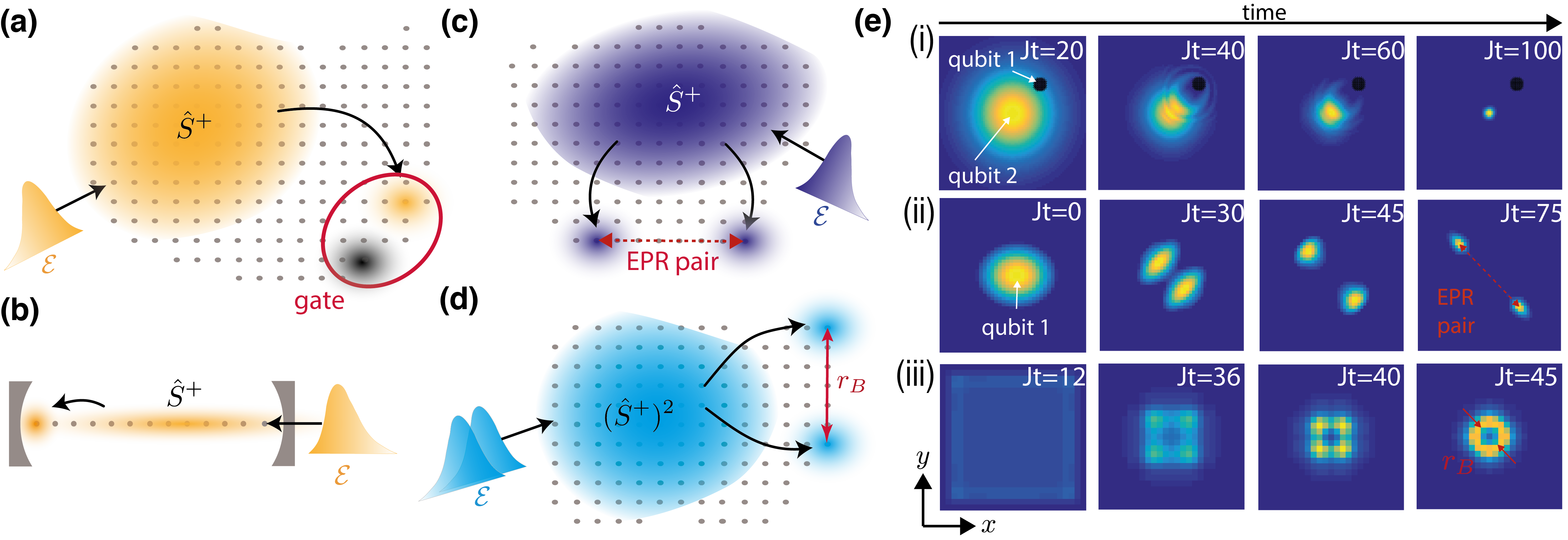 Figure 1
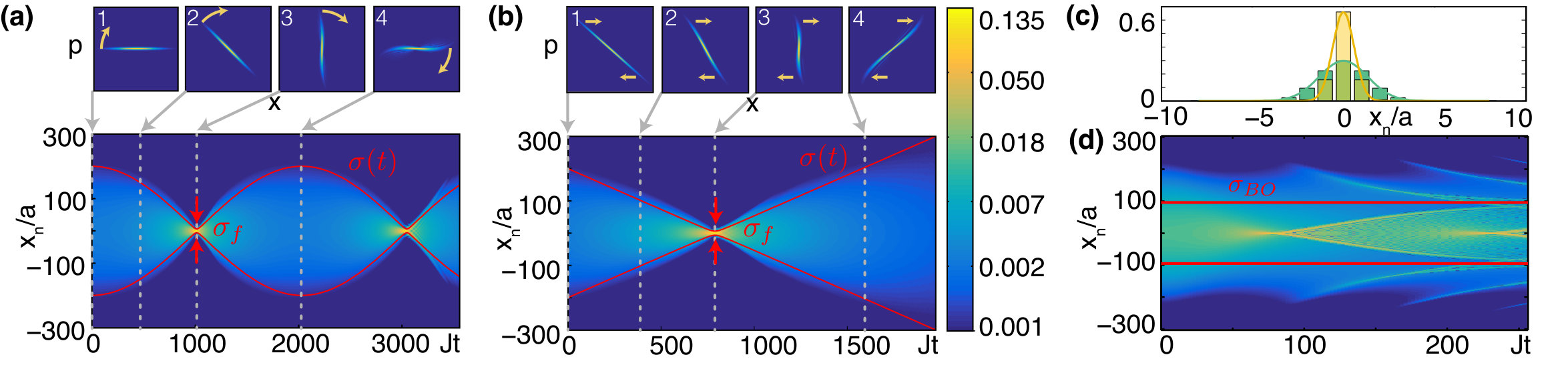 Figure 2
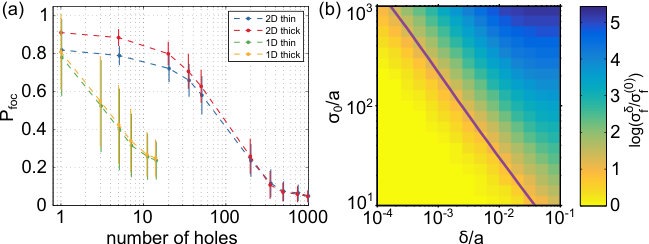 Figure 7
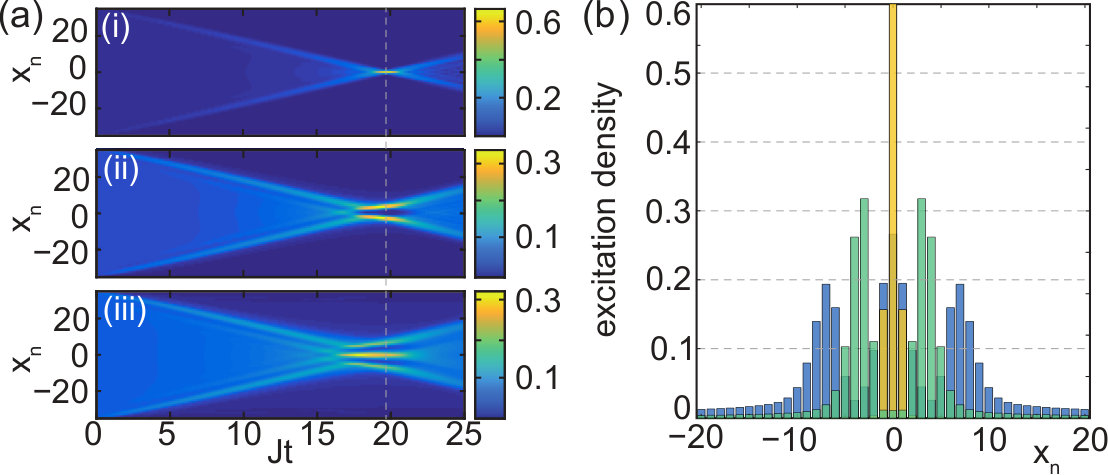 Figure 11
Peer Reviews
No public reviews on file for this paper yet. If you reviewed it on a platform where reviews are public (OpenReview, ICLR, NeurIPS, ICML), you can paste yours below so the community can read it here.
Videos
No videos yet. Explain this paper in a talk, walkthrough, or lecture? Add one.
‘Quantum Spin Lenses’ in Atomic Arrays
A. W. Glaetzle
Institute for Theoretical Physics, University of Innsbruck, A-6020 Innsbruck, Austria
Institute for Quantum Optics and Quantum Information of the Austrian Academy of Sciences, A-6020 Innsbruck, Austria
Centre for Quantum Technologies, National University of Singapore, 3 Science Drive 2, Singapore 117543
Clarendon Laboratory, University of Oxford, Parks Road, Oxford OX1 3PU, United Kingdom
K. Ender
Institute for Theoretical Physics, University of Innsbruck, A-6020 Innsbruck, Austria
Institute for Quantum Optics and Quantum Information of the Austrian Academy of Sciences, A-6020 Innsbruck, Austria
D. S. Wild
Department of Physics, Harvard University, Cambridge, Massachusetts 02138, USA
S. Choi
Department of Physics, Harvard University, Cambridge, Massachusetts 02138, USA
H. Pichler
ITAMP, Harvard-Smithsonian Center for Astrophysics, Cambridge, Massachusetts 02138, USA
Department of Physics, Harvard University, Cambridge, Massachusetts 02138, USA
M. D. Lukin
Department of Physics, Harvard University, Cambridge, Massachusetts 02138, USA
P. Zoller
Institute for Theoretical Physics, University of Innsbruck, A-6020 Innsbruck, Austria
Institute for Quantum Optics and Quantum Information of the Austrian Academy of Sciences, A-6020 Innsbruck, Austria
(March 2, 2024)
Abstract
We propose and discuss ‘quantum spin lenses’, where quantum states of delocalized spin excitations in an atomic medium are ‘focused’ in space in a coherent quantum process down to (essentially) single atoms. These can be employed to create controlled interactions in a quantum light-matter interface, where photonic qubits stored in an atomic ensemble are mapped to a quantum register represented by single atoms. We propose Hamiltonians for quantum spin lenses as inhomogeneous spin models on lattices, which can be realized with Rydberg atoms in 1D, 2D and 3D, and with strings of trapped ions. We discuss both linear and non-linear quantum spin lenses: in a non-linear lens, repulsive spin-spin interactions lead to focusing dynamics conditional to the number of spin excitations. This allows the mapping of quantum superpositions of delocalized spin excitations to superpositions of spatial spin patterns, which can be addressed by light fields and manipulated. Finally, we propose multifocal quantum spin lenses as a way to generate and distribute entanglement between distant atoms in an atomic lattice array.
I Introduction
In quantum information processing Ladd et al. (2010) with atoms, qubits are typically represented by internal atomic states, e.g. as long-lived spin excitations within the atomic ground state manifold Gardiner and Zoller (2015). Ideally, qubits are stored in single atoms, and for these qubits to be identifiable and addressable, we typically require localization of the atoms in well-defined spatial regions. Spatial control, and localization of single atoms is a pre-requisite to implement single and two-qubit operations, allowing addressing of individual qubits with laser light, and providing entangling operations between adjacent qubits by finite range interactions. Recent atomic physics experiments have demonstrated in a remarkable way the basic ingredients of single atom manipulation and addressing for trapped atoms and ions, and controlled interaction and entanglement between atomic spin qubits with Rydberg atoms Saffman et al. (2010); Bloch et al. (2012), trapped ions Schindler et al. (2013); Debnath et al. (2016); Jurcevic et al. (2014); Richerme et al. (2014), cavity QED setups Reiserer and Rempe (2015), and quantum interfaces Kimble (2008); Northup and Blatt (2014); Hucul et al. (2015).
In contrast to localized qubits stored in single trapped atoms, atomic ensembles provide us with qubits in the form of delocalized spin excitations Lukin (2003); Hammerer et al. (2010). Delocalized spin qubits arise naturally in light-atomic ensemble interfaces in both free space and cavity assisted setups. Here incident photons representing a ‘flying qubit’ are absorbed in an atomic ensemble with enhanced interactions benefiting from a large atom number , as in an optically thick medium, and converted into a spin excitation, which may be delocalized over the whole atomic cloud Eisaman et al. (2005); Lamata et al. (2011); Peyronel et al. (2012); Heinze et al. (2013); Maxwell et al. (2013). In order to create controlled interactions between such delocalized qubits it is desirable to convert delocalized spin qubits into localized qubits in the atomic array representing quantum memory. Thus ideally we want operations — a lens for spin excitations — on the atomic array, which allow in a coherent process ‘focusing’ of qubits to a well-defined and localized region, and ultimately to a single atom.
In this paper we propose and discuss linear and nonlinear ‘quantum spin lenses’ and their physical realization in quantum optical setups. We will first identify Hamiltonians to realize linear spin lenses, which map in a coherent process a delocalized to localized spin excitation, and vice versa. This has immediate application as a quantum atom-light interface, where incident photonic qubits are sequentially stored in an atomic array, and focused to a quantum register of spatially localized spin qubits represented by single atoms [see Fig. 1(a)]. Moreover, we can generalize the concept of the ‘quantum spin lens’ to a multifocal lens. In particular, this allows a single delocalized spin excitation to be mapped to a spatial EPR-like superposition state, thus providing a way to distribute or generate entanglement between (distant) atoms [c.f. Fig. 1(c)]. Finally, we will discuss the design of non-linear spin lenses, adding finite range (repulsive) spin-spin interactions to the spin-lens Hamiltonian. Thus focusing dynamics will be conditional on the number of initial spin excitations, and an initial quantum superposition state of delocalized spins will be mapped to a superposition of spatial spin patterns [c.f. Fig. 1(d)]. Remarkably, this provides a tool to manipulating the individual terms (corresponding to a specific excitation number) in the superposition state by spatially addressing in the atomic medium. As noted above, the relevant spin models are naturally implemented in existing atomic and solid state quantum optical setups, and we will illustrate this below with the examples of neutral atoms with Rydberg-mediated spin-spin interactions in 1D, 2D and 3D atomic lattices Maller et al. (2015a); Labuhn et al. (2016); Zeiher et al. (2016); Jau et al. (2016) using laser-dressing techniques Henkel et al. (2010); Pupillo et al. (2010); Glaetzle et al. (2015); van Bijnen and Pohl (2015), as well as with strings of trapped ions Jurcevic et al. (2014); Richerme et al. (2014).
II Linear Quantum Spin lenses: Focusing Dynamics of Single Spin Excitations
We are interested here in a scenario illustrated in Fig. 1(a), where an incident wave packet , representing a qubit as a superposition of vacuum and a one-photon wave packet, is stored as a delocalized spin excitation in a medium of two-level atoms. These two-level systems can be physically represented by long-lived atomic hyperfine ground states two-level atoms , with all atoms initially prepared in the ground state, and we assume atoms trapped in an array. Storage of a photonic qubit in the atomic medium is achieved, for example, in a Raman process Novikova et al. (2007); Gorshkov et al. (2007) , where the incident photon is absorbed and atoms, initially prepared in transferred to . Writing to atomic quantum memory thus corresponds to a mapping of the photonic qubit to the atomic state . Here , a sum of Pauli raising operators for atoms , creates a delocalized excitation distributed over the atoms according to an amplitude , acting on the ‘vacuum state’ with all atoms in the ground state. This mapping of photons to spin excitations should be understood in the spirit of the Holstein-Primakoff approximation, where excitations in the atomic medium are essentially bosonic for small excitation fractions.
A quantum spin lens aims to achieve a mapping of the delocalized atomic spin excitation to (ideally) a single atom, in a coherent quantum process, and preserving the superposition character of the qubit. Below we will first discuss spin-lens Hamiltonians that focus initially delocalized single spin excitations during the associated unitary time evolution. We will call this focusing dynamics of single excitations linear spin lenses, with nonlinear spin lenses as focusing of multiple interacting spin excitations to be discussed in the following section.
The focusing of single spin excitations discussed below can be generalized immediately to photonic qubits, provided we store and focus them sequentially, i.e. incident photonic qubits are absorbed and focused in the atomic medium one by one in spatially separated atoms representing a quantum register 111 Sequential mapping of qubits requires transfer of qubits stored in the excited states to another excited state to hide these qubits from the focusing dynamics of the following qubits. Note that these previously stored qubits appear as holes (defects) in the focusing dynamics of the consecutive qubits, as discussed in Sec. V.. Due to the spatial localization, these atomic qubits can now be individually addressed, and we can operate on them with single and two-qubit gate operations, implemented, for example, as Rydberg gates [see Fig. 1(a) and panel () of Fig. 1(e)].
II.1 Spin lens Hamiltonian with nearest-neighbor ‘flip-flop’ interactions
Focusing of a delocalized excitation in a spin chain is achieved with the Hamiltonian
[TABLE]
where are Pauli spin operators at lattice site . The first term describes hopping of the spin excitation (kinetic energy), which for the moment we take as nearest neighbor hopping, while the second term is a spatially dependent energy shift . While in Eq. (1) we write a 1D model, the present discussion can in a straightforward way be generalized to higher dimensions.
The Hamiltonian (1) is motivated by analogy to an optical lens with imprinting a phase on the -th spin centered around lattice site , reminiscent of the refractive material of a lens Lohmann (1993); Schleich (2015). The analogy to an optical lens is best illustrated by visualizing the focusing dynamics of single spin excitations with a Wigner phase space distribution as a function of time [see Fig. 1(e) and Fig. 2(a,b), upper panel]. We write the wave function of the single spin excitation as with amplitude initially delocalized as a wave packet of spatial width over the lattice, and we define a Wigner function on the lattice as Berry (1977); Bizarro (1994) ()
[TABLE]
Here () are discrete lattice positions with the lattice spacing, and momentum is -periodic, and we denote by spin waves with momentum on an infinite lattice. A momentum space representation of the time-dependent Schrödinger equation with Hamiltonian (1) shows that the dynamics is the one of a quantum pendulum. The first term in (1) gives rise to a Bloch band dispersion relation , and the quadratic potential term maps to a Laplacian in , i.e. a kinetic energy term.
Focusing dynamics is best illustrated in the continuum limit, i.e. we assume that the spin dynamics is smooth on the scale of the lattice spacing, and the wave function in momentum space remains localized to a region at the bottom of the Bloch band. Thus the dispersion relation is well approximated by for small momenta , and the Wigner function maps to the standard Wigner function for the continuous variables and . The Hamiltonian (1) becomes an effective harmonic oscillator (HO), with momentum and position . Here we have defined a frequency , mass , and we denote by the HO length. Under this Hamiltonian an initial Wigner function, , simply performs a (classical) rigid rotation in phase space, , where position, , and momentum, , describe elliptical trajectories in phase space as a function of time. Thus, an initial wave packet with width in position space is transformed after a quarter of period, , to a spatially localized state with width , as familiar from squeezed states Gardiner and Zoller (2015) 222In contrast to focusing with quench dynamics in a HO, as described above, one could also localize the wave function in an adiabatic ramp of the harmonic oscillator, i.e. by sweeping . An initial Gaussian wave packet, which is matched to represent the HO ground state with with width would then be mapped to the final ground state with width , with time required . Quench dynamics discussed in this paper results in fast focusing , and does not require good knowledge of the initial wave function or control over the applied trapping potential to match the initial wave packet to the HO ground state. In contrast, an adiabatic scheme can be expected to be more robust against imperfect parameters in Hamiltonian (1).
In this continuum approximation the single particle Schrödinger equation from (1) is formally equivalent to the paraxial Helmholtz equation Schleich (2015). The role of time in the Schrödinger equation is replaced by the axial dimension in the paraxial Helmholtz equation, and the potential translates to a spatially dependent refractive index. This allows to interpret most of the focussing dynamics in the language of classical optics. So far we considered focusing of a delocalized excitation in a potential , which is ‘on’ during the whole dynamics. In analogy to optics this corresponds to light propagating in a graded index multimode fiber. In the following we will refer to this dynamics as a ‘thick lens’. This is to distinguish from a second scenario, discussed below, where focussing is achieved by a ‘thin lens’.
In Fig. 2(a) we illustrate focusing dynamics of a ‘thick lens’ for spin excitations with the lattice model (1) in a parameter regime where the continuum approximation is well justified (see below for details). For an initial Gaussian wave packet with spatial width , corresponding to a (in the continuum limit) cigar shaped Wigner function , the spatial width starts oscillating as a function of time [see red line in panel (a)] and has periodic minima at every quarter of a period where . The final width in real space (after a quarter of a period) corresponds to the Fourier transform of the initial wavefunction, i.e. , as for an optical lens. The focusing in real space is illustrated in Fig. 2, where panels 1-4 show the corresponding phase space dynamics of the Wigner function.
Instead of the ‘always-on’ Hamiltonian (1) of the ‘thick lens’, focusing can also be obtained in a pulsed scheme, where the quadratic potential term is switched on for a short time only. This imprints a position dependent momentum kick (with ) onto the initial wavefunction via the quadratic phase shift , followed by a free evolution of the spin system via (1) with , as illustrated in Fig. 2(b). This is in analogy with a ‘thin lens’ in classical optics, where a thin refractive material imprints a position dependent phase onto the incoming plane wave. The Wigner function in phase space first acquires a momentum kick , followed by free evolution corresponding to a shear motion of the Wigner function, i.e. , as illustrated in panels 1-4 of Fig. 2(b). In contrast to the ‘thick lens’ there is a single focal time ( for ) where a Gaussian wavefunction has its minimum width .
Figure 2(c) shows the spatial excitation probability for lattice sites around the focus. The green bars correspond to the dynamics illustrated in panel (a). An excitation initially delocalized over lattice sites gets localized on lattice sites using a ‘thick’ lens including corrections up to sixth order (described in IIB). One can improve the focusing by using multiple pulses or even combining the two different schemes. For example, we can further focus the spin excitation from lattice sites to lattice sites, shown as the yellow bars in panel (c), by adjusting the lens strength to the new initial condition.
II.2 Lattice Corrections – Dephasing and Bloch Oscillations
Corrections to the continuum limit become important when the delocalized excitation is focused to a spatial region on the order of the lattice spacing, and the Wigner function extends close to the border of the first Brillouin zone. This happens for ‘sufficiently strong potential’ in Eq. (1), which leads to aberration and Bloch oscillations due to deviation from a quadratic dispersion relation. In the following we discuss the limitations this imposes on the achievable final width and show how the effects of the non-quadratic dispersion relation can be compensated using non-parabolic lens potentials.
The main results are summarized in Fig. 3(a) where the numerically obtained final width is plotted as a function of the initial width and lens strength or for the (i) ‘thick’ and (ii) ‘thin’ lens on a lattice, respectively. Simulations have been performed on a 1D chain with () spins according to Eq. (1) for the thin (thick) lens setup. In contrast to the continuum picture, where a stronger lens leads to a tighter spatial focus and a faster focusing time, the numerical results show that there exist optimal ‘lens potentials’ (see below) scaling as
[TABLE]
for the ‘thick’ and ‘thin’ lens setups, illustrated as black dashed lines in Figs. 3(a). At this optimal lens strength the final achievable width scales as
[TABLE]
for both the ‘thick’ and ‘thin’ lens with obtained numerically. Focusing works well below this optimal lens strength, in excellent agreement with Figs. 2(a,b). The scaling of Eq. (3) (black line) is in perfect agreement with the numerically evaluated final width (blue dots) shown in Fig. 3(b) for (i) the ‘thick’ and (ii) the ‘thin’ lens with and , respectively.
In the following we discuss the two main effects of the lattice: abberation, giving rise to the optimal lens potentials of Eq. (2), and Bloch oscillations at the edge of the lens shown in Fig. 2(d). We show that the corresponding aberration can be addressed using potentials and pulse shapes that include quartic and higher order terms.
Abberation: Deviations from the continuum model can be understood as arising from the non-linear group velocity on the lattice, which implies that wave packets with large momenta propagate more slowly in a lattice than in the continuum limit, where . The difference between the two velocities is only negligible provided the path difference during the focusing time is small compared to the final size of the wave packet, i.e. . Expanding the sine up to third order and evaluating the equation at the maximum momentum we obtain Eq. (2) (see appendix A). The difference in the group velocities further explains the ‘’-shaped distortion of the Wigner function observed panels 1-4 of Fig. 2(a,b) as the non-linear group velocity induces a non-rigid rotation in phase space.
Bloch oscillations: At an even larger potential strength, the wings of the wave packet with an extension larger than
[TABLE]
will undergo Bloch oscillations (see appendix A), as illustrated in Fig. 2(d). This limits the lens strength to values well-below , indicated as red dashed line in Figs. 3(a). At this critical lens potential the (local) potential gradient gives rise to Bloch oscillations with an amplitude and frequency Ben Dahan et al. (1996). If this frequency becomes of the order of the focusing time focusing becomes ineffective. A similar argument for the thin lens yields the maximum pulse strength . In contrast to Bloch oscillations in the thick lens, for the thin lens focusing is limited by phase wraps as the momentum kicks imparted by the pulse extend beyond the first Brillouin zone.
Correction of aberration: Quartic deviations from the dispersion relation limit the final width of the spin wave to . Similar to aspherical lenses, the effect of dephasing due to the non-quadratic dispersion relation, can be compensated using more general potentials (‘thick’ lens) and imprinted phase profiles (‘thin’ lens), of the form
[TABLE]
including additionally quartic (), sixth () or even higher order terms. Such higher order terms will accelerate the wings of the wave packet stronger compensating for their smaller group velocities on the lattice. Using a similar argument as in appendix A, one can show that for an appropriate choice of this leads to an improved scaling
[TABLE]
Fig. 3(b) plots the final width as a function of the initial width for () the ‘thin’ and () the ‘thick’ lens setup using a lens strength up to and . The numerically obtained final width agrees well with the scaling of Eq. (6).
For the ‘thin’ lens an optimized form of Eq. (5) can be derived analytically using a semi-classical model with continuous spatial variable and a Bloch band dispersion giving rise to a non-linear group velocity . Given the imprinted phase profile , the initial wave packet receives a position dependent momentum kick . In order to focus all parts of the wave packet to the focal point at the same time , we require which yields
[TABLE]
with . Panel (ii) of Fig. 3(b) shows the final width obtained using (7) with on a lattice (yellow diamonds), which shows a clear improvement over the parabolic phase profile. Note that is only real-valued up to due to the maximum group velocity on a lattice, since only parts of the wave packets with distance can be focussed within the focusing time.
II.3 Multifocal Lenses and Generation of EPR states
Instead of the single focus lens, as in (1), we can employ double well, or multi-well potentials. The corresponding potentials can be generated as spin dependent optical potentials, and an array of spin lenses can be realized with large spacing optical lattices. A multifocal lens operating on a single initial delocalized spin excitation will generate a superposition state of excitations at the focal points. For two foci, for example, we can generate an EPR type state
[TABLE]
Thus we generate a superposition (EPR state) between spins at lattice site and , as schematically illustrated in panel () of Fig. 1(c).
The time evolution of the corresponding multi-focal lens is visualized in panel () of Fig. 1(e). In the upper half plane () we used the 2D potential with focal points while in the lower half plane () we used with . Note that in Fig. 1(e) we rotated the potential by 45 degrees. The potential strength is optimized to for an initially symmetric Gaussian wave function with radial spatial width on a 2D lattice with lattice sites.
II.4 Long-range ‘flip-flop’ interactions
Implementations of Hamiltonian (1) with Rydberg atom in optical lattices or strings of trapped ions motivate a model
[TABLE]
with long-range ‘flip-flop’ interactions . In particular, dipolar and van der Waals interactions between Rydberg (dressed) atoms allow to realize and Saffman et al. (2010), respectively, while can be realized with strings of ions Schindler et al. (2013); Debnath et al. (2016); Jurcevic et al. (2014); Richerme et al. (2014). The first term of (9) gives rise to a dispersion relation , as shown in Fig. 4(a). While for the dispersion relation closely resembles the one of the nearest-neighbor ‘flip-flop’ interactions of (1), for the dispersion relation exhibits a kink, e.g. , resulting in a linear group velocity at small momenta with a discontinuity at . This leads to strong aberration and inefficient focusing. We note that this can be corrected using an adiabatic lens schemes 22footnotemark: 2.
Fig. 4(b) shows [see Eq. (3)] for different realizations of for the ‘thick’ lens setups. While for large values of the scaling of Eq. (3) agrees with the numerically obtained final width, for smaller values the linear dispersion relation leads to strong deviations. The smallest final width (smallest ) is obtained for large values of and ultimately with nearest-neigbor interactions, however, almost perfectly resembles nearest-neighbor interactions.
III A Non-linear quantum spin lens: Focusing and spatial sorting of multi-photon
states
While the lenses discussed so far are linear lenses operating on single spin excitations, we can also design non-linear lenses, where the focusing dynamics depend on the number of spin excitations in the medium via spin-spin interactions. Returning to the light-matter interface discussed at the beginning of Sec. II, we now generalize to an incident multiphoton superposition state . For a write process to atomic quantum memory using a Raman scheme involving a pair of atomic ground state levels (as described in Ref. Fleischhauer and Lukin (2002)), this multiphoton state will be mapped to a superposition of (dilute) delocalized spin excitations, (representing hardcore bosons). Repulsive spin-spin interactions, which become relevant during the focusing dynamics when the excitation density increases, will map this superposition state to a superposition of spatial spin patterns in an atomic quantum memory. We note that this provides a means of manipulating the individual terms in the superposition state by spatially addressing the atomic spins with a laser. These transformed superposition states of spins can then be mapped back to photons in a defocusing and read operation, providing effective nonlinearities and manipulation of quantum states on the single photon level.
Non-linear quantum lenses can be implemented by generalizing the Hamiltonian (1) to
[TABLE]
with the last term a long-range spin-spin interaction and blockade distance . We emphasize that the spin-spin interactions in (10) arise naturally in Rydberg (dressed) gases and in trapped ion spin models. Time evolution according to the above Hamiltonian will propagate the initial quantum state to a strongly correlated many-body quantum state,
[TABLE]
with
[TABLE]
and the spatial wave functions for spin excitations.
Figure 5 illustrates these focusing dynamics of interacting spins according to (10) for an initial superposition state consisting of exactly one, two or three delocalized spin excitations as a function of time. We plot the excitation probability as a function of position in the lattice, at lattice site for , which clearly exhibits the spatial mapping and resolution of spin patterns associated with of Eq. (12). This allows to perform gate operations on spatially localized atoms, e.g. atoms or , in order to manipulate the or contribution of the superposition state individually. We note that the small excitation fraction between the peaks, e.g. population of atoms with for (green bars), can be traced back to states in the initial wave function where two excitations were closer than . This fraction of states becomes smaller by decreasing the initial excitation density, i.e. increasing the atom number.
The above can be immediately generalized to higher dimensions. In particular, Fig. 1(e), bottom panel (iii), illustrates focusing of two spin excitations () in 2D. In this case the repulsive spin-spin interactions give rise to a superposition of states with two excitations separated by a characteristic distance around the single-excitation focus forming a ring, reminiscent of a quantum crystal.
IV Implementation with Rydberg atoms in 2D and 3D arrays
The quantum spin lenses proposed in the previous sections can be implemented with atoms stored in optical trap arrays, including large spacing optical lattices and and optical tweezers Endres et al. (2016); Barredo et al. (2016); Maller et al. (2015b) in 1D, 2D and 3D, or alternatively with trapped ions in 1D Schindler et al. (2013); Debnath et al. (2016); Jurcevic et al. (2014); Richerme et al. (2014).
Below we describe first a realization of a linear spin-lens Hamiltonians of the type (1) in 1D, but in particular also in 2D and 3D with alkali Rydberg atoms, where the spin degree of freedom of Sec. II is represented by a pair of levels involving a long-lived atomic hyperfine ground state, and a highly-excited Rydberg state. As an example, we consider 87Rb atoms and choose as the spin down and as the spin up state [see Fig. 6(a)]. Note that in this section we denote by the principal quantum number.
Long-range spin exchange interactions between spins and in 3D can be achieved by weakly dressing the atomic ground state by admixing with a laser a second Rydberg state with (effective) Rabi frequency and detuning . This particular choice of Rydberg states leads to spin couplings , which are isotropic in 3D, i.e. a purely radial dependence as a function of the distance for a large range of principal quantum numbers van Bijnen (2011); Whitlock et al. (2017). We note that, e.g. dipolar exchange interactions can be engineered by dressing the ground state with Rydberg states resulting in anisotropic flip-flop interactions of the form Barredo et al. (2015).
To obtain the desired flip-flop term in Eq. (1) we first consider two atoms and derive an effective Hamiltonian for the dynamics between the dressed ground state and the Rydberg state. We start with a microscopic Hamiltonian, , where the first two terms account for the two driven atoms with written in a rotating frame . A small magnetic field and a circularly polarized laser beam allows dressing of the ground state with a specific Zeeman sublevel of the Rydberg state.
The key element of the implementation is the van der Waals interaction, , between the and Rydberg states. Choosing two -states ensures that the resulting vdW interactions are isotropic in 3D over a large range of principal quantum numbers (see appendix B). The exchange interaction between the degenerate states and dominantly arises via virtual population of Rydberg states [see Fig. 6(a)] and strongly depends on and . As a particular example to demonstrate the tunability of the resulting spin interactions we discuss the case for which the exchange process is maximized [see Fig 6(c)]. The interaction has the structure
[TABLE]
written in the basis of states , and where we neglect the interactions, since we start initially with only one excitation and considering a linear lens. The generalized vdW coefficients (diagonal) and (exchange) are shown in Figure 6(a) and derived in appendix B. The linear behavior (on the log-scale) of shows the typical scaling of vdW interactions. The resonances in and for and stem from vanishingly small energy differences between to the states and , respectively. Close to one of the Förster resonances diagonal and off-diagonal interactions become approximately equal, , which are both dominated by a single channel.
Adiabatic elimination of in the limit leads to an effective long-range spin model between the dressed ground state and the Rydberg state of the form
[TABLE]
with Pauli operators and effective laser admixed interactions and given by
[TABLE]
Here, , () is a dimensionless distance and is the relative exchange strength (see Fig. 6). Note that we have dropped the AC Stark shift, which affects all states equally. The potentials are shown in Fig. 6(a) as a function of interatomic distance. As a particular example we consider dressing to the Rydberg state with (two-photon) Rabi frequency and detuning with a lattice constant adjusted to the maximum of which results in MHz resulting in a typical focusing times for an initial width around which increases linearly with the initial width This compares well with the lifetime of the state with Beterov et al. (2009) resulting in .
Instead of the spin models with atomic ground and Rydberg states representing a spin system, one can also employ dressing schemes, where spin is represented by a pair of long-lived and trapped atomic ground states, and spin hopping and interaction terms are obtained by admixing with a laser Rydberg interactions Glaetzle et al. (2015); van Bijnen and Pohl (2015). Such schemes may be convenient for the non-linear lenses described in Sec. III.
V Effects of disorder on focusing dynamics
In this section we analyze the robustness of the focusing dynamics against two types of static disorder in the spin lattice: () holes in the lattice and () static fluctuations of the atomic position resulting in a random distribution of long-range spin couplings and in Eq. (14).
Non-unity filling: Missing atoms in the lattice may arise due to imperfect loading or when a previously focused spin wave is stored in a different hyperfine ground state. In addition to being excluded from the hopping matrix , each hole is surrounded by an effective potential due to the modification of in Eq. (14). We numerically investigated the effect of randomly distributed holes in both one and two dimensions. Fig. 7(a) shows the spin excitation probability within a radius around the focus of the lens, , for a 1D and 2D spin lattice of and sites, respectively. Each data point is obtained by averaging over 1000 random hole realizations for the 1D example (400 realizations for 2D), starting with a Gaussian wavefunction with initial width . The width of the statistical distribution of the final probability is indicated by the error bars.
For the 1D case, a single hole already has a significant detrimental effect on the final wave packet, which we attribute to the fact that closely resembles nearest-neighbor hopping. By contrast, in 2D the focusing-scheme is almost unaffected by a small number of holes (), as the spin wave can ‘flow’ around the holes. This is further illustrated in panel (i) of Fig. 1(e) as a sequence of snapshots showing the 2D lattice of spins as a function of time. We expect the focusing scheme to be even more robust in three dimensions as there are more paths to avoid the holes.
Static disorder in atomic positions: As a second form of disorder we analyze the effect of fluctuations of the long-range spin couplings and . Such models have previously been discussed in the context of Rydberg atoms trapped in optical tweezers Marcuzzi et al. (2017). We assume that the position of the -th atom is given by , with the position on a regular lattice and the displacement drawn from a normal distribution with zero mean and standard deviation . This results in a change of the interatomic separation , in turn modifying the diagonal and hopping potentials of Eq. (14) to and . We note that the first order term in the expansion of may vanish for certain separations, e.g. nearest neighbors, if the maximum of the interaction potential is commensurate with the lattice. However, the first order term will be present for all other separations, as well as in the expansion of which exhibits no maximum or minimum as a function of distance (see Fig. 6).
Disorder tends to localize the eigenstates of the system and thus prevents focusing when the localization length is smaller than the initial width of the wave packet Anderson (1958). However, the focusing fidelity may be significantly reduced even if the localization length is large. To quantify the role of disorder we estimate the energy broadening of plane wave states due to position disorder. In a regular lattice, plane wave states with momentum are energy eigenstates following the dispersion relation . In the presence of weak disorder, states with similar momenta are coupled together such that the energy of a plane wave acquires an uncertainty on the order of , where and denote the Hamiltonian of the disordered and the clean system, respectively. Since our scheme sensitively relies on the interference between different momentum states, we expect that focusing ceases to be effective when the focusing time exceeds . Given that to lowest order in , this suggests that there exists a critical disorder strength above which the disorder strongly affects the focusing dynamics. Indeed, this simple argument correctly predicts the breakdown of focusing as demonstrated in Fig. 7(b). We note that we numerically verified that the argument applies equally well to the ‘thin lens’.
VI Conclusion and Outlook
In this work we have shown that lenses for spin qubits can be designed for atomic lattice gases, allowing focusing of delocalized spin excitations in quench dynamics to essentially single atoms. In addition, we have provided an implementation of a spin lens based on Rydberg-dressed spin-spin interactions. The present work defines a novel light-matter interface, where incoming photons are stored in delocalized atomic excitations in an atomic medium, with spin focusing providing the link and mapping to storage of qubits in single atoms. We note that existing experimental setups with Rydberg atoms Maller et al. (2015a); Labuhn et al. (2016); Zeiher et al. (2016); Jau et al. (2016) enabling the physical realization of 1D and 2D -spin models can provide first proof-of-principle experiments: here a single delocalized spin excitation as initial condition could be generated using the Rydberg-blockade mechanism in an atomic lattice Schauß et al. (2012); Endres et al. (2016); Barredo et al. (2015), and with focusing dynamics implemented as described in the present work. This scenario could also be demonstrated with the spin models realized with trapped ions Jurcevic et al. (2014); Richerme et al. (2014). Finally, we expect that optimal coherent control techniques both for spatial and temporal model parameters should allow for significant improvement of ‘spin lenses’ Caneva et al. (2011).
Acknowledgments: We acknowledge discussions with M. Heyl and UQUAM partners C. Gross and I. Bloch. Work at Innsbruck is supported by the Austrian Science Fund SFB FoQuS (FWF Project No. F4016-N23), the European Research Council (ERC) Synergy Grant UQUAM, EU H2020 FET Proactive project RySQ and Scalable Ion-Trap Quantum Network (SciNet). Work at Harvard is supported through NSF, CUA, AFOSR Muri and the Vannevar Bush Faculty Fellowship. AWG acknowledges funding from the National Research Foundation and the Ministry of Education of Singapore. SC acknowledges support from Kwanjeong Educational Foundation. HP is supported by the NSF through a grant for the ITAMP at Harvard University and the Smithsonian Astrophysical Observatory.
Appendix A Lattice Corrections
In this Appendix we discuss dephasing and Bloch oscillations on the lattice and derive Eq. (2) for the optimal lens strength and Eq. (3) for the scaling of the final width.
Dephasing: The optimal potential strengths and optimal pulse strength of Eq. (2) for the ‘thick’ and ‘thin’ lens, respectively, can be derived from the Bloch-band dispersion relation and its deviations from the quadratic dispersion relation . If these deviations become of the order of the inverse focusing time, i.e. , then plane wave eigenstates will dephase during the focusing dynamics. This happens for parts of the Wigner function exceeding a critical momentum for the ‘thick’ lens and for the ‘thin’ lens setup. During focusing the distribution of momentum states populated will become broader with the largest width in momentum space, i.e. , at the focusing time. This limits the minimum final width and restricts the the ‘lens potential’ to values below for the ‘thick’ lens, as well as the critical pulse strength for the ‘thin’ lens.
Bloch oscillations: The onset of Bloch oscillations at of Eq. (4) and the corresponding critical potential strength can be understood in a semi-classical model for a particle in a quadratic potential with a Bloch-band dispersion relation, following the (semi-classical) equations of motion and for position and momentum, respectively. These equations are equivalent to a motion of a classical particle with a quadratic dispersion relation in a modified potential . Depending on its initial position being smaller or larger than the particle will either experience a single well or a double well potential. Fig. 2(d) shows the corresponding eigenfunctions of the lattice Hamiltonian (1). Eigenfunctions which have an extension less than are well described by discretized harmonic oscillator eigenfunctions centered around the origin, while eigenfunctions with an extension larger than start to get localized at the minima of the double wells of . Thus, Bloch oscillations start to dominate the focusing dynamics at a critical potential strength, , which is indicated as the red dashed line in Figs. 3(a).
Appendix B Rydberg interaction between 87Rb atoms in and
Rydberg states
For distances large enough, such that the dipole interaction matrix element between two -states and two -states is larger than the energy difference between these pair states, i.e., , we can treat vdW interactions perturbatively. The vdW interaction Hamiltonian between and Rydberg states can be described by a 1616 matrix of the form
[TABLE]
The vdW coefficients are given by
[TABLE]
is a 44 matrix in the subspace of Zeeman levels and the vdW interaction operator
[TABLE]
coupling -states with energy and to intermediate -states with energies and via dipole-dipole interactions
[TABLE]
Here, is the atomic dipole operator and is the vector between the two atoms in spherical coordinates. With we denote the -th spherical components () of the atomic dipole operator, are Clebsch-Gordan coefficients and are spherical harmonics. Using Wigner-Eckart’s theorem the vdW interactions can be split up in an angular and radial part
[TABLE]
with generalized isotropic and anisotropic vdW coefficients
[TABLE]
and the 44 identity matrix and
[TABLE]
written in the basis of Zeeman states in the Rydberg manifold and accounting for the anisotropy and mixing between the Zeeman sublevels. With we denote the radial part of the matrix elements
[TABLE]
which accounts for the overall strength of the interaction and is independent of the magnetic quantum numbers. Here, is the radial integral and accounts for the four channels to intermediate states.
Figure 9 shows the numerically calculated and coefficients corresponding to the different blocks in Eq. (16) as a function of the principal quantum number . Both and show two Förster resonances around and where the channels to and states become close in energy, respectively. Apart from these resonances the anisotropy coefficient is several orders smaller then the diagonal coefficient which allows to safely neglect mixing of Zeeman sublevels and results in an almost perfect isotropic interaction.
For two atoms initially in the and states this allows to reduce the dynamics to the four states states with principal quantum numbers , , and and magnetic quantum number . The corresponding Hamiltonian restricted to this basis has the form
[TABLE]
with denoted as in the main text and plotted in Fig. 6(a) as a function of the principal quantum number .
For the long-range Hamiltonian of Eq. (14) (cf. Fig. 6(c)) next-nearest neighbor hopping is around 10% of the nearest neighbor hopping element. In Fig. 4 we compare the performance of a spin lens implemented with the potentials arising from the Rydberg interactions, compared to the case with ideal nearest neighbor hopping. Our numerical results indicate that long-range hopping terms slightly increase the speed of the scheme and decrease the final width.
The reference list from the paper itself. Each links out to its DOI / PubMed record.
- 1Ladd et al. (2010) T. D. Ladd, F. Jelezko, R. Laflamme, Y. Nakamura, C. Monroe, and J. L. O’Brien, Nature 464 , 45 (2010) . · doi ↗
- 2Gardiner and Zoller (2015) C. Gardiner and P. Zoller, in The Quantum World of Ultra-Cold Atoms and Light Book II: The Physics of Quantum-Optical Devices (World Scientific, 2015) pp. 1–524. · doi ↗
- 3Saffman et al. (2010) M. Saffman, T. G. Walker, and K. Mølmer, Rev. Mod. Phys. 82 , 2313 (2010) . · doi ↗
- 4Bloch et al. (2012) I. Bloch, J. Dalibard, and S. Nascimbene, Nat Phys 8 , 267 (2012) . · doi ↗
- 5Schindler et al. (2013) P. Schindler, D. Nigg, T. Monz, J. T. Barreiro, E. Martinez, S. X. Wang, S. Quint, M. F. Brandl, V. Nebendahl, C. F. Roos, et al. , New Journal of Physics 15 , 123012 (2013) . · doi ↗
- 6Debnath et al. (2016) S. Debnath, N. Linke, C. Figgatt, K. Landsman, K. Wright, and C. Monroe, Nature 536 , 63 (2016) . · doi ↗
- 7Jurcevic et al. (2014) P. Jurcevic, B. P. Lanyon, P. Hauke, C. Hempel, P. Zoller, R. Blatt, and C. F. Roos, Nature 511 , 202 (2014) . · doi ↗
- 8Richerme et al. (2014) P. Richerme, Z.-X. Gong, A. Lee, C. Senko, J. Smith, M. Foss-Feig, S. Michalakis, A. V. Gorshkov, and C. Monroe, Nature 511 , 198 (2014) . · doi ↗