Dirac Cone in two dimensional bilayer graphene by intercalation with V, Nb, and Ta transition metals
Srimanta Pakhira, Kevin P. Lucht, and Jose L. Mendoza-Cortes

TL;DR
This study demonstrates how intercalating transition metals like V, Nb, and Ta into bilayer graphene can induce Dirac cones and tune electronic properties, revealing new ways to control 2D material behaviors.
Contribution
The paper introduces a novel first-principles approach to control the electronic properties of bilayer graphene through transition metal intercalation, achieving Dirac cones and diverse electronic phases.
Findings
BLG intercalated with V exhibits a Dirac cone at the K-point.
Transition metal intercalation influences the Fermi level electron density.
The electronic properties can be tuned from metal to semiconductor by varying TM concentration and spin.
Abstract
Bilayer graphene (BLG) is semiconductor whose band gap and properties can be tuned by various methods such as doping or applying gate voltage. Here, we show how to tune electronic properties of BLG by intercalation of transition metal (TM) atoms between two monolayer graphene (MLG) using a novel dispersion-corrected first-principle density functional theory approach. We intercalated V, Nb, and Ta atoms between two MLG. We found that the symmetry, the spin, and the concentration of TM atoms in BLG-intercalated materials are the important parameters to control and to obtain a Dirac Cone in their band structures. Our study reveals that the BLG intercalated with one Vanadium (V) atom, BLG-1V, has a Dirac Cone at the K-point. In all the cases, the present DFT calculations show that the 2 sub-shells of C atoms in graphene and the 3 sub-shells of the TM atoms provide the electron…
Click any figure to enlarge with its caption.
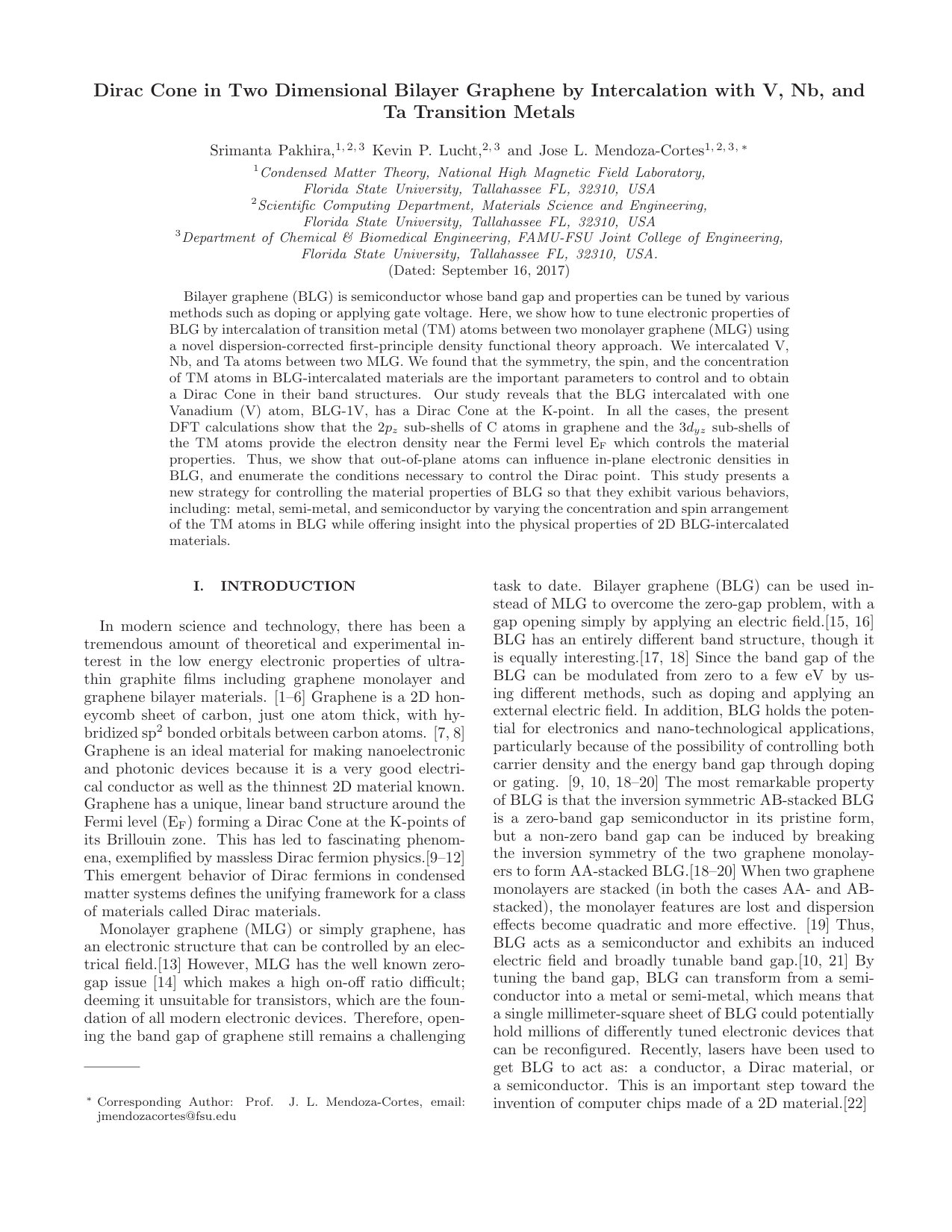 Figure 1
 Figure 2
Peer Reviews
No public reviews on file for this paper yet. If you reviewed it on a platform where reviews are public (OpenReview, ICLR, NeurIPS, ICML), you can paste yours below so the community can read it here.
Videos
No videos yet. Explain this paper in a talk, walkthrough, or lecture? Add one.
See pages 1-last of Manuscript_Dirac_PRB_2017_printed.pdf
See pages 1-last of Supplementary_Materials_printed.pdf