The Two-Nucleon 1S0 Amplitude Zero in Chiral Effective Field Theory
M. S\'anchez S\'anchez, C.-J. Yang, Bingwei Long, and U. van Kolck

TL;DR
This paper develops a new rearrangement of short-range interactions in the $^1S_0$ nucleon-nucleon channel within Chiral Effective Field Theory, accurately reproducing the amplitude zero and fitting empirical phase shifts up to the pion-production threshold.
Contribution
It introduces a novel rearrangement scheme that captures the amplitude zero at leading order and achieves systematic improvements at next-to-leading order within Chiral EFT.
Findings
Successfully reproduces the amplitude zero at ~340 MeV
Achieves excellent fit to empirical phase shifts up to pion-production threshold
Provides analytic results in a pionless approach that match phenomenology well
Abstract
We present a new rearrangement of short-range interactions in the nucleon-nucleon channel within Chiral Effective Field Theory. This is intended to reproduce the amplitude zero (scattering momentum 340 MeV) at leading order, and it includes subleading corrections perturbatively in a way that is consistent with renormalization-group invariance. Systematic improvement is shown at next-to-leading order, and we obtain results that fit empirical phase shifts remarkably well all the way up to the pion-production threshold. An approach in which pions have been integrated out is included, which allows us to derive analytic results that also fit phenomenology surprisingly well.
Click any figure to enlarge with its caption.
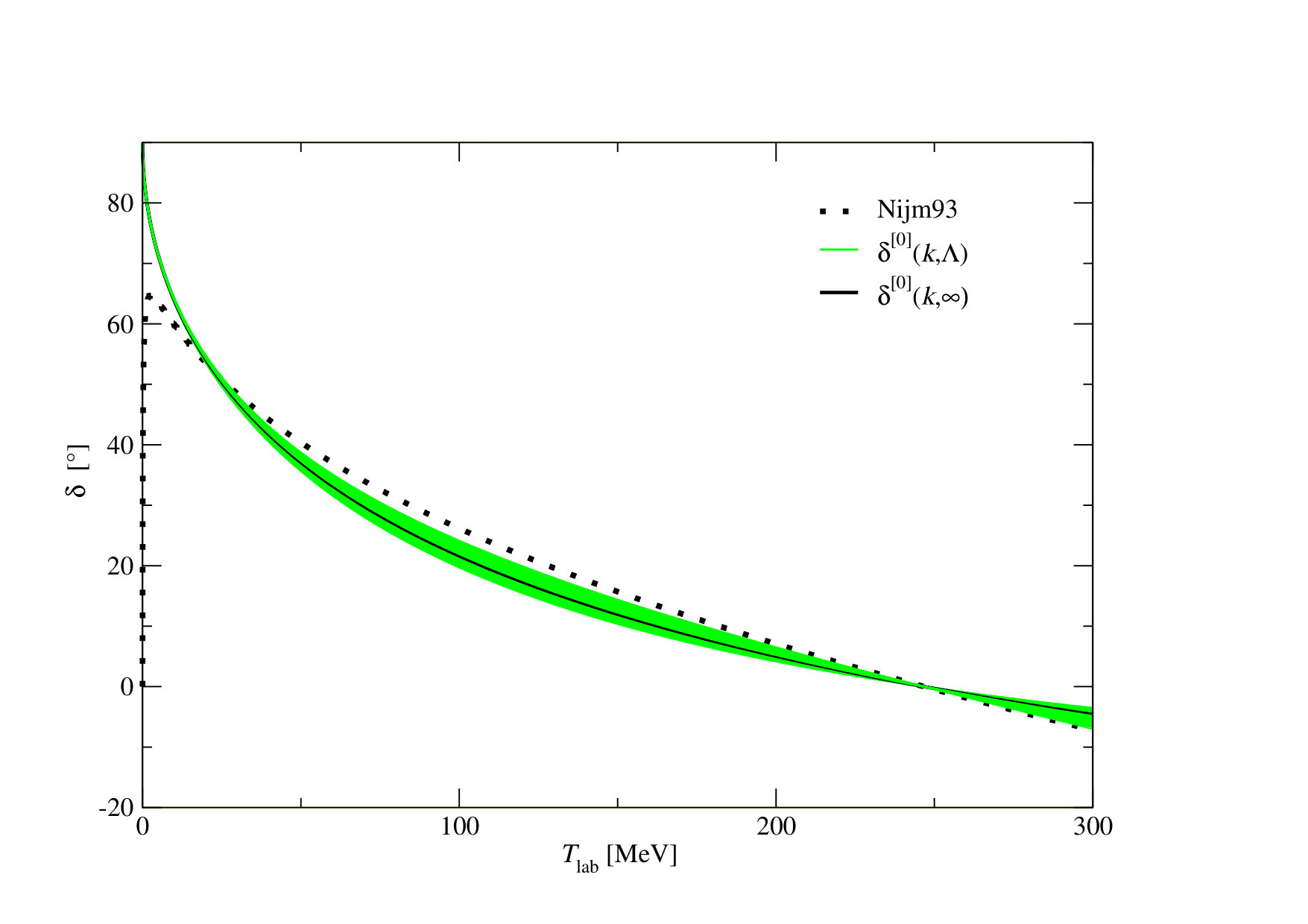 Figure 1
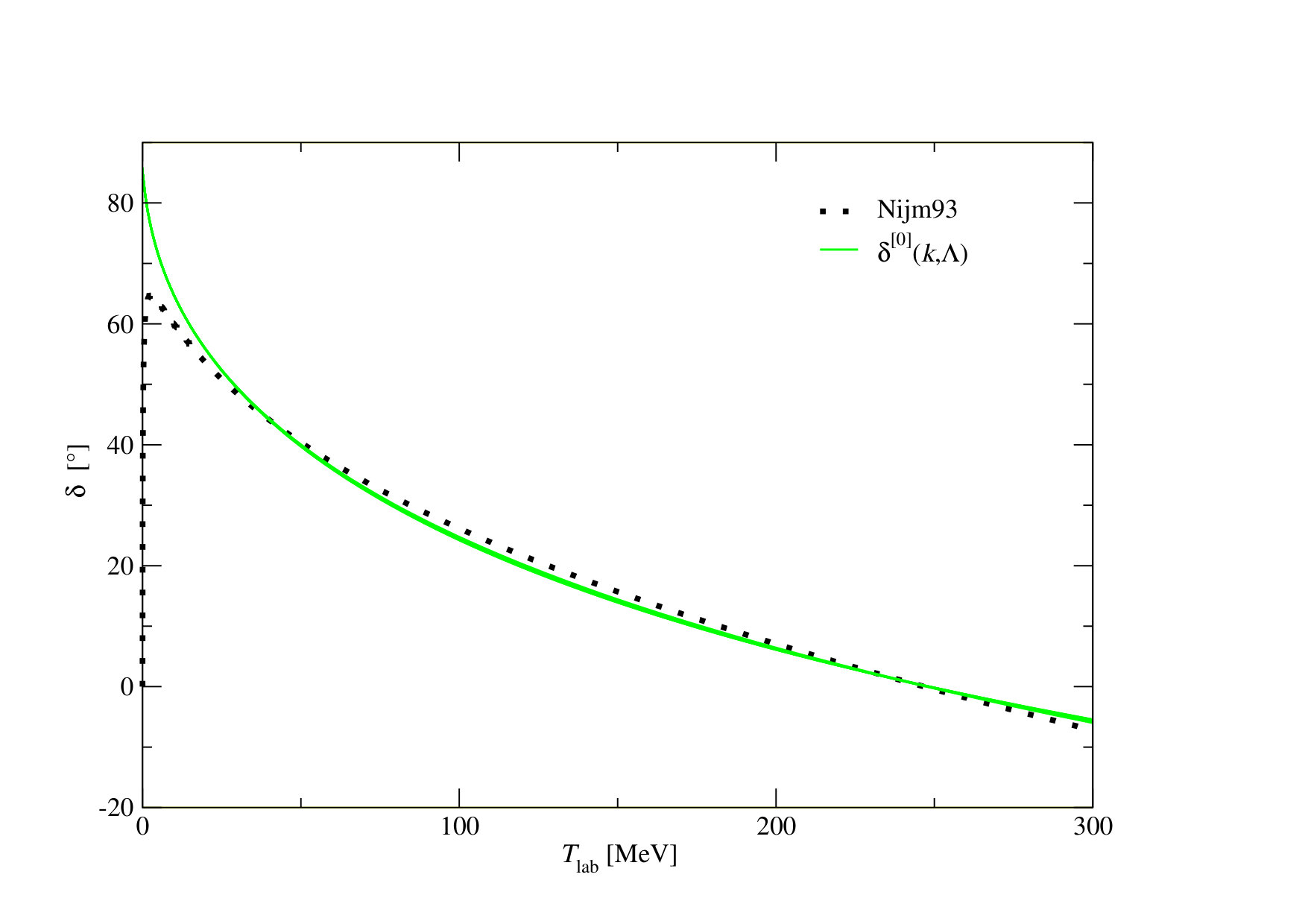 Figure 2
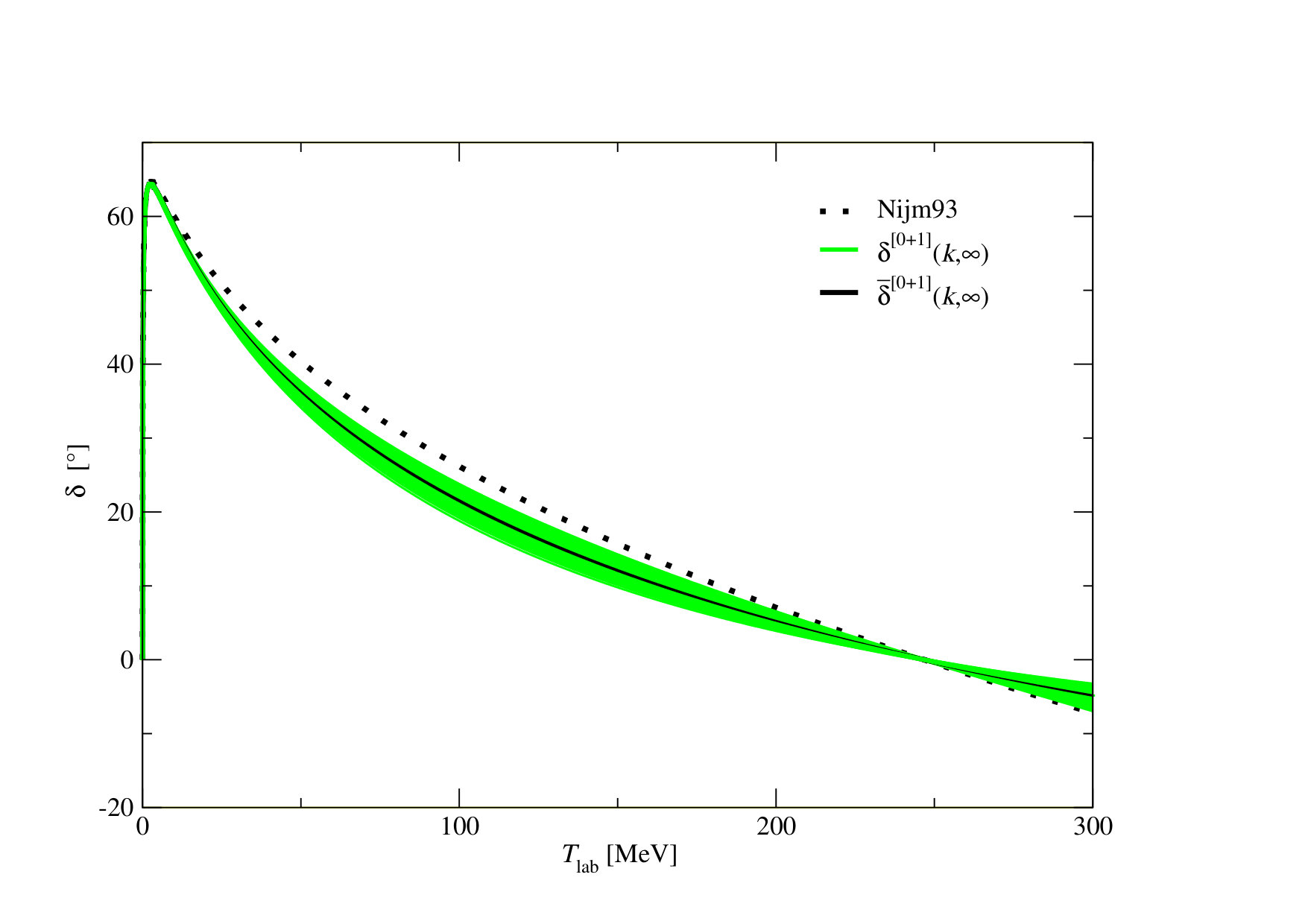 Figure 3
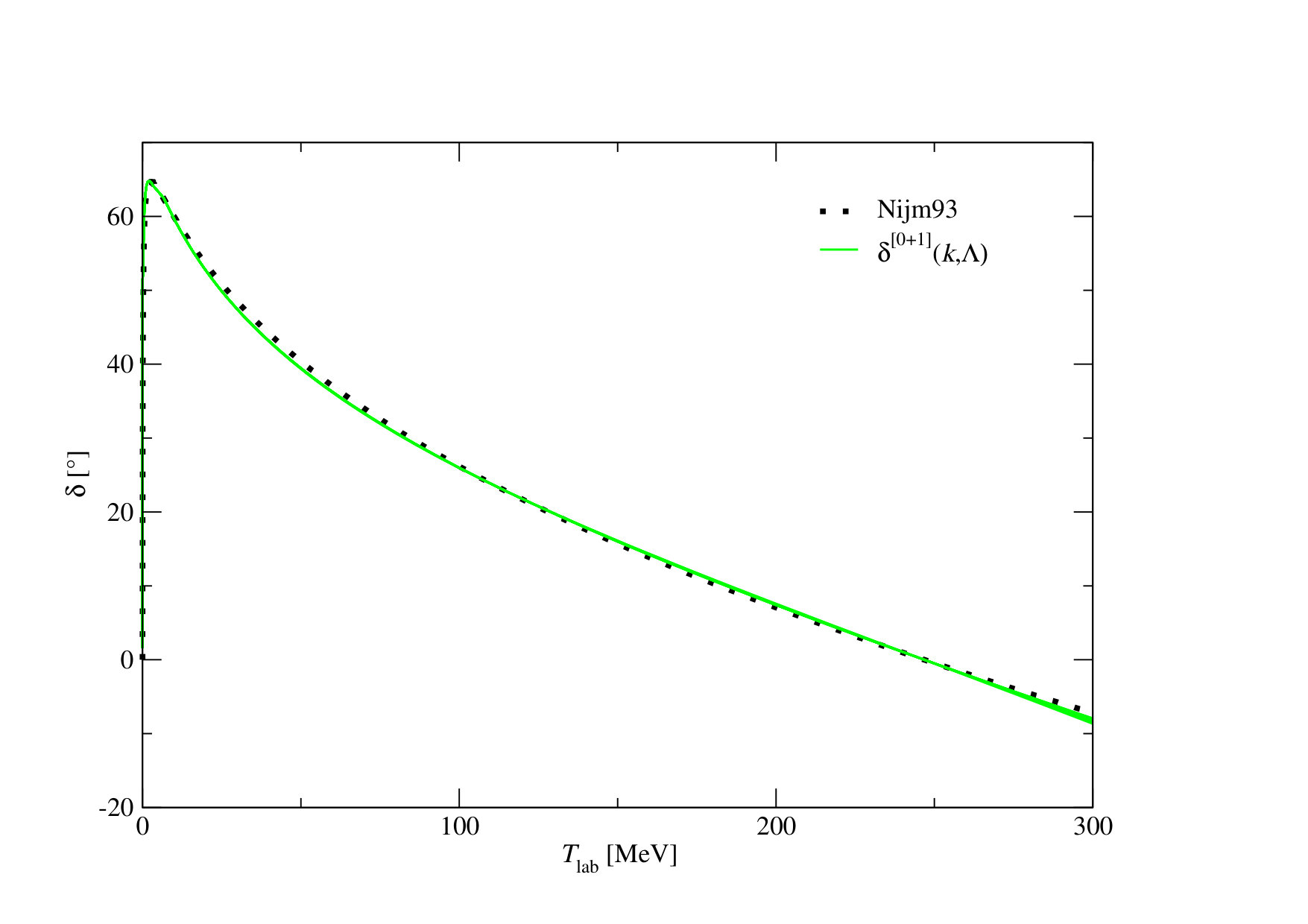 Figure 4
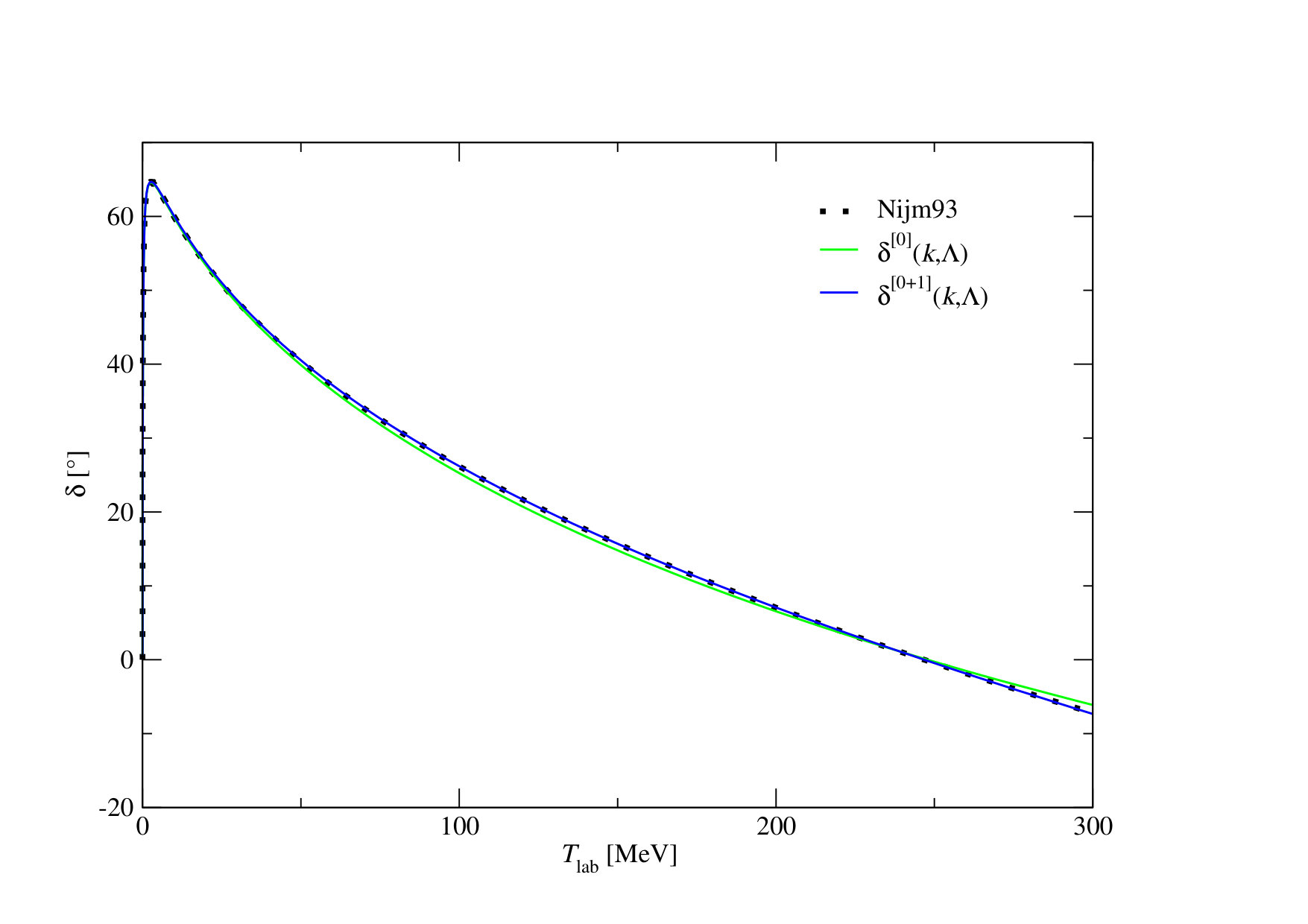 Figure 5
 Figure 6
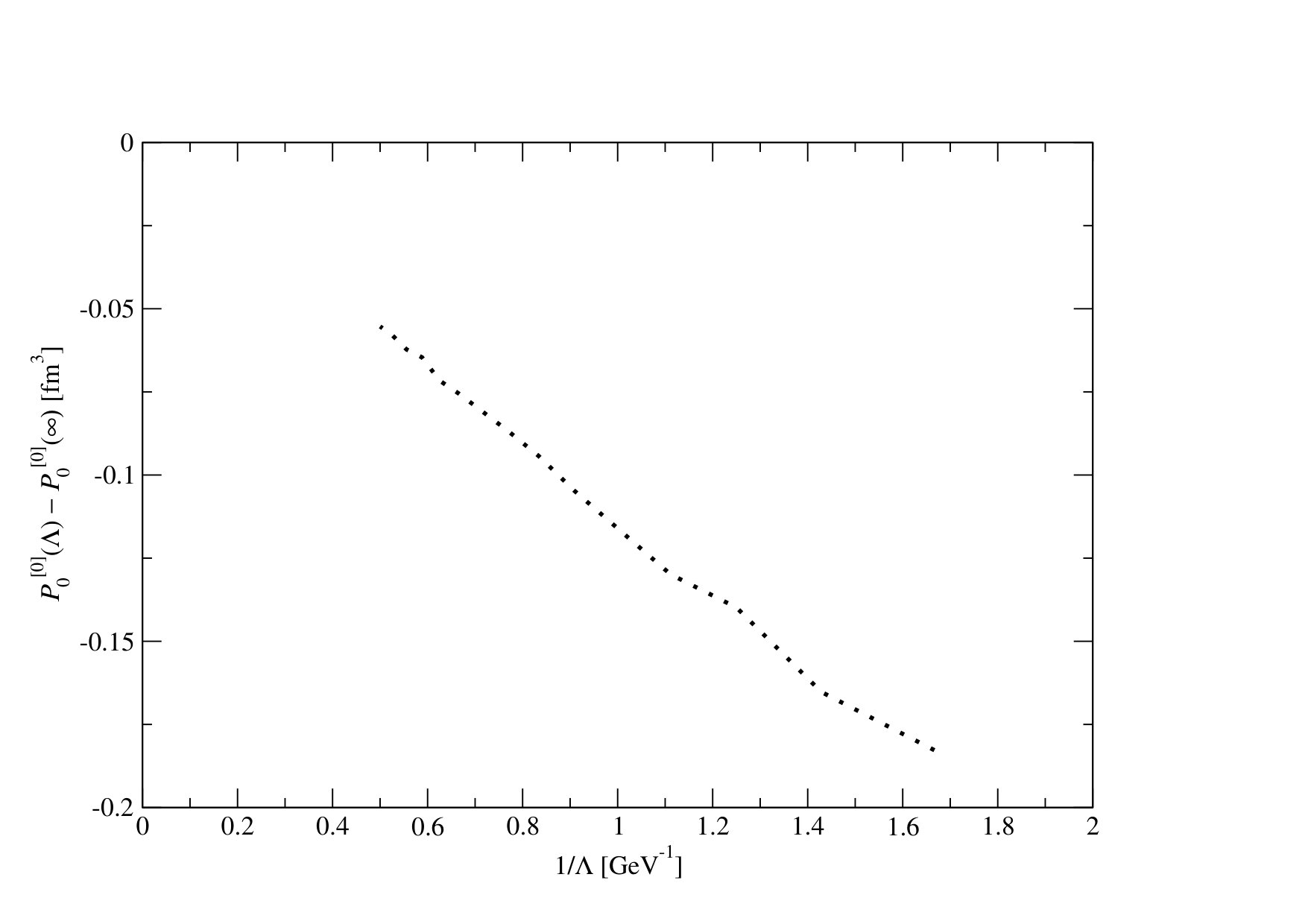 Figure 7
Peer Reviews
No public reviews on file for this paper yet. If you reviewed it on a platform where reviews are public (OpenReview, ICLR, NeurIPS, ICML), you can paste yours below so the community can read it here.
Videos
No videos yet. Explain this paper in a talk, walkthrough, or lecture? Add one.
The Two-Nucleon Amplitude Zero
in Chiral Effective Field Theory
M. Sánchez Sánchez
Institut de Physique Nucléaire, CNRS/IN2P3,
Univ. Paris-Sud, Université Paris-Saclay, 91406 Orsay, France
C.-J. Yang
Institut de Physique Nucléaire, CNRS/IN2P3,
Univ. Paris-Sud, Université Paris-Saclay, 91406 Orsay, France
Bingwei Long
Center for Theoretical Physics, Department of Physics, Sichuan University, 29 Wang-Jiang Road, Chengdu, Sichuan 610064, China
U. van Kolck
Institut de Physique Nucléaire, CNRS/IN2P3,
Univ. Paris-Sud, Université Paris-Saclay, 91406 Orsay, France
Department of Physics, University of Arizona, Tucson, AZ 85721, USA
Abstract
We present a new rearrangement of short-range interactions in the nucleon-nucleon channel within Chiral Effective Field Theory. This is intended to reproduce the amplitude zero (scattering momentum ) at leading order, and it includes subleading corrections perturbatively in a way that is consistent with renormalization-group invariance. Systematic improvement is shown at next-to-leading order, and we obtain results that fit empirical phase shifts remarkably well all the way up to the pion-production threshold. An approach in which pions have been integrated out is included, which allows us to derive analytic results that also fit phenomenology surprisingly well.
††preprint: CTP-SCU/2017008
I introduction
The nuclear effective field theory (EFT) program VanKolckBedaque02 ; ModTheNucFor conceives nuclear physics as the renormalization-group (RG) evolution of Quantum Chromodynamics (QCD) at low energies, formulated in terms of effective degrees of freedom (nucleons, pions, etc.). The link with QCD written in terms of more fundamental objects (quarks and gluons) is ensured by imposing QCD symmetries (particularly approximate chiral symmetry) as the only constraints on the otherwise most general EFT Lagrangian. Power counting (PC) rules tell which terms in this Lagrangian (out of an infinite number) should be taken into account when computing observables at a given order in an expansion in powers of the small parameter , where is the characteristic external momentum of a process and M_{\rm hi}\hskip 1.99997pt\raisebox{2.15277pt}{<}\raisebox{-3.00003pt}{\sim}\hskip 1.99997ptM_{\rm QCD}\sim 1 GeV is the EFT breakdown scale. Thanks to the recent development of ab initio methods, which bridge the gap between nuclear forces and currents on one hand and nuclear structure and reactions on the other, Chiral EFT (EFT) VanKolckBedaque02 ; ModTheNucFor ; Machleidt'n'Entem is now better exploited than ever. However, problems remain in the formulation of this EFT, some of which we address here in the simplest, yet surprisingly challenging, two-nucleon () channel — the spin-singlet, isospin-triplet wave, .
The initial applications of EFT followed a scheme suggested by Weinberg Weinberg90 ; Weinberg91 and Rho Rho:1990cf , where a PC dictated by naive dimensional analysis (NDA) Manohar:1983md ; Georgi93 was assumed to apply to the nuclear potential and currents. The truncated potential is inserted into a dynamical equation — Lippmann-Schwinger (LS), Schrödinger, or one of their variants for the many-body system — from whose exact solution nuclear wave functions are obtained. Averages of the appropriate, truncated currents give rise to scattering amplitudes when the system is probed by external particles such as photons or pions. To deal with the singular nature of the potential and currents, an arbitrary regularization procedure must be introduced. Unfortunately, already at leading order (LO) NDA does not yield all the short-range interactions necessary for the amplitude to be approximately independent of the regulator choice KSW96 ; NTvK ; PavonValderrama:2005uj . Similar issues appear at higher orders YangElsterPhillips ; Ya09B ; ZE12 and also affect electromagnetic currents Valderrama:2014vra . Given that non-perturbative renormalization can differ significantly from the perturbative renormalization used to infer NDA, it is perhaps unsurprising that a scheme based solely on NDA fails to produce nuclear amplitudes consistent with RG invariance.
This problem appears even in scattering in the channel, where one-pion exchange (OPE) has a delta-function singularity in coordinate space. While NDA prescribes that the contact term, which supplements OPE in the LO potential, is chiral-invariant, renormalization demands that a chiral-symmetry-breaking short-range interaction also be present KSW96 . According to NDA, such a chiral-breaking interaction, being proportional to two powers of the pion mass, should not appear before two more orders (next-to-next-to-leading order, or N2LO) in the expansion. This “chiral inconsistency” motivated Kaplan, Savage, and Wise KSW98bis ; KSW98 to propose a PC where pion exchanges are treated as perturbative corrections starting at next-to-leading order (NLO). However, higher-order calculations soon made clear that such an approach is not valid at low momenta in certain partial waves FMS00 . The alternative is to treat OPE as LO only in the lower waves NTvK ; Birse:2005um ; Valderrama:2009ei ; Valderrama:2011mv ; Long:2011qx ; Long:2011xw ; Long:2012ve ; Song:2016ale , where suppression by the centrifugal barrier is not effective. The angular-momentum suppression factor has been studied recently in peripheral spin-singlet channels PeripheralSinglets .
The partial wave was excluded from the analysis in Ref. PeripheralSinglets because this particular channel presents, in addition to the above renormalization issue, other features that are not completely understood. The situation has not improved greatly since the late 90s, despite considerable effort Kaplan97 ; Cohen:1998 ; Steele:1998zc ; Mehen:1999 ; Frederico:1999 ; Gegelia:1999 ; Kaplan:1999qa ; Hyun:2000 ; Lutz00 ; Beane:2001bc ; Nieves:2003 ; Oller:2003 ; ValArr:2004 ; ValArr:2004bis ; Frederico:2005 ; PA06 ; YangHuang ; EntArrValMach ; SotoTarrus08 ; Shukla:2008sp ; YangPhillips ; Ya09B ; Birse:2010jr ; Harada:2011 ; Long:2012ve ; AndoHyun12 ; Szpigel:2012 ; Long13 ; Harada:2013 ; Epelbaum-2015sha ; Ren-2016jna . Some of this work has been reviewed recently in Refs. Long16 ; Valderrama .
A unique feature of this channel, which was recognized early on, is fine tuning in the form of a very shallow virtual bound state. OPE is characterized by two scales, its inverse range given by the pion mass and its inverse strength given by , where is the nucleon mass, is the pion decay constant, and is the axial-vector coupling constant. At the physical pion mass MeV, the virtual state’s binding momentum MeV is much smaller than the pion scales, and can only be reproduced at LO through a fine tuning of the short-range interaction. Physics of this state can be described simply by another successful, renormalizable EFT, Pionless (or Contact) EFT (EFT). In the very-low-energy regime of nuclear physics, , pion exchange cannot be resolved, the EFT Lagrangian contains only contact interactions, and the two-body amplitude reduces vanKolck:1997ut ; KSW98bis ; KSW98 ; VanKolck98 to the effective range expansion (ERE). To simultaneously capture physics at , however, pion exchange needs to be retained. The perturbative expansion in prescribed by Refs. KSW98bis ; KSW98 converges very slowly, if at all, in the low-energy region Beane:2001bc , which leads to the identification of as a low-energy scale , just as suggested by NDA.
Yet, it is disturbing that the NDA-prescribed LO potential produces phase shifts that show large discrepancies with the Nijmegen partial-wave analysis (PWA) PWA ; nnonline even at moderate scattering energies. In Ref. Long:2012ve it was shown that — again at variance with NDA — the first correction in this channel appears already at NLO, in the form of a contact interaction with two derivatives. Still, only about half of the energy dependence of the amplitude near threshold is accounted for at LO, so Ref. Long13 went a step further by suggesting the promotion to LO of an energy-dependent short-range interaction that reproduces the effective range — a generalization of the same suggestion for EFT BeaneSavage . Even this promotion leaves significant room for improvement when compared to the Nijmegen PWA. In particular, the empirical phase shift, thus the amplitude, vanishes at a center-of-mass momentum . Since is significantly below the expected breakdown scale , we should consider it as a soft scale where the EFT converges. In contrast, we find that the LO phase shift of Ref. Long13 is around at and does not vanish until reaches a few GeV. Since higher orders need to overcome LO, convergence at momenta will be at best very slow. This can only be remedied if LO contains the amplitude zero. As pointed out in Ref. VanKolck98 , a low-energy zero requires a different kind of fine tuning than the one that gives rise to a shallow bound state. When the zero appears at very low energies, a contact EFT can be devised (the “other unnatural EFT” of Ref. VanKolck98 ) which gives rise to a perturbative expansion of the amplitude. Such an expansion around in the presence of pions was developed in Ref. Lutz00 .
Here we propose a rearrangement of the short-range part of EFT that leads to the existence of the amplitude zero at LO, in addition to the shallow virtual state. The PC of Ref. VanKolck98 is generalized with the purpose of including the non-perturbative region that contains the virtual state. This is patterned on an idea originally developed for doublet neutron-deuteron () scattering at very low energies nd , where the amplitude has a zero at small imaginary momentum, in addition to a shallow virtual state. We develop an expansion in for , which gives a renormalizable amplitude order by order. Following a successful approach to EFT Konig:2015aka , the virtual state is assumed to be located right at threshold at LO and is moved to a binding momentum at NLO. We calculate NLO corrections and show a systematic improvement in the description of the phase shift.
A challenging feature of EFT is that it usually does not yield analytical expressions for amplitudes. In order to facilitate an understanding of the properties of the amplitude, we also consider a version of our PC for the theory without explicit pions, where we retain but take . To our surprise, even though , this new version of EFT also produces a good description of the empirical phase shifts.
Our approach is in line with Refs. Kaplan:1999qa ; Birse:2010jr , which argued that short-range forces in the spin-singlet wave must produce rapid energy dependence. It is a systematic extension of the potential proposed in Ref. Kaplan97 , and it resembles the unitarized approach of Ref. Lutz00 . More generally, it can be seen as the EFT realization of Castillejo-Dalitz-Dyson (CDD) poles CDD in -matrix theory. Traditional -matrix tools, such as the method, have recently received renewed attention in the system (e.g. Ref. OllerEntem ). The function is determined modulo the addition of CDD poles, which result in zeros of the scattering amplitude. In particular, the momentum may be identified with the position of a CDD pole in the channel Krivoruchenko . An EFT provides a systematic description of the two-body CDD pole that can be naturally extended to more-body systems.
This article is structured as follows. In Sec. II we present an initial approach (“warm-up”) to the problem on the basis of a modified organization of EFT up to NLO. The proposed PC is discussed in detail, and RG invariance is demonstrated explicitly. In Sec. III we bring OPE into LO; also, we compare with the results nnonline of the high-quality Nijm93 potential Nijm93 before and after the inclusion of the NLO potential in this EFT. Conclusions and outlook are presented in Sec. IV.
II Pionless Theory
Our first approach to the problem will omit explicit pion exchange (and also electromagnetic interactions, which are small for anyway, as well as other small isospin-breaking effects Konig:2015aka ). This will allow us to find analytical results, which cannot be reached if one includes OPE in (fully iterated) LO.
In the absence of explicit pions and nucleon excitations, all interactions among nucleons are of contact type. The part of the “standard” EFT Lagrangian relevant for the channel is
[TABLE]
where is the isodoublet, bispinor nucleon field and the projector is expressed in terms of the Pauli matrices acting on spin (isospin) space as , while “” means more complicated interactions and relativistic corrections suppressed by negative powers of the breakdown scale of the theory. Now, the interaction term in Eq. (1) may be rewritten if, following Ref. Kaplan97 , an auxiliary “dibaryon” field with quantum numbers of an isovector pair of nucleons is introduced,
[TABLE]
The dibaryon residual mass and the dibaryon- coupling are such that , as can be straightforwardly checked if one performs the corresponding Gaussian path integral. This parameter redundancy permits the convenient choice GSS08
[TABLE]
Higher-order contact interactions can be reproduced by the inclusion of the dibaryon’s kinetic term and derivative dibaryon- couplings.
The standard PC of EFT vanKolck:1997ut ; KSW98bis ; KSW98 ; VanKolck98 accounts for the presence of a shallow virtual state at LO, but does not produce as much energy dependence as the phenomenological phase shifts. A promotion of the dibaryon kinetic term to LO BeaneSavage allows for the reproduction of the derivative of the amplitude with respect to the energy around threshold, but it is unable to generate the amplitude zero by itself. This is not a problem in the context of standard EFT, since — numerically larger than — is presumably outside the scope of this theory. But here we aim at reformulating the theory in a way such that is considered below the breakdown scale, so as to illustrate the proposed reformulation of the EFT PC in Sec. III.
Inspired by an EFT for scattering at very low energies nd , we consider here a generalization with two such dibaryon fields, ,
[TABLE]
where we have made use of Eq. (3) and displayed explicitly the kinetic dibaryon terms with dimensionless factors . As we will see, such an extension naturally allows us to reproduce the amplitude zero already at LO, greatly improving the description of the empirical phase shifts.
To illustrate the effects of the two dibaryons, we neglect for now the interactions represented by “” in Eq. (4). At momentum , where is the center-of-mass energy, the on-shell matrix is written in terms of the matrix and the phase shift as
[TABLE]
Loops are regularized by a momentum cutoff in the range and a regulator function , with the magnitude of the off-shell nucleon momentum, that satisfies
[TABLE]
Computing the two-dibaryon self-energy, i.e. dressing up the bare two-dibaryon propagator
[TABLE]
with nucleon loops (see Fig. 1), yields
[TABLE]
In this equation we introduced the regularized integral
[TABLE]
where the dimensionless coefficients depend on the specific regularization employed. For example, for a sharp-cutoff prescription with a step function it turns out that , while in dimensional regularization with minimal subtraction we have simply . We thus arrive at
[TABLE]
When is much smaller than any other scale, this inverse amplitude reduces at large cutoff to the ERE,
[TABLE]
where, for neutron-proton () scattering, KoesterNistler75 is the scattering length, Lomon1974 is the effective range, PB09 is the shape parameter, and so on. In addition, Eq. (10) allows for a pole at a momentum nnonline , around which the amplitude can be expanded as VanKolck98
[TABLE]
in terms of dimensionless parameters , with in the absence of further fine tuning. One can easily check that behaves linearly around , with a slope proportional to ,
[TABLE]
From the Nijm93 phase shifts nnonline we find .
It has long been recognized that the anomalously large value of is a consequence of a fine tuning that places a virtual bound state very close to threshold, and introduces an accidental, small scale MeV corresponding to its binding momentum. In the standard version of EFT, higher ERE parameters are assumed to depend on a single higher-energy scale , . The PC then organizes the contributions to an observable characterized by a momentum in an expansion in powers of , i.e. becomes the breakdown scale of the theory. Naively one expects , but there is some evidence that EFT works also at larger momenta. For example, the binding momenta for the ground states of systems with nucleons are near 100 MeV, and yet their physics is well described by the lowest orders of EFT (see, for example, Refs. Bedaque:1999ve ; Platter:2004zs ; Stetcu:2006ey ; Contessi:2017rww ). In fact, it has been suggested that the characteristic scale of EFT is set by these binding momenta through the LO three-nucleon force, so that appears only at NLO or higher Konig:2015aka ; vanKolck:2016 .
Here we propose to accommodate an enlarged range of validity of EFT and the smallness of by changing the standard PC of EFT in the channel on the basis of the replacements and . The phenomenological parameters of the theory are assumed to scale as
[TABLE]
with . This assumption will allow us to develop an expansion for an observable at typical momentum in powers of . The usefulness of such an expansion is far from obvious, but as we show below it seems to give good results. Our prescription includes the correct position of the amplitude zero at LO, and moves the virtual state at NLO very close to its empirical position. For the NLO amplitude is similar to that of standard EFT with . The assignment is somewhat arbitrary but motivated by the expectation that MeV and MeV, when it holds within a factor of 2 or so. If were taken to be smaller, a reasonable description of observables at momenta would only emerge at higher orders. Conversely, had we decided to treat as , the very-low-energy region would be well reproduced already at LO, but it would be more difficult to see improvements at NLO.
Quantities in the theory can be organized in powers of the small expansion parameter . For a generic coupling constant , we expand formally
[TABLE]
where the superscript [ν] indicates that the coupling appears at NνLO. The “renormalized” coupling — i.e. the regulator-independent contribution to the bare (running) coupling — is nominally suppressed by with respect to .
Likewise, the amplitude is written
[TABLE]
where
[TABLE]
etc., in terms of
[TABLE]
etc. Neglecting higher-order terms, the phase shifts at LO, LO+NLO and so on can be written as
[TABLE]
etc. At higher orders interactions in the “” of Eq. (4) appear. We now consider the first two orders of the expansion in detail.
II.1 Leading Order
From Eq. (10) we see that reproducing the amplitude zero at LO with a shallow pole requires a minimum of three bare parameters. Both residual masses, and , must be non-vanishing, otherwise the resulting inverse amplitude at threshold would be proportional to , i.e. not properly renormalized. At the same time, at least one of the kinetic factors, which we choose to be , needs to appear at LO, otherwise the amplitude zero could not be reproduced.
Since we attribute in Eq. (14) the smallness of the inverse scattering length to a suppression by one power of the breakdown scale , we take
[TABLE]
In other words, we perform an expansion of the amplitude around the unitarity limit, as in Refs. Konig:2015aka ; vanKolck:2016 . One of the dibaryon parameters, which turns out to be , carries such an effect, so that its observable contribution vanishes at LO. The regulator-independent parts of the remaining LO parameters, and , are assumed to be governed by the scale 111NDA Manohar:1983md ; Georgi93 gives for a dibaryon- coupling , which differs from our convention (3) by a factor of . Since it is the combination that enters the amplitude, is expected to be instead of .. In a nutshell,
[TABLE]
Because of the vanishing of , eliminating dibaryon-1 via Eq. (2) generates a momentum-independent contact interaction. Thus, at LO we obtain — except for our additional requirement (23) — the version of the model considered in Ref. Kaplan97 , where a dibaryon (our dibaryon-2) is added to a series of nucleon contact interactions.
In order to relate , , and — our three non-vanishing LO bare parameters — to observables, we impose on
[TABLE]
three renormalization conditions,
[TABLE]
The dependence of loops on positive powers of is canceled by that of the bare couplings,
[TABLE]
where “” stands for terms that become arbitrarily small for an arbitrarily large cutoff. Equation (24) ensures that the non-vanishing renormalized couplings,
[TABLE]
are indeed consistent with Eq. (14). Apart from a residual cutoff dependence that can be made arbitrarily small by increasing the cutoff, the amplitude can now be expressed in terms of the renormalized couplings or, using Eq. (30), in terms of and :
[TABLE]
Although the scales and the zero location are different, Eq. (31) is similar to the one nd for scattering at very low energies 222Defining
Eq. (31) may be rewritten as
which is a form used in early work on scattering, such as Ref. VanOers67 ..
Many interesting consequences can be extracted from Eq. (31). For momenta below the amplitude zero, our expression reduces to the unitarity-limit version of the ERE (11) but with predictions for the higher ERE parameters, starting with the shape parameter
[TABLE]
Using the cutoff dependence to estimate the error under the assumption MeV, the LO prediction is . These high ERE parameters are difficult to extract from data. A careful analysis in Ref. PB09 obtains , which is well within our expected truncation error. Yet, values obtained for from the phenomenological potentials NijmII and Reid93 Nijm93 are of the same order of magnitude as the value from Ref. PB09 , but with a negative sign ValderramaArriola04 .
We conjecture that, in contrast to standard EFT, Eq. (31) also applies at momenta around the amplitude zero, with terms which are and corrections of . Around the amplitude zero, the amplitude is perturbative VanKolck98 ; Lutz00 . Indeed, a simple Taylor expansion of Eq. (31) gives a perturbative expansion in the region |k-k_{0}|\hskip 1.99997pt\raisebox{2.15277pt}{<}\raisebox{-3.00003pt}{\sim}\hskip 1.99997ptk_{0}, i.e. an equation of the form (12) with LO predictions for the coefficients,
[TABLE]
where the “” account for . Numerically, these coefficients are and , which are indeed of . The former is in fact reasonably close to extracted from the phenomenological data. Note that we could have imposed as a renormalization condition that had a fixed value — the one that best fits the empirical value — at any , thus trading the information about energy dependence carried by for that contained in the derivative of the phase shift at its zero, see Eq. (13).
Equation (31) interpolates between the two regions, where the amplitude is non-perturbative and where it is perturbative. Compared to standard EFT, it resums not only range corrections as in Ref. BeaneSavage , but also corrections that give rise to the pole at . Compared to the expansion around the amplitude zero VanKolck98 , it resums the terms that become large at low energies and give rise to a resonant state at zero energy. The pole structure of the LO amplitude can be made explicit by rewriting Eq. (31) as
[TABLE]
with
[TABLE]
In addition to the amplitude zero, , it is apparent that there are three simple poles, , the nature of which is linked to the sign of :
- •
The pole at represents a resonant state at threshold, as it induces the vanishing of . Such a pole can be reproduced even with a momentum-independent contact potential, just as it is done at LO in standard EFT (1) in the unitarity limit. (Since , this state has a non-normalizable wavefunction.)
- •
The pole at , , lies on the positive imaginary semiaxis. However, since , the condition to produce a normalizable wavefunction is not satisfied. The pole at cannot correspond to a bound state, whose wavefunction has finite support in coordinate space. It is a redundant pole MA46 ; MA47 .
- •
The pole at , , lies deep on the positive imaginary semiaxis. It represents a bound state because . Since no such state exists experimentally, it sets an upper bound on the regime of validity of the EFT, M_{\textrm{hi}}\hskip 1.99997pt\raisebox{2.15277pt}{<}\raisebox{-3.00003pt}{\sim}\hskip 1.99997pt\kappa_{3}^{[0]}.
In Fig. 2, we plot the phase shifts (21) from the LO amplitude (31) in comparison with the Nijm93 results Nijm93 ; nnonline . As input, we use the empirical values of the effective range and the position of the amplitude zero. We display the cutoff band for a generic regulator by taking and varying from around the breakdown scale (500 MeV) to infinity — as the cutoff increases, our results converge, as evident in Eq. (31). This cutoff band provides an estimate of the LO error, except at low momentum where there is an error that scales with instead of . The LO phase shifts are in good agreement with empirical values for most of the low-energy momentum range, except at the very low momenta where the small but non-vanishing virtual-state binding energy is noticeable. A plot of shows that differences at the amplitude level are indeed small. We plot phase shifts to better display the region around the amplitude zero, which our PC is designed to capture. There, while the phase shifts themselves are not too far off empirical values, the curvature is not well reproduced. Nevertheless, the agreement is surprisingly good given the absence of explicit pion fields. In the next section we examine how robust this agreement is.
II.2 Next-to-Leading Order
As pointed out in Ref. Long:2012ve , the leading residual cutoff dependence of an amplitude, together with the assumption of naturalness, gives an upper bound on the order of the next correction to that amplitude. In standard EFT, for example, the LO amplitude has an effective range , indicating that there is an interaction at order no higher than NLO vanKolck:1997ut ; KSW98bis ; KSW98 ; VanKolck98 which will produce a physical effective range . The leading residual cutoff dependence in Eq. (31) is proportional to and of relative order . Thus, the NLO interaction must give rise to a contribution
[TABLE]
to the LO shape parameter (32). This correction requires a higher-derivative operator. Although we could add a momentum-dependent contact operator, a simpler, energy-dependent strategy will be implemented here: we allow for a non-vanishing .
In addition, since we are interpreting , one combination of parameters including enforces
[TABLE]
We also introduce corrections in the other two parameters, and , in order to keep and unchanged. Since NLO interactions must all be suppressed by ,
[TABLE]
This scaling — together with what was learned at LO — is consistent with the imposition of four renormalization conditions on
[TABLE]
which ensure that , , , and are fully independent at NLO:
[TABLE]
Defining the renormalized parameters
[TABLE]
which with Eq. (39) give Eqs. (14) and (37), the cutoff dependence of the bare parameters that guarantees Eq. (41) is
[TABLE]
where the ellipsis account for terms that disappear when we take .
The NLO contribution to the amplitude, Eq. (18), then satisfies
[TABLE]
which is indeed suppressed by one negative power of . If we resum while neglecting N2LO corrections, then
[TABLE]
Now the ERE (11) is reproduced for with the experimental scattering length and shape parameter. Additionally, there are predictions for the higher ERE parameters which are hard to test directly since they are difficult to extract from data. The zero at remains unchanged due to our choice of renormalization condition. Once expanded around , the distorted amplitude (48) yields NLO coefficients such as
[TABLE]
where “” stands for . NLO contributions are of relative with respect to their LO predictions and , consistently with the residual cutoff dependence displayed in Eqs. (33) and (34). Since underestimates the slope of the phenomenological phase shifts around the amplitude zero, a better description of data requires and thus, according to Eqs. (32) and (49), . The value given in Ref. PB09 leads to a small change , but unfortunately it is larger than . Since Ref. PB09 provides no error bars it is difficult to decide whether this is a real problem. We can reproduce the phenomenological value for with , which is still compatible with convergence but not so small a change with respect to LO. Of course, not all the discrepancy between LO and phenomenology should come from NLO, but this might be indicative that something is missing. We will return to the shape parameter in the next section.
NLO also shifts the LO position of the poles (36) of the matrix. One can obtain these shifts reliably by means of perturbative tools only for the two shallowest LO poles, finding in the large-cutoff limit
[TABLE]
We see that, as expected, , as long as . As a consequence:
- •
The shallowest pole is moved from threshold to MeV, and represents the well-known virtual state. Its new location almost coincides with the physical one.
- •
The redundant pole is moved from MeV to MeV, when the value of given in Ref. PB09 is used. This represents a shift of relative size with respect to LO. Roughly two thirds of this shift are due to the finiteness of the scattering length, while the other third corresponds to the NLO correction to the shape parameter. If we take the value of that gives the slope of the phenomenological phase shifts at , then the shape correction overcomes the scattering length and the pole moves to MeV, still a modest shift.
The LO+NLO phase shift can now be obtained from Eqs. (22) and (47), see Fig. 3. Now, in addition to the empirical values of and , also the values of the scattering length and the shape parameter from Ref. PB09 are input. We show a band corresponding to a variation of 30% around the value of Ref. PB09 to account for its (unspecified) error. Since the cutoff dependence of the NLO result (47) is very quickly convergent (), it has been neglected in Fig. 3. The band thus does not reflect the uncertainty of the NLO truncation, but of the input.
As expected, the physical value of greatly improves the description of the phase shifts at low energies (). However, at middle energies () this improvement is much less clear. In particular, as anticipated above, only for a shape parameter smaller than in Ref. PB09 does get slightly closer to empirical values than (see Fig. 2). Such a change is within the LO error and, overall, the reproduction of the phase shifts is very good at NLO. Agreement could be further improved, particularly around , by taking an even smaller value for the shape parameter — in particular, the value that reproduces the phenomenological value for . However, even in that case the curvature of the resulting phase shifts would remain different from empirical at middle energies, which suggests that our expansion is lacking terms at either LO or NLO.
II.3 Resummation and Higher Orders
The choice of identifying the fine-tuning scale with led to a non-zero scattering length only at NLO. This assignment is motivated by the numerical values estimated for these scales. Alternative choices are possible, leading to slightly different amplitudes at various orders. When plotting phase shifts, these differences are amplified. For example, taking as leads to a renormalization condition where is non-zero already at LO. In this case our running and renormalized parameters given above all change by terms. The amplitude itself (or equivalently its pole positions) changes only slightly, but in terms of phase shifts there appears to be a large improvement.
Given our previous identification of with , the alternative procedure just described amounts to a resummation of higher-order corrections. Because a bare parameter () exists already at LO to ensure proper renormalization, this resummation can be done without harm. However, because some NLO contributions are shifted to LO, we see less improvement when going from LO to NLO. Provided that one has a PC that converges, this is just one of many ways in which we can make results at one order closer to phenomenology while remaining within the error of that order.
Regardless of such resummation, corrections at higher orders are expected to improve the situation further. The cutoff dependence of Eq. (48) suggests that there are no new interactions at next order, N2LO, which would solely consist of one iteration of the NLO potential. However, the fact that our pionless phase shifts look too low in the middle range represents a significant, systematic lack of attraction between nucleons at . This could be a reminder to include pions explicitly. We now consider our expansion with additional pion exchange.
III Pionful Theory
We now modify the theory developed in the previous section to include pion exchange. This is done under the assumption that the pion mass, the characteristic inverse strength of OPE, and the magnitude of the relevant momenta have similar sizes, not being enhanced or suppressed by powers of the hard scale:
[TABLE]
Such an assumption has been standard in EFT since its beginnings Weinberg90 ; Weinberg91 . In the sector, it underlies the (non-perturbative) LO character of the OPE interaction, as well as the suppression of multiple pion exchanges by powers of . Moreover, the Coulomb interaction between protons — the dominant electromagnetic effect — contributes an expansion in , where is the fine-structure constant. As we took , we should account for the Coulomb interaction at NLO. (Other isospin-breaking effects, such as the nucleon mass splitting, are to be accounted for perturbatively, too.) Within the EFT framework, the (subleading) Coulomb effects were included in an expansion around the unitarity limit (without consideration of the amplitude zero) in Ref. Konig:2015aka . Since we anticipate no new features here, in this first approach we neglect isospin breaking. We also ignore the explicit dependence on quark mass, because the expansion is already quite complicated at a fixed value of .
Pions are introduced in the usual way, by demanding that the most general effective Lagrangian transforms under chiral symmetry as does the QCD Lagrangian written in terms of quarks and gluons. (For reviews and references, see Refs. VanKolckBedaque02 ; ModTheNucFor ; Machleidt'n'Entem .) In the particular case of one dibaryon field, this was done in Ref. Kaplan97 . The extension to the two dibaryons of the previous section is straightforward. If is the pion isotriplet, the effective Lagrangian reads
[TABLE]
in the same notation as Eq. (4). The omitted terms, which include chiral partners of the terms shown explicitly, are not needed up to NLO.
Inspired by the pionless theory, we use for the pionful case the same dibaryon arrangement of short-range potentials as in Sec. II. Adding the long-range, spin-singlet projection of OPE, the LO potential is
[TABLE]
where () is the relative incoming (outgoing) momentum and the inverse OPE strength is defined as KSW98bis ; KSW98
[TABLE]
The momentum-independent, contact piece of OPE has been absorbed in the short-range potential through the redefinition
[TABLE]
The long-range part of OPE is the Yukawa potential represented by . Integrating out dibaryon-1 we obtain the potential considered previously in Ref. Kaplan97 . Since two-pion exchange (TPE) enters only at N2LO and higher Ordonez:1992xp ; Ordonez:1995rz , at NLO the interaction is entirely short-ranged,
[TABLE]
In the limit the potential is an energy-dependent version of the momentum-dependent LO+NLO interaction of Ref. Long:2012ve , while the interaction of Ref. Long13 emerges in the limit .
Because OPE cannot be iterated analytically to all orders, we can no longer show explicitly that the amplitude has a zero at LO or that the amplitude is RG invariant. However, these two important features of the pionless theory are expected to be retained by the pionful theory on the basis that the strength of OPE is known to be numerically moderate in spin-singlet channels and that is non-singular. Moreover, we continue to use the scalings (24) and (39). Below we confirm through numerical calculations that the EFT obeying such a PC indeed has an amplitude zero and preserves RG invariance.
III.1 Leading Order
The off-shell LO amplitude is found from the LO potential (54) by solving the LS equation
[TABLE]
with a non-local regulator function (6). Defining the Yukawa amplitude,
[TABLE]
the Yukawa-dressing of the incoming/outgoing states,
[TABLE]
and the resummation of bubbles with iterated OPE in the middle,
[TABLE]
Eq. (58) can be rewritten as KSW96
[TABLE]
This is the generalization of Eq. (8) for LO in the presence of pions. Because is regular, the cutoff dependence of the integrals and is only residual, i.e. suppressed by powers of . In contrast, just as the in Eq. (8), has a linear cutoff dependence due to the singularity of . Additionally, it exhibits a logarithmic dependence KSW96 arising from the interference between and . This cutoff dependence is at the root of one of the shortcomings of NDA in the system.
Compared to Refs. KSW96 ; Long:2012ve ; Long13 , our has a different dependence. As in the previous section, two dibaryon parameters are needed to describe the zero of the amplitude and its energy dependence near threshold, while the third parameter ensures the fine tuning that leads to a large scattering length. These three parameters are sufficient for renormalization, leaving behind only residual cutoff dependence. Our LO amplitude is analogous to that of Ref. Lutz00 , which results from the unitarization of an expansion around the amplitude zero.
Taking the sharp-cutoff function , we solve numerically the -wave projection of Eq. (58), as done in, e.g., Refs. Long:2012ve ; YangPhillips . In order to determine the values of the three bare parameters at a given cutoff, three cutoff-independent conditions on the amplitude are needed. We choose them to be the same as in the previous section, i.e.
- •
unitarity limit, ;
- •
physical effective range, ;
- •
physical amplitude zero, .
The values of , , and in our numerical calculations must be very well tuned in order to reproduce the required values of , , and within a given accuracy. The need for such a tuning becomes more and more noticeable as is increased YangPhillips . But the resulting phase shift changes dramatically depending on whether is very small and negative (for a shallow virtual state) or very small and positive (as it would correspond to a bound state close to threshold). Thus, in order to facilitate the numerical solution of the LS equation, we kept the scattering length large and negative, fm. The difference with the unitarity limit cannot be seen in the results presented below.
The LO pionful phase shift is obtained from the on-shell, -wave-projected matrix in the usual way (21). The result, presented in Fig. 4, shows little cutoff dependence, even though the cutoff parameter is varied from 600 MeV to 2 GeV. It is likely that a more realistic estimate of the systematic error coming from the EFT truncation is obtained via the variation of the input inverse scattering length between its physical value and zero. We will come back to such an estimate later, when we resum finite- effects. In any case, comparing with Fig. 2 we confirm that pions help us achieve a better description of phase shifts between threshold and the amplitude zero.
From the results in Fig. 4 we can obtain numerical predictions for parameters appearing in the ERE and in the expansion around the amplitude zero. As an example, we extract the LO shape parameter using our low-energy results and the unitarity-limit version of the ERE (11) truncated at the level of the shape parameter. Results are shown in Fig. 5. For large enough, we find
[TABLE]
with and . Unlike the result for the shape parameter given in Ref. PB09 , is negative, being reasonably close to — the value extracted in Ref. ValderramaArriola04 from the NijmII fit Nijm93 . The large change in the prediction for compared to the corresponding pionless result (32) is confirmation of the importance of pions at LO.
III.2 Next-to-Leading Order
As before, we can infer the short-range contributions at NLO from the residual cutoff dependence of the amplitude. Figure 5 shows that the cutoff dependence of is proportional to , with as expected. Just as in the pionless case, this behavior implies that at least one extra short-range parameter needs to be included at NLO. This is represented by the NLO potential , Eq. (57).
Treating in distorted-wave perturbation theory, we obtain a separable NLO amplitude,
[TABLE]
where
[TABLE]
is defined in terms of the full LO amplitude in analogy with Eq. (60) for the long-range LO amplitude. As in the pionless case, we obtain the pionful LO+NLO phase shift from Eq. (22).
The dibaryon parameters are fixed in virtue of four cutoff-independent conditions, which we choose to be the values of the Nijm93 phase shifts nnonline at four different momenta:
- •
;
- •
;
- •
;
- •
.
The LO+NLO phase shifts are shown in Fig. 6. The narrow band when the cutoff is varied from 600 MeV to 2 GeV confirms that, as in Fig. 4, very quick cutoff convergence takes place. The LO+NLO prediction almost lies on the Nijm93 curve, which means that now the description of the empirical phase shifts throughout the whole elastic range is much better than at LO. Indeed, the improvement is clear not only in the very-low momentum regime (which had been expected considering that now we relaxed the unitarity-limit condition), but — more importantly from the EFT point of view — also for momenta . Comparison with the pionless result at NLO (Fig. 3) confirms that adding OPE significantly improves predictions in this momentum range.
III.3 Resummation and Higher Orders
Despite the systematic improvement and good description of data at NLO, one might be distressed by the unusual appearance of our LO phase shift (Fig. 4) at low momentum. Within potential models — whether purely phenomenological or based on Weinberg’s prescription — it is traditional to attempt to describe all regions below some arbitrary momentum on the same footing.
As emphasized earlier, plotting phase shifts is misleading when it comes to errors in the amplitude, which is the observable the PC is designed for. A plot of shows that only a small amount of physics is missed at LO even at low energies. Our strategy is a consequence of the fact that the PC assumes momenta , and it is in principle only in this region that we expect systematic improvement order by order. The higher the momentum, the smaller the relative improvement with order, till we reach and the EFT stops working. In the other direction, that of smaller momenta, the EFT PC may no longer capture the relative importance of interactions properly. A simple example is pion-nucleon scattering in Chiral Perturbation Theory, where sufficiently close to threshold the LO -wave interaction (stemming from the axial-vector coupling in Eq. (53)) is smaller than NLO corrections to the wave. Therefore the region of momenta much below the pion mass is not where one wants to judge the convergence of EFT.
However, it might be of practical interest to improve the description near threshold already at LO. As in EFT, we can choose to reproduce the empirical value of a phase shift in the very low-momentum region — thus accounting for non-vanishing already at LO — without doing damage to renormalization. As is the case with any other choice of data to fit, the difference with respect to what we have done earlier in this section is of NLO: we are just resumming some higher-order contributions into LO.
As an example, in Fig. (7) we show LO and LO+NLO results with an alternative fitting protocol. In the renormalization conditions at LO we replace the unitarity limit of our original fit with the physical scattering length, that is, we impose the following cutoff-independent conditions:
- •
;
- •
;
- •
.
Likewise, at NLO we substitute the lowest Nijm93 phase shift of our earlier fit with the physical scattering length:
- •
;
- •
;
- •
;
- •
.
As before we vary the cutoff from to , but the convergence of the phase shifts is so quick that the cutoff bands cannot be resolved in our plot. The improved description of the very low-energy region at LO compared to that seen in Fig. 4, which is entirely due to the resummation of the finite scattering length, is evident. The predicted LO+NLO phase shifts virtually lie on the the Nijm93 curve, and this fit is even more phenomenologically successful than the original LO+NLO shown in Fig. 6. The relatively small improvement over the alternative LO curve is consequence of the resummation of higher-order contributions into LO. The small difference between alternative and original LO+NLO curves attests to the fine-tuning of the channel, i.e. to the smallness of effects.
Given the importance of OPE, one expects potentially large changes in the position of the poles of in EFT with respect to the EFT result (36). Yet, the virtual state near threshold (at ) is guaranteed by construction, since
[TABLE]
Using the technique described in Ref. YangPhillips , one may obtain numerically the positions of the other two poles. The redundant pole seems to become deeper and deeper when the cutoff is increased. This is consistent with the point of view that the redundant pole accounts in EFT for the neglected left-hand cut due to OPE. In contrast, the binding energy of the deep bound state oscillates with , but we always find it to be , which corresponds to a binding momentum . This is, again, an estimate for the breakdown scale .
One might worry that the LO+NLO result shown in Fig. 7 is so good that higher orders could destroy agreement with the empirical phase shifts and undermine the consistency of our EFT expansion. At N2LO and N3LO there are several contributions to account for: TPE and the associated N2LO counterterms Ordonez:1992xp ; Ordonez:1995rz in first-order distorted-wave perturbation theory, as well as NLO interactions in second- and third-order distorted-wave perturbation theory. At these higher orders it might be convenient to use the perturbation techniques of Ref. Vanasse:2013sda or to devise further resummation of NLO interactions.
To investigate the potential effects of higher-order corrections we have performed an incomplete N2LO calculation where the long-range component of the N2LO TPE potential was included in first-order distorted-wave perturbation theory, following the analogous calculation in Ref. Long:2012ve . Since the short-range component of this potential can be absorbed in Eq. (57), there are no new short-range parameters and we impose the same four renormalization conditions as in NLO. We have repeated the extraction of the phase shifts and found a negligible effect on the final result, so that this incomplete N2LO phase shift is at least as good as the one plotted in Fig. 7. This indicates that in the channel the effects of the N2LO TPE potential can be compensated by a change in the strengths of our LO and NLO short-range interactions. Of course, this is not a full calculation of the amplitude up to N2LO, but since the change from LO to LO+NLO is small, we might expect the iteration of NLO interactions to also produce small effects. We intend to pursue full higher-order calculations in the future.
IV Conclusions and Outlook
Despite its simplicity from the computational perspective, the two-nucleon channel has proven remarkably resistant to a systematic expansion. In this work we have developed a rearrangement of Chiral EFT in this channel based on specific assumptions about the scaling of effective-range parameters and the amplitude zero with a single low-energy scale MeV. Through the introduction of two dibaryon fields, we were able to reproduce empirical phase shifts very well already at NLO — that is, including interactions of up to relative — from threshold to beyond the zero of the amplitude at . The existence of a deep bound state at LO indicates that the expansion in powers of breaks down at a scale MeV.
The new power counting is particularly transparent when pions are decoupled by an artificial decrease of their interaction strength, in which case a version of Pionless EFT is produced. Even in this case LO and NLO fits to empirical phase shifts look reasonable, although the lack of pion exchange is noticeable in the form of the energy dependence.
The apparent convergence of our LO and NLO results towards the empirical phase shifts suggests that our PC might be the basis for a new chiral expansion in this channel. Our new expansion relies only on the identification of the amplitude zero as a low-energy scale. The is unique in having such a zero and a low-energy -matrix pole — in the channel, the amplitude zero lies beyond the pion-production threshold, while the phase shift crosses zero at a lower energy but displays no low-energy pole. Moreover, both and channels are well described already at LO in a power counting consistent with RG invariance NTvK ; Valderrama:2009ei ; Valderrama:2011mv ; Long:2011qx ; Long:2011xw ; Song:2016ale .
Before a claim of convergence in the channel can be made, however, one or two higher orders should be calculated, where additional long-range interactions appear in the form of multi-pion exchange. Indications already exist Valderrama:2009ei ; Long:2012ve ; Long13 that two-pion exchange and its counterterms, which enter first at N2LO, are amenable to perturbation theory in this channel. However, it is yet to be checked whether their contributions are small enough not to destroy the excellent agreement obtained at NLO. This calculation is demanding because it requires treating the NLO interaction beyond first order in distorted-wave perturbation theory. An incomplete N2LO calculation which omits these demanding terms suggests that higher orders might provide only very small corrections.
If this approach succeeds, then it raises new questions. As one example, can we find an equivalent momentum-dependent approach, which would be better suited to many-body calculations? As another, what is the role of the quark masses in this power counting? We have worked at physical pion mass, but it remains to be seen how this new proposal can be implemented for arbitrary in a renormalization-consistent manner. We intend to address these issues in future work.
Acknowledgments
We thank J.A. Oller and M. Pavón Valderrama for useful discussions. UvK is grateful to R. Higa, G. Rupak, and A. Vaghani for insightful comments on the role of low-energy amplitude zeros, which have inspired this manuscript. MSS is grateful for hospitality to the Department of Physics at the University of Arizona, where part of this work was carried out. This research was supported in part by the National Natural Science Foundation of China (NSFC) through grant number 11375120, by the U.S. Department of Energy, Office of Science, Office of Nuclear Physics, under award number DE-FG02-04ER41338, and by the European Union Research and Innovation program Horizon 2020 under grant agreement no. 654002.
The reference list from the paper itself. Each links out to its DOI / PubMed record.
- 1(1) P.F. Bedaque and U. van Kolck, Ann. Rev. Nucl. Part. Sci. 52 (2002) 339.
- 2(2) E. Epelbaum, H.-W. Hammer, and U.-G. Meißner, Rev. Mod. Phys. 81 (2009) 1773.
- 3(3) D.R. Entem and R. Machleidt, Phys. Rept. 503 (2011) 1.
- 4(4) S. Weinberg, Phys. Lett. B 251 (1990) 288.
- 5(5) S. Weinberg, Nucl. Phys. B 363 (1991) 3.
- 6(6) M. Rho, Phys. Rev. Lett. 66 (1991) 1275.
- 7(7) A. Manohar and H. Georgi, Nucl. Phys. B 234 (1984) 189.
- 8(8) H. Georgi, Phys. Lett. B 298 (1993) 187.