Sticky matroids and Kantor's Conjecture
Winfried Hochst\"attler, Michael Wilhelmi

TL;DR
This paper establishes the equivalence between Kantor's Conjecture and the Sticky Matroid Conjecture, linking two important open problems in matroid theory.
Contribution
It proves that Kantor's Conjecture and the Sticky Matroid Conjecture are logically equivalent, clarifying their relationship in matroid theory.
Findings
Proves the equivalence of Kantor's and Sticky Matroid Conjectures
Clarifies the relationship between two major open problems in matroid theory
Provides a foundation for future research on these conjectures
Abstract
We prove the equivalence of Kantor's Conjecture and the Sticky Matroid Conjecture due to Poljak und Turz\'ik.
Click any figure to enlarge with its caption.
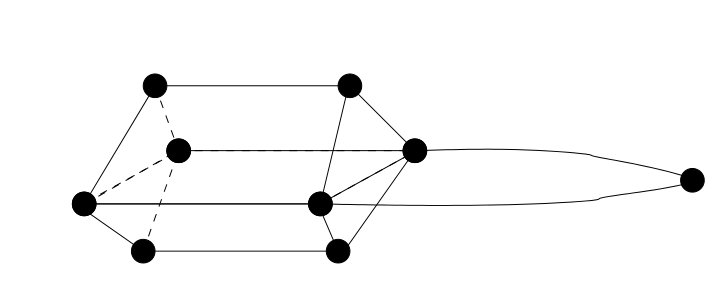 Figure 1
Peer Reviews
No public reviews on file for this paper yet. If you reviewed it on a platform where reviews are public (OpenReview, ICLR, NeurIPS, ICML), you can paste yours below so the community can read it here.
Videos
No videos yet. Explain this paper in a talk, walkthrough, or lecture? Add one.
Sticky matroids and Kantor’s Conjecture
Winfried Hochstättler and Michael Wilhelmi
FernUniversität in Hagen
{Winfried.Hochstaettler, Michael.Wilhelmi}@FernUniversitaet-Hagen.de
Dedicated to Achim Bachem on the occasion of his 70th birthday.
Abstract.
We prove the equivalence of Kantor’s Conjecture and the Sticky Matroid Conjecture due to Poljak und Turzík.
1. Introduction
The purpose of this paper is to prove the equivalence of two classical conjectures from combinatorial geometry. Kantor’s Conjecture [5] adresses the problem whether a combinatorial geometry can be embedded into a modular geometry, i.e., a direct product of projective spaces. He conjectured that for finite geometries this is always possible if all pairs of hyperplanes are modular.
The other conjecture, the Sticky Matroid Conjecture (SMC) due to Poljak and Turzík [8] concerns the question whether it is possible to glue two matroids together along a common part. They conjecture that a “common part” for which this is always possible, a sticky matroid, must be modular. It is well-known (see eg. [7]) that modular matroids are sticky and easy to see [8] that modularity is necessary for ranks up to three. Bachem and Kern [1] proved that a rank-4 matroid that has two hyperplanes intersecting in a point is not sticky. They also stated that a matroid is not sticky if for each of its non-modular pairs there exists an extension decreasing its modular defect. The proof of this statement had a flaw which was fixed by Bonin [2]. Using a result of Wille [9] and Kantor [5] this implies that the sticky matroid conjecture is true if and only if it holds in the rank-4 case. Bonin [2] also showed that a matroid of rank with two disjoint hyperplanes is not sticky and that non-stickiness is also implied by the existence of a hyperplane and a line that do not intersect but can be made modular in an extension.
We generalize Bonin’s result and show that a matroid is not sticky if it has a non-modular pair that admits an extension decreasing its modular defect. Moreover by showing the existence of the proper amalgam of two arbitrary extensions of the matroid we prove that in the rank-4 case this condition is also necessary for a matroid not to be sticky. As a consequence from every counterexample to Kantor’s conjecture arises a matroid that can be extended in finite steps to a counterexample of the (SMC), implying the equivalence of the two conjectures. A further consequence of our results is the equivalence of both conjectures to the following:
Conjecture 1**.**
In every finite non-modular matroid there exists a non-modular pair and a single-element extension decreasing its modular defect.
Finally, we present an example proving that the (SMC), like Kantor’s Conjecture fails in the infinite case.
We assume familiarity with matroid theory. The standard reference is [7].
2. Our results
Let be a matroid with groundset and rank function . We define the modular defect of a pair of subsets as
[TABLE]
By submodularity of the rank function, the modular defect is always non-negative. If it equals zero, we call a modular pair. A matroid is called modular if all pairs of flats form a modular pair.
An extension of a matroid on a groundset is a matroid on a groundset such that . If are extensions of a common matroid with groundsets resp. such that then a matroid with groundset is called an amalgam of and if for .
Theorem 1** (Ingleton see [7] 11.4.10 (ii)).**
If is a modular matroid then for any pair of extensions of an amalgam exists.
We found a proof of this result only for finite matroids (see eg. [7]). We will show that it also holds for infinite matroids of finite rank.
Conjecture 2** (Sticky Matroid Conjecture (SMC) [8]).**
If is a matroid such that for all pairs of extensions of an amalgam exists, then is modular.
The following preliminary results concerning the (SMC) are known:
Theorem 2** ([8, 1, 2]).**
Let be a matroid.
- (i)
If then the (SMC) holds for . 2. (ii)
If the holds for all rank-4 matroids, then it is true in all ranks. 3. (iii)
Let be a line and a hyperplane in such that . If has an extension such that , then is not sticky. 4. (iv)
If has two disjoint hyperplanes then is not sticky.
We will generalize the last two assertions and prove:
Theorem 3**.**
Let be a matroid, and two flats such that . If has an extension such that then is not sticky.
We postpone the proof of Theorem 3 to Section 3.
We call a matroid hypermodular if each pair of hyperplanes forms a modular pair. With this notion we can rephrase Kantor’s Conjecture.
Conjecture 3** (Kantor [5], page 192).**
Every finite hypermodular matroid embeds into a modular matroid.
Like the (SMC) Kantor’s Conjecture can be reduced to the rank-4 case (see Corollary 3, Section 5).
Next, we consider the correspondence between single-element extensions of matroids and modular cuts.
Definition 1**.**
A set of flats of a matroid is called a modular cut of if the following holds:
- (i)
If and is a flat in with , then . 2. (ii)
If and is a modular pair, then .
Theorem 4** (Crapo 1965 [3]).**
There is a one-to-one-correspondence between the single-element extensions of a matroid and the modular cuts of . consists precisely of the set of flats of containing the new point in .
The set of all flats of a matroid is a modular cut, the trivial modular cut, corresponding to an extension with a loop. The empty set is a modular cut corresponding to an extension with a coloop, the only single-element extension increasing the rank of . For a flat of , the set is a modular cut of . We call it a principal modular cut. We say that in the corresponding extension the new point is freely added to . A modular cut generated by a set of flats is the smallest modular cut containing .
The following is immediate from Theorem 7.2.3 of [7].
Proposition 1**.**
If is a non-modular pair of flats of a matroid , then there exists an extension decreasing its modular defect (we call the pair intersectable) if and only if the modular cut generated by and is not the principal modular cut .
We call a matroid OTE (only trivially extendable) if all of its modular cuts different from the empty modular cut are principal.
Most of this paper will be devoted to the proof of the following theorem.
Theorem 5**.**
If is a rank-4 matroid that is OTE, then is sticky.
As we will prove with Theorem 9, Theorem 3 implies that a matroid that is not OTE is not sticky. Hence Theorem 5 implies that for rank-4 matroids being sticky is equivalent to being OTE. Since the (SMC) is reducible to the rank-4 case, it is equivalent to the conjecture that every rank- matroid that is OTE is already modular. For finite matroids, this is our Conjecture 1, which is also reducible to the rank-4 case (see the remark after the proof of Corollary 3).
Like Kantor’s Conjecture our Conjecture 1 is no longer true in the infinite case. This will be a consequence of the following theorem, proven in Section 5.
Theorem 6**.**
Every finite matroid can be extended to a (not necessarily finite) matroid of the same rank that is OTE.
Starting from, say, the Vámos matroid this yields an infinite rank-4 non-modular matroid that is OTE, hence a counterexample to the (SMC) in the infinite case.
Finally, Theorem 11 will imply that any finite counterexample to Kantor’s Conjecture can be embedded into a finite non-modular matroid that is OTE. In the rank- case any counterexample to Kantor’s Conjecture this way yields a finite counterexample to the (SMC). We wil show in Corollary 3 that Kantor’s Conjecture is reducible to the rank-4 case, hence the (SMC) implies Kantor’s Conjecture. It had already been observed by Faigle (see [1]) and was explicitely mentioned by Bonin in [2] that Kantor’s Conjecture implies the (SMC). The latter is now immediate from Theorem 3 and the former establishes the equivalence of the two conjectures.
Corollary 1**.**
Kantor’s Conjecture holds true if and only if the Sticky Matroid Conjecture holds true.
3. Proof of Theorem 3
We start with a proposition that states that the so called Escher matroid ([7] Fig. 1.9) is not a matroid. For easier readability we use lattice theoretic notation here, i.e. for , for and for .
Proposition 2**.**
Let be three lines in a matroid that are pairwise coplanar but not all lying in a plane. If and intersect in a point , then must also be contained in .
Proof.
By submodularity of the rank function we have
[TABLE]
Now and hence must lie on . ∎
Probably the easiest way to prove that the (SMC) holds for rank 3 is to proceed as follows. If a rank-3 matroid is not modular, then it has a pair of disjoint lines. We consider two extensions and of such that adds to the two lines a point of intersection and erects a Vámos-cube ( in [7]) using the disjoint lines as base points. By Proposition 2 the amalgam of and cannot exist (see Figure 1).
Bonin [2] generalized this idea to the situation of a disjoint line-hyperplane pair in matroids of arbitrary rank. We further generalize this to a non-modular pair of a hyperplane and a flat that can be made modular by a proper extension. Our first aim is to show that such a pair exists in any matroid that is not OTE. Again, the following is immediate:
Proposition 3**.**
Let be a matroid, an extension of and a modular pair of flats in . Then is a modular pair in . Moreover
[TABLE]
Proposition 4**.**
Let be a matroid, a modular cut in and the corresponding single-element extension. If does not contain a modular pair of flats such that and are a non-modular pair in , then
[TABLE]
is a modular cut in .
Lemma 1**.**
Let be a matroid that is not OTE and be a non-modular pair of smallest modular defect such that there is a single-element extension decreasing their modular defect. Then there exists a sequence of matroids such that is a single-element extension of for and . In particular are a modular pair in .
Proof.
Let denote the modular cut generated by and in . Inductively we conclude, that by the choice of and
[TABLE]
is a modular cut in for implying the assertion. ∎
Lemma 2**.**
Let be a matroid that is not OTE. Then there exists an intersectable non-modular pair of smallest modular defect, where is a minimal element in the modular cut generated by and , and is a hyperplane of .
Proof.
Since is not OTE, it is not modular and hence of rank at least three. Every non-modular pair of flats in a rank-3 matroid clearly satisfies the assertion. Hence we may assume . Let be a non-modular intersectable pair of flats in of smallest modular defect and chosen such that, first, is of minimal and, second, of maximal rank. We claim that and are as required. Let be the modular cut generated by these two flats.
Assume, contrary to the first assertion, that there exists an with . Since the principal modular cut contains and , it is a superset of the modular cut . Hence we obtain . Since contains and but not , the pair is non-modular and intersectable in (according to Proposition 4). Due to submodularity of we have and hence:
[TABLE]
contradicting the choice of . Next we show that . Assume to the contrary that there exists and let . Then and hence . Since , the pair remains intersectable, contradicting the choice of , and hence verifying . Finally, assume is not a hyperplane. Let with . Then
[TABLE]
Since is not a hyperplane and , we must have , and being minimal in implies . Now yields that and thus by Proposition 4 the pair is intersectable with , contradicting the choice of . ∎
Lemmas 1 and 2 now imply the following:
Theorem 7**.**
Let be a matroid that is not OTE. Then there exist
- (i)
a non-modular pair where is a hyperplane of and 2. (ii)
an extension of such that is a modular pair in .
On the other hand we also have:
Theorem 8**.**
Let be a matroid and a non-modular pair of disjoint flats, where is a hyperplane of . Then there exists an extension of such that for every extension of , is not a modular pair in .
Proof.
We follow the idea from [1] and Bonin’s proof [2] and erect a Vámos-type matroid above and . Clearly, and . We extend by first adding a set of elements freely to . Next, we add, first, a coloop , and then an element freely to the resulting matroid, yielding an extension with groundset and of rank . Note, that . We consider the following sets:
- •
- •
- •
- •
Note that , are non-modular pairs of hyperplanes of rank in with the same modular defect
[TABLE]
Any non-modular pair of hyperplanes in a matroid is intersectable because the modular cut generated by the two hyperplanes contains additionally only the groundset of the matroid and hence is non-principal (see Proposition 1). In the corresponding single-element extension the modular defect of the hyperplane-pair decreases by one. If this defect is still non-zero these two hyperplanes remain intersectable. Repeating this process until they become a modular pair, the modular defect of other hyperplane-pairs stays unaffected in these extensions. This way, we obtain an extension of the matroid of rank with groundset where and are independent sets of size such that and are modular pairs in and resp. . We will show now that the matroid is as required.
Assume to the contrary that there exists an extension of such that , is a modular pair. As and we compute
[TABLE]
Let and . Proposition 3 yields and it holds . We obtain
[TABLE]
This implies . Similarly, using and instead of and , we get and conclude . This yields
[TABLE]
From we finally obtain
[TABLE]
contradicting submodularity. ∎
Summarizing the two previous theorems yields the final result of this section:
Theorem 9**.**
Let be a matroid that is not OTE. Then is not sticky.
Proof.
By Theorem 7, has a non-modular intersectable pair of flats such that is a hyperplane, and there exists an extension of such that is a modular pair. Possibly contracting , and referring to Lemma 7 of [1], we may assume that and are disjoint. Thus, by Theorem 8, there also exists an extension of such that in every extension of the pair is not modular. Hence is not sticky. ∎
4. Hypermodularity and OTE matroids
We collect some facts about hypermodular matroids and OTE matroids that we need for the proof of Theorem 5 and the embedding theorems in the next section. Recall that a matroid is hypermodular if any pair of hyperplanes intersects in a coline. Modular matroids are hypermodular and hypermodular matroids of rank at most must be modular. Thus, a contraction of a hypermodular matroid of rank by a flat of rank is a modular matroid of rank . Every projective geometry is hypermodular and remains hypermodular if we delete up to of its points. In the following we will focus on the case of hypermodular matroids of rank .
Proposition 5**.**
Let be a hypermodular rank-4 matroid. If contains a disjoint line and hyperplane, then also contains two disjoint coplanar lines. The same holds for a modular cut in .
Proof.
Let be a disjoint line-plane pair in . Take a point in . Because of hypermodularity, the plane intersects the plane in a line in . The lines and are coplanar and disjoint. If now and are elements of a modular cut in then it holds also . ∎
The next results are matroidal versions of similar results of Klaus Metsch (see [6]) for linear spaces.
Lemma 3**.**
Let be a hypermodular matroid of rank on a groundset . Let be two disjoint coplanar lines. Then can be partitioned into and lines that are coplanar with and with . The modular cut generated by and always contains such a line-partition of .
Proof.
We set . Then is a line for every and coplanar to and . By Proposition 2 it must be disjoint from and and from . This together with Proposition 2 implies that for with we must have either or . We denote the set of lines constructed this way by . Now we choose a line and for each we get a line . Let be the set of lines obtained in that way. It is clear that is a line partition of . Again, Proposition 2 implies that these lines must be pairwise disjoint and disjoint from and all lines . Now, the set is the desired set of lines partitioning . Obviously, it holds . ∎
A non-trivial and non-principal modular cut in a matroid always contains a non-modular pair of flats. Proposition 5 implies, that in a hypermodular rank-4 matroid it even must contain two disjoint coplanar lines. By Lemma 3 we, thus, get a set of pairwise disjoint lines that partition the ground set. Moreover we have:
Theorem 10**.**
- (i)
Under the assumptions of Lemma 3 the following two statements are equivalent:
- (a)
There exists a single-element extension where and intersect. 2. (b)
The modular cut generated by and in contains a set of pairwise coplanar lines, and among them, partitioning the groundset . 2. (ii)
If a single-element extension as in (i) exists, then the restriction to of any line in is a line. 3. (iii)
If there is no single-element extension as in (i), the matroid contains two non-coplanar lines such that and are coplanar for all and and no three of them are coplanar, i.e., it has the Vámos matroid containing and as a restriction.
Proof.
(i) By Lemma 3 the modular cut generated by and contains a set of lines partitioning the groundset . Since any two of these lines intersect in the extension in the new point, they must be coplanar.
On the other hand, if we have a set of pairwise coplanar lines partitioning the groundset , and among them, these lines must form the minimal elements of a modular cut. This is seen as follows. Consider the set of flats in which are elements or supersets of elements of . Any two lines of are disjoint and coplanar, hence they do not form a modular pair. For let denote the line in containing and let be a hyperplane containing . Then contains or some other line that is coplanar with . Since in the second case we always have . Let be two hyperplanes in , let and be two points on . Then and for implying . Finally, consider a hyperplane and a line . If they are a modular pair then they must intersect in a point , hence and . Thus is a modular cut defining a single-element extension where and intersect.
(ii) Let denote the new point and a line containing . Let be another point on . Then is contained in a line in of the partition of in lines. In we obtain . Since we obtain hence the restriction of to is the line .
(iii) Let be the line-partition of the groundset from the proof of Lemma 3. By (i) there exist and in that are not coplanar and hence . If we are done hence we may assume that and where and , as in the proof of Lemma 3. Since and are coplanar we conclude . If and are not coplanar, we replace by and are done. Hence we may assume that they are coplanar. The hyperplanes and intersect in the line . Assuming yields , contradicting and being not coplanar. Hence intersects only in . Furthermore, by Proposition 2, must be disjoint from and . Choose on but not on and define . We claim that must be noncoplanar with at least one of or . Otherwise, we would have
[TABLE]
which is impossible since is disjoint from . ∎
The absence of a configuration in Theorem 10 (iii) is called bundle condition in the literature.
Definition 2**.**
A matroid of rank at least satisfies the bundle condition if for any four disjoint lines of , no three of them coplanar, the following holds: If five of the six pairs are coplanar, then all pairs are coplanar.
Since a non-modular pair of hyperplanes together with the entire groundset always forms a modular cut that is not principal, OTE matroids must be hypermodular. Hence, Theorem 10 has the following corollary:
Corollary 2**.**
Let be an OTE matroid of rank . If the bundle-condition in holds, then is modular.
Proof.
Let be a rank-4 OTE-matroid that is not modular. Then, because is hypermodular and because of Proposition 5 it contains two disjoint coplanar lines. From Theorem 10 (iii) follows that the bundle-condition does not hold in . ∎
5. Embedding Theorems
With these results, we can prove a first embedding theorem. Assertion (iii) is a result of Kahn [4].
Theorem 11**.**
Let be a hypermodular rank-4 matroid with a finite or countably infinite groundset. Then is embeddable in an OTE matroid of rank 4 where the restriction of any line of is a line in . Furthermore:
- (i)
* is finite if and only if is finite.* 2. (ii)
The simplification of is isomorphic to the simplification of for every . 3. (iii)
If fulfills the bundle-condition then is modular.
Proof.
Let be a list of all disjoint coplanar pairs of lines of . Clearly, is finite or countably infinite. We inductively define a chain of matroids as follows: Let , suppose has already been defined for an . Let and denote the pair of disjoint lines in the list at index . If and are not intersectable in the matroid , set . Otherwise, let be the single-element extension of corresponding to the modular cut generated by and in .
By Theorem 10 (ii), the restriction of a line in is a line in and hence is also a line in . As a consequence also the restriction of a plane in is a plane in hence two planes in intersect in a line. Thus all matroids are hypermodular of rank . Now let be the set system where , and if and only if is independent in some . Clearly, satisfies the independence axioms of matroid theory. We call the union of the chain of matroids. The matroid is hypermodular of rank and has no new lines as well.
Assume there were a modular cut in that is not principal. By Proposition 5 it contains a pair of disjoint coplanar lines. The restriction of this pair in is on the list, say with index . The modular cut generated by these two lines in must contain , otherwise the lines would intersect in , hence also in . Since we also must have , a contradiction to not being principal. Thus, is OTE. If is finite, so is the list and hence proving (i).
It suffices to show that for every point every point is parallel to a point in . As the restriction of the line spanned by and in is a line in it contains a point different from and (ii) follows. Finally, (iii) is Corollary 2. ∎
This embedding theorem has the following corollary:
Corollary 3**.**
Kantor’s conjecture is reducable to the rank-4 case.
Proof.
Assume Kantor’s conjecture holds for rank-4 matroids. Let be a finite hypermodular matroid of rank . All contractions of by a flat of rank are finite hypermodular matroids of rank 4, hence are embeddable into a modular matroid. Using Theorem 11, it is easy to see that these contractions are also strongly embeddable (as defined in [5], Definition 2) into a modular matroid. Hence the matroid satisfies the assumptions of Theorem 2 in [5], and thus is embedabble into a modular matroid, implying the general case of Kantor’s Conjecture. ∎
Similarly, it is easy to show that our Conjecture 1 is reducible to the rank-4 case. We have a second embedding theorem:
Theorem 12**.**
Let be a matroid of finite rank on a set where is finite or countably infinite. Then is embeddable in an OTE matroid of the same rank.
Proof.
We proceed similar to the proof of Theorem 11. Let be the list of all intersectable non-modular pairs of . We build a chain of matroids , where each matroid is the extension of , where the modular defect of the -th pair on the list can no longer be decreased. Let be the union of the extension chain as in the proof before. Then is a matroid of finite rank with a finite or countably infinite ground set. If there still are intersectable non-modular pairs in we repeat the process and obtain . This yields a chain of matroids . Let be the union of that extension chain. Clearly, is a matroid. We claim it is OTE. For assume it had a non-trivial modular cut generated by a non-modular pair of intersectable flats . Since their rank is finite, there exists an index such that the matroid contains a basis of as well as of . But then in the matroid the pair would not be intersectable anymore and we get a contradiction. Thus, is an OTE matroid. ∎
We have a similar result for hypermodular matroids:
Theorem 13**.**
Every matroid of finite rank with finite or countably infinite groundset is embeddable in a infinite hypermodular matroid of rank .
Proof.
The proof mimics the one of Theorem 12, except that we have only the non-modular pairs of hyperplanes in the list. This generalizes the technique of free closure of rank-3 matroids and it is not difficult to show (see e.g. Kantor [5], Example 5) that if is non-modular (hence ), every contraction of by a flat of rank in is an infinite projective non-Desarguesian plane and hence must be infinite, too. ∎
6. On the Non-Existence of Certain Modular Pairs in Extensions
of OTE Matroids
In order to prove that the proper amalgam exists for any two extensions of a finite rank-4 OTE matroid we need some technical lemmas. We will show that certain modular pairs cannot exist in extensions of rank-4 OTE matroids. We need some preparations for that.
Proposition 6**.**
Let be matroid with groundset , let be a modular pair of subsets of and let . Then is a modular pair, too.
Proof.
Submodularity implies . Using modularity of we find
[TABLE]
and another application of submodularity implies the assertion. ∎
By we abbreviate the following list of assumptions:
- •
is a matroid with groundset and rank function .
- •
is an extension of with rank function and groundset .
- •
and are subsets of such that and are two disjoint coplanar lines in .
- •
is a flat in .
Proposition 7**.**
Assume and, furthermore, that and that is a modular pair of sets in . Then for all .
Proof.
Assume to the contrary that there exists with . Then coplanarity of and implies
[TABLE]
Hence , implying and modularity of yields , a contradiction, because is a flat in and a proper subset of . ∎
Lemma 4**.**
Assume and that is of rank 4 (the rank of may be larger) and, furthermore,
- •
* is a modular pair of sets in with and and*
- •
* is a line disjoint coplanar to and , not lying in .*
Then implies .
Proof.
Choose and . Because and are coplanar and we conclude . Similarly, we get .
By assumption , being of rank , is spanned by and and hence . If we had , then this would imply that , contradicting the assumptions, thus . In particular
Proposition 7 yields . If we had using the exchange-axiom of the closure-operator we would find which is impossible. Hence we obtain . In particular .
The choice of and implies and using we obtain We conclude
[TABLE]
hence . ∎
Lemma 5**.**
Assume , is a rank-4 OTE matroid and , and . Then is not a modular pair in .
Proof.
OTE matroids are hypermodular, hence is hypermodular, OTE and of rank . By Theorem 10 (iii), it has two lines und that span but are both disjoint coplanar to and and disjoint to .
Assume that were a modular pair in . Let and . Then by Lemma 4
[TABLE]
Since and we get
[TABLE]
By definition and hence by sumodularity
[TABLE]
contradicting being a modular pair. ∎
We come to the main result of this section.
Theorem 14**.**
Let be a rank-4 OTE matroid with groundset and an extension of with ground set . Let be sets such that is a flat in and the restrictions and are disjoint coplanar lines in . If then is not a modular pair in .
Proof.
Assume to the contrary that were a modular pair in . Let and . Applying Proposition 6 twice, we find that the pair is modular in , too, and satisfies the assumptions of Lemma 5 yielding the required contradiction. ∎
By contraposition we get
Corollary 4**.**
Let be a rank-4 OTE matroid with groundset and an extension of . Let be a modular pair of flats in such that is a non-modular pair in . Then .
Regarding the case that is a disjoint line-plane pair, we show the following.
Lemma 6**.**
Let be a rank-4 OTE matroid with groundset and rank function and let be an extension of with groundset and rank function . Assume that are sets such that is a plane, a line disjoint from in , and that is a flat in . Assume that there exists a line coplanar with such that . Then is not a modular pair in .
Proof.
Assume, for a contradiction, were a modular pair in and let . Since with , we find that by Proposition 6 is a modular pair in , too. Let . By assumption and is a line disjoint from and coplanar to . Moreover , thus is a flat in . Furthermore submodularity implies . Because is a modular pair we obtain:
[TABLE]
and again submodularity of implies that equality must hold throughout. Hence is a modular pair and
[TABLE]
implying . The pair now contradicts Theorem 14. ∎
7. The Proper Amalgam
We prove Theorem 5 by constructing the proper amalgam of two given extensions of a rank-4 OTE matroid. In this section we define this amalgam and we analyse some of its properties. Throughout, if not mentioned otherwise, we assume the following situation.
Let be a matroid with groundset and rank function and and be extensions of with groundsets resp. and rank functions resp. , where and . All matroids are of finite rank with finite or countably infinite ground set. We define two functions und by
[TABLE]
[TABLE]
The following is immediate:
Proposition 8**.**
The function is subcardinal, finite and monotone. That is,
[TABLE]
Moreover for all .
If is submodular on , then is the rank function of an amalgam of and along (see eg. [7], Proposition 11.4.2). This amalgam, if it exists, is called the proper amalgam of and along .
Now let be the set of all subsets of , so that and are flats in resp. . Then it is easy to see that with the inclusion-ordering is a complete lattice of subsets of . Let and be the meet resp. the join of this lattice. Clearly, for two sets we have and . We need two results from [7].
Lemma 7** (see [7] Prop. 11.4.5.).**
For all
[TABLE]
Lemma 8** (see [7] Lemma 11.4.6.).**
Let and be the smallest element of containing , then holds.
The proof of Lemma 11.4.6 in [7] must be slightly modified in the end in order to make it work for matroids of finite rank but infinite groundset as well.
Proof.
As in [7] for all we define and . Following [7] we derive
[TABLE]
Now let be the minimal element in such that and choose maximal with
[TABLE]
From and follows for and hence and Lemma 8 follows, also implying Lemma 7. ∎
Note that the proof of this lemma and part (R1a) of Proposition 8 imply that Theorem 1 holds for infinite matroids of finite rank as well. Now we generalize a result of Ingleton (cf. [7], Theorem 11.4.7):
Theorem 15**.**
Assume that for any pair of sets of the inequality defining submodularity is satisfied for at least one of or . Then is submodular on and the proper amalgam of and along exists.
Proof.
Let . By Lemma 7 we find such that and for . From we conclude that . By assumption either or or both are submodular on the pair of flats . Furthermore, and . Hence, by Proposition 8
[TABLE]
Thus, if is submodular on
[TABLE]
and otherwise
[TABLE]
Hence is submodular on and the proper amalgam exists. ∎
Lemma 8 immediately yields
Lemma 9**.**
If are in , then . Moreover we have .
We finish this section with a small lemma.
Lemma 10**.**
Additionally to the assumptions from the second paragraph of this section let be of rank . Let with . Then .
Proof.
Assume there exists such that . Then . Hence there exists an element , and because and are flats we get
[TABLE]
But since is of rank and , the decrease of for supersets of is bounded by and thus , a contradiction. ∎
8. Proof of Theorem 5
Our proof of Theorem 5 may be considered as a generalization of the proof of Proposition 11.4.9. in [7]. Oxley refers to unpublished results of A.W. Ingleton. We start with a lemma.
Lemma 11**.**
Let be a rank-4 OTE matroid with ground set . Let and be two extensions of with the ground sets and rank functions . Let and and let and be defined as in Section 7.
Let be a pair of elements of that violates the submodularity of . Then
- (i)
. 2. (ii)
* is a modular pair in for .* 3. (iii)
* are two disjoint coplanar lines or a disjoint line-plane pair in .* 4. (iv)
* and .*
Proof.
For part (i) a straightforward computation yields the first equality. The second one follows from the fact that OTE-matroids are hypermodular and that the modular defect in a hypermodular rank- matroid is bounded by . Parts (ii) and (iii) are immediate from (i) and part (iv) follows from Lemma 10. ∎
Lemma 12**.**
Under the assumptions of Lemma 11, let be a pair of elements of such that the submodularity of in is violated, and either or . Then is submodular for in .
Proof.
Recall that and and as well as by Lemma 9. Moreover by Lemma 11 (iv), and . Altogether this implies
[TABLE]
proving the assertion. ∎
We are now ready to tackle the proof of Theorem 5 which is an immediate consequence of the following:
Theorem 16**.**
Let be a rank-4 OTE matroid. Then for any pair of extensions of the proper amalgam exists.
Proof.
Let denote the ground set of and be two extensions of with ground sets and rank functions , such that and . We show that for these two extensions the proper amalgam exists. Let and be defined as in the previous section. By Lemma 15 it suffices to show that for each pair of elements of either or is submodular.
By cases, we check all possible pairs of sets of where the submodularity of could be violated, and show that or and hence (by Lemma 12) is submodular on .
By Lemma 11, are modular pairs of flats in for and is a pair of disjoint coplanar lines or a disjoint line-plane-pair.
Disjoint coplanar lines: Assume and are two disjoint coplanar lines. By Corollary 4 the fact that are modular pairs for implies that for . Let . Then
[TABLE]
Hence .
Disjoint point-line pair: Assume is a plane and is a line disjoint from . By Lemma 6 for every line such that we must have
[TABLE]
Choose a point . Since must be hypermodular is a line in and . Since is a flat in not containing and is a flat in disjoint from we have
[TABLE]
Choose a second point such that . Since and are coplanar, we obtain
[TABLE]
and thus
[TABLE]
Furthermore, since :
[TABLE]
Using these equations and the modularity of in we compute
[TABLE]
By submodularity of the last inequality must hold with equality and hence
[TABLE]
By symmetry (8) and (11) are also valid for and . Recalling that , we compute
[TABLE]
Hence ∎
9. Conclusion
Now if we put the embedding theorems together with Theorem 5, we get the equivalence of three conjectures:
Theorem 17**.**
The following statements are equivalent:
- (i)
All finite sticky matroids are modular. (SMC) 2. (ii)
Every finite hypermodular matroid is embeddable in a modular matroid. (Kantor’s Conjecture) 3. (iii)
Every finite OTE matroid is modular.
Proof.
These two statements can be reduced to the rank-4 case (see Theorem 2 and Corollary 3). Now consider a finite hypermodular rank-4 matroid . Because of Theorem 11, it can be embedded into a finite rank-4 OTE matroid that is sticky due to Theorem 5. If holds then is modular and can be embedded into a modular matroid and holds.
Let be a finite OTE matroid. It is also hypermodular. If holds, it is embeddable into a modular matroid. Since is OTE, it must itself already be modular.
Let be a finite sticky matroid. Because of Theorem 3 it must be an OTE matroid and, if holds, must be modular and holds. ∎
A slightly weaker conjecture than the (SMC) in the finite case, which could also hold in the infinite case, is the generalization of Theorem 5 to arbitrary rank.
Conjecture 4**.**
A matroid is sticky if and only if it is an OTE matroid.
Our proof of Theorem 5 frequently uses the fact that we are dealing with rank matroids. We think there is a way to avoid Lemma 10, but the case checking in the proof of of Theorem 16 seems to become tedious even for ranks only slightly larger than . Moreover, we need a generalization of Theorem 10 (iii) in order to generalize Lemma 4.
Acknowledgement
The authors are greatful to an anonymous referee who carefully read the paper, and whose comments helped to improve its readability.
The reference list from the paper itself. Each links out to its DOI / PubMed record.
- 1[1] Achim Bachem and Walter Kern. On sticky matroids. Discrete Math. , 69(1):11–18, 1988.
- 2[2] Joseph E. Bonin. A note on the sticky matroid conjecture. Ann. Comb. , 15(4):619–624, 2011.
- 3[3] Henry H. Crapo. Single-element extensions of matroids. J. Res. Nat. Bur. Standards Sect. B , 69B:55–65, 1965.
- 4[4] Jeff Kahn. Locally projective-planar lattices which satisfy the bundle theorem. Mathematische Zeitschrift , 175(3):219–247, 1980.
- 5[5] William M. Kantor. Dimension and embedding theorems for geometric lattices. J. Combinatorial Theory Ser. A , 17:173–195, 1974.
- 6[6] Klaus Metsch. Embedding finite planar spaces into 3-dimensional projective spaces. Journal of Combinatorial Theory, Series A , 51(2):161 – 168, 1989.
- 7[7] James Oxley. Matroid theory , volume 21 of Oxford Graduate Texts in Mathematics . Oxford University Press, Oxford, second edition, 2011.
- 8[8] Svatopluk Poljak and Daniel Turzík. A note on sticky matroids. Discrete Math. , 42(1):119–123, 1982.