High harmonic imaging of ultrafast many-body dynamics in strongly correlated systems
R. E. F. Silva, Igor V. Blinov, Alexey N. Rubtsov, O. Smirnova, M., Ivanov

TL;DR
This paper demonstrates that high harmonic generation can be used to ultrafastly resolve many-body dynamics in strongly correlated systems, enabling femtosecond-scale insights into optically driven phase transitions.
Contribution
It introduces a novel method combining high harmonic generation with the study of many-body dynamics in strongly correlated materials, achieving unprecedented temporal resolution.
Findings
High harmonic generation can track ultrafast many-body dynamics.
Femtosecond accuracy in resolving phase transitions.
Potential for new time-resolved studies in correlated systems.
Abstract
This Letter brings together two topics that, until now, have been the focus of intense but non-overlapping research efforts. The first concerns high harmonic generation in solids, which occurs when intense light field excites highly non-equilibrium electronic response in a semiconductor or a dielectric. The second concerns many-body dynamics in strongly correlated systems such as the Mott insulator. Here we show that high harmonic generation can be used to time-resolve ultrafast many-body dynamics associated with optically driven phase transition, with accuracy far exceeding one cycle of the driving light field. Our work paves the way for time-resolving highly non-equilibrium many body dynamics in strongly correlated systems, with few femtosecond accuracy.
Click any figure to enlarge with its caption.
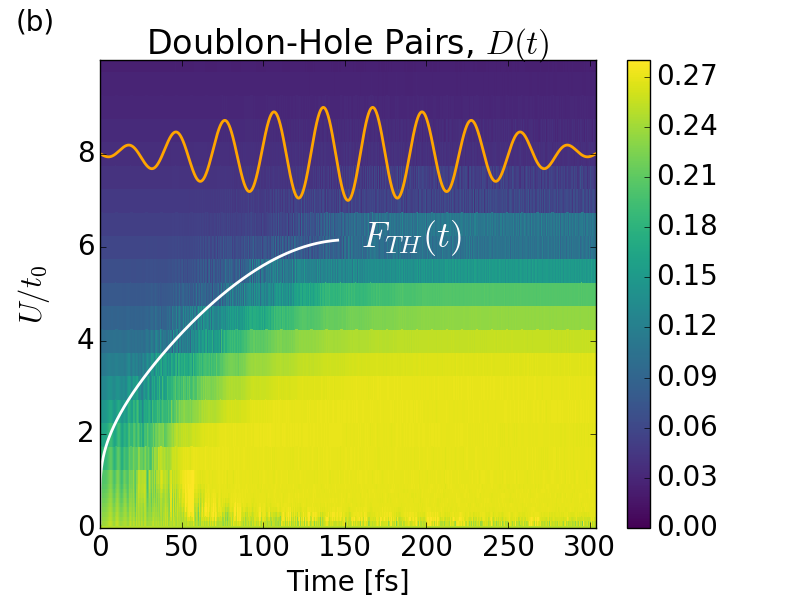 Figure 1
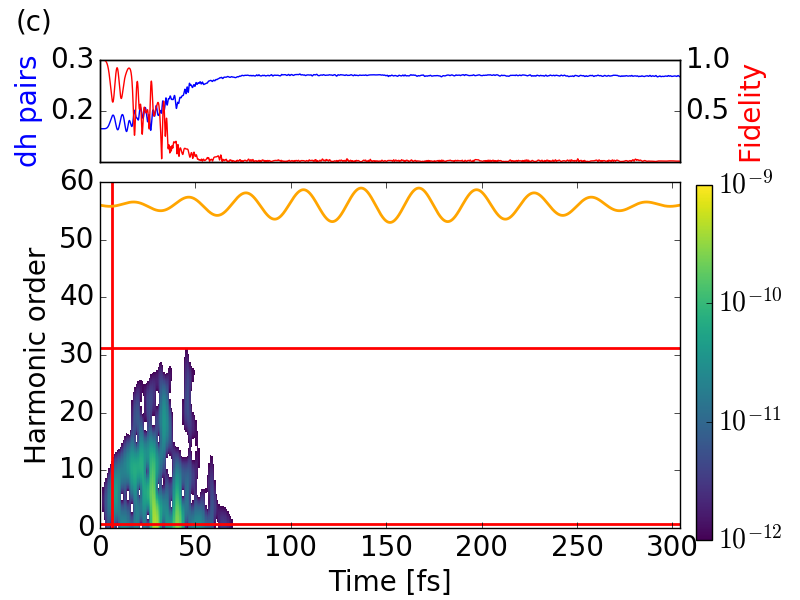 Figure 2
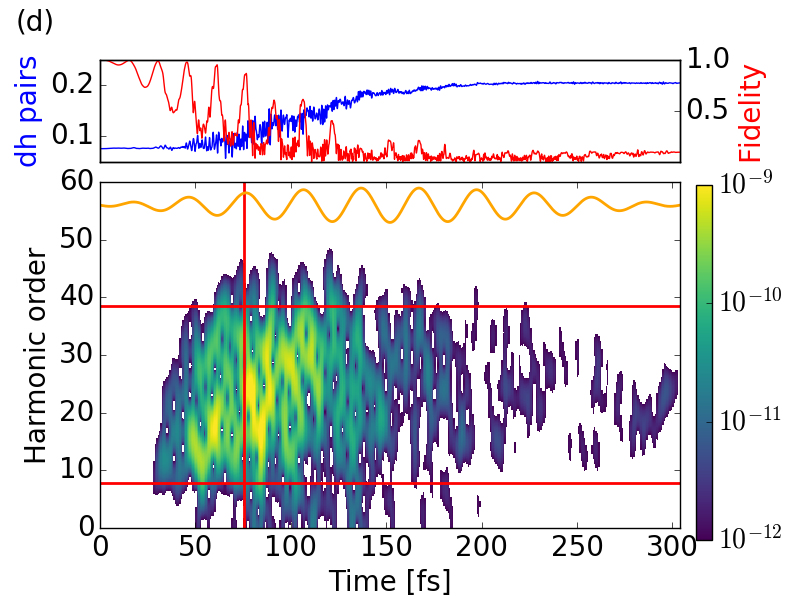 Figure 3
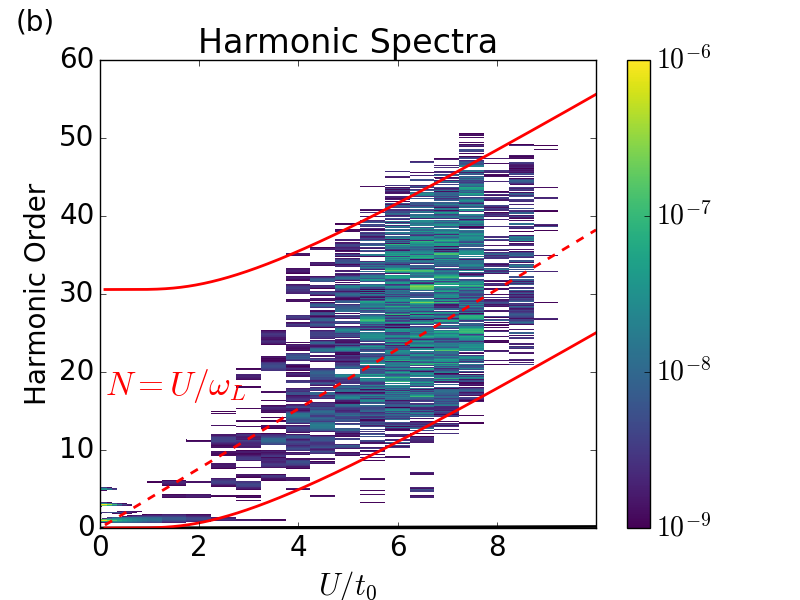 Figure 4
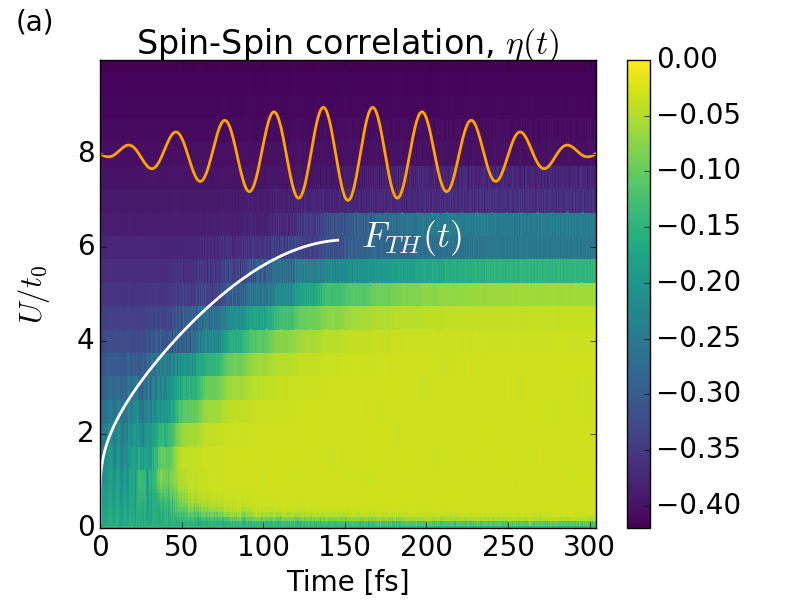 Figure 5
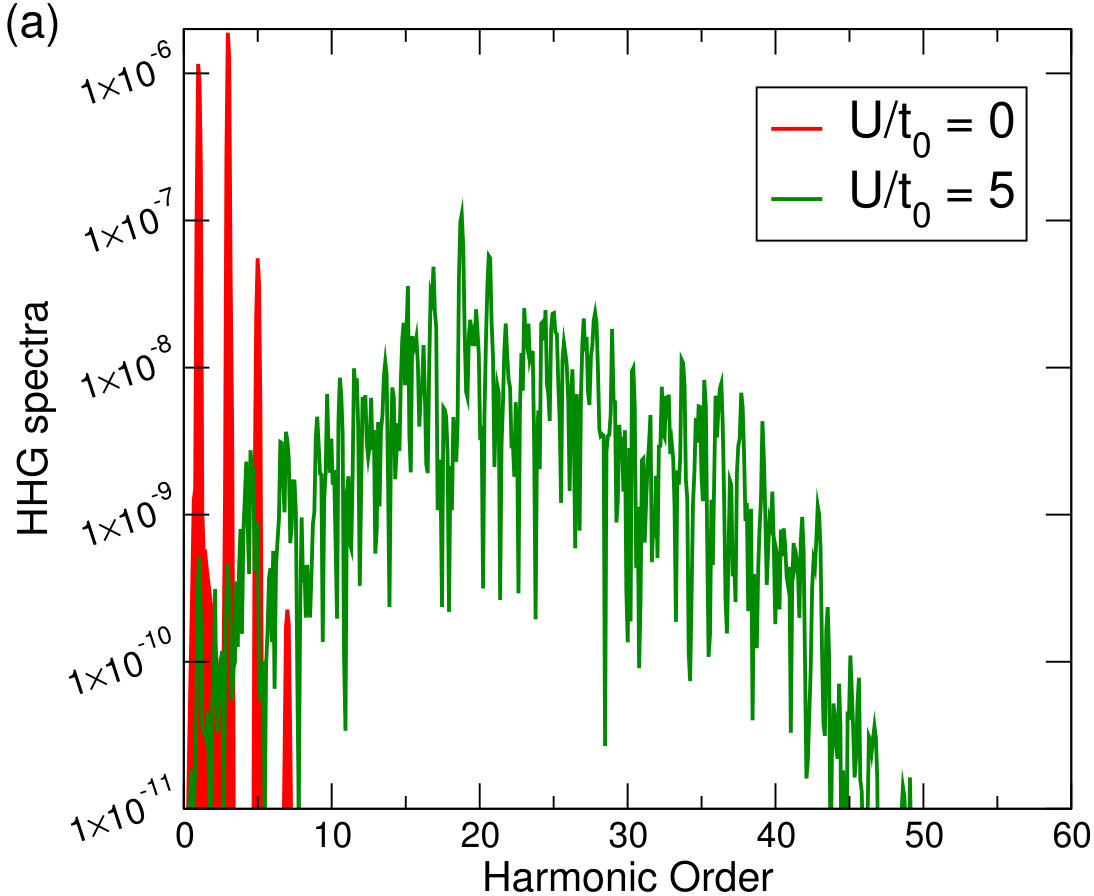 Figure 6
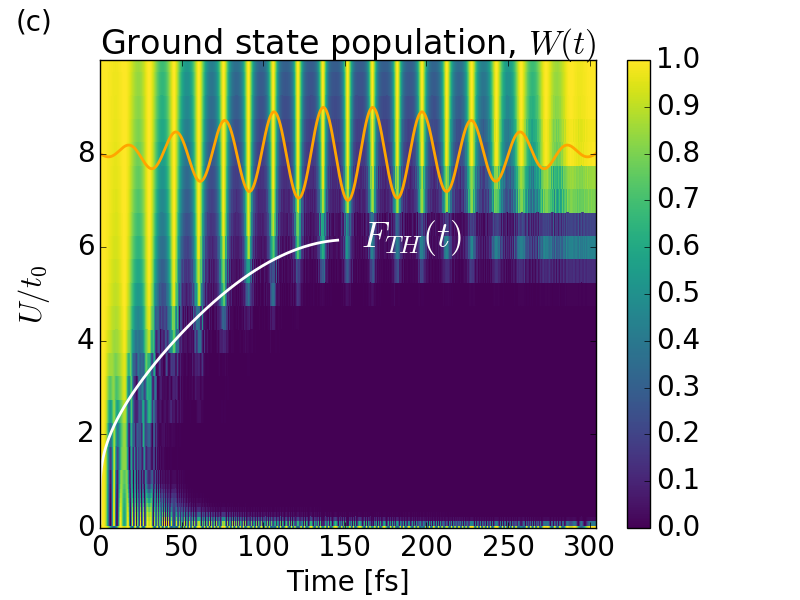 Figure 7
Peer Reviews
No public reviews on file for this paper yet. If you reviewed it on a platform where reviews are public (OpenReview, ICLR, NeurIPS, ICML), you can paste yours below so the community can read it here.
Videos
No videos yet. Explain this paper in a talk, walkthrough, or lecture? Add one.
High harmonic imaging of ultrafast many-body dynamics in strongly
correlated systems
R. E. F. Silva
Max-Born-Institut, Max Born Strasse 2A, D-12489 Berlin, Germany
Igor V. Blinov
Russian Quantum Center, Skolkovo 143025, Russia
Moscow Institute of Physics and Technology, 9 Institutsky lane, Dolgoprudny, Moscow region 141700, Russia
Alexey N. Rubtsov
Russian Quantum Center, Skolkovo 143025, Russia
Department of Physics, Moscow State University, 119991 Moscow, Russia
O. Smirnova
Max-Born-Institut, Max Born Strasse 2A, D-12489 Berlin, Germany
Technische Universitaet Berlin, Ernst-Ruska-Gebaeude, Hardenbergstr. 36A,10623, Berlin, Germany
M. Ivanov
Max-Born-Institut, Max Born Strasse 2A, D-12489 Berlin, Germany
Blackett Laboratory, Imperial College London, South Kensington Campus, SW7 2AZ London, United Kingdom
Department of Physics, Humboldt University, Newtonstrasse 15, 12489 Berlin, Germany
Abstract
This Letter brings together two topics that, until now, have been the focus of intense but non-overlapping research efforts. The first concerns high harmonic generation in solids, which occurs when intense light field excites highly non-equilibrium electronic response in a semiconductor or a dielectric. The second concerns many-body dynamics in strongly correlated systems such as the Mott insulator. Here we show that high harmonic generation can be used to time-resolve ultrafast many-body dynamics associated with optically driven phase transition, with accuracy far exceeding one cycle of the driving light field. Our work paves the way for time-resolving highly non-equilibrium many body dynamics in strongly correlated systems, with few femtosecond accuracy.
pacs:
78.47.J−, 71.27.+a, 42.65.Ky
High harmonic emission provides the frequency domain view of charge dynamics in quantum systems krausz2009attosecond . Complete characterization of the emitted harmonic light – its spectrum, polarization, and spectral phase – allows one to decode the underlying charge dynamics in atoms and molecules with resolution femtosecond (fs), well below a single cycle of the driving laser field, opening the new field of ultrafast high harmonic imaging baker2006probing ; lein2007molecular ; smirnova2009high ; haessler2010attosecond ; shafir2012resolving ; pedatzur2015attosecond ; bruner2016multidimensional ; kraus2015measurement .
Here we bring high harmonic imaging to many-body dynamics in strongly correlated solids, focusing on an ultrafast phase transition. We consider the breakdown of the Mott insulating state in the canonical model of a strongly correlated solid, the Fermi-Hubbard model. We show how the complex many-body charge dynamics underlying this transition are recorded by high harmonic emission, with few fs accuracy.
Combining high harmonic generation in bulk solids ghimire2011observation ; vampa2014theoretical ; Hohenleutner2015 ; langer2016lightwave ; luu2015extreme with robust techniques for characterizing the emitted light Hohenleutner2015 ; langer2016lightwave ; luu2015extreme has demonstrated the capabilities of high harmonic imaging in solids. Recent results include the demonstration of the dynamical Bloch oscillations schubert2014sub ; luu2015extreme , the reconstruction of the band structure in ZnO vampa2015all , the visualization of strong field-induced effective band structure hawkins2015effect , and direct visualization of the asymmetric charge flow driven by MIR fields you2016anisotropic . Yet, all of these studies have been confined to systems well described by single-particle band structure, and single-particle pictures have dominated the analysis ghimire2011observation ; higuchi2014strong ; Hohenleutner2015 ; vampa2014theoretical ; luu2015extreme ; hawkins2015effect . The role of electron-electron correlation has been relegated to empirically introduced (and unusually short, only a few fs) relaxation times vampa2014theoretical ; Hohenleutner2015 .
Yet, electron-electron correlations go well beyond mere dephasing, generating rich physics of strongly correlated systems, such as pre-thermalization and the formation of extended Gibbs ensembles eisert2015quantum , superfluid to Mott insulator transition bloch2008many , to name but a few. Studies of non-equilibrium many body dynamics have lead to the concepts of the dynamical heyl2013dynamical and light-induced phase transitions Nasu2004 ; oka2008photoinduced ; liu2012terahertz ; mayer2015tunneling . In particular, the Mott insulator-to-metal transition was recently achieved experimentally in VO2 liu2012terahertz ; mayer2015tunneling . Resolving such transitions with few-femtosecond accuracy remains, however, elusive. Our results show that high harmonic imaging is ideally suited to address this challenge, offering detailed view of the underlying dynamics.
We use one-dimensional Fermi-Hubbard model with half-filling, i.e. with averaged particle density equal to one per site (see Methods for details). A particle could freely hop to an adjacent site with a rate , yielding the metallic state of the system. Hopping can be obstructed by another particle already residing on the adjacent site, via the energy of the repulsive on-site interaction. In the strong coupling limit , the Mott insulating ground state has short-range antiferromagnetic order Gebhard1997mottbook (the electron spins at the adjacent sites tend to be anti-parallel). The elementary charge excitations, called doublon-hole pairs oka2012nonlinear ; hubbard_1d_book , are separated by an optical gap . Deep into repulsive regime (), scales linearly with . We focus on this regime, and consider the driving field in the mid-IR range, with THz identical to that in recent experiments Hohenleutner2015 , and a modest peak amplitude MV/cm. The hopping rate is set to eV to mimic oka2012nonlinear , and is varied to demonstrate the trends and the general nature of our conclusions. Details of our simulations are described in the Methods section.
To induce and resolve the Mott transition, we apply a light pulse where the field amplitude increases smoothly. This field can excite the doublon-hole pairs, which play the role of carrier chargers. The density of doublon-hole pairs may change during the pulse, depending on the field amplitude . As crosses the threshold , the density of charge carriers exceeds critical value, leading to the breakdown of the Mott insulator – the system becomes conducting. The transition is followed by the destruction of local magnetic order and a paramagnetic liquid-like state is formed oka2008photoinduced ; oka2012nonlinear . Smooth variation of during the pulse allows us to track the transition as a function of time, with high harmonic response providing sub-cycle accuracy (see below). The transition is mathematically similar to strong-field ionization in atoms oka2012nonlinear . In particular, the parameter (where is the correlation length oka2012nonlinear ) serves as the analogue of the Keldysh adiabaticity parameter krausz2009attosecond . In the ‘tunnelling’ regime the threshold field is oka2012nonlinear
[TABLE]
As the insulator-to-metal transition is marked by the increased density of charge carriers and the destruction of short-range magnetic order, we will characterize the state of the system via the two parameters describing the charge and spin degrees of freedom: the next-neighbor spin-spin correlation function
[TABLE]
and the average number of doublon-hole pairs per site,
[TABLE]
Here labels the site, up-down arrows the spin, is the number of cites, are the creation and annihilation operators.
The destruction of short range antiferromagnetic order during the transition is shown in Fig. 1 (a): within a cycle, the spin-spin correlation function drops to nearly zero (limited by the finite size of the system). The second signature of the transition is the rise in the number of doublon-hole pairs, Fig.1 (b), which is linked to the loss of spin-spin correlation (compare Figs. 1 (a,b)). After the transition, the system reaches a photo-induced saturated state oka2012nonlinear and the number of pairs remains constant. The abrupt nature of the transition is shown in Fig. 1(c): for fields crossing the overlap probability with the initial state drops to zero within a laser cycle, stressing the need for sub-cycle resolution.
Naturally, the rise of optical charge excitations has to manifest in the optical response. Indeed, we find that the transition is accompanied by very characteristic high-harmonic emission, see Fig.2.
Fig. 2 (a) shows harmonic spectra for two different values of . In the conducting limit the emission is typical for single band tight binding model ghimire2011observation , demonstrating clear low-order Bloch oscillation-type harmonics associated with intra-band current (the intra-band harmonics). As expected, the harmonics are narrow and well defined. In the case of , the spectrum is quite unusual.
First, the intra-band harmonics are strongly suppressed, in stark contrast with systems described by single-particle band structures (e.g. ghimire2011observation ; schubert2014sub ; vampa2014theoretical ; Hohenleutner2015 ; langer2016lightwave ). Second, for the same , the spectrum becomes much broader and shifts towards orders . This characteristic change is summarized in Fig. 2 (b), where we scan to demonstrate the trend. For , the spectrum peaks near the characteristic energies of doublon-hole excitation. In the half-filled system, the first allowed charge excitations are states with single doublon-hole pairs with energies between and hubbard_1d_book ; oka2012nonlinear . Fig.2(b) shows that these excitations are the ones responsible for the harmonic emission. Indeed, their range, shown with red lines in Fig. 2 (b), defines the lower and upper frequencies for the harmonic emission. Thus, the emission corresponds to the one-photon transition that brings the excited system back to its initial ground state via the doublon-hole recombination.
Third, the regular structure of the harmonic lines is lost in the strong coupling limit. This stands in stark contrast to weakly correlated systems, where electron-electron correlation is expected to introduce fast dephasing, the latter yielding regular, narrow harmonic lines vampa2014theoretical . Figs.2(c,d) clarify the physics responsible for the irregular structure of the spectrum.
Figs. 2 (c,d) show the time profile of the harmonic emission, obtained via the Gabor transform (see Methods). Note that complete time-domain reconstruction of the emitted harmonic light with fs accuracy is fully within the available experimental technology Hohenleutner2015 , for the same laser parameters as in our calculation. We see that (i) the onset of the harmonic emission is synchronized with the breakdown of the insulating Mott state and the rise in the number of doublon-hole pairs, and (ii) the fall of the emission follows the depletion of the insulating state (Fig.2(c,d)), following the fidelity . The Gabor profiles in Fig. 2(c,d) show that the emission takes about 50-70 fsec, i.e. only about 1-2 cycles of the driving field. The temporal restriction of the emission to a couple of cycles of the driving field explains the lack of clear peaks at odd harmonics. The complexity of the spectrum affirms the strongly aperiodic many-body dynamics, in contrast to the periodic intraband motion in the limit (see Fig.2(a)). The top panels in Figs. 2(c,d) confirm the conclusions drawn from Fig. 2(b): the emission relies on the coherence created between the Mott insulator ground state and the doublon-hole states. This is why it starts when the doublon-hole pairs are created and ends when the ground, Mott insulator state, is destroyed.
The lack of low-order harmonics after the phase transition leads to another important conclusion: the new many-body state created by the photo-induced transition does not support Bloch-like oscillations of doublon-hole pairs. Indeed, these would have generated strong low-order harmonics familiar from one-electron-type excitations in a conventional conduction band. Loosely speaking, this happens because all quasi-momenta states for the doublon-hole pairs are occupied upon the transition in the tunneling regime oka2012nonlinear .
In contrast to high harmonic emission in systems with single-particle band structure ghimire2011observation ; schubert2014sub ; luu2015extreme ; vampa2014theoretical , the cutoff of the harmonic signal associated with a phase transition in a strongly correlated system does not scale linearly with the electric field. In our case the harmonic emission has threshold behavior and, at , covers all energies between and irrespective of the field. We also find that strong electron-electron correlations do not necessarily lead to the emergence of regular harmonic spectra with well defined lines, as expected for weakly correlated systems. Highly irregular harmonic spectra imply highly aperiodic dynamics, in line with the dramatic change in the state of the system during a phase transition.
High harmonic generation has been pioneered three decades ago ferray1988multiple , evolving from an unusual table-top source of bright, coherent XUV light to the technological backbone of attosecond science krausz2009attosecond and a unique tool for imaging ultrafast dynamics with attosecond to few-femtosecond temporal resolution lein2007molecular . Yet, throughout these decades, the analysis of high harmonic generation has been rooted in effectively single-electron pictures. Our work is the first to bring fundamental strongly correlated many-body dynamics squarely into its view.
Acknowledgements.
We gratefully acknowledge fruitful discussions with Dr. Takashi Oka, Dr. Bruno Amorim, and Dr. Peter Hawkins. M. I. and R. E. F. S. acknowledge the support from the MURI programme.
Methods
We study high harmonic generation in the one-dimensional, half-filled Fermi-Hubbard model by solving the time dependent Schrödinger’s equation (TDSE) numerically exactly, fully including the electron-electron correlations in the system interacting with intense light field. We use the 1D Fermi-Hubbard Hamiltonian hubbard_1d_book
[TABLE]
where the laser electric field enters through the time-dependent Peierls phase , is the lattice constant and is the field vector potential. The hopping parameter is set to eV to mimic oka2012nonlinear , and is the on-site Coulomb repulsion. In the calculations, we use the periodic boundary conditions with , being the number of particles, and focus on the subspace. Starting at from the ground state of the Hamiltonian, we apply the pulse with at the carrier wavelength of m ( THz) and the peak amplitude MV/cm. All the parameters of the pulse are well within the experimental reach. The pulse has total duration of 10 optical cycles and a envelope, and is shown in Fig.1
To compute the harmonic emission, we first use the electric current operator, defined as hubbard_1d_book
[TABLE]
to compute the time-dependent current. The harmonic spectrum is calculated as the square of the Fourier transform of the dipole acceleration, . Time-resolved emission is obtained by performing the Gabor (window Fourier) transform with the sliding window , .
The reference list from the paper itself. Each links out to its DOI / PubMed record.
- 1(1) Krausz, F. & Ivanov, M. Attosecond physics. Reviews of Modern Physics 81 , 163 (2009).
- 2(2) Baker, S. et al. Probing proton dynamics in molecules on an attosecond time scale. Science 312 , 424–427 (2006).
- 3(3) Lein, M. Molecular imaging using recolliding electrons. Journal of Physics B: Atomic, Molecular and Optical Physics 40 , R 135 (2007).
- 4(4) Smirnova, O. et al. High harmonic interferometry of multi-electron dynamics in molecules. Nature 460 , 972–977 (2009).
- 5(5) Haessler, S. et al. Attosecond imaging of molecular electronic wavepackets. Nature Physics 6 , 200–206 (2010).
- 6(6) Shafir, D. et al. Resolving the time when an electron exits a tunnelling barrier. Nature 485 , 343–346 (2012).
- 7(7) Pedatzur, O. et al. Attosecond tunnelling interferometry. Nature Physics 11 , 815–819 (2015).
- 8(8) Bruner, B. D. et al. Multidimensional high harmonic spectroscopy of polyatomic molecules: detecting sub-cycle laser-driven hole dynamics upon ionization in strong mid-ir laser fields. Faraday Discussions 194 , 369–405 (2016).