From bare interactions, low--energy constants and unitary gas to nuclear density functionals without free parameters: application to neutron matter
Denis Lacroix, Antoine Boulet, Marcella Grasso, and C.-J. Yang

TL;DR
This paper develops a parameter-free energy functional for Fermi systems, accurately modeling neutron matter and nuclear densities up to saturation density by incorporating unitary gas properties and medium effects.
Contribution
It introduces a new functional based on low-energy constants that extends previous models to higher densities and includes medium renormalization effects, improving predictions for nuclear matter.
Findings
Functional reproduces unitary limit and low-density behavior
Predictive up to densities of ~0.01 fm$^{-3}$, higher than previous models
Scales at saturation are dominated by unitary gas properties
Abstract
We further progress along the line of Ref. [Phys. Rev. {\bf A 94}, 043614 (2016)] where a functional for Fermi systems with anomalously large -wave scattering length was proposed that has no free parameters. The functional is designed to correctly reproduce the unitary limit in Fermi gases together with the leading-order contributions in the s- and p-wave channels at low density. The functional is shown to be predictive up to densities fm that is much higher densities compared to the Lee-Yang functional, valid for fm. The form of the functional retained in this work is further motivated. It is shown that the new functional corresponds to an expansion of the energy in and to all orders, where is the effective range and is the Fermi momentum. One conclusion from the present work is that, except in the…
Click any figure to enlarge with its caption.
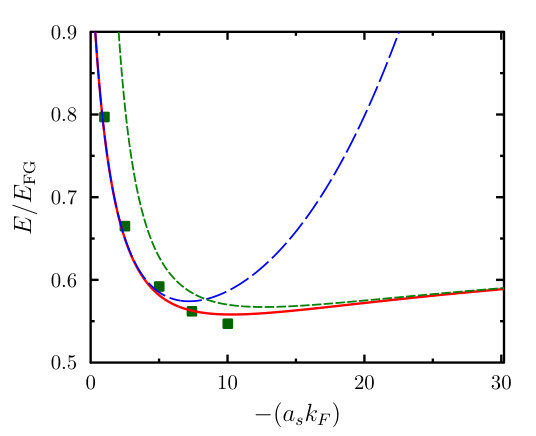 Figure 1
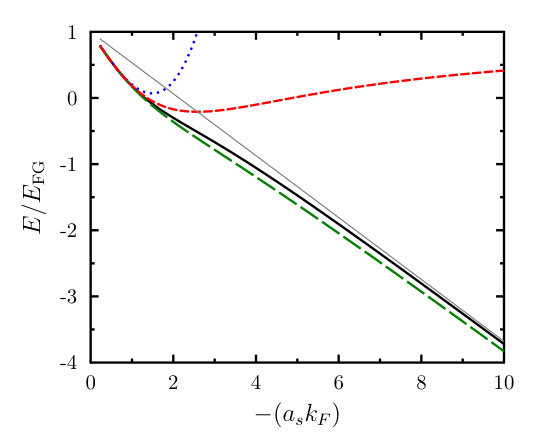 Figure 2
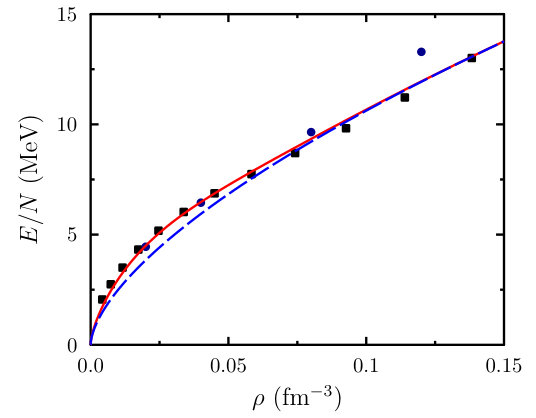 Figure 3
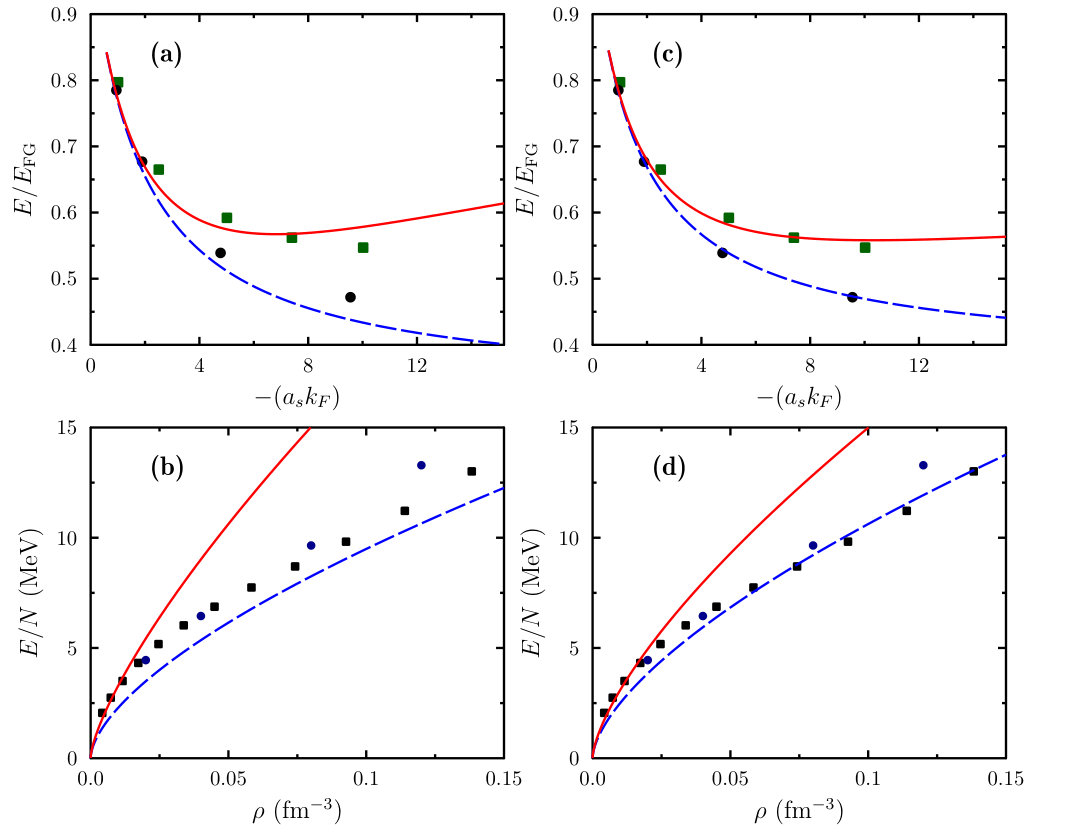 Figure 4
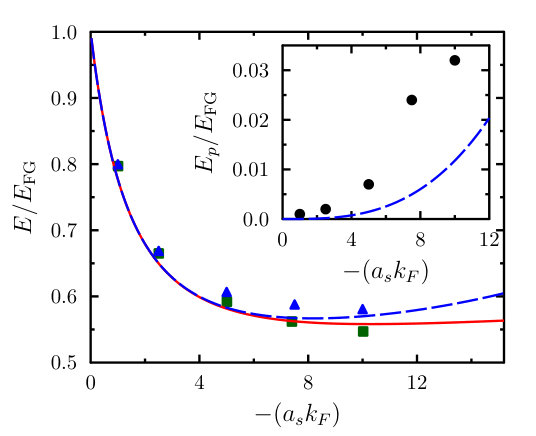 Figure 5
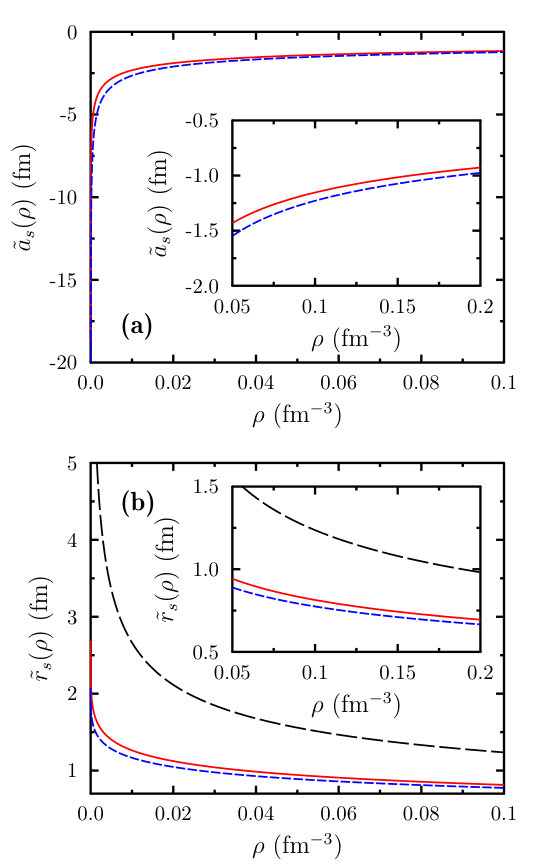 Figure 6
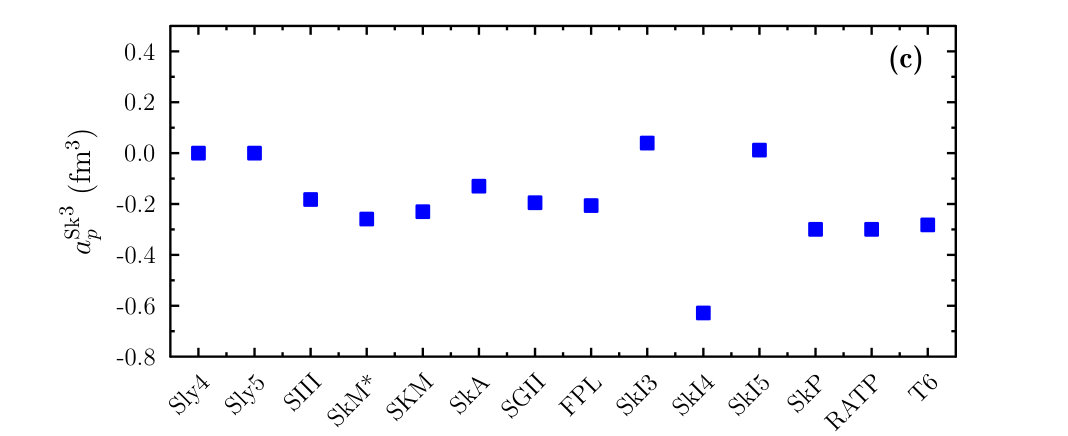 Figure 7
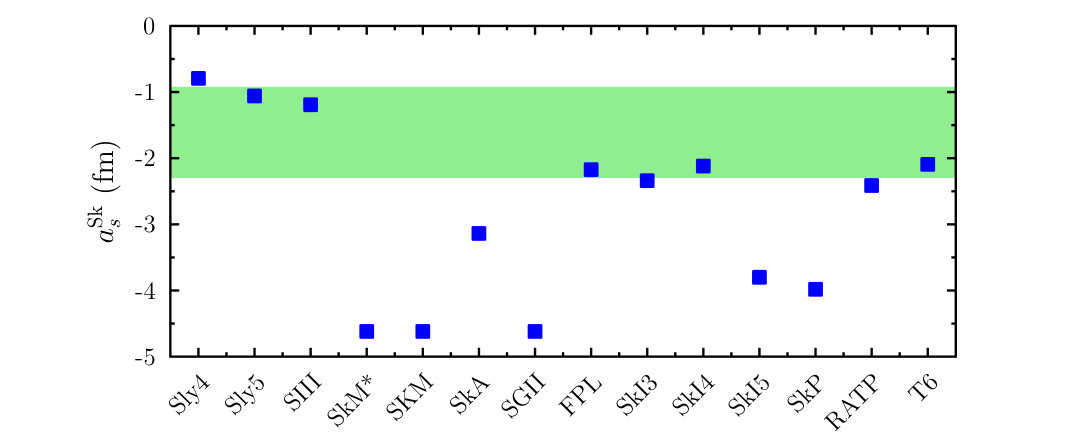 Figure 8
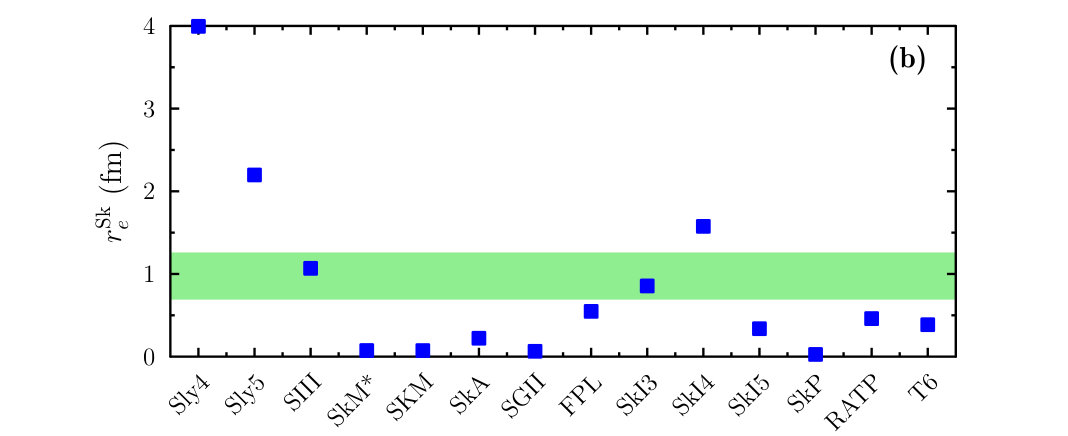 Figure 9
Peer Reviews
No public reviews on file for this paper yet. If you reviewed it on a platform where reviews are public (OpenReview, ICLR, NeurIPS, ICML), you can paste yours below so the community can read it here.
Videos
No videos yet. Explain this paper in a talk, walkthrough, or lecture? Add one.
From bare interactions, low–energy constants and unitary gas to
nuclear density functionals without free parameters: application to neutron matter
Denis Lacroix
Institut de Physique Nucléaire, IN2P3-CNRS, Université Paris-Sud, Université Paris-Saclay, F-91406 Orsay Cedex, France
Antoine Boulet
Institut de Physique Nucléaire, IN2P3-CNRS, Université Paris-Sud, Université Paris-Saclay, F-91406 Orsay Cedex, France
Marcella Grasso
Institut de Physique Nucléaire, IN2P3-CNRS, Université Paris-Sud, Université Paris-Saclay, F-91406 Orsay Cedex, France
C.-J. Yang
Institut de Physique Nucléaire, IN2P3-CNRS, Université Paris-Sud, Université Paris-Saclay, F-91406 Orsay Cedex, France
Abstract
We further progress along the line of Ref. [D. Lacroix, Phys. Rev. A 94, 043614 (2016)] where a functional for Fermi systems with anomalously large -wave scattering length was proposed that has no free parameters. The functional is designed to correctly reproduce the unitary limit in Fermi gases together with the leading-order contributions in the s- and p-wave channels at low density. The functional is shown to be predictive up to densities fm*-3* that is much higher densities compared to the Lee-Yang functional, valid for fm*-3*. The form of the functional retained in this work is further motivated. It is shown that the new functional corresponds to an expansion of the energy in and to all orders, where is the effective range and is the Fermi momentum. One conclusion from the present work is that, except in the extremely low–density regime, nuclear systems can be treated perturbatively in with respect to the unitary limit. Starting from the functional, we introduce density–dependent scales and show that scales associated to the bare interaction are strongly renormalized by medium effects. As a consequence, some of the scales at play around saturation are dominated by the unitary gas properties and not directly to low-energy constants. For instance, we show that the scale in the s-wave channel around saturation is proportional to the so-called Bertsch parameter and becomes independent of . We also point out that these scales are of the same order of magnitude than those empirically obtained in the Skyrme energy density functional. We finally propose a slight modification of the functional such that it becomes accurate up to the saturation density fm*-3*.
strongly interacting fermions, unitary limit, neutron matter
pacs:
67.85.Lm,21.65.-f
I Introduction
In the last 50 years, nuclear theoretical physics has encountered two major breakthrough. The first one was the nuclear Density Functional Theory (DFT) approach also called Energy Density Functional (EDF) theory. In the seventies, it was realized that simple functionals Vau72 ; Gog75 ; Gog75-b based on the concept of effective interaction can be very accurate while simultaneously unifying the description of nuclear structure Ben03 ; Sto07 , nuclear dynamics Sim10 ; Nak16 or thermodynamics Oer16 . Nuclear EDF remains, even today, the only microscopic approach able to describe nuclear systems from small masses () to infinite nuclear matter. Still, the understanding of ”why functional of extreme simplicity can work so well despite the known complexity of the underlying many-body interaction?” remains unclear.
A second breakthrough was made more recently on the nuclear interaction itself and on its application to nuclear systems. In particular, it was realized that the strong nuclear repulsion at short distances can be replaced by a softer potential that is optimized for the low-energy scales relevant for nuclei Ham09 ; Kuo16 . Progress has been made along this line in the past decades, especially under the impulse of the nuclear Effective Field Theory (EFT) leading to a constructive approach Kol02 ; Hol13 ; Gez13 ; Gez14 ; Epe15 ; Mac16 ; Mei16 for the nucleon-nucleon interaction. The possibility to get rid of the strong repulsion turns out to considerably simplify the nuclear many-body problem. In particular, nuclei become more perturbative and methods that were extremely difficult to apply with former generations of bare interactions become manageable. Considerable efforts are made nowadays to develop accurate exact calculations, called ab-initio methods, for infinite matter and nuclei Kuo16 ; Hag16 ; Nav16 ; Gan15 . A very important aspect of the strategy used in ab-initio methods, is that the complexity of the nuclear interaction is gradually increased using power counting analysis leading to exact calculations with controlled errors. One difficulty that is encountered is that the EFT approach automatically leads to three-body and more generally many-body interactions that are not easy to handle in applications. Nevertheless, by treating the Lagrangian at increasing orders, one should reduce gradually the errorbars in exact calculations. One can note however that, in practice, errorbars do not decrease so fast from LO to N2LO or N3LO, etc… In addition, when applying ab-initio methods to infinite systems, these errorbars are increasing with density (small relative distances), as expected, and turn out to be rather large around the saturation density (see for instance Dri16 ).
Quite naturally, attempts have been made to take advantage of these progress on the nuclear interaction and to obtain less empirical nuclear EDF. This includes the use of Density Matrix Expansion (DME) Neg72 ; Geb10 ; Sto10 ; Dob10 ; Car10 ; Dyh16 or functionals deduced for instance in infinite systems, like in the ongoing effort summarized in Ref. Hol13 . Another path that is now explored is to clarify the notion of beyond mean-field approaches within EDF and eventually propose new functionals using techniques from EFT Mog10 ; Kai15 ; Yan16a . A common feature of these attempts is that the functionals become rapidly rather complicated and therefore are at variance with the apparent simplicity of more empirical nuclear EDF.
Alternatively, it was noted that due to the very large -wave scattering length of the nuclear interaction, nuclear systems are rather close to unitary gas where the scattering length becomes infinitely large. Numerous experimental and theoretical works have been made on the unitary regime Gio08 ; Blo08 ; Zwe11 . Unitary gases are universal in the sense that, independently from the original interaction and particles nature, the energy can be written as where is the so-called Bertsch parameter Ber00 and is the free gas energy. In view of this, minimalist functionals have been produced at unitarity Pap05 ; Bul07 ; Zwe11 .
Our primary goal is to construct simple functionals for neutron matters with as less free parameters as possible, rendering the functionals at the same time less empirical. The starting point in the recent work Lac16 is to use the universality of unitary gas on one side and the behavior of nuclear systems at very low density to propose a new functional. Here, we report new progress we have made along this line. A more precise discussion and justification of the functional form we have retained is made. The functional is finally further improved by imposing that the effective range dependence of the unitary gas is better reproduced.
The novel functional leads naturally to density–dependent scales that identify with the bare scales at very low density and strongly evolve with the density. We show that the scale obtained in this way helps to understand why empirical functionals like Skyrme based EDF, although very simple and not connected to the bare interaction can be so predictive (see Section IV).
II Parameter free nuclear Density Functionals
Following the recent work of ref. Lac16 , we focus here on neutron matter. We consider a spin-degenerate system interacting through an s-wave interaction characterized by its phase shift at low momentum transfer:
[TABLE]
where is the relative momentum of the interacting particles and where the low–energy constants (LECs) and stand respectively for the s-wave scattering length and the effective range. For neutron matter, these low–energy constants are equal to fm and fm.
Guided by the resummation technique used in low-density Fermi gases with large scattering length Ste00 ; Sch05 ; Kai11 and on the recent efforts to develop a nuclear energy density functional correctly treating low–density fermi liquids Yan16 , a novel density functional for neutron matter was proposed in Ref. Lac16 . This functional can be generically written as:
[TABLE]
where is the free Fermi gas energy given by . Here is the number of particles, is the Fermi momentum that is obtained from the single-particle density through . is the degeneracy ( for neutron matter). In Ref. Lac16 , the following functional has been proposed:
[TABLE]
Besides this specific form, an important aspect is that the parameters are not adjustable but are fixed by imposing well-defined limits.
One possibility that has been explored in Refs. Sch05 ; Yan16 is to fix some parameters by imposing the correct low–density limit. In general, the energy of a Fermi system can be written as :
[TABLE]
where is the Hartree-Fock energy, (resp. ) is the second-order (resp. -order) perturbation theory contribution. At low density, the different contributions can be expanded in power of as Fet71 111Note that these expressions are valid if pairing correlations are neglected. The presence of pairing estimated using the Hartree-Fock Bogolyubov approach Fet71 would lead to an additional contribution associated for instance in the s-wave channel to a pairing gap Pap99 . :
[TABLE]
We recognize in particular some of the terms appearing in the Lee-Yang formula obtained in Refs. Lee57 ; Bis73 ; Ham00 . Setting the p-wave scattering volume to zero and imposing to recover the different terms appearing in Eqs. (5-6) when Taylor expanding (3) to second order in and first order in provides a unique determination of the parameters (see Lac16 for explicit values). Results of this method are shown in panels (a) and (b) of Fig. 1. As noted in Ref. Sch05 ; Lac16 , these results are actually not so far from the ”exact” QMC at low density even if .
As an alternative strategy, starting from the fact that the s-wave scattering length in nuclear matter is very large, it was proposed to constrain the functional (3) keeping the constraint of the Hartree-Fock expansion, Eq. (5) while using the unitary gas limit instead of the second–order contribution. The unitary regime corresponds to the limit . After simple manipulations, the unitary gas limit is better emphasized by rewriting Eq. (3) as:
[TABLE]
where new parameters can be expressed in terms of the original coefficients222It can be shown that starting from Eq. (3), we have the relationships and , so that the number of independent parameters in (7) is the same as in (3). However, in the present study, we will not impose this constraint and simply fix the 5 parameters entering in Eq. (7) independently from each other.. In Ref. Lac16 , the three independent parameters have been adjusted by imposing that the leading order in the low–density expansion in and the behavior of the quantity at unitarity are correctly reproduced. More precisely, we took advantage of the recent study For12 where the possible effect of non-zero effective range in unitary gases was analyzed:
[TABLE]
is the Bertsch parameter while and are two new parameters. In the present work, we take the reference values , , and For12 . It is worth mentioning that these values correspond to averages over the different interactions considered in Ref. For12 . We tested the sensitivity of the result to the value (assuming ). Reducing to 0.046 as originally obtained in Ref. Pap06 gives a slightly lower energy at low density while the shape and order of magnitude of the energy is globally unchanged for the density considered in panel (d) of Fig. 1.
In our previous work, accounting for the constraints between the and , three constraints were necessary to fix the 3 independents parameters. Then, only and where used as a constraint Lac16 together with the correct leading order (LO) in at low density. Here we slightly improve the functional by directly using expression (7) and relax the constraints between the different and coefficients. Then 5 constraints are needed to fix the 5 parameters. We impose that the three terms of Eq. (8) are reproduced as well as the the second and third terms of Eq. (5). This gives:
[TABLE]
Results of the functional (7) are shown in panels (c) and (d) of Fig. 1.
In panel (c) of Fig. 1, we also display the result obtained with the functional (7) assuming (blue dashed line) and compare it with the QMC calculations obtained in Ref. Gez10 ; Car12 (filled circles). In this case, the functional only depends on the two parameters and that are both only functions of the Bertsch parameter . Despite its simplicity the functional result perfectly matches the exact QMC result. As noted in Ref. Lac16 , it confirms the finding of Refs. Adh08 ; Adh08-b where a similar functional was proposed at unitarity.
By comparing the two red lines displayed respectively in panels (a) and (c) of Fig. 1 with the QMC results in neutron matter (filled squares), we also note that taking the constraint on the unitary limit instead of the constraint to reproduce the term appearing in (6) significantly improves the description of neutron matter. From this, it seems quite clear that the unitary gas regime is a good starting point.
In order to illustrate how perturbative is neutron matter with respect to unitary gas and/or low–density regime, we show in Fig. 2 the results of first–order Taylor expansion of Eq. (7) either in or in . It is then clear that the former expansion rapidly converges to the full expression. In particular, at densities above fm*-3*, the first–order expansion in cannot be distinguished from the result of Eq. (7).
It is interesting also to mention that the first–order expansion in deviates rather fast from the function (7). Indeed, although is much smaller than , for densities around the saturation density of symmetric matter, we are beyond the range of validity of an expansion in the effective range. It can also be stressed that Eq. (7) contains all orders in and therefore can also be seen as a resummed expression accounting for effective range effects. This aspect is discussed below.
III Mean-field based on finite-range interaction: discussion of resummation of effective range effect
In Ref. Lac16 , the effective range dependence of the unitary gas regime has been introduced without much justifying the retained expression. Here, we would like to give more physical insight in the expression and to show that the effective range dependence entering in (3) can be also regarded as a resummation of effect. The easiest way to introduce effective range effects beyond those contained in Eq. (5) is to consider the Hartree-Fock energy associated to a finite-range interaction. We take below the case of a Gaussian interaction. This section also illustrates how the interaction parameters should be adjusted to properly account for the low–energy constants coming from the underlying Lagrangian. This strategy is very similar to what is usually done in Effective Field Theory (EFT). The connection with EFT based on zero range interaction is then naturally made here. Finally, a discussion on the possibility to make resummation of the effective range such that the functional (3) is recovered.
III.1 Preliminary: Hartree-Fock energy of a Gaussian two-body interaction
We consider here a two-body gaussian interaction written in the form:
[TABLE]
where and are parameters. is the operator that exchanges the spin of two particles and is a normalized Gaussian given by:
[TABLE]
where and is a free parameter. The Hartree-Fock contribution of this interaction to the equation of state of neutron matter gives:
[TABLE]
where and are
[TABLE]
is a function given by:
[TABLE]
where denotes the spherical Bessel function and .
III.2 Discussion on the low–density limit and relation between the EFT, Skyrme and Gaussian interaction parameters
Fermi systems at low density have been widely studied using the EFT approach based on a zero-range interaction. In that case, spin–degenerate systems can be studied using a two-body interaction written in the form Ham00 :
[TABLE]
or equivalently in -space:
[TABLE]
Using this interaction, the Hartree-Fock energy then read:
[TABLE]
At low–density, we can then compare to the Hartree-Fock contribution given in Eq. (5). The low density expansion of the HF energy is recovered under the condition that the parameters are linked to the low–energy constants through Ham00 :
[TABLE]
is the so-called p-wave scattering volume 333Note that here we use a slightly different notation compared to standard definition. Indeed, the p-wave scattering volume is usually defined though the phase-shift using:
(25)
We use here so that has a length unit. . Similarly to the EFT case based on zero-range interaction, one can recover the low density expression starting from the Gaussian interaction. The most direct way to make connections between Eq. (15) and Eqs. (22) (23) is to expand the interaction in terms of the momentum transferred. Starting from Eq. (15) and expanding in up to second order, we have:
[TABLE]
Making the inverse Fourier transform, one then obtains the Skyrme–type interaction with standard parameters:
[TABLE]
where we have set
[TABLE]
These relationships on the one side between the Skyrme parameters and the parameters of the Gaussian and, on the other side, the evident similarities between Skyrme and EFT Hamiltonians is a useful guidance to understand how the low–density behavior can be correctly reproduced using the Gaussian interaction. For instance, starting from Eq. (17), the standard expression of the neutron matter energy is recovered by expanding the function up to second order in . This expression matches Eq. (23) and Eq. (5) under the set of conditions:
[TABLE]
With these relations, the same energy is obtained at the Hartree-Fock level either using the EFT Lagrangian, the Skyrme Hamiltonian or the Gaussian interaction provided that the energy (17) is expanded up to second order in .
There are several useful relations that could be derived for the Gaussian interaction when the low–density limit is imposed. For instance, we have:
[TABLE]
We then also get that the two parameters and entering in Eq. (17) respectively write:
[TABLE]
III.3 Resummation of effective range effect in Hartree-Fock theory
One motivation of the introduction of a finite-range interaction instead of a zero-range ansatz is the possibility to explore the effect of higher powers of the effective range, at least in the Hartree-Fock energy. For instance, Eq. (17) contains all powers in . Our objective here is to show that the approximation (3) can be inferred from the Gaussian interaction case.
Starting from (17) and using the Taylor expansion of , we deduce:
[TABLE]
For simplicity, we now set the p-wave scattering volume to zero. In this case, we have:
[TABLE]
Then, using the value of , we deduce:
[TABLE]
In Fig. 3, the equivalent of the parameter, Eq. (2), obtained for the Hartree-Fock energy of a Gaussian interaction is shown. In this figure, it is compared to the expansion (5) and to the result of (36). Obviously, Eq. (5) can only grasp the low–density regime of the HF energy. When using Eq. (36), the low–density limit is well reproduced. This finding has strongly guided the form of the functional proposed in Ref. Lac16 . Since the approximate form essentially mimics the effect of higher powers in , it can be interpreted as a resummed formula of the effective range for the Hartree-Fock energy. In particular, it is expected to have the correct limit at high density. We see however that it converges slower than the exact case to the energy . The faster convergence in the exact Hartree-Fock stems from the gaussian that appears in Eq. (20). Alternative resummed expressions of effective-range effects are underway Bou17 .
Our ultimate goal was however not to reproduce the Hartree-Fock energy of a finite-range interaction but to obtain a functional that has the proper low–density limit and a finite value at unitarity. This is not the case for the functional (36). However, resummation can be slightly modified to give:
[TABLE]
If we impose to reproduce the low–density limit, we get:
[TABLE]
together with:
[TABLE]
To make contact with Eq. (3), we set to zero the p-wave scattering volume and then obtain
[TABLE]
We recognize the terms and obtained in Eq. (3) when imposing the low–density limit. Not surprisingly, the term is not present since it was introduced to resum effects beyond Hartree-Fock Yan16 . The result of Eq. (37) is shown by short dashed line in Fig. 3. By construction, it now goes to a finite value at large while the low–density behavior is preserved. Note that the fact we do not reproduce the exact Hartree-Fock result (for the Gaussian interaction) is not an issue since our ultimate goal is to treat the energy of a highly correlated system at large scattering length.
The Gaussian example gives some phenomenological insight on how the functional was originally guessed. The term contains in some effective way many-body effects beyond Hartree-Fock while the term contains effective range effects, both terms being interpreted as re-summation of complex many-body diagrams to all orders. From the present discussion, it is also clear that the specific formula used to include effective range effect is not unique. Below, we will show that an alternative formula can improve the density functional at higher densities.
III.4 Inclusion of p-wave scattering volume effect in the functional
Our aim is now to improve the functional (7) by including possible p-wave effects. Let us first estimate the p-wave scattering volume relevant for neutron matter. Two neutrons can interact through , and . p-wave scattering volume estimates for each of these channels can be found in Ref. Mac01 ; Wir95 ; Val04 . We retain here the values for neutron-neutron scattering:
[TABLE]
Here denote the p-wave scattering volume in the channel . Accounting for the fact that these channels have respectively , and spin projection, the average p-wave scattering volume in neutron matter can be estimated through the weighted average:
[TABLE]
leading to . In particular, we see that we have the hierarchy of scales . Note that the value of the scattering volume given above is directly extracted from experimental observation. It however differs from the p-wave scattering volume directly deduced for the AV4 interaction that was used in the QMC approach. For this simplified nuclear interaction, the three channels , and are degenerate and have a scattering volume equal to . Although seems more appropriate for nuclear systems, when comparing to QMC, the value is more meaningful.
For the range of considered in panel (c) of Fig. 1, we have much smaller than one. Therefore, we anticipate that the third term of Eq. (5) can eventually account for the p-wave contribution for this density range. In Fig. 4, we compare the QMC result obtained with full AV4 interaction in neutron matter Gez10 to the result obtained by simply adding to the functional (7) the p-wave term of Eq. (5) using fm3. Similarly to the QMC calculation, we observe a global increase of the energy per particle. However, we see that the p-wave term leads to a slightly lower energy compared to QMC. This is illustrated in the inset of Fig. 4. The observed difference might be due to the necessity to add higher multipole contributions or to the go beyond the leading order contribution for the p-wave in particular by treating interference terms with the s-wave channels that appear for instance due to beyond mean-field effects.
IV Discussion of EDF for nuclear system from low to saturation density
Following Ref. Lac16 , we are here proposing an EDF for neutron matter where parameters are determined either from low–energy constant of the interaction or from the unitary limit. The simplest example of such functional is the Lee-Yang formula with increasing numbers of terms Ham00 . Unfortunately, due to the large -wave scattering length, such approach is restricted to very limited range of density, fm*-3* that is several order of magnitude smaller than the saturation density in nuclei. We introduce here a functional (Eq. (7)) that seems to be appropriate at much higher density 0.01 fm*-3*. This is still rather small but we have gained several orders of magnitudes. Although the functional does not treat the nuclear many-body problem in its full complexity and is at this stage restricted to small densities, we will show that it can bring interesting insight on standard functionals used currently in nuclear physics.
One stricking aspect in EDF is the apparent simplicity and remarkable predictive power of Skyrme based EDF. The essence of Skyrme functionals is the use of a contact interaction where the , , and terms can be regarded as the s-wave, effective range and p-wave terms usually introduced in EFT (see discussion in section III.2). However, as underlined in ref. Fur12 , starting from Skyrme parameters, one can estimate the equivalent values of ”Skyrme LEC”, that we will denote below , and using Eqs. (31-33). Deduced values have often nothing to do with physical values of nuclear LEC (see-below). For instance, one typically obtain fm, that is much smaller than he expected 18.9 fm value. Here, we would like to show that the functional we propose might be useful (i) to understand why simple functional like Skyrme EDF works so well (ii) why the equivalent LEC differs so much from the physical ones.
Omitting density–dependent and spin-orbit term, the Skyrme EDF mean-field energy can be written as the LO energy in EFT that is given by Eq. (23), provided that we use Eqs. (31-33). Starting from our new functional and to make contact with Skyrme or EFT, we introduce the three density–dependent terms , and and rewrite our functional as:
[TABLE]
and contains the term proportional to the effective range and p-wave scattering volume respectively while contains the rest. We then introduce density–dependent parameters , and that are linked to the parameters and through relations equivalent to (31)-(33). Then, the energy identifies with the expression (5), where the LEC are replaced by the new density–dependent parameters.
With these definitions, the density–dependent parameters can be expressed as a function of the parameters of the functional as:
[TABLE]
and
[TABLE]
Here the and are listed in Eq. (14). Note finally that we simply have here .
By construction, the constants and tend to the physical LEC at low density. The evolution of these quantities as a function of the density is shown in Fig. 5. In the limit of very large , we can expand in and we obtain to leading order:
[TABLE]
It is worth mentioning that keeping these two terms in the energy, i.e. setting to zero the p-wave scattering volume, gives the unitary gas limit of the functional. Results of this functional are shown by long dashed line in panel (c) of Fig. 1.
If we further take the LO in the expansion of in Eq. (47) we deduce for the asymptotic equation:
[TABLE]
There are several interesting conclusions one can draw from Fig. 5:
- •
We can see two regimes of evolution of and , first at very low density, they evolve very fast to much lower absolute values compared to their bare values. Then, they present a much smoother evolution towards higher densities. The sharp decrease is due to the strong influence of terms at very low density that tends rapidly to zero due to the very large value of . This is illustrated by comparing the complete evolution (solid line) with the LO order in the expansion of (short dashed line).
- •
Strictly speaking, the present functional has been validated up to densities fm*-1*. The approximate expressions (46) and (47) are already very accurate. In addition, already at these densities, the effective values of the s-wave scattering length and effective range are strongly reduced compare to fm and 2.7 fm.
- •
One of the most surprising conclusion one can draw from the present analysis is that the s-wave scattering length has completely disappeared from the expressions (46) and (47). In particular, has become independent of its value in the vacuum and its value is solely determined by the universal unitary gas parameters. This gives in particular an explanation why the parameters used to reproduce nuclear systems at equilibrium differ completely from those valid at low density Fur12 .
- •
It is worth mentioning that the expression (48) where both and have disappeared does not reproduce the full expression while the approximate form (47) provides a good approximation for densities fm*-3*. Therefore, the connection of to partially persists.
- •
When the energy density functional becomes independent of the scale at higher densities, the evolution of and is much slower. For instance, when the density increases from fm*-3* to fm*-3*, that are the densities of typical relevance for nuclear systems, we have:
[TABLE]
These values can then be compared to the equivalent values obtained using Skyrme functional. The equivalent values of the s-wave scattering length, effective range and p-wave scattering volume, denoted respectively by , and can be obtained using the three equations (31-33) where the and parameters are the standard Skyrme parameters. Several examples obtained with different sets of Skyrme parameters are illustrated in Fig. 6. We see that the windows given in (52) are of the same order of magnitude compared to the Skyrme values. We also give in panel (c) of Fig. 6 the equivalent p-wave scattering volume for Skyrme forces. We see that this volume is often negative and does not match the value relevant at low density, i.e. fm3. This suggests that a treatment equivalent to what has been done in the s-wave should also be made for the p-wave. We should however keep in mind that Skyrme functionals are globally adjusted and the physical interpretation of each separate terms as coming from a single-channel is a priori impossible, thus could receive contributions from higher partial-waves (such as d-waves) as well.
- •
As a side remark, one could note that, within our approach, neither nor are constant parameters contrary to parameters in Skyrme functionals. The fact that latter functionals work so well might stem from the slow variations observed in the insets of Fig. 5.
- •
The close agreement between the order of magnitude of the length (i.e., , ) obtained in the new functional proposed here and the one deduced from Skyrme parameters is, to our opinion, a very interesting outcome of the present study. Indeed, since Skyrme or other functionals are adjusted directly on expected properties in infinite systems or on experimental observation in finite systems, we a priori loose track to the underlying fundamental constants directly linked to the interaction or unitary limit. The present finding however opens new hopes to get functionals close to the simple Skyrme ones built on first principles.
V Possible extension of the functional from low density to saturation density
The functional (7) seems appropriate from very low density up to fm*-3* (see Fig. panel (c) and (d) of Fig 1). If we assume that the unitary gas limit is an adequate starting point (long dashed line in Fig. 1), the discrepancy observed with our new functional and the ab-initio calculations at higher densities might be due to: (i) effects of higher partial waves of the two-body interaction; (ii) possible three-body interaction effects; (iii) the shape of the functional itself and in particular a too strong effect of at high density.
Here, we explore the possibility to slightly modify the dependence such that the unitary and low density limit is still properly described while better reproducing ab-initio results for fm*-3*. As shown in section III.3, the functional form is strongly guided by the re-summation of effect for Hartree-Fock energy obtained with a finite-range interaction. More precisely, we used the approximation
[TABLE]
where is given by Eq. (20). The re-summed expression is designed such that the Taylor expansion up to is the same and that the approximate functional remains close to the exact at larger values. Obviously, the function used for re-summation is not unique and alternative form can be used. In particular, as discussed from Fig. 3, the convergence towards the limit is faster in the exact case, due to the Gaussian appearing in the function given by Eq. (20). Another functional with improved property and that keeps the form Eq. (53) as a starting point can be simply obtained by using
[TABLE]
with . Such generalized expression improves slightly the approximate energy evolution compared to the exact HF one especially at large . Again, this illustration can only give us a guidance to modify our functional since we are dealing here with strongly interacting systems.
Based on this simple example, the simplest way to reduce the effect of in the functional (7) while keeping all the nice properties unchanged is to multiply the second term in Eq. (7) by . Here is a new parameter that should a priori be fixed with appropriate arguments. For instance, in the example given above, using the fact that , we deduce .
There are arguments to assume that the parameter should be independent of for large densities. The first one is very practical. Indeed, if we suppose that this parameter is proportional to , it will cancel the dependence at unitarity and we cannot impose anymore the constraint (8). The second argument, more fundamental, stems from our previous conclusion that at densities above 0.01 fm*-3*, the scales become irrelevant. At this stage, we simply assume that is a constant that is independent of and should a priori be obtained from the unitary gas properties. Its determination would require to have an extra term in the expansion (8). Since we do not have it, and as a proof of principle, we simply adjust this term to reproduce the ab-initio result of Refs. Fri81 up to density fm*-3*. Doing so, we leave our original strategy to have no free parameters, hoping that future progress on unitary gas with effective range will justify the retained value of . In Fig. 7 we show the result obtained with , keeping all parameters of the functional equals to their previous values given in the set of equations (14). We see in particular, as expected, that the low–density regime is still perfectly reproduced while a much better agreement is obtained at high density.
VI Summary and discussion
In the present article, following the work of Ref. Lac16 , we further discuss the possibility to develop nuclear DFT using the unitary regime as a starting point. One of the clear advantage of the present approach is that the functional has no free parameters and depends explicitly on the physical low–energy constant as well as on the universal parameters describing Fermi systems at unitarity. Several aspects of the functional proposed in Ref. Lac16 are clarified. We show that the good matching of the functional with exact QMC approach illustrates that nuclear systems can be treated perturbatively in with respect to the unitary gas.
An important advantage of the present approach compared to other functionals based on bare LEC like Lee-Yang EDF, is that it can be applied for densities that starts to be of relevance for nuclear systems. By defining density–dependent scattering length and effective range, we analyze how these quantities makes a transition from the very low density regime to higher densities. We show that the relevant scales are strongly renormalized at very low density. This rapid evolution stems from the anomalously large s-wave scattering length in nuclear systems. After this rapid evolution, the relevant scales stabilize and slowly evolve. An important conclusion we draw is that the smooth evolution is completely dominated by the universal constant at unitarity for the s-wave. In particular, this scale becomes independent of its bare value. The situation is slightly different for the effective range. Its evolution depends on both the unitary regime and its bare limit . Since the s-wave scattering length is the only scales that is anomalous large, we do anticipate that the behavior observed for the effective range should be the same for other scales in other channels.
One of the interesting byproduct of the present work is that it gives some preliminary steps towards explaining why simple functionals, like Skyrme functionals, can be so successful while the apparent associated scales completely differs from the physical ones at low densities. At the heart of the reasoning is that part of the scales important in nuclear physics are not the one at this regime but the one at unitarity and therefore are independent on the underlying interaction.
A key aspect of the present work is the useful recent progress made on nuclear interactions, the precise study of systems at unitarity and the possibility to obtain exact solutions for nuclear systems and/or cold atoms in different regimes of s-wave scattering length. While the strategy we used here to design a nuclear DFT without any adjustable parameter is unambiguous, we are still far from having a predictive functional for densities up to twice the saturation density. Indeed, up to now we concentrated our attention to the neutron matter and incorporated essentially the s- and p-wave channels that are the dominant at low density. To further progress, other states of matter with various spin/isospin contents should be considered together with higher orders partial waves.
In the present exploratory study, the functional is solely designed for neutron systems. This restricts the range of applicability to neutron matter. One could also envisage the description of neutron droplets using for instance the local density approximation to treat finite systems. Work is in progress along this line. A great challenge to render the approach more versatile would be to extend it to nuclear matter and more generally to asymmetric matter. It should be noted that this project should be made back-to-back with progress in ab-initio calculations, like QMC theory, to obtain exact benchmark calculations of increasing complexity including effect beyond direct two-body interactions.
Acknowledgements.
The authors thanks A. Gezerlis for useful discussion at different stage of the work and for providing a crosscheck of the p-wave scattering volume for the AV4 interaction. This project has received funding from the European Unions Horizon 2020 research and innovation program under grant agreement No. 654002.
The reference list from the paper itself. Each links out to its DOI / PubMed record.
- 1(1) D. Vautherin and D. M. Brink, Phys. Rev. C 5, 626 (1972).
- 2(2) D. Gogny, Nucl. Phys. A 237 , 399 (1975).
- 3(3) D. Gogny, in Proceedings of the International Conference on Nuclear Self-consistent Fields, Trieste 1975, edited by G. Ripka and M. Porneuf (North-Holland, Amsterdam, 1975), pp. 176, 209, 265, 266.
- 4(4) M. Bender et al., Rev. Mod. Phys. 75 , 121 (2003).
- 5(5) J. R. Stone, P.-G. Reinhard, Prog.Part.Nucl.Phys. 58 , 587 (2007).
- 6(6) C. Simenel, D. Lacroix, and B. Avez, Quantum Many-Body Dynamics: Applications to Nuclear Reactions (VDM Verlag, Sarrebruck, Germany, 2010).
- 7(7) Takashi Nakatsukasa, Kenichi Matsuyanagi, Masayuki Matsuo, and Kazuhiro Yabana Rev. Mod. Phys. 88 , 045004 (2016).
- 8(8) M. Oertel, M. Hempel, T. Klähn, S. Typel, ar Xiv:1610.03361.