Probing dark matter annihilation in the Galaxy with antiprotons and gamma rays
Alessandro Cuoco, Jan Heisig, Michael Korsmeier, Michael Kr\"amer

TL;DR
This paper investigates potential dark matter signals in cosmic-ray antiprotons and gamma rays, suggesting a possible dark matter annihilation signature consistent with other astrophysical observations and exploring its implications within the Higgs portal model.
Contribution
It extends previous analyses to a broader range of annihilation channels and performs a joint fit with gamma-ray data and dwarf galaxy observations.
Findings
Hints of dark matter with cross-section near thermal value
Dark matter masses between 40 and 130 GeV depending on channel
Compatibility with Galactic center gamma-ray excess
Abstract
A possible hint of dark matter annihilation has been found in Cuoco, Korsmeier and Kr\"amer (2017) from an analysis of recent cosmic-ray antiproton data from AMS-02 and taking into account cosmic-ray propagation uncertainties by fitting at the same time dark matter and propagation parameters. Here, we extend this analysis to a wider class of annihilation channels. We find consistent hints of a dark matter signal with an annihilation cross-section close to the thermal value and with masses in range between 40 and 130 GeV depending on the annihilation channel. Furthermore, we investigate in how far the possible signal is compatible with the Galactic center gamma-ray excess and recent observation of dwarf satellite galaxies by performing a joint global fit including uncertainties in the dark matter density profile. As an example, we interpret our results in the framework of the Higgs…
Click any figure to enlarge with its caption.
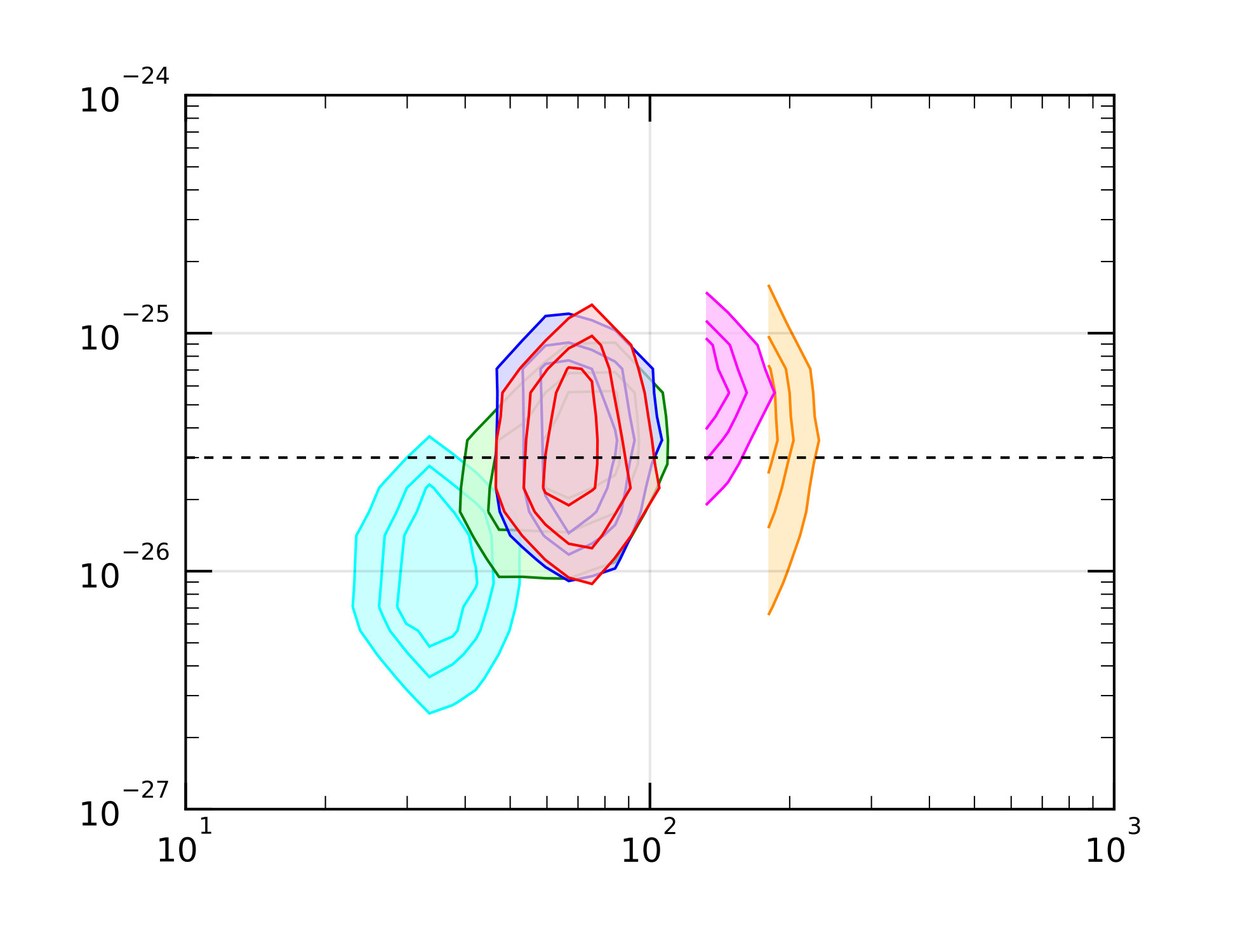 Figure 1
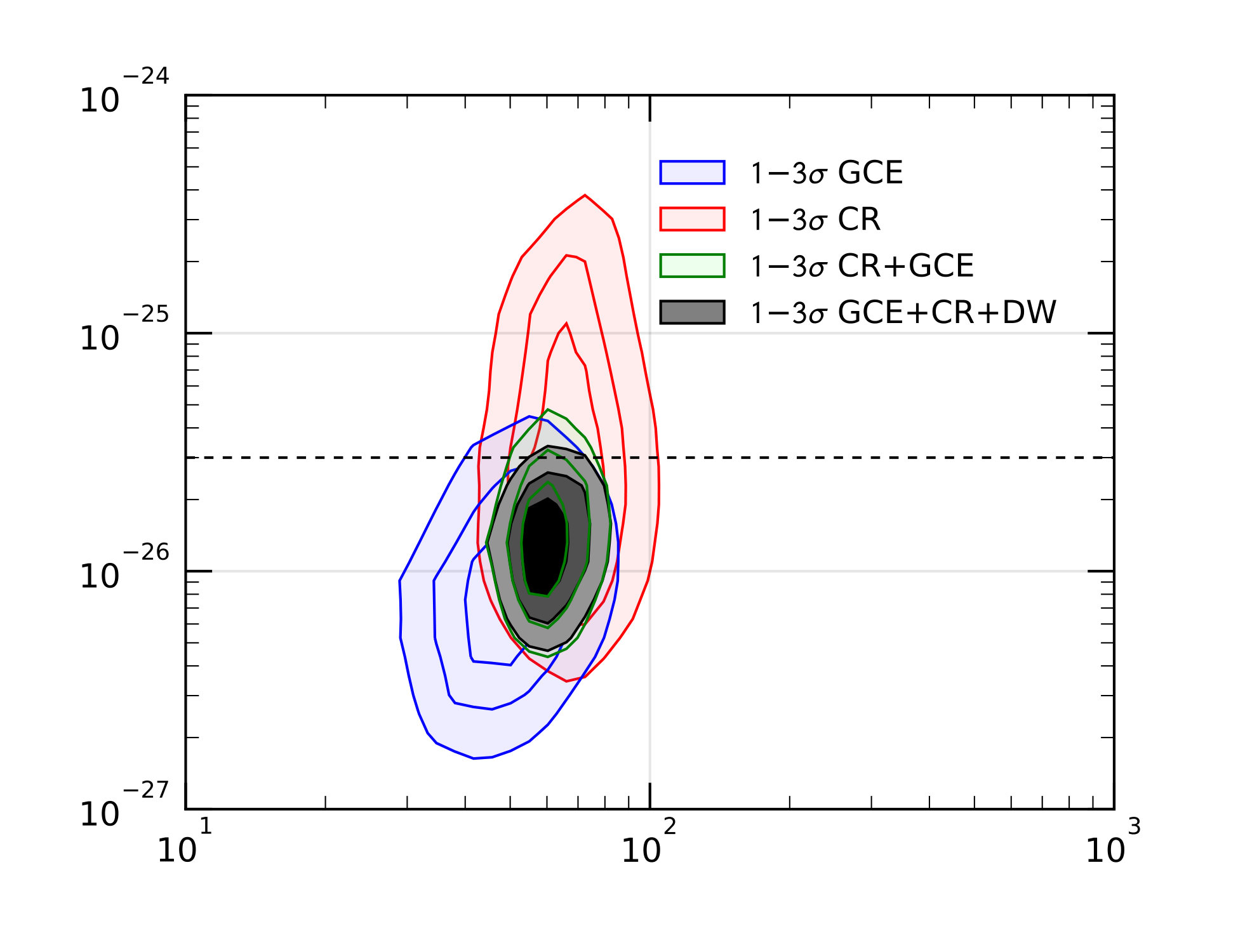 Figure 2
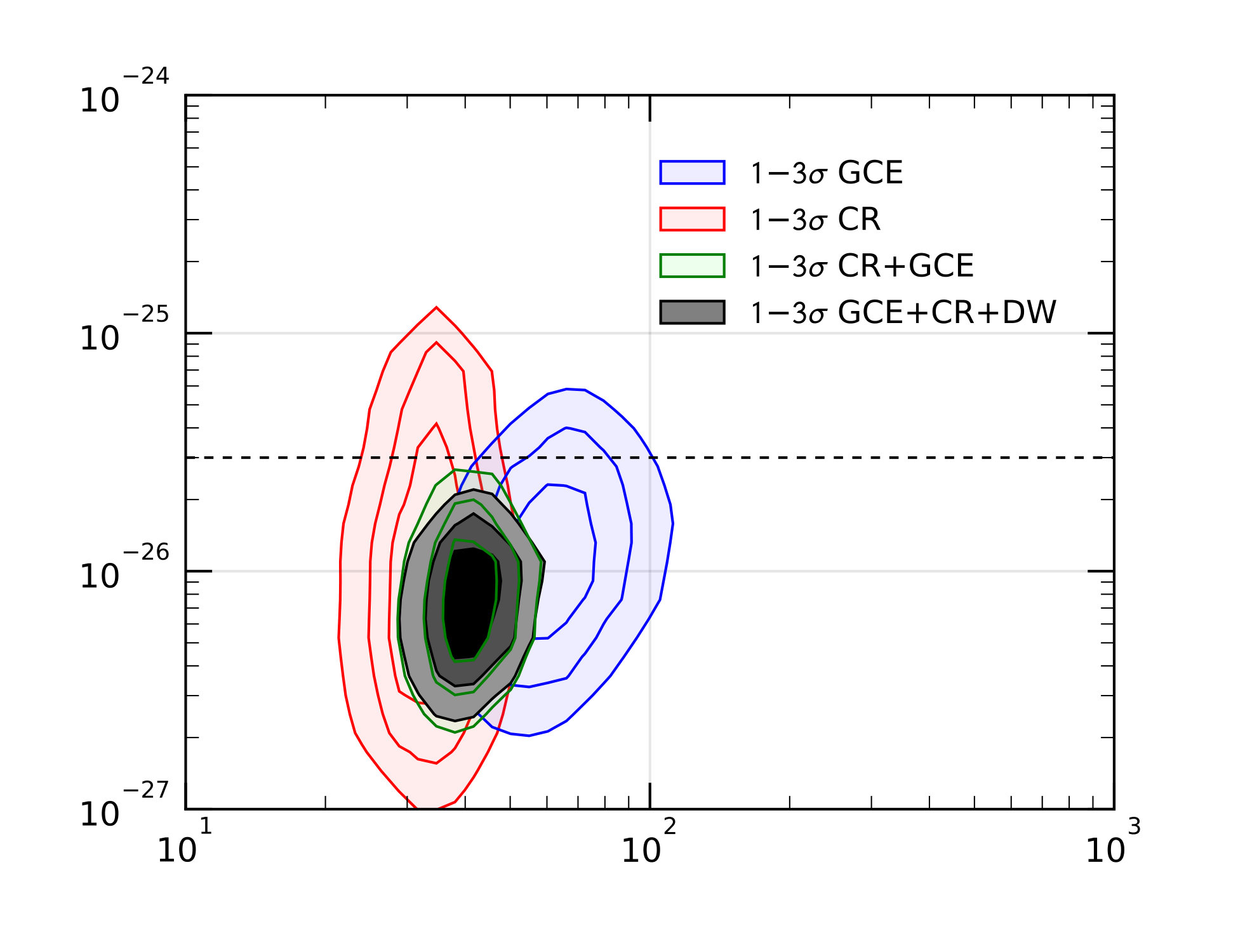 Figure 3
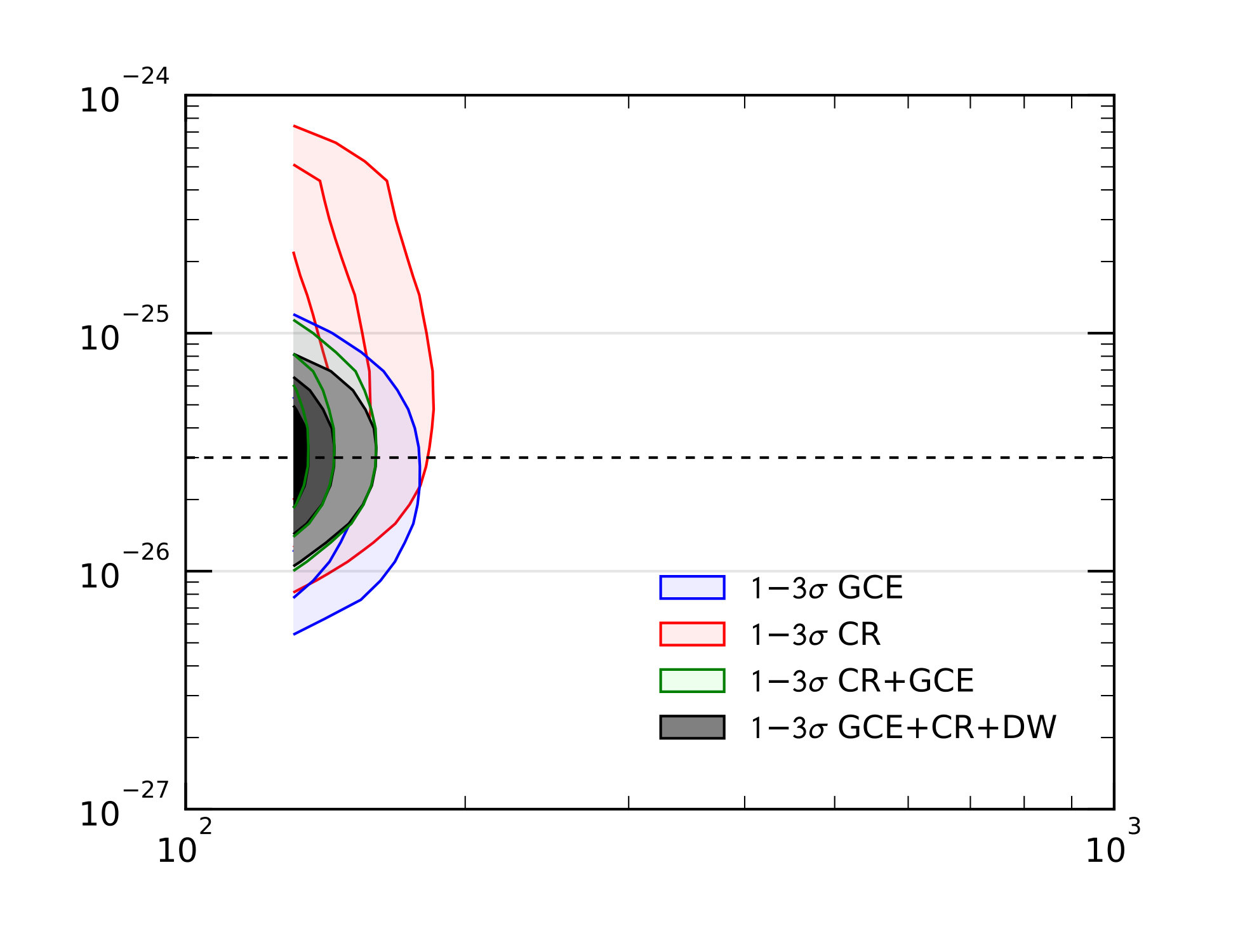 Figure 4
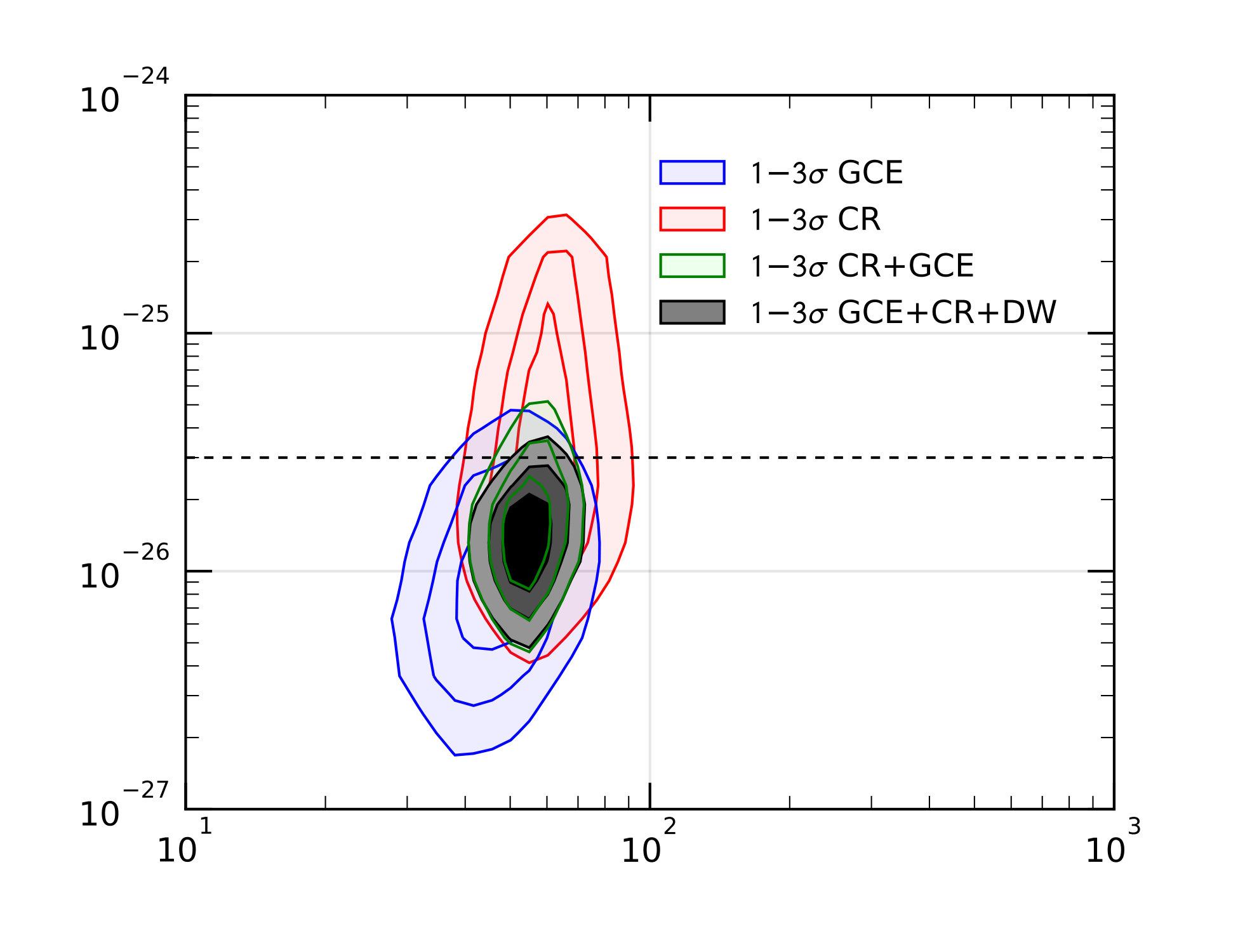 Figure 5
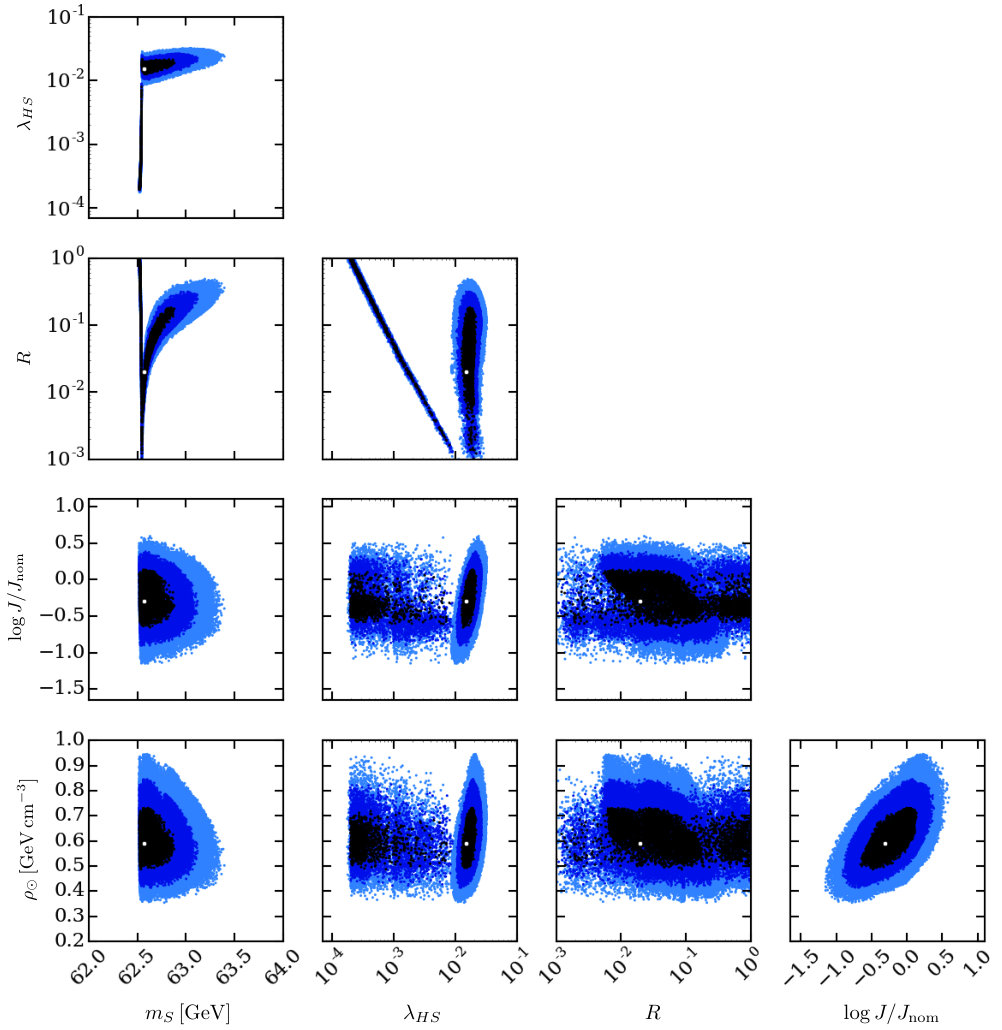 Figure 6
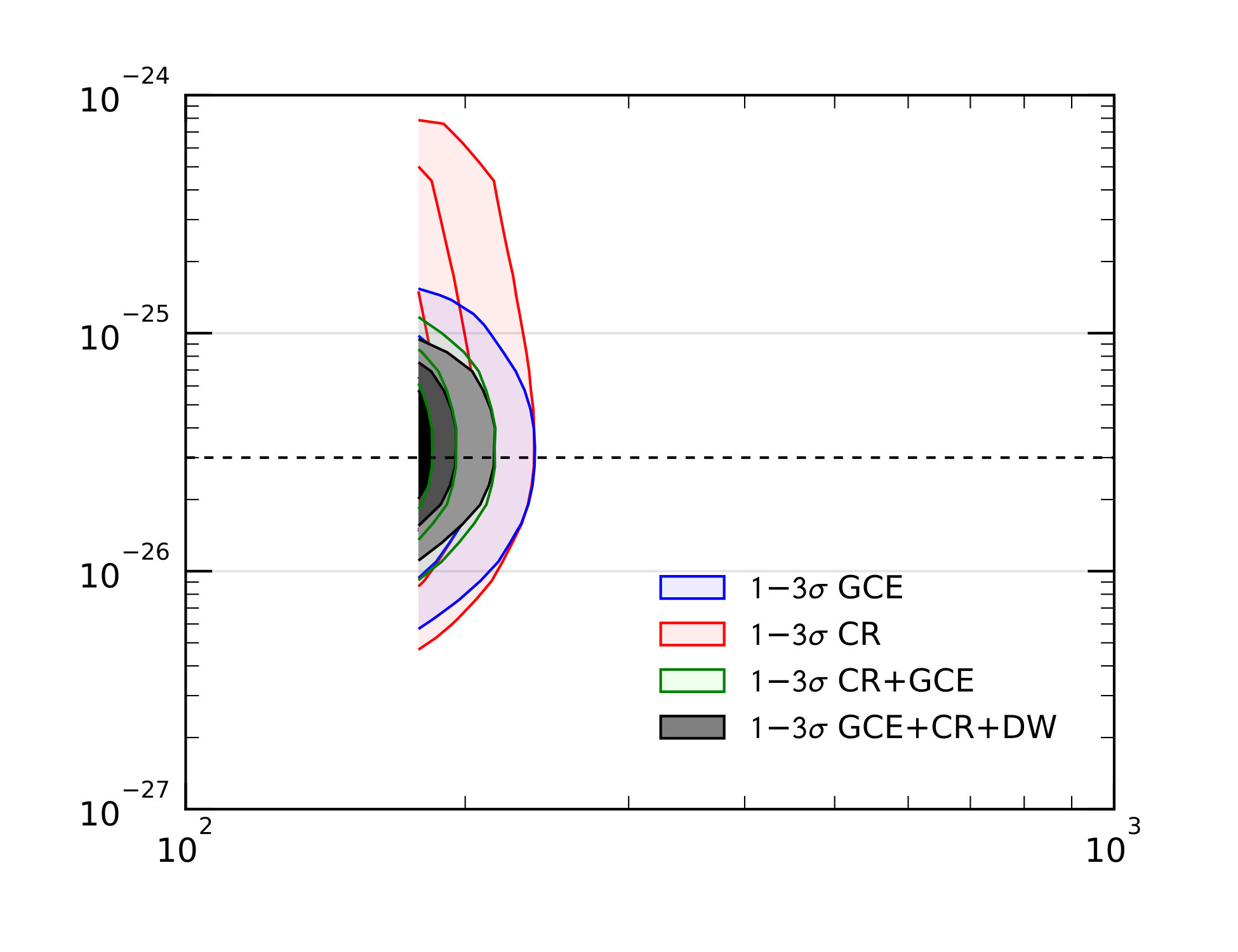 Figure 7
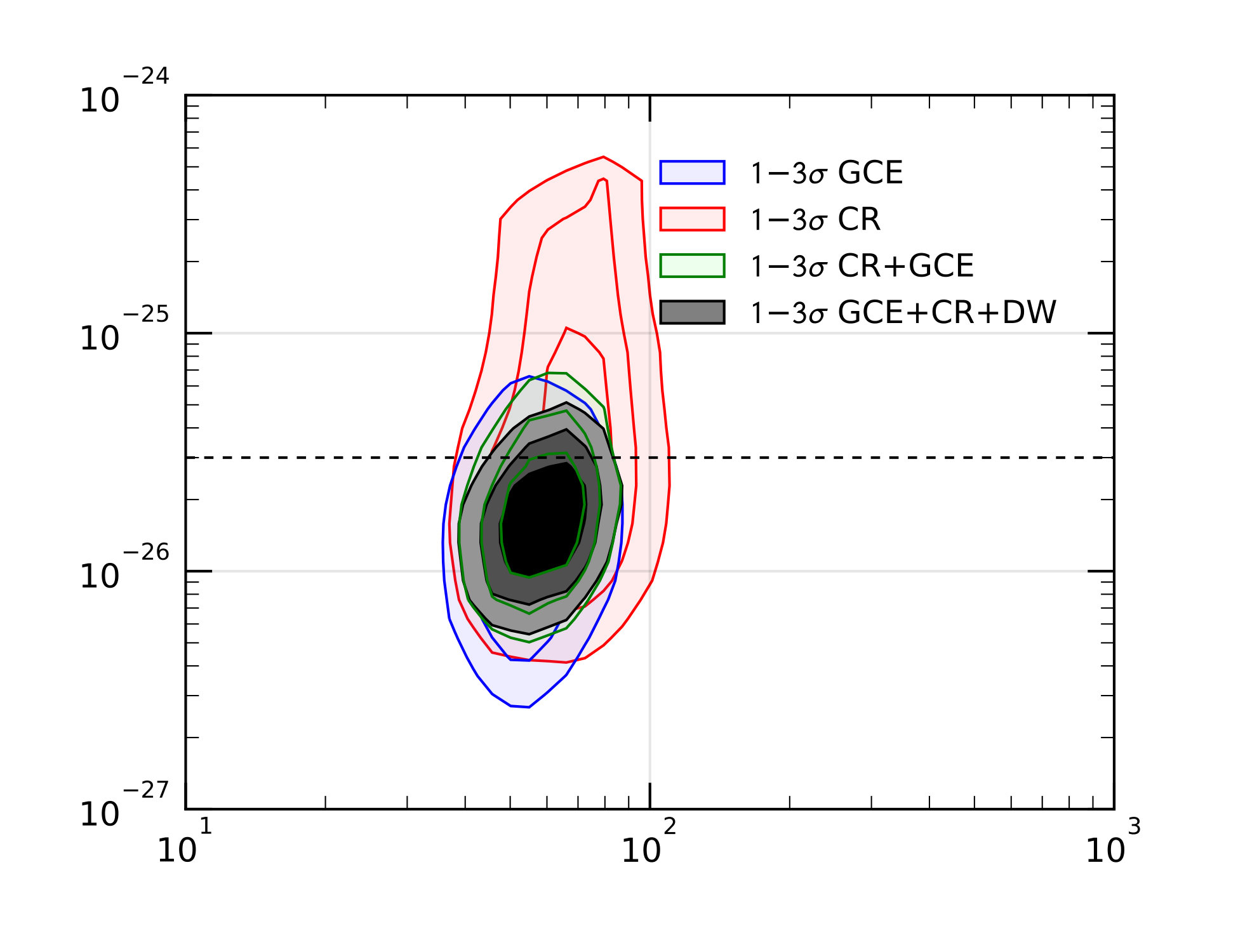 Figure 8
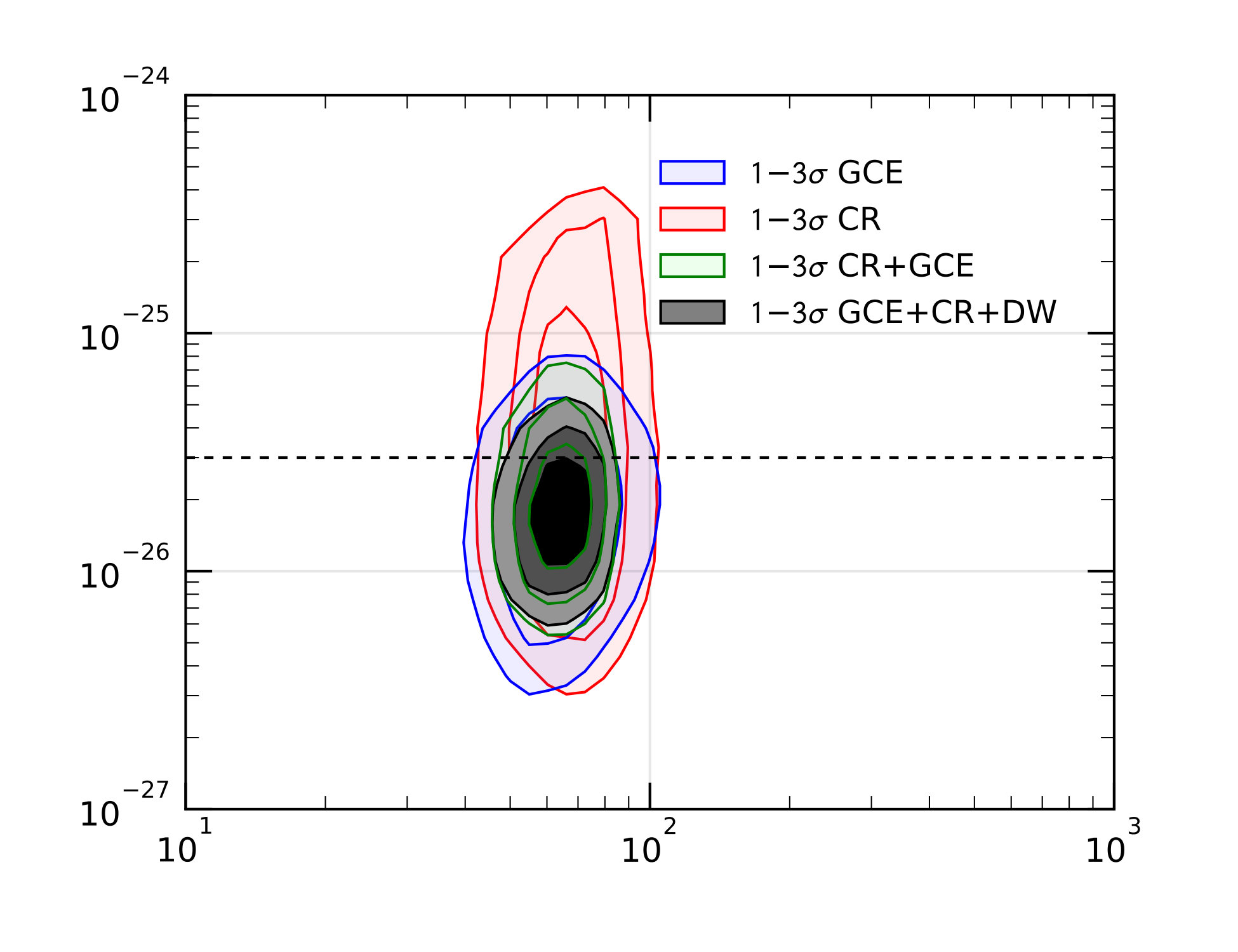 Figure 9
| individual fits | joint fit | |||
|---|---|---|---|---|
| channel | ||||
| 50.3 | 20.8 | 52.0 | 31.6 | |
| 45.8 | 21.2 | 47.9 | 23.5 | |
| 50.4 | 25.6 | 54.6 | 25.6 | |
| 45.6 | 25.0 | 45.8 | 25.9 | |
| 47.6 | 25.8 | 48.4 | 25.8 | |
| 59.5 | 41.1 | 59.5 | 41.1 | |
| region 1 | region 2 | |||||
| contribution | GCE+constr. | CR+constr. | GCE+CR+constr. | GCE+constr. | CR+constr. | GCE+CR+constr. |
| [GeV] | ||||||
| 26.22 | 26.49 | 26.69 | 26.47 | 27.35 | 26.88 | |
| 52.32 | 48.08 | 48.42 | 57.14 | 48.07 | 48.42 | |
Peer Reviews
No public reviews on file for this paper yet. If you reviewed it on a platform where reviews are public (OpenReview, ICLR, NeurIPS, ICML), you can paste yours below so the community can read it here.
Videos
No videos yet. Explain this paper in a talk, walkthrough, or lecture? Add one.
Probing dark matter annihilation in the Galaxy with antiprotons and gamma rays
Alessandro Cuoco
Jan Heisig
Michael Korsmeier
and Michael Krämer
Abstract
A possible hint of dark matter annihilation has been found in Cuoco, Korsmeier and Krämer (2017) from an analysis of recent cosmic-ray antiproton data from AMS-02 and taking into account cosmic-ray propagation uncertainties by fitting at the same time dark matter and propagation parameters. Here, we extend this analysis to a wider class of annihilation channels. We find consistent hints of a dark matter signal with an annihilation cross-section close to the thermal value and with masses in range between 40 and 130 GeV depending on the annihilation channel. Furthermore, we investigate in how far the possible signal is compatible with the Galactic center gamma-ray excess and recent observation of dwarf satellite galaxies by performing a joint global fit including uncertainties in the dark matter density profile. As an example, we interpret our results in the framework of the Higgs portal model.
1 Introduction
Observations of cosmic-ray (CR) antiprotons are a sensitive probe of dark matter (DM) models with thermal annihilation cross sections [1, 2, 3, 4, 5, 6, 7, 8, 9, 10, 11, 12, 13, 14]. In particular, with the very accurate recent measurement of the CR antiproton flux by AMS-02 [15], it is a timely moment to investigate this subject. A joint analysis of the CR fluxes of light nuclei and a potential DM contribution to the antiproton flux provides strong DM constraints [16], as well as an hint for a DM signal corresponding to a DM mass of about 80 GeV, and a thermal hadronic annihilation cross section, cm3/s. These values have been derived in [16] in a novel analysis where CR propagation uncertainties have been marginalized away, taking into account possible degeneracies between CR uncertainties and DM. A similar result has been found in [17], but using the boron over carbon ratio, also recently measured by AMS-02 [18]. In the present work, we shall extend the DM analysis of the CR antiproton flux presented in [16] to a comprehensive set of standard model (SM) annihilation channels, including gluons, bottom quarks, , and Higgs bosons, as well as top quarks.
Similarly, an excess in gamma-ray emission toward the center of our Galaxy has been reported by several analyses [19, 20, 21, 22, 23, 24, 25, 26, 27, 28, 29, 30]. The spectrum and spatial distribution of this Galactic center excess (GCE) is consistent with a signal expected from DM annihilation, and consistent with the excess observed in antiprotons. The second goal which we will pursue in this work is to quantify more precisely the above statement, performing joint fits of the antiproton and gamma-ray signals for various individual DM annihilation channels. In performing this comparison we will also use the most recent results of gamma-ray observations from dwarf satellite galaxies of the Milky Way, which are a known sensitive probe of DM annihilation.
Finally, while DM annihilation can be probed in a rather model-independent way by considering individual SM annihilation channels, it is interesting to also test specific models of DM. Such models typically predict CR and gamma-ray fluxes from a combination of various SM annihilation channels, and they can be confronted with direct and collider searches for DM. As an example, we shall thus consider a minimal Higgs portal DM model, which adds a real singlet scalar DM field to the SM. We shall demonstrate that the scalar Higgs portal model can accommodate both the CR antiproton flux and the GCE, despite strong constraints from invisible Higgs decays and direct DM detection.
The paper is organized as follows. In section 2 we analyze the CR antiproton data for individual DM annihilation channels. The joint analysis of antiproton and gamma-ray fluxes, including both the GCE and dwarf galaxies, is presented in section 3. In section 4 we consider the specific case of the scalar Higgs portal model, and present a global analysis including antiproton and gamma-ray fluxes, as well as constraints from the DM relic density, invisible Higgs decays and direct DM searches. We conclude in section 5.
2 Cosmic-ray fits for individual dark matter annihilation channels
DM annihilation in the Galaxy results in a flux of antiprotons from the hadronization and decay of SM particles. The corresponding source term is given by
[TABLE]
where is the DM mass and the DM density distribution. The thermally averaged annihilation cross section for the SM final state , , is denoted by , and is the corresponding antiproton energy spectrum per DM annihilation. Note that the factor corresponds to scalar or Majorana fermion DM.
We use the NFW DM density profile [31], , with a characteristic halo radius kpc, and a characteristic halo density , normalized to a local DM density GeV/cm3 [32] at the solar position kpc. The choice of the DM profile has a negligible impact on our results, as demonstrated in [16].
The energy distribution and yield of antiprotons per DM annihilation, , is determined by the DM mass and the relevant SM annihilation channel. We use the results presented in [33] for the annihilation into gluons, , and . (The spectra for annihilation into light quarks are very similar to those for gluons.) For and final states we have generated the spectra with Madgraph5_aMC@NLO [34] and Pythia 8.215 [35], adopting the default setting and scale choice, . We note that the choice of the Pythia tune may introduce uncertainties up to about 15%, while varying the shower scale in a range between and can result in uncertainties of up to 30%.111Note that in Madgraph5_aMC@NLO for the default setting (dynamical scale) the scale is set to . This difference is induced through the strength of the final state radiation. However, we have checked that the theoretical uncertainty in the prediction of the antiproton energy spectrum from this scale variation and different Pythia tunes does not affect our results. For the default Pythia settings, annihilation spectra into (on-shell) and are in reasonable agreement with those of [33].
To analyze the impact of DM annihilation on the CR antiproton flux, we perform a joint analysis of the fluxes of protons, helium and antiprotons, including a potential contribution from DM annihilation, which would affect the antiproton to proton ratio. We solve the standard diffusion equation using Galprop [36, 37], assuming a cylindrical symmetry for our Galaxy, with a radial extension of kpc. In total, we analyze a parameter space with thirteen dimensions. Eleven parameters are related to the CR sources and the propagation of CRs, while for each individual SM annihilation channel, the DM component of the CR flux is specified by the DM mass and its annihilation cross section. The parameters describing the CR sources and propagation, as well as the DM contribution, are determined in a global fit of the AMS-02 proton and helium fluxes [38, 39], and the AMS-02 antiproton to proton ratio [15], complemented by proton and helium data from CREAM [40] and VOYAGER [41]. We use MultiNest [42] to scan this parameter space and derive the corresponding profile likelihoods. For details of the propagation model and the numerical analysis we refer to [43, 16].
We use as benchmark antiproton production cross section the default in Galprop, i.e., the parameterization from [44]. In [16] we checked recent new updated models of the cross section from [45] and [46], and we found that the results of the fit are substantially unchanged. The main effect is to slightly modify the region of parameter space preferred by DM at the level of 20–30%, leaving unchanged the values of the minimal .
Adding a DM component significantly improves the global fit of the CR antiproton data. This is due to a sharp spectral feature in the antiproton flux at a rigidity of about 20 GV. Such a feature cannot be described by the smooth spectrum of secondary antiprotons produced by the interactions of primary protons and helium nuclei on the interstellar medium. The spectrum from DM annihilation, on the other hand, exhibits such a sharp feature from the kinematic cut-off set by the DM mass. Adding a DM component thus provides a significantly better description of the antiproton data.
In figure 1 we present the preferred range of DM masses and annihilation cross sections for the different SM annihilation channels. The regions are frequentist contour plots of the two-dimensional profile likelihood obtained minimizing the with respect to the remaining eleven parameters in the fit. They, thus, include the uncertainties in the CR source spectra and CR propagation. All channels provide an improvement compared to a fit without DM: we find a /(number of degrees of freedom) of 71/165 for the fit without DM, which is reduced to 46/163 (), 48/163 (), 50/163 (gluons and/or light quarks), 50/163 (), 46/163 (), and 59/163 (), respectively, when adding a corresponding DM component (see also Table 1). Formally, for the two extra parameters introduced by the DM component with annihilation into corresponds to a significance of 4.5, although such an estimate does not account for possible systematic errors.
Figure 1 also shows that different annihilation channels would imply different preferred DM masses, ranging from GeV for gluons and/or light quarks to near the Higgs and top mass for annihilation into Higgs or top-quark pairs, respectively. For all the channels, the fit points to a thermal annihilation cross section cm3/s.
It can be noted that the values of the are typically quite low for both the fits with and without DM. This is due to the fact that CR data error-bars are dominated by systematic errors rather than statistical errors. This is true in particular for the proton and helium data, while for the antiproton to proton ratio the two errors have comparable weight. As a consequence, the use of statistics to describe the data is not fully correct. A proper treatment would require a deeper knowledge of the systematic uncertainties so that to include them directly at the level of the likelihood rather than in the error-bars. This information is, however, not publicly available, and this approach is not possible at the moment. It would be desirable that such a more complete information is released for future CR data publications and updates.
3 Joint fit of antiproton and gamma-ray fluxes
DM annihilation would also result in a flux of gamma rays, predominantly from the decay of pions produced in the fragmentation of SM particles. The gamma-ray flux per unit solid angle at a photon energy is
[TABLE]
where is the photon spectrum per annihilation for a given final state , and is the corresponding annihilation cross section. The integral has to be evaluated along the line-of-sight (l.o.s.) at an observational angle towards the Galactic center. The l.o.s. integral of the DM density-squared, , over the solid angle is called the -factor. We adopt a generalized NFW profile [28] with an inner slope for the DM density . This is in contrast to the standard NFW profile applied in section 2. However, CRs and gamma-rays probe very different parts of the profiles. The l.o.s. integral in Eq. (3.1) is very sensitive to the profile behavior close to the Galactic center, while CRs mostly probe the local DM distribution. Indeed, in the latter case we verified that even changing to the cored Burkert profile [47] does not affect the results of the CR fit [16]. From this point of view it is legitimate to use an NFW profile for CRs while adopting the generalized NFW profile for gamma-rays.
An excess in the flux of gamma rays from the Galactic center has been reported by several groups [19, 20, 21, 22, 23, 24, 25, 26, 27, 28, 29, 30] (but see also [48]). The GCE is peaked at photon energies of a few GeV, and consistent with a spherical morphology, extending up to at least 10∘ away from the Galactic center, and a steep radial profile [27, 28]. Various astrophysical processes have been proposed to explain the excess [49, 50, 51]. Also, studies based on photon-count statistic suggest that the excess is more compatible with a population of unresolved point sources rather than with a pure diffuse emission [52, 53, 54]. Nonetheless, a DM interpretation is still viable. In particular, the excess is compatible with the signal expected from the annihilation of DM, with a cross section close to the thermal value and with a DM mass around 50 GeV. In our analysis of the GCE we will use the gamma-ray energy spectrum and error covariance matrix obtained in [28].
DM annihilation in gamma rays can also be sensitively tested by observations of dwarf satellite galaxies of the Milky Way [55, 56, 57, 58]. Here, we use the likelihood as a function of the flux for each dwarf provided by Fermi-LAT [58], and the gamma-ray spectra for the individual annihilation channels obtained in [59]. We consider a total of eleven dwarfs: the seven brightest confirmed dwarfs analyzed in [58] (Coma Berenices, Draco, Sculptor, Segue 1, Ursa Major II, Ursa Minor, Reticulum II) as well as Willman 1, Tucana III, Tucana IV and Indus II. Four of these dwarfs (Reticulum II, Tucana III, Tucana IV, Indus II) exhibit small excesses at the level of (local) each, which are compatible with a signal from DM annihilation with a thermal cross section [60, 61, 58]. The total likelihood is obtained as a product of likelihoods over each single dwarf as described in [57, 62]. The likelihood of each dwarf contains a factor from the flux likelihood, and a log-normal factor from a deviation of the -factor from its nominal value. For the seven brightest confirmed dwarfs we use the -factors and corresponding uncertainties provided in [58] (which, in turn, draws from [63], except for Reticulum II, whose -factor is taken from [64]), while for Willman we use the -factor from [57]. For Tucana III, Tucana IV and Indus II we use the distance-based predictions provided in [58] with a medium estimated error of 0.6 dex. We marginalize over the -factors of the individual dwarf galaxies in the fit. It should be noted that estimates of the -factors present some differences depending on the analysis (compare for example [63, 65]), with some analysis [66] finding somewhat lower values than the others. This, however, has only a minor impact on our results, since, as we show below, the results of the fits are dominated by the GCE and CR signals.
On the basis of the likelihoods obtained in the CR fit described in section 2 we now perform a joint fit of CR antiprotons and of gamma-rays from the Galactic center and from dwarf galaxies. The gamma-ray fit follows the methodology described in [59]. The fit contains four input parameters, the model parameters, and , as well as the -factor for the Galactic center, , and the local DM density . The latter two parameters are, in principle, not independent. However, as already mentioned above, CRs and gamma-rays probes different parts of the DM distribution in the Galaxy and it is thus reasonable to explore the uncertainties in these two parameters as independent. For we use a gaussian distribution (log-normal in ) with mean 53.54 and error 0.43, i.e., . This GC -factor refers to an integration region of around the GC and with a stripe of masked along the Galactic plane, in order to be compatible with the GCE data from Ref. [28] that we use. The details of the derivation of the distribution in and the error are described in [59]. For the local DM density we also use Gaussian errors GeV/cm3 [32]. We use the result of Ref. [32] in order to be conservative since has a relatively large error. A recent review on the status of the determination of is given in [67].
Figure 2 shows the preferred range of DM masses and annihilation cross sections, where we have marginalized over and . We present 1, 2, and 3 contours for a fit to the GCE (blue), CR (red), CR+GCE (green) and CR+GCE+dwarfs (black) for the six annihilation channels , , , , and . Note that the fits to the CR fluxes in figure 2 show a wider spread in than those displayed in figure 1, because in figure 2 we marginalize over the local DM density, GeV/cm3, while in figure 1 a fixed value GeV/cm3 is used.
For most SM annihilation channels, we observe very good agreement between the DM interpretation of the CR antiprotons and the GCE gamma-ray flux. The preferred region in and is consistent when comparing the CR and GCE fits individually, and the combined CR+GCE fit. However, as can be seen in the upper left panel of figure 2, annihilation into gluons (or light quarks) is disfavored as an explanation of both the CR antiproton flux and the GCE, as both signals individually prefer different regions of DM mass. Annihilation into quarks is also disfavored since it does not provide a good fit to either the GCE or antiprotons. Adding the constraints from dwarf galaxies disfavors large values for , but hardly affects the combined CR+GCE fit. Numerical values of the best-fit are reported in Table 1.
From the figure we note also that CR prefer a somewhat larger than the GCE and, hence, the joint fit pushes towards slightly larger values with respect to the assumed prior from [32]. More precisely, we find, with some variation depending on the DM channel, that the global fit gives a value GeV/cm3, i.e., GeV/cm3 higher than the input prior. We find that GeV/cm3 is at the lower edge of range preferred by the fit. This means that if the true is significantly lower than 0.3 GeV/cm3 it becomes difficult to reconcile the GCE with the CR data. Nonetheless, we also note that for , the half-height of the CR propagation region in the Galaxy, we use the prior 2-7 kpc, but, since this parameter is unconstrained by the fit (see [43, 16]), values up to 10 kpc or more are allowed. Thus, since the DM signal approximately scales linearly in , higher values would allow, in consequence, lower values, making possible a joint fit of the GCE and CRs down to a value of 0.2 GeV/cm3. This issue is also further discussed in the next section within the Higgs portal fit.
4 Interpretation within the singlet scalar Higgs portal model
We now discuss a specific minimal model of DM, where we add a singlet scalar field to the SM [68, 69, 70]. We will follow the analysis in [59],222An interpretation of the GCE within the singlet Higgs portal model has also been discussed in [71, 72, 73]. with the main difference that now we include CR data.
The scalar field interacts with the SM Higgs field through the Higgs portal operator . Imposing an additional symmetry, , the scalar particle is stable and thus a DM candidate. The Lagrangian of the scalar Higgs portal model reads
[TABLE]
After electroweak symmetry breaking, the last three terms of the above Lagrangian become
[TABLE]
with , GeV, and where we introduced the physical mass of the singlet field, . The phenomenology of the singlet Higgs portal model has been extensively studied in the literature, see e.g. the recent reviews [74, 75] and references therein.
While the scalar self-coupling, , is of importance for the stability of the electroweak vacuum, the DM phenomenology of the scalar Higgs portal model is fully specified by the mass of the scalar DM particle, , and the strength of the coupling between the DM and Higgs particles, . Even though the model is minimal, the interaction term implies a rich phenomenology, including invisible Higgs decays, , a DM-nucleon interaction through the exchange of a Higgs particle, and DM annihilation through -channel Higgs, -channel scalar exchange, and the interactions.
The region most relevant for the DM interpretation of the CR antiproton flux and the GCE is the region . As this is below the Higgs-pair threshold, , annihilation proceeds through -channel Higgs exchange only, and the relative weight of the different SM final states is determined by the SM Higgs branching ratios, independent of the Higgs-scalar coupling . Above the Higgs-pair threshold, , the final state opens up. The strength of the annihilation into Higgs pairs, as compared to or top-quark pairs, depends on the size of the Higgs-scalar coupling . However, as shown in [59], within the scalar Higgs portal model the region above the Higgs-pair threshold that provides a good fit to the GCE (and to the CR) requires very large which are excluded by direct detection limits. In the following, we will thus focus on DM masses .
We pursue two approaches. We first adopt a more model-independent point of view and consider a DM interpretation in terms of and . The only reference to the Higgs portal model is through the relative weight of the different SM final states, which is determined by . Such an analysis probes whether a certain combination of annihilation channels, considered individually in section 2 and 3, can provide a fit of the observations. Note that this kind of analysis can, in general, not be performed based on the results presented for the individual channels. Instead, we perform a dedicated fit to the CR antiproton flux, constructing the injection spectra from the spectra of the individual channels according to their relative weights. The result is shown in figure 3 (red contours), where we have marginalized over and . The preferred region of DM masses is around GeV, where the Higgs portal model predicts annihilation pre-dominantly into bottom quarks, -bosons and gluons with a weight of approximately 70, 20 and 10%, respectively. We find a /(number of degrees of freedom) of 47/163 for the Higgs portal model fit, compared to 71/165 for the fit without DM.
Performing a joint fit of the CR antiproton flux with the GCE (green contours) as well as with the GCE and dwarf galaxies (black contours) shifts the preferred region to slightly smaller masses GeV, with a /(number of degrees of freedom) of 49/163 for the CR and for the GCE. Although the best-fit point for the GCE-only fit lies at smaller masses, around GeV (cf. [59]), the /(number of degrees of freedom) for the GCE in the joint fit is almost as good as for the GCE-only fit (which yields ). We can draw the quite general conclusion that DM models where the annihilation is pre-dominantly into or final states, or any combination thereof, provide a very good fit of the CR antiproton flux, the GCE and gamma-rays from dwarf galaxies, and point to a DM mass in the vicinity of GeV.
We proceed with a more detailed analysis of the scalar Higgs portal model, where we take into account the various constraints on the parameter space from the Higgs invisible decay width, direct detection searches, searches for gamma-ray lines from the inner Galaxy and the DM relic density. Hence we consider the actual model parameters and defined in eq. (4.1).
We shall discuss the various constraints briefly in turn, and refer to [59] for more details.
- •
For light DM below the Higgs threshold, , the invisible Higgs decay is kinematically allowed. The LHC limits on the Higgs invisible branching ratio, [76], thus imply an upper limit on the Higgs-scalar coupling as a function of the DM mass.
- •
The scalar Higgs portal model predicts a spin-independent DM-nucleon scattering cross section, , through the exchange of the SM Higgs boson. The model is therefore severely constrained by direct detection experiments. We use the recent direct detection limits from LUX [77] in our numerical analysis, updating the results presented in [59]. Furthermore, we introduce the local DM density , relevant for the DM-nucleon scattering rate and the CR flux, as an additional nuisance parameter in the fit.
- •
Searches for gamma-ray lines provide constraints on the cross section for the annihilation into mono-chromatic photons, . We have calculated using an Higgs effective Lagrangian as described in [59], and constrain the model with data from the recent Fermi-LAT search for spectral lines in the Milky Way halo [78].
- •
We require that the Higgs portal model provide the correct DM relic density as measured by Planck, [79]. We assume a standard cosmological history, but allow for the possibility that the dark sector is more complex than assumed within our minimal model. Hence, the DM density provided by the scalar Higgs portal model is a certain fraction, , of the density of all gravitationally interacting DM, . The total DM density predicted by our model is then . We will consider as a free parameter in our fit. Note that the annihilation signal today scales as , while the direct detection limits scale , thus implying a non-trivial interplay of the various constraints for .
In figure 4 we present a fit of the Higgs portal model to the CR antiproton flux and the GCE, including the constraints from dwarf galaxies and searches for gamma-ray lines, the invisible Higgs branching ratio, direct DM detection, and the relic density.333Compared to the analysis presented in [59] we have included the likelihood of the CR antiproton flux and updated the direct detection and dwarf galaxy limits.
Let us first consider the upper left panel, which shows the allowed region in the Higgs portal coupling, , and the DM mass. The overall flux of antiprotons and photons scales with the annihilation cross section , where is the Higgs width. To accommodate the CR data and the GCE, either large couplings or masses near the Higgs resonance, , are required. However, large couplings are excluded by the invisible Higgs branching ratio for masses , and by direct detection limits for masses , leaving only the region near the Higgs threshold , where the annihilation proceeds through resonant Higgs exchange.
Upon closer inspection, we find two viable regions of parameter space, see the panel displaying the allowed region in the Higgs portal coupling and the scalar DM fraction . In one region, is of order and , so that an additional DM component is required. In the second region, the scalar particle constitutes a significant fraction or even all of DM, , but the Higgs portal coupling must be very small, of order . These two regions are a result of an interplay between the strong velocity dependence of the annihilation cross section near the resonance and the non-trivial scaling of the CR and GCE signals and the relic density with the fraction of scalar DM.
The best-fit points as well as their values are listed in table 2 for the two regions described above. For comparison we also show the results for the fit where we leave out the CR likelihood (GCE+constraints) or the GCE likelihood (CR+constraints). Within the Higgs portal model the observations are very well compatible with each other. However, the CR signal prefers a flux corresponding to a slightly larger annihilation cross section. In the joint fit the nuisance parameters and leave enough freedom to accommodate both signals. In fact, for and the fit prefers somewhat larger and smaller values, respectively, than the nominal ones (cf. lower panels in figure 4). Note that also effects the direct detection rate . As compared to the fit of the GCE presented in [59], the improved LUX limits and, to a lesser extent, the larger DM density further constrain large values of in the first region where is of order . Another difference to the results of [59] arises from the fact that the recent results from dwarf galaxies are less constraining and, in particular, are not in tension with the GCE anymore. This allows for larger and hence for a smaller value of while still fitting the GCE signal. Note also that the range preferred by the Higgs portal model, GeV/cm3 (see figure 4), is different from the case of the single channel fits where, instead, GeV/cm3. The specific parameter region preferred by the Higgs portal fit, thus, further pushes toward higher values with respect to the single channel fit case.
[FIGURE:]
5 Conclusion
In this paper we analyze antiproton data from AMS-02 searching for a signature of DM annihilation. Using the same methodology of [16], we take into account CR propagation uncertainties by fitting at the same time DM and propagation parameters. With respect to [16] we explore a wider class of annihilation channels including , , , , and . We find that almost all the channels provide similar hints of a DM annihilation at about 4 level (considering statistical uncertainties only) with masses ranging from 40 and 130 GeV depending on the annihilation channel. Annihilation into provides a smaller fit improvement, at the 3 level.
We then investigate the compatibility of the antiproton DM hint with the GCE performing a joint gamma-ray and antiproton fit where we further introduce two nuisance parameters related to the distribution of DM in the vicinity of the Galactic center and in the Solar local neighborhood. We find that the two signals are well compatible for most of the channels, except for , where the two are somewhat in tension. Overall, we find that , and provides good fits to both the GCE and antiprotons, followed by , which fits only slightly worse. and are less favored, either because they do not fit well one of the two signals or because the two signals are found to be in tension. We also include in the fit the latest results from the analysis of dwarf galaxies in gamma rays and we find that dwarf constraints are compatible with the joint GCE and antiproton fit and do not change significantly the conclusions.
Finally, as an example, we perform the above joint fit for the specific case of the Higgs portal DM model, including, in this case, also constraints from direct detection and collider searches. We find that a surviving, although fine tuned, region corresponding to DM of mass equal to about annihilating via resonant Higgs exchange satisfies all constrains and provides a good fit to both antiprotons and gamma rays.
Acknowledgements
We acknowledge support by the German Research Foundation DFG through the research unit “New physics at the LHC”.
The reference list from the paper itself. Each links out to its DOI / PubMed record.
- 1[1] L. Bergstrom, J. Edsjo and P. Ullio, Cosmic anti-protons as a probe for supersymmetric dark matter? , Astrophys. J. 526 (1999) 215–235 , [ astro-ph/9902012 ]. · doi ↗
- 2[2] F. Donato, N. Fornengo, D. Maurin and P. Salati, Antiprotons in cosmic rays from neutralino annihilation , Phys. Rev. D 69 (2004) 063501 , [ astro-ph/0306207 ]. · doi ↗
- 3[3] T. Bringmann and P. Salati, The galactic antiproton spectrum at high energies: Background expectation vs. exotic contributions , Phys. Rev. D 75 (2007) 083006 , [ astro-ph/0612514 ]. · doi ↗
- 4[4] F. Donato, D. Maurin, P. Brun, T. Delahaye and P. Salati, Constraints on WIMP Dark Matter from the High Energy PAMELA p ¯ / p ¯ 𝑝 𝑝 \bar{p}/p data , Phys. Rev. Lett. 102 (2009) 071301 , [ 0810.5292 ]. · doi ↗
- 5[5] N. Fornengo, L. Maccione and A. Vittino, Constraints on particle dark matter from cosmic-ray antiprotons , JCAP 1404 (2014) 003 , [ 1312.3579 ]. · doi ↗
- 6[6] D. Hooper, T. Linden and P. Mertsch, What Does The PAMELA Antiproton Spectrum Tell Us About Dark Matter? , JCAP 1503 (2015) 021 , [ 1410.1527 ]. · doi ↗
- 7[7] V. Pettorino, G. Busoni, A. De Simone, E. Morgante, A. Riotto and W. Xue, Can AMS-02 discriminate the origin of an anti-proton signal? , JCAP 1410 (2014) 078 , [ 1406.5377 ]. · doi ↗
- 8[8] M. Boudaud, M. Cirelli, G. Giesen and P. Salati, A fussy revisitation of antiprotons as a tool for Dark Matter searches , JCAP 1505 (2015) 013 , [ 1412.5696 ]. · doi ↗