Geometry of mean value sets for general divergence form uniformly elliptic operators
Ashok Aryal, Ivan Blank

TL;DR
This paper investigates the geometric properties of mean value sets associated with divergence form uniformly elliptic operators, extending classical mean value theorems and exploring their structure and applications.
Contribution
It provides initial results on the geometry of mean value sets for general elliptic operators and discusses their potential applications.
Findings
Mean value sets are nested and comparable to balls.
Geometric and topological properties of these sets are characterized.
Applications to related problems are demonstrated.
Abstract
In the Fermi Lectures on the obstacle problem in 1998, Caffarelli gave a proof of the mean value theorem which extends to general divergence form uniformly elliptic operators. In the general setting, the result shows that for any such operator and at any point in the domain, there exists a nested family of sets where the average over any of those sets is related to the value of the function at Although it is known that the are nested and are comparable to balls in the sense that there exists depending only on such that for all and in the domain, otherwise their geometric and topological properties are largely unknown. In this paper we begin the study of these topics and we prove a few results about the geometry of these sets and give a couple of applications of…
Click any figure to enlarge with its caption.
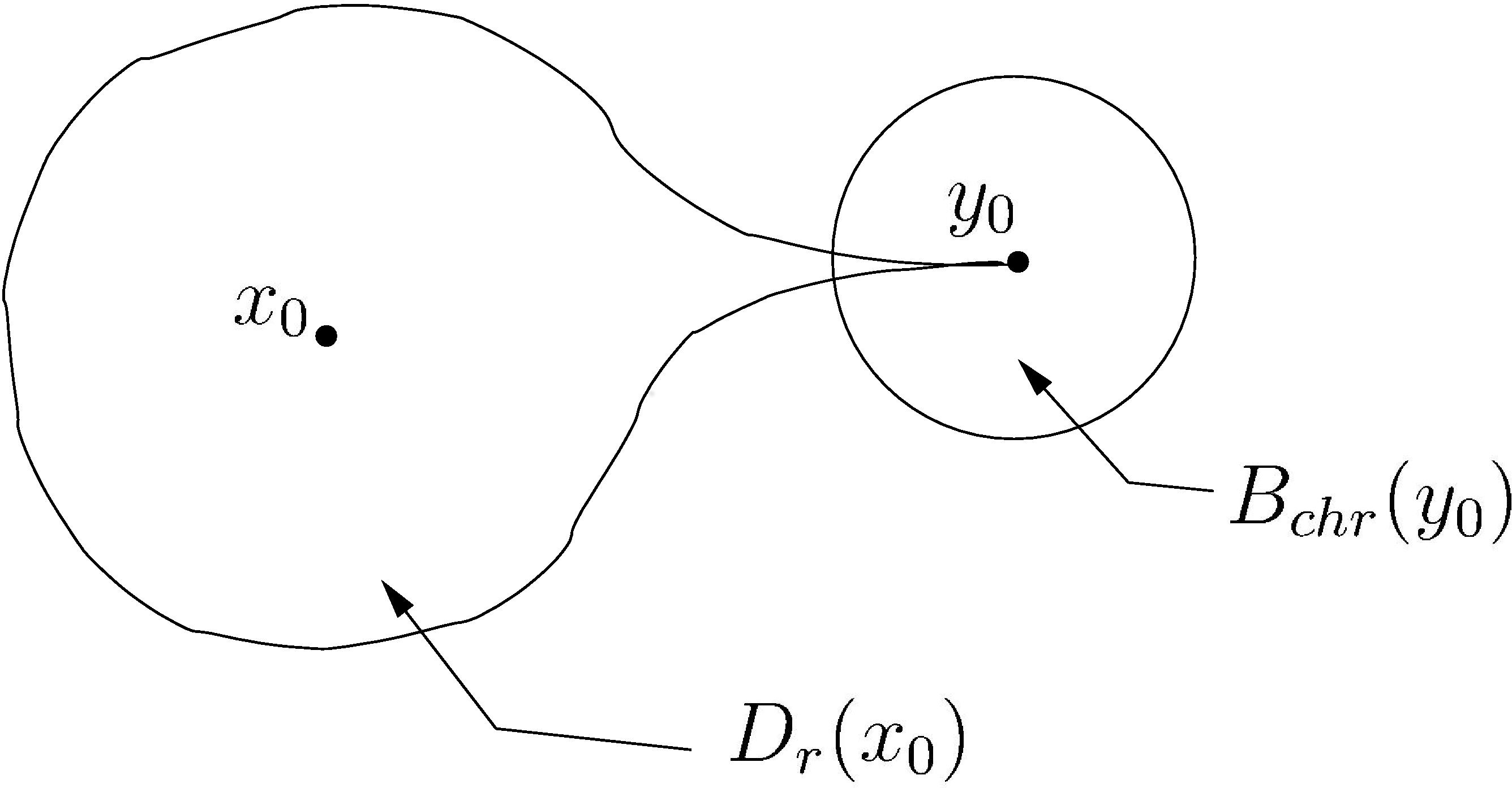 Figure 1
Peer Reviews
No public reviews on file for this paper yet. If you reviewed it on a platform where reviews are public (OpenReview, ICLR, NeurIPS, ICML), you can paste yours below so the community can read it here.
Videos
No videos yet. Explain this paper in a talk, walkthrough, or lecture? Add one.
Geometry of mean value sets for general divergence form uniformly elliptic operators
Ashok Aryal
and
Ivan Blank
Abstract.
In the Fermi Lectures on the obstacle problem in 1998, Caffarelli gave a proof of the mean value theorem which extends to general divergence form uniformly elliptic operators. In the general setting, the result shows that for any such operator and at any point in the domain, there exists a nested family of sets where the average over any of those sets is related to the value of the function at Although it is known that the are nested and are comparable to balls in the sense that there exists depending only on such that for all and in the domain, otherwise their geometric and topological properties are largely unknown. In this paper we begin the study of these topics and we prove a few results about the geometry of these sets and give a couple of applications of the theorems.
1. Introduction
Based on the great importance of the mean value theorem in understanding harmonic functions, it is clear that analogues for operators other than the Laplacian are automatically of interest. In 1963, Littman Stampacchia, and Weinberger showed that if is a nonnegative measure on and is the solution to
[TABLE]
and is the Green’s function for on then is equal to
[TABLE]
almost everywhere, and this limit is nondecreasing [11, Equation 8.3]. On the other hand, this formula is not as nice as the basic mean value formulas for Laplace’s equation for a number of reasons. First, it is an average with weights, and not merely a simple average. Indeed, the weights in question are not even easy to estimate. Second, it is not an average over a ball or something which is even homeomorphic to a ball, but rather an average over level sets of the Green’s function which do not include the central point being estimated.
The following simpler mean value theorem was stated by Caffarelli in [6, 7] and proved carefully by the second author and Hao within [3].
Theorem 1.1** (Mean Value Theorem for Divergence Form Elliptic PDE).**
Let be any divergence form elliptic operator with ellipticity , . For any , there exists an increasing family which satisfies the following:
- (1)
* with depending only on and .* 2. (2)
For any satisfying and , we have
[TABLE]
*Finally, the sets are noncontact sets of the following obstacle problem:
such that*
[TABLE]
where and is sufficiently large.
Although this theorem has already been shown to be useful (see for example [8] as one place where it has already been applied in this form), it is clear that the more that is known about the the more useful the theorem is. It is also clear that although the fact that for all gives us some information about these sets, there is still much more that is unknown.
The present work actually originated as an attempt to better understand the solutions of a free boundary problem of Bernoulli type. In the celebrated paper of Alt and Caffarelli in 1981, nonnegative local minimizers of the functional
[TABLE]
are studied [1]. They are shown to exist and satisfy certain Lipschitz regularity estimates, and they obey a linear nondegeneracy statement along their free boundary. From there, Alt and Caffarelli turn to a study of the free boundary. This problem is also found (with ) near the beginning of the text by Caffarelli and Salsa [5, Chapter 1], and the first author of this paper was working on a generalization of that problem for his dissertation. In particular, we were considering the functional
[TABLE]
with uniformly elliptic and that will certainly color some aspects of the current work. Unfortunately, after we started our project we learned of very nice and very recent work of dos Prazeres and Teixeira which solved some of the problems that we had intended to publish [9]. Nevertheless, their work had nothing to do with the MVT, and so we can now describe the dual purpose of the current work: First, we wish to state some theorems related to the geometry of the Second, we wish to show two applications in particular which illustrate both the usefulness of the MVT, and the usefulness of our own results which give a more detailed view of properties of the
The two biggest contributions that we make within this work regarding the properties of the appear to be the following:
Lemma 1.2** (Density Result).**
Assume and assume that and are the constants given in Theorem 2.2 . Fix There exists a positive constant such that
[TABLE]
This result prevents the from having what might be described as an “outward pointing cusp.”
Lemma 1.3** (Continuous Expansion).**
Fix and assume that there exists so that is not contained in and is compactly contained within Then there exists a unique such that
This result allows us to state that the boundary of the mean value sets will move in a continuous fashion.
We were able to use the mean value theorem above in order to prove positive density of the contact set along the free boundary. Originally, we needed our two lemmas just mentioned in order to prove a nondegeneracy lemma for the Bernoulli problem above. Very recently, in joint work with Benson and LeCrone, the second author has extended many of the results within this work to Riemannian manifolds [2] in the case where is the Laplace-Beltrami operator. Indeed, all of the results from Section 2 can be extended to this case, and when dealing with the obstacle problem on a compact Riemannian manifold with boundary, in order to be sure that the can be extended until an where collides with we need the analogue of Lemma 1.3 . (See in particular [2, Corollary 4.9].)
2. Solid MVT for divergence form elliptic operators
Let be an open connected set in and let be a symmetric uniformly elliptic matrix. That is for each we have unique matrix satisfying:
[TABLE]
and there exist such that
[TABLE]
which is called uniform ellipticity in this setting. Although there are certainly very interesting operators which are not uniformly elliptic, we will content ourselves to assume uniform ellipticity throughout this entire work.
Remark 2.1** (Analyst’s Convention).**
Notice that with our definition we can have but we won’t have
We consider the divergence form operator For any we will say that is a subsolution of (or more simply ), whenever and for every we have
[TABLE]
Of course, supersolutions are defined in the same way, but with the inequality in Equation ( 2.3) reversed.
We recall here the main MVT that is the focus of our attention:
Theorem 2.2** (MVT for divergence form elliptic PDE).**
Let be a divergence form elliptic operator as described above. For any there exist an increasing family which satisfies the following:
- (1)
There exists and depending only on and such that for all such that we have 2. (2)
For any v satisfying in and any we have
[TABLE]
*Finally, the sets are noncontact sets of the following obstacle problem: *
* such that*
[TABLE]
where and is sufficiently large.
Remark 2.3** (Dependencies).**
It is shown in [3] that for any the solution of the obstacle problem above becomes independent of the choice of as long as it is sufficiently large, and we will always assume that that is the case. (It will be identically equal to the Green’s function outside of the compact set ) We will frequently want to stress the dependence of the solution on and so, accordingly, we will refer to it as “” We will also use “” when we wish to look at a function which, at least away from satisfies the usual equations obeyed by the height function for an obstacle problem.
Remark 2.4** (Technicality).**
Technically, we cannot use the function as boundary values in the sense of having a difference in until we suitably remove the singularity at so within [3] they use a function that they call which agrees with within a neighborhood of the boundary but which has no singularity in order to bypass this difficulty.
The function is also the minimizer of
[TABLE]
among functions less than or equal to with boundary values equal to Note that the Green’s function of the general divergence form elliptic operator is the analogue of the classical obstacle and is that of the membrane, and here the obstacle constrains the membrane from above.
Although, as Caffarelli observed, the sets are nested and comparable to balls in the sense that:
[TABLE]
we know very little about the topology of the sets. As a first small step in this direction we offer the following lemma:
Lemma 2.5** (Structure of ).**
For any and for any such that the set has exactly one component and it contains
Proof.
Since it is immediate that Although this statement is certainly trivial, we include it because of the observation that the MVT given by Littman, Stampacchia, and Weinberger does not have this property. (See ( 1.2) above.)
Now for the next part, without loss of generality we can assume Assume for the sake of obtaining a contradiciton that has a component that we will call which does not contain Within we have and On the other hand, it follows from [3] that is a bounded set, and since on we contradict the weak maximum principle.
Lemma 2.6** (Density Result).**
Assume and assume that and are the constants given in Theorem 2.2 . Fix There exists a positive constant such that
[TABLE]
Note that has no dependance on or
Proof.
Without loss of generality we can rescale so that Observe that Theorem 2.2 implies that that belongs to the complement of It follows from the characterization of as the noncontact set for an obstacle problem along with the nondegeneracy result of the second author and Hao (see Theorem 3.9 of [3]) that there exists a point at a distance of to where the solution to the corresponding obstacle problem has grown by an amount Next, by applying optimal regularity (see Theorem 3.2 of [3]) we can be sure that there is a ball with a radius bounded from below by a constant times which is centered at which is not in the contact set.
Lemma 2.7** (Convergence of Minimizers).**
For any we let minimize within the set:
[TABLE]
where is as given in Equation ( 2.6) above. Now fix Then
[TABLE]
and
[TABLE]
for some
Proof.
It is not hard to show that if is a sequence of positive numbers converging to and if we let then the sequence is uniformly bounded in and uniformly bounded in (See section 4 of [3] for details.) Thus, by using standard functional analysis we can be sure that there is a subsequence of which we will denote by such that we have
[TABLE]
for some function Since the original sequence was arbitrary, it remains only to show that
First note that for all of the in our sequence, we have:
[TABLE]
where is the maximum of the norms of the Of course, as we let the right hand side goes to zero. We know
[TABLE]
Now we claim that
[TABLE]
which we can combine with the chain of inequalities in the previous paragraph along with uniqueness of minimizers to show that Suppose that this is not the case. Then there exists and an such that
[TABLE]
On the other hand, for sufficiently large by using Equation ( 2.12) again and then Equation ( 2.14) we have
[TABLE]
which contradicts the fact that is the minimizer of
Remark 2.8** (Statement for the ).**
Of course in the language of the height functions as long as is compactly contained in the complement of we have
[TABLE]
Lemma 2.9** (Continuous Expansion).**
Fix and assume that there exists so that is not contained in and is compactly contained within Then there exists a unique such that
Proof.
We borrow some of the ideas used in the proof of the counter-example within [4]. Define the set of real numbers:
[TABLE]
and let be the supremum of Because the are an increasing family of sets with respect to the set is an interval. We claim that Assuming that then there exists a so that
[TABLE]
At this point there are two possible cases: In the first case and in the second case
Suppose first that In this case, we have and so if
[TABLE]
then By Lemma 2.7 , there exists a sufficiently small such that implies
[TABLE]
Then the triangle inequality implies in all of which contradicts the definition of
Next suppose that Within the function satisfies the obstacle problem:
[TABLE]
and therefore enjoys the quadratic nondegeneracy property. (See section 3 of [3].) Because of this nondegeneracy, as long as (and by using the definition of ) we can guarantee that there is a point within where is greater than a constant On the other hand, by Lemma 2.7 again, there exists a sufficiently small such that implies
[TABLE]
Thus
[TABLE]
which gives us a contradiction for this case. Hence we must have
3. Applications to a Bernoulli-type free boundary problem
We turn now to applications of the mean value results to the following problem: Given as above, and boundary data, given on we consider minimizers of the functional:
[TABLE]
which we gave above in Equation ( 1.6) for a general domain Now in the case where the functional simplifies to:
[TABLE]
Alt and Caffarelli considered local minimizers of this functional, and indeed this problem was used as a model problem within the text by Caffarelli and Salsa. We will say that is a local minimizer of if given any subdomain of the value of
[TABLE]
is less than or equal to the value of for any which is equal to on
Some highlights of what is known about functions which locally minimize in include the following:
Theorem 3.1** (Basic Facts for Minimizers of ).**
Within any we have:
- (1)
* is Lipschitz.* 2. (2)
If then there is a constant depending only on and such that
[TABLE] 3. (3)
With again, there is a universal such that
[TABLE]
where we use to denote the n-dimensional Lebesgue measure of 4. (4)
Using to denote the -dimensional Hausdorff measure of then given there is a universal such that
[TABLE] 5. (5)
* in a suitable sense on almost all of the free boundary.*
Everything in the theorem above was proven by Alt and Caffarelli. See [1, 5] for details.
More recently, dos Prazeres and Teixeira studied the local minimizers of the more general functional where the which appear are assumed to be no more than bounded, symmetric, and uniformly elliptic. Now in this case, there is no hope of proving that minimizers are better than the Hölder regularity given by the famous result of De Giorgi and Nash. On the other hand dos Prazeres and Teixeira proved that functions which locally minimize in satisfy the following:
Theorem 3.2** (Basic Facts for Minimizers of ).**
Within any we have:
- (1)
If then there is a constant depending only on and such that
[TABLE] 2. (2)
With again, there is a universal such that
[TABLE]
See [9, Theorem 1.1]. Also considered by dos Prazeres and Teixeira were satisfying what they called the “-Lip” property which do allow for Lipschitz estimates of the minimizers, but we never make this assumption. (For those details, see [9, Definition 3.3].) Of course, even without any further hypotheses, one can reasonably view Equation ( 3.4) as saying that “at the free boundary” the solutions enjoy a Lipschitz-type behavior. On the other hand, for general one can easily construct a counter-example to the statement: “The one sided gradient exists at the free boundary” by choosing as in the paper by Blank and Teka, and then doing a blow up argument. Thus, it seems very difficult to get a successful analogue of the fifth statement in Theorem 3.1 above. It also seems difficult or impossible to prove Equation ( 3.3) in the general case, although as dos Prazeres and Teixeira observed, the free boundary is necessarily porous, and so if one is willing to weaken measure to measure for a which is between [math] and then one can assert the analogue [9]. From a certain point of view, the upshot is that the biggest gap between Theorem 3.1 and Theorem 3.2 that we can hope to close is the fact that Equation ( 3.5) is only giving half of what Equation ( 3.2) gave, and that leads to our first application.
3.1. Application 1: Positive Density of the Contact Set on the Free Boundary
Theorem 3.3** (Positive Density of the Contact Set on the Free Boundary).**
In the same setting as in Theorem 3.2 and with there exists a depending only on and such that
[TABLE]
Proof.
Let be a solution of the equation in with on Since is in the free boundary we know that and therefore is positive on a nontrivial portion of Then, the strong maximum principle implies in Since is local minimizer we have,
[TABLE]
which gives,
[TABLE]
On the other hand we claim that,
[TABLE]
Thus, if we grant the claim, then we obviously have
[TABLE]
Turning to the proof of the claim we see immediately that the last two inequalities in the chain of inequalities above simply use uniform ellipticity and the Poincare inequality respectively. Thus our claim is proved if we show the first equality. So letting and observing that we compute
[TABLE]
since in Thus, the claim is proved.
Now using the MVT for general divergence form operators we get,
[TABLE]
where in the final inequality we have used both the nondegeneracy and the optimal regularity of due to dos Prazeres and Teixeira [9]. Since is L-harmonic and nonnegative, the Harnack inequality tells us that for all By the Lipschitz continuity of we see that in By choosing to be sufficiently small we get
[TABLE]
Therefore by using Equation ( 3.7) we get,
[TABLE]
By combining this last result with part (2) of Theorem 3.2 we get the following statement simply by definition.
Corollary 3.4** (Measure Theoretic Boundary).**
Every point of the free boundary belongs to the measure theoretic boundary of the zero set and/or of the positivity set.
Definitions and information about the measure theoretic boundary can be found in a variety of references on geometric measure theory including [10] and [12].
3.2. Application 2: A Nondegeneracy Lemma
Although the previous application of the MVT gives us a new result, it does not make use of the new properties that we have shown. On the other hand, by making use of our lemmas in the second section, we can give a new proof of many of the results shown independently by dos Prazeres and Teixeira. Indeed, our method of proof follows the exposition of Caffarelli and Salsa’s text almost exactly, and so we will state here only the proof of the key lemma that relies on our statements of the This lemma is the analogue of Lemma 1.10 of [5].
Lemma 3.5** (Nondegeneracy Lemma).**
Let be an open set with and and in Suppose and
- (i)
* and*
- (ii)
in the region we have
Then there exist positive constants and which all depend on and such that as long as we have
[TABLE]
Proof.
Define by
[TABLE]
where is the solid mean value set given in Theorem 2.2 . Using Lemma 2.9 there exists a with By assumptions (i) and (ii) we know that By the Lipschitz continuity of for a suitable we have for all Now by using Lemma 2.6 we know that in a fixed proportion of By the basic properties of the mean value sets we have:
[TABLE]
but since there is a fixed proportion of where is less than we must have a point in which exceeds by some fixed amount. Since with as given in Theorem 2.2 , and since as we observed above we have we get the right hand side of Equation ( 3.8) . The left hand side of Equation ( 3.8) follows trivially from Lipschitz continuity so we are done.
Iterating this lemma in the same fashion that Caffarelli and Salsa iterate their Lemma 1.10 leads to the key nondegeneracy theorem for solutions to this free boundary problem.
The reference list from the paper itself. Each links out to its DOI / PubMed record.
- 1[1] H. W. Alt and L. A. Caffarelli. Existence and regularity for a minimum problem with free boundary. J. Reine Angew. Math. , 325:105–144, 1981.
- 2[2] Brian Benson, Ivan Blank, and Jeremy Le Crone. Mean value theorems for riemannian manifolds via the obstacle problem. Submitted , 2017.
- 3[3] Ivan Blank and Zheng Hao. The mean value theorem and basic properties of the obstacle problem for divergence form elliptic operators. Comm. Anal. Geom. , 23(1):129–158, 2015.
- 4[4] Ivan Blank and Kubrom Teka. The Caffarelli alternative in measure for the nondivergence form elliptic obstacle problem with principal coefficients in VMO. Comm. Partial Differential Equations , 39(2):321–353, 2014.
- 5[5] Luis Caffarelli and Sandro Salsa. A geometric approach to free boundary problems , volume 68 of Graduate Studies in Mathematics . American Mathematical Society, Providence, RI, 2005.
- 6[6] Luis A. Caffarelli. The obstacle problem . Lezioni Fermiane. [Fermi Lectures]. Accademia Nazionale dei Lincei, Rome; Scuola Normale Superiore, Pisa, 1998.
- 7[7] Luis A. Caffarelli. The obstacle problem revisited. J. Fourier Anal. Appl. , 4(4-5):383–402, 1998.
- 8[8] Luis A. Caffarelli and Jean-Michel Roquejoffre. Uniform Hölder estimates in a class of elliptic systems and applications to singular limits in models for diffusion flames. Arch. Ration. Mech. Anal. , 183(3):457–487, 2007.