Brieskorn spheres bounding rational balls
Selman Akbulut, Kyle Larson

TL;DR
This paper identifies new examples of Brieskorn spheres that bound rational homology balls but not integral ones, expanding understanding of their topological properties and providing explicit handlebody diagrams.
Contribution
It introduces new families of Brieskorn spheres bounding rational homology balls and provides explicit handlebody diagrams, building on prior work involving the figure-eight knot.
Findings
New families of Brieskorn spheres bounding rational homology balls
Explicit handlebody diagrams with 3-handles included
Extension of Fintushel and Stern's argument to additional cases
Abstract
Fintushel and Stern showed that the Brieskorn sphere bounds a rational homology ball, while its non-trivial Rokhlin invariant obstructs it from bounding an integral homology ball. It is known that their argument can be modified to show that the figure-eight knot is rationally slice, and we use this fact to provide the first additional examples of Brieskorn spheres that bound rational homology balls but not integral homology balls: the families and for odd. We also provide handlebody diagrams for a rational homology ball containing a rationally slice disk for the figure-eight knot, as well as for a rational homology ball bounded by . These handle diagrams necessarily contain 3-handles.
Click any figure to enlarge with its caption.
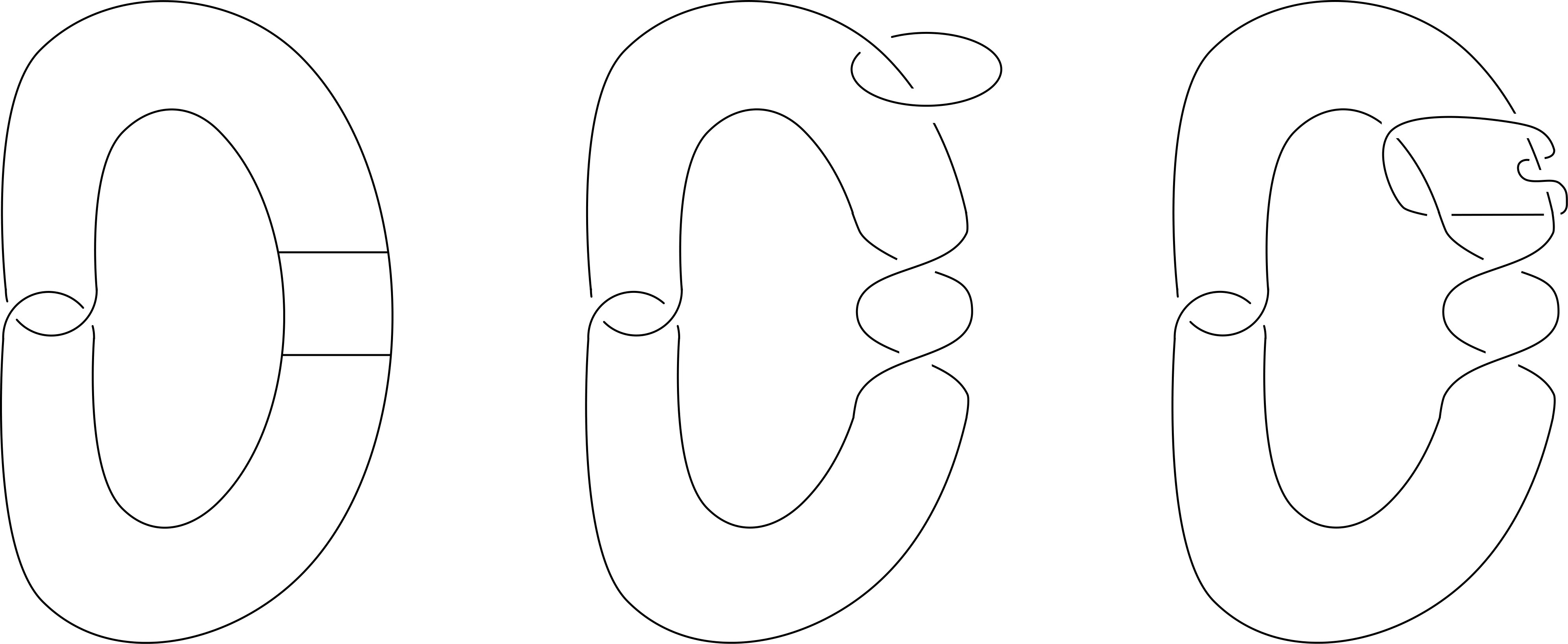 Figure 1
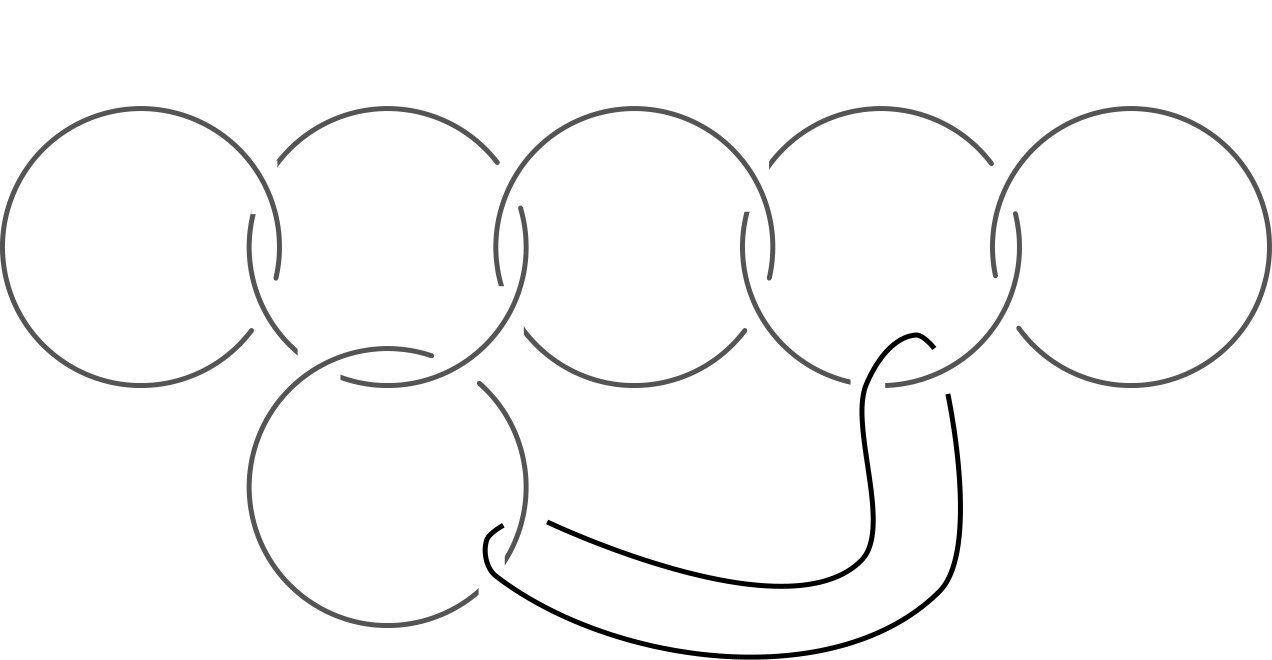 Figure 2
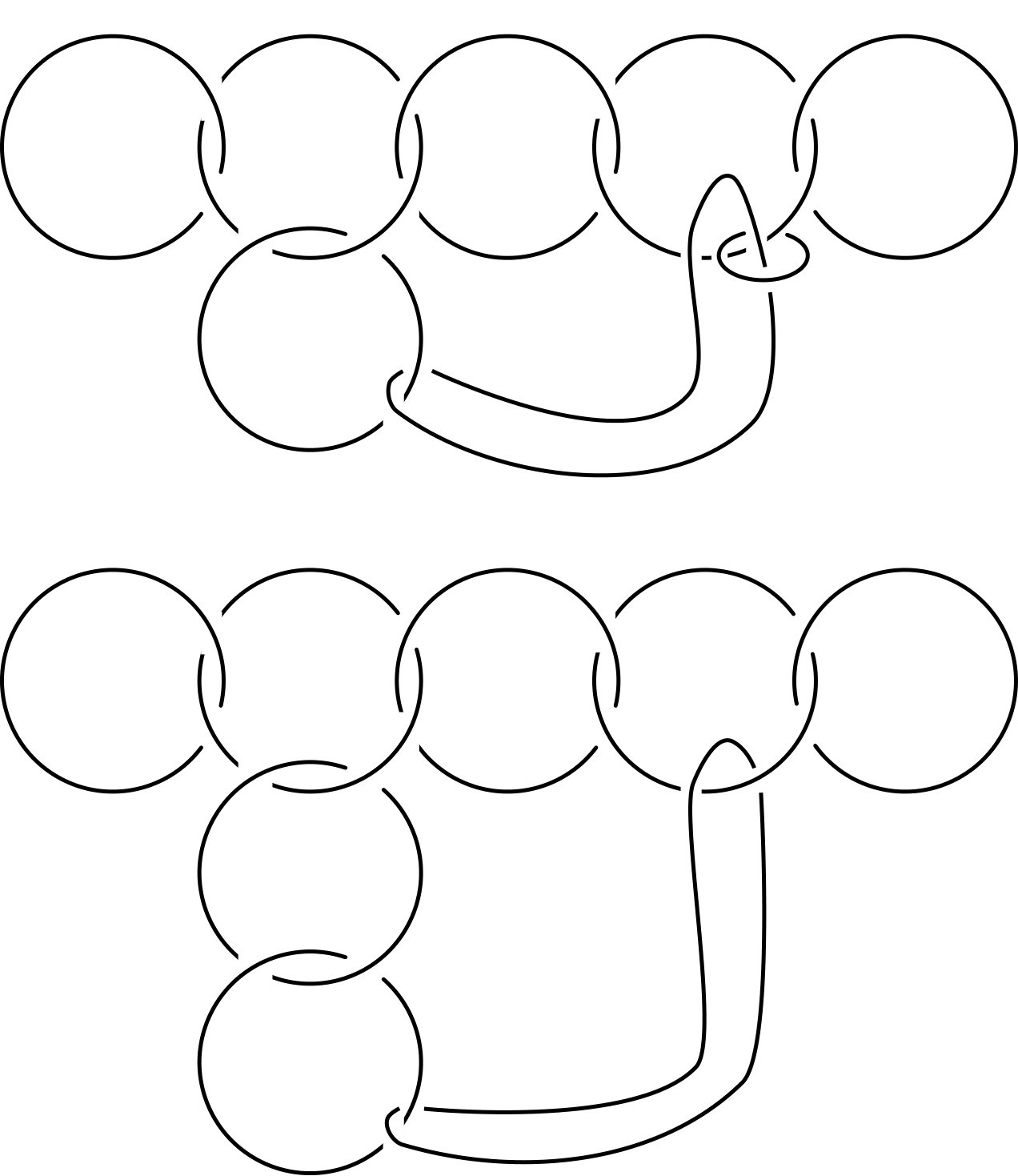 Figure 3
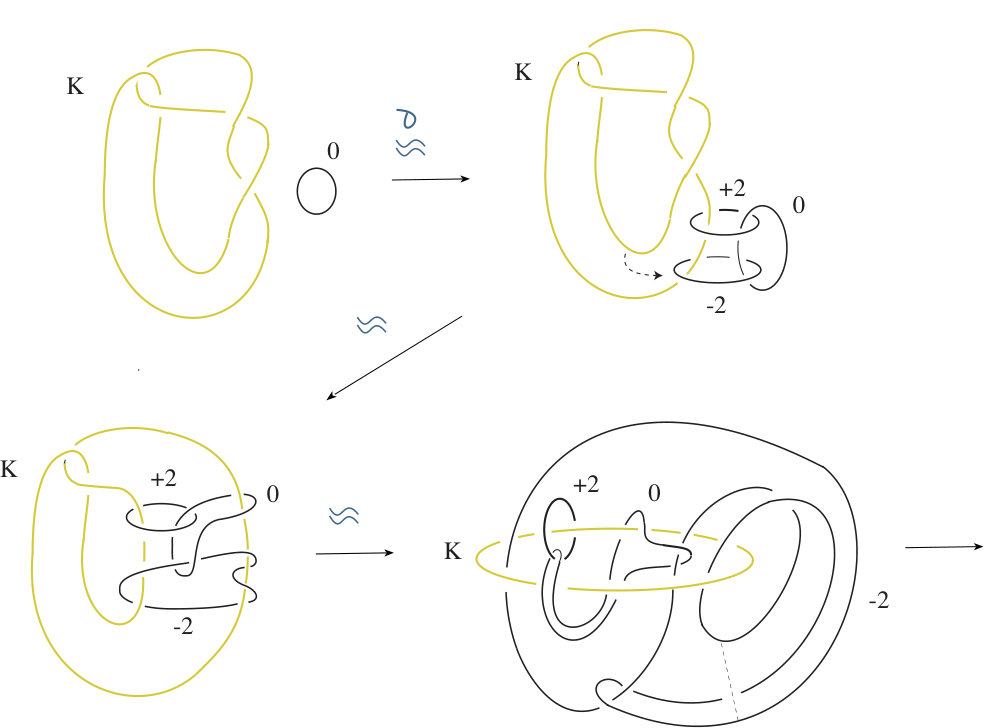 Figure 4
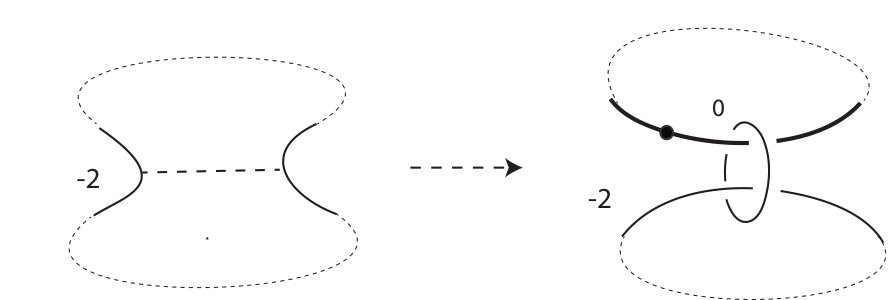 Figure 5
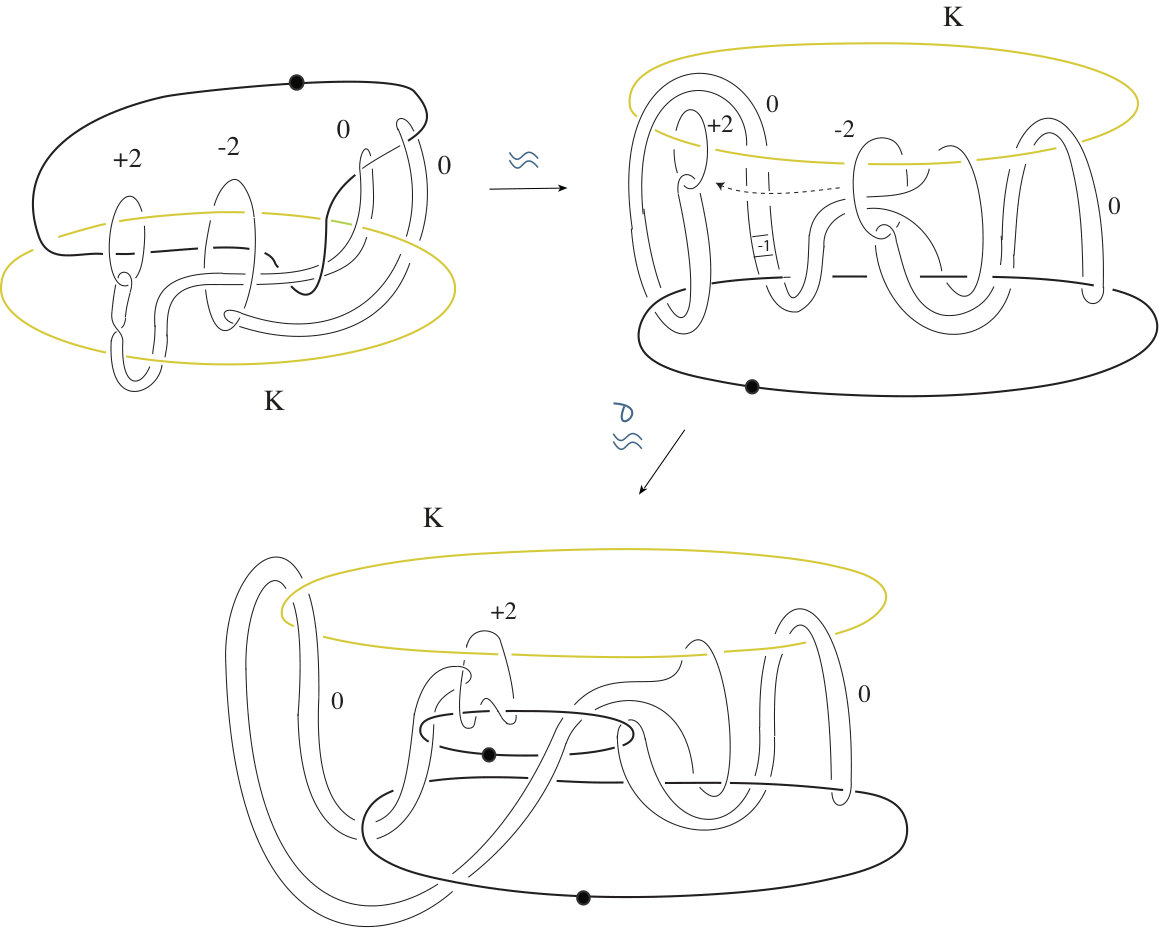 Figure 6
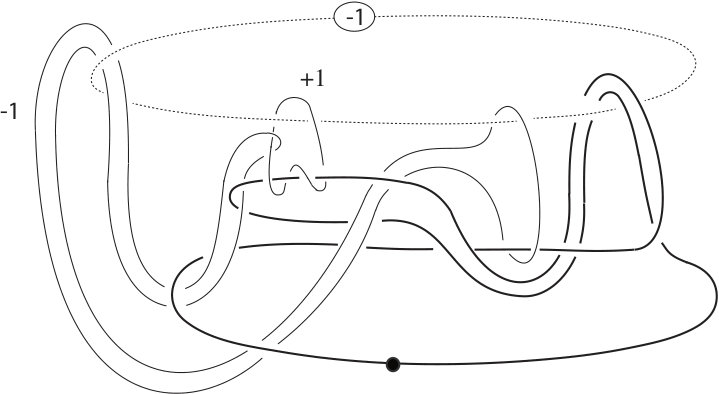 Figure 7
Peer Reviews
No public reviews on file for this paper yet. If you reviewed it on a platform where reviews are public (OpenReview, ICLR, NeurIPS, ICML), you can paste yours below so the community can read it here.
Videos
No videos yet. Explain this paper in a talk, walkthrough, or lecture? Add one.
Brieskorn spheres bounding rational balls
Selman Akbulut and Kyle Larson
Michigan State University, East Lansing, Michigan
Michigan State University, East Lansing, Michigan
Abstract.
Fintushel and Stern showed that the Brieskorn sphere bounds a rational homology ball, while its non-trivial Rokhlin invariant obstructs it from bounding an integral homology ball. It is known that their argument can be modified to show that the figure-eight knot is rationally slice, and we use this fact to provide the first additional examples of Brieskorn spheres that bound rational homology balls but not integral homology balls: the families and for odd. We also provide handlebody diagrams for a rational homology ball containing a rationally slice disk for the figure-eight knot, as well as for a rational homology ball bounded by . These handle diagrams necessarily contain 3-handles.
1. Introduction
A classic question in low-dimensional topology asks which 3-dimensional integral homology spheres smoothly bound integral homology balls. Due to their nice properties, a reasonable starting point to address this question is to consider the Brieskorn homology spheres , with positive and relatively prime. A large number of Brieskorn spheres are known to bound integral homology balls (or even contractible 4-manifolds), for example see [AK79], [CH81], [Ste78], [FS81], and [Fic84]. One can weaken the above question to ask which integral homology spheres bound rational homology balls; however, it turns out that this has not helped much in producing more examples. Indeed it appears to be a difficult problem to find Brieskorn spheres that bound rational homology balls but not integral homology balls. Fintushel and Stern [FS84] provided the first example by constructing a rational homology ball bounded by the Brieskorn sphere . Since has Rokhlin invariant , it cannot bound an integral homology ball. In this note we give the first new examples. Using the fact that the figure-eight knot is rationally slice (see Section 3), a simple observation shows that the Brieskorn sphere bounds a rational homology ball (Proposition 3). More interesting are two infinite families of Brieskorn spheres.
Theorem 1**.**
The Brieskorn spheres and bound rational homology balls, and when is odd they have and so do not bound integral homology balls.
The difficulty of this problem is related to handle decompositions of 4-manifolds. A simple homological argument shows that if an integral homology 3-sphere bounds a rational homology ball that is not an integral homology ball, then any handle decomposition of must contain 3-handles. Therefore the difficulty of working with handle decompositions with 3-handles points to the challenge and interest of finding these examples.
One of the main motivations for our work relates to the group of integral homology spheres and the group of rational homology spheres . There is a canonical homomorphism induced by inclusion (see [AL16] for more discussion of this homomorphism), and the work of [FS84] can be interpreted as showing that the kernel of is non-trivial. Since has infinite order in we get that the kernel contains a subgroup isomorphic to . Beyond this nothing is known of its structure, but it seems likely that the kernel is in fact much larger. Theorem 1 gives a large collection of additional Brieskorn spheres that represent non-trivial elements in the kernel of , but it is unknown if they are linearly independent in . Since Brieskorn spheres are often amenable to the computation of gauge and Floer theoretic invariants, it is possible that the following is a tractable question.
Question**.**
Is some subset of the Brieskorn spheres , , , and linearly independent in ?
Now we outline the proof of Theorem 1. Recall that can be obtained by -surgery on the figure-eight knot, and in fact the construction in [FS84] can be modified to show that the figure-eight knot is rationally slice, that is, bounds a smooth disk in a rational homology ball bounded by (see [Cha07]). This fact was apparently also known by Kawauchi111Kawauchi adds an extra algebraic condition in his definition of rationally slice and shows that the (2,1)-cable of the figure-eight knot satisfies this stronger condition. However, it is implicit in his argument that the figure-eight knot satisfies the weaker definition we use. [Kaw80], whose argument moreover generalizes to show that all strongly negative-amphicheiral knots are rationally slice (see [Kaw09], [KW16]). In Section 3 we give a handle proof that the figure-eight knot is rationally slice. Our proof uses the fact that the linking circle (meridian) of the 1-handle of is slice in (see p. 23 of [Akb16] for the notation).
If denotes the 3-manifold obtained by 0-surgery on the figure-eight knot, it then follows that bounds a 4-manifold with the rational homology of . Hence any homology sphere obtained by integral surgery on will bound a rational homology ball (the surgery corresponds to attaching a 2-handle to the rational homology which kills the non-torsion part of the homology). Theorem 1 is then proved by showing that each and can be obtained by an integral surgery on . We do this in Section 2.
In Section 3 we give handle diagrams for some of the relevant rational homology balls. In particular we give handle diagrams for a rational homology ball bounded by , and a rational homology ball bounded by showing a rationally slice disk for the figure-eight knot. While the arguments in [FS84] and [Cha07] are constructive, they do not give explicit handle diagrams for the rational homology balls they construct.
Acknowledgements
The second author thanks Paolo Aceto and Ron Stern for helpful conversations at the beginning of this project, and especially Ron Stern for suggesting Lemma 2 as a way to construct new examples.
2. Proof of Theorem 1
We start with the following lemma whose proof was outlined in Section 1. As before, let denote 0-surgery on the figure-eight knot.
Lemma 2**.**
Any integral homology sphere obtained by integral surgery on bounds a rational homology ball.
Proof.
Let be a rational homology ball with boundary such that the figure-eight knot bounds a smooth properly embedded disk in (for example, see Section 3). Then the Mayer-Vietoris long exact sequence shows that has the rational homology of . An integral surgery on corresponds to attaching to a 2-handle to . If the resulting 3-manifold is an integral homology sphere, then the 4-manifold obtained by attaching the corresponding 2-handle to must be a rational homology ball, as can be seen from the Mayer-Vietoris long exact sequence and the long exact sequence of the pair . ∎
We remark that in the previous lemma we can use 0-surgery on any rationally slice knot, and not just the figure-eight knot.
Proposition 3**.**
* bounds a rational homology ball.*
Proof.
Using Lemma 2 it suffices to show that can be obtained by an integral surgery on . The Brieskorn sphere admits a surgery description as -surgery on the twist knot defined as in Figure 1 (for this and plumbing descriptions of Brieskorn spheres see [Sav02]). Note that is the figure-eight knot. Blowing down the -framed components in the middle and right pictures of Figure 1 results in -surgery on and , respectively, showing that and bound rational homology balls. ∎
Proof of Theorem 1.
For the families and we use the dual approach, giving integral surgeries from their canonical negative definite plumbings to . For these plumbings take the form
[TABLE]
and for we have
[TABLE]
When we get and . Surgery diagrams for their canonical negative definite plumbings appear as the gray components in Figure 2 and Figure 3, and the black component gives the necessary surgery to . This can be seen from a straightforward sequence of blowdowns which we leave to the reader.
Now we describe an iterative procedure to obtain the whole families. Starting with the plumbing for either or , in Figure 2 or Figure 3 we can blow up to unlink the black -framed component from the -framed component. This is demonstrated in Figure 4. The result is to lower the framing of the -framed component to , and the previous surgery curve becomes a -framed component in the bottom chain. If we forget about the newly introduced -framed unknot we see a plumbing for the case, and the -framed unknot again provides the required surgery to since blowing up does not change the boundary 3-manifold. It is clear that we can keeping blowing up in this fashion, each time adding a -framed component to the bottom chain and decreasing the framing on the appropriate component in the upper-right chain by 1. Hence if we start with , blowing up in this way will generate the family , and starting with generates . In each case the -framed unknot coming from the blow up provides the surgery to , and so by Lemma 2 these Brieskorn spheres bound rational homology balls.
It is easy to compute the Neumann-Siebenmann invariant for our examples from the diagrams of their canonical negative definite plumbings, as described for example in [Neu80]. The plumbings have signature , and when is odd the square of their spherical Wu class is . Hence for odd these Brieskorn spheres have . Since , we see that these examples have nontrivial Rokhlin invariant.
∎
3. Handle diagrams
Here we will first construct a rational ball with boundary where the figure-eight knot is slice. Then by blowing down this slice disk we will get a specific handlebody of a rational ball which bounds. We start with the figure-eight knot in , drawn as the yellow curve in Figure 6. Then we attach a canceling handle pair to . After this, we apply the obvious boundary diffeomorphisms to get the last picture of Figure 6. Then we go from Figure 6 to Figure 7 by applying the local diffeomorphism described in Figure 5. This brings us to the first picture of Figure 7. Then an isotopy and handle slide (indicated by the dotted arrow) and turning a zero framed -handle to a dotted circle gives us the last picture of Figure 7, which is a rational ball and the figure-eight knot (drawn in yellow color) is obviously slice there. Then by blowing down this slice , in Figure 8 with -framing, gives a rational ball which bounds. The notation in Figure 8 means that everything going through is twisted by a -twist. From the picture we see that has one -handle, two -handles, and one -handle.
The reference list from the paper itself. Each links out to its DOI / PubMed record.
- 1[AK 79] Selman Akbulut and Robion Kirby, Mazur manifolds , Michigan Math. J. 26 (1979), no. 3, 259–284. MR 544597
- 2[Akb 16] Selman Akbulut, 4 4 4 -manifolds , vol. 25, Oxford University Press, 2016.
- 3[AL 16] Paolo Aceto and Kyle Larson, Knot concordance and homology sphere groups , To appear in Int. Math. Res. Not. IMRN , 2016.
- 4[CH 81] Andrew J. Casson and John L. Harer, Some homology lens spaces which bound rational homology balls , Pacific J. Math. 96 (1981), no. 1, 23–36. MR 634760
- 5[Cha 07] Jae Choon Cha, The structure of the rational concordance group of knots , Mem. Amer. Math. Soc. 189 (2007), no. 885, x+95. MR 2343079 (2009 c:57007)
- 6[Fic 84] Henry Clay Fickle, Knots, 𝐙 𝐙 {\bf Z} -homology 3 3 3 -spheres and contractible 4 4 4 -manifolds , Houston J. Math. 10 (1984), no. 4, 467–493. MR 774711
- 7[FS 81] Ronald Fintushel and Ronald J. Stern, An exotic free involution on S 4 superscript 𝑆 4 S^{4} , Ann. of Math. (2) 113 (1981), no. 2, 357–365. MR 607896
- 8[FS 84] by same author, A μ 𝜇 \mu -invariant one homology 3 3 3 -sphere that bounds an orientable rational ball , Four-manifold theory (Durham, N.H., 1982), Contemp. Math., vol. 35, Amer. Math. Soc., Providence, RI, 1984, pp. 265–268. MR 780582 (86f:57013)