System of unbiased representatives for a collection of bicolorings
Niranjan Balachandran, Rogers Mathew, Tapas Kumar Mishra and, Sudebkumar Prasant Pal

TL;DR
This paper investigates the minimal size of a family of subsets of [n] such that each bicoloring in a given set has an unbiased representative, contributing to combinatorial design theory.
Contribution
It introduces the concept of unbiased representatives for bicolorings and analyzes the minimal family size needed for coverage.
Findings
Established bounds on the minimum size of such families.
Characterized conditions for the existence of unbiased representatives.
Provided algorithms for constructing small unbiased representative families.
Abstract
Let denote a set of bicolorings of , where each bicoloring is a mapping of the points in to . For each , let . For each , let denote the incidence vector of . A non-empty set is said to be an `unbiased representative' for a bicoloring if . Given a set of bicolorings, we study the minimum cardinality of a family consisting of subsets of such that every bicoloring in has an unbiased representative in .
Click any figure to enlarge with its caption.
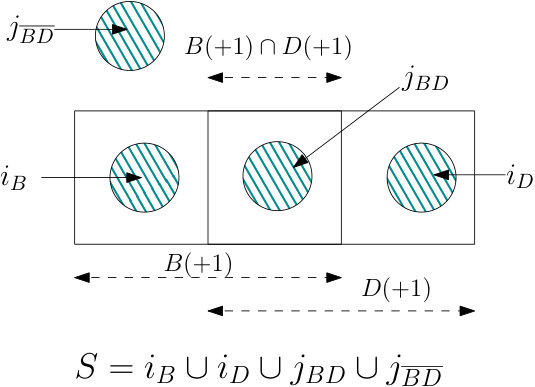 Figure 1
Peer Reviews
No public reviews on file for this paper yet. If you reviewed it on a platform where reviews are public (OpenReview, ICLR, NeurIPS, ICML), you can paste yours below so the community can read it here.
Videos
No videos yet. Explain this paper in a talk, walkthrough, or lecture? Add one.
\newdateformat
mydate\monthname[\THEMONTH], \THEYEAR
11institutetext: Department of Mathematics, Indian Institute of Technology, Bombay 400076, India 11email: [email protected]: Department of Computer Science and Engineering, Indian Institute of Technology, Kharagpur 721302, India
22email: {rogers,tkmishra,spp}@cse.iitkgp.ernet.in
System of unbiased representatives for a collection of bicolorings
Niranjan Balachandran1
Rogers Mathew2
Tapas Kumar Mishra2
Sudebkumar Prasant Pal2
Abstract
Let denote a set of bicolorings of , where each bicoloring is a mapping of the points in to . For each , let . For each , let denote the incidence vector of . A non-empty set is said to be an ‘unbiased representative’ for a bicoloring if . Given a set of bicolorings, we study the minimum cardinality of a family consisting of subsets of such that every bicoloring in has an unbiased representative in .
1 Introduction
Let denote a set of bicolorings of , where each bicoloring maps each point to either -1 or +1. Let denote the -dimensional vector representing the bicoloring , i.e. . A non-empty set is said to be an unbiased representative for a bicoloring if , where denotes the 0-1 -dimensional incidence vector corresponding to . We call a family of subsets of a system of unbiased representatives (or ‘SUR’) for if for every bicoloring , there exists at least one set such that . Note that the two monochromatic bicolorings can never have any unbiased representatives - we call these bicolorings ‘trivial’. Let denote the minimum cardinality of a system of unbiased representatives for . We define the maximum of over all possible families of non-trivial bicolorings of as . Note that no singleton set of is a member of any optimal system of unbiased representatives.
Unbiased representatives are useful in testing products such as drugs over a large population where the effectiveness (or side-effect) of a new drug is studied in correlation with a large set of patient attributes such as body weight, height, age, etc. Complementary extremes in the attributes, such as being obese or underweight, tall or short, and young or old, are relevant is such correlation studies. Such studies require patients with complementary ranges of values of a certain attribute to be present in equal (or roughly equal) numbers in the representative group for that attribute – such a group may be deemed to be an unbiased representative for the attribute. However, selecting a separate sample of individuals for each attribute having equal representation of the complementary traits is practically impossible. So, one needs to select a family of samples of individuals such that for any attribute , there exists a sample which has an equal representation of individuals from the complementary traits of . It is in the best interest to choose a family of such groups of representatives of the smallest possible cardinality. It is not hard to see the direct mapping of this problem to the problem addressed in this paper. In a generic setting, SURs are useful in various applications where a collection of items (like individual patients) have many attributes (like weight, height and age), where the objective is to form a small collection of subsets of items with almost equal representation of opposite or complementary traits for each attribute.
1.1 Definitions and notations
We use ‘SUR’ to denote the phrase ‘system of unbiased representatives’. For integers and , let denote the set , and denote the set . A bicoloring of is called a -bicoloring if the number of +1’s in is exactly . For a bicoloring , we use (respectively, ) to denote the set of points receiving color +1 (respectively, -1) under . We use () to denote the -dimensional vector (respectively, 0-1 vector) representing the bicoloring (respectively, ), i.e. . Note that for some implies that that is even. Throughout the rest of the paper, we consider only the non-trivial bicolorings and assume that every set in a SUR is of even cardinality. Let (respectively, ) be the minimum cardinality of a SUR for , where (i) each is a bicoloring of consisting of exactly +1’s (respectively, at least and at most +1’s), and, (ii) each is an -sized (respectively, at least -sized and at most -sized) subset of . We define () as follows.
[TABLE]
[TABLE]
Since no singleton set of can be a member of any optimal system of unbiased representative and the monochromatic bicolorings, consisting of exactly zero (or ) +1’s, are trivial, is the same as .
1.2 Relation to existing works
Given a family of subsets of , finding another family with certain properties in relation with has been well investigated. One of the most studied problem in this direction is the computation of separating families(see [16]). Let consist of pairs , , and be another family of subsets on . A subset separates a pair if and or vice versa. The family is a separating family for if every pair is separated by some (see [27, 16, 33, 10, 31] for detailed results and related problems on separating families). Separating families have many applications like ‘Wasserman-type’ blood tests of large populations, diagnosis and chemical analysis, locating defective items, etc (see [17]). An extension of the separating family problem is the ‘test cover’ problem: “Given a family of subsets of , finding a sub-collection of minimum cardinality such that every pair of is separated by some ”. The test cover problem is studied in the context of drug testing, biology [26, 35, 20] and pattern recognition [9]. For results and related notions, see [23, 13, 7, 8, 6]. In the above problems, any two sized set can be viewed as a partial bicoloring where , , and for any and a set covers if and only if .
An affine hyperplane is a set of vectors , where is a nonzero vector, . Covering the Hamming cube with the minimum number of affine hyperplanes has been well studied - a point is said to be covered by a hyperplane if (see [1, 21, 30]). It is not hard to see that any SUR for the non-trivial bicolorings is a covering for all the points of the Hamming cube, except , by hyperplanes satisfying (i) and (ii) .
1.3 Summary of results
The paper is divided into three logical sections. The first section (Section 2) focuses on obtaining upper bounds for SURs when (i) the collection of bicolorings is unrestricted or has minor restrictions, and (ii) the sets in the SURs are unrestricted or have minor restrictions. When consists of all the non-monochromatic bicolorings, it is not difficult to show that . Using a nice application of Combinatorial Nullstellensatz [2], we improve the above lower bound to .
Theorem 1.1
Let be a positive integer and . Then, , where .
We relate the problem of SUR to the hitting set problem, which in turn implies relations with ‘VC-dimension’ provided for each . For such families , this relationship assists in establishing an upper bound for cardinalities of any optimal SUR. Under a similar restriction for each , if it is mandatory that each set in the SUR is of cardinality exactly , the best upper bound obtained is large (). In order to establish an upper bound for size of an optimal SUR under this restriction, we introduce some error in the representations and we have the following theorem.
Theorem 1.2
Let , where is an integer. Let denote the set of all bicolorings , where , for some . Then, with high probability, one can construct a family of cardinality at most in time consisting of -sized subsets such that for every , there exists a set with .
In the second part of the paper (Section 3), we study the SUR problem where each is restricted to have exactly +1’s and each set in the SUR is required to be of cardinality exactly , for some , . We relate the SUR problem under such restrictions to ‘covering’ problems, that enables us to use a deterministic algorithm of Lovász [22] and Stein [32] to compute such a SUR in polynomial time. In particular, for sufficiently large values of , and , we use a result of Alon et al. [3, Corollary 1.3] to establish the following asymptotically tight bound on .
Theorem 1.3
For sufficiently large values of ,
[TABLE]
provided , for any .
The problem of estimation of becomes interesting when - the reduction to coverings gives a lower and upper bound of and , respectively. For , where is an increasing function in , this establishes only sub-linear lower bounds for . We use a vector space orthogonality argument combined with a theorem of Keevash and Long [18] to obtain a linear lower bound on under certain restrictions on , and .
Theorem 1.4
Let for any odd integer . Let be an even integer, where for some . Then, , where is some real positive constant.
Combined with an upper bound construction given in Lemma 4, this establishes an asymptotically tight bound for , when .
In the third part of the paper (Section 4), we obtain the following inapproximability result for computing optimal SURs by using a result of Dinur and Steurer [11] on the inapproximability of the hitting set problem.
Theorem 1.5
Let , where is an integer. Then, no deterministic polynomial time algorithm can approximate the system of unbiased representative problem for a family of bicolorings on to within a factor of the optimal when each set chosen in the representative family is required to have its cardinality at most , unless P=NP.
2 When cardinalities of sets in the ‘SUR’ are unrestricted or semi-restricted
2.1 Bounds on
Recall that , where is the cardinality of an optimal system of unbiased representative for . Observe that when . So, to establish bounds on , it suffices to consider the set of all the non-monochromatic bicolorings as and establish bounds on . We have the following proposition.
Proposition 1
Let be an integer and .
- (i)
. 2. (ii)
, for any . 3. (iii)
, for . 4. (iv)
, for .
Proof
(i) For any -bicoloring , any unbiased representative for is also an unbiased representative for the bicoloring , where and .
(ii) The proof follows from the proof of Statement (i) in Proposition 1.
(iii) Let denote the set of all the non-monochromatic bicolorings. It is not hard to see that is a SUR of cardinality for .
(iv) Let . So, . For any , if for any , , then . Moreover, for any , exactly two has . So, we need at least two sized sets to form a SUR for . The second inequality follows from the containment.
In the construction leading to the proof of Statement (iii) in Proposition 1, only two-sized sets are used as unbiased representatives. We have the following slightly non-trivial construction assuming , for some integer , giving similar bounds. Let : a partition of into two-sized sets. Let : a partition of into four-sized sets taken in that order. Similarly, repeating the construction for more steps, we obtain a sequence of partitions of , , where is a partition of into -sized parts, i.e., . Let . It follows that . To see that this is indeed a SUR for the set of all the non-monochromatic bicolorings, let denote any non-trivial bicoloring of . Without loss of generality, assume that . Let () be the minimum index such that there exists an with and . From construction of and assumption on , it follows that there exists consecutive parts with , , and . So, it follows that is an unbiased representative for .
To establish a tight lower bound on (), we need the following lemma.
Lemma 1
Let be a polynomial and be non-empty subsets of , for some field . If vanishes on all but one point , then deg() .
Proof
For the sake of contradiction, assume that deg() . Consider the polynomials.
[TABLE]
Note that deg() is . Let and . Then, the polynomial vanishes on all points of . However, has degree : the monomial has as its coefficient. Using Combinatorial Nullstellensatz [5], there exists at least one point in where is non-zero which is a contradiction.
Proof of Theorem 1.1
Statement of Theorem 1.1. Let be a positive integer and . Then, , where .
Proof
From Statements (ii) and (iii) of Proposition 1, we know that in order to prove Theorem 1.1, we only need to establish a lower bound of for .
Let denote the set of all the non-monochromatic bicolorings of . Let be a SUR of minimum cardinality for . Let () denote the -dimensional vector (respectively, 0-1 vector) representing the bicoloring (respectively, ) Consider the polynomial , .
[TABLE]
From the definition of , vanishes on all non-trivial bicolorings of . Now, consider the following polynomial .
[TABLE]
vanishes at every except at the point : vanishes at every except the two points and and vanishes at . has degree at most (note that one can repeatedly replace with since ). Using Lemma 1 with each , , it follows that . So, .
Remark 1
Lemma 1 can also be used to obtain an alternative proof of induction base case of the Cayley-Bacharach theorem by Riehl and Graham [28] (see Appendix 0.A). An alternative proof of the above lower bound can also be obtained using the Cayley-Bacharach theorem by Riehl and Graham [28].
Note that in Section 2.1, the underlying set of all the non-trivial bicolorings of , has cardinality . In this case, Theorem 1.1 establishes that . In the following section, we match the upper bound for slightly restricted sets of bicolorings.
2.2 Relation to hitting sets for arbitrary collection of bicolorings
Let denote a collection of subsets of . A subset is a hitting set for if for every , is non-empty. Let denote a minimum cardinality hitting set of . The decision version of the Hitting set problem is: “Given the pair and an integer as input, decide whether there exists a hitting set of cardinality at most for ”.
Lemma 2
Let be a family of bicolorings of . Construct the family where and , for . Let denote a hitting set for . Define . Then, is a SUR for of cardinality .
Proof
For the sake of contradiction, assume that has no unbiased representative in . Assume that . Since is a hitting set for , there exists some such that hits (and, thereby ). Then, the pair is an unbiased representative for , a contradiction to our assumption. So, . But this implies that . A similar contradiction can be obtained in this case.
Let be restricted to a special family of bicolorings: the number of +1’s for each lies in the range and , i.e., , for some fixed . Construct the family as above and let be the VC-dimension of . Note that every has size at least , for some fixed . Using a result of Haussler and Welzl [14] which was improved by Komlos et al. [19], we can get an ‘epsilon net’ (which is a hitting set for ) of cardinality at most (see Corollary 15.6 of [25] for this exact bound). Using Lemma 2, it follows that we can construct a SUR for of cardinality . Since any family of VC-dimension has cardinality at least , this establishes an upper bound for the cardinality of any optimal SUR under no restriction on set sizes. We state the result as a proposition below.
Proposition 2
Let be a constant. Let be a family of bicolorings, where , for each . Let be the family constructed from as in Lemma 2. Let be the VC-dimension of . Then, we can construct a SUR for of cardinality .
In both Section 2.1 and 2.2, the cardinality SURs contained sets of small sizes (2-sized sets) as well. In what follows, we study the problem of SURs made of large cardinality sets. In order to obtain a similar bound for such a SUR, we inevitably introduce some error in the representation.
2.3 Analysis with bias in representation
Consider the problem of estimation of for a set of bicolorings in terms of , where (i) the number of +1’s in each lies in the range for some , and (ii) each set in the SUR is of cardinality exactly , for some . Choosing elements, namely , from independently and uniformly at random, the probability that a fixed bicoloring does not have , where , is at most
[TABLE]
Let be constructed by choosing -element sets into independently, where each -element set is chosen as described above. Using union bound, the probability that some has for all , is . This gives an upper bound of for . Using Proposition 4, the case when and yields a asymptotically tight example for this upper bound. We have the following proposition.
Proposition 3
Let denote a set of bicolorings, where the number of +1’s in each lie in the range for some . Let denote a minimum cardinality SUR for , where each has cardinality exactly . Then,
[TABLE]
where
When , for some , Inequality 3 becomes
[TABLE]
Using the fact that , the right hand term is at most . Therefore, when , we have an upper bound for any optimal SUR consisting of sized sets for . However, if is any increasing function in , the upper bound given by Proposition 3 is large (even if , the term is ). For large values of , in order to obtain an upper bound for , one may allow some error in representation studied in the following section. Let denote the set of all bicolorings , where , for some . Our problem is to find a small sized family for such that
each is reasonably large; 2. 2.
for every , there exists a set such that , where is as small as possible.
Proof of Theorem 1.2
Statement of Theorem 1.2. Let , where is an integer. Let denote the set of all bicolorings , where , for some . Then, with high probability, one can construct a family of cardinality at most in time consisting of -sized subsets such that for every , there exists a set with .
Proof
We construct a set of size by picking each element of into independently with probability . Let denote the corresponding random vector where each . Note that . So, using linearity of expectation, . Moreover, since ’s are independent, . So, using the following form of Chernoff’s bound , we get, , for . So, we can sample a family of cardinality ( to be chosen later) consisting of sets of size .
Let be a bicoloring, where , where . Let denote the corresponding bit vector, where each . Let . Since , becomes a random variable (note that can take values and are independent). So, . It follows that . So, using Chebyshev’s inequality, we get, . That is, the probability that is at most . Let denote the bad event that some has for all . Using union bound, . Setting to at most , we get, .
Independently choose subsets of (call this collection ), where each is constructed by picking an element of independently with probability . Let be the sub-collection of -sized subsets in , where . Then, . Since , with high probability, . Partition into -sized sets. With high probability, one of the parts will form our desired family that is a SUR (with restricted error) for .
Comparison between Theorem 1.2 and Proposition 3: Expressing in Theorem 1.2 in terms of in Proposition 3, . So, . Substituting this value of in Inequality 4, we get a SUR of cardinality with no error for .
3 When cardinalities of sets in the ‘SUR’ and +1’s in the bicolorings are restricted
For any -bicoloring of , and any , if is an unbiased representative for , then : otherwise, . Recall that , where (i) is the collection of the distinct -bicolorings, (ii) is the cardinality of an optimal SUR for , and, (iii) each has cardinality exactly . We have the following propositions.
Proposition 4
.
Proof
Consider the case when . Given a SUR of cardinality consisting of -sized subsets, there exists a -sized subset (say, ) of that is completely disjoint from the union of these -sized subsets. The bicoloring with the points in colored +1 and the points in colored -1 does not have any unbiased representative in .
Proposition 5
, for .
See Appendix 0.B for a proof of Proposition 5.
A simple averaging argument gives the following lower bound.
[TABLE]
To establish an upper bound, we reduce this problem to a covering problem and then make use of a result by Lovász and Stein [32, 22].
Definition 1
Given a family of subsets of some finite set , the cover number of is the minimum number of members of whose union includes all the points in .
Theorem 3.1
[32, 22, 15]** If each member of covers at most elements and each element in is covered by at least members of , then
[TABLE]
We have the following theorem.
Theorem 3.2
Let be an integer, , and is even. Then,
[TABLE]
Proof
Consider the following construction of a uniform family of subsets based on the distinct -bicolorings and distinct -sized subsets of .
Construction 1
Corresponding to each distinct -bicoloring in , we add a point to . Corresponding to each distinct -sized subset in , we add a set to , where is the collections of all ’s such that . So, ‘covers’ if and only if .
So, , . Clearly, , . It follows from the construction that . So, from Theorem 3.1, we have
[TABLE]
Double counting pairs, where is a -bicoloring and is a -sized subset that covers , we get
[TABLE]
Combining Inequalities 6 and 7, and from Inequality 5, Theorem 3.2 follows.
Since Lovász-Stein method is deterministic and constructive, the above reduction gives a deterministic polynomial time algorithm for obtaining a SUR. Moreover, from Theorem 3.2, it follows that is approximable ( to be precise) and when , the approximation factor becomes ( to be exact). However, if and , for some , then this upper bound can be improved further.
3.1 Tight upper bounds under restrictions
From Construction 1, it is clear that the approximation factor for in Theorem 3.2 comes as a consequence of the approximation factor for the cover number given by Lovász-Stein Theorem. So, tighter bounds for the cover number should translate into tighter bounds for . Let denote the number of -sized sets that are unbiased representatives for both and , for any pair of -bicolorings, where . Let . Rödl nibble method [29, 4] establishes asymptotically tight bounds for the cover number provided the uniformity of the family in Construction 1 is fixed, , and . Alon et al. [3] relaxed the condition to provided . In the estimation of , if and , for any , using Construction 1, it follows that and . So, in order to prove Theorem 1.3, it suffices to show that .
Lemma 3
, when and , for any .
Proof
In order to prove the lemma, it is important to note that depends intrinsically on the cardinality of . Let be some -sized subset of . Let , , and (see Figure 1). So, . If is an unbiased representative for , then . If is an unbiased representative of , then . Therefore, if is an unbiased representative of both and , then (i) (, say), (ii) (, say), and (iii) . Let . We have,
[TABLE]
Since , applying Condition (iii), we get and . In other words, if is an unbiased representative of cardinality for both the -bicolorings and , . So, for any pair of -bicolorings, exactly one term in the summation of Equation 8 remains valid, namely . For instance, when , ; when , , etc. Therefore, if and . So, , when provided . Thus, , when . Computing ,
[TABLE]
Note that , since . So, , when .
Proof of Theorem 1.3
Statement of Theorem 1.3. For sufficiently large values of ,
[TABLE]
provided , for any .
Proof
From Lemma 3, and using the result of Alon et al. [3, Corollary 1.3] to obtain coverings, the proof follows.
3.2 when
Let denote the set of all distinct -bicolorings. It is not hard to see that is a SUR of cardinality for . Together with Proposition 4, this establishes . It is easy to see that . For arbitrary values of , from Theorem 3.2 and Proposition 4, we have,
[TABLE]
When , this establishes a lower bound and upper bound of and , respectively. In general, when is an increasing function in , this establishes sub-linear lower bounds for .
We use an extension of a theorem of Frankl and Rödl [12] given by Keevash and Long [18] to obtain a linear lower bound on under certain restrictions on and . Let be a -ary code. For any , the Hamming distance between and is the number of indices where , for . The code is called -avoiding if the Hamming distance between no pair of code-words in is . The following upper bound for -avoiding codes is given in [18].
Theorem 3.3
[18]** Let and let satisfy . Suppose that and is even if . If is -avoiding, then , for some positive constant .
We have the following lower bound for , when for any odd integer and , for some .
Proof of Theorem 1.4
Statement of Theorem 1.4. Let for any odd integer . Let be an even integer, where for some . Then, , where is some real positive constant.
Proof
Let denote the set of all the bicolorings of consisting of exactly +1’s. We construct a family , where corresponds to the +1 colored points of . Let be a SUR for , where each has cardinality exactly for some odd number . Note that implies that , where denotes the 0-1 incidence vector corresponding to the set . Let denote the vector space spanned by the vectors ’s, , over . Let denote the subspace orthogonal to . Since is a SUR for , it follows that for every , there exists a set such that (since is odd). Therefore, , for all . In other words, does not contain any vector consisting of exactly ones. Moreover, observe that for any , the number of ones in is same as the Hamming distance between and . Thus, is -avoiding. Since and is even, from Theorem 3.3, it follows that there exists a positive constant such that . So, dimension of is at most . Therefore, it follows that dimension of is at least .
Corollary 1
* provided is even and is odd, for some .*
Let be even and be odd. From Inequality 10, we have . When is a constant, using Corollary 1, this upper bound is asymptotically tight. However, for larger values of , there can be a large gap (up to when ) between the upper and the lower bound. In what follows, we address the problem for a special case when and establish a better upper bound of on .
Lemma 4
, where is any even integer.
Proof
Let denote the set of all the bicolorings with equal number of +1’s and -1’s. Let . Let . For any , it is not hard to see that each is even and . Since the bicolorings consist of equal number of +1’s and -1’s, if , and if . In particular, we have . Since , this implies the existence of an index such that . This concludes the proof that .
From Corollary 1 and Lemma 4, we have the following theorem.
Theorem 3.4
. Moreover, if is even and is odd, for some .
4 Inapproximability of the SUR problem
Firstly, we establish a hardness result of the hitting set problem for a special family of subsets.
Definition 2
A family of subsets of is complement closed on if for all ,
Proposition 6
Let be an integer, . No deterministic polynomial time algorithm can approximate the hitting set problem for complement closed families on to within a factor of of the optimal, unless P=NP.
Proof
For the sake of contradiction, assume that there exists an algorithm that approximates the hitting set for complement closed families on to within a factor of of the optimal. We obtain a contradiction to this assumption by the following reduction from the general hitting set problem.
Given a pair as input to the general hitting set problem, we extend the universe to by adding the element . We construct as follows: . Let () denote an optimal solution to the hitting set problem on (respectively, ). Let denote a hitting set outputted by on as input.
Observe that
[TABLE]
From our assumption, we know that , for . Note that is a valid hitting set for . So, . Therefore, is a factor approximation algorithm for the general hitting set problem. However, Dinur and Steurer [11] proved that it is impossible to approximate the set cover problem to a factor of of the optimal, unless P=NP.
We use Proposition 6 to establish the following hardness result for the system of unbiased representative problem.
Proof of Theorem 1.5
Statement of Theorem 1.5. Let , where is an integer. Then, no deterministic polynomial time algorithm can approximate the system of unbiased representative problem for a family of bicolorings on to within a factor of the optimal when each set chosen in the representative family is required to have its cardinality at most , unless P=NP.
Proof
We prove Theorem 1.5 by a reduction from an instance of the hitting set problem on complement closed familes. Let be a complement closed family on . From , we construct a family of bicolorings on in the following way: . For the sake of contradiction, assume that there exists an algorithm that approximates the system of unbiased representative problem for any family of bicolorings on to within a factor of the optimal, where and each set in the SUR is required to have its cardinality at most . Let () denote an optimal solution to the hitting set problem (respectively, the system of unbiased representative problem) on (respectively, ). Let denote a SUR outputted by with as its input. Then, executing on as input, we obtain a SUR for such that (i) for each , (ii) , for some . Let . It follows that and is a hitting set for .
From Lemma 2, we know that . Therefore,
[TABLE]
So, is a -factor approximation algorithm for computing hitting set of . Since , this is a contradiction to Proposition 6.
Remark 2
Consider the case when the family is restricted to a special family of bicolorings, where the number of +1’s (or -1’s) for each is exactly one, i.e. (or ). Then, the problem of system of unbiased representatives reduces to an edge cover problem [34, 24] on a complete graph , where for each , a vertex (respectively, ) is added to . So, this reduction makes the SUR problem polynomial time solvable for such families of bicolorings.
Acknowledgment
The authors thank Prof. Niloy Ganguly for helpful discussions on the problem.
Appendix 0.A Proof of induction base case of Theorem 0.A.1
Theorem 0.A.1
[28]** Given the quadratics in variables with common zeros, the maximum number of those common zeros a polynomial of degree can go through without going through them all is .
Proof
The proof is by induction on . When , we have nothing to prove. So, we consider all the degree polynomials on variables as the base case. For the sake of contradiction, assume that is a polynomial of degree on variable and it misses only one common zero of . Then, using Lemma 1, it follows that degree of must be , which is a contradiction. This completes the proof of the induction base case.
The rest of the proof is exactly same as given in [28].
Appendix 0.B Proof of Proposition 5
Statement of Proposition 5. , for .
Proof
Let denote the set of all the bicolorings consisting of exactly +1’s, for . Let denote a family of -sized subsets that is an optimal unbiased representative family for . For any , let . For each , we construct -sized subsets as follows: , , , . Let . To see that is a system of unbiased representative for , consider any and a -sized subset . Let has . From the construction, it follows that there is at least one such that .
For the lower bound, consider a SUR for of size . For each , let denote the family of distinct -sized subsets of . Then, is an unbiased representative family for where each set in the family is of size exactly .
The reference list from the paper itself. Each links out to its DOI / PubMed record.
- 1[1] N. Alon and Z. Füredi. Covering the cube by affine hyperplanes. European Journal of Combinatorics , 14(2):79–83, 1993.
- 2[2] Noga Alon. Combinatorial nullstellensatz. Combinatorics, Probability and Computing , 8(1-2):7–29.
- 3[3] Noga Alon, Béla Bollobás, Jeong Han Kim, and Van H. Vu. Economical covers with geometric applications. Proceedings of the London Mathematical Society , 86(2):273, 2003.
- 4[4] Noga Alon and Joel H. Spencer. The probabilistic method . John Wiley & Sons, 2000.
- 5[5] Noga Alon and M. Tarsi. Combinatorial nullstellensatz. Combinatorics Probability and Computing , 8(1):7–30, 1999.
- 6[6] Manu Basavaraju, Mathew C. Francis, M. S. Ramanujan, and Saket Saurabh. Partially polynomial kernels for set cover and test cover. SIAM Journal on Discrete Mathematics , 30(3):1401–1423, 2016.
- 7[7] Koen M. J. De Bontridder, B. J. Lageweg, Jan K. Lenstra, James B. Orlin, and Leen Stougie. Branch-and-bound algorithms for the test cover problem. In European Symposium on Algorithms , pages 223–233. Springer, 2002.
- 8[8] Robert Crowston, Gregory Gutin, Mark Jones, Saket Saurabh, and Anders Yeo. Parameterized study of the test cover problem. In International Symposium on Mathematical Foundations of Computer Science , pages 283–295. Springer, 2012.