Unified description of dynamics of a repulsive two-component Fermi gas
Piotr T. Grochowski, Tomasz Karpiuk, Miros{\l}aw Brewczyk, Kazimierz, Rz\k{a}\.zewski

TL;DR
This paper investigates the dynamics of a two-component Fermi gas, revealing a ferromagnetic transition driven by increasing repulsive interactions, supported by both theoretical models and experimental agreement.
Contribution
It provides a unified theoretical description of the spin-dipole oscillations and ferromagnetic instability in a repulsive Fermi gas, aligning with recent experimental findings.
Findings
Identification of ferromagnetic transition with increasing interaction strength
Observation of spin-dipole mode softening before ferromagnetism
Agreement between theoretical models and experimental data
Abstract
We study a binary spin-mixture of a zero-temperature repulsively interacting Li atoms using both the atomic-orbital and the density functional approaches. The gas is initially prepared in a configuration of two magnetic domains and we determine the frequency of the spin-dipole oscillations which are emerging after the repulsive barrier, initially separating the domains, is removed. We find, in agreement with recent experiment (G. Valtolina et al., arXiv:1605.07850 (2016)), the occurrence of a ferromagnetic instability in an atomic gas while the interaction strength between different spin states is increased, after which the system becomes ferromagnetic. The ferromagnetic instability is preceded by the softening of the spin-dipole mode.
Click any figure to enlarge with its caption.
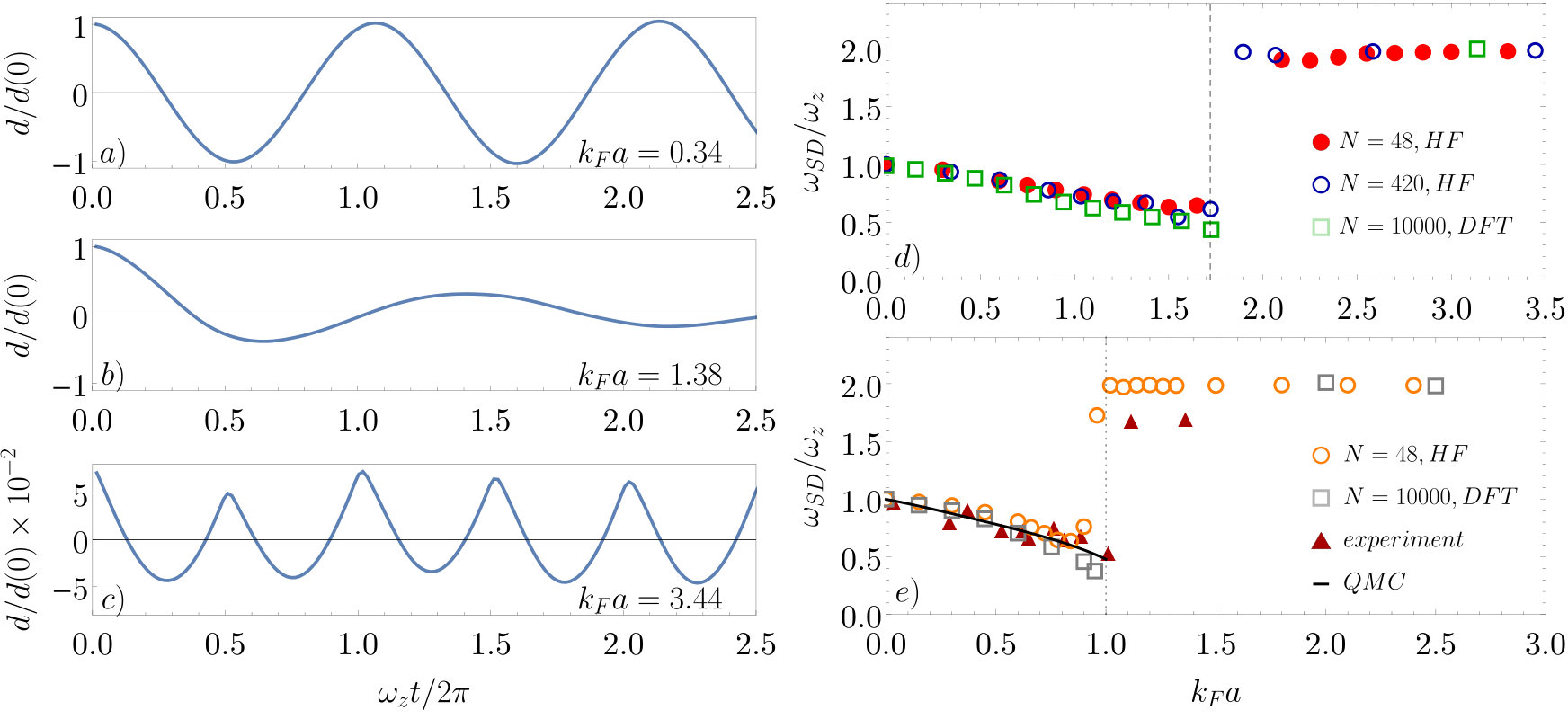 Figure 1
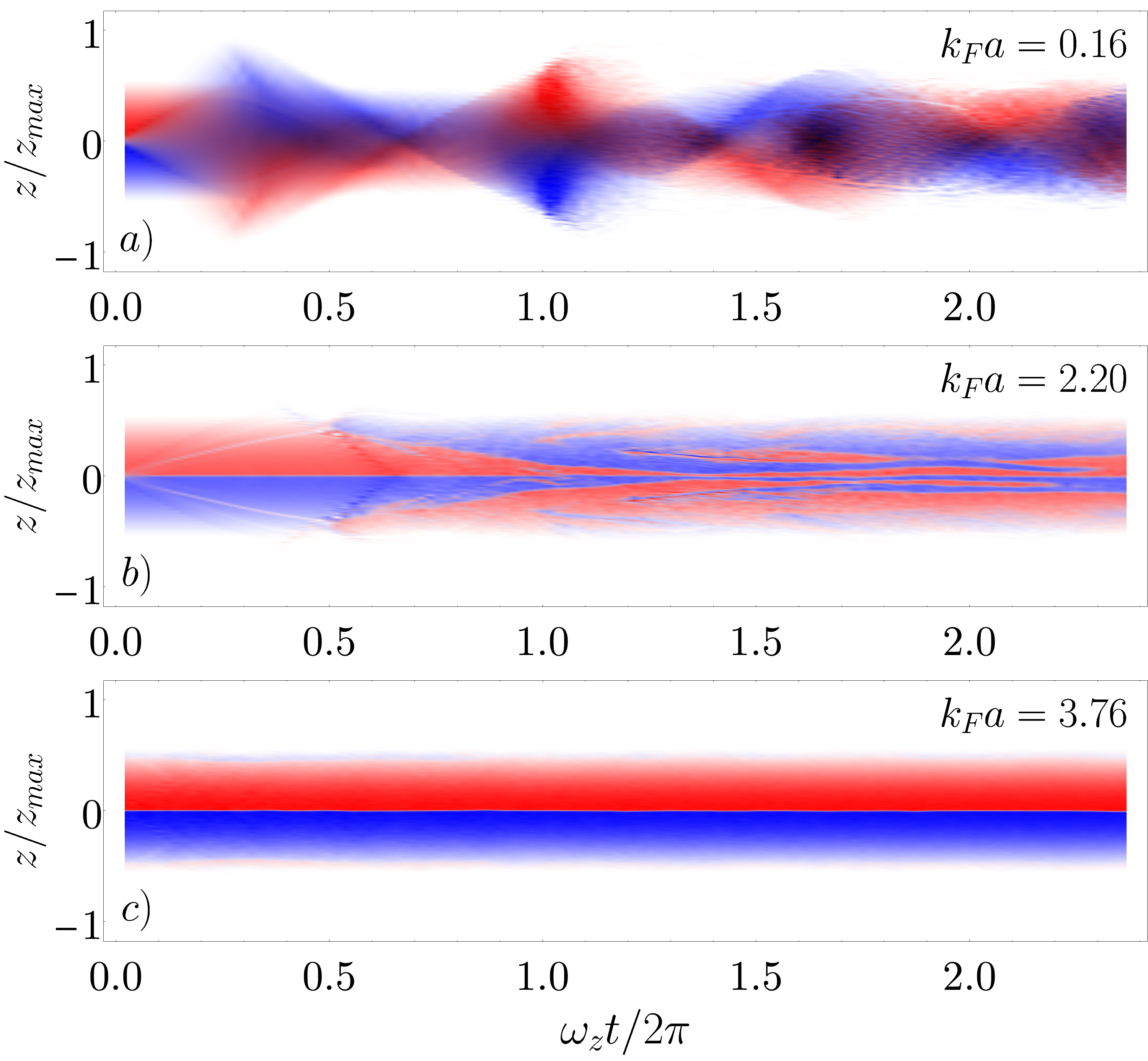 Figure 2
Peer Reviews
No public reviews on file for this paper yet. If you reviewed it on a platform where reviews are public (OpenReview, ICLR, NeurIPS, ICML), you can paste yours below so the community can read it here.
Videos
No videos yet. Explain this paper in a talk, walkthrough, or lecture? Add one.
Unified description of dynamics of a repulsive two-component Fermi gas
Piotr T. Grochowski
Center for Theoretical Physics PAN, Al. Lotników 32/46, 02-668 Warsaw, Poland
Tomasz Karpiuk
Wydział Fizyki, Uniwersytet w Białymstoku, ul. K. Ciołkowskiego 1L, 15-245 Białystok, Poland
Mirosław Brewczyk
Wydział Fizyki, Uniwersytet w Białymstoku, ul. K. Ciołkowskiego 1L, 15-245 Białystok, Poland
Kazimierz Rzążewski
Center for Theoretical Physics PAN, Al. Lotników 32/46, 02-668 Warsaw, Poland
Abstract
We study a binary spin-mixture of a zero-temperature repulsively interacting 6Li atoms using both the atomic-orbital and the density functional approaches. The gas is initially prepared in a configuration of two magnetic domains and we determine the frequency of the spin-dipole oscillations which are emerging after the repulsive barrier, initially separating the domains, is removed. We find, in agreement with recent experiment (G. Valtolina et al., Nat. Phys. 13, 704 (2017)), the occurrence of a ferromagnetic instability in an atomic gas while the interaction strength between different spin states is increased, after which the system becomes ferromagnetic. The ferromagnetic instability is preceded by the softening of the spin-dipole mode.
The interaction of itinerant fermions, i.e. the ones not localized in the lattice, causes a variety of effects in many quantum systems Giorgini et al. (2008); Brando et al. (2016); Silverstein (1969). Among them, the existence of ferromagnetism in binary spin-mixtures has been addressed numerous times in both theory Sogo and Yabu (2002); Karpiuk et al. (2004); Duine and MacDonald (2005); LeBlanc et al. (2009); Conduit et al. (2009); Cui and Zhai (2010); Pilati et al. (2010); Chang et al. (2011); Pekker et al. (2011); Massignan and Bruun (2011); Massignan et al. (2014); Trappe et al. (2016); Miyakawa et al. (2017) and experiment DeMarco and Jin (2002); Du et al. (2008); Jo et al. (2009); Sommer et al. (2011); Sanner et al. (2012); Lee et al. (2012); Valtolina et al. (2017). A simple mean-field treatment of the homogeneous electron gas, introduced by Stoner, predicts a ferromagnetic phase, when a short-ranged screened Coulomb repulsion between two particles of opposite spins dominates over the degeneracy pressure Stoner (1933). However, this idealized picture proved insufficient to satisfactorily describe majority of encountered phenomena as the effects beyond mean-field often play a crucial role Brando et al. (2016). Still, clean fermionic systems in which short-range interaction is dominant are experimentally available with the help of Feshbach resonances. Yet, the existence and stability of ferromagnetic phase in such systems are still in dispute.
The use of methods more sophisticated than Stoner approach likewise leads to ferromagnetic instability which can be driven by short-range interactions only. Such a ferromagnetic state is however a metastable one, as it corresponds to the excited energy branch Chin et al. (2010). It is due to the fact that the short-range repulsive interaction, ultimately described in terms of the s-wave scattering channel, calls for underlying attractive potential with a weakly bound molecular state Chin et al. (2010).
Indeed, recent experiments show that binary spin-mixture of Fermi gas, initially prepared in a paramagnetic state, decays to the superfluid state of paired fermions rather than creating a ferromagnetic phase Sanner et al. (2012); Lee et al. (2012). To decrease the pairing rate, in the experiment Valtolina et al. (2017), 6Li atoms were prepared in an artificial ferromagnetic state, in which both components are initially separated by the optical barrier in a harmonic trap and then undergo a free time evolution after the release of the barrier. The usual treatment of dynamics of such a spin-polarized system distinguishes between the weak Duine et al. (2010); Pilati et al. (2010); Recati and Stringari (2011); He and Huang (2012) and the strong interaction Taylor et al. (2011); Palestini et al. (2012); Mink et al. (2012) regimes. The only available unified descriptions are based on semi-classical Boltzmann equation Toschi et al. (2003); Goulko et al. (2011).
To tackle this problem in an alternative way, we employ two fundamentally different methods, namely atomic-orbital (time-dependent Hartree-Fock) and density-functional approaches. Both of them provide the results for a very broad range of interaction strengths and quantitatively agree with each other and with the experiments Sommer et al. (2011); Valtolina et al. (2017). We observe three regimes of the gas behavior with the increase of the interaction – miscible, intermediate and immiscible. For a weak coupling two fermionic clouds pass through each other and for the strong one the clouds bounce off each other. In both these cases a single frequency of relative center-of-mass oscillations can be found. However, this is not the case in the intermediate regime in which spontaneous creation of unstable domain structure takes place.
In the simple atomic-orbital description of a Fermi gas we apply, it is assumed that the many-body wave function of indistinguishable fermionic atoms is given by the single Slater determinant
[TABLE]
Here, the coordinates of an atom comprise both spatial and spin variables and denote different, orthonormal spin-orbitals. We further assume that the spin-dependent part of spin-orbitals is twofold and that exactly half of the atoms occupy each spin state.
At low temperatures atoms occupying each spin state can be considered as noninteracting Fermi gas. The only interaction present in the system is the repulsion between atoms of different spins which we describe by a contact potential characterized by the coupling constant , related to the -wave scattering length through . Hence, the time-dependent Hartree-Fock equations for the spatial parts of the spin-orbitals, i.e. spatial orbitals representing the first component, , and the second component, , are given by
[TABLE]
for and with
[TABLE]
Note that these evolution equations preserve orthogonality of the orbitals.
We consider an equally populated binary spin-mixture of ultracold 6Li atoms. We start our numerics assuming small numbers of atoms in each component, equal to . Just like in the experiment Valtolina et al. (2017) the atoms are confined in the axially symmetric harmonic trap with axial and radial frequencies equal to Hz and Hz, respectively. The system is initially prepared in the configuration of two fully separated domains. It is done numerically by raising additional high enough barrier at the plane to prevent mutual interactions and determining lowest energy spatial orbitals for the ideal gas in such a modified trapping potential.
Hence, we start to study the dynamics of the gas which is initially in the ground state of the harmonic trap plus the separating barrier potential. We abruptly remove the separating barrier and observe emerging oscillations of the atomic clouds. Fig. 1 summarizes our results. Frames (a), (b), and (c) show the time dependence of the relative distance between the positions of the centers of mass of two atomic clouds. For a very small repulsion the atomic clouds almost do not see each other, as they oscillate with frequencies equal to the axial trap frequency. When the repulsive interaction increases we observe the decrease of the frequency of the spin-dipole mode down to the value about (see Figs. 1(d,e)). In this range of interactions the oscillations are strongly damped. The response of the system changes qualitatively when the repulsion is further increased. The atomic clouds become immiscible and oscillate with the frequency close to twice the axial trap frequency.
Figs. 1(d,e) show the frequency of the spin-dipole mode in the wide range of repulsive interaction strengths. The interaction strength is given in the dimensionless variable , where is the Fermi wave number , and is the geometrical average of harmonic oscillator lengths (see e.g. Recati and Stringari (2011)). Evidently, there is a narrow region of interactions around (in fact, around – see subsequent discussion) which separates two qualitatively different regimes. For a weak enough repulsion two atomic clouds are miscible whereas for strong repulsion components get separated, i.e. the system enters the ferromagnetic phase. Hence, the model of a two-component Fermi gas we use, features the ferromagnetic instability. The critical value of at which this instability occurs does not depend on the number of atoms in the system (see Fig. 1(d)) revealing its universal behavior as it should be according to Stoner’s model of itinerant ferromagnetism Stoner (1933). Fig. 1(d) shows the results for systems with the number of atoms equal to and . However, further increase of the number of particles proves to be very challenging numerically within the atomic-orbital approach.
In order to analyze systems closer to the experimental setups, we employ density functional approach introduced for such systems in Ref. Trappe et al. (2016). This time, we consider a spherically symmetric trap to simplify the numerics and to provide a further check of the universality of the gas behavior under a different geometry. Underlying energy functional that we consider goes beyond the usual Thomas-Fermi approximation as it includes gradient (Weizsäcker) corrections to the kinetic energy functional Weizsäcker (1935); Kirzhnits (1957). These corrections appear to be crucial for a construction of a reliable ground state. The contact interaction term is given as an overlap between the density profiles of the components, . Such a treatment implies neglecting intercomponent correlations and assumes high occupation of both spin components. The coupling constant is therefore a free parameter. The time evolution of the system is then handled with the hydrodynamical approach Madelung (1927). Let us introduce the pseudo-wave function
[TABLE]
where is the total one-particle density, and are the velocity fields of the collective motion. The full system Hamiltonian is given by . The total kinetic energy consists of the intrinsic kinetic energy , which we approximate by the Thomas-Fermi-Weizsäcker functional, and the kinetic energy of the collective motion, . The potential energy is of the form . Throughout this work we assume zero-curl velocity fields . By means of the inverse Madelung transformation, we obtain a nonlinear pseudo-Schrödinger equation, governing the time evolution of the pseudo-wave function:
[TABLE]
where .
Equations of this type can be readily solved by the split-operator methods Gawryluk et al. (2017); Taha and Ablowitz (1984), yielding real or imaginary time propagation of a given pseudo-wave function. To recreate the initial state we follow the approach from the previous section, employing a half-trap potential as a basis for the evolution in imaginary time. We arrive at two separated clouds with no significant overlap, successfully reproducing the results from the orbital approach. As for the evolution in real time, special care is needed. The term proportional to in (Unified description of dynamics of a repulsive two-component Fermi gas) is not bounded from below as and can become significant due to the numerical noise even in regions where the density profile has a vanishing tail. Therefore, we introduce an appropriate cut-off for this term – it is equaled to [math] when . To further stabilize the evolution, we add a velocity-dependent dissipation-like term to the split-operator method, which simplifies into a slight retardation of the effective potential (the value of this retardation is in harmonic oscillator units).
We have performed the calculations for and particles, and obtained results that stay in agreement with the outcome of the previous method for smaller populations. Once again, we observe three regimes (see Figs. 1(d,e) and Fig. 2). Softening of the spin-dipole mode occurs at weak interaction, going as low as ca. near , before entering the regime in which no oscillatory motion of the clouds is visible. For a strong interaction, initial domain structure is preserved and small-amplitude oscillations are observed, signaling the entry into the immiscible regime.
The size of the intermediate regime differs for HF and DFT approaches in Figs. 1(d,e). We attribute this discrepancy to the different trap geometries. Contrary to the spherically symmetric case, in an elongated trap the gas transmission through the intercomponent interface on the perimeter is inhibited. On the perimeter the gas density is smaller and as a result – so is an overlap between two spin-components. It means smaller local interaction energy and thus possibility of components passing through each other when it does not happen at the center of the trap. The full transition into the immiscible regime is therefore shifted to the stronger interaction as a significant part of the gas is still allowed to move freely.
The universal behavior of a repulsive Fermi gas as encountered in our results can be understood through the Stoner instability Stoner (1933). In the simplified description, within the Thomas-Fermi approximation, the critical value of repulsive interactions can be found just by comparing the kinetic energy to the interaction one Zwerger (2009). For a uniform system it leads to . This kind of instability yields different number of atoms in components. Since in our model the number of atoms in each component is kept constant, the lowering of the interaction energy occurs rather via the separation of the atomic clouds (see Ref. Trappe et al. (2016)).
There are two sets of data presented in Fig. 1. Results obtained by solving Eqs. (8) and Eqs. (Unified description of dynamics of a repulsive two-component Fermi gas) (and showing the critical value of around ) only qualitatively agree with those reported in experiment Valtolina et al. (2017), from which by extrapolation to zero temperature the critical value of is expected. As predicted by the quantum Monte Carlo calculations Conduit et al. (2009); Pilati et al. (2010), at zero temperature the ferromagnetic transition occurs at the interactions in the bulk, which corresponds to in the trap Recati and Stringari (2011). A recent theoretical approach based on the dimensional epsilon-expansion method He et al. (2016) also leads to the similar critical value of . The evident discrepancy between our model and the experimental results manifests because our description of the system is very simplified. To improve the accuracy we must include in our approach the many-body correlations due to the interactions. This can be done along the way prescribed in Ref. von Stecher and Greene (2007). We renormalize the coupling parameter in the contact interactions locally, by replacing the bare scattering length, , by the effective (and symmetrized) one: , where and are the local Fermi momenta for the first and the second component, respectively, and is the renormalization function von Stecher and Greene (2007). We next expand the renormalization function into powers of : . The first term of the expansion is the usual scattering length for free two-particle scattering. The second one with was first obtained by Huang and Yang Huang and Yang (1957). It corresponds to the modification of the intermediate states by the Pauli exclusion principle. The third term in general depends on specifics of the interatomic potential and includes three-particle correlations. For hard sphere potential DeDominicis and Martin (1957); Efimov and Ya (1965). Keeping only first-order terms in the above expansion results in Eqs. (8) and (Unified description of dynamics of a repulsive two-component Fermi gas). However, taking into account the second- and third-order terms changes the time-dependent Hartree-Fock Eqs. (8) and pseudo-Schrödinger Eqs. (Unified description of dynamics of a repulsive two-component Fermi gas) in the following way: , where , . As seen in Fig. 1(e) the critical value of is now around just as in theoretical considerations Conduit et al. (2009); Pilati et al. (2010); He et al. (2016) and as implied by the experiment Valtolina et al. (2017).
The rate of small-amplitude oscillations within the immiscible regime measured in the experiment Valtolina et al. (2017) is lower than our prediction. This is likely due to temperature effects as the experimental data presented in Fig. 2(d) of Ref. Valtolina et al. (2017) strongly suggest that for higher temperature this rate decreases.
In summary, we have presented two distinctly different descriptions of dynamics of the repulsive two-component Fermi gas in a wide range of interaction strengths. Both of them quantitatively agree with the results of a recent experiment Valtolina et al. (2017). In the limit of the ideal gas, both atomic clouds oscillate with the frequency equal to the trap frequency . For a weak repulsion we observe the softening of the spin-dipole mode, i.e. the difference of the centers of mass of the components starts oscillating with frequency smaller than . This softening effect is stopped at some critical repulsion. This critical point occurs to be universal if expressed in terms of dimensionless parameter , staying independent of the number of atoms and of the trap geometry. Hence, our calculations reveal the existence of the ferromagnetic instability in the two-component Fermi gas in which the pairing mechanisms are inhibited. Beyond critical repulsion, for a strong interaction, the Fermi gas preserves its original domain structure and enters a stable ferromagnetic phase.
Acknowledgements.
P.T.G and K.R. were supported by (Polish) National Science Center Grant 2015/19/B/ST2/02820. Part of the results were obtained using computers of the Computer Center of University of Białystok.
The reference list from the paper itself. Each links out to its DOI / PubMed record.
- 1Giorgini et al. (2008) S. Giorgini, L. P. Pitaevskii, and S. Stringari, Rev. Mod. Phys. 80 , 1215 (2008) . · doi ↗
- 2Brando et al. (2016) M. Brando, D. Belitz, F. M. Grosche, and T. R. Kirkpatrick, Rev. Mod. Phys. 88 , 025006 (2016) . · doi ↗
- 3Silverstein (1969) S. D. Silverstein, Phys. Rev. Lett. 23 , 139 (1969) . · doi ↗
- 4Sogo and Yabu (2002) T. Sogo and H. Yabu, Phys. Rev. A 66 , 043611 (2002) . · doi ↗
- 5Karpiuk et al. (2004) T. Karpiuk, M. Brewczyk, and K. Rza̧żewski, Phys. Rev. A 69 , 043603 (2004) . · doi ↗
- 6Duine and Mac Donald (2005) R. A. Duine and A. H. Mac Donald, Phys. Rev. Lett. 95 , 230403 (2005) . · doi ↗
- 7Le Blanc et al. (2009) L. J. Le Blanc, J. H. Thywissen, A. A. Burkov, and A. Paramekanti, Phys. Rev. A 80 , 013607 (2009) . · doi ↗
- 8Conduit et al. (2009) G. J. Conduit, A. G. Green, and B. D. Simons, Phys. Rev. Lett. 103 , 207201 (2009) . · doi ↗