Exponential Riordan Arrays and Jacobi elliptic functions
Arnauld Mesinga Mwafise, Paul Barry

TL;DR
This paper introduces elliptic Riordan arrays derived from Jacobi elliptic functions, establishing new mathematical relationships and providing recursive formulas and examples for these arrays.
Contribution
It develops a novel class of Riordan arrays based on elliptic functions, expanding the mathematical framework and applications of Riordan arrays.
Findings
New elliptic Riordan arrays linked to Jacobi elliptic functions
Recursive formulas for specific elliptic Riordan arrays
Concrete examples illustrating the properties of these arrays
Abstract
This paper establishes relationships between elliptic functions and Riordan arrays leading to new classes of Riordan arrays which here are called elliptic Riordan arrays. In particular, the case of Riordan arrays derived from Jacobi elliptic functions that are parameterized by the elliptic modulus will be treated here. Some concrete examples of such Riordan arrays are presented via a recursive formula.
Click any figure to enlarge with its caption.
 Figure 1
 Figure 2
 Figure 3
 Figure 4
 Figure 5
 Figure 6
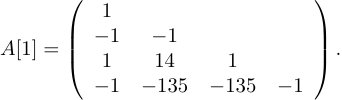 Figure 7
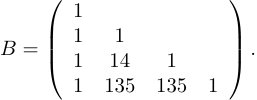 Figure 8
 Figure 9
 Figure 10
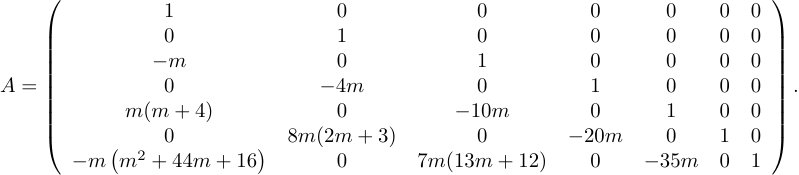 Figure 11
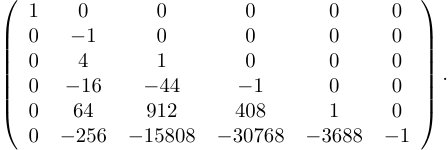 Figure 12
 Figure 13
 Figure 14
Peer Reviews
No public reviews on file for this paper yet. If you reviewed it on a platform where reviews are public (OpenReview, ICLR, NeurIPS, ICML), you can paste yours below so the community can read it here.
Videos
No videos yet. Explain this paper in a talk, walkthrough, or lecture? Add one.
Exponential Riordan arrays and Jacobi elliptic functions
Arnauld Mesinga Mwafise [email protected] Applied Algebra and Optimization Research Center, Department of Mathematics, Sungkyunkwan University, Suwon 16419, Republic of Korea
Paul Barry
School of Science, Waterford Institute of Technology, Cork Road, Waterford, Ireland
Abstract
This paper establishes relationships between elliptic functions and Riordan arrays leading to new classes of Riordan arrays which here are called elliptic Riordan arrays. In particular, the case of Riordan arrays derived from Jacobi elliptic functions that are parameterized by the elliptic modulus will be treated here. Some concrete examples of such Riordan arrays are presented via a recursive formula.
Keywords— Riordan matrix, Elliptic functions, Generating functions
1 Introduction
Riordan arrays were originally put forward by Shapiro et al.() [13] as a novel approach to representing certain classes of infinite lower triangular matrices having properties similar to the Pascal triangle in terms of their column generating functions. In addition, these Riordan arrays were found to form a group which was referred to as the Riordan group. They were so named in honour of the century combinatorialist John Riordan [11]. The theory of Riordan arrays was initially identified as a useful tool in solving combinatorial sum inversions [16, 4], proof of combinatorial identities[17, 18] and in the combinatorial enumeration of lattice paths [16, 3, 14]. The two main types of Riordan arrays are the ordinary and the exponential Riordan arrays which are constructed from ordinary and exponential generating functions respectively. This paper will primarily focus on the exponential Riordan arrays. An exponential Riordan array [1] is an infinite lower triangular matrix constructed from a pair of formal power series of order [math] and respectively, represented by their exponential generating functions given by
[TABLE]
and with the generic element associated with the coefficients of column evaluated by
[TABLE]
The exponential Riordan array is denoted by The bivariate generating function of exponential Riordan arrays is given by
[TABLE]
The case for in (1) results in the explicit formula for the row sums of the corresponding Riordan array. The most basic non-trivial exponential Riordan array is the Pascal triangle represented by having as its generic element
[TABLE]
An alternative way of defining a Riordan array is using its recursive formula. The two main recursive rules for the formation of all the elements of a Riordan array excluding the element located on its first row are based on the and sequence characterization of Riordan arrays [6, 7, 12]. The most suitable approach of quickly determining the explicit and generating functions of Riordan arrays is derived from their corresponding production matrices. The production matrix of the the Riordan array is defined by
[TABLE]
where is the matrix with its top row removed[5, 6]. In particular, the Riordan array is constructed from its and sequences as follows.
[TABLE]
The and generating functions from the theory of production matrices are explicitly given by
[TABLE]
and
[TABLE]
Here, denotes the series reversion of , which is the solution of the equation that satisfies . Furthermore, the bivariate generating function of the matrix is given by
[TABLE]
The Riordan array can transform an infinite sequence having generating function by the FTRA (Fundamental Theorem of Riordan arrays)[13] to form a new infinite sequence such that
[TABLE]
The multiplication operation determines the basis for a Riordan array to form a group. The multiplication rule for two Riordan arrays and is defined as
[TABLE]
corresponds to the identity element of . The inverse element is given by
[TABLE]
We note that for a power series with we define the reversion or the compositional inverse of to be the power series such that It can sometimes be denoted simply as or The subgroups of Riordan arrays of most interest are: Appell , Lagrange /associated , Bell/renewal , hitting-time , checkerboard where is an even generating function and is an odd generating function, and derivative , where denotes the first derivative of [7].
Similar to Riordan arrays, elliptic functions which are complex valued meromorphic and doubly periodic functions can be defined in terms of a reversion technique [9, 19]. The origins of the main theory of elliptic functions can be traced back to the th century work on integral calculus by the famous mathematician Niels H. Abel () [8]. His most remarkable achievement in this area was implementing the main technique of inverting elliptic integrals which led to elliptic functions. An elliptic integral can be written in the form
[TABLE]
where is a rational function in two variables and is a polynomial of degree or having no repeated roots. During the same period when Abel put forward his work on the inversion of elliptic integrals another mathematician Carl G. Jacobi() also worked in the same area. In Jacobi introduced the Jacobi elliptic functions denoted A key characteristic of these functions is that they satisfy the equation describing quartic elliptic curves given by
[TABLE]
The Jacobi elliptic functions may be explicitly defined by first defining such that
[TABLE]
We can also set The parameter where is called the modulus of the elliptic integral. The complementary modulus is . The first six terms of the coefficients of the Taylor series expansion of are
[TABLE]
We note that we can find the power series coefficients of in the first column of the inverse Riordan array
[TABLE]
An alternative method for defining is to start with the function
[TABLE]
The Legendre form of the elliptic integral which is an alternative definition of elliptic is given by
[TABLE]
The equivalence of these two approaches to the definition of follows from a change of variables which can be determined using the substitution such that . We then revert the function to get the amplitude function
[TABLE]
Finally we define
[TABLE]
The elliptic integral (4) is known as the incomplete elliptic integral. On the other hand the complete elliptic integrals are given by
[TABLE]
[TABLE]
with its complete complementary elliptic integral defined in a similar manner but with in replaced with such that
[TABLE]
The basic elliptic functions satisfy the equation
[TABLE]
Thus,
[TABLE]
All three functions and are doubly periodic:
[TABLE]
In addition, the three basic forms of the Jacobi elliptic function determine the other 9 forms of Jacobi elliptic functions such that the definitions are quotients of any of these three. For example The Jacobi elliptic function are considered a generalization of the trigonometric functions from which the basic properties are defined. The basic properties of the Jacobi elliptic functions are:
- •
- •
- •
In the limit we have,
[TABLE]
If we get the differential system :
[TABLE]
satisfying the initial conditions
[TABLE]
2 Elliptic functions derived from the and generating functions of Riordan arrays
For the inverse exponential Riordan array , we have
[TABLE]
and
[TABLE]
In particular, we can also express the array and in terms of and as follows:
[TABLE]
and
[TABLE]
Now we recall that an integral is called an elliptic integral if it is of the form
[TABLE]
where is a polynomial in of degree three or four and is a rational function of its arguments.
Thus if
[TABLE]
then the above exponential Riordan array satisfies the required form associated with an elliptic integral.
As we have seen, elliptic functions are defined as the inverses of elliptic integrals. Thus the expression
[TABLE]
in the defining relation for is an elliptic function when .
In this case we will have
[TABLE]
where
[TABLE]
will also be a rational function.
It is therefore natural to call an exponential Riordan array an elliptic Riordan array if
[TABLE]
where is a rational function and is a polynomial of degree three or four.
Lagrange showed that any elliptic integral can be written in terms of the following three fundamental or normal elliptic integrals.
[TABLE]
[TABLE]
[TABLE]
These integrals are called elliptic integrals of the first, second and third kind, respectively.
As an example of elliptic functions, the Jacobi elliptic functions may be defined by first defining as follows,
[TABLE]
involving the elliptic integral of the first kind, and then we define
[TABLE]
Thus if
[TABLE]
or
[TABLE]
then we obtain an exponential Riordan array with
[TABLE]
3 Jacobi Riordan arrays
We shall refer to the first type of elliptic Riordan arrays which will be derived from Jacobi elliptic functions as Jacobi Riordan arrays. We can generate Jacobi Riordan arrays from either the formal power series of Jacobi elliptic functions or by the and generating functions. In general an exponential Riordan array can be expressed in terms of its and generating functions such that
[TABLE]
3.1 Example:
Suppose that
Then Rev\left(\vbox{\hbox{\stretchto[440]{\displaystyle\int}{6ex}}}_{\mkern-12.0mu0}^{x}\frac{dt}{\sqrt{(1-t^{2})(1-k^{2}{t^{2}})}}\right)=\operatorname{sn}(x).
So
It follows that g(x)=e^{\vbox{\hbox{\stretchto[440]{\displaystyle\int}{4ex}}}_{\mkern-12.0mu0}^{\operatorname{sn}(x)}\frac{Z(t)}{A(t)}dt}.
For instance, if then we have
[TABLE]
Therefore, we have that
The coefficient array of is given by
[TABLE]
Remark 3.1.1: The row sums of at corresponds to A009282 in OEIS [15] and it also has the exponential generating function
Similarly, if then we get
[TABLE]
Thus,
[TABLE]
3.2 Example:
Let us consider the exponential Riordan array where we suppress the parameter .
We then have
[TABLE]
We also have , so that we obtain
[TABLE]
Thus for the exponential Riordan array we have
[TABLE]
This means in particular that the bivariate generating function of the production matrix of is given by
[TABLE]
In this case, we have
[TABLE]
or
[TABLE]
Thus
[TABLE]
as expected.
To calculate the inverse array we have
[TABLE]
and so
[TABLE]
3.3 Example:
We next look at the exponential Riordan array
[TABLE]
We once again have
[TABLE]
Now , and we find that
[TABLE]
We then get
[TABLE]
Thus the bivariate generating function for the production matrix of is given by
[TABLE]
We note that for , we get the exponential Riordan array
[TABLE]
The inverse matrix is calculated as follows.
[TABLE]
3.4 Example:
Our next example is the exponential Riordan array
[TABLE]
We do not immediately know what the inverse function of is, so we use the theory of Riordan arrays to continue the analysis.
Thus we note that
[TABLE]
where the second Riordan array in the product is related to the Laguerre polynomials.
Taking inverses, we obtain
[TABLE]
or
[TABLE]
This gives us
[TABLE]
Thus in particular, we have that
[TABLE]
or by the change of variable , we get
[TABLE]
We can generalize this to the following.
Theorem 3.1
Given two exponential Riordan arrays, if any one of these Riordan arrays is an elliptic Riordan array, then their product is also an elliptic Riordan array.
- Proof
We assume given two exponential Riordan arrays, , and . We assume that is an elliptic Riordan array, with
[TABLE]
We consider the product
[TABLE]
Knowing that
[TABLE]
we wish to find an “elliptic” characterisation of .
For this, we look at the inverse
[TABLE]
Now
[TABLE]
so we obtain
[TABLE]
Thus we have that
[TABLE]
To put this in an “elliptic” form, we use the change of variable
[TABLE]
in the integral.
This gives us
[TABLE]
When , we have , and so we have
[TABLE]
Thus we have
[TABLE]
3.5 Example:
In this example, we seek to write the elliptic function
[TABLE]
as the reversion of an integral whose limits are [math] to . For this, we consider the elliptic Riordan array and the transformation given by the exponential Riordan array .
Thus we have the product
[TABLE]
Here,
[TABLE]
In particular,
[TABLE]
and
[TABLE]
Also,
[TABLE]
Thus we have
[TABLE]
In the next examples that follow we examine some Jacobi Riordan arrays based on their coefficient and production matrices representations.
3.6 Example:
The coefficient matrix of begins
[TABLE]
which is equivalent to
[TABLE]
Remark 3.6.1:
- •
The numbers positioned along the diagonal of the matrix corresponds to OEIS A180291.
- •
The row sums of for form the sequence which correspond to OEIS A002017 with exponential generating function
- •
The row sums of for form the sequence which corresponds to OEIS A009265 with exponential generating function
The production matrix of in terms of is given by:
[TABLE]
If then produces the Riordan arrays
[TABLE]
The production matrices of associated to the Riordan arrays in for are as follows:
[TABLE]
Remark 3.6.2: The tri-diagonal matrix for in indicates that the inverse of the Riordan array forms the coefficient array of a family of orthogonal polynomials [2]. This is OEIS A060524 the number of degree -permutations with odd cycles. is the coefficient array of a family of orthogonal polynomials. The three term recurrence relation for the family of orthogonal polynomials is given by
[TABLE]
with
[TABLE]
we get
[TABLE]
The and sequences associated to the production matrices of and are listed below:
[TABLE]
3.7 Example:
The coefficient array of where is given by:
[TABLE]
Remark 3.7.1:
- •
The coefficient matrix of forms a palindromic Riordan array.
- •
The row sums of for form the sequence which has the exponential generating function
- •
The row sums of for form the sequence which has the exponential generating function
- •
The non-zero entries of the first column of corresponds to the matrix
[TABLE]
By multiplying the matrix by if where is the column number s.t we get the matrix
[TABLE]
The matrix corresponds to OEIS A060628.
The production matrix of in terms of is given by
[TABLE]
If then produces the Riordan arrays
[TABLE]
The production matrices of in terms of are as follows:
[TABLE]
Remark 3.7.2: The tridiagonal production matrix for in which is associated to the Riordan array in forms an orthogonal polynomial sequence for Furthermore,
[TABLE]
represents the coefficient matrix of the family of orthogonal polynomials. The three term recurrence relation for these polynomials is given by
[TABLE]
with
The and sequences corresponding to the production matrix of and are listed as follows:
[TABLE]
3.8
The coefficient array where is given by
[TABLE]
Remark 3.8.1:
- •
For we have
- •
The row sums of for form the sequence corresponding to OEIS A012123 with exponential generating function
where is the Gudermannian function such that
[TABLE]
- •
The nonzero elements of the first column of the matrix generated from the derivative of the Jacobi amplitude function forms the coefficient matrix
[TABLE]
The production matrix of in terms of :
[TABLE]
If and then produces the Riordan arrays
[TABLE]
Remark 3.8.2: We note that has an ordinary generating function given by
[TABLE]
The production matrices from in terms of are as follows:
[TABLE]
Remark 3.8.3: We note that the generating function of the matrix at is
[TABLE]
The and sequences corresponding to the production matrices of and are listed as follows:
[TABLE]
4 Conclusion
We have shown that through the definition of exponential Riordan arrays by means of their A and Z sequences, that it is natural to consider those exponential Riordan arrays that are defined by elliptic functions, when those elliptic functions are defined by a reversion. We have considered a number of such arrays defined by common Jacobi elliptic functions. In further work, we intend to re-cast some applications of elliptic functions to this new context, thus gaining more insight into the use of Riordan arrays in applied problems, as well as augmenting the solution context. Candidate areas for such explorations include transmission line theory, soliton theory and cosmology.
The reference list from the paper itself. Each links out to its DOI / PubMed record.
- 1[1] P. Barry, Riordan arrays: a Primer , Logic Press, Kilcock, 2017.
- 2[2] P. Barry, Riordan Arrays, Orthogonal Polynomials as Moments, and Hankel Transforms, J. Integer Seq. , 14 (2011). Available at https://cs.uwaterloo.ca/journals/JIS/VOL 14/Barry 1/barry 97r 2.pdf .
- 3[3] P. Barry and A. Hennessy, Generalized Narayana Polynomials, Riordan arrays and Lattice Paths, J. Integer Seq., 15 (2012).
- 4[4] C. Corsani, D. Merlini, R. Sprugnoli, Left-inversion of combinatorial sums, Discrete Math., 180 (1998), 107–122.
- 5[5] E. Deutsch, L. Ferrari, S. Rinaldi, Production Matrices, Adv. Appl. Math. , 34 (2005), 101–122. Available at: http://www.sciencedirect.com/science/article/pii/S 0196885804000673# .
- 6[6] E. Deutsch, L. Ferrari, S. Rinaldi, Production Matrices and Riordan arrays, Ann. Combinator. , 13 (2009), 65–85.
- 7[7] T.X He, R. Sprugnoli, Sequence Characterisation of Riordan Arrays, Discrete Math. , 309 (2009), 3962–3974.
- 8[8] C. Houzel, The Work of Niels Henrik Abel, The Legacy of Niels Henrik Abel-The Abel Bicentennial, Oslo 2002 , Springer-Verlag, 2004 . 2004 2004.