A direct method for reconstructing inclusions and boundary conditions from electrostatic data
Isaac Harris

TL;DR
This paper introduces a non-iterative sampling method utilizing Dirichlet to Neumann maps for reconstructing inclusions and boundary conditions in electrostatics, demonstrated through numerical examples in 2D.
Contribution
It presents a novel direct approach combining sampling and boundary integral equations for reconstructing inclusions and impedance parameters from electrostatic data.
Findings
Successful reconstruction of impenetrable inclusions using the sampling method.
Effective non-iterative reconstruction of impedance parameters.
Numerical demonstrations in two-dimensional settings.
Abstract
In this paper, we will discuss the use of a Sampling Method to reconstruct impenetrable inclusions from Electrostatic Cauchy data. We consider the case of a perfectly conducting and impedance inclusion. In either case, we show that the Dirichlet to Neumann mapping can be used to reconstruct impenetrable sub-regions via a sampling method. We also propose a non-iterative method based on boundary integral equations to reconstruct the impedance parameter using the reconstructed boundary of the inclusion from the knowledge of multiple Cauchy pairs which can be computed from Dirichlet to Neumann mapping. Some numerical reconstructions are presented in two space dimensions.
Click any figure to enlarge with its caption.
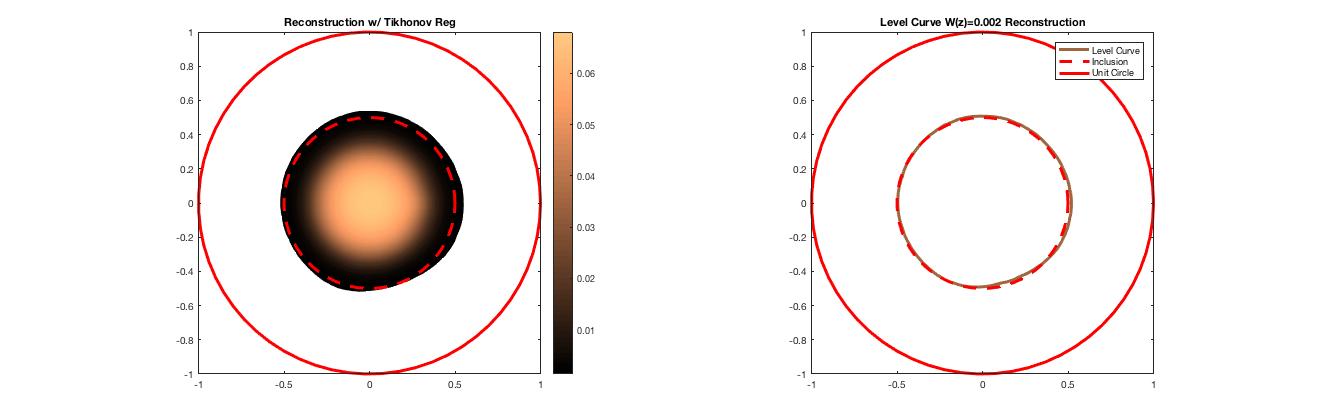 Figure 1
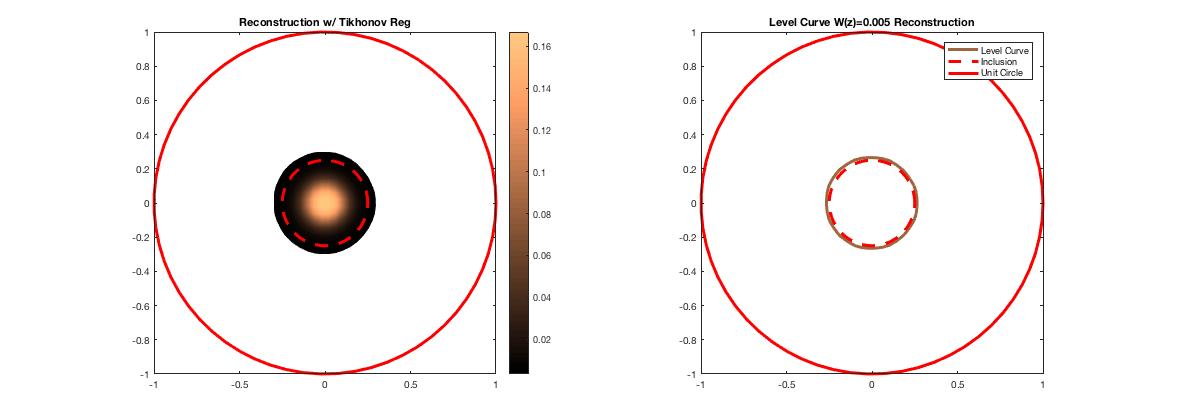 Figure 2
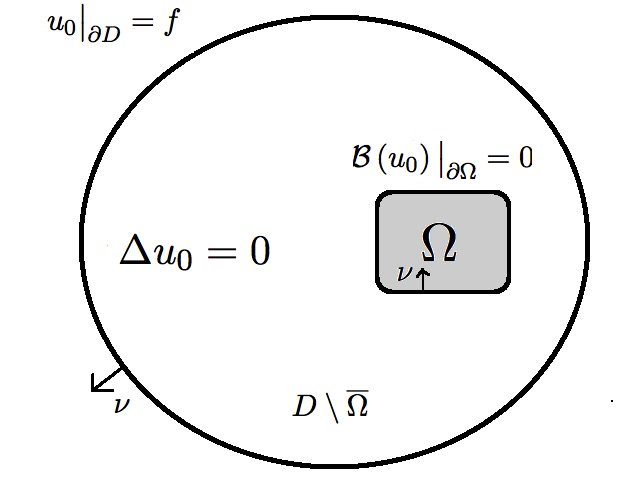 Figure 3
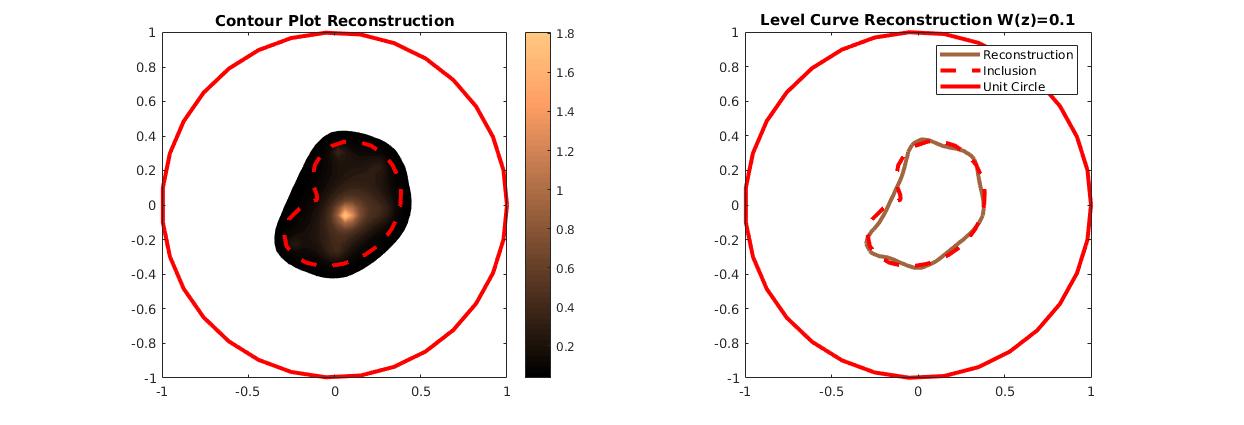 Figure 4
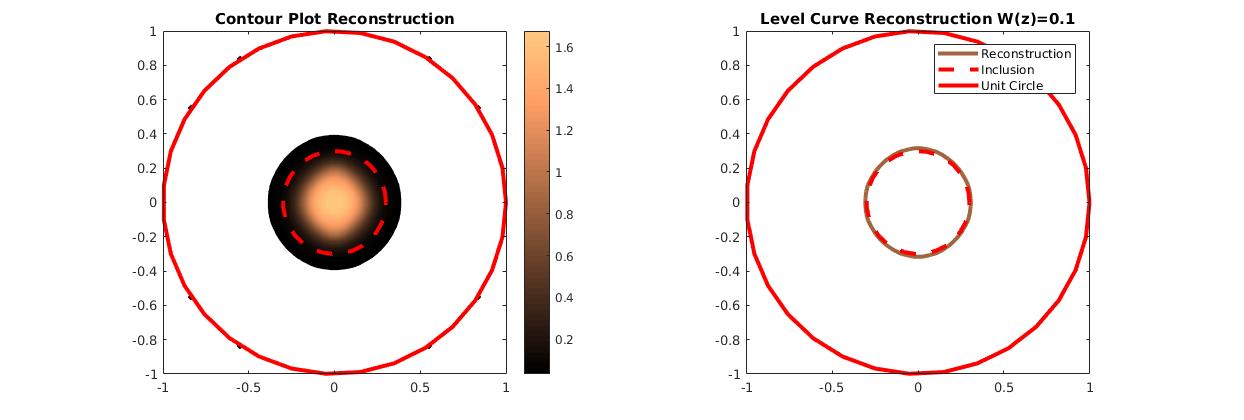 Figure 5
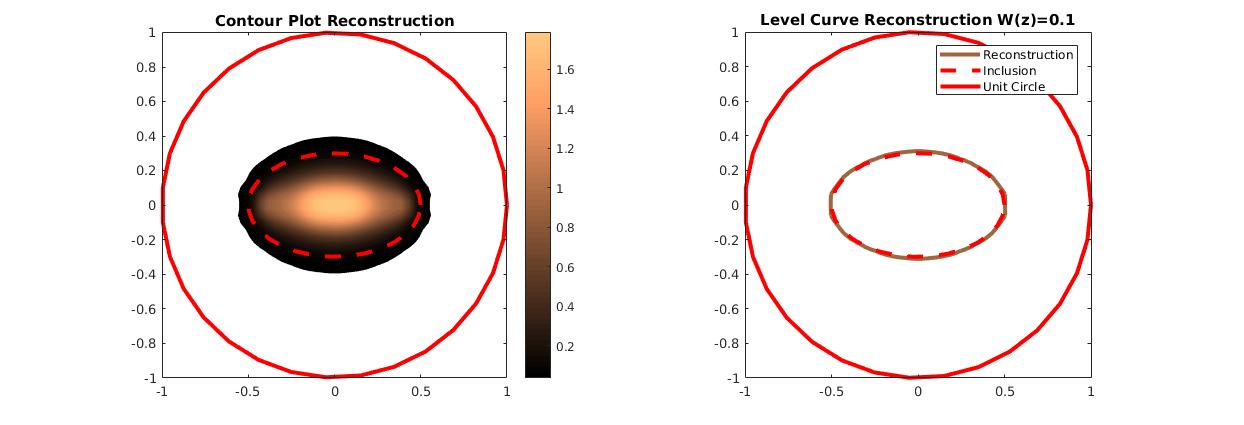 Figure 6
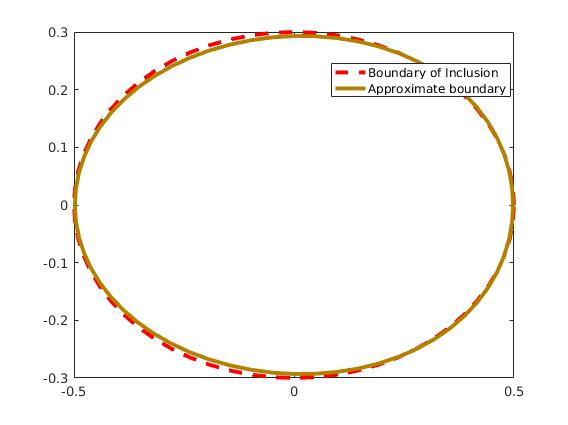 Figure 7
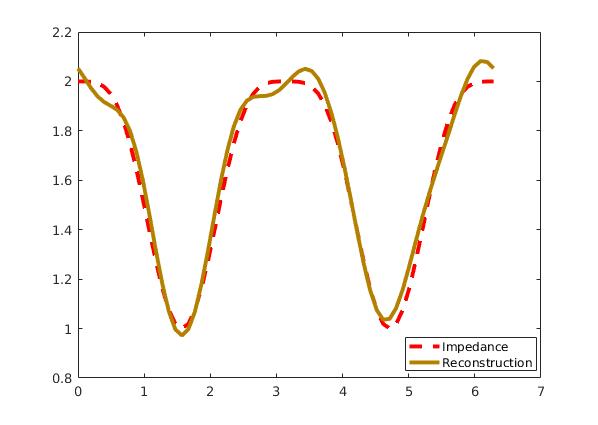 Figure 8
Peer Reviews
No public reviews on file for this paper yet. If you reviewed it on a platform where reviews are public (OpenReview, ICLR, NeurIPS, ICML), you can paste yours below so the community can read it here.
Videos
No videos yet. Explain this paper in a talk, walkthrough, or lecture? Add one.
A direct method for reconstructing inclusions and boundary conditions from electrostatic data
**Isaac Harris
**Department of Mathematics, Purdue University, West Lafayette, IN 47907, USA
Email: [email protected]
1 Introduction
In this paper, we use direct methods (otherwise known as non-iterative methods) to reconstruct impenetrable inclusions from electrostatic Cauchy data. This problem models the non-destructive testing for interior inclusion using the voltage and current measurements on the accessible outer boundary. In particular, for a Dirichlet or Impedance inclusion we derive a sampling algorithm to recover the inclusion from the knowledge of the Dirichlet-to-Neumann (DtN) mapping. We focus on the case of Laplace’s equation but the techniques used in this paper still hold for the case where the Laplacian is replaced with a uniformly elliptic operator in divergence form with sufficiently smooth coefficients. This gives a computationally simple way to solve the inverse problem of reconstructing the inclusion from the knowledge of DtN mapping. An important feature of sampling methods is that one does not need a prior information about the type or number of inclusions, unlike iterative methods where one needs to have some a prior knowledge of the inclusions to ensure convergence. See [12, 19, 23] for examples of iterative methods applied to reconstructing impenetrable inclusions. Sampling algorithms have grown in popularity over the past two decades since their inception in [10] as a computationally simple way to recover obstacles. These method where first used to recover unknown obstacles from time-harmonic scattering data (see monographs [7, 17] and the references therein). Over the years these methods have been employed to solve similar problems in the time domain. In [13, 16] the Linear Sampling Method is applied to the acoustic and elastic wave equation, respectively. Recently in [22] the Linear Sampling Method was applied to recovering an impedance inclusion in a heat conductor.
Once the boundary of the inclusion is reconstructed, we then consider the problem of determining the boundary conditions on the interior boundary from the knowledge of the boundary and the DtN mapping. This amounts to solving our inverse problem in two steps where we first determine the boundary from the DtN mapping and then use the reconstructed boundary to determine the boundary conditions. Since we know that the Cauchy data on the outer boundary uniquely determines the electrostatic potential by the unique continuation principle we derive a system of boundary integral equations to reconstruct the Cauchy data on the interior boundary. From this one can determine the boundary condition on the interior boundary. We focus on the case of an impedance condition, where we provide an inversion method for determining the impedance parameter from the recovered Cauchy data. In our investigation of this problem we are able to show that the DtN mapping uniquely determines the impedance parameter. It should be noted that uniqueness for both the inclusion and the impedance condition follows from two pairs of Cauchy data (suitable chosen) from [4] in the case of an inclusion with boundary and impedance function.
The rest of the paper is structured as follows. We begin by formulating the direct and inverse problem under consideration. Next, we consider the problem of reconstructing the interior Dirichlet or Impedance boundary from the electrostatic Cauchy data. To this end, a sampling method is derived to determine the inclusion. We then turn our attention to reconstructing the impedance parameter given the interior boundary and the DtN mapping. Uniqueness is proven and a inversion algorithm is described using boundary integral equation. Lastly, we provide numerical experiments in 2-dimensions to show the feasibility of our inversion algorithm.
2 Statement of the Direct and Inverse Problem
We begin by considering the boundary value problems associated with the electrostatic problem with and without an impenetrable inclusions as derived from the quasi-static Maxwell’s equations. Assume that (for or 3) is a simply connected open set with -boundary with unit outward normal . Now let be a (possibly multiple) simply connected open set with -boundary , where we assume that For a material without an inclusion, we define to be the unique solution to the following boundary value problem
[TABLE]
for a given . The function is the electrostatic potential for material without defects. Now for the defective material with an impenetrable inclusion, we define as the solution to
[TABLE]
for a given . Here the function is the electrostatic potential for the defective material and the boundary operator is given by the Dirichlet boundary condition on or the impedance boundary condition on . We assume that the impedance parameter is a non-trivial function in
[TABLE]
Here we take to be the unit outward normal to the domain , see Figure 1.
Assume that the ‘voltage’ is applied on the boundary and the current is ‘measured’ on . From these measurements we wish to reconstruct the impenetrable inclusion without any a prior knowledge of the number of inclusions or boundary condition on . Also, if we assume that it is known a priori that the boundary condition is of impedance type we wish to also reconstruct the parameter .
For the case of a perfectly conducting inclusion i.e. zero Dirichlet condition on it has been shown in [19] that a single pair of voltage and current measurements on can be used to determine . In [12, 19] iterative methods based on conformal mapping is used to reconstruct a single perfectly conducting inclusion. The question of unique determination of the boundary and impedance condition is more involved than for the case of the perfectly conduction inclusion. It has been shown in [4] that two pairs of voltage and current measurements on the boundary are enough to determine and provided the currents are linearly independent and non-negative assuming that and is class for . See [5, 23] where iterative methods are proposed to determine the inclusion and the impedance. The goal here is to develop a sampling method to reconstruct the boundary of the inclusion then one can reconstruct using a system of boundary integral equations, which is less computationally expensive to reconstruct the impedance parameter once the boundary is known.
By our assumptions on the impedance parameter it can easily be shown that both (1) and (2) are well-posed using variational techniques (see Chapter 5 of [15]) for the Dirichlet or impedance boundary condition on the inclusion. By the linearity of the equation and boundary conditions we have that the voltage to electrostatic potential mappings
[TABLE]
are bounded linear operators from to and H^{1}\big{(}D\setminus\overline{\Omega}\big{)}, respectively. We now define the DtN mappings from such that
[TABLE]
Due to the well-posedness of (1) and (2) along with the Trace Theorem (see for e.g. [15]) it follows that the DtN mappings are bounded linear operators. The inverse shape problem we consider here is to reconstruct the support of the impenetrable inclusion from the knowledge of the DtN mappings and , i.e. we want to determine the boundary from the set of all possible measurements and on . Moreover, for the case where is given by the impedance boundary condition on we consider the inverse impedance problem of recovering the impedance function from the knowledge of the DtN mappings .
3 A Sampling Method for the Inverse Shape Problem
We now derive a Sampling Method for our inverse shape problem. Therefore, we now consider the inverse problem of reconstructing from the knowledge of . The goal is to first reconstruct the boundary via a sampling method and provided that is given by the impedance boundary condition we then reconstruct the impedance parameter using boundary integral equations in the following section. The sampling method is based on connecting the support of the unknown region to an ill-posed equation involving the operator defined by the measurements (i.e. the difference of the DtN mappings). First we decompose the difference of the DtN mappings and analyze the operators used in our decomposition, then we develop the sampling methods using the decomposition to derive an inversion algorithms to determine the support of the inclusion. For the case of multiple inclusions we let where is a simply connected open set with -boundary such that is empty for all . All of the analysis in the preceding sections holds where the space Trace spaces are understood as the product space .
Remark 3.1**.**
The results in section can easily be extended for the case when the Laplacian is replaced by where is given by
[TABLE]
where the electric conductivity and electric permittivity are symmetric real valued matrices such that
[TABLE]
for all for almost every with frequency .
We now develop a sampling method to reconstruct the support of from a knowledge of the difference of the DtN operators for the Dirichlet or Impedance boundary condition. As we will see later in this section this method can be used without having any a prior information about the type or number of inclusions. To do so, we will decompose the difference of the DtN operators using two operators, the first mapping the voltage to an appropriate boundary value on and the second mapping takes the aforementioned boundary values on to the difference of the currents on .
Notice, that the difference of the currents on is given by on . Therefore, consider the difference of the solutions in which satisfies
[TABLE]
Now, motivated by equation (3a)-(3b) we let be the unique solution to
[TABLE]
for a given . Again, using a variational method one can show that equation (4) is well-posed, so we can define via the Trace Theorem the bounded linear operator
[TABLE]
where is the unique solution to equation (4). Notice that for h=\partial_{\nu}(u-u_{0})\big{|}_{\partial\Omega} then . We now define the bounded linear operators such that
[TABLE]
where and are the solutions of (1) and (2) respectively. This gives the following decomposition.
Theorem 3.1**.**
The difference of the DtN operators
[TABLE]
associated with (1) and (2) has the factorization .
We now analyze the operators used to factorize the difference of the DtN operators. We begin by analyzing the operator
[TABLE]
In the following results we obtain the properties of this operator.
Theorem 3.2**.**
The operator given by Gh=\partial_{\nu}w\big{|}_{\partial D} where is the unique solution to equation (4) is compact and injective.
Proof.
We begin by proving the compactness. Notice that by interior elliptic regularity (see for e.g. [15]) we have that for any the solution to (4) is in Now let be such that and where is class and let be the solution to (4) which gives that the trace of on is in . This implies that satisfies
[TABLE]
and by global elliptic regularity [15] we have that . The Trace Theorem implies that Gh=\partial_{\nu}w\big{|}_{\partial D}\in H^{1/2}(\partial D) and the compact embedding of into proves the claim.
Now we prove the injectivity. Let and be the solution to (4) with boundary data . Therefore, we have that
[TABLE]
By appealing to unique continuation we can conclude that in and therefore the Trace Theorem gives that , proving the claim. ∎
To analyze the operator further we now compute it’s Transpose (Dual) operator . Therefore, let denote the dual pairing between and (with as the pivot space) and by definition
[TABLE]
Now take a lifting of the function such that v\in H^{1}\big{(}D\setminus\overline{\Omega}\,\big{)} is the unique solution to
[TABLE]
Applying Green’s 2nd Theorem and using the boundary value problems (4) and (5) gives
[TABLE]
and we can conclude that
[TABLE]
where is the unique solution to equation (5).
Just as in the proof of Theorem 3.2 one can clearly see that due to the unique continuation principal that is injective and therefore since (see for e.g. [21])
[TABLE]
(here a denotes the annihilators) we have the following result.
Theorem 3.3**.**
The operator given by Gh=\partial_{\nu}w\big{|}_{\partial D} where is the unique solution to equation (4) has a dense range.
Now we turn our attention to the injectivity of the operator .
Assumption 3.1**.**
Assume that for any that
[TABLE]
has a unique solution depending continuously on the boundary data. Here is the unit inward norm to the boundary .
Since is the inward pointing normal it is clear that uniqueness is not guaranteed since the boundary condition will have the wrong sign for the positive impedance parameter. Note that Assumption 3.1 is a common feature of sampling method. In [8] where the linear sampling method is used to reconstruct anisotropic obstacles using time-harmonic acoustic measurements one must assume that the corresponding wave number is not a so-called interior transmission eigenvalue of the obstacle.
In our case, Assumption 3.1 says that is not an associated weighted Steklov eigenvalue given by the values such that there is a nontrivial solution to
[TABLE]
Since the set of eigenvalues is discrete is almost surely not an eigenvalue for a given domain and impedance . With Assumption 3.1 we now consider the injectivity of of the operator .
Theorem 3.4**.**
The operator
[TABLE]
where and are the solutions of (1) and (2) is injective.
Proof.
To prove the injectivity we split the proof into two parts for the two boundary conditions on under consideration. First assume that is the Dirichlet boundary condition on and let , therefore by definition we have that on where and are the solutions of (1) and (2) respectively. This implies that the difference solve (4) with boundary data and by well-posedness we conclude that in . We now have
[TABLE]
which it follows that in . By unique continuation we have in which gives that .
Similarly for the Impedance boundary condition on if we let then we can conclude that in . This implies
[TABLE]
which implies that in by Assumption 3.1. By again appealing to unique continuation and we conclude that , proving the claim. ∎
Recall, that the difference of the DtN operators has the decomposition . Since and are both bounded linear operators by appealing to the previous results we have the following.
Corollary 3.1**.**
The difference of the DtN operators
[TABLE]
is compact and injective.
We now derive a sampling method to solve our inverse problem. Sampling methods often connect the support of the region of interest to an ill-posed problem where one uses a singular solution to the background equation. The idea is to show that due to the singularity that a particular equation is “not” solvable unless the singularity is contained in the region of interest. To this end, we prove the following results to derive our inversion method.
Theorem 3.5**.**
The difference of the DtN operators
[TABLE]
is symmetric (i.e. is equal to it’s transpose) and therefore has a dense range.
Proof.
To begin, we let where and are the unique solutions to (1) and (2), respectively for . We now consider
[TABLE]
where again denotes the dual pairing between and . By definition we have that
[TABLE]
Now, by Green’s 1st Theorem
[TABLE]
For the Dirichlet boundary condition on we obtain
[TABLE]
and for the Impedance boundary condition conclude that
[TABLE]
Therefore, we have that the right hand side of the above expressions are symmetric bilinear forms and therefore is symmetric. By Corollary 3.1 we can conclude that has a dense range. ∎
We define as the Green’s function for which is the solution to
[TABLE]
We now connect the support of the inclusion to the range of the operator .
Theorem 3.6**.**
\partial_{\nu}\mathbb{G}(\cdot\,,z)\big{|}_{\partial D}\in\text{Range}(G)* if and only if .*
Proof.
Notice that for , is harmonic in the annular region and satisfies (4) with on . It is clear that Gh_{z}=\partial_{\nu}\mathbb{G}(\cdot\,,z)\big{|}_{\partial D}.
Now, assume that \partial_{\nu}\mathbb{G}(\cdot\,,z)\big{|}_{\partial D}\in\text{Range}(G) for some . Therefore, we can conclude that there is a solving (4) such that
[TABLE]
We now define which satisfies
[TABLE]
Holmgren’s Theorem implies that in D\setminus\big{(}\overline{\Omega}\cup\{z\}\big{)}, but interior elliptic regularity gives that is bounded as where as as , proving the claim by contradiction. ∎
Next we turn our attention to showing that the linear sampling method can be applied as an inversion method for our inverse problem. The linear sampling method was first derived in [10] as a way to reconstruct impenetrable obstacles using time-harmonic acoustic waves. We now show that a sampling algorithm can be used to reconstruct the inclusion.
From the analysis given in this section we now have all we need to derive sampling method for reconstructing . To this end, consider the ill-posed ‘current-gap’ equation
[TABLE]
By Theorem 3.5 we have that for all we have that there exists an approximating sequence \big{\{}f_{z,\varepsilon}\big{\}}_{\varepsilon>0} of solutions to (6) where
[TABLE]
Now assume that is bounded as . Since is a bounded sequence we have that there is a weakly convergent subsequence (still denote with ) such that as . Since is compact we can conclude that
[TABLE]
By the decomposition given in Theorem 3.1 this implies that Range, which is a contradiction of Theorem 3.6 if .
From the above analysis we have derived a sampling method for recovering the unknown inclusion by constructing approximate solutions to (6).
Theorem 3.7**.**
Let \phi_{z}=\partial_{\nu}\mathbb{G}(\cdot\,,z)\big{|}_{\partial D}. Then for any sequence \big{\{}f_{z,\varepsilon}\big{\}}_{\varepsilon>0}\in H^{1/2}(\partial D) that is an approximating solution of (6) such that
[TABLE]
then as for all .
Notice that Theorem 3.7 says that equation (6) is not “approximately solvable” provided that i.e. there is no sequence of approximate solutions whose (weak) limit satisfies (6). Since we assume that and are known we can use a regularization strategy to find an approximate solution to the current-gap equation (6). Also notice that it does not matter if one has the Dirichlet or impedance boundary condition on , Theorem 3.7 is valid for either case. One can easily modify the analysis in this section to show that Theorem 3.7 is also valid for the perfectly insulated inclusion where . This gives that the sampling method is robust in the fact that it can be applied for multiple boundary conditions. The inversion algorithm for reconstructing the boundary is as follows: choose a grid of points in , for each grid point ‘solve’ (6) via a regularization strategy, plot the where is the regularized solution to (6) and set the reconstruction {\partial\Omega_{\delta}}=\big{\{}z\in D\,\,:\,\,W(z)=\delta\ll 1\big{\}}.
4 Integral Equations for the Inverse Impedance Problem
In this section, we will derive a non-iterative method for reconstructing the impedance parameter . Even though we focus on the case of the impedance boundary condition the reconstruction method presented in this section works for determining if the inclusion is perfectly conducting/insulated. To this end, we consider the inverse problem of reconstructing the boundary impedance from the knowledge of . We assume that the boundary is known and that the DtN mapping which maps on to on is given on some subset of . The idea is to use the knowledge of the Cauchy data on to recover the corresponding Cauchy data on . Once we have the Cauchy data on of the impedance parameter can be determined by solving on .
We begin this section by proving a uniqueness for the inverse problem. Since we assume that the DtN mapping is known we wish to prove that the inverse impedance and inverse shape problems admits a unique solution. Since we assume that we have an infinite data set we should be able to prove uniqueness for sufficiently less regularity than is needed in [4]. To do so, we first need the following Theorem.
Theorem 4.1**.**
The set
[TABLE]
is a dense subspace of .
Proof.
To prove the claim let and assume that
[TABLE]
Now let be the unique solution to
[TABLE]
Using Green’s 2nd Theorem we have that
[TABLE]
Appealing to the boundary conditions for both and gives
[TABLE]
This implies that on since it is orthogonal to all . Since has zero Cauchy data on we have that in and the Trace Theorem gives that . Proving the claim. ∎
Notice that Theorem 4.1 hold true for any dense subset of . We can now prove that the impedance is uniquely determined by the knowledge of the DtN mapping on any dense subset of .
Theorem 4.2**.**
The DtN mapping uniquely determines impedance parameter .
Proof.
Assume that then let be the solution to (2) with impedance for . Therefore, we have that and have the same Cauchy data on which implies that in by unique continuation. We can conclude that
[TABLE]
Subtracting the impedance conditions implies that on for all . We conclude that is orthogonal to the set and is therefore zero a.e. on proving the claim. ∎
Remark 4.1**.**
The above proof is carried out in a variational setting so the uniqueness holds for the case where that Laplacian is replaced with where the symmetric coefficient matrix satisfies the same assumptions as in Remark 3.1.
We now turn our attention to deriving an inversion method for determining from the knowledge of the DtN mapping and . Our inversion method requires us to write the electrostatic potential function in terms of boundary integral operators. To this end, we adopt the notation (i.e. the measurements boundary) and (i.e. the impedance boundary). Therefore, since both boundaries are assumed to be we define
[TABLE]
by the boundary integral operators
[TABLE]
and
[TABLE]
Recall that is the fundamental solution to Laplace’s equation in given by
[TABLE]
We refer to [20, 21] for the mapping properties and analysis of the above boundary integral operators.
Since the double layer boundary integral operators satisfy Laplace’s equation in we make the ansatz that
[TABLE]
Using the jump relations for the double layer potentials in (7) we have that
[TABLE]
where
[TABLE]
with the index m,i. Notice that we have used that on in equation (8a). In order to proceed we must show that the system of integral equations in (8a)-(8b) is well-posed. To this end, define the operator
[TABLE]
which represents the integral operator associated with (8a)-(8b).
Theorem 4.3**.**
The operator has a bounded inverse.
Proof.
To prove the claim we show that the operator is satisfies the Fredholm alternative and is injective. We begin by proving the injectivity of . To this end, assume that which implies that satisfies Laplace’s equation in with zero Dirichlet trace on the boundary. The uniqueness of Laplace’s equation with zero Dirichlet data implies that in . The continuity of the normal derivative of the double layer potential on we have that satisfies Laplace’s equation in with zero Neumann trace on and uniqueness gives that in . Now using the jump relation for the double layer potential we conclude that . This gives that and since has zero exterior Dirichlet trace on which implies that . Since that operator is injective we have that , proving the injectivity.
We now show that is the compact perturbation of an invertible operator. To this end, we notice that
[TABLE]
It is well known (see [20]) that both and are invertible from to itself where m,i respectively. Next, we show that the operators
[TABLE]
are compact. Let for some which solves Laplace’s equation in and is therefore analytic in the interior of . We can conclude that v\big{|}_{\Gamma_{\text{i}}}=K_{\text{mi}}\varphi_{\text{m}}\in H^{3/2}(\Gamma_{\text{i}}) and the compactness follows from the compact embedding of into . A similar argument proves that compactness of the operator , which proves the claim since is injective and the compact perturbation of an invertible operator. ∎
Recall that u_{0}\big{|}_{\Gamma_{\text{i}}} is still unknown so we use that on to determine the Dirichlet value of the electrostatic potential on . Solving (8a)-(8b) for in terms of u_{0}\big{|}_{\Gamma_{\text{i}}} we have that (7) is a representation of in terms of it’s Dirichlet data on . Taking the normal derivative of (7) on gives that
[TABLE]
where the operators are given by
[TABLE]
To recover u_{0}\big{|}_{\Gamma_{\text{i}}} one solves (9) which can be written as
[TABLE]
Once u_{0}\big{|}_{\Gamma_{\text{i}}} is known equation (7) gives that in known for all and therefore \partial_{\nu}u_{0}\big{|}_{\Gamma_{\text{i}}} is given by taking the normal derivative of (7) on . Since the Cauchy data on is known the impedance condition can be used to reconstruct the unknown impedance parameter. One can solve for the impedance
[TABLE]
One can also consider using a least squares method for recovering the impedance by
[TABLE]
for some choice of basis functions for . Since we assume that is known we can apply this inversion procedure for multiple Cauchy pairs and and determine the impedance parameter for . Therefore, we can take the reconstructed impedance parameter to be the average of the reconstructions.
5 Numerical Validation
We now provide some numerical examples of our inversion methods. To do so, we will consider reconstructing both Dirichlet and Impedance inclusions in the unit disk. Recall that, is the normal derivative of the greens function in the unit disk with zero trace on the boundary and is therefore given by the Poisson kernel
[TABLE]
where is the polar angle that the point makes with the positive -axis.
5.1 Reconstruction of a Dirichlet inclusion
For this case we only consider a simple example and will give more substantial reconstructions for the case of an impedance condition. Assume that the boundary of the inclusion \partial\Omega=\rho\big{(}\cos(\theta),\sin(\theta)\,\big{)} where . Since we assume that is the unit disk in we attempt to find a representation of the electrostatic potential which solves the problem
[TABLE]
Now, since solves Laplace’s equation in an annular region we assume it can be written as linear combination of solutions to the to problem in the annuals and therefore has the form
[TABLE]
By applying the boundary conditions we have that (see [12])
[TABLE]
where are the Fourier coefficients for given by
[TABLE]
Therefore, by taking the derivative with respect to gives that
[TABLE]
It is clear that the electrostatic potential for a material without a perfectly conducting inclusion is given by
[TABLE]
This now gives that the difference of the DtN mapping is given by
[TABLE]
By interchanging summation and integration we obtain that
[TABLE]
where the kernel is given by
[TABLE]
We now consider the approximation of by a truncated series. In our experiments we will take the terms for . In the following we see that the converges of the truncated series converges exponentially fast to as .
Theorem 5.1**.**
Let be the truncated series approximation of given by (12) then we have that
[TABLE]
where is the operator norm on \mathcal{L}\big{(}H^{1/2}(0,2\pi)\,,\,H^{-1/2}(0,2\pi)\big{)}.
Proof.
To begin, let then we have that by (12)
[TABLE]
Now by the Cauchy-Schwarz inequality in we have that
[TABLE]
We have used that
[TABLE]
Now, notice that
[TABLE]
Since the -norm is bounded by -norm we can conclude that
[TABLE]
proving the claim. ∎
We can approximate the difference of the DtN mappings where we apply Theorem 3.7 to the discretized operator. We discretize our operator by using a simple collocation method with equally spaced points in the interval . This gives a matrix approximation of which we will denote and a vector where are the collocation points. In our calculations we add random noise to the DtN mappings given by {\bf A}^{\delta}_{i,j}={\bf A}_{i,j}\big{(}1+\delta{\bf E}_{i,j}\big{)} where the mean zero random matrix satisfying . This gives a discretized version of (6)
[TABLE]
Since the operator is compact we have that it’s matrix approximation is ill-conditioned. In order to solve (14) we use Tikhonov’s regularization. To this end, we let be the singular values with and in the singular vectors of the matrix . We let be the regularized solution to (14) given by
[TABLE]
Here denotes the Tikhonov’s regularization solution where is chosen by the discrepancy principle. Therefore, to reconstruct the inclusions we define the function
[TABLE]
Even though we plot the weaker -norm we see that this is sufficient to approximate the inclusion . In the following experiments we take the uniformly distributed noise level where we plot the indicator function , see Figures 2 and 3.
5.2 Reconstruction of an impedance inclusion
To reconstruct an inclusion with an impedance coefficient \gamma\big{(}x(\theta)\big{)} we us a boundary integral equation to simulate the DtN mappings. To this end, we assume that can be written as a combination of a double layer potential on and a single layer potential on . Here the boundary of is given by the boundary of the unit disk and is given by which is a -periodic representation of the boundary. Applying the boundary conditions
[TABLE]
gives a system of boundary integral equations. The boundary integral equations are solved via the Nyström method using 32 equally spaced points which gives a representation of in . This should give a sufficiently accurate approximation for the electrostatic potential due to the exponential convergence (see [20]). We then compute where is the DtN mapping for the material with the inclusion by taking the normal derivative of on . It is clear that for all . To obtain a discretized version of (6) we consider
[TABLE]
and solve for the first 20 Fourier coefficients to the solution to (6). In our experiments we solve the above equation for where are taken to be 20 equally spaced points. This gives a linear system which is solved using a spectral cut-off, where the cut-off parameter is chosen to be . To visualize the inclusion as in the previous examples we let
[TABLE]
We implement this for three different inclusions given by
[TABLE]
with the impedance parameter \gamma\big{(}x(\theta)\big{)}=2-\sin^{4}(\theta) where mean zero uniformly distributed random noise is added to the flux data measurements, see Figures 4, 5 and 6.
5.3 Reconstruction of the impedance parameter
We now give a numerical example of recovering the impedance parameter using the method described in Section 4. Therefore, we present an example where the boundary has been reconstructed by Theorem 3.7. Here we consider the ellipse x(\theta)=\big{(}0.5\cos(\theta)\,,\,0.3\sin(\theta)\big{)} with impedance parameter \gamma\big{(}x(\theta)\big{)}=2-\sin^{4}(\theta) from the previous section. In our calculations we first represent the reconstructed curve using trigonometric polynomials. To this end, we assume that the inclusion is centered at the origin and taking the values on the level curve given in Figure 4 we approximate
[TABLE]
where . The coefficients and are solved for in the least squares sense with Tikhonov regularization such that approximates the reconstructed curve. In our calculations we penalize the norm of by taking the regularization parameter based on the level of noise in the data.
Now that we have an approximation of we can reconstruct the impedance using boundary integral equations. We apply the data completion algorithm described in Section 4 to recover the Cauchy data on the interior boundary . Using the same method as in the previous Section for any given we can compute the corresponding . Note that our original data on is subject to mean zero random noise and these errors transfer to the reconstruction of . This gives that to reconstruct \gamma\big{(}x(\theta)\big{)} we must solve a discretized version of (10) where the Nyström method using 64 points is used to discretize the equation. Using a standard Tikhonov regularization scheme we solve the discretized version of (10) which allows use to determine and on for a given . In our calculations we take for which corresponds to having 16 voltage and current measurements. For each the impedance is computed by
[TABLE]
In Figure 7 we show the approximation of the reconstructed ellipse as well as the plot of the reconstructed impedance which is obtain by averaging the 16 results.
6 Conclusion
In conclusion, we have developed the linear sampling method for recovering two types of impenetrable inclusion from electrostatic data. Also, we have derived a direct method to recover that boundary condition on the recovered impenetrable inclusion without a-prior knowledge of the boundary condition. An alternative sampling method is the factorization method (see [17]) where one proves that the range of a known operator defined by the measurements operator uniquely determines the region and gives a simple numerical inversion algorithm. In [6] the factorization method has been used to reconstruct penetrable inclusions from electrostatic Cauchy data. To our knowledge, the only manuscript that analyzes the factorization method for the EIT problem with an impenetrable inclusion is done in [14] where the coefficients in the boundary condition are assumed to complex valued. Applying the factorization method for the problems considered in this paper is on going research. In [1] the MUSIC algorithm, which can be seen as a discrete version of the factorization method, was derived to detect corrosion of a known interior boundary. For many inverse boundary value problems for elliptic equations the factorization method has been used to validate the linear sampling method using the eigenvalue decomposition of the measurements see [2, 3].
7 Acknowledgments
The research was started while the author was at Texas AM University. The university’s hospitality during the time the author was there is greatly appreciated. The author would also like to thank William Rundell for providing the code to solve the direct problem and for helpful discussions during the authors time at Texas AM University and beyond.
The reference list from the paper itself. Each links out to its DOI / PubMed record.
- 1[1] H. Ammari et al., A MUSIC-type algorithm for detecting internal corrosion from electrostatic boundary data, Numer. Math. 108 (2008), 501-5028.
- 2[2] T. Arens, Why linear sampling method works, Inverse Problems 20 (2004), 163-173.
- 3[3] T. Arens and A. Lechleiter, Indicator Functions for Shape Reconstruction Related to the Linear Sampling Method, SIAM Journal on Imaging Sciences , 8(1) , (2015), 513-535.
- 4[4] V. Bacchelli, Uniqueness for the determination of unknown boundary and impedance with the homogeneous Robin condition, Inverse Problems 25 , (2009) 015004
- 5[5] F. Ben Hassen, Y. Boukari and H. Haddar, Inverse impedance boundary problem via the conformal mapping method: the case of small impedances Revue ARIMA , 13 (2010), pp. 47-62
- 6[6] M. Bruhl, Explicit characterization of inclusions in electrical impedance tomography, SIAM J. Math. Anal. , 32 , No. 6, (2001) 1327–1341
- 7[7] F. Cakoni and D. Colton, “A Qualitative Approach to Inverse Scattering Theory” , Springer, Berlin 2014.
- 8[8] F. Cakoni, D. Colton and H. Haddar, The linear sampling method for anisotropic media, J.Comput. Appl. Math. , 146 , (2002), 285-299.