Dynamical Casimir effect for semitransparent mirrors
C.D. Fosco, A. Giraldo, and F.D. Mazzitelli

TL;DR
This paper investigates the particle creation caused by oscillating semitransparent mirrors in the dynamical Casimir effect, highlighting the significance of relativistic motion and interference effects in two-mirror setups.
Contribution
It provides a perturbative analysis of the dynamical Casimir effect for semitransparent mirrors, including relativistic motions and interference effects, extending previous models with non-small oscillation amplitudes.
Findings
Relativistic motions significantly enhance particle creation.
Interference effects between two mirrors can alter particle production.
Results differ from small-amplitude assumptions even at non-relativistic speeds.
Abstract
We study the Dynamical Casimir Effect resulting from the oscillatory motion of either one or two flat semitransparent mirrors, coupled to a quantum real and massless scalar field. Our approach is based on a perturbative evaluation, in the coupling between mirrors and field, of the corresponding effective action, which is used to compute the particle creation rate. The amplitude of the oscillation is not necessarily small. We first obtain results for a single mirror, both for non-relativistic and relativistic motions, showing that only for the latter the effects may be significant. For two mirrors, on the other hand, we show that there are interesting interference effects, and that in some particular cases the results differ from those obtained assuming small amplitudes, already for non-relativistic motions.
Click any figure to enlarge with its caption.
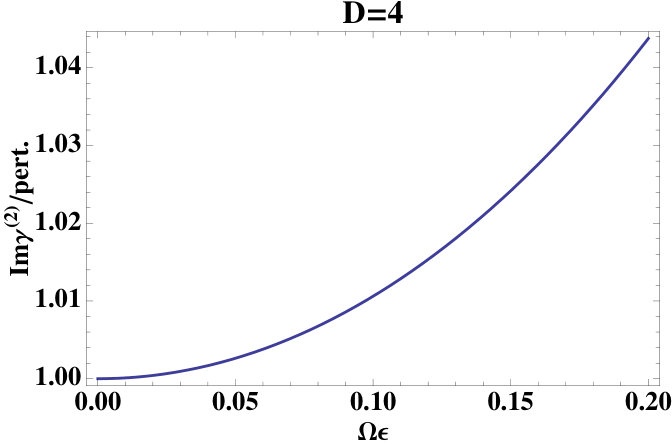 Figure 1
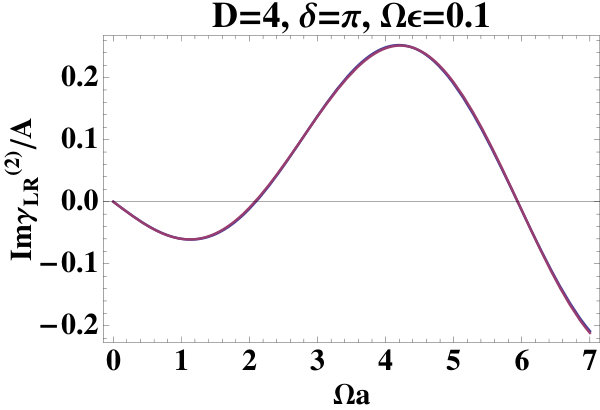 Figure 2
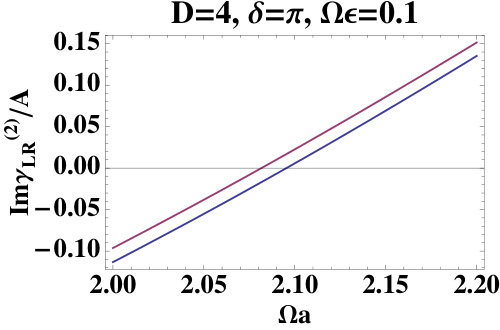 Figure 2
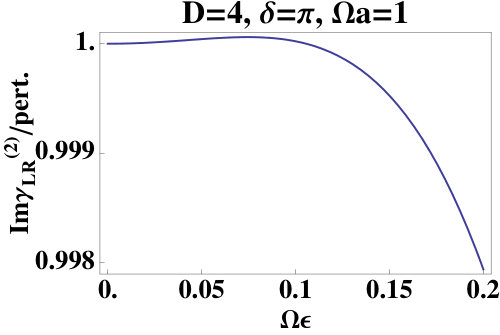 Figure 3
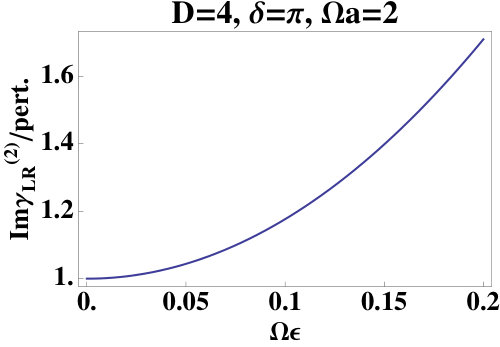 Figure 3
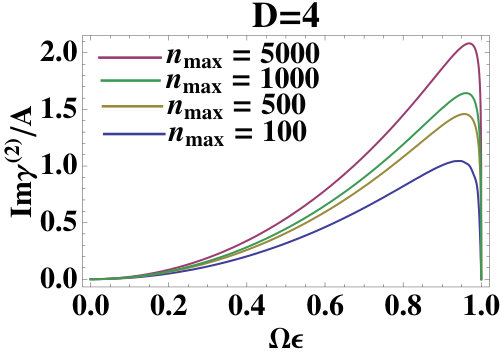 Figure 6
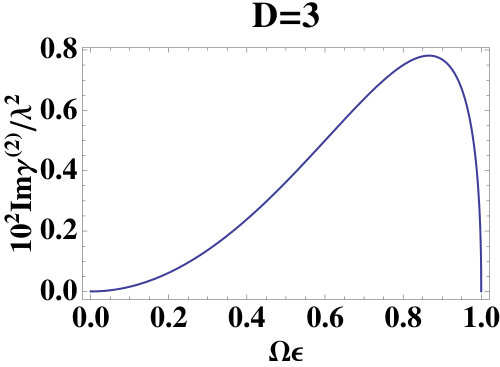 Figure 7
Peer Reviews
No public reviews on file for this paper yet. If you reviewed it on a platform where reviews are public (OpenReview, ICLR, NeurIPS, ICML), you can paste yours below so the community can read it here.
Videos
No videos yet. Explain this paper in a talk, walkthrough, or lecture? Add one.
Dynamical Casimir effect for semitransparent mirrors
C. D. Foscoa,b, A Giraldob and F. D. Mazzitellia,b
aCentro Atómico Bariloche, CONICET, Comisión Nacional de Energía Atómica, R8402AGP Bariloche, Argentina.
bInstituto Balseiro, Universidad Nacional de Cuyo, R8402AGP Bariloche, Argentina
(today)
Abstract
We study the Dynamical Casimir Effect resulting from the oscillatory motion of either one or two flat semitransparent mirrors, coupled to a quantum real and massless scalar field. Our approach is based on a perturbative evaluation, in the coupling between mirrors and field, of the corresponding effective action, which is used to compute the particle creation rate. The amplitude of the oscillation is not necessarily small. We first obtain results for a single mirror, both for non-relativistic and relativistic motions, showing that only for the latter the effects may be significant. For two mirrors, on the other hand, we show that there are interesting interference effects, and that in some particular cases the results differ from those obtained assuming small amplitudes, already for non-relativistic motions.
I Introduction
Dynamical Casimir effect (DCE), or motion induced radiation, refers to a plethora of phenomena in which real particles are created from the quantum vacuum due to the presence of external, time-dependent conditions. The creation of particles in a one dimensional cavity with a moving perfect mirror was first studied by Moore Moore , and subsequently by Fulling and Davies FulDav , as a toy model of black hole evaporation. Over the years, the DCE has received increasing attention, and became a relevant topic in studies on cavity quantum electrodynamics and cavity optomechanics, superconducting waveguides with time dependent boundary conditions, refractive index perturbations in optical fibers, quantum friction, etc, in addition to analogue gravity models. For some recent reviews see dodonov ; dalvit ; schutzhold ; nation .
In this work we evaluate the particle creation rate for a system which consists of either one or two flat, infinite, parallel semitransparent mirrors, undergoing oscillatory motion. Non-perfect moving mirrors have been considered long time ago in Ref. Barton1 , where the authors studied the quantum radiation from a dispersive mirror moving non-relativistically in dimensions. Later on, more general models have been considered by several authors gensemi .
Our approach here relies on a main assumption, namely, that of the mirrors being semitransparent, what justifies our use of a perturbative expansion in the strength of the coupling between each mirror and the quantum field. This approach is the dynamical counterpart of the perturbative calculations of the static Casimir force for dilute dielectric bodies Golestanian ; Milton , in which the small parameter is , where is the permittivity.
Since the amplitude of the oscillatory motion(s) is not assumed to be necessarily small, our results will be non-perturbative in that amplitude, and therefore our approach may be regarded as complementary to others which are non-perturbative in the mirror-field couplings but restricted to small amplitudes and non-relativistic motion. We will consider a simplified model involving a vacuum real scalar field, with the mirrors described by means of -potentials, and will present calculations up to second order in the coupling constants. The results could be generalized to more realistic models involving the electromagnetic field and to higher perturbative orders. In particular, we have in mind situations in which there is particle creation due to a varying refractive index perturbation with schutzhold ; rip .
The model considered in this paper has been first analyzed in the context of the DCE in Ref.Barton1 , in dimensions. It was pointed out there that, due to infrared divergences, an approach perturbative in the coupling constant is not possible. However, these divergences are typical for two dimensional massless fields. As we will see, they disappear in higher dimensions and the perturbative calculations are perfectly well defined (to our knowledge, this point has not been explored before). Generalizations of the -potential models have been considered more recently in the context of optomechanics Hu .
This paper is organized as follows: in Section II we describe the system that we consider subsequently, and introduce our conventions and notation. Then we consider the in-out effective action, presenting the corresponding weak-coupling expansion. In Section III we compute the imaginary part of the effective action for the case of an oscillating single mirror. Using the Jacobi-Anger expansion it is possible to compute the imaginary part of the effective action for oscillatory motions of arbitrary amplitude, including relativistic corrections. In Section IV we consider the case of two oscillating mirrors. We discuss interference effects and compare the results with those coming from a small amplitude approximation. Section V contains the conclusions of our work.
II Classical model and in-out effective action
II.1 The classical action
We follow the functional integral formalism, whereby the system is defined in terms of its (real time) action , for a real scalar field in dimensions. The action also depends on the configuration of the mirror (or mirrors), which play the role of ‘external fields’ here. In the examples that we shall consider, they are assumed to be infinite and parallel planes footnote , it is sufficient to give just one function of time to determine the position of each mirror. Furthermore, we assume to have the structure:
[TABLE]
where denotes the free real scalar field action:
[TABLE]
the part of the total action which is independent of the configurations of the mirrors. The term accounts, on the other hand, for the interaction between the field and the mirror(s). For a single, flat, zero-width mirror, moving along the normal direction to its plane, its instantaneous position may be completely determined by an equation with the form:
[TABLE]
where denotes the coordinate normal to the plane. The class of mirrors considered in this work has, therefore, translation invariance along the spatial ‘parallel’ coordinates . Besides, the coordinates which are relevant to describe the motion will also be denoted (irrespective to the value of ) as , and , and we will assume its action to be given by:
[TABLE]
where is a constant that determines the strength of the coupling, and denotes the Lorentz factor: , which is only relevant to the relativistic-motion case (in our conventions, the speed of light ).
When considering two mirrors, denoted by and , no direct coupling is assumed to exist between them, aside from the indirect one which will result from the mediation of the scalar field. Thus the total interaction action becomes the sum of the corresponding terms , where
[TABLE]
with , where the functions and define the motion of the respective mirror.
The action considered here can be thought as a toy model for the interaction of a non-perfect mirror with the electromagnetic field and, with some modifications, for a situation in which a refractive index perturbation concentrated on a plane travels along a trajectory given by .
II.2 The effective action
The (in-out) effective action, is a functional of the functions that determine the instantaneous position the mirrors, and is simply related to the vacuum persistence amplitude, namely,
[TABLE]
The probability of pair creation of real particles associated to the vacuum field, during the whole motion of the mirror(s), is given by
[TABLE]
We note first that can be split as , where is the effective action corresponding to the free action , and therefore will be discarded. On the other hand,
[TABLE]
where the average symbol of a given functional of the vacuum field is understood in the functional sense, with defining a (complex) Gaussian weight:
[TABLE]
For weak coupling, we use an expansion in cummulants, which proceeds as follows: we assume the strength of the term, controlled by the value of the coefficients, is such that we may expand in powers of that term. may then be expanded in powers of ; denoting by the -order term in that expansion, we see that:
[TABLE]
where
[TABLE]
where the subscript denotes the connected part of the Feynman diagrams (resulting from the application of Wick’s theorem to the calculation of the Gaussian averages).
In what follows, we deal with the explicit evaluation of the imaginary part of the effective action for either one or two mirrors (as mentioned previously, this quantity is related to the probability of particle creation Eq.(7)). Our focus shall be in the case, although we will also comment on some particular cases where different values of produce qualitatively different results.
III A single mirror
The first-order term in Eq.(11) leads to
[TABLE]
which may be interpreted as an infinite renormalization for the mirror, regarded as a particle moving in one spatial dimension (corresponding to the coordinate). Thus, may be written as follows:
[TABLE]
where denotes the proper time corresponding to the trajectory defined by , and the mass , regularized by means of an UV cutoff , is given by:
[TABLE]
where has the dimensions of a length, and is the total ‘volume’ of the mirror, as measured along the spatial coordinates which are parallel to its surface. is a dimensionless, regularization-dependent constant.
For the second-order term, we see that:
[TABLE]
where
[TABLE]
with the free Feynman propagator for the scalar field given by:
[TABLE]
Thus, in Fourier space, Eq.(III) becomes:
[TABLE]
where
[TABLE]
and:
[TABLE]
In this perturbative approach, the probability of creation of a pair of particles is
[TABLE]
and therefore the total energy of the created particles reads
[TABLE]
III.1 Low-velocity motion
We now assume the explicit form of , the mirror’s oscillatory motion, to be harmonic:
[TABLE]
We will first consider a non-relativistic motion, with and therefore (in which we will denote ), and then compute corrections in powers of the maximum velocity .
The usual approaches to this problem consider small amplitudes for the oscillation, then the exponential in Eq.(21) is expanded in powers of
[TABLE]
Instead of doing this, we use the Jacobi-Anger expansion and get:
[TABLE]
where denotes a Bessel function of the first kind. This expression is valid for any amplitude value. The effective action becomes extensive in the volume of the mirror, and proportional to the extent of the time coordinate. Thus, defining , which has the dimensions of an energy per unit of -dimensional volume:
[TABLE]
Finally, since we are interested in the imaginary part of the effective action, we get, to this order:
[TABLE]
In other words, the imaginary part of the effective action is determined by the imaginary part of , at some special points in momentum space, which depend on the properties of the mirror’s oscillation.
To proceed, we need a more explicit expression for . This object is, generally, UV divergent, but not its imaginary part, since the divergences are (at most) polynomials in , i.e., entire functions.
By using a Feynman parameter , the momentum integral can be performed using dimensional regularization, the result being:
[TABLE]
This is IR divergent when , while for it is IR and UV finite, its form being:
[TABLE]
Thus,
[TABLE]
In the particular case of , we have a UV divergent term which, being a constant, does not contribute to the imaginary part of the effective action. Thus, from the minimally subtracted part:
[TABLE]
we obtain
[TABLE]
where denotes Heaviside’s step function.
We can then write down the explicit results for and to this order:
[TABLE]
Note that from Eq. (23), one could also extract the total power dissipated per unit area: one should insert a factor into the series in Eq. (III.1), and divide the result by the total time elapsed.
Let us now compare our result in Eq.(III.1), with the result of a calculation perturbative in the amplitude. To that end, we expand the Bessel functions for small arguments; we see that the leading contribution comes just from the term. Hence:
[TABLE]
which is consistent with the results in Ref. fosetal1 for the specific motion of the mirror defined by Eq. (24). A numerical evaluation of the series shows that the leading perturbative result is highly accurate in the non-relativistic limit . This is illustrated in Fig. 1.
We now compute the relativistic corrections to these results, expanding the factor in in powers of . From Eq.(21) we obtain
[TABLE]
Using again the Jacobi-Anger expansion we get
[TABLE]
and therefore
[TABLE]
To compare this with the non-relativistic result, we write both in a way which shows the dependence in more explicitly:
[TABLE]
and
[TABLE]
where the latter has been obtained from Eq.(38) by using recurrence relations of the Bessel functions.
We made a numerical evaluation of these expressions, and found that the series in Eqs.(39) and (40) are dominated by the first terms, and are of the same order of magnitude. More concretely, we found that the relativistic correction can be fitted as
[TABLE]
for .
III.2 Ultrarelativistic motion
In order to obtain closed analytical expressions in the ultrarelativistic case, we have found it convenient to consider, instead of a harmonic motion, the oscillatory motion , where sets the amplitude of motion, and oscillates between and , depending linearly on in each half-period:
[TABLE]
Note that this motion has infinite acceleration at the return points. Physically, this is an idealization of a smooth trajectory in which the change of velocity at the return points takes place during a small finite time interval , and therefore the acceleration at those points is of the order . We shall keep in mind that this finite returning time will act as a “cutoff”, a fact that will reflect itself when encountering an UV divergence below. Note that this cutoff is a parameter of the motion, not an artifact of the calculation. A similar motion (but with a single half-period), has been considered before by Moore Moore and Fulling and Davies FulDav , in dimensions.
The main reason to introduce the idealization above is a practical one: it simplifies the calculation. Indeed, (neglecting the contribution of this small interval) the velocity in Eq. (42) always has modulus , and the Lorentz factor becomes time-independent. Thus,
[TABLE]
Noting that has a period , we expand it in Fourier space,
[TABLE]
with , and
[TABLE]
By means of the usual ‘uncertainty relation’ between time and frequency, we note that the Fourier series above have an implicit cutoff:
[TABLE]
or:
[TABLE]
The explicit form of the Fourier coefficients is:
[TABLE]
with:
[TABLE]
Then we see that the effective action per unit time and unit area, becomes:
[TABLE]
and its imaginary part in is:
[TABLE]
By a change of variables in the integral it may be written as follows:
[TABLE]
with:
[TABLE]
This sum grows logarithmically with the cutoff. Fig. 2 shows the results for different terms in the series, as a function of the velocity. Recalling that , we see that the imaginary part of the effective action grows as , as .
It is worth observing that the dissipative effects vanish in the ultrarelativistic limit. This is a consequence of the -potential interaction in our model (see Eq.(4)), in which the effective coupling between the mirror and the quantum field is : the mirror is transparent as .
It is interesting to repeat this calculation in dimensions, where this kind of motion produces a finite imaginary part of the effective action even in the limit of infinite acceleration. The corresponding result is
[TABLE]
with:
[TABLE]
Inserting Eq.(55) into Eq.(54) and performing the integral we obtain
[TABLE]
The plot in Fig. 3 shows the same qualitative behavior that in the previous case. The imaginary part of the effective action has a peak at a velocity close to and then vanishes in the ultrarelativistic limit .
To conclude this section, we have seen that the imaginary part of the effective action diverges logarithmically with the maximum acceleration of the mirror in dimensions, and is finite in dimensions. It is also finite in dimensions Moore ; FulDav . The fact that the UV behavior of the imaginary part of the effective action get worse for higher dimensions is well known, and related to the phase space available for the created particles.
IV Two mirrors
Let us consider now two mirrors, each one moving with a harmonic time dependence, and having a constant average distance :
[TABLE]
Note that we have included here also the phases . As we will see, they become relevant when there are two mirrors.
The first relevant term in the perturbative expansion corresponds again to order-two. In this term, there are three contributions:
[TABLE]
the first two of which reduce to the second-order term for the respective single mirror (the phases disappear in those terms). Thus, we will only keep the last term, which is also the only contribution to this order which depends on the average distance . This term describes the ‘interference’ between mirrors in the particle creation rate.
Denoting that contribution by , we see that:
[TABLE]
where
[TABLE]
which is of course identical to the kernel except for a multiplicative constant.
With a similar notation to the one used in the previous subsection, we also see that:
[TABLE]
where
[TABLE]
and:
[TABLE]
Here:
[TABLE]
and
[TABLE]
Thus we see that the second order term will vanish unless and satisfy:
[TABLE]
for some natural numbers , i.e., unless the frequencies are commensurable. Among the different possibilities for this to happen, let us first consider the simplest one, corresponding to equal frequencies: . Then,
[TABLE]
with . Note that if we set and , the three contributions of reduce to the result for a single mirror with coupling , as expected.
We will now discuss in some detail the particular case , in four dimensions. We have
[TABLE]
As in the case of one mirror, we can evaluate the imaginary part of the effective action perturbatively in the amplitude of the oscillation, keeping only the term in the series, and expanding the Bessel function for small arguments. The result is
[TABLE]
and has some interesting properties. We first note that the sign of {\rm Im}\Big{[}\gamma_{LR}^{(2)}\Big{]} is not necessary positive, because this is only the interference part of the imaginary part of the effective action. It vanishes for some particular values of , etc, whatever the dephasing . Moreover, it also vanishes for , for any value of . In the particular case we obtain
[TABLE]
which is twice the result of a single mirror Eq.(35) multiplied by .
It is interesting to asses the accuracy of the perturbative result Eq.(69). In Fig 4(a) we plot {\rm Im}\Big{[}\gamma_{LR}^{(2)}\Big{]} for a fixed value of , as a function of . The exact Eq.(68) and perturbative Eq.(69) results are indistinguishable, unless is close to a zero of the perturbative result. This is illustrated in Fig. 4(b). The terms of higher order produce only a small shift in the position of the zeros.
In Figs. 5(a) and 5(b) we plot the ratio of the exact and perturbative results as a function of , for fixed values of . These results verifies the significant difference between perturbative and exact results in the region near to zeros of the imaginary part of the effective action.
V Higher orders, and more mirrors
The results presented in the previous sections can be easily generalized to include higher order corrections in . For example, the third order contribution to the effective action for a single, non-relativistic mirror, reads
[TABLE]
where
[TABLE]
Now, since depends only on the differences between pairs of arguments, its Fourier transform may be written as follows:
[TABLE]
Then, the effective action becomes extensive in time and the parallel coordinates; defining a density as in the second-order case:
[TABLE]
Again, the imaginary part is determined by the corresponding absorptive part in , that is given by
[TABLE]
More generally, the term of order can be written as follows
[TABLE]
where:
[TABLE]
of which only the part of which is completely symmetric with respect to its arguments contributes to Eq.(V).
When considering mirrors, the interaction action will be of the form
[TABLE]
where each term is proportional to a coupling constant . The contribution of order to the effective action will be proportional to . Therefore, we see that the expansion in powers of the coupling constants (assuming all of them to be of the same order) includes, up to order , body interactions between the mirrors. This is entirely analogous to what happens for the static Casimir energy, when computed using a perturbative expansion in the dielectric contrast Golestanian .
VI Conclusions
We have considered the DCE for semitransparent mirrors, having as the main goal the development of a systematic perturbative approach to compute the imaginary part of the effective action in powers of the coupling constant between the mirrors and the quantum field. The approach is valid in dimensions , because of the infrared divergences that arise in .
We presented explicit results for the case of one or two oscillating mirrors, considering both relativistic and non-relativistic motions, without restricting the calculations to the small amplitude limit. Technically, this has been accomplished by using the Jacobi-Anger expansion. The resulting expressions for the imaginary part of the effective action are suitable to compute relativistic corrections, expanding the factors in powers of .
For the case of a single mirror undergoing harmonic oscillations, we have shown that the results in the non-relativistic case are practically identical to the ones of a perturbative expansion in the amplitude of oscillation, to the lowest non trivial order. However, in our approach is very simple to incorporate relativistic corrections, going beyond the usual non-relativistic results. Then we considered, for the case of a single mirror, an example of ultrarelativistic motion which corresponded to accelerations concentrated in time at the return points, having an essentially constant speed elsewhere. For and spacetime dimensions, we found a qualitatively similar behaviour, where the dissipation reaches a maximum at a relativistic speed, but vanishes when the speed of the oscillation reaches the speed of light. In dimensions the imaginary part of the effective action is finite in the limit of infinite acceleration, while in dimensions diverges logarithmically.
The case of two mirrors oscillating about a constant distance is qualitatively different. Indeed, we have found departures from the calculation perturbative in the amplitudes in the non-relativistic case (the only case we considered for two mirrors). Those departures are concentrated close to the zeroes of the imaginary part of the effective action, regarded as a function of . Moreover, we have found that the interference term in the effective action vanishes unless the mirrors move with commensurable frequencies.
Finally, we considered briefly the calculation of higher order corrections, for an arbitrary number of mirrors. It is conceptually interesting to remark that the contribution of order to the effective action includes up to -body interactions, as happens when computing the static Casimir energy for dilute bodies Golestanian ; Milton
Our approach can be generalized to more realistic situations involving the quantum electromagnetic field where the ‘mirrors’ are, for instance, refractive index perturbations, or relativistic flying mirrors in a plasma RFM . Moreover, it is also possible to consider other geometries for the mirrors.
Acknowledgements
This work was supported by CONICET, ANPCyT and UNCuyo.
The reference list from the paper itself. Each links out to its DOI / PubMed record.
- 1(1) G. T. Moore, J. Math. Phys. 11 , 2679 (1970).
- 2(2) P. C. W. Davies and S. A. Fulling, Proc. Roy. Soc. Lond. A 348 , 393 (1976); ibidem Proc. Roy. Soc. Lond. A 356 , 237 (1977).
- 3(3) V. V. Dodonov, Phys. Scripta 82 , 038105 (2010).
- 4(4) D. A. R. Dalvit, P. A. Maia Neto and F. D. Mazzitelli, Lect. Notes Phys. 834 , 419 (2011).
- 5(5) R. Schutzhold, ar Xiv:1110.6064 [quant-ph].
- 6(6) P. D. Nation, J. R. Johansson, M. P. Blencowe and F. Nori, Rev. Mod. Phys. 84 , 1 (2012).
- 7(7) G. Barton and A. Calogeracos, Annals Phys. 238 , 227 (1995).
- 8(8) A. Lambrecht, M. T. Jaekel and S. Reynaud, Phys. Rev. Lett. 77 , 615 (1996); G. Barton, Annals Phys. 245 , 361 (1996); V. P. Frolov and D. Singh, Class. Quant. Grav. 16 , 3693 (1999); N. Obadia and R. Parentani, Phys. Rev. D 64 , 044019 (2001); N. Nicolaevici, Class. Quant. Grav. 18 , 619 (2001); J. Haro and E. Elizalde, J. Phys. A 41 , 032002 (2008); N. Nicolaevici, Class. Quant. Grav. 28 , 025014 (2011); C. D. Fosco, F. C. Lombardo and F. D. Mazzitelli, Phys. Rev. D 84 , 02