
TL;DR
This paper provides an update on the discovery of nuclides as of 2016, highlighting new nuclides observed, publication status, and ongoing research efforts in nuclear physics.
Contribution
It offers the latest comprehensive update on nuclide discoveries, including new observations and publication trends, without altering previous assignments.
Findings
Twelve new nuclides observed in 2016
Many isotopes only published in conference proceedings
No changes to earlier nuclide assignments
Abstract
The 2016 update of the discovery of nuclide project is presented. Only twelve new nuclides were observed for the first time in 2016. A large number of isotopes is still only published in conference proceedings or internal reports. No changes to earlier assignments were made.
Click any figure to enlarge with its caption.
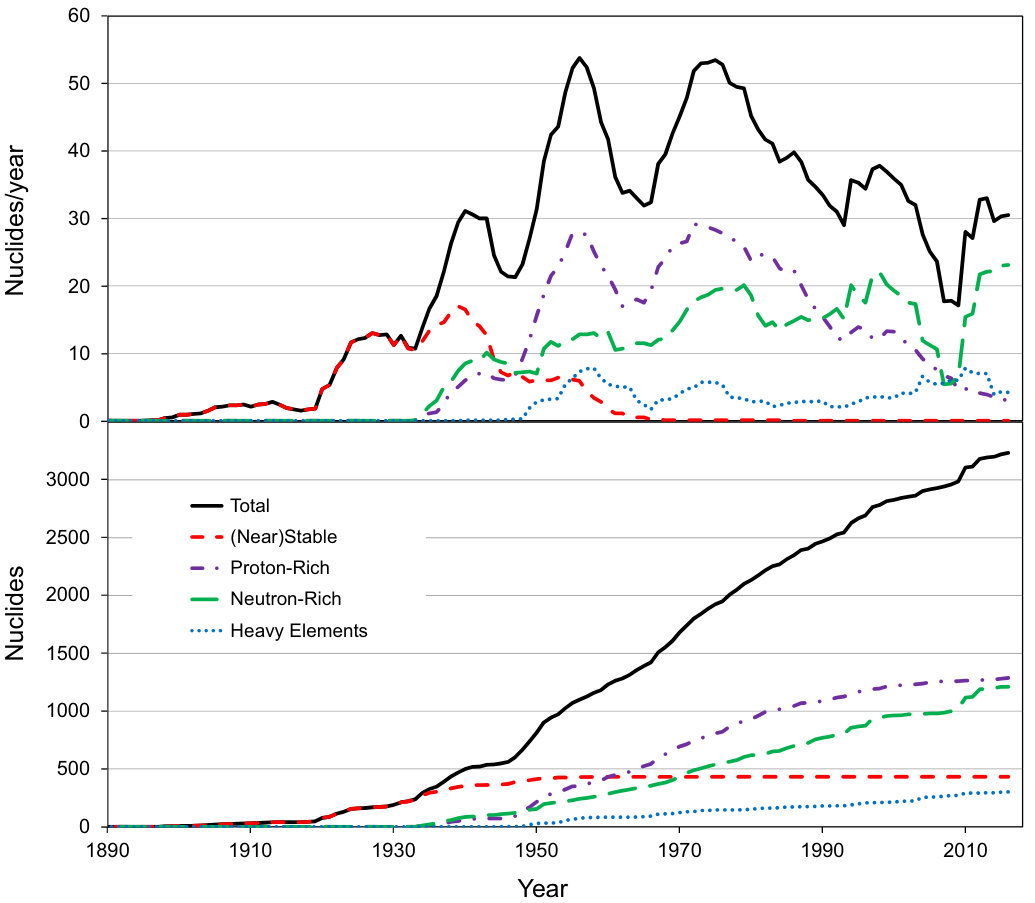 Figure 1
Peer Reviews
No public reviews on file for this paper yet. If you reviewed it on a platform where reviews are public (OpenReview, ICLR, NeurIPS, ICML), you can paste yours below so the community can read it here.
Videos
No videos yet. Explain this paper in a talk, walkthrough, or lecture? Add one.
\catchline
2016 UPDATE OF THE DISCOVERIES OF NUCLIDES
M. THOENNESSEN
National Superconducting Cyclotron Laboratory and
Department of Physics & Astronomy
Michigan State University
East Lansing, Michigan 48824, USA
(Day Month Year; Day Month Year)
Abstract
The 2016 update of the discovery of nuclide project is presented. Only twelve new nuclides were observed for the first time in 2016. A large number of isotopes is still only published in conference proceedings or internal reports. No changes to earlier assignments were made.
keywords:
Discovery of nuclides; discovery of isotopes
{history}
\ccode
PACS numbers: 21.10.-k, 29.87.+g
1 Introduction
This is the fourth update of the isotope discovery project which was originally published in a series of papers in Atomic Data and Nuclear Data Tables from 2009 through 2013 (see for example the first [1] and last [2] papers). Two summary papers were published in 2012 and 2013 in Nuclear Physics News [3] and Reports on Progress in Physics [4], respectively, followed by annual updates in 2014 [5], 2015 [6] and 2016 [7]. The 2016 update included an overall reevaluation to apply the criteria uniformly for all elements. A description of the discoveries from an historical perspective was published last year in the book “The Discovery of Isotopes – A complete Compilation” [8].
2 New discoveries in 2016
In 2016, the discoveries of twelve new nuclides were reported in refereed journals. This includes the first observation of an unbound resonance in the tetra-neutron system. In addition, eight nuclides along the proton-dripline and three transuranium nuclides were discovered. Table 2 lists details of the discovery including the production method. With the exception of 178Pb all isotopes were identified at RIKEN in Japan.
Evidence for the observation of the four-neutron resonance was reported by Kisamori et al. in the paper “Candidate resonant tetraneutron state populated by the 4He(8He,8Be) reaction” [9]. The state was detected in the missing-mass spectrum following the double-charge-exchange reaction with a 186 MeV/u radioactive 8He beam from the Radioactive Ion Beam Factory (RIBF) of the RIKEN Nishina Center. The tentative claim for a bound tetra-neutron in 2002 [14] was not confirmed in subsequent experiments [15]. In addition, parts of the analysis were questioned [16] and the existence of a bound tetraneutron seems theoretically very unlikely [17].
96In, 94Cd, 92Ag, and 90Pd were discovered by Čelikovíc et al. and reported in “New Isotopes and Proton Emitters–Crossing the Drip Line in the Vicinity of 100Sn” [10]. A 345 MeV/A primary 124Xe beam from RIBF was fragmented on thick 9Be targets and separated with the BigRIPS projectile fragment separator. The isotopes were identified using the method. “Four new isotopes, namely, 96In, 94Cd, 92Ag, and 90Pd, have been clearly identified with 2, 3, 8, and 2 events, correspondingly.”
Blank et al. reported the observation of 63Se, 67Kr, and 68Kr in “New neutron-deficient isotopes from 78Kr fragmentation” [11]. A 345 MeV/A primary 78Kr beam from RIBF was fragmented on thick 9Be targets and separated with the BigRIPS projectile fragment separator. The isotopes were identified using the method. “Clean identification spectra could be produced and 63Se, 67Kr, and 68Kr were identified for the first time.”
The first identification of 178Pb was published by Badran et al. in the paper entitled “Confirmation of the new isotope 178Pb” [12]. A self-supporting 104Pd target was bombarded with a 358 MeV 78Kr beam from the K-130 cyclotron at Jyväskylä. The recoils from the fusion evaporation reaction 104Pd(78Kr,4n)178Pb were separated with the gas-filled separator RITU and identified in the GREAT spectrometer. “The half-life of the ground state of 178Pb was determined to be ms using the maximum-likelihood method.” The word confirmation in the title of the paper referred to a previous observation of 178Pt which, however, was only published as a conference proceeding [18].
230Am, 234Cm, and 234Bk were discovered by Kaji et al. as reported in the paper “Decay Properties of New Isotopes 234Bk and 230Am, and Even-Even Nuclides 234Cm and 230Pu” [13]. A 189.5 MeV 40Ar beam accelerated by the RIKEN heavy-ion linear accelerator RILAC bombarded a gold target to form 234Bk in the reaction 197Au(40Ar,3n). Reaction products were separated with the gas-filled ion separator GARIS and transported to the rotating wheel system MANON where correlated -particles and fission fragments were measured. “Alpha-decay energies of eleven 234Bk were found at 7.627.96 MeV, and six fission events that correlated with the -decay of 234Bk were observed. The half-lives of 234Bk and 230Am were determined to be 19 s and 3 s, respectively. The 234Cm followed by the -decay of 234Bk was also identified.” The observation of 234Cm was not considered a new discovery referring to an internal report [19] and a conference proceeding [20].
In addition to these new discoveries in 2016, the observation of 215U was reported in 2015 but had not been included in the update of the compilation last year. It was reported by Yang et al. in the paper “Alpha decay of the new isotope 215U” [21]. 215U was formed in the fusion evaporation reaction 180W(40Ar,5n)215U with an 205.5 MeV 40Ar beam delivered from the Sector-Focusing Cyclotron of the Heavy Ion Research Facility in Lanzhou, China. The gas-filled recoil separator for Heavy Atoms and Nuclear Structure (SHANS) was used to separate evaporation residues which were implanted in a position-sensitive silicon strip detector (PSSD). 215U was identified by detecting correlated particles in the PSSD or in a box of eight silicon detectors surrounding the PSSD in the backward direction. “The -particle energy and half-life of 215U were determined to be 8.428(30)MeV and 0.73 ms, respectively.”
3 Status at the end of 2016
The twelve new discoveries in 2016 plus the inclusion of the 2015 discovery of 215U increased the total number of observed isotopes to 3224. They were reported by 905 different first authors in 1537 papers and a total of 3667 different coauthors. Further statistics can be found on the discovery project website [22].
Figure 1 shows the current status of the evolution of the nuclide discoveries for four broad areas of the nuclear chart, (near)stable, proton-rich, neutron-rich, and the region of the heavy elements. The figure was adapted from the 2014 review[5] and was extended to include all isotopes discovered until the end of 2016. The top part of the figure shows the ten-year average of the number of nuclides discovered per year while the bottom panel shows the integral number of nuclides discovered.
Although the ten-year average rate for neutron-rich isotopes reached an all-time high of 23.1, overall there are still more known proton-rich than neutron-rich nuclides. The total number of isotopes discovered by projectile fragmentation or projectile fission crossed 600. The method is used to produce neutron- as well as proton-rich nuclides. It corresponds to the second largest production mechanism only behind fusion-evaporation reactions which account for over 750 isotope discoveries.
4 Discoveries not yet published in refereed journals
Eight isotopes (96In, 94Cd, 92Ag, 90Pd, 178Pb, 230Am, 234Cm, and 234Bk) included in the list of isotopes only reported in proceedings or internal reports in last year’s update [7] have been published in refereed publications this year. While 215U was still included in this list it was actually published in a refereed journal in 2015 [21].
Table 4 lists the isotopes which so far still have only been presented in conference proceedings or internal reports. This includes almost 70 isotopes produced by projectile fragmentation and projectile fission at RIBF which should be published in refereed journals in the near future. The table includes two new entries: (i) 280Ds which was presented at the second Conference on Advances in Radioactive Isotope Science (ARIS) in 2014 [23] and has been discussed in the 2014 RIKEN accelerator report [24], and (ii) a Ph.D. thesis from 2005, reporting an additional measurement of 255Db [25].
Seven isotopes (116Nb, 138In, 143Sb, 145Te, 147I, 149Xe, and 154Ba) presented at the 4th Joint Meeting of the APS Division of Nuclear Physics and the Physical Society of Japan in 2014 [26] have not been included in a proceeding or annual report so far.
5 Summary
Following the revisions performed in preparations for the book “ The Discovery of Isotopes ” [8] presented in last year’s update [7] no major changes to the discovery assignments were made. As the example of 215U demonstrates, sometimes discoveries are overlooked. Thus continued input, feedback, and comments from researchers are encouraged to ensure that the compilation is always complete and up-to-date.
Acknowledgements
Support of the National Science Foundation under grant No. PHY15-65546 is gratefully acknowledged.
The reference list from the paper itself. Each links out to its DOI / PubMed record.
- 1[1] J. Q. Ginepro, J. Snyder, and M. Thoennessen, At. Data Nucl. Data Tables 95 (2009) 805.
- 2[2] C. Fry and M. Thoennessen, At. Data Nucl. Data Tables 99 (2013) 520.
- 3[3] M. Thoennessen, Nucl. Phys. News 22(3) (2012) 19.
- 4[4] M. Thoennessen, Rep. Prog. Phys. 76 (2013) 056301.
- 5[5] M. Thoennessen, Int. J. Mod. Phys. E 23 (2014) 1430002.
- 6[6] M. Thoennessen, Int. J. Mod. Phys. E 24 (2015) 1530002.
- 7[7] M. Thoennessen, Int. J. Mod. Phys. E 25 (2016) 1630004.
- 8[8] M. Thoennessen, The Discovery of Isotopes, A Complete Compilation , Springer International Publishing 2016, doi:10.1007/978-3-319-31763-2, in press.