Measurements of charmonium production in p$+$p, p$+$Au, and Au$+$Au collisions at $\sqrt{s_{_{\rm NN}}}$~=~200~GeV with the STAR experiment
Takahito Todoroki (for the STAR Collaboration)

TL;DR
This paper reports the first measurements of charmonium production in various collision systems at RHIC, providing insights into production mechanisms, nuclear effects, and suppression patterns at different transverse momenta.
Contribution
First measurement of mid-rapidity charmonium via di-muon decay in p+p, p+Au, and Au+Au collisions at 200 GeV with STAR, including cross sections and nuclear modification factors.
Findings
Inclusive J/ψ production in p+p aligns with NRQCD+CGC models.
Nuclear modification factor in p+Au shows suppression at low pT and unity at high pT.
Significant J/ψ suppression observed in central Au+Au collisions at high pT.
Abstract
We present the first results from the STAR MTD of mid-rapidity charmonium measurements via the di-muon decay channel in pp, pAu, and AuAu collisions at ~GeV at RHIC. The inclusive production cross section in pp collisions can be described by the Non-Relativistic QCD (NRQCD) formalism coupled with the color glass condensate effective theory (CGC) at low transverse momentum () and next-to-leading order NRQCD at high . The nuclear modification factor in pAu collisions for inclusive is below unity at low and consistent with unity at high , which can be described by calculations including both nuclear PDF and nuclear absorption effects. The double ratio of inclusive and production rates for ~GeV/ at mid-rapidity between pp and pAu collisions is measured to be…
Click any figure to enlarge with its caption.
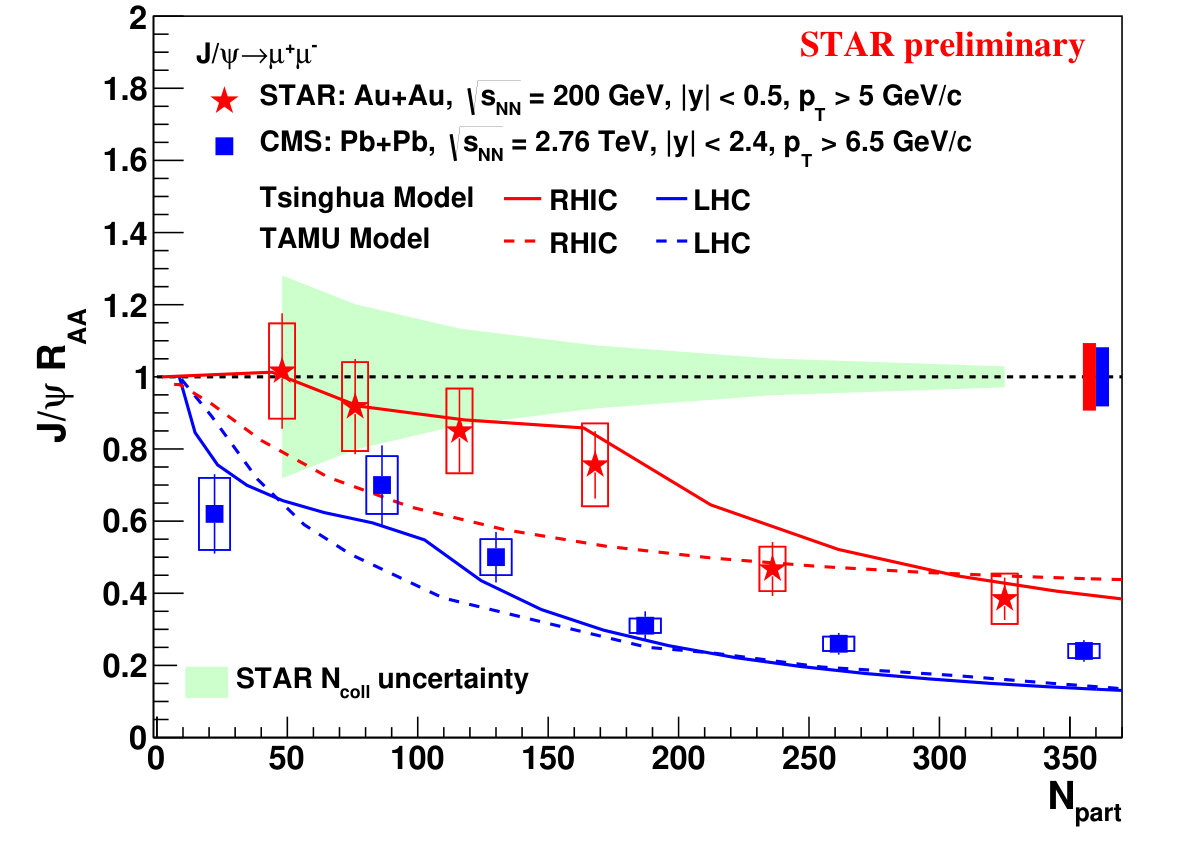 Figure 1
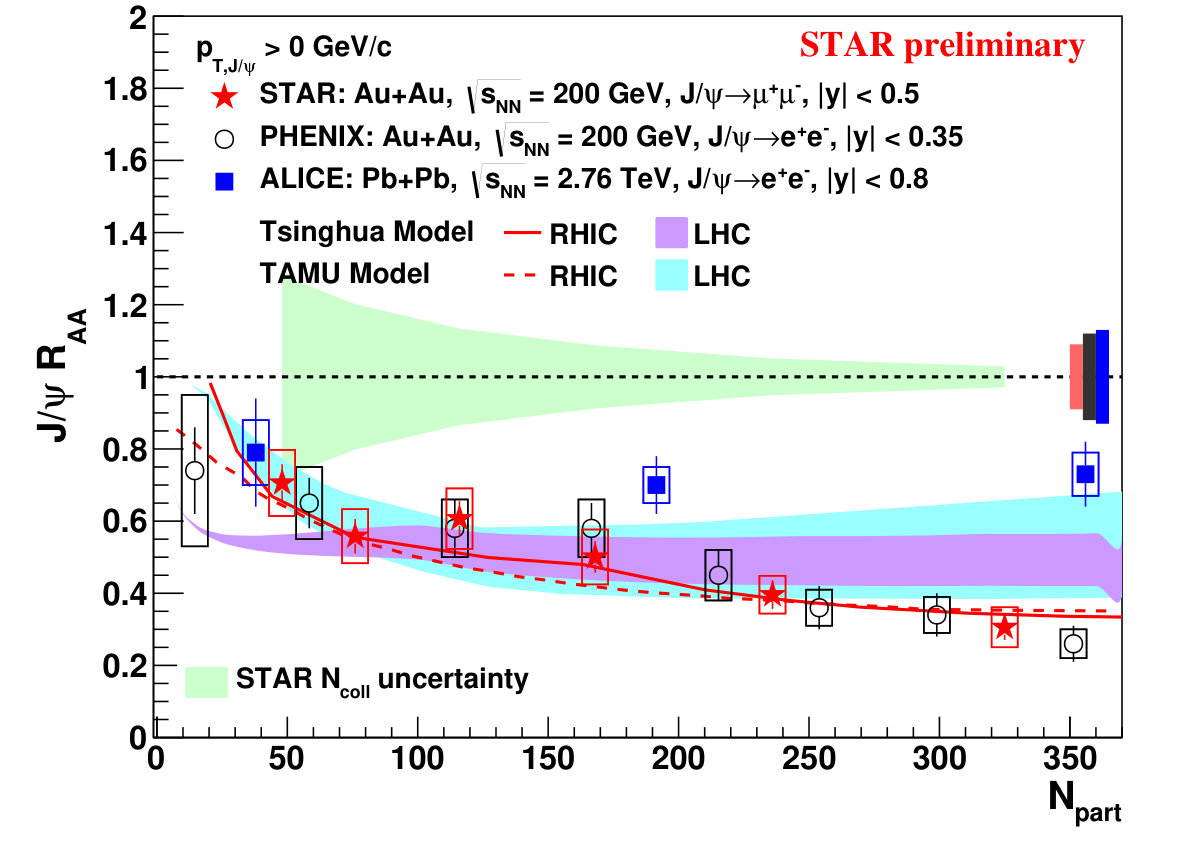 Figure 2
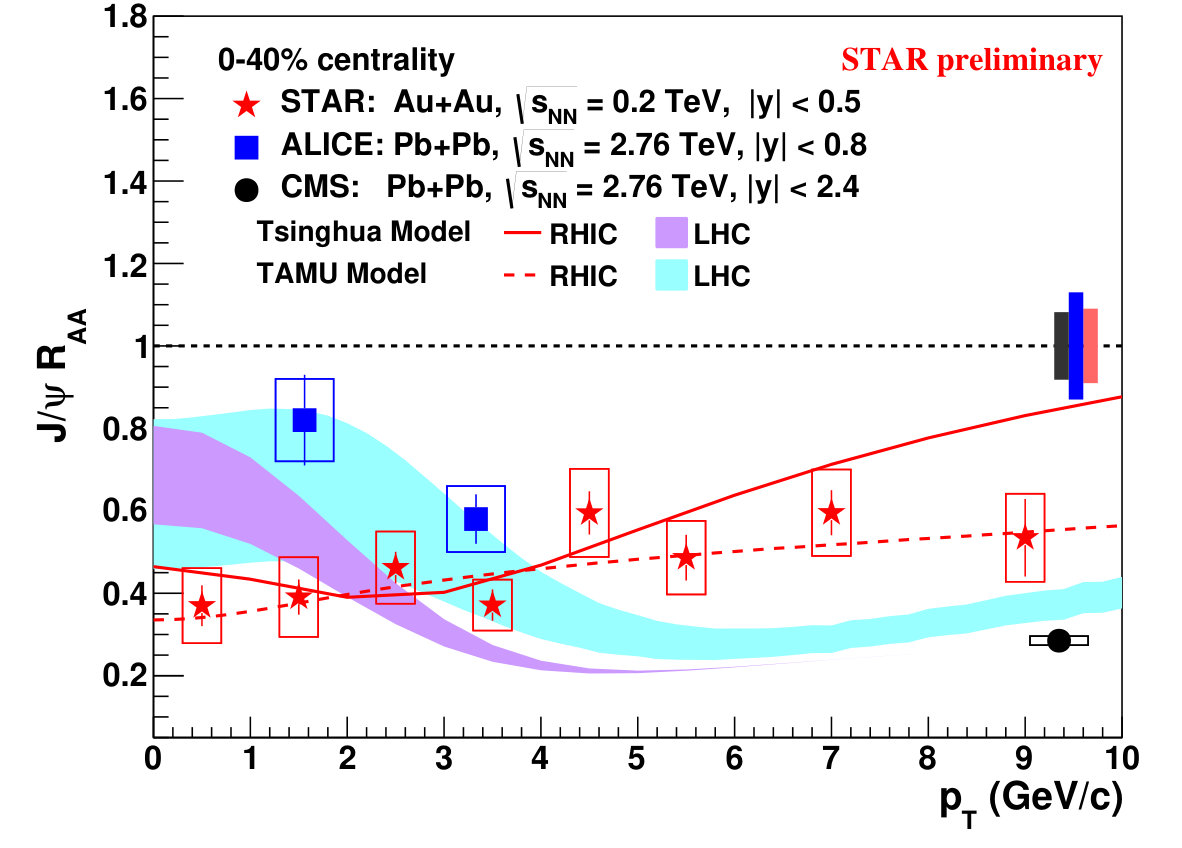 Figure 3
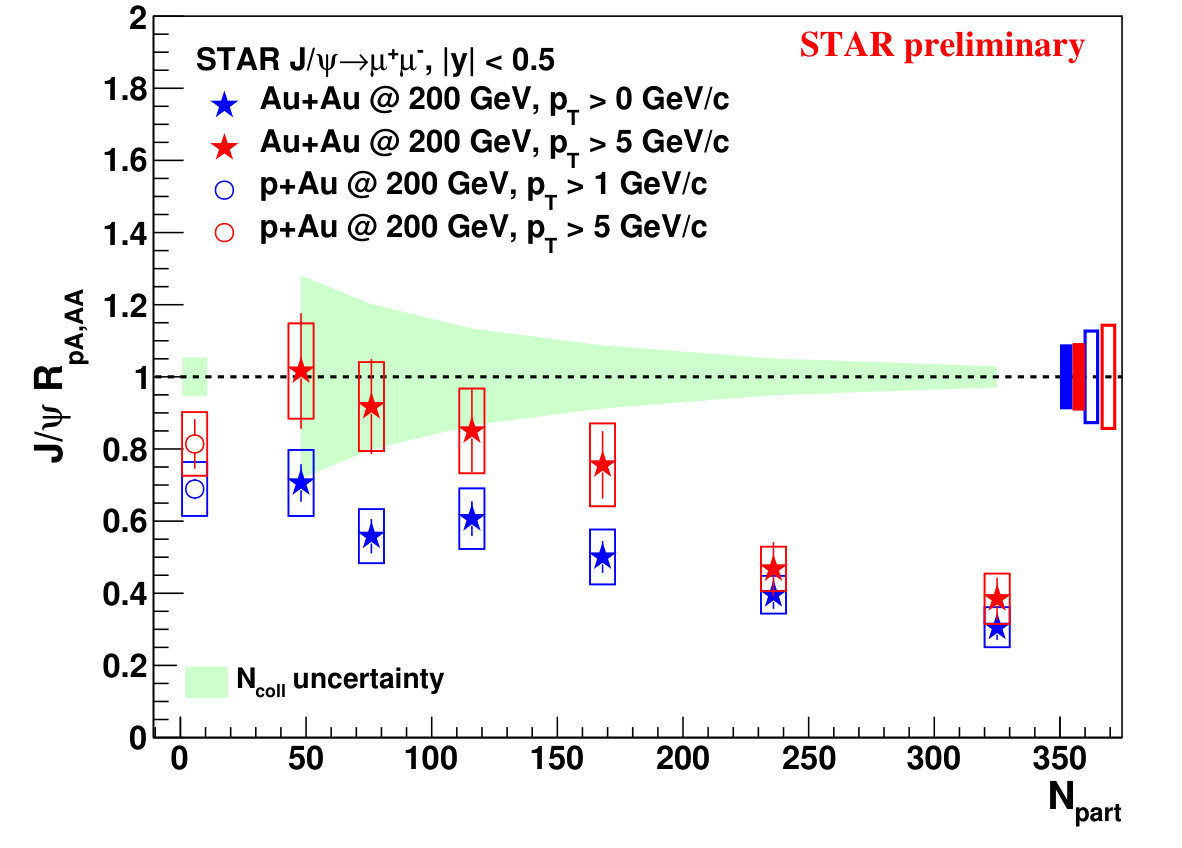 Figure 4
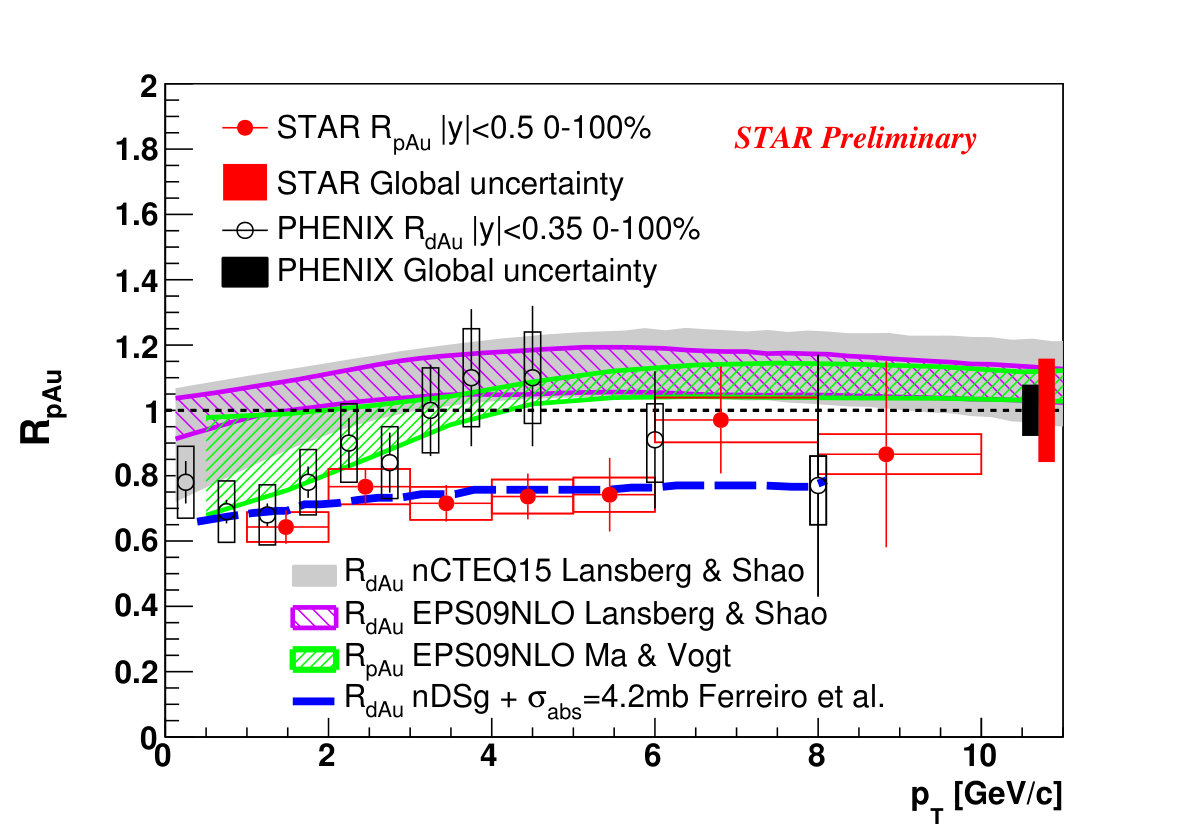 Figure 5
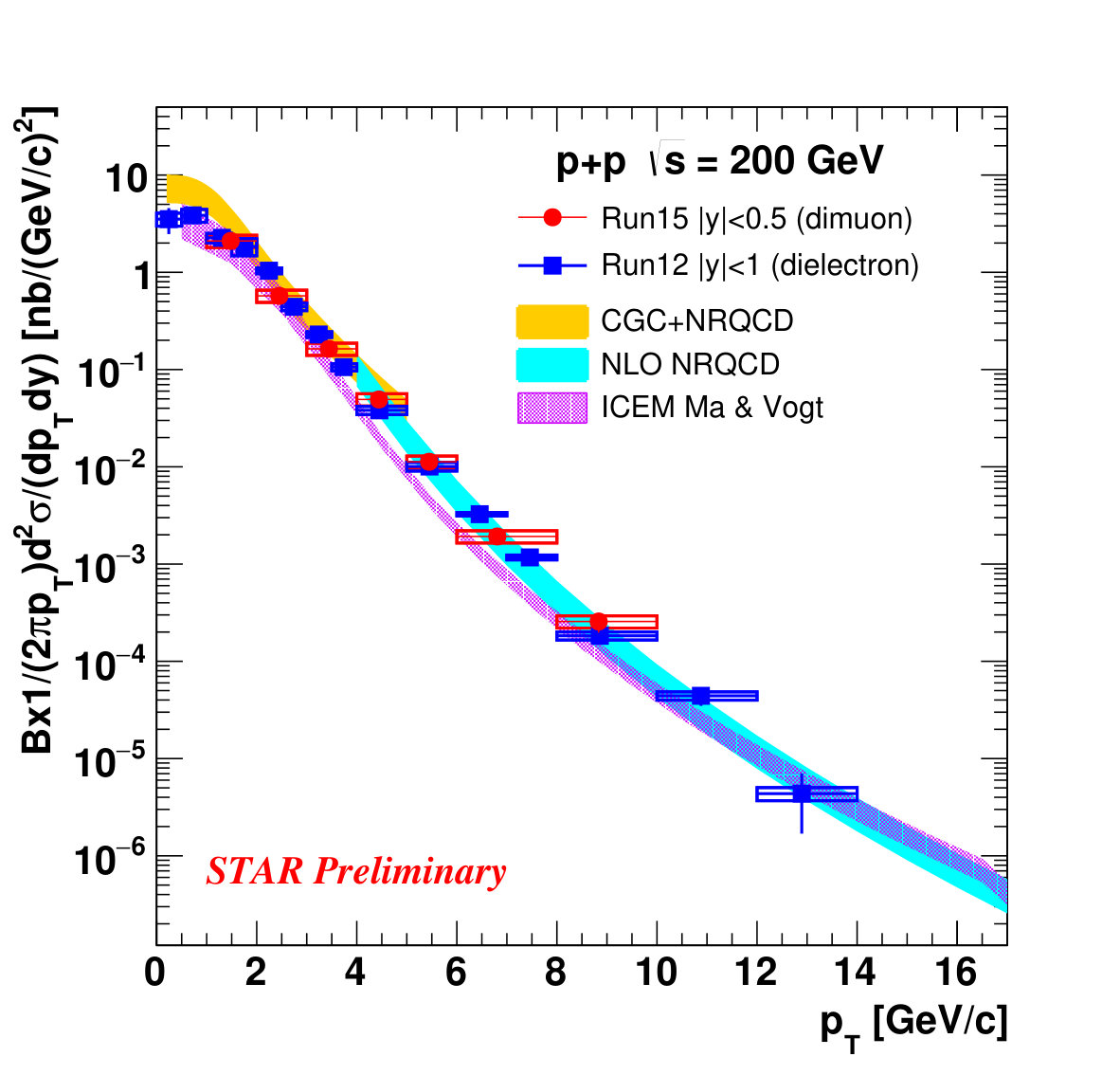 Figure 6
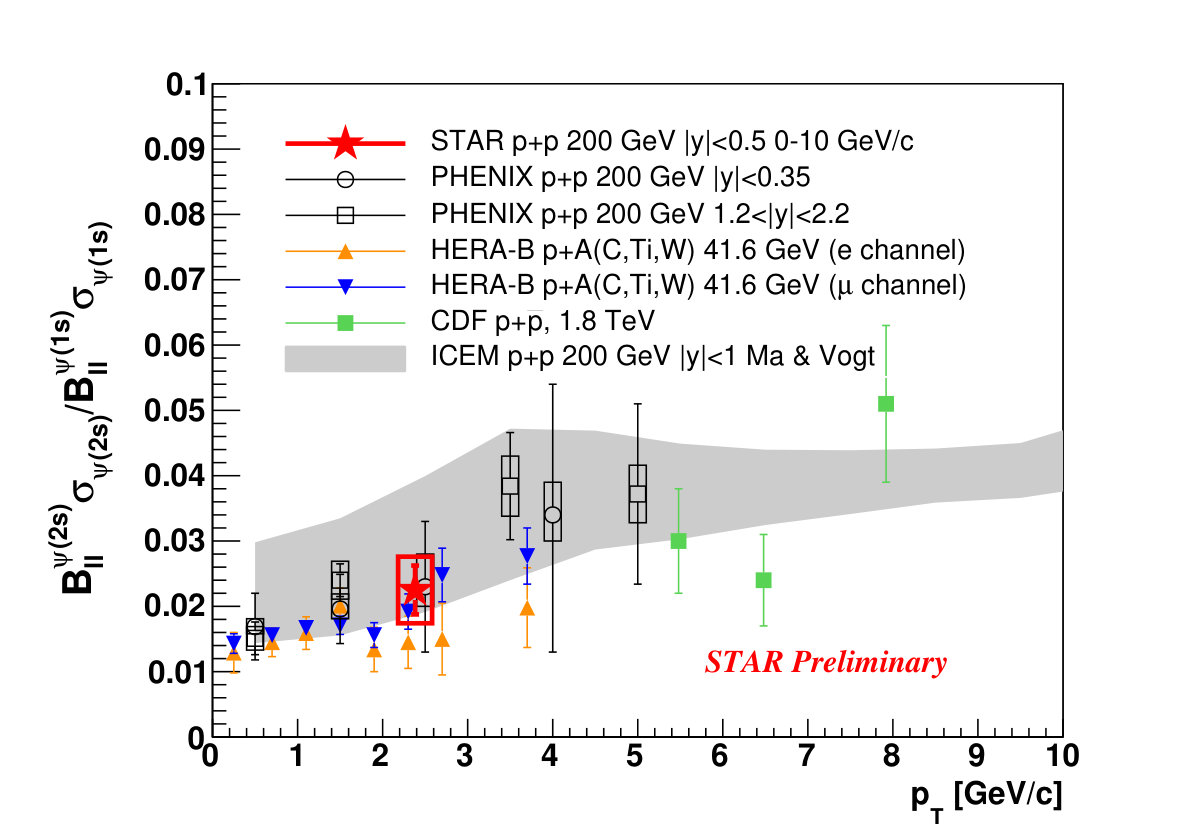 Figure 7
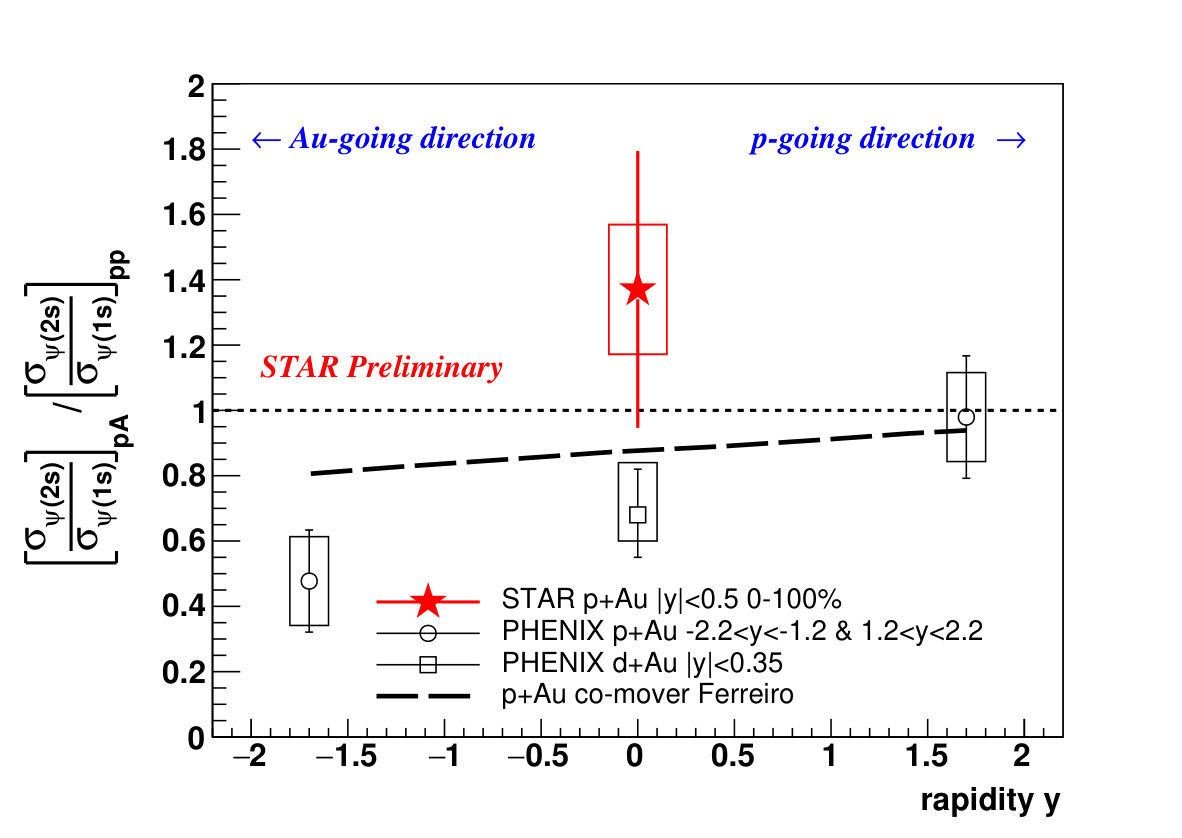 Figure 8
 Figure 9
 Figure 10
Peer Reviews
No public reviews on file for this paper yet. If you reviewed it on a platform where reviews are public (OpenReview, ICLR, NeurIPS, ICML), you can paste yours below so the community can read it here.
Videos
No videos yet. Explain this paper in a talk, walkthrough, or lecture? Add one.
Measurements of charmonium production in pp, pAu, and AuAu collisions at = 200 GeV with the STAR experiment
Takahito Todoroki (for the STAR Collaboration)
Physics Department, Brookhaven National Laboratory, Upton, New York 11973, USA
Abstract
We present the first results from the STAR MTD of mid-rapidity charmonium measurements via the di-muon decay channel in pp, pAu, and AuAu collisions at GeV at RHIC. The inclusive production cross section in pp collisions can be described by the Non-Relativistic QCD (NRQCD) formalism coupled with the color glass condensate effective theory (CGC) at low transverse momentum () and next-to-leading order NRQCD at high . The nuclear modification factor in pAu collisions for inclusive is below unity at low and consistent with unity at high , which can be described by calculations including both nuclear PDF and nuclear absorption effects. The double ratio of inclusive and production rates for GeV/ at mid-rapidity between pp and pAu collisions is measured to be 1.37 0.42 0.19. The nuclear modification factor in AuAu collisions for inclusive shows significant suppression at high in central collisions and can be qualitatively described by transport models including dissociation and regeneration contributions.
keywords:
heavy-ion collisions , quarkonium , suppression , color screening , cold nuclear matter effect
1 Introduction
The dissociation by the color-screening effect in the hot and dense medium [1] was initially proposed as direct evidence of the quark-gluon plasma formation. However, the interpretation of suppression observed in heavy-ion collisions has remained a challenge due to the contribution of regenerated from the coalescence of deconfined pairs in the medium as well as cold nuclear matter effects. Quantifying the cold and hot nuclear matter effects at the RHIC requires precise measurements of charmonium production in pp, pAu, and AuAu collisions. The Muon Telescope Detector (MTD), which provides both the muon triggering and identification capabilities at mid-rapidity, opens the door to measuring quarkonia via the di-muon decay channel at STAR. Using the MTD di-muon trigger, the STAR experiment recorded data corresponding to an integrated luminosity of 14.2 nb*-1* in AuAu collisions at GeV in the RHIC 2014 run, and integrated luminosities of 122 pb*-1* in pp collisions and 409 nb*-1* in pAu collisions at GeV in the RHIC 2015 run. In these proceedings, we present (i) measurements of nuclear modification factors for inclusive production over a broad kinematic range in both pAu and AuAu collisions at GeV; and (ii) the first measurement of the double ratio of inclusive and production rates at mid-rapidity between pp and pAu collisions at GeV.
2 Inclusive measurements in pp and pAu collisions at GeV
Figure 2 shows the production cross section of inclusive in pp collisions at GeV via the di-muon decay channel for the transverse momentum () range of GeV/c (red circles), along with a similar measurement via the di-electron decay channel (blue squares) in GeV/c. These results are consistent in the overlapping range. The experimental results can be well described by CGC+NRQCD [2] and NLO NRQCD [3] calculations for prompt at low and high ranges, respectively. While an improved color evaporation model (ICEM) calculation for direct [4] can describe the data for GeV/, it generally underestimates the yield at higher .
Figure 2 shows the nuclear modification factor, , of inclusive in 0-100% central pAu collisions. The measured is generally consistent with the previous result reported by the PHENIX experiment [5] within statistical and systematic uncertainties. The largest deviation between these results is 1.4 in the range of GeV/. This overall consistency suggests similar cold nuclear matter effects in pAu and dAu collisions. Calculations, taking into account the nuclear PDF effect using the nCTEQ15 [6, 7, 8] or EPS09NLO [6, 7, 8, 9] nuclear PDF sets, can touch the upper limit of the data within uncertainties. However, the model calculation including an additional nuclear absorption effect [10] is favored by the data.
3 Double ratio of inclusive and yields between pp and pAu collisions at GeV
Figure 4 shows the ratio of inclusive and production cross sections as a function of in pp collisions at GeV. The new STAR result for GeV/ follows the global trend of results by HERA [11], PHENIX [12, 13], and CDF [14] experiments. The ICEM calculation at GeV [4] can describe the increasing trend of the ratio with .
Figure 4 shows the double ratio of and production rates between pp and pAu collisions as a function of rapidity. The new STAR results at is 1.37 0.42(stat) 0.19(sys), which is consistent with the published PHENIX results at in dAu collisions [15]. The co-mover model calculation [16, 17] can qualitatively describe the double ratio at forward and backward rapidities in pAu collisions reported by the PHENIX experiment [13], and is consistent with the new STAR result at mid-rapidity within uncertainties.
4 Inclusive measurements in AuAu collisions at GeV
Shown in Fig. 6 is the nuclear modification factor of inclusive in 0-40% central AuAu collisions compared with LHC results [18, 19]. The strong suppression at RHIC at high indicates significant dissociation. The hint of the increasing with increasing can be explained by the formation-time effect and the feed-down contribution from hadron decays [20]. The stronger suppression of at RHIC at low can be explained by less regeneration contribution due to smaller charm production cross section, while the smaller suppression of at RHIC at high could arise from a smaller dissociation rate due to the lower temperature of the medium. The as a function of the number of participant nucleons () for GeV/ and GeV/ are compared with the in Fig. 6. The nuclear modification factors in the most peripheral Au+Au collisions are consistent with those measured in p+Au collisions.
Transport models from Tsinghua [21, 22] and Texas A&M University (TAMU) [20, 23] groups, including dissociation and regeneration contributions, can qualitatively describe the dependence of the RHIC and the LHC data as shown in Fig. 6. Centrality dependences of the at the RHIC [24] and the LHC are shown in Fig. 8 for GeV/ and in Fig. 8 for GeV/. For GeV/, both models can describe the centrality dependence at the RHIC, but tend to overestimate the suppression at the LHC. For GeV/, there is tension among models and data. The discontinuities seen in the as a function of from the Tsinghua model calculation can be attributed to the complete dissociation of when the medium temperature exceeds the dissociation temperature.
5 Summary
In summary, we presented the first charmonium measurements in the di-muon decay channel at mid-rapidity at the RHIC. In pp collisions at GeV, inclusive production cross section can be described by CGC+NRQCD and NLO NRQCD model calculations for prompt at low and high ranges, respectively. While the ICEM calculation for direct can describe the data for GeV/, it generally underestimates the yield at higher . In pAu collisions at GeV, we observe (i) inclusive is consistent with suggesting similar cold nuclear matter effects in p+Au and d+Au collisions; (ii) calculations incorporating the nuclear PDF and nuclear absorption effects can well describe ; and (iii) the double ratio of inclusive and production rates between pp and pAu collisions is 1.37 0.42 0.19. In AuAu collisions at GeV, we observe (i) significant suppression in central collisions at high indicating dissociation; (ii) the can be qualitatively described by transport models including dissociation and regeneration; and (iii) the in the most peripheral collisions is consistent with the . These measurements in AuAu collisions will gain additional statistical precision by combining with the similar amount of data recorded in the RHIC 2016 run.
The reference list from the paper itself. Each links out to its DOI / PubMed record.
- 1[1] T. Matsui, H. Satz, Phys. Lett. B 178 (1986) 416–422.
- 2[2] Y.-Q. Ma, R. Venugopalan, Phys. Rev. Lett. 113 (19) (2014) 192301.
- 3[3] H.-S. Shao, H. Han, Y.-Q. Ma, C. Meng, Y.-J. Zhang, K.-T. Chao, JHEP 05 (2015) 103.
- 4[4] Y.-Q. Ma, R. Vogt, Phys. Rev. D 94 (11) (2016) 114029.
- 5[5] A. Adare, et al., Phys. Rev. C 87 (3) (2013) 034904.
- 6[6] J.-P. Lansberg, H.-S. Shao, Eur. Phys. J. C 77 (1) (2017) 1.
- 7[7] H.-S. Shao, Comput. Phys. Commun. 184 (2013) 2562–2570.
- 8[8] H.-S. Shao, Comput. Phys. Commun. 198 (2016) 238–259.