Raman scattering from Higgs mode oscillations in the two-dimensional antiferromagnet Ca$_2$RuO$_4$
Sofia-Michaela Souliou, Ji\v{r}\'i Chaloupka, Giniyat Khaliullin,, Gihun Ryu, Anil Jain, B.J. Kim, Matthieu Le Tacon, and Bernhard Keimer

TL;DR
This study uses Raman spectroscopy and theoretical modeling to detect and analyze the Higgs mode in the two-dimensional antiferromagnetic Mott insulator Ca$_2$RuO$_4$, providing evidence for excitonic magnetism.
Contribution
It presents the first direct observation of the Higgs mode in Ca$_2$RuO$_4$ using Raman scattering, supported by exact diagonalization calculations and neutron scattering data.
Findings
Detection of Higgs mode in $A_g$ polarization
Observation of single-magnon and two-magnon peaks in $B_{1g}$ geometry
Quantitative agreement between experiments and model calculations
Abstract
We present and analyze Raman spectra of the Mott insulator CaRuO, whose quasi-two-dimensional antiferromagnetic order has been described as a condensate of low-lying spin-orbit excitons with angular momentum . In the polarization geometry, the amplitude (Higgs) mode of the spin-orbit condensate is directly probed in the scalar channel, thus avoiding infrared-singular magnon contributions. In the geometry, we observe a single-magnon peak as well as two-magnon and two-Higgs excitations. Model calculations using exact diagonalization quantitatively agree with the observations. Together with recent neutron scattering data, our study provides strong evidence for excitonic magnetism in CaRuO and points out new perspectives for research on the Higgs mode in two dimensions.
Click any figure to enlarge with its caption.
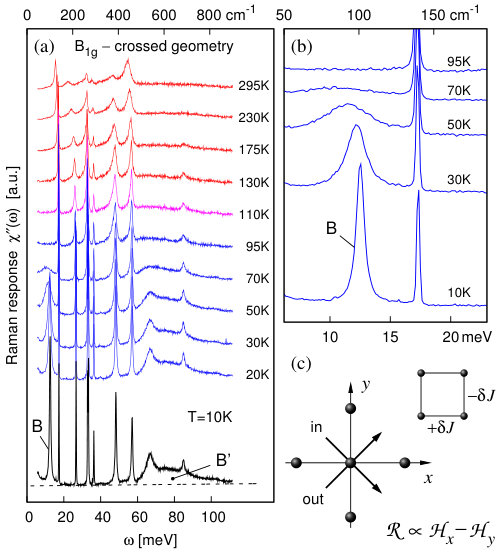 Figure 1
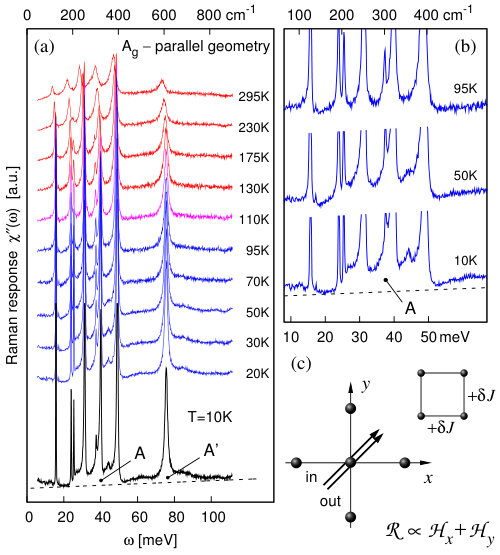 Figure 2
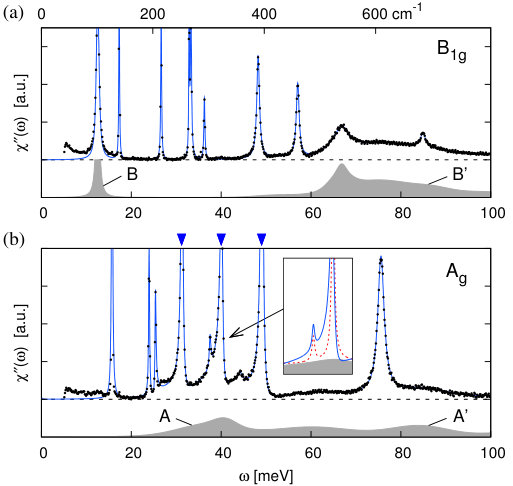 Figure 3
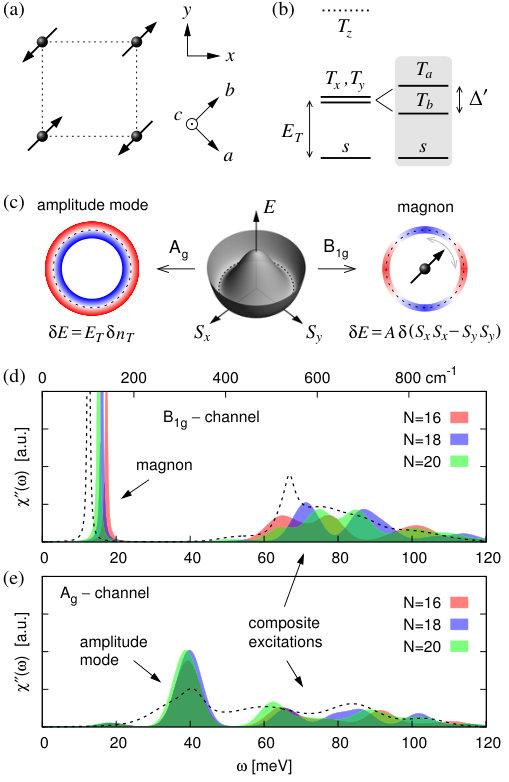 Figure 4
Peer Reviews
No public reviews on file for this paper yet. If you reviewed it on a platform where reviews are public (OpenReview, ICLR, NeurIPS, ICML), you can paste yours below so the community can read it here.
Videos
No videos yet. Explain this paper in a talk, walkthrough, or lecture? Add one.
Raman scattering from Higgs mode oscillations in the two-dimensional antiferromagnet Ca2RuO4
Sofia-Michaela Souliou
Max Planck Institute for Solid State Research, Heisenbergstrasse 1, D-70569 Stuttgart, Germany
European Synchrotron Radiation Facility, BP 220, F-38043 Grenoble Cedex, France
Jiří Chaloupka
Central European Institute of Technology, Masaryk University, Kamenice 753/5, 62500 Brno, Czech Republic
Department of Condensed Matter Physics, Faculty of Science, Masaryk University, Kotlářská 2, 61137 Brno, Czech Republic
Giniyat Khaliullin
Max Planck Institute for Solid State Research, Heisenbergstrasse 1, D-70569 Stuttgart, Germany
Gihun Ryu
Max Planck Institute for Solid State Research, Heisenbergstrasse 1, D-70569 Stuttgart, Germany
Anil Jain
Max Planck Institute for Solid State Research, Heisenbergstrasse 1, D-70569 Stuttgart, Germany
B. J. Kim
Max Planck Institute for Solid State Research, Heisenbergstrasse 1, D-70569 Stuttgart, Germany
Matthieu Le Tacon
Max Planck Institute for Solid State Research, Heisenbergstrasse 1, D-70569 Stuttgart, Germany
Karlsruhe Institute of Technology, Institut für Festkörperphysik, D-76021 Karlsruhe, Germany
Bernhard Keimer
Max Planck Institute for Solid State Research, Heisenbergstrasse 1, D-70569 Stuttgart, Germany
Abstract
We present and analyze Raman spectra of the Mott insulator Ca2RuO4, whose quasi-two-dimensional antiferromagnetic order has been described as a condensate of low-lying spin-orbit excitons with angular momentum . In the polarization geometry, the amplitude (Higgs) mode of the spin-orbit condensate is directly probed in the scalar channel, thus avoiding infrared-singular magnon contributions. In the geometry, we observe a single-magnon peak as well as two-magnon and two-Higgs excitations. Model calculations using exact diagonalization quantitatively agree with the observations. Together with recent neutron scattering data, our study provides strong evidence for excitonic magnetism in Ca2RuO4 and points out new perspectives for research on the Higgs mode in two dimensions.
pacs:
75.10.Jm
The notion of Goldstone and Higgs modes, corresponding to phase and amplitude oscillations of a condensate of quantum particles, appears in many areas of physics including magnetism Pek15 . In quantum magnets, especially near quantum criticality Sac11 , the magnetization density is far from being saturated and hence allowed to oscillate near its mean value, forming a collective amplitude mode.
The “magnetic” Higgs mode has been observed Rue08 in quantum dimer systems, where the magnetic order is due to Bose-Einstein condensation of spin-triplet excitations Gia08 . A conceptually similar, but physically distinct case is expected in Van Vleck-type Mott insulators, where the “soft” moments result from condensation of spin-orbit excitons Kha13 , that is, magnetic transitions between spin-orbit and levels propagating via exchange interactions. Recent inelastic neutron scattering (INS) experiments Jai17 on Ca2RuO4 have indeed revealed Higgs oscillations of the magnetization in this material, which is based on nominally non-magnetic, spin-orbit singlet Ru4+ ions. A detailed analysis of the dispersion relations of the Higgs mode and magnons determined by INS showed that Ca2RuO4 is close to a quantum critical point associated with the condensation of excitons Jai17 .
The unique aspect of Ca2RuO4 is that it hosts Higgs physics in a two-dimensional setting, which has been a focus of many theoretical studies Pod11 ; Pod12 ; Pol12 ; Che13 ; Gaz13a ; Gaz13b ; Ran14 ; Ros15 ; Kat15 . As the magnetization density is not a conserved quantity, the Higgs mode is not symmetry protected, and various decay processes convert it into a many-body resonance with onset. It was also emphasized Pod11 that the actual appearance of this resonance strongly depends on the symmetry of the probe. In INS experiments, which probe the longitudinal magnetic susceptibility, the low-energy behaviour of the Higgs resonance is masked by the infrared-singular two-magnon contribution. To avoid contamination by the Goldstone modes, the probe should couple to the condensate in the scalar channel (i.e. insensitively to the phase/direction). Precisely this type of experiment has been done in ultracold atomic systems End12 .
In this Letter, we demonstrate that Raman light scattering in the fully symmetric, i.e. channel can serve as a scalar probe in magnetic systems, thus providing direct access to Higgs oscillations of “soft” moments. While in conventional Heisenberg magnets with rigid spins (such as La2CuO4 or Sr2IrO4) the channel is magnetically silent, the size of the local moments, and hence the magnetization density in excitonic systems is determined by a balance between the spin-orbit and exchange -interactions Kha13 ; Jai17 , and the modulation of the latter directly shakes the condensate density.
The Raman scattering data in Ca2RuO4 presented below indeed reveal a pronounced magnetic contribution in the channel, which we identify and describe using the same excitonic model that has already been parameterized in the INS study Jai17 . In the channel, we observe the expected two-magnon scattering and an additional two-Higgs scattering contribution, as well as a single-magnon peak. All the observations are coherently explained by model calculations.
*Experiment.—*Single crystals of Ca2RuO4 with were grown by a floating zone method, as described elsewhere Nak01 . The Raman data were recorded on a Labram (Horiba Jobin-Yvon) single-grating Raman spectrometer, using the line of a He+/Ne+ mixed gas laser. The experiments were performed in backscattering geometry along the crystallographic -axis. Ca2RuO4 crystalizes in the orthorhombic Pbca-D space group. Excitations in the and representations of the point group D were probed in crossed and parallel configurations respectively, with the polarization of the incident light at to the Ru-Ru bonds [see Figs. 1(c) and 2(c)]. The spectra were corrected for the Bose thermal factor to obtain the Raman response functions .
Temperature-dependent in the range of to are plotted in Figs. 1 and 2. The frequencies of the observed phonon modes are in good agreement with previous Raman studies Rho05 . The phonon modes are superimposed on top of a broad continuum. As the temperature is lowered, the continuum evolves into distinct spectral features , (Fig. 1) and , (Fig. 2). The temperature dependence of the new features follows closely that of the magnetic order parameter and strongly suggests their magnetic origin. The fact that these excitations are well inside the optical gap exceeding Jun03 further supports this interpretation.
More specifically, in the channel, the feature appears around and gradually sharpens [Fig. 1(b)]. Earlier Raman studies attributed it either to two-magnon scattering Sno02 ; Rho03 or to a zone-boundary folded phonon in the magnetically ordered state Rho05 . However, we find below that the two-magnon scattering is represented by the structure around , while the -peak is identified as a single-magnon excitation.
In the channel, the -structure in the range of to develops in the magnetically ordered state [Fig. 2(b)]. The phonon modes in this spectral region exhibit pronounced Fano-type asymmetric lineshapes – a clear signature of the presence of a continuum of excitations coupled to the phonons. As noticed above, the large optical gap implies a magnetic origin of the continuum.
*Extraction of the magnetic response.—*We adopt the Green’s function approach Nit74 ; Kle75 ; Che93 to the Raman response of the coupled system of phonons and a continuum. We describe the system by a matrix propagator whose inverse contains the response functions of the magnetic and phonon () subsystems as the diagonal elements. The coupling between phonon and the continuum is provided by nondiagonal matrix elements . After inverting , the Raman response is obtained as , where are spectral weights of the normal modes of the coupled spin-phonon system.
The magnetic response functions , determined by fitting to the low-temperature spectra, are presented in Fig. 3. While in the case the above procedure just confirms the expected result, in the case it proved essential to obtain the actual profile. The feature is found to be peaked at about and has a long tail that merges with the high-energy continuum (), much flatter than the one ().
*Magnetic model.—*In the following, we give a quantitative interpretation of the magnetic features using the excitonic model of Ref. Kha13 , refined further by a comparison to INS data Jai17 . The model utilizes the local basis depicted in Fig. 4(b) stabilized by intraionic spin-orbit coupling. The dominant energy scale corresponds to the energy cost of a triplon (derived from states) relative to that of the singlet ground state (). Its competition with the spin-orbital exchange interaction results in a quantum critical point separating the paramagnetic phase (dilute “gas” of on top of background) and antiferromagnetic phase (condensate with coherently mixed and ). In terms of hardcore bosons and associated with the relevant low-energy levels and obeying local constraint , these main constituents of the model are expressed as
[TABLE]
The exchange interaction comprises triplon hopping and pair creation/annihilation which act together to form AF-aligned pairs of Van Vleck moments.
The full model is most conveniently expressed using pseudospin =1 formed by the three levels Jai17 . The corresponding in-plane operators for are directly linked to the dominating Van Vleck part of magnetic moment, while is related to the moment residing in the excited levels. In this basis, the -term in Eq. (1) takes a form of the XY-model . Supplemented by the bond-directional interaction and coupling between the out-of-plane components, the exchange Hamiltonian for the -bonds reads as
[TABLE]
The signs of the terms are opposite for bonds. The -level orthorhombic splitting [see Fig. 4(a),(b)] orienting the moments along axis translates into a single-ion anisotropy . The full Hamiltonian used below is then , with .
*Model calculations and interpretation of the data.—*We employ the Loudon-Fleury Fle68 Raman scattering operator , which modulates the exchange interactions in a way determined by the incoming and outgoing polarization vectors notezz . Specifying () by its angle () to the axis, becomes
[TABLE]
For (, ) and () symmetries, only the or term above is active, respectively.
We first discuss the implications of Eq. (3) on a qualitative level. Consider the scattering channel with . While in the usual rigid spin systems (e.g. cuprates) this operator is proportional to the Hamiltonian itself and does not bring any dynamics, here we may replace it by its complement in the Hamiltonian, i.e. (and a small term), and obtain a non-trivial spectrum. Most importantly, globally changes the balance between the and components coherently mixed in the condensate, exciting thus directly the amplitude mode of the condensate. This Raman process may be intuitively understood as a forced expansion and contraction of the Mexican-hat potential in Fig. 4(c). In contrast to INS, the amplitude mode is probed here in a rotationally invariant way, using a scalar coupling to the condensate density. We thus avoid the contamination by the two-magnon response that leads to a drastic broadening of the longitudinal mode in the dynamical spin susceptibility.
In the channel, the modulation of the exchange contained in produces a high-energy two-magnon continuum, as in usual Heisenberg magnets. Here it is additionally supported by other composite excitations such as two-Higgs continuum (similar to what found in a soft-spin model Wei15 ). A special role is played by the bond-anisotropic term contributing to as . The resulting quadrupolar modulation of the condensate energy [see Fig. 4(c)] drives the ordered moment toward the or directions hence exciting a magnon.
To confirm the above expectations and make a quantitative comparison to the experiment, in Fig. 4(d),(e) we show Raman spectra calculated by exact diagonalization (ED). The best fit to the magnetic intensity extracted in Fig. 3 is obtained for the parameters , , , , and , well matching those from the INS data Jai17 . The small differences in and is due to the different methods – the spin-wave approach Jai17 versus ED used here.
In accord with the above discussion, the model spectrum in Fig. 4(d) contains a high-energy continuum and a single-magnon peak due to the bond-directional -part of that sums up to . Approximating along the ordered moment direction by with , this part becomes thus probing the magnon at the ordering vector. The energy of the experimental feature of about indeed agrees with that of INS -magnon peak Jai17 ; Kun15 . The spectral weight (SW) of the peak is roughly proportional to , enabling us to estimate by comparing the SW of and that of the continuum. The experimental SW ratio obtained from Fig. 3(a) amounts to . In the model calculations, the average through the three clusters gives a consistent value of , confirming taken from INS fits.
In the channel, the model spectrum in Fig. 4(e) is dominated by the amplitude mode appearing at in agreement with the expected position of the bare amplitude mode based on INS (see Fig. 4 of Ref. Jai17 ). The amplitude mode peak is accompanied by a high-energy continuum [Fig. 4(e)]. Since it is a part of the susceptibility, its profile is rather different than that of the (mainly) two-magnon continuum in the channel. The limited scattering possibilities on the small clusters do not allow us to access the mode profile by ED in detail. The available results for the relativistic quantum model in dimensions Gaz13a ; Gaz13b ; Ran14 ; Ros15 suggest a Higgs peak with onset and an extended tail which is in a qualitative agreement with extracted in Fig. 3(b).
Finally, we comment on the notable interplay of phonons with the amplitude mode observed in Fig. 3(b). First, phonons involving rotations and tiltings of RuO6 octahedra modify the Ru-O-Ru bond angle, thus modulating the exchange in a symmetric fashion. Second, deformations of the octahedra affect the splitting among orbitals, thus modulating owing to the different orbital composition of and states. Both mechanisms provide a natural coupling of phonons to oscillations of the condensate density that is determined by the ratio .
In conclusion, we have presented Raman light scattering data on Ca2RuO4 and fully interpreted its magnetic features in terms of the excitonic model Kha13 ; Jai17 . As demonstrated, the scattering channel enables direct access to the amplitude (Higgs) mode of the spin-orbit condensate. In contrast to INS, the Higgs mode is probed here via a scalar coupling and is not obscured by the two-magnon continuum. The overall agreement with both the neutron and Raman experiments strongly supports the excitonic picture as the basis for magnetism of Ca2RuO4. More generally, our results encourage future experimental efforts to explore other compounds based on Van Vleck-type ions such as Ru4+, Os4+, and Ir5+.
JC acknowledges support by the Czech Science Foundation (GAČR) under Project No. GJ15-14523Y and MŠMT ČR under NPU II project CEITEC 2020 (LQ1601). BK acknowledges support by the European Research Council under Advanced Grant 669550 (Com4Com) and by the German Science Foundation (DFG) under the coordinated research program SFB-TRR80.
The reference list from the paper itself. Each links out to its DOI / PubMed record.
- 1(1) D. Pekker and C. M. Varma, Annu. Rev. Condens. Matter Phys. 6 , 269 (2015).
- 2(2) S. Sachdev and B. Keimer, Phys. Today 64 , 29 (2011).
- 3(3) Ch. Rüegg, B. Normand, M. Matsumoto, A. Furrer, D. F. Mc Morrow, K. W. Krämer, H.-U. Güdel, S. N. Gvasaliya, H. Mutka, and M. Boehm, Phys. Rev. Lett. 100 , 205701 (2008).
- 4(4) T. Giamarchi, Ch. Rüegg, and O. Tchernyshyov, Nature Phys. 4 , 198 (2008).
- 5(5) G. Khaliullin, Phys. Rev. Lett. 111 , 197201 (2013).
- 6(6) A. Jain, M. Krautloher, J. Porras, G. H. Ryu, D. P. Chen, D. L. Abernathy, J. T. Park, A. Ivanov, J. Chaloupka, G. Khaliullin, B. Keimer, and B. J. Kim, Nature Phys. 13 , 633 (2017).
- 7(7) D. Podolsky, A. Auerbach, and D. P. Arovas, Phys. Rev. B 84 , 174522 (2011).
- 8(8) D. Podolsky and S. Sachdev, Phys. Rev. B 86 , 054508 (2012).