Topological Semimetals carrying Arbitrary Hopf Numbers: Hopf-Link, Solomon's-Knot, Trefoil-Knot and Other Semimetals
Motohiko Ezawa

TL;DR
This paper introduces a new class of topological semimetals characterized by arbitrary Hopf numbers, with complex linked Fermi surfaces such as knots and links, expanding the understanding of topological phases.
Contribution
It proposes a novel framework for Hopf semimetals with tunable Hopf numbers, including rational values, and describes their linked Fermi surface structures.
Findings
Fermi surfaces form torus links like Hopf links, Solomon's knots, and trefoil knots.
Hopf number can be arbitrarily chosen as an integer or rational.
Fermi surfaces can be open strings for rational Hopf numbers.
Abstract
We propose a new type of Hopf semimetals indexed by a pair of numbers , where the Hopf number is given by . The Fermi surface is given by the preimage of the Hopf map, which is nontrivially linked for a nonzero Hopf number. The Fermi surface forms a torus link, whose examples are the Hopf link indexed by , the Solomon's knot , the double Hopf-link and the double trefoil-knot . We may choose or as a half integer, where torus-knot Fermi surfaces such as the trefoil knot are realized. It is even possible to make the Hopf number an arbitrary rational number, where a semimetal whose Fermi surface forms open strings is generated.
Click any figure to enlarge with its caption.
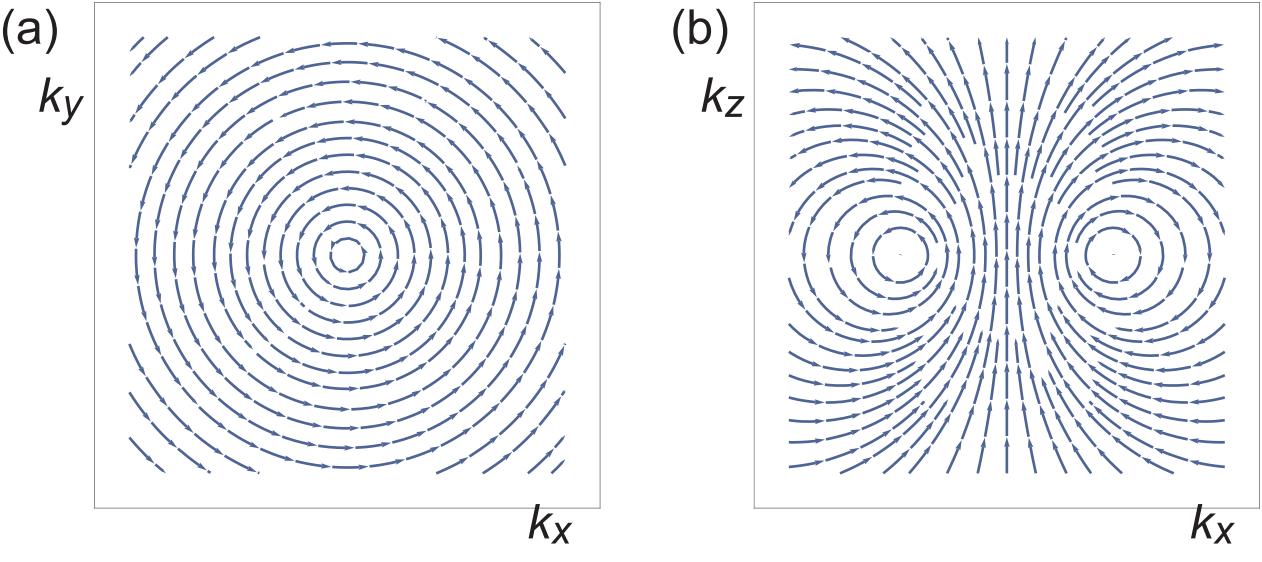 Figure 1
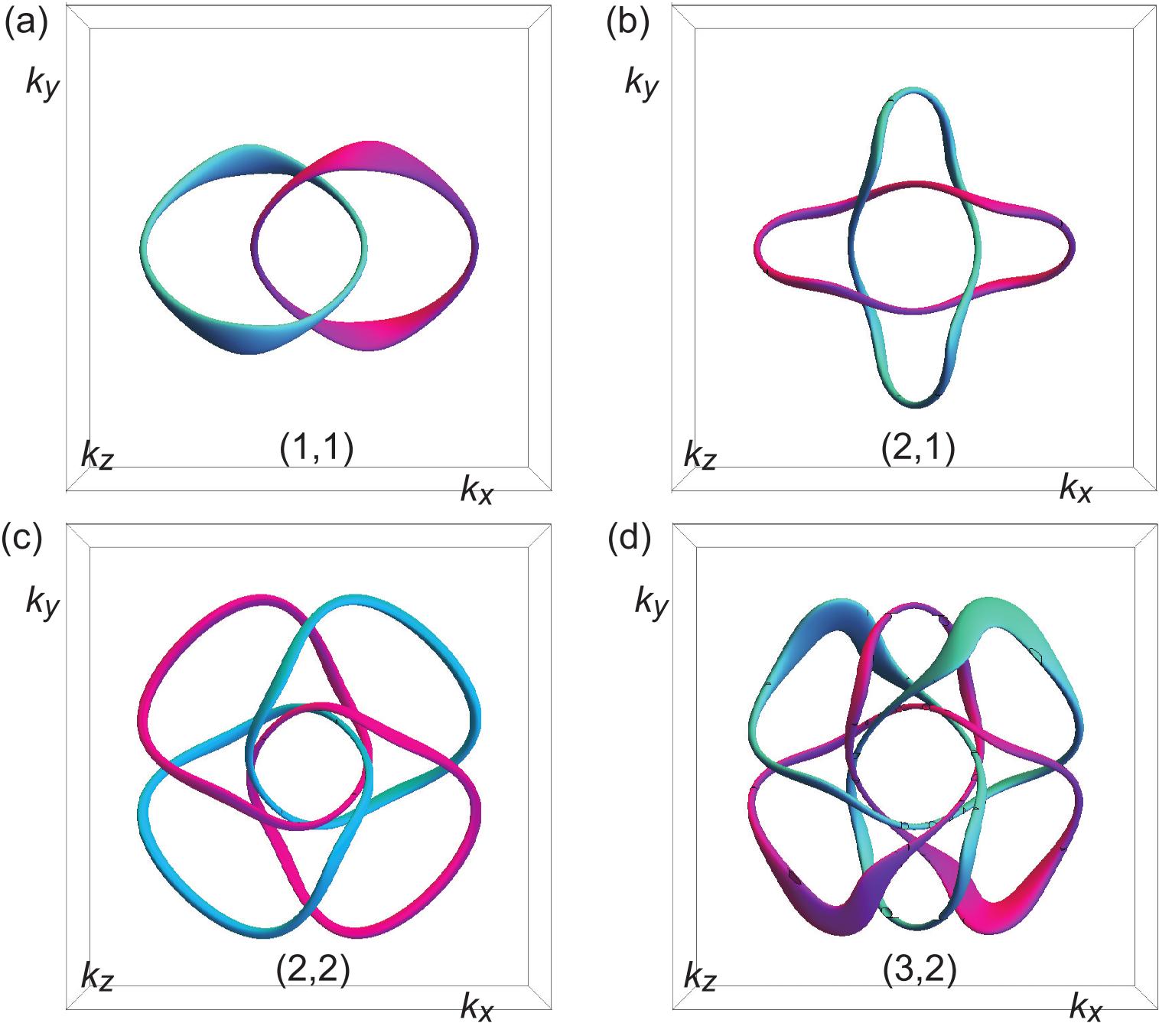 Figure 2
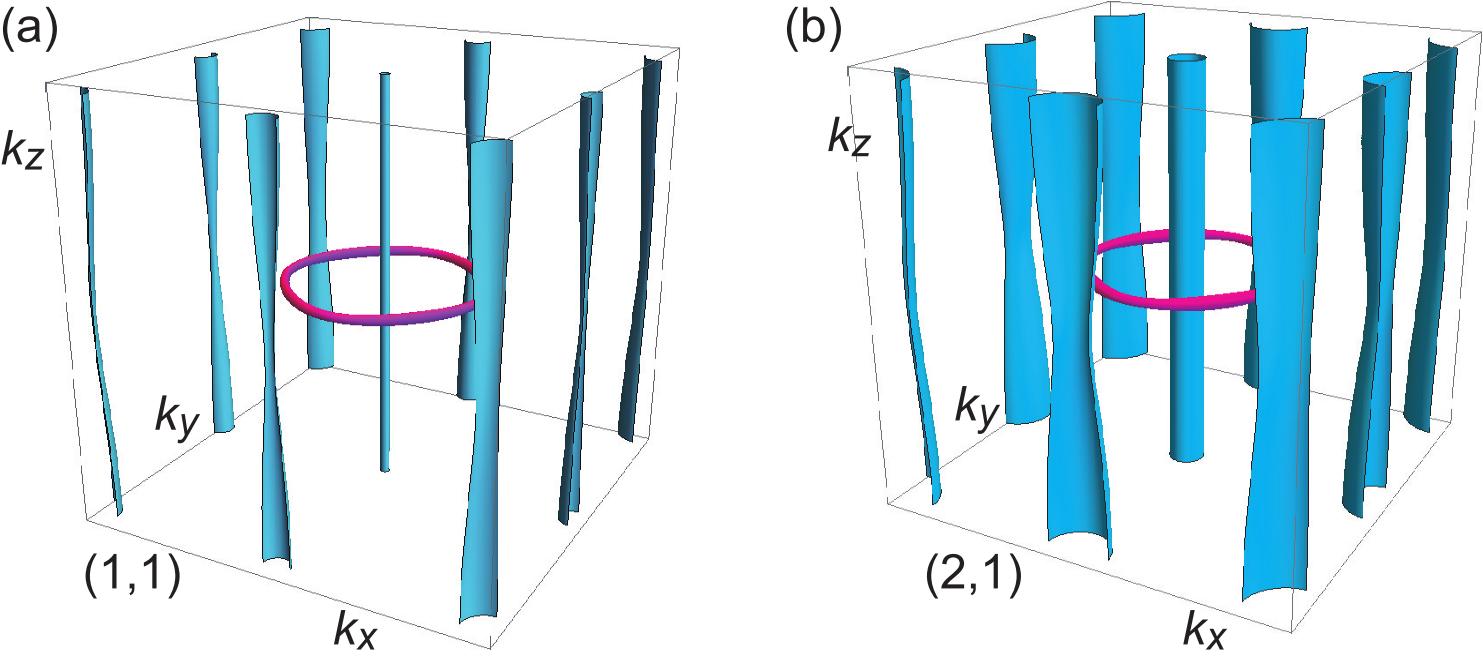 Figure 3
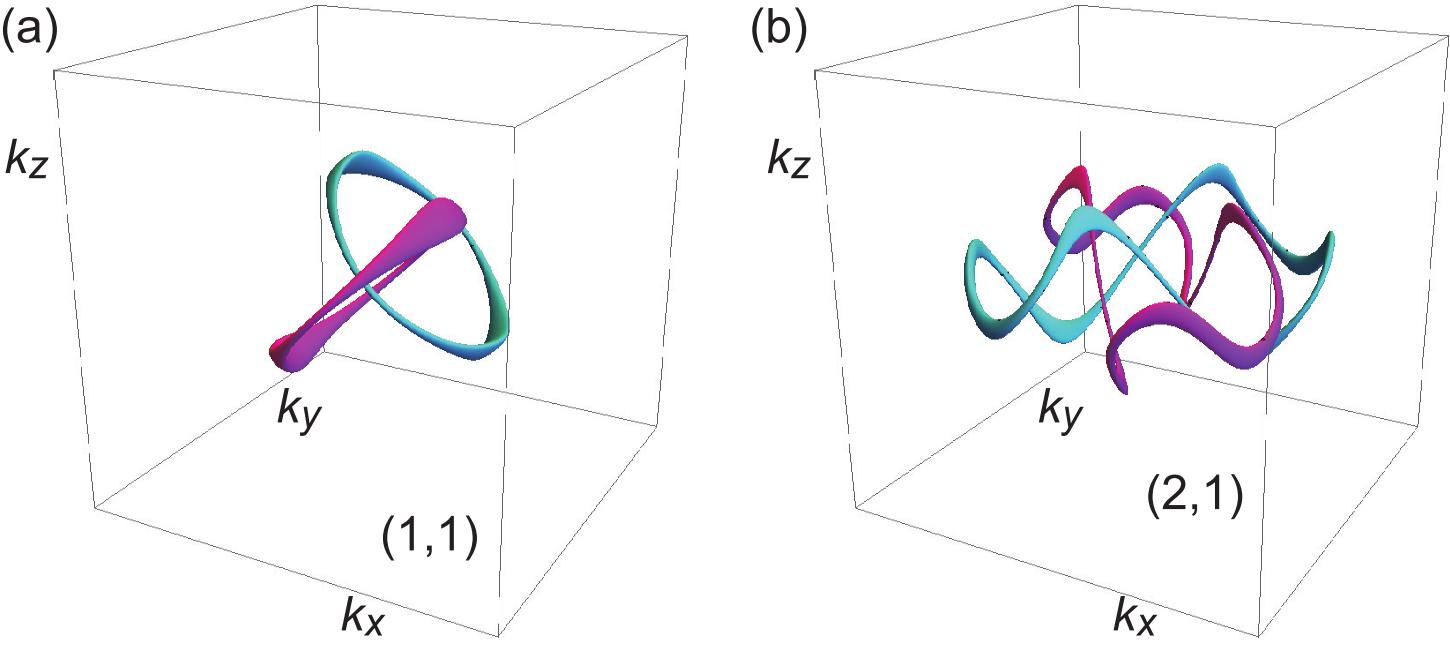 Figure 4
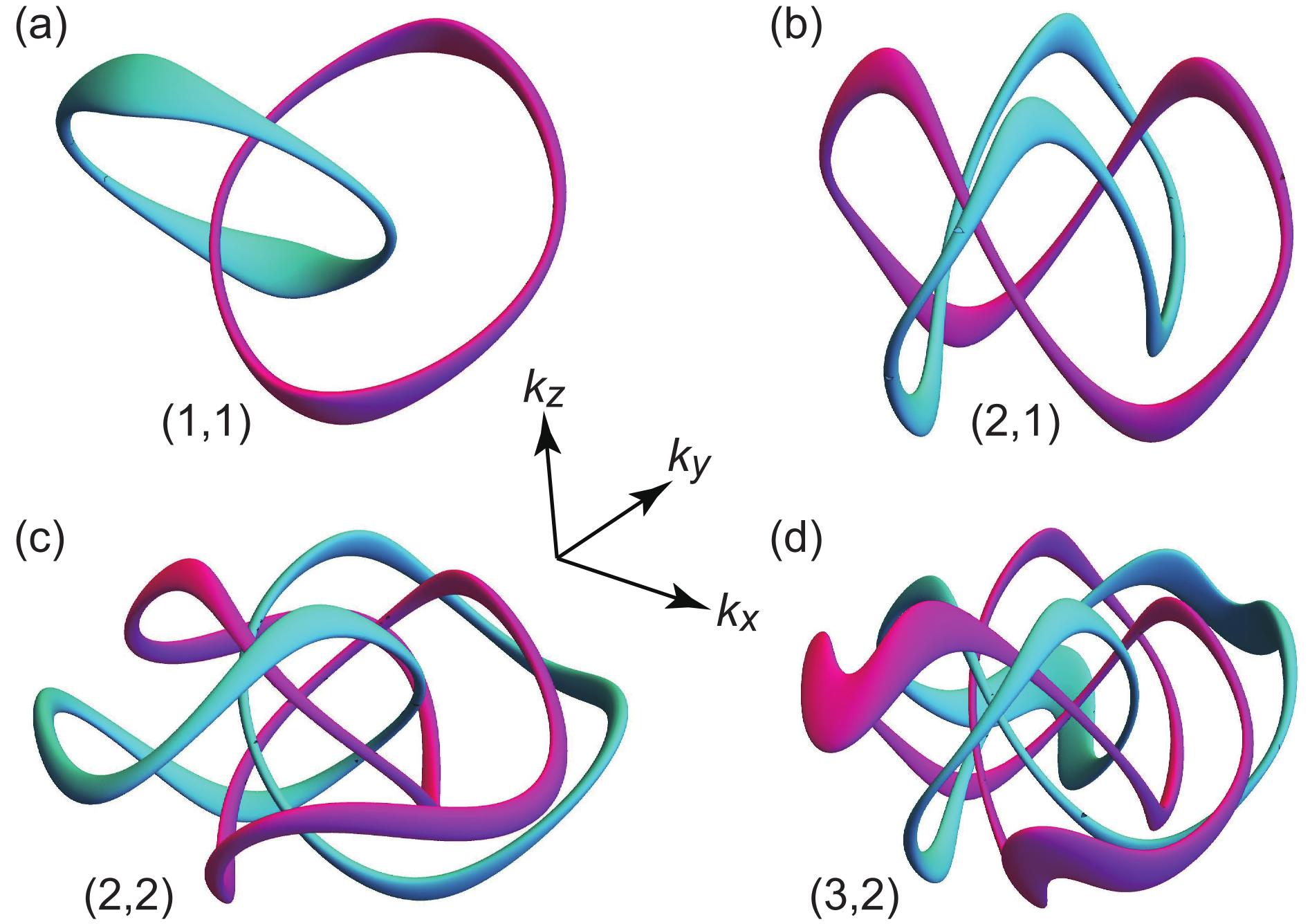 Figure 5
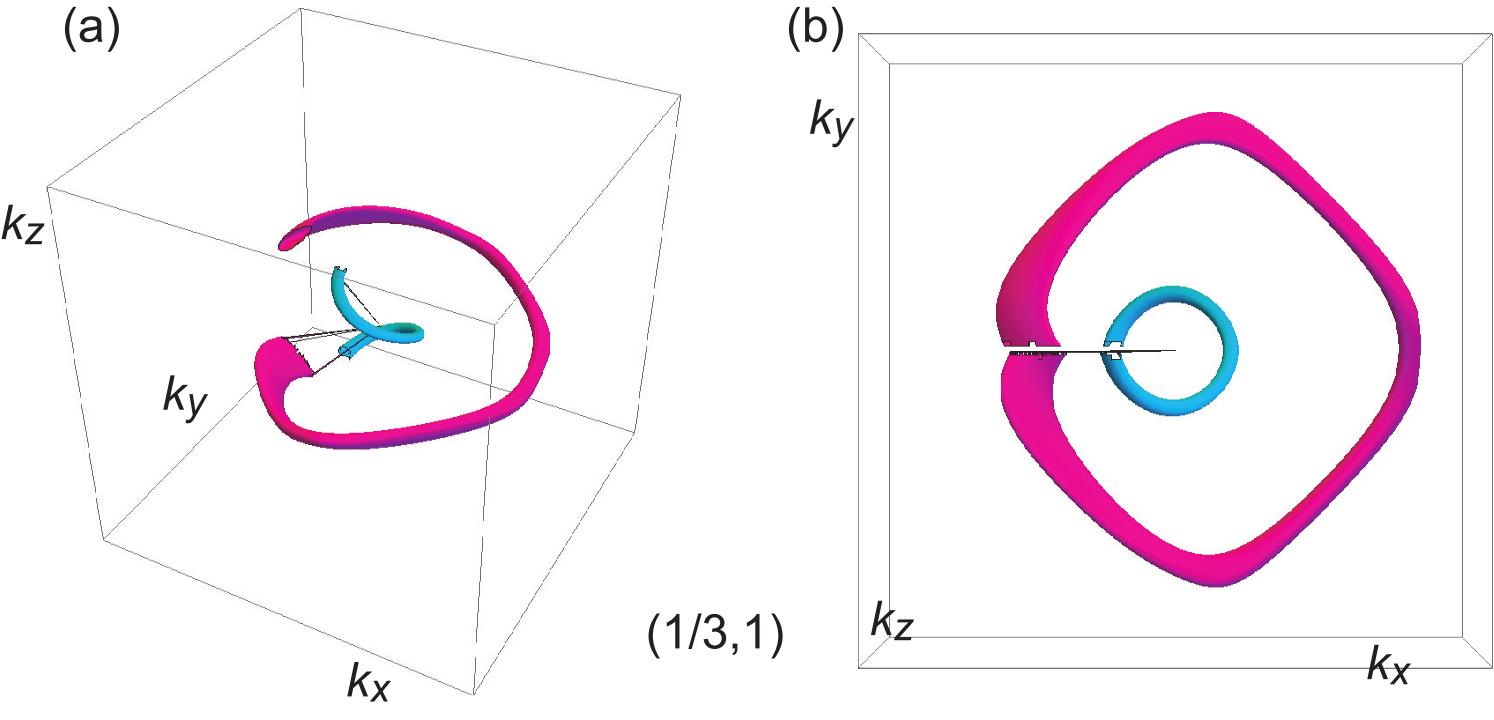 Figure 6
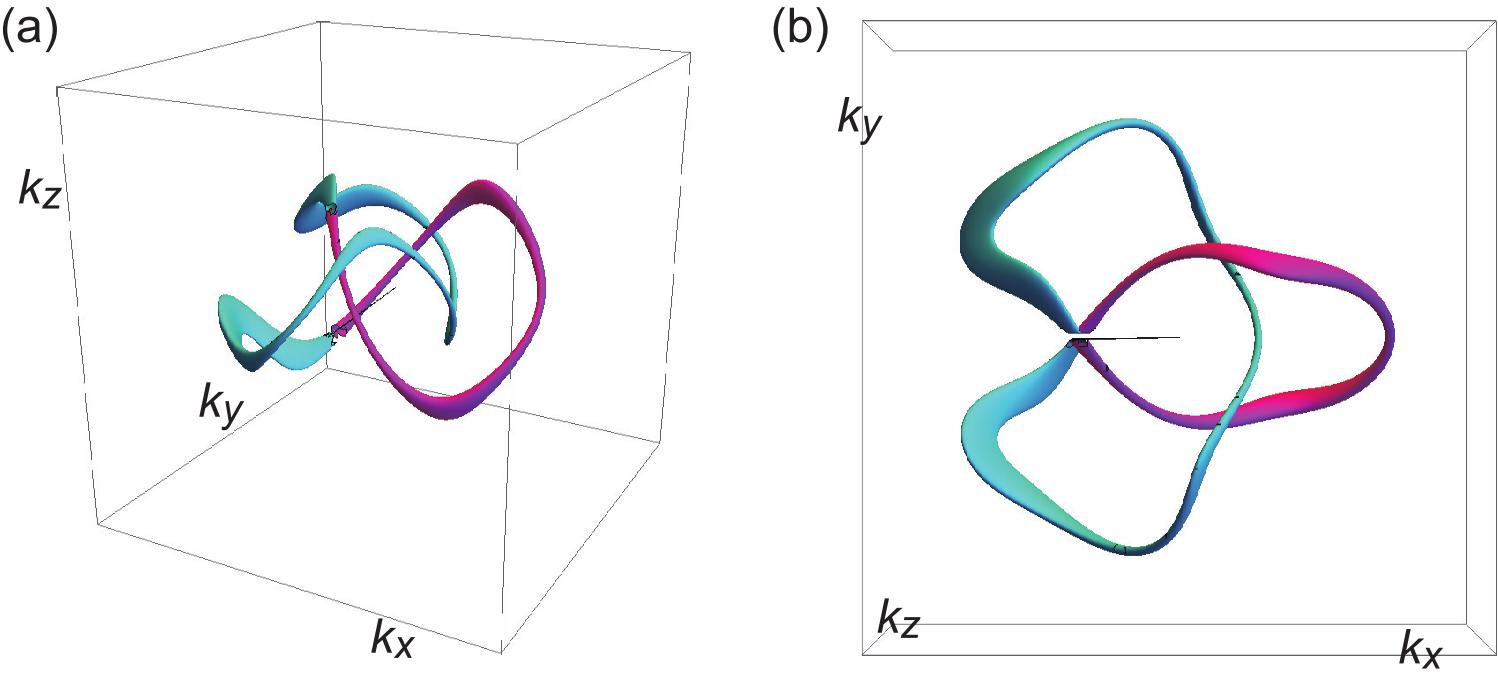 Figure 7
Peer Reviews
No public reviews on file for this paper yet. If you reviewed it on a platform where reviews are public (OpenReview, ICLR, NeurIPS, ICML), you can paste yours below so the community can read it here.
Videos
No videos yet. Explain this paper in a talk, walkthrough, or lecture? Add one.
Topological Semimetals carrying Arbitrary Hopf Numbers:
Hopf-Link, Solomon’s-Knot, Trefoil-Knot and Other Semimetals
Motohiko Ezawa
Department of Applied Physics, University of Tokyo, Hongo 7-3-1, 113-8656, Japan
Abstract
We propose a new type of Hopf semimetals indexed by a pair of numbers , where the Hopf number is given by . The Fermi surface is given by the preimage of the Hopf map, which consists of loops nontrivially linked for a nonzero Hopf number. The Fermi surface forms a torus link, whose examples are the Hopf link indexed by , the Solomon’s knot , the double Hopf-link and the double trefoil-knot . We may choose or to be a half integer, where the Fermi surface is a torus knot such as the trefoil knot . It is even possible to make the Hopf number an arbitrary rational number, where a semimetal whose Fermi surface forms open strings is generated.
Introduction: Weyl semimetals are described by the two-band model equipped with a point node in the three-dimensional (3D) spaceHosur ; Jia . It is characterized by the monopole charge in the momentum spaceMurakami . Line-nodal semimetals or loop-nodal semimetals are also possible in the 3D space, where the zero-energy Fermi surface is given by a line or a closed loopMandal ; Burkov ; Philip ; Xie ; Yu ; Kim ; Yamakage ; Hyper ; CFang ; Hirayama ; Sy . Recently, a nodal-chain semimetal is proposed, where loop nodes touch with each otherChain . A natural question is whether nontrivial Fermi-surfaces made of loop nodes such as links and knots are possible.
The two-band Hamiltonian is a prototype of Hopf insulatorsMoore ; Deng ; Duan ; DengC ; Ken ; Xu , where are the Pauli matrices and is the normalized pseudospin spanning the sphere surface . On the other hand, the 3D Brillouin zone is identical to the torus . A homotopy from to is characterized by the Hopf number. It has been argued that Hopf insulators with arbitrary Hopf numbers are possibleDuan . Nontrivial Hopf textures are also discussed in cold atomsKawaguchi ; Hall , light fieldsKedia and liquid crystalAk .
In this Letter we investigate topological semimetals, where Fermi surfaces consist of nontrivial loops with arbitrary Hopf numbers. We explore the Hamiltonian , where the zero-energy condition reads . The Fermi surface is the preimage of the points in the mapping , and it consists of two loops. They are linked for a nonzero Hopf number. We construct Fermi surfaces comprised of the Hopf link, the Solomon’s knot and others: See Fig.1. They are "torus links" lying on the surface of a torus. Furthermore, we construct Fermi surfaces comprised of torus knots by choosing half integer Hopf numbers, among which there arises in particular a trefoil-node Fermi surface. We can even choose any one rational number as a Hopf number, where the Fermi surface forms open strings though it describes no longer a topological semimetal.
Torus-link semimetals: The Hamiltonian of topological Hopf insulators is given byMoore ; Deng ; Duan ; DengC ; Ken ; Xu
[TABLE]
where is the normalized pseudospin field, . It is written as in terms of the CP1 field . We define it by
[TABLE]
where and are complex numbers given byDuan ; Moore ; Deng ; DengC ; Ken
[TABLE]
while and are integers. We note that and are originally introduced as a set of coprime integerDuan but here we do not impose it. We will see that and can be generalized even to rational numbers though a cut is introduced. The normalized pseudospin is explicitly represented as
[TABLE]
We consider a class of pseudospin textures indexed by a pair of numbers in the Hamiltonian (1).
The CP1 field takes valued on the 3D sphere since it contains four real numbers, , , and , together with the normalization condition . It gives a mapping , for the Brillouin zone is a 3D torus. On the other hand, the normalized pseudospin expressed as defines a mapping , for it takes values on the sphere . Consequently the underlying structure of the Hamiltonian (1) is a mapping from the Brillouin zone to the pseudospin space.
The combined mapping is indexed by the Hopf numberMoore ; Deng ; Duan ; DengC ; Ken ; Xu
[TABLE]
By inserting (3) to this formula we obtain
[TABLE]
We note that the definition of the Hopf number (5) is different from the previous literatureDuan , in which it is defined in terms of rather than . The formula (6) is understood intuitively as follows: When , it is a well-known formula for the Hopf numberDuan , which indicates that there exist one circle in the interior of the torus and one circle around its axis of rotational symmetry. Now, and imply that there exist and of these circles.
The energy spectrum of the Hamiltonian (1) reads . The Fermi surface of the topological Hopf insulator is constructed by the intersection of the three curved surfaces, . In general, the intersection of three surfaces is null, which results in an insulating state.
In order to construct a model having a Fermi surface, it is necessary to reduce the number of the conditions on the zero-energy states. There exist three trivial ways to do so. We may employ any one of the conditions, , , or . Obviously, they are the zero-energy conditions of the following three Hamiltonians,
[TABLE]
respectively. The Fermi surface constructed by the intersection of the two curved surfaces is a line node in general. In all these models we use the same CP1 field (2) to define . Only the Hamiltonian preserves the combination symmetry of the time reversal and inversion symmetry .
The model: We first investigate the Hamiltonian . From the normalization condition on , the zero-energy condition is expressed as . Namely, the Fermi surface is the preimage of the points in the combined Hopf map , which is a circle in the 3D Brillouin zone. Consequently there are at least two loops corresponding to the preimage of and in the 3D Brillouin zone. These two loops form a link when the Hopf number is nonzero.
Various links indexed by a pair are realized in the 3D Brillouin zone. We show an almost zero-energy surface with for in Figs.1 and 2. The preimage of is colored in magenta and that of is colored in cyan. For example, the Hopf link and the Solomon’s knot are realized by taking pairs and , respectively. The Fermi surface for is given by the combination of two trefoils, which we call a double trefoil.
We recall the terminology in the link theory. A link lying on the surface of a torus is called a torus link. The torus link winds times around a circle in the interior of the torus, and times around its axis of the rotational symmetry. In the present context, the surface determined by the condition gives a torus. Thus the node indexed by is the torus link , where the factor appears because it is the preimage of the two points . According to the link theory, is identical to . Furthermore, link and are mirror images of .
If and are not relatively prime, we have a torus link with more than one component. The number of the loops is given by gcdgcd, where gcd represents the greatest common divisor. For example, the Fermi surface consists of four loop nodes for and . This looks a bit odd since we have discussed that two loops arise as the preimage of . It is an interesting problem how such a Fermi surface consisting more than two loops is realized for gcd. We assume gcd. Then we can write and , where and are coprime integers. The solutions are given by and , where and satisfy the for the model with and . The roots of and have solutions, which results in the Fermi loops.
In the following, we derive the equations to determine the link. The zero-energy states must satisfy the condition . By combining it with the normalization condition , the CP1 field is parametrized as
[TABLE]
The zero-energy states correspond to , which reads
[TABLE]
The solution is given by . We find the relation , or
[TABLE]
These two equations determine the Fermi surface made of links.
The model: The Fermi surface of is topologically equivalent to that of model. The only difference is that the Fermi surface is rotated 90 degree between the and models.
The model: The Fermi surface of looks very different, where some of the Fermi surfaces form lines penetrating the whole Brillouin zone: See Fig.3. The model is instructive since we obtain various analytical expressions.
The zero-energy condition in the model is given by the preimage of . By combining it with the normalization condition , the preimage of is given by and , which is equivalent to the condition , where
[TABLE]
The solution is
[TABLE]
which represents -fold degenerate loop nodes.
On the other hand, the preimage of is given by and , which is equivalent to the condition , where
[TABLE]
The solution represents p-fold degenerate line nodes along the direction described by , , with , where and are integers.
We may also analyze this Hamiltonian system from the view point of the Berry curvature. We introduce a continuum model defined by
[TABLE]
The Fermi surface is topologically equivalent to the original model (3). The only difference is the approximation of the loop (13) by the circle , which does not change the linking structure.
By using them we may derive explicitly the eigenstate of the Hamiltonian (9). The Berry connection is given by
[TABLE]
where we have introduced the polar coordinate and . We show the Berry curvature in Fig.5. We find a vortex structure along a line node (cyan line in Fig.3) described by , , with , and a circle described by , . Actually this line node has a p-fold degeneracy. Indeed, we calculate the Berry phase along a loop encircling the line node to find that
[TABLE]
which is quantized and represents the degeneracy. In the same way, the Berry phase along a small circle around a loop node (magenta loop in Fig.3) is obtained as
[TABLE]
representing the degeneracy of the loop node. Thus the indices and are detected separately, while only the product appears in the Hopf number.
Torus-knot semimetals: We have seen that the Fermi surfaces consist of at least two loops, which form a torus link. It is an interesting problem whether we can construct a Fermi surface consist of one nontrivial loop, which is a torus knot. Since the number of loops is given by gcd, we must take one of and non-integer. We find that a torus-knot Fermi surface is realized by taking a half-integer . For example, we can realize a trefoil Fermi surface by taking and , which is shown in Fig.4. There is a cut in the momentum space due to the square root contribution in the Hamiltonian. Namely, only the magenta or cyan curve does not form a closed loop but form a loop with the combination of them.
Open string semimetals: It is possible to choose even any rational numbers for or , which creates an open string Fermi surface as shown in Fig.6. This is understood as follows. The model with and gives the torus link . If one of the and is not a half integer, it cannot describe a closed loop, generating to an open string. The ends of the open string are on the cut plane.
The author is very much grateful to N. Nagaosa for many helpful discussions on the subject. This work is supported by the Grants-in-Aid for Scientific Research from MEXT KAKENHI (Grant Nos.JP17K05490 and 15H05854).
Note added: During the preparation of this manuscript, we became aware of closely related worksWChen ; ZYan ; PYChang , where various linked nodal semimetals are proposed. Especially, this work has turned out to be a generalization of the work ZYan , where only the case with is studied.
The reference list from the paper itself. Each links out to its DOI / PubMed record.
- 1(1) P. Hosur, X.L. Qi, C. R. Physique 14, 857 (2013).
- 2(2) S. Jia, S.-Y. Xu, M. Z. Hasan, Nature Materials 15, 1140 (2016).
- 3(3) S. Murakami, New J. Phys. 9, 356 (2007).
- 4(4) T. Bzduek, Q.-S. Wu, A. Ruegg, M. Sigrist and A. A. Soluyanov, Nature 538 , 75 (2016).
- 5(5) S. Mandal and N. Surendran Phys. Rev. B 79 , 024426 (2009).
- 6(6) A. A. Burkov, M. D. Hook, and L. Balents, Phys. Rev. B 84 , 235126 (2011).
- 7(7) M. Phillips and V. Aji, Phys. Rev. B 90 , 115111 (2014).
- 8(8) C. Fang, Y. Chen, H.-Y. Kee and L. Fu, Phys. Rev. B 92 , 081201 (2015).