Ultrabroadband supercontinuum generation and frequency-comb stabilization using on-chip waveguides with both cubic and quadratic nonlinearities
Daniel D. Hickstein, Hojoong Jung, David R. Carlson, Alex Lind, Ian, Coddington, Kartik Srinivasan, Gabriel G. Ycas, Daniel C. Cole, Abijith, Kowligy, Connor Fredrick, Stefan Droste, Erin S. Lamb, Nathan R. Newbury,, Hong X. Tang, Scott A. Diddams, and Scott B. Papp

TL;DR
This paper demonstrates on-chip aluminum-nitride waveguides capable of generating ultrabroadband supercontinuum light and stabilizing frequency combs through multiple nonlinear processes, advancing integrated photonic spectroscopy and metrology.
Contribution
It introduces a novel on-chip platform using aluminum nitride waveguides that combine quadratic and cubic nonlinearities for supercontinuum generation and frequency comb stabilization.
Findings
Generated supercontinuum from 500 nm to 4000 nm.
Achieved stabilization of the laser comb's carrier-envelope-offset frequency.
Produced significant power in the mid-infrared for molecular spectroscopy.
Abstract
Using aluminum-nitride photonic-chip waveguides, we generate optical-frequency-comb supercontinuum spanning from 500 nm to 4000 nm with a 0.8 nJ seed pulse, and show that the spectrum can be tailored by changing the waveguide geometry. Since aluminum nitride exhibits both quadratic and cubic nonlinearities, the spectra feature simultaneous contributions from numerous nonlinear mechanisms: supercontinuum generation, difference-frequency generation, second-harmonic generation, and third-harmonic generation. As one application of integrating multiple nonlinear processes, we measure and stabilize the carrier-envelope-offset frequency of a laser comb by direct photodetection of the output light. Additionally, we generate ~0.3 mW in the 3000 nm to 4000 nm region, which is potentially useful for molecular spectroscopy. The combination of broadband light generation from the visible through the…
Click any figure to enlarge with its caption.
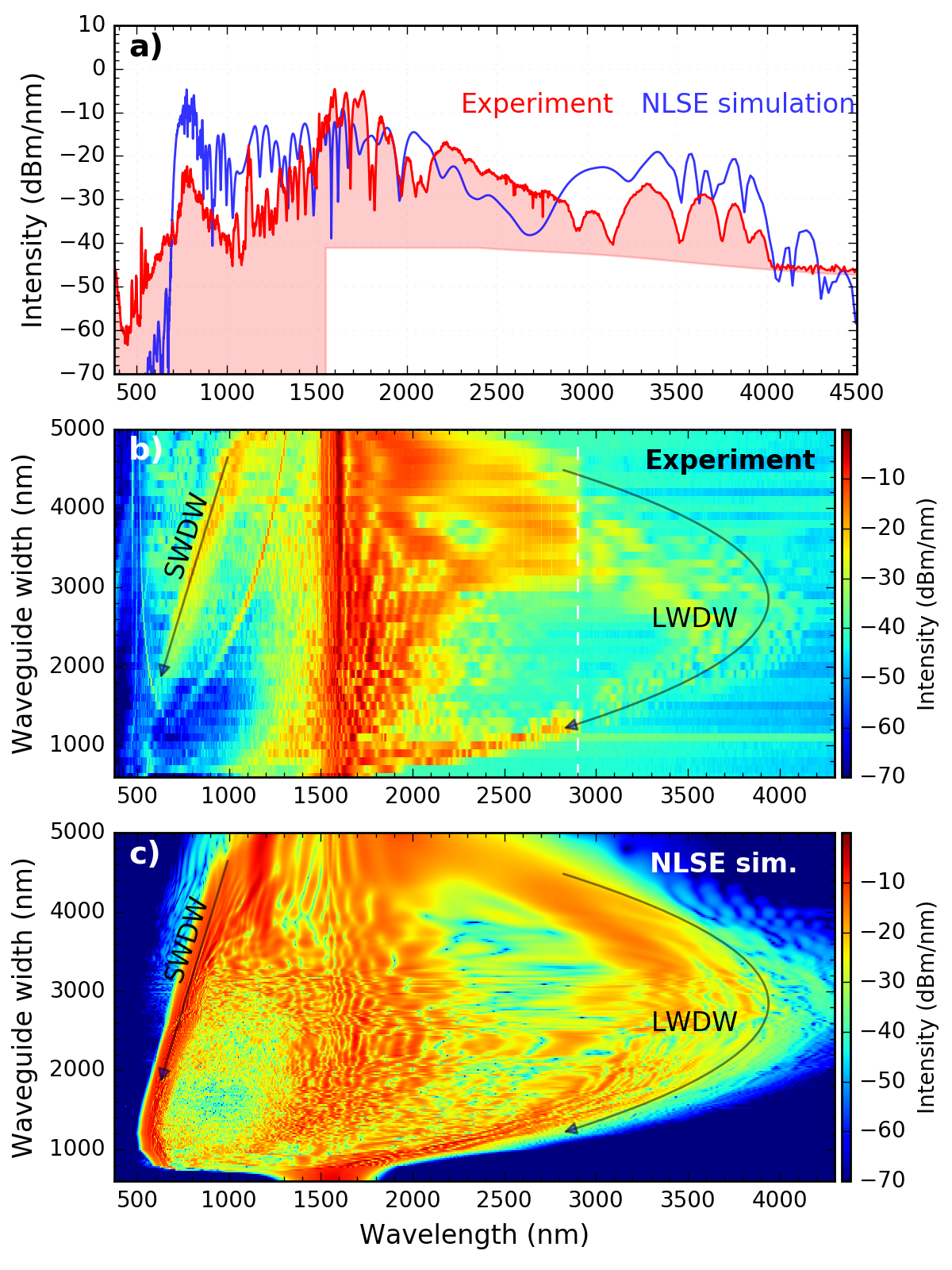 Figure 1
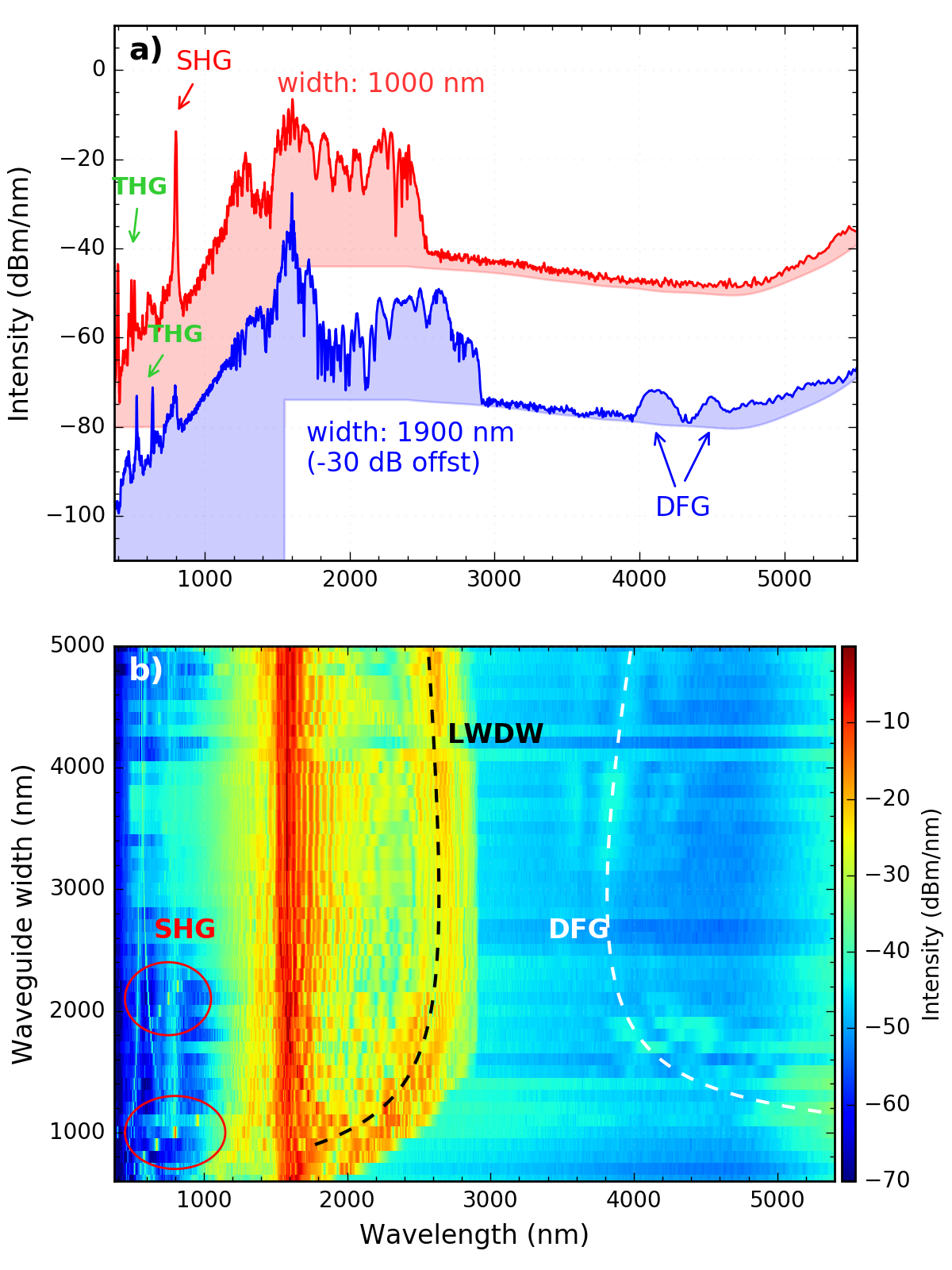 Figure 2
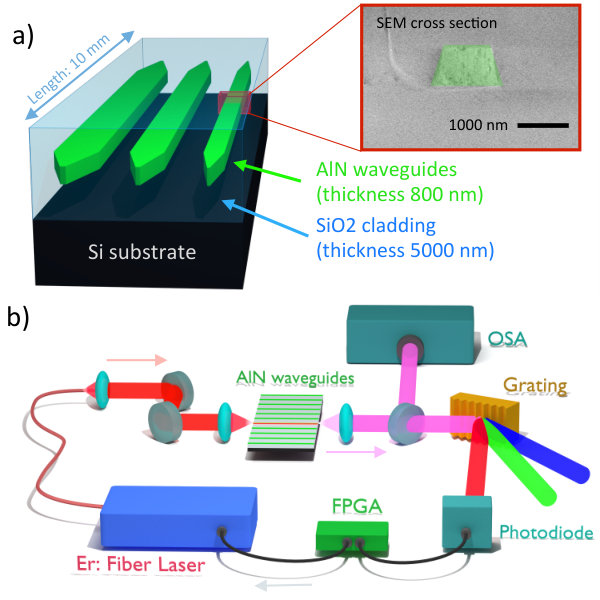 Figure 1
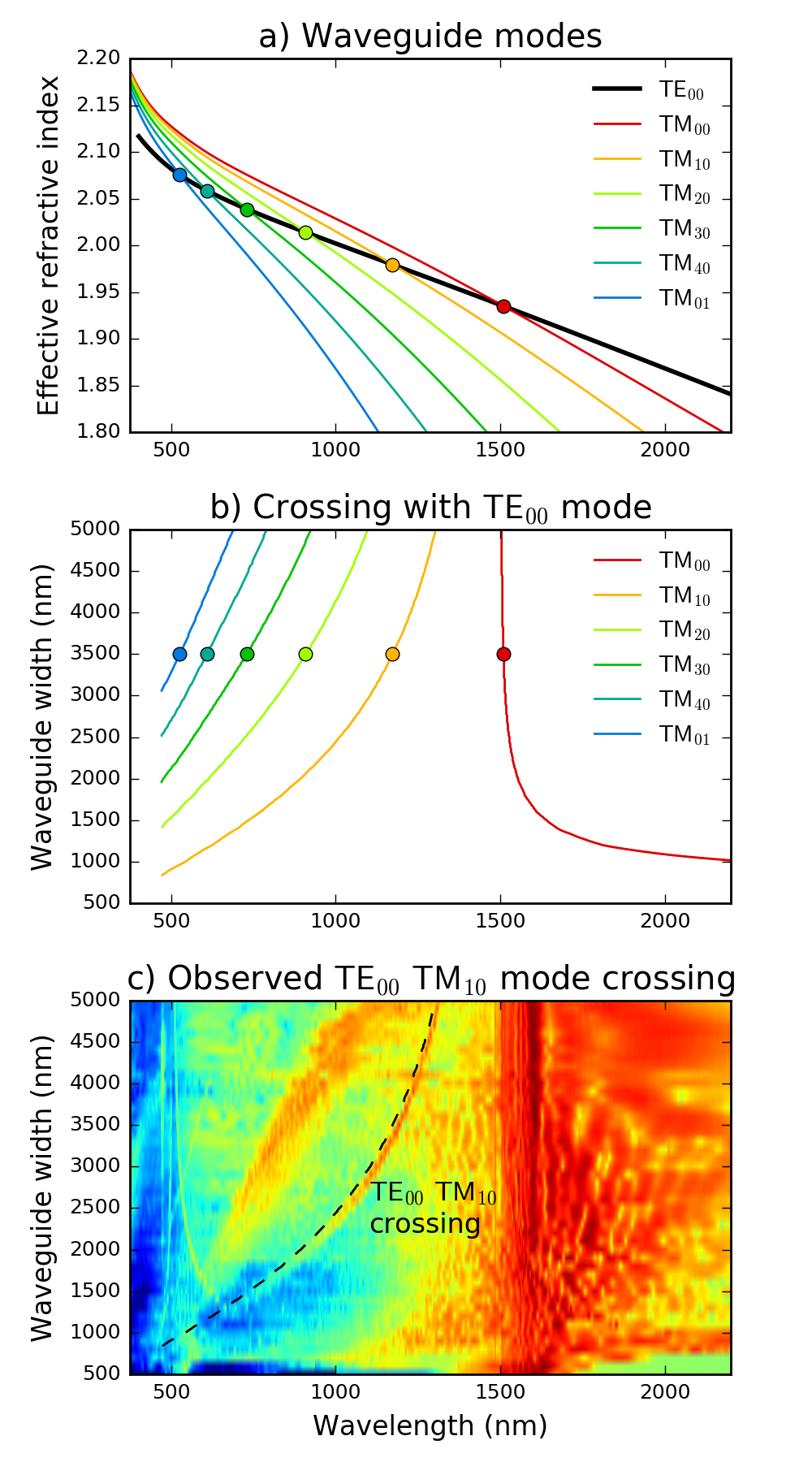 Figure 4
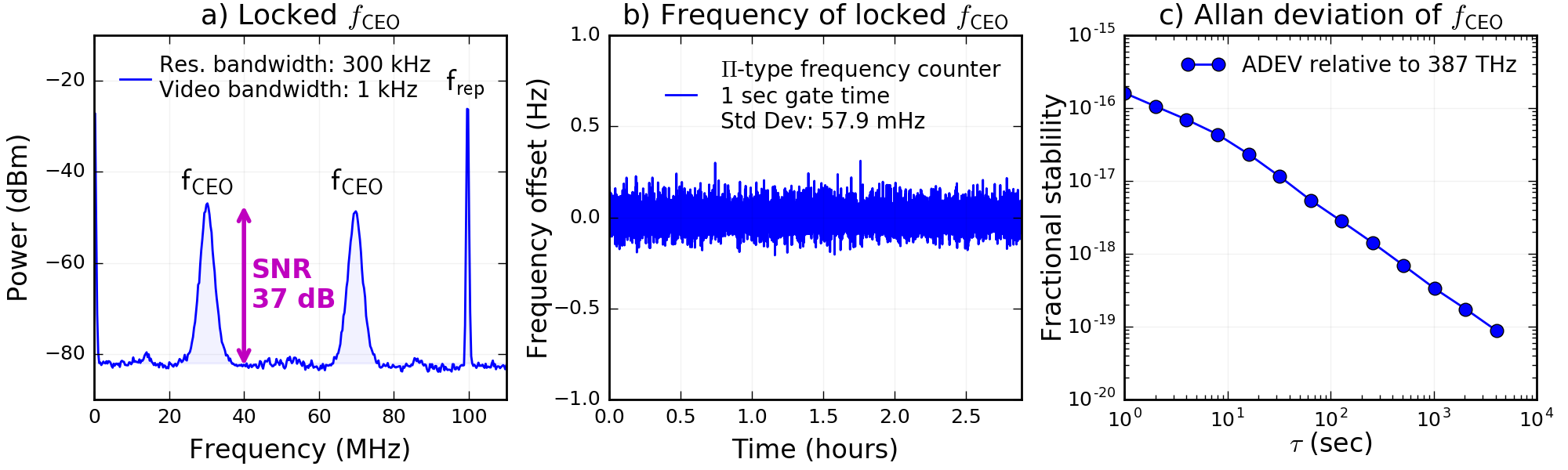 Figure 5
Peer Reviews
No public reviews on file for this paper yet. If you reviewed it on a platform where reviews are public (OpenReview, ICLR, NeurIPS, ICML), you can paste yours below so the community can read it here.
Videos
No videos yet. Explain this paper in a talk, walkthrough, or lecture? Add one.
Ultrabroadband supercontinuum generation and frequency-comb stabilization using on-chip waveguides with both cubic and quadratic nonlinearities
Daniel D. Hickstein
Time and Frequency Division, National Institute of Standards and Technology, Boulder, Colorado 80305, U.S.A.
Hojoong Jung
Department of Electrical Engineering, Yale University, New Haven, Connecticut, 06520, U.S.A
David R. Carlson
Time and Frequency Division, National Institute of Standards and Technology, Boulder, Colorado 80305, U.S.A.
Alex Lind
Time and Frequency Division, National Institute of Standards and Technology, Boulder, Colorado 80305, U.S.A.
Department of Physics, University of Colorado, Boulder, Colorado, 80309, U.S.A.
Ian Coddington
Applied Physics Division, National Institute of Standards and Technology, Boulder, Colorado 80305, U.S.A.
Kartik Srinivasan
Center for Nanoscale Science and Technology, National Institute of Standards and Technology, Gaithersburg, Maryland 20899, U.S.A.
Gabriel G. Ycas
Time and Frequency Division, National Institute of Standards and Technology, Boulder, Colorado 80305, U.S.A.
Daniel C. Cole
Time and Frequency Division, National Institute of Standards and Technology, Boulder, Colorado 80305, U.S.A.
Department of Physics, University of Colorado, Boulder, Colorado, 80309, U.S.A.
Abijith Kowligy
Time and Frequency Division, National Institute of Standards and Technology, Boulder, Colorado 80305, U.S.A.
Connor Fredrick
Time and Frequency Division, National Institute of Standards and Technology, Boulder, Colorado 80305, U.S.A.
Department of Physics, University of Colorado, Boulder, Colorado, 80309, U.S.A.
Stefan Droste
Applied Physics Division, National Institute of Standards and Technology, Boulder, Colorado 80305, U.S.A.
Erin S. Lamb
Time and Frequency Division, National Institute of Standards and Technology, Boulder, Colorado 80305, U.S.A.
Nathan R. Newbury
Applied Physics Division, National Institute of Standards and Technology, Boulder, Colorado 80305, U.S.A.
Hong X. Tang
Department of Electrical Engineering, Yale University, New Haven, Connecticut, 06520, U.S.A
Scott A. Diddams
Time and Frequency Division, National Institute of Standards and Technology, Boulder, Colorado 80305, U.S.A.
Department of Physics, University of Colorado, Boulder, Colorado, 80309, U.S.A.
Scott B. Papp
Time and Frequency Division, National Institute of Standards and Technology, Boulder, Colorado 80305, U.S.A.
(March 16, 2024)
Abstract
Using aluminum-nitride photonic-chip waveguides, we generate optical-frequency-comb supercontinuum spanning from 500 nm to 4000 nm with a 0.8 nJ seed pulse, and show that the spectrum can be tailored by changing the waveguide geometry. Since aluminum nitride exhibits both quadratic and cubic nonlinearities, the spectra feature simultaneous contributions from numerous nonlinear mechanisms: supercontinuum generation, difference-frequency generation, second-harmonic generation, and third-harmonic generation. As one application of integrating multiple nonlinear processes, we measure and stabilize the carrier-envelope-offset frequency of a laser comb by direct photodetection of the output light. Additionally, we generate 0.3 mW in the 3000 nm to 4000 nm region, which is potentially useful for molecular spectroscopy. The combination of broadband light generation from the visible through the mid-infrared, combined with simplified self-referencing, provides a path towards robust comb systems for spectroscopy and metrology in the field.
I Introduction
Optical frequency combs are laser-based light sources that enable a wide variety of precision measurements, including the comparison of state-of-the-art atomic clocks Rosenband et al. (2008), the quantitative measurement of pollution over several-kilometer paths above cities Rieker et al. (2014); Waxman et al. (2017), and even the search for distant Earth-like planets Li et al. (2008); Ycas et al. (2012). Laser frequency combs are typically generated with relatively narrow (10 %) relative spectral bandwidth Kippenberg et al. (2011). However, broad bandwidth is a requirement for many applications, such as spectroscopy, where it is desirable to probe several atomic or molecular transitions simultaneously, and optical frequency metrology, where stable lasers at different wavelengths must be compared. Consequently, narrowband frequency combs are usually spectrally broadened to at least one octave via supercontinuum generation (SCG) in materials with cubic nonlinearity (), such as highly nonlinear fiber (HNLF) or photonic crystal fiber Dudley et al. (2006).
Moreover, octave-spanning bandwidth allows the carrier-envelope-offset frequency () of the frequency comb to be measured (and subsequently stabilized) using “f–2f” self referencing Jones et al. (2000); Holzwarth et al. (2000); Diddams et al. (2000). In the f–2f scheme, the low frequency portion of the spectrum undergoes second harmonic generation (SHG) in a material with quadratic nonlinearity (), such as , and interferes with the high-frequency portion of the spectrum, producing a signal that oscillates at . Due to the modest effective nonlinearity of silica HNLF, SCG using traditional silica fiber requires high peak powers (typically 10 kW or more), which increases the electrical power requirements of the laser and limits the achievable repetition rates. Indeed, the adoption of new and compact frequency comb sources at gigahertz repetition rates, such as electro-optic combs Kobayashi et al. (1972); Torres-Company and Weiner (2014) and microresonator combs Kippenberg et al. (2011); Del’Haye et al. (2007); Herr et al. (2014a), is currently hindered by the difficulty of generating octave-spanning spectra using low-peak-power pulses. In addition, many potential applications of frequency combs require supercontinuum light at wavelengths that are difficult to achieve with SCG in silica fiber. In particular, light in the mid-infrared ( to ) region is advantageous for molecular spectroscopy Schliesser et al. (2012); Coddington et al. (2016); Truong et al. (2016); Giorgetta et al. (2015); Cossel et al. (2017), but is absorbed by silica fiber.
Fortunately, on-chip photonic waveguides with wavelength-scale dimensions offer high confinement of light, which provides a substantial increase in the effective nonlinearity
[TABLE]
where is the wavelength, is the effective area of the mode, and is the material-dependent nonlinear index, which is directly proportional to Dudley et al. (2006). In addition, materials with higher – such as silicon nitride Epping et al. (2015); Porcel et al. (2017); Klenner et al. (2016); Mayer et al. (2015); Boggio et al. (2014); Hickstein et al. (2016); Carlson et al. (2017a); Johnson et al. (2015), silicon Singh et al. (2015); Hsieh et al. (2007); Leo et al. (2015), aluminum gallium arsenide Pu et al. (2016), and chalcogenide materials Yu et al. (2013); Lamont et al. (2008) – further increase and allow much lower peak power ( kW) to be used for the SCG process. High confinement waveguides provide the additional advantage of increased control over the group-velocity dispersion (GVD), and therefore the spectral output of the SCG process.
Currently, supercontinuum generation in materials with both strong and nonlinearities is opening new possibilities for broadband light sources. For example, experiments with periodically poled (PPLN) have demonstrated supercontinuum generation via cascaded processes, and the simultaneous generation of supercontinuum and harmonic light Iwakuni et al. (2016); Guo et al. (2015); Langrock et al. (2007). Recently, aluminum nitride (AlN) has emerged as a lithographically compatible material that exhibits both strong and nonlinearities in addition to a broad transparency window. Consequently, thin-film AlN is proving to be a versatile platform for nanophotonics, providing phase-matched second-harmonic generation (SHG) Guo et al. (2016a), frequency comb generation Jung et al. (2013), and ultraviolet light emission Zhao et al. (2015).
Here we present the first observations of SCG in lithographically fabricated, on-chip AlN waveguides and demonstrate that the platform provides exciting new capabilities: (1) We observe SCG from 500 nm to 4000 nm, and show the spectrum can be tailored simply by changing the geometry of the waveguide. (2) We find that the material birefringence induces a crossing of the transverse-electric (TE) and transverse-magnetic (TM) modes, which enhances the spectral brightness in a narrow band, and that the spectral location of this band can be adjusted by changing the waveguide dimensions. (3) We observe bright SHG, which is phase-matched via higher-order modes of the waveguide, as well as phase-mismatched difference frequency generation (DFG), which produces broadband light in the 3500 nm to 5500 nm region. (4) We demonstrate that simultaneous SCG and SHG processes in an AlN waveguide allows to be extracted directly from the photodetected output, with no need for an external SHG crystal, recombination optics, or delay stage. (5) We use this simple scheme to lock the of a compact laser frequency comb, and find that the stability of the locked is comparable to a standard – interferometer and sufficient to support precision measurements.
II Experiment
The fully -clad AlN waveguides Jung et al. (2013); Xiong et al. (2012) have a thickness (height) of 800 nm, and a width that varies from 400 nm to 5100 nm. Near the entrance and exit facets of the chip, the waveguide width tapers to 150 nm in order to expand the mode and improve the coupling efficiency, which is estimated at -4 dB/facet, on average. We generate supercontinuum by coupling into the waveguide approximately 80 mW of 1560 nm light from a compact, turn-key Er-fiber frequency comb Sinclair et al. (2015), which produces 80 fs pulses at 100 MHz. The polarization of the light is controlled using achromatic quarter- and half-waveplates. The light is coupled into each waveguide using an aspheric lens (NA=0.6) designed for 1550 nm. For output coupling, two different techniques are used, as shown in Fig. 1b. In the case of detection, the light is out-coupled using a visible wavelength microscope objective (NA=0.85) and then dispersed with a grating before illuminating a photodiode. Alternatively, when recording the spectrum, the light is collected by butt-coupling a multimode fiber (NA=0.26) at the exit facet of the chip. The waveguide output is then recorded using two optical spectrum analyzers (OSAs); a grating-based OSA is used to record the spectrum across the visible and near-infrared regions, while a Fourier-transform OSA extends the coverage to 5500 nm.
To model the supercontinuum generation, we perform numerical simulations using the nonlinear Schrödinger equation (NLSE), as implemented in the PyNLO package Hult (2007); Heidt (2009); Ycas et al. (2016); Amorim et al. (2009). The effective refractive indices and effective nonlinearities of the waveguides are calculated using the vector finite-difference modesolver of Fallahkhair, Li, and Murphy Fallahkhair et al. (2008). The NLSE includes effects and incorporates the full wavelength dependence of the effective index, but it does not take into account any effects, higher order modes, or wavelength-dependent absorption.
III Results and Discussion
III.1 Supercontinuum from visible to mid-infrared
When pumped in the lowest-order quasi-transverse-electric mode (), the AlN waveguides generate light (Fig. 2) from the blue portion of the visible region (500 nm) to the mid-infrared (4000 nm). The broad peaks on both sides of the spectrum are the short-wavelength and long-wavelength dispersive waves (labeled “SWDW” and “LWDW” in Fig. 2b,c), which are generated at locations determined by the GVD of the waveguide Akhmediev and Karlsson (1995); Dudley et al. (2006). The broadband spectrum is a result of the flat GVD profile enabled by strong confinement of the light in these waveguides. The simulated spectra (Fig. 2c) reproduce the spectral location of thee long-wavelength and short-wavelength dispersive waves. However, the NLSE simulations overestimate the light intensity in the dispersive waves compared with the experiment. One reason for this discrepancy is that the waveguide mode at 1560 nm does not have perfect overlap with modes at different wavelengths, and the effective nonlinearity is actually smaller than what is predicted by Eq. 1, which assumes perfect mode-overlap. This effect is most pronounced at longer wavelengths, where the mode extends significantly outside of the waveguide and does not overlap well with the 1560 nm mode, which is mostly confined within the AlN waveguide.
When waveguide widths near 3500 nm are used, the supercontinuum shows high spectral intensity over a broad region from 1400 nm to 2800 nm, generally remaining within dB of the transmitted pump intensity. This bright spectrum represents a promising source for molecular spectroscopy, since OH stretching transitions absorb in this region Solomons and Fryhle (2009). Indeed, sharp dips visible in the spectral intensity near 2700 nm are due to the absorption of water vapor in the OSA. Unfortunately, a sharp minimum in the spectrum near 2900 nm, and decreased intensity at wavelengths longer that 2900 nm suggests that these mid-infrared wavelengths are not efficiently transmitted through the waveguides. This loss is likely due to OH absorption Navarra et al. (2005) in the , since a significant fraction of the mode extends outside the AlN waveguide and into the cladding at these wavelengths. In the future, the use of a different cladding material could increase the output of mid-infrared light. Nevertheless, the waveguides still produce usable, broadband light in the mid-infrared region – for example, we estimate that the 2600-nm waveguide produces mW in the 3500 nm to 4000 nm spectral region, which is sufficient power for some applications. Indeed, the mid-infrared light is easily seen in Fig. 2b, which presents spectra collected with just a few seconds integration time for each spectrum.
III.2 Brightness enhancement via a mode crossing
In the 800 nm to 1200 nm region, a sharp peak is seen in the supercontinuum spectrum for waveguide widths 1500 nm (Figs. 2b and 3c), which is not explained by the NLSE. The location of the peak occurs at the wavelength where the refractive index of the lowest order TE mode () and a higher order quasi-TM mode () cross (Fig. 3a). While such mode crossings are commonplace in Kerr-comb generation in microring resonators Cole et al. (2016); Ramelow et al. (2014); Herr et al. (2014b), they are not typically seen in supercontinuum generation in straight waveguides, because the usually has the highest effective index at all wavelengths. In the case of AlN waveguides, the polarization-mode crossing occurs because AlN is a birefringent material, and the bulk index for the vertical (TM) polarization is higher than for the horizontal (TE) polarization. At short wavelengths, where the waveguide geometry provides only a small modification to the refractive index, the TM modes tend to have the highest effective index. However, at longer wavelengths, geometric dispersion plays a larger role, lowering the effective index of the TM modes more than the TE modes and causing the polarization-mode crossing. Similarly, since modifications of the waveguide width tend to change the effective index of the TE modes more than the TM modes, the spectral location of the mode crossing also depends on the width of the waveguide (Fig. 3b).
A mode crossing causes a sharp feature in the GVD, which can allow for the phase-matching of four-wave-mixing processes in spectral regions that would otherwise be phase-mismatched Cole et al. (2016); Ramelow et al. (2014). Indeed, the crossing of the and modes enables a strong enhancement of the supercontinuum spectrum in a spectral region that is otherwise dim. In some cases, this mode crossing enables a dB enhancement of the spectral intensity. This enhancement enables a new degree of control over the spectral output, providing a narrow, bright region that could, for example, be used to measure a heterodyne beat with a narrow-band atomic-clock laser. It is not clear why the crossing with the mode is clearly seen in the experiment, while the crossings with the higher order TM modes are absent. Understanding what mechanism couples the modes, and how this coupling could be enhanced, would allow for further customization of the spectral output of this supercontinuum source.
III.3 Second harmonic generation and difference frequency generation
Since AlN has nonlinearity, it is capable of three-wave mixing processes, such as difference frequency generation (DFG), sum-frequency generation (SFG), and SHG. The thin AlN films used in this study are not single crystals, but instead consist of many hexagonal columns, which have the crystal -axis oriented in the same (vertical) direction Xiong et al. (2012), but a random orientation for the other crystal axes. Consequently, while there is a strong component in the vertical (TM) direction, the in the horizontal (TE) direction is much weaker.
Indeed, we observe the strongest effects with the laser in the mode. The brightest SHG results from situations where the phase-velocity of the second harmonic in a higher order mode is the same as the phase velocity of the fundamental wavelength in the lowest order mode. This situation provides excellent phase matching, and we observe situations where the spectral intensity of the second harmonic light is on the same order-of-magnitude as that of the transmitted pump laser (Fig. 4a,b). However, this phase-matching mechanism provides a phase-matching bandwidth of only a few nanometers. Additionally, we also see THG, which is phase matched to higher order modes of the waveguide.
Under TM-pumping, the waveguides also produce broadband light in the 3500 nm to 5500 nm region via DFG (Fig. 4a,b). This process corresponds to the difference frequency between the spectrally broadened pump (1400 nm to 1700 nm) and the long-wavelength dispersive wave (2000 nm to 2700 nm). As the waveguide width becomes narrower and the dispersive wave moves to shorter wavelengths, the DFG is pushed to longer wavelengths, as determined by conservation of (photon) energy. Indeed, for waveguide widths less than 1800 nm, the DFG moves to wavelengths longer than 5500 nm, which is outside of the range of our OSA. Additionally, the DFG process is strongly phase-mismatched, and therefore the conversion efficiency is low. However, in principle, it is possible to achieve phase matching by launching the pump laser into a higher-order mode of the waveguide.
III.4 detection and comb stabilization
Since AlN exhibits both as well as strong , can be directly detected in the 780-nm region, as a result of simultaneous SHG and SCG. Unlike a traditional f–2f measurement, no interferometer is needed to set the temporal overlap of the interfering beams, and no additional alignment is necessary. The only equipment required to detect is a 780-nm bandpass filter and a photodetector. Since these AlN waveguides have the strongest tensor component in the vertical direction, we observe the highest signal-to-noise ratio signal when pumping in the mode. When TM pumping the 4800-nm-width waveguide, we achieve 37 dB SNR for the peak (Fig. 5a). Interestingly, the highest SNR was obtained from phase-mismatched SHG in the larger width waveguides, despite the fact that much higher efficiency phase-matched SHG was seen for waveguide widths near 1000 nm.
We speculate that the poor mode overlap between the supercontinuum (in the mode) and the phase-matched second harmonic (in a higher-order TM mode) hinders detection of the . Indeed, a recent attempt to detect a – signal in SiN waveguides found that mode overlap severely limited the achievable SNR Carlson et al. (2017b). In contrast, the phase-mismatched SHG that takes place in the fundamental mode compensates for low conversion-efficiency with better overlap with the supercontinuum light. Furthermore, the highest SHG conversion likely takes place at the point of soliton fission, where the pulse is compressed and the peak intensity is the highest. This is the same point where most of the supercontinuum light is generated. Since the and signals are generated simultaneously, and propagate in the same waveguide mode, temporal overlap is provided automatically. Nevertheless, in future implementations, on-chip mode converters Guo et al. (2016b) could be used to provide both phase-matched SHG, as well as mode overlap, thereby providing higher signal.
With the detected directly from the waveguide output (Fig. 1b), we could achieve glitch-free locking of a compact frequency comb for several hours (Fig. 5b). By recording the frequency of the beat with an independent -type Dawkins et al. (2007) frequency counter (Fig. 5c), we can verify that the has been stabilized to a level comparable to what can be achieved with a traditional f–2f interferometer Sinclair et al. (2015). Unfortunately, thermal drifts in the input coupling prevented locking for more than a few hours without re-alignment. In the future, input and output coupling could be accomplished via fibers glued to the facets of the chip Jung et al. (2016), which would effectively eliminate thermal drift in the coupling, and enable long-term stabilization of the laser comb.
IV Conclusion
In summary, we have demonstrated aluminum nitride, a lithographically compatible material with strong and nonlinearities, as a promising material for on-chip supercontinuum generation and frequency comb self-referencing. Broadband light from 500 nm to 4000 nm can be generated with only mW (0.8 nJ) of 1560-nm pump power in the waveguide. Aluminum nitride provides an unexpected level of control over the output spectrum. In particular, the birefringence of the material enables a crossing of the TE and TM modes, which provides an enhancement in the spectral intensity by several orders of magnitude. In addition, we observe phase-mismatched difference frequency generation across the 3500 to 5500 nm region, which, if phase-matched, could provide a useful mid-infrared light source. Moreover, fully phase-matched second and third harmonic generation provide narrowband light that is tunable across the visible region.
Simultaneous second harmonic and supercontinuum generation processes allowed for the simplified detection of using a single, monolithic waveguide, and enabled high-quality stabilization of a compact laser frequency comb. In conclusion, aluminum nitride waveguides provide both robust comb stabilization as well as access to broad spectra across the visible, near infrared, and mid-infrared regions. These capabilities are crucial ingredients for building inexpensive, portable frequency combs for field applications, such as dual comb spectroscopy, spectrograph calibration, and precision metrology.
Acknowledgements.
The authors thank Nima Nader, Jeff Chiles, Frank Quinlan, and Tara Fortier for helpful discussions, and acknowledge assistance in device fabrication provided by Yale cleanroom staff Michael Power and Michael Rooks. This material is based upon work supported by the Air Force Office of Scientific Research under award number FA9550-16-1-0016, the Defense Advanced Research Projects Agency (DARPA) ACES, PULSE and SCOUT programs, the National Aeronautics and Space Administration (NASA), the National Institute of Standards and Technology (NIST), the National Research Council (NRC), and the National Science Foundation (NSF) Graduate Research Fellowship Program (GRFP). Certain commercial equipment, instruments, or materials are identified in this paper in order to specify the experimental procedure adequately. Such identification is not intended to imply recommendation or endorsement by the National Institute of Standards and Technology, nor is it intended to imply that the materials or equipment identified are necessarily the best available for the purpose. This work is a contribution of the United States government and is not subject to copyright in the United States of America.
The reference list from the paper itself. Each links out to its DOI / PubMed record.
- 1Rosenband et al. (2008) T. Rosenband, D. B. Hume, P. O. Schmidt, C. W. Chou, A. Brusch, L. Lorini, W. H. Oskay, R. E. Drullinger, T. M. Fortier, J. E. Stalnaker, S. A. Diddams, W. C. Swann, N. R. Newbury, W. M. Itano, D. J. Wineland, and J. C. Bergquist, “Frequency Ratio of Al + + {}^{\textrm{+}} and Hg + + {}^{\textrm{+}} Single-Ion Optical Clocks; Metrology at the 17th Decimal Place,” Science 319 , 1808–1812 (2008) . · doi ↗
- 2Rieker et al. (2014) G. B. Rieker, F. R. Giorgetta, W. C. Swann, J. Kofler, A. M. Zolot, L. C. Sinclair, E. Baumann, C. Cromer, G. Petron, C. Sweeney, P. P. Tans, I. Coddington, and N. R. Newbury, “Frequency-comb-based remote sensing of greenhouse gases over kilometer air paths,” Optica 1 , 290–298 (2014) . · doi ↗
- 3Waxman et al. (2017) E. M. Waxman, K. C. Cossel, G.-W. Truong, F. R. Giorgetta, W. C. Swann, S. Coburn, R. J. Wright, G. B. Rieker, I. Coddington, and N. R. Newbury, “Intercomparison of Open-Path Trace Gas Measurements with Two Dual Frequency Comb Spectrometers,” Atmos. Meas. Tech. Discuss. 2017 , 1–26 (2017) . · doi ↗
- 4Li et al. (2008) Chih-Hao Li, Andrew J. Benedick, Peter Fendel, Alexander G. Glenday, Franz X. Kärtner, David F. Phillips, Dimitar Sasselov, Andrew Szentgyorgyi, and Ronald L. Walsworth, “A laser frequency comb that enables radial velocity measurements with a precision of 1 cm s -1 -1 {}^{\textrm{-1}} ,” Nature 452 , 610–612 (2008) . · doi ↗
- 5Ycas et al. (2012) Gabriel G. Ycas, Franklyn Quinlan, Scott A. Diddams, Steve Osterman, Suvrath Mahadevan, Stephen Redman, Ryan Terrien, Lawrence Ramsey, Chad F. Bender, Brandon Botzer, and Steinn Sigurdsson, “Demonstration of on-sky calibration of astronomical spectra using a 25 G Hz near-IR laser frequency comb,” Optics Express 20 , 6631–6643 (2012) . · doi ↗
- 6Kippenberg et al. (2011) T. J. Kippenberg, R. Holzwarth, and S. A. Diddams, “Microresonator-Based Optical Frequency Combs,” Science 332 , 555–559 (2011) . · doi ↗
- 7Dudley et al. (2006) John M. Dudley, Goëry Genty, and Stéphane Coen, “Supercontinuum generation in photonic crystal fiber,” Reviews of Modern Physics 78 , 1135–1184 (2006) . · doi ↗
- 8Jones et al. (2000) David J. Jones, Scott A. Diddams, Jinendra K. Ranka, Andrew Stentz, Robert S. Windeler, John L. Hall, and Steven T. Cundiff, “Carrier-Envelope Phase Control of Femtosecond Mode-Locked Lasers and Direct Optical Frequency Synthesis,” Science 288 , 635–639 (2000) . · doi ↗