Cooper pairs without 'glue' in high-$T_c$ superconductors
William Sacks, Alain Mauger, Yves Noat

TL;DR
This paper proposes that in high-$T_c$ cuprates, Cooper pairs form spontaneously without a mediating 'glue', driven by mutual pair interactions, leading to a new understanding of the superconducting phase and its properties.
Contribution
It introduces the concept of 'pairons' formed by itinerant holes in an antiferromagnetic background and explains superconductivity without traditional pairing mechanisms.
Findings
Pairs form spontaneously without 'glue'
The phase diagram is explained by a single energy scale $\,J$
The excitation gap is determined by carrier concentration and $J$
Abstract
We address the origin of the Cooper pairs in high- cuprates and the unique nature of the superconducting (SC) condensate. Itinerant holes in an antiferromagnetic background form pairs spontaneously, without any `glue', defining a new quantum object the `pairon'. In the incoherent pseudogap phase, above or within the vortex core, the pairon binding energies are distributed statistically, forming a `Cooper-pair glass'. Contrary to conventional SC, it is the mutual pair-pair interaction that is responsable for the condensation. We give a natural explanation for the {\it ergodic rigidity} of the excitation gap, being uniquely determined by the carrier concentration and . The phase diagram can be understood, without spin fluctuations, in terms of a single energy scale , the exchange energy at the metal-insulator transition.
Click any figure to enlarge with its caption.
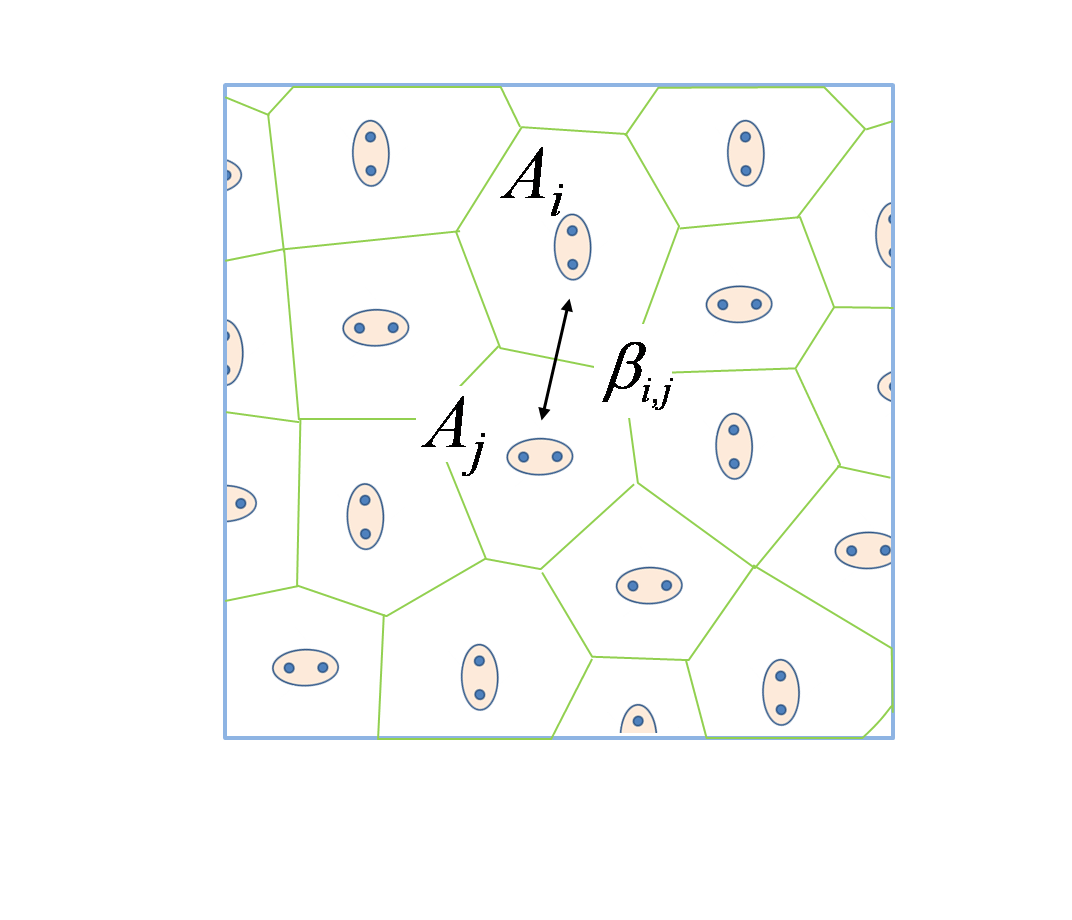 Figure 1
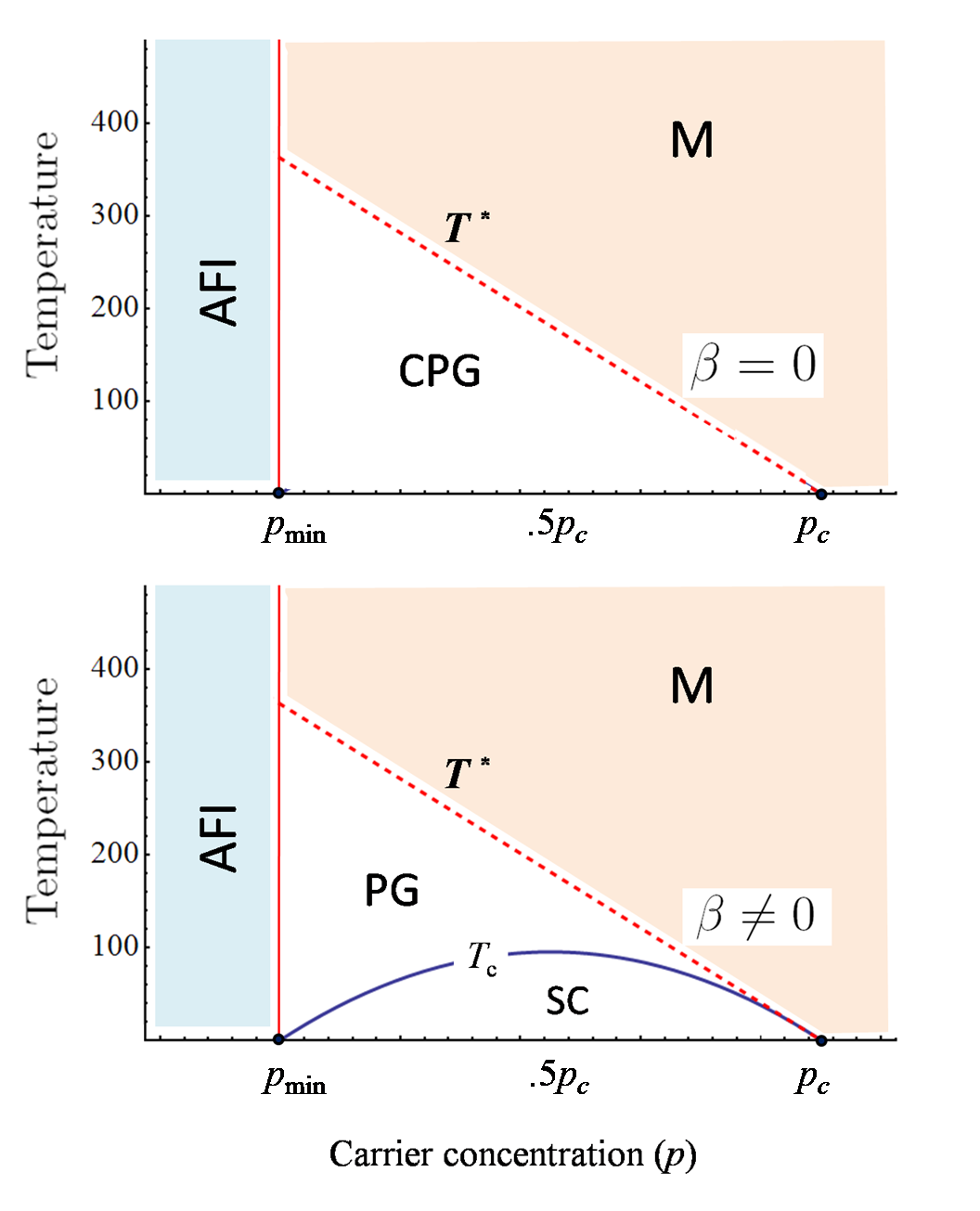 Figure 2
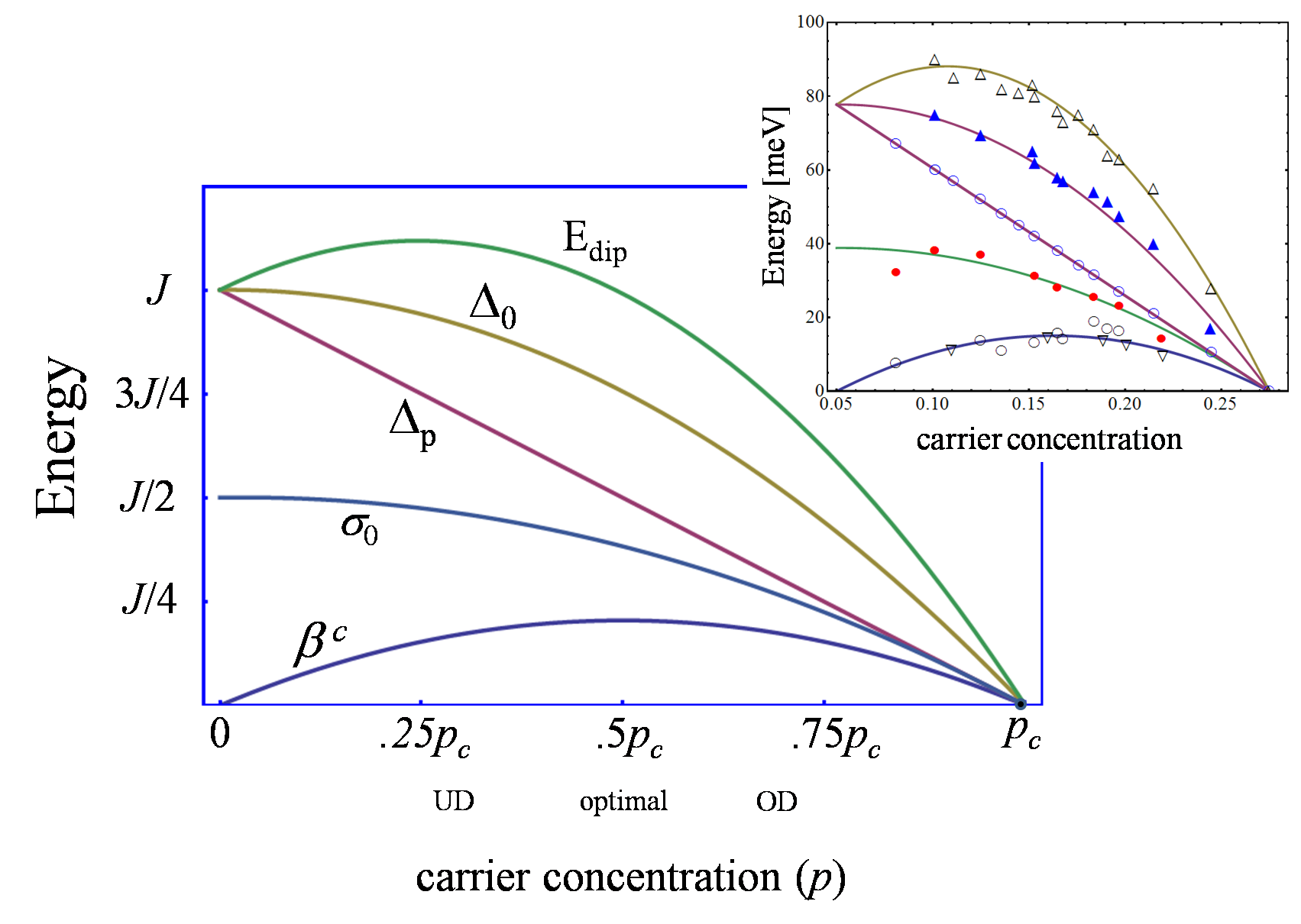 Figure 3
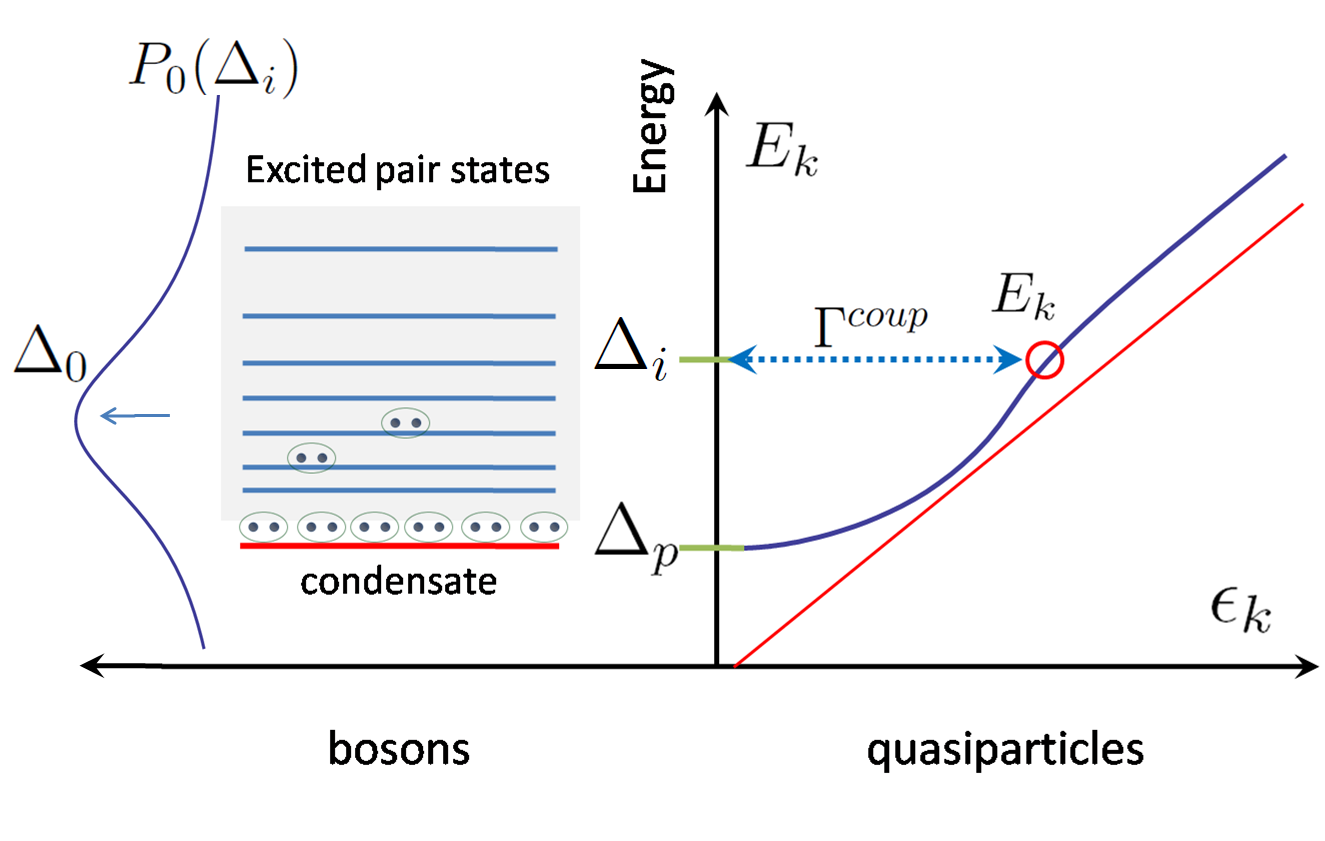 Figure 4
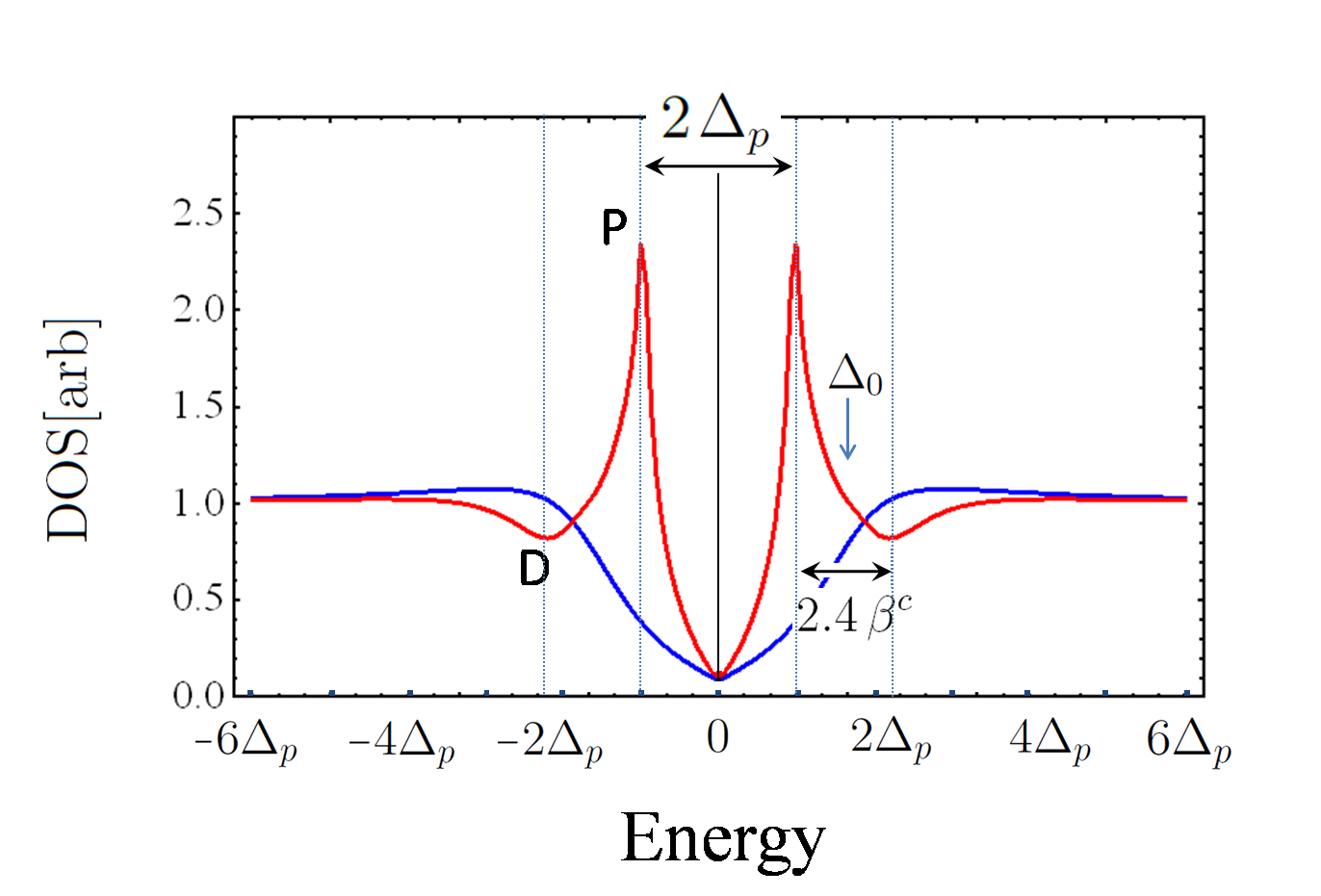 Figure 5
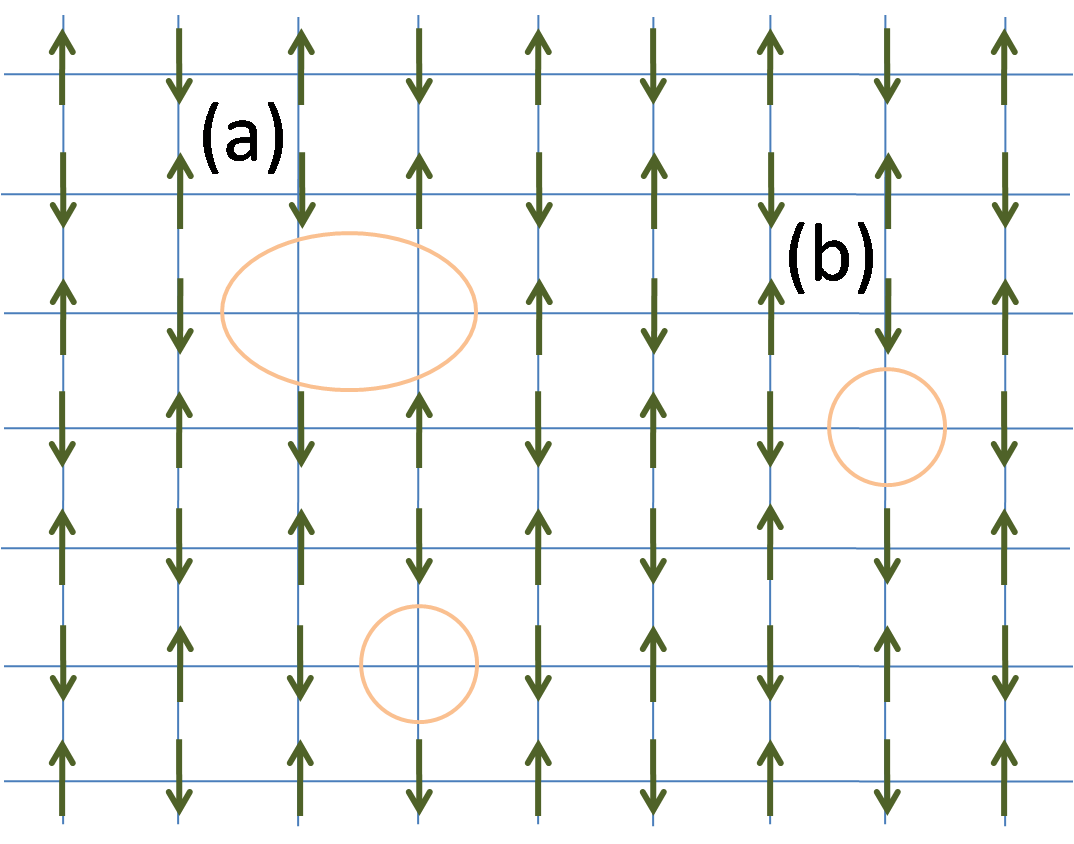 Figure 6
| SC parameters | |||
|---|---|---|---|
| spectral gap | |||
| pair-pair int. | ) | ||
| dist. maximum | |||
| dist. width | |||
| dip energy |
Peer Reviews
No public reviews on file for this paper yet. If you reviewed it on a platform where reviews are public (OpenReview, ICLR, NeurIPS, ICML), you can paste yours below so the community can read it here.
Videos
No videos yet. Explain this paper in a talk, walkthrough, or lecture? Add one.
11institutetext: Institut de Minéralogie, de Physique des Matériaux, et de Cosmochimie (IMPMC), UMR 7590, Institut des Nanosciences de Paris (INSP), UMR 7588,
Sorbonne Universités, UPMC Paris 6,
4 place Jussieu, 75252 Paris Cedex 05, France
Corresponding author : [email protected]
First pacs description Second pacs description Third pacs description
Cooper pairs without ‘glue’ in high- superconductors
William Sacks 11
Alain Mauger 11**
Yves Noat 221122**
Abstract
We address the origin of the Cooper pairs in high- cuprates and the unique nature of the superconducting (SC) condensate. Itinerant holes in an antiferromagnetic background form pairs spontaneously, without any ‘glue’, defining a new quantum object the ‘pairon’. In the incoherent pseudogap phase, above or within the vortex core, the pairon binding energies are distributed statistically, forming a ‘Cooper-pair glass’. Contrary to conventional SC, it is the mutual pair-pair interaction that is responsable for the condensation. We give a natural explanation for the ergodic rigidity of the excitation gap, being uniquely determined by the carrier concentration and . The phase diagram can be understood, without spin fluctuations, in terms of a single energy scale , the exchange energy at the metal-insulator transition.
pacs:
74.72.h
pacs:
74.20.Mn
pacs:
74.20.Fg
Introduction.
A remarkable aspect of the BCS superconducting (SC) state is its universality, explaining a large number of properties quite independently of the detailed composition of the material [1]. The conventional SC state emerges from a general metallic state leading to a macroscopic wave function responsable for zero resistivity, perfect diamagnetism and Josephson quantum effects [2]. The microscopic picture is the condensation of Cooper pairs [3] wherein the binding energy is the order parameter, vanishing at , and whose value is material independent, with a universal ratio : 2 . Although conventional SC is well understood, the pairing mechanism due to phonon exchange [4] is still hidden in the ground state energy gap. However it is revealed in the strong-coupling quasiparticle (QP) excitation spectrum in the fine structure at the phonon energies above the gap [5, 6].
In marked contrast, high- superconductivity [7] emerges upon doping from an insulating state dominated by antiferromagnetic (AF) interactions [8]. The macroscopic wavefunction expresses the hallmark SC properties, but the microscopic mechanism, in particular the pair formation, remains unknown. Moreover, the relevant parameters are orders of magnitude different from the conventional case : the nanometric coherence length, a large spectral gap, large penetration length and, of course, very high . Strikingly, the magnitude of the spectral excitation gap, as measured by tunneling [9, 10] and photoelectron spectroscopies ([11] and refs. therein), remains constant as a function of temperature up to and just above , in the pseudogap (PG) state (see [12] and refs. therein), suggesting the existence of pairing correlations above [13, 14]. Thus, contrary to the conventional BCS scenario, the energy gap is clearly not the order parameter.
In this work, we propose a simple mechanism for the pair formation in high- cuprates. We demonstrate that hole pairs in a lightly-doped antiferromagnetic environnement are energetically stable. Their binding energy is directly related to the exchange energy of the surrounding electron spins. Thus, the hole pairing arises spontaneously, without ‘glue’, due to an effective quantum potential well. This defines a new complex quantum state, a hole pair coupled to its local AF environnement, the ‘pairon’.
Beyond the AF phase, the pairons are in a disordered incoherent state, a ‘Cooper-pair glass’ wherein their binding energies are statistically distributed. This state is revealed above in the pseudogap (PG) phase, and also within the vortex core once SC coherence is lost [15]. Contrary to the BCS theory, the SC coherent state is achieved due to the mutual pair-pair interaction (PPI), as shown in the phase diagram, Fig. 1, lower panel.
A novel fundamental constraint emerges in this work : the condensate wave function is such that the hole-pair/anferromagnetic state (pairon) must be homogeneous. As a result, the spectral gap is pinned to the specific value which is remarkably constant with regards to perturbations such as temperature, magnetic field or disorder. We show that the latter gap value is uniquely determined by the doping and the exchange energy . This pairing constraint suggests the novel concept of ‘ergodic rigidity’.
Contrary to conventional SC, the pairing energy is not the condensation energy. Rather, it is the mutual interaction between pairs that allows for a Bose-type condensation onto the ground state [16, 17]. Consequently, is proportional to the condensate density which decreases with temperature due to the pairon excitations, instead of quasiparticles, to finally vanish at . The PPI has the required properties of an order parameter and in this work we show that it is a unique function of and .
The SC state is thus built from two inter-dependent phenomena, the pairon formation and their mutual interaction, both depending on a single energy scale .
Origin of Cooper pairs in cuprates
In high- cuprates, superconductivity emerges upon doping from the antiferromagnetic state at half filling i.e. one electron per copper site. As a function of doping, it starts at a minimal value , corresponding to the extinction of the long-range magnetic order (). In spite of the vanishing of the AF order parameter, antiferromagnetism is known to exist at the local scale, as indicated by the paramagnon resonance even inside the SC dome [18]. A large number of measurements have confirmed the small SC coherence length of the Cooper pairs in these materials (). Thus, provided that the magnetic coherence length is large compared to the lattice constant, the exchange energy is logically the dominant energy scale.
In this AF background, pairs of holes are energetically more favorable than individual holes (see Fig. 2). Considering only the magnetic potential energy for the square lattice,
[TABLE]
where and are nearest neighbor occupied sites. Thus, two individual holes have an energy 8 with respect to the full AF ‘sea’, while a hole pair has an energy 6 , leading to a gain of per hole. Thus, in the nearest-neighbor approximation, the energy gain for a single hole pair in a perfect infinite AF background is compared to two separate holes. This provides a simple explanation for the pairing in these materials – they arise spontaneously without ‘glue’, i.e. without a boson exchange, due to the surrounding AF background.
This effect can be viewed as a quantum potential well of depth for two holes. The question then arises whether 4 holes together, or a more numerously populated island, would not be more stable. In fact they are not since the interaction between pairs is repulsive. Indeed, the effective potential well becomes rapidly nil when two pairs are approached together. Given these considerations, the expected stable solution for itinerant holes in an AF background should be preformed pairs.
We now consider a statistical ensemble of uncondensed pairs of density , each pair being surrounded by a number of nearest neighbors as in Fig. 3. Clearly, the binding energy for each pair must be directly affected by the local AF environnement. This conclusion is in good agreement with the experimental AF correlation length as function of doping [19]. Remarkably, , which is also the typical distance between pairs.
The simplest model, which works remarkably well, is that each binding energy is uniquely determined by the area available to each pair. This defines a new composite object, the pairon, being a quantum state consisting of a hole pair entangled with its local AF environnement. Thus, we take the th pairon binding energy to be proportional to the corresponding area which, in a classical view, is the Voronoi cell area in a two-dimensional distribution [20].
For large density, an additional consideration is necessary. As increases, and the characteristic areas decrease, there is a minimum incompressible area at which the local AF environment is too small to create a potential well. In this limit, the binding energy for a pairon vanishes. The minimum configuration is one hole pair surrounded by 6 occupied copper sites, giving a critical doping of . This agrees well with the observed critical value for Bi2Sr2CaCu2O8+δ (). This effect is also related to the critical percolation threshold for holes on a square lattice corresponding to 4 sites for each hole [21].
For small densities, the critical point for SC onset is ( for Bi2Sr2CaCu2O8+δ). This value corresponds to the largest Voronoi cell area wherein the pairs can condense. At this point, their binding energies are in fact maximum with a binding energy close to .
With these considerations, between these two limits, the pairing energy for each pair is given by :
[TABLE]
where is the effective exchange energy, is the Voronoi area for the th pair (see Fig. 3) and denotes the average. As a result, the mean binding energy is :
[TABLE]
i.e. simply determined by the number of holes and . This general relation shows that the dominant effect is the linear decrease of the pair binding energy with the carrier concentration to ultimately vanish at the critical point , a universal feature of high- superconductivity.
We now consider the many-body properties of the pairon system.
The Cooper-pair glass state
Unconventional superconductivity in cuprates can be described by a microscopic Hamiltonian of interacting preformed pairs [16]. In absence of pair-pair interactions, the scenario is an incoherent state of preformed pairs that are distributed in different energy states defined by their binding energies . We call this state the Cooper-pair glass (CPG), illustrated in Fig. 3. It is quite analagous to the Bragg-glass vortex phase [22, 23], unique to high- superconductivity, which is formed when the vortex-vortex interaction (the PPI in the present case) is small compared to any local disorder potential.
To understand the CPG state, characterized by , we note that the CPG Hamiltonian can be formally mapped onto the Suhl-Mathias-Walker model for multiband superconductors [24] where is the band index. In our case, the th index refers to the given CPG pair state. The corresponding density of states is very well described by a Lorentzian form :
[TABLE]
where and 2 are respectively the median and the width of the pair energy distribution (see Fig. 4, left panel). Again, reflects the variation of the possible configurations of the Voronoi cells discussed previously.
Superconducting coherence arises as a result of the mutual interactions between pairons, leading to a Bose-Einstein type condensation into the single energy state . From the microscopic Hamiltonian [16], the latter must satisfy the self-consistent gap equation :
[TABLE]
where is the interaction energy in the SC state described below. In the absence of the PPI, i.e. , the pairons are distributed in the energy states centered around , the Cooper-glass state. The excitation spectrum exhibits a broad gap without quasiparticle peaks (Fig. 5), as observed in tunneling experiments when coherence is broken, either at the critical temperature [9, 25, 10] or locally within the vortex core [15].
Below the CPG state is more favorable than the normal metallic state but, due to pair-pair interactions, it is unstable to SC condensation giving rise to the well-known critical dome (Fig. 1, lower panel).
The unconventional superconducting state
The accurate temperature dependence of the quasiparticle spectra measured by Sekine et al. [10] leads to the counter-intuitive conclusion that the spectral gap value, , remains constant right up to the critical temperature. Significantly, this unique gap value is very robust as a function of external perturbations, temperature, magnetic field and disorder. Even though there are thermal pair excitations, so long as the condensate is non vanishing, the gap value is pinned to . Since the system remains statistically invariant in spite of the perturbation, this leads to the novel concept of ergodic rigidity specific to unconventional SC.
Therefore, we take as a principle that in the SC state, for which , the gap value is imposed by the fundamental properties of the system, the doping and the effective exchange energy . The coherence in the SC phase imposes homogeneity, which we obtain in the Voronoi scheme (equation 1) by choosing all areas to be equal. Thus, , where is the total number of pairs and the total area, guaranteeing homogeneity. In addition, we assume that in the uniform SC state , where is the exchange energy. With these considerations, we have :
[TABLE]
as indicated in table 1. In the SC state the spectral gap is thus uniquely determined by and . Since in the SC state the PPI is positive (), comparing the gap equation (4) with equation (2) leads to and thus .
As a consequence of ergodic rigidity, the gap amplitude cannot be the order parameter of the SC to PG transition. As opposed to conventional SC, at finite temperature the system is not characterized by quasiparticle excitations (pair breaking) but by pair excitations following Bose-Einstein statistics [16], leading to an unconventional shape of the measured specific heat [26].
Superconducting coherence is subtly hidden in the ground state but, contrary to BCS, it is not directly linked to the superfluid density. Indeed, examining the gap equation (4), the SC order parameter is the PPI term, , the latter being the number of condensed pairs. It should be measurable in any experiment sensitive to SC coherence such as Josephson effects [2]. In quasiparticle tunneling, the spectral gap remains constant, but the coherence peaks decrease monotonically due to the increasing pairon excited states leading to the pseudogap at [17].
The PPI energy is universally revealed in the shape of the quasiparticle excitation spectrum beyond the gap energy measured by tunneling and ARPES (see [27] and refs. therein). This well known ‘peak-dip-hump’ fine structure is usually interpreted in terms of a spin-collective mode [28]. However, this compelling interpretation fails to fit the shape of the experimental spectra and does not account for the pseudogap phase.
The resolution of the microscopic Hamiltonian [16, 29] leads to the alternative conclusion that, due to the PPI, the quasiparticles are now coupled to excited pairon states (see Fig. 4, right panel). These ‘super-quasiparticles’ are described by an unusual dependence of the gap upon quasiparticle energy :
[TABLE]
where the anti-nodal direction is assumed. The corresponding DOS (see Fig. 5) reveals the strong ‘peak-dip’ structure in the excitation spectrum seen in both cuprates [27] and iron-based superconductors [30, 31]. Using the parameters of Table 1, the theoretical curves fit accurately the experimental spectra for both classes of materials[29]. The peak-dip structure present at low temperature is thus a clear signature of long-range SC coherence, while the mere presence of a spectral gap is not.
We thus see clear deviations in the unconventional case from BCS in all aspects, be it the SC ground state, the pair (boson) excitations or the quasiparticle (fermion) excitations.
Universal dependence of the parameters on
How does the pair-pair interaction depend on the fundamental parameters ? In the mean-field treatment of the microscopic Hamiltonian leading to equation (4) the PPI is repulsive and can be expressed as : . From the detailed fits to the phase diagram (Fig. 6, inset) the proportionality constant is found :
[TABLE]
where both and are measured from the SC onset.
This form of the mutual pair interaction can be visualized as the lowering of the potential well due to the interaction with neighboring pairs. Most significantly, both the gap magnitude and the interaction energy depend on a single characteristic energy . This shows unambiguously that the pair formation (pairon) as well as the PPI depend on the same microscopic mechanism, the intimate cooperation of holes with the underlying antiferromagnetism.
As a function of the carrier concentration , both and display a universal dependence upon doping (Fig. 6). The binding energy is given by the exchange energy at low doping and decreases linearly with , while the PPI exhibits the universal dome, equation (7), as expected for the SC order parameter.
As shown in Fig. 6, all the parameters are simply proportional to the exchange interaction energy, with typical value at half-filling in this class of materials [32]. Since the critical temperature scales with ( for Bi2Sr2CaCu2O8+δ) this energy scale explains the high critical temperature in cuprates.
Examining the gap equation (4) we note that , the average gap in the CPG state, is approximately given by : leading to the effective exchange energy . Thus as function of , is a monotonic concave curve for the whole doping range. In addition, as indicated in Table 1, the distribution width is very close to , which is verified empirically (see inset in Fig. 6). Note that defines the condensation energy for any value of .
As mentioned previously, the PPI is revealed in the dip position in the quasiparticle spectrum which has a doping dependence also shown in Fig 6. It lies above for the whole doping range and is such that . The latter relation agrees very well with experiment [16].
Many authors invoke the quasiparticle strong coupling to the spin collective mode [28] to account for the dip energy (relative to the gap ) which is found to be . In our work, the PPI is which gives to be , in good agreement. As mentioned, our interpretation is completely different : The dip position is a direct consequence of the static quasiparticle-pair interaction expressed in Eq. (6).
The apparent contradiction can be lifted by noting that both depend on the exchange energy . In particular, at optimal doping our model indicates the precise value . Since both phenomena, the superconducting state and the paramagnon resonance, depend on the same energy parameter they are indeed highly correlated. On the other hand, as is well known in diverse fields, even a strong correlation does not imply causality.
The interpretation of the phase diagram is thus as follows : the subtle interplay between hole doping and antiferromagnetism leads to a pairing, without boson exchange. Contrary to the BCS case where Cooper pairs arise from the metallic state [3], here pairs emerge from an AF state. A crucial point is that the hole pair state (pairon) preserves at best the symmetry of the AF lattice. Such a pairing mechanism would not exist in a frustrated spin system, such as in a triangular lattice, since in this case there is no energy gain when forming hole pairs. This prediction is in agreement with the absence of a SC transition in a Kagome-lattice spin liquid [33].
The pairons in this scenario cannot condense without the PPI and would remain in the Cooper glass state. However their mutual interaction, itself mediated by the same underlying AF local order, allows for the condensation onto the homogenous and unique state with energy . As a consequence, the mutual interaction energy, , as well as the pair formation mechanism, depend on the unique energy .
How does this picture translate to the quantum mechanical formulation ? Each hole pair in the AF sea, such as in Fig. 2, is surrounded by equivalent degenerate pair positions where it can easily tunnel with no effect on the surrounding AF symmetry. Its wave function is thus :
[TABLE]
where and are nearest-neighbours and the Fermi operator creates a hole in the AF half-filled state at the site . These pairon states are highly favorable and, when interacting with neighboring pairons, i.e. the PPI process, allows for a macroscopic SC wave function to be established.
Conclusion
In summary, in this article we show that the microscopic origin of high- superconductivity is a subtle cooperation of holes with the underlying local antiferromagnetism. First, preformed hole pairs, the pairons, arise without ‘glue’ in the AF background with a binding energy directly related to the exchange AF energy . The superconducting phase emerges from an incoherent disordered pair state, a Cooper-pair glass. As a result of pair-pair interactions, they condense following the Bose-Einstein statistics onto a single pair state. The pair binding energy is anchored to a value determined by the basic properties of the system, the exchange energy and the doping . The latter is remarkably robust with respect to a perturbation, be it temperature or magnetic field, suggesting the novel concept of ergodic rigidity at the heart of the transition.
Contrary to BCS, the order parameter is the pair-pair interaction energy . The unconventional SC state is the subtle compromise between pairon formation, of high binding energy, and their repulsive interaction, both determined by the unique energy . The high- of cuprates thus follows. The single parameter accounts quantitatively for the experimental phase diagram in () plane, the quasiparticle density of states and its evolution as a function of temperature in both the superconducting and the pseudogap phases.
The reference list from the paper itself. Each links out to its DOI / PubMed record.
- 1[1] J. Bardeen, L. Cooper, J. Schrieffer, Theory of Superconductivity, Phys. Rev. 108 1175 (1957).
- 2[2] B. D. Josephson, Possible new effects in superconductive tunnelling, Phys. Lett. 1 , 251 253 (1962).
- 3[3] Leon N. Cooper, Bound electron pairs in a degenerate Fermi gas, Physical Review 104 , 1189-1190 (1956).
- 4[4] H. Frölich, Interaction of electrons with lattice vibrations, Proc. R. Soc. London A 215 , 291 (1952).
- 5[5] I. Giaever, H. R. Hart, Jr., and K. Megerle, Tunneling into Superconductors at Temperatures below 1 K ∘ superscript K \,{}^{\circ}\mathrm{K} , Phy. Rev. 126 , 941 (1962).
- 6[6] W. L. Mc Millan and J. M. Rowell, Lead Phonon Spectrum Calculated from Superconducting Density of States, Phys. Rev. Lett. 14 , 108 (1965).
- 7[7] J. G. Bednorz, K. A. Müller, Possible high T c subscript 𝑇 𝑐 T_{c} superconductivity in the Ba–La–Cu–O system , Zeitschrift für Physik B Condensed Matter 64 , 189-193 (1986).
- 8[8] P.J. Hirschfeld, Using gap symmetry and structure to reveal the pairing mechanism in Fe-based superconductors, Comptes Rendus Physique 17 , 197 (2015).