Lago Distributed Network Of Data Repositories
H. Asorey, A. Mart\'inez-M\'endez, L.A. N\'u\~nez, A. Valbuena-Delgado, (for the LAGO Collaboration)

TL;DR
This paper presents the LAGO data repository network, a set of tools and strategies designed to enhance data accessibility, reproducibility, and trustworthiness for scientific research.
Contribution
It introduces a comprehensive framework for distributed data management tailored to the needs of the Latin American Giant Observatory.
Findings
Improved data accessibility across repositories
Enhanced reproducibility of scientific results
Strengthened trustworthiness of data handling processes
Abstract
We describe a set of tools, services and strategies of the Latin American Giant Observatory (LAGO) data repository network, to implement Data Accessibility, Reproducibility and Trustworthiness.
Click any figure to enlarge with its caption.
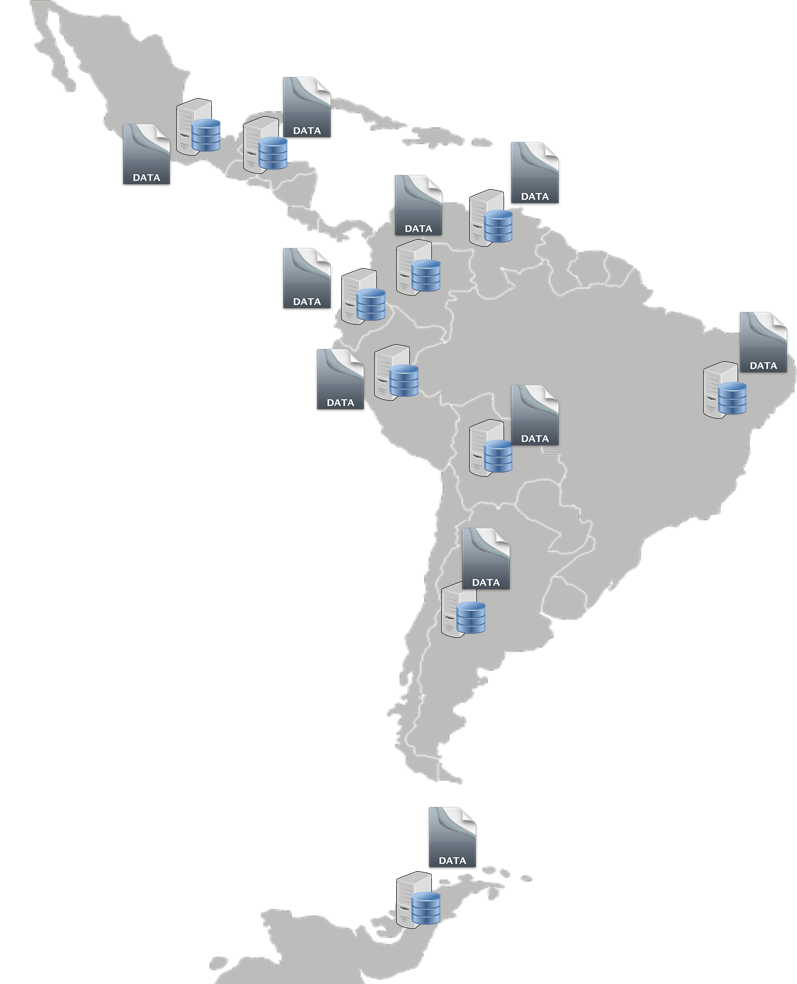 Figure 1
Peer Reviews
No public reviews on file for this paper yet. If you reviewed it on a platform where reviews are public (OpenReview, ICLR, NeurIPS, ICML), you can paste yours below so the community can read it here.
Videos
No videos yet. Explain this paper in a talk, walkthrough, or lecture? Add one.
Taxonomy
TopicsScientific Computing and Data Management · Distributed and Parallel Computing Systems · Research Data Management Practices
\SetYear
2016 \SetConfTitleXV Latin American Regional IAU Meeting LARIM
\suppressfulladdresses
\addkeywordData Repository \addkeywordOpen Data \addkeywordData preservation
LAGO distributed network of data repositories
H. Asorey11affiliation: Laboratorio Detección de Partículas y Radiación, Centro Atómico Bariloche & Instituto Balseiro, Bariloche, Argentina
A. Martínez-Méndez22affiliation: Escuela de Ingeniería de Sistemas, Universidad Industrial de Santander, Bucaramanga, Colombia.
L.A. Núñez33affiliation: Escuela de Física, Universidad Industrial de Santander, Bucaramanga, Colombia. 44affiliation: Departamento de Física, Universidad de Los Andes, Mérida, Venezuela. and A. Valbuena-Delgado33affiliationmark: for the LAGO Collaboration55affiliation: The Latin American Giant Observatory (LAGO), http://lagoproject.org, see the full list of members and institutions at http://lagoproject.org/collab.html
\boldabstract
We describe a set of tools, services and strategies of the Latin American Giant Observatory (LAGO) data repository network, to implement Data Accessibility, Reproducibility and Trustworthiness.
The Latin American Giant Observatory, (LAGO), is an extended continental astroparticle observatory oriented to basic research on: the Extreme Universe, Space Weather, and Atmospheric Radiation, with singles and small arrays particle detectors, covering a huge range of geomagnetic rigidity cutoffs and atmospheric absorption/reaction levels (Asorey et al., 2016).
Unlike other instruments where data flows from only one place to a network of data repositories, in LAGO each site preserves, catalogs and generates data locally which, referrers not only to raw data but also to data produced during the analysis and/or simulation of cosmic rays phenomena. Dspace provides basic functionality for storing and retrieving of digital content with a straightforward adaptability for non-native types of contents and metadata schemes, supporting two interoperability protocols: OAI-PMH (Open Archive Initiatives Protocol for Metadata Harvesting) and SWORD (Simple Webservice Offering Repository Deposit)(Smith et al., 2003; Lewis et al., 2012). We have overcome one of the most important DSpace limitations: its inability to upload/download multiple records, developing a script to ingest data profiting from the some DSpace capabilities(Asorey et al., 2015). This data repository network will also be useful for the solar physics and space climatology communities.
The Data Accessibility, Reproducibility and Trustworthiness (DART) initiative was launched by CHAIN-REDS (Coordination and Harmonisation of Advanced e-infrastructure for Research and Education Data Sharing), an European Commission co-funded project focused on promoting and supporting technological and scientific collaboration across different communities in various continents. GRNET PID (European Persistent Identifiers Consortium) service enables the allocation, management and resolution of PIDs and has been employed to ensure the data persistence and reproducibility of the experiments. Part identifiers can compute an unlimited number of handles on the fly, without requiring registering each separately. (Barbera et al., 2014).
This project has been partially funded by VIE Universidad Industrial de Santander.
The reference list from the paper itself. Each links out to its DOI / PubMed record.
- 1Asorey et al. [2015] Asorey, H., Cazar-Ramírez, D., Mayo-García, R., Núñez, L., Rodríguez-Pascual, M., Torres-Niño, L., & the LAGO Collaboration. 2015, in The 34th International Cosmic Ray Conference, Vol. Po S(ICRC 2015), 672
- 2Asorey et al. [2016] Asorey, H., Núñez, L., Suárez-Durán, M., Torres-Niño, L., Rodríguez-Pascual, M., Rubio-Montero, A., & Mayo-García, R. 2016, in Cluster, Cloud and Grid Computing (CC Grid), 2016 16th IEEE/ACM International Symposium on, IEEE, 707–711
- 3Barbera et al. [2014] Barbera, R., Becker, B., Carrubba, C., Inserra, G., Jalife-Villalón, S., Kanellopoulos, C., Koumantaros, K., Mayo-García, R., Núñez, L., Prnjate, O., Ricceri, R., Rodríguez-Pascual, M., Rubio-Montero, A., Ruggieri, F., & Project, C.-R. 2014, in ANAIS DAS SESSÕES TEMÁTICAS E PÔSTERS, 166
- 4Lewis et al. [2012] Lewis, S., de Castro, P., & Jones, R. 2012, D-Lib Magazine, 18
- 5Smith et al. [2003] Smith, M., Barton, M., Bass, M., Branschofsky, M., Mc Clellan, G., Stuve, D., Tansley, R., & Walker, J. H. 2003, D-lib magazine, 9