Search for dark matter at $\sqrt{s}=13$ TeV in final states containing an energetic photon and large missing transverse momentum with the ATLAS detector
ATLAS Collaboration

TL;DR
This paper reports a search for dark matter and new physics in events with energetic photons and missing transverse momentum at the LHC, setting exclusion limits on mediator and resonance masses based on ATLAS data.
Contribution
It provides new exclusion limits on dark-matter mediators and scalar resonances using 13 TeV ATLAS data, extending previous constraints in these models.
Findings
Excluded mediator masses below 750-1200 GeV for certain dark-matter models.
Restricted the suppression scale M* to be above 790 GeV at 95% CL.
Set limits on high-mass scalar resonance decaying to Zγ with neutrino decay channels.
Abstract
Results of a search for physics beyond the Standard Model in events containing an energetic photon and large missing transverse momentum with the ATLAS detector at the Large Hadron Collider are reported. As the number of events observed in data, corresponding to an integrated luminosity of 36.1 of proton-proton collisions at a centre-of-mass energy of 13 TeV, is in agreement with the Standard Model expectations, exclusion limits in models where dark-matter candidates are pair-produced are determined. For dark-matter production via an axial-vector or a vector mediator in the s-channel, this search excludes mediator masses below 750-1200 GeV for dark-matter candidate masses below 230-480 GeV at 95% confidence level, depending on the couplings. In an effective theory of dark-matter production, the limits restrict the value of the suppression scale to be above 790…
Click any figure to enlarge with its caption.
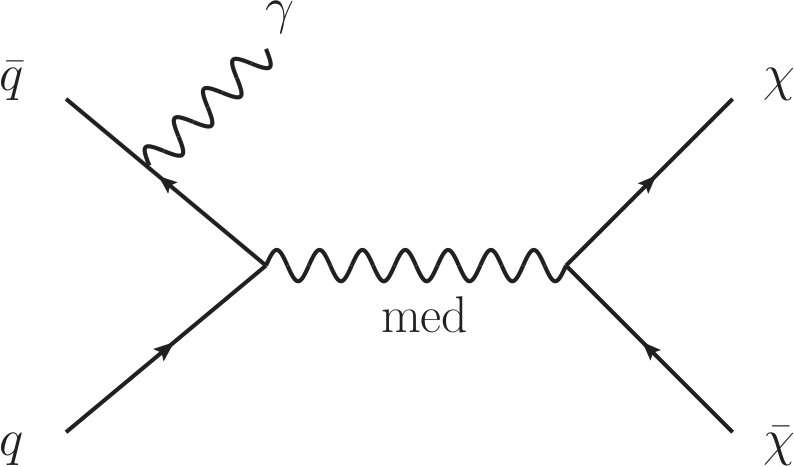 Figure 1
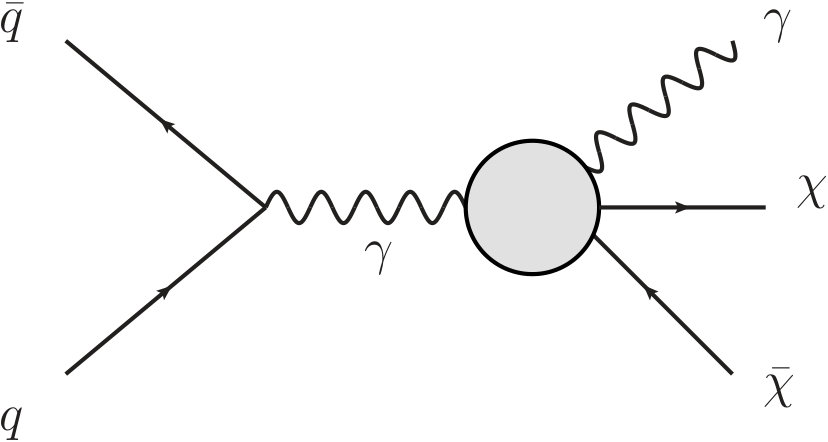 Figure 1
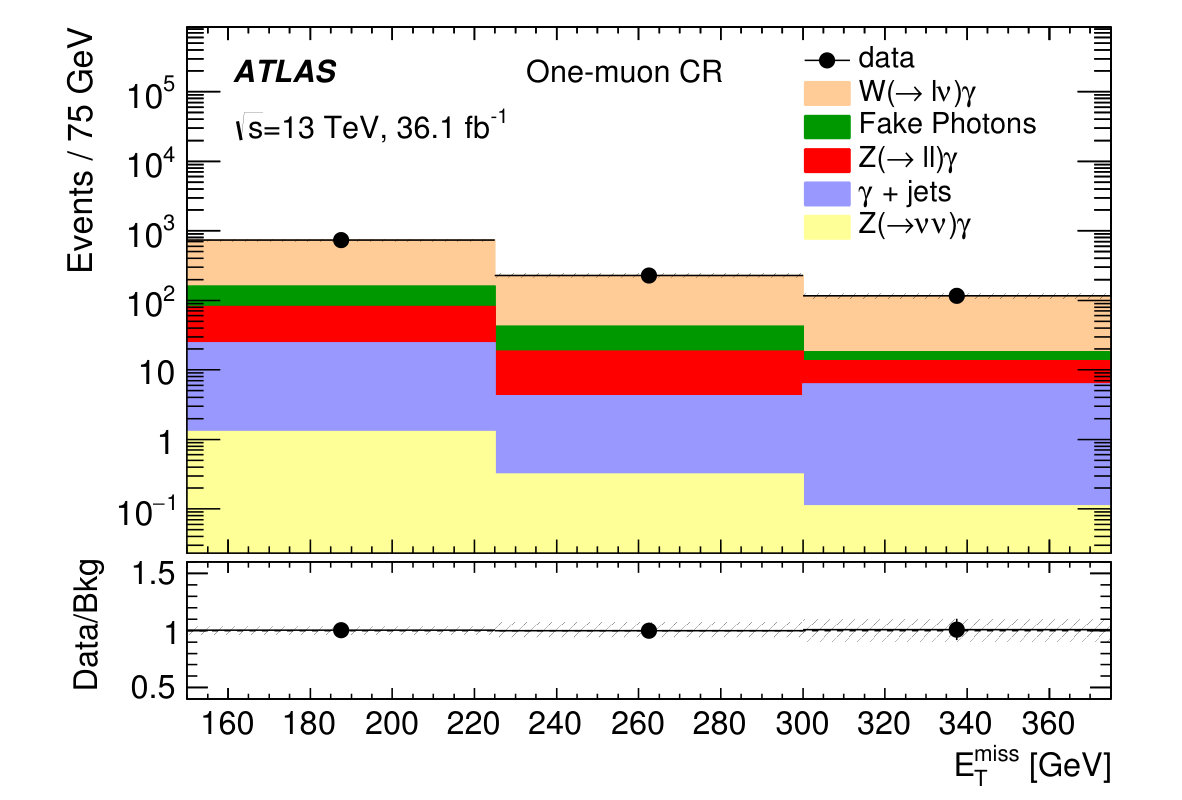 Figure 2
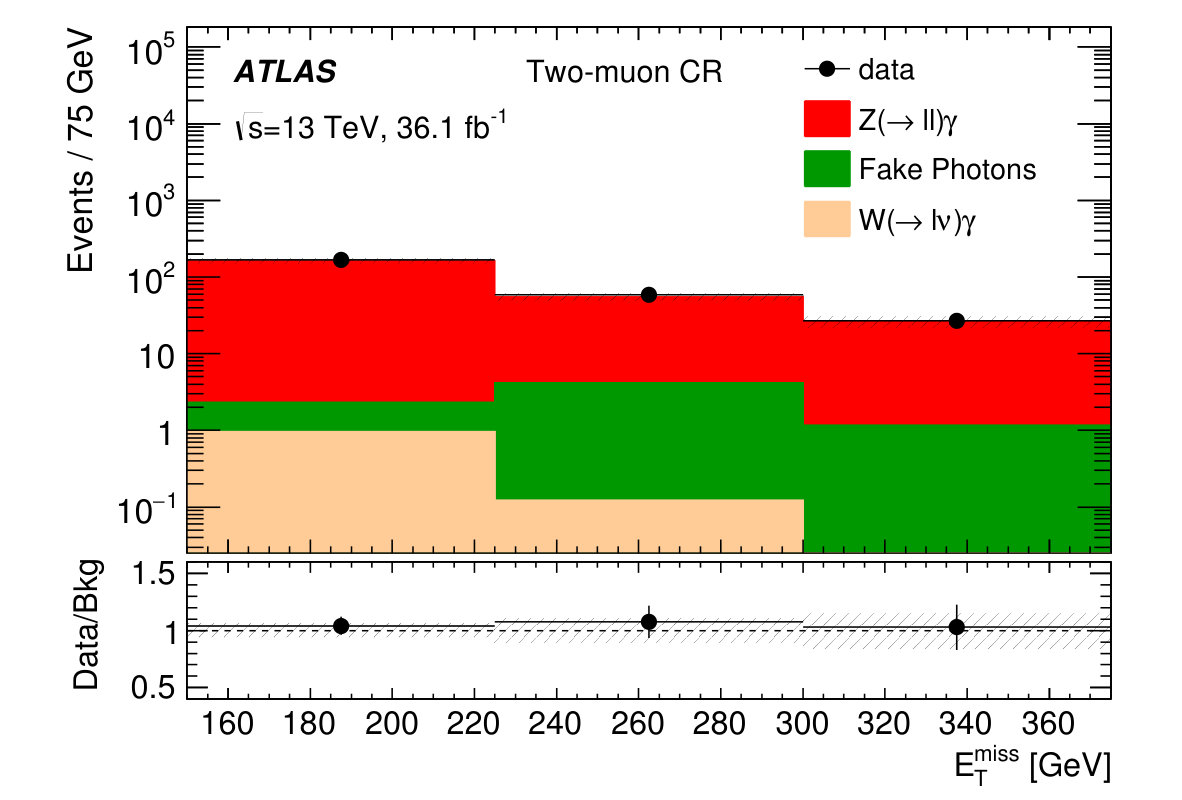 Figure 2
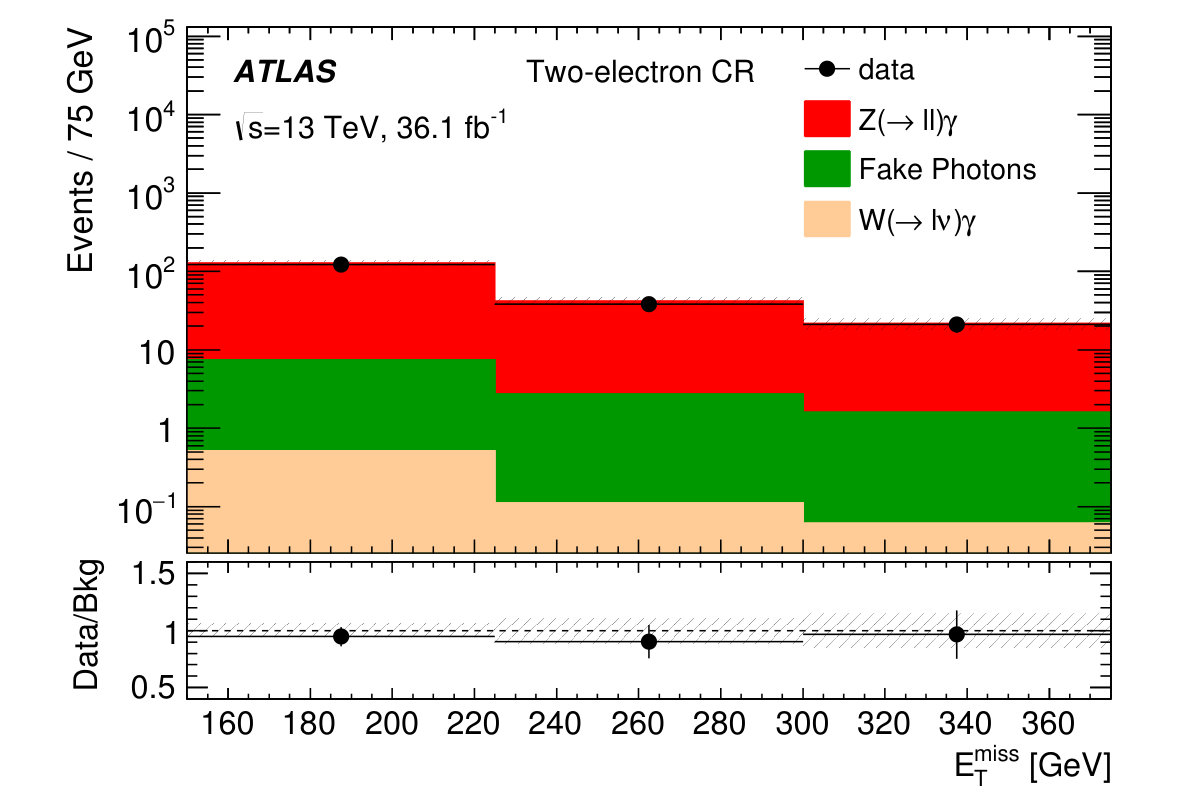 Figure 2
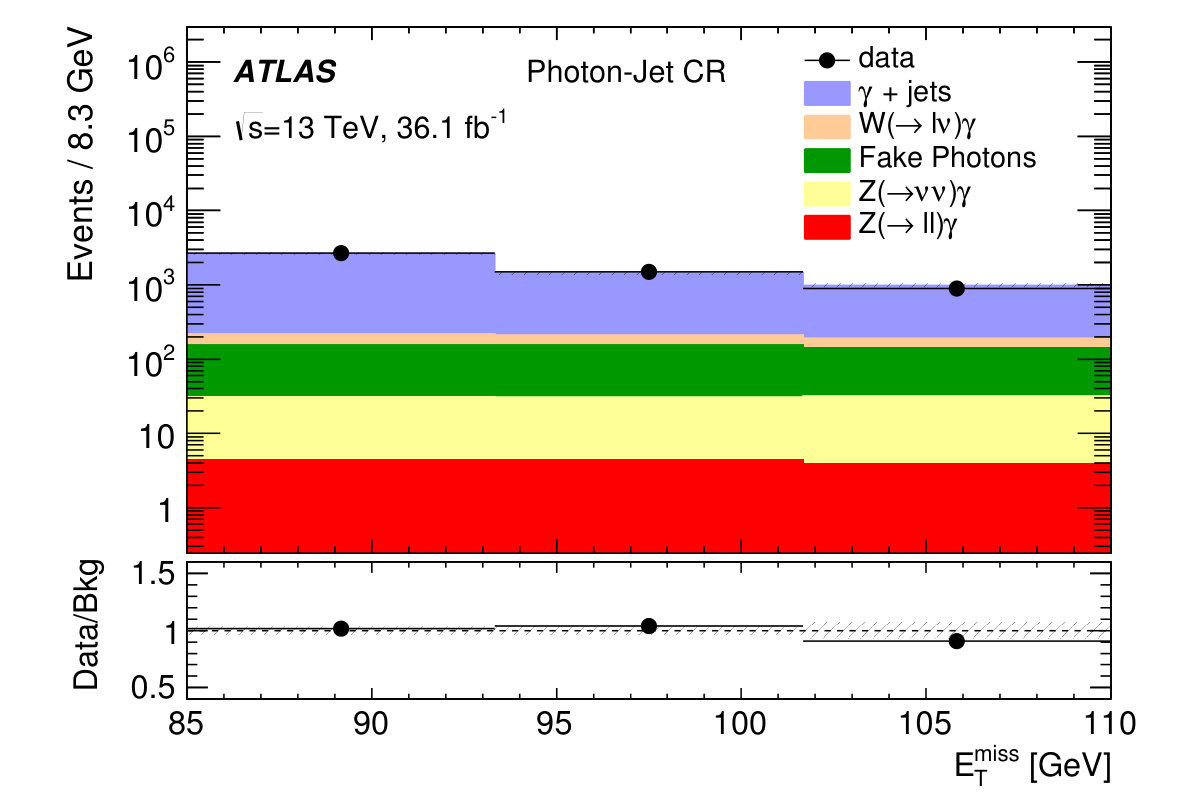 Figure 2
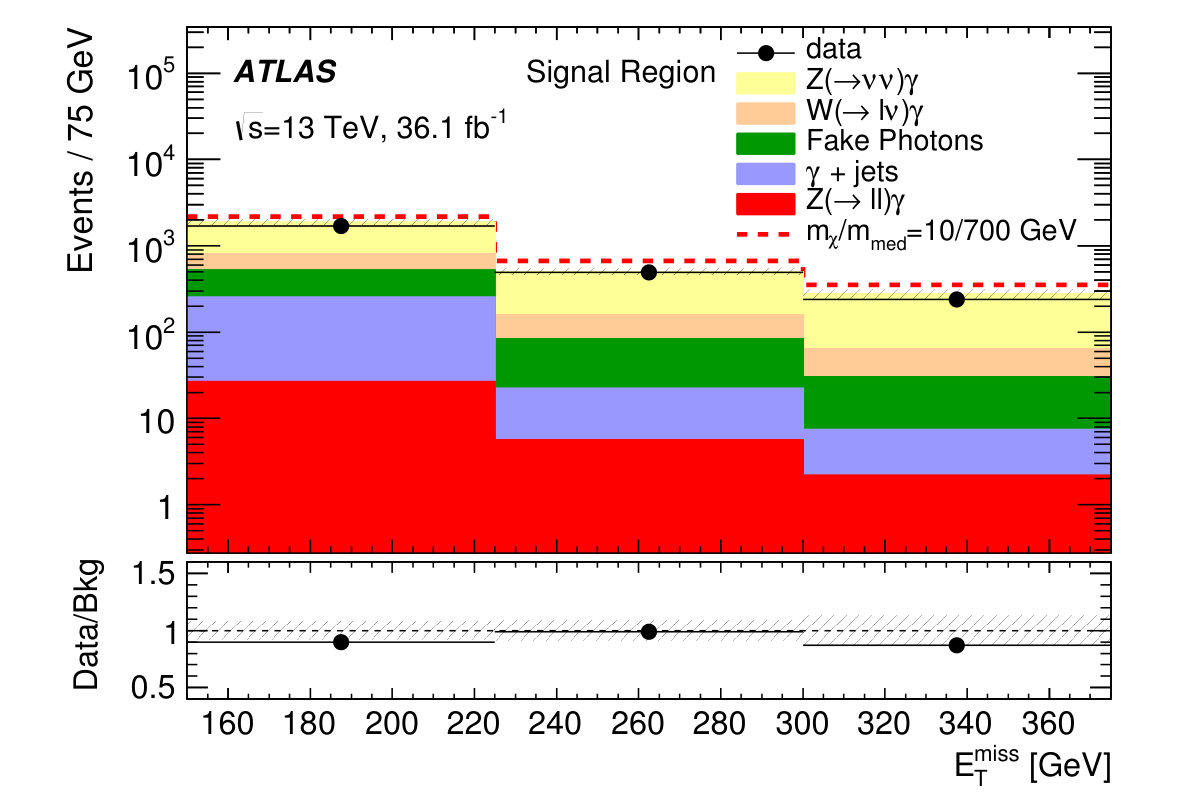 Figure 3
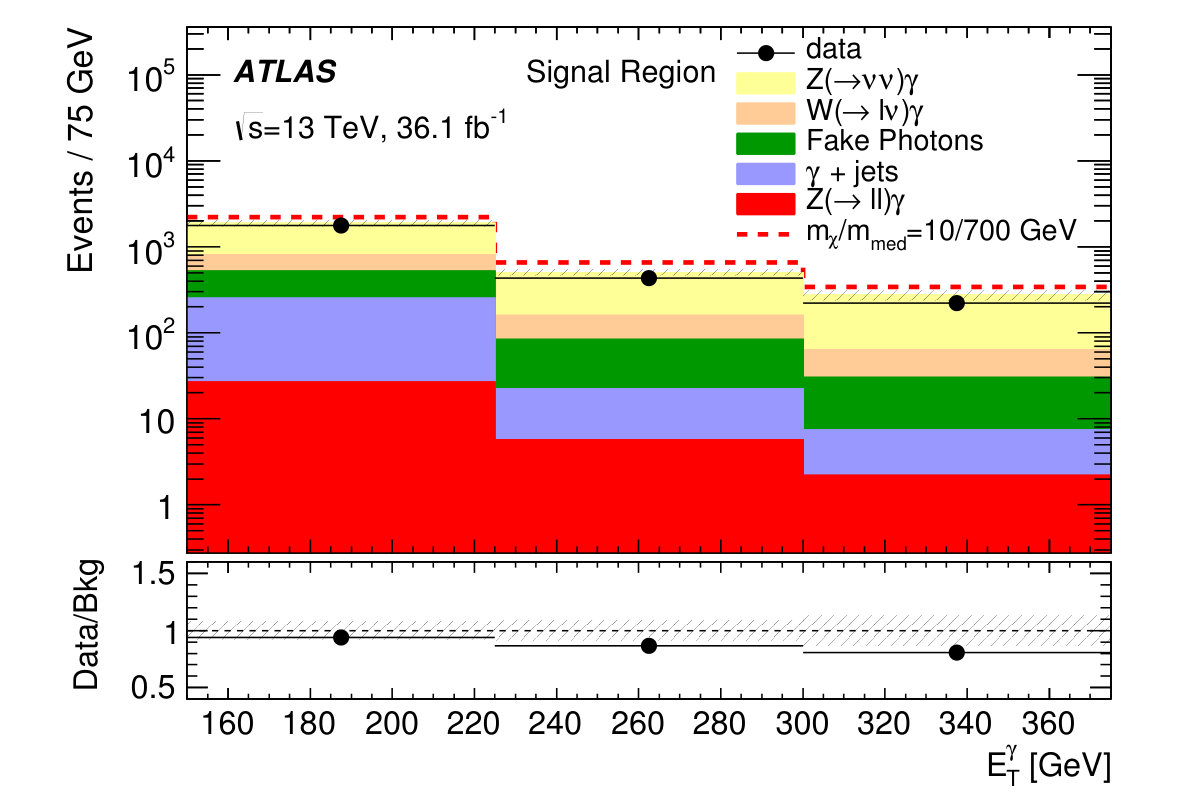 Figure 3
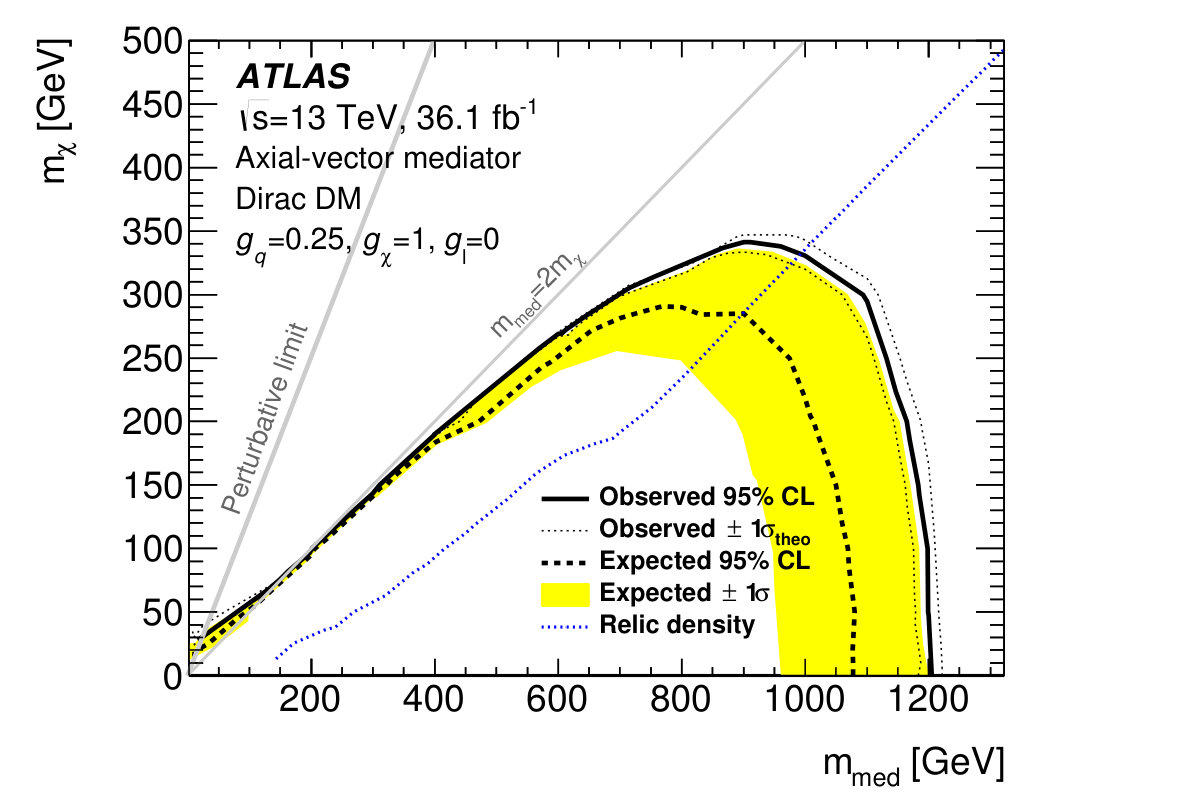 Figure 4
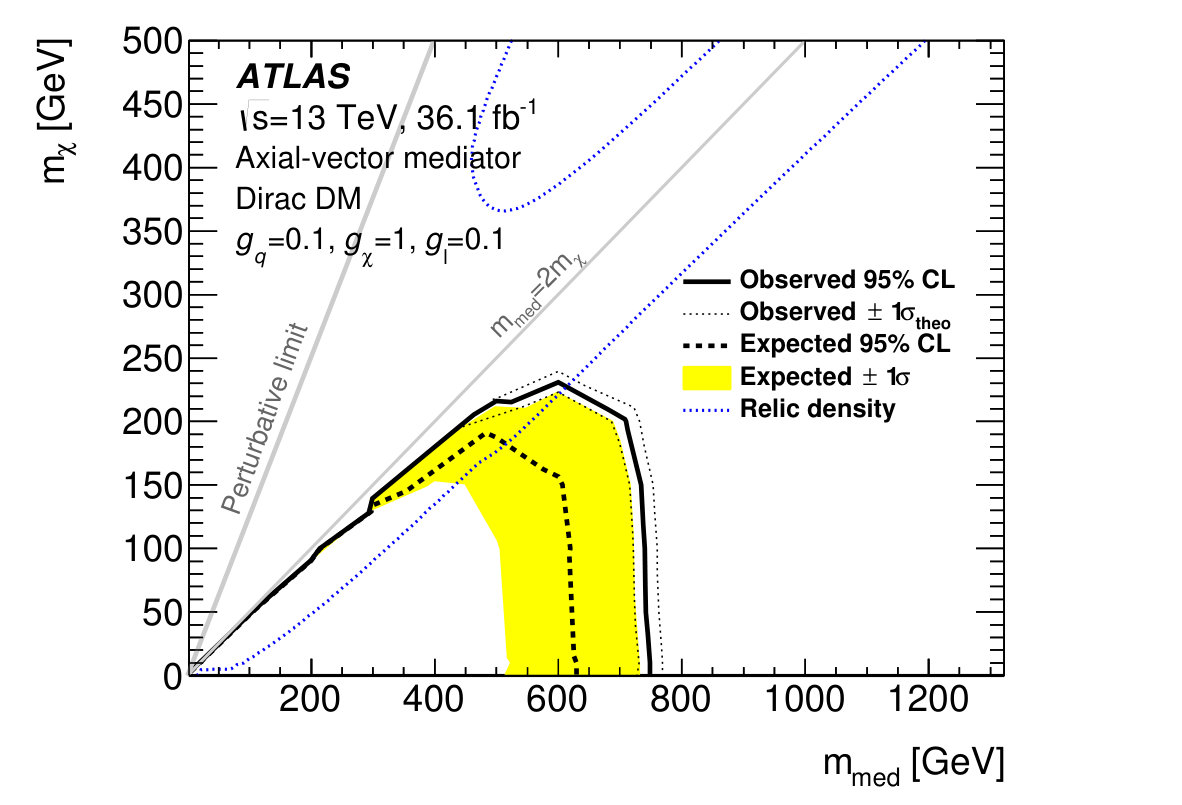 Figure 4
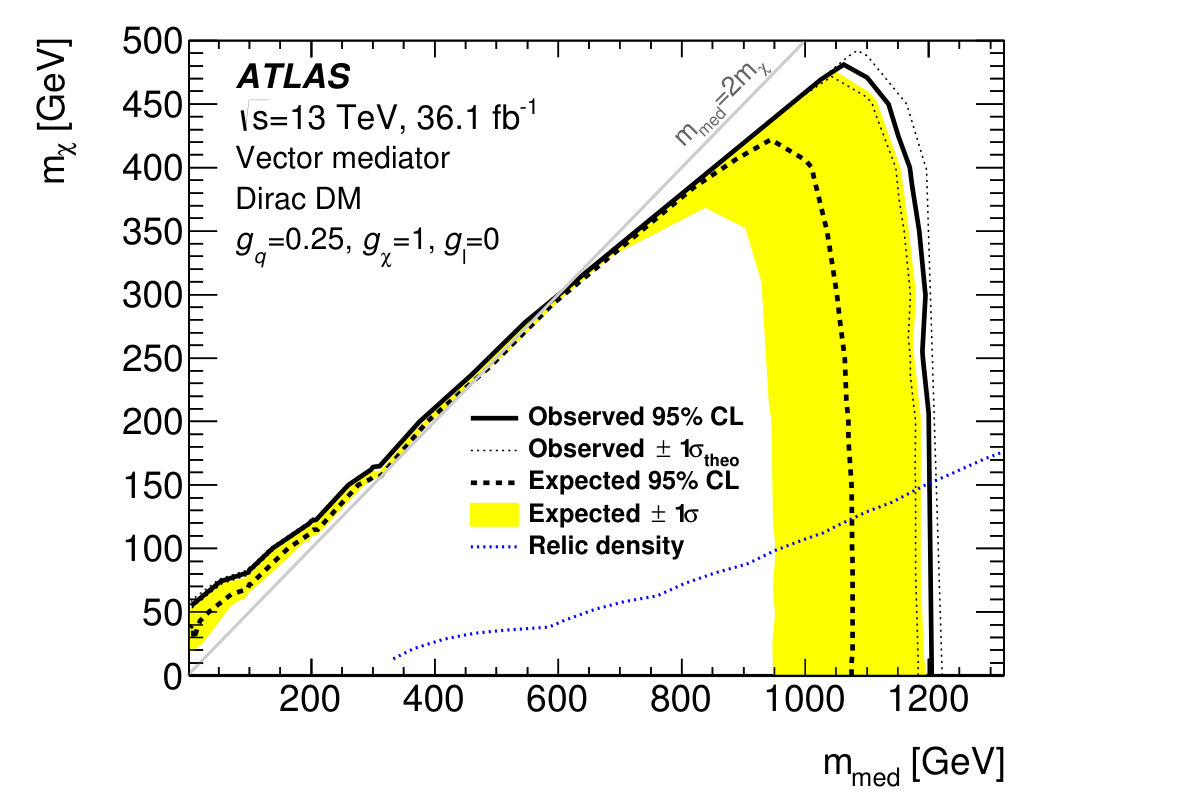 Figure 4
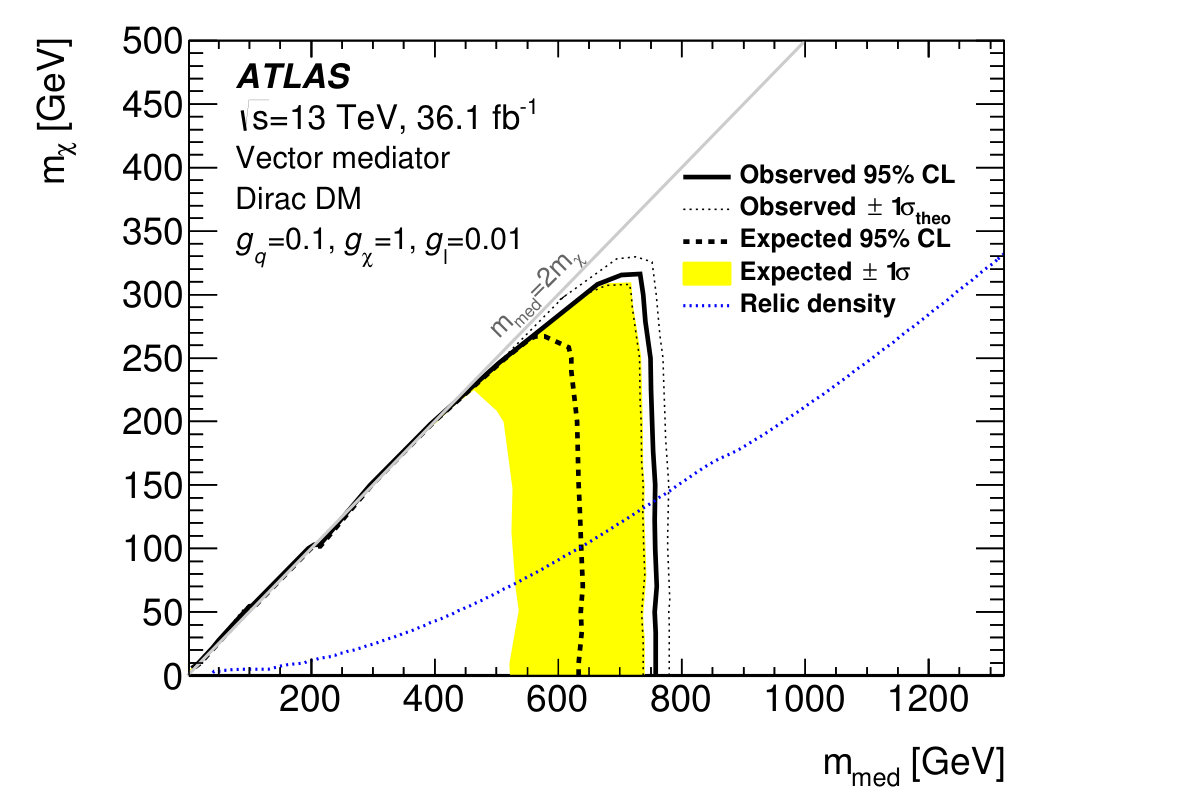 Figure 4
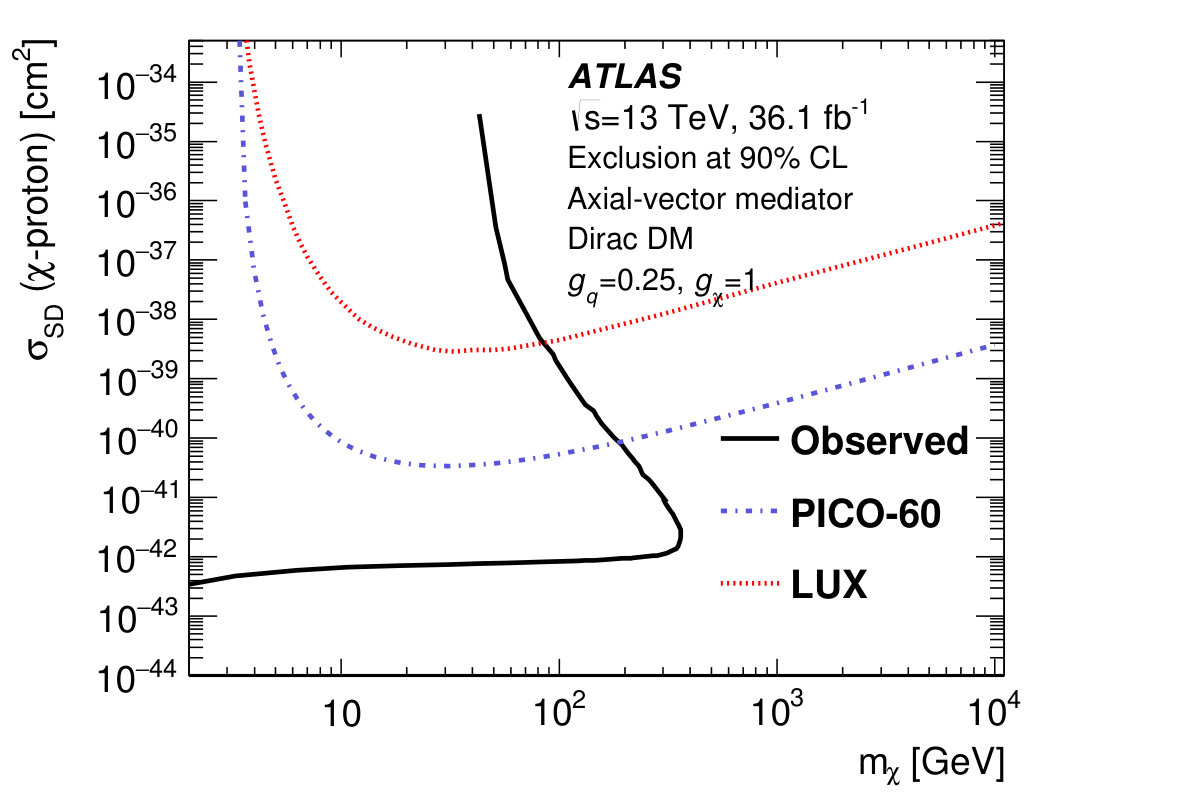 Figure 5
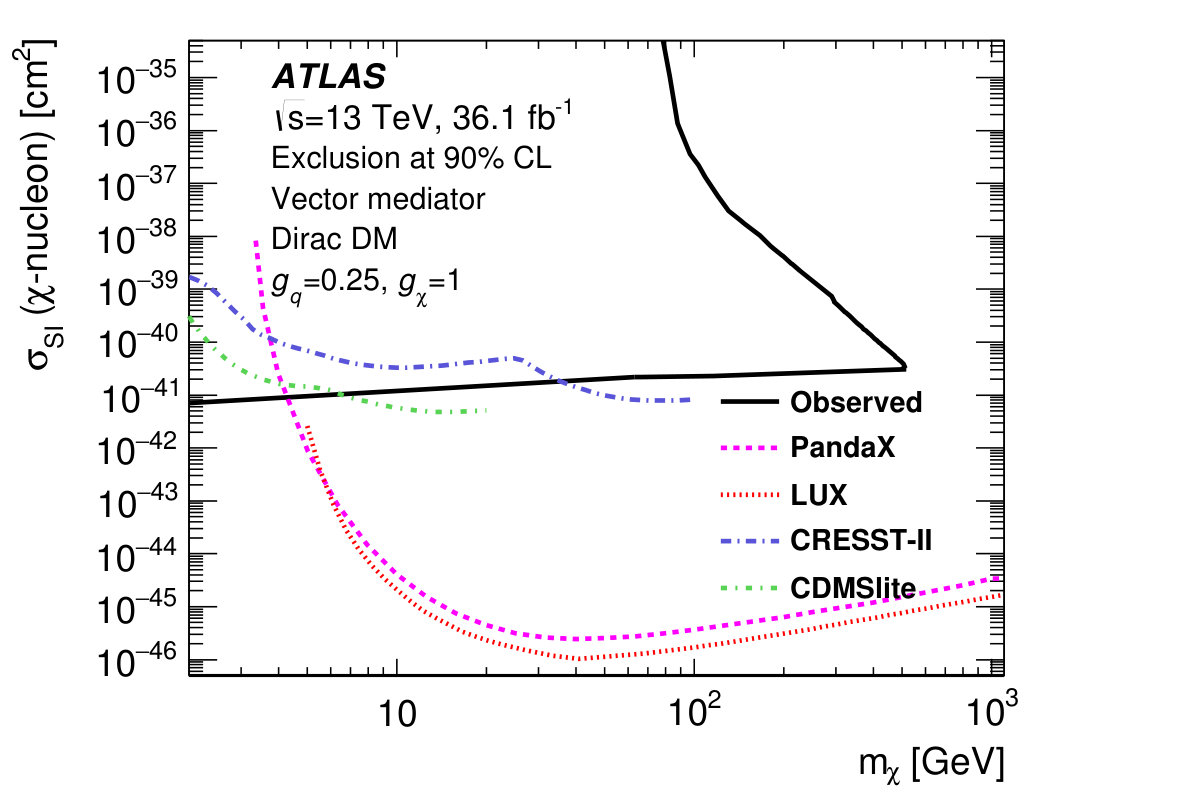 Figure 5
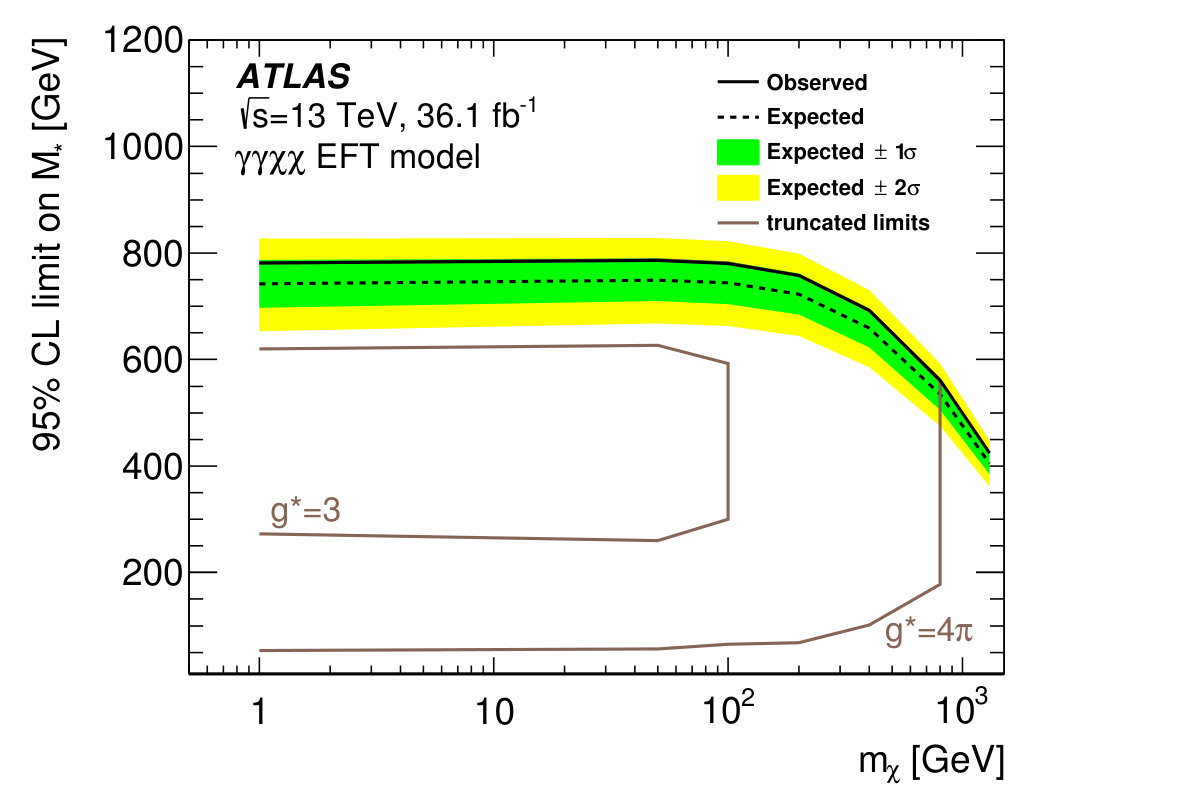 Figure 6
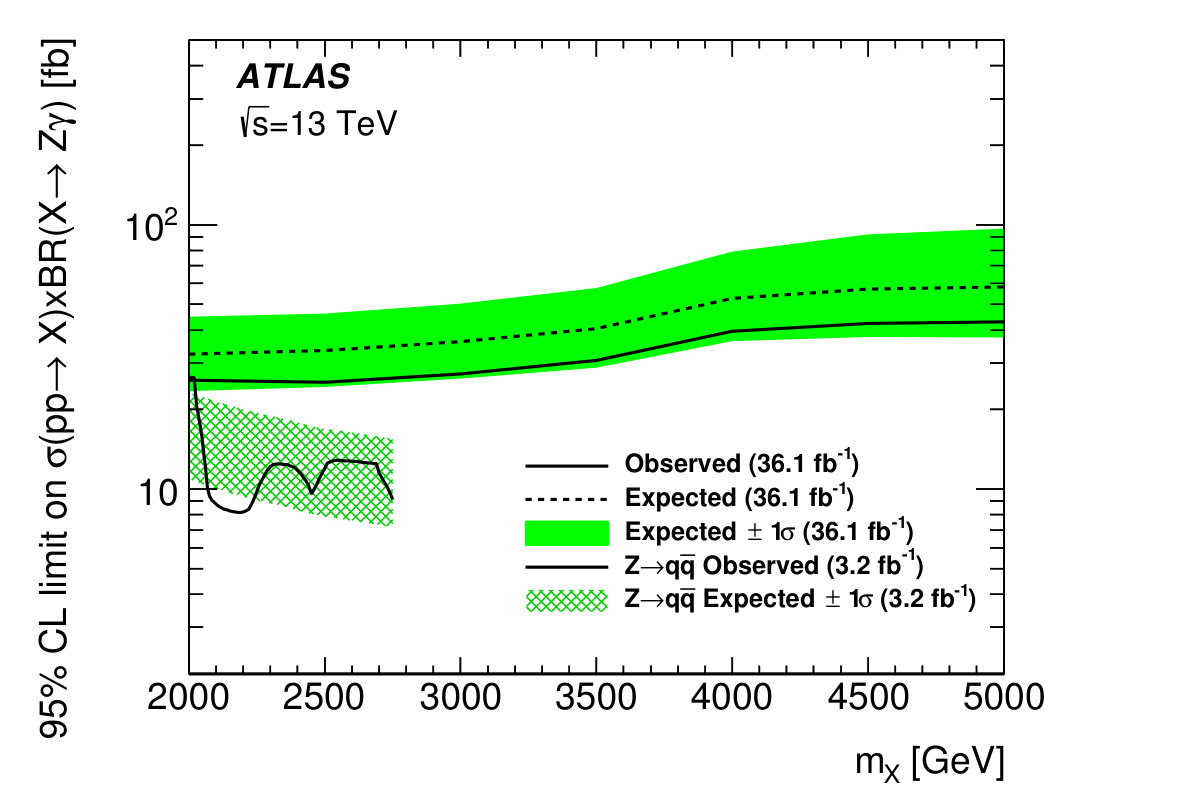 Figure 7
 Figure 17
 Figure 18
| Process | Event generators used | PDF sets | Order | Requirements |
|---|---|---|---|---|
| DMsimp model | MG5_aMC@NLO v2.4.3 | NNPDF30_nlo_as_0118 | NLO | |
| + Pythia v8.212 | ||||
| EFT model | MG5_aMC@NLO v2.2.3 | NNPDF30_lo_as_0130 | LO | |
| + Pythia v8.186 | ||||
| BSM resonance | Powheg-Box v1 | CT10 | NLO | |
| + Pythia v8.210 | ||||
| Sherpa v2.1.1 | CT10 | LO | for : | |
| Sherpa v2.1.1 | CT10 | LO | ||
| +jets | Sherpa v2.2.0 | NNPDF30_nnlo | LO/NLO |
| Event cleaning | Quality and Primary vertex | ||||
|---|---|---|---|---|---|
| Leading photon | , or , | ||||
| tight, isolated, , | |||||
| Jets | 0 or 1 with \pt , and | ||||
| Lepton | veto on and | ||||
| SRI1 | SRI2 | SRI3 | SRE1 | SRE2 | |
| – | – | ||||
| Selected events in data | 2400 | 729 | 236 | 1671 | 493 |
| Events with 0 jets | 1559 | 379 | 116 | 1180 | 263 |
| Signal | |||||||
|---|---|---|---|---|---|---|---|
| region | [GeV] | ||||||
| SRI1 | |||||||
| SRI2 | |||||||
| SRI3 | |||||||
| SRE1 | – | ||||||
| SRE2 | – |
| SRI1 | 1muCR | 2muCR | 2eleCR | PhJetCR | |
| Observed events | 2400 | 1083 | 254 | 181 | 5064 |
| Fitted Background | |||||
| Fake photons from electrons | |||||
| Fake photons from jets | |||||
| Pre-fit background |
| SRI1 | SRI2 | SRI3 | SRE1 | SRE2 | |
| Observed events | 2400 | 729 | 236 | 1671 | 493 |
| Fitted Background | |||||
| Fake photons from electrons | |||||
| Fake photons from jets | |||||
| Observed events in 1muCR | 1083 | 343 | 116 | 740 | 227 |
| Observed events in 2muCR | 254 | 86 | 27 | 168 | 59 |
| Observed events in 2eleCR | 181 | 59 | 21 | 122 | 38 |
| Observed events in PhJetCR | 5064 | 5064 | 5064 | 5064 | 5064 |
| SRI1 | SRI2 | SRI3 | SRE1 | SRE2 | |
| Total background | 2600 | 765 | 273 | 1900 | 501 |
| Total (statistical+systematic) uncertainty | 7.7% | 14% | 7.7% | 8.8% | |
| Statistical uncertainty only | 6.2% | 10% | 5.5% | 7.8% | |
| Jet fake rate (Section 6.4) | 1.7% | 3.3% | |||
| Electron fake rate (Section 6.3) | 1.5% | 1.6% | |||
| Jet energy scale [56] | 5.6% | 0.6% | |||
| Jet energy resolution [69] | 0.8% | 0.3% | |||
| \met soft-term scale and resolution [61] | 1.1% | 1.0% | |||
| Muon reconstruction/isolation efficiency [53] | 1.3% | 1.4% | |||
| Electron reco/identification/isolation efficiency [70] | 0.8% | 1.2% | |||
| Electron and photon energy scale [51] | |||||
| Electron and photon energy resolution [51] | 0.1% | 1.0% | |||
| Photon efficiency [52] | 0.2% | ||||
| jets modelling | 2.3% | 0.4% | |||
| distribution in MC simulation (Section 3) | 1.7% | 0.3% |
| limit [fb] | |||
|---|---|---|---|
| Region | SRI1 | SRI2 | SRI3 |
| 95% CL observed | 7.0 | 3.7 | 2.3 |
| 95% CL expected | 10.6 | 4.5 | 3.0 |
| 95% CL expected () | 14.5, 7.7 | 6.2, 3.3 | 4.2, 2.2 |
| [%] | 14–48 | 5–31 | 2–19 |
| [%] | 84–95 | 73–86 | 64–85 |
| Model | Mediator | Limit on [GeV] | Limit on [GeV] | |||
|---|---|---|---|---|---|---|
| for low | reaching as high as | |||||
| A1 | axial-vector | 0.25 | 1 | 0 | 1200 | 340 |
| A2 | axial-vector | 0.1 | 1 | 0.1 | 750 | 230 |
| V1 | vector | 0.25 | 1 | 0 | 1200 | 480 |
| V2 | vector | 0.1 | 1 | 0.01 | 750 | 320 |
Peer Reviews
No public reviews on file for this paper yet. If you reviewed it on a platform where reviews are public (OpenReview, ICLR, NeurIPS, ICML), you can paste yours below so the community can read it here.
Videos
No videos yet. Explain this paper in a talk, walkthrough, or lecture? Add one.
\AtlasTitle
A standalone cover for CERN preprints \PreprintIdNumberCERN-EP-2017-044 \AtlasJournalRefEPJC (2017) 77:393 \AtlasDOI10.1140/epjc/s10052-017-4965-8 \AtlasAbstract Results of a search for physics beyond the Standard Model in events containing an energetic photon and large missing transverse momentum with the ATLAS detector at the Large Hadron Collider are reported. As the number of events observed in data, corresponding to an integrated luminosity of 36.1 fb*-1* of proton–proton collisions at a centre-of-mass energy of , is in agreement with the Standard Model expectations, model-independent limits are set on the fiducial cross section for the production of events in this final state. Exclusion limits are also placed in models where dark-matter candidates are pair-produced. For dark-matter production via an axial-vector or a vector mediator in the -channel, this search excludes mediator masses below – for dark-matter candidate masses below – at 95% confidence level, depending on the couplings. In an effective theory of dark-matter production, the limits restrict the value of the suppression scale to be above at 95% confidence level. A limit is also reported on the production of a high-mass scalar resonance by processes beyond the Standard Model, in which the resonance decays to and the boson subsequently decays into neutrinos.
\AtlasTitleSearch for dark matter at in final states containing an energetic photon and large missing transverse momentum with the ATLAS detector
\size@chapter\sectfont
Contents
@afterheading@starttoc
toc
1 Introduction
Multiple theories of physics beyond the Standard Model (BSM) predict a high production rate of events containing a photon with a high transverse energy () and large missing transverse momentum (, with magnitude \met) referred to as events, in collisions. The search for energetic events, whose rates have a low expected contribution from Standard Model (SM) processes, can thus provide sensitivity to new physics models [1, 2, 3, 4, 5], also related to dark matter (DM). Although the existence of DM is well established [6], its nature is yet unknown. One candidate is a weakly interacting massive particle (WIMP, also denoted by ) that interacts with SM particles with a strength similar to the weak interaction. If WIMPs interact with quarks via a mediator particle, pairs of WIMPs are produced in collisions at sufficiently high energy. The pair is invisible to the detector, but the radiation of an initial-state photon in interactions [7] can produce detectable events.
Effective field theories (EFT) with various forms of interaction between the WIMPs and the SM particles are a powerful model-independent approach for the interpretation of DM production in collisions [7]. However, the typical momentum transfer in collisions at the LHC can often exceed the cut-off scale below which the EFT approximation is valid. Simplified models that involve the explicit production of the intermediate state, as shown in Figure 1 (left), avoid this limitation. This paper focuses on simplified models assuming Dirac-fermion DM candidates produced via an -channel mediator with vector or axial-vector interactions [8, 9, 10]. There are five free parameters in this model: the WIMP mass , the mediator mass , the width of the mediator , the coupling of the mediator to quarks, and the coupling of the mediator to the dark-matter particle. In the limit of a large mediator mass, these simplified models map onto the EFT operators, with the suppression scale111The suppression scale, also referred to as , is the effective mass scale of particles that are integrated out in an EFT. The non-renormalisable operators are suppressed by powers of 1/. linked to by the relation [11].
The paper also considers a specific dimension-7 EFT operator with direct couplings between DM and electroweak (EW) bosons, for which there is neither a corresponding simplified model nor a simplified model yielding similar kinematic distributions implemented in an event generator [12, 10]. The process describing a contact interaction of type is shown in Figure 1 (right). In this model, DM production proceeds via , generating an energetic photon without requiring initial-state radiation. There are four free parameters in this model: the EW coupling strengths and (which respectively control the strength of the coupling to the SM U(1) and SU(2) gauge sectors), , and the suppression scale .
Many BSM models [13, 14] introduce new bosons through either an extension of the Higgs sector or additional gauge fields. In some of those, the bosons are predicted to decay into electroweak gauge bosons: the analysis presented here also searches for such a resonance decaying into , which would lead to an excess of energetic +\met events when the boson subsequently decays to neutrinos.
The ATLAS and CMS collaborations have reported limits in various models based on searches for an excess of events using collisions at centre-of-mass energies of and (LHC Run 1) and with the first LHC Run-2 data collected in 2015 at a centre-of-mass energy of [15, 16, 17, 18, 19]. A pair can also be produced in association with other objects leading to different +\metsignatures, where can be a jet, a boson, a boson or a Higgs boson. DM searches are hence performed in a variety of complementary final states [20, 21, 22, 23, 24]. The final state has the advantage of a clean signature providing a good complementarity with respect to the other +\metprocesses. Moreover it also offers the unique possibility to probe for DM models in which the photon does not come from initial-state radiation. This paper reports the results of a search for dark matter and for a BSM resonance in events in collisions at a centre-of-mass energy of using the Run-2 data collected in 2015 and 2016, corresponding to an integrated luminosity of 36.1 fb*-1*. As described in Section 5, this search follows a strategy similar to that implemented in Ref. [17], but with multiple signal regions optimised to take advantage of the tenfold increase in integrated luminosity.
The paper is organised as follows. A brief description of the ATLAS detector is given in Section 2. The signal and background Monte Carlo (MC) simulation samples used are described in Section 3. The reconstruction of physics objects is explained in Section 4, and the event selection is described in Section 5. Estimation of the SM backgrounds is outlined in Section 6. The results are described in Section 7 and the systematic uncertainties are given in Section 8. The interpretation of results in terms of models of pair production of dark-matter candidates and of BSM production of a high-mass resonance is described in Section 9. A summary is given in Section 10.
2 The ATLAS detector
The ATLAS detector [25] is a multipurpose particle physics apparatus with a forward–backward symmetric cylindrical geometry and near 4 coverage in solid angle.222ATLAS uses a right-handed coordinate system with its origin at the nominal interaction point (IP) in the centre of the detector and the -axis along the beam pipe. The -axis points from the IP to the centre of the LHC ring, and the -axis points upward. Cylindrical coordinates () are used in the transverse plane, being the azimuthal angle around the beam pipe. The pseudorapidity is defined in terms of the polar angle as . The inner tracking detector (ID), covering the pseudorapidity range 2.5, consists of a silicon pixel detector including the insertable B-layer [26, 27], which was added around a new, smaller-radius beam-pipe before the start of Run 2; a silicon microstrip detector; and, for 2.0, a straw-tube transition radiation tracker (TRT). The ID is surrounded by a thin superconducting solenoid which provides a 2 T magnetic field. A high-granularity lead/liquid-argon sampling electromagnetic calorimeter (EM) covers the region 3.2. It is segmented longitudinally in shower depth. The first layer has a high granularity in the direction in order to provide an efficient discrimination between single-photon showers and two overlapping photons originating from a decay. The second layer is where most of the energy, deposited in the calorimeter by electron- or photon-initiated electromagnetic showers, is collected. Significant energy deposits can be left in the third layer by very high energy showers; this layer can also be used to correct for energy leakage beyond the electromagnetic calorimeter. A steel/scintillator-tile hadronic calorimeter covers the range 1.7, while the liquid-argon technology with either copper or tungsten as the absorber material is used for the hadronic calorimeters in the end-cap region 1.5 3.2 and for electromagnetic and hadronic measurements in the forward region up to 4.9. A muon spectrometer (MS) surrounds the calorimeters. It consists of three large air-core superconducting toroidal magnet systems, precision tracking chambers providing accurate muon tracking out to = 2.7, and fast detectors for triggering in the region 2.4. A two-level trigger system is used to select events for offline analysis [28].
3 Monte Carlo simulation samples
Several simulated MC samples are used to estimate the signal acceptance, the detector efficiency and various SM background contributions. For all the DM samples considered here, the values of the free parameters were chosen following the recommendations given in Ref. [10].
Samples of DM production in simplified models are generated via an -channel mediator with axial-vector interactions. The program MG5_aMC@NLO v2.4.3 [29] is used in conjunction with Pythia v8.212 [30] with the parameter values set according to the ATLAS tune A14 [31]. The parton distribution function (PDF) set used is NNPDF3.0 at next-to-leading order (NLO) [32] with = 0.118. The coupling is set to be universal in quark flavour and equal to 0.25, the coupling is set to 1.0, and is computed as the minimum width allowed given the couplings and masses. As shown in Ref. [10], varies between 2% and 6% for the values probed here. Different choices of the couplings and a model with a vector mediator are also considered, as described in Section 9. The generation was updated with respect to the 2015 data analysis [17] by using the DMsimp [33] implementation of the model at NLO. Events are generated with parameters spanning a grid of points in the – plane.
For DM samples corresponding to an EFT model involving dimension-7 operators with a contact interaction of type , the parameters which only influence the cross section are set to and [10]. A scan over a range of values of is performed. Events are generated with MG5_aMC@NLO v2.2.3 and the PDF set NNPDF3.0 at leading order (LO) with =0.130, in conjunction with Pythia v8.186, using the ATLAS tune A14.
For DM signal generation in both the simplified and EFT models, a photon with at least is required at the matrix-element level in MG5_aMC@NLO.
The samples used in the search for a BSM high-mass scalar resonance decaying to are generated using Powheg-Box v1 [34], with the CT10 PDF set [35] and Pythia v8.210 for the showering with the AZNLO tune [36] based on the CTEQ6L1 PDF set [37]. The simulated heavy scalar resonance of very narrow width (4 MeV), with masses in the range 2 to , is produced through gluon–gluon fusion and then assumed to decay exclusively to .
For all the signal samples described above, the EvtGen v1.2.0 program [38] is used for properties of the bottom and charm hadron decays.
For and backgrounds, events containing a charged lepton (, or ) and a neutrino, a pair of neutrinos () or a pair of charged leptons () together with a photon and associated jets are simulated using the Sherpa v2.1.1 event generator [39]. The matrix elements including all diagrams with three electroweak couplings are calculated with up to three partons at LO and merged with Sherpa parton showers [40] using the ME+PS@LO prescription [41]. The CT10 PDF set is used in conjunction with a dedicated parton shower tuning developed by the Sherpa authors. For events with the boson decaying to a pair a requirement on the dilepton invariant mass of is applied at event generator level.
Events containing a photon with associated jets are also simulated using Sherpa v2.1.1 [39], generated in several bins of with lower edges ranging from to . The matrix elements are calculated at LO with up to three or four partons and merged with Sherpa parton showers using the ME+PS@LO prescription. The CT10 PDF set is used in conjunction with the dedicated parton shower tuning.
For +jets backgrounds, events containing or bosons with associated jets are simulated using Sherpa v2.2.0. The matrix elements are calculated for up to four partons at LO and two partons at NLO using the Comix [42] and OpenLoops [43] matrix-element generators and merged with Sherpa parton showers using the ME+PS@NLO prescription [44]. The NNPDF3.0 PDF set at next-to-next-to-leading order (NNLO) is used. As in the case of the +jets samples, the dedicated parton shower tuning is used. The +jets events are normalised to the NNLO inclusive cross sections [45].
Table 1 summarises the choices made in the generation of MC samples used in the analysis.
Multiple interactions in the same or neighbouring bunch crossings (referred to as pile-up) superimposed on the hard physics process are simulated with the minimum-bias processes of Pythia v8.186 using the A2 tune [46] and the MSTW2008LO PDF set [47]. Simulated events are reweighted so that the distribution of the expected number of collisions per bunch crossing, , matches the one observed in data, which has a mean value of 13.7 (24.2) in 2015 (2016) data.
All generated event samples are processed with a full ATLAS detector simulation [48] based on Geant4 [49]. The simulated events are reconstructed and analysed with the same analysis chain as used for the data, utilising the same trigger and event selection criteria discussed in Section 5.
4 Event reconstruction
Photons are reconstructed from clusters of energy deposits in the electromagnetic calorimeter measured in projective towers. Clusters without matching tracks are classified as unconverted photon candidates. A photon candidate containing clusters that can be matched to tracks is considered as a converted photon candidate [50]. The photon energy is corrected by applying the energy scales measured with decays [51]. The trajectory of the photon is reconstructed using the longitudinal (shower depth) segmentation of the calorimeters and a constraint from the average collision point of the proton beams. For converted photons, the position of the conversion vertex is also used if tracks from the conversion have hits in the silicon detectors. Identification requirements are applied in order to reduce the contamination from or other neutral hadrons decaying to two photons. The photon identification is based on the profile of the energy deposits in the first and second layers of the electromagnetic calorimeter. Candidate photons are required to have , to satisfy the "loose" identification criteria defined in Ref. [52] and to be within . Photons used in the event selection must additionally satisfy the "tight" identification criteria [52], have or and be isolated by requiring the energy in the calorimeters in a cone of size around the cluster barycentre, excluding the energy associated with the photon cluster, to be less than . This cone energy is corrected for the leakage of the photon energy from the central core and for the effects of pile-up [51]. In addition, the scalar sum of the of non-conversion tracks in a cone of size around the cluster barycentre is required to be less than .
Electrons are reconstructed from clusters in the electromagnetic calorimeter which are matched to a track in the ID. The criteria for their identification, and the calibration steps, are similar to those used for photons. Electron candidates must fulfil the "medium" identification requirement of Ref. [51]. Muons are identified either as a combined track in the MS and ID systems, or as an ID track that, once extrapolated to the MS, is associated with at least one track segment in the MS. Extrapolated muons are also considered; they are reconstructed from an MS track which is required to be compatible with originating from the nominal interaction point. Muon candidates must pass the "medium" identification requirement [53]. The significance of the transverse impact parameter, defined as the transverse impact parameter divided by its estimated uncertainty, , of tracks with respect to the beam line is required to satisfy 5.0 for electrons and 3.0 for muons. The longitudinal impact parameter must satisfy for both the electrons and muons. Electrons are required to have and , while muons are required to have and .
Jets are reconstructed with the anti- algorithm [54] with a radius parameter 0.4 from clusters of energy deposits at the electromagnetic scale in the calorimeters [55]. A correction used to calibrate the jet energy to the scale of its constituent particles [56, 57] is then applied. Jets are also corrected for contributions from pile-up interactions and a residual correction derived in situ is applied as the last step to jets reconstructed in data [56] . Candidate jets are required to have . In order to suppress pile-up jets, which are mainly at low \pt, a jet vertex tagger [58], based on tracking and vertexing information, is applied for jets with \pt and . Jets used in the event selection are required to have \pt and . The leptons decaying to hadrons and are considered as jets as in previous analyses [16, 17].
The removal of overlapping candidate objects is performed in the following order. If any selected electron shares its ID track with a selected muon, the electron is removed and the muon is kept, in order to remove electron candidates originating from muon bremsstrahlung followed by photon conversion. If an electron lies a distance of a candidate jet, the jet is removed from the event, while if an electron lies a distance of a jet, the electron is removed. Muons lying a distance with respect to the remaining candidate jets are removed, except if the number of tracks with associated with the jet is less than three. In the latter case, the muon is kept and the jet is discarded. Finally, if a jet lies a distance of a candidate photon, the jet is removed.
The missing transverse momentum vector is obtained from the negative vector sum of the momenta of the candidate physics objects, selected as described above. Calorimeter energy deposits and tracks are matched with candidate high- objects in a specific order: electrons with \pt, photons with , muons with \pt and jets with \pt [59]. Tracks from the primary vertex333The primary vertex is defined as the vertex with the highest sum of the squared transverse momenta of its associated tracks. It is reconstructed from at least two associated good-quality tracks with [60]. not associated with any such objects are also taken into account in the \met reconstruction ("soft term") [61].
Corrections are applied to the objects in the simulated samples to account for differences compared to data in object reconstruction, identification and isolation efficiencies for both the leptons and photons. For the photons, the efficiency corrections depend on whether or not they are converted, and on their and ; for the photons used in this analysis they are generally of the order of .
5 Event selection
The data were collected in collisions at during 2015 and 2016. The events for the analysis were recorded using a trigger requiring at least one photon candidate above a threshold of to pass "loose" identification requirements, which are based on the shower shapes in the EM calorimeter as well as on the energy leaking into the hadronic calorimeter [62].
For events in the signal regions defined below, the efficiency of the trigger is more than 98.5%. The 1% difference in the efficiency between data and MC simulation is treated as a systematic uncertainty. Only data satisfying beam, detector and data-quality criteria are considered. The data used for the analysis correspond to an integrated luminosity of 36.1 fb*-1*. The uncertainty in the integrated luminosity is 3.2%. It is derived following a methodology similar to that detailed in Ref. [63], from a preliminary calibration of the luminosity scale using – beam-separation scans performed in August 2015 and May 2016.
Events are removed if they contain a bad-quality photon or jet [50, 64], arising from instrumental problems or non-collision background. Events are required to have a reconstructed primary vertex, as defined in Section 4.
Events in the signal regions (SRs) are required to have the leading photon satisfying the criteria defined in Section 4 and having , which is well above the thresholds used for the MC event generation and for the data-collection trigger. The || position, defined as the longitudinal separation between the beamspot position and the intersection of the extrapolated photon trajectory with the beam-line, is required to be smaller than 0.25 m. This criterion provides a powerful rejection against the muons from beam background [17], which can leave significant energy deposits in the calorimeters and hence lead to reconstructed fake photons that do not point back to the primary vertex. It is required that the photon and do not overlap in the azimuthal plane: \Delta\phi(\gamma,\leavevmode\nobreak\$$\textbf{{E}}_{\textrm{T}}^{\textrm{miss}}$$)>0.4. To further suppress the background events where the is fake, e.g. arising from poorly reconstructed objects, a requirement on the ratio is added,444This ratio simulates the significance because the resolution due to purely calorimetric measurements scales approximately as . where is calculated as the scalar sum of all from the objects and the tracks contributing to the reconstruction described in Section 4. This requirement mainly rejects the +jets background events. Events with more than one jet or with a jet with \Delta\phi(\mathrm{jets},\leavevmode\nobreak\$$\textbf{{E}}_{\textrm{T}}^{\textrm{miss}}$$)<0.4 are rejected (jet veto), the latter to remove events where originates from jet mismeasurement. The remaining events with one jet are retained to increase the signal acceptance and reduce systematic uncertainties related to the modelling of initial-state radiation. Events are required to have no electrons or muons passing the requirements for candidates described in Section 4. This lepton veto mainly rejects events with charged leptons in the final state.
As the production of a pair of dark-matter candidates or of a high-mass BSM resonance are both expected to lead to events with large , five SRs are defined with different requirements: three inclusive (SRI1, SRI2 and SRI3) with increasing thresholds and two exclusive (SRE1 and SRE2) with in two different ranges. Table 2 shows the criteria for selecting events in the SRs and the number of events selected in data. The fraction of events in which the selected photon is unconverted is about for all regions. The fraction of selected events with no jets increases in the regions with lower thresholds and ranges from about to about .
6 Background estimation
The SM background to the final state is due to events containing either a true photon or an object misidentified as a photon. The background with a true photon is dominated by the electroweak production of events. Secondary contributions come from and production with unidentified electrons, muons or with decays and from +jets events. The contribution from is negligible thanks to the jet veto. The contribution from events where a lepton or a jet is misidentified as a photon arises mainly from +jets production, with smaller contributions from diboson, multi-jet and top-quark pair production.
All significant background estimates are extrapolated from non-overlapping data samples. A simultaneous fit in background-enriched control regions (CRs) is performed to obtain normalisation factors for the , and +jets backgrounds (see Sections 6.1 and 6.2), which are then used to estimate backgrounds in the SRs; more details are given in Sections 6.5.1 and 6.5.2. The same normalisation factor is used for both and in SR events. The backgrounds due to photons from the misidentification of electrons or jets in processes such as +jets, diboson and multi-jet events (referred to as fake photons) are estimated using data-driven techniques (see Sections 6.3 and 6.4).
6.1 and backgrounds
For the estimation of the background, three control regions are defined for each SR by selecting events with the same criteria used for the various SRs but inverting the lepton vetoes. As the +jets background contribution is not significant in these leptonic CRs, the requirement on the ratio is not applied. In the one-muon control region (1muCR) the contribution is enhanced by requiring the presence of a muon; the 1muCR is sufficient to constrain the normalisation effectively without the need of a similar one-electron control region, which would be contaminated by +jets background. The two-lepton control regions enhance the background by requiring the presence of a pair of muons (2muCR) or electrons (2eleCR). In each case, the CR lepton selection follows the same requirements as the SR lepton veto, with the addition that the leptons must be isolated with "loose" criteria [53] based on information from the calorimeter and tracking systems. In both 1muCR and 2muCR, the value is computed disregarding muons, effectively treating them as non-interacting particles, in order to ensure that the distributions in those CRs are similar to that in the SR. The same procedure is followed for electrons in 2eleCR. In both the -enriched control regions, the dilepton invariant mass is required to be greater than , and the invariant mass of the leptons and photon, , is required to be smaller than in order to avoid probing for potential BSM high-mass resonances. The normalisation of the dominant background source is largely constrained by the event yields in 2muCR and 2eleCR. The systematic uncertainty due to the extrapolation of the correction factors from CRs to SRs is taken into account (see Section 8).
6.2 +jets background
The +jets background in the SRs consists of events where the jet is poorly reconstructed and partially lost, creating fake . This background, which increased in 2016 data with respect to 2015 data because of the higher pile-up conditions, is suppressed by the large and jet– azimuthal separation requirements and by the requirement described in Section 5. This last requirement reduces the contribution of +jets events in SRI1 to less than 10% of the total background, with a negligible effect on the acceptance for signal events. The fraction of +jets events decreases with and becomes less than of the total background in SRI3. For the estimation of the residual +jets background, a specific control region (PhJetCR) enriched in +jets events is defined. It uses the same criteria as used for the SRs, but does not apply the requirement on the ratio , and requires and azimuthal separation between the photon and , \Delta\phi(\gamma,\leavevmode\nobreak\$$\textbf{{E}}_{\textrm{T}}^{\textrm{miss}}$$), to be smaller than 3.0. The latter selection minimises the contamination from signal events, which is estimated to be at most at the level of 1%. The PhJetCR is the same for all SRs; the systematic uncertainty due to the modelling of the +jets background, which affects its extrapolation from the low- PhJetCR to the SRs with larger , is taken into account (see Section 8).
6.3 Fake photons from misidentified electrons
Contributions from processes in which an electron is misidentified as a photon in the SRs are estimated by scaling yields from a sample of events by an electron-to-photon misidentification factor. This factor is measured with mutually exclusive samples of and events in data. To establish a pure sample of electrons, the and the invariant masses ( and ) are both required to be consistent with the boson mass to within , and the is required to be smaller than . Furthermore, the sidebands to the boson mass window are used to estimate and subtract possible contamination from misidentified jets in this sample. The misidentification factor, calculated as the ratio of the number of to the number of events, is parameterised as a function of and pseudorapidity and it varies between and . Systematic uncertainties in the misidentification factors are evaluated by varying the sideband definition, comparing the results of the method (with or without using the sideband subtraction) with generator-level information about MC events, and comparing the misidentification factors in and MC events. Background estimates are then also made for the four control regions, 1muCR, 2muCR, 2eleCR and PhJetCR, by applying the electron-to-photon misidentification factor to events selected with the same criteria used for these regions but requiring an electron instead of a photon. The estimated contribution from this background in the SRs and the associated uncertainty are reported in Section 7.
6.4 Fake photons from misidentified jets
Background contributions from events in which a jet is misidentified as a photon are estimated using a sideband counting method [62]. This method relies on counting photon candidates in four regions of a two-dimensional space, defined by the isolation transverse energy and by the quality of the identification criteria. A signal region (region A) is defined by photon candidates that are isolated with tight identification. Three background regions are defined, consisting of photon candidates which are tight and non-isolated (region B), non-tight and isolated (region C) or non-tight and non-isolated (region D). The method relies on the assumption that the isolation profile in the non-tight region is the same as that of the background in the tight region. This has been verified in MC samples by checking that the correlation factor, calculated as () is compatible with unity within uncertainties. The number of background candidates in the signal region () is calculated by taking the ratio of the two non-tight regions () multiplied by the number of candidates in the tight, non-isolated region (). A correction to the method is added in order to take into account the leakage of real photon events to the three background regions. The systematic uncertainty of the method is evaluated by varying the criteria of tightness and isolation used to define the four regions. This estimate also accounts for the contribution from multi-jet events, which can mimic the signature if one jet is misreconstructed as a photon and one or more of the other jets are poorly reconstructed, resulting in large . This method is then used to evaluate the contribution of jets misidentified as photons in all analysis regions: the SRs and their associated four control regions, 1muCR, 2muCR, 2eleCR and PhJetCR. The estimated contribution from this background in the SRs and the associated uncertainty are reported in Section 7.
6.5 Final background estimation
The normalisation factors for the , and +jets backgrounds are obtained via a profile likelihood fit (referred to as the background-only fit). For this fit, a likelihood function is built as the product of Poisson probability functions of the observed and expected event yields in the control regions. The event yield in the corresponding SR is not considered. The systematic uncertainties, described in Section 8, are treated as Gaussian-distributed nuisance parameters in the likelihood function. For each CR, the inputs to the fit are: the number of events observed in the data, the expected numbers of and +jets background events, which are taken from MC simulations and whose normalisations are free parameters in the fit, and the number of fake-photon events obtained from the data-driven techniques.
Two different configurations are used for the fit: the background-only inclusive fit, which determines the normalisations for , and +jets backgrounds for each inclusive SR independently and the background-only multiple-bin fit, which determines the normalisations for the three exclusive SRs simultaneously. In the former case, four CRs corresponding to a given SR are used to obtain the normalisations. In the latter case, all ten CRs (the three leptonic CRs for each SR and the PhJetCR) associated with the three exclusive SRs are used. These fits are described in more detail in the following.
6.5.1 Background-only inclusive-SR fit
Background estimates in each inclusive SR are derived from a simultaneous fit to the respective four control regions (1muCR, 2muCR, 2eleCR and PhJetCR). The fitted values of the normalisation factors for and +jets backgrounds (scale factors ) are reported in Table 3. Although the PhJetCR is defined in the same way for all SRs, the factors in the three inclusive SRs differ slightly because they are fitted together with the other CRs, which are different for the different SRs.
The inclusive-SR fit is used to set model-independent limits, as shown in Section 9.
6.5.2 Background-only multiple-bin fit
A background-only multiple-bin fit is performed using simultaneously the control regions corresponding to the three signal regions SRE1, SRE2 and SRI3, which are mutually exclusive. The +jets normalisation factor is fixed in the common control region at low \met(PhJetCR), while the and normalisation factors are fitted in each \met range separately. The estimated normalisation factors (scale factors ) after this multiple-bin fit for each of the three SRs are also reported in Table 3. As expected, they agree within uncertainties with the scale factors obtained from the inclusive-SR fit.
Post-fit distributions of in the four control regions are shown in Figure 2. The scale factors from the multiple-bin fit are used for the different ranges to produce these figures. These distributions illustrate the contribution from the different background processes.
The multiple-bin fit is used to set exclusion limits in the models studied, if no excess is found in the data, as discussed in Section 9.
7 Results
Table 4 presents the observed number of events and the SM background predictions in SRI1 that is the most inclusive signal region with the lowest threshold, as obtained from the simultaneous inclusive-SR fit to its CRs. The corresponding number of events is shown in the three lepton CRs and in PhJetCR. For the SM predictions both the statistical and systematic uncertainties, described in Section 8, are included.
Table 5 shows the observed number of events and the total SM background prediction after the fit in all signal regions. For SRI1, SRI2 and SRI3 regions the expected SM event yields are obtained from the inclusive-SR fit to each region; for SRE1 and SRE2 regions the expected SM event yields are obtained from the multiple-bin fit to the regions SRE1, SRE2 and SRI3. The expected SM event yields in SRI3 are the same when obtained from the multiple-bin fit. The numbers of observed events in the corresponding lepton CRs for each SR are also reported.
The post-fit and distributions are shown in Figure 3 after applying the scale factors from the multiple-bin fit. Only the distribution is used in the multiple-bin fit, as discussed in Section 9.
8 Systematic uncertainties
The systematic uncertainties are treated as Gaussian-distributed nuisance parameters in the likelihood function fitted to obtain the final background predictions in the SRs, as described in Section 6. The fit provides constraints on many sources of systematic uncertainty, as the normalisations of the dominant background processes are fitted parameters; only the uncertainties affecting the extrapolation between CRs and SRs therefore remain important.
The fitted uncertainties are presented as percentages of the total background predictions in SRs. The total background prediction uncertainty, including systematic and statistical contributions, varies from to for the five SRs, dominated by the statistical uncertainty in the control regions, which varies from approximately to .
The relevant uncertainties (giving a contribution of more than 0.1% in at least one SR) are summarised in Table 6 for all SRs.
Aside from the uncertainty due to the statistical precision from the CRs, the largest relative systematic uncertainties are due to the uncertainty in the rate of fake photons from jets, which contributes –, increasing for SRI3 and SRE2 because of the smaller number of events available for the estimation, and to the uncertainty in the jet energy scale, which contributes –, decreasing in the regions with larger . The systematic uncertainty due to the modelling of the +jets background, which affects the extrapolation of this background from the PhJetCR to the SRs, is evaluated by independently varying the following four parameters with respect to the nominal values used in the MC generation: the renormalisation, factorisation and resummation scales by factors of 2.0 and 0.5, and the CKKW matching scale [65] to 15 GeV and 30 GeV (the nominal value being 20 GeV). For the backgrounds, the lepton identification/reconstruction efficiency uncertainties are propagated from the leptonic CRs to the SRs in terms of veto efficiency uncertainties. After the fit, the uncertainty in the luminosity [66] is found to have a negligible impact on the background estimation. The uncertainties due to the PDF have an impact on the samples in each region but the effect on normalisation is largely absorbed in the fit, so their impact is negligible.
For the signal-related systematic uncertainties, the uncertainties due to PDF are evaluated following the PDF4LHC recommendations [67] and using a reweighting procedure implemented in the LHAPDF Tool [68], while uncertainties due to the scales are evaluated by varying the renormalisation and factorisation scales by factors of 2.0 and 0.5 with respect to the nominal values used in the MC generation. The uncertainties in initial- and final-state radiation, due to the choice of parton shower and multiple-parton-interaction parameters used with Pythia 8.186 are estimated by generating MC samples with the alternative tunes described in Ref. [31]. The PDF, scale and tune each induce uncertainties of up to about 5% in the acceptance (and cross section) in the simplified DM models.
9 Interpretation of results
The event yields observed in data are consistent within uncertainties with the predicted SM background event yields in all inclusive SRs, as shown in Table 5. The results from the SRs shown in Section 7 are therefore interpreted in terms of exclusion limits in models that would produce an excess of events. Upper bounds are calculated using a one-sided profile likelihood ratio and the technique [71, 72], evaluated using the asymptotic approximation [73]. The likelihood fit includes both the SRs and their CRs.
The upper limits on the visible cross section, defined as the product of the cross section times the acceptance times the reconstruction efficiency defined in a fiducial region, , of a potential BSM signal, are obtained from the three inclusive SRs. The value of for a particular model is computed by applying the same selection criteria as in the SR but at the particle level; in this computation is given by the vector sum of the transverse momenta of all non-interacting particles. The values with the selection for SRI1 or SRI2 or SRI3 are reported in Table 7 for the simplified DM models; the lowest values are found in models with low-mass off-shell mediators and the highest values in models with high-mass on-shell mediators. The observed and expected upper limits, at 95% confidence level (CL), on the fiducial cross section, defined as are shown in Table 7. They are computed by dividing the limit on the visible cross section by the fiducial reconstruction efficiency shown in the same table; as in the case of the acceptance, the efficiency is smaller in the high- bins. The lowest efficiency for each signal region is used in a conservative way to set the fiducial cross-section limit. These limits can be extrapolated to models producing events once is known, assuming that the conservative efficiency applies.
The expected limit on the signal strength in the simplified DM model is computed with the inclusive-SR fit for the various inclusive regions and with the multiple-bin fit in order to determine which strategy to adopt for limit setting. While SRI1 is the inclusive SR that gives the most stringent expected limits at very low DM/mediator masses, SRI2 is the inclusive SR providing the most stringent limits in the rest of the parameter space; SRI3, which has larger uncertainties, is not able to set better expected constraints on high-mass models in spite of their harder \met spectra. The multiple-bin fit, making use of the expected signal distribution in by combining the information from the various exclusive SRs, allows more stringent expected limits to be set than in any of the inclusive signal regions.
The results are presented for both the axial-vector and vector mediators using different couplings to show the complementarity to the direct searches in events and the searches looking for the mediator, such as dijet or dilepton resonance searches, as recommended in Ref. [74]. Four models are considered with different mediators and different couplings to quarks, to DM particles, and to leptons, and these models are summarised in Table 8. As the choices of mediators and of couplings only affect the signal cross section and not the acceptance for signal events, the events generated for the axial-vector mediator with = 0.25, =1 and (model A1), described in Section 3, can be re-scaled in order to obtain results for the other three models.
When placing limits in specific models, the signal-related systematic uncertainties estimated as described in Section 8 affecting (PDF, scales, initial- and final-state radiation) are included in the statistical analysis, while the uncertainties affecting the cross section (PDF, scales) are indicated as bands around the observed limits and written as .
Simplified models with explicit mediators are valid for all values of momentum transfer in collisions [10]. Figure 4 (top left) shows the observed and expected contours corresponding to a 95% CL exclusion as a function of and for the simplified model A1. The region of the plane under the limit curves is excluded. The region not allowed due to perturbative unitarity violation is to the left of the line defined by [75]. The line corresponding to the DM thermal relic abundance measured by the Planck collaboration [76] is also indicated in the figure; it is obtained as detailed in Ref. [74]. Figure 4 (top right) shows the contours for the A2 model, while Figure 4 (bottom left) and (bottom right) show the contours for the V1 and V2 models, respectively. The search excludes mediator masses below the values reported in Table 8 for masses below the values reported in the same table. The limits for the model A1 are more stringent than the limits obtained with the 2015 data only [17], which excluded mediator masses below for masses below .
Figure 5 (left) shows the contours corresponding to a 90% CL exclusion translated into the plane of –proton spin-dependent (SD) scattering cross sections vs. for the axial-vector mediator model A1. Bounds on the –proton cross section are obtained following the procedure described in Ref. [77], assuming that the axial-vector mediator with couplings as in A1 is solely responsible for both collider pair production and for –proton scattering. In this plane, a comparison with the result from direct DM searches [78, 79] is possible. The limit placed in this search extends to arbitrarily low values of , as the acceptance at lower mass values is the same as the one at the lowest value shown here. The search provides stringent limits on the scattering cross section of the order of up to masses of about . These results allow complementary limits to be set on the –proton scattering cross section in the low DM mass region where the direct DM search experiments have less sensitivity due to the very low energy recoils that such low-mass dark-matter particles would induce. Figure 5 (right) shows the limit contours in the plane of the –nucleon spin-independent (SI) scattering cross section vs. for the vector mediator model V1 compared with results of direct DM searches [80, 81, 82, 83]. In this case the limit on the scattering cross section is of the order of up to masses of about .
In the case of the model of interactions, lower limits are placed on the effective mass scale as a function of , as shown in Figure 6. In this model, which presents a hard spectrum, the signal events mainly contribute to the bin. The search excludes model values of up to about , which is a more stringent limit than the one placed in earlier searches [17]. The EFT description is not always valid at these scales. The effect of the truncation for two representative values of the EFT coupling, , is shown in the same figure, assuming that the scale at which the EFT description becomes invalid () is related to through . For the maximal coupling value of 4, the truncation has almost no effect; for lower coupling values, the exclusion limits are confined to a smaller area of the parameter space.
The results are also interpreted in terms of a limit on the cross section for the production of a narrow heavy scalar resonance produced through gluon–gluon fusion. Figure 7 shows the observed and expected limit at 95% CL on the production cross section of a resonance as a function of its mass. The limit is produced in exactly the same way as the other signal samples, where an excess of events is sought in the three exclusive signal regions by using the multiple-bin fit. The heavy resonances are expected to populate mainly the GeV signal region as they would have a hard \met spectrum. The upper bound on applied in 2eleCR and 2muCR (see Section 6.1) suppresses the contamination from potential high-mass resonances in these control regions. Limits on such a resonance were also placed by bump searches in the very sensitive dileptonic channel and the hadronic channel for masses below and above 1.5 TeV, respectively [84]. Although the boson branching ratio to neutrinos is higher than to charged leptons, the presence of makes the search in this channel much less sensitive than in the dileptonic channel; the region of interest for the analysis discussed here lies at higher masses, where it can complement the searches using boson hadronic decays whose limits, obtained with 3.2 fb*-1*, are reported in the same figure. The observed (expected) limits at CL on the production of a resonance are fb and fb ( fb and fb) for masses of and , respectively.
10 Conclusion
Results are reported from a search for dark matter in events with a high transverse energy photon and large missing transverse momentum in collisions at at the LHC. Data collected by the ATLAS experiment and corresponding to an integrated luminosity of 36.1 fb*-1* are used. The observed data are consistent with the Standard Model expectations. The observed (expected) upper limits on the fiducial cross section for the production of events with a photon and large missing transverse momentum are 7.0 and 2.3 fb (10.6 and 3.0 fb) at 95% CL for thresholds of and , respectively. For the simplified dark-matter model considered, the search excludes axial-vector and vector mediators with masses below – for masses below – at 95% CL, depending on the couplings chosen. For an EFT model of dark-matter production, values of the suppression scale up to are excluded at 95% CL and the effect of truncation for various coupling values is reported. The observed (expected) limits at 95% CL on the production cross section for a narrow scalar resonance are 26 and 43 fb (32 and 58 fb) for masses of 2 and , respectively.
Acknowledgements
We thank CERN for the very successful operation of the LHC, as well as the support staff from our institutions without whom ATLAS could not be operated efficiently.
We acknowledge the support of ANPCyT, Argentina; YerPhI, Armenia; ARC, Australia; BMWFW and FWF, Austria; ANAS, Azerbaijan; SSTC, Belarus; CNPq and FAPESP, Brazil; NSERC, NRC and CFI, Canada; CERN; CONICYT, Chile; CAS, MOST and NSFC, China; COLCIENCIAS, Colombia; MSMT CR, MPO CR and VSC CR, Czech Republic; DNRF and DNSRC, Denmark; IN2P3-CNRS, CEA-DSM/IRFU, France; SRNSF, Georgia; BMBF, HGF, and MPG, Germany; GSRT, Greece; RGC, Hong Kong SAR, China; ISF, I-CORE and Benoziyo Center, Israel; INFN, Italy; MEXT and JSPS, Japan; CNRST, Morocco; NWO, Netherlands; RCN, Norway; MNiSW and NCN, Poland; FCT, Portugal; MNE/IFA, Romania; MES of Russia and NRC KI, Russian Federation; JINR; MESTD, Serbia; MSSR, Slovakia; ARRS and MIZŠ, Slovenia; DST/NRF, South Africa; MINECO, Spain; SRC and Wallenberg Foundation, Sweden; SERI, SNSF and Cantons of Bern and Geneva, Switzerland; MOST, Taiwan; TAEK, Turkey; STFC, United Kingdom; DOE and NSF, United States of America. In addition, individual groups and members have received support from BCKDF, the Canada Council, CANARIE, CRC, Compute Canada, FQRNT, and the Ontario Innovation Trust, Canada; EPLANET, ERC, ERDF, FP7, Horizon 2020 and Marie Skłodowska-Curie Actions, European Union; Investissements d’Avenir Labex and Idex, ANR, Région Auvergne and Fondation Partager le Savoir, France; DFG and AvH Foundation, Germany; Herakleitos, Thales and Aristeia programmes co-financed by EU-ESF and the Greek NSRF; BSF, GIF and Minerva, Israel; BRF, Norway; CERCA Programme Generalitat de Catalunya, Generalitat Valenciana, Spain; the Royal Society and Leverhulme Trust, United Kingdom.
The crucial computing support from all WLCG partners is acknowledged gratefully, in particular from CERN, the ATLAS Tier-1 facilities at TRIUMF (Canada), NDGF (Denmark, Norway, Sweden), CC-IN2P3 (France), KIT/GridKA (Germany), INFN-CNAF (Italy), NL-T1 (Netherlands), PIC (Spain), ASGC (Taiwan), RAL (UK) and BNL (USA), the Tier-2 facilities worldwide and large non-WLCG resource providers. Major contributors of computing resources are listed in Ref. [85].
The reference list from the paper itself. Each links out to its DOI / PubMed record.
- 1[1] OPAL Collaboration, G. Abbiendi et al. “Photonic events with missing energy in e + e − superscript 𝑒 superscript 𝑒 e^{+}e^{-} collisions at s 𝑠 \sqrt{s} = 189 Ge V” In Eur. Phys. J. C 18 , 2000, pp. 253–272 DOI: 10.1007/s 100520000522 · doi ↗
- 2[2] L 3 Collaboration, P. Achard, et al. “Single photon and multiphoton events with missing energy in e + e − superscript 𝑒 superscript 𝑒 e^{+}e^{-} collisions at LEP” In Phys. Lett. B 587 , 2004, pp. 16–32 DOI: 10.1016/j.physletb.2004.01.010 · doi ↗
- 3[3] DELPHI Collaboration, J. Abdallah et al. “Photon events with missing energy in e + e − superscript 𝑒 superscript 𝑒 e^{+}e^{-} collisions at s 𝑠 \sqrt{s} = 130 Ge V to 209 Ge V” In Eur. Phys. J. C 38 , 2005, pp. 395–411 DOI: 10.1140/epjc/s 2004-02051-8 · doi ↗
- 4[4] CDF Collaboration, T. Aaltonen et al. “Search for large extra dimensions in final states containing one photon or jet and large missing transverse energy produced in p p ¯ 𝑝 ¯ 𝑝 p\bar{p} collisions at s 𝑠 \sqrt{s} = 1.96 Te V” In Phys. Rev. Lett. 101 , 2008, pp. 181602 DOI: 10.1103/Phys Rev Lett.101.181602 · doi ↗
- 5[5] D 0 Collaboration, V.M. Abazov et al. “Search for large extra dimensions via single photon plus missing energy final states at s 𝑠 \sqrt{s} = 1.96 Te V” In Phys. Rev. Lett. 101 , 2008, pp. 011601 DOI: 10.1103/Phys Rev Lett.101.011601 · doi ↗
- 6[6] Gianfranco Bertone, Dan Hooper and Joseph Silk “Particle dark matter: Evidence, candidates and constraints” In Phys. Rept. 405 , 2005, pp. 279–390 DOI: 10.1016/j.physrep.2004.08.031 · doi ↗
- 7[7] Jessica Goodman “Constraints on Dark Matter from Colliders” In Phys. Rev. D 82 , 2010, pp. 116010 DOI: 10.1103/Phys Rev D.82.116010 · doi ↗
- 8[8] Jalal Abdallah “Simplified Models for Dark Matter Searches at the LHC” In Phys. Dark Univ. 9-10 , 2015, pp. 8–23 DOI: 10.1016/j.dark.2015.08.001 · doi ↗