Capacity of a quantum memory channel correlated by matrix product states
Jaideep Mulherkar, V. Sunitha

TL;DR
This paper investigates the quantum capacity of a memory channel influenced by correlated spin chain environments modeled as matrix product states, providing exact formulas for specific models like AKLT and Majumdar-Ghosh.
Contribution
It derives exact formulas for the quantum capacity of a correlated quantum memory channel using matrix product states, including specific models like AKLT and Majumdar-Ghosh.
Findings
Capacity formulas are analytic over parameter ranges.
Exact capacity results for AKLT and Majumdar-Ghosh models.
Demonstrates the impact of environment correlations on quantum channel capacity.
Abstract
We study the capacity of a quantum channel where channel acts like controlled phase gate with the control being provided by a one-dimensional quantum spin chain environment. Due to the correlations in the spin chain, we get a quantum channel with memory. We derive formulas for the quantum capacity of this channel when the spin state is a matrix product state. Particularly, we derive exact formulas for the capacity of the quantum memory channel when the environment state is the ground state of the AKLT model and the Majumdar-Ghosh model. We find that the behavior of the capacity for the range of the parameters is analytic.
Click any figure to enlarge with its caption.
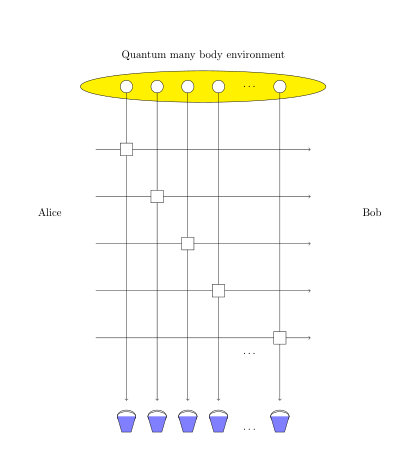 Figure 1
Peer Reviews
No public reviews on file for this paper yet. If you reviewed it on a platform where reviews are public (OpenReview, ICLR, NeurIPS, ICML), you can paste yours below so the community can read it here.
Videos
No videos yet. Explain this paper in a talk, walkthrough, or lecture? Add one.
Taxonomy
TopicsQuantum and electron transport phenomena · Quantum Computing Algorithms and Architecture · Quantum many-body systems
Capacity of a quantum memory channel correlated by matrix product states
Jaideep Mulherkar
V Sunitha
Dhirubhai Ambani Institute of Information and Communication Technology, Gandhinagar, India.
Abstract
We study the capacity of a quantum channel where channel acts like controlled phase gate with the control being provided by a one-dimensional quantum spin chain environment. Due to the correlations in the spin chain, we get a quantum channel with memory. We derive formulas for the quantum capacity of this channel when the spin state is a matrix product state. Particularly, we derive exact formulas for the capacity of the quantum memory channel when the environment state is the ground state of the AKLT model and the Majumdar-Ghosh model. We find that the behavior of the capacity for the range of the parameters is analytic.
I Introduction
Quantum memory channels are quantum channels in which the noise effects are correlated. The quantum capacity of a quantum memory channel is the maximum information carrying capacity of the channel. This capacity has an operational meaning described in terms of protocols of entanglement transmission or by the amount of distillable entanglement. Computing the capacity of such a channel is a difficult optimization task since the capacity formula is not given by a single letter formula. Instances of memory channels that occur in physical situations are an unmodulated spin chain Bayat et al. (2008) and a micro maser Benenti et al. (2009). A systematic study of quantum memory channels and a review of results has been done in Kretschmann and Werner (2005); Caruso et al. (2014).
In this work we compute the capacities of quantum channels that have a many body environment. The set up is that Alice transmits a sequence of particles to Bob and each particle interacts via a unitary with its own environmental particle. The environmental particles themselves are in the ground state of a quantum many body environment like a spin chain. Due to the correlations in the chain, memory effects are introduced. Consequently, the resulting channel between Alice and Bob which is given by tracing out the environment, is a quantum memory channel. This set up was studied in detail in Plenio and Virmani (2007, 2008) wherein conditions were derived under which the quantum capacity equals the regularized coherent information of the channel. Along with this it was also shown that a non-analytic behavior of the capacity was related to a phase-transition in the many-body environment.
The work in this paper focuses on the case where the quantum many-body environment is a class of spin chains called matrix product states (MPS) or finitely correlated states Fannes et al. (1992). These states are important from the point of view of both quantum computation and condensed matter theory. It is known Verstraete and Cirac (2004) that they are universal for measurement based quantum computation. Numerical techniques based on higher dimensional MPS (tensor networks) are also being used to study phenomenon such as high temperature superconductivity and exotic phases of matter Orus (2014). MPS states are easy to describe and under some conditions they have nice properties like existence of a spectral gap and exponentially decaying correlations. The MPS formalism arose out of work done by Majumdar-Ghosh (MG) Majumdar and Ghosh (1969) and Afflek-Kennedy-Lieb-Tasaki (AKLT) Affleck et al. (1988) on valence bond solid models. The quantum many body environment for the channel in this paper is the ground states of these models.
The main results in this paper are the derivation of exact formulas for the quantum capacities of the quantum memory channels when the environment is in the ground state of the AKLT model and MG model. The work is organized as follows: In Section II we give an overview of the matrix product states in terms of the theory of completely positive maps as formulated in Fannes et al. (1992). In Section III we go over the construction of the memory channel. In Section IV we derive the formula for the channel correlated by the AKLT and the MG state.
II Quantum spin chains and MPS: The AKLT and MG states
A quantum spin chain is a suitable limit of local spin algebras where is the algebra at each site. A state on is specified by local density matrices such that for any local observable
[TABLE]
A state is translation invariant if the following holds
[TABLE]
MPS are a class of translation invariant states over that are defined by a triple () where is a matrix algebra, is a state on , and is a completely positive unital map which has the Krauss representation
[TABLE]
where . Note that defines a completely positive map from to . We define as maps from to recursively as follows
[TABLE]
It was shown in Fannes et al. (1992) that given the triplet () there exists a translation invariant state on such that the local density matrices satisfy the condition
[TABLE]
Translation invariance of yields the property
[TABLE]
When the completely positive map in equation (1) is pure, that is, it has only one Krauss operator, then
[TABLE]
The state generated herein is called a purely generated MPS. For purely generated MPS there exists an orthonormal set and operators defined as
[TABLE]
[TABLE]
for . From equation (2) we get
[TABLE]
Furthermore the operators satisfy
[TABLE]
It can be shown that the local density matrices are given by
[TABLE]
It was shown in Fannes et al. (1992) that for purely generated MPS if there exists a unique satisfying equation then the resulting states are pure states over . Moreover they are ground states of translation invariant finite range Hamiltonians. They also have some interesting properties like exponentially decaying correlation functions and a ground state enery gap. The AKLT Hamiltonian is given by
[TABLE]
The AKLT Hamiltonian is a spin-1 chain and are spin-1 observables corresponding to observing the spin at site i in the x,y and z directions respectively. The ground state of the AKLT Hamiltonan is unique and we look at the parametrized version of the AKLT state which has MPS representation given by the triplet () with
[TABLE]
and the map determined by the operators where
[TABLE]
where are the Pauli matrices and . The ground state of the Hamiltonian in expression (5) corresponds to . The Majumdar-Ghosh Hamiltonian is a spin- Hamiltonian given by
[TABLE]
It has two distinct ground states and an equal superposition of these two ground states has MPS representation with operators given by
[TABLE]
where is a parameter and the ground state of the Hamiltonian (7) corresponds to . The invariant state is
[TABLE]
III Construction of the memory channel and capacity formula
A quantum channel is a completely positive trace preserving (CPTP) map where and are Hilbert spaces of the input and output systems respectively. Every completely positive map has a Krauss form
[TABLE]
where the linear operators satisfy . By Stinesprings’ dilation theorem there exists a Hilbert space referred to as environment and an isometry such that the map is given by
[TABLE]
where we have taken the partial trace over the environment system. If we take the partial trace over the system instead of the environment we get the complementary map which is also CPTP
[TABLE]
Due to equations we can write the output state of the complementary channel as
[TABLE]
Memory less channels are channels where the noise acts independently on each input state. Multiple uses of a memory less channel is given by the tensor product . In situations where the tensor product structure of the multi use of the channel does not hold, we get a channel with memory. In a quantum memory channel besides the input and output, there is a third system which represents the state of the memory. The channel operates on the input state and the state of the memory yielding an output state and a new state of the memory. Thus a quantum memory channel is represented by a CPTP map . The action of n successive uses of this channel is given by the channel where
[TABLE]
The final output state can be determined by performing a partial trace over the memory system.
The memory considered in this paper is a state of a quantum many body system like state of a quantum spin chain. The memory consists of a tensor product of spin algebras at each site, that is, where is the algebra at site . The memory state is assumed to be initially in an entangled state of the algebra . The memory channel is created by a family of local unitaries,
[TABLE]
with each unitary acting on the the channel input and the local spin algebra. The final state of the channel is given by
[TABLE]
See Figure 1.
We study the special case when the local unitary is a generalized controlled phase gate. For the environment of spin- particles the local unitaries are given by the controlled Z-gate
[TABLE]
For a d-level environment system the unitary is a generalized phase gate given by
[TABLE]
where . For this channel, if the environment is in state
[TABLE]
then the action of controlled Z-gate leads to the following dephasing channel
[TABLE]
Computing the capacities of dephasing channels was also done previously in Benenti et al. (2007); Lemos and Benenti (2010); Arshed et al. (2010). In Plenio and Virmani (2008) it was shown that the quantum capacity of the quantum memory channel with many body environment of a MPS equals the regularized coherent information
[TABLE]
where
[TABLE]
Furthermore, in Plenio and Virmani (2008), it was shown that for the quantum memory channel with a many body environment given by a MPS state the quantum capacity is given by
[TABLE]
where is the dimension of the local spin algebra.
IV Capacity of channel correlated with the AKLT and MG states
In the previous section we saw that the capacity of the quantum memory channel can be computed from the diagonal elements of the local density matrix of the MPS environment. From equation (4) the diagonal elements of local densities of an MPS described by operators and invariant state are given by
[TABLE]
Now, if are simultaneously diagonalizable, with for some unitary then the problem becomes tractable since in this case we get
[TABLE]
where are the number of occurrences of the operators in equation (14), respectively. In Plenio and Virmani (2008) a solution for this problem was given when the matrices are rank-1 matrices by reducing the analysis to the solution of a classical 1D Ising model. If the MPS operators are not of the form described in these special cases then the problem is more difficult. Consider the classical probability distribution as
[TABLE]
The translation invariance of the MPS states carries over to this classical probability distribution. The limit is the entropy rate of the stochastic process given by the equation (15). Thus, by equation (13), computing the diagonal entropy of the MPS state is equivalent to computing the entropy rate of this classical probability distribution. The limit exists when the process is stationary Cover and Thomas (2006) and we have
Lemma 1**.**
[TABLE]
A closed form formula for the entropy rate of a stationary stochastic process exists when a stationary process is Markov Cover and Thomas (2006) or a hidden Markov process of a special kind Marchand et al. (2012). In general, obtaining a closed form solution for the entropy rate of a general stationary stochastic process is known to be hard. In what follows we compute the entropy rate of the stationary stochastic process generated by the diagonal elements of the AKLT state and the MG state by explicitly computing the diagonal elements. Let the local densities of the ground state of the AKLT model and MG model be denoted by and respectively. For AKLT model we have the following lemma
Lemma 2**.**
The non-zero diagonal elements of are given by where
[TABLE]
**Proof: ** From equation (4) and the cyclicity of the trace the diagonal elements of local density matrices are given by
[TABLE]
where and the operators are as in equation (6). We denote , and and note the following relations:
[TABLE]
[TABLE]
[TABLE]
[TABLE]
[TABLE]
[TABLE]
Let be the number of occurrences of operator in equation (16), then because of equations (17) and (21) we have
[TABLE]
where the operators is . From (17) we get
[TABLE]
Due to relation (20) the operators and must occur alternately in the sequence on the right side of equation (24). Now, using equations (18),(19) and (22) we get
[TABLE]
where if otherwise is either or . If we get exactly one diagonal element
[TABLE]
If then we get diagonal elements of the form
[TABLE]
If then the number of ways that one can place these operators in the sequence is . Since the remaining and operators occur alternately, there are only ways to place them and hence the multiplicity of in this case is .
Theorem 3**.**
The quantum capacity of the channel correlated with the AKLT ground state is given by
[TABLE]
where
**Proof: ** From equation ( 13) we have
[TABLE]
where is as in lemma 2. Setting and we get
[TABLE]
The term goes to zero as . Hence, we get
[TABLE]
The last equality follows from the fact that expectation of a binomial random variable with parameters is and the fact that the sum of the binomial probabilities is . Hence
[TABLE]
In particular, the capacity of the channel for the ground state of the AKLT Hamiltonian given by equation (5) is .
Lemma 4**.**
*The non-zero diagonal elements of are given by:
If is odd:*
[TABLE]
If is even*:*
[TABLE]
**Proof: ** See appendix.
Theorem 5**.**
The quantum capacity of the channel correlated with the Majumdar-Ghosh ground state is given by
[TABLE]
**Proof: ** We consider the cases of being odd and even separately.
Case 1: n is odd
Setting from lemma 4 we get
[TABLE]
Rearranging the terms we get
[TABLE]
The summation in the first two terms inside the limit is expectation of a binomial random variable with parameters and respectively. The summation of last term is just the sum of the binomial probabilities which is equal to one. Thus, we have
[TABLE]
Case 2: n is even
Using lemma 4, we get
[TABLE]
Rearranging the terms of and we can write this as
[TABLE]
Proceeding along the lines of the odd case we see that
[TABLE]
For (Majumdar-Ghosh Hamiltonian) given by equation (5) the capacity is .
V Conclusion
In this paper we have computed the quantum capacity of a quantum memory channel where the noise correlations come from a spin chain external environment. In particular the environment that we consider are parametrized ground states of the AKLT and the MG spin chains. These are well known matrix product states and we have used the formalism and mechanics of MPS to compute exact formulas for the capacities of these quantum memory channels. We also observed that the diagonal elements of translation invariant MPS correspond to the probability distribution of a stationary stochastic process. A question that naturally arises is whether the diagonal elements of an MPS correspond to some special stochastic processes that will make the computation of the quantum capacity of the correlated memory channels tractable. Another question of interest is whether the methods in this work can be used to compute the quantum capacity of a much larger class of quantum memory channels correlated by MPS. The capacity formulas that we derived were analytic in the range that we have considered. It would be interesting to investigate the effect on the capacities for other ranges of parameter values, especially where there are known phase transitions.
Appendix A Proof of lemma 4
The lemma can be easily verified for the cases when , and . So we prove for the case with as in equation (8).
Proof for values:
The proof is based on the observation that, for ,
[TABLE]
Consequently, for ,
[TABLE]
Now, the non-zero values for can be inferred as stated in the lemma. The validity of the observation can be established by mathematical induction on . For , the observation can be verified explicitly. Now, assuming that the observation is valid for an arbitrary integer , we prove that the observation holds for . Let
denote ,
denote ,
denote ,
denote ,
denote ,
denote ,
denote ,
and denote .
By induction hypothesis
[TABLE]
So,
[TABLE]
Now, since
[TABLE]
we get
[TABLE]
Proof of multiplicity:
Let , , , , , , , and denote the multiplicity of , , , , , , , and , respectively, in . From the relations A1-A10 we obtain the following recurrence relations:
For ,
[TABLE]
with initial conditions
[TABLE]
Solving the above recurrences with the given initial conditions result in
[TABLE]
Now that we have identified the distinct values along with multiplicities for with and , we can consider the cases of being odd or even to conclude the lemma.
The reference list from the paper itself. Each links out to its DOI / PubMed record.
- 1Bayat et al. (2008) A. Bayat, D. Burgarth, S. Mancini, and S. Bose, Phys. Rev. A 77 (2008).
- 2Benenti et al. (2009) G. Benenti, A. D’Arrigo, and G. Falci, Phys. Rev. Lett. 103 (2009).
- 3Kretschmann and Werner (2005) D. Kretschmann and R. Werner, Rev. Mod. Phys. 72 (2005).
- 4Caruso et al. (2014) F. Caruso, V. Giovanetti, C. Lupo, and S. Mancini, Rev. Mod. Phys. 86 , 1203 (2014).
- 5Plenio and Virmani (2007) M. Plenio and S. Virmani, Phys. Rev. Lett. 99 (2007).
- 6Plenio and Virmani (2008) M. Plenio and S. Virmani, New Journal of Physics 10 (2008).
- 7Fannes et al. (1992) M. Fannes, B. Nachtergaele, and R. Werner, Comm. in Math. Phys. 144 , 443 (1992).
- 8Verstraete and Cirac (2004) F. Verstraete and J. Cirac, Phys. Rev. A 70 (2004).