Unambiguous discrimination of nonorthogonal quantum states in cavity QED
R. J. de Assis, J.S. Sales, N. G. de Almeida

TL;DR
This paper presents a simplified method using a three-level atom and POVM techniques to unambiguously distinguish nonorthogonal quantum states in high-Q cavity systems, enhancing quantum measurement precision.
Contribution
It introduces a novel, simplified scheme for unambiguous quantum state discrimination in cavity QED using a single atom and POVM, improving practical implementation.
Findings
Scheme achieves unambiguous discrimination with high efficiency.
Analysis aligns with current cavity QED experimental capabilities.
Potential for improved quantum information processing applications.
Abstract
We propose an oversimplified scheme to unambiguously discriminate nonorthogonal quantum field states inside high-Q cavities. Our scheme, which is based on positive operator-valued mea- sures (POVM) technique, uses a single three-level atom interacting resonantly with a single mode of a cavity-field and selective atomic state detectors. While the single three-level atom takes the role of the ancilla, the single cavity mode field represents the system we want to obtain information. The efficiency of our proposal is analyzed considering the nowadays achievements in the context of cavity QED.
Click any figure to enlarge with its caption.
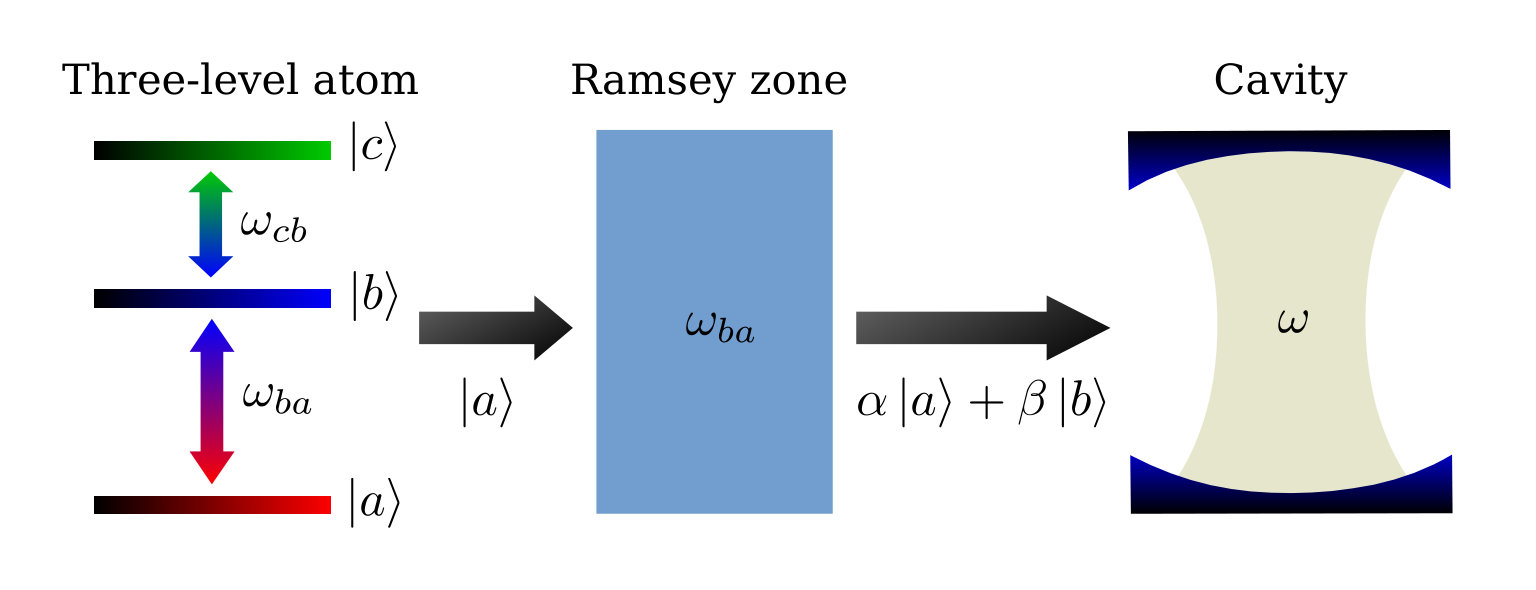 Figure 1
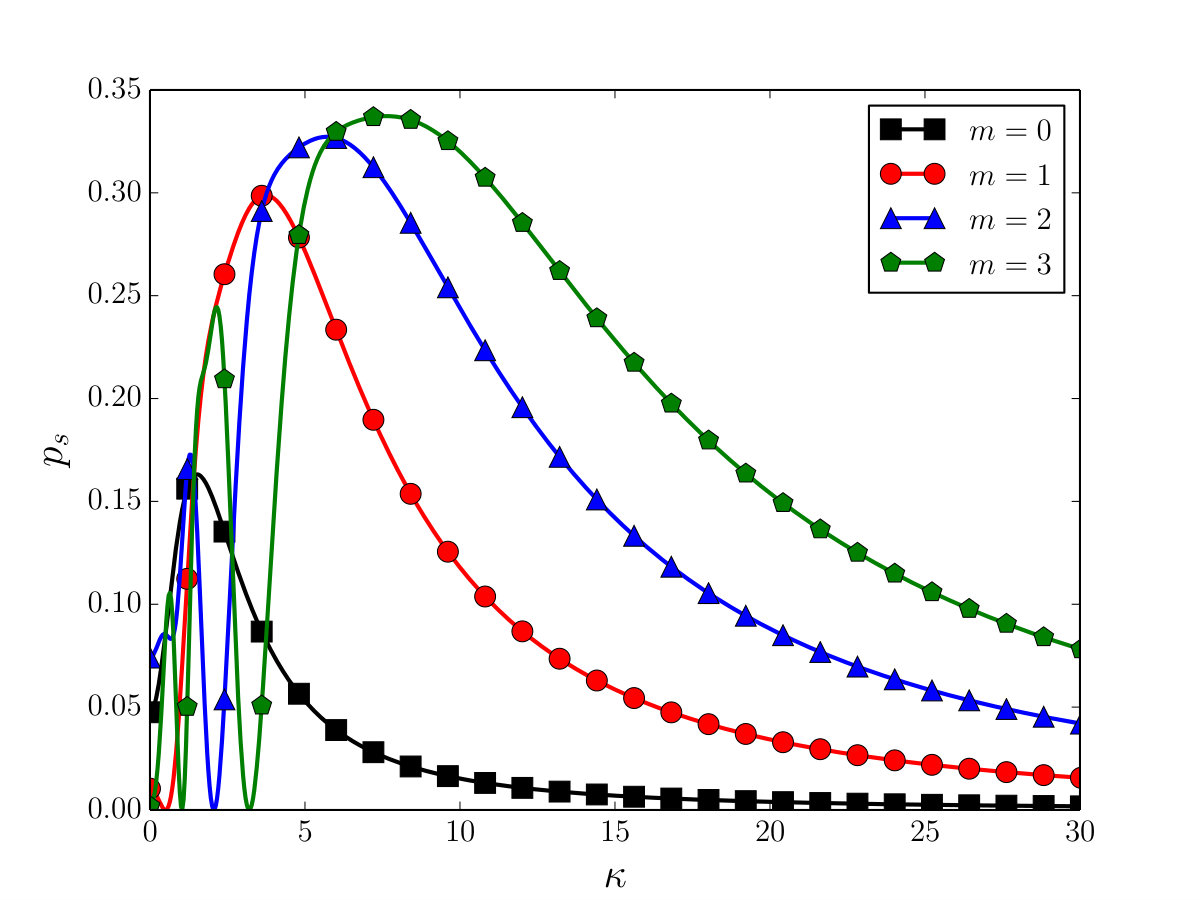 Figure 2
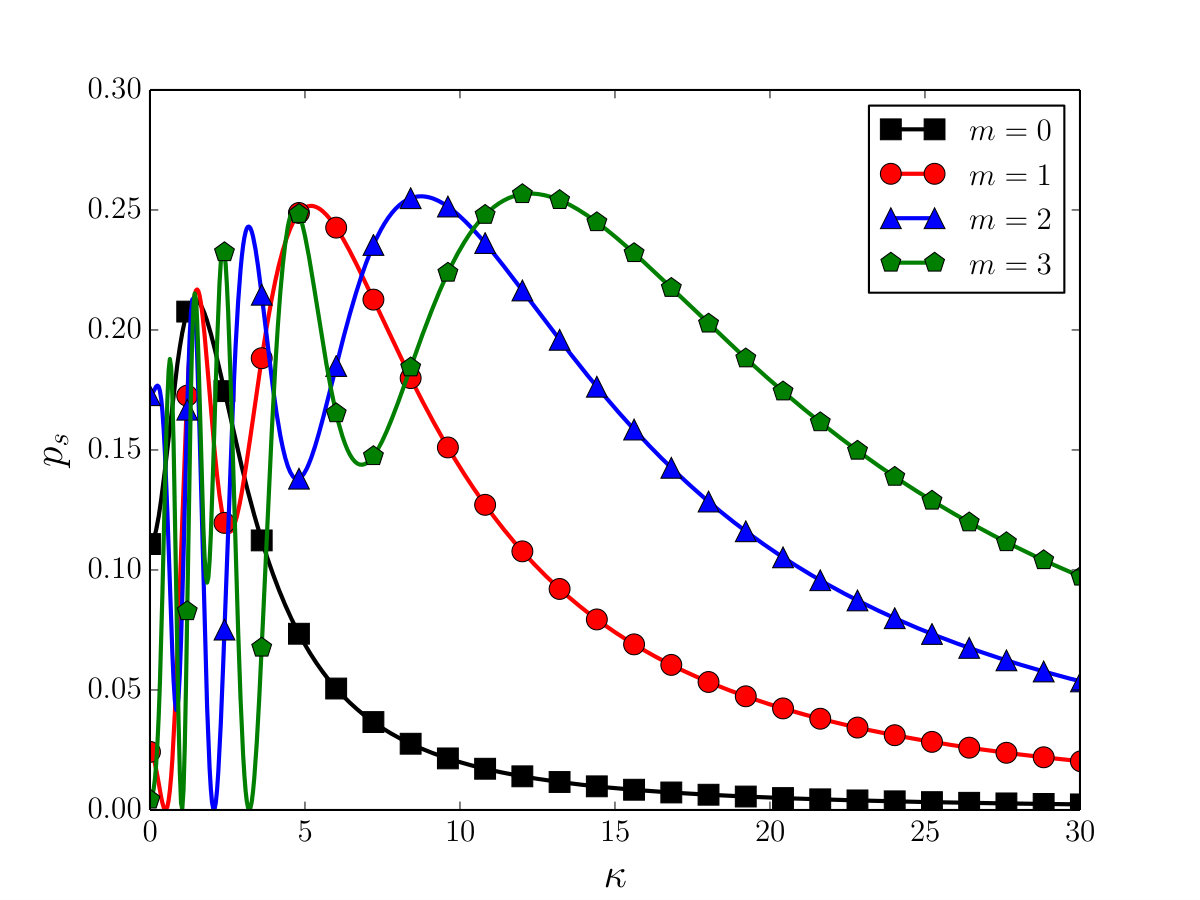 Figure 3
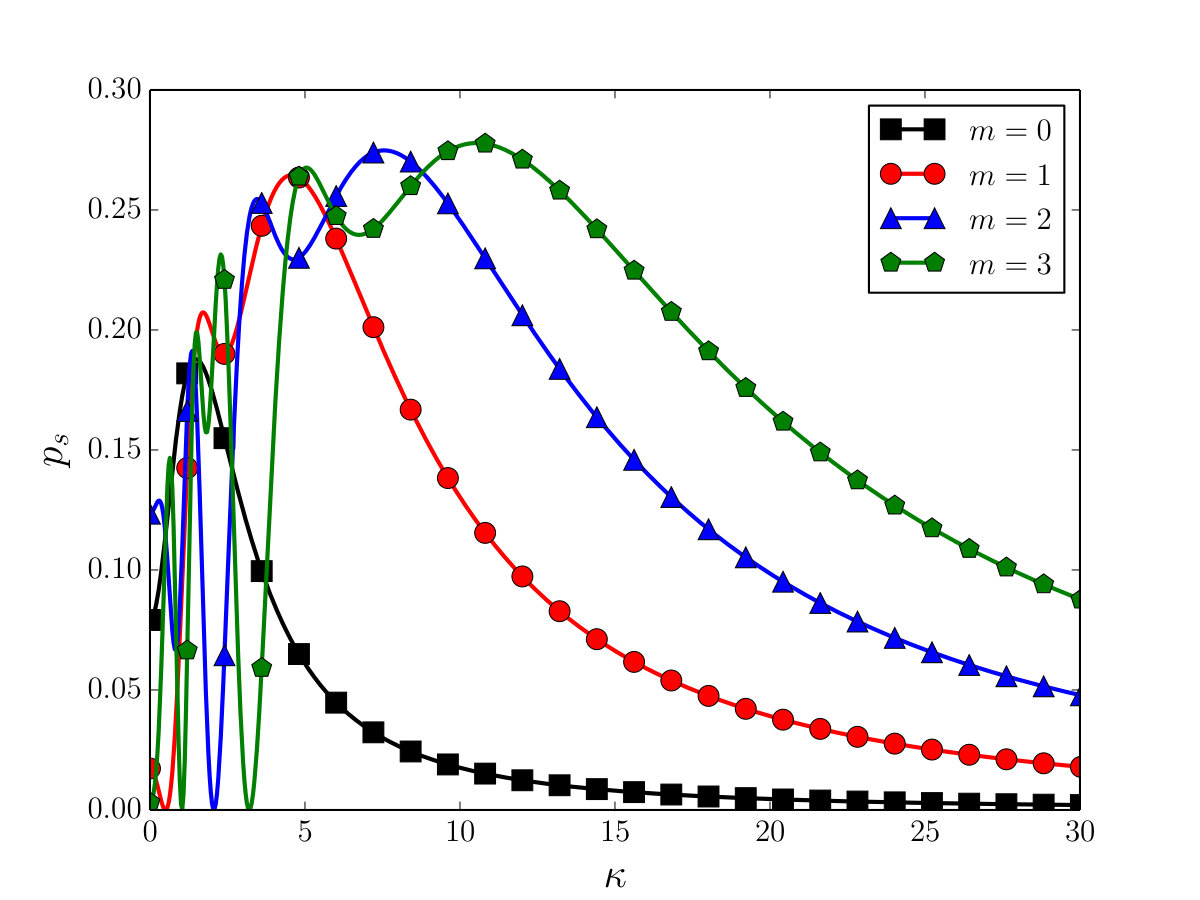 Figure 4
| 0 | 1.52 | 0.8369 | 0.0747 | 0.0884 | 0.1631 |
|---|---|---|---|---|---|
| 1 | 3.72 | 0.7011 | 0.0366 | 0.2623 | 0.2989 |
| 2 | 5.71 | 0.6728 | 0.0155 | 0.3117 | 0.3272 |
| 3 | 7.63 | 0.6627 | 0.0069 | 0.3304 | 0.3373 |
| 4 | 9.54 | 0.6581 | 0.0032 | 0.3387 | 0.3419 |
| 5 | 11.44 | 0.6556 | 0.0015 | 0.3429 | 0.3444 |
| 10 | 21.23 | 0.6505 | 0.0012 | 0.3483 | 0.3495 |
| 20 | 41.11 | 0.6505 | 0.0001 | 0.3494 | 0.3495 |
| 50 | 101.05 | 0.6501 | 0.0000 | 0.3499 | 0.3499 |
| 0 | 1.45 | 0.7874 | 0.1749 | 0.0377 | 0.2126 |
|---|---|---|---|---|---|
| 1 | 5.19 | 0.7483 | 0.1693 | 0.0824 | 0.2517 |
| 2 | 8.54 | 0.7443 | 0.1679 | 0.0878 | 0.2557 |
| 3 | 12.27 | 0.7432 | 0.1674 | 0.0894 | 0.2568 |
| 4 | 15.80 | 0.7427 | 0.1673 | 0.0900 | 0.2573 |
| 5 | 19.32 | 0.7426 | 0.1671 | 0.0903 | 0.2574 |
| 10 | 36.91 | 0.7422 | 0.1670 | 0.0908 | 0.2578 |
| 20 | 72.08 | 0.7420 | 0.1670 | 0.0910 | 0.2580 |
| 50 | 177.58 | 0.7420 | 0.1670 | 0.0910 | 0.2580 |
| 0 | 1.47 | 0.8123 | 0.1248 | 0.0629 | 0.1877 |
|---|---|---|---|---|---|
| 1 | 4.50 | 0.7356 | 0.1039 | 0.1605 | 0.2644 |
| 2 | 7.55 | 0.7252 | 0.0989 | 0.1759 | 0.2748 |
| 3 | 10.55 | 0.7221 | 0.0957 | 0.1822 | 0.2779 |
| 4 | 13.70 | 0.7209 | 0.0956 | 0.1835 | 0.2791 |
| 5 | 16.50 | 0.7101 | 0.0950 | 0.1849 | 0.2799 |
| 10 | 31.52 | 0.7191 | 0.0941 | 0.1868 | 0.2809 |
| 20 | 61.50 | 0.7189 | 0.0938 | 0.1873 | 0.2811 |
| 50 | 151.50 | 0.7188 | 0.0930 | 0.1882 | 0.2812 |
Peer Reviews
No public reviews on file for this paper yet. If you reviewed it on a platform where reviews are public (OpenReview, ICLR, NeurIPS, ICML), you can paste yours below so the community can read it here.
Videos
No videos yet. Explain this paper in a talk, walkthrough, or lecture? Add one.
Unambiguous discrimination of nonorthogonal quantum states in cavity
QED
R. J. de Assis
Instituto de Física, Universidade Federal de Goiás, 74.001-970, Goiânia
- GO, Brazil
J.S. Sales
Centro de Ciências Exatas e Tecnológicas, Universidade Estadual de Goiás, 75132-903, Anápolis, Goiás, Brazil
N. G. de Almeida
Instituto de Física, Universidade Federal de Goiás, 74.001-970, Goiânia
- GO, Brazil
Abstract
We propose an oversimplified scheme to unambiguously discriminate nonorthogonal quantum field states inside high-Q cavities. Our scheme, which is based on positive operator-valued measures (POVM) technique, uses a single three-level atom interacting resonantly with a single mode of a cavity-field and selective atomic state detectors. While the single three-level atom takes the role of the ancilla, the single cavity mode field represents the system** **we want to obtain information. The efficiency of our proposal is analyzed considering the nowadays achievements in the context of cavity QED.
pacs:
42.50.−p, 42.50.Ct, 42.50.Pq, 05.30.-d, 03.65.Ta
I Introduction
Positive operator-valued measures (POVM) generalizes all possible kind of measurements povm ; jacobs14 and cannot be reduced to standard projections of the initial state onto orthogonal states spanning the initial Hilbert space alone, pertaining to the system we want to obtain information Peres93 ; Nielsen00 . In fact, although in general POVM can always be realized as standard projective measurements on an enlarged system Peres93 , they are such that the number of outputs may be larger than the dimensionality of the space of states of the system in which we are interest in. POVM is now standard in several areas of quantum mechanics, including quantum optics and quantum information, among others Nielsen00 ; Scully97 ; Lo98 ; Janos07 . In this paper we show how to accomplish POVM to unambiguously discriminate nonorthogonal field states inside high-Q cavities. The goal of unambiguous quantum state discrimination (UQSD) is to discern in which state the system was prepared Ivanovic87 ; Chefles00 ; Cheffles12 ; Gisin96 , founding many applications in several protocols Chefles00 ; Cheffles12 , mainly for quantum cryptography Bennet17 ; Bennett84 ; Kak06 ; Eckert91 . **Our scheme, employing one three-level atom interacting with a single mode of a cavity field, is very simple from the experimental point of view and can be implemented using nowadays techniques in cavity QED.
We begin by reviewing the general quantum measurement theory. Next, we present our model and results, comparing with the simple case of projective measurements. Then we present our conclusions.
II General measurements
Consider a quantum system we are interested to measure, and a second quantum system we call the ancilla,* which is used to get information about the system of interest jacobs14 . Let the Hilbert space dimension of the system of interest and the ancilla as and , respectively. The ancilla is prepared in some known initial state independently of the system of interest, and then the two systems are allowed to interact, getting correlated.* Next, a von Neumann measurement is performed on the ancilla, providing us with information about the system of interest, which we are going to call the **system from now on. Let us call the initial state of the ancilla as in the basis , , and denote the initial density operator of ancilla-system as
[TABLE]
where is the initial density operator of the system. Let denote the ancilla-system evolution operator. Since acts in the tensor-product space, it can be written as
[TABLE]
where
[TABLE]
being , , a set of basis states for the system, and are the matrix elements of . Note that acts in the Hilbert space of the system, and since the space of system has dimension , each sub-block matrix has dimension . From now on we use to refer to the first column of the sub-block of . Denoting the sub-blocks of the matrix by , and since , it is readily seen that
[TABLE]
The important point to note here is that can be chosen to be any set of operators, provided the restriction Eq. (4) above is obeyed.
Now, performing a von Neumann measurement on the ancilla states, represented by , we can write the (unnormalized) collapsed state of both ancilla and system as
[TABLE]
or, in terms of the sub-blocks of :
[TABLE]
From Eq. (6) we can write the normalized state of the system as
[TABLE]
where
[TABLE]
is the probability of finding the ancilla in state after the unitary evolution . It is now promptly recognized that every set of operators satisfying describes a possible measurement on a quantum system, with the measuring having outcomes. This gives us a complete description of a quantum system under a general measurement. Next, we use the above results to discriminate one of two nonorthogonal field states prepared into a high Q cavity.
III Model
In our proposal, see Fig. 1, a three-level atom in ladder configuration, described by the set of states ,** is initially prepared in and crosses a Ramsey zone (carrier interaction). Next, the atom enters a cavity **interacting on-resonance with a singe mode of a cavity field which in turns is prepared either in state or in state , for which (nonorthogonal states).
While inside the cavity, the atom suffers a Stark shift in order to lead Haroche99 ; Haroche01 . After the atom crosses the cavity, it is detected in one of its three possible states, thus revealing in which state the cavity mode was prepared. The Hamiltonian model is given by Scully97
[TABLE]
where and is the creation (annihilation) photon number operator, and is the atom-field coupling, which we take as real for convenience. In this protocol we are interested in discriminating nonorthogonal states which are combinations of the Fock states and . Thus, since the maximum number of photons in this case is , which happens when the atom decays and increases the photon number into the cavity, we can consider . After a little algebra, it is straightforward to obtain
[TABLE]
[TABLE]
[TABLE]
where , with , given by Eq.(9), and is the evolution operator as given by the carrier or Ramsey zone: .
Following the standard procedure Nielsen00 , we must build three POVM elements: the one that discriminates ; the other one that discriminates , and a third one leading to inconclusive results with probability . It is to be noted that the only constraint obeyed by the POVM elements is . Thus, as soon as the atom state is known, we will know with certainty* *that the cavity mode field was either in state or in state , or that we do not know the initial state as a result of the inconclusive measurement. As explained above, to build the three POVM elements , , we have to calculate :
[TABLE]
and
[TABLE]
Using Eq. (10)-(12), we calculate the following operators in Eq. (13):
[TABLE]
[TABLE]
[TABLE]
From Eq. (15)-(17) we can calculate the POVM elements for :
[TABLE]
[TABLE]
[TABLE]
As can be checked, .
To be specific, let us assume that we want to discriminate the following nonorthogonal field states into the cavity: and Nielsen00 . The cavity state is thus represented by , where is the classical probability related to the frequency of preparing the state and . Clearly, discriminates state , since . To discriminate , we impose . This imposition leads us with the conditions: (i) , (ii) , and (iii) . Letting , the third condition can be rewritten as , . On the other hand, is inconclusive, since and , meaning that we must discard this measurement. Using these three conditions, we can write the effective POVM elements in the following way:
[TABLE]
[TABLE]
[TABLE]
where we have neglected terms containing the state and put .
The probabilities related to the success probability rates of POVM elements and are, respectively,
[TABLE]
and
[TABLE]
while the probability for the inconclusive results is ****
[TABLE]
The success probability is given by :
[TABLE]
where , as should.
IV Discussion
Since the result of POVM element is the inconclusive one, all we have to do in order to optimize our proposal is either minimize or maximize . We numerically maximize Eq. (27) with (i) , (ii) and, for comparison to other work, (iii) Nielsen00 . As an example, to we find, see Fig. 4, (a) for (black line with squares), implying , (b) for , (red line with circles), implying (c) for ** **(blue line with triangles), implying (d) for , (green line pentagons), implying . Values of can be used at the expense of greater ratio , see Tab. 1-3. The best choice to UQSD is the one that minimizes (maximizes) for each integer , and it is worthwhile to mention that the success probability rate around 0.26, obtained for the first values of the integer m, is very close to the best rate of success for this kind of quantum state discrimination predicted theoretically, which is 0.292 when Nielsen00 ; Janos07 . As can be seen from Fig. 2-3, there are several maxima in , depending on the value of . Here we have chosen those whose success probability is the greatest one. Note from Tab. 3, corresponding to , that the best value for the success probability rate is below 0.292, which is the maximum value according to Ref. Nielsen00 ; Janos07 . This is also confirmed by our numerical calculations using much greater values for and .
It is to be noted that the simple strategy of choosing whether to project the cavity field state on the computational basis or would allow us to discriminate only one state. Indeed, if the result of projection is , the cavity mode state could not have been prepared in and was prepared therefore in state ; however, if the measurement result is , we can not be sure if the cavity mode state had been prepared in or , this result being inconclusive. As a result of this strategy, we would find a success probability of , thus lesser than the POVM strategy we developed. In Tab. 1-3 we present the values of maximizing and the corresponding values for , , and , Eq. (24)-(27), for several integers and .
As a final remark, one could ask why to use POVM strategy instead of simply projecting on the computational basis of the cavity states. Three remarks are in order: (i) First, in addition to our protocol presenting a higher probability of success, there is no known technique to directly project the cavity state on the computational basis: usually, measurement of the cavity state requires additional atoms and/or cavities, thus being necessary to build another POVM elements to measure the cavity mode field Iara07 ; Almeida11 , (ii) second, the direct projective strategy does not discriminate both states but just , while the POVM strategy allows us to discriminate both and , (iii) the POVM strategy was build using known matter-radiation interaction parameters: it remains an open question if other types of interaction, such as those developed by effective Hamiltonian techniques Serra05 ; Prado06 ; deAlmeida14 , could attain optimal POVM results Jaeger95 .
V Conclusion
We have proposed an oversimplified scheme to build POVM elements allowing to discriminate nonorthogonal field states inside a high Q cavity. Besides to circumvent the impossibility to directly project the cavity states onto the computational Fock states without using ancilla, our protocol achieves a rate of success probability greater than the direct projective technique. Our proposal relies on nowadays techniques in the cavity QED domain, making use of just one single three-level atom undergoing a Ramsey zone (carrier interaction) plus one cavity and selective atomic state detectors. This simplicity makes our protocol very attractive from the experimental point of view. Finally, we hope our protocol can inspire other POVM strategies based on effective Hamiltonians technique making possible to attain optimal rates of success probability.
Acknowledgements.
We acknowledge financial support from the Brazilian agency CNPq, CAPES and FAPEG. This work was performed as part of the Brazilian National Institute of Science and Technology (INCT) for Quantum Information.
The reference list from the paper itself. Each links out to its DOI / PubMed record.
- 1(1) C. W. Helstrom, Quantum Detection and Estimation Theory (Academic, New York, 1976).
- 2(2) K. Jacobs, Quantum Measurement Theory and its Applications (Cambridge University Press, 2014).
- 3(3) A. Peres, Quantum Theory: Concepts and Methods (Kluwer, Dordrecht, 1993), Chap. 9.
- 4(4) Nielsen, M.A., Chuang, I.L.: Quantum Computation and Quantum Information. Cambridge University Press, Cambridge (2000).
- 5(5) M. O. Scully and M. S. Zubairy Quantum Optics (Cambridge 1997).
- 6(6) H.-K. Lo, S. Popescu and T. P. Spiller (eds.), Introduction to Quantum Computation and Information, (World Scientific Publishing, 1998), ISBN 981-02-3399-X.
- 7(7) Bergou J. A., Quantum state discrimination and selected applications. Journal of Physics: Conference series 84 012001 (2007).
- 8(8) I. D. Ivanovic, Physics Letters A Volume 123, Issue 6, Pages 257-312 (17 August 1987).