On multiplicity of eigenvalues and symmetry of eigenfunctions of the $p$-Laplacian
Benjamin Audoux, Vladimir Bobkov, Enea Parini

TL;DR
This paper explores the multiplicity and symmetry of eigenvalues and eigenfunctions of the p-Laplacian on symmetric domains, revealing new inequalities and properties, especially for the second eigenvalue and eigenfunctions on balls and discs.
Contribution
It introduces topological methods to analyze eigenvalue multiplicities and symmetry, establishing inequalities and properties for p-Laplacian eigenvalues on symmetric domains.
Findings
Established inequalities between eigenvalues on balls.
Proved the second eigenvalue has multiplicity at least N.
Showed third eigenfunctions on discs are nonradial.
Abstract
We investigate multiplicity and symmetry properties of higher eigenvalues and eigenfunctions of the -Laplacian under homogeneous Dirichlet boundary conditions on certain symmetric domains . By means of topological arguments, we show how symmetries of help to construct subsets of with suitably high Krasnosel'ski\u{\i} genus. In particular, if is a ball , we obtain the following chain of inequalities: Here are variational eigenvalues of the -Laplacian on , and is the eigenvalue which has an associated eigenfunction whose nodal set is an equatorial section of . If , as it holds true for , the result implies that the…
Click any figure to enlarge with its caption.
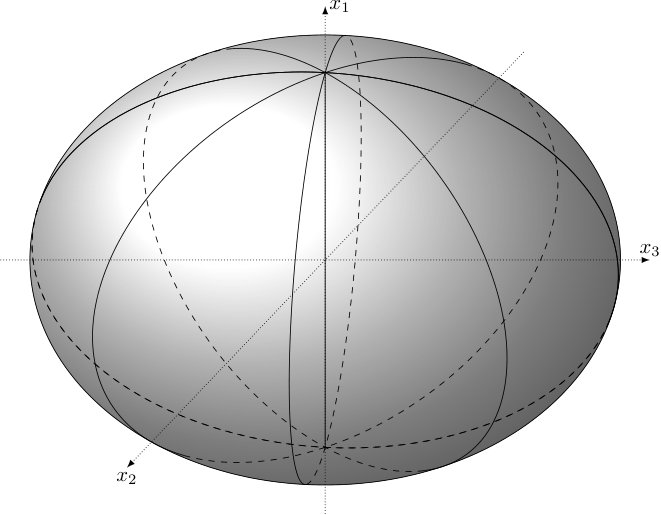 Figure 1
Peer Reviews
No public reviews on file for this paper yet. If you reviewed it on a platform where reviews are public (OpenReview, ICLR, NeurIPS, ICML), you can paste yours below so the community can read it here.
Videos
No videos yet. Explain this paper in a talk, walkthrough, or lecture? Add one.
On multiplicity of eigenvalues and symmetry of eigenfunctions of the -Laplacian
Benjamin Audoux
,
Vladimir Bobkov
and
Enea Parini
Aix Marseille Univ, CNRS, Centrale Marseille, I2M, 39 Rue Frederic Joliot Curie, 13453 Marseille, France
University of West Bohemia, Faculty of Applied Sciences, Department of Mathematics and NTIS, Univerzitní 8, 306 14 Plzeň, Czech Republic
Abstract.
We investigate multiplicity and symmetry properties of higher eigenvalues and eigenfunctions of the -Laplacian under homogeneous Dirichlet boundary conditions on certain symmetric domains . By means of topological arguments, we show how symmetries of help to construct subsets of with suitably high Krasnosel’skiĭ genus. In particular, if is a ball , we obtain the following chain of inequalities:
[TABLE]
Here are variational eigenvalues of the -Laplacian on , and is the eigenvalue which has an associated eigenfunction whose nodal set is an equatorial section of . If , as it holds true for , the result implies that the multiplicity of the second eigenvalue is at least . In the case , we can deduce that any third eigenfunction of the -Laplacian on a disc is nonradial. The case of other symmetric domains and the limit cases , are also considered.
Key words and phrases:
-Laplacian; nonlinear eigenvalues; Krasnoselskii genus; symmetry; multiplicity; degree of map
2010 Mathematics Subject Classification:
35J92; 35P30; 35A15; 35A16; 55M25; 35B06;
1. Introduction and main results
Let , , be a bounded, open domain, and let . We say that is an eigenfunction of the -Laplacian associated to the eigenvalue if it is a weak solution of
[TABLE]
where . If , (1.1) is the well-known eigenvalue problem for the Laplace operator. The first eigenvalue of the -Laplacian is defined as
[TABLE]
where
[TABLE]
Besides the first eigenvalue, in the linear case , the standard Courant-Fisher minimax formula
[TABLE]
provides a sequence of eigenvalues which exhausts the spectrum of the Laplacian, cf. [3, Theorem 8.4.2]. In (1.3), the minimum is taken over subspaces of dimension . However, for the problem is nonlinear, and it is necessary to make use of a different method. A sequence of variational eigenvalues can be obtained by means of the following minimax variational principle. Let be a symmetric set, i.e., if , then . Define the Krasnosel’skiĭ genus of as
[TABLE]
with the convention if, for every , no continuous odd map exists. Here is a -dimensional sphere. For we define
[TABLE]
and
[TABLE]
It is known that each is an eigenvalue and
[TABLE]
see [13, §5]. However, it is not known if the sequence exhausts all possible eigenvalues, except for the case , where the eigenvalues in (1.4) coincide with the eigenvalues in (1.3), see, e.g., [10, Proposition 4.7] or [9, Appendix A]. It has to be observed that the definitions of by (1.2) and (1.4) are consistent. The associated first eigenfunction is unique modulo scaling and has a strict sign in (cf. [4, 24]), while eigenfunctions associated to any other eigenvalue must necessarily be sign-changing (see, e.g., [19, Lemma 2.1]). Therefore, it makes sense to define the nodal domains of an eigenfunction as the connected components of the set , and the nodal set of as . The version of the Courant nodal domain theorem for the -Laplacian obtained in [12] states that any eigenfunction associated to with has at most nodal domains. In particular, any eigenfunction associated to has exactly two nodal domains. Moreover, since there are no eigenvalues between and [1], the latter is indeed the second eigenvalue.
For the sake of simplicity, in the following we will restrict our attention mainly to the case where is an open -ball centred at the origin. In the linear case , the eigenfunctions of the Laplace operator on are given explicitly by means of Bessel functions and spherical harmonics, and therefore it can be seen that the first eigenfunction is radially symmetric, while the nodal set of any second eigenfunction is an equatorial section of the ball; moreover, the following multiplicity result holds true:
[TABLE]
see, for instance, the discussion in [15]. In contrast, in the nonlinear case much less is known. While it is relatively easy to show that the first eigenfunction is still radially symmetric by means of Schwarz symmetrization, symmetry properties of second eigenfunctions, as well as the multiplicity of the second eigenvalue, are not yet completely understood. For instance, it is known only that second eigenfunctions can not be radially symmetric; this was shown in the planar case in [21] for close to , and later in [5] for general . The result was finally generalized to any dimension in [2]. The notion of multiplicity itself needs to be clarified in the nonlinear case. We say that the variational eigenvalue has multiplicity if there exist variational eigenvalues with such that
[TABLE]
We point out that we are not aware of any multiplicity results for higher eigenvalues of the -Laplacian.
Despite the deficit of information about symmetry properties of variational eigenfunctions, it is possible to consider eigenvalues (possibly non-variational) with associated eigenfunctions which respect certain symmetries of . For instance, the existence of a sequence of eigenvalues
[TABLE]
corresponding to radial eigenfunctions has been shown, for instance, in [11]. Each radial eigenfunction associated to is unique modulo scaling and possesses exactly nodal domains. The latter implies that for any and (see Lemma 2.7 below). The above-mentioned results about radial properties of first and second eigenfunctions, together with [6, Theorem 1.1], can therefore be stated as
[TABLE]
Another sequence of eigenvalues
[TABLE]
was considered in [2, Theorem 1.2]. Here is constructed in such a way that it has an associated symmetric eigenfunction111 We use the adjective “symmetric” to distinguish this eigenfunction from the radial one, since and can be equal to each other and hence might have associated eigenfunctions with not appropriate nodal structures, see [6, Corollary 1.3 and Theorem 1.4]. whose nodal domains are spherical wedges of angle ; see also Section 2.2 below, where a generalization of this sequence to other symmetric domains is given. In particular, the nodal set of any symmetric eigenfunction associated to is an equatorial section of . By construction, a symmetric eigenfunction associated to has nodal domains, which implies that
[TABLE]
At the same time, in the linear case, one can easily use the Courant-Fisher variational principle (1.3) to show (see Remark 3.2 below) that at least
[TABLE]
The generalization of even such simple facts as (1.5) and (1.7) to the nonlinear case meets certain difficulties. The main obstruction consists in the following fairly common problem:
How to obtain a symmetric compact set with suitably high Krasnosel’skiĭ genus, and, at the same time, with suitably low value ?
In the linear case, the consideration of subspaces spanned by the first eigenfunctions directly solves this problem. Let us sketchily describe the approach supposing that we want to prove the multiplicity in (1.5) using the definition (1.4) only. Let and be a first and a second eigenfunction of the Laplacian on , respectively, such that for . Since and the Laplace operator are rotation invariant, we see that generates linearly independent second eigenfunctions whose nodal sets are equatorial sections of orthogonal to each other. Consider the set
[TABLE]
Evidently, is symmetric and compact, and it is not hard to show that . Moreover, since all are mutually orthogonal with respect to -inner product, we get . Indeed,
[TABLE]
Therefore, , and, using again the orthogonality, we obtain
[TABLE]
which leads to the desired chain of equalities in (1.5).
However, this approach does not work well enough in the nonlinear case . First of all, we do not know if a second eigenfunction has an equatorial section of as its nodal set. This can be overcome by considering a symmetric eigenfunction associated to . Using the first eigenfunction , symmetric eigenfunction , and noting that the -Laplacian is rotation invariant for , we can produce linearly independent eigenfunctions as above and define a symmetric compact set analogously to (1.8). Moreover, similarly to [16, Lemma 2.1] it can be shown that . However, the lack of the -orthogonality prevents to achieve as in (1.9), and further normalization of increases the value .222A similar approach was used in [16, Section 2]. However, this approach also does not give a necessarily small upper bound for due to a gap in the proof of [16, Lemma 2.3]. Namely, it is assumed that for any which might not be correct.
Another usual approach to obtain sets of higher Krasnosel’skiĭ genus for general is based on the independent scaling of nodal components of a function, cf. Lemma 2.7 below. Assume that some can be represented as , where all and they are disjointly supported. Considering the set
[TABLE]
we easily achieve that . However, as before, the disadvantage of this approach is that cannot be made, in general, appropriately small.
In this article, we present a variation of the above-mentioned approaches. Namely, using the symmetries of , we combine the scaling of nodal components of an eigenfunction with its rotations, which allows us to find a set for appropriately big , while keeping control of the value . By virtue of this fact, we obtain the following generalizations of (1.5) and (1.7), which can be seen as a step towards exact multiplicity results for nonlinear variational higher eigenvalues.
Theorem 1.1**.**
Let be a radially symmetric bounded domain, . Let , and let be defined as in (2.3). Then the following inequalities are satisfied:
[TABLE]
Theorem 1.1 implies that, if , then the second eigenvalue has multiplicity at least . It is also meaningful to emphasize that the inequalities (1.10) do not imply that eigenfunctions associated to are nonradial. Indeed, to the best of our knowledge, the inequality is not proved yet for general and . Nevertheless, in the planar case, the results of [5] and [6] allow us to characterize Theorem 1.1 in a more precise way. For visual simplicity we denote
[TABLE]
Recall that if , then
[TABLE]
For we have the following result.
Proposition 1.2**.**
Let . Then for every it holds
[TABLE]
that is, any third eigenfunction on the disc is not radially symmetric. Moreover, there exists such that
[TABLE]
that is, fourth and fifth eigenfunctions on the disc are also not radially symmetric for .
Note that the last inequality in (1.13) is reversed for close to , see [6, Theorem 1.3].
Consider now a bounded domain which is invariant under rotation of variables for some , see the definition (2.1) below. Analogously to the case of -ball, it is possible to define symmetric eigenvalues of the -Laplacian on for any , see Section 2.2 below. Similarly to Theorem 1.1, we have the following facts.
Proposition 1.3**.**
Let be a bounded domain of revolutions defined by (2.1), where and . Let and . Then the following inequalities are satisfied:
[TABLE]
The article is organized as follows. In Section 2.1, we recall some facts from Algebraic Topology and prove necessary technical statements. Section 2.2 is mainly devoted to the construction of symmetric eigenvalues on domains of revolution. Section 3 contains the proofs of the main results. Finally, in Section 4, we discuss the limit cases and and some naturally appeared open problems.
2. Preliminaries
2.1. Some algebraic topological results
Recall first that a subset of a topological vector space is symmetric if it is invariant under the central symmetry map defined as . A map between symmetric sets is called odd if , and it will be called even if . In the following, we assume all maps to be continuous.
Let us denote by the homology group (over ) of a manifold (cf. [14, Chapter 2]). We say that a manifold is an -manifold (with ) if it is an oriented closed -dimensional manifold. If is an -manifold, then it can be shown that [14, Theorem 3.26] with a preferred generator given by the orientation of . Moreover, by post-composition, any map induces linear maps for each . When both and are -manifolds, the degree of the map is defined as the image by of the preferred generator of in and denoted as . It follows directly from the definitions that if and are two continuous maps between -manifolds, then . Moreover, two homotopic maps, that is two maps with a continuous path of maps between them, have the same degree since they induce the same map on homology; see [14, Theorem 2.10] and point (c) in [14, p.134].
The following result is known as Borsuk’s Theorem and it was proved in [8, Hilfssatz 6]. An English written proof can found in [14, Proposition 2B.6].
Theorem 2.1**.**
Any odd map has an odd degree.
Remark 2.2**.**
Borsuk’s Theorem implies the classical Borsuk-Ulam Theorem which states that there is no odd map from a sphere into a sphere of strictly lower dimension.
The following proposition is considered as well-known in the literature, see, e.g., [14, Exercice 14, p. 156].
Proposition 2.3**.**
Any even map has an even degree.
The following lemma, which will be crucial for our arguments, is a consequence of Borsuk’s Theorem.
Lemma 2.4**.**
Let be a symmetric subset of a topological space. Suppose that there is a map such that is odd, and either of the following conditions is satisfied:
- (a)
* is even;* 2. (b)
* is equal to , where is a map such that .*
Then there is no odd map from to for .
Proof.
Assume, by contradiction, that there exists an odd map for some . By considering as an iterated equator of , can be promoted as an odd map . Since \big{(}t\mapsto h\circ f_{|S^{n}\times\{t\}}\big{)} is a continuous map from to , it follows that they are homotopic and hence have the same degree . Moreover, since is an odd map, it follows from Theorem 2.1 that is odd. Now we distinguish the two cases:
- (i)
Under assumption , if is even, then so is and hence is even by Proposition 2.3. 2. (ii)
Under assumption , we use the multiplicativity of the degree to get
[TABLE]
since by assumption, and since it is odd.
In both cases, we get a contradiction, and hence the lemma follows. ∎
Remark 2.5**.**
It is possible to obtain a weaker result by using the classical Borsuk-Ulam Theorem, without any assumptions on . In this case, one can only prove nonexistence of odd maps from to for .
To be applied, Lemma 2.4 requires an evaluation of the degree of the map . We address now a very elementary example that will be useful to prove Proposition 3.1 below. For that purpose, we consider the permutation map defined by .
Lemma 2.6**.**
The map has degree .
Proof.
As auxiliary maps, we define the reflexion along the first coordinate, and the rotation of angle in the oriented plane generated by the and the coordinates. More explicitly, we have and
[TABLE]
It is then directly computed that
[TABLE]
It is easily seen that , cf. [14, Section 2.2, Property (e), p. 134]. Moreover, all rotations are path-connected to the identity map and hence they have degree by the same codomain argument as in the proof of Lemma 2.4. Combined with the multiplicativity of the degree, this proves the statement. ∎
2.2. The eigenvalue problem
First we give the following well-known fact.
Lemma 2.7**.**
Let be such that , where and have disjoint supports for and each . Then
[TABLE]
* is symmetric and compact, and . Moreover,*
[TABLE]
In particular, if is an eigenfunction of the -Laplacian on associated to an eigenvalue , and has at least nodal domains, then
[TABLE]
Proof.
Since all the statements are trivial, we will prove, for the sake of completeness, only that ; see [22, Proposition 7.7]. Note first that there exists an odd homeomorphism between and given by
[TABLE]
This implies that . If we suppose that , then there exists a continuous odd map . However, the composition is odd and maps into which contradicts the classical Borsuk-Ulam Theorem, cf. Remark 2.2. Thus, . ∎
Now we generalize the construction of eigenvalues and corresponding symmetric eigenfunctions given in [2] to domains of revolution. Let us introduce the usual spherical coordinates in :
[TABLE]
where , and . We say that , , is a bounded domain of revolutions, if is a bounded domain and there exists a set with such that
[TABLE]
Note that the latter two constraints describe a unit sphere . Moreover, if , then is radially symmetric.
For any consider wedges of defined as (cf. Figure 1)
[TABLE]
Let be a first eigenfunction of the -Laplacian on and be the associated first eigenvalue. Hereinafter, we assume that is extended by zero outside of its support. We define
[TABLE]
Let be the rotation of on the angle of measure with respect to , that is,
[TABLE]
Denote by the corresponding rotation of , that is,
[TABLE]
Consider the function given by
[TABLE]
Lemma 2.8**.**
* is an eigenfunction of the -Laplacian on associated to the eigenvalue .*
Proof.
Note that , where , and . Moreover, if we denote by the reflection of with respect to the hyperplane H_{i}:=\{x\in\mathbb{R}^{N}\,\big{|}\,\theta_{N-1}=\frac{i\pi}{k}\}, then it is not hard to see that , where , and . At the same time, since the -Laplacian is invariant under orthogonal changes of variables, we obtain that the rotation of is a first eigenfunction of the -Laplacian on . Analogously, if is a reflection of with respect to the hyperplane , then is also a first eigenfunction on . Since the first eigenvalue is simple, we conclude that . Now, the proof of [2, Theorem 1.2] based on reflection arguments can be applied with no changes to conclude the desired fact. ∎
Remark 2.9**.**
Let be obtained by rotating on the angle of measure with respect to , see (2.4). Since the -Laplacian and are invariant under such rotation, we see that is also an eigenfunction associated to .
3. Proofs of the main results
The proofs of Theorem 1.1 and Propositions 1.2 and 1.3 will be achieved in several steps. First, in Proposition 3.1, we prove the inequalities (1.15) of Proposition 1.3. The inequalities (1.11) of Theorem 1.1, being a partial case of (1.15), will be hence covered. Second, in Proposition 3.5, we prove the inequalities (1.10) of Theorem 1.1. The method of proof carries over to the inequalities (1.14) of Proposition 1.3, see Proposition 3.7. Finally, we give the proof of Proposition 1.2.
Proposition 3.1**.**
Let be a bounded domain of revolutions defined by (2.1), where and . For any and it holds
[TABLE]
Proof.
Denote by a first eigenfunction of the -Laplacian on the wedge defined by (2.2) and assume that is normalized such that . Then generates the eigenfunction of the -Laplacian on , as defined by (2.5), associated to the eigenvalue , see Lemma 2.8. Note that has exactly nodal domains. Consider the set
[TABLE]
where is obtained by rotating on the angle of measure with respect to , see (2.4). It is not hard to see that is symmetric, compact and . Consider the continuous map defined by
[TABLE]
Then, clearly satisfies and, in view of (2.5), , where and are defined in Section 2.1. Therefore, it follows from assertion of Lemma 2.4 and Lemma 2.6 that there is no odd map from to for any , which implies that . Thus, .
Noting now that for any it holds
[TABLE]
we conclude the desired inequality:
[TABLE]
∎
Remark 3.2**.**
In the linear case , the inequality (3.1) can be easily obtained using the Courant-Fisher variational principle (1.3). Indeed, since the Laplacian is rotation invariant and is a domain of revolution, for any we can find at least two linearly independent symmetric eigenfunctions associated to , one is a rotation of another. Therefore, taking a first eigenfunction and also two linearly independent eigenfunctions for every , we produce a -dimensional subspace of which leads to the desired inequality via (1.3). Let us also remark that, in view of Pleijel’s Theorem, the inequality (3.1) is strict for sufficiently large , see, e.g., [15].
Remark 3.3**.**
Let, for simplicity, , and . Assume that there exists a second eigenfunction of the -Laplacian on which is antisymmetric with respect to the rotation of the angle , that is, . (This happens, for instance, when the nodal set is a diameter or a “yin-yang”-type curve.) Then the proof of Proposition 3.1 works with no changes considering or instead of , which yields . Therefore, the knowledge about structure of the nodal set of higher eigenfunctions plays an important role for our arguments.
It is of independent interest to prove the inequalities (1.10) of Theorem 1.1 up to , since the proof uses only rotations of to increase the Krasnosel’skiĭ genus.
Proposition 3.4**.**
Let be a bounded radially symmetric domain, . Then for any it holds
[TABLE]
Proof.
For any we define
[TABLE]
Denote as the first eigenfunction on such that in and , and extend it by zero outside of . Arguing as in Lemma 2.8, it can be deduced that is an eigenfunction associated to for any . Consider the set
[TABLE]
It is not hard to see that is compact. Moreover, is evidently symmetric and . Note that is uniquely determined by the choice of since corresponds to the unique unit normal vector of the nodal set which points to the nodal domain . Therefore, taking defined by , we deduce that is an odd homeomorphism, and hence . If we suppose that , then we get a contradiction as in the proof of Lemma 2.7. Therefore, and , and we conclude as in the proof of Proposition 3.1. ∎
To prove the whole chain of inequalities (1.10) of Theorem 1.1, we combine rotations of with the scaling of its nodal components.
Proposition 3.5**.**
Let be a bounded radially symmetric domain, . Then for any it holds
[TABLE]
Proof.
Using the notation from Proposition 3.4, we define the set
[TABLE]
As before, and is symmetric and compact. Let be a path from \Big{(}\frac{1}{\sqrt[p]{2}},-\frac{1}{\sqrt[p]{2}}\Big{)} to \Big{(}\frac{1}{\sqrt[p]{2}},\frac{1}{\sqrt[p]{2}}\Big{)} and denote by and the first and the second component of , respectively. The continuous map defined by clearly satisfies and , where is defined in Section 2.1. Then, it follows from assertion of Lemma 2.4 that there is no odd map from to for any , and hence . Thus , and we conclude as in the proof of Proposition 3.1. ∎
Corollary 3.6**.**
If , then the second eigenvalue has multiplicity at least .
The inequalities (1.14) of Proposition 1.3 can be proved in much the same way as Proposition 3.5. Let us briefly sketch the proof.
Proposition 3.7**.**
Let be a bounded domain of revolutions, where and . Then for any it holds
[TABLE]
Proof.
Take any and define a hemisphere
[TABLE]
We parametrize in spherical coordinates by angles and define
[TABLE]
Denote as the first eigenfunction on such that in and . In view of the symmetries of (see (2.1)) it is not hard to obtain that is associated to the eigenvalue for any . Consider the set
[TABLE]
The rest of the proof goes along the same lines as in Proposition 3.5. ∎
Proof of Proposition 1.2.
[TABLE]
This fact was fully proved in [5], although the case is not explicitly stated in the text. For the sake of completeness, we collect the arguments from [5] to explain the proof.
Denote by a half-disc of a unit disc . By definition we have . Translation invariance of the -Laplacian and the strict domain monotonicity of its first eigenvalue (cf. [5, Proposition 4]) imply that , where is a disc of radius . On the other hand, it is known that \lambda_{\circledcirc}(p)=\lambda_{1}\bigl{(}p;B^{2}_{\nu_{1}(p)/\nu_{2}(p)}\bigr{)}, where is a disc of radius , and , are the first two positive roots of a (unique) solution of the Cauchy problem
[TABLE]
see [11, Lemmas 5.2 and 5.3]. Therefore, if the inequality
[TABLE]
holds for all , then the strict domain monotonicity yields the desired conclusion:
[TABLE]
The inequality (3.3) is, in fact, the main objective of [5]. In the interval , (3.3) was proved in [5, Proposition 7] via a self-validated numerical integration of (3.2). For , (3.3) was proved in [5, Proposition 13] by obtaining analytical bounds for and . In the rest case it was shown that , see the proof of [5, Proposition 6]. This fact was enough to apply the proof of [21, Theorem 6.1] and get nonradiality of the second eigenfunction. However, as a byproduct of the proof of [21, Theorem 6.1], we know also that for , which yields for . Thus, summarizing the above facts, we conclude that for all .
- The first two inequalities in (1.13) follow from (1.11) by taking . The last inequality in (1.13) was proved in [6, Theorem 1.2]. ∎
4. Final remarks and open questions
The results of this paper can be applied also to the singular case , which must be treated separately. In [20] the authors defined a sequence of variational eigenvalues and proved that they can be approximated by the corresponding eigenvalues of the -Laplacian as . The second variational eigenvalue of the -Laplacian can be characterized geometrically, as a consequence of [20, Theorem 2.4] and [21, Theorem 5.5] (see also [7]). In particular, if is a disc, it holds , and therefore
[TABLE]
by reasoning as in Proposition 3.1. That is, the second eigenvalue of the -Laplacian on a disc has multiplicity (in the sense of (1.6)) at least .
The limit case can be also considered in terms of a geometric characterization of the corresponding first and second eigenvalues. It is known from [18] and [17] that
[TABLE]
where is the radius of a maximal ball inscribed in , and is the maximal radius of two equiradial disjoint balls inscribed in . Let be a ball of radius . Then we deduce from (1.10) that
[TABLE]
We are left with several open problems.
- (1)
By analogy with the linear case, it would be interesting to show the optimality of (1.10), namely whether the inequality
[TABLE]
where is a radially symmetric bounded domain, holds true. 2. (2)
To prove (1.11) we used the scaling of nodal components of symmetric eigenfunctions corresponding to together with their rotation with respect to the angle . However, it is not hard to see that for , symmetric eigenfunctions can be also rotated with respect to all the angles , where if is radial, and if is a general domain of revolution. This observation leads to the conjecture that for every there exists such that
[TABLE]
The proof might be achieved by showing the nonexistence of maps , for suitable , , , which are odd in the first variable (corresponding to the normalization constraint) and satisfy some additional conditions given by symmetries of eigenfunctions. 3. (3)
In the spirit of the previous question, it is natural to study a generalization of (1.11) where the upper bound is given by eigenvalues whose associated eigenfunctions are invariant under the action of other symmetry groups. 4. (4)
Is it possible to obtain multiplicity results for domains which satisfy different symmetry properties, for instance if is a square? In this case, on the one hand, numerical evidence [25] supports the conjecture that if , unlike the linear case where equality trivially holds. On the other hand, if the nodal set of a second eigenfunction is a middle line or a diagonal of the square, as indicated again in [25], then there is another second eigenfunction linearly independent with obtained by rotating by an angle of .
Acknowledgments. The article was started during a visit of E.P. at the University of West Bohemia and was finished during a visit of V.B. at Aix-Marseille University. The authors wish to thank the hosting institutions for the invitation and the kind hospitality. V.B. was supported by the project LO1506 of the Czech Ministry of Education, Youth and Sports.
The reference list from the paper itself. Each links out to its DOI / PubMed record.
- 1[1] A. Anane, Simplicité et isolation de la première valeur propre du p 𝑝 p -Laplacien avec poids , C. R. Acad. Sci. Paris Sér. I Math. 305 (1987), no. 16, 725–728. http://gallica.bnf.fr/ark:/12148/bpt 6k 57447681/f 27
- 2[2] T. V. Anoop, P. Drábek, S. Sasi, On the structure of the second eigenfunctions of the p 𝑝 p -Laplacian on a ball , Proc. Amer. Math. Soc. 144 (2016), no. 6, 2503–2512. doi:10.1090/proc/12902 · doi ↗
- 3[3] H. Attouch, G. Buttazzo, G. Michaille, Variational analysis in Sobolev and BV spaces , Applications to PD Es and optimization, Second edition. MOS-SIAM Series on Optimization 17 (2014). doi:10.1137/1.9781611973488 · doi ↗
- 4[4] M. Belloni, B. Kawohl, A direct uniqueness proof for equations involving the p 𝑝 p -Laplace operator , Manuscripta Math. 109 (2002), no. 2, 229–231. doi:10.1007/s 00229-002-0305-9 · doi ↗
- 5[5] J. Benedikt, P. Drábek, P. Girg, The second eigenfunction of the p 𝑝 p -Laplacian on the disc is not radial , Nonlinear Anal. 75 (2012), no. 12, 4422–4435. doi:10.1016/j.na.2011.06.012 · doi ↗
- 6[6] V. Bobkov, P. Drábek, On some unexpected properties of radial and symmetric eigenvalues and eigenfunctions of the p 𝑝 p -Laplacian on a disk , J. Differential Equations, in press. doi:10.1016/j.jde.2017.03.028 · doi ↗
- 7[7] V. Bobkov, E. Parini, On the higher Cheeger problem , in preparation.
- 8[8] K. Borsuk, Drei Sätze über die n 𝑛 n –dimensionale euklidische Sphäre , Fund. Math. 20 (1933), 177–190. http://matwbn.icm.edu.pl/ksiazki/fm/fm 20/fm 20117.pdf