Anisotropic flow of inclusive and identified particles in Pb--Pb collisions at $\sqrt{s_{\rm NN}} = 5.02$ TeV
R. A. Bertens (for the ALICE collaboration)

TL;DR
This paper reports measurements of anisotropic flow coefficients for various particles in Pb--Pb collisions at 5.02 TeV, providing insights into the properties of the quark-gluon plasma and collision dynamics.
Contribution
It presents the first measurements of elliptic and higher harmonic flow coefficients for identified particles at 5.02 TeV, enhancing understanding of QGP viscosity and initial state effects.
Findings
Flow coefficients measured for multiple particle species.
Results suggest specific viscosity values of the quark-gluon plasma.
Data improves constraints on initial collision conditions.
Abstract
Anisotropic flow measurements constrain the shear and bulk () viscosity of the quark-gluon plasma created in heavy-ion collisions, as well as give insight into the initial state of such collisions and hadronization mechanisms. In these proceedings, elliptic () and higher harmonic () flow coefficients of , , p and the -meson,measured in Pb--Pb collisions at the highest-ever center-of-mass energy of = 5.02 TeV, are presented.
Click any figure to enlarge with its caption.
 Figure 1
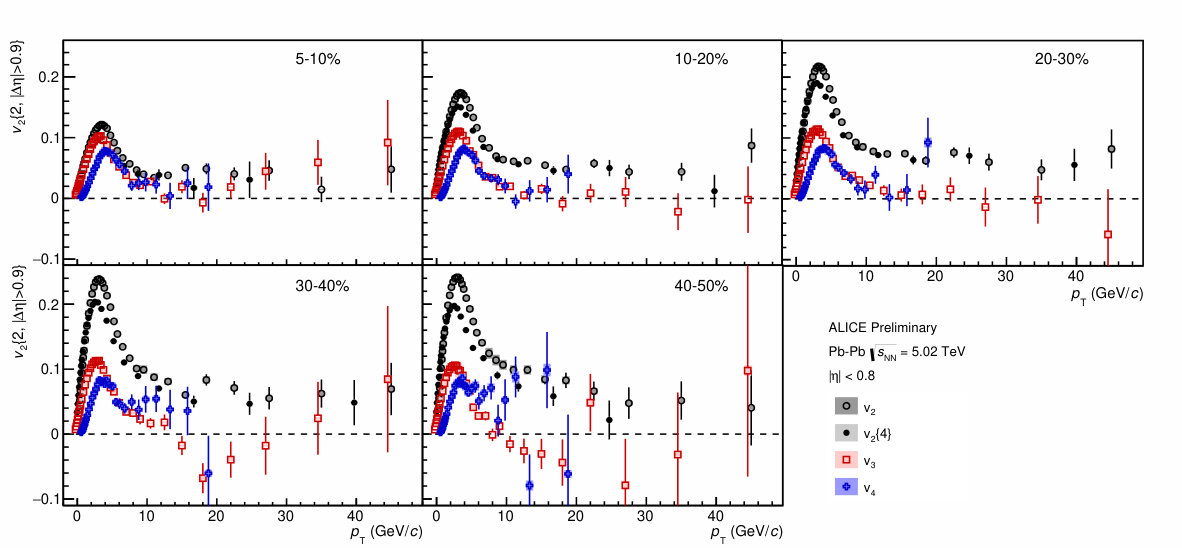 Figure 2
 Figure 3
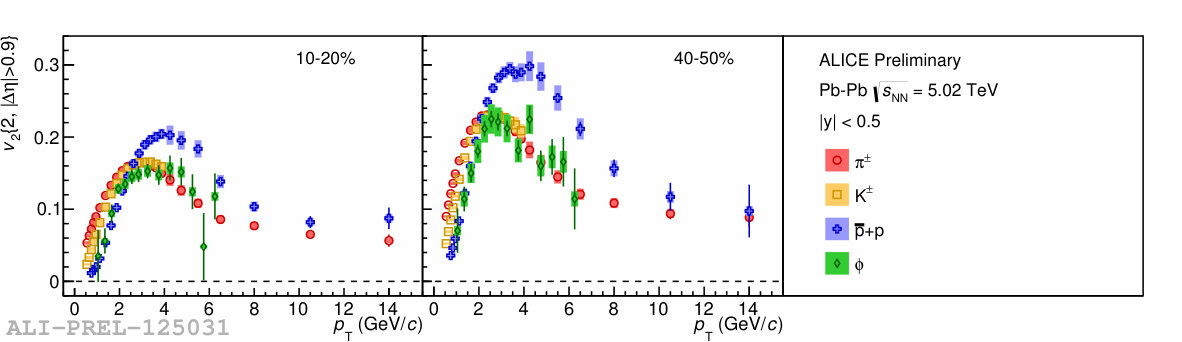 Figure 4
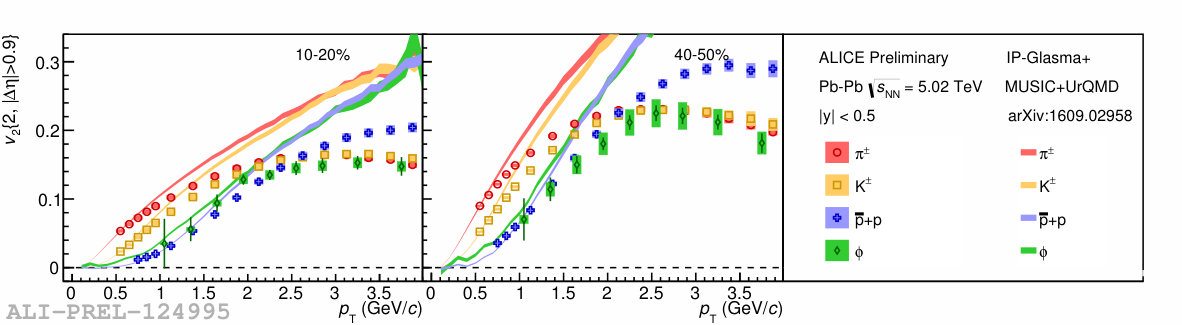 Figure 5
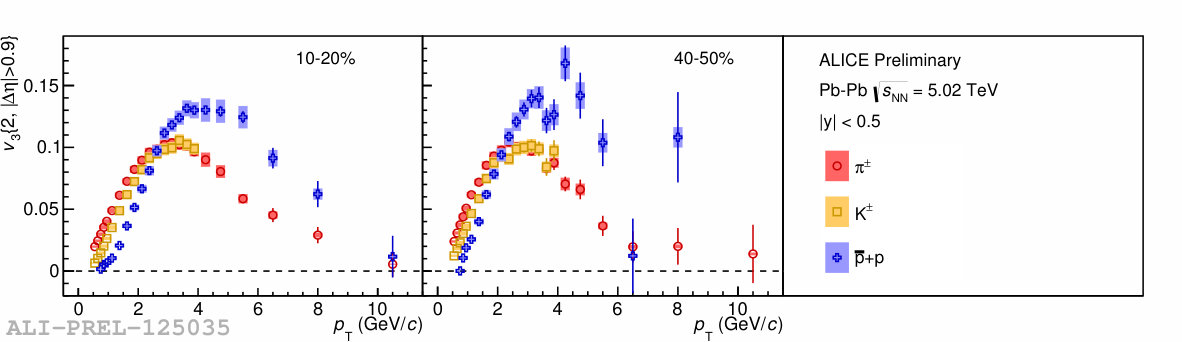 Figure 6
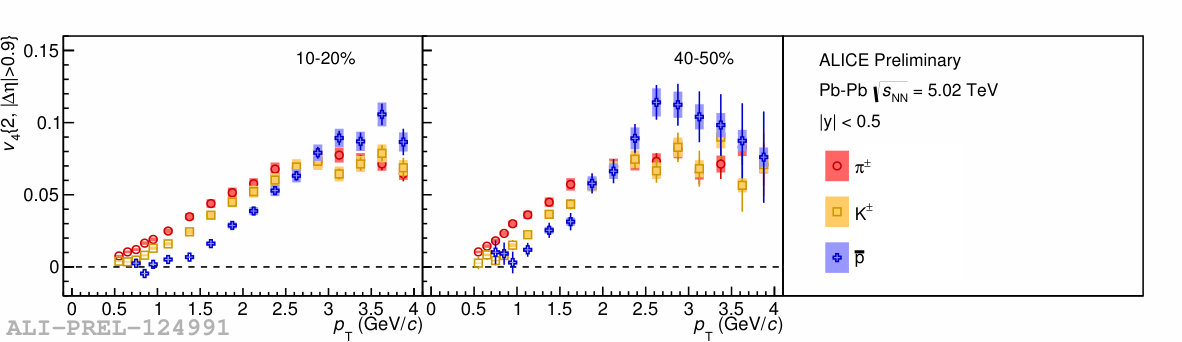 Figure 7
Peer Reviews
No public reviews on file for this paper yet. If you reviewed it on a platform where reviews are public (OpenReview, ICLR, NeurIPS, ICML), you can paste yours below so the community can read it here.
Videos
No videos yet. Explain this paper in a talk, walkthrough, or lecture? Add one.
Anisotropic flow of inclusive and identified particles in Pb–Pb collisions at TeV
R. A. Bertens (for the ALICE collaboration)
University of Knoxville (Tennessee USA), CERN
Abstract
Anisotropic flow measurements constrain the shear and bulk () viscosity of the quark-gluon plasma created in heavy-ion collisions, as well as give insight into the initial state of such collisions and hadronization mechanisms. In these proceedings, elliptic () and higher harmonic () flow coefficients of , , p and the -meson, measured in Pb–-Pb collisions at the highest-ever center-of-mass energy of = 5.02 TeV, are presented.
keywords:
anisotropic flow , heavy-ion , higher harmonic , identified , relativistic hydrodynamics
1 Introduction
Heavy-ion collision experiments are used to study the properties of the quark-gluon plasma (QGP), a state of deconfined quarks and gluons created at high baryon densities or temperatures. Particles produced in collisions are boosted collectively by a common velocity field that is induced by the rapid expansion of the system. Spatial anisotropies resulting from the elliptic overlap region of the colliding nuclei and the initial inhomogeneities of the system density are transformed, through multiple interactions between the produced particles, into an anisotropy in momentum space of the produced particles. The efficiency of this process depends on e.g. the shear () and bulk () viscosity of the created matter, and the lifetime of the system.
Anisotropy in particle production can be quantified by a Fourier analysis of the azimuthal distribution relative to the system’s symmetry plane angles , characterized by harmonic coefficients [1]
[TABLE]
where is the azimuthal angle of the produced particles.
Flow coefficients are, in addition to being a probe for and , sensitive to the initial state of the system, freeze-out conditions and hadronization mechanisms.
2 Data analysis
The data used for this work were recorded in 2015 at a center of mass energy per nucleon of = 5.02 TeV with the ALICE detector [2] and comprise approximately 6 collisions with a vertex within 10 cm of the nominal interaction point and collision centrality between 5-60%. Charged particle tracks are reconstructed using the Inner Tracking System (ITS) and Time Projection Chamber (TPC) at 0.5 for identified particles or for unidentified particles. Centrality determination, as well as reconstruction of the Qn vectors (see Eq. 2), is performed with V0 detectors, located at 2.8 5.1 and -3.7 -1.7.
Coefficients are measured using the scalar product method [3], written as
[TABLE]
where is the unit vector of a single particle with azimuthal angle . Flow vectors Qn = , where the sum runs over all tracks and ∗ denotes the complex conjugate, are measured in the TPC or V0 detectors. Brackets indicate an all-event average; the double brackets in the numerator of Eq. 2 mean that prior to the all-event average, an average over all tracks within the single event is taken. The large (pseudo-)rapidity gap between un and Q reduces sensitivity to short-range correlations that are unrelated to the initial geometry, commonly referred to as non-flow.
Particle identification is performed using ionization energy loss measured in the TPC, combined with the arrival time of particles in the Time of Flight (TOF) detector. The -meson is reconstructed in the channel, using the analysis method outlined in [4]; its is determined using Eq. 2.
3 Results
Figure 1 shows -differential , and of unidentified charged particles. For the presented centrality classes, for 5 . The observed trends at low and intermediate ( 7 ) are characteristic for the hydrodynamic expansion of the medium. The non-zero at high is attributed to path-length dependent in-medium energy loss of highly energetic partons.
The top panel of Fig. 2 shows -differential of , p and the -meson for 10-20% (left) and 40-50% (right) collision centrality (these two centrality intervals are used for all subsequent figures). For 2 GeV/, of the different species is mass-ordered, which is indicative of strong radial flow. For 3 8 , particles are grouped according to their valence quark content, which supports the hypothesis of particle production via quark coalescence [6]. Particle type scaling and mass ordering is most directly tested by -meson , as the is a meson with a mass close to proton mass. Figure 2 demonstrates that -meson follows proton at low , but pion at intermediate . Lastly it should be noted that p() is larger than for 10 , after which the converge, which suggests that partonic energy loss is flavor independent at high transverse momenta.
Higher harmonic flow coefficients () are generated by inhomogeneities in the initial nucleon distribution and are thought to be more sensitive to transport coefficients than [7]. The middle and lower panels of Fig. 2 show that non-zero is observed for , p( up to 8 . Statistical precision limits the range of the measurement to 4 ; is non-zero though in the entire measured range. Both and show a clear mass ordering at low , and analogous to the trend of , p() is larger than up to = 10 . The crossing of the meson and baryon trends at 2.5 is reminiscent of the behavior observed for as well. Overall, the values are qualitatively similar to those observed at a collision energy of = 2.76 TeV [4, 8].
To test the validity of the hydrodynamic description of the QGP, are compared to model predictions from [9] in Fig. 3. The model uses an IP-Glasma initial state and a viscous hydrodynamic medium evolution ( = 0.095 and a temperature-dependent ) which is coupled to a hadronic cascade procedure for hadronization. Interestingly, mass ordering is broken (-meson p() ) in the calculations. The predictions show good agreement with the data for 1 in central collisions, but overestimate already at lower momenta for more peripheral collisions. Similar behavior is found for and (not shown here).
To test the hypothesis of particle production via quark coalescence, the axes of Fig. 2 can be scaled by the number of constituent quarks, independently for each species. Such a scaling (not shown) shows that from p_{\mathrm{T}}$$/n_{\rm q}> 1.5 particles group approximately according to their type (baryon, meson), similar behavior is observed for and . It is stressed that the observed scaling only holds approximately, as was also observed elsewhere [4].
4 Summary
Flow harmonics and of unidentified and identified particles have been measured at = 5.02 TeV Pb–Pb collisions. Mass ordering is observed for 2 , as well as approximate particle type scaling for 2.5 . The flow coefficient of unidentified particles is non-zero up to high , and p() , are larger than , up to = 10 . The unprecedented precision of these new measurements will put strong constraints on model calculations and furthers the understanding of the hydrodynamic behavior of the QGP, as well as its initial state, and freeze-out conditions.
The reference list from the paper itself. Each links out to its DOI / PubMed record.
- 1[1] J.-Y. Ollitrault, Anisotropy as a signature of transverse collective flow, Phys. Rev. D 46 (1992) 229–245.
- 2[2] B. Abelev, et al., Performance of the ALICE Experiment at the CERN LHC, Int. J. Mod. Phys. A 29 (2014) 1430044.
- 3[3] S. A. Voloshin, A. M. Poskanzer, R. Snellings, Collective phenomena in non-central nuclear collisions ar Xiv:0809.2949 .
- 4[4] B. B. Abelev, et al., Elliptic flow of identified hadrons in Pb-Pb collisions at s NN = 2.76 subscript 𝑠 NN 2.76 \sqrt{s_{\mathrm{NN}}}=2.76 Te V, JHEP 06 (2015) 190.
- 5[5] A. Bilandzic, R. Snellings, S. Voloshin, Flow analysis with cumulants: Direct calculations, Phys. Rev. C 83 (2011) 044913.
- 6[6] D. Molnar, S. A. Voloshin, Elliptic flow at large transverse momenta from quark coalescence, Phys.Rev.Lett. 91 (2003) 092301.
- 7[7] G.-Y. Qin, H. Petersen, S. A. Bass, B. Muller, Translation of collision geometry fluctuations into momentum anisotropies in relativistic heavy-ion collisions, Phys. Rev. C 82 (2010) 064903.
- 8[8] K. Aamodt, et al., Higher harmonic anisotropic flow measurements of charged particles in Pb-Pb collisions at s N N subscript 𝑠 𝑁 𝑁 \sqrt{s_{NN}} =2.76 Te V, Phys. Rev. Lett. 107 (2011) 032301.