Generation of radiative neutrino mass in the linear seesaw framework, charged lepton flavor violation and dark matter
Arindam Das, Takaaki Nomura, Hiroshi Okada, Sourov Roy

TL;DR
This paper proposes a model combining linear seesaw neutrino mass generation, lepton flavor violation, and dark matter within a U(1)$_{B-L}$ and $Z_2$ symmetry framework, with detailed phenomenological analysis.
Contribution
It introduces a novel linear seesaw mechanism at one-loop level with exotic fields and explores its implications for lepton flavor violation, magnetic moments, and dark matter.
Findings
Neutrino masses generated at one-loop level.
Predictions for lepton flavor violation rates.
Dark matter relic density consistent with observations.
Abstract
We investigate a model with local U(1) and discrete symmetries where two types of weak isospin singlet neutrinos, vector-like charged lepton and exotic scalar fields are introduced. The linear seesaw mechanism is induced at one-loop level through Yukawa interactions associated with the standard model leptons and exotic fields. We also discuss lepton flavor violation and muon anomalous dipole magnetic moment induced by the new Yukawa interaction. In addition, our model has dark matter candidate which is the lightest odd neutral particle. We calculate the relic density and constraints from direct detection.
Click any figure to enlarge with its caption.
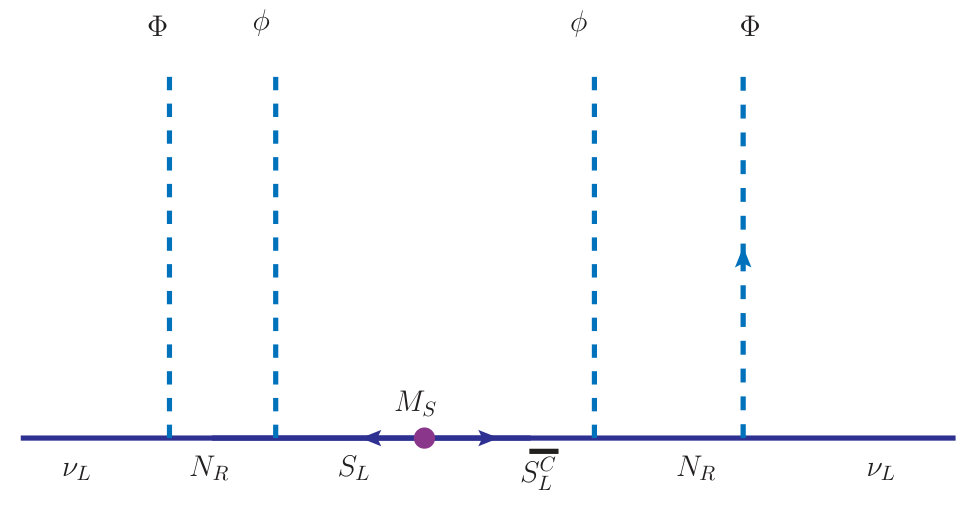 Figure 1
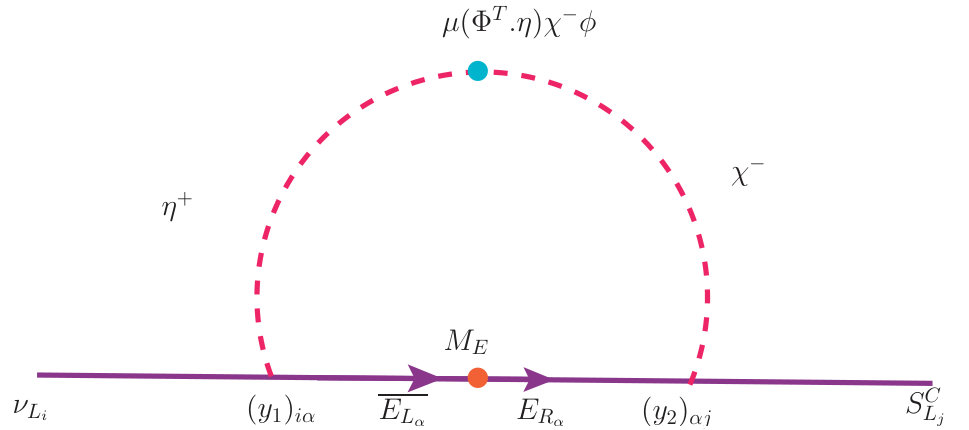 Figure 2
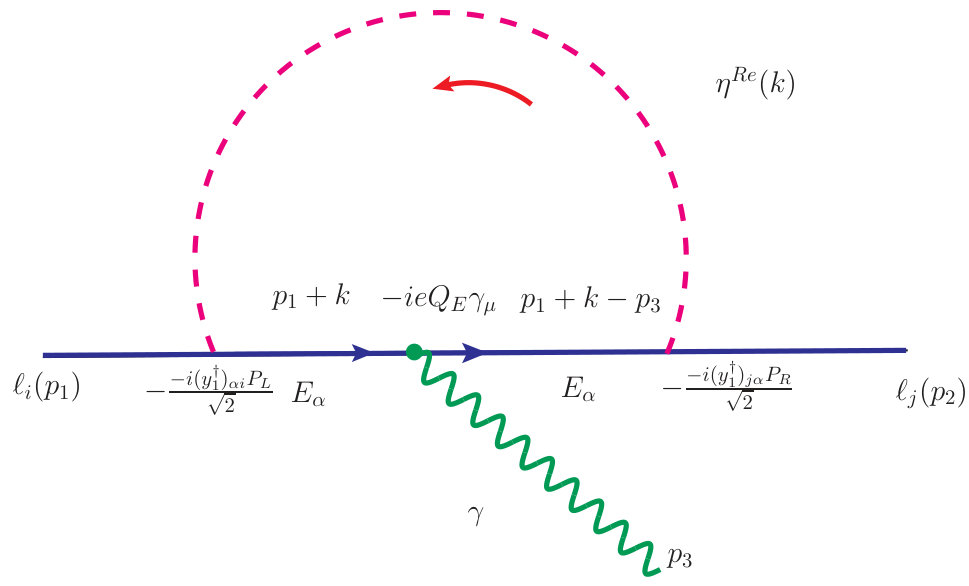 Figure 3
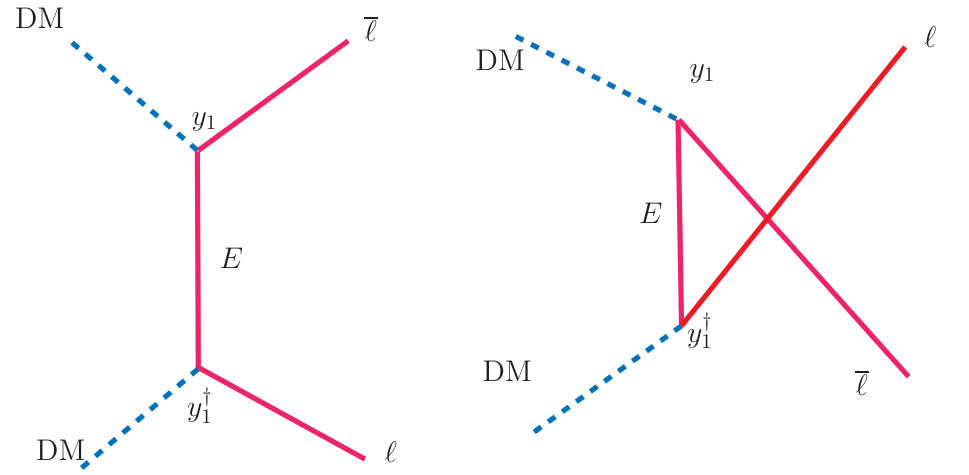 Figure 4
| 2 | ||||
| 1 | ||||
| 1 | 0 | |||
| 1 | 0 | 0 | ||
| 1 | ||||
| 2 | 0 | |||
| 2 | 0 | |||
| 1 | ||||
| 1 | 0 |
| [GeV] | ||||
|---|---|---|---|---|
| [fb] | 0.3 | 0.064 | 0.016 | 0.0044 |
Peer Reviews
No public reviews on file for this paper yet. If you reviewed it on a platform where reviews are public (OpenReview, ICLR, NeurIPS, ICML), you can paste yours below so the community can read it here.
Videos
No videos yet. Explain this paper in a talk, walkthrough, or lecture? Add one.
Generation of radiative neutrino mass in the linear seesaw framework, charged lepton flavor violation and dark matter
Arindam Das
School of Physics, KIAS, Seoul 130-722, Korea
Department of Physics & Astronomy, Seoul National University 1 Gwanak-ro, Gwanak-gu, Seoul 08826, Korea
Korea Neutrino Research Center, Bldg 23-312, Seoul National University, Sillim-dong, Gwanak-gu, Seoul 08826, Korea
Takaaki Nomura
School of Physics, KIAS, Seoul 130-722, Korea
Hiroshi Okada
Physics Division, National Center for Theoretical Sciences, Hsinchu, Taiwan 300
Sourov Roy
Department of Theoretical Physics, Indian Association for the Cultivation of Science, 2A & 2B Raja S.C.Mullick Road, Jadavpur, Kolkata 700 032, INDIA
Abstract
We investigate a model with local U(1)B-L and discrete symmetries where two types of weak isospin singlet neutrinos, vector-like charged lepton and exotic scalar fields are introduced. The linear seesaw mechanism is induced at one-loop level through Yukawa interactions associated with the standard model leptons and exotic fields. We also discuss lepton flavor violation and muon anomalous dipole magnetic moment induced by the new Yukawa interaction. In addition, our model has dark matter candidate which is the lightest odd neutral particle. We calculate the relic density and constraints from direct detection.
††preprint: KIAS-P17018
I Introduction
Different experiments T2K ; MINOS ; DCHOOZ ; DayaBay ; RENO on neutrino oscillation phenomena Beringer:1900zz are consistently giving the firm indications of the existence of the tiny neutrino mass and flavor mixing. The existence of the neutrino mass allows us to extend the Standard Model(SM) which is an essential window to search for the new physics. The simplest idea to extend the SM with an SM singlet right handed heavy Majorana neutrino was introduced in Seesaw1 ; Seesaw2 ; Seesaw3 ; Seesaw4 . The heavy right handed Majorana neutrinos create a lepton number violating mass term ‘for the light neutrinos’ through a dimension five operator which can naturally explain the tiny neutrino masses. This procedure is called the seesaw mechanism. The seesaw scale (the mass scale of the heavy Majorana neutrinos) varies from the electroweak scale to the intermediate scale as the neutrino Dirac Yukawa coupling () varies from the scale of electron Yukawa coupling () up to that of the top quark (). If we consider the scale of the seesaw mechanism at the TeV scale or lower, the Dirac Yukawa coupling () becomes very small () to produce appropriate light neutrino masses as suggested by neutrino oscillation experiments and cosmological observations.
Apart from the seesaw mechanism there is another type of mechanism where a small lepton number violating term plays a key role in generating the tiny neutrino mass. Such mechanism is commonly called as the canonical inverse seesaw mechanism InvSeesaw1 ; InvSeesaw2 . In this scenario unlike the seesaw mechanism, the light neutrino mass is not obtained by the suppression of the heavy neutrino mass. Due to the smallness of the lepton number violating parameter the heavy right handed neutrinos are pseudo-Dirac in nature. Their Dirac Yukawa couplings with the SM lepton doublets and the SM Higgs doublet could be order one to produce the light neutrino mass.
There is another type of TeV scale seesaw model which is called the linear seesaw Wyler:1982dd ; Akhmedov:1995ip ; Akhmedov:1995vm ; Malinsky:2005bi ; Gavela:2009cd ; Khan:2012zw ; Bambhaniya:2014kga ; Kashiwase:2015pra . This is a simple variation of the canonical inverse seesaw model. In linear seesaw model we introduce two heavy right handed SM singlet neutrinos with opposite lepton numbers where four right handed SM singlet Majorana heavy neutrinos are used as in canonical inverse seesaw. It has been shown in Khan:2012zw that from the vacuum metastability bounds the unknown Dirac Yukawa coupling can be constrained. The vacuum stability bounds on the Dirac Yukawa coupling for the canonical type-I frame-work has been studied in Rodejohann:2012px ; Chakrabortty:2012np ; Bambhaniya:2016rbb . In our paper we consider the linear seesaw model where we have the and elements of the neutrino mass matrix are nonzero but and elements to be zero; here the elements of neutrino mass matrix are considered in the basis of where and are SM singlet fermions. Whereas in inverse seesaw model and elements are zero, element is nonzero and may or may not be zero. In our model we generate the and elements of the neutrino mass matrix at the one loop level and study various features of this model.
In our model, we apply an extended gauged BL framework with an additional parity where we also introduce vector-like charged lepton, two types of weak isospin (which is equivalent to ) singlet neutrinos, and new scalar fields. The one loop induced linear seesaw mechanism is realized by Yukawa couplings associated with SM leptons and new fields. These Yukawa couplings also induce muon anomalous magnetic dipole moment (muon ) where current measurement indicates Neut3 , and lepton flavor violating (LFV) processes such as which is taken as constraints Lindner:2016bgg . In addition, the lightest odd particle is stable which can be a good candidate of dark matter(DM) if it is neutral Bhattacharya:2016ysw ; Patra:2016ofq ; Singirala:2017see . Then we discuss relic density and constraint from direct detection for our DM candidate.
The paper is organized as follows. In Section II, we introduce our model representing particle contents, new interactions and a neutrino mass matrix where we have studied neutrino masses and mixing in the light of neutrino experimental data. In Section III, we study lepton flavor violation and muon anomalous dipole magnetic moment. In Section IV we analyze dark matter physics in the model. In Section V, we give a conclusion.
II Model
In this model we extend the SM with a gauge group and a discrete parity. The relevant part of the particle content has been displayed in Tab. 1. The is the heavy right handed Majorana neutrino with three generations to keep the model free from anomalies. The fermion is also a left handed Majorana heavy neutrino which has three generation and is neutral under gauge group. The iso-singlet charged fermion is vector-like with odd parity. We also consider that also has three generation in our model. Notice that the lightest odd particle is stable and can be a good DM candidate if it is electrically neutral.
We can write the Lagrangian which is relevant for neutrino mass matrix at tree level as follows:
[TABLE]
where the first three terms induce the Dirac mass terms after and getting VEV, and the fourth term with is the lepton number violating Majorana mass term. We use the SM Higgs field as
[TABLE]
where neutral components are written by , and , and .
After the symmetry breaking one can write the neutrino mass matrix in Eq. II.3
[TABLE]
where Dirac masses can be written by and . The BL symmetry forbids the term in the neutrino mass matrix of Eq. II.3.
At this point it must be pointed out that is a BL charged scalar whose vacuum expectation value (VEV) is denoted by . The breaking of the electroweak and BL symmetry is induced spontaneously through the potential:
[TABLE]
After U(1)B-L breaking, we have boson whose mass is given by . In our analysis, we assume boson is sufficiently heavy evading collider constraints. Then the mixing between and is essentially given in terms of their masses as
[TABLE]
that is negligible tiny, where we take TeV. Since does not contribute to neutrino mass and DM physics, we just assume the gauge coupling for is sufficiently small satisfying the current constraint. Thus we will not discuss phenomenology of . There are other two scalars and with odd parity, and the potential term containing the and can be written as
[TABLE]
which is invariant under the prescribed gauge group and the symmetry111. After symmetry breaking, .. Therefore the complete potential of our system will be given as
[TABLE]
Using seesaw approximation, from Eq. II.3 we can write the effective light neutrino mass matrix as
[TABLE]
Note that the light neutrino mass is directly proportional to the . Therefore the degree of smallness regulates the smallness of the light neutrino mass and if , the light neutrino becomes massless, which is the inverse seesaw scenario InvSeesaw1 ; InvSeesaw2 , and the Feynman diagram of the inverse seesaw operator is given in Fig. 1. If there is a non-zero term in Pilaftsis:1991ug ; Dev:2012sg ; Dev:2012bd in the neutrino mass matrix which provides a nontrivial contribution to light neutrino masses at the one loop level which does not vanish in the limit term going to zero. However, at the tree level the light neutrino masses go to zero in the limit , even if .
There is another possibility to obtain the light neutrino mass through switching on the -term in the mass matrix in Eq.II.3. This can restore the small neutrino mass even if we have a vanishing . Here vanishing can be justified by assigning a charge of some global symmetry to , and as , and , for example, where only term explicitly breaks the charge conservation in our model. In that case we can interpret that term softly breaks the symmetry and it is natural to take small value for the . However in our model it is not possible to generate the mass term at the tree level because symmetry forbids us in writing the terms like , and where the first and the second terms respectively induce - and - terms of the neutrino mass matrix while the third term would contribute to a LFV process. Although some terms in neutrino mass matrix are forbidden at tree level, our particle content in Tab. 1 allows us to write the Dirac mass term of and the gauge invariant Yukawa terms which can generate the (or )-term of the neutrino mass matrix through one loop diagram;
[TABLE]
where and is the generation index of the fermions and respectively. The third term of Eq. II.9 is a Dirac mass term of and will contribute in the neutrino mass generation at one-loop level. After generating the (or ) term radiatively we can write the neutrino mass matrix 222It must be mentioned that in Eq. II.3 we have three generations of , three generations of and which makes the Dirac mass matrix, as a matrix as is carrying the flavors. The same structure is for Eq. II.10 where is a matrix keeping the other matrices same and the total mass matrix has structure.
[TABLE]
Using seesaw approximation, from Eq. II.10 we can write the effective light neutrino mass matrix as
[TABLE]
Therefore vanishing limit of in Eq. II.11 will switch off the tree level mass term and the light neutrino mass term will be generated only from the 1-loop term leading to
[TABLE]
Therefore, we can resolve the light neutrino mass through the radiative one loop process in the linear seesaw mechanism. The 1-loop diagram in Fig. 2 shows the radiative mass term for the and elements in the neutrino mass matrix. Now solving the diagram, we can calculate the value of . To do this we first rotate the charged scalar sector using an arbitrary orthogonal matrix
[TABLE]
From the Fig. 2 and using Eq. II.13 we write
[TABLE]
[TABLE]
where we have assumed , and is defined as the mass of the singly charged boson of . When we take () typical size of is approximately given by
[TABLE]
where factor is omitted here.
Depending on the mass scales and the scales of the Yukawa couplings one can justify the degree of smallness of the mass term so as to reproduce the light neutrino masses at the correct scale.
II.1 Neutrino data
In this analysis we assume that which allows us to express the flavor eigenstates \Big{(}\nu\Big{)} of the light Majorana neutrinos in terms of the mass eigenstates of the light \Big{(}\nu_{m}\Big{)} and heavy\Big{(}N_{m}\Big{)} Majorana neutrinos where
[TABLE]
For simplicity we may consider , and are real quantities. Here
[TABLE]
and is the usual neutrino mixing matrices which can diagonalize in the following way
[TABLE]
Due to the presence of , the mixing matrix is non-unitary. For simplicity we consider that there are three degenerate heavy neutrinos.
We consider a situation where the Dirac mass term carries the flavor, where as the term is proportional to unity. Therefore
[TABLE]
[TABLE]
where NH(IH) represents the shorthand symbol for “normal (inverted) hierarchy”. Using the neutrino oscillation data Neut5 ; Neut3 , , , eV2 and eV2 we can write
[TABLE]
and
[TABLE]
respectively. We have expressed in Eq. LABEL:DNH in terms of and whereas in Eq.II.23 has been expressed in terms of and . Without the loss of generality we can also replace the least eigenvalues by zero for the NH and IH cases, however, the choices of the smallness of these values do not affect the smallness of .
Therefore
[TABLE]
Using the updated result of the non unitarity matrix from the LFV bounds we can write . Due to its non-unitarity, the elements of the mixing matrix are severely constrained by the combined data from the neutrino oscillation experiments, the precision measurements of weak boson decays, and the lepton-flavor-violating decays of charged leptons Constraints1 ; Constraints2 ; Constraints3 ; Constraints4 ; Constraints5 . We update the results by using more recent data on the lepton-favor-violating decays Adam ; Aubert ; OLeary :
[TABLE]
Since , we have the constraints on such that
[TABLE]
The most stringent bound is given by the -element which is from the constraint on the lepton-flavor-violating muon decay . Using these bounds we can find the minimum value of as \delta_{1_{min}}$$\sim$$\mathcal{O}(10~{}\rm{eV}).
III Charged Lepton Flavor Violation
In our model the fermion and the scalar is involved in the charged lepton flavor violation (cLFV) processes through the interaction
[TABLE]
where . The Feynman diagram for the corresponding process(es) are given in Fig. 3. The scattering amplitude for Fig. 3 is given as333In our convention .
[TABLE]
where
[TABLE]
[TABLE]
Now
[TABLE]
where is the fine structure constant, GeV*-2* is Fermi constant, and is defined by
[TABLE]
The current experimental bound on is respectively given by TheMEG:2016wtm , Adam:2013mnn at 90 % CL.
[TABLE]
We can avoid the constraints by choosing the Yukawa coupling so that off-diagonal elements of are sufficiently small.
The diagram in Fig. 3 also contributes to the muon anomalous magnetic moment when , and it is given by
[TABLE]
including the real and imaginary parts of the neutral scalar . The current experiments bennett ; discrepancy1 ; discrepancy2 report that its deviation is . Taking , we roughly obtain . Thus we find that product of Yukawa coupling should be order one or larger to obtain sizable . In addition, exotic particles are preferred not to be too heavy as TeV for getting sizable muon .
IV Dark matter scenario
Neutral component of can be a dark matter (DM) candidate. Here we assume the real part to be DM: . General analysis has been done by Ref. Hambye:2009pw , where the DM mass is greater than the mass of boson. 444In this case, DM mass should be greater than 500 GeV, and coannihilation should also be taken into consideration because of oblique parameter. We are interested in lower range since it is preferred to obtain sizable muon , and thus we focus on this range. Also we note that annihilation modes from Higgs portal is subdominant when we require to evade the direct detection constraint such as LUX experiment which is discussed below. Under this situation, dominant mode comes from the same Yukawa coupling as Eq.III.1, which gives d-wave dominance in the limit of massless final state. The interaction Lagrangian is again given by
[TABLE]
The relevant Feynman diagrams for the DM annihilation are given in Fig. 4. Then the nonrelativistic cross section to explain the relic density of DM is obtained by
[TABLE]
Here we apply the relative velocity expansion approximation as follows:
[TABLE]
where GeV is the Planck mass, is the total number of effective relativistic degrees of freedom at the time of freeze-out, and is defined by at the freeze out temperature (), and is the contribution to the -wave. We find that should be sizable to obtain observed relic density. Note also that even if is large we can obtain small scale of in Eq. II.16 by small values of and .
Spin independent scattering cross section can be found via Higgs portal. The relevant terms in Higgs potential is given in second line of RHS in Eq. II.6. Then the CP even Higgs mixing in basis of is given by
[TABLE]
where is the SM Higgs and its mass GeV, and is another neutral Higgs with vacuum expectation value as . Then its formula is given by
[TABLE]
where GeV is the neutron mass. Here we give a brief estimation, where we simply fix several parameters as and GeV. Then the resulting cross section is simplified as
[TABLE]
notice here that it does not depend on , , and . The stringent cross section is found to be cm2 at GeV reported by LUX experiment Akerib:2016vxi , which are supported by CoGENT Aalseth:2014eft and CREST Angloher:2011uu , although their results are more relaxed. Therefore in our case, the bound on is found to be
[TABLE]
Here we discuss order estimation to fit the experimental values such as relic density of DM and muon satisfying LFVs, where notice here that the crucial parameter is and we do not need to include the neutrino sector because of a lot of independent parameters. First of all, the correct relic density can be achieved by taking to be order one, where we expect all the scales of exotic masses are of the order of GeV. Also sizable muon is achieved if we take to be order one. While LFVs restricts some components of . For example, the most stringent constraint arises from , and its Yukawa combination should be taken to be order to satisfy this bound, where we respectively take the one-loop function and the mediated fields to be order one and 500 GeV. Comparing these three combinations, one finds that there are allowed regions by controlling each component of .
Before closing this section we discuss odd particle production at the LHC. The vector-like charged leptons can be produced via electroweak process or exchange in s-channel where we assume coupling is small and the electroweak process is dominant. Then decays into charged lepton and DM via Yukawa interaction as . We thus expect charged lepton plus missing energy signal at the LHC. Thus our production signal is smiler to that of electroweak production of sleptons in supersymmetric models and we can roughly obtain mass limit as GeV from current slepton searches ATLAS:2017uun . Note that the mass limit for our exotic charged scalar boson will be less constrained or similar to that of ; the production cross section of the charged scalar and are similar to that of while they decay as or and ( is off-shell state and depending upon the masses can be on-shell, too.) which give more particles in final states compared to case and the significance of finding charged scalar would be reduced. In Table 2 we summarize the pair production cross section of for some benchmark values of which are calculated by CalcHEP Belyaev:2012qa with TeV. Therefore we expect more than 10 events for integrated luminosity 300 fb*-1* for TeV. More detailed analysis including simulation study is beyond the scope of this paper and will be done elsewhere.
V Conclusion
In this paper, we have proposed an extension of SM with local U(1)B-L symmetry and discrete symmetry where exotic leptons and scalar particles are introduced. In particular, two types of weak isospin singlet neutrinos, and are introduced.
Since is charged under the U(1)B-L, it has to have three generations, due to the anomaly cancelation. While does not have charge that suggests that the number of flavor for can be arbitrary. Thus we assume to be three generations of for simplicity. The model induces linear seesaw mechanism through one loop diagram in which odd particles propagate, if Majorana mass of is suppressed. In addition, the lightest odd neutral particle can be a good DM candidate.
We have shown a formula for the component of the neutrino mass matrix which is generated by one-loop diagram. Then the neutrino mass matrix is given by and the Dirac mass parameters in our neutrino sector through linear seesaw mechanism. To fit the neutrino oscillation data, the order of is required to be which can easily be realized choosing the values of relevant parameters in the formula. We have also derived formulas of muon and lepton flavor violating decay at one-loop level. Furthermore, relic density of DM and DM-nucleon scattering are discussed assuming neutral component of inert doublet scalar is dark matter candidate. We then find that our model can accommodate with neutrino oscillation data via linear seesaw mechanism, sizable muon , and the relic density of DM, satisfying the constraints from lepton flavor violations and the direct detection experiment of DM.
Such a model can also be tested at the collider. A small value of ensures a sizable mixing between the SM light leptons and the BSM fermions. Through such mixings the BSM fermions can be produced at the high energy collider such as Large Hadron Collider (LHC) and 100 TeV pp collider, using boson and boson exchange from the charged current and neutral current interactions respectively. In fact due to the BL model framework, the pair production of such fermions can be tested through the BL gauge boson. These fermions can display the multilepton final states through the corresponding charged current and neutral current interactions Dev:2013oxa ; Dev:2013wba ; Das:2014jxa ; Das:2015toa ; Das:2016akd ; Das:2016hof ; Das:2017pvt which will be interesting in the High Luminosity era of the high energy collider/s. Moreover a general parameter structure can also be adopted for such models as discussed in Das:2012ze ; Das:2017nvm using the Casas-Ibarra parametrizationCasas:2001sr .
In addition, we have several odd scalars including DM where heavier particles decay into SM leptons and DM via Yukawa interactions. Thus the signals of charged leptons with missing transverse momentum are expected as a signature of these scalar particles. We estimated the cross section of pair production of heavy charged leptons via electroweak process. Then we find that fb cross section is obtained when heavy charged lepton mass is around 1 TeV. More detailed discussion with simulation is left as future work.
In future a general version of this model under the gauge group can also be considered. Recently the extended SM has been investigated recently in a variety of contexts, such as the classical conformality Oda:2015gna ; Das:2016zue , -portal dark matter Okada:2016tci , and cosmological inflation scenario OOR .
Finally, we also want to comment that such a model can be useful to study baryogenesis via leptogenesis.Dick:1999je ; Murayama:2002je ; Abel:2006nv ; Bechinger:2009qk ; Heeck:2013vha ; Ahn:2016hhq ; Borah:2016zbd ; Blanchet:2010kw ; Dev:2014laa ; Okada:2012fs as we can do in the BL, , inverse seesaw models. In this model we also have such possibilities to consider three generations of heavy fermions being couples with the SM scalar sector. Such fermions can be non-degenerate, too.Such non-degenerate heavy fermions can have sizable mixings with the SM light neutrinos which are dependent upon the neutrino oscillation data and the free model parameters such as the Dirac phase, Majorana phase, heavy fermion masses and the Casas- Ibarra parametrization. An elaborate discussion on leptogenesis in this model is beyond the scope of this paper and will be considered as a seperate work in the near future.
Acknowledgements.
The work AD is supported by the Korea Neutrino Research Center which is established by the National Research Foundation of Korea(NRF) grant funded by the Korea government(MSIP) (No. 2009-0083526).
The reference list from the paper itself. Each links out to its DOI / PubMed record.
- 1(1) K. Abe et. al. [T 2K Collaboration] Phys. Rev. Lett. 107 , 041801 (2011). [ar Xiv:1106.2822[hep-ex]]
- 2(2) P. Adamson et al. [MINOS Collaboration], “Improved search for muon-neutrino to electron-neutrino oscillations in MINOS,” Phys. Rev. Lett. 107 , 181802 (2011). [ar Xiv:1108.0015 [hep-ex]].
- 3(3) Y. Abe et al. [DOUBLE-CHOOZ Collaboration], “Indication for the disappearance of reactor electron antineutrinos in the Double Chooz experiment,” Phys. Rev. Lett. 108 , 131801 (2012). [ar Xiv:1112.6353 [hep-ex]].
- 4(4) F. P. An et al. [DAYA-BAY Collaboration], “Observation of electron-antineutrino disappearance at Daya Bay,” Phys. Rev. Lett. 108 , 171803 (2012). [ar Xiv:1203.1669 [hep-ex]].
- 5(5) J. K. Ahn et al. [RENO Collaboration], “Observation of Reactor Electron Antineutrino Disappearance in the RENO Experiment,” Phys. Rev. Lett. 108 , 191802 (2012). [ar Xiv:1204.0626 [hep-ex]].
- 6(6) J. Beringer et al. [Particle Data Group Collaboration], “Review of Particle Physics (RPP),” Phys. Rev. D 86 , 010001 (2012). doi:10.1103/Phys Rev D.86.010001
- 7(7) P. Minkowski, Phys. Lett. B 67 , 421 (1977);
- 8(8) T. Yanagida, in Proceedings of the Workshop on the Unified Theory and the Baryon Number in the Universe (O. Sawada and A. Sugamoto, eds.), KEK, Tsukuba, Japan, 1979, p. 95;