Observation of Efimov molecules created from a resonantly interacting Bose gas
Catherine E. Klauss, Xin Xie, Carlos Lopez-Abadia, Jos\'e P. D'Incao,, Zoran Hadzibabic, Deborah S. Jin, and Eric A. Cornell

TL;DR
This study demonstrates the creation of Efimov trimers from a resonantly interacting Bose gas and analyzes their decay dynamics, revealing their presence alongside Feshbach dimers and their stability properties.
Contribution
The paper provides experimental evidence of Efimov molecules in a Bose gas and characterizes their decay behavior and formation efficiency, advancing understanding of few-body quantum states.
Findings
Approximately 8% of atoms form Efimov trimers.
Efimov trimers have a density-independent lifetime of about 100 μs.
Feshbach dimer lifetime depends on density due to inelastic collisions.
Abstract
We convert a strongly interacting ultracold Bose gas into a mixture of atoms and molecules by sweeping the interactions from resonant to weak. By analyzing the decay dynamics of the molecular gas, we show that in addition to Feshbach dimers it contains Efimov trimers. Typically around 8\% of the total atomic population is bound into trimers, identified by their density-independent lifetime of about 100~s. The lifetime of the Feshbach dimers shows a density dependence due to inelastic atom-dimer collisions, in agreement with theoretical calculations. We also vary the density of the gas across a factor of 250 and investigate the corresponding atom loss rate at the interaction resonance.
Click any figure to enlarge with its caption.
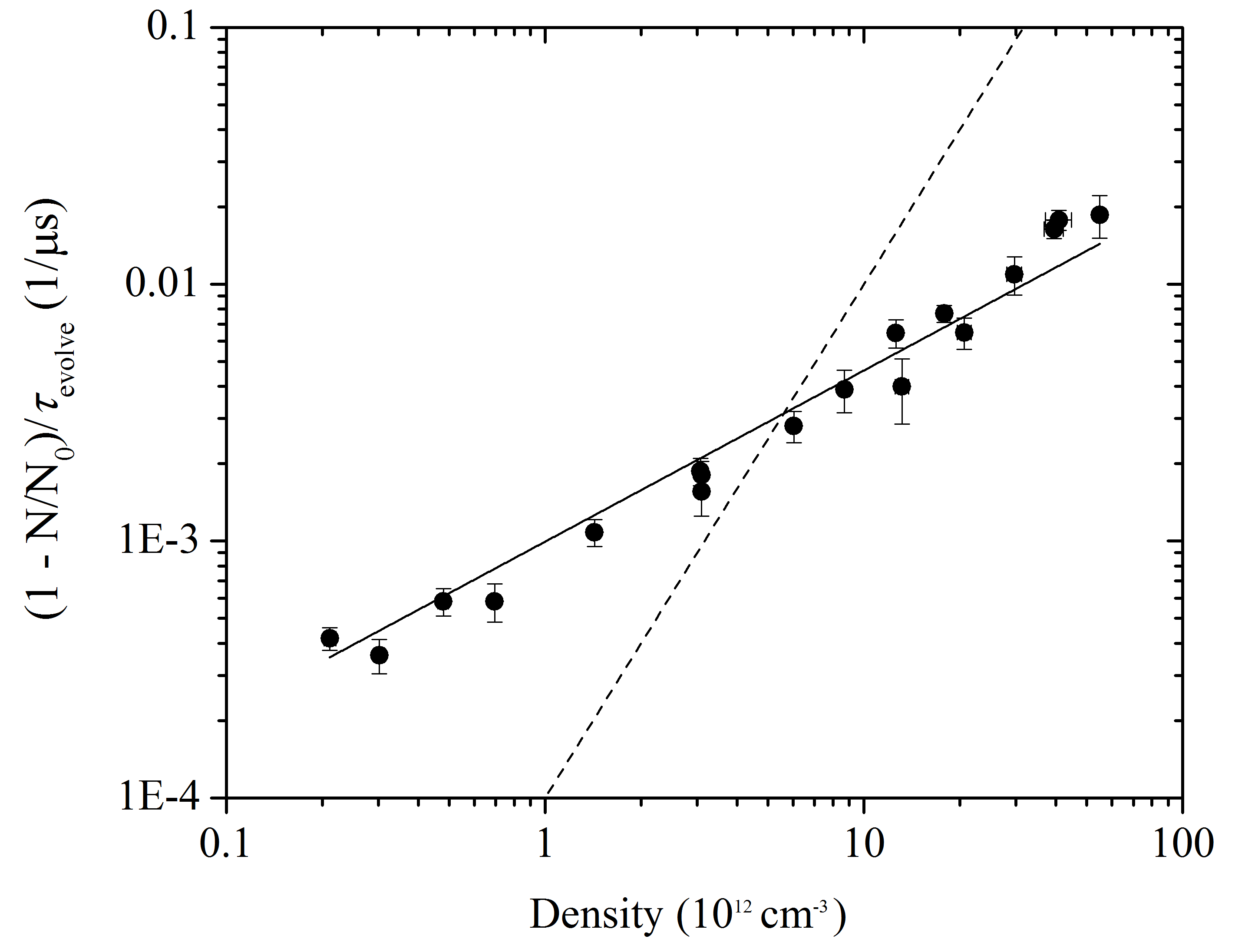 Figure 1
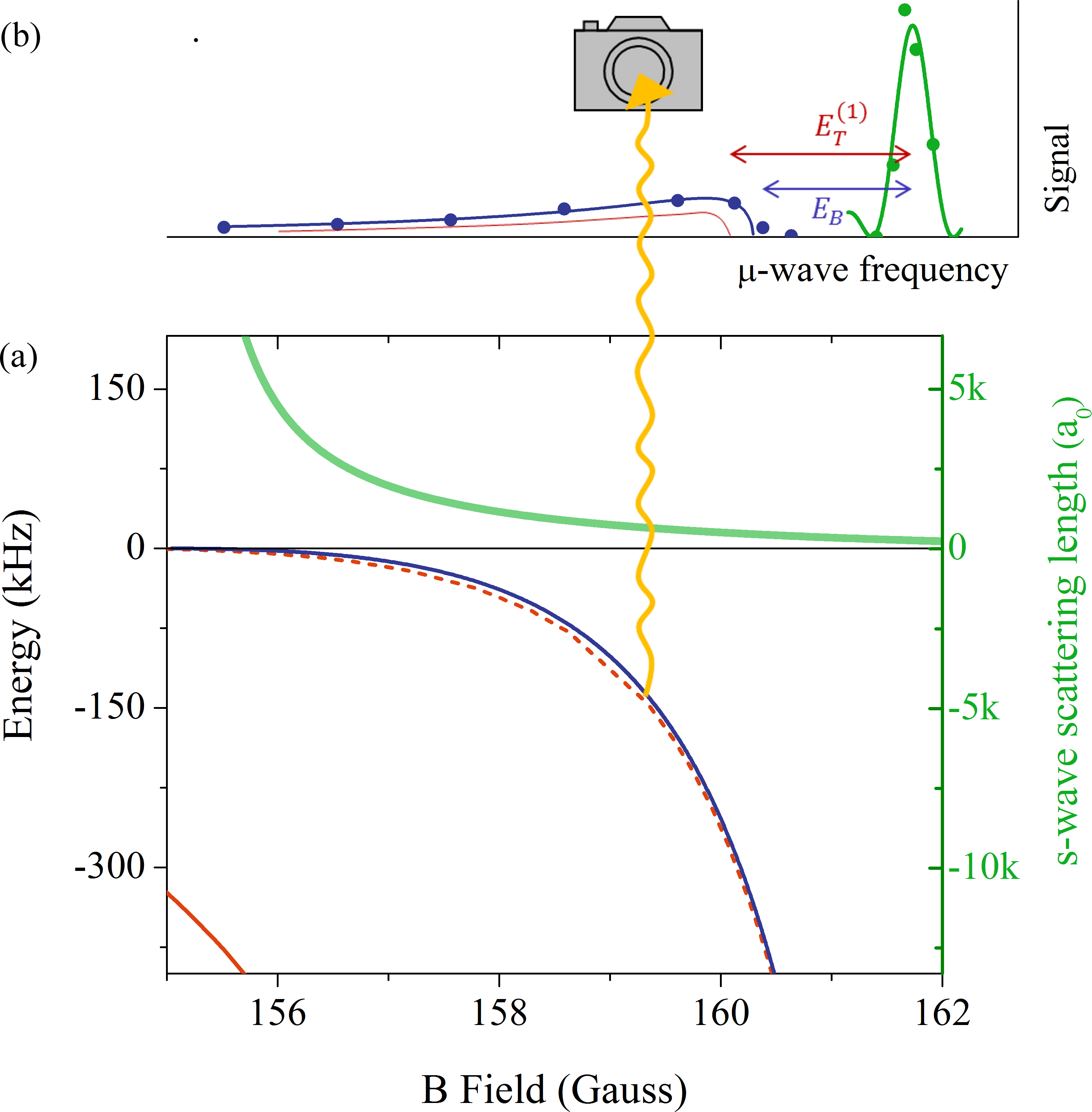 Figure 2
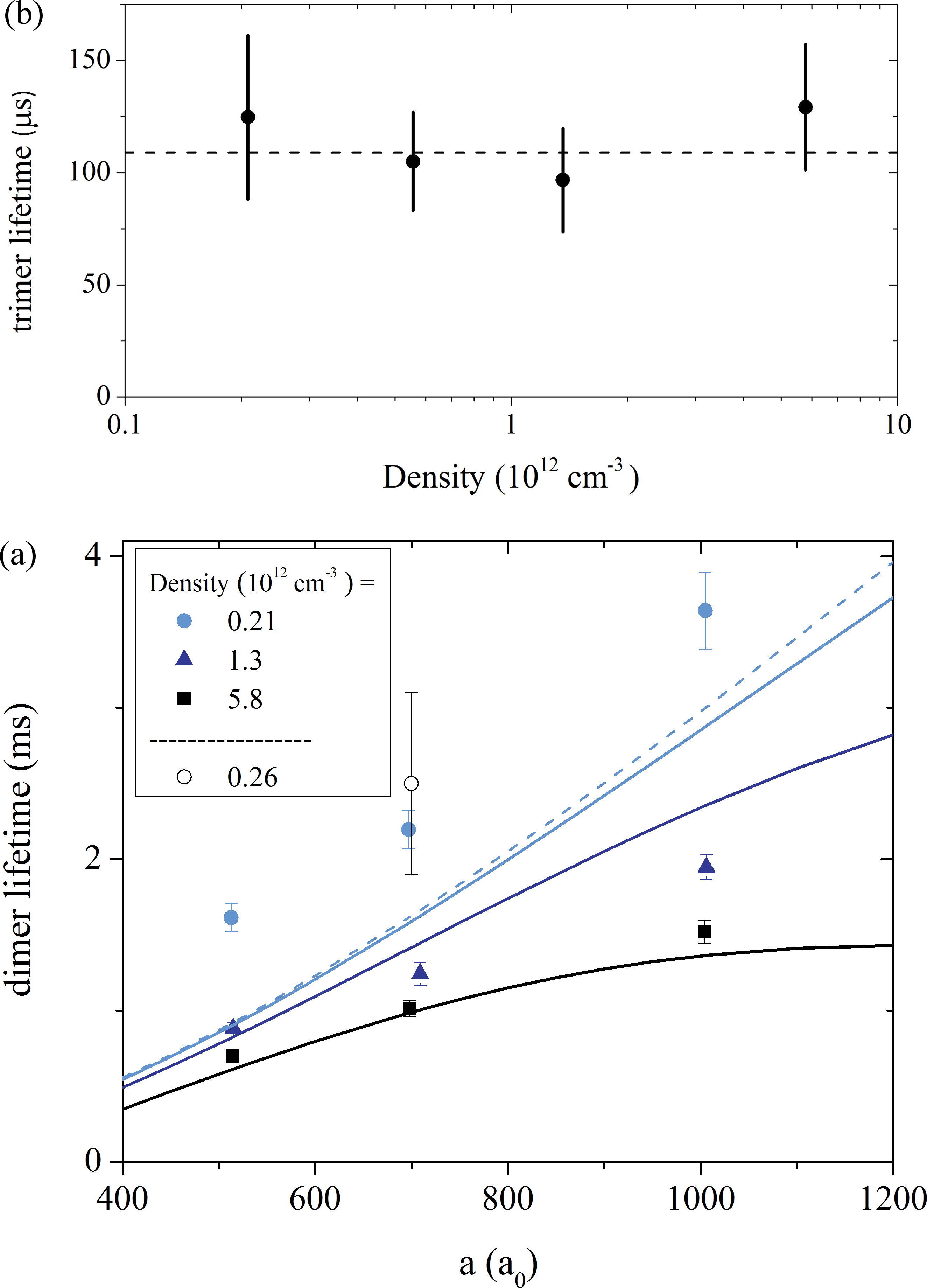 Figure 3
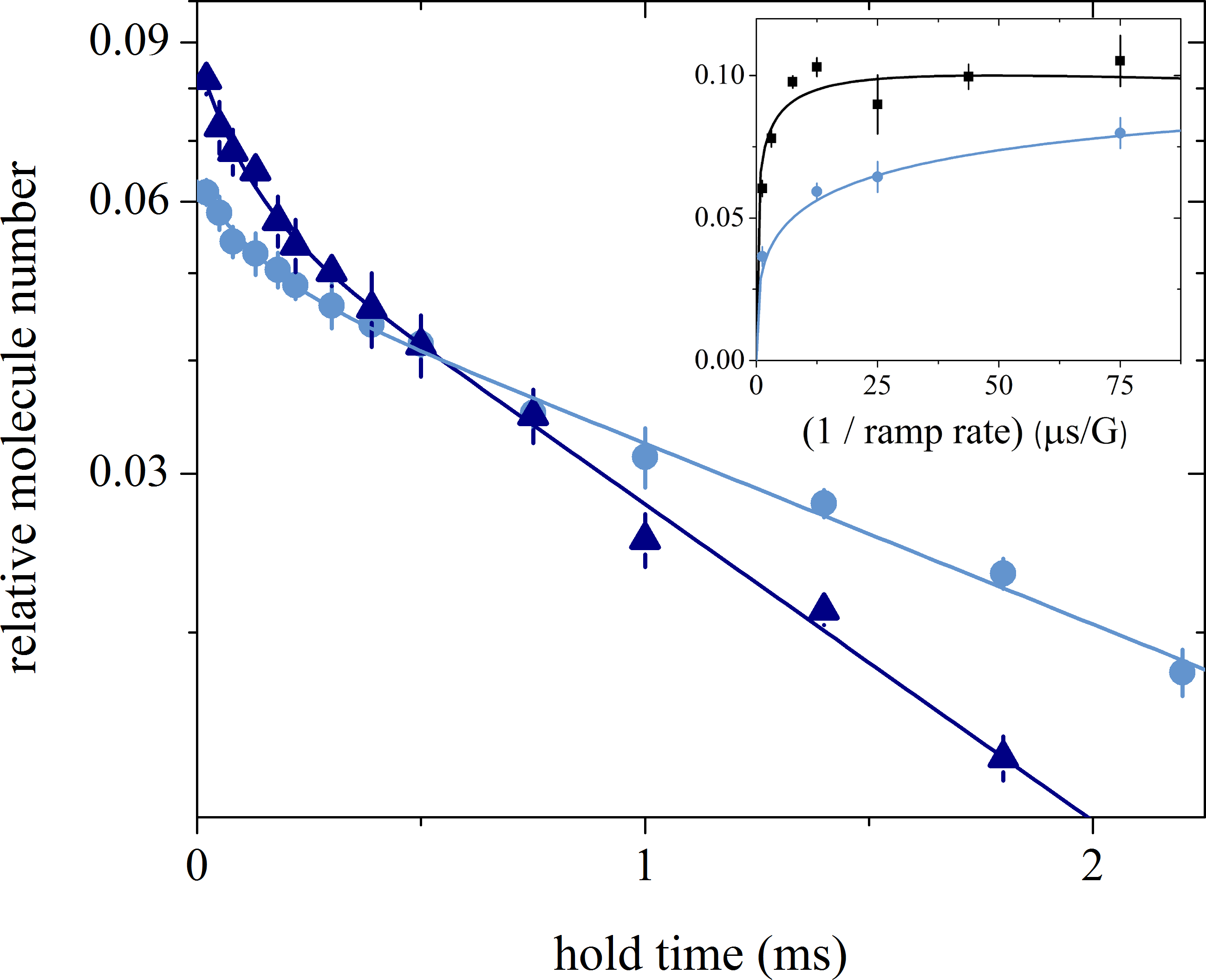 Figure 4
Peer Reviews
No public reviews on file for this paper yet. If you reviewed it on a platform where reviews are public (OpenReview, ICLR, NeurIPS, ICML), you can paste yours below so the community can read it here.
Videos
No videos yet. Explain this paper in a talk, walkthrough, or lecture? Add one.
Observation of Efimov molecules created from a resonantly interacting Bose gas
Catherine E. Klauss
JILA, National Institute of Standards and Technology and University of Colorado, and Department of Physics, Boulder, CO 80309-0440, USA
Xin Xie
JILA, National Institute of Standards and Technology and University of Colorado, and Department of Physics, Boulder, CO 80309-0440, USA
Carlos Lopez-Abadia
JILA, National Institute of Standards and Technology and University of Colorado, and Department of Physics, Boulder, CO 80309-0440, USA
José P. D’Incao
JILA, National Institute of Standards and Technology and University of Colorado, and Department of Physics, Boulder, CO 80309-0440, USA
Zoran Hadzibabic
Cavendish Laboratory, University of Cambridge, J. J. Thomson Avenue, Cambridge CB3 0HE, UK.
Deborah S. Jin
JILA, National Institute of Standards and Technology and University of Colorado, and Department of Physics, Boulder, CO 80309-0440, USA
Eric A. Cornell
JILA, National Institute of Standards and Technology and University of Colorado, and Department of Physics, Boulder, CO 80309-0440, USA
Abstract
We convert a strongly interacting ultracold Bose gas into a mixture of atoms and molecules by sweeping the interactions from resonant to weak. By analyzing the decay dynamics of the molecular gas, we show that in addition to Feshbach dimers it contains Efimov trimers. Typically around 8% of the total atomic population is bound into trimers, identified by their density-independent lifetime of about 100 s. The lifetime of the Feshbach dimers shows a density dependence due to inelastic atom-dimer collisions, in agreement with theoretical calculations. We also vary the density of the gas across a factor of 250 and investigate the corresponding atom loss rate at the interaction resonance.
Experiments with ultracold atomic gases provide access to a vast array of intriguing phenomena, in part because of magnetically tunable Feshbach resonances. In particular, recent experimental rem2013lifetime ; fletcher2013stability ; makotyn2014universal ; eismann2016universal ; fletcher2016two and theoretical diederix2011ground ; yin2013quench ; sykes2014quenching ; rancon2014equilibrating ; laurent2014momentum ; rossi2014monte ; piatecki2014efimov ; smith2014two ; kira2015coherent ; jiang2016long ; yin2016quench advances have made resonantly interacting Bose gases an exciting new research topic chevy2016strongly . Unlike their fermionic counterparts, strongly interacting Bose systems are profoundly influenced by three-body phenomena, and help us understand the progression from two- through few- to many-body physics.
At the Feshbach resonance the s-wave scattering length diverges, and in the case of zero density the Feshbach molecule state, also of size , merges with the free-atom state. This diatomic resonant scenario is the prelude for a set of exotic few-body phenomena, namely the Efimov effect. Although the Feshbach molecular state is unbound at the resonance, there exists an infinite log-periodic series of Efimov three-body bound states efimov1971yad ; efimov1973energy . At the size of the Efimov state () is larger than the previous by a factor by 22.7, and its binding energy smaller by a factor of braaten2006universality ; wang2013ultracold .
At finite density many-body effects complicate the physics. The system has an additional length scale, the interparticle spacing , that may determine how few- and many-body interactions scale. Many questions arise, such as: what are the structure, strength, length scale and dynamics of the two-, few- and many-body correlations? What does it mean to have a two- or three-atom molecule when it is embedded in a gas with interparticle spacing comparable to the molecular size?
Both the ambiguous constitution of two- and three-body states in a many-body environment and the short-lived quasi-equilibrium of a resonantly interacting Bose gas makotyn2014universal complicate experiments. For these reasons, many experiments simplify matters by reducing interactions to a well-understood regime before imaging makotyn2014universal ; rem2013lifetime ; eismann2016universal ; fletcher2013stability . This interaction sweep can preserve resonance fossils in the form of perceived loss rem2013lifetime ; fletcher2013stability ; eismann2016universal , momentum generation makotyn2014universal , and molecule formation.
In this letter, we create a mixture of 85Rb (free atoms), 85Rb (Feshbach dimers), and 85Rb (Efimov trimers) by sweeping a resonantly interacting degenerate Bose gas onto the molecular states in the weakly-interacting regime (). Our theory for the relevant Efimov trimer predicts binding energy values spectroscopically indistinguishable (within our technical limitations) from the Feshbach dimer binding energy, . However, the calculated Efimov molecule lifetime is an order of magnitude shorter than the Feshbach dimer’s, making loss rates an invaluable tool for distinguishing the population of each component. In addition to detecting a population of Efimov trimers, we measure the density-dependent atom-dimer collision rates at finite interactions. We also present measurements of the apparent atom loss over two orders of magnitude in density, covering a significant fraction of a full Efimov period, and discuss the potential of these measurements for probing the few- and many-body effects in the resonantly interacting Bose gas.
Our experiment begins with a 85Rb Bose-Einstein condensate (BEC) of atoms confined in a 10 Hz spherical magnetic trap in the state pino2011photon . We use the Feshbach resonance centered at G, with a width of G, to control the interactions claussen2003very . We prepare our sample at G, at which , well within the extremely dilute limit with .
At this point our condensate has a Thomas-Fermi density distribution with an average density of cm*-3*. We take advantage of tunable interaction strengths and our spherical trap to change to a mean density, , before the main experimental sequence perez1997dynamics . defines our density-dependent scales for energy and time: and .
We rapidly lower the magnetic field from to in 5 s following the procedure outlined in makotyn2014universal . We estimate that by the end of our ramp, the field is within 10 mG of the Feshbach resonance, which corresponds to , even for our lowest density. After allowing the gas to evolve on resonance for we sweep to weak interactions () at a typical rate of 12.5 s/G. This sweeps the many-body resonant wave function onto the weakly-interacting free atomic state and the shallow molecular states, both diatomic and triatomic. We measure the number of atoms swept into the molecular states by flipping one atom from each molecule from to the imaging state, using microwave dissociation (see Fig. 1) chin2005radio . The 50 s microwave pulse is detuned from the atomic resonance, and is long enough that all molecules are dissociated.
To investigate the composition of the molecular gas at weak interactions, we study its decay dynamics. A typical measurement is shown in Fig. 2. We find the data is described well by a sum of two exponentials: , an indication of a two component mixture with distinct decay rates and populations of and .
Figure 3(a) shows the fitted values of the longer lifetime, , for various densities, and as a function of magnetic field. For the lowest density ( cm*-3*) our measurements are in qualitative agreement with theoretical predictions for inelastic spin relaxation in Feshbach dimers,
[TABLE]
where claussen2003very , MHz/mT and s koehler2005spontaneous ; comment1 .
Similar measurements at and times larger densities yield shorter dimer lifetimes [Fig. 3(a)]. The density dependent loss rates are indicative of inelastic atom-dimer scattering: the collision of an atom with a shallow dimer produces a deeply bound molecule and a recoiling atom braaten2004enhanced ; mestrom2016efimov . The dimer number is expected to decay roughly exponentially as this decay does not significantly deplete the much larger population of atoms. The atom-dimer collisional rate coefficient , defined by , is calculated in braaten2004enhanced to be
[TABLE]
where is the inelasticity parameter characterizing the width of the Efimov resonance at , where the Efimov state intersects the atom-dimer threshold braaten2007resonant .
The solid lines in Fig. 3(a) are theoretical predictions for the dimer lifetime due to inelastic spin relaxation and atom-dimer collisions:
[TABLE]
where and we account for overall loss and modest expansion during by setting . We use wild2012measurements and mestrom2016efimov , and see qualitative agreement between our data and this model. We therefore conclude the slower loss follows expected dimer loss rate patterns.
Returning now to explain the shorter lifetimes () seen in Fig. 2, we now discuss the other molecular states in this system: the infinite series of Efimov trimers that exist at . The Efimov ground state has an energy on the order of hundreds of kHz, [see Fig. 1(a)]. Of interest to our experiment is the first-excited Efimov state, whose energy is on the order of hundreds of Hz wang2012origin ; sykes2014quenching , thus comparable to in our experimental range of densities. It is reasonable to expect that the mechanism that sweeps atoms into Feshbach dimers would also create Efimov trimers. Although universal four-body states also exist von2009signatures ; d2009universal , for our experiment the first excited Efimov state is the only relevant weakly bound molecular state besides the Feshbach molecule comment2 .
We calculate by solving the three-body problem in the adiabatic hyperspherical representation [see Fig. 1(a)] wang2012origin ; sykes2014quenching . Our model, which includes a loss term tuned to match the Efimov decay seen in wild2012measurements , shows that is at most 7 kHz deeper than the Feshbach state and this difference varies only by 2 kHz between and . We calculate a lifetime of s at , determined by one-body decay to a deeply bound dimer state; this lifetime is an order magnitude shorter than the dimer lifetime, making the molecules distinguishable through lifetime alone.
Figure 3(b) shows the fitted values of at for various initial densities. The timescale of the fast decay does not appreciably vary over a range of 30 in density, and averages a value of 114(16) s, in agreement with our prediction comment3 . We therefore take this fast decay as evidence that the excited Efimov state has been populated.
Many experiments are sensitive to the existence of Efimov states, through both observation of inelastic collision rates in atomic samples kraemer2006evidence ; zaccanti2009observation ; wild2012measurements ; berninger2011universality ; gross2010nuclear ; huckans2009three ; barontini2009observation and atom-dimer resonances knoop2009observation ; nakajima2010nonuniversal ; zenesini2014resonant ; bloom2013tests ; lompe2010atom , and observation of atomic loss after RF association into Efimov states lompe2010radio ; machtey2012association ; nakajima2011measurement , and other means fletcher2016two . This work, along with that in Ref. kunitski2015observation , differs in that it is an observation of a populated Efimov state.
We find that the population of Efimov and Feshbach states depends on both the sweep rate (see inset of Fig. 2) and the evolution time on resonance, ; for a fast sweep and we see almost the entire population return as free atoms. Whether the atoms collisionally decay into deeply bound molecules, or are swept into weakly bound ones, their disappearance is a signature of the correlations that develop as the sample evolves at resonance.
What is the relevant physics that sets the rate at which these correlations appear? The physical range of the two-atom interaction potential, , is likely too small to be relevant, whereas the scattering length and the initial thermal wavelength are likely too large. What is left is only the mean interparticle spacing and the sizes of the Efimov molecule, . On resonance is not experimentally adjustable, but by studying the rate of atom loss over a range in densities covering a factor of 250, we can change the ratio by a factor of 6.5, which is more than half of a complete log-periodic Efimov cycle. To cover such a wide range of density, we perform a simplified protocol, in which we fix , sweep to weak interactions in 5 s, and simply look at the total loss of the atomic population. In this protocol, both recombination to deep states and conversion to shallow dimers and trimers look like atom loss. In Fig. 4 we plot the atom-loss rate as a function of the initial density, and find that it agrees quite well with an power law.
To the extent that the atom loss is due to three-body recombination, the scaling makes sense: in the mean-field zero-temperature limit, the per atom three-body recombination rate goes as weber2003bose ; nielsen1999low ; esry1999recombination ; bedaque2000three ; as formally diverges, a plausible physical limit is , yielding a loss rate scaling as d2004limits ; chevy2016strongly . While it is known that at finite the presence of Efimov states modulates the three-body inelastic collision rates by a dimensionless log-periodic function of braaten2006universality ; kraemer2006evidence ; nielsen1999low ; esry1999recombination ; bedaque2000three ; zaccanti2009observation ; pollack2009universality ; gross2009observation ; ferlaino2011efimov ; chin2010feshbach , it is not known how this Efimovian physics modulates density dependence when both and .
As for the other contributing component of the measured atom loss (the conversion into shallow dimers and trimers) we have no similar model. We do note that the total loss rate scaling as suggests that the Efimov length scale is, at least for this particular combination of observables, much less relevant than the interparticle spacing. However, the propensity of the system to sweep into shallow molecules appears to depend not only on the sweep rate but on density in a way we don’t fully understand yet (see inset of Fig. 2). We believe the dependence of molecule formation on sweep rate offers information about the length scale of correlations that form in the strongly interacting gas altman2005dynamic . However, preliminary data exploring the multi-dimensional parameter space of , sweep rates, and even the time at weak interactions have displayed nonseparable dependencies beyond a non-trivial dependence.
In conclusion, we have created a 85Rb, 85Rb and 85Rb mixture by sweeping a resonantly interacting BEC onto weak interactions. We believe a better theoretical understanding of how a many-body wave function evolves into the molecular states as interaction strength is lowered may suggest experiments to directly probe the few- and many-body interactions in the resonantly interacting degenerate Bose gas.
The authors thank John Bohn and Francesca Ferlaino for discussions. Z.H. acknowledges support from EPSRC (Grant No. EP/N011759/1). This work is supported by the NSF (Grant No. 1125844 and 1607294), NASA, and NIST.
The reference list from the paper itself. Each links out to its DOI / PubMed record.
- 1[1] B. S. Rem, A. T. Grier, I. Ferrier-Barbut, U. Eismann, T. Langen, N. Navon, L. Khaykovich, F. Werner, D. S. Petrov, F. Chevy, et al. Lifetime of the Bose gas with resonant interactions. Phys. Rev. Lett. , 110(16):163202, 2013.
- 2[2] R. J. Fletcher, A. L. Gaunt, N. Navon, R. P. Smith, and Z. Hadzibabic. Stability of a unitary Bose gas. Phys. Rev. Lett. , 111(12):125303, 2013.
- 3[3] P. Makotyn, C. E. Klauss, D. L. Goldberger, E. A. Cornell, and D. S. Jin. Universal dynamics of a degenerate unitary Bose gas. Nat. Phys. , 10(2):116–119, 2014.
- 4[4] U. Eismann, L. Khaykovich, S. Laurent, I. Ferrier-Barbut, B. S. Rem, A. T. Grier, M. Delehaye, F. Chevy, C. Salomon, L.-C. Ha, et al. Universal loss dynamics in a unitary Bose gas. Phys. Rev. X , 6(2):021025, 2016.
- 5[5] R. J. Fletcher, R. Lopes, J. Man, N. Navon, R. P. Smith, M. W. Zwierlein, and Z. Hadzibabic. Two- and three-body contacts in the unitary Bose gas. Science , 355(6323):377–380, 2017.
- 6[6] J. M. Diederix, T. C. F. Van Heijst, and H. T. C. Stoof. Ground state of a resonantly interacting Bose gas. Phys. Rev. A , 84(3):033618, 2011.
- 7[7] X. Yin and L. Radzihovsky. Quench dynamics of a strongly interacting resonant Bose gas. Phys. Rev. A , 88(6):063611, 2013.
- 8[8] A. G. Sykes, J. P. Corson, J. P. D’Incao, A. P. Koller, C. H. Greene, A. M. Rey, K. R. A. Hazzard, and J. L. Bohn. Quenching to unitarity: Quantum dynamics in a three-dimensional Bose gas. Phys. Rev. A , 89(2):021601, 2014.