Emergent eigenstate solution and emergent Gibbs ensemble for expansion dynamics in optical lattices
Lev Vidmar, Wei Xu, Marcos Rigol

TL;DR
This paper demonstrates that the emergent eigenstate solution applies to the expansion dynamics of Tonks-Girardeau gases in optical lattices after geometric quenches, allowing a description via emergent Hamiltonians and Gibbs ensembles.
Contribution
It extends the emergent eigenstate solution to geometric quenches in optical lattices and introduces an emergent Gibbs ensemble for finite-temperature initial states.
Findings
Ground states remain in the eigenstate of the emergent Hamiltonian during expansion.
Finite-temperature states are described by an emergent Gibbs ensemble.
The approach applies to systems undergoing dynamical fermionization.
Abstract
Within the emergent eigenstate solution to quantum dynamics [Phys. Rev. X 7, 021012 (2017)], one can construct a local operator (an emergent Hamiltonian) of which the time-evolving state is an eigenstate. Here we show that such a solution exists for the expansion dynamics of Tonks-Girardeau gases in optical lattices after turning off power-law (e.g., harmonic or quartic) confining potentials, which are geometric quenches that do not involve the boost operator. For systems that are initially in the ground state and undergo dynamical fermionization during the expansion, we show that they remain in the ground state of the emergent local Hamiltonian at all times. On the other hand, for systems at nonzero initial temperatures, the expansion dynamics can be described constructing a Gibbs ensemble for the emergent local Hamiltonian (an emergent Gibbs ensemble).
Click any figure to enlarge with its caption.
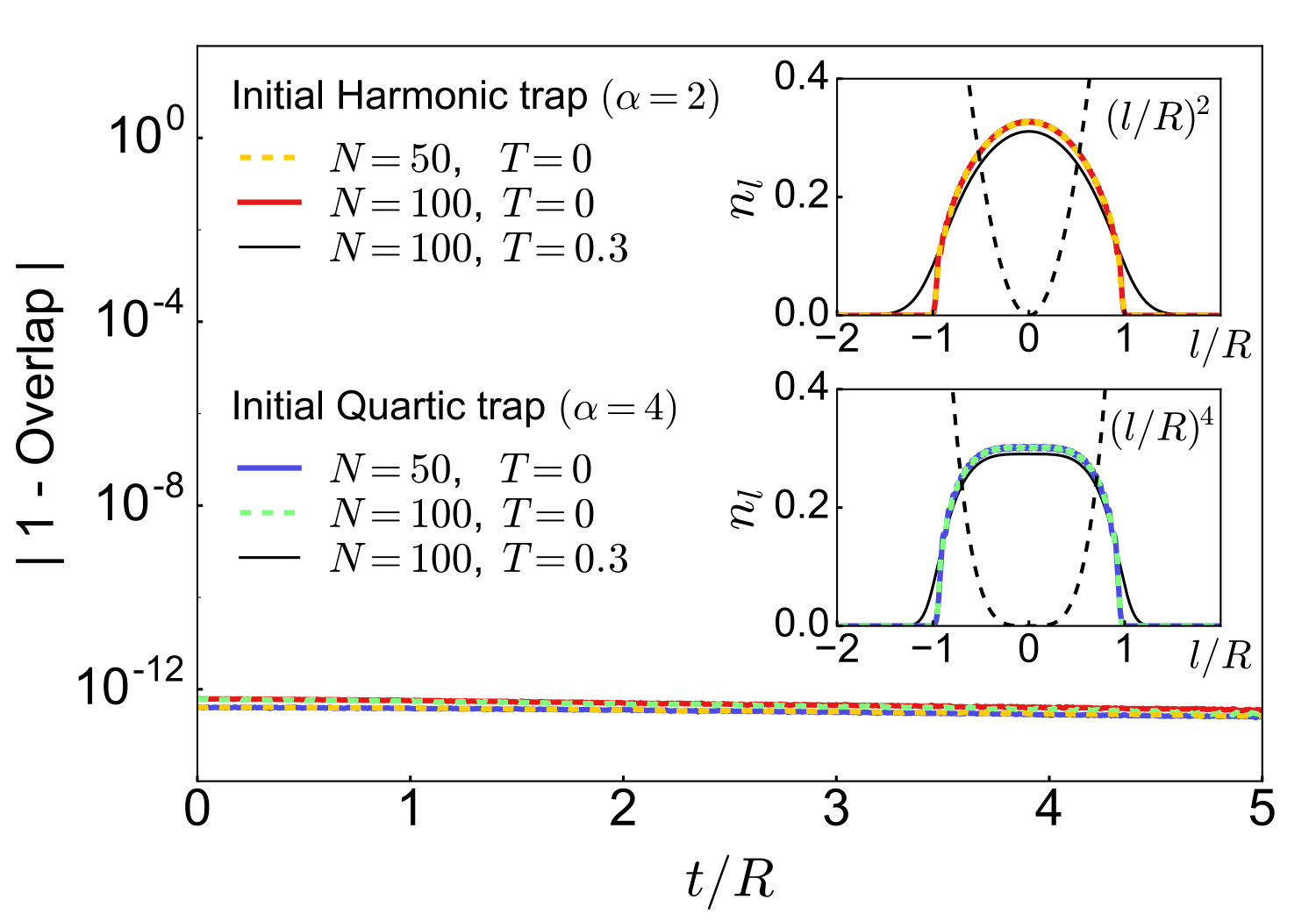 Figure 1
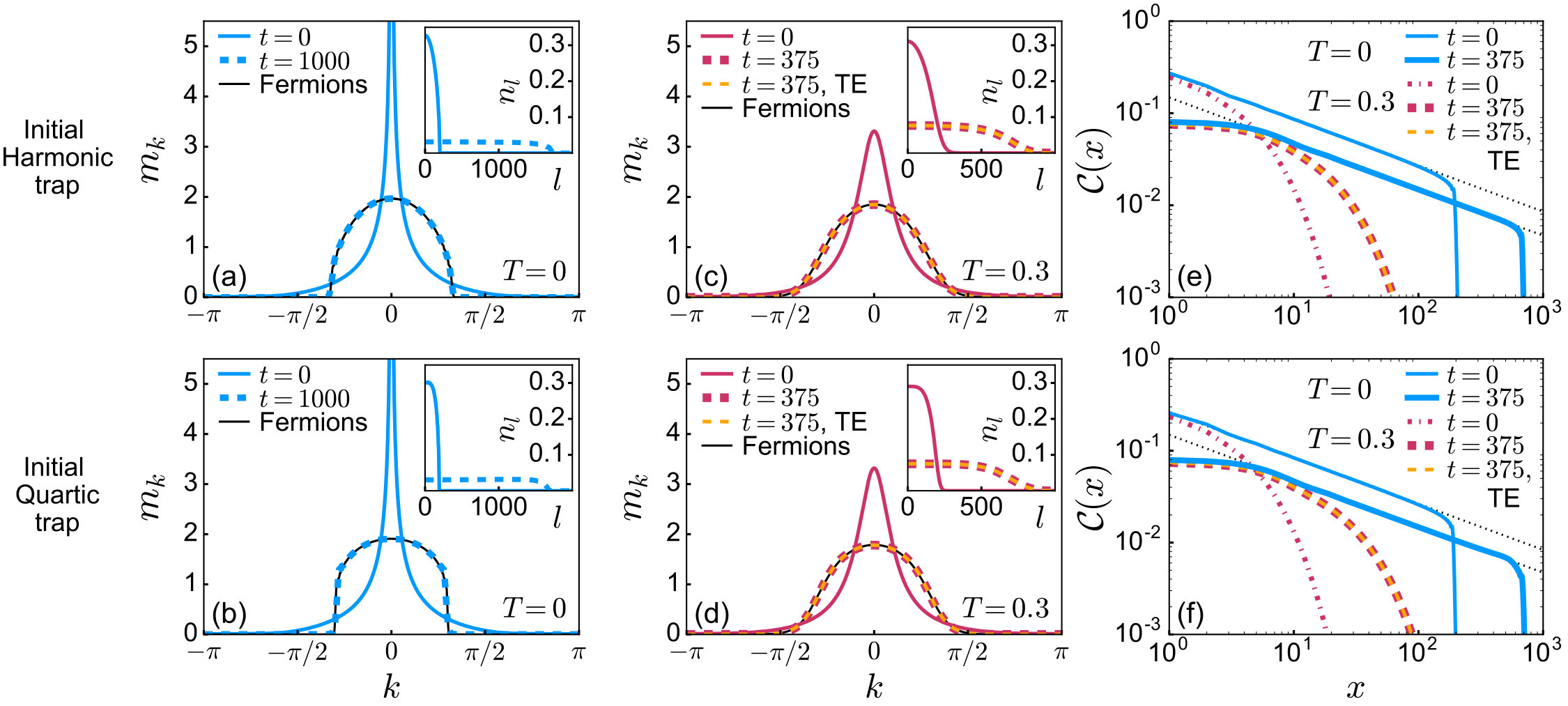 Figure 2
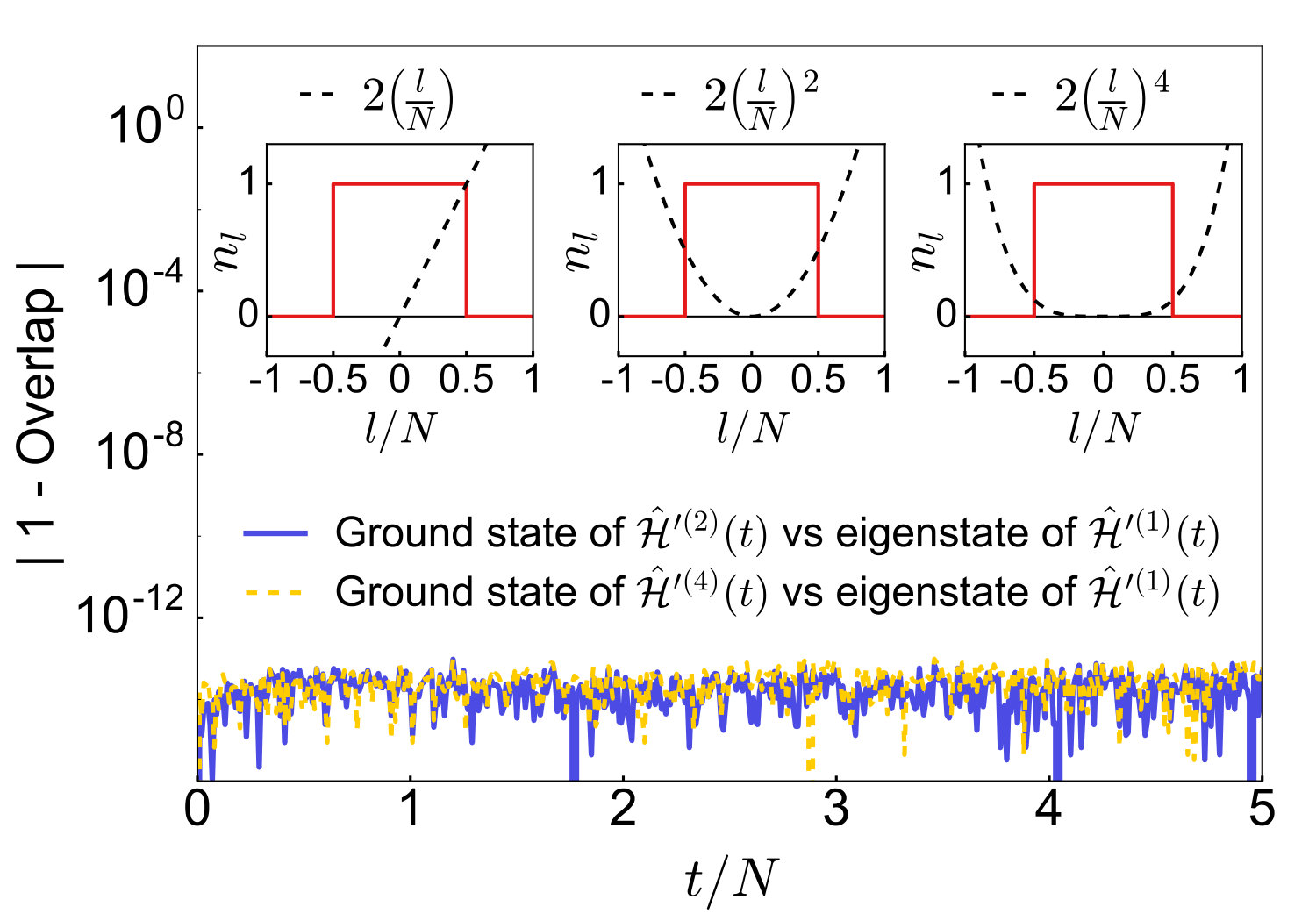 Figure 3
Peer Reviews
No public reviews on file for this paper yet. If you reviewed it on a platform where reviews are public (OpenReview, ICLR, NeurIPS, ICML), you can paste yours below so the community can read it here.
Videos
No videos yet. Explain this paper in a talk, walkthrough, or lecture? Add one.
Emergent eigenstate solution and emergent Gibbs ensemble for
expansion dynamics in optical lattices
Lev Vidmar
Wei Xu
Marcos Rigol
Department of Physics, The Pennsylvania State University, University Park, Pennsylvania 16802, USA
Abstract
Within the emergent eigenstate solution to quantum dynamics [Phys. Rev. X 7, 021012 (2017)], one can construct a local operator (an emergent Hamiltonian) of which the time-evolving state is an eigenstate. Here we show that such a solution exists for the expansion dynamics of Tonks-Girardeau gases in optical lattices after turning off power-law (e.g., harmonic or quartic) confining potentials, which are geometric quenches that do not involve the boost operator. For systems that are initially in the ground state and undergo dynamical fermionization during the expansion, we show that they remain in the ground state of the emergent local Hamiltonian at all times. On the other hand, for systems at nonzero initial temperatures, the expansion dynamics can be described constructing a Gibbs ensemble for the emergent local Hamiltonian (an emergent Gibbs ensemble).
I Introduction
Nonequilibrium dynamics in isolated quantum systems generally result in states in which observables can be described using equilibrium statistical mechanics (they “thermalize”) dalessio_kafri_16 . Nevertheless, there are many examples of intriguing outcomes of quantum dynamics. Some are the result of designing controllable dynamical protocols to create states of matter that do not exist in equilibrium, e.g., long-lived nonequilibrium states after short photoexcitation pulses fausti_tobey_11 ; stojchevska14 and Floquet states mentik_balzer_15 ; mendozaarenas_17 . Others are the result of having current-carrying states. Within the latter, recent studies have aimed at clarifying the role of (quasi-)local conserved quantities in transport in integrable systems prosen11 ; mierzejewski_prelovsek_14 ; ilievski_medenjak_16 ; castroalvaredo_doyon_16 ; bertini16 ; deluca_collura_17 ; ilievski_denardis_17 ; medenjak_karrasch_17 , and generating interesting current-carrying states in closed quantum systems using inhomogeneous initial states antal99 ; karevski02 ; rigol04 ; rigol_muramatsu_05 ; rigol05a ; gobert05 ; daley05 ; hm08 ; santos11 ; jesenko_znidaric_11 ; karrasch_moore_13 ; eisler13 ; sabetta_misguich_13 ; alba14 ; vasseur15 ; lancaster16 ; eisler_maislinger_16 ; ljubotina_znidaric_17 . Other remarkable dynamical phenomena that have recently attracted much attention are dynamical phase transitions heyl_polkovnikov_13 ; vosk14 ; heyl_14 ; andraschko14 ; heyl_15 and discrete time crystals yao17 ; zhang_hess_17 ; choi_choi_17 .
Also departing from the traditional thermalization scenario, it was pointed out in Ref. vidmar_iyer_17 that, for certain classes of quantum quenches involving pure states, there exist a local operator (an emergent local Hamiltonian) of which the time-evolving state is an eigenstate. Namely, there exists an emergent eigenstate solution to the quantum dynamics. Whenever the time-evolving state is the ground state of the emergent local Hamiltonian, one can understand why ground-state-like correlations, such as those observed in Refs. rigol04 ; vidmar15 , can occur far from equilibrium. On the other hand, the emergent eigenstate solution also offers promising tools to engineer many-body states with ultracold atoms. Related ideas have been recently explored in the context of integrable Floquet dynamics gritsev17 and counter-diabatic driving sels_polkovnikov_17 .
In the quantum quenches studied in Ref. vidmar_iyer_17 , the initial states were eigenstates of Hamiltonians that contained the so-called boost operator (an operator that is used in integrable models to generate conserved quantities). While such Hamiltonians could potentially be engineered in optical lattice experiments, they are not directly relevant to current experiments. Our first goal in this paper is to show that the emergent eigenstate solutions also exist for quenches that do not involve the boost operator. Our second goal is to formalize the numerical observation in Ref. xu17 that the emergent local Hamiltonian can be used to understand the dynamics of thermal states after a quench. We justify analytically, and show numerically, the applicability of an emergent Gibbs ensemble (a Gibbs ensemble for the emergent local Hamiltonian) for quenches starting from Gibbs states.
We study bosons in the Tonks-Girardeau regime (hard-core bosons) girardeau60 ; olshanii98 ; paredes_widera_04 ; kinoshita_wenger_04 in one-dimensional (1D) lattices, and consider systems that are initially at zero and nonzero temperatures confined in power-law traps (harmonic traps are the ones relevant to current experiments). The physical phenomenon that will be central to our discussions is the dynamical fermionization of the quasimomentum distribution function during the expansion after suddenly turning off the trap rigol_muramatsu_05 ; minguzzi_gangardt_05 ; rigol05a ; xu17 . In closing, by comparing results for power-law traps with even and odd exponents (for spectra that are bounded and unbounded from below, respectively), we show that different emergent local Hamiltonians can be used to describe dynamics of the same states, and that the target eigenstates can be ground states or highly excited states of such Hamiltonians.
II Emergent eigenstate solution
We first review some key elements of the emergent eigenstate solution to quantum dynamics introduced in Ref. vidmar_iyer_17 . We consider a quantum quench from the initial Hamiltonian to the final Hamiltonian , with the initial state being an eigenstate of (). The time-evolving state is an eigenstate of the operator
[TABLE]
which is in general nonlocal and therefore of no particular interest (we set ). However, there are physically relevant cases for which is a local operator, i.e., an extensive sum of operators with support on a finite number of lattice sites vidmar_iyer_17 . We say that the emergent eigenstate solution to quantum dynamics exists whenever can be replaced by a local operator that we call the emergent local Hamiltonian. Since , instead of time-evolving the initial state one can solve for the dynamics by finding a single eigenstate of . Remarkably, is time independent in the Heisenberg picture []. Hence, is a local conserved quantity even though it does not commute with the physical Hamiltonian that governs the dynamics.
The conditions for to exist become apparent from the expansion of Eq. (1) in power series
[TABLE]
where is an -th nested commutator of the final Hamiltonian with the initial Hamiltonian. An emergent local Hamiltonian exists if: (i) vanishes at some finite , or (ii) if the nested commutators close the sum in Eq. (2).
III Emergent Gibbs ensemble
One can generalize the emergent eigenstate solution of quantum dynamics to initial thermal states. For an initial density matrix , where and is the initial inverse temperature (we set ), the time-evolving density matrix is
[TABLE]
where, in the second line, the operator was expanded in a power series. Writing yields
[TABLE]
In Eq. (4), one can introduce the operator such that the time-evolving density matrix is a Gibbs density matrix of . is in general nonlocal and, hence, of no particular use. However, whenever is local [], Eq. (4) represents a physically meaningful emergent Gibbs ensemble
[TABLE]
Note that the temperature in is that of the initial state, only the emergent local Hamiltonian changes with time. The expectation value of any observable during the dynamics can be computed as .
IV Dynamical fermionization
As mentioned before, here we study hard-core bosons in 1D lattices. We consider initial Hamiltonians of the form:
[TABLE]
where () is the creation (annihilation) operator of a hard-core boson at site , is the hopping amplitude, and and are the strength and exponent of the power-law trap, respectively. The quantity to be kept constant when taking the thermodynamic limit is the so-called characteristic density rigol_muramatsu_04 ; rigol_muramatsu_05a , where is the total number of particles in the trap.
Mapping hard-core bosons onto spins 1/2 and spins 1/2 onto fermions, jordan_wigner_28 ; holstein_primakoff_40 ; cazalilla_citro_review_11 , Hamiltonian (6) maps onto a Hamiltonian of noninteracting spinless fermions
[TABLE]
One can efficiently compute one-body observables of hard-core bosons solving for the fermions and using properties of Slater determinants rigol_muramatsu_05a ; rigol05a ; rigol05b ; xu17 . The site occupations of fermions , with , and hard-core bosons are identical.
We first focus on the cases in which (harmonic trap) and (quartic trap). The insets in Fig. 1 show typical initial ground-state and finite-temperature () site occupations considered in our study. It is interesting to note that, in the center of the quartic trap, the site occupations are almost constant.
Our quench consists of turning off the trap, so that the dynamics occur under the physical Hamiltonian
[TABLE]
We measure time in units of and set . This class of geometric quantum quenches is known as sudden expansion and has been widely studied theoretically rigol04 ; rigol_muramatsu_05 ; rigol05a ; rodriguez_manmana_06 ; delcampo06 ; delcampo08 ; buljan_pezer_08 ; hm08 ; jukic09 ; hm09 ; eisler09 ; lancaster10 ; kajala11 ; bolech12 ; iyer12 ; collura_sotiriadis_13 ; collura13b ; vidmar13 ; boschi14 ; campbell_gangardt_15 ; brandino15 ; hauschild15 ; ren_wu_15 ; schluenzen_harmanns_16 ; mei16 ; robinson_caux_16 ; xu17 and in experiments with ultracold atoms in optical lattices schneider12 ; ronzheimer13 ; xia_zundel_15 ; vidmar15 ; preiss_ma_15 . In contrast to the standard time-of-flight measurements, the lattice potential and, as a result, strong interactions, are not switched off during the quench.
We now derive the emergent local Hamiltonian for this setup. Note that, in Ref vidmar_iyer_17 , the initial and the final Hamiltonians satisfied the commutation relation , with being a conserved quantity of the final Hamiltonian (up to boundary terms). Such a commutation relation was enforced by making the sum of and a boost operator. For and 4 [see Eq. (7)], the traps of interest here, this is not the case.
For the analysis that follows, it is useful to define the generalized kinetic energy and current operators
[TABLE]
They allow us to write the initial Hamiltonian as , and the final Hamiltonian as . Note that the operators and commute with , up to boundary terms. This is what ensures that the sum in Eq. (2) is convergent for our quenches of interest.
Let us consider first the initial harmonic confinement, in Eq. (7). The commutator of the final and the initial Hamiltonian yields
[TABLE]
While does not commute with , their commutator yields the operators
[TABLE]
with , which both commute with (up to boundary terms). We therefore truncate the series in Eq. (2) at . Consequently, the emergent local Hamiltonian for the initial harmonic trap reads
[TABLE]
Remarkably, when mapping spinless fermions back to hard-core bosons, the operator in Eq. (13) becomes a two-body operator . Hence, the emergent local Hamiltonian for hard-core bosons contains correlated next-nearest neighbor hoppings, even though the emergent local Hamiltonian for the corresponding fermions is quadratic.
The emergent local Hamiltonian to describe the expansion dynamics from other initial power-law traps, with , can also be determined in a straightforward way. However, the calculations become increasingly lengthy with increasing as the series in Eq. (2) is truncated at . In Appendix B, we discuss the calculation for the quartic trap, in Eq. (7). The resulting emergent local Hamiltonian reads
[TABLE]
which is significantly more complex than . However, it still consists of sums of local operators.
The emergent local Hamiltonian construction implies that if the initial state is the ground state of (7) [for even and positive] and is nondegenerate, the time-evolving state is the ground state of at all times, which we denote as . This statement is not limited to a particular initial characteristic density . We check this numerically for and 4, and in Fig. 1 by calculating the overlap . The overlap is essentially one to machine precision. This confirms that, if the lattice is sufficiently large such that the site occupations at the edges vanish at all times, the emergent eigenstate solution is valid at all times (see Appendix A). Moreover, Figs. 2(c)–2(f) show results for various one-body observables for initial finite-temperature states, obtained both by time-evolving the initial density matrix (as in Ref. xu17 ) and by using the emergent Gibbs ensemble. The results can be seen to agree, which demonstrates the validity of the emergent Gibbs ensemble description [see Eq. (5)].
Physically, the quench dynamics under investigation is of particular interest because the quasimomentum distribution of hard-core bosons undergoes a dynamical fermionization, namely, it approaches that of spinless fermions as the cloud expands rigol_muramatsu_05 . (Note that the quasimomentum distribution of the spinless fermions does not change in time because the fermionic occupations of the quasimomentum modes are conserved quantities.) This dynamical fermionization is to be contrasted to the result of the time-of-flight protocol, in which all the external potentials are switched off and the measured momentum distribution after expansion is, up to higher-order Bragg peaks, the same as the initial quasimomentum distribution of the hard-core bosons. Dynamical fermionization has been studied for hard-core bosons in initial ground states in a lattice rigol_muramatsu_05 ; rigol05a , in the continuum minguzzi_gangardt_05 , and at finite temperatures in a lattice xu17 .
Figures 2(a)–2(d) display the quasimomentum distribution for and . We define of hard-core bosons as (for spinless fermions, one just needs to replace by ). In equilibrium, of hard-core bosons is clearly different from its spinless fermion counterpart: it is sharply peaked at in the ground state [Figs. 2(a) and 2(b)], while finite temperatures [Figs. 2(c) and 2(d)] smoothen the peak rigol05b . Remarkably, during the dynamics [see Figs. 2(a)–2(d)], of hard-core bosons approaches the one of spinless fermions irrespective of the initial temperature xu17 and of the exponent of the initial confining potential. The quasimomentum distribution of hard-core bosons is nearly identical to that of the fermions at the longest expansion times studied, when the occupations in the center of the lattice are strongly reduced from their initial values [see the insets of Figs. 2(a)-2(d)].
The dynamical fermionization of the bosonic quasimomentum distribution function is not the only intriguing phenomenon that occurs during the expansion dynamics. Another remarkable feature is the preservation of coherence in the many-body wavefunction of pure states. This can be seen by studying the spatial decay of the absolute value of one-body correlations , for which results are depicted in Figs. 2(e) and 2(f). While the spatial decay for finite-temperature initial states is exponential xu17 , it is intriguing that for initial ground states the correlations retain a power-law decay with the ground-state exponent at all times rigol_muramatsu_05 ; rigol05a . The fact that the expanding states that start their dynamics from ground states are eigenstates of emergent local Hamiltonians (13) and (14) allow one to gain an intuitive understanding for why correlations can be power law. This is a behavior typical of gapless 1D systems in their ground states, which are described by the Luttinger liquid theory cazalilla_citro_review_11 .
V Nonuniqueness of the emergent local Hamiltonian
Before concluding, let us also consider initial Hamiltonians of the form
[TABLE]
which commute for different values of . Let us consider two initial Hamiltonians and and the same final Hamiltonian after the quench. The corresponding emergent local Hamiltonians and commute [this follows from Eq. (1)], i.e., they share eigenstates. This means that different emergent local Hamiltonians can be used to describe dynamics from initial states that are common eigenstates of and .
An interesting aspect about the nonuniqueness of the emergent local Hamiltonian appears when studying for even and odd values of , as the former (latter) exhibits a spectrum that is bounded (unbounded) from below. If one considers an initial state that is a Fock state with one particle per site in the center of the lattice, see the insets in Fig. 3, that state is the ground state of and , while it is a highly-excited (degenerate) eigenstate of . As a result, the expansion dynamics can be described using the ground state of and [obtained by replacing and in Eqs. (13) and (14), respectively] or using a highly-excited eigenstate of
[TABLE]
with vidmar_iyer_17 . In the main panel in Fig. 3, we show overlaps between the target eigenstates of , , and as a function of time. The overlaps are one within machine precision for all times shown.
This example offers an understanding for why one-body correlations with ground-state character can be found in highly-excited eigenstates of emergent local Hamiltonians with spectra that are unbounded from below vidmar_iyer_17 . In the case considered here, a highly-excited eigenstate of is the ground state of and . Note that, actually, a macroscopic number of low-energy eigenstates of and appears (is “cloned”) in the middle of the spectrum of .
VI Conclusions
We have shown that emergent eigenstate solutions exist for the expansion dynamics of Tonks-Girardeau gases in 1D optical lattices after turning off power-law confining potentials. Those quenches do not involve the boost operator, which was central to the discussion in Ref. vidmar_iyer_17 . Our construction is applicable independently of the characteristic density chosen, the exponent of the power-law traps, the initial temperature, and for arbitrarily long times, so long as particles do not reach the edges of the lattice. The emergent local Hamiltonians constructed here provide a promising tool to manipulate time-evolving states in optical lattices. For example, by quenching to the emergent Hamiltonian during the expansion one can suddenly freeze the atomic cloud, as it becomes a stationary state. This opens a door towards the efficient engineering of tailored many-particle states.
We studied the dynamical fermionization of the hard-core boson quasimomentum distribution function during expansion dynamics, and showed that the dynamically fermionized state can be the ground state of an emergent local Hamiltonian with competing (generalized) kinetic and current operators. We also formally introduced the concept of the emergent Gibbs ensemble to describe quantum dynamics of initial Gibbs states. It can be used to describe the expansion dynamics of Tonks-Girardeau gases, relevant to current experiments with ultracold atomic bosons in optical lattices.
Appendix A Times of validity of the emergent eigenstate description
In the derivation of and , we neglected boundary terms that appear in the commutators . These terms enter the series in Eq. (2) generating operators at the lattice boundaries whose support increases with the power of , and eventually result in a breakdown of the emergent eigenstate description of the dynamics on finite lattices and long times. Physically, the breakdown time can be understood to be the time at which propagating particles reach the lattice boundaries vidmar_iyer_17 . Hence, by taking limits appropriately, no breakdown of the emergent eigenstate solution will occur. One needs to first take the lattice size to infinity while keeping the time fixed, and then take the infinite time limit.
Appendix B Emergent local Hamiltonian for the initial quartic trap
The emergent local Hamiltonian in Eq. (14) is derived by evaluating elements of the series in Eq. (2). The first-order term is
[TABLE]
the second-order term is
[TABLE]
the third-order term is
[TABLE]
and the fourth-order term is
[TABLE]
One then realizes that commutes with (up to boundary terms), and, hence, the series in Eq. (2) can be truncated at to produce the emergent local Hamiltonian in Eq. (14).
Acknowledgements.
We acknowledge discussions with M. Heyl and D. Iyer, and we thank F. Heidrich-Meisner for a careful reading of the manuscript. This work was supported by the Office of Naval Research, Grant No. N00014-14-1-0540. The computations were done at the Institute for CyberScience at Penn State.
The reference list from the paper itself. Each links out to its DOI / PubMed record.
- 1(1) L. D’Alessio, Y. Kafri, A. Polkovnikov, and M. Rigol, From quantum chaos and eigenstate thermalization to statistical mechanics and thermodynamics, Adv. Phys. 65 , 239 ( 2016 ). · doi ↗
- 2(2) D. Fausti, R. I. Tobey, N. Dean, S. Kaiser, A. Dienst, M. C. Hoffmann, S. Pyon, T. Takayama, H. Takagi, and A. Cavalleri, Light-induced superconductivity in a stripe-ordered cuprate, Science 331 , 189 ( 2011 ). · doi ↗
- 3(3) L. Stojchevska, I. Vaskivskyi, T. Mertelj, P. Kusar, D. Svetin, S. Brazovskii, and D. Mihailovic, Ultrafast switching to a stable hidden quantum state in an electronic crystal, Science 344 , 177 ( 2014 ). · doi ↗
- 4(4) J. H. Mentink, K. Balzer, and M. Eckstein, Ultrafast and reversible control of the exchange interaction in Mott insulators, Nature Communications 6 , 6708 ( 2015 ). · doi ↗
- 5(5) J. J. Mendoza-Arenas, F. J. Gomez-Ruiz, M. Eckstein, D. Jaksch, and S. R. Clark, Ultra-fast control of magnetic relaxation in a periodically driven Hubbard model, ar Xiv:1701.04123 .
- 6(6) T. Prosen, Open XXZ spin chain: Nonequilibrium steady state and a strict bound on ballistic transport, Phys. Rev. Lett. 106 , 217206 ( 2011 ). · doi ↗
- 7(7) M. Mierzejewski, P. Prelovšek, and T. Prosen, Breakdown of the generalized Gibbs ensemble for current-generating quenches, Phys. Rev. Lett. 113 , 020602 ( 2014 ). · doi ↗
- 8(8) E. Ilievski, M. Medenjak, T. Prosen, and L. Zadnik, Quasilocal charges in integrable lattice systems, J. Stat. Mech. (2016), 064008 . · doi ↗