Deterministic entanglement between a propagating photon and a singlet--triplet qubit in an optically active quantum dot molecule
Yves L. Delley, Martin Kroner, Stefan F\"alt, Werner Wegscheider,, Ata\c{c} \.Imamo\u{g}lu

TL;DR
This paper demonstrates deterministic entanglement between a photon and a spin qubit in a quantum dot molecule, showcasing a high overlap with a fully entangled state and introducing a novel heterodyne detection method for energy-encoded photonic qubits.
Contribution
It reports the first deterministic entanglement between a propagating photon and a spin qubit in a quantum dot molecule, with a new heterodyne detection technique for energy-encoded photonic states.
Findings
Achieved 69.5% overlap with a fully entangled state.
Demonstrated entanglement between a photon and a spin qubit.
Developed a heterodyne detection method for color qubits.
Abstract
Two-electron charged self-assembled quantum dot molecules exhibit a decoherence-avoiding singlet-triplet qubit subspace and an efficient spin-photon interface. We demonstrate quantum entanglement between emitted photons and the spin-qubit after the emission event. We measure the overlap with a fully entangled state to be , exceeding the threshold of required to prove the non-separability of the density matrix of the system. The photonic qubit is encoded in two photon states with an energy difference larger than the timing resolution of existing detectors. We devise a novel heterodyne detection method, enabling projective measurements of such photonic color qubits along any direction on the Bloch sphere.
Click any figure to enlarge with its caption.
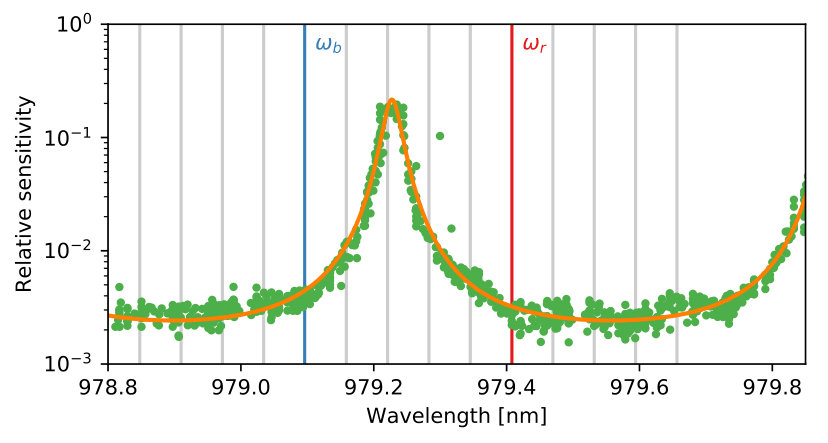 Figure 1
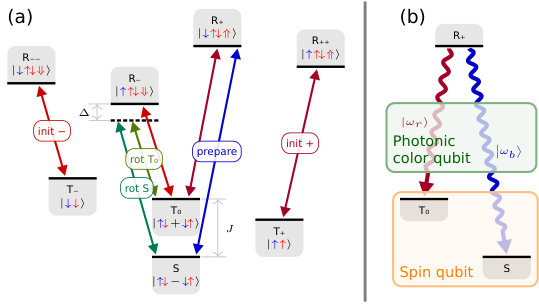 Figure 2
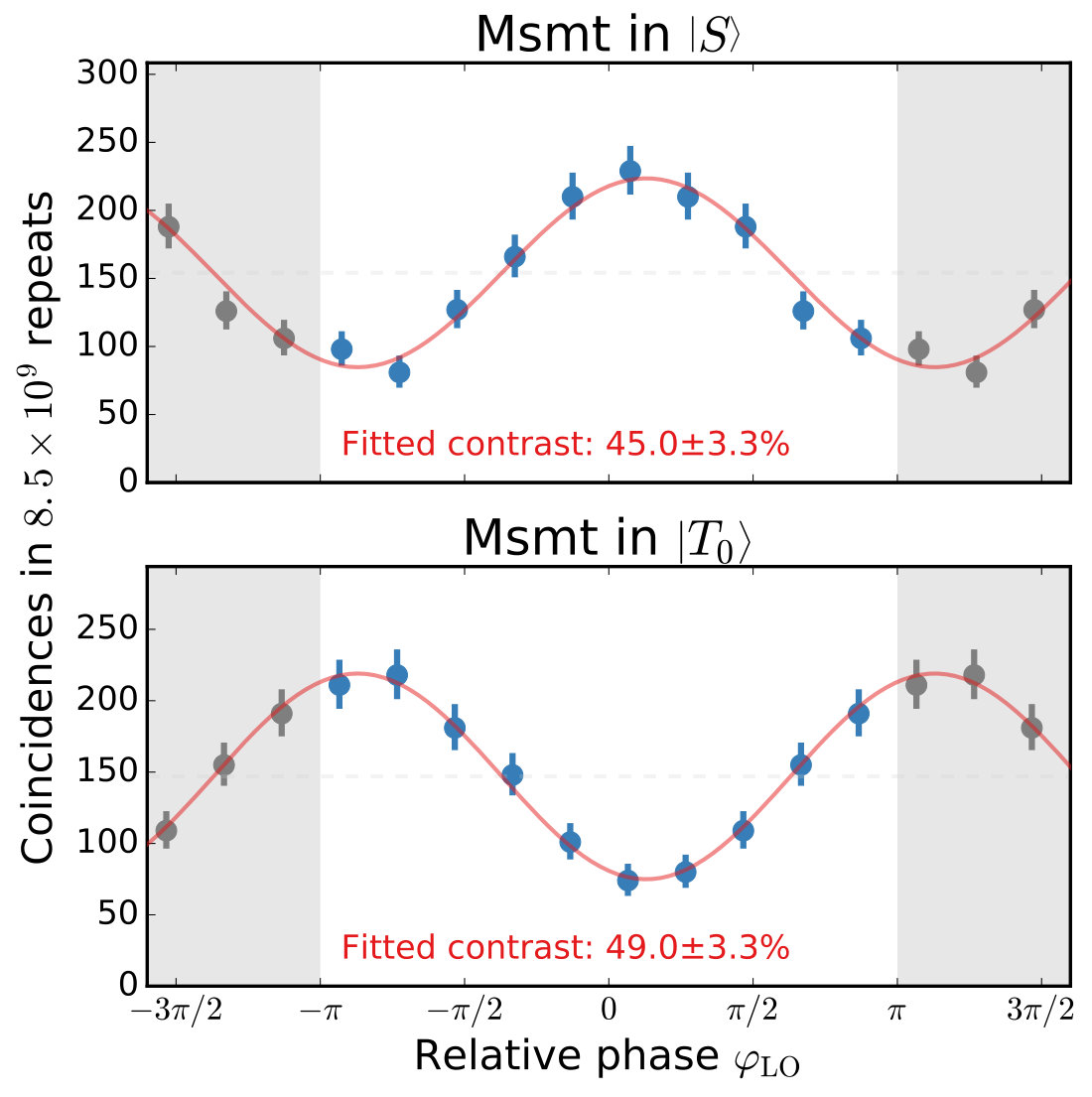 Figure 3
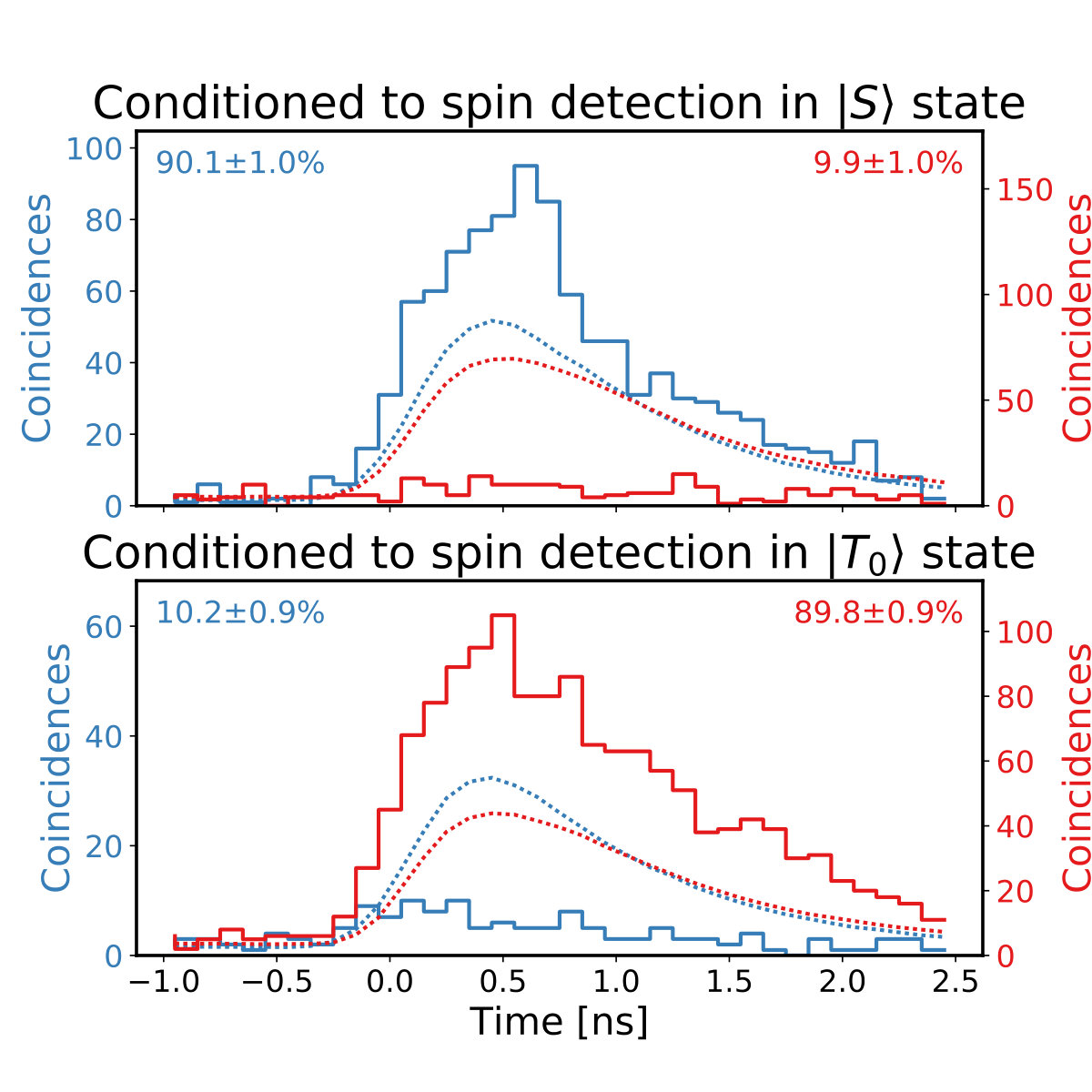 Figure 4
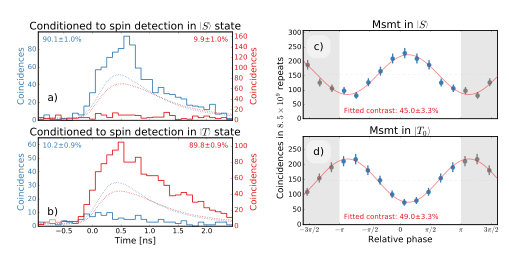 Figure 2
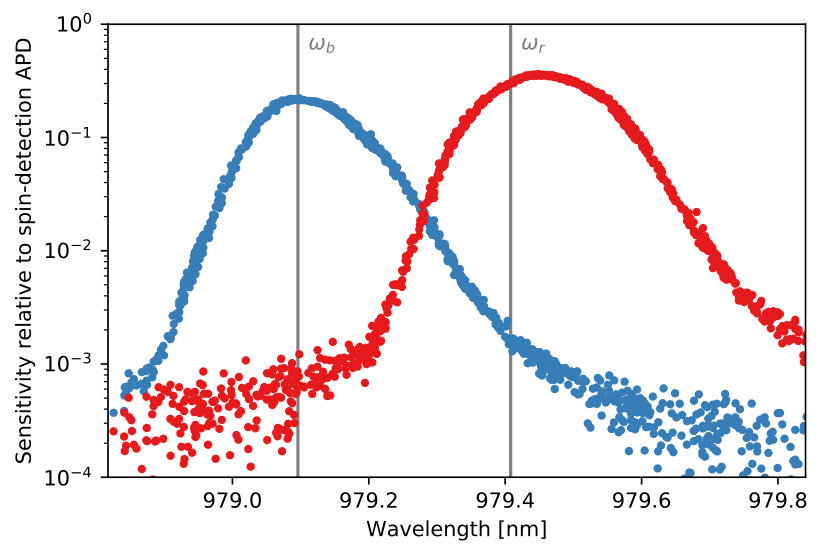 Figure 6
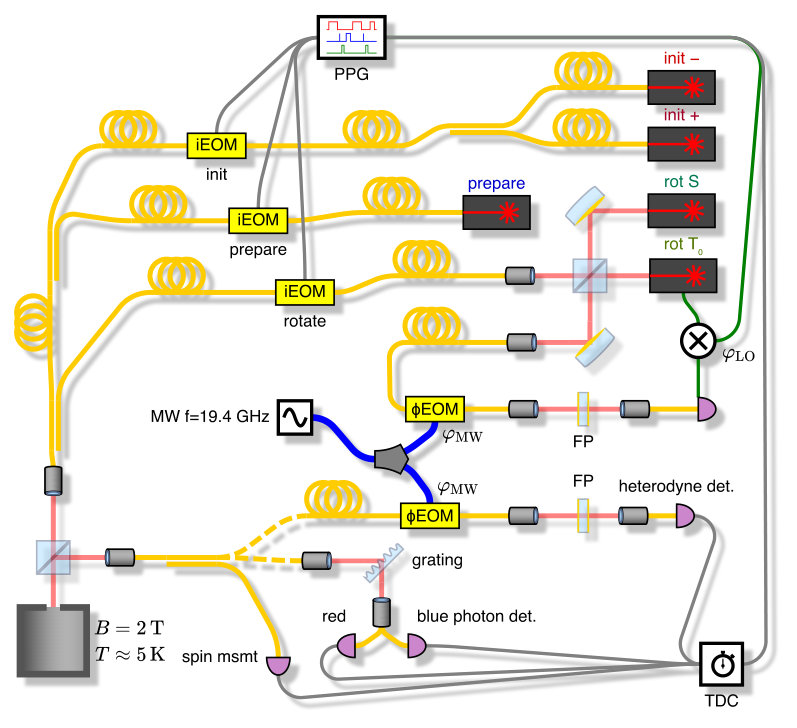 Figure 7
| Imperfection | |
|---|---|
| Spin dephasing | |
| Rotation pulse | |
| Sideband suppression | |
| Phase lock performance | |
| Phase reference drift | |
| Remaining visibility |
Peer Reviews
No public reviews on file for this paper yet. If you reviewed it on a platform where reviews are public (OpenReview, ICLR, NeurIPS, ICML), you can paste yours below so the community can read it here.
Videos
No videos yet. Explain this paper in a talk, walkthrough, or lecture? Add one.
Deterministic entanglement between a propagating photon
and a singlet–triplet qubit in an optically active quantum dot molecule
Y. L. Delley
Institute for Quantum Electronics, ETH Zürich, CH-8093 Zurich, Switzerland.
M. Kroner
Institute for Quantum Electronics, ETH Zürich, CH-8093 Zurich, Switzerland.
S. Faelt
Institute for Quantum Electronics, ETH Zürich, CH-8093 Zurich, Switzerland.
Laboratory for Solid State Physics, ETH Zürich, CH-8093 Zurich, Switzerland.
W. Wegscheider
Laboratory for Solid State Physics, ETH Zürich, CH-8093 Zurich, Switzerland.
A. İmamoğlu
Institute for Quantum Electronics, ETH Zürich, CH-8093 Zurich, Switzerland.
Abstract
Two-electron charged self-assembled quantum dot molecules exhibit a decoherence-avoiding singlet-triplet qubit subspace and an efficient spin-photon interface. We demonstrate quantum entanglement between emitted photons and the spin-qubit after the emission event. We measure the overlap with a fully entangled state to be , exceeding the threshold of required to prove the non-separability of the density matrix of the system. The photonic qubit is encoded in two photon states with an energy difference larger than the timing resolution of existing detectors. We devise a novel heterodyne detection method, enabling projective measurements of such photonic color qubits along any direction on the Bloch sphere.
pacs:
03.67.Hk, 73.21.La, 42.50.-p
Spins in optically active quantum dots (QD) exhibit relatively short coherence times. Despite this strong limitation, QDs stand out among solid-state qubit systems for their excellent optical properties that render them promising for quantum communication tasks relying on a quantum interface between stationary (spin) and flying (photonic) qubits. Recent experiments have used this favorable feature to demonstrate coherent all-optical spin manipulation Press et al. (2010), emission of entangled photon-pairs Young et al. (2007); Hafenbrak et al. (2007), spin-photon entanglement Gao et al. (2012); De Greve et al. (2012); Schaibley et al. (2013), teleportation from a photonic to a spin qubit Gao et al. (2013) and heralded distant spin entanglement using QDs in Voigt geometry Delteil et al. (2016). However, the magnetic field configuration to achieve efficient spin measurement Delteil et al. (2014) is incompatible with the configuration for coherent manipulation.
The moleclular states and in optically active quantum dot molecules (QDMs) in Faraday geometry emerge as a promising alternative effective qubit for quantum information processing since (i) they exhibit a decoherence-avoiding clock-transition that is insensitive to fluctuations in both electric and magnetic fields Weiss et al. (2012), (ii) the spin polarized triplet states ( and ) of the ground-state manifold exhibit cycling optical transitions Delley et al. (2015), and (iii) the qubit states exhibit equal coupling strength to common optically excited trion states, essential for maximal spin-photon entanglement. In this letter, we experimentally determine the amount of entanglement obtained from the spontaneous emission from such an excited state.
S–T0 qubits in QDMs
Our experiment is carried out on a single \ceInGaAs self-assembled QDM, consisting of two QDs separated by a \ceGaAs tunneling barrier along the growth direction Xie et al. (1995). The QDM is embedded in a Schottky diode, formed by a semi-transparent metallic top gate and an n-doped layer, which is used to control the charge state of the QDM and the optical transition energies vie the quantum confined Stark effect Miller et al. (1984). A distributed Bragg reflector (DBR) below the doped layer forms a weak planar microcavity together with the top gate, enhancing the collection efficiency though a combination of emission profile modification and Purcell effect Delteil et al. (2014). Thanks to engineered confinement energies of the two QDs, the QDM can be brought into the (1,1)-regime Kim et al. (2011); Greilich et al. (2011), where each QD is charged with a single electron. In this regime, the singlet state () is split from the triplet states (, and ) by the exchange splitting, which is gate-voltage tunable and has a minimum value of 97\text{,}\mathrm{GHz}$$ in our device. The triplet states are split by from each other by an external magnetic field of that is applied along the growth direction (Faraday geometry). The relevant level scheme is outlined in fig. 1 (a). Under these conditions, and can be compared to atomic clock transitions that are insensitive to both electric and magnetic field fluctuations Weiss et al. (2012). Coupling to the common optically excited state (with equal oscillator strength) allows for coherent manipulation of the qubit Kim et al. (2011); Greilich et al. (2011). Spontaneous radiative recombination of projects the joint-system of the QDM and the optical field into an entangled state
[TABLE]
where and denote single-photon states with center frequencies at and respectively, both of them being circularly polarized with the same handedness. The relative phase of the state is fixed by the optical selection rules.
Experimental setup
Figure 2 shows schematically how the experiment is set-up. The sample is held in a liquid helium bath cryostat at about . A confocal microscope with NA= is used to direct -pulses from tunable diode lasers to the QDM to manipulate the qubit state and to read it out via detection of resonance fluorescence (RF). The laser pulses are linearly polarized, and the RF is collected from the orthogonal linear polarization, such that all transitions couple to excitation and detection equally well Vamivakas et al. (2010); Yılmaz et al. (2010), while reflected laser light is suppressed by a factor of . Multiple \ceSi avalanche photo-diodes (APDs) are used to detect the emitted photons, and a time-digital converter (TDC) records the arrival time of every photon.
Entanglement generation and verification
Resonant laser pulses are used to initialize the QDM into via optical spin-pumping Atatüre et al. (2006). To this end, we combine the light of two lasers, one of which is resonant with and , the other is resonant with and .
From , a long resonant laser pulse prepares the QDM in . Spontaneous emission creates the entangled state between the propagating photon and the remaining spin-qubit in the – subspace.
To verify the entangled state, we estimate the overlap of the post-emission state described by the density matrix with the entangled state as defined in equation (1), quantified by the state fidelity
[TABLE]
The fidelity can be decomposed into two parts: quantifies the amount of classical correlations between the probabilities of finding each subsystem in a particular eigenstate. on the other hand is sensitive to the relative phase between the two parts of the state when written in the eigenbasis, thus we refer to that term as the quantum correlations. The state described by generally is a mixture of pure states, such that becomes a convex mixture of the fidelity of each contained pure state. Since no separable state has a higher fidelity than , observing a fidelity above that limit proves inseparability of Sackett et al. (2000).
Measurement of the classical correlations
To estimate , we measure the correlations between the two subsystems in their eigenbases. To that end, we disperse the photon from the entanglement pulse using a transmission grating, split the two color components using a fiber-bundle with two cores next to each other, and detect it using a dedicated APD for each component.
To measure the spin, we detect the scattered photons from spin-selective RF Vamivakas et al. (2009), where either a laser pulse resonant with is used to detect the state , or a combined two-laser pulse resonant with and is used to detect the state . Contrary to spin initialization, for spin measurement, any one of the two lasers would suffice. However, that would have required an additional EOM and a pulse-pattern channel, neither of which were easily available.
Figure 3 (a) and (b) show the time resolved fluorescence measured by the spectrally filtered detectors, conditioned on the observation of a photon during the following spin measurement pulse. We normalized the values using the relative overall sensitivity of the two detection paths, which we determined separately 111See Supplemental Material at [URL] for Spectral selectivity of the grating-filtered photon detection. There is a strong correlation between the spin and the detected photon color: 90.19.9\pm 1.0\text{,}\mathrm{\char 37\relax} and $P(b|\mathrm{T_{0}})\mathbin{:}P(r|\mathrm{T_{0}})=($10.2$\mathbin{:}$89.8$)$\pm 0.9\text{\,}\mathrm{\char 37\relax}. Errors are one standard deviation and are derived from counting statistics. We take as well as , valid if the results are conditioned to the cases where a photon is detected, and as long as optically forbidden transitions are rare. From this, we can extract a lower bound to the fidelity as 89.4\pm 0.8\text{,}\mathrm{\char 37\relax}$$ since is a convex mixture of the two conditional probabilities.
We attribute the reduction from perfect correlations mainly to double excitation during the entanglement pulse: The duration of the excitation pulse is comparable with the exciton lifetime of about , such that emission events early during the pulse may loose the correlation with the spin during subsequent excitation events. Simulation of the optical Bloch equations suggest between double-excitation events.
Measurement of quantum correlations
To determine , we measure both the photon and the spin in a superposition basis, where the basis states are lying on the equator of Bloch spheres of the subsystems. Entanglement between the systems then implies a sinusoidal dependency of coincidence probabilities on the relative azimuthal angle between each system’s measurement basis Blinov et al. (2004).
To measure the photon in a superposition state of the two colors, we need to detect the phase of the beat-note at 97\text{,}\mathrm{GHz}$$. This is faster than the timing resolution of existing photo-detectors. We therefore employ a heterodyne detection scheme: Using an electro-optic phase modulator (phase-EOM) driven by a microwave (MW) signal, we generate sidebands to each spectral component of the incoming photon. The MW frequency is close to divided by an integer; due to limitations of our MW source, we chose . A free-space Fabry-Pérot etalon with a free spectral range of and a bandwidth of allows us to single-out the sideband of the red photon simultaneously with the sideband of the blue photon. Hence, detection of a photon after the etalon corresponds to a projective measurement of the incoming photon in a superposition state whose phase is given by , determined only by the MW source. In the rotating frame of the two-color photon, this phase rotates at a frequency of , which can be chosen arbitrarily. It was set to , such that the timing jitter of standard \ceSi-APDs does not affect the measured visibility.
To measure the spin in a superposition state, we rotate the spin by around a vector in the equatorial plane of the Bloch sphere, and then measure the population in the or states via RF detection. To that end, we utilize a variation of the standard method of ultrafast coherent optical control based on the optical (AC-)Stark effect (see Press et al. (2008) and references therein): Instead of using a single pulse that is far-detuned from both transitions, we use two quasi-resonant pulses detuned by 10\text{,}\mathrm{GHz}$$ from the transitions and to induce an energy shift to a coherent superposition of the states and . In this case, the azimuthal angle of the rotation vector is determined by the relative optical phase of the two laser pulses, which stays constant during the pulse in the rotating frame of the spin. To ensure a fixed phase relation over the whole measurement time, we embed one of the two diode lasers in a phase-locked loop (PLL), relying on the same heterodyne detection method employed for the photon measurement: The beat-note of the two lasers is down-mixed via side-band generation and spectral filtering, where the MW signal is derived from the same source that drives the photon measurement. The resulting beat-note of is then locked to a local oscillator (LO) that is synchronized with the pulse sequence. While the phase of the MW source therefore determines the azimuthal angle of both the photon measurement basis as well as the spin measurement basis, the relative angle between the two is only determined by the LO phase .
With this detection scheme, given an arbitrary joint density matrix , the probability to detect a coincidence between the photon measurement and the spin measurement is given by
[TABLE]
By letting the MW source run freely, we average over , such that the modulation depth of the coincidence rate with respect to is a direct measure of . Figure 3 (c) and (d) shows the detected photon counts conditioned on detection of a scattered photon during the spin measurement, depending on the phase . Fitting the data by a sinusoidal function, we extract a visibility of when the spin is measured in the state, and when the spin is measured in the state. Errors are one standard deviation and are derived from counting statistics. Since the measurement process can only make the visibility contrast worse, the higher value of the two puts a lower bound on 49.5\pm 2.9\text{,}\mathrm{\char 37\relax}$$.
This value is considerably lower than the ideal case for perfect entanglement. A significant amount of visibility is lost due to the spectral filtering properties of the Fabry-Pérot etalon used in the phase-sensitive photon detection setup, limiting the visibility of the measurement to about : The beating of neighboring pairs of sidebands are out of phase by . Our FP etalon only suppresses the neighboring pairs by a factor of 12 222See Supplemental Material at [URL] for Spectral selectivity of the Fabry-Pérot etalon. The limitation can be overcome by using higher finesse FPs or higher MW frequencies. A further reduction of the visibility is likely to be due to imperfections of the spin-rotation pulse. (See supplementary material for a detailed listing of all sources of error 333See Supplemental Material at [URL] for Estimation of imperfections).
Combining the two measurements, we obtain 69.5\pm 2.7\text{,}\mathrm{\char 37\relax}$$, where the error indicates one standard deviation of uncertainty due to counting statistics.
To summarize, we have shown deterministic generation of a photonic color qubit entangled with the QDM spin qubit. Working with color qubits split by a large energy separation was enabled thanks to our heterodyne quadrature detection method, effectively erasing the energy separation. Since the – spin qubit can controllably be furnished with a dipole, QDM’s promise to bridge the gap between optical long-distance quantum communication and quantum information processing in the solid state. Possible candidates for coupling to the QDM dipole are (a) the dipole of quantum-well exciton-(di-)polaritons in planar microcavities Christmann et al. (2011), (b) the electric field of photons in microwave cavities Tsuchimoto et al. and (c) phonons of microresonators via the piezoelectricity of \ceGaAs.
Acknowledgements.
We acknowledge helpful discussions with Joseph M. Renes and Emre Togan. This work is supported by NCCR Quantum Science and Technology (NCCR QSIT), research instrument of the Swiss National Science Foundation (SNSF) and by Swiss NSF under Grant No. 200021-140818.
I Supplementary Information
I.1 Spectral selectivity of the grating-filtered photon detection
To measure the classical correlations, the color of the photon has to be resolved. This has been achieved using spectral filtering with the help of a transmission grating. To that end, the collected light, after dividing using a 50:50 fiber-splitter for spin detection, is collimated into a free-space beam of diameter. The first order diffraction generated by the transmission grating is focused using a focal length achromatic doublet onto the facet of a multi-mode fiber bundle with two cores separated by .
The sensitivity of that setup can be calibrated by comparing the count-rate of the APDs connected to the multi-mode fibers with the count-rate of the APD used for spin measurement, while laser light of a known wavelength is coupled into the setup. Figure 4 displays a full spectrum obtained using this method. It indicates of a suppression of more than two orders of magnitude. Thus, the resulting probability for a wrong color assignment is small enough to not significantly impact the measurement of the classical correlations. As the response is sensitive to the alignment of the free-space elements, the ratio between the sensitivities for detection of a photon at and was monitored during the measurement via the magnitude of the residual laser-background during the spin-measurement pulses. It was confirmed to stay constant within the measurement accuracy of .
I.2 Spectral selectivity of the Fabry-Pérot etalon
The spectral response of the Fabry-Pérot filter used in the measurement of the quantum correlations has been measured using using a tunable narrow band laser. It is displayed in figure 5. Here, the suppression of the next pair of sidebands separated by is only , leading to a reduction of the visibility of the quantum correlations of the order of .
I.3 Phase stability of the setup
The measurement of the quantum correlations can be considered an interferometric measurement in the microwave domain. In this view, the goal of the experiment is to measure the stability of the relative phase between the emitted photon and the QDM spin. The phase reference for the spin is given from the phase of the beat-note of the rotation pulse, which is locked to the MW phase (up to a tunable phase given by the LO), which in turn determines the phase of the photon measurement. The precision up to which the phase relation between spin and photon can be measured is determined by the phase stability of the interferometer loop, which includes many elements and is of the order of long.
We measured the stability of the whole interferometer by using the photon-superposition detection setup to detect light from the rotation lasers, reflected by the sample surface. The photon detection rate should vary sinusoidally with the LO phase. The visibility of the modulation allows to determine a lower bound on the short-term stability of the loop, while slow drifts in the phase offset can directly be observed. The QDM was moved out of the focus to prevent any RF interfering with the measurement. Over the course of 12 hours, the visibility stayed constant at , but the phase offset drifted by .
The limited visibility can have many reasons, among them, the spectral selectivity of the Fabry-Pérot etalon or an imbalance between the powers of the two lasers participating in the rotation pulse. Thus, the visibility is not an independent measurement of the interferometer stability. On the other hand, the phase drift only depends on the stability of the interferometer, but the loss of visibility due to averaging over is significantly below one percent.
The phase stability of the laser phase lock at short time-scales has been measured separately by comparison of time-traces of the two inputs of the feedback controller; the beat note as measured by the photo diode and the LO reference. We determined an RMS error of with a correlation time of about . This amounts to a reduction of the visibility by approximately .
I.4 Spin-rotation fidelity and spin coherence
The spin-rotation pulse has a duration of and was placed with a delay of to the entanglement pulse, in order to prevent residual laser photons impacting the photon measurement. Due to limited coherence, both the pulse duration and the delay time lead to a decrease of the quantum correlations. In a separate Ramsey experiment, we determined a coherence time of , with an exponential decay of fringe visibility. Hence, dephasing during the rotation pulse limits the visibility to , while dephasing during the delay reduces the visibility to , leading to an overall visibility of .
The spin coherence could be prolonged significantly by employing spin-echo. We measured several hundreds of coherence time on this QDM under spin-echo. However, with the parameters of our rotation pulses, that would require a pulse, whose fidelity would again be impacted by the time. In principle, our quasi-resonant rotation pulses could be shortened down to a few hundred , limited by the EOM bandwidth. To keep the pulse-area constant, the pulse power would have to be increased, which was not possible in our case. Instead, ultrafast spin rotation could be employed Press et al. (2008), but in this case, the large exchange splitting requires even higher laser-powers, which proved to be problematic as well.
I.5 Estimation of imperfections
Arguably, all of the limitations described above and summarized in table 1 are of technical nature that can be overcome using improved methods and equipment. Together, they account for nearly all of the reduced visibility of quantum coherence in our measurements, suggesting that the intrinsic entanglement fidelity is close to unity.
The reference list from the paper itself. Each links out to its DOI / PubMed record.
- 1Press et al. (2010) D. Press, K. De Greve, P. L. Mc Mahon, T. D. Ladd, B. Friess, C. Schneider, M. Kamp, S. Hofling, A. Forchel, and Y. Yamamoto, Nature Photonics 4 , 367 (2010) . · doi ↗
- 2Young et al. (2007) R. J. Young, R. M. Stevenson, A. J. Shields, P. Atkinson, K. Cooper, and D. A. Ritchie, Journal of Applied Physics 101 , 081711 (2007) . · doi ↗
- 3Hafenbrak et al. (2007) R. Hafenbrak, S. M. Ulrich, P. Michler, L. Wang, A. Rastelli, and O. G. Schmidt, New Journal of Physics 9 , 315 (2007) . · doi ↗
- 4Gao et al. (2012) W. B. Gao, P. Fallahi, E. Togan, J. Miguel-Sanchez, and A. Imamoglu, Nature 491 , 426 (2012) . · doi ↗
- 5De Greve et al. (2012) K. De Greve, L. Yu, P. L. Mc Mahon, J. S. Pelc, C. M. Natarajan, N. Y. Kim, E. Abe, S. Maier, C. Schneider, M. Kamp, S. Hofling, R. H. Hadfield, A. Forchel, M. M. Fejer, and Y. Yamamoto, Nature 491 , 421 (2012) . · doi ↗
- 6Schaibley et al. (2013) J. R. Schaibley, A. P. Burgers, G. A. Mc Cracken, L.-M. Duan, P. R. Berman, D. G. Steel, A. S. Bracker, D. Gammon, and L. J. Sham, Physical Review Letters 110 , 167401 (2013) . · doi ↗
- 7Gao et al. (2013) W. B. Gao, P. Fallahi, E. Togan, A. Delteil, Y. S. Chin, J. Miguel-Sanchez, and A. Imamoğlu, Nature Communications 4 , 2744 (2013) . · doi ↗
- 8Delteil et al. (2016) A. Delteil, Z. Sun, W.-b. Gao, E. Togan, S. Faelt, and A. Imamoğlu, Nature Physics 12 , 218 (2016) . · doi ↗