Spatio-temporal coherent control of thermal excitations in solids
Mathias Sander, Marc Herzog, Jan-Etienne Pudell, Matias Bargheer,, Norbert Weinkauf, Martin Pedersen, Gemma Newby, Jan Sellmann, Jutta, Schwarzkopf, Valentin Besse, Vasily Temnov, Peter Gaal

TL;DR
This paper demonstrates the spatio-temporal coherent control of thermal surface deformations in solids using femtosecond laser-induced transient gratings and X-ray reflectivity, enabling ultrafast manipulation of surface states.
Contribution
It introduces a method to control thermal excitations in solids via coherent superposition of acoustic and thermal gratings using X-ray diffraction.
Findings
Thermal gratings can be canceled by a second delayed excitation.
Sub-angstrom resolution measurement of surface deformations achieved.
Limits of ultrafast X-ray shutter speed analyzed.
Abstract
X-ray reflectivity (XRR) measurements of femtosecond laser-induced transient gratings are applied to demonstrate the spatio-temporal coherent control of thermally induced surface deformations on ultrafast timescales. Using gracing incidence X-ray diffraction we unambiguously measure the amplitude of transient surface deformations with sub-\AA{} resolution. Understanding the dynamics of femtosecond TG excitations in terms of superposition of acoustic and thermal gratings makes it possible to develop new ways of coherent control in X-ray diffraction experiments. Being the dominant source of TG signal, the long-living thermal grating with spatial period can be canceled by a second, time-delayed TG excitation shifted by . The ultimate speed limits of such an ultrafast X-ray shutter are inferred from the detailed analysis of thermal and acoustic dynamics in TG…
Click any figure to enlarge with its caption.
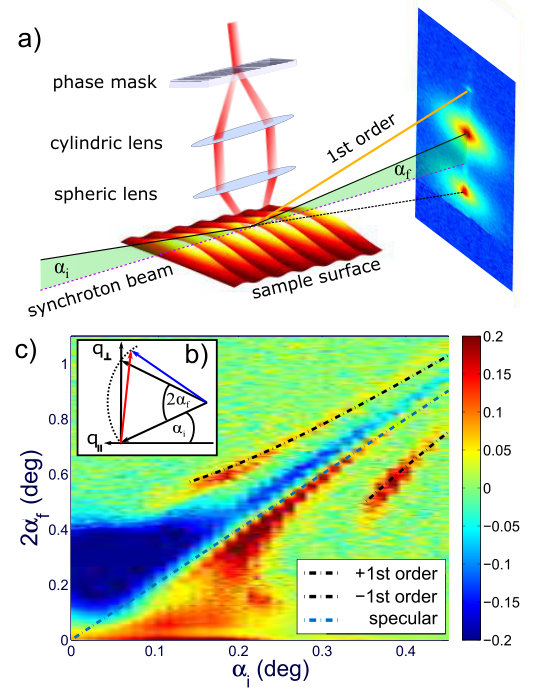 Figure 1
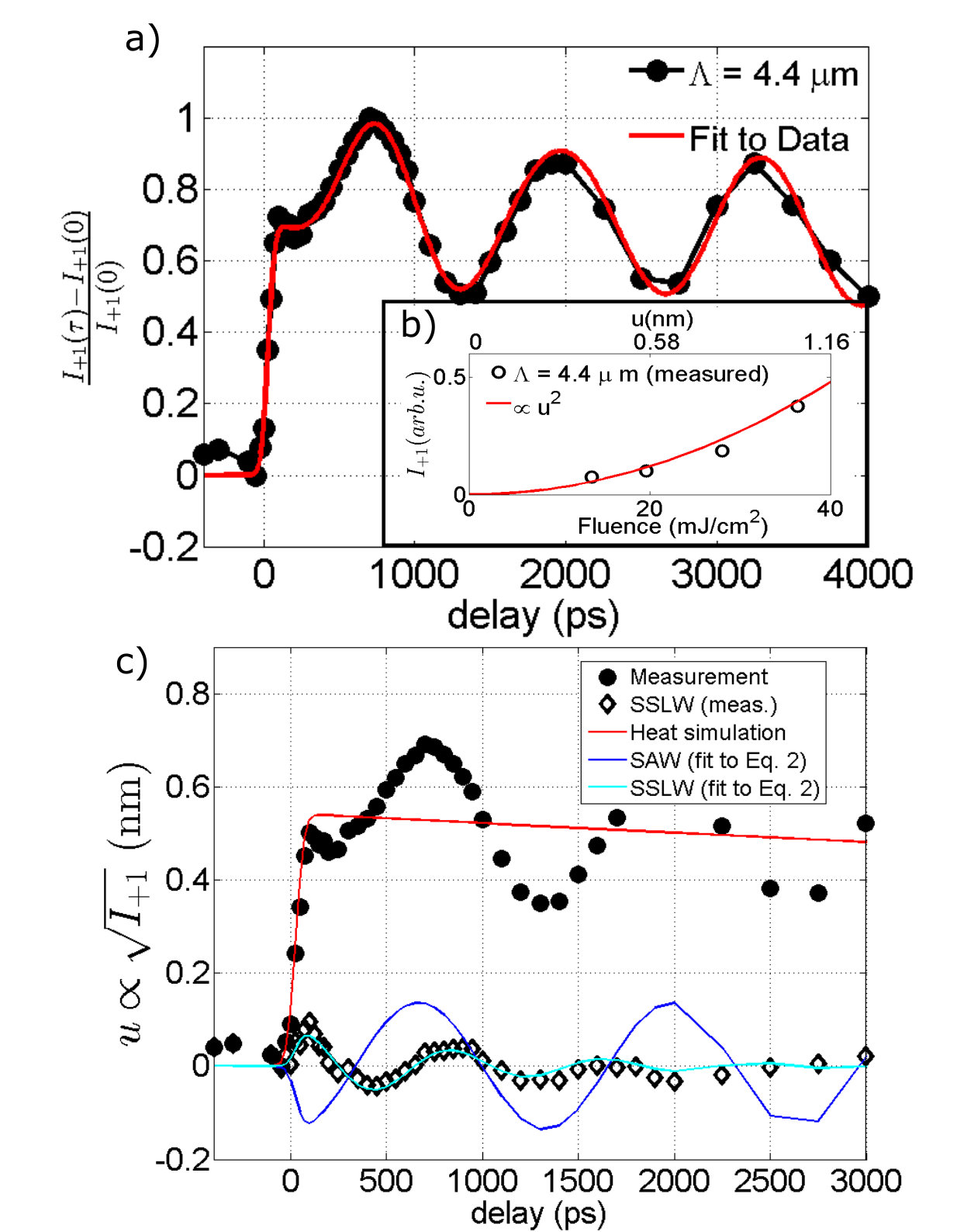 Figure 2
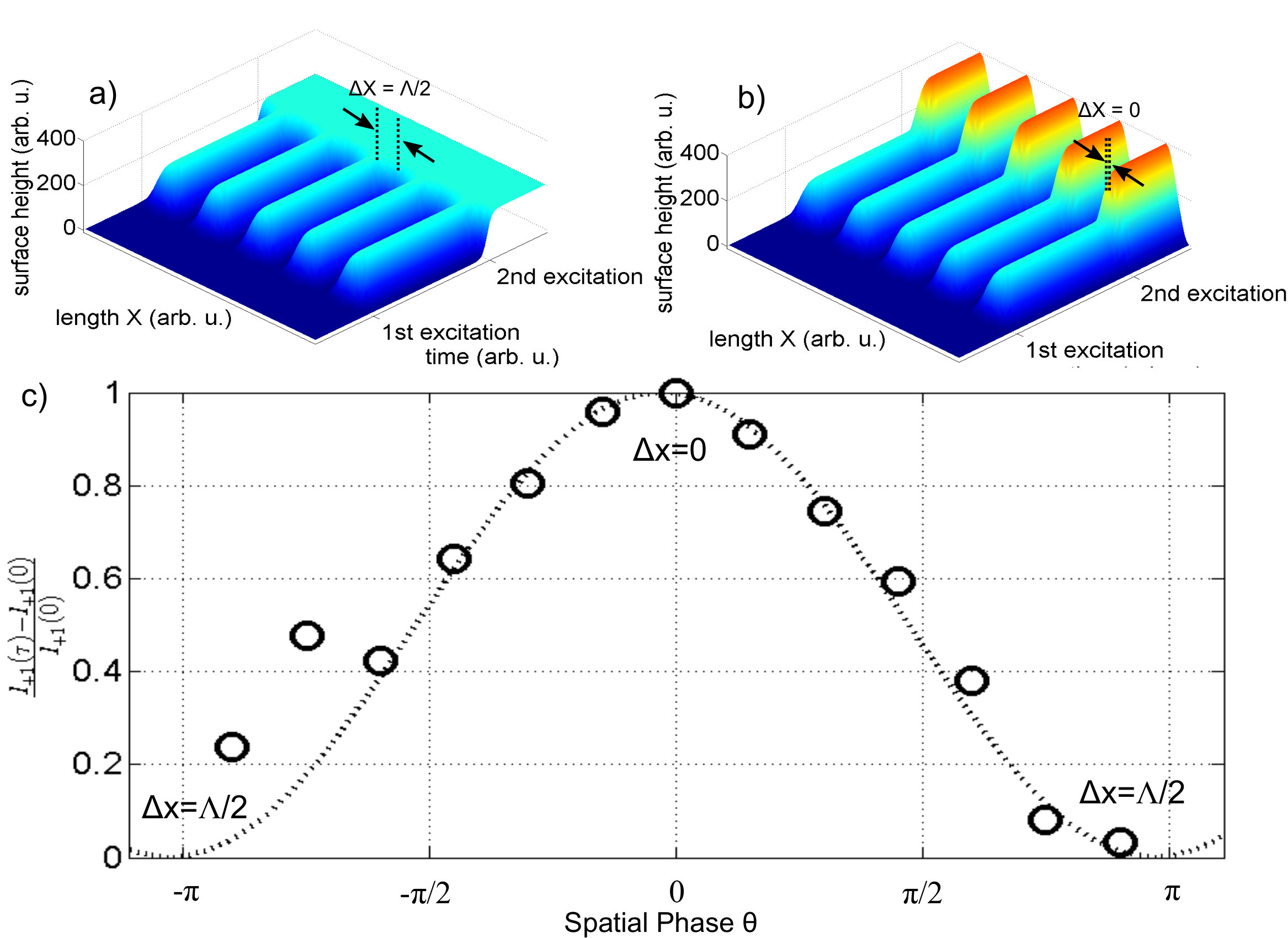 Figure 3
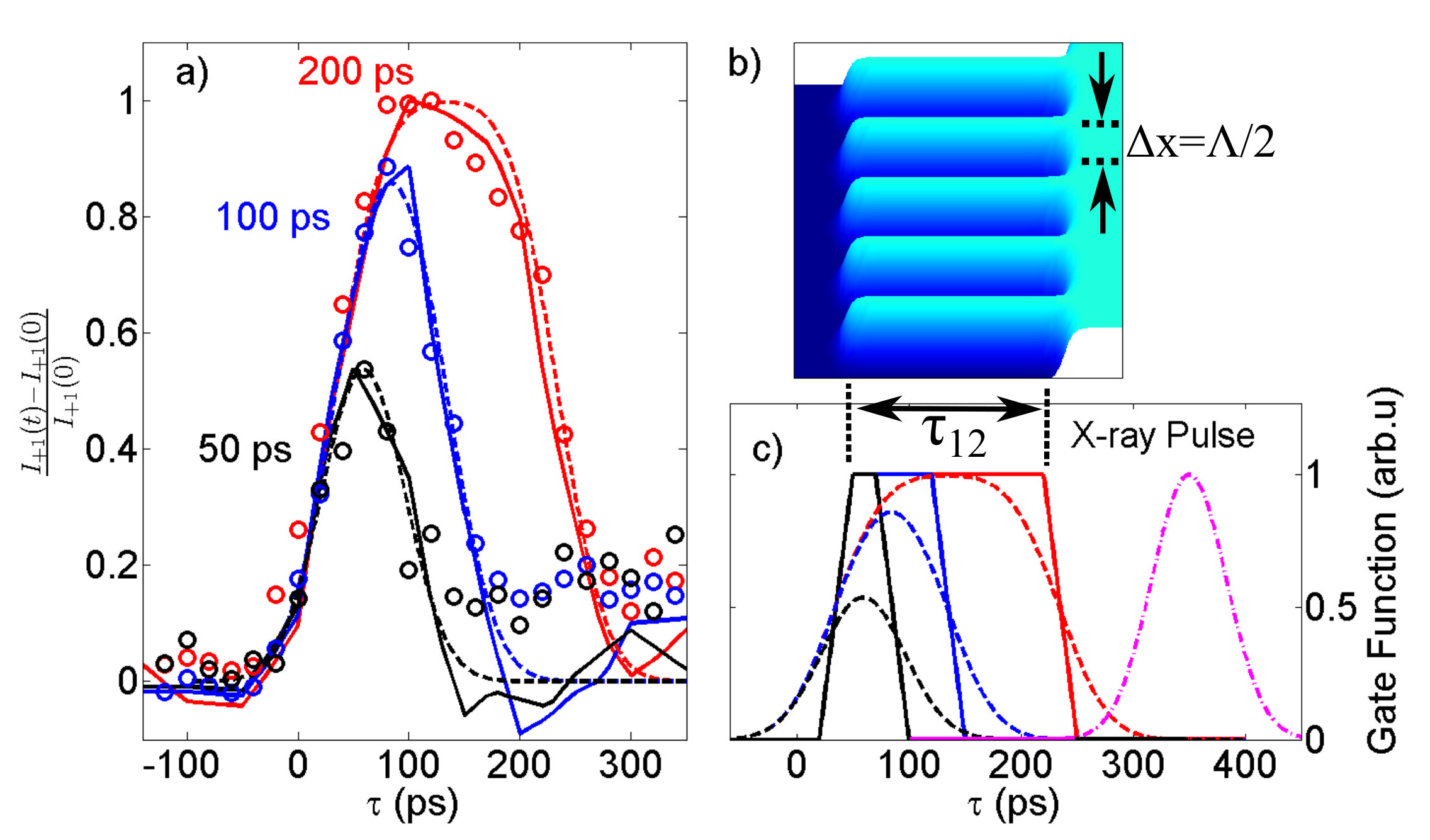 Figure 4
Peer Reviews
No public reviews on file for this paper yet. If you reviewed it on a platform where reviews are public (OpenReview, ICLR, NeurIPS, ICML), you can paste yours below so the community can read it here.
Videos
No videos yet. Explain this paper in a talk, walkthrough, or lecture? Add one.
Spatio-temporal coherent control of thermal excitations in solids
M. Sander
Institute for Physics and Astronomy, Universität Potsdam, Karl-Liebknecht-Str. 24-25, 14476 Potsdam, Germany
M. Herzog
Institute for Physics and Astronomy, Universität Potsdam, Karl-Liebknecht-Str. 24-25, 14476 Potsdam, Germany
J. E. Pudell
Institute for Physics and Astronomy, Universität Potsdam, Karl-Liebknecht-Str. 24-25, 14476 Potsdam, Germany
M. Bargheer
Institute for Physics and Astronomy, Universität Potsdam, Karl-Liebknecht-Str. 24-25, 14476 Potsdam, Germany
Helmholtz-Zentrum Berlin for Materials and Energy GmbH, Wilhelm-Conrad-Röntgen Campus, BESSY II, Albert-Einstein-Str. 15, 12489 Berlin Germany
N. Weinkauf
Institute for Solid State and Nanostructure Physics, Universität Hamburg, Jungiusstr. 11, 20355 Hamburg, Germany
M. Pedersen
European Synchrotron Radiation Facility ESRF, 71 Avenue des Martyrs 23800 Grenoble, France
G. Newby
European Synchrotron Radiation Facility ESRF, 71 Avenue des Martyrs 23800 Grenoble, France
J. Sellmann
Institute for Crystal Growth, Max-Born-Str. 2, 12489 Berlin, Germany
J. Schwarzkopf
Institute for Crystal Growth, Max-Born-Str. 2, 12489 Berlin, Germany
V. Besse
IMMM CNRS 6283, Université du Maine, 72085 Le Mans cedex, France
V. V. Temnov
IMMM CNRS 6283, Université du Maine, 72085 Le Mans cedex, France
Groupe d’Etude de la Matière Condensée (GEMaC), Université de Versailles-Saint Quentin en Yvelines, CNRS UMR 8635, Université Paris-Sacley, 45 avenue des Etats-Unis, 78035 Versailles Cedex, France
P. Gaal
Institute for Solid State and Nanostructure Physics, Universität Hamburg, Jungiusstr. 11, 20355 Hamburg, Germany
Helmholtz-Zentrum Berlin for Materials and Energy GmbH, Wilhelm-Conrad-Röntgen Campus, BESSY II, Albert-Einstein-Str. 15, 12489 Berlin Germany
Abstract
X-ray reflectivity (XRR) measurements of femtosecond laser-induced transient gratings (TG) are applied to demonstrate the spatio-temporal coherent control of thermally induced surface deformations on ultrafast timescales. Using grazing incidence x-ray diffraction we unambiguously measure the amplitude of transient surface deformations with sub-Å resolution. Understanding the dynamics of femtosecond TG excitations in terms of superposition of acoustic and thermal gratings makes it possible to develop new ways of coherent control in x-ray diffraction experiments. Being the dominant source of TG signal, the long-living thermal grating with spatial period can be canceled by a second, time-delayed TG excitation shifted by . The ultimate speed limits of such an ultrafast x-ray shutter are inferred from the detailed analysis of thermal and acoustic dynamics in TG experiments.
pacs:
68.35.Ja, 68.60.Bs, 68.35.Ja, 68.60.Bs, 61.05.C-
Ultrafast photoacousticsThomsen86PRB34 ; Ruel2015a allows for the application of strain to a crystal lattice on ultrashort time- and lengthscales. Numerous studies have investigated coherent and incoherent phonon dynamics and the coupling of lattice deformations to electronicWeiß2014a , opticalSing2014a , magnetic Scherbakov2010 ; kim2012a ; Thevenard10PRB82 or plasmonic TemnovNatureComm2013 ; TemnovJOPT2016 degrees of freedom. Strain-induced phenomena may be used to discover new material properties and develop new applications, for example the modification of optical and electronic properties in semiconductor nanostructuresWang2016a . Surface acoustic waves (SAWs) are often employed as a source of lattice strain. They can be generatedRoge2000a and controlledFaye1986a optically via the excitation of transient gratings (TGs)Vega2015a ; Shen1997a . Recently, these TG-excitations heave been used to probe heat transport in suspended thin filmsVega2016a and magneto-elastic coupling in thin nickel films Janu2016a ; Janu2016b ; ChangPRB2017 . Optical excitation of a solid generates not only coherent sound waves but also incoherent thermal strain. Coherent excitations can be controlled in amplitude and phase by series of light pulses in time domain, which is labeled temporal coherent controlBlan1997a . The main fraction of the deposited optical energy is stored in incoherent excitations of the lattice, i.e., heatherz2012b ; shay2011a which can consequently not be controlled by a temporal sequence of light pulses. This thermal lattice excitation often generates a background which makes is difficult to precisely observe the coherent acoustic signal in purely optical experiments.
In this letter we demonstrate, for the first time, the coherent control of incoherent, thermal transient gratings. We apply spatio-temporal coherent control showing that the spatial part of coherent control adds a new degree of freedom to control the amplitude and the phase of a thermally deformed surface. This is clearly a new approach that introduces the concept of spatial coherent control to the dynamics of incoherent excitations on ultrafast time scales, a phenomenon impossible to achieve with temporal coherent control only. We also demonstrate the control of a transient thermal grating on a timescale faster than the oscillation of the simultaneously excited coherent acoustic modes. Our new quantitative method allows for decomposing the coherent and incoherent dynamics in the sample by measuring the amplitude of the surface excursion with sub-Å precision and 70 ps temporal resolution. The modification of x-ray diffraction intensity from laser-generated TGs is exploited to implement an ultrafast hard x-ray shutter. Whereas our data confirm the generation of Rayleigh SAWs and Surface Skimming Longitudinal Waves (SSLW)Janu2016b , the most intriguing results deal with coherent control of the incoherent, thermal transient grating. The latter becomes possible by using a second time-delayed and spatially phase-shifted TG excitation.
The optical TG excitation and experimental setup are shown in Fig. 1 a). The sample was a 60 nm Strontium Titanate (STO) on 150 nm Strontium Ruthenate (SRO) thin film system grown on Dysprosium Scandate (DSO)Sell2014 . The energy of the pump laser is absorbed only in the SRO film, which has a penetration depth of 44 nm, i.e., shorter than the film thickness. The photoacoustic properties of these materials are well understood. In particular, we studied nanoscale heat diffusionshay2011a , thermoelastic effectsNavirian2014 and coherent phonon dynamicsherz2012c ; Shayduk2013 ; Gaal2012 ; Gaal2014 ; sand2016a in SRO, STO and similar materials. We assign a characteristic wavevector to the optically generated surface distortion with periodicity . is directed in the plane of the sample and in the diffraction plane of the incident x-ray beam. The periodic distortion results in a momentum transfer to the reflected x-ray beam . We emphasise the conceptional difference to inelastic x-ray diffraction by phononsboja2013a : instead of a specific reciprocal lattice vector , denotes the recoil momentum due to specular reflection. It is directed perpendicular to the sample surface and of continuous magnitude . The Ewald construction of the scattering vector is shown in Fig. 1 b). It reveals that the x-ray photons diffracted by the periodic surface excursion (PSE) exhibit an exit angle . Indeed, a typical detector image presented in Fig. 1 a) shows a first-order diffraction spot (orange solid line) above the specular total reflection (black solid line). Fig. 1 c) shows a differential x-ray reflectivity measurement at a pump-probe delay of = 500 ps around the critical angle of total reflection. Evaluation of the scattering condition for a spatial period of µm yields the blue and black dashed curves which are in excellent agreement with the angular position of the specular and 1st-order reflection, respectively. Having established the capability of picosecond x-ray reflectivity measurements to detect a PSE and to quantify its spatial periodicity, we now investigate the dynamics of impulsively excited PSEs. The black symbols in Fig. 2 a) represent the time-dependent intensity of the first-order diffraction peak at after TG excitation with a period of µm and an incident fluence of 19.6 mJ/cm2. Note that , i.e., only the evanescent field of the incident x-ray beam penetrates the sample and the main part of the beam is diffracted from the surfacewarren1969 . Upon TG excitation () we observe a step-like increase of the diffracted intensity. The initial step, which occurs with the temporal resolution of the experiment, is followed by a signal decrease that lasts for 300 ps. Subsequently we observe oscillations of the diffracted intensity with a period of ps.
Due to the short x-ray penetration depth in our surface diffraction experiment, we rely on kinematic theory Madsen2005a ; Nicolas2014a ; Irzhak2014 ; Roshchupkin2009 and find the following expression for the diffracted intensity from a PSE under grazing incidence below the critical angle :
[TABLE]
is the first order Bessel function and denotes the phase difference between x-ray wave fields reflected from the maximum and the minimum of the PSE. For small arguments , is proportional to the square of the time-dependent surface amplitude , as evidenced by Fig. 2 b). Hence, in the limit of small deformations, the x-ray intensity diffracted from the PSE is directly proportional to the squared surface amplitude . A quantitative comparison of experimental data with theoretical modelsHerzog2012 ; herz2012b ; Schick2014a shows that an optical excitation fluence of 1 mJ/cm2 results in a lattice strain of 0.20.05‰. We derive the calibration factor in the Supplemental MaterialSupplement . With our excitation fluence of 19.6 mJ/cm2 and a thickness of 150 nm of the absorbing SRO layer, we determine the maximum surface amplitude to 0.57 nm. The y-scale of Fig. 2 c) is an absolute scale which quantifies the surface distortion in nanometers.
Impulsive optical excitation of an absorbing medium with a spatially periodic intensity distribution results in a time-dependent surface deformation of the form: , where the the first term accounts for the thermal grating. The coherent part is the sum of SAW and SSLW contributions, respectively Janu2016b :
[TABLE]
With the diffraction model outlined above, we can interpret all components that result from the decomposition of the measured surface amplitude shown in the black dotted curve in Fig. 2 c). To model the thermal background of the surface amplitude, we numerically solve the two-dimensional heat diffusion equation for one period of the PSE with periodic boundary conditions. The initial temperature profile into the depth of the absorbing SRO thin film is determined by the optical penetration depth and decays exponentially. We choose the in-plane and out-of-plane thermal conductance of SRO and DSO in order to reproduce the slow decay of the incoherent signal contribution (see Supplemental MaterialSupplement ). By subtracting the simulated thermal background [red solid line in Fig. 2 c)] we obtain the coherent part of the time-dependent surface amplitude, which we decompose in two modes by fitting Eq. (Spatio-temporal coherent control of thermal excitations in solids) to our data. The blue solid line in Fig. 2 c) represents the amplitude of the Rayleigh-wave propagating parallel the surface. Further subtraction of the Rayleigh wave from the coherent signal reveals a strongly damped mode with a decay constant of 500 ps and a period of ps shown by the black diamonds (measurement) and the light blue solid curve (fit to data) in Fig. 2 c). We assign this feature to the Surface Skimming Longitudinal Wave (SSLW) that is generated by the optical excitation and propagates into the substrate. The results in Fig. 2 clearly demonstrate the ability to decompose the full surface dynamics into individual coherent acoustic and incoherent thermal components. In the following we adress the incoherent thermal background to fully control the surface deformation in a coherent control scheme. In particular our experiment entails controlling the lateral heat flow in the sample by a series of consecutive TG excitations with defined time delay . In addition, we control the spatial phase by adjusting the angle of incidence of the second pulse on the transmission phase mask (see Methods section). denotes the distance between the maxima of first and second TG excitation. Examples for and are shown in Fig. 3 a) and b) where the PSE is eliminated and enhanced , respectively. An experimental demonstration of this novel spatio-temporal TG coherent control is shown in Fig. 3 c), where the first-order diffracted intensity at a delay ps is plotted as a function of spatial phase . The delay between the first and second TG excitation is 200 ps. The experimental data follow the expected -dependence (dashed line) and thus evidence spatial coherent control of a thermal grating on ultrafast timescales.
Finally we demonstrate coherent control of the thermal grating along the temporal degree of freedom by keeping the spatial phase constant and by changing the time delay between the first and second TG excitation. We restrict the experiment to pump-probe delays much shorter than the period of the coherent modes, i.e., . Hence the temporal phase difference of the coherent modes launched by either TG excitation nearly vanishes, because the spatial alignment introduces a phase shift of . The total spatio-temporal phase difference results in complete destructive interference of both the thermal grating and of the coherent sound waves.
The above considerations are fully confirmed by the experimental data (symbols) shown in Fig. 4 a) which evidence an almost complete elimination of the first-order diffraction efficiency by the second TG excitation for time delays ps. In particular, all traces reveal that the transient PSE opens a temporal gate for incident x-ray photons that is spanned by the first and second TG excitation. The duration of the gate can be controlled by even to durations shorter than the incident x-ray pulse. However, the measured gate width cannot be shorter than the duration of the x-ray probe pulse Gaal2012 ; sand2016a although individual x-ray pulses are truncated by the gate. This reduces the signal strength and decreases the signal-to-noise ratio in this measurement. To prove that the recorded data shown in Fig. 4 a) evidence the coherent superposition of two time-delayed laser-induced surface gratings, we construct the corresponding gate function by summation of two replica of the measured transients for a single-TG excitation such as shown in Fig. 2 with appropriate relative sign and time delay. For a spatial phase the second TG excitation reduces the amplitude of the surface deformation, which we incorporate by a negative sign of the second surface amplitude response. We further add the relative time delay to the second transient. This approach, which is explained in more detail in the Supplemental MaterialSupplement , is solely based on experimentally measured transients and yields the solid lines in Fig. 4 a). We observe a very good agreement between the measured and the constructed gate functions. The dashed lines in Fig. 4 a) result from a convolution of gate functions shown in Fig. 4 c) with a Gaussian-shaped x-ray probe pulse. This simple model also yields very good representation of the experimental data.
In conclusion, we demonstrated full control over a thermally excited incoherent surface deformation by introducing spatio-temporal coherent control in ultrafast laser-induced TG experiments. Our new approach allows for a separation of the coherent and incoherent response of the optically generated lattice excitation. We show that the incoherent thermal grating can be controlled on a timescale significantly shorter than the oscillation period of the coherent modes, which we exploit to implement an ultrafast shutter in gracing incidence x-ray diffraction geometry. The presented concept is not limited to thin metallic transducers deposited on dielectric substrates: it will work on any optically opaque bulk sample. However, the ultimate speed of an x-ray shutter will be determined by the acoustic propagation time through the depth of the laser-generated stress. With the demonstrated outstanding sub-angstrom spatial precision and a sub-100 ps instrumental time resolution we are looking forward towards applying an ultrafast x-ray gating technique to resolve the dynamics of strain-and heat-induced phenomena in solids and nanostructures.
The authors would like to acknowledge valuable discussion with Flavio Zamponi, support during the beamtime by Michael Wulff and financial support from BMBF via 05K16GU3 and from Stratégie Internationale ”NNN-Telecom” de la Région Pays de La Loire, ANR-DFG ”PPMI-NANO” (ANR-15-CE24-0032 & DFG SE2443/2).
The reference list from the paper itself. Each links out to its DOI / PubMed record.
- 1(1) C. Thomsen, H. T. Grahn, H. J. Maris, and J. Tauc. Phys. Rev. B , 34:4129–4138, 1986.
- 2(2) Pascal Ruello and Vitalyi E. Gusev. Ultrasonics , 56:21 – 35, 2015.
- 3(3) Matthias Weiß, Jörg B. Kinzel, Florian J. R. Schülein, Michael Heigl, Daniel Rudolph, Stefanie Morkötter, Markus Döblinger, Max Bichler, Gerhard Abstreiter, Jonathan J. Finley, Gregor Koblmüller, Achim Wixforth, and Hubert J. Krenner. Nano Letters , 14(5):2256–2264, 2014.
- 4(4) David J. Singh, Qiang Xu, and Khuong P. Ong. Applied Physics Letters , 104(1):011910, 2014.
- 5(5) A. V. Scherbakov, A. S. Salasyuk, A. V. Akimov, X. Liu, M. Bombeck, C. Bruggemann, D. R. Yakovlev, V. F. Sapega, J. K. Furdyna, and M. Bayer. Phys. Rev. Lett. , 105(11):117204, SEP 9 2010.
- 6(6) Ji-Wan Kim, Mircea Vomir, and Jean-Yves Bigot. Phys. Rev. Lett. , 109:166601, Oct 2012.
- 7(7) L. Thevenard, E. Peronne, C. Gourdon, C. Testelin, M. Cubukcu, E. Charron, S. Vincent, A. Lemaitre, and B. Perrin. Phys. Rev. B , 82:104422, 2010.
- 8(8) V. V. Temnov, C. Klieber, K. A. Nelson, T. Thomay, V. Knittel, A. Leitenstorfer, D. Makarov, M. Albrecht, and R. Bratschitsch. Nature Communications , 4:1468, 2013.