A note on Hurwitz's inequality
Juli\`a Cuf\'i, Eduardo Gallego, Agust\'i Revent\'os

TL;DR
This paper refines Hurwitz's inequality for convex plane curves by establishing positive lower bounds for the isoperimetric deficit, involving geometric properties like visual angle and pedal curves, and characterizes equality cases.
Contribution
It improves Hurwitz's inequality by providing explicit positive lower bounds for the isoperimetric deficit involving geometric invariants and characterizes the equality cases.
Findings
Established lower bounds for the isoperimetric deficit involving visual angle and pedal curves.
Identified conditions under which equality in the improved inequalities holds.
Characterized extremal convex sets related to hypocycloids and their Minkowski sums.
Abstract
Given a simple closed plane curve of length enclosing a compact convex set of area , Hurwitz found an upper bound for the isoperimetric deficit, namely , where is the algebraic area enclosed by the evolute of . In this note we improve this inequality finding strictly positive lower bounds for the deficit , where . These bounds involve wether the visual angle of or the pedal curve associated to with respect to the Steiner point of or the distance between and the Steiner disk of . For each established inequality we study when equality holds. This occurs for those compact convex sets being bounded by a curve parallel to an hypocycloid of or cusps or the Minkowski sum of this kind of sets.
Click any figure to enlarge with its caption.
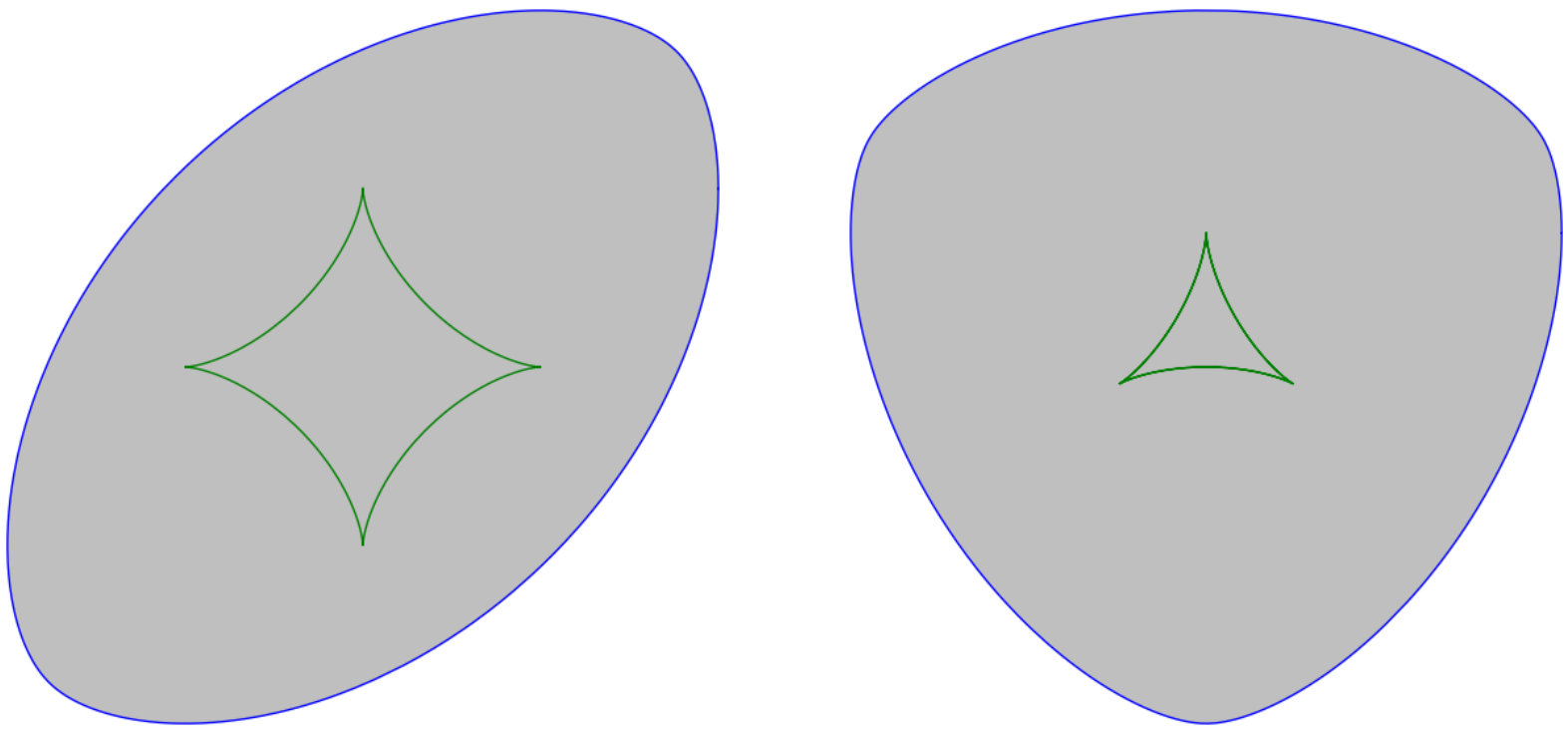 Figure 1
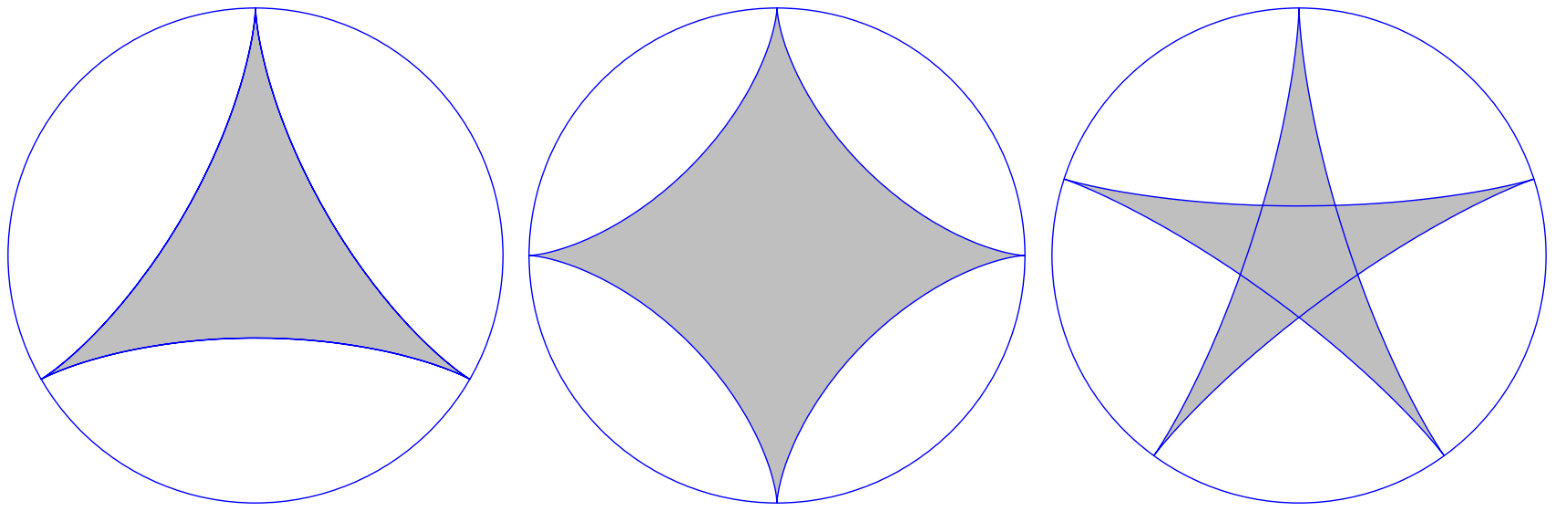 Figure 2
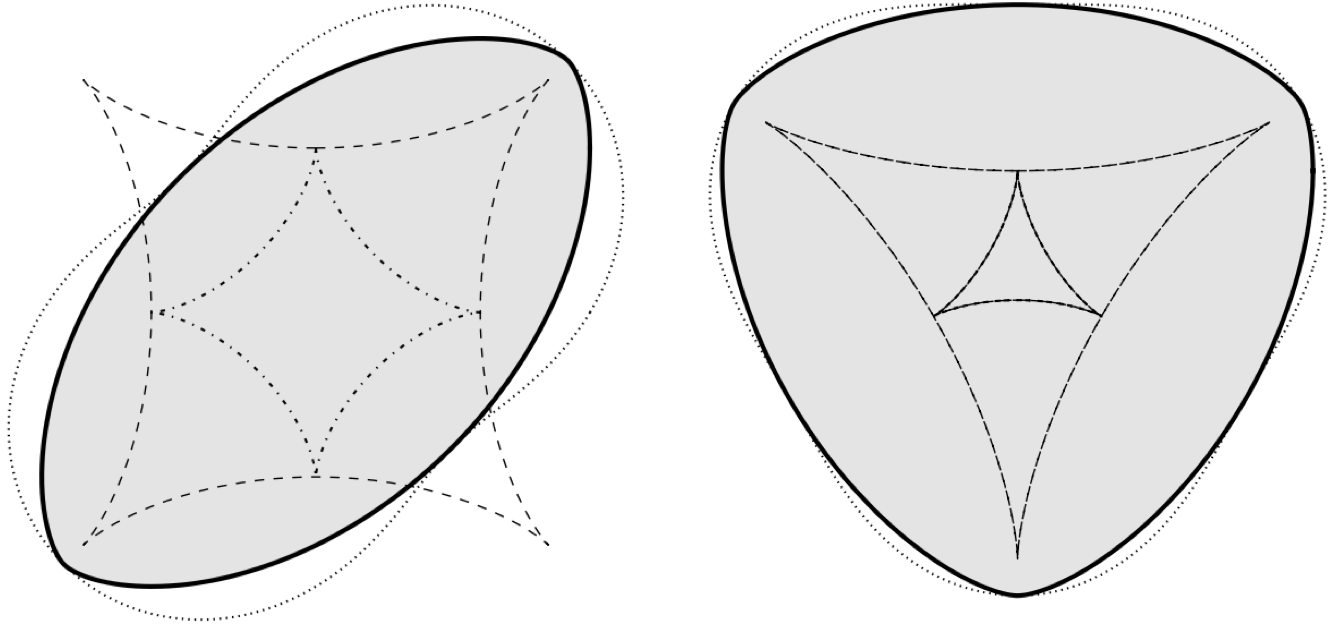 Figure 3
Peer Reviews
No public reviews on file for this paper yet. If you reviewed it on a platform where reviews are public (OpenReview, ICLR, NeurIPS, ICML), you can paste yours below so the community can read it here.
Videos
No videos yet. Explain this paper in a talk, walkthrough, or lecture? Add one.
A note on Hurwitz’s inequality
Julià Cufí
,
Eduardo Gallego*∗*
and
Agustí Reventós
Departament de Matemàtiques
Universitat Autònoma de Barcelona
08193 Bellaterra, Barcelona
Catalonia
Abstract.
Given a simple closed plane curve of length enclosing a compact convex set of area , Hurwitz found an upper bound for the isoperimetric deficit, namely , where is the algebraic area enclosed by the evolute of .
In this note we improve this inequality finding strictly positive lower bounds for the deficit , where . These bounds involve wether the visual angle of or the pedal curve associated to with respect to the Steiner point of or the distance between and the Steiner disk of .
For each established inequality we study when equality holds. This occurs for those compact convex sets being bounded by a curve parallel to an hypocycloid of , or cusps or the Minkowski sum of this kind of sets.
Key words and phrases:
Convex set, isoperimetric inequality, evolute, hypocycloid, pedal curve, visual angle
2010 Mathematics Subject Classification:
52A10, 53A04
The authors where partially supported by grants 2014SGR289 (Generalitat de Catalunya) and MTM2015-66165-P (FEDER/Mineco).
*∗*Corresponding author
1. Introduction
Let be a simple closed plane curve of length enclosing a region of area . The classical isoperimetric inequality states that
[TABLE]
with equality attained only for a circle.
In the case that bounds a convex set , Hurwitz ([5]) established a kind of reverse isoperimetric inequality, namely
[TABLE]
where is the algebraic area () enclosed by the evolute of . We recall that the evolute of a curve is the envelope of its normal lines. Moreover equality holds in (1) if and only if is a circle or a curve parallel to an astroid.
The goal of this note is to improve Hurwitz’s inequality (1) finding strictly positive lower bounds for the Hurwitz deficit , where . These bounds involve wether the visual angle of or the pedal curve associated to with respect to the Steiner point of or the distance between the support function of and the support function of the Steiner disk of .
Hurwitz’s inequality (1) can be improved without introducing new quantities for some special compact sets. For instance, if has constant width one gets
[TABLE]
as shown in Theorem 5.1.
For the general case we prove in Theorem 4.1 the inequality
[TABLE]
where is the visual angle of from , that is the angle between the tangents from to , and the area measure. For the case of constant width Theorem 5.3 asserts that
[TABLE]
In both cases the quantities in the right hand side are strictly positive except when the left hand side vanishes.
In terms of the area of the pedal curve associated to the compact strictly convex set , with respect to its Steiner point, we prove in Theorem 4.3
[TABLE]
When has constant width we obtain (Corollary 5.4)
[TABLE]
In both cases the lower bounds for the positive Hurwitz deficit are strictly positive.
For each established inequality we study when equality holds. This occurs for those compact convex sets being bounded by a curve parallel to an hypocycloid of , or cusps or the Minkowski sum of this kind of sets.
2. Preliminaries
2.1. Convex sets and support function
A set is convex if it contains the complete segment joining every two points in the set. We shall consider nonempty compact convex sets. The support function of is defined as
[TABLE]
For a unit vector the number is the signed distance of the support line to with outer normal vector from the origin. The distance is negative if and only if points into the open half-plane containing the origin (cf. [6]). We shall denote by the -periodic function obtained by evaluating on . Note that is the envelope of the one parametric family of lines given by
[TABLE]
If the support function is differentiable we can parametrize the boundary by
[TABLE]
where When is a function the radius of curvature of at the point is given by . Then, convexity is equivalent to . We say that a support function defines a strictly convex set if for every value of .
It can be seen that the length of is given by
[TABLE]
A straightforward computation shows that the area of is given by
[TABLE]
Since is -periodic, integrating by parts, we get
[TABLE]
In general, a one parameter family of lines
[TABLE]
where is a differentiable function, defines a curve in the plane. In this setting the curve is not necessarily closed nor convex. When a curve , , is defined as the envelope of a family of lines of this type, for a function of class , we say that is the generalized support function of the curve. The area with multiplicities swept by the radius vector of the curve is given by
[TABLE]
as a simple computation shows.
Let be the support function of a strictly convex set . Then defines for each real a parallel curve to . If the origin is in the interior of then is a strictly positive function. If the function corresponds to the outer parallel set at distance . When the curve given by is not necessarily convex (this is the case when , being the radius of curvature).
The Steiner formula (see for instance [6])
[TABLE]
gives the area of the -parallel set to . The discriminant of this polynomial is the isoperimetric deficit . It is always strictly positive except for a circle. Thus, for every convex set there are interior parallel sets with negative area. The minimum area value is and it is attained for the parallel set at distance . Then
[TABLE]
A special type of convex sets are those of constant width, that is those convex sets whose orthogonal projection on any direction have the same length . In terms of the support function of , constant width means that . Expanding in Fourier series
[TABLE]
it follows that
[TABLE]
so constant width is equivalent to for all even .
2.2. Hypocycloids
Consider a curve defined by the generalized support function
[TABLE]
with a positive rational number and . If we define and , then can be written in the more convenient form
[TABLE]
The envelope curve given by this generalized support function can be parametrized by
[TABLE]
Putting the curve has components
[TABLE]
Using known trigonometric identities we get
[TABLE]
This is just the parametrization of an hypocycloid obtained by rolling a circle of radius inside a circle of radius .
Writing with coprime numbers, in order to obtain a closed hypocycloid the parameter has to vary in the interval and the parameter has to vary in the interval . Note that for a generalized support function with an integer greater or equal than two, the hypocycloid is traveled twice if is odd and once if is even.
When is an integer the curve has cusps (extremal points of the curvature). For with , coprime numbers the curve has cusps. In the special case the hypocycloid is called a deltoid or Steiner curve; for it is called an astroid.
2.3. Steiner point and pedal curve
Given a compact convex set with support function the Steiner point of is defined by the vector-valued integral
[TABLE]
This functional on the space of convex sets is additive with respect to the Minkowski sum. The Steiner point is rigid motion equivariant; this means that for every rigid motion . We remark that can be considered, in the case, as the centroid with respect to the curvature measure in the boundary ; also we have that lies in the interior of (see [3]). In terms of the Fourier coefficients of given in (6) the Steiner point is
[TABLE]
The relation between the support function of a convex set and the support function of the same convex set but with respect to a new reference with origin at the point , and axes parallel to the previous and -axes, is given by
[TABLE]
Hence, taking the Steiner point as a new origin, we have
[TABLE]
We recall that the Steiner disk of is the disk whose center is the Steiner point and whose diameter is the mean width of .
The associated pedal curve to is the curve that in polar coordinates with respect to the origin is given by . Notice that this curve depends on the center point from which the support function is considered. In fact it is the geometrical locus of the orthogonal projection of the center on the tangents to the curve. The area enclosed by the pedal curve is
[TABLE]
3. Hurwitz’s inequality
For a function of period , let us introduce the Wirtinger deficit of by
[TABLE]
Note that by (4), where is the area with multiplicities enclosed by the curve defined by the generalized support function .
Recall that Wirtinger’s inequality (see [4]) states that if
[TABLE]
then
[TABLE]
In particular we always have
Now we give a relationship between the Wirtinger deficit and Hurwitz’s deficit.
Proposition 3.1**.**
Let be a compact strictly convex set of area bounded by a curve of class and length . Let be the support function of and let be the area with multiplicities enclosed by the evolute of . Then
[TABLE]
where and .
Proof.
First of all we claim that the generalized support function for the evolute of is . In fact, if the curve is parametrized by as in (2), its evolute can be parametrized by
[TABLE]
and this proves the claim. So and since we get .
Now by (5) we have that and by (4) we know that Therefore
[TABLE]
∎
Remark*.*
Let be the area enclosed by the curve with generalized support function the -periodic function . As well be the area enclosed by the evolute of this curve. The equalities and give
[TABLE]
both areas counted with multiplicities. Thus, for closed curves with positive curvature, we have
[TABLE]
where is the radius of curvature and the length of the curve. We have used the relation . Equality (7) for the case of simple closed curves that bound a strictly convex domain was proved in [5] and [2].
Next Lemma compares the Wirtinger deficit of a given function with that of its derivative. The proof follows the standard pattern of the proof of Wirtinger inequality using Fourier series.
Lemma 3.2**.**
Let a -periodic function. Then
[TABLE]
Moreover the first inequality is an equality if and only if
[TABLE]
for some constants .
Proof.
Let
[TABLE]
be the Fourier series expansion of . Using the Parseval identity we get
[TABLE]
Equality holds if and only if , if . ∎
Remark that the first inequality in Lemma 3.2 improves Wirtinger’s inequality for the derivative of -periodic functions.
For reader’s convenience we provide a simple proof of Hurwitz’s inequality based on Proposition 3.1.
Theorem 3.3** **(Hurwitz).
Let be a compact strictly convex set of area bounded by a curve of class and length and let be the area with multiplicities enclosed by the evolute of . Then
[TABLE]
Equality holds if and only if is a circle or it is a curve parallel to an astroid at distance .
Proof.
The inequality follows from Proposition 3.1 and Lemma 3.2.
Since it is
[TABLE]
and so equality in (8) is equivalent to equality in the first inequality of Lemma 3.2. This implies
[TABLE]
Taking the Steiner point as a new origin of coordinates the new support function of becomes
[TABLE]
If we get a circle. Otherwise we put , where
[TABLE]
and in terms of the support function of is
[TABLE]
with . Notice that, since , one has
From subsection 2.2 it follows that is parallel to an astroid at distance . ∎
4. Lower bounds for Hurwitz’s deficit in terms of the visual angle
We proceed now to find a lower bound for the Hurwitz deficit so improving Theorem 3.3. If
[TABLE]
is the Fourier series of the support function of a compact convex set , it is known that the quantities , for , are invariants under the group of plane motions. This invariance will be clear through formula (9) due to Hurwitz.
Consider the visual angle of from , that is the angle between the tangents from to , and let be the area measure. Writing
[TABLE]
it is proved in [5]111There is a misprint with the sign in Hurwitz’s paper. Moreover the coefficients appearing in (9) are different from those in Hurwitz’s paper because the latter correspond to the Fourier series of the curvature radius function. that
[TABLE]
being the length of the boundary of .
For instance, if one gets
[TABLE]
Moreover, this visual angle also verifies the Crofton formula (see [5])
[TABLE]
We can prove now the following result.
Theorem 4.1**.**
Let be a compact strictly convex set of area bounded by a curve of class and length . Let be the area with multiplicities enclosed by the evolute of and let be the isoperimetric deficit. Then
[TABLE]
The right hand side of this inequality is a strictly positive quantity except when in which case it also vanishes.
Proof.
As we have seen in the proof of Proposition 3.1 we have
[TABLE]
where , and is the support function of with respect to the Steiner point.
In terms of the Fourier coefficients of
[TABLE]
Observe now that, for , we have , with equality only for . Therefore
[TABLE]
Using Crofton’s formula (11), the last expression can be written as
[TABLE]
and the inequality in the theorem is proved. Moreover, the sum in (14) vanishes if and only if for as well as ∎
We study now when equality holds in Theorem 4.1.
Proposition 4.2**.**
Equality in (12) holds if and only if for the compact strictly convex set one of the following assertions holds:
- a)
* is a disk or it is bounded by a curve parallel to an astroid.*
- b)
* is bounded by a curve parallel to a Steiner curve.*
- c)
* is the Minkowski sum of compact sets of the above types.*
Proof.
It follows from the proof of Theorem 4.1 that equality in (12) holds if and only if the support function of the domain with respect to the Steiner point is of the form
[TABLE]
If we put and , we have and so is the Minkowski sum of the non necessarily convex domains and with generalized support functions and respectively.
We know, by the proof of Theorem 3.3, that is the interior of a curve parallel to an astroid or a disc. For we make the change of variable given by , where and we get with From subsection 2.2 it follows that is the interior of a Steiner curve. ∎
Relationship with the pedal curve
If is the area of and is the area enclosed by the pedal curve associated to with respect to its Steiner point we obviously have , with equality if and only if is a disk, and
[TABLE]
Theorem 4.3**.**
Let be a compact strictly convex set of area bounded by a curve of class and length . Let be the area with multiplicities enclosed by the evolute of . Let be the area enclosed by the pedal curve associated to with respect to its Steiner point. Then
[TABLE]
The right hand side of this inequality is a strictly positive quantity except when in which case it also vanishes. Equality holds for the same compact sets as in Proposition 4.2.
Proof.
[TABLE]
Moreover the right hand side vanishes if and only if for as well as
Equality holds if and only if , and the result follows as in Proposition 4.2. ∎
Relationship with the metric.
Consider now the quantity equal to the distance in , where is the unit circle, between the support function of and the support function of the Steiner disk of . We have that
[TABLE]
where being , the Fourier coefficients of the support function of with respect to its Steiner point ([3]). Clearly the quantity vanishes only when is a disk.
Theorem 4.4**.**
Let be a compact strictly convex set of area bounded by a curve of class and length . Let be the area with multiplicities of the evolute of . Then
[TABLE]
The right hand side of this inequality is a strictly positive quantity except when in which case it also vanishes. Equality holds for the same compact sets as in Proposition 4.2.
Proof.
According to (13) and (10) we have
[TABLE]
as required. Equality holds if and only if , . ∎
5. Convex sets of constant width
Although Hurwitz’s inequality (8) can not be improved for general convex domains, it is possible to obtain a stronger inequality for convex sets of constant width, that is those convex sets whose orthogonal projection in any direction have the same length. In this case we have the following result.
Theorem 5.1**.**
Let be a compact strictly convex set of constant width and area bounded by a curve of class and length . Let be the area with multiplicities of the evolute of . Then
[TABLE]
Equality holds if and only if is a circle or a curve parallel to a Steiner curve at distance .
Proof.
Let where is the support function of . As it has been said in the proof of Proposition 3.1 we have
[TABLE]
and so
[TABLE]
Since is of constant width, the Fourier series of its support function has only odd terms, see subsection 2.1. Following the proof of Lemma 3.2 for this special case one gets
[TABLE]
and hence the inequality (15) follows.
Equality in (15) holds if and only if , for . This implies
[TABLE]
Taking the Steiner point as a new origin of coordinates the new support function of becomes
[TABLE]
We make, as in the proof of Proposition 4.2, the change of variable , where Then
[TABLE]
with . Notice that because represents the support function of a strictly convex set .
From aubsection 2.2 it follows that is a circle or a curve parallel to a Steiner curve. ∎
Corollary 5.2**.**
Under the same hypothesis as in Theorem 5.1 one has
[TABLE]
where is the area enclosed by the associated pedal curve to with respect to its Steiner point.
Equality holds if and only if is a circle or a curve parallel to a Steiner curve at distance .
Proof.
By Proposition 3.2 of [1] one has
[TABLE]
This inequality combined with (15) gives the result. The characterization of equality follows from Corollary 4.4 of [1] and Theorem 5.1. ∎
Remark*.*
If is the support function of the Wigner caustic of is the curve given by the support function . In [7] the area of the Wigner caustic of is considered. If this area is counted with multiplicities it is proved that
[TABLE]
with equality if and only if is of constant width.
In the case of constant width the Wigner caustic and the interior parallel curve at distance coincide. So using Theorem 5.1 and (5) one obtains, in the case of constant width, the estimate
[TABLE]
with equality if and only if is a circle or a curve parallel to a Steiner curve at distance .
We can improve inequality (15) in terms of the visual angle.
Theorem 5.3**.**
Let be a compact strictly convex set of constant width and area bounded by a curve of class and length . Let be the area with multiplicities of the evolute of and be the isoperimetric deficit of . Then
[TABLE]
The right hand side of this inequality is a strictly positive quantity except when in which case it also vanishes.
Equality holds if and only if is a disk or it is bounded by a curve parallel to a Steiner curve or it is bounded by a curve parallel to an hypocycloid of five cusps or the Minkowski sum of compact sets of the previous types.
Proof.
If is the support function of we have (see the proof of Theorem 5.1)
[TABLE]
with and , being , the Fourier coefficients of the support function of . Recall that since has constant width we have , for even, .
Since for it follows that
[TABLE]
But
[TABLE]
So we get
[TABLE]
Now using Crofton’s formula (11), the formula (9) for and the fact that it follows that the second member of (16) can be written as
[TABLE]
The right hand side of (16) vanishes if and only if for , as well as
Moreover equality in (16) holds if and only if , . If we put and , we have and so is the Minkowski sum of the domains and with generalized support functions and respectively. As seen before is parallel to a Steiner curve. For we can write
[TABLE]
where Then corresponds to the curve with support function
[TABLE]
which by subsection 2.2 is the interior of an hypocycloid of five cusps. ∎
Also the inequalities in Theorems 4.3 and 4.4 can be improved for the case of constant width, as shown by the following corollaries.
Corollary 5.4**.**
Under the hypothesis of Theorem 4.3 and assuming moreover that has constant width one has
[TABLE]
Equality holds if and only if is a disk or it is bounded by a curve parallel to a Steiner curve.
Proof.
Just note that in the constant width case, (10) gives
[TABLE]
and apply Theorem 4.3. ∎
Remark*.*
A straightforward calculation involving the Fourier series of and shows that
[TABLE]
where is the area of the Wigner caustic counted with multiplicities, with equality in the case of constant width. So Theorem 4.3 and Corollary 5.4 give lower bounds for the Hurwitz deficit that involve .
Corollary 5.5**.**
Under the hypothesis of Theorem 4.4 and assuming that has constant width one has
[TABLE]
Moreover
[TABLE]
Equality holds in both inequalities if and only if is a disk or it is bounded by a curve parallel to a Steiner curve.
Proof.
When has constant width by (10) one has and the first inequality follows from Theorem 4.4.
Then we have
[TABLE]
which gives the second inequality.
Equalities hold if and only for . ∎
The reference list from the paper itself. Each links out to its DOI / PubMed record.
- 1[1] Cufí, J., Reventós, A., 2016. A lower bound for the isoperimetric deficit. Elemente der Mathematik 71 (4), 156–167.
- 2[2] Escudero, C. A., Reventós, A., 2007. An interesting property of the evolute. Amer. Math. Monthly 114 (7), 623–628.
- 3[3] Groemer, H., 1996. Geometric applications of Fourier series and spherical harmonics. Vol. 61 of Encyclopedia of Mathematics and its Applications. Cambridge University Press.
- 4[4] Hardy, G. H., Littlewood, J. E., Pólya, G., 1952. Inequalities. Cambridge University Press, 2d ed.
- 5[5] Hurwitz, A., 1902. Sur quelques applications géométriques des séries de Fourier. Annales scientifiques de l’É.N.S. 19 (3e série), 357–408.
- 6[6] Schneider, R., 2013. Convex bodies: the Brunn–Minkowski theory (second expanded edition). Cambridge University Press.
- 7[7] Zwierzyński, M., 2016. The improved isoperimetric inequality and the Wigner caustic of planar ovals. Journal of Mathematical Analysis and Applications 442 (2), 726–739.