Mechanics of disordered auxetic metamaterials
Maryam Hanifpour, Charlotte F. Petersen, Mikko J. Alava, Stefano, Zapperi

TL;DR
This study systematically investigates how disorder influences the mechanical properties of auxetic metamaterials, revealing that disorder preserves auxetic behavior and affects failure modes and tensile strength.
Contribution
It provides a combined theoretical and experimental analysis of disorder effects on auxetic lattices, offering guidelines for optimizing their elasticity and strength.
Findings
Disorder has minimal impact on Poisson's ratio unless lattice topology changes.
Disorder influences whether failure is brittle or ductile depending on loading direction.
Disorder affects tensile strength in brittle failure but not in ductile failure.
Abstract
Auxetic materials are of great engineering interest not only because of their fascinating negative Poisson's ratio, but also due to their increased toughness and indentation resistance. These materials are typically synthesized polyester foams with a very heterogeneous structure, but the role of disorder in auxetic behavior is not fully understood. Here, we provide a systematic theoretical and experimental investigation in to the effect of disorder on the mechanical properties of a paradigmatic auxetic lattice with a re-entrant hexagonal geometry. We show that disorder has a marginal effect on the Poisson's ratio unless the lattice topology is altered, and in all cases examined the disorder preserves the auxetic characteristics. Depending on the direction of loading applied to these disordered auxetic lattices, either brittle or ductile failure is observed. It is found that brittle…
Click any figure to enlarge with its caption.
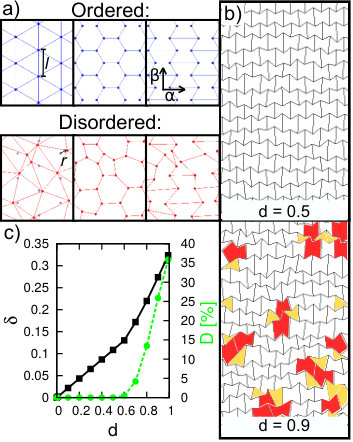 Figure 1
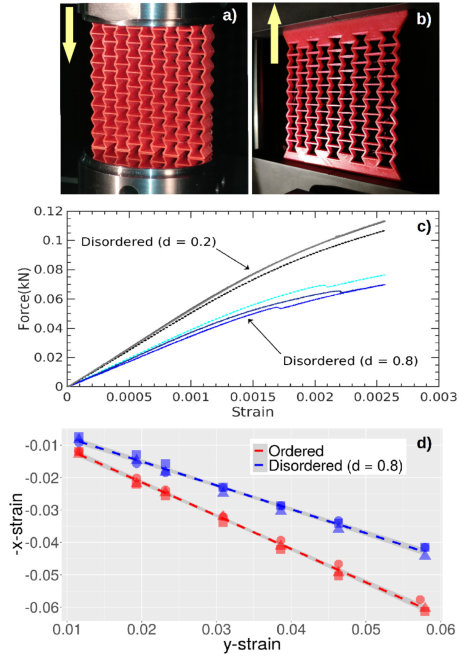 Figure 2
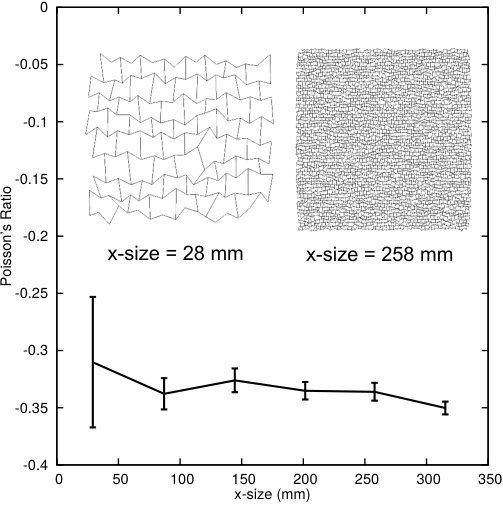 Figure 3
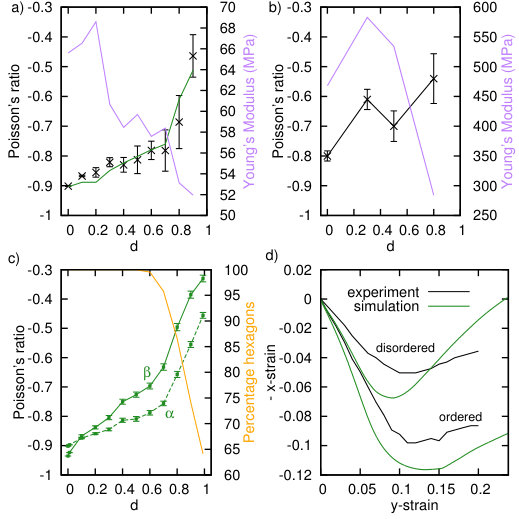 Figure 4
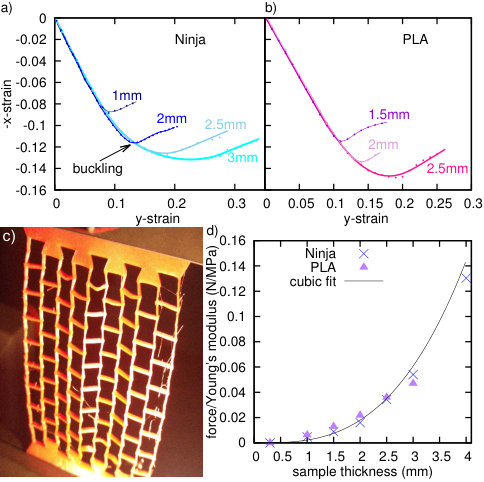 Figure 5
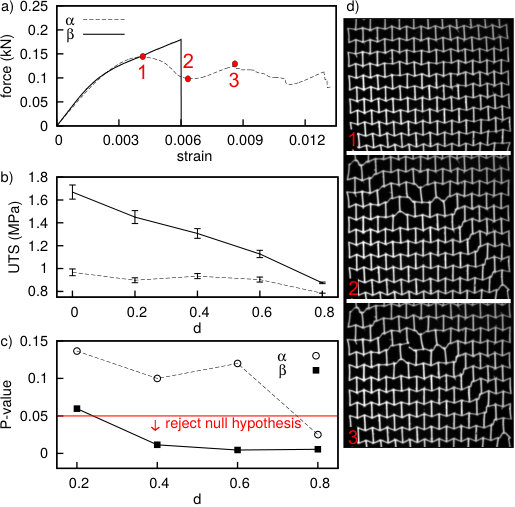 Figure 6
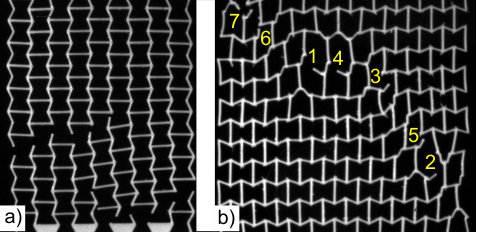 Figure 7
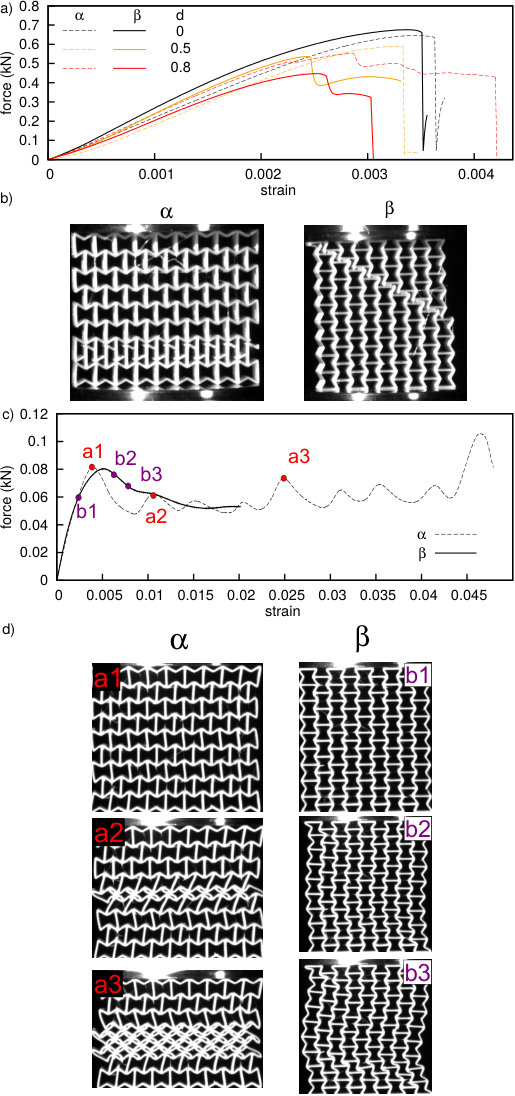 Figure 8
| Material | Load | Young’s modulus [GPa] | Poisson’s ratio |
|---|---|---|---|
| NinjaFlex | Tensile | 0.1124 | 0.344 |
| Compressive | 0.15 | 0.340 | |
| FlexPLA | Tensile | 1.743 | 0.342 |
| Compressive | 1.4879 | - | |
| Hard PLA | Tensile | 7.23 | 0.0855 |
| Compressive | 3.1613 | - |
Peer Reviews
No public reviews on file for this paper yet. If you reviewed it on a platform where reviews are public (OpenReview, ICLR, NeurIPS, ICML), you can paste yours below so the community can read it here.
Videos
No videos yet. Explain this paper in a talk, walkthrough, or lecture? Add one.
Mechanics of disordered auxetic metamaterials
Maryam Hanifpour
COMP Centre of Excellence, Department of Applied Physics, Aalto University, P.O. Box 11100, FI-00076 Aalto, Espoo, Finland
Charlotte F. Petersen
COMP Centre of Excellence, Department of Applied Physics, Aalto University, P.O. Box 11100, FI-00076 Aalto, Espoo, Finland
Mikko J. Alava
COMP Centre of Excellence, Department of Applied Physics, Aalto University, P.O. Box 11100, FI-00076 Aalto, Espoo, Finland
Stefano Zapperi
Center for Complexity and Biosystems, Department of Physics, University of Milano, Via Celoria 16, 20133 Milano, Italy
CNR - ICMATE, Via R. Cozzi 53, 20125 Milano, Italy
Department of Applied Physics, Aalto University, P.O. Box 11100, FI-00076 Aalto, Espoo, Finland
Corresponding author: [email protected]
Abstract
Auxetic materials are of great engineering interest not only because of their fascinating negative Poisson’s ratio, but also due to the possibility to increase by design the toughness and indentation resistance. The general understanding of auxetic materials comes mostly from ordered or periodic structures, while auxetic materials used in applications are typically strongly disordered. Yet, the effect of disorder in auxetics has rarely been investigated. Here, we provide a systematic theoretical and experimental study of the effect of disorder on the mechanical properties of a paradigmatic two-dimensional auxetic lattice with a re-entrant hexagonal geometry. We show that disorder has a marginal effect on the Poisson’s ratio until the point when the lattice topology becomes altered, and in all cases examined the disorder preserves the auxetic characteristics. Depending on the direction of loading applied to these disordered auxetic lattices, either brittle or ductile failure is observed. It is found that brittle failure is associated with a disorder-dependent tensile strength, whereas in ductile failure disorder does not affect strength. Our work thus provides general guidelines to design and optimize elasticity and strength of disordered auxetic metamaterials.
Introduction
Auxetic materials display the counter-intuitive property of expanding orthogonally to the stretching direction and have some improved mechanical properties, such as toughness and indentation resistance [1, 2]. This makes them potentially important for a variety of applications [3], such as bioprostheses [4, 5], acoustic damping [6, 7] and aerospace [8]. Many of these applications require specific material properties, so precise control and understanding is crucial to realising the full potential of auxetics. General mechanisms underlying this peculiar behavior have been uncovered in the design of ordered metamaterial lattices [9, 10, 11, 12], but their applicability to commercially available bulk auxetic foams, which are typically strongly disordered [13], remains unclear. Previous studies of the effect of disorder yielded a somewhat contradictory picture: Simple disordered structures designed to imitate bulk auxetics [14] include perforated sheets [15] and arrays of rigid rotating units [16, 17, 18]. In the latter case, disorder has little affect on the Poisson’s ratio. In contrast, studies on disordered versions of the re-entrant hexagonal lattice [19, 20] demonstrate that disorder can change the impact resistance [21] and decrease the magnitude of the Poisson’s ratio and yield strength significantly [22, 23].
The re-entrant hexagonal geometry is a prototypical ordered auxetic lattice, whose mechanical behaviour has been extensively studied [24, 25, 26, 27, 28]. The auxetic mechanism of this geometry is simple to understand; when tensile load is applied to the lattice, each unit is forced to unfold, thus increasing the samples size on the perpendicular axes. The geometry is auxetic in both orientations, and its properties are sensitive to the geometric cell parameters [29]. In addition to being being a good test case of a simple auxetic mechanism, the structure has potential applications to sandwich panel composites [30, 31] and textiles [32]. Through slight modifications of the structure, control of some of the material properties is possible, such as increasing the in-plane stiffness by adding additional connections [33]. Further control is gained by using the auxetic honeycomb in combination with other lattices, which allows for control of wave propagation [34]. Recently, the re-entrant hexagonal lattice has been extended to three dimensions [35, 36] and constructed with 3D printing [37, 38, 39], direct-laser-writing [40] and selective electron beam melting [41, 42].
In addition to the elastic properties, the fracture properties of auxetics are of interest because of possibility of an increased fracture toughness relative to conventional materials [1, 43]. It has been shown computationally that the ordered re-entrant hexagonal lattice exhibits improved fracture properties over an equivalent conventional hexagonal lattice [44], however little work exists on the failure of this lattice experimentally [45]. The presence of disorder has not been considered, even though normally disorder has a key role in fracture strength and toughness [46].
Here we study the elastic properties as well as the fracture mechanics of perfect (zero disorder) and disordered auxetic lattices. We introduce a methodology for adding disorder including the possibility to alter the topology of the lattice, which we find to be crucial for the auxetic behavior. In particular, the Poisson’s ratio is shown to depend very strongly on the presence of topological defects. This is remarkable in view of the increasing interest in the role of topology in mechanical metamaterials [47, 48, 49].
Methods
Lattice construction
In previous papers on disordered re-entrant hexagonal lattices [19, 20, 21, 22, 23], no standard method of adding disorder is adopted. Here, we opt for a method of randomly generating lattices which produces geometries that contain disorder, but still maintain characteristics of the re-entrant lattice. We begin by constructing a disordered triangular lattice, and convert it to a re-entrant hexagonal lattice using the process shown in Fig. 1(a). That is, starting from a triangular lattice, we take the dual lattice, which is a hexagonal lattice. Each vertex is then moved such that its most horizontal bond is lengthen by 50%. If the initial triangular lattice is ordered, this algorithm produces the ordered re-entrant hexagonal lattice. If the initial triangular lattice contains disorder, so does the resultant re-entrant hexagonal lattice. A disordered triangular lattice is generated by shifting the vertex positions of an ordered triangular lattice with edge length randomly by an amount , where and are uniformly distributed random numbers between - and . Links between the vertices are then added with a Delaunay triangulation. The parameter d controls the amount of disorder in the initial triangular lattice, which determines the structure of the disordered re-entrant lattice. This algorithm can produce infinitely many geometries for each level of disorder. All cells in the ordered lattice are hexagons, however variations in the topology are possible in the disordered geometries. Figure 1(b) shows examples of disordered lattices with different values of d, and demonstrates that the topology of the lattice is also controlled by this parameter, with only very disordered samples including topological defects. The percentage of topological defects, , is plotted against the disorder parameter in Fig. 1(c). The disorder measure used here, , is specific to the algorithm we have used to generate the disordered geometries. To further characterize the disorder, we compute the area of every cell in the lattice, , and calculate its coefficient of variation , where is the mean of . The parameter , plotted in Fig. 1(c) as a function of , could be used to quantify disorder in generic two-dimensional random lattices. Fig. 1(c) shows that in our case either or can equivalently be used to quantify disorder.
Experiment
Experimentally, samples are prepared for tension [Fig. 2(b)] and compression [Fig. 2(a)] through 3D printing. The force is applied in one of two orientations, labelled as and in Fig. 1(a). The 3D models of each geometry have been produced with a bond width of 0.4 mm. Samples are manufactured by means of 3D printing, fused deposition modeling technique (FDM). In this method structures are produced by laying down many successive thin layers of molten plastic. Each layer thickness is 0.15 mm. The printed samples are of high quality, as evident by the repeatability of mechanical measurements on reprints of the samples. The force strain curves of reprinted samples of the same geometry are plotted in Fig. 2(c), for two different geometries, and . The samples of the same geometry have very similar curves. The strain functions of both a disordered and ordered geometry have the same consistency between samples, plotted in Fig. 2(d). These results demonstrate that the fluctuations due to printing imperfections are minimal, and so variation in physical properties can be attributed to variation in the geometry.
Three different materials have been used in this work: NinjaFlex (used unless stated otherwise), which is a formulated thermoplastic polyurethane material with super elastic properties; hard PLA; and FlexPLA, which is more flexible compared to hard PLA. The measured mechanical properties of the base material are presented in Table 1. Due to the force limitations of the testing machine, the Poisson’s ratio under compression could not be measured in the solid samples of PLA. More details on material properties at http://vexmatech.com/. Hard PLA is brittle at room temperature, which allows us to study the fracture of the auxetic structures.
Prepared samples are put under tensile and compressive load by an Instron Electropuls E1000 testing machine, which applied a constant strain-rate of 0.02 mm/sec up to 1 kN force limitation. The amount of applied forced is recorded every 0.002 seconds and a gray scale camera (Dalsa Genie HM1024) records pictures every second.
Simulation
The lattices are modelled as simple elastic networks [50, 51] to capture the effects of the geometry on the Poisson’s ratio. We simulate the response of a lattice under tension using molecular dynamics, with LAMMPS [52]. A harmonic spring is placed between every vertex, with the energy of the spring described by , where is the bond length and is the equilibrium bond length. Additionally, a harmonic angular spring is placed between each of these bonds, described by , where is the bond angle and is the equilibrium bond angle. Tension was applied by fixing the velocity of the top row of vertices, while clamping the position of the bottom row of vertices. The fitting parameters were the bond () and angle () spring constants, however only their ratio affected the results, provided that the imposed tension velocity was sufficiently slow. The simulations are only performed in tension, to avoid any effects of contact between links.
To allow the links of the lattice to bend, necessary to fit the behavior of the experimental sample at high strains, each link is replaced by 4 equal length bonds in series. An angular spring is added at every vertex along the link, described by , where the angle is straight in equilibrium and the spring stiffness is . The spring constants are fit to the experimental results, and represent the material properties. The energy of the full lattice is given by where the sums are taken over all bonds , all angles and all link angles . Comparing this constitutive equation to the definition of the Young’s modulus, we can relate the spring constant used to the Young’s modulus of a single link as , where is the cross-sectional area of one link in the experimental sample. The bending modulus of our link with discrete nodes is given by , where is the equilibrium length of the full link.
The ratio of the bending and stretching modulus can be calculated for a simulated link as . When the ratio of bond and link spring constants is fit to give the best match between simulation and experimental results (), we have , where cm. This ratio can also be calculated directly from the area moment of inertia if we consider each link as a beam, . In our experimental samples, the thickness is mm and the width is mm, so . This indicates the choice of spring constants to describe this system is reasonably consistent with the beam model.
The effect of the sample size on the Poisson’s ratio is measured in simulations, and found to have no observable impact, Fig. 3.
Results
Elastic properties
We find that for all values of disorder, the Poisson’s ratio remains negative under both tension, Fig. 4(a), and compression, Fig. 4(b). The lattice dimensions used are 7.590.15 cm and 4.54.51.0 cm respectively. The tension simulation uses the parameters , and the same geometry as the experiment. Generally the Poisson’s ratio increases with disorder (the structure becomes less auxetic). Under tension, for both the simulation and experimental results, this trend becomes more evident for values of d greater than 0.7. In both cases we also plot the Young’s modulus, and find that it varies more with disorder under compression than tension.
The trend in Poisson’s ratio with disorder is further explored in simulations of larger lattice sizes (using a 1616 cell lattice rather than the 99 cell experimental size), with 100 realizations of each value of disorder, plotted in Fig. 4(c). There is no observable variation in Poisson’s ratio with sample size (Fig. 3), and thus these results can be compared with the experiment, and we expect that the experimental results can be scaled up to larger lattice sizes. Also included in this plot is the percentage of hexagons, which classifies the number of topological defects. The point where the Poisson’s ratio starts to change more rapidly with disorder corresponds to the point where the topology of the geometry first changes. Small changes in topology result in large changes in the Poisson’s ratio.
The Poisson’s ratio is the slope of the -strain vs. -strain plot, included as Fig. 4(d) for the lattice under tension. The dimensions of this lattice are 7.590.15 cm. We see that for both the disordered and ordered samples, the lattice is only auxetic initially, before a turning point where the Poisson’s ratio becomes positive. The disordered sample is auxetic over a smaller range of strains than the ordered structure. To fit this behavior after the auxetic regime in simulation, we had to allow each rib to bend in-plane. This was achieved by adding more nodes to the elastic network (see methods). The simulation parameters are and .
The change to non-auxetic behavior during the tension experiments, plotted for two materials in Fig. 5(a) and 3(b), corresponds to the sample buckling out of the plane, pictured in Fig. 5(c). The sample size used in these experiments is 7.510.5 cm. The point where the buckling starts, and so the range of strains over which the sample is auxetic, is highly dependent on the sample thickness. While buckling in systems under tension is rare [53], it has been observed when the boundaries are clamped [54], and its onset depends cubicly on sample thickness and linearly on the Young’s modulus [55]. We observed the same relationship, plotted in Fig. 5(d). While this behaviour may need to be controlled to measure the evolution of the Poisson’s ratio, in this study all reported Poisson’s ratios are measured before the onset of buckling.
Lattice failure
We investigate the fracture properties of the auxetic lattices with samples printed in hard PLA (see methods), a more brittle filament. The mechanism for fracture under tension in the two orientations we have considered is vastly different. Figure 6(a) shows that the fracture in the direction is sudden and brittle, while in the direction ductile behavior is observed, with the formation of a shear band preceding the fracture of the structure, pictured in Fig. 6(d). This can be seen clearly in the supplementary videos. Snapshots of the final fractured structure for both cases are presented in Fig. 7. Details of the fracture of the sample can be seen from the order of bond fracture. In the direction, the sample broke too rapidly for the details to be observed. The dimensions of these samples are 9.510.60.15 cm for the orientation and 7.411.30.15 cm for the orientation. The ultimate tensile strength (UTS) for both orientations is plotted in Fig. 6(b). The small error bars (from 5 reprints of each geometry) indicate that the fracture is extremely consistent amongst the repeated samples, and the print quality used is sufficiently high. Performing a t-test on the data (presented in 6(c)), we may conclude that the UTS in the samples decreases with disorder for values of d as low as 0.4, where as in the samples, no change is seen until . This high value of disorder corresponds to the point where the geometry begins to contain topological defects. The start of the change in the UTS is perhaps expected given the respective failure characteristics, brittle and ductile.
The force-strain plot of the brittle sample under compression are shown in Fig. 8(a). They show little dependence on the orientation of the lattice or the amount of disorder. All samples exhibit brittle failure, though the disordered structures fail at slightly smaller strains. In all cases fracture occurs while the sample is in the auxetic regime. The fractured structures are pictured in Fig. 8(b).
In flexible samples, compression does not result in fracture. The force strain curves of flexible samples, shown in Fig. 8(b), illustrate the difference in the response to compression in each orientation. In the direction each peak in the plot corresponds to one row of the re-entrant lattice collapsing, exhibiting similar low shear resistance to the tensile experiment. In contrast, the force strain plot in the orientation is simpler, with the lattice first compressing symmetrically in the linear regime, before long wavelength in-plane buckling is observed. Snapshots of these processes are included in Fig. 8(d). For both material types in compression, the sample has the dimensions 4.94.41.0 cm, and the sample is 4.44.91.0 cm.
Summary and conclusions
In this work we have thoroughly investigated the re-entrant hexagonal lattice structure in the presence of a controlled degree of disorder. We have measured its elastic behavior under both compression and tension, and where applicable we have confirmed the effects of the geometry with computer simulation. Unlike previous studies of disordered re-entrant hexagonal lattices [23, 22], we find the addition of disorder does not have a large effect on the Poisson’s ratio, unless the topology is modified. Disorder does not have a significant effect on the mechanism of fracture. However, the orientation of applied tension is important, where we see brittle failure in one direction but ductile failure in the other, and a notable difference in the sensitivity to disorder.
This improved understanding of the elastic and fracture properties of disordered re-entrant geometries could contribute to the rational design of auxetic metamaterials. We expect that the three-dimensional case should exhibit similar robustness to the presence of disorder with a similar qualitative change when the lattice topology is finally altered. Though the strength properties of these systems are robust against the introduction of disorder - in contrast to usual lattice models of fracture and brittle materials [46] - it would also be interesting to study in detail the relation of crack nucleation and growth to the topology of the local geometry. Further tuning or design using disorder might give rise to the possibility of the control of crack patterns and robustness.
Acknowledgments:
We thank Daniel Rayneau-Kirkhope (Aalto University) for useful comments.
Authors contributions
MH performed experiments, CP performed numerical simulations, MJA and SZ coordinated and designed the project. All the authors wrote the paper.
Additional information
Competing financial interests The authors declare no competing financial interests.
The reference list from the paper itself. Each links out to its DOI / PubMed record.
- 1[1] Greaves, G. N., Greer, A. L., Lakes, R. S. & Rouxel, T. Poisson’s ratio and modern materials. Nat. Mater. 10 , 823–37 (2011).
- 2[2] Yang, W., Li, Z. M., Shi, W., Xie, B. H. & Yang, M. B. On auxetic materials. J. Mater. Sci. 39 , 3269–3279 (2004).
- 3[3] Evans, K. E. & Alderson, A. Auxetic Materials : Functional Materials and Structures from Lateral Thinking! Adv. Mater. 12 , 617–628 (2000).
- 4[4] Scarpa, F. Auxetic materials for bioprostheses. IEEE Signal Process. Mag. 25 , 128–126 (2008).
- 5[5] Caddock, B. D. & Evans, K. E. Negative poisson ratios and strain-dependent mechanical properties in arterial prostheses. Biomaterials 16 , 1109–1115 (1995).
- 6[6] Scarpa, F. & Smith, F. C. Passive and mr fluid-coated auxetic pu foam–mechanical, acoustic, and electromagnetic properties. J. Intell. Mater. Syst. Struct. 15 , 973–979 (2004).
- 7[7] Chekkal, I. et al. Vibro-acoustic properties of auxetic open cell foam: model and experimental results. Acta Acust. Acust. 96 , 266–274 (2010).
- 8[8] Alderson, A. & Alderson, K. L. Auxetic materials. Proc. Inst. Mech. Eng., Part G 221 , 565–575 (2007).