Collective flow in 2.76 A TeV and 5.02 A TeV Pb+Pb collisions
Wenbin Zhao, Hao-jie Xu, Huichao Song (Peking U.)

TL;DR
This paper uses a hybrid model to analyze and predict flow observables in Pb+Pb collisions at 2.76 and 5.02 A TeV, providing insights into the quark-gluon plasma properties.
Contribution
It introduces a comprehensive modeling approach that accurately describes existing data and predicts new flow observables at higher collision energies.
Findings
Model reproduces flow harmonics at 2.76 A TeV
Model matches flow data at 5.02 A TeV
Many observables are similar across energies
Abstract
In this paper, we study and predict flow observables in 2.76 A TeV and 5.02 A TeV Pb +Pb collisions, using the iEBE-VISHNU hybrid model with TRENto and AMPT initial conditions and with different forms of the QGP transport coefficients. With properly chosen and tuned parameter sets, our model calculations can nicely describe various flow observables in 2.76 A TeV Pb +Pb collisions, as well as the measured flow harmonics of all charged hadrons in 5.02 A TeV Pb +Pb collisions. We also predict other flow observables, including of identified particles, event-by-event distributions, event-plane correlations, (Normalized) Symmetric Cumulants, non-linear response coefficients and -dependent factorization ratios, in 5.02 A TeV Pb+Pb collisions. We find many of these observables remain approximately the same values as the ones in 2.76 A TeV Pb+Pb collisions. Our theoretical…
Click any figure to enlarge with its caption.
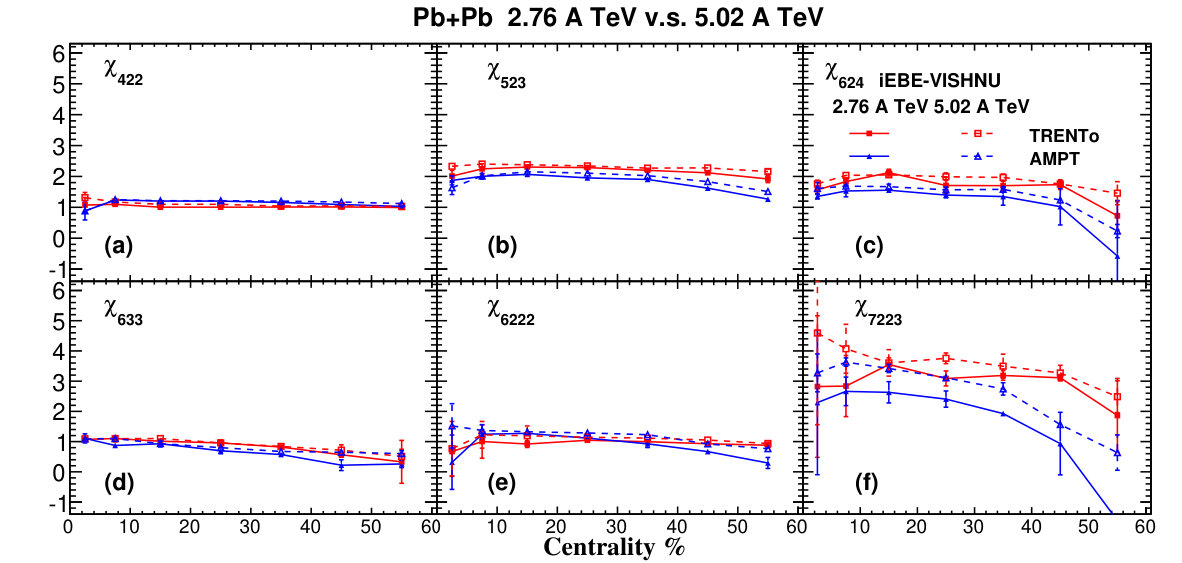 Figure 1
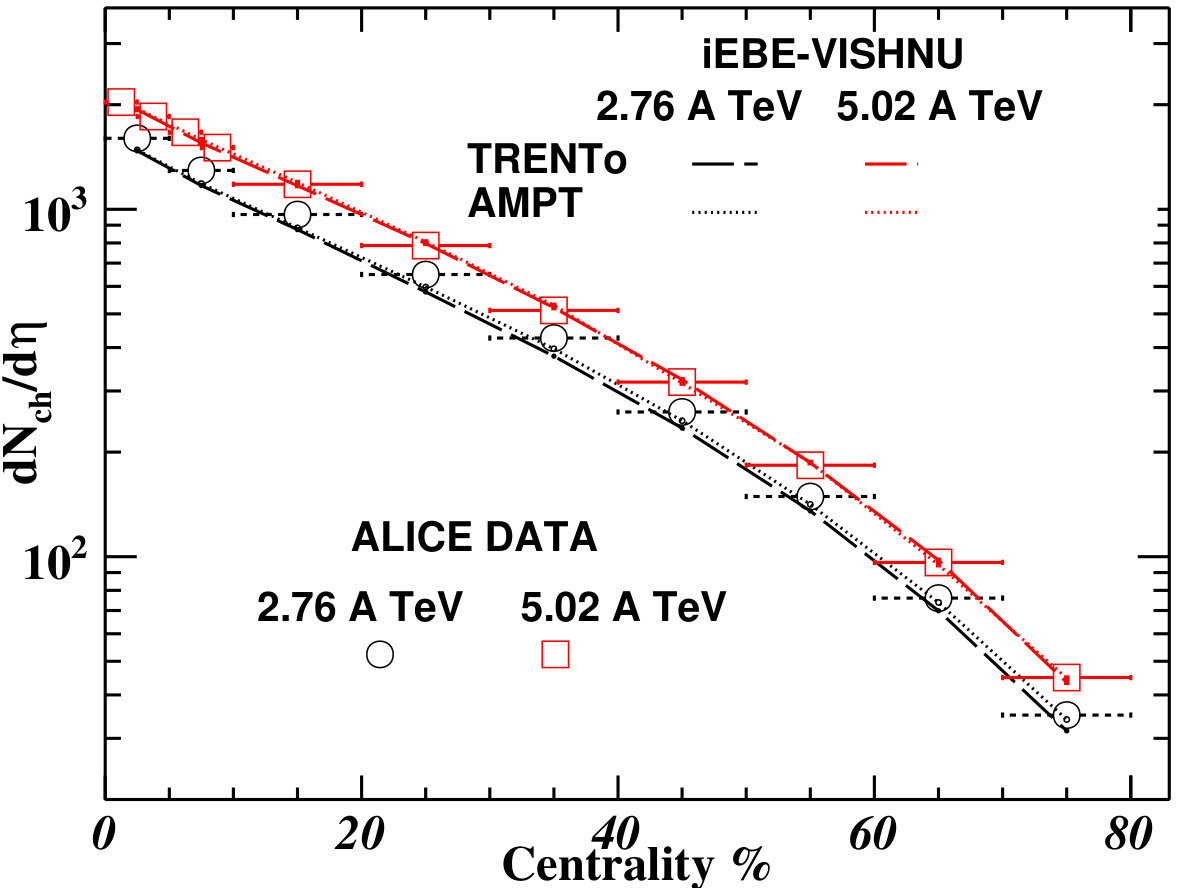 Figure 2
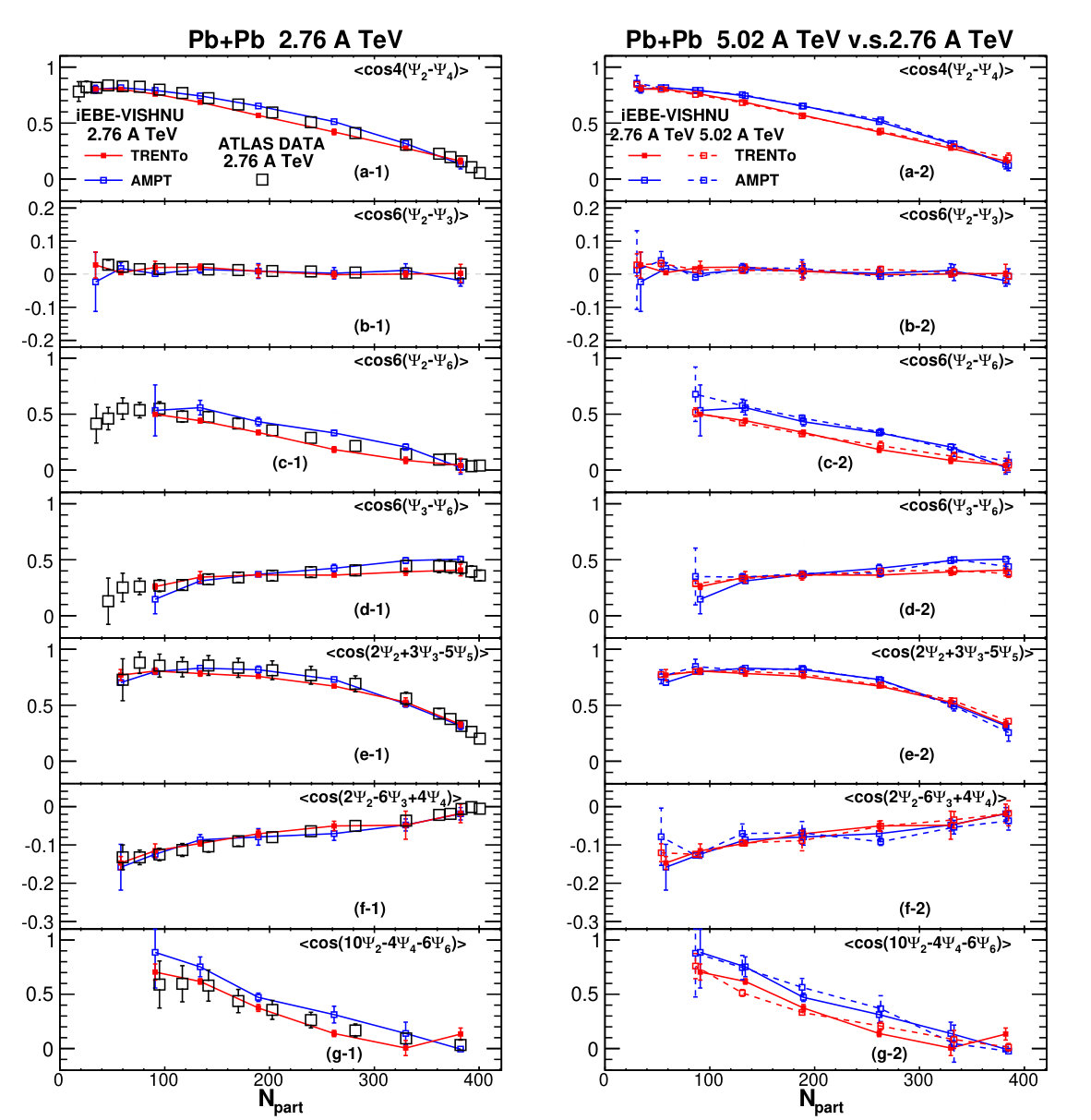 Figure 3
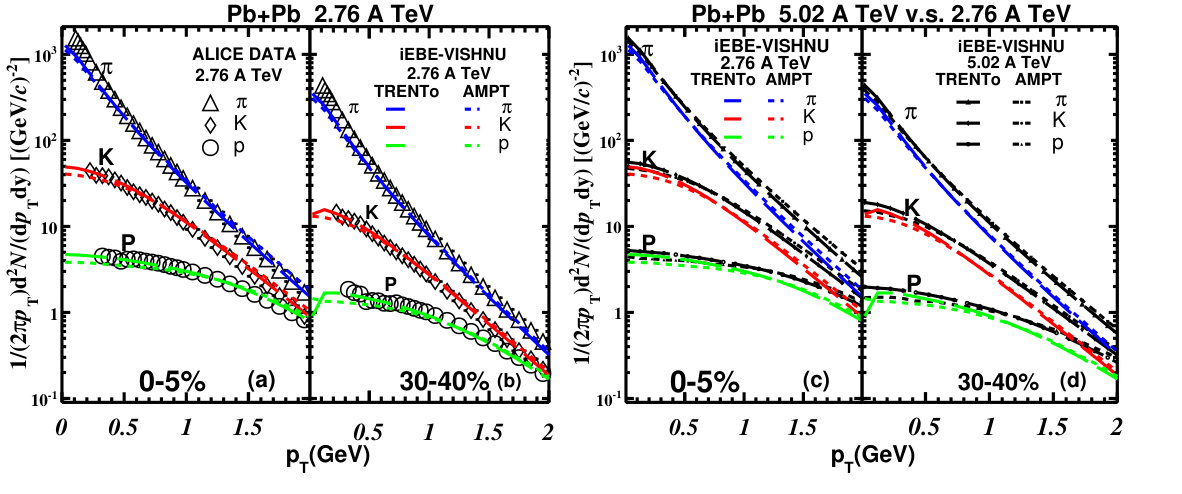 Figure 4
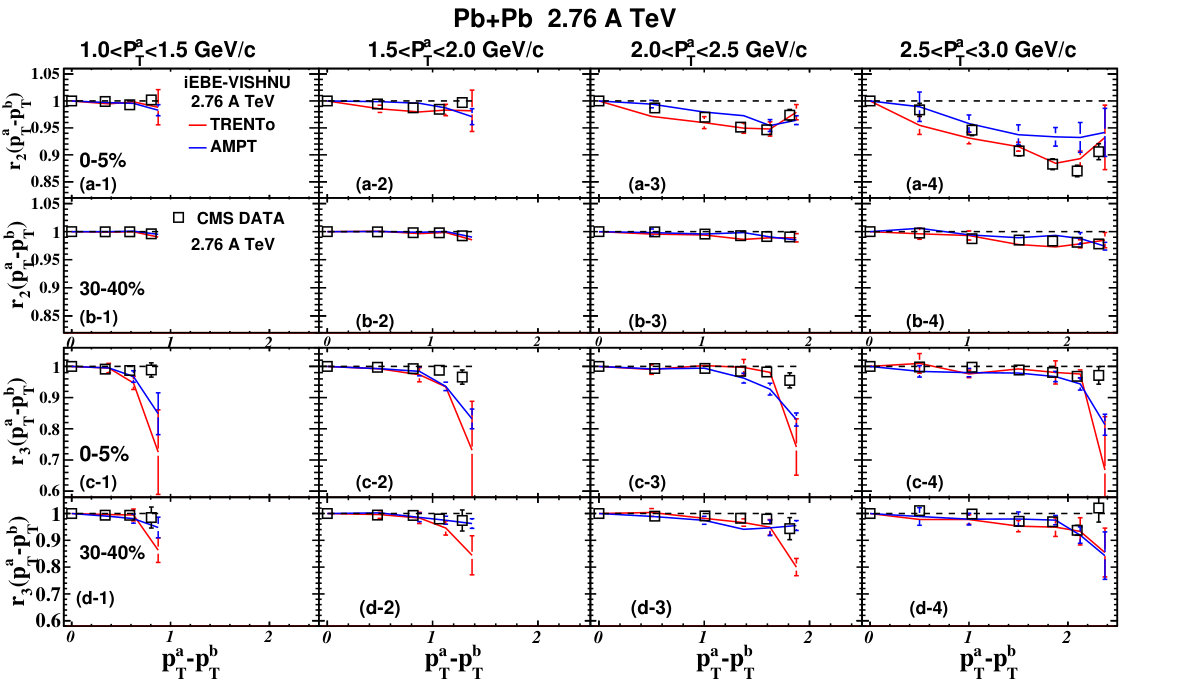 Figure 5
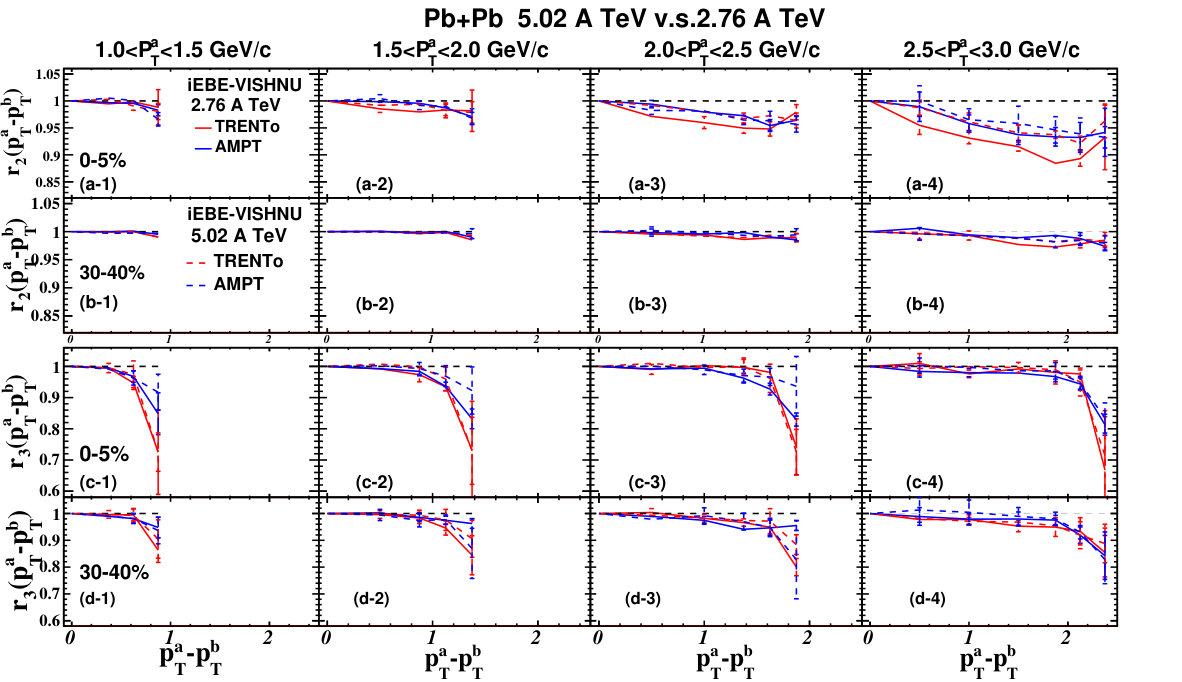 Figure 6
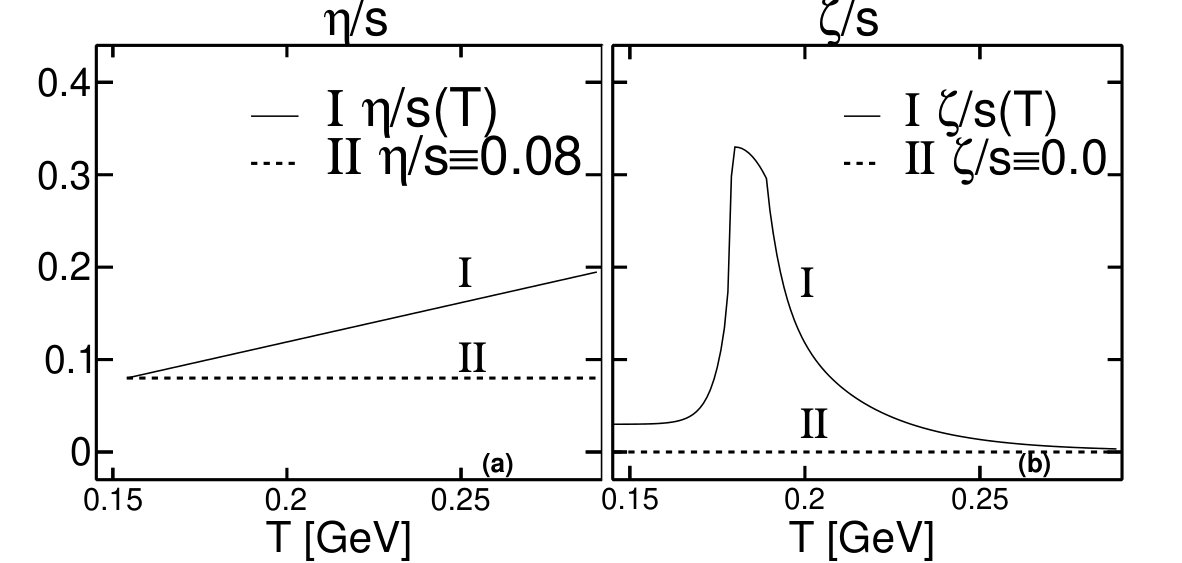 Figure 7
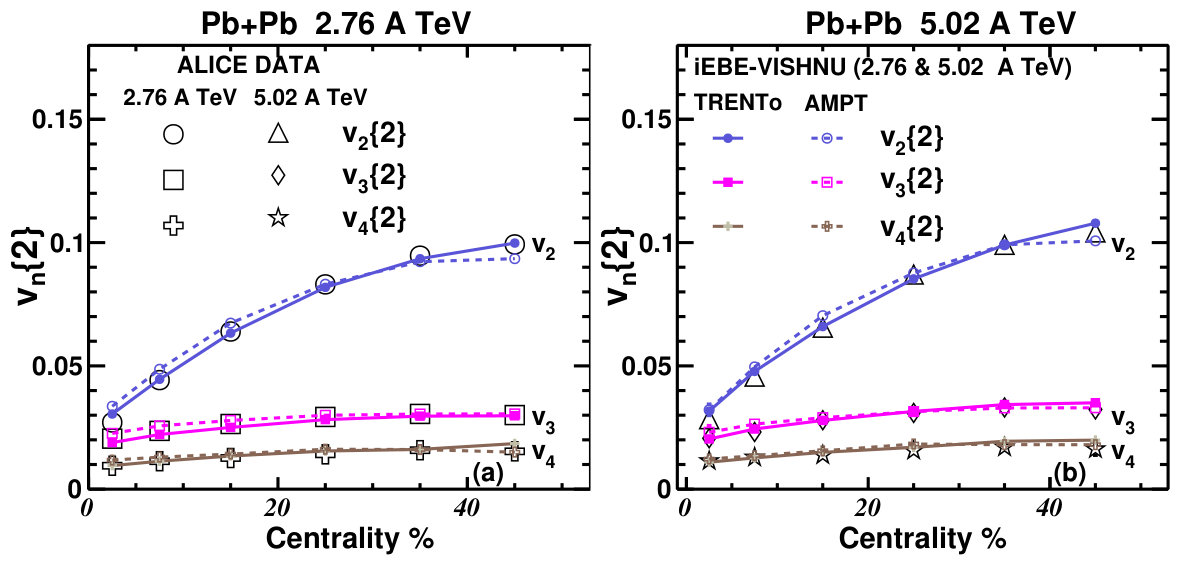 Figure 8
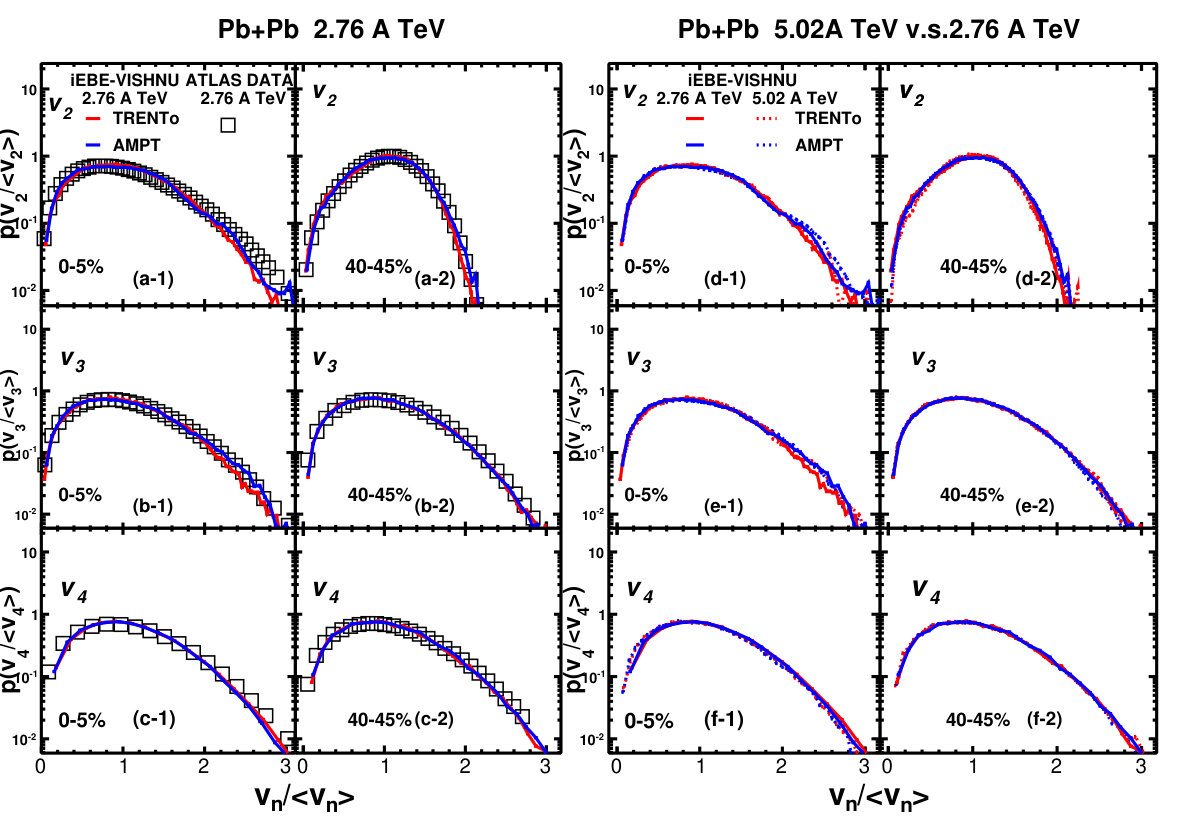 Figure 9
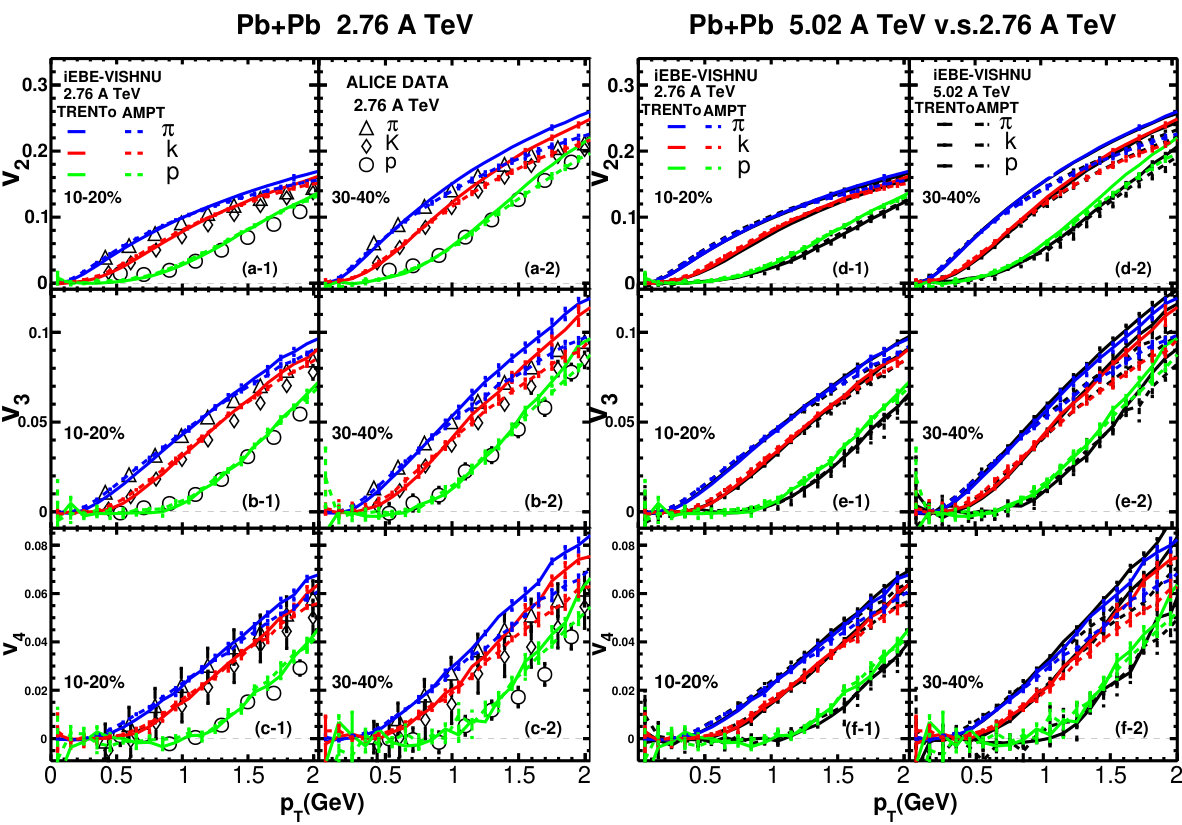 Figure 10
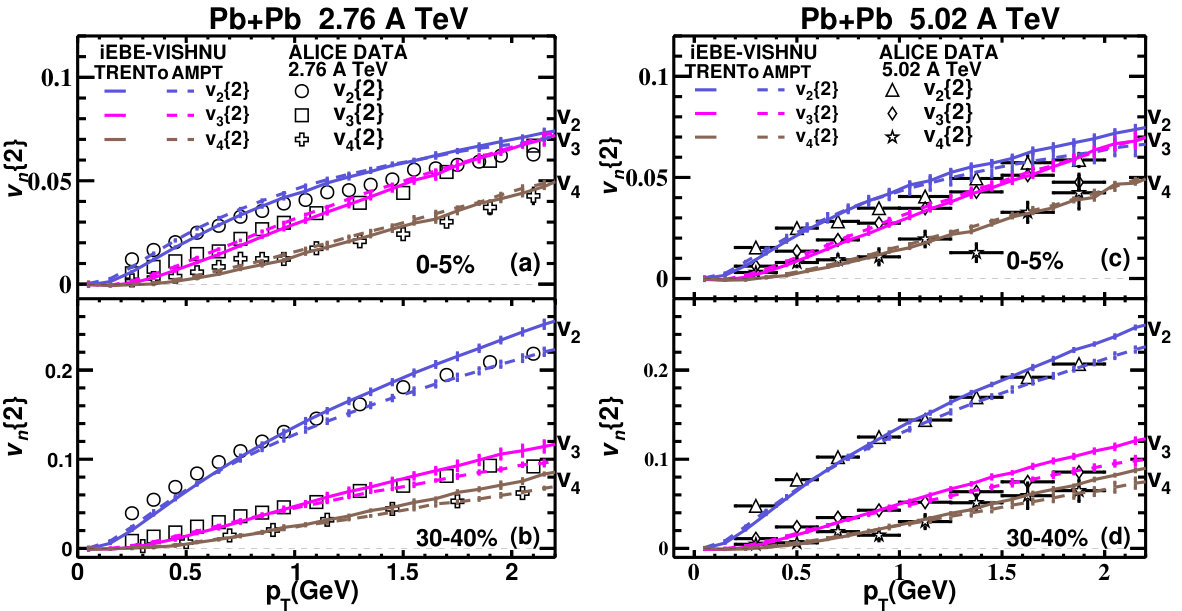 Figure 11
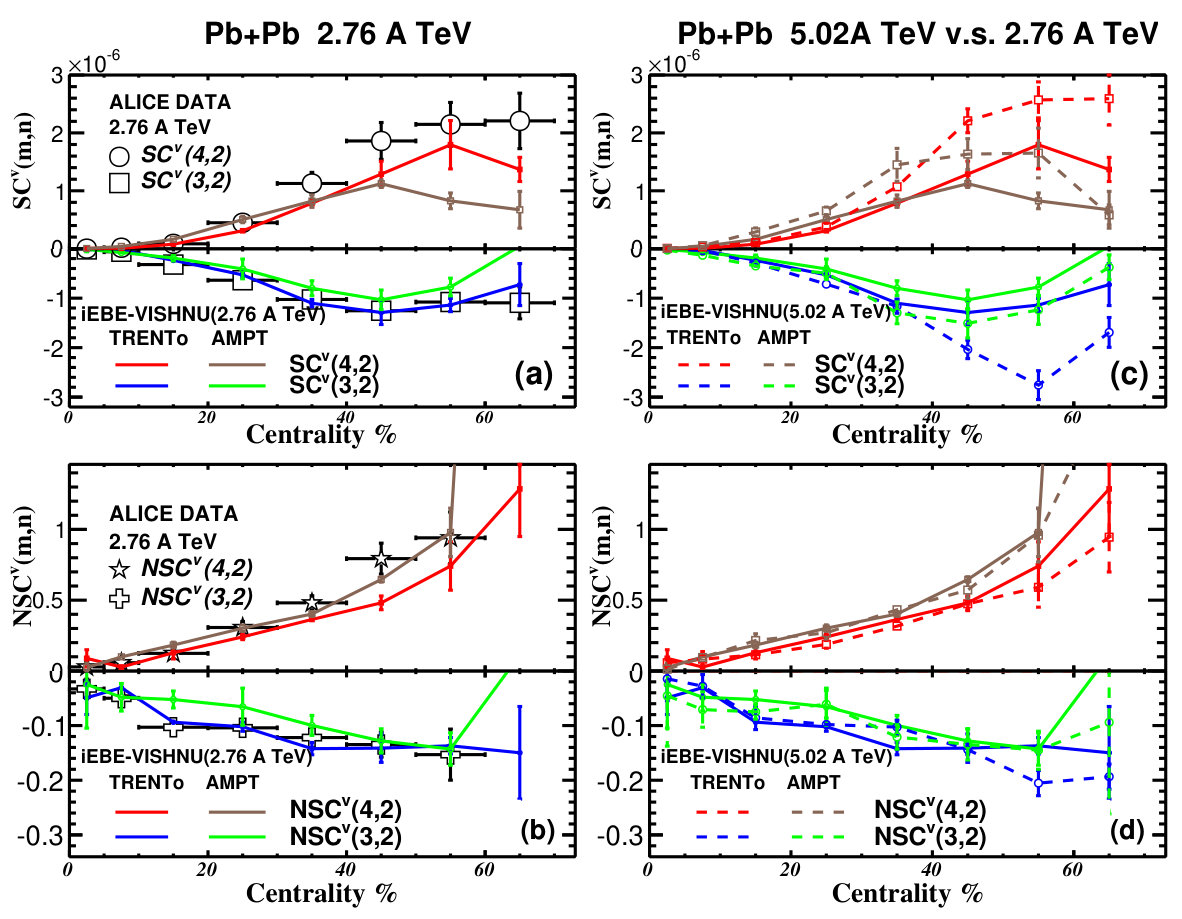 Figure 12
Peer Reviews
No public reviews on file for this paper yet. If you reviewed it on a platform where reviews are public (OpenReview, ICLR, NeurIPS, ICML), you can paste yours below so the community can read it here.
Videos
No videos yet. Explain this paper in a talk, walkthrough, or lecture? Add one.
∎
11institutetext: Department of Physics and State Key Laboratory of Nuclear Physics and Technology, Peking University, Beijing 100871, China 22institutetext: Collaborative Innovation Center of Quantum Matter, Beijing 100871, China 33institutetext: Center for High Energy Physics, Peking University, Beijing 100871, China
\thankstext
e1e-mail: [email protected]
Collective flow in 2.76 A TeV and 5.02 A TeV Pb+Pb collisions
Wenbin Zhao\thanksrefaddr1
Hao-jie Xu\thanksrefaddr1
Huichao Song\thanksrefaddr1,addr2,addr3,e1
Abstract
In this paper, we study and predict flow observables in 2.76 A TeV and 5.02 A TeV Pb +Pb collisions, using the iEBE-VISHNU hybrid model with TRENTo and AMPT initial conditions and with different forms of the QGP transport coefficients. With properly chosen and tuned parameter sets, our model calculations can nicely describe various flow observables in 2.76 A TeV Pb +Pb collisions, as well as the measured flow harmonics of all charged hadrons in 5.02 A TeV Pb +Pb collisions. We also predict other flow observables, including of identified particles, event-by-event distributions, event-plane correlations, (Normalized) Symmetric Cumulants, non-linear response coefficients and -dependent factorization ratios, in 5.02 A TeV Pb+Pb collisions. We find many of these observables remain approximately the same values as the ones in 2.76 A TeV Pb+Pb collisions. Our theoretical studies and predictions could shed light to the experimental investigations in the near future.
1 Introduction
At extreme high temperature and density, the nuclear matter can experience a phase transition and form the quark-gluon plasma (QGP). The main goals of the relativistic heavy-ion collisions at Relativistic Heavy Ion Collider (RHIC) and the Large Hadron Collider (LHC) are to create the QGP and to explore its properties Rev-Arsene:2004fa ; Gyulassy:2004vg ; Muller:2006ee . Since the running of RHIC in 2000, strong evidences have been gradually accumulated for the creation of the QGP, including jet quenching, strong collective flow and the valance quark scaling of the elliptic flow Rev-Arsene:2004fa ; Gyulassy:2004vg ; Muller:2006ee . Hydrodynamics and hybrid models are successful tools to simulate the collective expansion of the QGP fireball and to study various flow observable at RHIC and the LHC Teaney:2009qa ; Romatschke:2009im ; Huovinen:2013wma ; Heinz:2013th ; Gale:2013da ; Song:2017wtw . The past research has revealed that the created QGP fireballs fluctuate event-by-event and behave like nearly perfect liquids with very small specific shear viscosity Heinz:2013th ; Gale:2013da ; Song:2017wtw ; Song:2013gia ; Luzum:2013yya ; Jia:2014jca .
In the past few years, various flow observables have been extensively measured and studied in 2.76 A TeV Pb+Pb collisions, including the integrated and differential flow harmonics ALICE:2011ab ; ATLAS:2012at ; Alver:2010dn ; Song:2011qa ; Song:2013qma ; Xu:2016hmp ; Gale:2012rq , the event-by-event distributions Gale:2012rq ; Aad:2013xma ; Yan:2014afa ; Zhou:2015eya , the event-plane correlations Aad:2014fla ; Qiu:2012uy ; Bhalerao:2013ina ; Teaney:2013dta ; Bhalerao:2014xra , and the correlations between different flow harmonics (Symmetric Cumulants) Bhalerao:2014xra ; Aad:2015lwa ; ALICE:2016kpq ; Niemi:2015qia ; Giacalone:2016afq ; Zhu:2016puf ; Qian:2016pau , the or -dependent de-correlations of the flow vector Heinz:2013bua ; Gardim:2012im ; Khachatryan:2015oea ; Zhou:2014bba ; Pang:2014pxa ; Pang:2015zrq ; Xiao:2015dma ; Ma:2016fve and etc.. Many of these flow observables reflect the information on the event-by-event initial state fluctuations and the non-linear evolution of the system, which provide constraints for the initial condition models and the QGP transport coefficients. For example, it was found that the event-by-even distributions mostly follow the the event-by-even distributions of the initial state for n=2 and 3, which does not favor the traditional MC-Glauber and MC-KLN models with nucleon position fluctuations Gale:2012rq ; Aad:2013xma . Based on eikonal entropy deposition via a reduced thickness function, Moreland and his collaborators constructed a parametric TRENTo model that could match various initial conditions with tunable parameters Moreland:2014oya . Using TRENTo initial conditions, the Duke and OSU group has performed massive data simulations of iEBE-VISHNU hybrid model and systematically evaluated the measured multiplicity, mean and integrated in 2.76 A TeV Pb+Pb collisions. The extracted temperature dependent specific shear viscosity is an approximately linear function with a minimum value close to the KSS bound near Bernhard:2016tnd . The early hydrodynamic or hybrid model simulations, using either IP-Glasma Gale:2012rq , or AMPT Xu:2016hmp or EKRT initial conditions Niemi:2015qia , can also nicely fit the integrated and differential flow harmonics with a constant or temperature dependent , close to the KSS bound near . In fact, the flow harmonics are not sensitive to the details of the initial condition models as along as the balanced initial eccentricities can be produced with some tunable parameters. Other flow measurements, e.g., the event-plane correlations, Symmetric Cumulants, non-linear response coefficients, the de-correlation of the flow vector and etc., could reveal more details on initial state fluctuations and the non-linear hydrodynamic response Aad:2014fla ; Qiu:2012uy ; Bhalerao:2013ina ; Teaney:2013dta ; Bhalerao:2014xra ; Aad:2015lwa ; ALICE:2016kpq ; Niemi:2015qia ; Giacalone:2016afq ; Zhu:2016puf ; Qian:2016pau ; Heinz:2013bua ; Gardim:2012im ; Khachatryan:2015oea ; Zhou:2014bba ; Pang:2014pxa ; Pang:2015zrq ; Xiao:2015dma ; Ma:2016fve . A systematic study of these flow observables will help us to test the model calculations and the extracted QGP viscosity as well as to further evaluate and constrain the initial condition models.
Recently, the ALICE collaboration has measured the integrated and differential flow harmonics of all charged hadrons in 5.02 A TeV Pb +Pb collisions Adam:2016izf . It was found, with the collision energies raised from 2.76 A TeV to 5.02 A TeV, , and slightly increase with the increase of average transverse momentum, as predicted by early hydrodynamic calculations Niemi:2015voa ; Noronha-Hostler:2015uye . In this paper, we will implement iEBE-VIHSNU hybrid model with TRENTo and AMPT initial conditions to study and predict various flow observable in 2.76 A TeV and 5.02 A TeV Pb+Pb. Instead of predicting the flow harmonics of all charged hadrons at 5.02 A TeV (which has been done in Niemi:2015voa ; Noronha-Hostler:2015uye ), we use these available data to fix the free parameters in the iEBE-VIHSNU simulations and then make predictions for other flow observables, including the differential flow harmonics of identified hadrons, the event-by-event distributions, the event-plane correlations, the Symmetric Cumulants, non-linear response coefficients and the -dependent factorization ratios. We have noticed that the MC-grill group also predicted various flow observables in 5.02 A TeV Pb+Pb collisions, using MUSIC simulations with the IP-Glasma initial conditions McDonald:2016vlt . Compared with their calculations McDonald:2016vlt and other early investigations Niemi:2015voa ; Noronha-Hostler:2015uye , our predictions are more complete, which are also on time and can be measured in the near future. For example, the Symmetric cumulants and non-linear response coefficients in 5.02 A TeV Pb+Pb collisions are firstly predicted in this paper, which have not been done elsewhere as far as we know. Secondly, the parameters in iEBE-VIHSNU are fine tuned to fit the published soft hadron data, which give more reliable predictions for these un-measured flow observables. For example, our descriptions of of all charged hadrons are better than the ones in McDonald:2016vlt . Correspondingly, the predicted flow harmonics of identified hadrons are also more reliable. Besides, it is worthwhile to investigate the same flow observables using the hydrodynamic calculations with different initial conditions, which could help us to understand the details of the initial state fluctuations and may help us to locate some certain flow observables to further constrains the initial conditions.
This paper is organized as the following: Sec. 2 introduces the iEBE-VISNU hybrid model and the set-ups of calculations with TRENTo and AMPT initial conditions. Sec. 3 introduces the methodology to calculate various flow observables. Sec. 4 presents and discusses the calculated and predicted flow observables in 2.76 A TeV and 5.02 A TeV Pb+Pb collisions. Sec. 5 summarizes and concludes.
2 The model and set-ups of the calculations
2.1 iEBE-VISHNU** hybrid model**
In this paper, we will implement iEBE-VISHNU hybrid model to study and predict various flow observables in 2.76 A and 5.02 A TeV Pb+Pb collisions. iEBE- VISHNU Shen:2014vra is an event-by-event version of the VISHNU hybrid model Song:2010aq , which combines (2+1)-d viscous hydrodynamics VISH2+1 Song:2007fn ; Song:2007ux ; Song:2009gc to describe the expansion of the QGP fireball with a hadron cascade model (UrQMD) Bleicher:1999xi ; Bass:1998ca to simulate the succeeding evolution of the hadron resonance gas.
In the hydrodynamics part, iEBE-VISHNU solves the transport equations for energy-momentum tensor and the 2nd order Israel-Stewart equations for shear stress tensor and bulk pressure Song:2007fn ; Song:2007ux ; Song:2009gc :
[TABLE]
where , and are the local energy density, pressure and temperature, and is the flow 4-velocity. , and . is the shear viscosity, is the bulk viscosity and , are the corresponding relaxation times. Here, we neglect the equations for net charge current and heat flow since we focus on the soft physics at the LHC, where both net baryon density and heat conductivity are negligible. With a Bjorken approximation Bjorken:1982qr , the above equations can be written in a 2+1-d form with longitudinal boost invariance Song:2007ux ; Song:2009gc ; Heinz:2005bw , which largely increase the numerical efficiency when compared with the full 3+1-d simulations.
For the hydrodynamic simulations, one needs to input an equation of state (EoS), , to close the system. Following Bernhard:2016tnd , we implement a state-of-art EoS that matches the recent lattice EoS at zero baryon density from the HotQCD collaboration Bazavov:2014pvz and the hadron resonance gas EoS using a smooth interpolation function.
In the hybrid model, the switch between hydrodynamics and hadron cascade simulations is realized by a particle event generator, which converts the hydrodynamic outputs on a switching hyper-surface into various hadrons with specific momentum and position for the succeeding UrQMD simulations. More specifically, such Monte Carlo event generator is constructed according to the differential Cooper-Frye formula Song:2010aq : {ceqn}
[TABLE]
where is the distribution function of particle which includes both equilibrium and non-equilibrium contributions . is a volume element of the switching hypersurface , which is generally defined by a constant switching temperature . Following Bernhard:2016tnd , is set to 148 MeV and the non-equilibrium distribution function is taken the form \delta f=\delta f_{shear}=f_{0}\bigl{(}1{\mp}f_{0}\bigr{)}\frac{p^{\mu}p^{\nu}\pi_{\mu\nu}}{2T^{2}\left(e{+}p\right)} 111Note that the bulk viscous correction is neglected here. In fact, has a variety of forms, which more or less influences the flow observables when bulk pressure or transverse momentum become large Dusling:2011fd ; Noronha-Hostler:2013gga . To avoid such uncertainties for the massive data fitting, Ref. Bernhard:2016tnd directly set in the particle event generator of iEBE-VISHNU. For our simulations with TRENTo initial condition, we input the same parameterizations for specific shear and bulk viscosity (para-I in Fig. 1) and thus set as Bernhard:2016tnd . For the AMPT initial condition, we input a constant specific shear viscosity and zero bulk viscosity (para-II in Fig. 1) in the iEBE-VISHNU simulations, which does not need the additional corrections for ..
After conversing the fluid into various hadrons, the evolution of the hadron matter is simulated by the Ultra-relativistic Quantum Molecular Dynamics (UrQMD) through solving the Bolzmann equations Bleicher:1999xi ; Bass:1998ca : {ceqn}
[TABLE]
where is the distribution function of hadron species and is the corresponding collision terms. According to these equations, the produced hadrons propagate along classical trajectories, together with the elastic, inelastic scatterings and resonance decays. When all the interactions cease, the evolution stops and final information of produced hadrons are output to be further analyzed and compared with the experimental data.
2.2 Set-ups
In this paper, we will implement two different initial conditions, called TRENTo and AMPT, in the iEBE-VISHNU simulations. In this sub-section, we will briefly introduce these two initial conditions and the set-ups of related parameters for the simulations in Pb+Pb collisions at 2.76 A TeV and 5.02 A TeV.
The TRENTo model parameterizes the initial entropy density via the reduced thickness function Moreland:2014oya : {ceqn}
[TABLE]
where is the modified participant thickness function and is a random weighting factor. is the nucleon thickness function with a Gaussian form: and is a tunable effective nucleon width. is a normalization factor and is a tunable parameter, which makes TRENTo model effectively interpolates among different entropy deposition schemes, such as KLN, EKRT, WN, and so on Moreland:2014oya ; Bernhard:2016tnd . Following Bernhard:2016tnd , we input a temperature dependent specific shear viscosity and specific bulk viscosity for the simulations with TRENTo initial condition. In Ref. Bernhard:2016tnd , the specific shear viscosity above was assumed to be a linear function with tunable minimum value and slope parameter. The specific bulk viscosity was taken a peak form with two functions falls off exponentially at each side, together with a tunable overall normalization factor. Using Bayesian statistics, the free parameters of TRENTo , the initial time , switching temperature , and the parameterized and in iEBE-VISHNU simulations, are simultaneously tuned through the massive data fitting of final multiplicity, mean and integrated flow harmonics in 2.76 A TeV Pb+Pb collisions. Such massive data evaluation prefer , , together with the extracted and curves shown in Fig. 1 (denoted as para-I). Other well calibrated parameters for TRENTo initial condition can be found in table IV in Bernhard:2016tnd .
In this paper, we will study and predict various flow observables in both 2.76 A TeV and 5.02 A TeV Pb+Pb collisions. As shown in Fig. 2, the final multiplicities only increase by 30% after the collision energy raised from 2.76 A TeV to 5.02 A TeV, which corresponds to 10% increase of the initial temperature. We thus use the same and parametrization as well as other related parameter sets extracted in Bernhard:2016tnd , except for re-tuning the normalization factor in Eq. (4) to fit the final multiplicities of all charged hadrons in 5.02 A TeV Pb+Pb collisions 222The centralities here and the ones for following calculations in Sec. 4 are all cut by the distributions of all charged hadrons with .. We found that such parameter set-ups could equally well describe the measured flow harmonics of all charged hadrons in both 2.76 A TeV and 5.02 A TeV Pb+Pb collisions (please refer to Sec. 4 for details).
The AMPT initial conditionXu:2016hmp ; Bhalerao:2015iya ; Pang:2012he constructs the initial energy density profiles through the energy decompositions of individual partons via a Gaussian smearing:
[TABLE]
where is the Gaussian smearing factor, is the Lorentz invariant energy of the produced partons and is an additional normalization factor. For simplicity, the initial flow are neglected as Ref. Xu:2016hmp ; Bhalerao:2015iya ; Pang:2012he and the total produced partons from AMPT are truncated within to construct the initial energy density profiles in the transverse plane according to the Eq.(5).
Following Xu:2016hmp , we input a constant QGP specific shear viscosity and zero specific bulk viscosity, and set the parameters for the pre-equilibrium AMPT evolution as: Lund string fragmentation =2.2 and =0.5, strong coupling constant and the screening mass =3.226 fm*-1*. Again, considering that the final multiplicities from 2.76 A TeV to 5.02 A TeV Pb+Pb collisions only increase by 30%, we use the same hydrodynamic starting time , transport coefficients , (denoted as para-II in Fig. 1) and Gaussian smearing factor , and switching temperature , but only tune the normalization factor K of the initial condition to fit the final multiplicities of all charged hadrons in 2.76 A and 5.02 A TeV Pb+Pb collisions. We found such parameter set-ups can nicely fit the multiplicity, -spectra and integrated flow harmonics of all charged hadrons at these two collision energies (please also refer to Sec. 4). The details of parameter tuning can be found in our earlier paper Xu:2016hmp .
3 Flow observables
In this section, we will briefly introduce the calculation of various flow observables that will be shown in the next section, which include flow harmonics , event-by-event distributions, event-plane correlations, the Symmetric Cumulants, non-linear response coefficients, and the -dependent factorization ratios.
Flow harmonics and the Q-cumuant method
The flow harmonics measure the anisotropy of momentum distributions of final produced hadrons. It can be obtained from a Fourier expansion of the event-averaged azimuthal particle distributions Voloshin:1994mz : {ceqn}
[TABLE]
where is the -th order flow-vector, defined as , is the n-th flow harmonics and is the corresponding event plane.
The generally used Q-cumulant method Bilandzic:2010jr measures the flow harmonics from 2- and multi-particle correlations without the knowledge of the event plane. The -vector is defined as: {ceqn}
[TABLE]
where is the multiplicity in a single event and is the azimuthal angle of the emitted particle . With this -vector, the 2-and 4-particle azimuthal correlations in a single event can be calculated as Bilandzic:2010jr :
[TABLE]
Here, we have used the general notation of the single-event k-particle correlators and means an average over all the particles in a single event. After averaging over the whole events within the selected centrality bin, the obtained 2- and 4-particle cumulants are: {ceqn}
[TABLE]
Then, the 2- and 4-particle integrated flow harmonics can be calculated as Bilandzic:2010jr :
[TABLE]
In general, the 4-particle correlations in flow harmonics could largely suppress the non-flow effects from jets, resonance decays and etc.. However, they still significantly influence obtained from the 2-particle correlations. To suppress such non-flow effects, one divides the whole event into two sub-events with a certain pseudorapidity gap , and then calculate the modified 2-particle azimuthal correlations as: {ceqn}
[TABLE]
where and are the -vectors and multiplicities of sub-event A(B). The Q-cumulant and flow harmonics from 2-particle correlations with a gap become: {ceqn}
[TABLE]
One could also define a single-event correlator averaged over the Particles Of Interests (POIs). Such POIs can be some specific identified hadrons or the hadrons within some transverse momentum ranges and so on, depending on the physics interested. With the correlators of POIs, one can further calculate the (differential) flow harmonics flow of all charged hadrons or identified hadrons and etc. in a similar way as described above. Again the non-flow effects can be suppressed by a pseudo rapidity gap . For the limited space, we will not further outline the lengthy formulas, but refer to Bilandzic:2010jr ; Zhou:2015iba for details.
Note that the Scalar Product (SP) method is also belong to the framework of two-particle correlations, but uses different event average weights when compared with the the standard Q-cumulant method Bilandzic:2010jr . We found that, for the iEBE-VISHNU hybrid model simulations with non-flows mainly contributed from resonance decays, the Q-cumulant method and the scalar product method generate almost identical flow harmonics from semi-central to semi-peripheral collisions Xu:2016hmp ; Xu:private
Distributions of event-by-event flow harmonics
The event-by-event distributions reflect the event-by-event fluctuations of the initial states of relativistic heavy-ion collisions, which are not significantly influenced by the hydrodynamic evolution and can provide strong constraints for the initial condition models Gale:2012rq ; Aad:2013xma ; Jia:2013tja .
In general, one first calculates the per-particle flows from an expansion of the particle distributions in azimuthal angle and then obtains the event-by-event distributions of flow harmonics in a selected centrality bin. However, finite multiplicities and non-flow effects can make the distributions of observed per-particle flow deviate from the true distributions. To suppress such effects, one implements the standard Bayesian unfolding procedureAad:2013xma ; Adye:2011gm to obtain the true distributions. For the limited spaces, we do not out-line the details to calculate the distributions and the related Bayesian unfolding procedure, but refer to Aad:2013xma ; Adye:2011gm for details.
For a selected centrality bin, the averaged flow harmonics from model calculations and experimental measurements are not exactly the same, but exist some differences. To get rid of such influences and focus on the shape of the distributions, one defines the scaled event-by-event distributions , which are generally used to evaluate the related model calculations with certain initial conditions Gale:2012rq ; Aad:2013xma .
Event-plane correlations
The event-plane correlations evaluate the correlations of various flow angle combinations, which shed lights on the initial state fluctuations and the non-linear response of the evolving system Aad:2014fla ; Qiu:2012uy ; Bhalerao:2013ina ; Teaney:2013dta ; Bhalerao:2014xra . Following Aad:2014fla ; Bhalerao:2013ina , we implement the Scalar-Product method to calculate the event-plane correlations. The two and three event-plane correlations are defined as:
[TABLE]
Here, the subscript “A” and “B” donate the two different sub-events, which are separated by a gap. The reduced flow vector is defined as: {ceqn}
[TABLE]
where is the number of particles in a sub-event, and is azimuthal angles of particle . Note that for a specific two or three event-plane correlator, the azimuthal symmetry requires that or Aad:2014fla ; Bhalerao:2013ina .
The Symmetric Cumulant
The Symmetric Cumulant measures the correlations between different flow harmonics, which is defined as ALICE:2016kpq ; Bhalerao:2014xra :
[TABLE]
Here the symmetric cummulant is only defined with with two positive integers and . The single event 4-particle and 2-particle correlations , and can be expressed in term of the Q-vectors (please refer to Bhalerao:2014xra ; ALICE:2016kpq for details), and denotes an average over all the events.
To evaluate the relative strength of the correlations between different flow harmonics, one defines the Normalized Symmetric Cumulants: {ceqn}
[TABLE]
where and can be calculated by the 2-particle cumulants in Eq.(10). For details, please refer to ALICE:2016kpq ; Zhu:2016puf .
Non-linear response coefficients
The non-linear evolution of the QGP fireball leads to the mode-couplings between different flow harmonics, which could be evaluated by the non-linear response coefficients Bhalerao:2014xra ; Qian:2016fpi ; Yan:2015jma . Except for the second and third order anisotropic flows which are linearly proportional to second and third order eccentricities of the initial state, the higher-order anisotropic flow vectors contain contributions of both linear and nonlinear parts, which can be decomposed as Bhalerao:2014xra ; Qian:2016fpi ; Yan:2015jma :
[TABLE]
Here, the non-linear terms directly involve the contributions from lower order flow anisotropies and the corresponding coefficients and are called as the non-linear response coefficients (mode-coupling coefficients). Following Yan:2015jma , we implement the Scalar-Product method to calculate the mode coupling coefficients, which are expressed as: {ceqn}
Here, the whole event is divided into two sub-events, A and B, with a gap separation to suppress the non-flow effects. The reduced flow vectors and are defined by Eq.(14), and means averaging over the whole events, and then taking the real parts.
-dependent factorization ratio
The produced hadrons at different transverse momentum do not share a common flow angle, which leads to the break-up of the flow harmonics factorizations. To evaluate the strength of such break-ups, one defines the -dependent factorization ratio Heinz:2013bua ; Khachatryan:2015oea : {ceqn}
[TABLE]
Here, are the average value of for all particles pairs within a momentum bin range, together with a gap to reduce the non-flow effects. It can be calculated asKhachatryan:2015oea : {ceqn}
[TABLE]
where denotes averaging over all particle pairs in a single event and then taking an average over all events. is the reduced flow vector of POIs calculated within a specific bin and rapidity range: . The related average means averaging over the whole events, and then taking the real parts.
4 RESULTS AND DISCUSSIONS
Before studying and predicting various flow observables, it is important to check the spectra of identified hadrons since it reflects the radial flow of the expanding system. Fig. 3 shows the spectra of pions, kaons, and protons in 0-5% and 30-40% Pb+Pb collisions at 2.76 A TeV and 5.02 A TeV. The left two panels compare iEBE-VISHNU calculations with the ALICE data Abelev:2013vea at 2.76 A TeV. For both TRENTo and AMPT initial conditions, iEBE-VISHNU nicely fit the data for these two selected centrality bins, which indicates that hybrid model simulations generate proper amounts of radial flow. Note that the slope of the spectra is sensitive to the initial time and the switching temperature . The massive data evaluations from early iEBE-VISHNU simulations with TRENTo initial conditions prefer and in 2.76 A TeV Pb+Pb collisions Bernhard:2016tnd . For simulations with the AMPT initial conditions, we continue to use the same values of and . This leads to slightly softer spectra for protons and slightly harder spectra for pions compared with the results obtained with the TRENTo initial conditions, but still make an overall good fit of the measured data below 2 GeV.
Fig. 3 (c) and (d) show the VISHNU predictions for the -spectra of pions, kaons and protons in 5.02 A TeV Pb + Pb collisions. As introduced in Sec. II, we use almost the same parameter sets as the ones at 2.76 A TeV, except for tuning the normalization factors of the initial entropy/energy densities to achieve a nice fit of the final multiplicities of all charged hadrons in 5.02 A TeV Pb+Pb collisions. Panels (c) and (d) show that the -spectra in 5.02 A TeV are higher and flatter than ones in 2.76 A TeV, which illustrates that stronger radial flow has been developed in the systems with larger final multiplicities at the higher collision energy.
Fig. 4 shows the integrated flow harmonics (n=2-4) of all charged hadrons in 2.76 A TeV and 5.02 A TeV Pb + Pb collisions. Following ALICE:2011ab and Adam:2016izf , we calculate the flow harmonics using the 2-particle cumulant method within and , together with a pseudo rapidity gap . For both TRENTo and AMPT initial conditions, the transport coefficients and other related parameters in iEBE-VISHNU have been fine tuned to fit the flow harmonics in 2.76 A TeV Pb+Pb collisions (please refer to Sec.II for details). We found, with the extracted and (para-I in Fig. 1) for TRENTo initial condition and and (para-II in Fig. 1) for AMPT initial condition, iEBE-VISHNU can nicely describe the centrality dependent flow harmonics in both 2.76 A TeV and 5.02 A TeV Pb+Pb collisions. The comparison runs in McDonald:2016vlt also showed that, with the same sets of transport coefficients, MUSIC+IP-Glasma simulations can nicely fit the data at these two collision energies. In contrast, the early calculations of the flow harmonics in 200 A GeV Au+Au collisions and 2.76 A TeV Pb+Pb collisions indicated that the average QGP shear viscosity is slightly larger at the LHC than at RHIC, when the final multiplicities increase by about a factor of two Song:2011qa ; Gale:2013da . In fact, the final multiplicities between 2.76 A TeV to 5.02 A TeV Pb+Pb collisions only differ by 30%, which corresponds to 10% change of the initial temperature. We thus do not fine-tuning the transport coefficients for each collision energies, but use the same parameter sets. We find that such choice of parameters can simultaneously fit the individual flow harmonics in both 2.76 A TeV and 5.02 A TeV Pb+Pb collisions.
Fig. 5 shows the differential flow harmonics (n=2-4) of all charged hadron in 0-5% and 30-40% Pb + Pb collisions at 2.76 A TeV and 5.02 A TeV, calculated by iEBE-VISHNU and measured by ALICE using the 2-particle cumulant method within 333Instead of imposing a pseudorapidity cut as ALICE:2011ab and Adam:2016izf , we calculate the 2- particle cumulants using two sub-events with in order to reduce the error bars of the limited iEBE-VISHNU runs. The non-flow effects in iEBE-VISHNU are dominated by resonance decays. The past simulations Xu:2016hmp ; XuSong have shown that the curves with and cuts almost overlap.. For TRENTo initial conditions, iEBE-VISHNU roughly fit the ALICE data in these two collision energies, but with slightly larger slopes. This leads to over-predictions of the data above 1 GeV, especially for the 30-40% centrality. In fact, the parameter sets used in our calculations were obtained from the massive data fitting of the particle yields, mean and integrated flow harmonics in 2.76 A TeV Pb+Pb collisions Bernhard:2016tnd . Considering the relatively larger error bars, the differential flow harmonics were not included in the early massive data evaluations. This partially explains why the current iEBE-VISHNU simulations with TRENTo initial conditions do not perfectly describe the data. Note that the MUSIC + IP-Glasma simulations McDonald:2016vlt also over-predicted the slope of the curves and did not very nicely fit the data in both 2.76 A TeV and 5.02 A TeV Pb+Pb collisions. Compared with these two simulations, iEBE-VISHNU with AMPT initial condition gives a better description of the data, especially for 30-40% centrality. We have also noticed that data below 0.5 GeV are all slightly under-predicted for these simulations with different initial conditions. In Adam:2016nfo , it was pointed out that the data at lower region may contaminated by residual non-flow effects, which have not been fully removed.
Fig. 6 shows the differential flow harmonics (n=2-4) of identified hadrons in and Pb+Pb collisions at 2.76 A TeV and 5.02 A TeV. Following Adam:2016nfo , we calculate using the Scalar Product method with particle of interest (POIs) and reference particles (RPs) selected from two sub-events within and . Note that the ALICE data at 2.76 A TeV Adam:2016nfo have further subtracted the residue non-flow effects using the corrections from p–p collisions. This is not necessary for our iEBE-VISHNU calculations since the related non-flow effects are mainly from resonance decays. The left panels (a-c) compare our model calculations with the data in 2.76 A TeV Pb+Pb collisions. For TRENTo initial condition, iEBE-VISHNU can roughly describe the of pions, kaons and protons at 10-20% centrality, but over-predicts the above 1 GeV at 30-40% centrality. For AMPT initial condition, iEBE-VISHNU gives an overall quantitative description of the ALICE data for these two selected centrality bins. The situation is similar to the case in Fig. 5 since of identified hadrons reflect both the total momentum anisotropies and their distributions among various hadron species.
In the right panels (d-f), we predict (n=2-4) of pions, kaons and protons in 5.02 A TeV Pb + Pb collisions, together with a comparison to the iEBE-VISHNU results in 2.76 A TeV Pb + Pb collisions. For both TRENTo and AMPT initial conditions, the differences between these two collision energies are pretty small, which also show similar mass-orderings. Note that the measured and calculated (n=2-4) of all charged hadrons also almost overlap between these two collision energies (please refer to Fig. 5 in this paper and Fig. 2 in Adam:2016izf ). The early comparison of the flow harmonics at RHIC and the LHC has shown that of all charged hadrons almost overlap, while the mass splittings between pions and protons are enlarged with the increase of collision energySnellings:2014vqa . As shown in Fig. 6, the mass-splittings between pions and protons slightly increase from 2.76 A TeV to 5.02 A TeV due to the slightly increased of radial flow.
In Ref. McDonald:2016vlt , the differential flow harmonics of , and have also been predicted, which presented certain mass-ordering patterns among these strange and multi-strange hadrons. While, other early research showed that the mass-orderings between and p are largely influenced by the pre-equilibrium flow Heinz:2015arc and the magnitude of the is sensitive to the interaction between the meson and the hadronic matter Song:2013qma . Considering these complexities and the requirement of much higher statistical runs for the model calculations, we do not further predict of these strange and multi-strange hadrons, but leave it to future study.
Fig. 7 shows the scaled event-by-event distributions (n=2-4) in 0-5% and 40-45% Pb + Pb collisions at 2.76 A TeV and 5.02 A TeV. Following Aad:2013xma , we first calculate the integrated within transverse momentum GeV and pseudorapidity , using the single-particle method, and then perform the standard Bayesian unfolding procedure Adye:2011gm ; Aad:2013xma to obtain the “true” distributions. The left panels (a-c) compare the measured and calculated scaled distributions in 2.76 A TeV Pb+Pb collisions. For both AMPT and TRENTo initial conditions, iEBE-VISHNU nicely describes the measured curves from ATLAS. As observed in Gale:2012rq , the scaled distributions follow the the scaled distributions, for n=2 and 3, due to the linear hydrodynamic response. For n=4, the scaled distributions show small deviations from the experimental data in semi-central Pb+Pb collisions Gale:2012rq . The non-linear hydrodynamic evolution coupling the modes between n=2 and n=4, leading to a nice description of the data for n=4.
The right panels (d-f) show iEBE-VISNU predictions for the scaled distributions in and Pb + Pb collisions at 5.02 A TeV, together with a comparison with the results at 2.76 A TeV. For both TRENTo and AMPT initial conditions, the curves at these two collisions energies overlap with each other. As discussed in the above text, the scaled distributions mostly follow the scaled distributions, which thus are insensitive to the collision energy.
Fig. 8 shows the event-plane correlations as a function of participants number in Pb+ Pb collisions at 2.76 A TeV and 5.02 A TeV. Following the ATLAS paper Aad:2014fla , we calculate the event-plane correlations using the scalar product method with a pseudorapidity gap and within 0.5 GeV and . The left panels show that, for both TRENTo and AMPT initial conditions, iEBE-VISHNU can roughly reproduce the ATLAS data in 2.76 A TeV Pb + Pb collision 444For the limited space, we do not plot the whole 14 event-plane correlations as measured in experiments, but only show 7 representative correlations.. More specifically, our model calculations nicely describe the decreasing trends of , , and , and the increasing trends of and with the increase of the participant number, which also shows close to zero values for -, as measured in experiments. In Ref. Qiu:2012uy , it was found that the non-linear mode couplings and the related event-plane rotations during the hydrodynamic evolution are essential for a qualitative description of various centrality-dependent correlations, which even flip the signs of some correlators between initial and final states. Their calculations also showed that event-plane correlations are sensitive to both initial conditions and the QGP shear viscosity Qiu:2012uy . However the early VISH2+1 calculations, with either MC-Glauber or MC-KLN initial conditions, failed to quantitatively describe all the measured event-plane correlation data. In fact, both of these two initial conditions also have difficulties to fit all the flow harmonics as well as the event-by-event distributions Aad:2013xma ; Shen:2014lye . Compared with the early investigations, our iEBE-VISHNU simulations with TRENTo and AMPT initial conditions could nicely describe the data of individual flow harmonics, which also largely improve the description of the event-plane correlations. Similarly, the recent MUSIC simulations with the successful IP-Glasma initial condition, also nicely described these measured event-plane correlations McDonald:2016vlt .
The right panels of Fig. 8 show the iEBE-VISHNU predictions on the event-plane correlations in 5.02 A TeV Pb +Pb collisions, which almost overlap with the corresponding ones at 2.76 A TeV. Some of the correlators , , and etc. shows certain separations for TRENTo and AMPT initial conditions, but insensitive to the collision energy. This indicates that the hydrodynamic responses of the corresponding initial correlations are similar at these two collision energies.
Fig. 9 shows the Symmetric Cumulants and and Normalized Symmetric Cumulants and in Pb + Pb collisions at 2.76 A TeV and 5.02 A TeV 555Other symmetric Cumulants and can also be predicted, using the same iEBE-VISHNU simulations. However, the related Normalized Symmetric Cumulants and require much higher statistical runs to reduce the error bars. Therefore, we do not further predict them here. For related investigations, please refer to Zhu:2016puf .. Following ALICE:2016kpq , these Symmetric Cumulants are calculated by the Q-cumulant method within and . The left panels compare our model calculations with the experimental data in 2.76 A TeV Pb + Pb collisions. For both TRENTo and AMPT initial conditions, iEBE-VISHNU could roughly describe the centrality dependent and , which also indicate that and are correlated and and are anti-correlated. In Ref. Gardim:2016nrr , it was pointed out that both centrality bin width and non-trivial event weighting influence the measured and calculated Symmetric Cumulants. A quantitative description of the SC(m,n) and NSC(m,n) data should further consider these factors, which we would like to leave them to future study.
The right panels of Fig. 9 show the iEBE-VISHNU predictions for the Symmetric Cumulants and and the Normalized Symmetric Cumulants and in 5.02 A TeV Pb + Pb collisions. Due to the slightly larger integrated flow harmonics, the absolute values of and also increase from 2.76 A TeV to 5.02 A TeV Pb+Pb collisions, while the Normalized Symmetric Cumulant and do not significantly change with the collision energy. In Zhu:2016puf , it was pointed out that the is mainly determined by the from the initial state due to the linear response and . Due to the mode coupling between and , is influenced by both initial condition and the non-linear evolution of the systems. Here we find that shows certain sensitivity to the initial conditions, but do not significantly change with the collision energy even the hydrodynamic evolution time increases.
In Fig. 10, we predict the centrality dependent non-linear response coefficients in Pb + Pb collisions at 2.76 A TeV and 5.02 A TeV, using iEBE-VISHNU hybrid model with TRENTo and AMPT initial conditions. These non-linear response coefficients are calculated according to the scalar-product formula Eq. (LABEL:Q_chi) with two sub-events divided by a pseudorapiduty gap and within 0.33.0 GeV and . For the collision energies at both 2.76 A TeV and 5.02 A TeV, these non-linear response coefficients present weak centrality dependence, except for the . As found in the early paper Qian:2016fpi , these non-linear response coefficients exhibit certain sensitivity to the initial condition. For example, , and show clear separations for TRENTo and AMPT initial conditions. On the other hand, the non-linear response coefficients, except for , are not sensitive to these two collision energies in our model calculations.
Fig. 11 shows the -dependent factorization ratios, and , as a function of in and Pb + Pb collisions at 2.76 A TeV and 5.02 A TeV. Following Khachatryan:2015oea , we calculate the -factorization ratio, and , using the scalar-product method with and . In upper panels, we compare the iEBE-VISHNU results with the CMS data in 2.76 A TeV Pb+Pb collisions. For both TRENTo and AMPT initial conditions, iEBE-VISHNU hybrid model roughly describe the measured data in four bins of . However, from iEBE-VISHNU drops sharply at larger values, which obviously deviates from the CMS data. In McDonald:2016vlt , it was pointed out that the hadronic rescatterings during the late evolution randomize the flow angles of , leading to larger factorization breakings there.
The lower panels show the iEBE-VISHNU predictions of and in 5.02 A TeV Pb+Pb collisions. We found, for both TRENTo and AMPT initial conditions, the values of and are pretty close for the two collision energies at 2.76 A TeV and 5.02 A TeV, which indicate that the non-linear response patterns do not significantly change with the collision energy.
5 Summary
In this paper, we studied and predicted various flow observables in Pb +Pb collisions at 2.76 A TeV and 5.02 A TeV, using the iEBE-VISHNU hybrid model with TRENTo and AMPT initial conditions and with different forms of the QGP transport coefficients. More specifically, we have calculated the integrated and differential flow harmonics of all charged and identified hadrons, the event-by-event distributions, the event-plane correlations, the correlations between different flow harmonics, the nonlinear response coefficients of higher-order flow harmonics, and -dependent factorization ratios. A comparison with the flow measurements in 2.76 A TeV Pb +Pb collisions showed that many of these flow observables can be well described by our model calculations with these two chosen initial conditions, as long as the transport coefficients and other related parameters are properly turned. Some of the flow observables, such as the event plane correlations and , the non-linear response coefficients and , and so on show certain separations for the results obtained with TRENTo and AMPT initial conditions. A detailed study of these related flow observables in the future may reveal more details of the initial state fluctuation patterns and the non-linear evolution of the systems.
With almost the same parameter sets, except for the re-tuned normalization factors of initial entropy/energy densities, we predicted various flow observables in 5.02 A TeV Pb+Pb collisions. For the flow harmonics of all charged hadrons, our iEBE-VISHNU simulations describe the measured data with the same transport coefficients sets. This indicates that raising the collision energy from 2.76 A TeV to 5.02 A TeV with the final multiplicities increased by 30%, the transport properties of the QGP fireball do not significantly change. We also predict other flow observables, including of identified particles, event-by-event distributions, event-plane correlations, (Normalized) Symmetric Cumulants, non-linear response coefficients and -dependent factorization ratios, for 5.02 A TeV Pb+Pb collisions. We found many of these observables remain approximately the same values as the ones in 2.76 A TeV Pb+Pb collisions. Our theoretical investigations and predictions could shed light to the experimental measurements in the near future.
Acknowledgments:
We thanks the discussion from A. Behera, J. E. Bernhard, J. Jia, Z. Lin, C. Shen and Y. Zhou. This work is supported by the NSFC and the MOST under grant Nos.11435001, 11675004 and 2015CB856900. H.X. is partially supported by the China Postdoctoral Science Foundation under Grant No. 2015M580908. We gratefully acknowledge the extensive computing resources provided by Super-computing Center of Chinese Academy of Science (SCCAS) and Tianhe-1A from the National Supercomputing Center in Tianjin, China.
The reference list from the paper itself. Each links out to its DOI / PubMed record.
- 1(1) I. Arsene et al. (BRAHMS Collaboration), Nucl. Phys. A 757 , 1 (2005); B. B. Back et al. (PHOBOS Collaboration), ibid., p. 28; J. Adams et al. (STAR Collaboration), ibid., p. 102; K. Adcox et al. (PHENIX Collaboration), ibid., p. 184.
- 2(2) M. Gyulassy, in Structure and dynamics of elementary matter , edited by W. Greiner et al. , NATO science series II: Mathematics, physics and chemistry, Vol. 166 (Kluwer Academic, Dordrecht, 2004), p. 159-182; M. Gyulassy and L. Mc Lerran, Nucl. Phys. A 750 , 30 (2005); E. V. Shuryak, ibid. , p. 64.
- 3(3) B. Muller and J. L. Nagle, Ann. Rev. Nucl. Part. Sci. 56 , 93 (2006); B. Muller, J. Schukraft and B. Wyslouch, Ann. Rev. Nucl. Part. Sci. 62 , 361 (2012).
- 4(4) D. A. Teaney, ar Xiv:0905.2433 [nucl-th].
- 5(5) P. Romatschke, Int. J. Mod. Phys. E 19 , 1 (2010).
- 6(6) P. Huovinen, Int. J. Mod. Phys. E 22 , 1330029 (2013).
- 7(7) U. Heinz and R. Snellings, Ann. Rev. Nucl. Part. Sci. 63 , 123 (2013).
- 8(8) C. Gale, S. Jeon and B. Schenke, Int. J. Mod. Phys. A 28 , 1340011 (2013).