Kerr principal null directions from Bel--Robinson and Kummer surfaces
Jens Boos, Alberto Favaro

TL;DR
This paper explores the geometric properties of Kerr spacetime, identifying principal null directions via Bel--Robinson and Kummer tensors, and discusses potential observational implications of constant curvature surfaces beyond the horizon.
Contribution
It introduces a novel method to determine Kerr principal null directions using Bel--Robinson and Kummer tensors, extending understanding of spacetime invariants.
Findings
Principal null directions can be derived from Bel--Robinson and Kummer tensors.
Constant curvature surfaces extend beyond the Kerr horizon.
Potential observational significance of these surfaces in non-minimally coupled matter fields.
Abstract
In the Kerr geometry, we calculate various surfaces of constant curvature invariants. These extend well beyond the Kerr horizon, and we argue that they might be of observational significance in connection with non-minimally coupled matter fields. Moreover, we demonstrate that the principal null directions of the Kerr geometry can be obtained by projections involving either the Bel--Robinson or the Kummer tensor. We conjecture that this is also possible in more general settings.
Click any figure to enlarge with its caption.
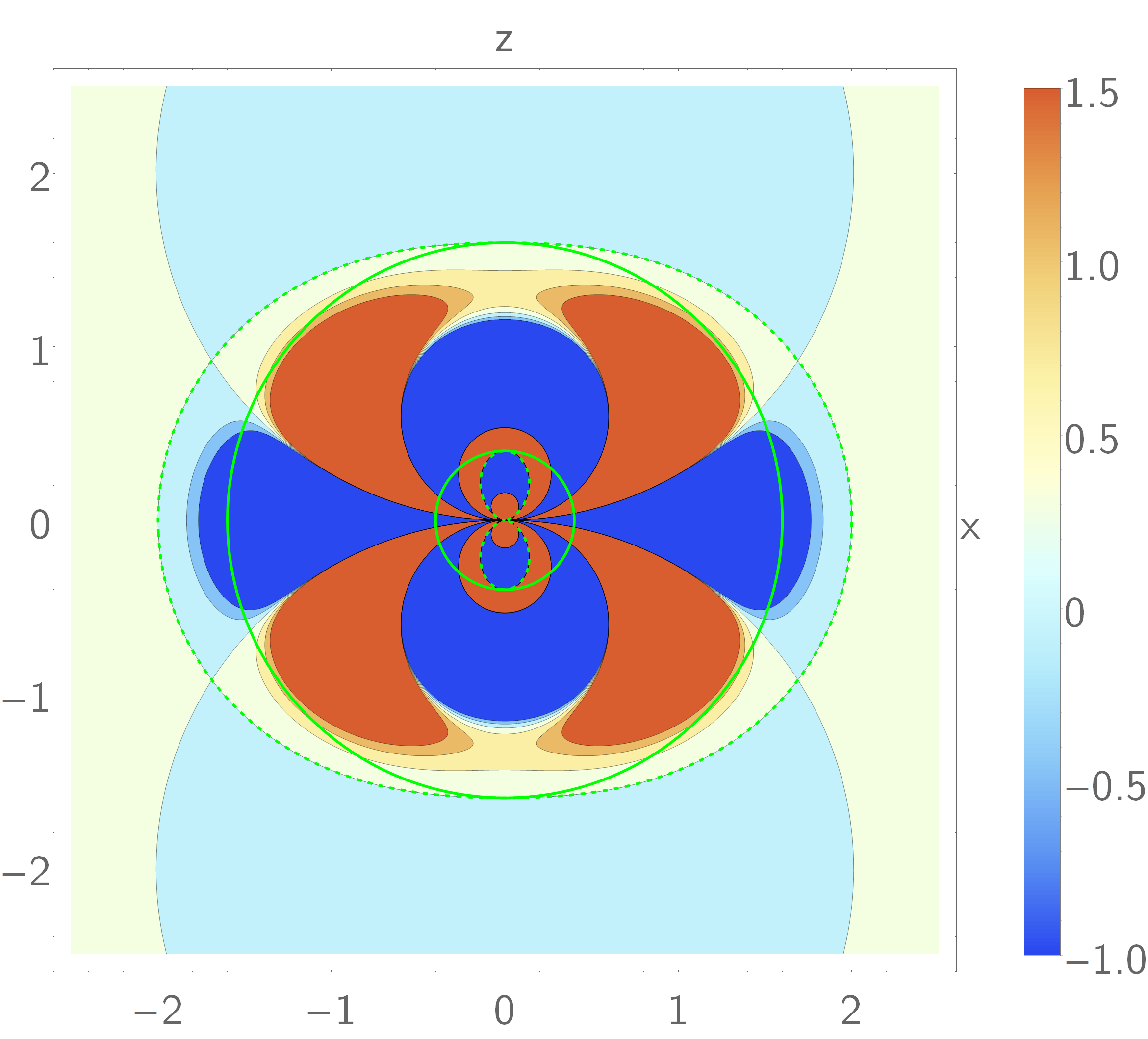 Figure 1
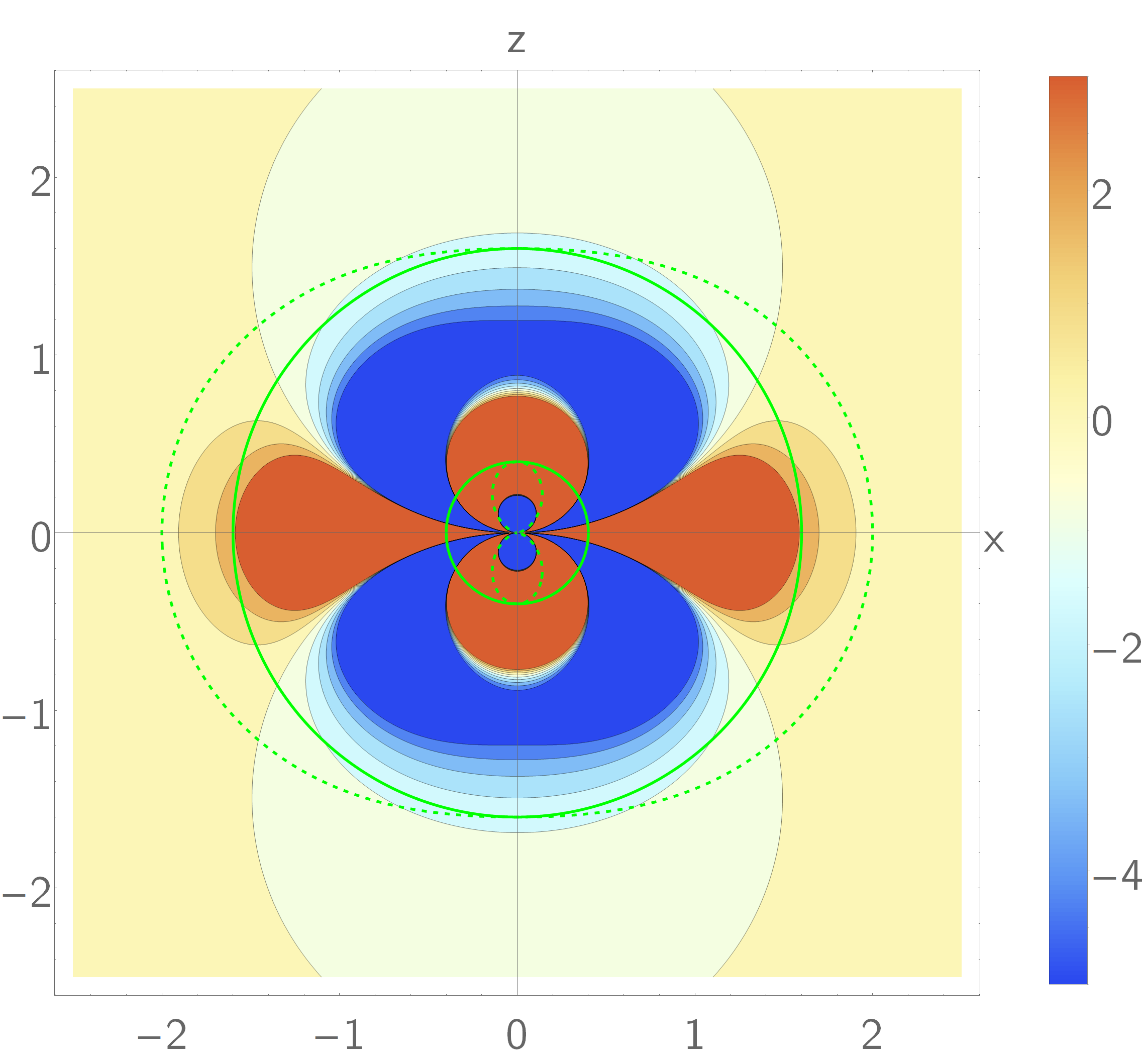 Figure 2
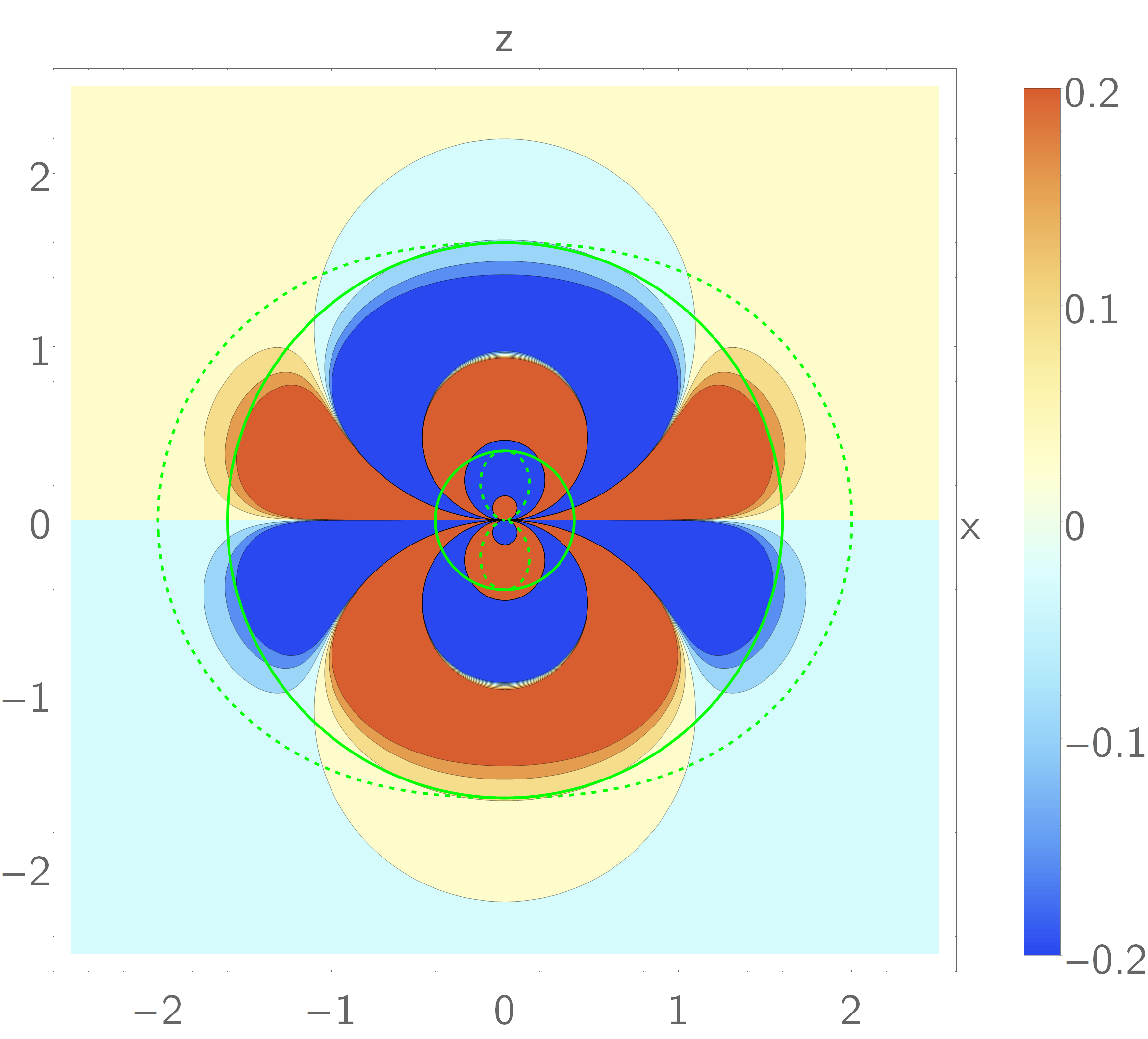 Figure 3
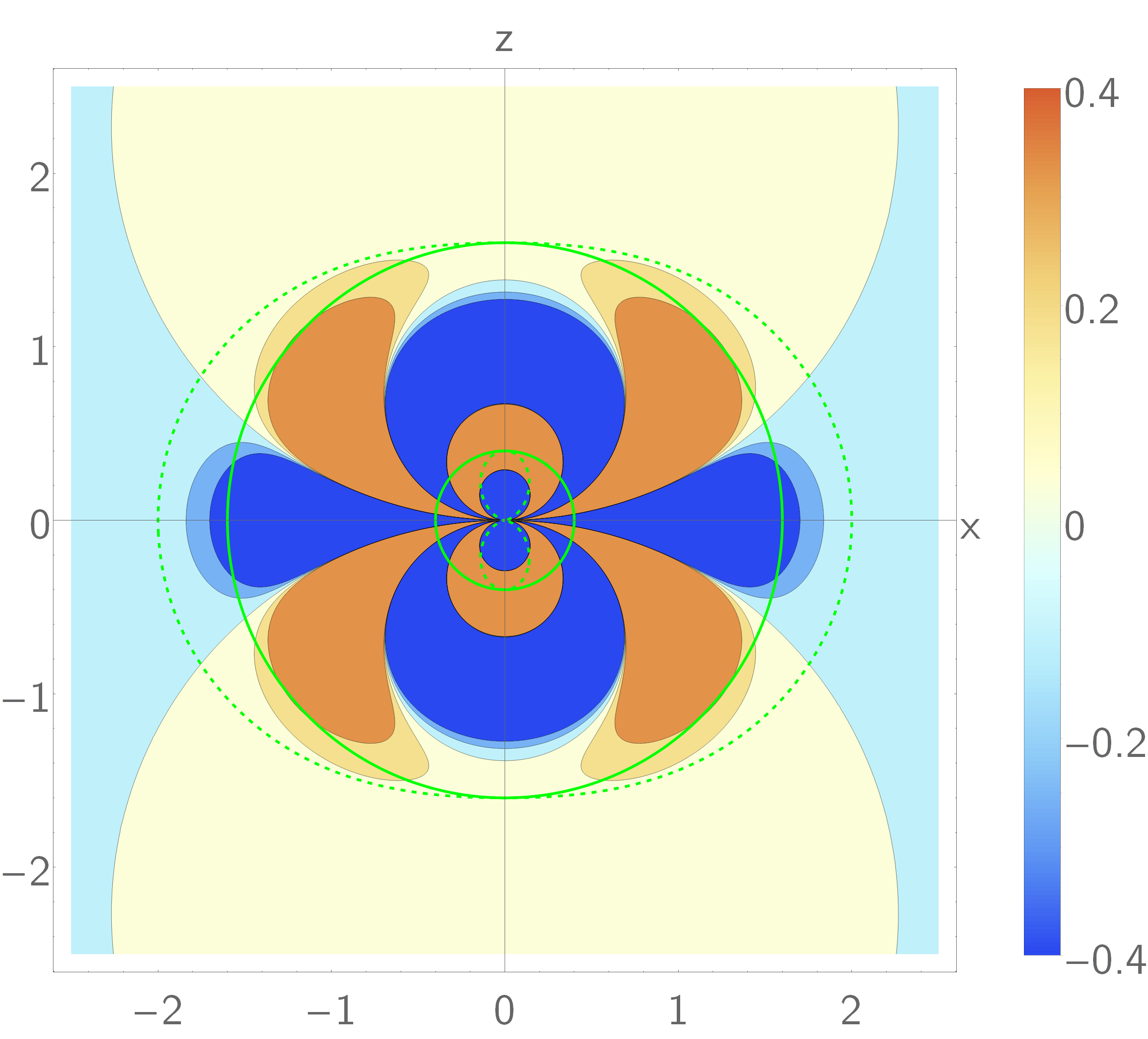 Figure 4
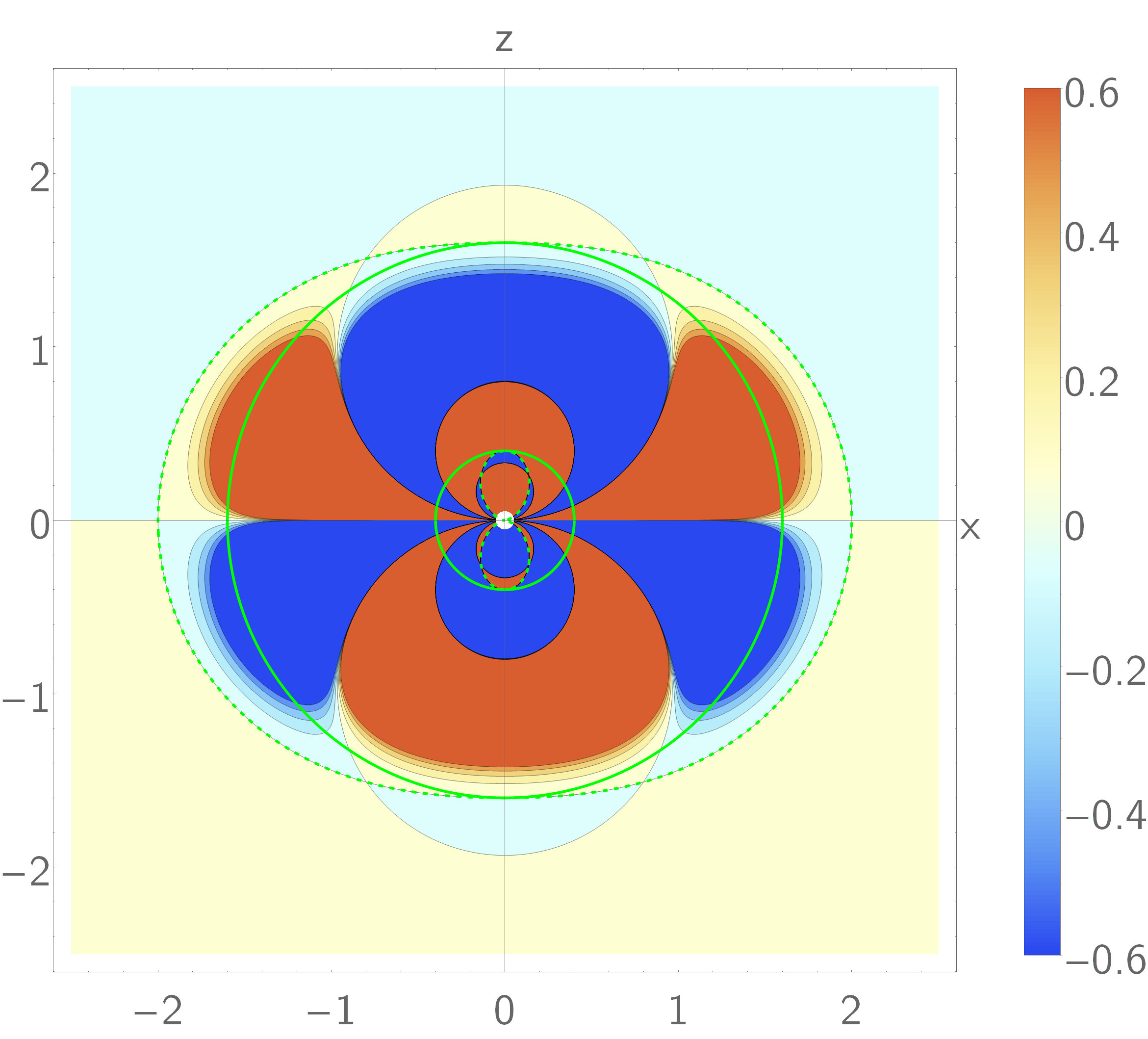 Figure 5
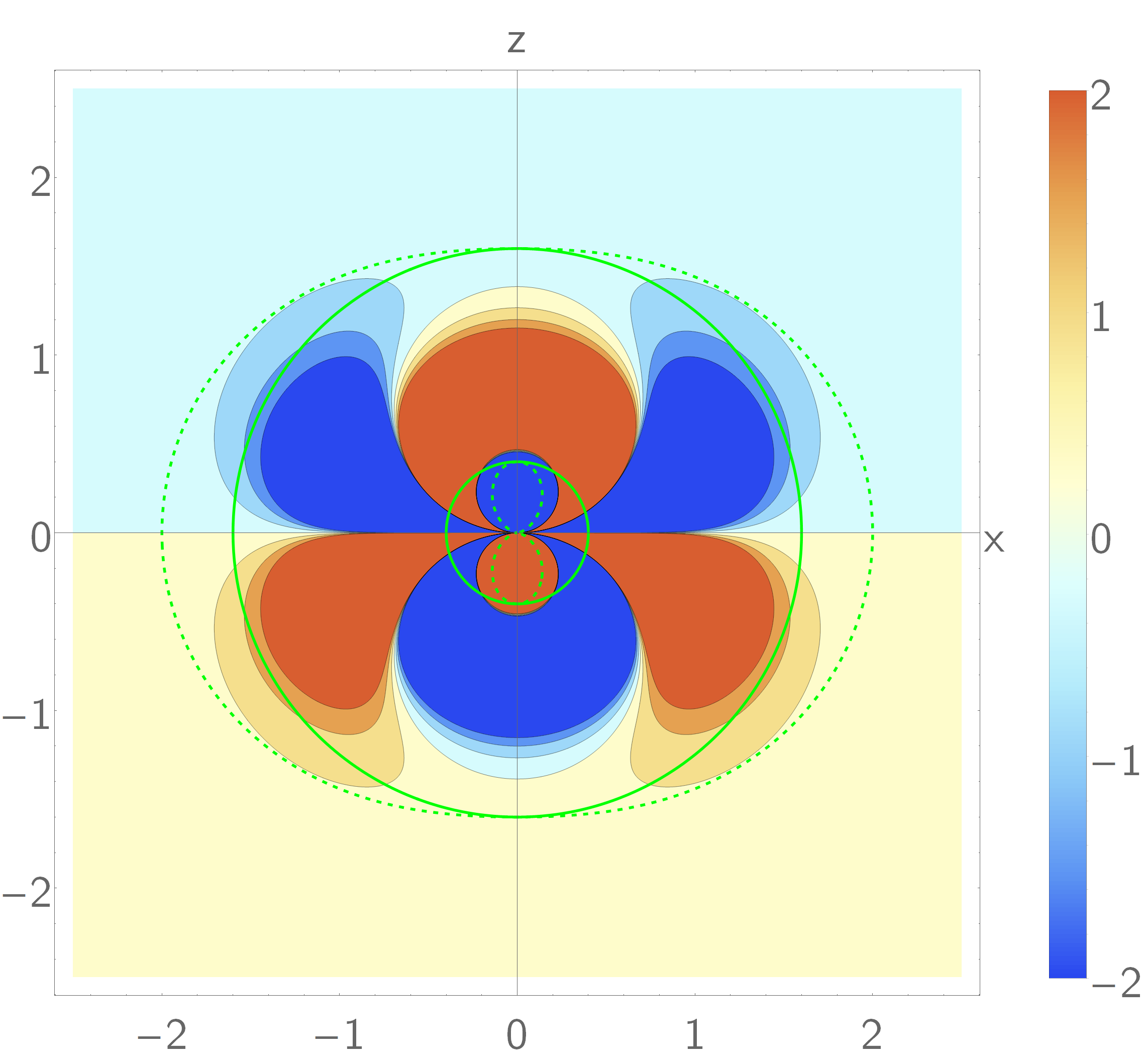 Figure 6
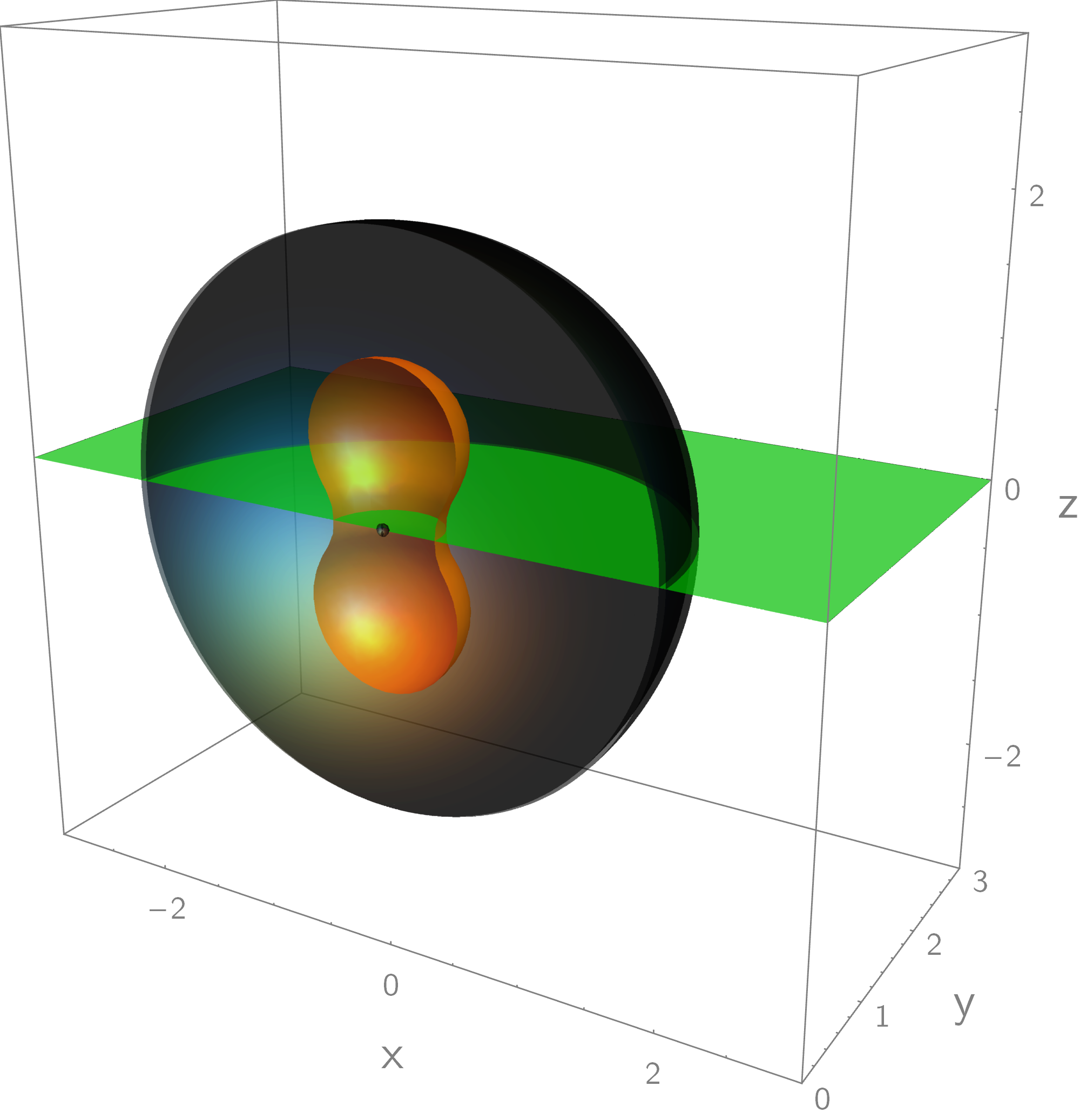 Figure 7
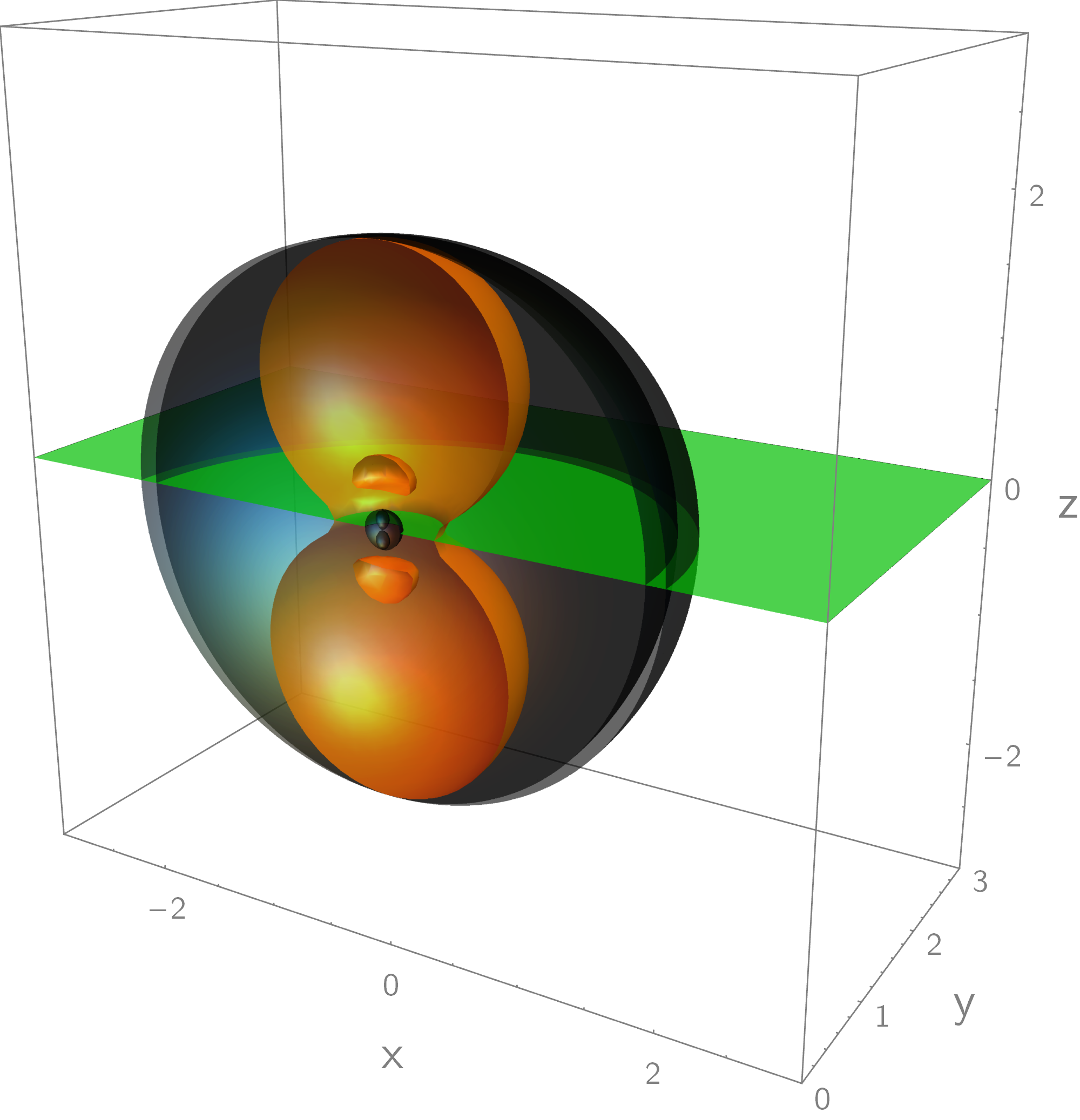 Figure 8
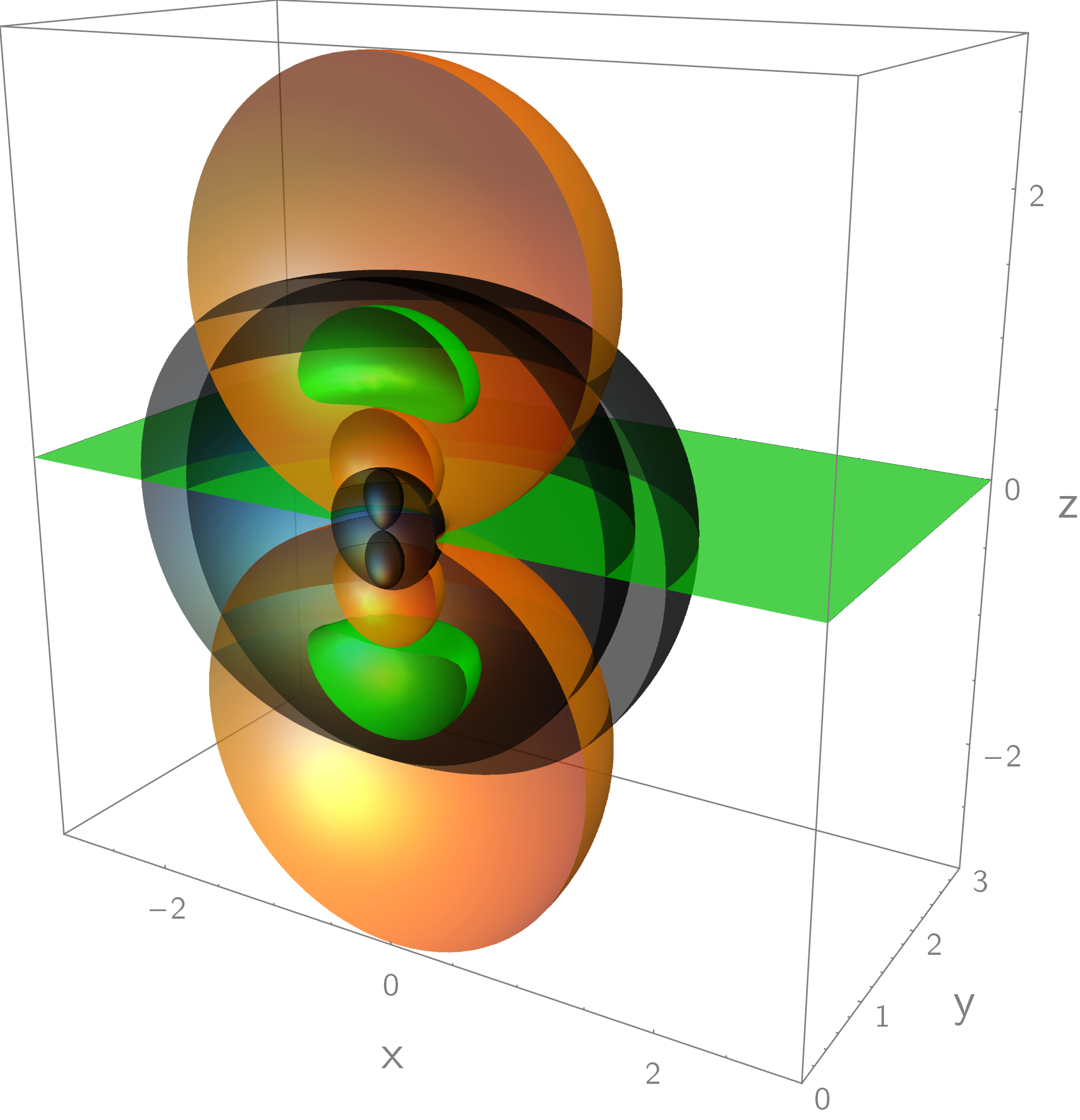 Figure 9
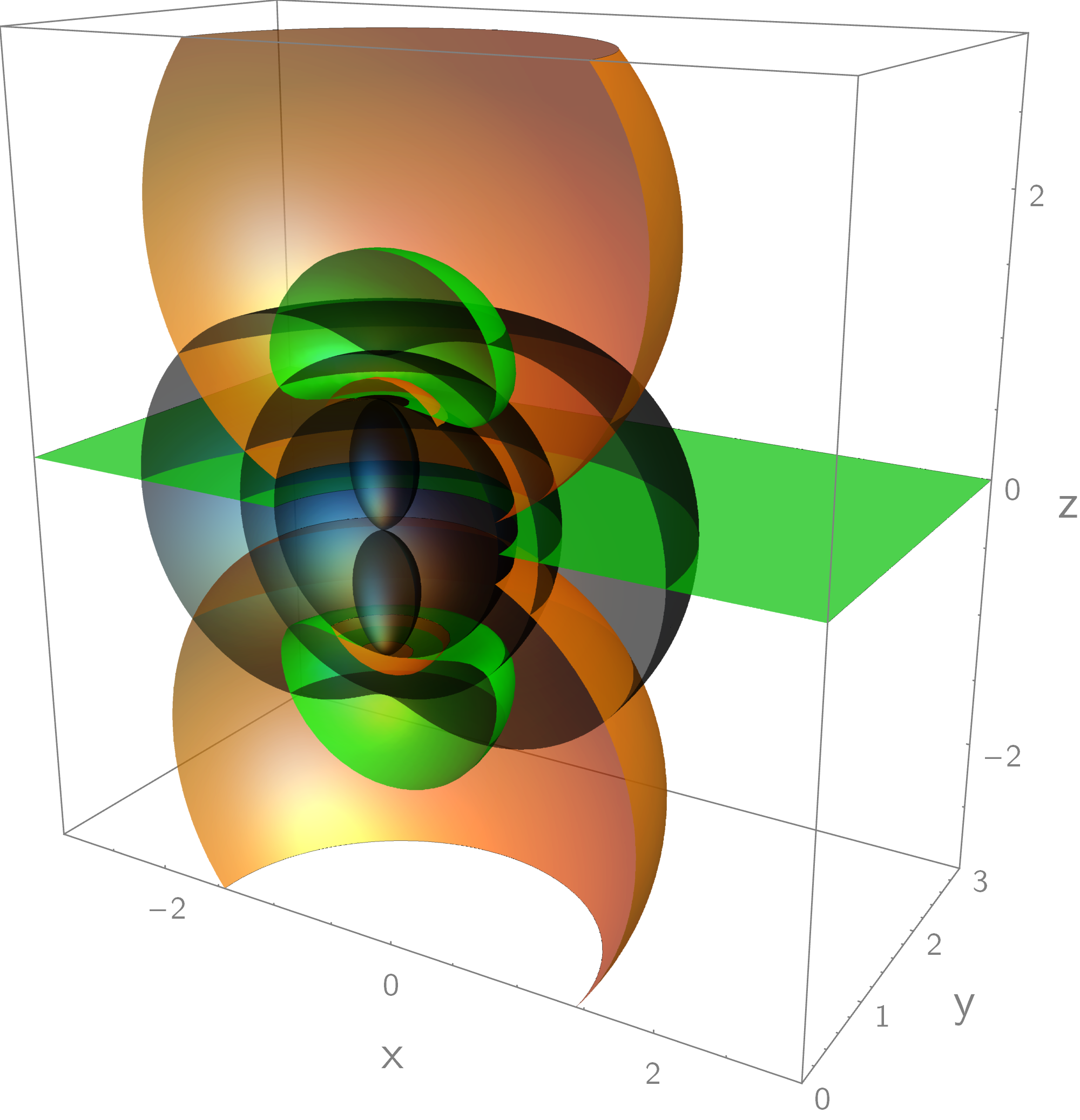 Figure 10
Peer Reviews
No public reviews on file for this paper yet. If you reviewed it on a platform where reviews are public (OpenReview, ICLR, NeurIPS, ICML), you can paste yours below so the community can read it here.
Videos
No videos yet. Explain this paper in a talk, walkthrough, or lecture? Add one.
Taxonomy
TopicsAnalytic and geometric function theory · Advanced Numerical Analysis Techniques · Meromorphic and Entire Functions
Kerr principal null directions from Bel–Robinson and Kummer surfaces
Jens Boos
Theoretical Physics Institute, University of Alberta, Edmonton, AB T6G 2E1, Canada
Alberto Favaro
Department of Physics, Imperial College London, UK, and ASI Data Science, London, UK
(March 18, 2024)
Abstract
In the Kerr geometry, we calculate various surfaces of constant curvature invariants. These extend well beyond the Kerr horizon, and we argue that they might be of observational significance in connection with non-minimally coupled matter fields. Moreover, we demonstrate that the principal null directions of the Kerr geometry can be obtained by projections involving either the Bel–Robinson or the Kummer tensor. We conjecture that this is also possible in more general settings.
Essay written for the Gravity Research Foundation 2017 Awards for Essays on Gravitation.
*file: 28_kerr_v2.tex, Mar 31, 2017, jb *
The Kerr solution Kerr:1963ud , describing a rotating black hole, is a truly remarkable exact solution of the vacuum Einstein field equations: it is not only important in astrophysics, has not only spawned a wealth of mathematical tools and devices in the context of the finding of solutions to the Einstein field equations Kerr:2007dk ; Heinicke:2015iva , but it has also served as a testing ground for new physical ideas. For example, the concept of hidden symmetries Frolov:2011 was discovered after studying the separability of the geodesic equation and the appearance of Carter’s constant Carter:1968 . More recently, the emergence of conformal symmetry in the near-horizon region of a maximally rotating Kerr black hole has given rise to the Kerr/CFT correspondence Castro:2010fd .
In this essay, we would like to focus on properties of the Kerr black hole that can be described using invariant expressions obtained from the curvature. We will apply two techniques: visual analysis of invariant curvature surfaces, and projective methods involving the principal null directions of the Kerr spacetime as contracted with tensorial expressions in the curvature. See also Refs. Nichols:2011pu ; Abdelqader:2013bma ; Koehler regarding different visualization procedures of spacetime curvature.
The Kerr solution in Boyer–Lindquist coordinates takes the form
[TABLE]
where we defined and . We may readily read off a possible orthonormal coframe such that .
I Invariant curvature surfaces
The Kerr solution (1) is a vacuum solution, and thus the Riemann curvature tensor equals the Weyl tensor, . All invariant and tensorial expressions in curvature shall be derived from the Weyl tensor alone.
Let us start by defining the two Cartan invariants MacCallum:2015zaa
[TABLE]
where hatted indices refer to the orthonormal coframe . These quantities capture the mass (“gravitational charge”) and angular momentum (“gravitational current”) of the Kerr solution. They are ubiquitous in analytic expressions for different (pseudo-)scalar invariants.
Focusing the discussion somewhat, let us now introduce the curvature invariants that will be examined in this work. The Kretschmann scalar and Chern–Pontryagin pseudoscalar take the values Boos:2014hua
[TABLE]
where is the left dual of the Weyl tensor. Following Ref. Abdelqader:2014vaa we consider the additional Karlhede–Lindström–Åman invariants Karlhede:1982
[TABLE]
They vanish on the Kerr ergosphere (and hence at the Schwarzschild horizon, for ), but they are not very useful in locating the horizon of the Kerr solution. Their explicit form can be found in Ref. Abdelqader:2014vaa . By contrast, the following invariant vanishes on the Kerr horizon Abdelqader:2014vaa ; Page:2015aia :
[TABLE]
We close by defining the Bel–Robinson tensor Bel:1962 ; Robinson:1997 as well as the vacuum Kummer tensor Baekler:2014kha ; Baekler:2014b :
[TABLE]
The Bel–Robinson tensor is related to the notion of superenergy, since its full contraction with any timelike vector is positive, Senovilla:1999xz . The Kummer tensor can be introduced by analogy with electromagnetism. In Ref. Baekler:2014kha , it was suggested that this tensor may encode specific properties of gravitational waves. The Bel–Robinson tensor and the Kummer tensor admit the following invariants:
[TABLE]
Now we can define invariant curvature surfaces by setting
[TABLE]
where is some polynomial function. Of course, one may also consider simpler cases where just one of the invariants assumes a constant value, as can be seen in Fig. 1. These invariants define surfaces that may extend well outside the horizon and can take relatively complicated shapes.
One may ask: what is a special value for these invariants to take? Since the Kerr solution can be written as , where the new line element only depends on the dimensionless parameter , there is no intrinsic length scale other than . In other words, if all distances are measured in terms of , the dimensionless parameter no longer provides a length scale related to the rotation parameter.
Of course, one special value still exists: zero. Suppose we consider the dynamics of a non-minimally coupled matter field in the vicinity of a black hole. Under some assumptions on the Lagrangian, the non-minimally coupled curvature expressions can serve as an effective potential for the matter field. Therefore, in a WKB approximation where the field dynamics are fast compared to the gravitational dynamics, the field may condense in the minimum of its potential. Notably, in some circumstances, the expression of this minimum may have the structure of Eq. (8), see Fig. 2 for a few zero-curvature surfaces around the Kerr black hole. Again, they may extend far outside the horizon.
II Projective surfaces and principal null directions
Suppose we have a vector field at our disposal: then, we may consider scalar invariants formed by contractions of expressions in the curvature and that vector field:
[TABLE]
An important class of vector fields, , intrinsic to a given spacetime, are the principal null directions (PNDs) of the Weyl tensor, defined by with Stephani:2004 . The algebraic multiplicity of the corresponding eigenvalue problem then defines the Petrov type of the given spacetime at each point. The Kerr spacetime is of type D, and the PNDs are
[TABLE]
Here, denotes the components of the PNDs with respect the coframe . According to Eq. (6) in Bel’s work Bel:1962 , there is an equivalent way to formulate this eigenvalue problem for Petrov type D spacetimes (what Bel calls type IIb). For the Kerr solution it reads
[TABLE]
It is straightforward to check that the above implies
[TABLE]
Is the converse also true? Interestingly, inserting instead the general null vector into the left-hand side of Eq. (12) implies
[TABLE]
respectively. For and , the unique solution is for any . Hence either the Bel–Robinson surface or the Kummer surface imply the PNDs of the Kerr spacetime. Due to the algebraic nature of this proof, it seems plausible to us that this result may hold for general type D spacetimes. It remains to be seen whether these concepts can be generalized to different Petrov types.
III Conclusions
Invariant curvature surfaces and projective surfaces seem to play an important role in the study of the Kerr geometry, both for experimental reasons (non-minimally coupled matter fields) as well as for theoretical considerations (Petrov classification). More work is necessary to extend our conclusions beyond the Kerr metric to general Petrov type D solutions and perhaps to other algebraically special spacetimes as well.
Acknowledgements.
Discussions with Friedrich W. Hehl (Cologne & Missouri) are greatly appreciated. JB was supported by a Doctoral Recruitment Scholarship and the Golden Bell Jar Graduate Scholarship in Physics at the University of Alberta.
The reference list from the paper itself. Each links out to its DOI / PubMed record.
- 1(1) R. P. Kerr, “Gravitational field of a spinning mass as an example of algebraically special metrics,” Phys. Rev. Lett. 11 (1963) 237.
- 2(2) R. P. Kerr, “Discovering the Kerr and Kerr-Schild metrics,” ar Xiv:0706.1109 [gr-qc] .
- 3(3) C. Heinicke and F. W. Hehl, “Schwarzschild and Kerr Solutions of Einstein’s Field Equation – an Introduction,” Int. J. Mod. Phys. D 24 (2014) no.02, 1530006; ar Xiv:1503.02172 [gr-qc] .
- 4(4) V. P. Frolov and A. Zelnikov, Introduction to Black Hole Physics , (Oxford University Press, Oxford, 2011).
- 5(5) B. Carter, “Global structure of the Kerr family of gravitational fields,” Phys. Rev. 174 (1968) 1559; “Hamilton–Jacobi and Schrodinger separable solutions of Einstein’s equations,” Comm. Math. Phys. 10 (1968) 280.
- 6(6) A. Castro, A. Maloney and A. Strominger, “Hidden Conformal Symmetry of the Kerr Black Hole,” Phys. Rev. D 82 (2010) 024008; ar Xiv:1004.0996 [hep-th] .
- 7(7) D. A. Nichols et al. , “Visualizing Spacetime Curvature via Frame-Drag Vortexes and Tidal Tendexes I. General Theory and Weak-Gravity Applications,” Phys. Rev. D 84 (2011) 124014; ar Xiv:1108.5486 [gr-qc] .
- 8(8) M. Abdelqader and K. Lake, “Visualizing Spacetime Curvature via Gradient Flows. III. The Kerr Metric and the Transitional Values of the Spin Parameter,” Phys. Rev. D 88 (2013) no.6, 064042; ar Xiv:1308.1433 [gr-qc] .