Measurement of the Decays $\boldsymbol{B\to\eta\ell\nu_\ell}$ and $\boldsymbol{B\to\eta^\prime\ell\nu_\ell}$ in Fully Reconstructed Events at Belle
Belle Collaboration: C. Bele\~no, J. Dingfelder, P. Urquijo, H., Aihara, S. Al Said, D. M. Asner, T. Aushev, R. Ayad, V. Babu, I. Badhrees, A., M. Bakich, V. Bansal, P. Behera, B. Bhuyan, J. Biswal, A. Bobrov, M., Bra\v{c}ko, T. E. Browder, D. \v{C}ervenkov, A. Chen, B. G. Cheon

TL;DR
This paper measures the branching fractions of B meson decays to eta and eta' mesons with leptons, using a large data sample from the Belle experiment, providing new experimental results on these rare decays.
Contribution
First measurement of B+ to eta and eta' semileptonic decays using fully reconstructed events at Belle.
Findings
Measured B+ to eta l nu branching fraction as (4.2 ± 1.1 ± 0.3) × 10^{-5}
Set an upper limit of 0.72 × 10^{-4} for B+ to eta' l nu at 90% CL
Utilized 711 fb^{-1} of data with full reconstruction technique.
Abstract
We report branching fraction measurements of the decays and based on 711~fb of data collected near the resonance with the Belle experiment at the KEKB asymmetric-energy collider. This data sample contains 772 million ~events. One of the two ~mesons is fully reconstructed in a hadronic decay mode. Among the remaining ("signal-") daughters, we search for the ~meson in two decay channels, and , and reconstruct the ~meson in with subsequent decay of the into . Combining the two modes and using an extended maximum likelihood, the branching fraction is measured to be . For…
Click any figure to enlarge with its caption.
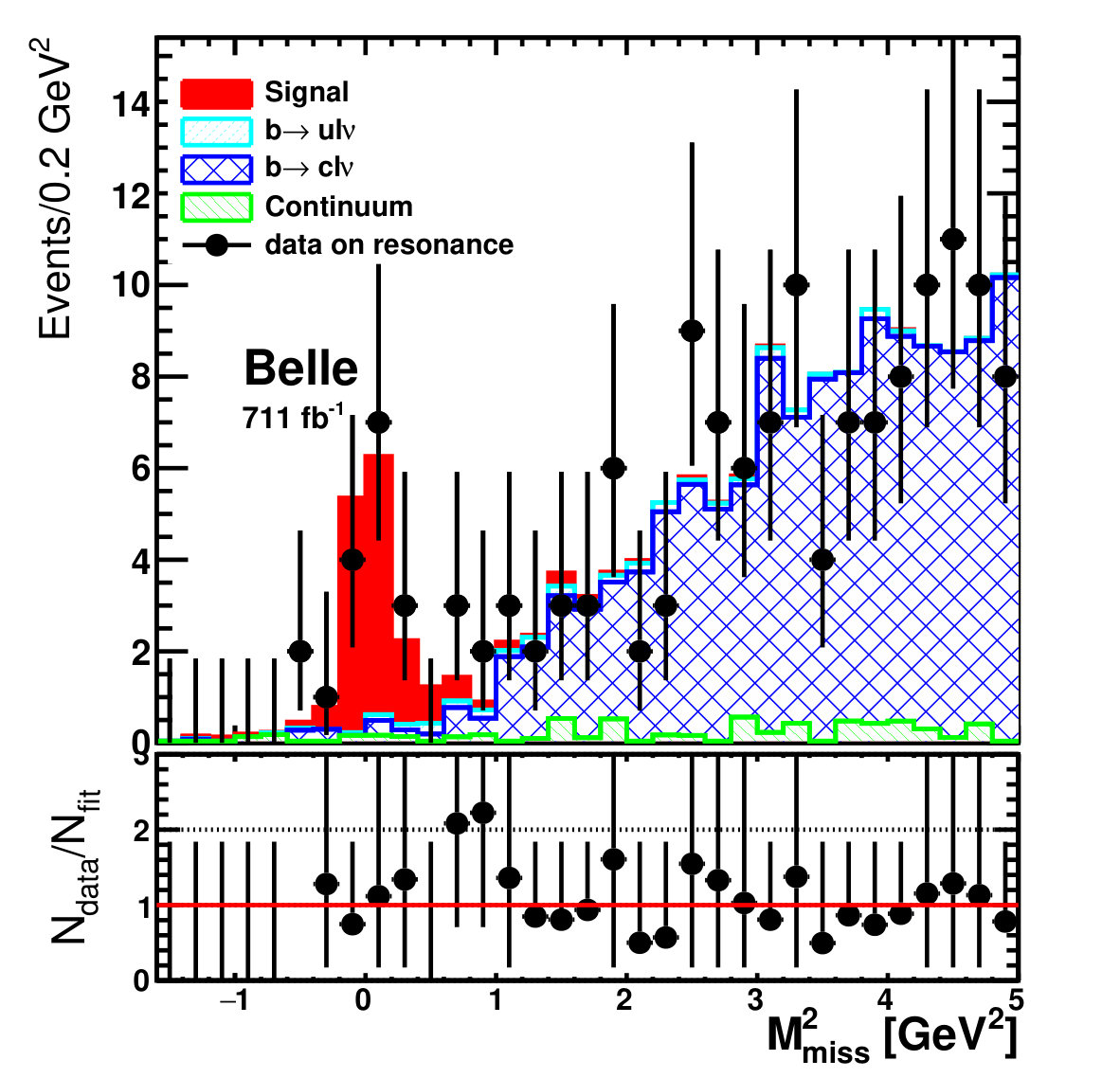 Figure 1
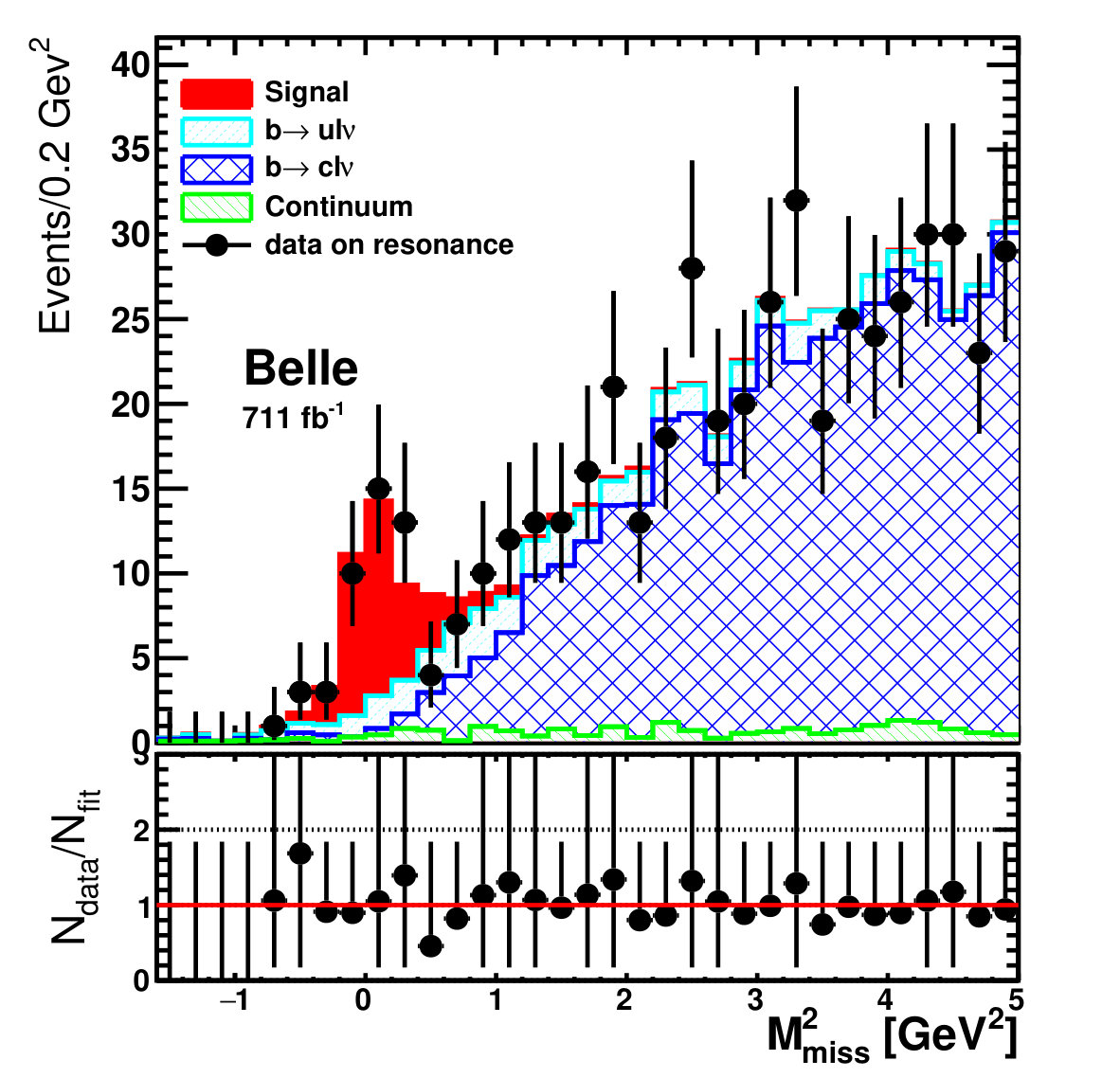 Figure 2
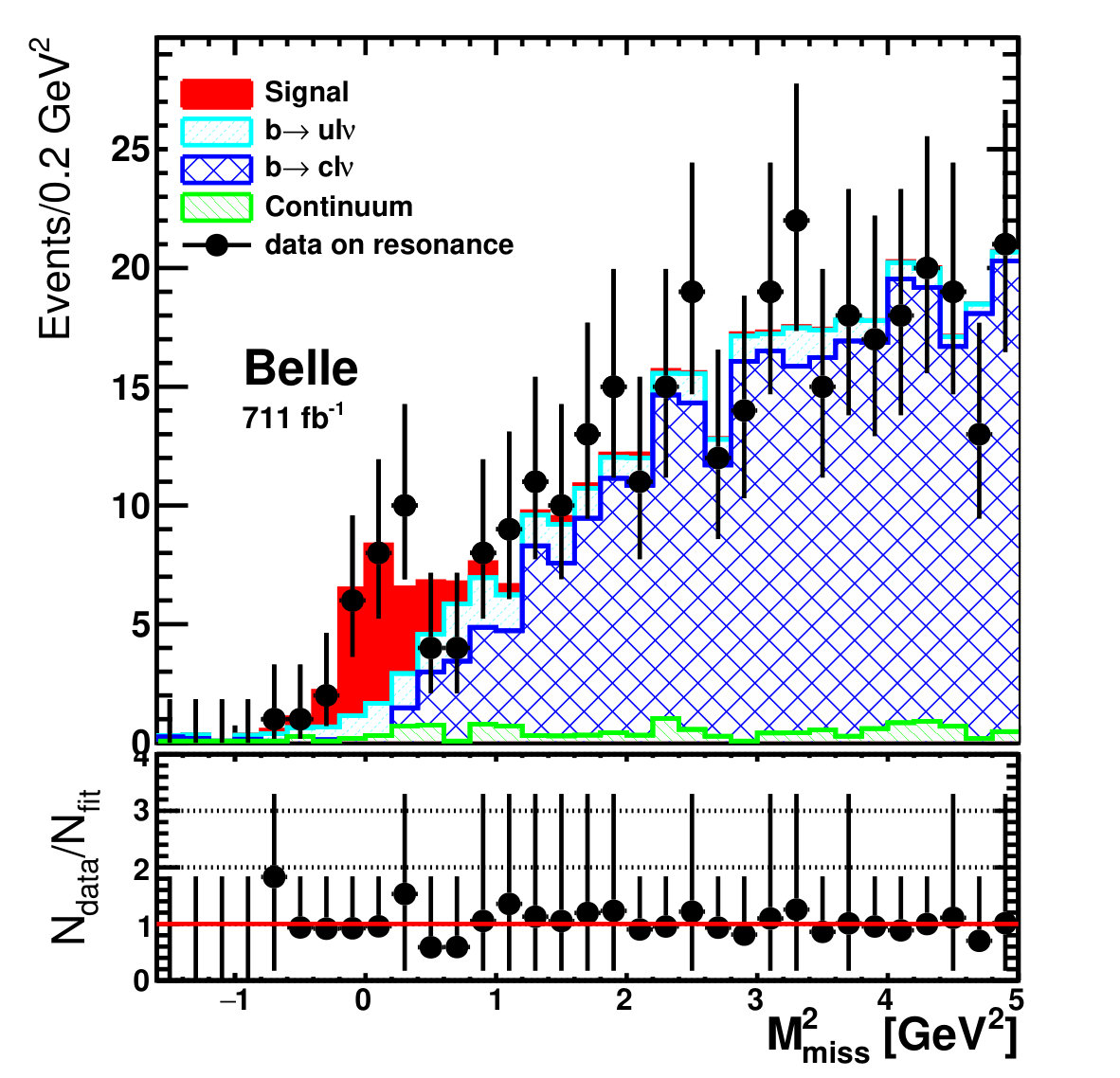 Figure 3
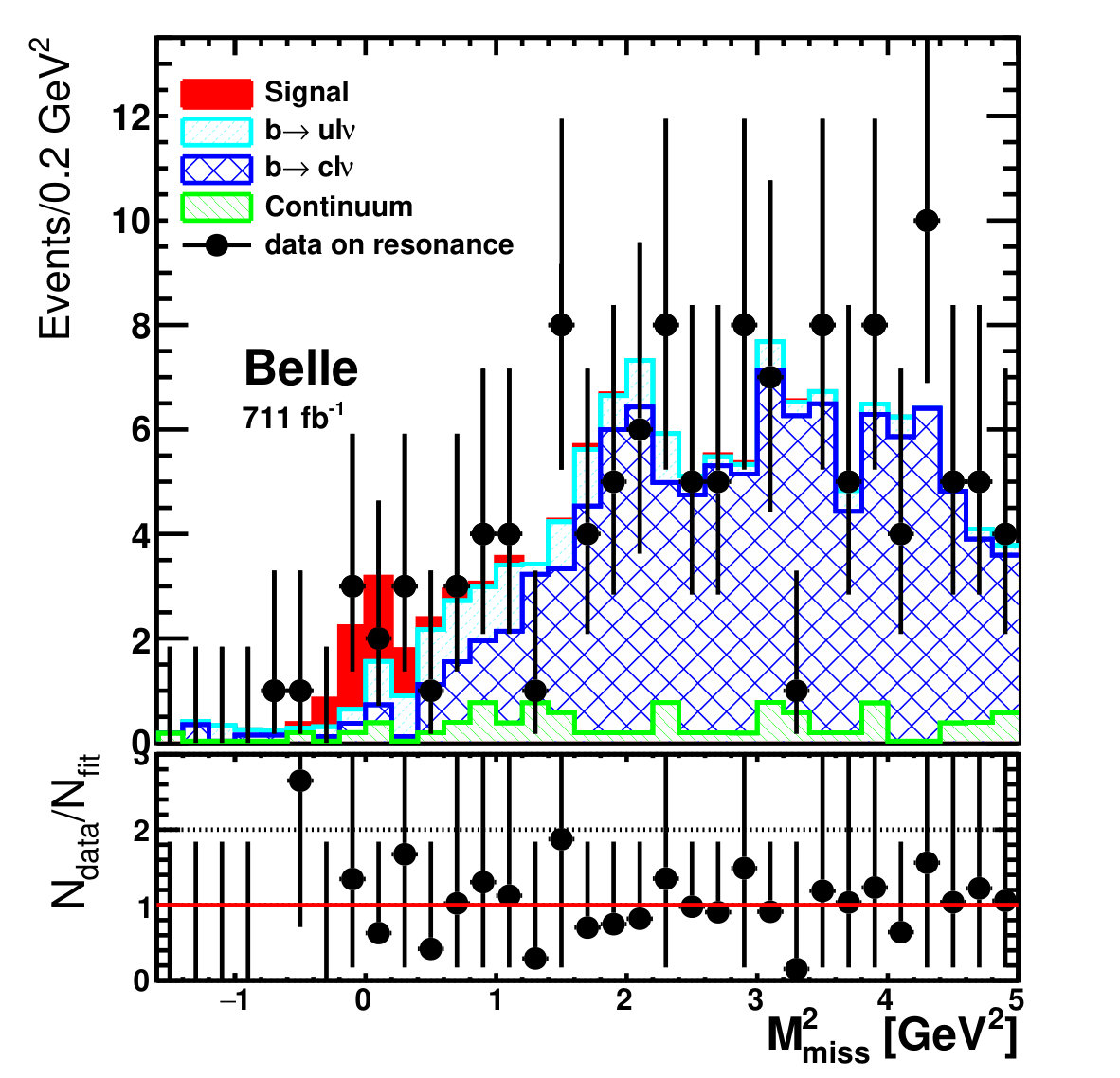 Figure 4
| Channel | \bigstrut | |||||||||
| Mode | Both modes combined | \bigstrut | ||||||||
| [GeV2] | All | All | All | All \bigstrut[b] | ||||||
| Raw yield | 355 | 261 | 94 | 148 | 98 | 50 | 503 | 359 | 144 | 129 \bigstrut[t] |
| Signal | 23.68.7 | 15.77.3 | 9.05.3 | 16.05.3 | 12.24.1 | 4.02.5 | 38.810.1 | 27.98.7 | 12.96.1 | 5.74.4\bigstrut |
| 3225 | 2227 | 1013 | 421 | 15 | 48 | 4629 | 3029 | 1418 | 1513\bigstrut | |
| 28727 | 21228 | 7313 | 12217 | 7910 | 4110 | 39931 | 28530 | 11418 | 9914\bigstrut | |
| Continuum | 12.7 | 10.4 | 2.3 | 6.2 | 5.2 | 0.9 | 18 | 15.7 | 3.2 | \bigstrut[b] |
| 1.21 | 1.28 | 0.99 | 0.53 | 0.57 | 0.44 | 0.96 | 1.02 | 0.79 | 0.61\bigstrut[t] | |
| ndf | \bigstrut[t] | |||||||||
| Probability[%] | \bigstrut[b] | |||||||||
| Combined\bigstrut[t] | |||
|---|---|---|---|
| GeV2 | \bigstrut[b] | ||
| GeV2 | \bigstrut[t] | ||
| Sum | \bigstrut[b] | ||
| All | \bigstrut[b] |
| Mode | Both modes | \bigstrut[t] | ||||||||
| [GeV2] | All | All | All | All \bigstrut[b] | ||||||
| Track finding | \bigstrut | |||||||||
| Photon finding | \bigstrut | |||||||||
| reconstruction | \bigstrut | |||||||||
| veto | \bigstrut | |||||||||
| Pion ID | \bigstrut | |||||||||
| Lepton ID | \bigstrut | |||||||||
| Lepton fake rate | \bigstrut[b] | |||||||||
| Signal model | \bigstrut | |||||||||
| form factors | \bigstrut[t] | |||||||||
| branching fractions | \bigstrut | |||||||||
| form factors | \bigstrut | |||||||||
| branching fractions | \bigstrut | |||||||||
| Secondary leptons | \bigstrut[t] | |||||||||
| combined | \bigstrut | |||||||||
| Hadronic tag | \bigstrut[b] | |||||||||
| N | \bigstrut[b] | |||||||||
| Continuum | \bigstrut | |||||||||
| Fit procedure | \bigstrut[b] | |||||||||
| Total | \bigstrut | |||||||||
Peer Reviews
No public reviews on file for this paper yet. If you reviewed it on a platform where reviews are public (OpenReview, ICLR, NeurIPS, ICML), you can paste yours below so the community can read it here.
Videos
No videos yet. Explain this paper in a talk, walkthrough, or lecture? Add one.
The Belle Collaboration
Measurement of the Decays
and in Fully Reconstructed Events at Belle
C. Beleño
II. Physikalisches Institut, Georg-August-Universität Göttingen, 37073 Göttingen
J. Dingfelder
University of Bonn, 53115 Bonn
P. Urquijo
School of Physics, University of Melbourne, Victoria 3010
H. Aihara
Department of Physics, University of Tokyo, Tokyo 113-0033
S. Al Said
Department of Physics, Faculty of Science, University of Tabuk, Tabuk 71451
Department of Physics, Faculty of Science, King Abdulaziz University, Jeddah 21589
D. M. Asner
Pacific Northwest National Laboratory, Richland, Washington 99352
T. Aushev
Moscow Institute of Physics and Technology, Moscow Region 141700
R. Ayad
Department of Physics, Faculty of Science, University of Tabuk, Tabuk 71451
V. Babu
Tata Institute of Fundamental Research, Mumbai 400005
I. Badhrees
Department of Physics, Faculty of Science, University of Tabuk, Tabuk 71451
King Abdulaziz City for Science and Technology, Riyadh 11442
A. M. Bakich
School of Physics, University of Sydney, New South Wales 2006
V. Bansal
Pacific Northwest National Laboratory, Richland, Washington 99352
P. Behera
Indian Institute of Technology Madras, Chennai 600036
B. Bhuyan
Indian Institute of Technology Guwahati, Assam 781039
J. Biswal
J. Stefan Institute, 1000 Ljubljana
A. Bobrov
Budker Institute of Nuclear Physics SB RAS, Novosibirsk 630090
Novosibirsk State University, Novosibirsk 630090
M. Bračko
University of Maribor, 2000 Maribor
J. Stefan Institute, 1000 Ljubljana
T. E. Browder
University of Hawaii, Honolulu, Hawaii 96822
D. Červenkov
Faculty of Mathematics and Physics, Charles University, 121 16 Prague
A. Chen
National Central University, Chung-li 32054
B. G. Cheon
Hanyang University, Seoul 133-791
R. Chistov
P.N. Lebedev Physical Institute of the Russian Academy of Sciences, Moscow 119991
Moscow Physical Engineering Institute, Moscow 115409
K. Cho
Korea Institute of Science and Technology Information, Daejeon 305-806
S.-K. Choi
Gyeongsang National University, Chinju 660-701
Y. Choi
Sungkyunkwan University, Suwon 440-746
D. Cinabro
Wayne State University, Detroit, Michigan 48202
N. Dash
Indian Institute of Technology Bhubaneswar, Satya Nagar 751007
S. Di Carlo
Wayne State University, Detroit, Michigan 48202
Z. Doležal
Faculty of Mathematics and Physics, Charles University, 121 16 Prague
S. Eidelman
Budker Institute of Nuclear Physics SB RAS, Novosibirsk 630090
Novosibirsk State University, Novosibirsk 630090
H. Farhat
Wayne State University, Detroit, Michigan 48202
J. E. Fast
Pacific Northwest National Laboratory, Richland, Washington 99352
T. Ferber
Deutsches Elektronen–Synchrotron, 22607 Hamburg
A. Frey
II. Physikalisches Institut, Georg-August-Universität Göttingen, 37073 Göttingen
B. G. Fulsom
Pacific Northwest National Laboratory, Richland, Washington 99352
V. Gaur
Tata Institute of Fundamental Research, Mumbai 400005
N. Gabyshev
Budker Institute of Nuclear Physics SB RAS, Novosibirsk 630090
Novosibirsk State University, Novosibirsk 630090
A. Garmash
Budker Institute of Nuclear Physics SB RAS, Novosibirsk 630090
Novosibirsk State University, Novosibirsk 630090
R. Gillard
Wayne State University, Detroit, Michigan 48202
P. Goldenzweig
Institut für Experimentelle Kernphysik, Karlsruher Institut für Technologie, 76131 Karlsruhe
T. Hara
High Energy Accelerator Research Organization (KEK), Tsukuba 305-0801
SOKENDAI (The Graduate University for Advanced Studies), Hayama 240-0193
H. Hayashii
Nara Women’s University, Nara 630-8506
M. T. Hedges
University of Hawaii, Honolulu, Hawaii 96822
W.-S. Hou
Department of Physics, National Taiwan University, Taipei 10617
T. Iijima
Kobayashi-Maskawa Institute, Nagoya University, Nagoya 464-8602
Graduate School of Science, Nagoya University, Nagoya 464-8602
K. Inami
Graduate School of Science, Nagoya University, Nagoya 464-8602
G. Inguglia
Deutsches Elektronen–Synchrotron, 22607 Hamburg
A. Ishikawa
Department of Physics, Tohoku University, Sendai 980-8578
R. Itoh
High Energy Accelerator Research Organization (KEK), Tsukuba 305-0801
SOKENDAI (The Graduate University for Advanced Studies), Hayama 240-0193
Y. Iwasaki
High Energy Accelerator Research Organization (KEK), Tsukuba 305-0801
H. B. Jeon
Kyungpook National University, Daegu 702-701
Y. Jin
Department of Physics, University of Tokyo, Tokyo 113-0033
D. Joffe
Kennesaw State University, Kennesaw, Georgia 30144
K. K. Joo
Chonnam National University, Kwangju 660-701
K. H. Kang
Kyungpook National University, Daegu 702-701
G. Karyan
Deutsches Elektronen–Synchrotron, 22607 Hamburg
D. Y. Kim
Soongsil University, Seoul 156-743
J. B. Kim
Korea University, Seoul 136-713
K. T. Kim
Korea University, Seoul 136-713
M. J. Kim
Kyungpook National University, Daegu 702-701
Y. J. Kim
Korea Institute of Science and Technology Information, Daejeon 305-806
K. Kinoshita
University of Cincinnati, Cincinnati, Ohio 45221
P. Kodyš
Faculty of Mathematics and Physics, Charles University, 121 16 Prague
S. Korpar
University of Maribor, 2000 Maribor
J. Stefan Institute, 1000 Ljubljana
D. Kotchetkov
University of Hawaii, Honolulu, Hawaii 96822
P. Križan
Faculty of Mathematics and Physics, University of Ljubljana, 1000 Ljubljana
J. Stefan Institute, 1000 Ljubljana
P. Krokovny
Budker Institute of Nuclear Physics SB RAS, Novosibirsk 630090
Novosibirsk State University, Novosibirsk 630090
R. Kulasiri
Kennesaw State University, Kennesaw, Georgia 30144
I. S. Lee
Hanyang University, Seoul 133-791
Y. Li
Virginia Polytechnic Institute and State University, Blacksburg, Virginia 24061
L. Li Gioi
Max-Planck-Institut für Physik, 80805 München
J. Libby
Indian Institute of Technology Madras, Chennai 600036
D. Liventsev
Virginia Polytechnic Institute and State University, Blacksburg, Virginia 24061
High Energy Accelerator Research Organization (KEK), Tsukuba 305-0801
M. Lubej
J. Stefan Institute, 1000 Ljubljana
T. Luo
University of Pittsburgh, Pittsburgh, Pennsylvania 15260
M. Masuda
Earthquake Research Institute, University of Tokyo, Tokyo 113-0032
T. Matsuda
University of Miyazaki, Miyazaki 889-2192
D. Matvienko
Budker Institute of Nuclear Physics SB RAS, Novosibirsk 630090
Novosibirsk State University, Novosibirsk 630090
K. Miyabayashi
Nara Women’s University, Nara 630-8506
H. Miyata
Niigata University, Niigata 950-2181
H. K. Moon
Korea University, Seoul 136-713
T. Mori
Graduate School of Science, Nagoya University, Nagoya 464-8602
E. Nakano
Osaka City University, Osaka 558-8585
M. Nakao
High Energy Accelerator Research Organization (KEK), Tsukuba 305-0801
SOKENDAI (The Graduate University for Advanced Studies), Hayama 240-0193
T. Nanut
J. Stefan Institute, 1000 Ljubljana
K. J. Nath
Indian Institute of Technology Guwahati, Assam 781039
M. Nayak
Wayne State University, Detroit, Michigan 48202
High Energy Accelerator Research Organization (KEK), Tsukuba 305-0801
S. Nishida
High Energy Accelerator Research Organization (KEK), Tsukuba 305-0801
SOKENDAI (The Graduate University for Advanced Studies), Hayama 240-0193
S. Ogawa
Toho University, Funabashi 274-8510
S. Okuno
Kanagawa University, Yokohama 221-8686
H. Ono
Nippon Dental University, Niigata 951-8580
Niigata University, Niigata 950-2181
B. Pal
University of Cincinnati, Cincinnati, Ohio 45221
C.-S. Park
Yonsei University, Seoul 120-749
C. W. Park
Sungkyunkwan University, Suwon 440-746
H. Park
Kyungpook National University, Daegu 702-701
T. K. Pedlar
Luther College, Decorah, Iowa 52101
R. Pestotnik
J. Stefan Institute, 1000 Ljubljana
L. E. Piilonen
Virginia Polytechnic Institute and State University, Blacksburg, Virginia 24061
M. Ritter
Ludwig Maximilians University, 80539 Munich
Y. Sakai
High Energy Accelerator Research Organization (KEK), Tsukuba 305-0801
SOKENDAI (The Graduate University for Advanced Studies), Hayama 240-0193
M. Salehi
University of Malaya, 50603 Kuala Lumpur
Ludwig Maximilians University, 80539 Munich
S. Sandilya
University of Cincinnati, Cincinnati, Ohio 45221
T. Sanuki
Department of Physics, Tohoku University, Sendai 980-8578
O. Schneider
École Polytechnique Fédérale de Lausanne (EPFL), Lausanne 1015
G. Schnell
University of the Basque Country UPV/EHU, 48080 Bilbao
IKERBASQUE, Basque Foundation for Science, 48013 Bilbao
C. Schwanda
Institute of High Energy Physics, Vienna 1050
Y. Seino
Niigata University, Niigata 950-2181
K. Senyo
Yamagata University, Yamagata 990-8560
O. Seon
Graduate School of Science, Nagoya University, Nagoya 464-8602
M. E. Sevior
School of Physics, University of Melbourne, Victoria 3010
V. Shebalin
Budker Institute of Nuclear Physics SB RAS, Novosibirsk 630090
Novosibirsk State University, Novosibirsk 630090
T.-A. Shibata
Tokyo Institute of Technology, Tokyo 152-8550
J.-G. Shiu
Department of Physics, National Taiwan University, Taipei 10617
F. Simon
Max-Planck-Institut für Physik, 80805 München
Excellence Cluster Universe, Technische Universität München, 85748 Garching
E. Solovieva
P.N. Lebedev Physical Institute of the Russian Academy of Sciences, Moscow 119991
Moscow Institute of Physics and Technology, Moscow Region 141700
M. Starič
J. Stefan Institute, 1000 Ljubljana
T. Sumiyoshi
Tokyo Metropolitan University, Tokyo 192-0397
M. Takizawa
Showa Pharmaceutical University, Tokyo 194-8543
J-PARC Branch, KEK Theory Center, High Energy Accelerator Research Organization (KEK), Tsukuba 305-0801
Theoretical Research Division, Nishina Center, RIKEN, Saitama 351-0198
U. Tamponi
INFN - Sezione di Torino, 10125 Torino
University of Torino, 10124 Torino
K. Tanida
Advanced Science Research Center, Japan Atomic Energy Agency, Naka 319-1195
F. Tenchini
School of Physics, University of Melbourne, Victoria 3010
M. Uchida
Tokyo Institute of Technology, Tokyo 152-8550
T. Uglov
P.N. Lebedev Physical Institute of the Russian Academy of Sciences, Moscow 119991
Moscow Institute of Physics and Technology, Moscow Region 141700
Y. Unno
Hanyang University, Seoul 133-791
S. Uno
High Energy Accelerator Research Organization (KEK), Tsukuba 305-0801
SOKENDAI (The Graduate University for Advanced Studies), Hayama 240-0193
Y. Usov
Budker Institute of Nuclear Physics SB RAS, Novosibirsk 630090
Novosibirsk State University, Novosibirsk 630090
C. Van Hulse
University of the Basque Country UPV/EHU, 48080 Bilbao
G. Varner
University of Hawaii, Honolulu, Hawaii 96822
K. E. Varvell
School of Physics, University of Sydney, New South Wales 2006
A. Vinokurova
Budker Institute of Nuclear Physics SB RAS, Novosibirsk 630090
Novosibirsk State University, Novosibirsk 630090
V. Vorobyev
Budker Institute of Nuclear Physics SB RAS, Novosibirsk 630090
Novosibirsk State University, Novosibirsk 630090
C. H. Wang
National United University, Miao Li 36003
M.-Z. Wang
Department of Physics, National Taiwan University, Taipei 10617
P. Wang
Institute of High Energy Physics, Chinese Academy of Sciences, Beijing 100049
Y. Watanabe
Kanagawa University, Yokohama 221-8686
E. Widmann
Stefan Meyer Institute for Subatomic Physics, Vienna 1090
E. Won
Korea University, Seoul 136-713
Y. Yamashita
Nippon Dental University, Niigata 951-8580
H. Ye
Deutsches Elektronen–Synchrotron, 22607 Hamburg
J. Yelton
University of Florida, Gainesville, Florida 32611
Y. Yook
Yonsei University, Seoul 120-749
Z. P. Zhang
University of Science and Technology of China, Hefei 230026
V. Zhilich
Budker Institute of Nuclear Physics SB RAS, Novosibirsk 630090
Novosibirsk State University, Novosibirsk 630090
V. Zhukova
Moscow Physical Engineering Institute, Moscow 115409
V. Zhulanov
Budker Institute of Nuclear Physics SB RAS, Novosibirsk 630090
Novosibirsk State University, Novosibirsk 630090
A. Zupanc
Faculty of Mathematics and Physics, University of Ljubljana, 1000 Ljubljana
J. Stefan Institute, 1000 Ljubljana
Abstract
We report branching fraction measurements of the decays and based on 711 fb*-1* of data collected near the resonance with the Belle experiment at the KEKB asymmetric-energy collider. This data sample contains 772 million events. One of the two mesons is fully reconstructed in a hadronic decay mode. Among the remaining (“signal-”) daughters, we search for the meson in two decay channels, and , and reconstruct the meson in with subsequent decay of the into . Combining the two modes and using an extended maximum likelihood, the branching fraction is measured to be . For , we observe no significant signal and set an upper limit of at 90% confidence level.
pacs:
13.20.He, 14.40.Nd
The magnitude of the Cabibbo-Kobayashi-Maskawa matrix element KM ; cabibbo can be determined by inclusive measurements sensitive to the entire rate in a given region of phase space, or by exclusive measurements of specific decays such as . As both experimental and theoretical uncertainties differ in the two approaches, consistency between the inclusive and exclusive determinations of is a crucial cross-check of our understanding of the CKM mechanism. At present, inclusive and exclusive measurements of disagree by about three standard deviations HFAG . Precise measurements of and rates will improve the inclusive signal modelling, since the lack of knowledge on all exclusive decays is one of the contributions to the systematic uncertainty Ball_Jones . Also, a measurement of the ratio determines the mixing angle and the form factor eta-kim ; eta-singlet by constraining the gluonic singlet contribution to this form factor in the LCSR calculation Ball_Jones . In this paper, we report measurements of the branching fractions and CC , where stands for either an electron or a muon. These are the first measurements of these decays based on the Belle data sample. The modes have been studied previously by CLEO CLEOetapub ; CLEOetapub2 and BaBar BABARetapub ; BABARetapub2 ; BABARetapub3 ; BABARetapub4 .
The Belle detector is a large-solid-angle magnetic spectrometer that consists of a silicon vertex detector (SVD), a 50-layer central drift chamber (CDC), an array of aerogel threshold Cherenkov counters (ACC), a barrel-like arrangement of time-of-flight scintillation counters (TOF), and an electromagnetic calorimeter comprised of CsI(Tl) crystals (ECL) located inside a super-conducting solenoid coil that provides a 1.5 T magnetic field. An iron flux-return located outside of the coil is instrumented to detect mesons and to identify muons (KLM). The detector is described in detail elsewhere Belle .
In this analysis, we use the entire Belle data sample of 711 fb*-1* collected at the KEKB asymmetric-energy collider KEKB at the center-of-mass (c.m.) energy of the resonance. The sample contains events. Two inner detector configurations were used in the course of the experiment. A 2.0 cm beampipe and a 3-layer silicon vertex detector were used for the first sample of pairs, while a 1.5 cm beampipe, a 4-layer silicon detector, and a small-cell inner drift chamber were used to record the remaining pairs svd2 .
Monte Carlo (MC) simulated samples are generated using the EvtGen EVTGEN package and the response of the detector is modeled using GEANT3 GEANT3 . MC samples equivalent to about five times the integrated luminosity are produced for events and continuum events, where stands for a , , or quark. Simulated samples containing the decay equivalent to 20 times the integrated luminosity are used in this analysis. In these samples, the decays and have been generated according to the ISWG2 ISGW2 calculation of the form factors.
After selecting hadronic events (, ) based on the charged track multiplicity and the total visible energy gas_beam , we reconstruct one meson () of the pair in a hadronic decay mode using the Belle full reconstruction software Feindt based on the NeuroBayes neural-network package Feindt2 . A total of 1104 exclusive decay channels to charm mesons and 71 neural networks were employed to reconstruct whose quality is characterized by the NeuroBayes classifier (), which ranges from 0 to 1. We require that to ensure good quality of . is identified using the beam-constrained mass, , and the energy difference, , where is the energy of the colliding beam particles in the c.m. frame and and are the reconstructed energy and three-momentum of the candidate in the same reference system natural-units . For well-reconstructed candidates, peaks at zero and peaks at the nominal mass; we retain events that satisfy and . Finally, we select only the charged candidates since the signal mode only involves charged mesons.
The other meson in the event, , is reconstructed using all charged particles and neutral clusters not associated with the candidate. Low-momentum particles, which spiral inside the CDC and pass close to the interaction point, can lead to multiple reconstruction of the same particle. Duplicate tracks are identified as pairs of tracks with momenta transverse to the beam direction below MeV, with a momentum difference below 100 MeV, and with an opening angle either below 15∘ or above 165∘. Whenever such pair is found, we select the track passing closer to the interaction point.
Charged hadrons are identified using the ionization energy loss in the CDC, the time-of-flight information provided by the TOF, and the response of the ACC Nakano:2002jw . Pions used in this analysis are identified with an efficiency of 98% and a kaon fake rate of 30%. Electron candidates are identified using the ratio of the energy detected in the ECL to the track momentum, the ECL shower shape, the position matching between the track and the ECL cluster, the energy loss in the CDC, and the response of the ACC. Muons are identified based on their penetration range and transverse scattering in the KLM detector. In the momentum region relevant to this analysis, charged leptons are identified with an efficiency of about 90% and the probability to misidentify a pion as an electron (muon) is 0.25% (1.4%) hanagaki ; abashian . We veto charged leptons from photon conversion and decay if the lepton candidate, when combined with an oppositely charged particle, gives an invariant mass below 100 MeV or within MeV around the nominal mass. Only events with a single charged lepton candidate on the signal side are considered in this analysis.
Photons are reconstructed from clusters in the ECL not matched to a track. Beam-related background is removed by rejecting clusters with an energy below 50 MeV. Higher thresholds of 100 MeV and 150 MeV are applied in the forward () and backward () regions, respectively, where is the laboratory-frame polar angle with respect to the opposite of the positron beam direction. Neutral pion candidates are reconstructed by combining two photons, requiring their invariant mass to lie between 120 and 150 MeV. The c.m. momentum of the candidate must exceed 200 MeV.
Then, mesons are reconstructed in the decays and . Candidates are selected in the intervals GeV and GeV, determined by signal-to-background optimization on MC simulated events. We reconstruct candidates in the channel with and require GeV. The aforementioned mass requirements correspond to windows around the nominal mass of the mesons. The fraction of events with multiple meson candidates after the signal selection corresponds to for , for and for . If more than one candidate is found on the signal side, we select the one closer to the nominal mass PDG . For modes involving charged pions, we also use information on the signal vertex quality, and choose the candidate with the smallest defined as .
After selecting the single charged lepton and the candidate, the remaining particles on the signal side are considered further to reduce background. We require no remaining charged particles. The sum of the energies of neutral clusters associated with neither nor must be below 0.5 GeV. To reject charged leptons inconsistent with the signal decay, the charge of the lepton must be opposite to that of the meson. Since the mode has a larger background than the mode, we remove any events in the former channel that contain one or more neutral pions on the signal side. This veto is not applied to the channel.
The yield is extracted from the distribution of the missing mass squared, defined as , where , and are the four-momenta of the , , and charged lepton candidates, respectively. For well-reconstructed signal decays, we expect to peak at zero, as the only remaining particle in the event is the neutrino. We determine the yields of the signal, , and continuum backgrounds from an extended binned maximum likelihood fit to the distribution between and 5.0 GeV2 (with a bin width of 0.2 GeV2). The shapes of the fit components are taken from MC simulation and the fitting algorithm accounts for statistical fluctuations in both the real data and the MC simulated samples barlow_beeston . As continuum is a small component, we fix it to the MC expected yield. The contributions from secondary and fake leptons are negligible and thus not taken into account as additional fit components. For , the fit incorporates both modes. As a cross-check, we also determine the fit results for the individual modes. In addition, we include also fit results for the regions of below and above 12 GeV2. These fit results are quoted in Table 1 and shown in Fig. 1. We carried out 10000 toy MC to validate the fit procedure. The distributions of signal and background in each ensemble are generated according to their measured values in data, and then the fit procedure is executed. The statistical uncertainties estimated by the nominal fit are consistent with the size of the uncertainties evaluated by the toy MC technique. However, given that in some channels the pull distribution exhibits a non-Gaussian shape, we do not apply a correction to the central value of the signal yields. Instead, we assign a systematic uncertainty associated with the fit procedure with values between 2% and 10% depending on the reconstructed channel.
The signal branching fractions are calculated as
[TABLE]
where is the fitted signal yield from Table 1, is the number of pairs in the Belle data, is the world average value of the sub-decay branching fraction PDG ; combined and is the signal efficiency including reconstruction, calibrated as described in Ref. sibidanov . The factor of 2 in the denominator indicates an average over lepton flavor. The combined and separate branching fractions are quoted in Table 2. Our result for the branching fraction is . The significance of the observed signal FeldmanCousins ; significance is calculated as with , where is the maximized log-likelihood assuming a signal plus background hypothesis and is the maximized log-likelihood with background only. Systematic uncertainties are included by convolving with a Gaussian function of width corresponding to the systematic uncertainty in the number of signal events. The signal significance in the combined mode sample is found to be , including systematic uncertainties related to the signal yield.
For , we calculate a branching fraction of and a significance (including systematics) of . Given the low value of , we convert this result into an upper limit on . Using the frequentist calculator from the RooStats package RooStats , we obtain a 90% confidence level upper limit of 11.6 events on the signal yield or on the branching fraction. For the channel this upper limit is of 51.2 events, corresponding an upper bound on the branching ratio of .
We also determine the ratio to be , which is important to constraint the gluonic singlet contribution Ball_Jones . A 90% confidence level upper limit to the latter quantity is calculated to be .
We compute the CKM matrix element from our measurement of in the region GeV2 using the light-cone sum rule (LCSR) calculation of the form factor in Ref. Ball_Jones . For that purpose we use the relation:
[TABLE]
where for decays, is the measured partial branching ratio for GeV2, ps PDG is the lifetime of the meson and is the decay rate provided by theory Ball_Jones . We determine to be s*-1* and consequently , which is in agreement with previous exclusive measurements HFAG .
The systematic uncertainties considered for the branching fractions are summarized in Table 3 and fall into two groups: those related to detector perfomance and those in the signal and background modeling. Uncertainties related to detector performance are derived from dedicated studies of control samples within the Belle experiment to measure the tracking efficiency of charged particles, the photon and neutral-pion reconstruction efficiency, and the charged-lepton and pion-identification efficiency. Systematic uncertainties related to the signal and background model are estimated by varying the respective parameter in the simulation within its uncertainty or by reweighting MC samples. The deviation of the result from the nominal fit is taken as the uncertainty.
Uncertainties in the signal form factors are estimated by comparing the Ball-Zwicky model Ball_Zwicky to the ISGW2 model ISGW2 . The form factor parameters of the former are taken from Ref. Ball_Jones . The HQET-based form factors of the decays in the MC simulation are adjusted to the recent world average values HFAG . The branching fractions of have been corrected PDG . The hadronic branching fractions on the tag side are adjusted by the calibration and its uncertainty is taken from Ref. sibidanov . We vary the branching fractions of the and decay modes within standard deviation of their world average values. We consider the form-factor uncertainties in the decays , , , and , and uncertainties in the shape-function parameters of the inclusive model. We further assign an uncertainty due to the branching fraction uncertainty in the sub-decay modes. The systematic error components in which a weight factor is applied include uncertainties due to secondary and fake leptons and the continuum. The contribution of the secondary leptons is adjusted to the measured branching fraction. The contribution of events in which a lepton has been misidentified as a hadron is corrected using the fake rate measured in a kinematically selected sample. Since the expected number of continuum events is small after signal selection, a comparison with off-resonance data is not carried out. Instead, we rely on MC simulation to estimate the systematic uncertainty associated with continuum normalization by varying the number of events by 20% and examining the effect on the fit. The deviation from the nominal fit is taken as the uncertainty. The uncertainty on the number of produced -meson pairs is 1.4%.
In summary, we have measured the branching fraction of the decay to be , where the first error is statistical and the second systematic. For the branching fraction of , we determine a 90% confidence level upper limit of . The measurements are compatible with previous analyses performed by CLEO and BaBar CLEOetapub ; CLEOetapub2 ; BABARetapub ; BABARetapub2 ; BABARetapub3 ; BABARetapub4 . Our measurement is limited by the size of the Belle data sample. Significant improvements can thus be expected from the Belle II/SuperKEKB super flavor factory.
We thank the KEKB group for the excellent operation of the accelerator; the KEK cryogenics group for the efficient operation of the solenoid; and the KEK computer group, the National Institute of Informatics, and the PNNL/EMSL computing group for valuable computing and SINET5 network support. We acknowledge support from the Ministry of Education, Culture, Sports, Science, and Technology (MEXT) of Japan, the Japan Society for the Promotion of Science (JSPS), and the Tau-Lepton Physics Research Center of Nagoya University; the Australian Research Council; Austrian Science Fund under Grant No. P 26794-N20; the National Natural Science Foundation of China under Contracts No. 10575109, No. 10775142, No. 10875115, No. 11175187, No. 11475187, No. 11521505 and No. 11575017; the Chinese Academy of Science Center for Excellence in Particle Physics; the Ministry of Education, Youth and Sports of the Czech Republic under Contract No. LG14034; the Carl Zeiss Foundation, the Deutsche Forschungsgemeinschaft, the Excellence Cluster Universe, and the VolkswagenStiftung; the Department of Science and Technology of India; the Istituto Nazionale di Fisica Nucleare of Italy; the WCU program of the Ministry of Education, National Research Foundation (NRF) of Korea Grants No. 2011-0029457, No. 2012-0008143, No. 2014R1A2A2A01005286, No. 2014R1A2A2A01002734, No. 2015R1A2A2A01003280, No. 2015H1A2A1033649, No. 2016R1D1A1B01010135, No. 2016K1A3A7A09005603, No. 2016K1A3A7A09005604, No. 2016R1D1A1B02012900, No. 2016K1A3A7A09005606, No. NRF-2013K1A3A7A06056592; the Brain Korea 21-Plus program and Radiation Science Research Institute; the Polish Ministry of Science and Higher Education and the National Science Center; the Ministry of Education and Science of the Russian Federation and the Russian Foundation for Basic Research; the Slovenian Research Agency; Ikerbasque, Basque Foundation for Science and the Euskal Herriko Unibertsitatea (UPV/EHU) under program UFI 11/55 (Spain); the Swiss National Science Foundation; the Ministry of Education and the Ministry of Science and Technology of Taiwan; and the U.S. Department of Energy and the National Science Foundation.
The reference list from the paper itself. Each links out to its DOI / PubMed record.
- 1(1) M. Kobayashi and T. Maskawa, Prog. Theor. Phys. 49 , 652 (1973).
- 2(2) N. Cabibbo, Phys. Rev. Lett. 10 , 531 (1963).
- 3(3) Y. Amhis et al. (Heavy Flavor Averaging Group), ar Xiv:1612.07233 [hep-ex] and online updates at http://www.slac.stanford.edu/xorg/hfag .
- 4(4) P. Ball and G.W. Jones, J. High Energy Phys. 08 , 25 (2007).
- 5(5) C.S. Kim and Y.D. Yang, Phys. Rev. D 65 , 017501 (2001).
- 6(6) C.S. Kim, S. Oh and C. Yu, Phys. Lett. B 590 , 223 (2004).
- 7(7) Throughout this paper, the inclusion of the charge conjugate mode decay is implied unless stated otherwise.
- 8(8) R. Gray et al. (CLEO Collaboration), Phys. Rev. D 76 , 012007 (2007).