A holographic stress-energy tensor near the Cauchy horizon inside a rotating black hole
Akihiro Ishibashi, Kengo Maeda, and Eric Mefford

TL;DR
This paper uses holographic techniques to analyze the stress-energy tensor inside a rotating black hole, revealing divergences at the Cauchy horizon that support the strong cosmic censorship conjecture.
Contribution
It constructs a perturbative black droplet solution and analytically computes the holographic stress-energy tensor near the Cauchy horizon, showing divergence and potential singularity formation.
Findings
Stress-energy tensor is finite at outer horizons
Energy density is negative outside the event horizon
Stress-energy tensor diverges at the Cauchy horizon
Abstract
We investigate a stress-energy tensor for a CFT at strong coupling inside a small five-dimensional rotating Myers-Perry black hole with equal angular momenta by using the holographic method. As a gravitational dual, we perturbatively construct a black droplet solution by applying the "derivative expansion" method, generalizing the work of Haddad (arXiv:1207.2305), and analytically compute the holographic stress-energy tensor for our solution. We find that the stress-energy tensor is finite at both the future and past outer (event) horizons, and that the energy density is negative just outside the event horizons due to the Hawking effect. Furthermore, we apply the holographic method to the question of quantum instability of the Cauchy horizon since, by construction, our black droplet solution also admits a Cauchy horizon inside. We analytically show that the null-null component of the…
Click any figure to enlarge with its caption.
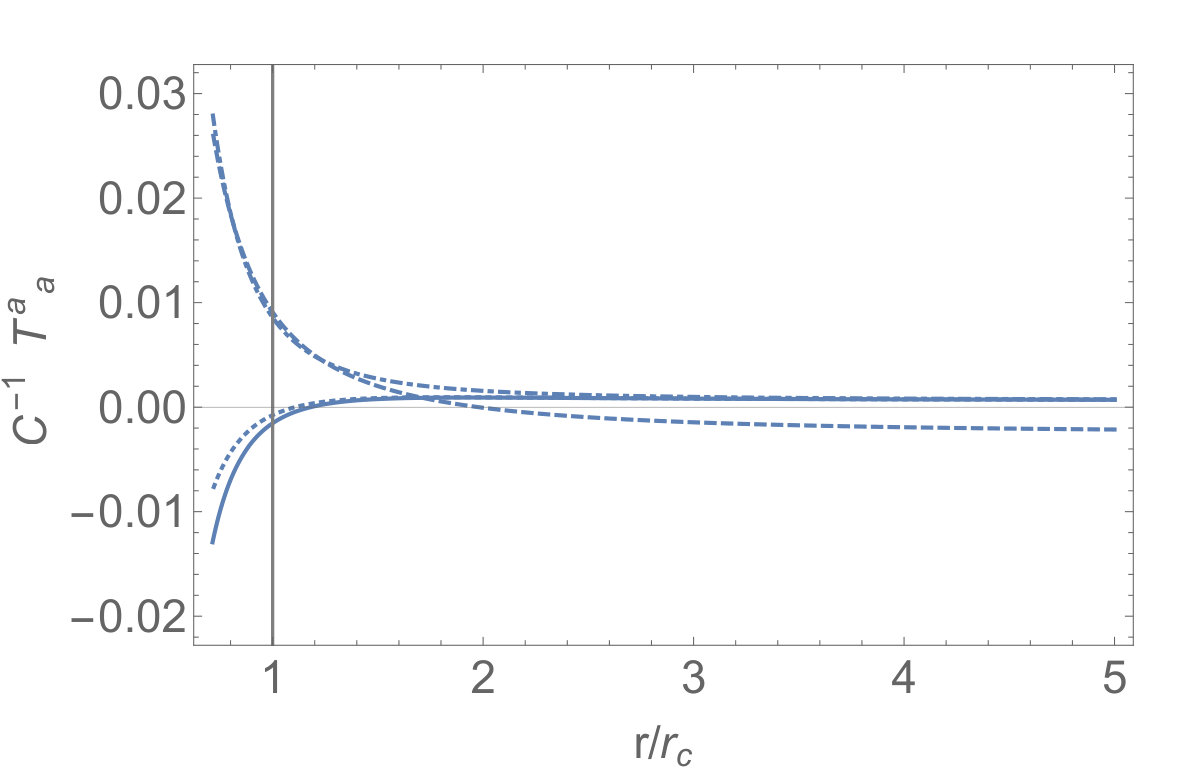 Figure 1
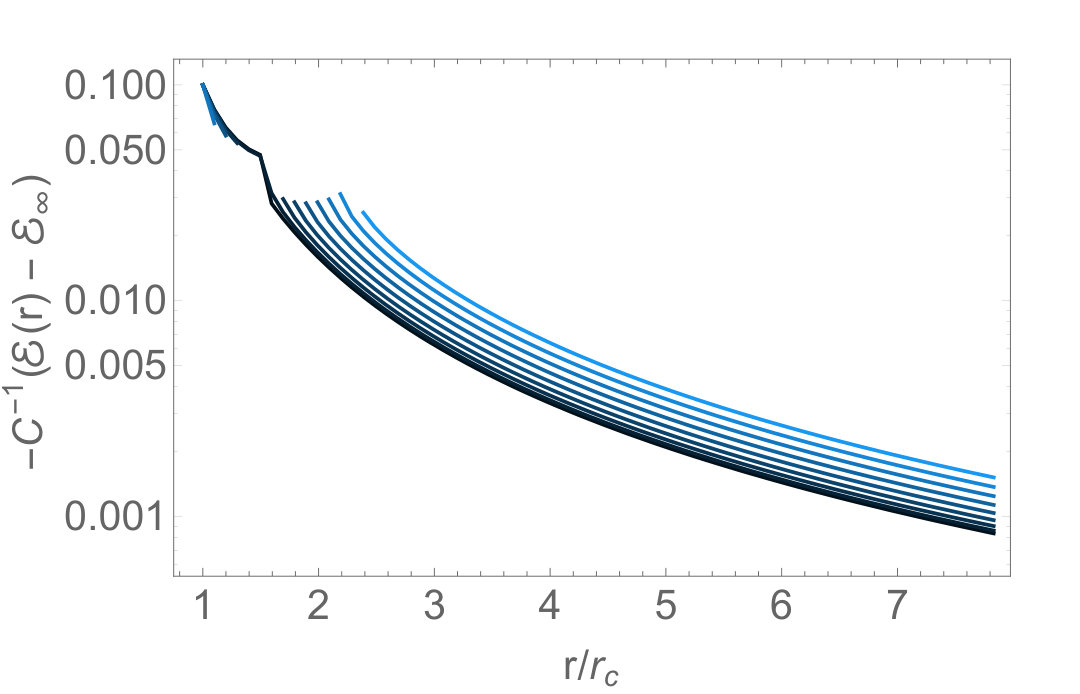 Figure 2
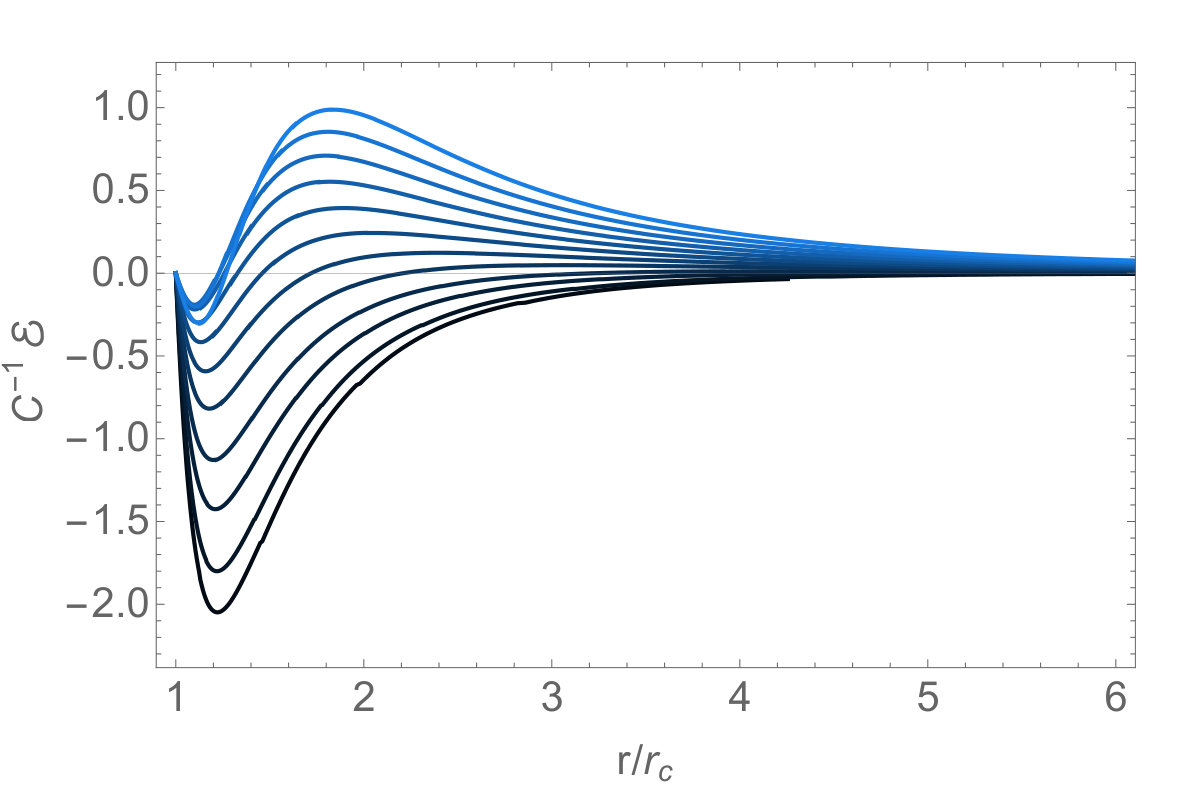 Figure 3
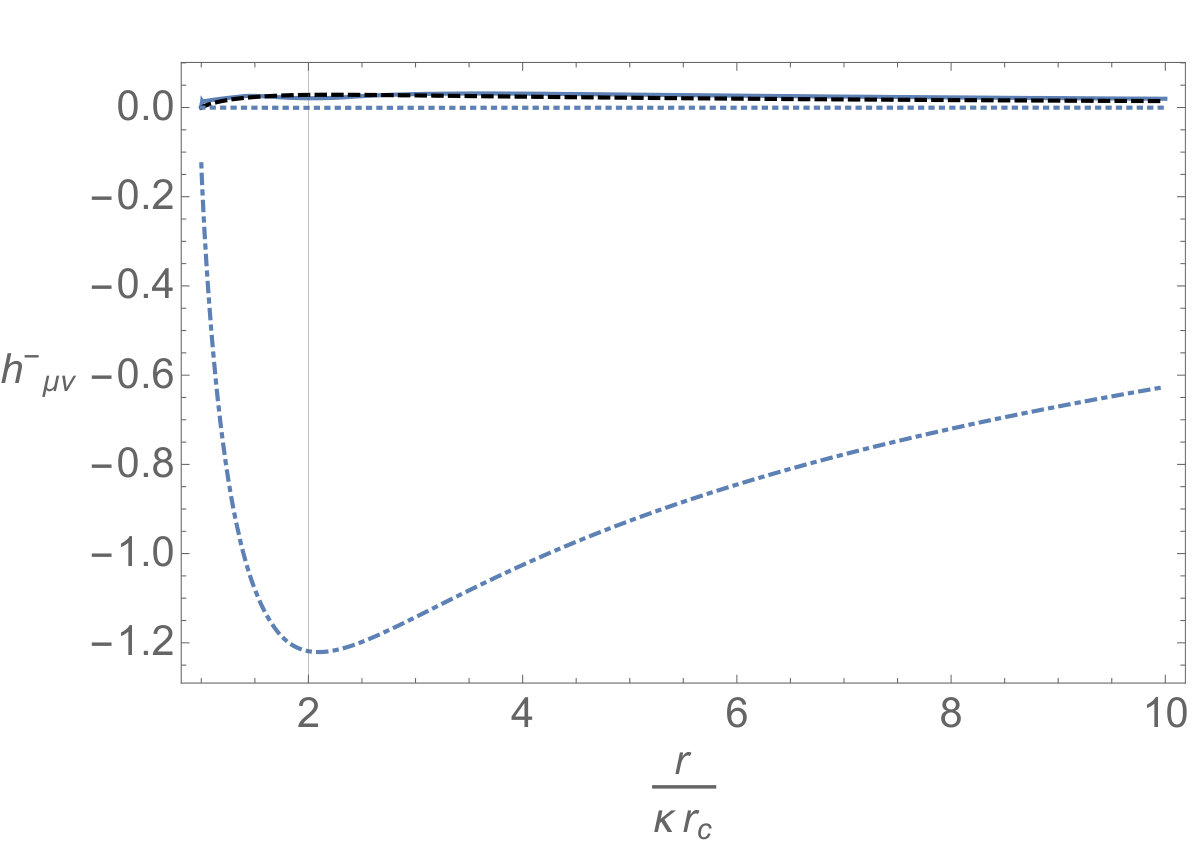 Figure 4
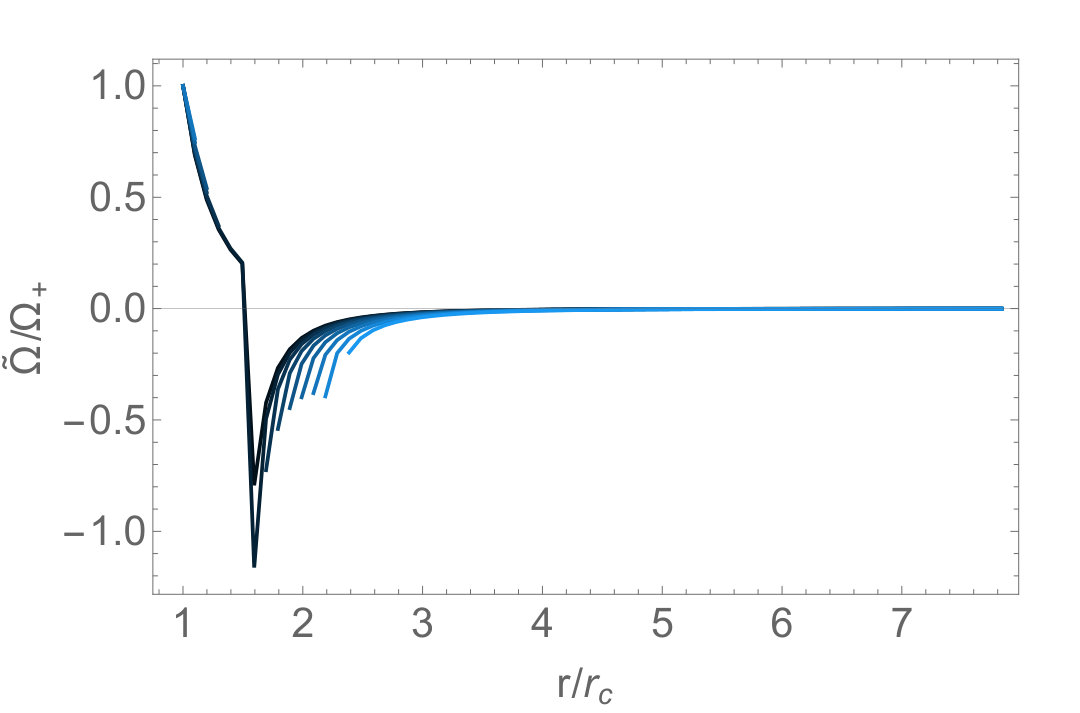 Figure 5
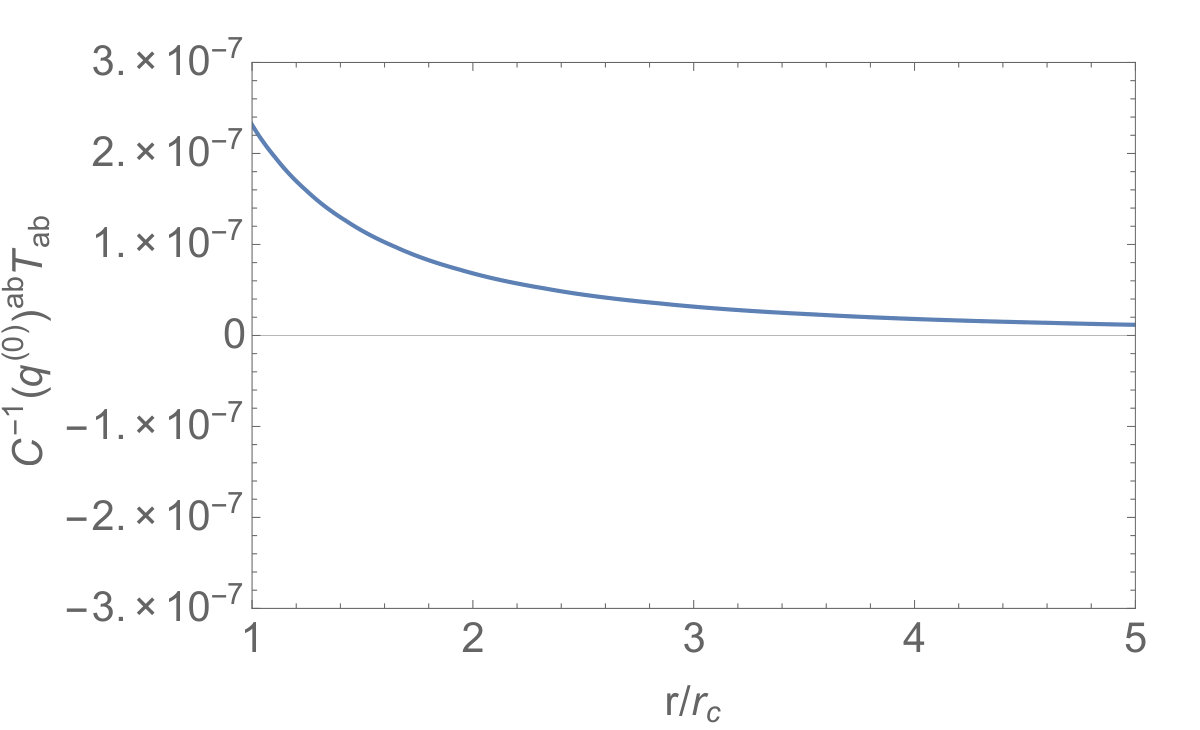 Figure 6
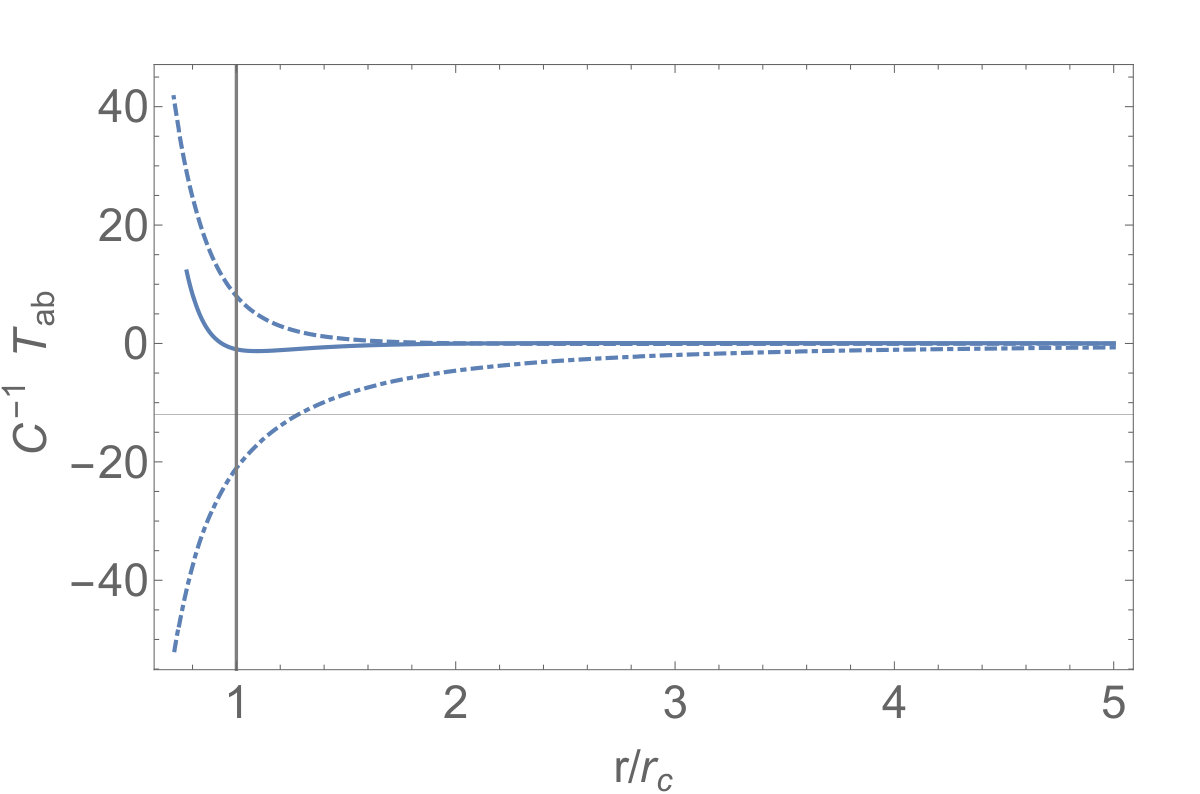 Figure 7
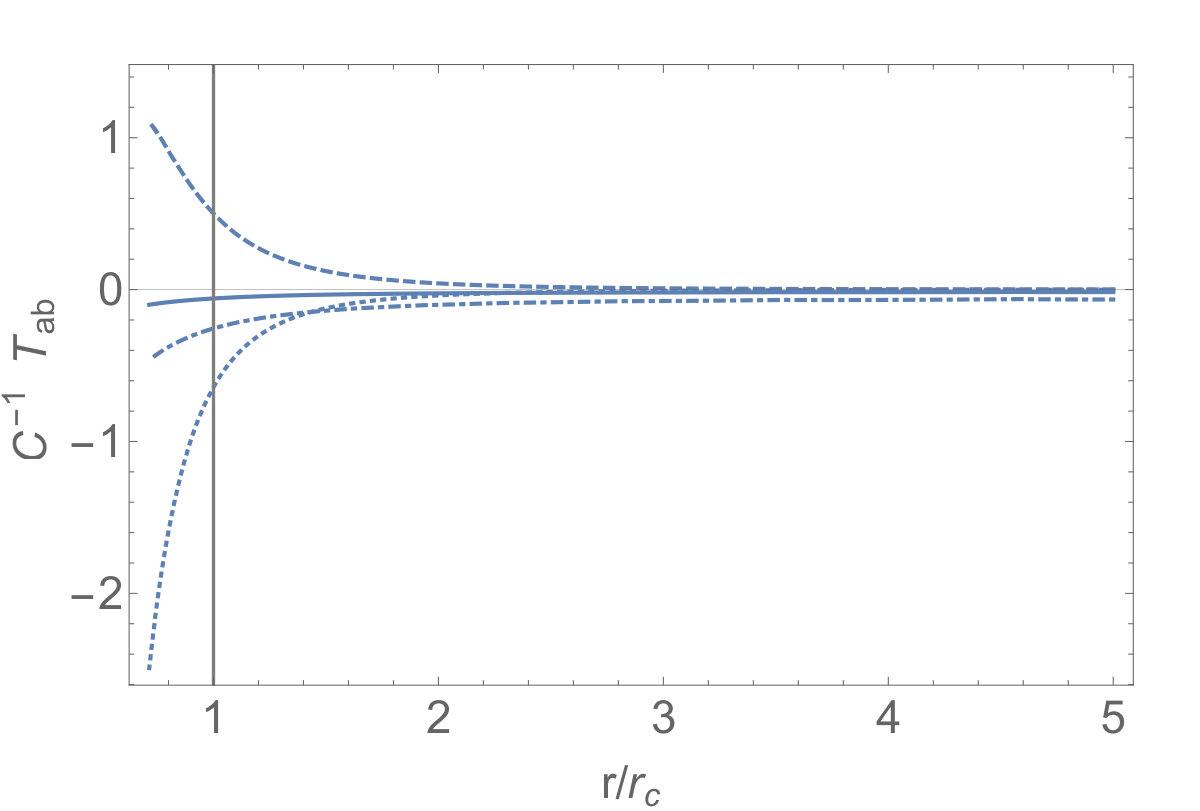 Figure 8
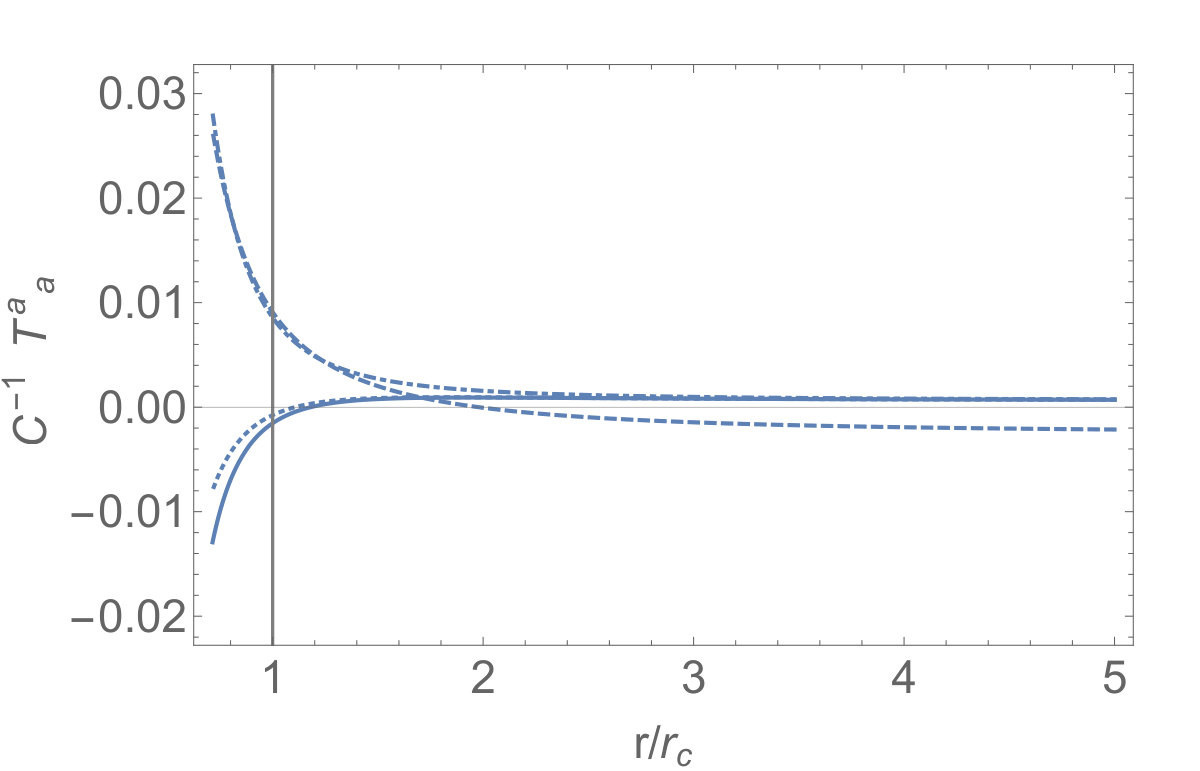 Figure 9
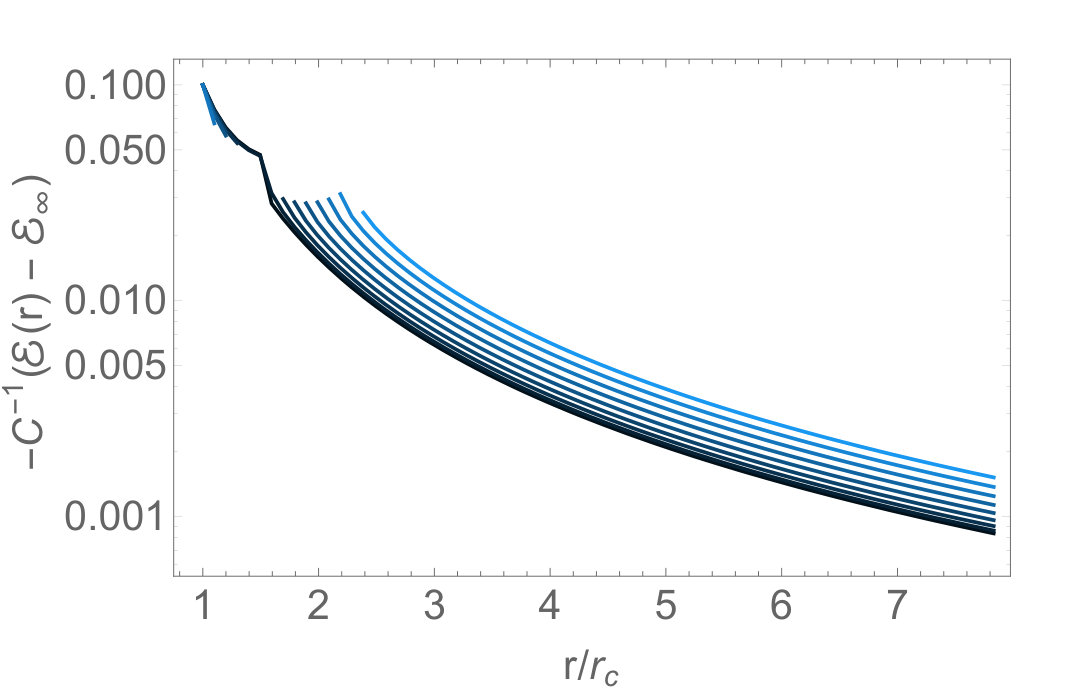 Figure 10
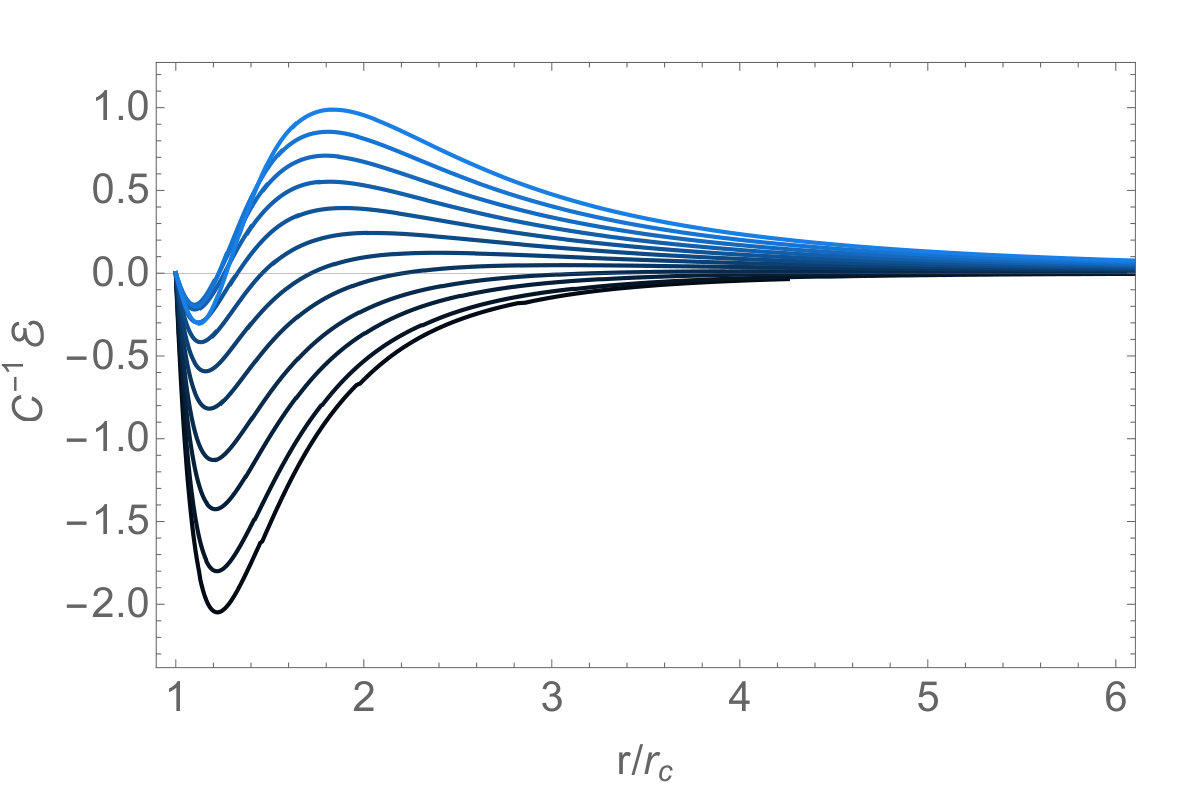 Figure 11
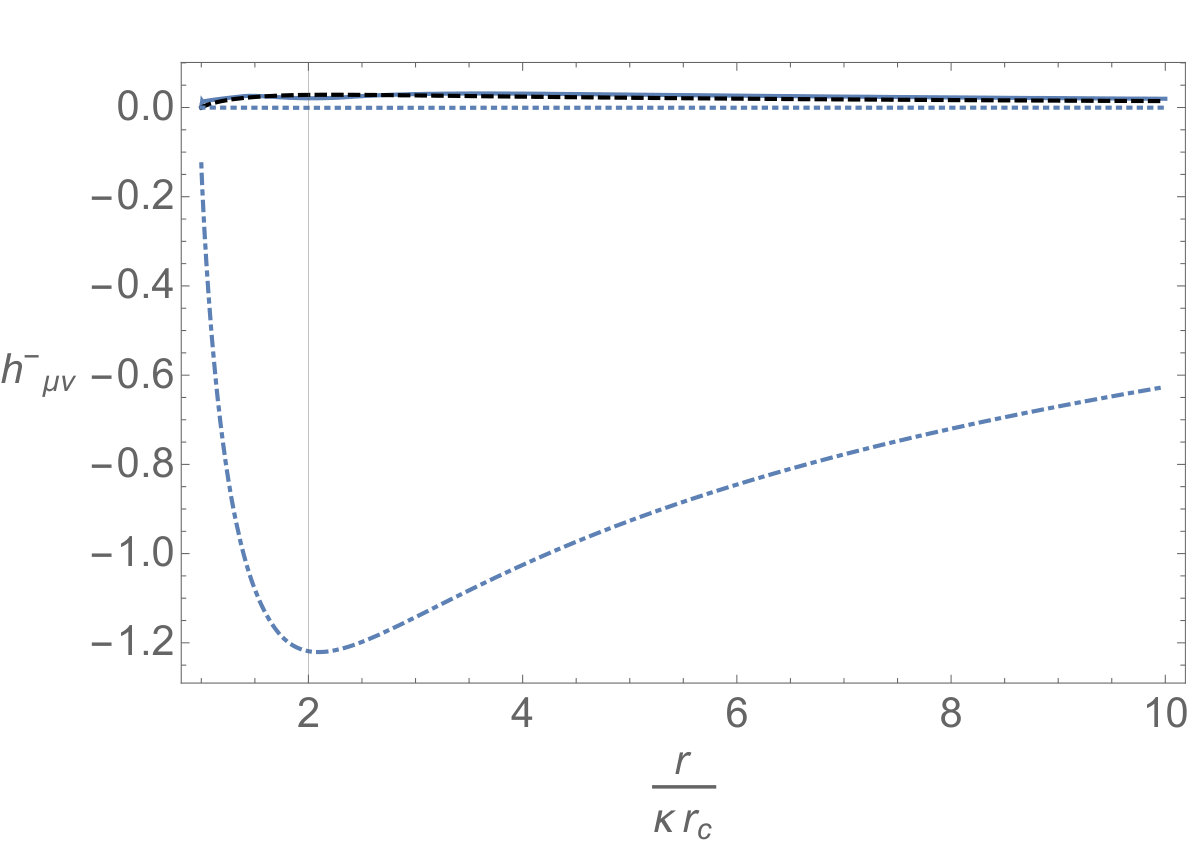 Figure 12
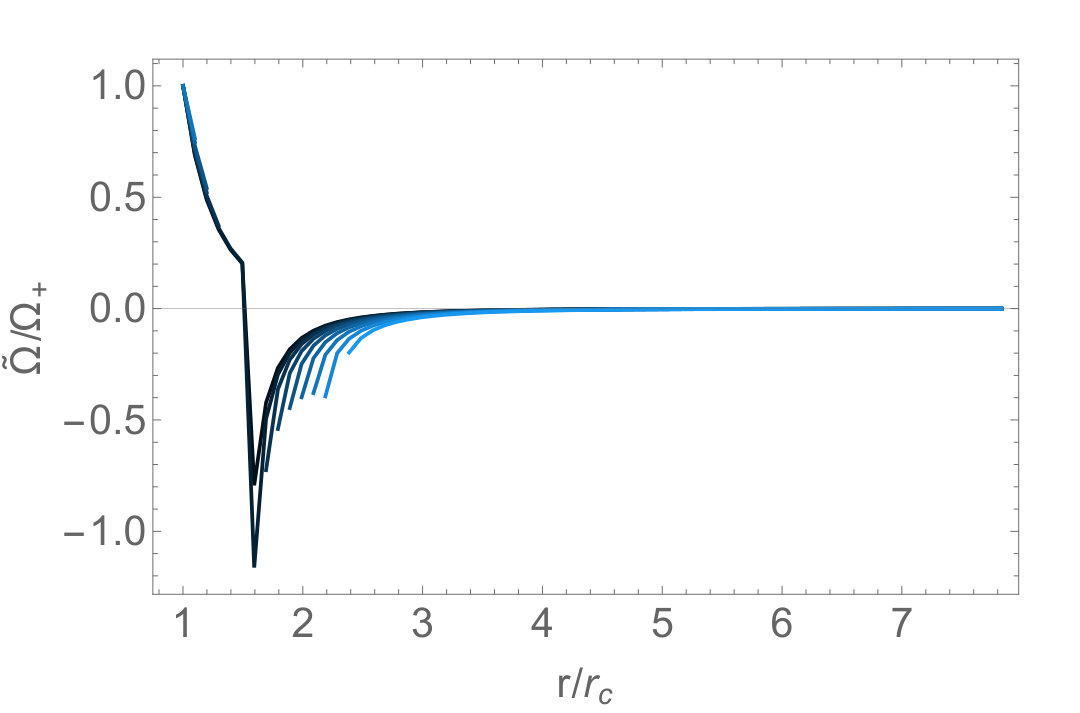 Figure 13
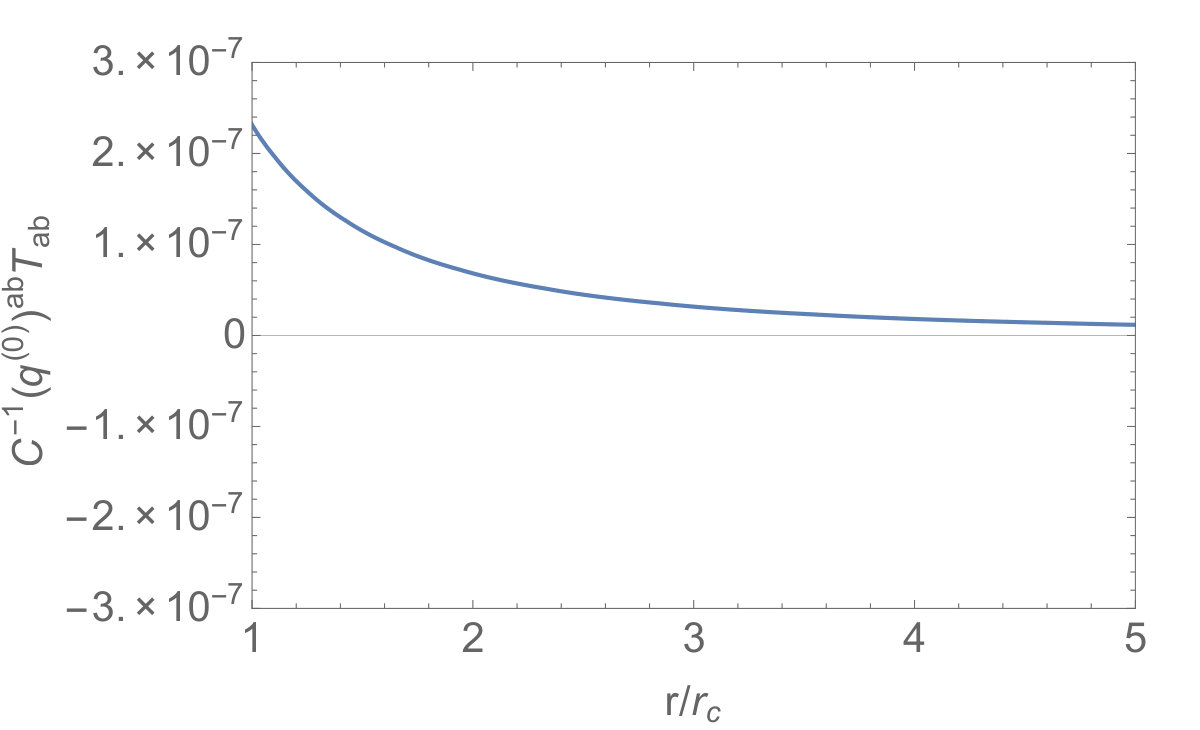 Figure 14
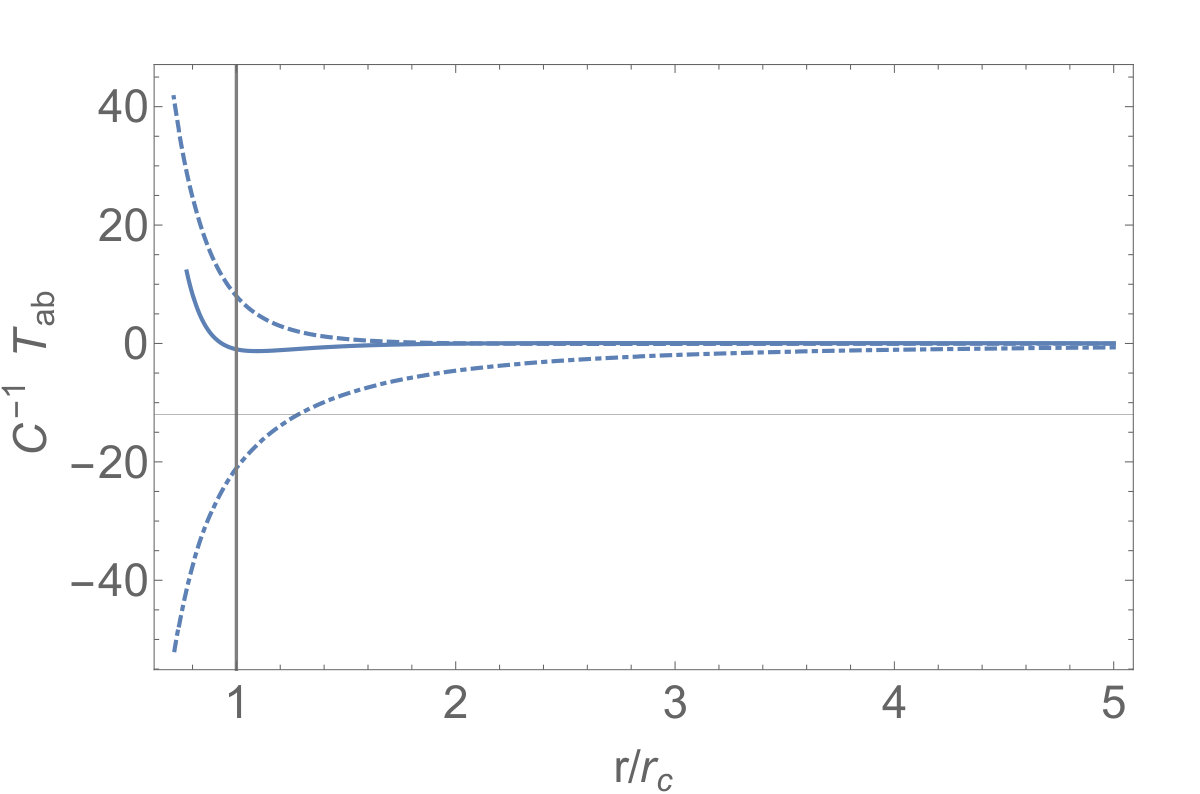 Figure 15
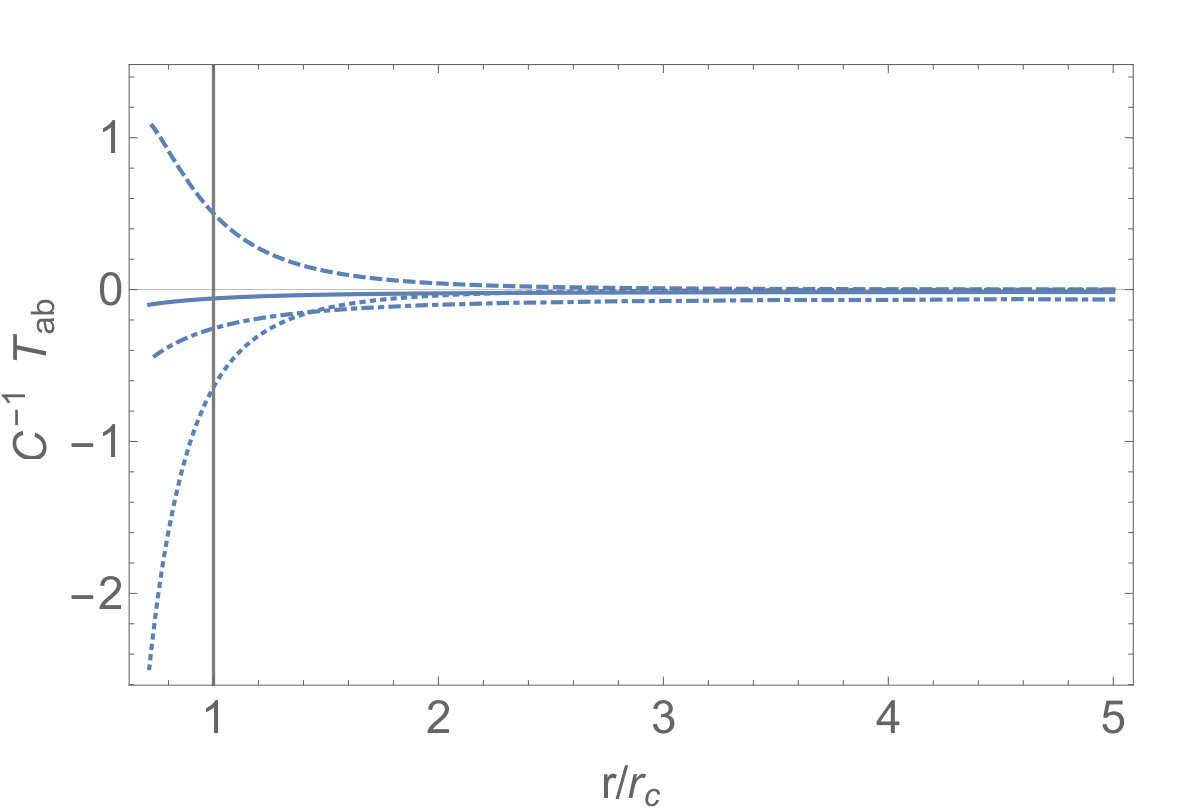 Figure 16
Peer Reviews
No public reviews on file for this paper yet. If you reviewed it on a platform where reviews are public (OpenReview, ICLR, NeurIPS, ICML), you can paste yours below so the community can read it here.
Videos
No videos yet. Explain this paper in a talk, walkthrough, or lecture? Add one.
A holographic stress-energy tensor near the Cauchy horizon
inside a rotating black hole
Akihiro Ishibashi
Department of Physics, Kindai University, Higashi-Osaka, 577-8502, Japan
Kengo Maeda
Faculty of Engineering, Shibaura Institute of Technology, Saitama, 330-8570, Japan
Eric Mefford
Department of Physics, University of California, Santa Barbara, CA 93106, USA
Abstract
We investigate a stress-energy tensor for a CFT at strong coupling inside a small five-dimensional rotating Myers-Perry black hole with equal angular momenta by using the holographic method. As a gravitational dual, we perturbatively construct a black droplet solution by applying the “derivative expansion” method, generalizing the work of Haddad Haddad2012 , and analytically compute the holographic stress-energy tensor for our solution. We find that the stress-energy tensor is finite at both the future and past outer (event) horizons, and that the energy density is negative just outside the event horizons due to the Hawking effect. Furthermore, we apply the holographic method to the question of quantum instability of the Cauchy horizon since, by construction, our black droplet solution also admits a Cauchy horizon inside. We analytically show that the null-null component of the holographic stress-energy tensor negatively diverges at the Cauchy horizon, suggesting that a singularity appears there, in favor of strong cosmic censorship.
I Introduction
One of the outstanding issues in gravity is understanding quantum effects in regions of large spacetime curvature. Although energy densities in typical classical fields such as electromagnetic fields are always non-negative, there have been a number of studies that show the appearance of negative energy density when quantum field effects are taken into account. For instance, it was shown (see, e.g. FPR1998 ) that the energy density for an observer falling into a singularity negatively diverges for some physical vacuum state. On the Cauchy horizon deep inside a charged black hole, the stress-energy tensor was calculated for a two-dimensional massless scalar field model and the energy density diverges at the horizon Hiscock1977 . Calculations of a conformal scalar field in Taub-NUT-type cosmologies show that the stress-energy tensor negatively diverges on the Cauchy horizon even though the curvature remains small HiscockKonkowski1982 . However, most studies have been made for free massless scalar field models and little attention has been given to strongly interacting field models such as CFTs at strong coupling.
The AdS/CFT duality adscft provides a powerful tool to investigate CFTs at strong coupling on a fixed curved background spacetime. According to the dictionary of the duality, a CFT at strong coupling on a fixed -dimensional spacetime is dual to a gravitational theory in -dimensional AdS spacetime with a timelike boundary conformal to the -dimensional spacetime. Motivated by the investigation of Hawking radiation in a model of a CFT at strong coupling, two types of black hole solutions were constructed in asymptotically locally AdS spacetimes Haddad2013 ; HMR2010-1 ; HMR2010-2 ; HMR2010-3 ; CDMS2011 ; FMS2012 ; FischettiMarolf2012 ; SantosWay2012 ; FischettiSantos2013 ; FiguerasTunyasuvunakool2013 ; Eric2016 . One solution is called a “black funnel” in which there is a single connected horizon extending from the conformal boundary to an asymptotically planar horizon in the bulk, and it is dual to the thermal equilibrium Hartle-Hawking vacuum state of the boundary theory. The other is called a “black droplet” solution in which the horizon is disconnected from the planar horizon in the bulk, and it is dual to the Unruh vacuum state. In these models, negative energy density is observed outside the event horizon due to the Hawking effect. However, these solutions are quite complicated and their construction has required numerical methods; hence, it is difficult to analyze general properties of the stress-energy tensor inside the boundary black hole. It is then desirable to have some analytically constructed solutions for a black funnel/droplet. Recently some attempts along this direction have been made by Haddad Haddad2012 111 Note that this expansion method is essentially the same as the one developed for the ”blackfold approach” in EHNO2009 . See also e.g. Armas2013 , for further applications of this method. , who, using a derivative expansion method, has constructed a five-dimensional static black droplet solution and computed the holographic stress-energy tensor for the corresponding dual quantum field in the background of a four-dimensional static black hole background Haddad2013 (See also for the lower dimensional case () HMR2010-1 ; HMR2010-3 ; FischettiMarolf2012 ). It is clearly interesting to generalize the line of research Haddad2012 ; Haddad2013 performed for the static vacuum case to more general cases. In particular, including rotations would drastically change the causal structure inside the resultant black funnel/droplet motivating a study of the holographic consequences of strong coupling in quantum fields near the inner (Cauchy) horizon.
In this paper, we construct a rotating black droplet solution by generalizing the work Haddad2013 . In general, including rotation makes the relevant analysis significantly more complicated compared to the static case. For example, if one attempts to add a rotation to the model of Haddad2013 so that the corresponding boundary field lives in a four-dimensional Kerr black hole–which is already cohomogeneity-two, then one would have to construct a five-dimensional bulk black droplet by solving a cohomogeneity-three system. In order to avoid this technical difficulty, instead of trying to add a rotation to a five-dimensional black droplet, we attempt to construct a six-dimensional rotating black droplet solution dual to a five-dimensional field theory in the background of the rotating Myers-Perry black hole MyersPerry with equal angular momenta, which is known to be cohomogeneity-one. In this case, the derivative expansion method enables us to reduce the bulk field equations to a set of ordinary differential equations, thereby making it possible to compute–analytically and explicitly within our expansion framework–the holographic stress-energy tensor for a CFT at strong coupling and large inside the five-dimensional rotating black hole. In addition, since quantum field theories in odd-dimensions are not well understood, it is of considerable interest to study the behavior of quantum fields in a five-dimensional spacetime. In fact, motivated from recent interests in five-dimensional conformal field theory (see e. g., FiguerasTunyasuvunakool2013 for references), the six-dimensional rotating black droplet solutions dual to the rotating Myers-Perry black hole spacetime with equal angular momenta on the boundary were numerically constructed and the holographic stress-energy tensor was derived in region outside the event horizon FischettiSantos2013 ; FiguerasTunyasuvunakool2013 .
Having two rotations, the rotating droplet solution admits not only an outer event horizon but also an inner (Cauchy) horizon. In this paper, we are primarily concerned with the properties of the holographic stress-energy tensor inside the outer horizon and in particular, investigating the quantum instability of the Cauchy horizon. We find that the null-null component of the stress-energy tensor diverges negatively near the Cauchy horizon, in agreement with the study of free massless scalar fields Hiscock1977 ; HiscockKonkowski1982 . Our results suggest that the Cauchy horizon suffers from a quantum instability in favor of the strong cosmic censorship. As far as we know, this is the first example of applying the holographic method to study the Cauchy horizon instability due to quantum effects. We also find that negative energy appears just outside the outer horizon, describing particle creation by the Hawking effect. Nevertheless, there is no flux at infinity. This suggests that the dual phase corresponds to a transition from black funnels to black droplets, and that it is reminiscent of soft condensed matter systems representing a transition from a fluid-like behavior to rigid behavior, just like a “jammed” state FischettiSantos2013 (see also Eric2016 ).
The paper is organized as follows. In next section, we describe our metric ansatz, derive the equations of motion, and construct a rotating black droplet solution in six-dimensions by using the derivative expansion method. In section III, we perform an analytic computation of the holographic stress-energy tensor for a CFT at strong coupling and large inside the five-dimensional rotating black hole on the boundary. In section IV, we numerically check our results analytically obtained in the previous sections. Section V is devoted to summary and discussion.
II Derivative expansion method
In this section, we derive the field equations following the derivative expansion method Haddad2012 and investigate general properties of the solution. Our bulk field equations are the -dimensional vacuum Einstein equations with negative cosmological constant,
[TABLE]
where is the AdS radius. We start with the following metric ansatz:
[TABLE]
where is an unknown function of and determined later. In the limit and , this metric reduces to the familiar planar Schwarzschild-AdS spacetime with horizon radius after performing the coordinate transformation, . Furthermore, the metric at each hypersurface represents the cohomogeneity-one Myers-Perry black hole solution with equal angular momenta MyersPerry , where the outer and inner (Cauchy) horizons are located at and (), respectively. So, the metric (II) represents a rotating black string embedded in the background planar Schwarzschild-AdS spacetime in which the horizon is extended along -direction. The metric (II) itself does not satisfy the Eqs. (1), and must be corrected order by order in derivatives. To this end, we write the metric as
[TABLE]
where is the formal derivative expansion parameter defined below and is the th correction of the metric determined by the Einstein equations (1). The derivative expansions are valid only when the horizon radius of the string is much smaller than the other scales,
[TABLE]
This implies that the background metric (II) changes very slowly along the -direction compared with the radial scale . Thus, the contributions of the first and second derivatives with respect to -direction to the Einstein Eqs. (1) are suppressed by a factor of and (or similarly, and ).
Following Ref. Haddad2012 , we shall expand the metric functions, , , and in a series of around an arbitrary value as
[TABLE]
where collectively denotes the metric functions such as , , and , and the expansion coefficients are . Note that the expansion coefficients are functions of only , but and , are independent of .
So, the Einstein Eqs. (1) are formally modified to
[TABLE]
where . This implies that the effect of the cosmological constant appears at second order in the derivative expansion (5). Note that the derivative expansion parameter will be set to unity at the end of our calculations.
II.1 First order in derivatives
Substituting Eqs. (II) and (II) into Eqs. (6) one finds that the field Eqs. (6) are satisfied at first order by
[TABLE]
provided that the following two equations with respect to
[TABLE]
are satisfied. When
[TABLE]
is satisfied, the solution satisfying both two equations (II.1) is given by
[TABLE]
where is an integration constant. We discard the integration constant because it can be eliminated by gauge transformation of . In this case, limit agrees with the non-rotating four-dimensional black string case Haddad2012 .
II.2 Second order in derivatives
At second order, , we make an ansatz for the non-zero perturbed metric as
[TABLE]
We derive equations of motion for the metric functions above by substituting Eqs. (II), (II), and (II.2) into (6) and also using given by (10) with replaced by . The equation of motion for is decoupled from the other variables as
[TABLE]
where the source term is explicitly given by Eq. (A). The general solution includes two integral constants, one of which is determined by imposing the regularity on the horizon . Then, we obtain the following analytic solution,
[TABLE]
where is the remaining integral constant. Hereafter, we discard this constant becuase it can be eliminated by making a gauge transformation Haddad2012 . We find that we can solve for in terms of the other variables, so we need only solve three coupled second order differential equations for , , and .
[TABLE]
[TABLE]
[TABLE]
[TABLE]
where , , and are functions of given by Eqs. (A), (A), and (A) in the Appendix. From the other constraint equations, we obtain the coefficient as
[TABLE]
Combining Eqs. (9) and (18), we obtain
[TABLE]
up to second order in the derivative expansion, where is the radius of at the AdS boundary, . Just as in the non-rotating five-dimensional black string case Haddad2012 , the droplet horizon shrinks to zero at the horizon of the planar Schwarzschild-AdS spacetime, ending on the horizon.
These three equations (II.2), (II.2), and (II.2) have a singular source term arising from in (II.2). This implies that , , and can be expanded near the inner (Cauchy) horizon as
[TABLE]
Note that we have assumed that the black droplet solution is non-extremal, i. e. , , in the expansion. Substituting these into Eqs. (II.2), (II.2), and (II.2), we obtain all the coefficients provided that the coefficients , , , , , and are given. This implies that six independent mode solutions exist for the second order differential equations (II.2), (II.2), and (II.2). For the discussions in the next section, it suffices to obtain the relation between the leading order coefficients , , and . The remaining subleading coefficients are determined by numerics in Sec. IV.
The leading coefficients and are determined by as
[TABLE]
By Eq. (II.2), we also find the asymptotic behavior of near the Cauchy horizon:
[TABLE]
II.3 The non-rotating case
In the non-rotating case (), Eqs. (II.2) and (II.2) respectively for and are decoupled from the other variables and we can set . Furthermore, we obtain analytic expressions for and from Eqs. (II.2), (II.2), and (II.2):
[TABLE]
where and are constants that correspond to a global shift in the temperature as explained in Haddad2012 , so we must set it to zero.
III The holographic stress-energy tensor
In this section, we calculate the holographic stress-energy tensor using the prescription of EJM1999 , up to the second order in . In the six-dimensional bulk theory, the regularized action becomes
[TABLE]
where is the Ricci scalar of the induced metric at associated with the unit normal outward pointing vector , and is the trace of the extrinsic curvature defined below. Note that the first three terms in the second line are sufficient to cancel the divergences. Furthermore, the last two terms are at , since the induced metric is the vacuum Myers-Perry black hole MyersPerry at zeroth order, i. e. , . Thus, the holographic stress-energy tensor , given by , becomes
[TABLE]
where is the Einstein tensor of the induced metric , and is the extrinsic curvature defined by
[TABLE]
If the metric (II) is decomposed into
[TABLE]
is rewritten by
[TABLE]
where is the covariant derivative with respect to the induced metric , and the lapse function and the shift vector are given by
[TABLE]
Note that , as it includes the derivative with respect to from Eq. (II). Thus, if we expand , , and as
[TABLE]
is determined by as
[TABLE]
where denotes the covariant derivative with respect to . Then, Eq. (25) reduces to
[TABLE]
This implies that the second order perturbation contributes to the stress-energy tensor only through the Einstein tensor, up to .
First, we investigate the stress-energy tensor in the static case (). Substitution of Eqs. (II.3) into Eq. (32) yields
[TABLE]
where . It is easily checked that the conservation law is satisfied. Near the outer horizon , negative energy density appears, i.e., . This implies that due to the Hawking effect, pair creation of particles occurs near the horizon, and the negative energy particles are absorbed into the horizon. Nevertheless, there is no flux at null infinity. This is verified by checking that the -component of the stress-energy tensor in the original coordinate system becomes zero at null infinity. This is due to strong coupling effects of the dual CFT in the boundary theory, just as in the five-dimensional case Haddad2013 . It is also immediately checked that the trace of our stress-energy tensor vanishes, in agreement with the general argument that odd dimensional CFTs have a vanishing trace anomaly.
Next, we investigate the stress-energy tensor near the inner (Cauchy) horizon in the rotating case. Note that is regular near the Cauchy horizon at because and the shift vector are regular there. Thus, the dominant term of in Eq. (25) near the Cauchy horizon comes from the Einstein tensor . As shown in Eqs. (II.2), (II.2) and (22), the second order metric diverges near the Cauchy horizon. So, the relevant (i.e., -) component of the Einstein tensor can be expanded as
[TABLE]
where is a constant. As for the other components, the leading term in order behave as , and therefore are irrelevant to the rest of our arguments.
The most striking feature is that in Eq. (34) negatively diverges at the Cauchy horizon. This implies that the null energy condition is strongly violated along the null direction, near the Cauchy horizon:
[TABLE]
Interestingly, this behavior is very similar to the case of massless scalar field in two-dimensions Hiscock1977 ; HiscockKonkowski1982 ; in both cases, the stress-energy tensor negatively diverges as .
IV Numerical results
When we add rotation to our droplets, we must solve the second order equations numerically. To account for the logarithmic divergences in and , as well as the pole in , we make the following ansatz,
[TABLE]
In the last equation, the coefficient of is required to have vanish as goes to infinity, matching the non-rotating case.
We insert these ansatz into (II.2) and find eight equations to solve numerically–four from the coefficients of involving only and and four remaining equations involving these variables as well as . It is numerically convenient to also set and work in terms of a variable in order to impose boundary conditions at spatial infinity.
As we did in the analytic case, we can perform a series expansion in powers of near the Cauchy horizon to find appropriate boundary conditions on our new metric functions,
[TABLE]
where refers collectively to . This expansion reflects the fact that the divergences in come only from a log term sourced by and there is an extra divergence of in . Inserting this expansion into our eight differential equations and solving order by order in leads to the following boundary conditions,
[TABLE]
as well as the previously derived conditions, Eq. (II.2). Furthermore, the expansion leads to the following constraint at the horizon,
[TABLE]
We can likewise perform a series expansion at spatial infinity in powers of (recall corresponds to spatial infinity) to find appropriate boundary conditions. This leads to
[TABLE]
Note that these boundary conditions correspond to imposing a single constraint on the free parameters and in Eq. (II.2).
Finally, there are a few boundary conditions which me must impose by hand. These are analogous to the constants and in Eq. (II.3). To smoothly match onto the non-rotating case, we choose and . This choice is equivalent to imposing .
These boundary conditions are not sufficient to ensure smooth solutions because the point is a (regular) singular point of our differential equations. To accommodate this singularity, we used two numerical regions, and (this is only necessary for ). We impose continuity of our functions and match the first derivatives of our functions at this point. Regularity of the differential equation, or similarly smoothness of and at our singular point, amounts to two constraints. In total, we start with four free constants, , and and fix three by hand to smoothly match onto the non-rotating solution. The final constant is fixed by consistency of the two constraints coming from the smoothness of .
To find these numerical solutions, we use the Newton-Raphson method with pseudospectral collocation over a Chebyshev grid in the two numerical domains. In figure 1, we have plotted our solutions for (reexpressed in terms of the original radial coordinate ). Importantly, we have included only the finite pieces of the solutions, subtracting off the divergent pieces. For example, using the notation of (II.2),
[TABLE]
and similarly for .
We have also plotted the non-vanishing components of the stress-energy tensor for this solution in figure 2. We have only included the part of the stress-energy tensor near because the behavior of the stress-energy tensor near the Cauchy horizon can be derived from (II.2) as was done for in (35). To verify that we obtained the correct holographic stress-energy tensor, we varied between and and checked that did not change.
As pointed out for the non-rotating case, an interesting quantity is the energy density near the outer horizon. The local energy density may be found by diagonalizing the stress-energy tensor , as done in FiguerasTunyasuvunakool2013 . The stress-energy tensor in our spacetime is diagonalizable near the horizon and far from the horizon, but there is an intermediate region
[TABLE]
where the stress-energy tensor diagonalization breaks down. This is likely a result of our expansion, as in a fully non-perturbative solution like FiguerasTunyasuvunakool2013 , no such region was seen, though it is notable that our solution contains a finite temperature, rather than extremal, bulk horizon. Following FiguerasTunyasuvunakool2013 , In the region where this decomposition is well-defined, we may write
[TABLE]
where is the (unique) normalized timelike eigenvector and can be interpreted as the energy density observed by the timelike observer with velocity . At leading order in and ,
[TABLE]
The plus sign in this equation corresponds to the near horizon region, while the minus sign corresponds to the region far from the horizon.
The energy density obtained from the decomposition is plotted in figure 3 for different values of . Just as in the non-rotating case, the region of negative energy density extends all the way from the horizon to spatial infinity. Interestingly, at spatial infinity, the energy density approaches a constant,
[TABLE]
This should not be surprising because far from the boundary black hole, the CFT should be in a thermal state, with an energy density corresponding to the temperature of the bulk black hole. In fact, this value matches the energy density for a CFT dual to a 6 dimensional planar-AdS Schwarzschild black brane. Furthermore, this value is independent of as it should be, since our boundary black holes are asymptotically flat and a similar result was seen for in Haddad2013 . In figure 3, we have subtracted this asymptotic value from the energy density to emphasize that a local observer near the black hole measures an energy density less than the thermal energy density because of quantum effects in the curved background spacetime.
Interestingly, our energy density approaches as , rather than the decay observed in FiguerasTunyasuvunakool2013 . This less steep fall-off could be a consequence of our derivative expansion method. However, it is also notable that our droplet solution ends on a finite temperature black brane horizon, whereas in FiguerasTunyasuvunakool2013 , the bulk horizon was extremal (the Poincaré horizon) and the black droplet was disconnected. Similar fall-off discrepancies were seen in numerical constructions of five dimensional static droplets, where the energy density decayed as with an extremal bulk horizon Figueras2011 , but as for a finite temperature bulk horizon SantosWay2014 . Importantly, as in the analytic case, for an observer with tangent vector , for all choices of , the energy density diverges negatively as near the Cauchy horizon.
We also can use the stress-energy tensor eigenvalue decomposition to define rotation of the dual plasma. Again, following FiguerasTunyasuvunakool2013 ), we write the timelike eigenvector of the stress-energy tensor as
[TABLE]
and define to be the rotation. At the outer horizon, this becomes (at zeroth order in )
[TABLE]
which, on the conformal boundary, matches the future generator of the horizon at . Note that the rotation decays as , rather than the fall-off seen in FiguerasTunyasuvunakool2013 . The faster fall-off could again be a consequence of our perturbative expansion, though more likely a result of the droplet ending on a finite temperature bulk horizon.
To better understand the energy density in regions of the spacetime where is not diagonalizable, we instead define a new vector, timelike everywhere outside the outer horizon,
[TABLE]
which also approaches at the outer horizon and goes to near spatial infinity. An observer with this tangent vector would see the energy density plotted in figure 4, which is regular everywhere and still has the important feature of being negative near the event horizon. Furthermore, the localization of negative energy density near the event horizon is reminiscent of Eric2016 and illuminates the “jammed” nature of the dual CFT. Here too, because near spatial infinity, the energy density also approaches , indicative of the CFT in a thermal phase. This tangent vector, however, becomes spacelike inside the outer event horizon, and so is not useful to illustrate strong cosmic censorship. In this region, is well-defined and diverges on the Cauchy horizon.
We emphasize that while the stress-energy tensor diverges on the Cauchy horizon, it is finite at so that it is regular on the past and future event horizons (shown in figure 2). Finally, one can check that the trace of stress-energy tensor vanishes at leading order, as expected for a CFT in odd spacetime dimensions, just as in the non-rotating case. In figure 5, we have plotted the diagonal components of the holographic stress-energy tensor, (no sum) as well as the trace. From this figure, it is clear that the sum vanishes as we approach the conformal boundary, (i.e. ). One can also check explicitly from the definition of the stress-energy tensor (32) and the equations of motion for (II.2–II.2), that the trace vanishes as , exactly following the non-rotating case.
To summarize our numerical results, for generic rotation parameter, , of our boundary black hole, the CFT plasma exhibits the following features. The stress-energy tensor is traceless to leading order in and regular on the outer event horizon. For a timelike observer, there is a region near the event horizon which has negative energy density. As a timelike observer approaches spatial infinity, the energy density seen by such an observer approaches that of the thermal CFT dual to a six dimensional planar AdS-Schwarzschild black brane. Depending on the observer’s velocity, the energy density may remain less than this asymptotic value for all of space, as for the observer with tangent vector , or there may be a region with positive energy density, as in the observer with tangent vector . In all cases, this negative energy density diverges on the Cauchy horizon, as shown in Eq. (35), in favor of strong cosmic censorship.
V Conclusion and discussions
In this paper we have analytically constructed a rotating black droplet solution embedded in the planar Schwarzschild-AdS black brane spacetime by applying the generalized derivative expansion method, which was originally developed for the static case Haddad2012 . Our method is valid when the horizon size of the black droplet is much smaller than the horizon size of the planar Schwarzschild-AdS black brane (and the curvature radius of the background AdS space). In this case, the derivative of the metric along the bulk radial direction, , is much smaller than the one along the droplet radial direction, (parallel to the planar horizon). Then, order by order in the derivative expansion, we have been able to solve the Einstein equations. The horizon radius of the thin black droplet solution gradually shrinks toward the planar horizon and caps off smoothly just at the horizon. Since the temperature of the black droplet solution is much higher than the temperature of the background planar horizon, the dual boundary state can be interpreted as the Unruh state Haddad2013 . For our black droplet solution, we have–analytically and holographically–computed the null-null components of the stress-energy tensor for a strongly coupled CFT in the boundary five-dimensional rotating Myers-Perry black hole spacetime. First, we have found that the negative energy appears just outside the event horizon, which can be interpreted as a consequence of the particle production by the Hawking effect. We show, however, there is no energy flux at infinity, as in the static case studied in Haddad2013 , and therefore our boundary CFT can be viewed as a jammed state. We have also studied the behavior of the holographic stress-energy tensor near the inner Cauchy horizon. The null-null component of the stress-energy tensor corresponds to the energy density seen by an observer whose world line is transverse to the Cauchy horizon. We have found that the null-null component negatively diverges at the Cauchy horizon, suggesting that due to quantum effects, the Cauchy horizon would become singular, in favor of strong cosmic censorship.
Although we have not analyzed the classical instability of our droplet solution in the present paper, we expect our solution to show a classical instability or divergence of curvature scalars inside the event horizon. In fact, it was shown in MOK that in general, adding stationary but spatially inhomogeneous linear perturbations makes inhomogeneous black branes unstable, rendering the Kretschmann scalar with respect to the perturbed geometry divergent on the Cauchy horizon. Viewing our black droplet solution as a type of an inhomogeneous black string in the bulk and applying the general argument of MOK , our droplet solution should also exhibit the divergence of curvature scalars at the Cauchy horizon even inside the bulk . In the spirit of the bulk-boundary duality, our result of the quantum divergence of the stress-energy tensor at the Cauchy horizon in the boundary geometry may be viewed as a holographic realization of the classical divergence of curvatures at the Cauchy horizon in the bulk geometry.
Acknowledgments
This work was supported in part by JSPS KAKENHI Grant Number 15K05092(AI), 26400280, 17K05451 (KM) as well as by NSF grant PHY-1504541 (EM).
Appendix A Expressions for , , , and
We provide the explicite expressions for , , , and , appeared in (II.2), (II.2), (II.2), and (II.2).
[TABLE]
[TABLE]
[TABLE]
[TABLE]
The reference list from the paper itself. Each links out to its DOI / PubMed record.
- 1(1) N. Haddad, “Black Strings Ending on Horizons,” Class. Quantum Grav. 29 (2012) 245001.
- 2(2) R. Emparan, T. Harmark, V. Niarchos, and N. A. Obers, Phys. Rev. Lett. 102 (2009) 191301.
- 3(3) J. Armas, JHEP 1309 (2013) 073
- 4(4) L. H. Ford, M. J. Pfenning, and T. A. Roman, “Quantum inequalities and singular negative energy densities”, Phys. Rev. D 57 (1998) 4839.
- 5(5) W. A. Hiscock, “Stress-energy tensor near a charged, rotating, evaporating black hole,” Phys. Rev. D 15 (1977) 3054.
- 6(6) W. A. Hiscock and D. A. Konkowski, “Quantum vacuum energy in Taub-NUT (Newman-Unti-Tamburino)-type cosmologies,” Phys. Rev. D 26 (1982) 1225.
- 7(7) J. Maldacena, “The Large N limit of superconformal field theories and supergravity” Adv. Theor. Math. Phys. 2 (1998) 231, O. Aharony, S. Gubser, J. Maldacena, H. Ooguri, and Y. Oz, “Large N field theories, string theory and gravity” Phys. Rep. 323 (2000) 183.
- 8(8) V. E. Hubeny, D. Marolf, and M. Rangamani, “Hawking radiation in large N strongly-coupled field theories,” Class. Quantum Grav. 27 (2010) 095015.