On generalization of D'Aurizio-S\'andor trigonometric inequalities with a parameter
Li-Chang Hung, Pei-Ying Li

TL;DR
This paper generalizes the D'Aurizio-Sándor trigonometric inequalities using an elementary approach, providing alternative proofs and extending the inequalities to hyperbolic functions.
Contribution
It introduces a new generalized form of the D'Aurizio-Sándor inequalities and extends their applicability to hyperbolic functions.
Findings
New generalized inequalities for trigonometric functions
Alternative proof of existing inequalities
Extension to hyperbolic functions
Abstract
In this work, we generalize the D'Aurizio-S\'andor inequalities (\cite{D'Aurizio,Sandor}) using an elementary approach. In particular, our approach provides an alternative proof of the D'Aurizio-S\'andor inequalities. Moreover, as an immediate consequence of the generalized D'Aurizio-S\'andor inequalities, we establish the D'Aurizio-S\'andor-type inequalities for hyperbolic functions.
Click any figure to enlarge with its caption.
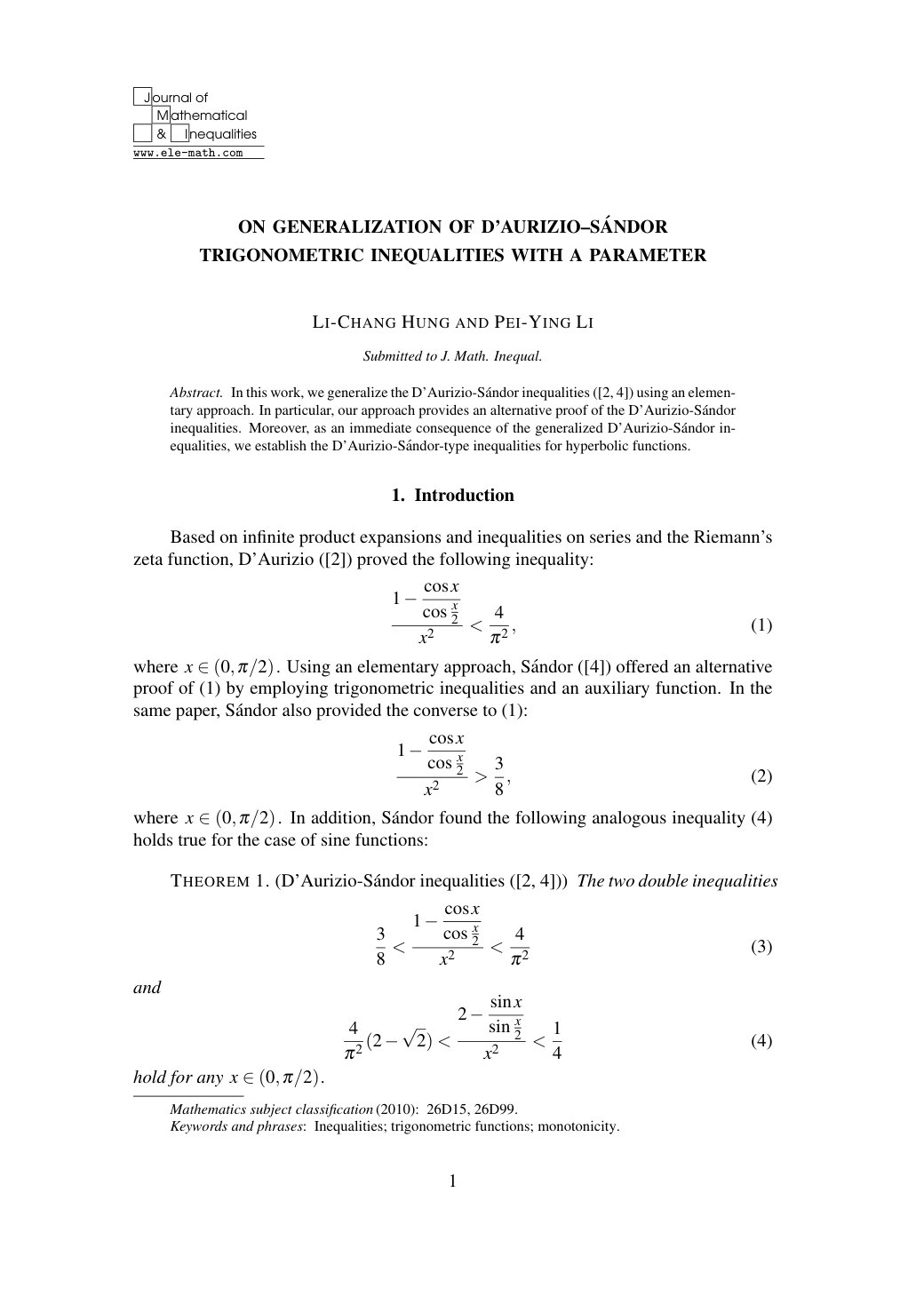 Figure 1
Peer Reviews
No public reviews on file for this paper yet. If you reviewed it on a platform where reviews are public (OpenReview, ICLR, NeurIPS, ICML), you can paste yours below so the community can read it here.
Videos
No videos yet. Explain this paper in a talk, walkthrough, or lecture? Add one.
Taxonomy
TopicsMathematical Inequalities and Applications · Functional Equations Stability Results · Mathematics and Applications
On generalization of D’Aurizio-Sándor trigonometric inequalities with a parameter
Li-Chang Hung and Pei-Ying Li
Abstract
In this work, we generalize the D’Aurizio-Sándor inequalities ([1, 3]) using an elementary approach. In particular, our approach provides an alternative proof of the D’Aurizio-Sándor inequalities. Moreover, as an immediate consequence of the generalized D’Aurizio-Sándor inequalities, we establish the D’Aurizio-Sándor-type inequalities for hyperbolic functions.
1 Introduction
Based on infinite product expansions and inequalities on series and the Riemann’s zeta function, D’Aurizio ([1]) proved the following inequality:
[TABLE]
where . Using an elementary approach, Sándor ([3]) offered an alternative proof of (1) by employing trigonometric inequalities and an auxiliary function. In the same paper, Sándor also provided the converse to (1):
[TABLE]
where . In addition, Sándor found the following analogous inequality (4) holds true for the case of sine functions:
Theorem 1** (D’Aurizio-Sándor inequalities ([1, 3])).**
The two double inequalities
[TABLE]
and
[TABLE]
hold for any .
Throughout this paper, we denote and by and , respectively:
[TABLE]
Our aim is to generalize the D’Aurizio-Sándor inequalities for the case of and as follows:
Theorem 2** (Generalized D’Aurizio-Sándor inequalities).**
Let . Then the two double inequalities
[TABLE]
and
[TABLE]
hold for . In particular, the double inequality (8) remains true when while the double inequality (7) is reversed when .
The remainder of this paper is organized as follows. Section 2 is devoted to the proof of Theorem 2 and an alternative proof of Theorem 1. In Section 3, we establish analogue of Theorem 2 for hyperbolic functions. As an application of Theorem 2, we apply in Section 4 inequality (8) to the Chebyshev polynomials of the second kind and establish a trigonometric inequality.
2 Proof of the main results
At first we will prove the following lemma. The lemma provides expressions of the higher-order derivative involving , which are helpful in proving Theorem 2. We note that the sign of plays a crucial role in proving Theorem 2.
Lemma 1**.**
Let and . Then when and , we have
[TABLE]
[TABLE]
In particular,
when ,
[TABLE]
when ,
[TABLE]
For and ,
[TABLE]
- Proof.
, and follows directly from calculations using elementary Calculus. In particular, trigonometric addition formulas are used in proving and . To prove (11), we claim
[TABLE]
Indeed, we rewrite
[TABLE]
On the other hand, making use of Euler’s formula leads to an alternative expression of the left-hand side of (16):
[TABLE]
where is the real part of and . Now it suffices to show
[TABLE]
Using () in , this can be achieved by straightforward calculations. Thus is true. The proof of is similar, and we omit the details. We complete the proof of Lemma 1.∎
∎
We provide here an alternative proof of the two double inequalities in Theorem 1.
- Proof of Theorem 1.
To this end, we show that for , is strictly increasing while is strictly decreasing. These lead to the desired inequalities since it is easy to see that
[TABLE]
To see is strictly increasing, we employ () in Lemma 1 to obtain
[TABLE]
As , it follows that . We are led to or since . This that shows is strictly increasing.
By using (11) in Lemma 1, we have
[TABLE]
from which we infer that since by of Lemma 1. Then
[TABLE]
together with the fact from of Lemma 1 yields or . Thus we have shown that is strictly decreasing. This completes the proof of the theorem.∎∎
We are now in the position to give the proof of Theorem 2.
- Proof of Theorem 2.
The proof of the case when has been given in Theorem 2. For , we prove the desired inequalities by showing that for . Due to of Lemma 1, we see that for . Instead of employing of Lemma 1, we use (11) and (13) in Lemma 1 to conclude that . Thus we have for ,
[TABLE]
Because of the first vanishing limit in of Lemma 1, it follows that
[TABLE]
which, together with the fact that the second limit in of Lemma 1 vanishes, implies that or for . It remains to find the following limits:
[TABLE]
We immediately have
[TABLE]
and
[TABLE]
The proof is completed.∎
∎
3 Generalized D’Aurizio-Sándor inequalities for hyperbolic functions
In this section, we show an analogue of Theorem 2 for the case of hyperbolic functions holds true. Let
[TABLE]
Following the same arguments for proving Lemma 1, it can be shown that Lemma 1 with , and replaced by , and respectively, remains true. It follows that we can prove for as in the proof of Theorem 2. It remains to calculate the following limits:
[TABLE]
Thus, we have the following analogue of Theorem 2 for and .
Theorem 3**.**
Let . Then the two double inequalities
[TABLE]
and
[TABLE]
hold for . In particular, the double inequality (36) is reversed when while the double inequality (37) remains true when .
4 Application of the generalized D’Aurizio-Sándor inequalities to the Chebyshev polynomials of the second kinds
The first few Chebyshev polynomials of the second kind are ([1, 1])
[TABLE]
In this section, we apply Theorem 2 to with . By means of the formula , we obtain the following corollary.
Corollary 1**.**
Let . The double inequality
[TABLE]
holds for .
- Proof.
The double inequality (8) in Theorem 2 can be written as
[TABLE]
Letting , we have
[TABLE]
Since , the proof is completed.∎∎
Example 1**.**
Letting in Corollary 1 results in the following inequality
[TABLE]
where and .
Acknowledgements. The authors wish to express sincere gratitude to Tom Mollee for his careful reading of the manuscript and valuable suggestions to improve the readability of the paper. Thanks are also due to Chiun-Chuan Chen and Mach Nguyet Minh for the fruitful discussions. The authors are grateful to the anonymous referee for many helpful comments and valuable suggestions on this paper.
R E F E R E N C E S
- [1]
\currbox@\currbox@, , , , , , (), , *Handbook of Mathematical Functions with Formulas, Graphs, and Mathematical Tables *, , , National Bureau of Standards, Applied Mathematics Series 55, 9th printing , Washington , ,
R E F E R E N C E S
- [1]
\currbox@\currbox@, *Refinements of the Shafer-Fink inequality of arbitrary uniform precision *, , Math. Inequal. Appl. , **17 **, 4 , (2014 ), 1487–1498 , , , , , ,
R E F E R E N C E S
- [1]
, *Chebyshev Polynomials *, Wiley , New York , pp. .
- [2]
- [3]
, *On D’Aurizio’s trigonometric inequality *, J. Math. Inequal. , 10 , 3 , (2016 ), 885–888 , , .
The reference list from the paper itself. Each links out to its DOI / PubMed record.
- 1[1] \currbox@ \currbox@ , , , , , , (), , Handbook of Mathematical Functions with Formulas, Graphs, and Mathematical Tables , , , National Bureau of Standards, Applied Mathematics Series 55 , 9th printing , Washington , ,
- 2[1] \currbox@ \currbox@ , Refinements of the Shafer-Fink inequality of arbitrary uniform precision , , Math. Inequal. Appl. , 17 , 4 , ( 2014 ), 1487–1498 , , , , , ,
- 3[1] , Chebyshev Polynomials , Wiley , New York , pp. .
- 4[2]
- 5[3] , On D’Aurizio’s trigonometric inequality , J. Math. Inequal. , 10 , 3 , ( 2016 ), 885–888 , , .