Intelligent bidirectional rapidly-exploring random trees for optimal motion planning in complex cluttered environments
Ahmed Hussain Qureshi, Yasar Ayaz

TL;DR
The paper introduces IB-RRT*, an advanced bidirectional sampling-based motion planning algorithm that improves convergence speed and efficiency in complex cluttered environments, outperforming existing RRT* variants.
Contribution
It proposes a novel IB-RRT* algorithm combining bidirectional trees and intelligent sampling heuristics for faster optimal path finding.
Findings
IB-RRT* converges faster than RRT* and B-RRT* in complex environments.
Experimental results show IB-RRT* achieves higher success rates in cluttered spaces.
Theoretically analyzed for asymptotic optimality and efficiency improvements.
Abstract
The sampling based motion planning algorithm known as Rapidly-exploring Random Trees (RRT) has gained the attention of many researchers due to their computational efficiency and effectiveness. Recently, a variant of RRT called RRT* has been proposed that ensures asymptotic optimality. Subsequently its bidirectional version has also been introduced in the literature known as Bidirectional-RRT* (B-RRT*). We introduce a new variant called Intelligent Bidirectional-RRT* (IB-RRT*) which is an improved variant of the optimal RRT* and bidirectional version of RRT* (B-RRT*) algorithms and is specially designed for complex cluttered environments. IB-RRT* utilizes the bidirectional trees approach and introduces intelligent sample insertion heuristic for fast convergence to the optimal path solution using uniform sampling heuristics. The proposed algorithm is evaluated theoretically and…
Click any figure to enlarge with its caption.
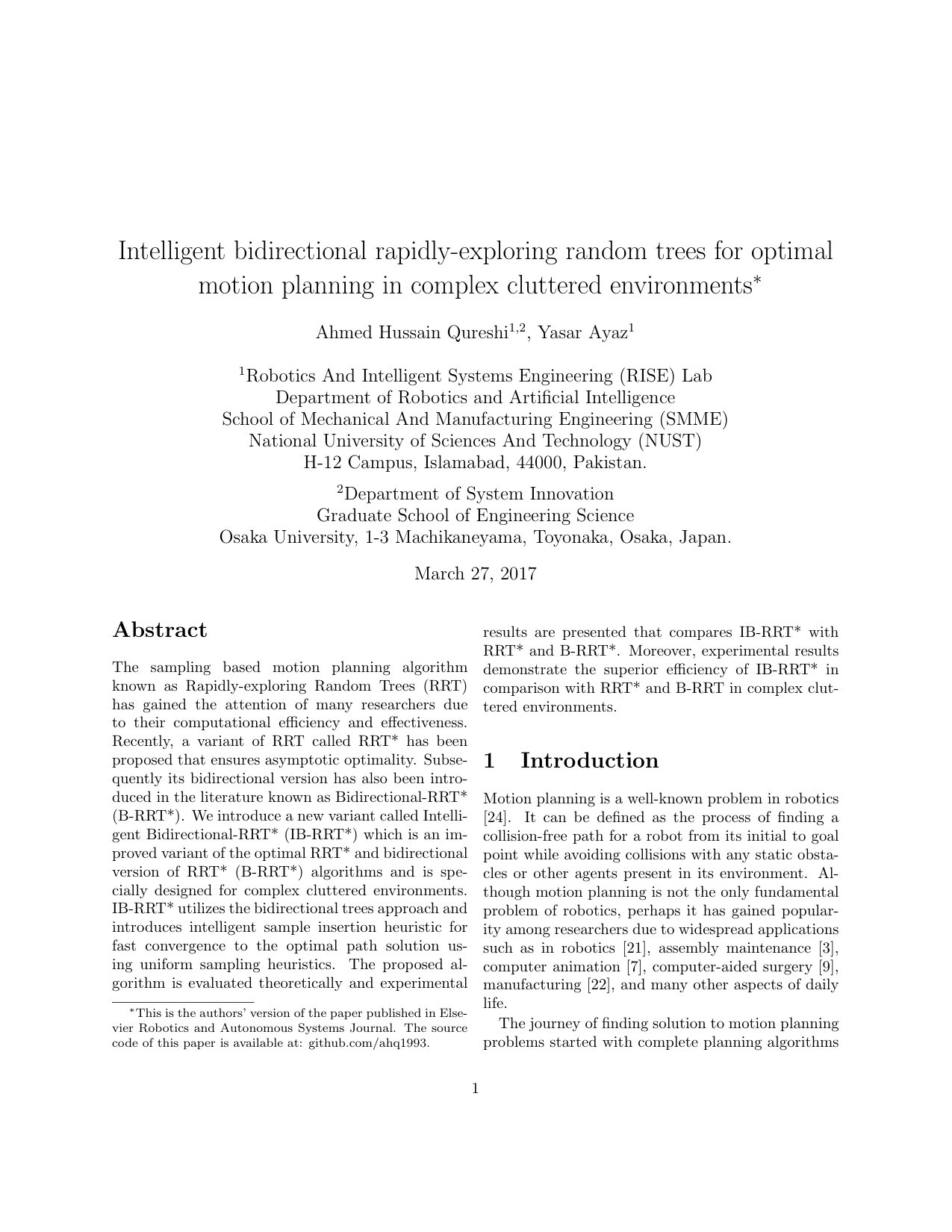 Figure 1
Peer Reviews
No public reviews on file for this paper yet. If you reviewed it on a platform where reviews are public (OpenReview, ICLR, NeurIPS, ICML), you can paste yours below so the community can read it here.
Videos
No videos yet. Explain this paper in a talk, walkthrough, or lecture? Add one.
See pages 1-last of simple2.pdf