Colloid-oil-water-interface interactions in the presence of multiple salts: charge regulation and dynamics
Jeffrey C. Everts, Sela Samin, Nina. A. Elbers, Jessi E.S. van der, Hoeven, Alfons van Blaaderen, Ren\'e van Roij

TL;DR
This study combines theoretical modeling and experiments to understand how multiple salts influence charge regulation and interaction dynamics of colloidal particles at oil-water interfaces, revealing tunable colloid-interface interactions.
Contribution
It introduces a combined theoretical and experimental approach to analyze salt-dependent charge regulation and dynamics at colloid-oil-water interfaces.
Findings
Salt concentrations significantly affect the sign and magnitude of the Donnan potential.
The effective colloid-interface interactions can be highly tuned by salt partitioning.
Theoretical predictions align well with experimental observations.
Abstract
We theoretically and experimentally investigate colloid-oil-water-interface interactions of charged, sterically stabilized, poly(methyl-methacrylate) colloidal particles dispersed in a low-polar oil (dielectric constant ) that is in contact with an adjacent water phase. In this model system, the colloidal particles cannot penetrate the oil-water interface due to repulsive van der Waals forces with the interface whereas the multiple salts that are dissolved in the oil are free to partition into the water phase. The sign and magnitude of the Donnan potential and/or the particle charge is affected by these salt concentrations such that the effective interaction potential can be highly tuned. Both the equilibrium effective colloid-interface interactions and the ion dynamics are explored within a Poisson-Nernst-Planck theory, and compared to experimental observations.
Click any figure to enlarge with its caption.
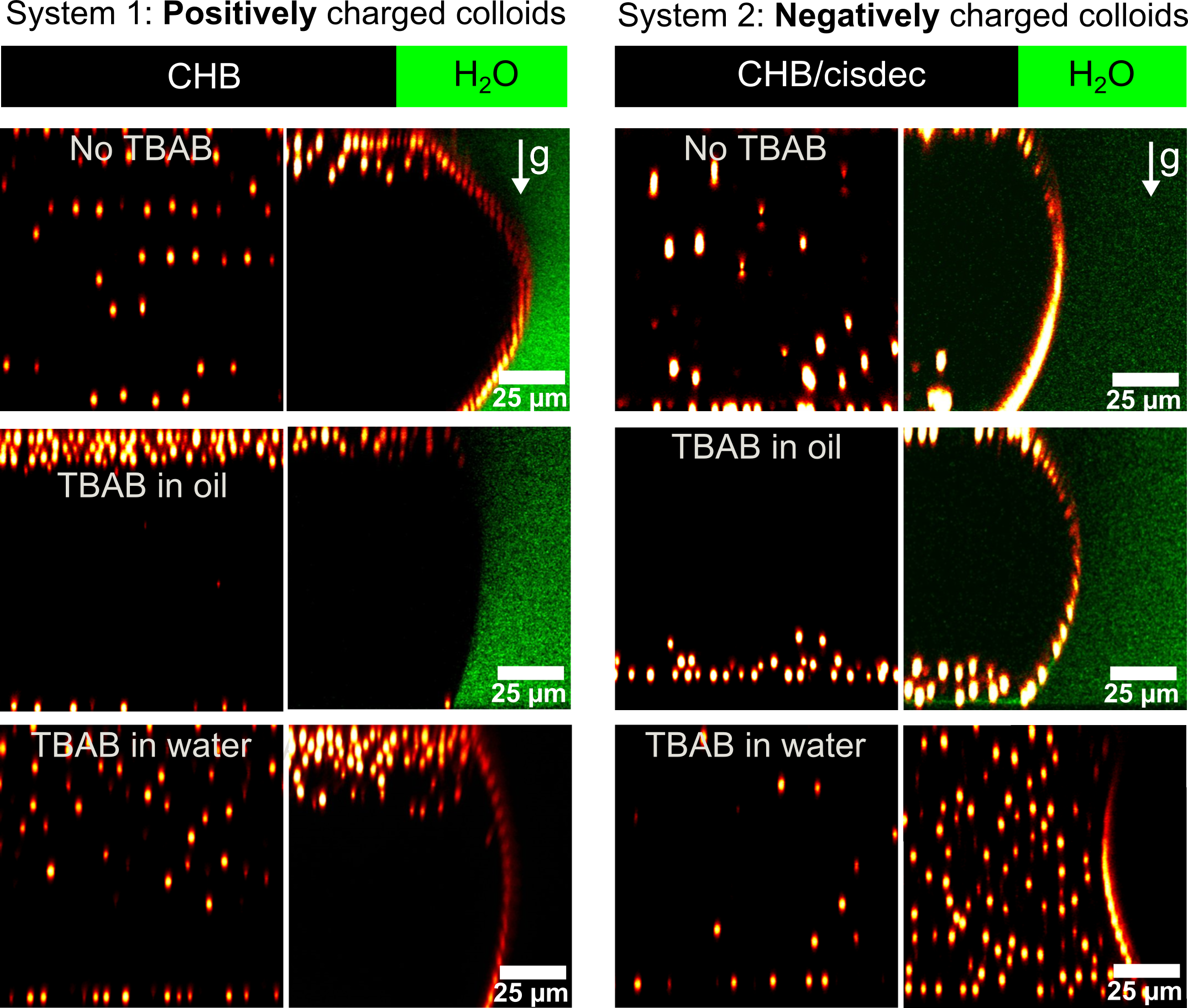 Figure 1
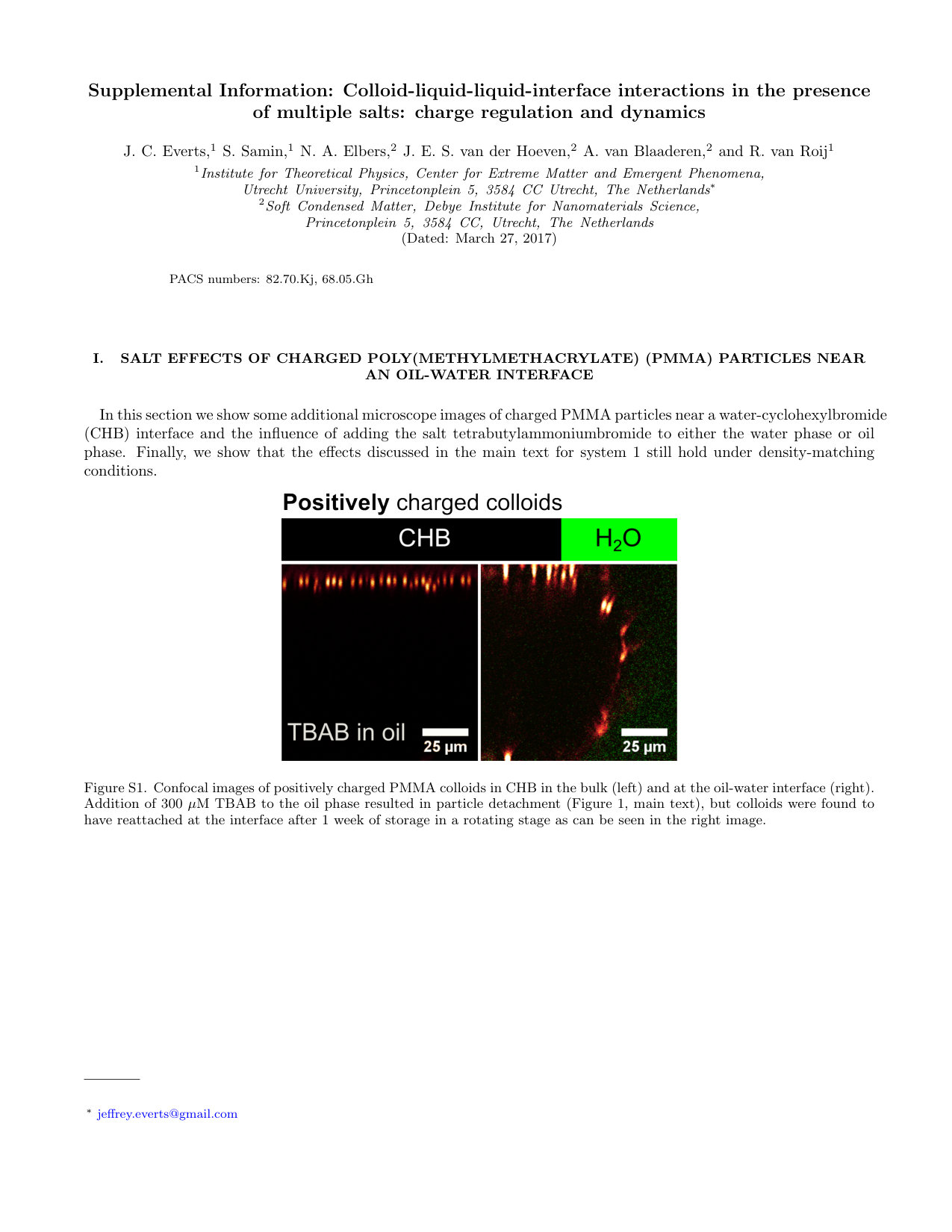 Figure 2
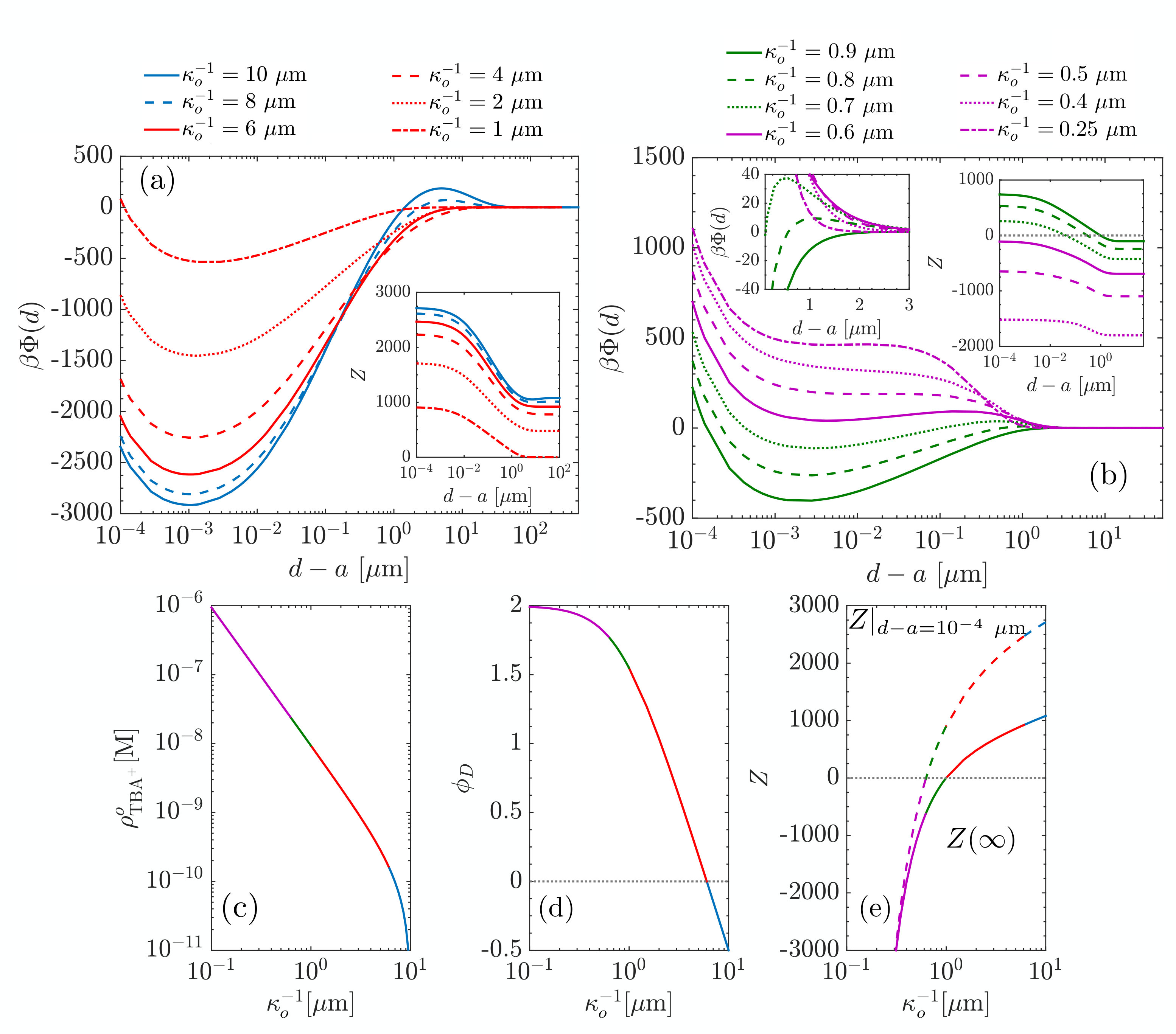 Figure 3
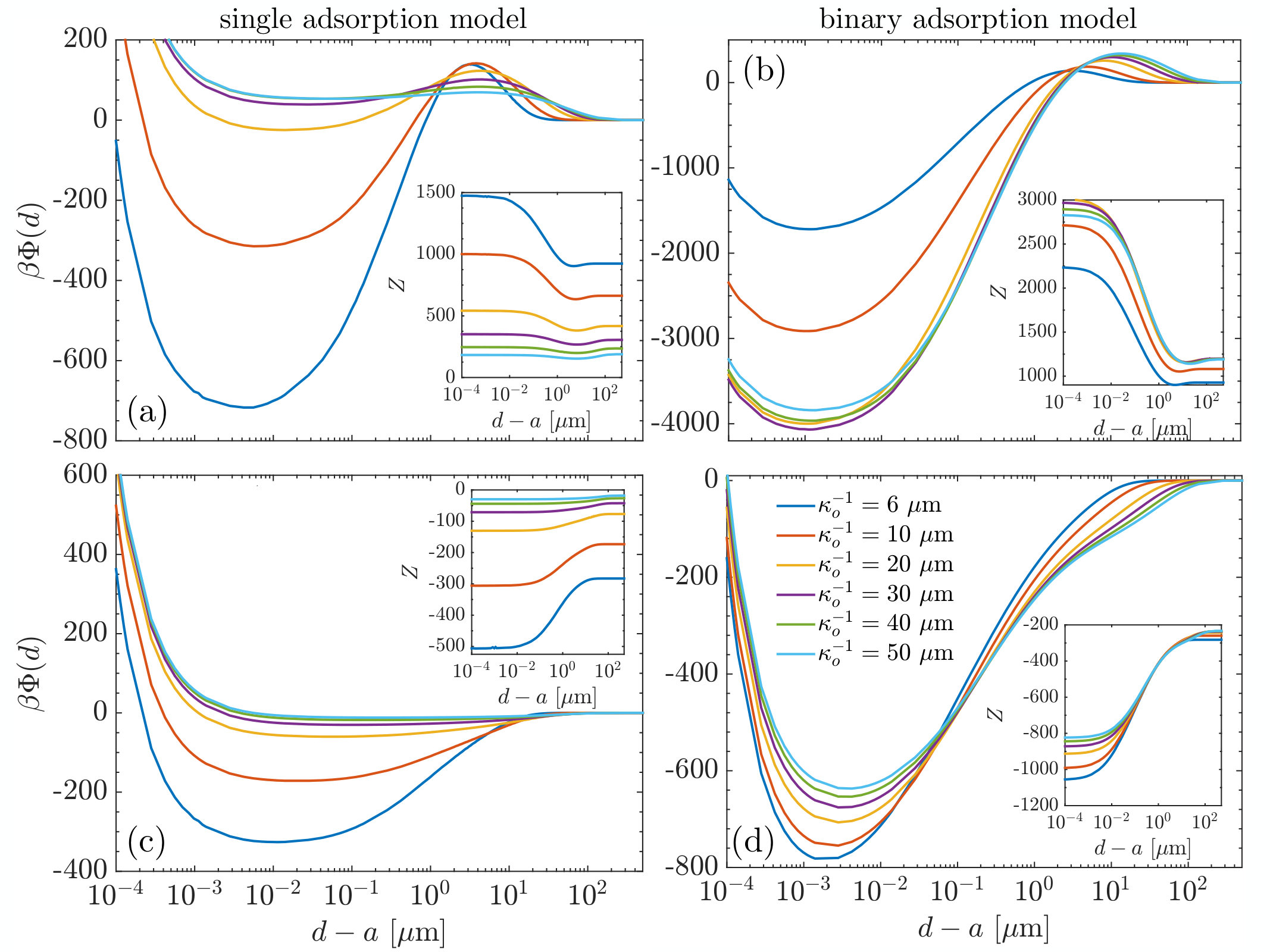 Figure 4
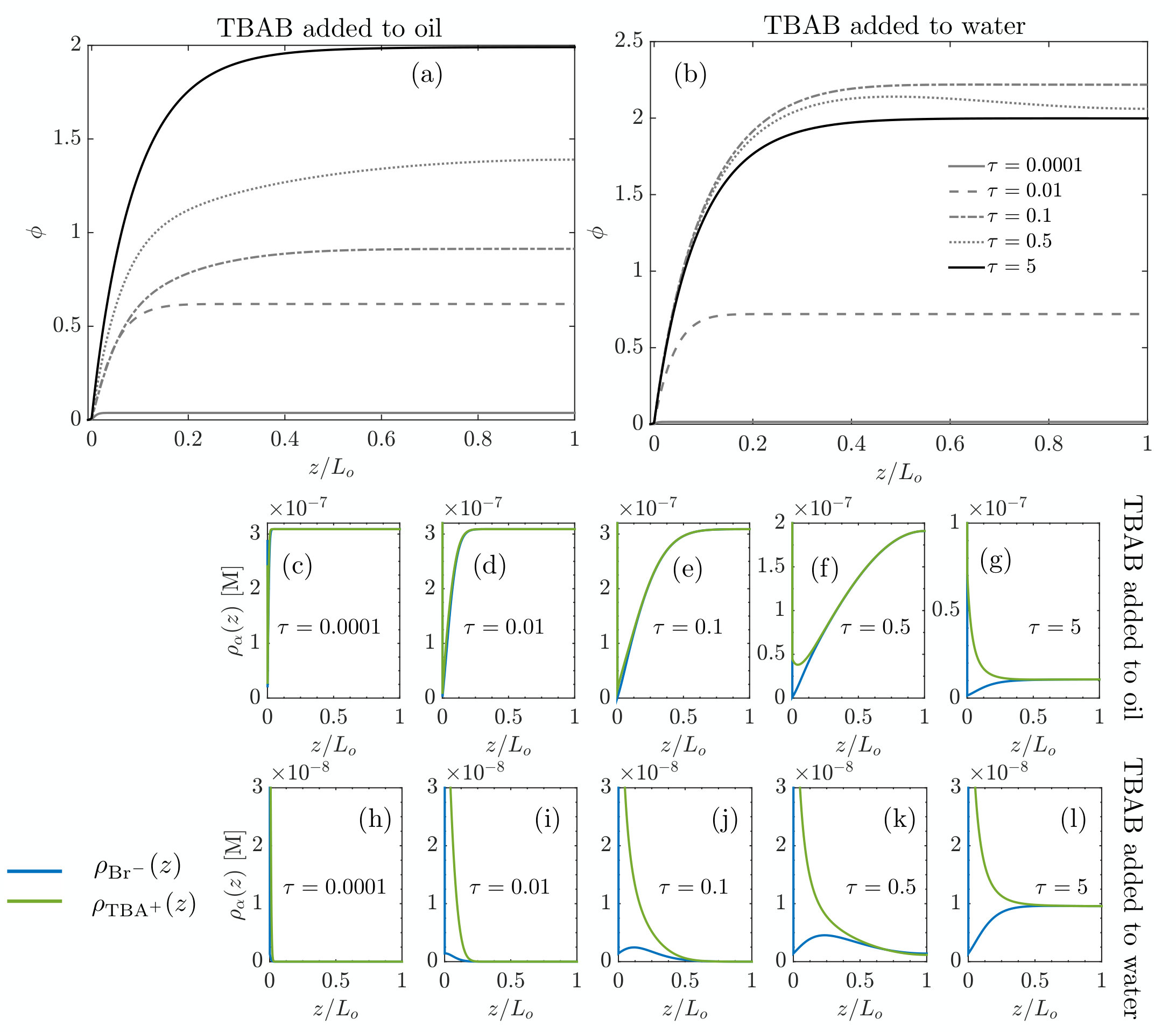 Figure 5
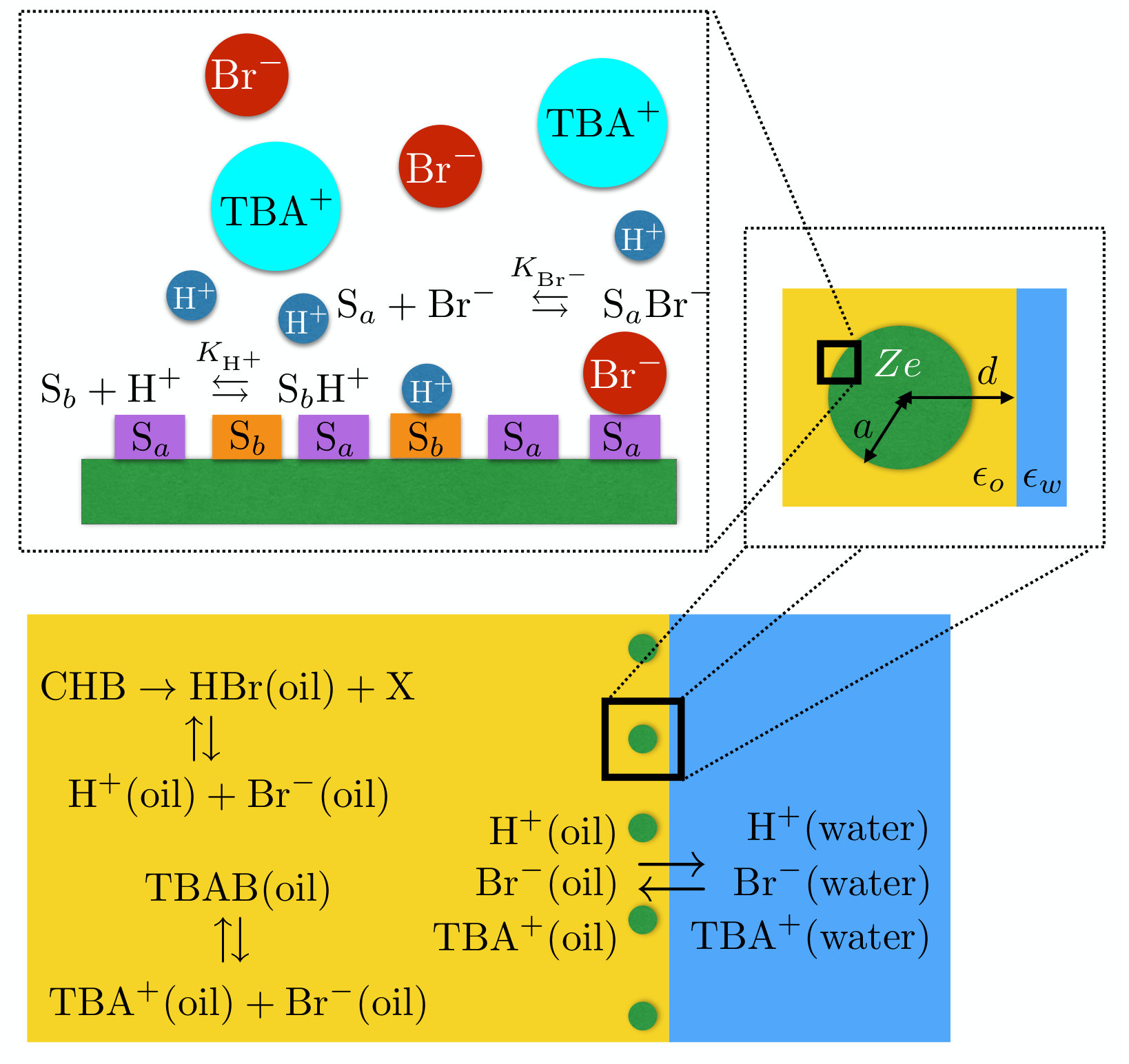 Figure 6
| System | [M] | [m] | |||
|---|---|---|---|---|---|
| 1 | 7.92 | 0.01 | +930 | 1-5 | |
| 2 | 6.2 | 0.01 | -280 | n.a. | n.a. |
Peer Reviews
No public reviews on file for this paper yet. If you reviewed it on a platform where reviews are public (OpenReview, ICLR, NeurIPS, ICML), you can paste yours below so the community can read it here.
Videos
No videos yet. Explain this paper in a talk, walkthrough, or lecture? Add one.
Colloid–oil-water-interface interactions in the presence of multiple salts: charge regulation and dynamics
J. C. Everts
Institute for Theoretical Physics, Center for Extreme Matter and Emergent Phenomena, Utrecht University, Princetonplein 5, 3584 CC Utrecht, The Netherlands
S. Samin
Institute for Theoretical Physics, Center for Extreme Matter and Emergent Phenomena, Utrecht University, Princetonplein 5, 3584 CC Utrecht, The Netherlands
N. A. Elbers
Soft Condensed Matter, Debye Institute for Nanomaterials Science, Princetonplein 5, 3584 CC, Utrecht, The Netherlands
J. E. S. van der Hoeven
Soft Condensed Matter, Debye Institute for Nanomaterials Science, Princetonplein 5, 3584 CC, Utrecht, The Netherlands
A. van Blaaderen
Soft Condensed Matter, Debye Institute for Nanomaterials Science, Princetonplein 5, 3584 CC, Utrecht, The Netherlands
R. van Roij
Institute for Theoretical Physics, Center for Extreme Matter and Emergent Phenomena, Utrecht University, Princetonplein 5, 3584 CC Utrecht, The Netherlands
(March 15, 2024)
Abstract
We theoretically and experimentally investigate colloid-oil-water-interface interactions of charged, sterically stabilized, poly(methyl-methacrylate) colloidal particles dispersed in a low-polar oil (dielectric constant ) that is in contact with an adjacent water phase. In this model system, the colloidal particles cannot penetrate the oil-water interface due to repulsive van der Waals forces with the interface whereas the multiple salts that are dissolved in the oil are free to partition into the water phase. The sign and magnitude of the Donnan potential and/or the particle charge is affected by these salt concentrations such that the effective interaction potential can be highly tuned. Both the equilibrium effective colloid-interface interactions and the ion dynamics are explored within a Poisson-Nernst-Planck theory, and compared to experimental observations.
pacs:
82.70.Kj, 68.05.Gh
I Introduction
Electrolyte solutions in living organisms often contain multiple ionic species such as , , and . The concentrations of these ions and their affinity to bind to specific proteins determine the intake of ions from the extracellular space to the intracellular one Alberts et al. (2007). In this example, the concentration of multiple ionic species is used to tune biological processes. However, this scenario is not limited to living systems, as it can also be important for ionic liquids Chatel et al. (2014), batteries Guerfi et al. (2010), electrolytic cells Westbroek et al. (2015), and colloidal systems Elbers et al. (2016); Elbers (2015); van der Hoeven (2014), as we show in this paper.
In colloidal suspensions, the dissolved salt ions screen the surface charge of the colloid, leading to a monotonically decaying diffuse charge layer in the fluid phase. At the same time, these ions may adsorb to the colloid surface and modify its charge Lyklema (1995). The colloid surface may also possess multiple ionizable surface groups that respond to the local physico-chemical conditions Ninham and Parsegian (1971); Prieve and Ruckenstein (1976). Hence, the particle charge is determined by the ionic strength of the medium and the particle distance from other charged interfaces. This so-called charge regulation is known to be crucial to correctly describe the interaction between charged particles in aqueous solutions, from nanometer-sized proteins Warshel et al. (2006) to micron-sized colloids Trefalt et al. (2016).
Colloidal particles are also readily absorbed at fluid-fluid interfaces, such as air-water and oil-water interfaces, since this leads to a large reduction in the surface free energy, of the order of per particle, where is the thermal energy Pieranski (1980). In an oil-water mixture, colloids therefore often form Pickering emulsions that consist of particle-laden droplets Pickering (1907); bin (2006), which have been the topic of extensive research due to their importance in many industrial processes, such as biofuel upgrade Crossley et al. (2010), crude oil refinery bin (2006), gas storage Carter et al. (2010), and as anti-foam agents Denkov (2004).
When the colloidal particles penetrate the fluid-fluid interface, the electrostatic component of the particle-particle interactions is modified by the dielectric mismatch between the fluid phases Hurd (1985), nonlinear charge renormalization effects Frydel et al. (2007); Frydel and Oettel (2011), and the different charge regulation mechanisms in each phase Kim et al. (2014). The resulting long range lateral interactions have been studied in detail Pieranski (1980); Hurd (1985); Frydel et al. (2007); Frydel and Oettel (2011), with the out-of-plane interactions also receiving some attention Zwanikken and van Roij (2007); Leunissen et al. (2007a). Less attention has been dedicated to the electrostatics of the particle-interface interaction, although it is essential for understanding the formation and stability of Pickering emulsions.
In this work, we focus on an oil-water system, where oil-dispersed charged and sterically stabilized poly(methyl-methacrylate) (PMMA) particles are found to be trapped near an oil-water interface, without penetrating it, due to a force balance between a repulsive van der Waals (vdW) and an attractive image-charge force between the colloidal particle and the interface Parsegian (2005); Oettel (2007); Elbers et al. (2016). Here, the repulsive vdW forces stem from the particle dielectric constant that is smaller than that of water and oil. This can be understood from the fact that for the three-phase system of PMMA-oil-water, the difference in dielectric spectra determine whether the vdW interaction is attractive or repulsive Parsegian (2005), while for two-phase systems, like atoms in air, the vdW interaction is always attractive. In addition to this force balance, we have recently shown in Ref. Everts et al. (2016) that the dissolved ions play an important role in the emulsion stability. In addition to the usual screening and charge regulation, ions can redistribute among the oil and water phase according to their solvability and hence generate a charged oil-water interface that consists of a back-to-back electric double layer. Within a single-particle picture, this ion partitioning can be shown to modify the interaction between the colloidal particle and the oil-water interface. For a non-touching colloidal particle, the interaction is tunable from attractive to repulsive for large enough separations, by changing the sign of the product Everts et al. (2016), where is the particle charge and the Donnan potential between oil and water due to ion partitioning, with the elementary charge. The tunability of colloid-ion forces is a central theme of this work, in which we will explore how the quantities and can be rationally tuned.
Although tuning the interaction potential through is quite general, the salt concentrations in a binary mixture of particle-charge determining positive and negative ions cannot be varied independently due to bulk charge neutrality; in other words, is always of a definite sign for a given choice of two ionic species. This motivates us to extend the formalism of Ref. Everts et al. (2016) by including at least three ionic species which are all known to be present in the experimental system of interest that we will discuss in this paper. Including a second salt compound with an ionic species common to the two salts, allows us to independently vary the ionic strength and the particle charge. Because of this property, it is then possible to tune the sign of the particle charge, which is acquired by the ad- or de-sorption of ions, via the salt concentration of one of the two species. Furthermore, for more than two types of ions, the Donnan potential depends not only on the difference in the degree of hydrophilicity between the various species Bier et al. (2008), but also on the bulk ion concentrations Westbroek et al. (2015). This leads to tunability of the magnitude, and possibly the sign, of the Donnan potential.
We apply our theory to experiments, where seemingly trapped colloidal particles near an oil-water interface could surprisingly be detached by the addition of an organic salt to the oil phase Elbers et al. (2016). We will show that our minimal model including at least three ionic species is sufficient to explain the experiments. We do this by investigating the equilibrium properties of the particle-oil-water-interface effective potential in presence of multiple salts and by examining out-of-equilibrium properties, such as diffusiophoresis. The latter is relevant for recent experiments where diffusiophoresis was found to play a central role in the formation of a colloid-free zone at an oil-water interface Florea et al. (2014); Musa et al. (2016); Banerjee et al. (2016).
As a first step, we set up in Sec. II the density functional for the model system. In Sec. III, the experiments are described. In Sec. IV, the equilibrium effective colloid-interface interaction potentials are explored as function of salt concentration, and we work out a minimal model that can account for the experimental observations. In Sec. V, we look at the influence of the ion dynamics within a Poisson-Nernst-Planck approach, and investigate how the system equilibrates when no colloidal particle is present. We conclude this paper by elucidating how our theory compares against the experiments of Elbers et al. Elbers et al. (2016), where multiple ionic species were needed to detach colloidal particles from an oil-water interface.
II Density functional
Consider two half-spaces of water (, dielectric constant ) and oil (, dielectric constant ) at room temperature separated by an interface at . We approximate the dielectric constant profile by , with and the interface thickness. Since we take to be molecularly small, we can interpret as the Heaviside step function within the numerical accuracy on the micron length scales of interest here. The species of monovalent cations and species of monovalent anions can be present as free ions in the two solvents, and are described by density profiles (, ) with bulk densities in water (oil) (). Alternatively, the ions can bind to the surface of a charged colloidal sphere (dielectric constant , radius , distance from the interface) with areal density . The colloidal surface charge density is thus given by . The ions can partition among water and oil, which is modeled by the external potentials (where ), where the self-energy is defined as the (free) energy cost to transfer a single ion from the water phase to the oil phase.
The effects of ion partitioning and charge regulation can elegantly be captured within the grand potential functional, , given by
[TABLE]
with the chemical potential of the ions in terms of the ion bulk concentrations in water and the normal unit vector of the planar interface. Here the Helmholtz free energy functional is given by
[TABLE]
where the region outside the colloidal particle is denoted by and the particle surface is denoted by . The first term of Eq. (2) is an ideal gas contribution. The mean-field electrostatic energy is described by the second term of Eq. (2) which couples the total charge density to the electrostatic potential . The final term is the free energy of an -component lattice gas of neutral groups and charged groups, with a surface density of ionizable groups (or one ionizable group per ) and is the fraction of ionizable groups available for an ion of type . A neutral surface site Si,α can become charged via adsorption of an ion , i.e., with an equilibrium constant and .
From the Euler-Lagrange equations , we find the equilibrium profiles . Combining this with the Poisson equation for the electrostatic potential, we obtain the Poisson-Boltzmann equation for ,
[TABLE]
where we used bulk charge neutrality to find the Donnan potential given by,
[TABLE]
In Eq. (3), we also introduced the inverse length scale , with
[TABLE]
where the Bjerrum length in oil is given by . Notice that for , with the screening length in oil, and that for we have that , with the screening length in water. Finally, the bulk oil densities are related to the bulk water densities as
[TABLE]
Inside the dielectric colloidal particle, the Poisson equation reads . On the particle surface, , we have the boundary condition , with a charge density described by the Langmuir adsorption isotherm for ,
[TABLE]
which follows from .
Eqs. (3)-(7) are solved numerically for using the cylindrical symmetry, and generic solutions were already discussed in the case of a single adsorption model in Ref. Everts et al. (2016). From the solution we determine and . These in turn determine the effective colloid-interface interaction Hamiltonian via
[TABLE]
Here, we added the vdW sphere-plane potential , with an effective particle-oil-water Hamaker constant Parsegian (2005). Eq. (8) can then be evaluated to give
[TABLE]
which we will investigate using the experimental parameters given in Table 1, to be elucidated in the next section.
III System and experimental observations
We consider two experimental systems from Ref. Elbers et al. (2016), to which we will refer as system 1 and 2. Both systems are suspensions with sterically stabilized poly(methyl-methacrylate) (PMMA) colloidal particles of radius and dielectric constant Leunissen et al. (2007b); Elbers et al. (2016). The comb-graft steric stabilizer is composed of poly(12-hydroxystearic acid) (PHSA) grafted on a backbone of PMMA Bosma et al. (2002); Elsesser and Hollingsworth (2010). This stabilizer was covalently bonded to the particles in system 1 (resulting in so-called locked PMMA particles van der Linden et al. (2015)) whereas it was adsorbed to the surface of the particles in system 2 (resulting in so-called unlocked PMMA particles van der Linden et al. (2015)). In the locking process the PMMA colloids acquire a higher surface potential and charge. The increase in charge is mainly due to the incorporation of 2-(dimethylamino)ethanol in the PMMA colloids during the locking procedure. The protonation of the incorporated amine groups renders colloidal particles with an increased positive charge (see also Ref. van der Linden et al. (2015)). Locked particles (like in system 1) are thus always positively charged and can only become negative by introducing TBAB. Unlocked particles can be either (slightly) positively or negatively charged.
The locked particles in system 1 were dispersed in deionized cyclohexylbromide (CHB) and were positively charged, whereas the unlocked particles in system 2 were dispersed in CHB/cis-decalin (27.2 wt%) and were negatively charged. The key parameters of both systems are summarized in Table 1, where is the volume fraction. It is important to note that CHB decomposes in time, producing HBr. Since CHB is a non-polar oil (), rather than an apolar oil (), which means that the dielectric constant is high enough for significant dissociation of (added) salts to occur, specifically, HBr can dissociate into and ions, which can subsequently adsorb on the particle surface van der Linden et al. (2015). In an oil phase without added salt and without an adjacent water phase, was assumed for both systems van der Linden et al. (2015), which is a reasonable estimate based on conductivity measurements or the crystallization behaviour of colloidal particles dispersed in CHB.
In the experimental study suspensions of system 1 and 2 were brought in borosilicate capillaries (5 cm 2.0 mm 0.10 mm) which were already half-filled with deionized water; the colloidal behavior near the oil-water interface was studied with confocal microscopy. When necessary the oil-water interface was more clearly visualized by using FITC-dyed water instead of ultrapure water. FITC water was taken from a stock solution to which an excess of FITC dye was added. FITC water was never used in combination with TBAB in the aqueous phase to prevent interactions between the FITC dye and TBAB. In Fig. 1, the confocal images of both systems before (top) and after addition of organic salt tetrabutylammoniumbromide (TBAB) to the oil (middle) and water phase (bottom) are shown. In the absence of salt, the force balance between image charge attractions and vdW repulsion leads to the adsorption of the colloidal particles at the interface in both systems Oettel (2007), without the colloidal particles penetrating the oil-water interface Elbers et al. (2016). In addition, the water side of the interface was reported to be positively charged, while the oil side is negatively charged Leunissen et al. (2007b). When TBAB was added to the oil phase above the threshold concentration \rho_{\text{TBA}^{+}}\big{|}_{Z=0} mentioned in table 1, with corresponding Debye screening length in oil (\kappa_{o}\big{|}_{Z=0})^{-1}, the colloidal particles in system 1 were driven from the interface towards the bulk oil phase, whereas the addition of TBAB did not result in particle detachment in system 2, see Fig. 1. Over time the detached colloidal particles in system 1 reattached close to the oil-water interface Elbers et al. (2016) (see Fig. S1 in the supplemental information). When TBAB was added to the water phase, the colloidal particles in both system 1 and 2 were driven from the bulk oil to the oil-water interface, producing dense layers of colloidal particles near the interface Elbers et al. (2016), see Fig. 1 and Fig. S2 in the supplemental information. Finally, we also investigated system 1 under the same density-matching conditions as in system 2, and observed no qualitative change in the response to salt addition, see Fig. S3 in the supplemental information.
When the TBAB was added to the oil phase, the positively charged colloidal particles in system 1 reversed the sign of their charge from positive () to negative () Elbers et al. (2016). This suggests that and can both adsorb to the particle surface and that the addition of TBAB introduces more in the system, causing the particle charge of system 1 to become negative for a high enough concentration of TBAB. The estimated concentration of free TBA+ ions \rho_{\text{TBA}^{+}}\big{|}_{Z=0}, and the corresponding Debye length (\kappa_{o}\big{|}_{Z=0})^{-1} in our experiments are listed in Table 1. Both parameters are not defined for system 2 (not applicable, n.a.), since here negative particles cannot become positively charged in the setup that we consider, because we always observed that adding TBAB results in a more negative particle charge. In Fig. 2, all equilibria, including the decomposition of CHB, the equilibria of HBr and TBAB with their free ions, and the partitioning of these ions between water and oil, are schematically shown. For simplicity, we have not taken the salt decomposition equilibria into account in the theory of Sec. II. However, the Bjerrum pairs HBr and TBAB could be included in the theory by using the formalism of Ref. Valeriani et al. (2010). In the upper right inset of Fig. 2, we show schematically the binding of and onto the particle surface. In principle, TBA+ can also adsorb on the particle surface, but we expect this to be a small effect that we neglect. This is justified since adding TBAB renders more negative particles, suggesting that can more easily adsorb on the particle surface than TBA+. Hence, including a finite value for in our model does not change our results qualitatively, but only quantitatively.
We will explain the experimental observations described in this section by applying the formalism of section II. Moreover, we will discuss the differences between a single adsorption model and a binary adsorption model and the influence of a third ionic species, which is a first extension trying to get closer to the full experimental complexity compared to our previous work Everts et al. (2016), where only a single adsorption model was considered in a medium with only two ionic species.
IV Colloid-interface interactions
We will perform calculations for up to two species of cations () and one species of anions , where corresponds to , to , and to . To estimate the order of magnitude of the ion sizes, we consider their effective (hydrated) ionic radii , , and Leunissen et al. (2007a). This gives self-energies (in units of ): , and , based on the Born approximation . This is a poor approximation in the case of , because it is known that is actually a hydrophobic ion, . However, this simple approximation does not affect our predictions since we can deduce from Eq. (4) the inequality . Therefore, as long as , we find that the Donnan potential is varied between a negative value and a positive one by adding TBAB, in line with experimental observations. Setting is therefore not required. Since we will fix throughtout our calculations, assuming would only affect the value of , and we have already shown in our previous work that this parameter is not important for the colloid-interface interaction of oil-dispersed colloidal particles Everts et al. (2016). We therefore use the Born approximation to analyze the qualitative behaviour of the effective interactions, such that can vary between and .
In an isolated oil phase without an adjacent water phase, the screening length in our experiments was approximated to be . However, becomes larger in the presence of an adjacent water phase, since water acts as an ion sink: the ions dissolve better in water than in oil and therefore diffuse towards the water phase. The charged colloidal particles in the oil phase will counteract this effect, because these colloidal particles are always accompanied by a diffuse ion cloud, keeping some of the ions in the oil. Because we do not know the exact value of in an oil-water system, we consider it as a free parameter and let it vary in a reasonable range between and . In our single-particle picture, we neglect many-body effects which can reduce the value of , due to the overlap of double layers. This can be taken into account by introducing an effective Debye length Trizac et al. (2002); Zoetekouw and van Roij (2006a, b). Another many-body effect that we do not include, is the discharging of particles when the particle density is increased Vissers et al. (2011). One should keep this in mind when directly comparing the values we use for to experiment.
IV.1 Systems without TBAB added
In this subsection, we first investigate systems without the added TBAB (such that H+ and Br- are the only ionic species) for two different adsorption models. The first one is a single-ion adsorption model. In this case, system 1 in Table I is described by the adsorption of alone, while for system 2 only can adsorb. We use the experimental values of from Table 1 to determine the equilibrium constants on the basis of a spherical-cell model in the dilute limit with . Note that these values are obtained for colloidal particles dispersed in CHB without an adjacent water phase. Within this procedure, we find and for system 1, while for system 2 we find and . For the particle–oil-water-interface vdW interaction we use a Hamaker constant , which is an estimate based on the Lifshitz theory for the vdW interaction Elbers et al. (2016). The resulting colloid-interface interaction potentials as function of are shown in Fig. 3(a) and (c), with the corresponding in the inset. The product determines the long-distance nature of the colloid-interface interaction: in Fig. 3(a) it is repulsive for system 1, since and in Fig. 3(c) attractive for system 2, since (recall that here ), see Ref. Everts et al. (2016) for a detailed discussion. At smaller , the image-charge interaction, which is attractive for both systems, becomes important. In the nanometer vicinity of the interface, the vdW repulsion dominates, and taken together with the image-charge potential, this gives rise to a minimum in , which corresponds to the equilibrium trapping distance of the particles from the interface.
Increasing reduces , such that the vdW repulsion can eventually overcome the image-charge potential for sufficiently small (Fig. 3(a),(c)). However, the reduction in the particle-ion force is much smaller than the reduction of the image force, since the former scales like , unlike the latter, which scales (approximately) like . In Fig. 3(a), we find that this results in a trapped state near the interface which becomes metastable for large , with a reduced energy barrier upon increasing . For system 2, we find that becomes repulsive for all for sufficiently large , because the attractive image charge and the attractive colloid-ion force are reduced due to particle discharging. This calculation shows that particle detachment from the interface is possible by removing a sufficient number of ions from the oil phase. This effect is stronger in system 1, because the repulsive Donnan-potential mechanism is longer ranged than the vdW repulsion. However, to the best of our knowledge, such detachment was not observed in experiments by, for example, adding a sufficient amount of water that acts as an ion sink. Taken together with the experimental observation that initially positively charged particles can acquire a negative charge, we conclude that systems 1 and 2 are not described by single-adsorption models Elbers et al. (2016).
With the same procedure as for the single adsorption model, we determined the values of the equilibrium constants in the case of a binary adsorption model. For system 1 we also used the salt concentration \rho_{\text{TBA}^{+}}\big{|}_{Z=0} for which charge inversion takes place, to find , , and . Here is the fraction of sites on which anions can adsorb. For system 2, we assumed and found and . The short-distance (vdW), mid-distance (image charge) and long-distance (Donnan) behaviour of does not qualitatively change in the binary adsorption model, see Fig. 3(b) and (d). However, the trapped state is more “robust” to changes in the ionic strength, because of the much higher values of . This can be understood as follows. In system 1, , and thus decreasing the salt concentration leads the negatively charged surface sites to discharge first, which means that the charge initially increases with . This enhances the image-charge effects, giving rise to a deeper potential well for the trapped state. At even higher , will eventually decrease due to cationic desorption, although this is not explicitly shown in Fig. 3. A similar reasoning applies to the negatively charged colloidal particles in system 2, which show only discharging upon increasing , but much less compared to the single adsorption model.
The theoretically predicted stronger trapping in both systems and the experimentally observed sign reversal of the colloidal particles of system 1, which requires at least two adsorbed ionic species, indicates that the binary adsorption model describes the experiments better than the single adsorption model. In addition, the large energy barrier between the trapped state and the bulk in Fig. 3(b), shows that not all the colloidal particles can be trapped near the oil-water interface. This is consistent with the experimentally observed zone void of colloidal particles, although one should keep in mind that the charged monolayer will provide additional repulsions which are not taken into account in our single-particle picture.
IV.2 Systems with TBAB added
We now show how the colloid-interface interaction changes in a system with three ionic species. We focus on the binary adsorption model applied to system 1, because this system has the richest behaviour, allowing to switch sign. Here, the addition of TBAB gives rise to two new features. The first one is that it is possible to independently tune and in the bulk oil phase while satisfying the constraint of bulk charge neutrality, . By increasing , we find that switches sign at
[TABLE]
where we used Eq. (7) together with the condition . Secondly, because of the hierarchy , the Donnan potential can switch sign at
[TABLE]
where we used Eq. (4) and (6). Eq. (11) is weakly dependent on the precise value of , since for (with 6 being its value within the Born approximation), and hence the second term in the denominator of Eq. (11) can be neglected. Using the equilibrium constants of Sec. IV.1, we see from Eq. (10) and (11) that switches sign before does upon adding TBAB; i.e., \rho_{\text{TBA}^{+}}\big{|}_{\phi_{D}=0}<\rho_{\text{TBA}^{+}}\big{|}_{Z=0}.
Since our calculations are performed in the grand-canonical ensemble, we have to specify how we account for the added TBAB. We choose to fix , and set without added TBAB (blue curve in Fig. 3(b)). The Debye length is chosen to be slightly larger than that of a pure CHB system, because the water phase acts as an ion-sink, see the discussion in Sec IV. The resulting colloid-interface interactions are shown in Fig. 4(a) and (b), for various values of , which decreases upon addition of TBAB. The relation between the screening lengths and the bulk concentration is shown in Fig. 4(c). We can identify four regimes, indicated by different colors in Fig. 3. We start with a system for which and (blue curves), such that an energy barrier is present that separates the trapped state from the bulk state. Increasing decreases until ultimately the energy barrier vanishes and becomes positive (red curves). At even larger TBAB concentration, the colloidal particle becomes negative for as it would be in bulk at the given (green curves).
Interestingly, there is a (small) energy barrier of a different nature than the energy barriers shown until now. Namely, there exists a for which (see insets in Fig. 4(b)). Surprisingly, at this point of zero charge, does not coincide with the location of the maximum in . Furthermore, the result for m does not show a maximum, although there is a point of zero charge. Both observations can be understood from the fact that although , the charge density is not spatially constant. In this case, there is still a coupling between bulk and surface ions, that contributes to , see second term in Eq. (9).
Lastly, at a very high TBAB concentration we find for all (purple curves), and the large Donnan potential leads in a repulsion for all , and hence to particle detachment. Upon decreasing , this repulsion first becomes stronger, as increases towards . At the same time, increasing increases the strength of the image-charge attraction, eventually resulting in a plateau in between and (compare with in Fig. 4(b)).
We now briefly explain how added TBAB would change the colloid-interface interactions in the other cases presented in Fig. 3(a), (c) and (d). In the case of a single adsorption model of system 1 only the Donnan potential switches sign, the energy barrier would vanish and the particles stay trapped. Possibly, some of the particles from the bulk are then moved towards the oil-water interface. For system 2, the addition of TBAB would only introduce an energy barrier separating the trapped state from a bulk state, but no detachment occurs, independent of the investigated adsorption model. This is in line with the experiments of Ref. Elbers et al. (2016), where no particle detachment was observed for system .
From the calculations in Fig. 4, we deduce that significant particle detachment from the interface occurs whenever and . However, the range of the repulsion, which extends up to , is too short to explain the particle detachment found in experiments, which may extend up to . One possible explanation to this discrepancy is that the particle motion far from the interface is governed by a non-equilibrium phenomenon, e.g. from the concentration gradient of ions generated by their migration from the oil phase to the water phase, similar to the recent experiment by Banerjee et al. Banerjee et al. (2016). This motivated us to investigate the ion dynamics in the next section, in order to gain insight into the time evolution of the colloid-ion forces.
V Ion dynamics
For simplicity, we assume now that no colloidal particle is present in the system, such that the ion dynamics can be captured within a planar geometry. This can still give insight into the colloid-ion potential, because we deduced in our previous work that can be approximated by for sufficiently large , with the dimensionless potential without the colloidal particle Everts et al. (2016). The theory can be set up from Eq. (2), with the second line set equal to zero, and one should also keep in mind that is the total system volume in this case. It is then possible to derive equations of motion for by using dynamical density functional theory (DDFT) Marconi and Tarazona (1999). For ionic species with charge , the continuity equation reads
[TABLE]
with particle currents equal to
[TABLE]
Explicitly working out the functional derivative gives
[TABLE]
with , with () the diffusion coefficient of an ion of sign in bulk oil (water). Here, we have used the Einstein-Smoluchowski relation to relate the electric mobility to the diffusion constant. The time-dependent electrostatic potential satisfies the Poisson equation (neglecting retardation),
[TABLE]
Eqs. (12)-(15) are the well-known the Poisson-Nernst-Planck equations, and we solve them under the boundary conditions
[TABLE]
which follow from global mass and charge conservation, respectively.
We estimate the diffusion coefficients by making use of the Stokes-Einstein relation , where the viscosity of the solvent (). At room temperature we have Pas, while for CHB Pas. From these values we find: ms, ms, ms, ms, ms and ms.
V.1 Dynamics after TBAB addition
The ion dynamics can provide further insight into the particle dislodgement after TBAB is added to the oil phase. In experiment, we observed that can be decreased down to 50 nm, after TBAB is added. This Debye length implies a salt concentration of the order of M, such that we can safely neglect the HBr concentration, which has a maximal value of M before the oil is brought into contact with the water phase.
We investigate the time-dependence of the electrostatic potential , with the direction perpendicular to the oil-water interface. The oil is assumed to reside in a capillary with a linear dimension perpendicular to the oil-water interface of length , which is much larger than but much smaller than the experimental sample size of about cm, to facilitate numerical calculations. It was difficult to perform calculations at even larger with such a small , but the present parameter settings can nevertheless give qualitative insights. In experiments, the length of the water side of the capillary is also 1 cm, but here we take it to be , which is still much larger than . The disadvantage of the small is that only the ionic profiles in the oil phase are considered realistic, because given the small no bulk charge neutrality in the water phase can be obtained. Furthermore, stems from the initial condition that we define below together with the desired final condition, constrained by the fact that ions cannot leave the oil-water system and that the water phase is modeled as an ion-less ion sink. In contrast, for the calculation of the effective colloid-oil-water-interface potential in Sec. IV, we used a grand-canonical treatment, rather than a canonical treatment for the ions that is used for the dynamics here.
Similar to the experiments, the initial condition for is a uniform distribution of ions in the oil phase:
[TABLE]
The amplitude is used such that we can acces the regime where the particles are negatively charged for and , but they can become positively charged close to the interface. In particular, we use , leading to a final (cf. Fig. 4(b)). Solving Eq. (12), (14), (15), with boundary conditions (18) and initial condition (19), results in the profiles , , and . It is convenient to express the results in terms of a dimensionless time , with time scale , which in our system is s. This means that the equilibrium state is reached within several seconds in our system, see the profiles in Fig. 5. However, if a more realistic is chosen, this time scale will be on the order of hours, since scales with .
In Fig. 5(a), we show the time evolution towards equilibrium of . For all times, increases monotonically with and becomes constant as . The range of steadily increases over time due to the depletion of ions in the oil. In addition, increases with time, until ultimately is reached.
The equilibrium calculations of Fig. 4 supported particle detachment by means of a repulsive colloid-ion force, but due to the large salt concentrations the range of the repulsive colloid-ion force was deemed to be too small in the parameter regime where the particle was negatively charged. The dynamics of the ionic profiles at the oil side, presented in Fig. 5(c)-(g)), show that this issue can be resolved when the system is (correctly) viewed out of equilibrium, as we will explain next.
From the profiles in Fig. 5(c), a short time after the addition of salt, we infer that the colloids are initially negatively charged according to the corresponding and in Fig. 4(c). Therefore, the approximate interaction potential leads to a colloid-ion force that is repulsive. Colloidal particles that were initially trapped are then repelled from the interface, but only for surface-interface distances up to a micron, as can be inferred from Fig. 4(b). When increases, the water phase uptake of ions reduces the Br- concentration close to the interface. At the same time, mass action is at play, and we can estimate from 4(c) that the particles become positively charged at M. This means that as time progresses, some of the particles close to the interface will reverse their sign. For example, at time , we can estimate from the profiles in 5(f) that only particles at are still negatively charged. However, assuming that the bulk ion dynamics is much slower than the mass action dynamics, the range of the Donnan potential has not relaxed yet, and is longer ranged than at . At , still extends up until , see the dotted line in Fig. 5(a). Hence, the range of repulsion for the negatively charged particles is longer than one would expect from the equilibrium calculation. In other words, the range of the interaction is set much faster than the electrostatic potential and the colloidal charge at large . At later times, enough ions are depleted from the oil, all the colloids become positively charged, and are attracted towards the interface, as one would expect in equilibrium for the final . This also gives a possible explanation for the experimentally observed reattachment after the initial detachment.
For comparison, we also performed calculations with HBr as the only salt (no added TBAB). We found that except at the very early stages of the dynamics, the HBr concentration is indeed negligible and decreases rapidly after the oil comes into contact with the water due to the ion partitioning. These calculations also confirmed that, within the binary adsorption model, the colloid-ion forces remain repulsive throughout the partitioning processes, since particles becomes more positively charged with decreasing the ionic strength, because of the larger desorption of negative ions than positive ions. Thus, the colloid-interface interaction is still always dominated by the attractive short range image forces.
Finally, we consider what happens when TBAB is added to the water, neglecting the HBr concentration. In 5(b), we show , and find that the potential in this case can temporarily become larger than . The ion densities behave as expected. Some of the ions from the water side are transferred towards the oil phase. In 5(h)-(l) we see that the density of ions is first largest at the interface until, slowly, also the rest of the oil is filled. Note that the oil side of the interface is always positively charged, and that the equilibrium situation is identical to the one in Fig. 5 by construction. Based on the calculation of Fig. 5(b), we conclude that the colloid-ion forces are attractive for all times up until equilibrium is nearly reached. Because there is a high density of Br- ions in bulk, the particles are negatively charged sufficiently far from the interface. The colloids for small are, however, positively charged as was explained in the inset of Fig. 4(b) (green curves). This explains why colloids are drawn closer to the interface upon adding TBAB in water: the colloids remain mainly positive, but a positive Donnan potential is generated out of a negative one, and hence an attraction towards the interface is induced. This we have already understood from the equilibrium calculations.
V.2 Diffusiophoresis
Despite having only discussed electrostatic forces generated by the Donnan potential, our calculations can also give some insight into diffusiophoretic effects, that is, those induced by the motion of colloidal particles in concentration gradients of ions. We now estimate the importance of diffusiophoresis in both the HBr and added TBAB systems using the PNP calculations. Whenever the unperturbed concentration fields satisfy , a negligble electric field is generated by the ions that would give rise to the aforementioned colloid-ion force. However, in an overall concentration gradient, the particles can be translated due to diffusiophoresis, in which the particle velocity is given by , with slip-velocity coefficient
[TABLE]
see Ref. Anderson (1989) for details. Note that Eq. (20) is derived assuming a homogeneous surface potential , and that only the gauged potential is relevant for an oil-dispersed colloidal particle.
From Eq. (20), we can estimate the sign of . For a system that contains HBr only, we find , and hence colloidal particles tend to always move towards higher concentrations. This means that diffusiophoresis repels particles from the interface, similar to the colloid-ion force that we described in equilibrium. We therefore conclude that without TBAB, attractions are provided solely by the image charge forces.
When TBAB is added, we find that for and otherwise. For TBAB in oil, the negatively charged particles therefore experience a repulsive diffusiophoretic force from the oil-water interface, while positively charged particles are attracted for , but are repelled otherwise. Assuming that for TBAB in water the particles are always positively charged, particles with are attracted to the interface by diffusiophoresis. Given that the particles in our studies were (relatively) highly charged, all forces except for the vdW (image charge, colloid-ion and diffusiophoretic force) are attractive in this specific case.
We conclude that diffusiophoresis could possibly account for the long range repulsion or attraction near the oil-water interface, since concentration gradients occur over a scale that is much larger than the Debye screening length. In fact it could suggest that diffusiophoresis is the dominant force generating mechanism outside of the double layer near the oil-water interface. However, the equilibrium considerations in Sec. IV are pivotal to understanding why colloidal particles can be detached in the first place.
VI Conclusion and outlook
In this paper, we discussed colloid–oil-water-interface interactions and ion dynamics of PMMA colloids dispersed in a non-polar oil at an oil-water interface, in a system with up to three ionic species. We have applied a formalism that includes ion partitioning, charge regulation, and multiple ionic species to recent experiments Elbers et al. (2016), to discuss (i) how the charges on the water and oil side of the oil-water interface can change upon addition of salt, (ii) how charge inversion of interfacially trapped non-touching colloidal particles upon addition of salt to the oil phase can drive particles towards the bulk over long distances, followed by reattachment for large times, (iii) that particles that cannot invert their charge stay trapped at the interface, and (iv) that colloids in bulk can be driven closer to the interface by adding salt to the water phase. We used equilibrium and dynamical calculations to show that these phenomena stem from a subtle interplay between long-distance colloid-ion forces, mid-distance image forces, short-distance vdW forces, and possibly out-of-equilibrium diffusiophoretic forces. The colloid-ion forces are the most easily tunable of the three equilibrium forces, because they can be tuned from repulsive to attractive over a large range of interaction strengths. We have shown this explicitly by including three ionic species in the theory, and by investigating various charge regulation mechanisms, extending the formalism of Ref. Everts et al. (2016).
For future directions, we believe that it would be useful to investigate many-body effects, in a similar fashion as in Ref. Zwanikken and van Roij (2007). There are, however, two drawbacks of the method of Ref. Zwanikken and van Roij (2007) that need to be amended before we could apply it to a system of non-touching colloids. First of all, in Ref. Zwanikken and van Roij (2007), a Pieranski potential Pieranski (1980) was used to ensure the formation of a dense monolayer at the oil-water interface. It would be interesting to see if the trapping of particles near the interface can be found self-consistently by the mechanism presented here and the one of Ref. Zwanikken and van Roij (2007), by using a repulsive vdW colloid-interface potential. Secondly, the formalism of Ref. Zwanikken and van Roij (2007) was set up for constant-charge particles. In the constant-charge case, it is a good approximation to replace the particle nature of the colloids by a density field. For charge-regulating particles, this can be a limiting approximation because one needs the surface potential and not the laterally averaged electrostatic potential to determine the colloidal charge.
Investigating many-body effects can be interesting, because colloidal particles present in bulk contribute to the Donnan potential. This is not the case when all the colloids are trapped near the interface: in this case the electrostatic potential generated by the colloids cannot extend through the whole system volume. Finally, a dense monolayer can provide an additional electrostatic repulsion for colloids, in addition to the repulsive colloid-ion force for and the repulsive vdW force. Therefore, we expect that the interplay of the colloidal particles with ions can be very interesting on the many-body level, especially when we include not only image-charge and ion-partitioning effects, but most importantly, also charge regulation. However, it is not trivial to take all these effects into account in a many-body theory. Another direction that we propose is to perform the ion dynamics calculation of Sec. V in the presence of a single (and maybe stationary) charged sphere near an oil-water interface. This would give insights into the out-of-equilibrium charging of charge-regulating particles, providing more information on the tunability of colloidal particles trapped near a “salty” dielectric interface.
We acknowledge financial support of a Netherlands Organisation for Scientific Research (NWO) VICI grant funded by the Dutch Ministry of Education, Culture and Science (OCW) and from the European Union’s Horizon 2020 programme under the Marie Skłodowska-Curie grant agreement No. 656327. This work is part of the D-ITP consortium, a program of the Netherlands Organisation for Scientific Research (NWO) funded by the Dutch Ministry of Education, Culture and Science (OCW). J.C.E. performed the theoretical modelling and numerical calculations under supervision of S.S. and R.v.R. The experiments were performed by N.A.E. and J.E.S.v.d.H. under the supervision of A.v.B. The paper is co-written by J.C.E. and S.S., with contributions of N.A.E., J.E.S.v.d.H., A.v.B. and R.v.R. The supplemental information is provided by N.A.E. and J.E.S.v.d.H. All authors discussed results and revised the paper.
The reference list from the paper itself. Each links out to its DOI / PubMed record.
- 1Alberts et al. (2007) B. Alberts, A. Johnson, J. Lewis, M. Raff, K. Roberts, and P. Walter, in Molecular Biology of the Cell (5th edition) (Garland Science, 2007).
- 2Chatel et al. (2014) G. Chatel, J. F. B. Pereira, V. Debbeti, H. Wang, and R. D. Rogers, Green Chem. 16 , 2051 (2014) . · doi ↗
- 3Guerfi et al. (2010) A. Guerfi, M. Dontigny, P. Charest, M. Petitclerc, M. Lagacé, A. Vijh, and K. Zaghib, Journal of Power Sources 195 , 845 (2010) . · doi ↗
- 4Westbroek et al. (2015) M. J. E. Westbroek, N. Boon, and R. van Roij, Phys. Chem. Chem. Phys. 17 , 25100 (2015) . · doi ↗
- 5Elbers et al. (2016) N. A. Elbers, J. E. S. van der Hoeven, D. A. M. de Winter, C. T. W. M. Schneijdenberg, M. N. van der Linden, L. Filion, and A. van Blaaderen, Soft Matter 12 , 7265 (2016) . · doi ↗
- 6Elbers (2015) N. Elbers, Experiments in which oil, water and colloidal particles meet , Ph.D. thesis , Utrecht University (2015).
- 7van der Hoeven (2014) J. E. S. van der Hoeven, Colloids near oil-water Interfaces: charge regulation, phase behavior and interfacial motion , Master’s thesis , Utrecht University (2014).
- 8Lyklema (1995) J. Lyklema, Fundamentals of Interface and Colloid Science , Vol. Volume II Solid-Liquid Interfaces (Academic Press, 1995).