Automatic Detection of GUI Design Smells: The Case of Blob Listener
Val\'eria Lelli, Arnaud Blouin, Benoit Baudry, Fabien Coulon, and Olivier Beaudoux

TL;DR
This paper introduces Blob listeners, a new GUI design smell in Java Swing applications, and presents a static analysis tool that effectively detects them to improve GUI code quality.
Contribution
It identifies Blob listeners as a novel GUI design smell, develops a static analysis method, and demonstrates high detection accuracy in real-world software.
Findings
21% of GUI controllers are Blob listeners
InspectorGuidget detects 97.37% of Blob listeners
Blob listeners are linked to higher fault-proneness
Abstract
Graphical User Interfaces (GUIs) intensively rely on event-driven programming: widgets send GUI events, which capture users' interactions, to dedicated objects called controllers. Controllers implement several GUI listeners that handle these events to produce GUI commands. In this work, we conducted an empirical study on 13 large Java Swing open-source software systems. We study to what extent the number of GUI commands that a GUI listener can produce has an impact on the change-and fault-proneness of the GUI listener code. We identify a new type of design smell, called Blob listener that characterizes GUI listeners that can produce more than two GUI commands. We show that 21 % of the analyzed GUI controllers are Blob listeners. We propose a systematic static code analysis procedure that searches for Blob listener that we implement in InspectorGuidget. We conducted experiments on six…
Click any figure to enlarge with its caption.
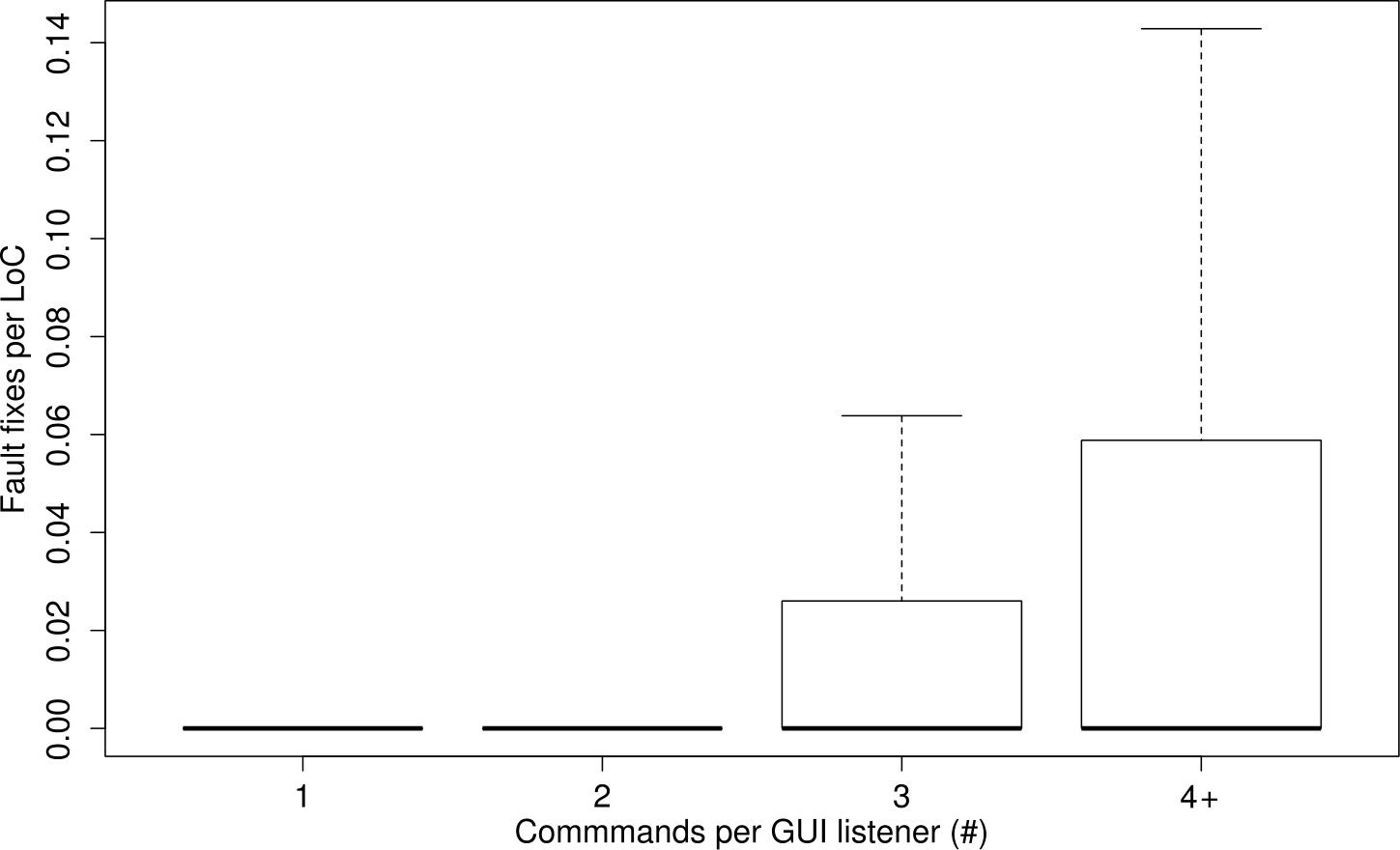 Figure 1
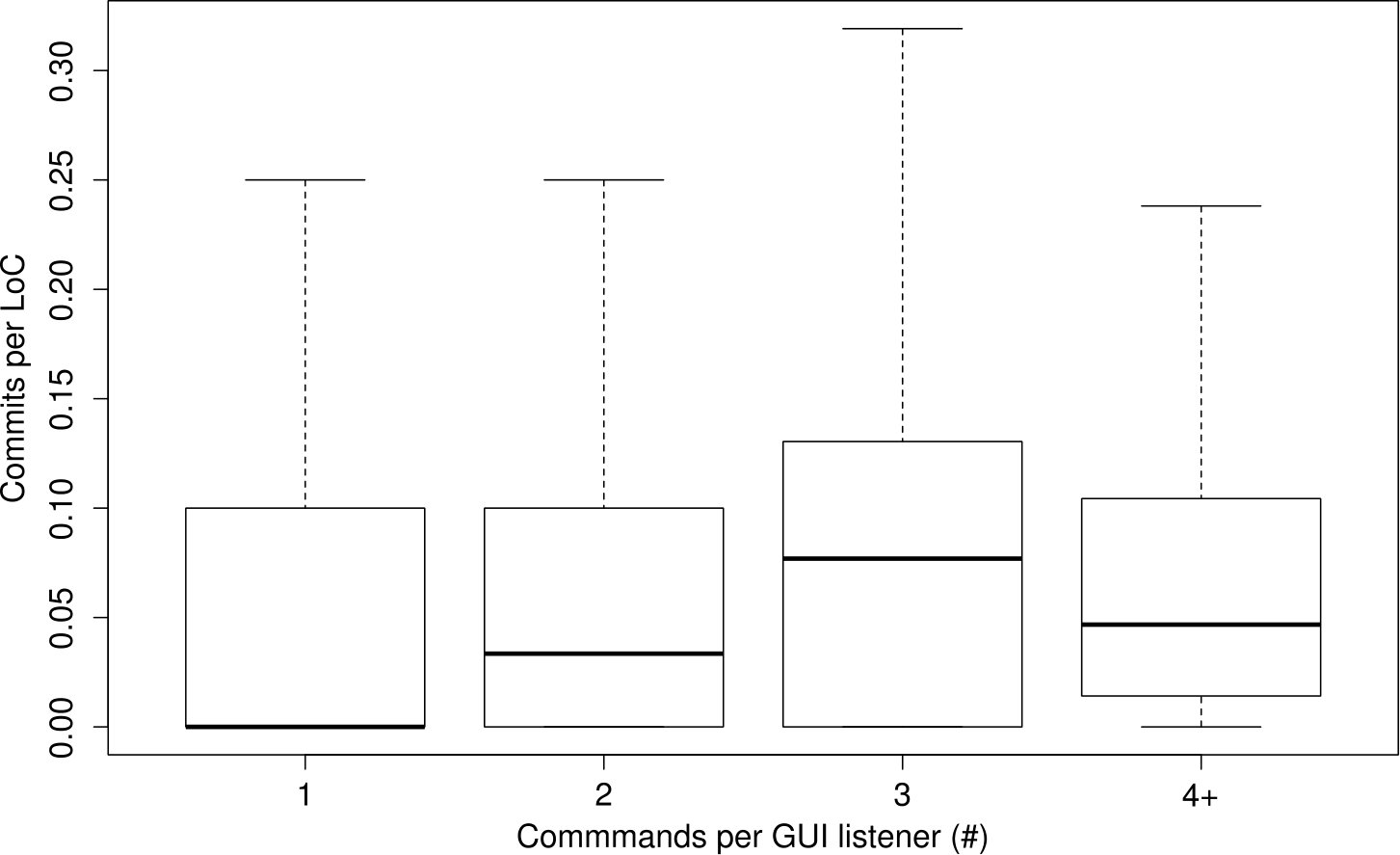 Figure 2
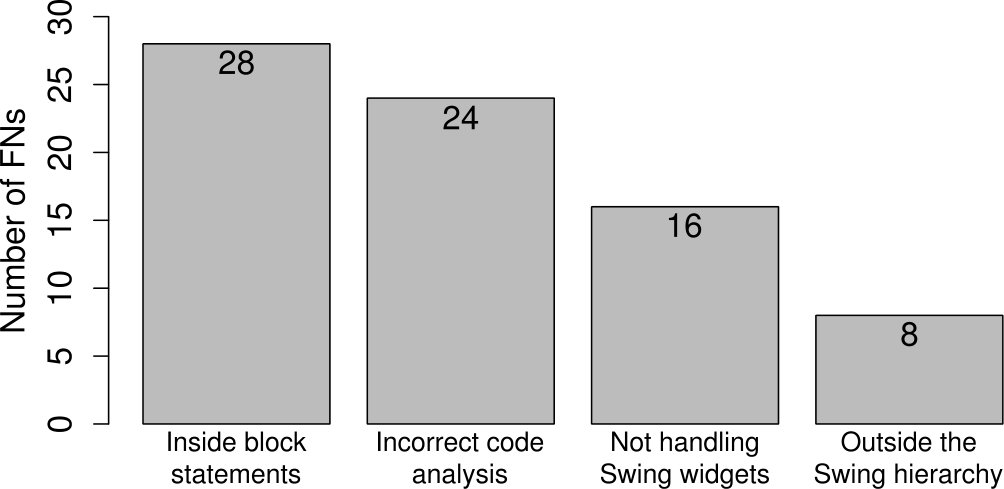 Figure 3
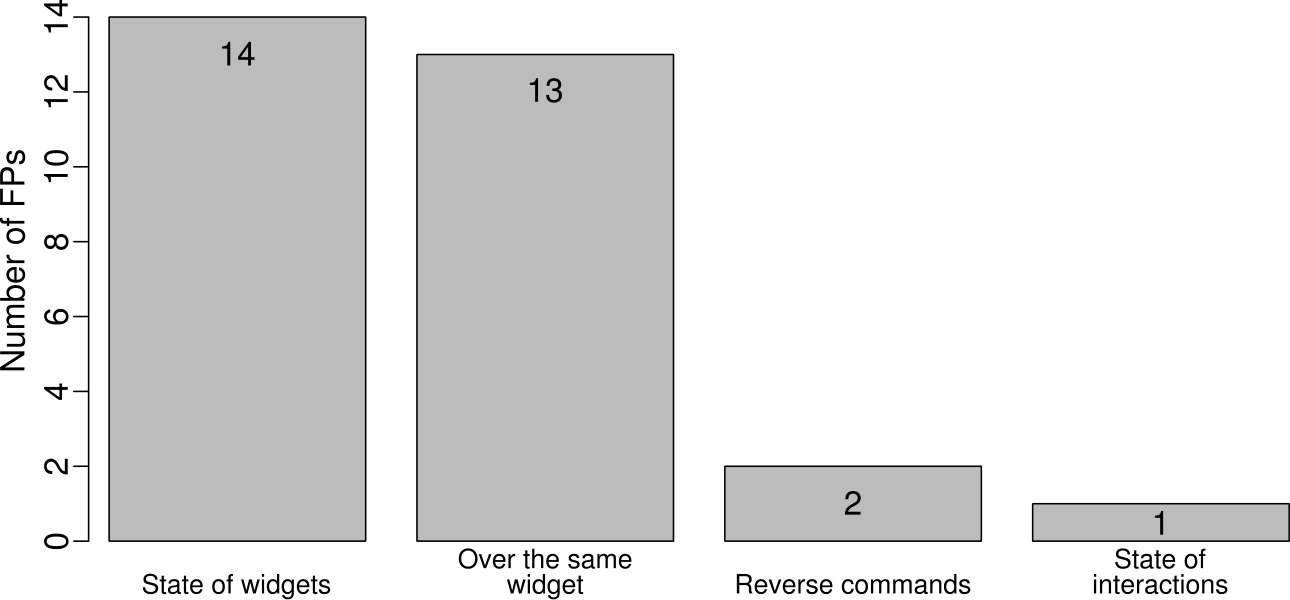 Figure 4
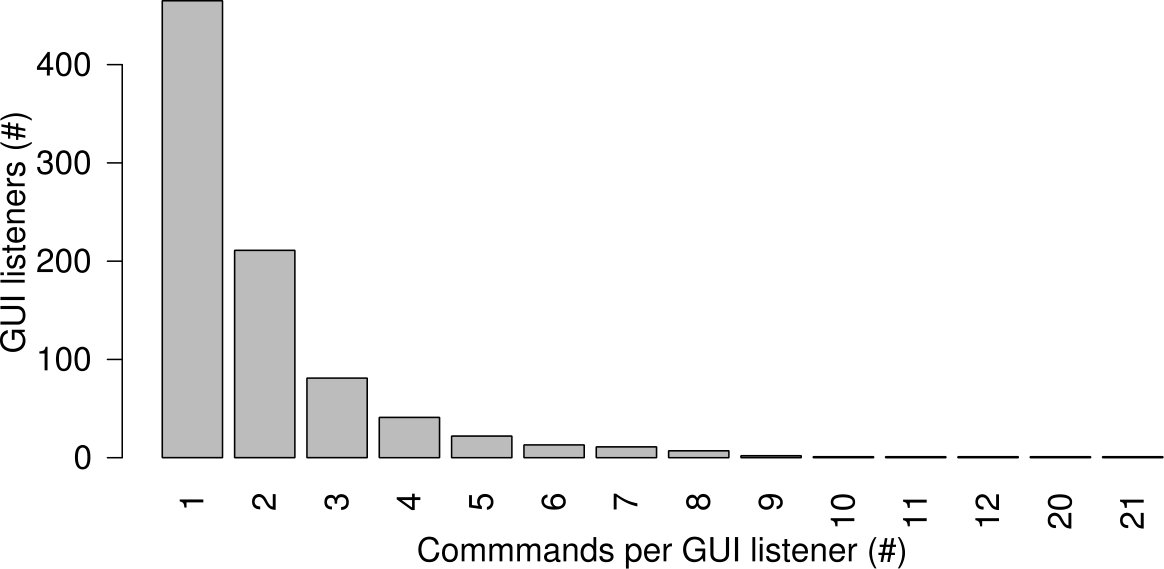 Figure 5
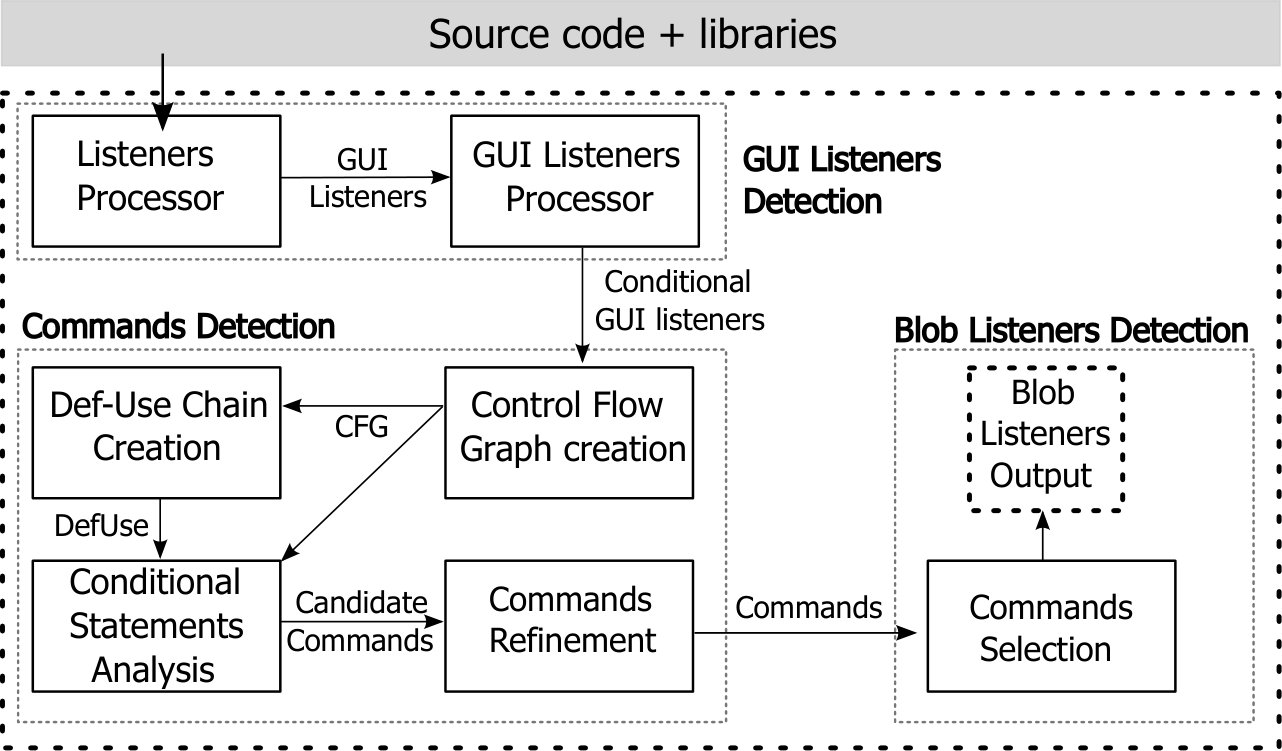 Figure 6
| Dependent | Mean | Mean | Mean | Mean | Correlation | Significance |
|---|---|---|---|---|---|---|
| variables | CMD=1 | CMD=2 | CMD=3 | CMD>3 | -value | |
| \cellcolorgreen 0.4438 | \cellcolorgreen <0.001 | |||||
| 0.0570 | 0.111 |
| Software | Version | GUI | Conditional | Source Repository Link |
|---|---|---|---|---|
| Systems | Listeners (# (LoC)) | GUI Listeners (# (LoC)) | ||
| FastPhotoTagger | 2.3 | 94 (555) | 23 (408) | http://sourceforge.net/projects/fastphototagger/ |
| GanttProject | 2.0.10 | 67 (432) | 14 (282) | https://code.google.com/p/ganttproject/ |
| JaxoDraw | 2.1 | 123 (1331) | 50 (1128) | http://jaxodraw.svn.sourceforge.net/svnroot/jaxodraw/trunk/jaxodraw |
| Jmol | 14.1.13 | 248 (1668) | 53 (1204) | http://svn.code.sf.net/p/jmol/code/trunk/Jmol |
| TerpPaint | 3.4 | 272 (1089) | 4 (548) | http://sourceforge.net/projects/terppaint/files/terppaint/3.4/ |
| TripleA | 1.8.0.3 | 559 (6138) | 174 (4321) | https://svn.code.sf.net/p/triplea/code/trunk/triplea/ |
| Software | Successfully | FN | FP | ||
|---|---|---|---|---|---|
| System | Detected | (#) | (#) | (%) | (%) |
| Commands (#) | |||||
| FastPhotoTagger | |||||
| GanttProject | |||||
| JaxoDraw | |||||
| Jmol | |||||
| TerpPaint | |||||
| TripleA | |||||
| OVERALL |
| Software | Successfully | FN | FP | Time | ||
|---|---|---|---|---|---|---|
| System | Detected | (#) | (#) | (%) | (%) | (ms) |
| Blob listeners (#) | ||||||
| FastPhotoTagger | 3445 | |||||
| GanttProject | 1910 | |||||
| JAxoDraw | 13143 | |||||
| Jmol | 16904 | |||||
| TerpPaint | 12723 | |||||
| TripleA | 16732 | |||||
| OVERALL | 10810 |
Peer Reviews
No public reviews on file for this paper yet. If you reviewed it on a platform where reviews are public (OpenReview, ICLR, NeurIPS, ICML), you can paste yours below so the community can read it here.
Videos
No videos yet. Explain this paper in a talk, walkthrough, or lecture? Add one.
\toappear
Author’s version.
Automatic Detection of GUI Design Smells:
The Case of Blob Listener
Valéria Lelli
[email protected] Arnaud Blouin
[email protected] Benoit Baudry
[email protected] Fabien Coulon
[email protected] Olivier Beaudoux
University of Ceará, Brazil
INSA Rennes, France
Inria, France
Inria, France
ESEO, France
Abstract
Graphical User Interfaces (GUIs) intensively rely on event-driven programming: widgets send GUI events, which capture users’ interactions, to dedicated objects called controllers. Controllers implement several GUI listeners that handle these events to produce GUI commands. In this work, we conducted an empirical study on 13 large Java Swing open-source software systems. We study to what extent the number of GUI commands that a GUI listener can produce has an impact on the change- and fault-proneness of the GUI listener code. We identify a new type of design smell, called Blob listener that characterizes GUI listeners that can produce more than two GUI commands. We show that of the analyzed GUI controllers are Blob listeners. We propose a systematic static code analysis procedure that searches for Blob listener that we implement in InspectorGuidget. We conducted experiments on six software systems for which we manually identified 37 instances of Blob listener. InspectorGuidget successfully detected 36 Blob listeners out of 37. The results exhibit a precision of and a recall of . Finally, we propose coding practices to avoid the use of Blob listeners.
keywords:
User interface, design smell, software validation, code quality
category:
F.3.3 Studies of Program Constructs Control primitives
category:
H.5.2 User Interfaces Graphical user interfaces (GUI)
category:
D.3.3 Language Constructs and Features Patterns
1 Introduction
Graphical User Interfaces (GUI) are the visible and tangible vector that enable users to interact with software systems. While GUI design and qualitative assessment is handled by GUI designers, integrating GUIs into software systems remains a software engineering task. Software engineers develop GUIs following widespread architectural design patterns, such as MVC [18] or MVP [30] (Model-View-Controller/Presenter), that consider GUIs as first-class concerns (e.g., the View in these two patterns). These patterns clarify the implementations of GUIs by clearly separating concerns, thus minimizing the "spaghetti of call-backs" [23]. These implementations rely on event-driven programming where events are treated by controllers (resp. presenters111For simplicity, we use the term controller to refer to any kind of component of MV* architectures that manages events triggered by GUIs, such as Presenter (MVP), or ViewModel (MVVM [37]).), as depicted by LABEL:lst.introEX. In this code example, the AController controller manages three widgets, b1, b2, and m3 (Lines 2 to 4). To handle events that these widgets trigger in response to users’ interactions, the GUI listener is implemented in the controller (Lines 6 to 17). One major job of GUI listeners is the production of GUI commands, i.e., a set of statements executed in reaction of a GUI event produced by a widget (Lines 9, 11, and 15). Like any code artifact, GUI controllers must be tested, maintained and are prone to evolution and errors. In particular, software developers are free to develop GUI listeners that can produce a single or multiple GUI commands. In this work, we investigate the effects of such development practices on the code quality of the GUI listeners.
In many cases GUI code is intertwined with the rest of the code. We thus propose a static code analysis required for detecting the GUI commands that a GUI listener can produce. Using this code analysis, we then conduct a large empirical study on Java Swing open-source GUIs. We focus on the Java Swing toolkit because of its popularity and the large quantity of Java Swing legacy code. We empirically study to what extent the number of GUI commands that a GUI listener can produce has an impact on the change- or fault-proneness of the GUI listener code, considered in the literature as negative impacts of a design smell on the code [27, 16, 20, 31]. Based on the results of this experiment, we define a GUI design smell we call Blob listener, i.e., a GUI listener that can produce more than two GUI commands. For example with LABEL:lst.introEX, the GUI listener implemented in manages events produced by three widgets, b1, b2, and m3 (Lines 8, 10, and 13), that produce one GUI command each. 21% of the analyzed GUI controllers are Blob listeners.
We provide an open-source tool, InspectorGuidget 222https://github.com/diverse-project/InspectorGuidget, that automatically detect Blob listeners in Java Swing GUIs. To evaluate the ability of InspectorGuidget at detecting Blob listeners, we considered six representative Java software systems. We manually retrieved all instances of Blob listener in each application, to build a ground truth for our experiments: we found 37 Blob listeners. InspectorGuidget detected 36 Blob listeners out of 37. The experiments show that our algorithm has a precision of and recall of to detect Blob listeners. Our contributions are:
- •
an empirical study on 13 Java Swing open-source software systems. This study investigates the current coding practices of GUI controllers. The main result of this study is the identification of a GUI design smell we called Blob listener.
- •
a precise characterization of the Blob listener. We also discuss the different coding practices of GUI listeners we observed in listeners having less than three commands.
- •
an open-source tool, InspectorGuidget, that embeds a static code analysis to automatically detect the presence of Blob listeners in Swing GUIs. We evaluated the ability of InspectorGuidget at detecting Blob listeners.
The paper is organized as follows. Section 2 describes an empirical study that investigates coding practices of GUI controllers. Based on this study, Section 3 describes an original GUI design smell we called Blob listener. Following, Section 4 introduces an algorithm to detect Blob listeners, evaluated in Section 5. The paper ends with related work (Section 7) and a research agenda (Section 8).
2 An empirical study on GUI listeners
All the material of the experiments is freely available on the companion web page@footnotemark.
2.1 Independent Variables
GUI listeners are core code artifacts in software systems. They receive and treat GUI events produced by users while interacting with GUIs. In reaction of such events, GUI listeners produce GUI commands that can be defined as follows:
Definition 1** (GUI Command).**
*A GUI command [13, 5], aka. action [6, 7], is a set of statements executed in reaction to a user interaction, captured by an input event, performed on a GUI. GUI commands may be supplemented with: a pre-condition checking whether the command fulfills the prerequisites to be executed; undo and redo functions for, respectively, canceling and re-executing the command. *
Number of GUI Commands (CMD). This variable measures the number of GUI commands a GUI listener can produce. To measure this variable, we develop a dedicated static code analysis (see Section 4).
GUI listeners are thus in charge of the relations between a software system and its GUI. As any code artifact, GUI code has to be tested and analyzed to provide users with high quality (from a software engineering point of view) GUIs. In this work, we specifically focus on a coding practice that affect the code quality of the GUI listeners: we want to state whether the number of GUI commands that GUI listeners can produce has an effect on the code quality of these listeners. Indeed, software developers are free to develop GUI listeners that can produce a single or multiple GUI commands since no coding practices or GUI toolkits provide coding recommendations. To do so, we study to what extent the number of GUI commands that a GUI listener can produce has an impact on the change- and fault-proneness of the GUI listener code. Such a correlation has been already studied to evaluate the impact of several antipatterns on the code quality [16].
We formulate the research questions of this study as follows:
- RQ1
To what extent the number of GUI commands per GUI listeners has an impact on fault-proneness of the GUI listener code?
- RQ2
To what extent the number of GUI commands per GUI listeners has an impact on change-proneness of the GUI listener code?
- RQ3
Does a threshold value, i.e., a specific number of GUI commands per GUI listener, that can characterize a GUI design smell exist?
2.2 Dependent Variables
To answer the previously introduced research questions, we measure the following dependent variables.
Average Commits (COMMIT). This variable measures the average number of commits per line of code (LoC) of GUI listeners. This variable will permit to evaluate the change-proneness of GUI listeners. The measure of this variable implies that the objects of this study, i.e., software systems that will be analyzed, must have a large and accessible change history. To measure this variable, we automatically count the number of the commits that concern each GUI listener.
Average fault Fixes (FIX). This variable measures the average number of fault fixes per LoC of GUI listeners. This variable will permit to evaluate the fault-proneness of GUI listeners. The measure of this variable implies that the objects of this study must use a large and accessible issue-tracking system. To measure this variable, we manually analyze the log of the commits that concern each GUI listener. We count the commits which log refers to a fault fix, i.e., logs that point to a bug report of an issue-tracking system (using a bug ID or a URL) or that contain the term "fix" (or a synonymous).
Both COMMIT and FIX rely on the ability to get the commits that concern a given GUI listener. For each software system, we use all the commits of their history. To identify the start and end lines of GUI listeners, we developed a static code analysis. This code analysis uses the definition of the GUI listener methods provided by GUI toolkits (e.g., void actionPerformed(ActionEvent)) to locate these methods in the code. Moreover, commits may change the position of GUI listeners in the code (by adding or removing LoCs). To get the exact position of a GUI listener while studying its change history, we use the Git tool git-log333https://git-scm.com/docs/git-log. The git-log tool has options that permit to: follow the file to log across file renames (option -M); trace the evolution of a given line range across commits (option -L). We then manually check the logs for errors.
2.3 Objects
The objects of this study are a set of large open-source software systems. The dependent variables, previously introduced, impose several constraints on the selection of these software systems. They must use an issue-tracking system and the Git version control system. Their change history must be large (i.e., must have numerous commits) to let the analysis of the commits relevant. In this work, we focus on Java Swing GUIs because of the popularity and the large quantity of Java Swing legacy code. We thus selected from the Github platform444https://github.com/ large Java Swing software systems. The average number of commits of these software systems is approximately commits. The total size of Java code is k Java LoCs. Their average size is approximately k Java LoCs.
2.4 Results
We can first highlight that the total number of GUI listeners producing at least one GUI command identified by our tool is , i.e., an average of GUI listeners per software system. This approximately corresponds to kLoCs, i.e., around of their Java code.
Figure 1 shows the distribution of the listeners according to their number of GUI commands. Most of the listeners () can produce one command (we will call 1-command listener). listeners can produce two commands. listeners can produce three commands. listeners can produce at least four commands. To obtain representative data results, we will consider in the following analyses four categories of listeners: one-command listener, two-command listener, three-command listener, and four+-command listener.
Besides, a first analysis of the data exhibits many outliers, in particular for the one-command listeners. To understand the presence of these outliers, we manually scrutiny some of them and their change history. We observe that some of these outliers are GUI listeners which size has been reduced over the commits. For instance, we identified outliers that contained multiple GUI commands before commits that reduced them as one- or two-command listeners. Such listeners distort the analysis of the results by considering listeners that have been large, as one- or two-command listeners. We thus removed those outliers from the data set, since outliers removal, when justified, may bring benefits to the data analysis [26]. We compute the box plot statistics to identify and then remove the outliers.
Figure 2 depicts the number of fault fixes per LoC (i.e., FIX) of the analyzed GUI listeners. We observe an increase of the fault fixes per LoC when . These results are detailed in Table 1. The mean value of FIX constantly increases over CMD. Because these data follow a monotonic relationship, we use the Spearman’s rank-order correlation coefficient to assess the correlation between the number of fault fixes per LoC and the number of GUI commands in GUI listeners [26]. We also use a confidence level (i.e., -value0.05). This test exhibits a low correlation () statistically significant with a -value of .
Regarding RQ1, on the basis of these results we can conclude that the number of GUI commands per GUI listeners does not have a strong negative impact on fault-proneness of the GUI listener code. This result is surprising regarding the global increase that can be observed in Figure 2. One possible explanation is that the mean of the number of bugs per LoC slowly increases over the number of commands as shown in the first row of Table 1. On the contrary, the range of the box plots of Figure 2 strongly increases with 3-command listeners. This means that the 3+-command data sets are more variable than for the 1- and 2-command data sets.
Figure 3 depicts the number of commits per LoC (i.e., COMMIT) of the analyzed GUI listeners. These results are also detailed in Table 1. We observe that COMMIT does not constantly increases over CMD. This observation is assessed by the absence of correlation between these two variables (), even if this result is not statistically significant with a -value of . We can, however, observe in Figure 3 an increase of COMMIT for the three-command listeners.
Regarding RQ2, on the basis of these results we can conclude that there is no evidence of a relationship between the number of GUI commands per GUI listeners and the change-proneness of the GUI listener code.
Regarding RQ3, we observe a significant increase of the fault fixes per LoC for 3+-command listeners. We observe a mean of bugs per LoC for 1- and 2-command listeners, against a mean of bugs per LoC for 3+-command listeners, as highlighted by Figure 2. We apply the independent samples Mann-Whitney test to compare 1- and 2-command listeners against 3+-command listeners and we obtain a -value of (i.e., -value0.05). We observe similar, but not significant, increase on the commits per LoC for the three-command listeners. We thus state that a threshold value, i.e., a specific number of GUI commands per GUI listener, that characterizes a GUI design smell exists. On the basis of the results, we define this threshold to three GUI commands per GUI listener. Of course, this threshold value is an indication and as any design smell it may vary depending on the context. Indeed, as noticed in several studies, threshold values of design smells must be customizable to let system experts the possibility to adjust them [15, 28]. Using the threshold value of 3, the concerned GUI listeners represent 21% of the analyzed GUI listener and of the Java code of the analyzed software systems. Besides, the average size of the 3+-command listeners is LoCs, i.e., less than the long method design smell defined between and LoCs in mainstream code analysis tools [10].
To conclude on this empirical study we highlight the main findings. The relation between the number of bug fixes over the number of GUI commands is too low to draw conclusions. Future works will include a larger empirical study to investigate more in depth this relation. However, a significant increase of the fault fixes per LoC for 3+-command listeners is observed. We thus set to three the number of GUI commands beyond which a GUI listener is considered as badly designed. This threshold value is an indication and as any design smell it may be defined by system experts according to the context. We show that of the Java code of the analyzed software systems is affected by this new GUI design smell that concerns 21% of the analyzed GUI listeners. The threats to validity of this empirical study are discussed in Section 6.1.
3 Blob Listener: Definition & Illustration
This section introduces the GUI design smell, we call Blob listener, identified in the previous section, and illustrates it through real examples.
3.1 Blob Listener
We define the Blob listener as follows:
Definition 2** (Blob Listener).**
*A Blob listener is a GUI listener that can produce more than two GUI commands. Blob listeners can produce several commands because of the multiple widgets they have to manage. In such a case, Blob listeners’ methods (such as actionPerformed) may be composed of a succession of conditional statements that:
- check whether the widget that produced the event to treat is the good one, i.e., the widget that responds a user interaction;
- execute the command when the widget is identified.
We identified three variants of the Blob listener. The variations reside in the way of identifying the widget that produced the event. These three variants are described and illustrated as follows.
Comparing a property of the widget. LABEL:lst.fitsAllSwing is an example of the first variant of Blob listener: the widgets that produced the event (lines 9, 12, and 14) are identified with a String associated to the widget and returned by getActionCommand (line 8). Each of the three if blocks forms a GUI command to execute in response of on the triggered widget (lines 10, 11, 13, and 15).
In Java Swing, the properties used to identify widgets are mainly the name or the action command of these widgets. The action command is a string used to identify the kind of commands the widget will trigger. LABEL:lst.init, related to LABEL:lst.fitsAllSwing, shows how an action command (lines 2 and 6) and a listener (lines 3 and 7) can be associated to a widget in Java Swing during the creation of the user interface.
Checking the type of the widget. The second variant of Blob listener consists of checking the type of the widget that produced the event. LABEL:lst.instanceof depicts such a practice where the type of the widget is tested using the operator instanceof (Lines 3, 5, 7, and 9). One may note that such if statements may have nested if statements to test properties of the widget as explained in the previous point.
Comparing widget references. The last variant of Blob listener consists of comparing widget references to identify those at the origin of the event. LABEL:lst.fitsAllGWT illustrates this variant where getSource returns the source widget of the event that is compared to widget references contained by the listener (e.g., lines 2, 4, and 6).
In these three variants, multiple if statements are successively defined. Such successions are required when one single GUI listener gathers events produced by several widgets. In this case, the listener needs to identify the widget that produced the event to process.
The three variants of the Blob listener design smell also appear in others Java GUI toolkits, namely SWT, GWT, and JavaFX. Examples for these toolkits are available on the companion webpage of this paper@footnotemark.
4 Automatic Detection of GUI Commands
and Blob Listeners
4.1 Approach Overview
Figure 4 describes the process we propose to automatically detect Blob listeners. The detection process includes three main steps. First, GUI listeners that contain conditional blocks (conditional GUI listeners) are automatically detected in the source code through a static analysis (Section 4.2). Then, the GUI commands, produced while interacting with widgets, that compose conditional GUI listeners are automatically detected using a second static analysis (Section 4.3). This second static analysis permits to spot the GUI listeners that are Blob listeners, i.e., those having more than two commands. InspectorGuidget uses Spoon, a library for transforming and analyzing Java source code [29], to support the static analyses.
4.2 Detecting Conditional GUI Listeners
We define a conditional GUI listener as follows:
Definition 3** (Conditional GUI listener).**
*A conditional GUI listener is a listener composed of conditional blocks used to identify the widget that produced an event to process. Such conditional blocks may encapsulate a command to execute in reaction to the event. *
For instance, five nested conditional blocks (Lines 7, 9, 10, 12, and 14) compose the listener method actionPerformed in LABEL:lst.fitsAllSwing (Section 3). The first conditional block checks the type of the widget that produced the event (Line 7). This block contains three other conditional blocks that identify the widget using its action command (Lines 9, 12, and 14). Each of these three blocks encapsulates one command to execute in reaction of the event.
Algorithm 1 details the detection of conditional GUI listeners. The inputs are all the classes of an application and the list of classes of a GUI toolkit. First, the source code classes are processed to identify the GUI controllers. When a class implements a GUI listener (8), all the implemented listener methods are retrieved (9). For example, a class that implements the MouseMotionListener interface must implement the listener methods mouseDragged and mouseMoved. Next, each GUI listener is analyzed to identify those having at least one conditional statement (11 and 12). All listeners with those statements are considered as conditional GUI listeners (13).
4.3 Detecting Commands in Conditional GUI Listeners
Algorithm 2 details the detection of GUI commands. The input is a set of GUI conditional listeners. The statements of conditional GUI listeners are processed to detect commands. First, we build the control-flow graph (CFG) of each listener (8). Second, we traverse the CFG to gather all the conditional statements that compose a given statement (9). Next, these conditional statements are analyzed to detect any reference to a GUI event or widget (10). Typical references we found are for instance:
if(e.getSource() instanceof Component)...
if(e.getSource() == copy)...
if(e.getActionCommand().contains("copy"))...
where e refers to a GUI event, Component to a Swing class, and copy to a Swing widget. The algorithm recursively analyzes the variables and class attributes used in the conditional statements until a reference to a GUI object is found in the controller class. For instance, the variable actionCmd in the following code excerpt is also considered by the algorithm.
String actionCmd = e.getSource().getActionCommand()
if("copy".equals(actionCmd)) ...
When a reference to a GUI object is found in a conditional statement, it is considered as a potential command (11). These potential commands are then more precisely analyzed to remove irrelevant ones (14 to 24) as discussed below.
A conditional block statement can be surrounded by other conditional blocks. Potential commands detected in the function getPotentialCmds can thus be nested within other commands. We define such commands as nested commands. In such a case, the algorithm analyzes the nested conditional blocks to detect the most representative command. We observed two cases:
- A potential command contains only a single potential command, recursively. The following code excerpt depicts this case. Two potential commands compose this code. Command #1 (Lines 1 to 5) has a set of statements (i.e., command #2) to be executed when the widget labeled "Copy" is pressed. However, command #2 (Lines 2 to 4) only checks whether there is a text typed into the widget "output" to then allow the execution of command #1. So, command #2 works as a precondition to command #1, which is the command executed in reaction to that interaction. In this case, only the first one will be considered as a GUI command. ⬇ 1if(cmd.equals("Copy")){ //Potential command #1
2 if(!output.getText().isEmpty()){//Potential command #2
3 output.copy();
4 }
5}
- A potential command contains more than one potential command. The following code excerpt depicts this case. Four potential commands compose this code (Lines 1, 3, 5, and 7). In this case, the potential commands that contain multiple commands are not considered. In our example, the first potential command (Line 1) is ignored. One may note that this command checks the type of the widget, which is a variant of Blob listener (see Section 3.1). The three nested commands, however, are the real commands triggered on user interactions.
⬇ 1if(src instanceof JMenuItem){ //Potential command #1
2 String cmd = e.getActionCommand();
3 if(cmd.equals("Copy")){ //Potential command #2
4 }
5 else if(cmd.equals("Cut")){ //Potential command #3
6 }
7 else if(cmd.equals("Paste")){ //Potential command #4
8 }
9}
These two cases are described in Algorithm 2 (19 to 23). Given a potential command, all its nested potential commands are gathered (17 to 18). The function getNestCmds analyzes the commands by comparing their code line positions, statements, etc. So, if one command contains other commands, they are marked as nested to . Then, for each potential command and its nested ones: if the number of nested commands equals 1, the single nested command is ignored (20 to 21); if the number of nested commands is greater than 1, the root command is ignored (23). Finally, GUI listeners that can produce more than two commands are marked as Blob listeners. InspectorGuidget allows the setting of this threshold value to let system experts the possibility to adjust them, as suggested by several studies [15, 28].
5 Evaluation
To evaluate the efficiency of our detection algorithm, we address the two following research questions:
- RQ4
To what extent is the detection algorithm able to detect GUI commands in GUI listeners correctly?
- RQ5
To what extent is the detection algorithm able to detect Blob listeners correctly?
The evaluation has been conducted using InspectorGuidget, our implementation of the Blob listener detection algorithm. InspectorGuidget is an Eclipse plug-in that analyzes Java Swing software systems. InspectorGuidget leverages the Eclipse development environment to raise warnings in the Eclipse Java editor on detected Blob listeners and their GUI commands. Initial tests have been conducted on software systems not reused in this evaluation. InspectorGuidget and all the material of the evaluation are freely available on the companion web page@footnotemark.
5.1 Objects
We conducted our evaluation by selecting six well-known or large open-source software systems based on the Java Swing toolkit: FastPhotoTagger, GanttProject, JAxoDraw, Jmol, TerpPaint, and TripleA. We use other software systems than those used in our empirical study (Section 2) to diversify the data set used in this work and assess the validation of the detection algorithm on other systems. Only GanttProject is part of both experiments since it is traditionally used in experiments on design smells. Table 2 lists these systems and some of their characteristics such as their number of GUI listeners.
5.2 Methodology
The accuracy of the static analyses that compose the detection algorithm is measured by the recall and precision metrics [24]. We ran InspectorGuidget on each software system to detect GUI listeners, commands, and Blob listeners. We assume as a precondition that only GUI listeners are correctly identified by our tool. Thus, to measure the precision and recall of our automated approach, we manually analyzed all the GUI listeners detected by InspectorGuidget to:
- •
Check conditional GUI Listeners. For each GUI listener, we manually checked whether it contains at least one conditional GUI statement. The goal is to answer RQ4 and RQ5 more precisely, by verifying whether all the conditional GUI listeners are statically analyzed to detect commands and Blob listeners.
- •
Check commands. We analyzed the conditional statements of GUI listeners to check whether they encompass commands. Then, recall measures the percentage of relevant commands that are detected (Equation 1). Precision measures the percentage of detected commands that are relevant (Equation 2).
[TABLE]
[TABLE]
RelevantCmds corresponds to all the commands defined in GUI listeners, i.e., the commands that should be detected by InspectorGuidget. Recall and precision are calculated over the number of false positives (FP) and false negatives (FN). A command incorrectly detected by InspectorGuidget while it is not a command, is classified as false positive. A false negative is a command not detected by InspectorGuidget.
- •
Check Blob listeners. To check whether a GUI listener is a Blob listener, we stated whether the commands it contains concern several widgets. We use the same metrics of commands detection to measure the accuracy of Blob listeners detection:
[TABLE]
[TABLE]
Relevant Blob listeners are all the GUI listeners that handle more than two commands (see Section 4). Detecting Blob listeners is therefore dependent on the commands detection accuracy.
5.3 Results and Analysis
RQ4: Command Detection Accuracy. Table 3 shows the number of commands successfully detected per software system. TripleA has presented the highest number of GUI listeners (559), conditional GUI listeners (174), and commands (152). One can notice that despite the low number of conditional GUI listeners that has TerpPaint (4), this software system has 34 detected commands. So, according to the sample we studied, the number of commands does not seem to be correlated to the number of conditional GUI listeners.
Table 3 also reports the number of FN and FP commands, and the values of the recall and precision metrics. TripleA and Jmol revealed the highest number of FN, whereas TerpPaint presented the lowest number of FN. The precision of the command detection is . Most of the commands (437/441) detected by our algorithm are relevant. We, however, noticed 76 relevant commands not detected leading to an average recall of . Thus, our algorithm is less accurate in detecting all the commands than in detecting the relevant ones. For example, TripleA revealed 44 FN commands and no false positive result, leading to a recall of and a precision of . The four FP commands has been observed in JAxoDraw (2) and Jmol (2), leading to a precision of and respectively.
Figure 5 classifies the 76 FN commands according to the cause of their non-detection. 28 commands were not detected because of the use of widgets inside block statements rather than inside the conditional statements. For example, their conditional expressions refer to boolean or integer types rather than widget or event types. 16 other commands were not detected since they rely on ad hoc widgets or GUI listeners. These widgets are developed for a specific purpose and rely on specific user interactions and complex data representation [19]. Thus, our approach cannot identify widgets that are not developed under Java Swing toolkit. All the FN commands reported in this category concern TripleA (14) and Jmol (2) that use several ad hoc widgets. Similarly, we found eight FN commands that use classes defined outside the Swing class hierarchy. A typical example is the use of widgets’ models (e.g., classes ButtonModel or TableModel) in GUI listeners. Also, we identified 24 FN commands caused by an incorrect code analysis (either bugs in InspectorGuidget or in the Spoon library). This result was mainly affected by Jmol, that has a listener with 14 commands not detected.
To conclude on RQ4, our approach is efficient for detecting GUI commands that compose GUI listener, even if some improvements are possible.
RQ5: Blob Listeners Detection Accuracy. Table 4 gives an overview of the results of the Blob listeners detection per software system. The highest numbers of detected Blob listeners concern TripleA (11), Jmol (11), and JAxoDraw (7). Only one false positive and false negative have been identified against 37 Blob listeners correctly detected. The average recall is and the average precision is . The average time spent to analyze the software systems is . It includes the time that Spoon takes to process all classes plus the time to detect GUI commands and Blob listeners. The worst-case is measured in TripleA, i.e., the largest system, with . Spoon takes a significant time to load the classes for large software systems (e.g., out of in TripleA). Similarly to the command detection, we did not observe a correlation between the number of conditional GUI listeners, commands, and Blob listeners. So, regarding the recall and the precision, our approach is efficient for detecting Blob listeners.
Regarding the single FN Blob listener, located in the Jmol software system, this FN is due to an error in our implementation. Because of a problem in the analysis of variables in the code, 14 GUI commands were not detected. LABEL:lst.codeJaxoDraw gives an example of the FP Blob listener detected in JAxoDraw. It is composed of three commands based on checking the states of widgets. For instance, the three commands rely on the selection of a list (Lines 4, 7, and 11).
6 Discussion
In the next three subsections, we discuss the threats to validity of the experiments detailed in this paper, the scope of InspectorGuidget, and alternative coding practices that can be used to limit Blob listeners.
6.1 Threats to validity
External validity. This threat concerns the possibility to generalize our findings. We designed the experiments using multiple Java Swing open-source software systems to diversify the observations. These unrelated software systems are developed by different persons and cover various user interactions. Several selected software systems have been used in previous research work, e.g., GanttProject [10, 3], Jmol [3], and TerpPaint [9] that have been extensively used against GUI testing tools. Our implementation and our empirical study (Section 2) focus on the Java Swing toolkit only. We focus on the Java Swing toolkit because of its popularity and the large quantity of Java Swing legacy code. We provide on the companion web page examples of Blob listeners in other Java GUI toolkits, namely GWT, SWT, and JavaFX@footnotemark.
Construct validity. This threat relates to the perceived overall validity of the experiments. Regarding the empirical study (Section 2), we used InspectorGuidget to find GUI commands in the code. InspectorGuidget might not have detected all the GUI commands. We show in the validation of this tool (Section 5) that its precision () and recall () limit this threat. Regarding the validation of InspectorGuidget, the detection of FNs and FPs have required a manual analysis of all the GUI listeners of the software systems. To limit errors during this manual analysis, we added a debugging feature in InspectorGuidget for highlighting GUI listeners in the code. We used this feature to browse all the GUI listeners and identify their commands to state whether these listeners are Blob listeners. During our manual analysis, we did not notice any error in the GUI listener detection. We also manually determined whether a listener is a Blob listener. To reduce this threat, we carefully inspected each GUI command highlighted by our tool.
6.2 Scope of the Approach
Our approach has the following limitations. First, InspectorGuidget currently focuses on GUIs developed using the Java Swing toolkit. This is a design decision since we leverage Spoon, i.e., a library to analyze Java source code. However, our solution is generic and can be used to support other GUI toolkits.
Second, our solution is limited to analyze GUI listeners and associated class attributes. We identified several GUI listeners that dispatch the event processing to methods. Our implemented static analyses can be extended to traverse these methods to improve its performance.
Last, the criteria for the Blob listeners detection should be augmented by inferring the related commands. For example, when a GUI listener is a Blob listener candidate, our algorithm should analyze its commands by comparing their commonalities (e.g., shared widgets and methods). The goal is to detect commands that form in fact a single command.
6.3 Alternative Practices
We scrutinized GUI listeners that are not Blob listeners to identify alternative practices that may limit Blob listeners. In most of the cases, these practices consist of producing one command per listener by managing one widget per listener.
Listeners as anonymous classes. LABEL:lst.good is an example of this good practice. A listener, defined as an anonymous class (Lines 3 to 8), registers with one widget (Line 2). The methods of this listener are then implemented to define the command to perform when an event occurs. Because such listeners have to handle only one widget, if statements used to identify the involved widget are not more used, simplifying the code.
Listeners as lambdas. LABEL:lst.goodJava8 illustrates the same code than LABEL:lst.good but using Lambdas supported since Java 8. Lambdas simplify the implementation of anonymous class that have a single method to implement.
Listeners as classes. In some cases, listeners have to manage different intertwined methods. This case notably appears when developers want to combine several listeners or methods of a single listener to develop a more complex user interaction. For example, LABEL:lst.listClass is a code excerpt that describes a mouse listener where different methods are managed: mouseClicked (Line 2), mouseReleased (Line 7), and mouseEntered (Line 10). Data are shared among these methods (isDrag, Lines 3 and 8).
7 Related Work
Work related to this paper fall into two categories: design smell detection; GUI maintenance and evolution.
7.1 Design Smell Detection
The characterization and detection of object-oriented (OO) design smells have been widely studied [32]. For instance, research works characterized various OO design smells associated with code refactoring operations [12, 8]. Multiple empirical studies have been conducted to observe the impact of several OO design smells on the code. These studies show that OO design smells can have a negative impact on maintainability [39], understandability [2], and change- or fault-proneness [16]. While developing seminal advances on OO design smells, these research works focus on OO concerns only. Improving the validation and maintenance of GUI code implies a research focus on GUI design smells, as we propose in this paper.
Related to GUI code analysis, Silva *et al.*propose an approach to inspect GUI source code as a reverse engineering process [36, 34]. Their goal is to provide developers with a framework supporting the development of GUI metrics and code analyzes. They also applied standard OO code metrics on GUI code [35]. Closely, Almeida *et al.*propose a first set of usability smells [4]. These works do not focus on GUI design smell and empirical evidences about their existence, unlike the work presented in this paper.
The automatic detection of design smells involves two steps. First, a source code analysis is required to compute source code metrics. Second, heuristics are applied to detect design smells on the basis of the computed metrics to detect design smells. Source code analyses can take various forms, notably: static, as we propose, and historical. Regarding historical analysis, Palomba *et al.*propose an approach to detect design smells based on change history information [27]. Future work may also investigate whether analyzing code changes over time can help in characterizing Blob listeners. Regarding detection heuristics, the use of code metrics to define detection rules is a mainstream technique. Metrics can be assemble with threshold values defined empirically to form detection rules [21]. Search-based techniques are also used to exploit OO code metrics [33], as well as machine learning [40], or bayesian networks [17]. Still, these works do not cover GUI design smells. In this paper, we focus on static code analysis to detect GUI commands to form a Blob listener detection rule. To do so, we use a Java source code analysis framework that permits the creation of specific code analyzers [29]. Future work may investigate other heuristics and analyses to detect GUI design smells.
Several research work on design smell characterization and detection are domain-specific. For instance, Moha *et al.*propose a characterization and a detection process of service-oriented architecture anti-patterns [22]. Garcia *et al.*propose an approach for identifying architectural design smells [14]. Similarly, this work aims at motivating that GUIs form another domain concerned by specific design smells that have to be characterized.
Research studies have been conducted to evaluate the impact of design smells on system’s quality [25, 11] or how they are perceived by developers [28]. Future work may focus on how software developers perceive Blob listeners.
7.2 GUI maintenance and evolution
Unlike object-oriented design smells, less research work focuses on GUI design smells. Zhang et al. propose a technique to automatically repair broken workflows in Swing GUIs [42]. Static analyses are proposed. This work highlights the difficulty "for a static analysis to distinguish UI actions [GUI commands] that share the same event handler [GUI listener]". In our work, we propose an approach to accurately detect GUI commands that compose GUI listeners. Staiger also proposes a static analysis to extract GUI code, widgets, and their hierarchies in C/C++ software systems [38]. The approach, however, is limited to find relationships between GUI elements and thus does not analyze GUI controllers and their listeners. Zhang et al. propose a static analysis to find violations in GUIs [41]. These violations occur when GUI operations are invoked by non-UI threads leading a GUI error. The static analysis is applied to infer a static call graph and check the violations. Frolin et al. propose an approach to automatically find inconsistencies in MVC JavaScript applications [24]. GUI controllers are statically analyzed to identify consistency issues (e.g., inconsistencies between variables and controller functions). This work is highly motivated by the weakly-typed nature of Javascript.
8 Conclusion
In this paper, we investigate a new research area on GUI design smells. We detail a specific GUI design smell, we call Blob listener, that can affect GUI listeners. The empirical study we conducted exhibits a specific number of GUI commands per GUI listener that characterizes a Blob listener exists. We define this threshold to three GUI commands per GUI listener. We show that of the analyzed GUI controllers are affected by Blob listeners. We propose an algorithm to automatically detect Blob listeners. This algorithm has been implemented in a tool publicly available and then evaluated.
Next steps of this work include a behavior-preserving algorithm to refactor detected Blob listeners. We will conduct a larger empirical study to investigate more in depth the relation between the number of bug fixes over the number of GUI commands. We will study different GUI coding practices to identify other GUI design smells. We will investigate whether some GUI faults [19] are accentuated by GUI design smells.
Acknowledgements
This work is partially supported by the French BGLE Project CONNEXION. We thank Yann-Gaël Guéhéneuc for his insightful comments on this paper.
The reference list from the paper itself. Each links out to its DOI / PubMed record.
- 1[1]
- 2[2] Marwen Abbes, Foutse Khomh, Y. G. Guéhéneuc, and Giuliano Antoniol. 2011. An empirical study of the impact of two antipatterns, Blob and Spaghetti Code, on program comprehension. In Proceedings of the European Conference on Software Maintenance and Reengineering . 181–190. DOI: http://dx.doi.org/10.1109/CSMR.2011.24 · doi ↗
- 3[3] Andrea Adamoli, Dmitrijs Zaparanuks, Milan Jovic, and Matthias Hauswirth. 2011. Automated GUI performance testing. Software Quality Journal 19, 4 (2011), 801–839. http://dx.doi.org/10.1007/s 11219-011-9135-x · doi ↗
- 4[4] Diogo Almeida, José Creissac Campos, João Saraiva, and João Carlos Silva. 2015. Towards a Catalog of Usability Smells. In Proceedings of the 30th Annual ACM Symposium on Applied Computing (SAC ’15) . ACM, 175–181. http://doi.acm.org/10.1145/2695664.2695670
- 5[5] Michel Beaudouin-Lafon. 2000. Instrumental interaction: an interaction model for designing post-WIMP user interfaces. In Proc. of CHI’00 . ACM, 446–453. http://dl.acm.org/citation.cfm?id=332473
- 6[6] Arnaud Blouin and Olivier Beaudoux. 2010. Improving modularity and usability of interactive systems with Malai. In Proc. of EICS’10 . 115–124. https://hal.inria.fr/inria-00477627
- 7[7] Arnaud Blouin, Brice Morin, Grégory Nain, Olivier Beaudoux, Patrick Albers, and Jean-Marc Jézéquel. 2011. Combining Aspect-Oriented Modeling with Property-Based Reasoning to Improve User Interface Adaptation. In EICS’11: Proceedings of the 3rd ACM SIGCHI symposium on Engineering interactive computing systems . 85–94. DOI: http://dx.doi.org/10.1145/1996461.1996500 · doi ↗
- 8[8] William J Brown, Hays W Mc Cormick, Thomas J Mowbray, and Raphael C Malveau. 1998. Anti Patterns: refactoring software, architectures, and projects in crisis . Wiley New York.