The (theta, wheel)-free graphs Part II: structure theorem
Marko Radovanovi\'c, Nicolas Trotignon, Kristina Vu\v{s}kovi\'c

TL;DR
This paper establishes a new decomposition and structure theorem for (theta, wheel)-free graphs using clique cutsets and 2-joins, enabling efficient recognition and further analysis of these graphs.
Contribution
It introduces the first decomposition theorem combining only clique cutsets and 2-joins for (theta, wheel)-free graphs, leading to a complete structure theorem and recognition algorithm.
Findings
Decomposition theorem for (theta, wheel)-free graphs using clique cutsets and 2-joins.
Explicit construction of all (theta, wheel)-free graphs from basic components.
Recognition algorithm with O(n^4 m) complexity.
Abstract
A theta is a graph formed by three paths between the same pair of distinct vertices so that the union of any two of the paths induces a hole. A wheel is a graph formed by a hole and a node that has at least 3 neighbors in the hole. In this paper we obtain a decomposition theorem for the class of graphs that do not contain an induced subgraph isomorphic to a theta or a wheel, i.e. the class of (theta, wheel)-free graphs. The decomposition theorem uses clique cutsets and 2-joins. Clique cutsets are vertex cutsets that work really well in decomposition based algorithms, but are unfortunately not general enough to decompose more complex hereditary graph classes. A 2-join is an edge cutset that appeared in decomposition theorems of several complex classes, such as perfect graphs, even-hole-free graphs and others. In these decomposition theorems 2-joins are used together with vertex cutsets…
Click any figure to enlarge with its caption.
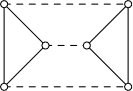 Figure 1
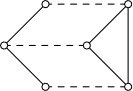 Figure 2
 Figure 3
 Figure 6
Peer Reviews
No public reviews on file for this paper yet. If you reviewed it on a platform where reviews are public (OpenReview, ICLR, NeurIPS, ICML), you can paste yours below so the community can read it here.
Videos
No videos yet. Explain this paper in a talk, walkthrough, or lecture? Add one.
The (theta, wheel)-free graphs
Part II: structure theorem
Marko Radovanović , Nicolas Trotignon , Kristina Vušković University of Belgrade, Faculty of Mathematics, Belgrade, Serbia. Partially supported by Serbian Ministry of Education, Science and Technological Development project 174033. E-mail: [email protected], LIP, ENS de Lyon. Partially supported by ANR project Stint under reference ANR-13-BS02-0007 and by the LABEX MILYON (ANR-10-LABX-0070) of Université de Lyon, within the program “Investissements d’Avenir” (ANR-11-IDEX-0007) operated by the French National Research Agency (ANR). Also Université Lyon 1, université de Lyon. E-mail: [email protected] of Computing, University of Leeds, and Faculty of Computer Science (RAF), Union University, Belgrade, Serbia. Partially supported by EPSRC grants EP/K016423/1 and EP/N0196660/1, and Serbian Ministry of Education and Science projects 174033 and III44006. E-mail: [email protected]
Abstract
A hole in a graph is a chordless cycle of length at least 4. A theta is a graph formed by three paths between the same pair of distinct vertices so that the union of any two of the paths induces a hole. A wheel is a graph formed by a hole and a node that has at least 3 neighbors in the hole. In this paper we obtain a decomposition theorem for the class of graphs that do not contain an induced subgraph isomorphic to a theta or a wheel, i.e. the class of (theta, wheel)-free graphs. The decomposition theorem uses clique cutsets and 2-joins. Clique cutsets are vertex cutsets that work really well in decomposition based algorithms, but are unfortunately not general enough to decompose more complex hereditary graph classes. A 2-join is an edge cutset that appeared in decomposition theorems of several complex classes, such as perfect graphs, even-hole-free graphs and others. In these decomposition theorems 2-joins are used together with vertex cutsets that are more general than clique cutsets, such as star cutsets and their generalizations (which are much harder to use in algorithms). This is a first example of a decomposition theorem that uses just the combination of clique cutsets and 2-joins. This has several consequences. First, we can easily transform our decomposition theorem into a complete structure theorem for (theta, wheel)-free graphs, i.e. we show how every (theta, wheel)-free graph can be built starting from basic graphs that can be explicitly constructed, and gluing them together by prescribed composition operations; and all graphs built this way are (theta, wheel)-free. Such structure theorems are very rare for hereditary graph classes, only a few examples are known. Secondly, we obtain an -time decomposition based recognition algorithm for (theta, wheel)-free graphs. Finally, in Parts III and IV of this series, we give further applications of our decomposition theorem.
1 Introduction
In this article, all graphs are finite and simple.
A prism is a graph made of three node-disjoint chordless paths , , of length at least 1, such that and are triangles and no edges exist between the paths except those of the two triangles. Such a prism is also referred to as a or a (3PC stands for 3-path-configuration).
A pyramid is a graph made of three chordless paths , , of length at least 1, two of which have length at least 2, node-disjoint except at , and such that is a triangle and no edges exist between the paths except those of the triangle and the three edges incident to . Such a pyramid is also referred to as a or a .
A theta is a graph made of three internally node-disjoint chordless paths , , of length at least 2 and such that no edges exist between the paths except the three edges incident to and the three edges incident to . Such a theta is also referred to as a or a .
A hole in a graph is a chordless cycle of length at least 4. A wheel is a graph formed by a hole (called the rim) together with a node (called the center) that has at least three neighbors in the hole.
A 3-path-configuration is a graph isomorphic to a prism, a pyramid or a theta. Observe that the lengths of the paths in the definitions of 3-path-configurations are designed so that the union of any two of the paths induce a hole. A Truemper configuration is a graph isomorphic to a prism, a pyramid, a theta or a wheel (see Figure 1). Observe that every Truemper configuration contains a hole.
If and are graphs, we say that contains when is isomorphic to an induced subgraph of . We say that is -free if it does not contain . We extend this to classes of graphs with the obvious meaning (for instance, a graph is (theta, wheel)-free if it does not contain a theta and does not contain a wheel).
In this paper we prove a decomposition theorem for (theta, wheel)-free graphs, from which we obtain a full structure theorem and a polynomial time recognition algorithm. This is part of a series of papers that systematically study the structure of graphs where some Truemper configurations are excluded. This project is motivated and explained in more details in the first paper of the series [7]. In Parts III and IV of the series (see [11, 12]) we give several applications of the structure theorem.
The main result and the outline of the paper
A graph is chordless if all its cycles are chordless. By the following decomposition theorem proved in [7], to prove a decomposition theorem for (theta, wheel)-free graphs, it suffices to focus on graphs that contain a pyramid.
Theorem 1.1** **([7])
If is (theta, wheel, pyramid)-free, then is a line graph of a triangle-free chordless graph or it has a clique cutset.
In Section 2, we define a generalization of pyramids that we call P-graphs. The full definition is complex, but essentially, a P-graph is a graph that can be vertexwise partitioned into the line graph of a triangle-free chordless graph and a clique. Clearly, if a (theta, wheel)-free graph contains a pyramid, then it contains a P-graph. We consider such a maximal P-graph and prove that the rest of the graph attaches to it in a special way that entails a decomposition.
The decompositions that we use are the clique cutset and the 2-join (to be defined soon). Our main theorem is the following.
Theorem 1.2
If is (theta, wheel)-free, then is a line graph of a triangle-free chordless graph or a P-graph, or has a clique cutset or a 2-join.
Clique cutsets are vertex cutsets that work really well in decomposition based algorithms, but are unfortunately not general enough to decompose more complex hereditary graph classes. A 2-join is an edge cutset that appeared in decomposition theorems of several complex classes, such as perfect graphs [3], even-hole-free graphs [6, 13] and others. In these decomposition theorems 2-joins are used together with vertex cutsets that are more general than clique cutsets, such as star cutsets and their generalizations (which are much harder to use in algorithms). This is the first example of a decomposition theorem that uses just the combination of clique cutsets and 2-joins. This has several consequences. First, we can easily transform our decomposition theorem into a complete structure theorem for (theta, wheel)-free graphs, i.e. we show how every (theta, wheel)-free graph can be built starting from basic graphs that can be explicitly constructed, and gluing them together by prescribed composition operations; and all graphs built this way are (theta, wheel)-free. Such structure theorems are very rare for hereditary graph classes, only a few examples are known, such as chordal graphs [8], universally-signable graphs [5], graphs that do not contain a cycle with a unique chord [14], claw-free graphs [4] and bull-free graphs [2] (for a survey see [15]).
The second consequence is the following theorem, and the remaining consequences are given in [11].
Theorem 1.3
There exists an -time algorithm that decides whether an input graph is (theta, wheel)-free.
In Section 2, we give all the definitions needed in the statement of Theorem 1.2. In particular, we define P-graphs and 2-joins. In Section 3, we study skeletons (the skeleton is the root-graph of the line graph part of a P-graph). In Section 4, we study the properties of P-graphs. In Section 5, we study attachments to P-graphs in (theta, wheel)-free graphs. In Section 6, we prove Theorem 1.2. In Section 7, we prove Theorem 1.3 and describe how a structure theorem is derived from our decomposition theorem.
Terminology and notations
A clique in a graph is a (possibly empty) set of pairwise adjacent vertices. We say that a clique is big if it is of size at least 3. A clique of size 3 is also referred to as a triangle, and is denoted by . A diamond is a graph obtained from a clique of size 4 by deleting an edge. A claw is a graph induced by nodes and edges .
A path is a sequence of distinct vertices , , such that is an edge for all . Edges , for , are called the edges of . Vertices and are the ends of . A cycle is a sequence of vertices , , such that is a path and is an edge. Edges , for , and edge are called the edges of . Let be a path or a cycle. The vertex set of is denoted by . The length of is the number of its edges. An edge is a chord of if , but is not an edge of . A path or a cycle in a graph is chordless if no edge of is a chord of .
Let and be two disjoint node sets such that no node of is adjacent to a node of . A path connects and if either and has neighbors in both and , or and one of the two endnodes of is adjacent to at least one node in and the other endnode is adjacent to at least one node in . The path is a direct connection between and if in no path connecting and is shorter than . The direct connection is said to be from to if is adjacent to a node of and is adjacent to a node of .
Let be a graph. For , is the set of all neighbors of in , and . Let and be vertex-disjoint induced subgraphs of . The attachment of over , denoted by , is the set of all vertices of that have at least one neighbor in . When consists of a single vertex , we denote the attachment of over by , and we say that it is an attachment of over . Note that . For , denotes the subgraph of induced by .
When clear from the context, we will sometimes write instead of .
2 Statement of the decomposition theorem
We start by defining the cutsets used in the decomposition theorem. In a graph , a subset of nodes and edges is a cutset if its removal yields a disconnected graph. A node cutset is a clique cutset if is a clique. Note that every disconnected graph has a clique cutset: the empty set.
For a graph and disjoint sets , we say that a node cutset of separates and if and no vertex of is in the same connected component of as some vertex of .
An almost 2-join in a graph is a pair that is a partition of , and such that:
- •
For , contains disjoint nonempty sets and , such that every node of is adjacent to every node of , every node of is adjacent to every node of , and there are no other adjacencies between and .
- •
For , .
An almost 2-join is a 2-join when for , contains at least one path from to , and if then is not a chordless path.
We say that is a split of this 2-join, and the sets are the special sets of this 2-join.
A star cutset in a graph is a node cutset that contains a node (called a center) adjacent to all other nodes of . Note that a nonempty clique cutset is a star cutset.
Lemma 2.1** **([7])
If is a (theta, wheel)-free graph that has a star cutset, then has a clique cutset.
We now define the basic graphs. A graph is chordless if no cycle of has a chord, and it is sparse if for every edge , at least one of or has degree at most 2. Clearly all sparse graphs are chordless.
An edge of a graph is pendant if at least one of its endnodes has degree 1. A branch vertex in a graph is a vertex of degree at least 3. A branch in a graph is a path of length at least 1 whose internal vertices are of degree 2 in and whose endnodes are both branch vertices. A limb in a graph is a path of length at least 1 whose internal vertices are of degree 2 in and whose one endnode has degree at least 3 and the other one has degree 1. Two distinct branches are parallel if they have the same endnodes. Two distinct limbs are parallel if they share the same vertex of degree at least 3.
Cut vertices of a graph that are also branch vertices are called the attaching vertices of . Let be an attaching vertex of a graph , and let be the connected components of that together with are not limbs of (possibly, , when all connected components of together with are limbs). If is the end of at least two parallel limbs of , let be the subgraph of formed by all the limbs of with endnode . The graphs (for , if ) and the graph (if it exists) are the -petals of .
For any integer , a -skeleton is a graph such that (see Figures 3, 3 and 4 for examples of -skeletons for ):
- (i)
is connected, triangle-free, chordless and contains at least three pendant edges (in particular, is not a path). 2. (ii)
has no parallel branches (but it may contains parallel limbs). 3. (iii)
For every cut vertex of , every component of has a vertex of degree 1 in . 4. (iv)
For every vertex cutset of and for every component of , either is a chordless path from to , or contains at least one vertex of degree 1 in . 5. (v)
For every edge of a cycle of , at least one of the endnodes of is of degree 2 in . 6. (vi)
Each pendant edge of is given one label, that is an integer from . 7. (vii)
Each label from is given at least once (as a label), and some label is used at least twice. 8. (viii)
If some pendant edge whose one endnode is of degree at least 3 receives label , then no other pendant edge receives label . 9. (ix)
If has no branches then , and otherwise if two limbs of are parallel, then their pendant edges receive different labels and at least one of these labels is used more than once. 10. (x)
If then for every attaching vertex and for every -petal of , there are at least two distinct labels that are used in . Moreover, if is a union of at least one but not all -petals, then there is a label such that both and have pendant edges with label . 11. (xi)
If , then both labels are used at least twice.
Note that if is a -skeleton, then it edgewise partitions into its branches and its limbs. To prove this, let be an edge of and , where , the maximal path of that contains and whose internal vertices are of degree 2. If , then is the chordless path induced by , which contradicts (i). If , then, by the maximality of , is an edge of . Now, if , then is the chordless cycle induced by , which contradicts (i); if , then is a cut vertex of that contradicts (iii). So, and is a branch of , or and in which case (by the maximality of ) and is a limb of .
Also, there is a trivial one-to-one correspondence between the pendant edges of and the limbs of : any pendant edge belongs to a unique limb, and conversely any limb contains a unique pendant edge.
If is a graph, then the line graph of , denoted by , is the graph whose nodes are the edges of and such that two nodes of are adjacent in if and only if the corresponding edges are adjacent in .
A P-graph is any graph that can be constructed as follows (see Figures 3, 3 and 4 for examples of P-graphs):
- •
Pick an integer and a -skeleton .
- •
Build , the line graph of . The vertices of that correspond to pendant edges of are called pendant vertices of , and they receive the same label as their corresponding pendant edges in .
- •
Build a clique with vertex set , disjoint from .
- •
is now constructed from and by adding edges between and all pendant vertices of that have label , for .
We say that is the special clique of and is the skeleton of .
The next lemma, that is proved in Part I, allows us to focus on (theta, wheel, diamond)-free graphs in the remainder of the paper.
Lemma 2.2** **([7])
If is a wheel-free graph that contains a diamond, then has a clique cutset.
Observe that P-graphs are generalizations of pyramids (this is why we call them P-graphs). Let us explain this. A pyramid is long if all of its paths are of length greater than 1. Note that in a wheel-free graph all pyramids are long. Every long pyramid is a P-graph, where and is a tree that is obtained from a claw by subdividing each edge at least once and giving all pendant edges label 1 (see Figure 3). It can be checked that a pyramid whose one path is of length 1 (and that is therefore a wheel) is not a P-graph. This is a consequence of Lemma 4.2 to be proved soon, but let us sketch a direct proof: the apex of the pyramid is the center of a claw, so it must be in the special clique, which therefore has size 1 or 2. It follows that the skeleton must contain two pendant edges with the same label, and one of them contains a vertex of degree 3, a contradiction to condition (viii).
Lemma 2.3
A long pyramid is a P-graph.
In fact, every P-graph contains a long pyramid. Formally we do not need this simple fact, we therefore just sketch the proof: consider three pendant edges of the skeleton for which at most two labels are used (this exists by (i) and (vii)). Consider a minimal connected subgraph of that contains these three edges. It is easy to check that is a tree with three pendant edges and a unique vertex of degree 3, and that adding to its line graph the vertices of corresponding to at most two labels yields a long pyramid. To check that the pyramid is long condition (viii) is used, to check that two paths of linking to pendant edges with the same label have length at least 2.
3 Connectivity of skeletons
In the following theorem we state versions of Menger’s theorem that we use in this paper.
Theorem 3.1
Let be a graph.
- (i)
Let and be non-adjacent vertices of . Then the maximum number of internally vertex-disjoint paths from to is equal to the minimum size of a cutset of that separates and .
- (ii)
Let and be disjoint subsets of . Then the maximum number of vertex-disjoint paths with one endnode in and the other in is equal to the minimum size of a cutset of that separates and .
- (iii)
Let and . Then the maximum number of paths from to that are vertex-disjoint except at is equal to the minimum size of a cutset of that separates and .
Additionally, we will often use the following variant of Menger’s theorem, which is due to Perfect [10].
Let be a graph, and . A set of paths of is a -fan from to if , for , and , for . A fan from to is a -fan from to .
Lemma 3.2** **([1, 10])
Let be a graph, and such that . If there are fans from to and from to , then there is a fan from to , for some .
For distinct vertices of , and pairwise disjoint and non-empty subsets of , we say that vertex-disjoint paths are from to if for some permutation , and is a vertex of , for .
Lemma 3.3
Let be a connected graph, distinct vertices of and pairwise disjoint and non-empty subsets of , such that all vertices of are of degree 1. The following holds:
- (1)
if , and all vertices of are of degree 1 or , then there exist 2 vertex-disjoint paths from to , or a vertex that separates from ;
- (2)
if , , and there exist 2 vertex-disjoint paths from to , then there exist 3 vertex-disjoint paths from to , or there exist vertices and such that separates from .
Proof.
Let be the graph obtained from by adding a vertex () and edges , for .
(1) By Menger’s theorem, there is a vertex that separates from , or two vertex-disjoint paths from to . If the first outcome holds, then we are done, so we may assume that there are vertex-disjoint paths and from to . If both and contain an endnode of and , then we are again done. So we assume that both and have an endnode in w.l.o.g. , and let these endnodes be and . This means that in there is a fan from to . Since is connected, there is a fan from to some , and therefore, by Lemma 3.2, there is a fan from to , for some . This completes the proof of (1).
(2) By Menger’s theorem, there are vertices and that separate from , or three vertex-disjoint paths such that each of them has one endnode in and the other in . If the first outcome holds, then we are done, so we may assume that there are vertex-disjoint paths such that each of them has one endnode in and the other in . Let the endnodes of paths that are in be . This means that in there is a fan from to . By the conditions of the lemma, there is also a fan from to , and therefore, by Lemma 3.2, there is a fan from to , for some . Since is a subset of , this completes our proof. ∎
Recall a standard notion: a block of a graph is an induced subgraph that is connected, has no cut vertices and is maximal with respect to these properties. Recall that every block of a graph is either 2-connected, or is a single edge. Recall that cut vertices of a graph that are of degree at least 3 are called the attaching vertices of .
Lemma 3.4
Let be a -skeleton. If is a 2-connected block of , then no two vertices of that are of degree at least 3 in are adjacent. In particular, every 2-connected block of is sparse, no two adjacent vertices of every cycle of have degree at least 3, and if an edge of is between two vertices of degree at least 3, then it is a cutedge of .
Proof.
This is equivalent to condition (v) in the definition of a P-graph, since an edge of belongs to a cycle if and only if it belongs to a 2-connected block of . ∎
Lemma 3.5
Let be a -skeleton. If and are edges of , then there exists a cycle of that goes through and , or there exists a path in whose endnodes are of degree 1 (in ) and that goes through and .
Proof.
We set and . We apply Menger’s theorem to and (or their one-element subsets if these sets are not disjoint). If the outcome is a pair of vertex-disjoint paths, then we obtain the cycle whose existence is claimed. We may therefore assume that the outcome is a cut vertex that separates from . Hence, is vertex-wise partitioned into , and , in such a way that and and there are no edges between and . We now show that contains a path from a vertex of degree 1 in to that contains . Since is connected this is clearly true if an endnode of has degree 1 in . So we may assume that both endnodes of are of degree greater than 1 in . Let be the set of all vertices in that have degree 1 in . Note that by (iii) of the definition of the skeleton. Suppose . By (iii) of the definition of the skeleton, there exists a path in from a vertex of degree 1 to , and this path can be extended to a desired path by adding the edge . Therefore, by symmetry, we may assume that . In , we apply Lemma 3.3 to and . If we obtain a cut vertex that separates from , then is cut vertex of (separating from ) and the component of that contains contradicts (iii). Hence, we obtain two vertex-disjoint paths, whose union yields a path that contains from a vertex of degree 1 (in ) to . A similar path exists in . The union of and yields the path whose existence is claimed. ∎
Lemma 3.6
Let be a -skeleton. Every 2-connected induced subgraph of has at least 3 distinct vertices that have neighbors outside . In particular, every 2-connected block of has at least 3 attaching vertices.
Proof.
Let be a 2-connected induced subgraph of . Let be a degree 1 vertex of (it exists by (i)). Since is connected, there is a path , where is the unique vertex of in . In particular, is a vertex of with a neighbor outside of .
If is not a cut vertex of that separates from , then there is a path , where is the unique vertex of in . Otherwise, by (iii), the component of that contains has a vertex of degree 1 in , and a path , where is the unique vertex of from . So in both cases we get a vertex distinct from such that both and have neighbors outside . Since is 2-connected, and are contained in a cycle of , so by (v), is not an edge of .
Suppose that is not a cutset of that separates from a vertex of . Then there is a path in , where is a vertex of and is the unique vertex of in , and hence are the desired three vertices.
So we may assume that is a cutset of that separates from a vertex of . By (ii) there is a component of such that and is not a chordless path. By (iv), contains a vertex of degree 1 in , and a path , where is the unique vertex of in . Hence are the desired three vertices.
Finally, observe that if is a block then each of is a cut vertex of , and hence has at least three attaching vertices. ∎
Lemma 3.7
Let be a -skeleton. Let and be branch vertices of (not necessarily distinct). Then, there are two paths and , vertex-disjoint (except at if ) such that and both have degree 1 and are incident with edges with the same label.
Proof.
First suppose that there exists a label that is used at least twice in , and such that there does not exist a vertex and two sets such that form a partition of , , all degree 1 vertices from edges with label are in , and there are no edges between and . Then, by Menger’s theorem there exist two vertex-disjoint paths (except at if ) between and the set of all degree 1 vertices from edges with label .
So, suppose that in , for every label that is used at least twice in , there exists a vertex and two sets such that form a partition of , , all degree 1 vertices from edges with label are in , and there are no edges between and . We then choose , , and subject to the minimality of . We claim that is an attaching vertex of . If , it is true by assumption. Otherwise, if has a unique neighbor in , then is a cut vertex that contradicts the minimality of (it separates from ). Hence, has at least two neighbors in , and at least one in , so it is indeed an attaching vertex.
Suppose that contains a limb of ending at . This limb cannot have or as its internal vertex, so we can move it to which contradicts the minimality of . It follows that is an -petal, or is the union of two -petals (that contains ) and (that contains ). In this last case, by (x), there exists a label that is used in both and . So, there exists a path from to an edge with label in and a path in from to an edge with label , and the conclusion follows. When is an -petal, we note that there exists another -petal included in , because cannot be a single limb since a label is used twice in . Hence, by (x), there exists a label that is used in both and . Let be the set of degree 1 vertices from which are the degree 1 ends of edges with label .
First suppose that . Since is connected, it contains a path from to a vertex incident to an edge labeled . If then similarly contains a path from to a vertex in , and the result holds. So we may assume that . By connectivity of there exists a path in from to a vertex of , and the result holds. Therefore, by symmetry, we may assume that . Now suppose that . If there are two paths from to , then the result holds (by possibly extending one of the paths from , through , to a vertex incident to an edge labeled ). Otherwise, by Menger’s theorem there is a cut vertex that contradicts the minimality of . Therefore we may assume that .
We now apply Lemma 3.3 to and . If the conclusion is two disjoint paths, we are done (by extending the path ending in to an edge with label in ). And if the outcome is a cut vertex that separates from , then we define as the union of the components of that contain and . This contradicts the minimality of . ∎
Lemma 3.8
Let be a -skeleton. Let be a branch of and a neighbor of not in . Then there are three paths , and , vertex-disjoint except and sharing , and such that and are degree 1 vertices incident with edges with at most two different labels.
Proof.
By Lemma 3.7, there are vertices and of degree 1 incident with edges with the same label, such that there exist vertex-disjoint paths from to . We define as the set of all vertices of degree 1 in , except and . Note that by (i). We apply Lemma 3.3 to and . If the output is three vertex-disjoint paths, then the conclusion of the lemma holds ( needs to be added to the path that starts at ). Otherwise, there exists a cutset that separates from . This contradicts (iv). ∎
4 Properties of P-graphs
For a P-graph with special clique and skeleton , we use the following additional terminology. The cliques of of size at least 3 are called the big cliques of . Note that they correspond to sets of edges in that are incident to a vertex of degree at least 3. We denote by the set that consists of and all big cliques of . Remove from the edges of cliques in . What remains are vertex-disjoint paths, except possibly those that meet at a vertex of . These paths are segments of ; moreover, a segment is an internal segment if its endnodes belong to big cliques of , and otherwise it is a leaf segment. If is a leaf segment and is an endnode of , we say that is a claw segment if is not the only segment with endnode ; otherwise we say that is a clique segment. Observe that it is possible that a segment is of length 0, but then it must be an internal segment. Two segments and are parallel if are all distinct nodes and for some , and . Note also that every two cliques of meet in at most one vertex (since is triangle-free).
Lemma 4.1
Let be a graph that satisfies all the conditions of being a P-graph except that its skeleton fails to satisfies (v) or (viii). Then contains a wheel.
Proof.
Let be the skeleton of , and its special clique.
Case 1: when fails to satisfy (v). Suppose that in there exists an edge contained in a cycle such that and are both of degree at least 3. If in , there are two internally vertex-disjoint paths from to , then contains a cycle with a chord (namely ). So in , is a vertex that is the center of a wheel. Hence, by Menger’s theorem, we may assume that in , there is a cut vertex that separates from (note that is on ). Let (resp. ) be the connected component of that contains (resp. ). We claim that in there exists a path such that has degree 1 in .
If is a cut vertex of , can be constructed as the union of a path from to going through the component of that contains , and a path from a vertex of degree 1 (that exists by (iii)) to going through another component. So, we assume that is not a cut vertex of . Hence, from here on, we assume that is connected.
We observe that is a cutset of , which separates from each neighbor of distinct from . We define as the vertex of closest to along such that is a cutset of that separates from each neighbor of distinct from . Let be a neighbor of not in (this exists since has degree at least 3 by assumption). Since is not a cut vertex of , . Let be the connected component of that contains . Suppose . Since is connected there is a path from to in . Together with this provides a cycle with a chord (namely ), which yields a wheel in . So, . Let be the connected component of that contains the vertices from that are between and (possibly, ). Note that the vertices of that are between and are in the same connected component of as , so none of them is in . In there are two internally vertex-disjoint paths and from to , for otherwise, by Menger’s theorem, a vertex from separates them, and is a cutset that contradicts being closest to ( also separates from each neighbor of distinct from ). Note that or is not a chordless path, since otherwise they induce parallel branches contradicting (ii). Therefore, by (iv) one of them contains a vertex of degree 1. So, there exists a cycle (made of and ) in , and a minimal path in from to a vertex in . This proves that a path visiting in order , and exists. We build by extending this path to along .
We can build a similar path . In , the paths and can be completed to a wheel via ( is the center of this wheel).
Case 2: when fails to satisfy (viii). Suppose for a contradiction that some edge of has label 1, where has degree at least 3 and degree 1. Suppose moreover that another edge of , say where has degree 1, also receives label 1. Let be set of all degree 1 vertices of , except and . We claim that in , there exist two vertex-disjoint paths and , where and are some neighbors of different from . For otherwise, by Lemma 3.3, there exists a cut vertex in that separates from . Then is a cutset of such that the connected component of that contains fails to satisfy (iv). Additionally, we may assume that (resp. ) does not contain , since otherwise instead of (resp. ) we can take the subpath of (resp. ) from a neighbor of (on this path) to (resp. ). Now, in , the two paths and together with and vertices from yield a hole, that is the rim of a wheel centered at the vertex of . ∎
Lemma 4.2
Every P-graph is (theta, wheel, diamond)-free.
Proof.
Let be a P-graph with skeleton and special clique . By construction of , none of the vertices of can be centres of claws in . So all centres of claws of are contained in and are therefore pairwise adjacent. It follows that is theta-free. Since is triangle-free and pendant vertices of have unique neighbors in , and by (viii), is diamond-free.
Suppose that contains a wheel . If then some neighbor of in does not belong to , and hence is a pendant vertex of . It follows that the neighborhood of in is a clique and that has a unique neighbor in . But this contradicts the assumption that belongs to the hole of . Therefore, .
Since is a vertex of , it cannot be a center of a claw in . Since is diamond-free, has neighbors in , where is an edge and and are not. Let and be the neighbors of in . Note that has no neighbor in and it is adjacent to at most one vertex of .
Suppose . Then w.l.o.g. . But then and are pendant vertices of that have the same labels. Since induce a triangle in , corresponds to a pendant edge of whose one endnode is of degree at least 3, contradicting (viii). Therefore , and hence it cannot be a center of a claw. Without loss of generality it follows that the neighbors of in are and none of them is in . In particular, is not a pendant vertex of .
Let be the edge of that corresponds to vertex of . Note that the endnodes of are of degree at least 3 in . So by (v), cannot be contained in a 2-connected block of . It follows that is a cut vertex of . Let and be connected components of . Then w.l.o.g. and , and every path in from to must go through . It follows that must have a chord, a contradiction. ∎
Lemma 4.3
If is a P-graph with special clique and a vertex of an internal segment of , then there exists a hole in that contains , some vertex and two neighbors of in .
Proof.
We view as an edge of the skeleton of . The edge belongs to a branch of with ends and . Let and be the two paths whose existence is proved in Lemma 3.7 applied to and . Let be the label of edges incident to and . The hole whose existence is claimed is induced by and the line graph of the union of , , and the branch of from to . ∎
Lemma 4.4
Let be a P-graph with special clique . Let be three distinct big cliques. Then there exist three paths , and , vertex-disjoint except at , with no edges between them (except at ), such that and for , .
Proof.
Each of the cliques and is a set of edges from that share a common vertex. This defines three branch vertices , and in . By Lemma 3.7 there are vertex-disjoint paths from to , where and are two vertices of incident with edges that have the same label say 1. We denote by the set of all the vertices of degree 1 from different from and ( is not empty by (i)). We now apply Lemma 3.3 to and . If three vertex-disjoint paths exist (up to a permutation, say , and , where and w.l.o.g. has label 1 or 2), then we are done. Indeed, in , this yields three chordless paths with no edges between them, ending at three vertices with labels 1, 1, 1 or 1, 1, 2. By adding or , we obtain the three paths whose existence is claimed.
We may therefore assume that the outcome of Lemma 3.3 is a set of at most two vertices that separates and . This contradicts (iii) or (iv). ∎
Lemma 4.5
Let be a P-graph with special clique . Let be a leaf segment of , whose ends are in and in . Let be a clique in . Then there exist three paths , and , vertex-disjoint except at , with no edges between them (except at and for one edge in ), such that , is the endnode of in , and for , . Moreover, or .
Proof.
In skeleton of , the segment corresponds to limb with a pendant edge . Each of the cliques and is a set of edges from that share a common vertex. This defines two vertices and in .
We suppose first that has a label that is used only once in the skeleton . We apply Lemma 3.7 to and . This yields paths and that have pendant edges with the same label, say 1. Then , line graphs of and and vertex , give the desired three paths.
We now suppose that the label of , say 1, is used for another pendant edge with a vertex of degree 1. We denote by the set of all degree 1 vertices of , except and the end of . We apply Lemma 3.3 to and . If two paths are obtained, note that they do not intersect (because is a limb), so by adding to corresponding paths in , we obtain the paths that we need. Otherwise, we obtain a cut vertex, that together with any vertex of yields a cutset of size 2 that contradicts (iv). ∎
Lemma 4.6
Let be a P-graph with special clique such that . Let and be leaf segments of that have a common endnode in , and let their other endnodes be in and , respectively (). Then there exist paths and , vertex-disjoint except maybe at a vertex of (when ) and with no edges between them (except for one edge of if , or for edges incident to when ), such that for , , and .
Proof.
In skeleton of , the segments and correspond to limbs with pendant edges and , respectively. Each of the cliques and is a set of edges from that share a common vertex. This defines two vertices and in .
The label of and is . We denote by the set of all degree 1 vertices of that are incident with an edge not labeled with . We apply Menger’s theorem to and (by (vii) and (xi) we have ). If two paths are obtained, then we are done. Otherwise, we obtain a cut vertex , that separates from . Since and are of degree 3 we may assume that is an attaching vertex, which contradicts (x). ∎
Lemma 4.7
Let be a P-graph with special clique such that . Let be a leaf segment with endnode , and an endnode in , and let . Then there exist paths and vertex-disjoint except maybe at a vertex of (when ) and with no edges between them (except for one edge of if , and for edges incident to when ), such that , , and .
Proof.
In skeleton of , the segment corresponds to a limb with pendant edge . Each of the cliques and is a set of edges from that share a common vertex. This defines two vertices and in .
The label of is . We denote by the set of all degree 1 vertices of that are incident with an edge not labeled with . We apply Menger’s theorem to and (by (vii) and (xi) we have ). If two paths are obtained, then we are done. Otherwise, we obtain a cut vertex , that separates from . Since and are of degree 3 we may assume that is an attaching vertex, which contradicts (x). ∎
Lemma 4.8
Let be a P-graph with special clique . If is a leaf segment of and an internal segment of , with an endnode in such that , then there exists a pyramid contained in , such that and are contained in different paths of and .
Proof.
Let be the skeleton of . Let (resp. ) be the limb (resp. branch) of that corresponds to (resp. ). Let be the degree 1 vertex of , let be the other endnode of , and let and be the endnodes of , such that edges incident to correspond to nodes of . Then . Furthermore, let be the set of all degree 1 vertices of different from .
If in there exists a vertex that separates from , then for any internal vertex of (it exists by (vii) and (viii)), the set is a cutset of that contradicts (iv). So, by Menger’s theorem there are vertex-disjoint paths and , where . Suppose that in there exists a path from to , and let be chosen such that it has the minimum length. Then induces the desired pyramid.
So, we may assume that is a cut vertex of , such that and are contained in different connected components of . Let be the connected component of that contains , let be the edge incident to and let be an edge of . By Lemma 3.5 there exists a path in that contains edges and whose endnodes are of degree 1 in . Note that contains . Let be a node adjacent to that does not belong to . Since , we have . Let us apply Lemma 3.3 in graph to and , where is the set of all degree 1 (in ) nodes of different from ( is non-empty, since otherwise for any internal vertex of the set is a cutset of that contradicts (iv)). If vertex-disjoint paths and are obtained, then and induce a desired pyramid . Otherwise, let be a vertex of that separates from . But then is a cutset of that contradicts (iv). ∎
Lemma 4.9
Let be a P-graph with special clique . If and are leaf segments of , then there exists a pyramid contained in , such that and are contained in different paths of .
Proof.
Let (resp. ) be degree 1 vertex of skeleton of incident to pendant edge that corresponds to a vertex of (resp. ). Furthermore, let be the set of all degree 1 vertices of different from and . Note that by (i), . Let be a direct connection from to in , and w.l.o.g. let be the neighbor of one endnode of . Let be a direct connection from to . Then induces the desired pyramid. ∎
Lemma 4.10
Let be a P-graph with special clique . Let be the vertex of an internal segment of length 0, let be such that and let . Then contains a pyramid such that and .
Proof.
Let be the skeleton of , and let be an edge of that corresponds to vertex . Let be the neighbor of in such that corresponds to vertex . Let , and be the three paths obtained by applying Lemma 3.8 to and . Then and are vertices of degree 1 in incident with edges with at most two different labels, say and . It follows that and induce the desired pyramid in . ∎
5 Attachments to a P-graph
Lemma 5.1** **([7])
Let be a (theta, wheel)-free graph. If is a hole of and a node of , then the attachment of over is a clique of size at most 2.
Lemma 5.2
In a P-graph every pair of segments is contained in a hole. Also, every pair of vertices of is contained in a hole.
Proof.
Follows directly from Lemma 3.5 (note that every vertex of is contained in a segment of , and every segment contains a vertex that corresponds to an edge of skeleton of ). ∎
Lemma 5.3
Let be a (theta, wheel, diamond)-free graph and a P-graph contained in . If , then either or is a maximal clique of .
Proof.
Since is diamond-free, it suffices to show that is a clique. Assume not and let and be non adjacent neighbors of in . By Lemma 5.2, and are contained in a hole of . But then and contradict Lemma 5.1. ∎
Let be a (theta, wheel, diamond)-free graph and be a pyramid contained in . Then is a long pyramid and by Lemma 2.3 it is a P-graph with special clique . For , we denote by the branch of from to and we denote by the neighbor of on this path. By Lemma 5.3 it follows that the attachment of a node over is a clique of size at most 3. For , we shall say that is of Type i w.r.t. if . We now define several kinds of paths that interact with .
- •
A crossing of is a chordless path in of length at least 1, such that and are of Type 1 or 2 w.r.t. , for some , , , , has a neighbor in , has a neighbor in , at least one of has a neighbor in and no node of has a neighbor in .
- •
Let be a crossing of such that for some , , or , is of Type 2 w.r.t. and . Moreover, if then has length at least 3. Then we say that is a crosspath of (from to ). We also say that is a -crosspath of .
- •
If is a crossing of such that and are of Type 2 w.r.t. and neither is adjacent to , then is a loose crossing of .
A long pyramid with a loose crossing is a P-graph. To see this, consider a 1-skeleton made of a chordless cycle together with three chordless paths , all of length at least 2, such that for , , and are pairwise distinct and nonadjacent. The three pendant edges of the paths receive label 1, and the special clique has size 1.
A long pyramid with a crosspath is also a P-graph. The special clique is (when ) or (when ), so it has size 2 or 3. It is easy to check that removing yields the line graph of a tree that has two vertices of degree 3 and four pendant edges that receive labels 1, 1, 2, 2 when and 1, 1, 2, 3, when .
Lemma 5.4
Let be a (theta, wheel, diamond)-free graph. If is a crossing of a contained in , then is a crosspath or a loose crossing of .
Proof.
Assume w.l.o.g. that has a neighbor in , and in . Not both and can be adjacent to , since otherwise and , and hence induces a wheel with center . Suppose that both and are of Type 2 w.r.t. . If is adjacent to , then is a crosspath, since otherwise is adjacent to and not to , and hence induces a wheel with center . So we may assume that neither nor is adjacent to . If is adjacent to , then contains a wheel with center . So is not adjacent to , and by symmetry is not adjacent to . If is adjacent to , then contains a wheel with center . So is not adjacent to , and by symmetry is not adjacent to . It follows that is a loose crossing.
Without loss of generality we may now assume that is of Type 1 w.r.t. . If is also of Type 1, then induces a theta. So is of Type 2. If is not adjacent to , then contains a , where is the only neighbor of on . So is adjacent to . Since cannot induce a wheel with center , is not adjacent to . Since cannot induce a wheel with center , . If is of length 2, then contains a wheel with center . Therefore is of length at least 3, and hence is a crosspath. ∎
Lemma 5.5
Let be a (theta, wheel, diamond)-free graph. If contains a pyramid with a crossing , then is a P-graph.
Proof.
Follows from Lemma 5.4 and the fact already mentioned that a pyramid together with a loose crossing or a crosspath is a P-graph. ∎
Let be a segment of a P-graph such that its endnodes are in and . Then we say that is an extended segment of .
Lemma 5.6
Let be a P-graph with special clique which is contained in a (theta,wheel,diamond)-free graph . Let be a path in whose interior nodes have no neighbors in and one of the following holds:
- (1)
* and are cliques of size at least 2 in which are not contained in the same extended segment of .*
- (2)
, where , and is a clique of size at least 2 which is in , but not in an extended clique segment of .
- (3)
, and is a clique of size at least 2 in which is not in a extended segment of incident with .
Then is a P-graph contained in .
Proof.
Let and let be the skeleton of . In all three cases neighbors of in are in fact in , and they correspond to some edges of all incident to a single vertex . By Lemma 5.3, is adjacent to all vertices that correspond to edges incident to . We now consider each of the cases.
(1) Let be the vertex of whose incident edges correspond to vertices of the clique in . Note that by Lemma 5.3, is adjacent to all vertices that correspond to edges incident to . Construct graph from by adding a branch between and , of length one more than the length of . We prove that is a -skeleton.
By Lemma 4.1, it suffices to check that all conditions other than (v) and (viii) are met. Since is of length at least 1, is of length at least 2, and thus (i) holds. Since and are not contained in the same extended segment of , no branch of contains both and , and hence (ii) holds.
Note that and have the same degree 1 vertices and the same limbs. It follows that (vi), (vii), (ix) and (xi) hold for .
Let be a cut vertex of . Since is connected, is not an internal vertex of . Hence, is also a cut vertex of and every component of contains a union of components of . It follows that (iii) holds. Also, every -petal of is a union of some -petals of and some vertices of , and therefore (x) holds.
To prove (iv) let be a cutset of . If and are in the interior of , one component of is a chordless path from to , and the other contains all the vertices of of degree 1, so (iv) holds. If one of or , say , is in the interior of , and the other (so, ) is not, then is a cut vertex of . Also, every component of contains a component of . Hence (iv) holds because (iii) holds for . Finally, if none of and is in the interior of , then is also a cutset of , and every components of contains a component of . Therefore, (iv) holds for because it holds for . Thus (iv) holds, and our claim is proven.
(2) Construct graph from by adding a chordless path of the same length as , whose one endnode is and the remaining nodes are new. Note that pendant edges of are also pendant edges of , and has one new pendant edge (the one incident to the vertex of degree 1 in that is in ). Let us assign label to the new pendant edge. We claim that is a skeleton. By Lemma 4.1, there is no need to check (v) and (viii). Since is a limb, (i), (ii), (vi), (vii) and (xi) hold for because they hold for and since in this case .
Let us show that (ix) holds. It could be that the limb that we add to to build is in fact parallel to a limb of , that corresponds to a clique segment of . If the label of pendant edge of is used only once, then is contained in an extended clique segment of (namely extended segment of ), a contradiction. So (ix) holds.
The conditions (iii), (iv) and (x) hold for because they hold for . Indeed, in , we added a limb, this only possibly adds a vertex of degree 1 to a component, making the condition easier to satisfy.
(3) Let . We build a path of the same length as and we consider the graph obtained from by attaching at . Hence, in there is a pendant edge, and we give it label . We claim that is a skeleton. By Lemma 4.1, there is no need to check (v) and (viii). Since is a limb, (i), (ii), (vi), (vii) and (xi) hold for because they hold for .
Condition (ix) also holds, since the limb that we add to build has pendant edge with label that is now used at least twice, and it is not parallel to some other limb with pendant edge by the condition of the lemma.
The conditions (iii), (iv) and (x) hold for because they hold for . Indeed, in we added a limb, which only possibly adds a vertex of degree 1 to a component, making the condition easier to satisfy. ∎
Lemma 5.7
Let be a (theta, wheel, diamond)-free graph, and let be the P-graph contained in with special clique and skeleton , such that is maximum, and among all P-graphs contained in and with special clique of size , has the maximum number of segments. Let be a chordless path in such that and both have neighbors in and no interior node of has a neighbor in . Then one of the following holds:
- (1)
, where .
- (2)
There exists a segment of , of length at least 1, whose endnodes are in where , such that . Moreover, if (resp. ) has a neighbor in , for some , then (resp. ) is complete to .
Proof.
Before proving the theorem, note that in the proof, conclusion (2) can be replaced by a weaker conclusion :
- (2’)
There exists a segment of , of length at least 1, whose endnodes are in where , such that .
Indeed, if (2’) is satisfied, then (1) or (2) is satisfied. Let us prove this. Suppose that (2’) holds, but neither (1) nor (2) does. Up to symmetry, and by Lemma 5.3, this means that is a single vertex of . If is also a single vertex , then by Lemma 5.2, together with a hole that goes through and forms a theta (note that since (1) does not hold, and hence since has no parallel branches by (ii), is not an edge). By Lemma 5.3, we may therefore assume that or is a clique of size 2 in .
We first suppose that . In , is an edge , where is a branch vertex and corresponds to a branch . We apply Lemma 3.8 to and . Let and be the three paths obtained and suppose that label is used on pendant edges of two of these paths. Then the graph induced by together with , and contains a (note that by (viii), is not an edge).
Next suppose that and let . First observe that if and there exists a segment of with endnode and an endnode in , then satisfies (2) w.r.t. . So this cannot happen. It follows that if then by part (3) of Lemma 5.6, the maximality of is contradicted. So let , where , and let be a segment of with endnode . Let be a direct connection from to in . Then is a wheel with center , a contradiction.
Therefore . First suppose that is a vertex of an internal segment of . Then by Lemma 4.3, there exists a hole that contains and a vertex such that neighbors of in are in . If is not contained in , then contains a (note that since belongs to an internal segment of , is not an edge). So is contained in , and hence is an endnode of . If then is a theta. So . In , is an edge , where is a branch vertex, and corresponds to a limb . Let be the set of all degree 1 vertices of incident with pendant edges labeled with not including (note that is nonempty) and the set of all other degree 1 vertices of not including . If in there are vertex-disjoint paths and from to , then contains a . So, by Lemma 3.3, there is a vertex in that separates from in , and therefore is a cutset of that contradicts (iv).
It follows that is an endnode of a leaf segment of . Since (2) does not hold for and , and hence is a clique of size 2 in . Let (resp. ) be the endnode of (resp. ) in . Suppose . Then by (ix), has no branches, so by (i), contains a (note that is not an edge by (viii)). So . By (ix) there is a segment with an endnode in . Note that does not have an endnode in . Let be a direct connection from to in . Then either contains a (if has endnode ) or (if has endnode , note that in this case by (viii), is not an edge). Therefore, if (2’) holds then (1) or (2) holds.
We are now back to the main proof. Suppose the conclusion of the theorem fails to be true. By Lemma 5.3, it suffices to consider the following cases.
Case 1: For some , and .
Since (1) does not hold, . Let us first prove that no segment of has endnodes in .
Suppose to the contrary that some segment of has endnodes in . Since (2’) does not hold, is of length 0, say . So is an internal segment of . Let be the edge of that corresponds to . By Lemma 3.4, is a cut edge of , and hence is a cut vertex of . For , let be the connected component of that contains . Note that the endnodes of in are cut vertices of , and hence by (iii), has a pendant vertex, for . It follows that contains a chordless -path , where , and no interior node of has a neighbor in . But then induces a wheel with center . Therefore, no segment of has an endnode in .
Now, by part (1) of Lemma 5.6, this contradicts the maximality of .
Case 2: For some , and .
Since (2’) does not hold, there is no (leaf) segment with endnodes in and , and so by parts (2) and (3) of Lemma 5.6 and maximality of , this case is impossible.
Case 3: For some segment of , and .
Since (2’) does not hold, is an internal segment of . Let be a neighbor of in . Apply Lemma 4.3 to and . This provides a hole in that contains and a single node of . Note that contains because is a segment. If is the only neighbor of in , then and form a theta, a contradiction. So, by Lemma 5.1, for some vertex of adjacent to , . By parts (2) and (3) of Lemma 5.6 this contradicts the maximality of .
Case 4: For some and some internal segment of , and .
Let and be the end cliques of . Since (1) and (2’) do not hold, . We apply Lemma 4.4 to , and . This provides three paths , and . If then and induce a theta. So by Lemma 5.3 where and are two adjacent vertices of . By part (1) of Lemma 5.6 this contradicts the maximality of .
Case 5: For some and some leaf segment of , and .
Let the endnodes of be in cliques and . Since is a leaf segment of , it is of length at least 1. Since (2’) does not hold, . Let be a neighbor of in , and let , and be paths obtained when Lemma 4.5 is applied to segment and clique .
First, let us assume that . If and is not adjacent to , then induces a , a contradiction. So, or is an edge. If , then by part (3) of Lemma 5.6 and maximality of , there is a segment with one endnode in and the other . But then and satisfy condition (2’). So, , and hence is an edge. Suppose . Let be a node of that belongs to an internal segment of (note that since , and since is connected by (i), it follows that has a branch and exists by (ix)). By Lemma 4.8 there exists a pyramid contained in such that and belong to different paths of and . So, is an edge of a path of that contains . Note that since is wheel-free, is a long pyramid and by Lemma 5.4 is a crosspath of . But then is a P-graph with special clique of size greater than 1, contradicting our choice of (since ). Therefore, . Let and be paths obtained when Lemma 4.7 is applied to and . Then induces a theta or a wheel, a contradiction. So, by Lemma 5.3, is a clique of size 2.
If , then, by (1) of Lemma 5.6, we have a contradiction to the maximality of . So, , where . If , then induces a wheel, a contradiction. So, . If , then by Lemma 4.8 there exists a pyramid , contained in , such that and are in different paths of , where is a node of that belongs to an internal segment of (it exists by the same argument as in the previous paragraph). Note that is the center of the claw of . But then is a P-graph whose special clique is of size 3, contradicting our choice of . So . Let and be paths obtained when Lemma 4.7 is applied to and a node that is on an internal segment of . Then induces a wheel, a contradiction.
Case 6: For some distinct segments and of , and .
Let and (resp. and ) be the end cliques of (resp. ). We divide this case in several subcases.
Case 6.1: .
We may assume that . Let , and be the 3 paths obtained by applying Lemma 4.4 to , and . Suppose that is a single vertex . Since (2’) does not hold, has a neighbor in . But then contains a theta. So, by Lemma 5.3, is a clique of size 2 in , and similarly is a clique of size 2 in . By (1) of Lemma 5.6, this contradicts the maximality of .
Case 6.2: and .
Case 6.2.1: .
By Lemma 4.8, contains a pyramid such that and are contained in different paths of . By part (1) of Lemma 5.6, cannot be a loose crossing of . So by Lemma 5.4, is a crosspath of . But this contradicts our choice of since .
Case 6.2.2: .
For , let be the endnode of that is in , and let and be the endnodes of . First suppose that . Let and be the three paths obtained by applying Lemma 4.5 to and (where for , ). Then is a pyramid , and and belong to different paths of . Suppose and . If has a unique neighbor in , then contains a , and otherwise by part (3) of Lemma 5.6 our choice of is contradicted. So either or . But then by Lemma 5.4, is a crosspath or a loose crossing of , and therefore by Lemma 5.6 our choice of is contradicted.
So by symmetry, . Let and be the three paths obtained by applying Lemma 4.4 to , and (so and for , ). Let be a direct connection from to in and a hole in that contains and . Suppose . If , then contains a . So is a clique of size 2 in , and hence by Lemma 5.6 our choice of is contradicted. So . Now, let us assume that and that one of the paths and contains a vertex from . Note that then . Let be a pyramid contained in (this pyramid contains and its claw has center ). Then contains a crossing of with an endnode in , and hence has two neighbors in (since is not adjacent to ). If , then contains a , and if , then our choice of is contradicted by Lemma 5.6. So, we may assume that , since otherwise our choice of is contradicted by Lemma 5.6. But then contains a wheel with center , a contradiction.
So or . Then contains a pyramid (whose claw has center or ), such that and belong to different paths of . By our choice of and Lemma 5.6, cannot be a loose crossing of . So, by Lemma 5.4, is a crosspath of . If the center of the claw of is and , then contains a theta or a wheel, a contradiction. So, the center of the claw of is . Also , since otherwise our choice of is contradicted by Lemma 5.6. This implies that is a claw segment of . Let and be the paths obtained when Lemma 4.7 is applied to and (we assume that ). Furthermore, if does not contain , then we can extend such that it contains one neighbor of and such that we do not introduce edges between this new path and . But then, contains a wheel or a theta, a contradiction.
Case 6.3: and .
Let (resp. ) be the endnode of (resp. ) in , and let (resp. ) be the other endnode of (resp. ).
Case 6.3.1: .
First, let . By Lemma 4.9 contains a pyramid such that and are contained in different paths of . Since does not satisfy (1) and does not satisfy (2’) w.r.t. nor w.r.t. , is a crossing of . By the choice of and since , cannot be a crosspath of . So by Lemma 5.4, is a loose crossing of . But then by part (1) of Lemma 5.6, our choice of is contradicted.
So, let . Let and be paths obtained when Lemma 4.6 is applied to and . Since does not satisfy (2’), node (resp. ) has a neighbor in (resp. ). If or is adjacent to , then contains a wheel with center . Therefore, neither nor is adjacent to . Suppose that has the unique neighbor in . If is not an edge, then contains a . If is an edge, then contains a wheel with center or a theta. So by Lemma 5.3, is a clique of size 2 that belongs to , and by symmetry is a clique of size 2 that belongs to . By (1) of Lemma 5.6, this contradicts the maximality of .
Case 6.3.2: .
In particular, . First suppose that and are both clique segments of . Let , and be the three paths obtained by applying Lemma 4.5 to and . So . Since (2’) does not hold (resp. ) has a neighbor in (resp. ). Let be a neighbor of in . If either or is adjacent to , then contains a wheel with center or a . So by Lemma 5.3, is a clique of size 2 in , and by symmetry is a clique of size 2 in . But then by (1) of Lemma 5.6 our choice of is contradicted.
So w.l.o.g. we may assume that is a claw segment. Let be a direct connection from to in . Let be a segment of distinct from that has endnode . Let be a direct connection from to in . Then is a pyramid , in which and are contained in different paths of . cannot be a loose crossing of , since otherwise by (1) of Lemma 5.6 our choice of is contradicted. Therefore by Lemma 5.4, is a -crosspath of , where is the neighbor of in (since has a neighbor in ). In particular, is an edge and . By (xi) there exists a leaf segment of with endnode such that either , or and . Let be a direct connection from to . Then contains a (if and ) or a wheel with center (otherwise).
Case 6.4: and .
Let (resp. ) be the endnode of (resp. ) in , and let (resp. ) be the other endnode of (resp. ).
Case 6.4.1: .
Then by (ix) has no branches. By (i) contains a pyramid where and are paths of . Since does not satisfy (1) and does not satisfy (2’) w.r.t. nor w.r.t. , is a crossing of . By the choice of and since , cannot be a crosspath of . So by Lemma 5.4, is a loose crossing of . But then by part (1) of Lemma 5.6, our choice of is contradicted.
Case 6.4.2: .
Then by (ix), and w.l.o.g. is an endnode of a leaf segment . Let be a direct connection from to in . Then and induce a pyramid (where is an endnode of ) such that and are paths of . Since does not satisfy (1) and it does not satisfy (2’) w.r.t. nor w.r.t. , is a crossing of . By (1) of Lemma 5.6 and our choice of , cannot be a loose crossing of . So by Lemma 5.4, is a crosspath of . If is a -crosspath of then by part (3) of Lemma 5.6, our choice of is contradicted. So for the neighbor of in , is a -crosspath of . In particular, is adjacent to and , and is a clique of size 2 of . By (xi) there exists a leaf segment with endnode such that . Let be a direct connection from to . But then either contains a (if and is not an edge) or a wheel with center (otherwise). ∎
Let be a pyramid contained in a graph . A hat of is a chordless path in such that and both have a single neighbor in and they are adjacent to different nodes of , and no interior node of has a neighbor in .
Lemma 5.8
Let be a (theta, wheel)-free graph. If contains a pyramid with a hat, then has a clique cutset.
Proof.
Let be a hat of contained in , with w.l.o.g. and . Assume that does not have a clique cutset. Then by Lemma 2.2, is diamond-free. Let be the set comprised of and all nodes such that . Since is diamond-free, is a clique. Let be a direct connection from to in . We may assume w.l.o.g. that a hat and direct connection are chosen so that is minimized.
By Lemma 5.3, either has a single neighbor in or are two adjacent nodes of a path of . If a node , , is adjacent to a node of , then by definition of , has a single neighbor in . If at least two nodes of have a neighbor in , then a subpath of is a hat of , contradicting the minimality of . So at most one node of has a neighbor in . Suppose , for some , has a neighbor in , and let be such a neighbor with highest index. Then , since otherwise is a crossing of that contradicts Lemma 5.4. If then a subpath of or is a hat of , contradicting the minimality of . So w.l.o.g. . But then contains a wheel with center . Therefore, no node of has a neighbor in .
Without loss of generality we may assume that contains a chordless path from to that does not contain . Then , since otherwise the path induced by is a crossing of that contradicts Lemma 5.4. If then induces a . So has a neighbor in . If is the unique neighbor of in , then contains a wheel with center . So must contain a chordless path from to that does not contain . But then the path induced by is a crossing of that contradicts Lemma 5.4. ∎
6 Proof of Theorem 1.2
A strip is a triple that satisfies the following:
- (i)
is a graph and and are disjoint non-empty cliques of ;
- (ii)
every vertex of is contained in a chordless path of whose one endnode is in , the other is in , and no interior node is in (such a path is called an -rung).
Let be a P-graph with special clique , and let be the set of all vertices of that are the unique vertex of some segment of length zero. A strip system is any graph obtained from as follows:
- •
for every segment of of length at least 1, let be a strip, such that and ;
- •
is the union of vertices of , for all segments of of length at least 1, and ;
- •
if , , is a claw segment of , then ;
- •
for segments and of length at least 1, if , then ;
- •
a clique is complete to a clique whenever and are in the same clique of ;
- •
a clique is complete to whenever and are in the same clique of and ;
- •
these are the only edges of the strip system.
Furthermore, for a clique , we denote (where is a segment of length at least 1 that contains ).
Note that any P-graph can be seen as a strip system, where every segment of length at least 1 is replaced by a strip equal to the segment. So, strip system can be seen as a way to thicken a P-graph. In the other direction, consider a graph induced by and vertices of one rung from every strip of a strip system . We say that is a template of . Note that in particular is a strip system with unique template, namely .
Lemma 6.1
Let be a (theta, wheel)-free graph. Then every template of a strip system of is a P-graph.
Proof.
We claim that given a P-graph and a strip system obtained from (that is contained in ), replacing one segment of by a corresponding rung yields another P-graph . The lemma then follows from this claim by induction on the number of segments. So let us prove the claim.
Let be the special clique of and its skeleton. If or , say , is in , then let ; otherwise let .
By [9] a graph is (claw,diamond)-free if and only if it is the line graph of a triangle-free graph. So, is (claw,diamond)-free, and hence the same holds for , i.e. is the line graph of a triangle-free graph . Observe that can be obtained from by changing the length of a single branch or limb. Furthermore, in this way no branch of length 1 is obtained since the two cliques of any strip are disjoint. Therefore, satisfies all conditions of the definition of a skeleton, except possibly the ones that are concerned with the lengths of the limbs. So, we only need to check that satisfies (viii), which is true by Lemma 4.1. ∎
We are ready to prove Theorem 1.2.
Proof of Theorem 1.2: Let be a (theta, wheel)-free graph, and assume that does not have a clique cutset and that it is not a line graph of triangle-free chordless graph. By Lemma 2.2, is diamond-free and by Theorem 1.1, contains a pyramid, and hence a long pyramid (since is wheel-free). So, by Lemma 2.3, contains a P-graph. Let be a P-graph contained in with maximum size of the special clique , say , and such that out of all P-graphs with special clique of size it has the maximum number of segments. Let be the set that includes all big cliques of and , and let be the skeleton of . Furthermore, let be a maximal (w.r.t. inclusion) strip system obtained from .
Claim 1. For every either for some clique , , or for some segment of of length at least 1, .
Proof of Claim 1. Suppose not. Observe that if for some , has two distinct neighbors in , then since is diamond-free, is complete to .
First suppose that is adjacent to a vertex . By Lemma 2.1, is not a star cutset of , so there exists a chordless path in such that has a neighbor in and no interior node of has a neighbor in . By definition of a strip and , there is a template of that contains and . By Lemma 6.1 we may assume w.l.o.g. that contains and . By Lemma 5.7 applied to and , and since is not adjacent to , . In particular, , and . By Lemma 4.10, contains a pyramid , with and . If then is a hat of , contradicting Lemma 5.8. So there exists . By Lemma 5.3, is a maximal clique of . If then contains a wheel with center . So , and hence is complete to . It follows that has a neighbor in . Let be a template of that contains and . By Lemma 6.1, is a P-graph. By Lemma 5.3, is a maximal clique of , and in particular is an edge. It follows that for some , is complete to . By Lemma 4.3 applied to and , there exists a hole in that contains , and hence it contains a vertex of and a vertex of . But then is a wheel, a contradiction.
Therefore, is not adjacent to a vertex of . It follows that there exist distinct segments and of , both of length at least 1, such that has a neighbor in , a neighbor , and there is no clique such that and are both in . Let be a template of that contains and (it exists by definition of a strip and ). But then by Lemma 6.1, and contradict Lemma 5.3. This completes the proof of Claim 1.
Claim 2. Let be a segment of of length at least 1 with endnodes and , where and are distinct cliques of , , and let be the corresponding strip of . Then cannot contain a chordless path such that the following hold:
- •
,
- •
, or and has a neighbor in , and
- •
no interior node of has a neighbor in .
Proof of Claim 2. Assume such a path exists. Let and . If and either or , then let , and otherwise let . Since has a neighbor in , contains a rung with endnode that contains , so is a strip. Since, by maximality of , cannot be a strip system, it follows that is a claw segment (so ) and and . Since is a claw segment of , , and there exists another leaf segment of with endnode . Suppose that a node of has a neighbor in interior of . Let be a rung of that contains . By Lemma 6.1, is a -graph where is a claw segment, so by (viii) of the definition of skeleton, is not an edge. Let be a hole of that contains and . But then contains a , a contradiction. Therefore, no node of has a neighbor in interior of . But then by (2) of Lemma 5.6, the choice of is contradicted. This completes the proof of Claim 2.
Claim 3. For a clique , there cannot exist a vertex of such that .
Proof of Claim 3. Suppose such a vertex exists. Let be a maximal clique of that contains . Note that since is diamond-free, no node of is complete to . Since cannot be a clique cutset of , there exists a chordless path in such that has a neighbor in , no node of is complete to , and no interior node of has a neighbor in . By Claim 1 one of the following two cases hold.
Case 1: For some segment of of length at least 1, .
First suppose that has an endnode and an endnode , for . By Claim 2, a node of must have a neighbor in . Let be a node of closest to that has a neighbor in . So, since is diamond-free and , , where . Let be a template of that contains and . By Lemma 6.1 is a -graph, and so and the -subpath of contradict Lemma 5.7.
So does not have an endnode in . Let be a node of closest to that has a neighbor in . Let be a neighbor of in , and let be a a template of that contains and . By Lemma 6.1 is a -graph, and so and the -subpath of contradict Lemma 5.7.
Case 2: For some clique , .
First suppose that there exists a segment of of length at least 1 with endnode and an endnode . Then by Claim 2, a node of has a neighbor in . Let be the node of closest to that has a neighbor in . Then . Let be a template of that contains and . By Lemma 6.1 is a -graph, and so and the -subpath of contradict Lemma 5.7.
So no segment of of length at least 1 has an endnode in and an endnode in . Let be the node of closest to that has a neighbor . Let be a template of that contains . Then by Lemma 6.1, and the -subpath of contradict Lemma 5.7.
This completes the proof of Claim 3.
Claim 4. Let be a clique segment of with endnode . Then cannot contain a chordless path such that the following hold:
- •
has a neighbor in ,
- •
, and
- •
no interior node of has a neighbor in .
Proof of Claim 4. Assume such a path exists. By Lemma 6.1, w.l.o.g. we may assume that has a neighbor in . Let be an endnode of different from , and let such that . By Claim 3, , and so by Claim 1, . Let and . Then is a strip and is a strip system that contradicts our choice of . This completes the proof of Claim 4.
Claim 5. For every connected component of , there exists a segment of of length at least 1 such that .
Proof of Claim 5. Suppose that a connected component of does not satisfy the stated property. Since is not a clique cutset, some node of has a neighbor in . So by Claims 2 and 3 some node of has a neighbor in for some segment of of length at least 1. So there exists a chordless path in such that has a neighbor in . We choose to be a minimal such path.
First suppose that is an interior segment of , and let and be endnodes of , where . By Lemma 6.1 w.l.o.g. we may assume that has a neighbor in and has a neighbor in . By the choice of , no interior node of has a neighbor in . But then by Lemma 5.7, is complete to or , say . By Claim 1 , contradicting Claim 3. Therefore is a leaf segment of .
Let and be the endnodes of . By the choice of , no interior node of has a neighbor in . Suppose has a neighbor in . Then by Lemma 6.1, w.l.o.g. we may assume that has a neighbor in and has a neighbor in . By Lemma 5.7 and Claims 1 and 3, an interior node of is adjacent to . Let be the interior node of closest to that is adjacent to . By Lemma 5.7 applied to -subpath of , for some leaf segment of with endnode , has a neighbor in . Let be the clique in that contains a node of . Recall that interior nodes of do not have neighbors in . Also by Claims 1 and 3 and by Lemma 5.3, (resp. ) is either a single node or an edge of (resp. ). Suppose . Then by (ix) of the definition of skeleton, . Let and be the paths obtained by applying Lemma 4.6 to and . Then contains a theta or a wheel with center . So .
By Lemma 4.9 let be a pyramid contained in such that and are contained in different paths of . If is adjacent to then contains a wheel with center . So is not adjacent to and by symmetry neither is . If both and have unique neighbors in , then contains a wheel with center or a theta. So w.l.o.g. where is an edge of . Then contains a pyramid . But then, by Lemma 5.4, is a crosspath of contradicting our choice of (since ). Therefore, .
Since has a neighbor outside , . Let be a neighbor of in . Let be a node of adjacent to , and let be a direct connection in from to . By Lemma 6.1 w.l.o.g. has a neighbor in . Note that by Claims 1 and 3, . By Lemma 5.3, is a clique of size 1 or 2 in . If has a neighbor in , then contains a theta or a wheel. So has no neighbor in . Then by Lemma 5.7, is complete to , and hence by Claim 1, . By Claim 4, is a claw segment of . So there is a node of adjacent to . Let be a direct connection in from to , and let be the neighbor of in which is the closest to . If is adjacent to , then is a wheel with center . So, is not adjacent to , and hence by Lemma 5.6, is the unique neighbor of in . But then is a theta. This completes the proof of Claim 5.
Suppose . Then by Claim 5, there exists a segment of of length at least 1 such that either or a node of has a neighbor in . Let be the union of all connected components of that have a node with a neighbor in . By Claim 5, . If is not a claw segment of , then is a 2-join of . So we may assume that is a claw segment of with an endnode . Then, by Claim 5, is a 2-join of (note that and by (viii) of the definition of skeleton, every rung of is of length at least 2).
7 Recognition algorithm
In this section we give a recognition algorithm and a structure theorem for the class of (theta,wheel)-free graph. For this, most of the necessary work is already done in [7] (see Sections 6 and 7, where all important steps in the proof are given for (theta,wheel)-graphs).
To obtain a recognition algorithm for (theta,wheel)-free graphs we modify the algorithm given in Theorem 7.6 of [7] for only-pyramid graphs. In fact, the only modification that should be made is the change of the subroutine that checks whether a graph is basic. A recognition algorithm for basic (theta,wheel)-free graphs is given in the following lemma.
Lemma 7.1
There is an -time algorithm that decides whether an input graph is the line graph of a triangle-free chordless graph or a P-graph.
Proof.
By Lemma 7.4 from [7], there is an -time algorithm that decides whether an input graph is the line graph of a triangle-free chordless graph. So, it is enough to give an -time algorithm that decides whether an input graph is a P-graph.
First, in time we can find the set of all centers of claws in . If , or does not induce a clique, then is not a P-graph. So, assume that induces a non-empty clique. Next, let be a maximal clique of that contains , unless , in which case take if the vertex of is not contained in a clique of size 3, or is a maximal clique of size at least 3 that contains otherwise. Now, let be the graph obtained from by removing all vertices of (and edges incident with them). Using Lemma 7.4 from [7] we decide (in time ) whether is a line graph of a triangle-free chordless graph, and if it is find such that (if is not a line graph of a triangle-free chordless graph, then is not a P-graph). Now, we check whether is a -skeleton, where . To do this, first we find all pendant edges of . We name vertices of with numbers 1 to , and give labels to the pendant edges of according to their neighbor in . We test whether (i), (vi), (vii), (viii) and (xi) in the definition of a -skeleton are satisfied. Next, we check if (iii) is satisfied (in time ) and then if (iv) is satisfied (in time ). To check (v), note that an edge is contained in a cycle of if and only if is connected, that is (v) can be check in time . Branches and limbs of can be found in time and the number of them is . Hence, (ii) and (ix) can be checked in time . Finally, for an attaching vertex of all -petals can be found in time , and hence (x) can be be checked in time . ∎
By the previous lemma, recognition of basic (theta,wheel)-free graphs can be done in the same running time as the recognition of basic only-pyramid graphs (used in [7]). Hence, the recognition algorithm for (theta,wheel)-free graphs, that was explained above, has the same running time as the algorithm given in Theorem 7.6 of [7]. This proves Theorem 1.3.
As in [7], our decomposition theorem for (theta,wheel)-free graphs can be turned into a structure theorem as follows.
Let be a graph that contains a clique and a graph that contains the same clique , and is node disjoint from apart from the nodes of . The graph is the graph obtained from and by gluing along a clique.
Let be a graph that contains a path such that has degree 2, and such that is a consistent almost 2-join of (consistent almost 2-join is a special type of almost 2-joins – for the definition see [7]). Let be defined similarly. Let be the graph built on by keeping all edges inherited from and , and by adding all edges between and , and all edges between and . Graph is said to be obtained from and by consistent 2-join composition. Observe that is a 2-join of and that and are the blocks of decomposition of with respect to this 2-join.
Using the results from [7], it is straightforward to check the following structure theorem. Every (theta,wheel)-free graph can be constructed as follows:
- •
Start with line graphs of triangle-free chordless graphs and P-graphs.
- •
Repeatedly use consistent 2-join compositions from previously constructed graphs.
- •
Gluing along a clique previously constructed graphs.
The reference list from the paper itself. Each links out to its DOI / PubMed record.
- 1[1] J.A. Bondy and U.S.R. Murty. Graph Theory , volume 244 of Graduate Texts in Mathematics . Springer, 2008.
- 2[2] M. Chudnovsky. The structure of bull-free graphs II and III - a summary. Journal of Combinatorial Theory B , 102: 252–282, 2012.
- 3[3] M. Chudnovsky, N. Robertson, P. Seymour, and R. Thomas. The strong perfect graph theorem. Annals of Mathematics , 164 (1):51–229, 2006.
- 4[4] M. Chudnovsky and P. Seymour. The structure of claw-free graphs. In Surveys in Combinatorics, LMS Lecture Notes Series , 327:153–171, 2005.
- 5[5] M. Conforti, G. Cornuéjols, A. Kapoor and K. Vušković. Universally signable graphs. Combinatorica , 17(1):67–77, 1997.
- 6[6] M. Conforti, G. Cornuéjols, A. Kapoor and K. Vušković. Even-hole-free graphs part I: Decomposition theorem. Journal of Graph Theory , 39(1):6–49, 2002.
- 7[7] E. Diot, M. Radovanović, N. Trotignon and K. Vušković. The (theta, wheel)-free graphs, Part I: only-prism and only-pyramid graphs. ar Xiv:1308.6433
- 8[8] G.A. Dirac. On rigid circuit graphs. Abhandlungen aus dem Mathematischen Seminar der Universität Hamburg , 25:71–76, 1961.