On cardinal characteristics of Yorioka ideals
Miguel A. Cardona
TU Wien, Faculty of Mathematics and Geoinformation, Institute of Discrete Mathematics and Geometry, Wiedner Hauptstrasse 8–10, A-1040 Vienna, Austria
[email protected]
and
Diego A. Mejía
Shizuoka University, Faculty of Sciences. 836 Ohya, Suruga-ku, Shizuoka city, Japan 422-8529
[email protected]
http://www.researchgate.com/profile/Diego_Mejia2
Abstract.
Yorioka [Yor02] introduced a class of ideals (parametrized by reals) on the Cantor space to prove that the relation between the size of the continuum and the cofinality of the strong measure zero ideal on the real line cannot be decided in ZFC. We construct a matrix iteration of ccc posets to force that, for many ideals in that class, their associated cardinal invariants (i.e. additivity, covering, uniformity and cofinality) are pairwise different. In addition, we show that, consistently, the additivity and cofinality of Yorioka ideals does not coincide with the additivity and cofinality (respectively) of the ideal of Lebesgue measure zero subsets of the real line.
Key words and phrases:
Cardinal characteristics of the continuum, Yorioka ideals, localization cardinals, anti-localization cardinals, matrix iterations, preservation properties
2010 Mathematics Subject Classification:
Primary 03E17; Secondary 03E15, 03E35, 03E40
This work was supported by: the Austrian Science Fund (FWF) P23875 (both authors), I1272 (second author) and P30666 (both authors); the first author was supported by the International Academic Mobility Scholarship from Universidad Nacional de Colombia; the second author was supported by the grant no. IN201711, Dirección Operativa de Investigación, Institución Universitaria Pascual Bravo, and by Grant-in-Aid for Early Career Scientists 18K13448, Japan Society for the Promotion of Science.
1. Introduction
Yorioka [Yor02] introduced a characterization of SN, the σ-ideal of strong measure zero subsets of the Cantor space 2ω, in terms of σ-ideals If parametrized by increasing functions f∈ωω, which we call Yorioka ideals (see Definition 2.13). Concretely, SN=⋂{If:f∈ωω increasing} and If⊆N where N is the σ-ideal of Lebesgue-measure zero subsets of 2ω. Yorioka used this characterization to show that no inequality between cof(SN) and c:=2ℵ0 cannot be decided in ZFC, even more, he proved that cof(SN)=dκ (the dominating number on κκ) whenever add(If)=cof(If)=κ for all increasing f (111Yorioka’s original proof assumes add(If)=cof(If)=d=cov(M)=κ for all increasing f, but d and cov(M) can be omitted thanks to the results in Section 3.).
Further research on Yorioka ideals has been continued by Kamo and Osuga [Osu06, KO08, Osu08, KO14]. In [KO08] they proved that, in ZFC, add(If)≤b≤d≤cof(If) for all increasing f and that, for any fixed f, the basic diagram of the cardinal invariants associated to If (see Figure 1) is complete in the sense that no other inequality can be proved in ZFC. On the other hand, in [KO14] they constructed models by FS (finite support) iterations of ccc posets where infinitely many cardinal invariants of the form cov(If) are pairwise different. Moreover, if there exists a weakly inaccessible cardinal, then there is a ccc poset forcing that there are continuum many pairwise different cardinals of the form cov(If).
To continue this line of research, we aim to obtain further consistency results considering several cardinal invariants associated with Yorioka ideals at the same time, that is, to construct models of ZFC where three or more of such cardinal invariants are pairwise different. Given a family I of subsets of a set X, the cardinal invariants associated with I are the four cardinals add(I), cov(I), non(I) and cof(I). The main objective of this paper is to prove the following result.
Theorem A**.**
There is a function f0∈ωω and a ccc poset forcing that the four cardinal invariants associated with If are pairwise different for each increasing f≥∗f0.
Concerning problems of this nature, the consistency of add(N)<cov(N)<non(N)<cof(N) with ZFC is a consequence of [Mej13, Thm. 17]. Quite recently, Goldstern, Kellner and Shelah [GKS] showed the consistency, modulo strongly compact cardinals, of Cichoń’s diagram separated into 10 different values, in particular, the four cardinal invariants associated with the meager ideal M on R are pairwise different is consistent. However, this consistency result alone is unknown without using large cardinals.
Though many inequalities between the cardinal invariants associated with Yorioka ideals and the cardinals in Cichoń’s diagram are known in ZFC, there are still many open questions. Most of these inequalities had been settled in [KO08, KO14], however, there are a couple of statements from [Osu08] whose proofs do not appear anywhere. Namely, add(N)≤add(Ig)≤add(If) and cof(If)≤cof(Ig)≤cof(N) when f,g∈ωω are increasing and f(n+1)−f(n)≤g(n+1)−g(n) for all but finitely many n<ω. We offer our own proofs of these inequalities in Corollaries 3.14 and 3.16, even more, in Theorem 3.13 we show the stronger fact (222Its proof does not use the fact that If is an ideal, and it is simpler than Yorioka’s argument to prove that If is a σ-ideal (see [Yor02, Lemma 3.4]), though the ideas in both proofs are quite similar.) that add(Ig) is above some definable cardinal invariant above add(N) (and dually for cof(If)). We use this to prove the following new consistency result.
Theorem B** (Theorem 5.12).**
If f∈ωω is increasing then there is a ccc poset that forces add(N)<add(If)<cof(If)<cof(N).
This definable cardinal we use to prove the theorem above is a cardinal characteristic, denoted by bb,hLc, that is parametrized by functions b,h∈ωω, which form part of what we call localization cardinals (Definition 2.3). These cardinals are a generalization of the cardinal invariants Bartoszyński used to characterize add(N) and cof(N) in terms of a slalom structure (Theorem 2.4), and they were used by Brendle and the second author in [BM14] to show consistency results about cardinal invariants associated with Rothberger gaps in Fσ ideals on ω. In one of these results, it was constructed a ccc poset that forces infinitely many cardinals of the form bb,hLc to be pairwise different (even continuum many modulo a weakly inaccessible). An older precedent is known for db,hLc, the dual of bb,hLc: Goldstern and Shelah [GS93] constructed a proper poset (using creatures) to force that ℵ1-many cardinals of the form db,hLc are pairwise different, result that was later improved by Kellner [KS09] for continuum many. In this work, to prove Theorem B, we show in Theorem 3.13 a connection between the cardinals of type add(If), cof(If) and the localization cardinals.
A variation of the localization cardinals that we call anti-localization cardinals, denoted by bb,haLc and (its dual) db,haLc (for b,h∈ωω), also play an important role in the study of cardinal invariants associated with Yorioka ideals. The cardinal db,haLc is known from Miller’s [Mil81] characterization non(SN)=min{db,haLc:b∈ωω} (for any h≥∗1). On the other hand, Kellner and Shelah [KS12] constructed a proper poset that forces that, for the types bb,haLc and db,hLc, continuum many cardinals of each type are pairwise different. In fact, Kamo and Osuga [KO14] discovered a connection between the cardinals of type cov(If), non(If) and the anti-localization cardinals (Lemmas 3.19 and 3.20), which they use to construct a finite support iteration of ccc posets that forces that, for the types cof(If) and bb,1aLc, infinitely many cardinals of each type are pairwise different (even continuum many when a weakly inaccessible cardinal is assumed).
We use the connections between the cardinal invariants associated with Yorioka ideals and the localization and anti-localization cardinals to prove Theorems A and B. Even more, in the consistency result of the first theorem we can additionally include that infinitely many cardinals of each type bb,hLc and bb,1aLc are pairwise different.
Theorem C** (Theorem 5.7).**
There is a function f0∈ωω and a ccc poset forcing that
- (a)
the four cardinal invariants associated with If are pairwise different for each increasing f≥∗f0,
2. (b)
infinitely many cardinals of the form bb,hLc are pairwise different, and
3. (c)
infinitely many cardinals of the form bb,haLc and cov(If) are pairwise different.
Within this result, we merge with Theorem A the consistency result of infinitely many localization cardinals from [BM14], and the consistency result of infinitely many anti-localization cardinals and cov(If) from [KO14].
This result is proved by using a FS iteration, so it forces that non(M)≤cov(M). Because of this, as ZFC proves that bb,haLc≤non(M) and cov(M)≤non(SN)≤non(If) for any b,h,f, we cannot expect continuum many values in (b) and (c) above. However, Theorem 5.7 is stated in such generality that (c) can be obtained for continuum many values when a weakly inaccessible is assumed (of course, in this case (a) can not forced). The same applies for (b) but not simultaneously with (c) because of the limitation in our result that the values for the cardinals in (b) appear below those of (c). A curious fact is that, in our result, any single value from (b) and (c) can be repeated continuum many times for different parameters.
The forcing method we use to prove Theorems A, B and C is the technique of matrix iterations to construct two dimensional arrays of posets by FS iterations. This method has been very useful to obtain models where several cardinal characteristics of the continuum are pairwise different. It was introduced for the first time by Blass and Shelah [BS89] to prove the consistency of u<d with large continuum (i.e. c>ℵ2) where u is the ultrafilter number. Later on, this method was improved by Brendle and Fischer [BF11] when they proved the consistency of b=a<s and ℵ1<s=b<a with large continuum, the latter assuming the existence of a measurable cardinal in the ground model. The second author [Mej13] induced known preservation results in such type of iterations to construct models where several cardinals in Cichoń’s diagram are pairwise different. Just a while ago, Dow and Shelah [DS18] used this technique to prove that the splitting number s is consistently singular.
To guarantee that the matrix iteration constructed to prove the theorem forces the desired values for the cardinal invariants, we propose a more general version of the classical preservation theory of Judah and Shelah [JS90] and Brendle [Bre91], along with the corresponding version for matrix iterations of the second author [Mej13]. This generalization also looks to describe the preservation property that Kamo and Osuga [KO14] proposed to control the covering of Yorioka ideals. Concretely, they proposed a preservation property for cardinal invariants of the form bb,hidωaLc in order to decide values of cov(If) thanks to the relations they discovered between both types of cardinals. Although this preservation property is similar to Judah-Shelah’s and Brendle’s preservation theory, it is not a particular case of it. In view of this, we generalize this classical preservation theory so that the preservation property of Kamo and Osuga becomes a particular case (Example 4.20). Even more, our theory also covers the preservation property defined in [BM14, Sect. 5] to decide cardinal invariants related to Rothberger gaps by forcing (Example 4.26). In addition, we add a particular case of our theory to deal directly with the preservation of cardinals of the form bb,hLc (Example 4.21).
This paper is structured as follows. In Section 2 we review the essential notions of this paper: localization and anti-localization cardinals, Yorioka ideals and related forcing notions and their properties. In Section 3 we show the connection between add(N), cof(N) and the localization cardinals, and we review some inequalities between the cardinal invariants associated to Yorioka ideals that are known in ZFC. Additionally, we show what happens to the localization and anti-localization cardinals in non-standard cases, that is, in cases where the function b is allowed to take uncountable values. Section 4 is devoted to our general preservation theory. In Section 5 we prove the main results of this paper. Finally, we present in Section 6 discussions and open questions related to this work.
2. Notation and preliminaries
Throughout this text, we refer to members of any uncountable Polish space as reals. We write ∃∞n<ω and ∀∞n<ω to abbreviate ‘for infinitely many natural numbers’ and ‘for all but
finitely many natural numbers’, respectively. For sets A,B, denote by BA the set of functions from A to B. For functions f,g from ω into the ordinals, f≤g means that f(n)≤g(n) for all n<ω. We say that g (eventually) dominates f, denoted by f≤∗g, if ∀n<ω∞(f(n)≤g(n)). Define f<g and f<∗g similarly. F⊆ωω is bounded if it is dominated by a single function in ωω, i.e, there is a g∈ωω such that f≤∗g for all f∈F. A not bounded set is called unbounded. A set D⊆ωω is dominating if every f∈ωω is dominated by some member of D.
We extend some known operations in the natural numbers as operations between functions of natural numbers defined point-wise. For example, for f,g∈ωω, f+g∈ωω is defined as (f+g)(n)=f(n)+g(n), likewise for the product and exponentiation. Also, we use natural numbers (and even ordinal numbers) to denote constant functions with domain ω. We denote by f+ and logf the functions from ω to ω defined by:
[TABLE]
For any set A, idA denotes the identity function on A.
Given a function b with domain ω such that b(i)=∅ for all i<ω, h∈ωω and n<ω, define
[TABLE]
Depending on the context, for a set A we denote S<ω(A,h)=S<ω(b,h) where b:ω→{A}. Similarly, we use Sn(A,h) and S(A,h).
Denote ∏b:=∏i<ωb(i) and seq<ω(b):=⋃n<ω∏i<nb(i). As a topological space, we endow ∏b with the product topology where each b(i) has the discrete topology. Note that the sets of the form [s]:=[s]b:={x∈∏b:s⊆x} form a basis of this topology. In particular, if each b(i) is countable then ∏b is a Polish space, and it is perfect iff ∃∞i<ω(∣b(i)∣≥2).
2.1. Relational systems and cardinal invariants
Many of the classical cardinal invariants can be expressed by relational systems, and inequalities between these cardinals are induced by the Tukey-Galois order between the corresponding relational systems. These notions where defined by Votjas [Voj93].
Definition 2.1**.**
A relational system is a triple A=⟨A−,A+,⊏⟩ consisting of two non-empty sets A+,A− and a binary relation ⊏⊆A−×A+. If A=⟨A−,A+,⊏⟩ is a relational system, define the dual of A as the relational system A⊥=⟨A+,A−,⊐⟩.
For x∈A− and y∈A+, x⊏y is often read y⊏-dominates x. A family X⊆A− is A-bounded if there is a member of A+ that ⊏-dominates every member of X, otherwise we say that the set is A-unbounded. On the other hand, Y⊆A+ is A-dominating if every member of A− is ⊏-dominated by some member of Y.
Define d(A) as the smallest size of an A-dominating family, and b(A) as the smallest size of an A-unbounded family.
Note that d(A)=b(A⊥) and b(A)=d(A⊥). Depending on the relational system, b(A) or d(A) may not exist, case in which the non-existent cardinal is treated as ‘something’ above all the cardinal numbers. Clearly, b(A) does not exist iff d(A)=1, and d(A) does not exist iff b(A)=1.
Many classical cardinal invariants can be expressed through relational systems.
Example 2.2**.**
- (1)
Let I be a family of subsets of a non-empty set X which is downwards ⊆-closed and ∅∈I. Clearly, ⟨I,I,⊆⟩ and ⟨X,I,∈⟩ are relational systems, add(I)=b⟨I,I,⊆⟩, cof(I)=d⟨I,I,⊆⟩, non(I)=b⟨X,I,∈⟩, and cov(I)=d⟨X,I,∈⟩.
2. (2)
D:=⟨ωω,ωω,≤∗⟩ is a relational system, b=b(D) and d=d(D).
3. (3)
Let b be a function with domain ω such that b(i)=∅ for all i<ω. Define the relation =∗ on ∏b as x=∗y iff ∀∞i<ω(x(i)=y(i)). This means that x and y are eventually different. Denote its negation by =∞. Put Ed(b):=⟨∏b,∏b,=∗⟩ (Ed stands for eventually different). It is clear that Ed(b)⊥=⟨∏b,∏b,=∞⟩.
Functions φ:ω→[ω]<ω are often called slaloms.
Definition 2.3**.**
- (1)
For two functions x and φ with domain ω, define
- (1.1)
x∈∗φ by ∀∞n<ω(x(n)∈φ(n)), which is read φ* localizes x*;
2. (1.2)
x∈∞φ by ∃∞n<ω(x(n)∈φ(n)). Denote its negation by φ∋∗x, which is read φ anti-localizes x.
2. (2)
Let b be a function with domain ω such that b(i)=∅ for all i<ω, and let h∈ωω.
- (2.1)
Define Lc(b,h):=⟨∏b,S(b,h),∈∗⟩ (Lc stands for localization), which is a relational system. Put bb,hLc:=b(Lc(b,h)) and db,hLc:=d(Lc(b,h)), to which we often refer to as localization cardinals.
2. (2.2)
Define aLc(b,h):=⟨S(b,h),∏b,∋∗⟩ (aLc stands for anti-localization), which is a relational system. Note that aLc(b,h)⊥=⟨∏b,S(b,h),∈∞⟩. Define bb,haLc:=b(aLc(b,h)) and db,haLc:=d(aLc(b,h)), to which we refer to as anti-localization cardinals.
Goldstern and Shelah [GS93], and Kellner and Shelah [KS09, KS12] have studied cardinal coefficients of the form db,hLc and bb,haLc for b∈ωω (with a different notation in their work) to provide the first examples of models where continuum many cardinal characteristics of the continuum are pairwise different. On the other hand, Brendle and Mejía [BM14] investigated cardinals of the form bb,hLc for b∈ωω in relation with gap numbers for Fσ-ideals. In this paper we also look at db,haLc, the dual cardinal of bb,haLc.
When b is the constant function ω, the localization and anti-localization cardinals provide the following well-known characterizations of classical cardinal invariants.
Theorem 2.4** (Bartoszyński [BJ95, Thm. 2.3.9]).**
If h∈ωω goes to infinity then add(N)=bω,hLc and
cof(N)=dω,hLc.
Theorem 2.5** (Bartoszyński [BJ95, Lemmas 2.4.2 and 2.4.8]).**
If h∈ωω and h≥∗1 then
bω,haLc=non(M) and dω,haLc=cov(M).
Remark 2.6*.*
Fix b and h as in Definition 2.3. The following items justify that the study of localization and anti-localization cardinals can be reduced to the case when 1≤h and h(i)<∣b(i)∣ for all i<ω.
- (1)
If ∣b(i)∣≤h(i) for all but finitely many i<ω, db,hLc=1 and bb,hLc is undefined. On the other hand, if ∃∞i<ω(h(i)=0) then bb,hLc=1 and db,hLc is undefined. Hereafter, both localization cardinals for b,h are defined only when 1≤∗h and ∃∞i<ω(h(i)<∣b(i)∣), even more, if A:={i<ω:1≤h(i)<∣b(i)∣} (which is infinite) and ιA:ω→A is the increasing enumeration of A, then bb,hLc=bb∘ιA,h∘ιALc and db,hLc=db∘ιA,h∘ιALc (actually, Lc(b,h)≅TLc(b∘ιA,h∘ιA), see Definition 2.7).
2. (2)
If ∃∞i<ω(∣b(i)∣≤h(i)) then bb,haLc=1 and db,haLc is undefined. On the other hand, if ∀∞i<ω(h(i)=0) then db,haLc=1 and bb,haLc is undefined. Hence, both anti-localization cardinals for b,h are defined iff h(i)<∣b(i)∣ for all but finitely many i<ω, and ∃∞i<ω(h(i)≥1), even more, if A and ιA are as in (1) then bb,haLc=bb∘ιA,h∘ιAaLc and db,haLc=db∘ιA,h∘ιAaLc (actually, aLc(b,h)≅TaLc(b∘ιA,h∘ιA), see Definition 2.7).
Definition 2.7** ([Bla10, Def. 4.8]).**
Let A=⟨A−,A+,⊏⟩ and B=⟨B−,B+,⊏′⟩ be relational systems. Say that A is Tukey-Galois below B, denoted by A⪯TB, if there exist functions φ−:A−→B− and φ+:B+→A+ such that, for all x∈A− and b∈B+, if φ−(x)⊏′b then x⊏φ+(b). Here, we say that the pair (φ−,φ+) witnesses A⪯TB. Say that A and B are Tukey-Galois equivalent, denoted by A≅TB, if A⪯TB and B⪯TA.
Theorem 2.8** ([Bla10, Thm. 4.9]).**
Assume A⪯TB and that this is witnessed by (φ−,φ+).
- (a)
If D⊆B+ is B-dominating then φ+[D] is A-dominating.
2. (b)
If C⊆A− is A-unbounded then φ−[D] is B-unbounded.
In particular, d(A)≤d(B) and b(B)≤b(A).
Example 2.9**.**
- (1)
Let I⊆J be two downwards ⊆-closed families of subsets of a non-empty set X such that ∅∈I. Clearly, ⟨X,J,∈⟩⪯T⟨X,I,∈⟩. In particular, cov(J)≤cov(I) and non(I)≤non(J).
2. (2)
Let b be a sequence of length ω of non-empty sets and h∈ωω such that h≥∗1. Define φ+=id∏b and
φ−:∏b→S(b,h) where φ−(x):=sx is defined as sx(i):={x(i)} if h(i)=0, or sx(i):=∅ otherwise.
Note that, for any x,y∈∏b, sx∋∗y implies x=∗y, so Ed(b)⪯TaLc(b,h). Even more, Ed(b)≅TaLc(b,1). Hence
bb,haLc≤bb,1aLc=b⟨∏b,∏b,=∗⟩ and db,haLc≥db,1aLc=d⟨∏b,∏b,=∗⟩.
In addition, if b∈ωω then aLc(b,1)≅TLc(b,b−1), so bb,1aLc=bb,b−1Lc and db,1aLc=db,b−1aLc.
3. (3)
Let b,b′ be sequences of length ω of non-empty sets, and let h,h′∈ωω. If ∀∞i<ω(∣b(i)∣≤∣b′(i)∣) and h′≤∗h then Lc(b,h)⪯TLc(b′,h′) and aLc(b′,h′)⪯TaLc(b,h). Hence
- (i)
bb′,h′Lc≤bb,hLc and db,hLc≤db′,h′Lc,
2. (ii)
bb,haLc≤bb′,h′aLc and db′,h′aLc≤db,haLc.
By Theorem 2.5, if each b(i) is countable and h≥∗1 then bb,haLc≤non(M) and cov(M)≤db,haLc. In addition, if h goes to infinity then add(N)≤bb,hLc and db,hLc≤cov(N) by Theorem 2.4.
4. (4)
Let b and h be as in (2). If ι:ω→ω is a one-to-one function, then Lc(b∘ι,h∘ι)⪯TLc(b,h) and aLc(b∘ι,h∘ι)⪯TaLc(b,h). Hence bb,hLc≤bb∘ι,h∘ιLc and db∘ι,h∘ιLc≤db,hLc, likewise for the anti-localization cardinals.
Even more, if ω∖ranι is finite then Lc(b∘ι,h∘ι)≅TLc(b,h) and aLc(b∘ι,h∘ι)≅TaLc(b,h).
5. (5)
If b and h are as in (2), then aLc(b,h)⊥⪯TLc(b,h), so bb,haLc≤db,hLc and bb,hLc≤db,haLc.
Definition 2.10** ([Bla10, Def. 4.10]).**
Let A=⟨A−,A+,⊏⟩ and B=⟨B−,B+,⊏′⟩ be relational systems. Define the following relational systems.
- (1)
The conjunction A∧B=⟨A−×B−,A+×B+,⊏∧⟩
where the binary relation ⊏∧ is defined as (x,y)⊏∧(a,b) iff x⊏a and y⊏′b.
2. (2)
The sequential composition (A;B)=⟨A−×B−A+,A+×B+,⊏;⟩ where the binary relation (x,f)⊏;(a,b) means x⊏a and f(a)⊏′b.
The following result describes the effect of the conjunction and sequential composition on the corresponding cardinal invariants.
Theorem 2.11** ([Bla10, Thm. 4.11]).**
Let A=⟨A−,A+,⊏⟩ and B=⟨B−,B+,⊏′⟩ be relational systems. Then:
- (a)
max{d(A),d(B)}≤d(A∧B)≤d(A)⋅d(B)* and b(A×B)=min{b(A),b(B)}.*
2. (b)
d(A;B)=d(A)⋅d(B)* and b(A;B)=min{b(A),b(B)}.*
2.2. Yorioka ideals
Definition 2.12**.**
For σ∈(2<ω)ω define
[TABLE]
Also define hσ∈ωω such that hσ(i)=∣σ(i)∣ for each i<ω.
Define the relation ≪ on ωω by
f≪g iff ∀k<ω∀∞n<ω(f(nk)≤g(n)).
Definition 2.13** (Yorioka [Yor02]).**
For each f∈ωω define the families
[TABLE]
Any family of the form If with f increasing is called a Yorioka ideal.
It is clear that both Jg and If contain all the finite subsets of 2ω and that they are downwards ⊆-closed. Note that f≤∗f′ implies Jf′⊆Jf and If′⊆If, so cov(If)≤cov(If′) and non(If)≥non(If′), likewise for Jf and Jf′. Moreover If⊆Jf and f≪g implies Jg⊆If, so cov(Jf)≤cov(If)≤cov(Jg) and non(Jg)≤non(If)≤non(Jf). On the other hand, Jf⊆N iff the series ∑i<ω2−f(i) converges, and SN⊆Jf. Hence SN⊆If⊆N when f is increasing, so cov(N)≤cov(If)≤cov(SN) and non(SN)≤non(If)≤non(N).
Theorem 2.14** (Yorioka [Yor02]).**
If f∈ωω is an increasing function then If is a σ-ideal. Moreover, SN=⋂{If:f increasing}.
In contrast, Kamo and Osuga [KO08] proved that Jf is not closed under unions when f(i+1)−f(i)≥3 for all but finitely many i<ω.
Denote ω↑ω:={d∈ωω:d(0)=0 and d is increasing}. For d∈ω↑ω and an increasing f∈ωω, define gdf∈ωω by gdf(n)=f(nk+10) when n∈[d(k),d(k+1)).
Note that d≤∗e iff gef≤∗gdf, and d≤e iff gef≤gdf.
Lemma 2.15** (Osuga [Osu06]).**
For each d∈ω↑ω, gdf is increasing and gdf≫f for each d∈ω↑ω. Conversely, for each g≫f there exists a d∈ω↑ω such that gdf≤∗g. In particular, if D⊆ω↑ω is a dominating family, then If=⋃d∈DJgdf.
Lemma 2.16**.**
If f∈ωω is increasing and c∈ω then f≪g iff f+c≪g for all g∈ωω. In particular If=If+c.
Proof.
Assume f≪g. Fix a natural number k≥1 and choose m>c+2 such that ∀n≥m(f(nk+1)≤g(n)). As f is increasing, for all n≥m,
[TABLE]
∎
2.3. Forcing
The basics of forcing can be found in [Jec03], [Kec95] and [Kun80]. See also [BJ95] for further information about Suslin ccc forcing. Unless otherwise stated, we denote the ground model by V. When dealing with an iteration over a model V, we denote by Vα the generic extension at the α-th stage.
Recall the following stronger versions of the countable chain condition of a poset.
Definition 2.17**.**
Let P be a forcing notion and κ an infinite cardinal.
- (1)
For n<ω, B⊆P is n-linked if, for every F⊆B of size ≤n, ∃q∈P∀p∈F(q≤p).
2. (2)
C⊆P is centered if it is n-linked for every n<ω.
3. (3)
P is κ-linked if P=⋃α<κPα where each Pα is 2-linked. When κ=ω, we say that P is σ-linked.
4. (4)
P is κ-centered if P=⋃α<κPα where each Pα is centered. When κ=ω, we say that P is σ-centered.
5. (5)
P has κ-cc (the κ-chain condition) if every antichain in P has size <κ. P* has ccc (the countable chain contidion)* if it has ℵ1-cc.
Any κ-centered poset is κ-linked and any κ-linked poset has κ+-cc.
The following generalization of the notion of σ-linkedness is fundamental in this work.
Definition 2.18** (Kamo and Osuga [KO14]).**
Let ρ,π∈ωω. A forcing notion P is (ρ,π)-linked if there exists a sequence ⟨Qn,j:n<ω,j<ρ(n)⟩ of subsets of P such that
- (i)
Qn,j is π(n)-linked for all n<ω and j<ρ(n), and
2. (ii)
∀p∈P∀∞n<ω∃j<ρ(n)(p∈Qn,j).
Here, condition (ii) can be replaced by
- (ii’)
∀p∈P∀∞n<ω∃j<ρ(n)∃q≤p(q∈Qn,j)
because (i) and (ii’) imply that the sequence of Qn,j′:={q∈P:∃p∈Qn,j(q≤p)} (n<ω and j<ρ(n)) satisfies (i) and (ii).
Lemma 2.19**.**
If P is σ-centered then P is (ρ,π)-linked when ρ:ω→ω goes to +∞.
Proof.
Suppose that P=⋃n<ωPn where each Pn is centered. For each n∈ω, define Qn,j=Pj for j<ρ(n). It is clear that ⟨Qn,j:n<ω,j<h(n)⟩ satisfies (i) and (ii) of Definition 2.18.
∎
Lemma 2.20** ([KO14, Lemma 6]).**
If P is (ρ,π)-linked and π≤∗1 then P is σ-linked.
To fix some notation, for each set Ω let CΩ be the finite support product of Cohen forcing C:=ω<ω (ordered by end-extension) indexed by Ω; D is Hechler forcing, i.e. the standard σ-centered poset that adds a dominating real; and \mathds1 denotes the trivial poset. These three posets are Suslin ccc forcing notions.
The following poset was defined by Kamo and Osuga to increase the cardinal bb,haLc.
Definition 2.21** (Kamo and Osuga [KO14]).**
Let b,h∈ωω such that b≥1 and assume limi→+∞b(i)h(i)=0.
Define the (b,h)-eventually different real forcing Ebh as the poset whose conditions are of the form (s,F) and satisfy:
- (i)
s∈seq<ω(b),
2. (ii)
F⊆S(b,h) is finite, and
3. (iii)
∣F∣h(n)<b(n) for each n≥∣s∣.
It is ordered by (t,F′)≤(s,F) iff s⊆t, F⊆F′ and ∀i∈∣t∣∖∣s∣∀φ∈F(t(i)∈φ(i)).
If S⊆S(b,h), define Ebh(S)={(s,F)∈Ebh:F⊆S} with the same order as Ebh. Denote Eb:=Eb1 and Eb(S):=Eb1(S).
If G is Ebh(S)-generic over V and r:=⋃{s:∃F((s,F)∈G)}, then r∈∏b and ∀φ∈S(φ∋∗r). Also, V[G]=V[r]. In particular, Ebh adds an r∈∏b such that ∀φ∈S(b,h)∩V(φ∋∗r). Hence, when h≥∗1, r is eventually different from the members of V∩∏b.
The following result is a generalization of [KO14, Lemma 9] about the linkedness of Ebh(S)
Lemma 2.22**.**
Let b,h∈ωω with b≥1. Let π,ρ∈ωω and assume that there is a non-decreasing function f∈ωω going to infinity and an m∗<ω such that, for all but finitely many k<ω,
- (i)
kπ(k)h(i)<b(i)* for all i≥f(k) and*
2. (ii)
k∏i=m∗f(k)−1((min{k,f(k)}−1)h(i)+1)≤ρ(k).
Then, for any S⊆S(b,h), Ebh(S) is (ρ,π)-linked.
Proof.
Fix M>m∗ such that, for all k≥M, (i) and (ii) holds and f(k)>0. Find a non-decreasing function g:ω→ω that goes to infinity such that, for all k≥M, g(k)<min{k,f(k)} and ∣∏i<g(k)b(i)∣≤k. Choose M′≥M such that g(k)≥M for all k≥M′. Put
[TABLE]
when k≥M′, otherwise put Sk:=∅. Note that, for k≥M′,
[TABLE]
so ∣Sk∣≤ρ(k) for all k<ω. For each s∈Sk put
[TABLE]
Clearly, Qk,s is π(k)-linked.
It remains to show that ⟨Qk,s:k<ω,s∈Sk⟩ satisfies (ii’) of Definition 2.18. If (t,F)∈Ebh(S), choose N such that ∣t∣+∣F∣+M′≤g(N). We prove that, for all k≥N, there is some s∈Sk such that (s,F)≤(t,F) and (s,F)∈Qk,s. Extend t to t′ so that ∣t′∣=g(k) and (t′,F) is a condition in Ebh(S) stronger than (t,F). Note that ∣⋃φ∈Fφ(i)∣≤h(i)g(N)≤h(i)g(k) for each i≥g(k), thus we can extend t′ to an s∈Sk so that (s,F) is a condition stronger than (t′,F). As ∣F∣π(k)h(i)≤g(N)π(k)h(i)≤kπ(k)h(i)<b(i) by (i), (s,F)∈Qk,s.
∎
Corollary 2.23**.**
If S⊆S(b,h) and limn→+∞b(n)h(n)=0 then Ebh(S) is σ-linked. In particular, Ebh is a Suslin ccc poset.
Proof.
As limn→+∞b(n)h(n)=0, we can find an increasing function f:ω→ω such that 2kh(i)<b(i) for all i≥f(k) and k<ω. By Lemma 2.22, Ebh(S) is (ρ,2)-linked where ρ(k):=k∏i=1f(k)−1((min{k,f(k)}−1)h(i)+1). The conclusion is a consequence of Lemmas 2.20 and 2.22.
∎
Corollary 2.24** ([KO14, Lemma 9]).**
Let b,π,h∈ωω such that π and h are non-decreasing, b≥1, both π and h are ≥∗1 and b≥∗hπidω+1. If S⊆S(b,h) then Ebh(S) is ((idωh)idω,π)-linked. In particular, if h is the constant function 1 then Eb(S) is ((idω)idω,π)-linked.
Proof.
Use f=idω and m∗=1 in Lemma 2.22.
∎
To finish this section, we review from [BM14] the poset that increases bb,hLc.
Definition 2.25** (Brendle and Mejía [BM14, Def. 4.1]).**
Let b,h∈ωω such that b≥1. For R⊆∏b, define the poset
[TABLE]
ordered by (s′,F′)≤(s,F) iff s⊆s′, F⊆F′ and ∀i∈[∣s∣,∣s′∣)({x(i):x∈F}⊆s′(i)). Put LCbh:=LCbh(∏b), which is a Suslin ccc poset.
Lemma 2.26** (Brendle and Mejía [BM14, Lemma 4.2]).**
Let b,h∈ωω such that b≥1 and let R⊆∏b. If h goes to infinity then LCbh(R) is σ-linked and it generically adds a slalom in S(b,h) that localizes all reals in R. In particular, LCbh generically adds a slalom in S(b,h) that localizes all the ground model reals in ∏b.
Lemma 2.27** (Brendle and Mejía [BM14, Lemma 5.10]).**
Let b,h,π,ρ∈ωω be non-decreasing functions with b≥1 and h going to infinity. If {mk}k<ω is a non-decreasing sequence of natural numbers that goes to infinity and, for all but finitely many k<ω, k⋅π(k)≤h(mk) and k⋅∣[b(mk−1)]≤k∣mk≤ρ(k), then LCbh(R) is (ρ,π)-linked for any R⊆∏b.
3. ZFC results
In this section we prove and review some inequalities between the cardinal invariants associated with Yorioka ideals, the cardinals in Cichoń’s diagram and localization and anti-localization cardinals. Figure 2 at the end of this section, which is taken from [Osu08], illustrates some of these inequalities.
3.1. Localization and anti-localization cardinals
For this subsection, fix a function b with domain ω and h∈ωω such that 1≤∗h, b(i)=∅ for every i<ω and ∀∞i<ω(h(i)<∣b(i)∣). We show that the localization and anti-localization cardinals are characterized by any other known cardinal invariants when b(i) is infinite for infinitely many i<ω. We also show some results for these cardinals when b∈ωω, mostly when taking limit values like sup{db,hLc:b∈ωω}.
When h does not go to infinity, the localization cardinals have simple characterizations.
Theorem 3.1**.**
If h does not go to infinity then db,hLc≥c and bb,hLc=N+1 where N is the minimum natural number such that AN:={i<ω:h(i)=N} is infinite. Moreover, db,hLc=c when ∀∞i<ω(∣b(i)∣≤c).
Proof.
Without loss of generality, we assume that each b(i) is a cardinal number. For each l≤N define xl∈∏b(i) by xl(i):=l when i∈AN and h(i)<b(i), or [math] otherwise. Note that no single slalom in S(b,h) localizes every xl for l≤N, so bb,hLc≤N+1. Conversely,
by the definition of N, N≤∗h, so N<bb,hLc.
On the other hand, [GS93, Lemma 1.11] states that db,hLc=c whenever h is constant and b∈ωω. So, by Example 2.9(3) and (4), db,hLc≥c holds in our case. In addition, if ∀i<ω(∣b(i)∣≤c) then \mathfrak{d}^{\mathrm{Lc}}_{b,h}\leq|\mathcal{S}(b,h)|=\big{|}\prod b\big{|}=\mathfrak{c}, so the “moreover” part follows by Example 2.9(3).
∎
A similar result to the above can be proved for the anti-localization cardinals when the sequence \big{\langle}\frac{h(i)}{|b(i)|}:i<\omega\big{\rangle} does not converge to [math] (put ∣b(i)∣h(i)=0 when b(i) is an infinite set).
Theorem 3.2**.**
If the sequence \big{\langle}\frac{h(i)}{|b(i)|}:i<\omega\big{\rangle} does not converge to [math] then bb,haLc=N where N is the minimum natural number such that BN:={i<ω:∣b(i)∣≤N⋅h(i)} is infinite, and db,haLc=c.
Proof.
For all but finitely many i∈BN there is a partition ⟨ci,j:j<N⟩ of b(i) such that 0<∣ci,j∣≤h(i) for each j<N. Let ι:ω→BN be the increasing enumeration of BN. Define φ−:Nω→S(b,h) such that, for each z∈Nω, φ−(z)(ι(i))=cι(i),z(i) and φ−(z)(i)=∅ for all i∈/BN; and define φ+:∏b→Nω such that φ+(x)(i)=j iff x(ι(i))∈cι(i),j. Note that the pair (φ−,φ+) witnesses that Ed(N)⪯TaLc(b,h), so bb,haLc≤bN,1aLc and dN,1aLc≤db,haLc. On the other hand, by Example 2.9(2) and Theorem 3.1, bN,1aLc=bN,N−1Lc=N and dN,1aLc=dN,N−1Lc=c. Therefore bb,haLc≤N and c≤db,haLc.
The converse inequality for bb,haLc follows from the fact that (N−1)⋅h(i)<∣b(i)∣ for all but finitely many i<ω (so N−1<bb,haLc).
Put b′(i)=min{ω,∣b(i)∣}. As ∣b′(i)∣≤∣b(i)∣ for all i<ω, by Example 2.9(3) db,haLc≤db′,haLc. Note that \mathfrak{d}^{\mathrm{aLc}}_{b^{\prime},h}\leq\big{|}\prod b^{\prime}\big{|}\leq\mathfrak{c}.
∎
Lemma 3.3**.**
Assume that the sequence ⟨∣b(i)∣:i<ω⟩ is non-decreasing and ∣b(0)∣≥ℵ0. Then bb,haLc≥cof([κ]ℵ0) and db,haLc≤add([κ]ℵ0) where κ=supi<ω{∣b(i)∣}.
Recall that cof([ω]ℵ0)=1 and that add([ω]ℵ0) is undefined. If we interpret add([ω]ℵ0) as “something” that is above all the ordinals, the inequality db,haLc≤add([ω]ℵ0) makes sense. On the other hand, add([κ]ℵ0)=ℵ1 when κ is uncountable.
Proof.
Wlog assume that each b(i) is an infinite cardinal. Define b′(i):=b(i)<ω for each i<ω. As ∣b′(i)∣=∣b(i)∣ then aLc(b′,h)≅TaLc(b,h), so we can work with b′ instead of b. Define φ−:S(b′,h)→[κ]ℵ0 such that φ−(S) contains {s(j):j<∣s∣, s∈S(i), i<ω}, and define φ+:[κ]ℵ0→∏b′ such that, for any c∈[κ]ℵ0, φ+(c)(i)=cˉ↾kc,i where cˉ:=⟨cj:j<ω⟩ is some (chosen) enumeration of c and kc,i is the maximal k≤i such that cˉ↾k∈b′(i). Note that ⟨kc,i:i<ω⟩ is a non-decreasing sequence that goes to infinity.
It is enough to show that (φ−,φ+) witnesses aLc(b,h)⪯T⟨[κ]ℵ0,[κ]ℵ0,⊉⟩, that is, for any S∈S(b,h) and c∈[κ]ℵ0, if φ−(S)⊉c then S∋∗φ+(c). Choose l∈c∖φ−(S). Hence φ+(c)(i)∈/S(i) for any i≥N, where N is some natural number such that l=cj0 for some j0<N and {cj:j≤j0}⊆b′(N).
∎
Theorem 3.4**.**
- (a)
If b(i) is infinite for all but finitely many i<ω then
[TABLE]
where κ=liminfi<ω{∣b(i)∣}. In particular, if κ=ω then bb,haLc=non(M) and db,haLc=cov(M); otherwise, if κ is uncountable then db,haLc=ℵ1.
2. (b)
If b(i) is infinite for infinitely many i<ω then
[TABLE]
where λ=limsupi<ω{∣b(i)∣}. In particular, if λ=ω then bb,hLc=bω,hLc and db,hLc=dω,hLc; if λ is uncountable and h goes to infinity then bb,hLc=ℵ1.
Proof.
We first show (a). Wlog, we may assume that b(i) is an infinite cardinal for all i<ω. Find a non-decreasing function b0 from ω into the infinite cardinals such that b0(i)≤b(i) for all i<ω, and supi<ω{b0(i)}=κ. By Example 2.9(3) and Theorem 2.5, non(M)≤bb0,haLc≤bb,haLc and db,haLc≤db0,haLc≤cov(M). On the other hand, by Lemma 3.3, cof([κ]ℵ0)≤bb0,haLc≤bb,haLc and db,haLc≤add([κ]ℵ0), so max{cof([κ]ℵ0),non(M)}≤bb,haLc and db,haLc≤min{add([κ]ℵ0),cov(M)}.
Now we show that bb,haLc≤max{cof([κ]ℵ0),bω,haLc}. Let C⊆[κ]ℵ0 be a witness of cof([κ]ℵ0). For each c∈C choose a witness Sc⊆S(bc,h) of bbc,haLc where bc(i):=b(i)∩c, and put S:=⋃c∈CSc. It is clear that ∣S∣≤max{cof([κ]ℵ0),bω,haLc}, so it is enough to show that, for any x∈∏b, there is some φ∈S such that x∈∞S. As ranx is countable, there is some c∈C such that ranx⊆c. Hence x∈∏bc and there is some φ∈Sc such that x∈∞φ.
To see that min{add([κ]ℵ0),cov(M)}≤db,haLc, assume that Y⊆∏b has size less than this minimum and show that there is some φ∈S(b,h) such that y∈∞φ for every y∈Y. For each y∈Y choose a cy∈[κ]ℵ0 such that y∈∏bcy. As ∣Y∣<add([κ]ℵ0), there is some c∗∈[κ]ℵ0 such that ⋃y∈Ycy⊆c∗(333For this to happen, it is clear that either κ=ω or Y is countable.), so Y⊆∏bc∗. Hence, as ∣Y∣<cov(M)=dbc∗,haLc, there is some φ∈S(bc∗,h) as desired.
To finish, we show (b). As b≤∗λ, by Example 2.9(3) bλ,hLc≤bb,hLc and db,hLc≤dλ,hLc. A similar argument as in (a) guarantees that min{add([λ]ℵ0),bω,hLc}≤bλ,hLc and dλ,hLc≤max{cof([λ]ℵ0),dω,hLc}.
Find an increasing function ι:ω→ω such that ⟨∣b(ι(i)∣:i<ω⟩ is a non-decreasing sequence of infinite cardinals and supi<ω{∣b(ι(i))∣}=λ. Put b′:=b∘ι and h′=h∘ι. By Example 2.9(4), (5) and Lemma 3.3, bb,hLc≤bb′,h′Lc≤db′,h′aLc≤add([λ]ℵ0) and cof([λ]ℵ0)≤bb′,h′aLc≤db′,h′Lc≤db,hLc, so it remains to show that bb,hLc≤bω,hLc and dω,hLc≤db,hLc. This is clear by Lemma 3.1 when h does not go to infinity; if h goes to infinity then so does h′ and, by Theorem 2.4 and Example 2.9(3), bb,hLc≤bb′,h′Lc≤bω,h′Lc=bω,hLc and dω,hLc=dω,h′Lc≤db′,h′Lc≤db,hLc.
∎
Remark 3.5*.*
In Theorem 3.4 the role of h is not too relevant. In (a) we actually have bb,haLc=bb,1aLc and db,haLc=db,1aLc. In (b), when h goes to infinity bb,hLc=min{add([λ]ℵ0),add(N)}=bb,idωLc and db,hLc=max{cof([λ]ℵ0),cof(N)}=db,idωLc. When h does not go to infinity db,hLc=db,1Lc (see Theorem 3.1 and Corollary 3.6(b)) and, although bb,hLc depends on h, it is a finite number already calculated in Theorem 3.1.
The previous result implies that bωn,1aLc=max{ℵn,non(M)}, dωn,idωLc=max{ℵn,cof(N)}, and dωn,1Lc=max{ℵn,c} for any n<ω. For larger κ, the cardinal cof([κ]ℵ0) is quite special, e.g., large cardinals are necessary to prove the consistency of cof([κ]ℵ0)>κ for some κ of uncountable cofinality (for more on this, see e.g. [Eis10, Rin06]).
When b is above the continuum, bb,haLc and db,hLc are simpler to calculate.
Corollary 3.6**.**
- (a)
If ∀∞i<ω(∣b(i)∣≥c) then bb,haLc=(liminfi<ω{∣b(i)∣})ℵ0.
2. (b)
If ∃∞i<ω(∣b(i)∣≥c) then db,hLc=(limsupi<ω{∣b(i)∣})ℵ0.
Proof.
It is a direct consequence of Theorem 3.4 and the fact that cf([κ]ℵ0)=κℵ0 whenever κ≥c. This is clear for κ=c. If κ>c, as ∣P(c)∣=c for any c∈[κ]ℵ0, no cofinal family in [κ]ℵ0 can have size <\big{|}[\kappa]^{\aleph_{0}}\big{|}=\kappa^{\aleph_{0}}.
∎
The cases that are not characterized in Theorem 3.4 are when b(i) is finite for all (but finitely many) i<ω for the localization cardinals, and when b(i) is finite for infinitely many i<ω for the anti-localization cardinals. Even more, by the following result (for the case κ=ω), the latter case is reduced to the case when b(i) is finite for all i<ω.
Lemma 3.7**.**
Let κ be an infinite cardinal. If the set F:={i<ω:∣b(i)∣<κ} is infinite and ι:ω→F is the increasing enumeration of F, then bb,haLc=bb∘ι,h∘ιaLc and db,haLc=db∘ι,h∘ιaLc.
Proof.
If ω∖F is finite, it is clear that aLc(b,h)≅TaLc(b∘ι,h∘ι). Otherwise, when ω∖F is infinite, aLc(b,h)≅TaLc(b∘ι,h∘ι)∧aLc(b∘ι′,h∘ι′) where ι′:ω→ω∖F is the increasing enumeration of ω∖F. On the other hand, bb∘ι,h∘ιaLc≤bκ,h∘ιaLc=bκ,h∘ι′aLc≤bb∘ι′,h∘ι′aLc
by Example 2.9(3) and Theorem 3.4. In a similar way, db∘ι′,h∘ι′aLc≤db∘ι,h∘ιaLc Hence, the result follows by Theorem 2.11.
∎
Now, we look at limits of localization and anti-localization cardinals.
Definition 3.8**.**
Define the following cardinal characteristics.
[TABLE]
Lemma 3.9**.**
- (a)
min{bb,hLc:b∈ωω}=minLc* and sup{db,hLc:b∈ωω}=supLc when h goes to infinity.*
2. (b)
sup{bb,haLc:b∈ωω}=supaLc* and min{db,haLc:b∈ωω}=minaLc.*
Proof.
Denote by minLch:=min{bb,hLc:b∈ωω}, supLch:=sup{db,hLc:b∈ωω}, supaLch:=sup{bb,haLc:b∈ωω}, and minaLch:=min{db,haLc:b∈ωω}. To see (a) it is enough to show the following.
Claim 3.10**.**
For any b,h′∈ωω such that h≤h′ there is some b′∈ωω such that Lc(b,h)⪯TLc(b′,h′)
Proof.
Choose an interval partition ⟨In:−1≤n<ω⟩ of ω such that h(k)≥h′(n) for all k∈In (denote h′(−1):=0). Put b′(n):=∏k∈Inb(k). Define φ−:∏b→∏b′ by φ−(x):=⟨x↾In:0≤n<ω⟩, and define φ+:S(b′,h′)→S(b,h) by φ+(S)(k)={s(k):s∈S(n)} whenever k∈In (put S(−1):=∅). It is easy to show that (φ−,φ+) is the required Tukey connection.
∎
Assume h≤h′. The claim implies that minLch′≤bb′,h′Lc≤bb,hLc and db,hLc≤db′,h′Lc≤supLch′ for any b∈ω. On the other hand, minLch≤minLch′ and supLch′≤supLch by Example 2.9(3), so equality holds. Therefore, (a) follows by using an h′ above both idω and h.
Concerning item (b), we have
Claim 3.11**.**
For any b,h∈ωω with h≥∗1 there is some b′∈ωω such that aLc(b′,h)⪯TaLc(b,1).
Proof.
Let ⟨In:n<ω⟩ be the interval partition of ω such that ∣In∣=h(n) for all n<ω. Put b′(n):=∏k∈Inb(k). Define φ−:S(b′,h)→∏b such that, for any S∈S(b′,h), φ−(S) satisfies that ∀n<ω∀t∈S(n)∃k∈In(φ−(S)(k)=t(k)) (which is fine because ∣S(n)∣≤∣In∣). On the other hand, define φ+:∏b→∏b′ by φ+(y):=⟨y↾In:n<ω⟩. It is clear that (φ−,φ+) is the Tukey connection we want.
∎
As in the proof of (a), the claim above can be used to prove (b).
∎
Other cardinals like sup{bb,hLc:b∈ωω} are in principle not that interesting, for instance, this supremum above would be b1,hLc, which is undefined, or at least if b is restricted to be above h, then it would be bh+1,hLc. Also, when h does not go to infinity, minLch and supLch are easily characterized by Theorem 3.1.
The following is another characterization of add(N) and cof(N) in terms of Localization cardinals for b∈ωω.
Lemma 3.12**.**
add(N)=min{b,minLc}* and cof(N)=max{d,supLc}.*
Proof.
In this proof we use the characterization of add(N) and cof(N) given in Theorem 2.4
Assume that F⊆ωω and ∣F∣<min{b,minLc}. Therefore, there is some d∈ωω such that, for every x∈F, ∀∞i<ω(x(i)<d(i)). On the other hand, as ∣F∣<bd,idωLc, we can find an slalom in S(d,idω)⊆S(ω,idω) that localizes all the reals in F (just use a family F′⊆∏d of the same size as F such that each member of F′ is a finite modification of some member of F and viceversa). Therefore, add(N)≥min{b,minLc}).
Now we prove cof(N)≤max{d,supLc}. Choose a dominating family D⊆ωω of size d and, for each d∈D, choose a family of slaloms Sd⊆S(d,idω) that witnesses dd,idωLc. Note that S:=⋃d∈DSd⊆S(ω,idω) has size ≤max{d,supLc} and that every real in ωω is localized by some slalom in S, so cof(N)≤∣S∣.
It is easy to see that D⪯TLc(ω,idω), so
add(N)≤b and d≤cof(N). On the other hand, as add(N)≤bb,idωLc and db,idωLc≤cof(N) for any b∈ωω (see Example 2.9(3)), the converse inequalities follow.
∎
The version of this lemma for the anti-localization cardinals is Miller’s [Mil81] known result add(M)=min{b,minaLc} and its dual cof(M)=max{d,supaLc}, which is proved in Theorem 3.24. Miller also proved that non(SN)=minaLc. At the end of Section 5 we explain why no inequality between each pair of these cardinals can be proved in ZFC .
3.2. Additivity and cofinality of Yorioka ideals
Though Corollary 3.14 and Theorem 3.16 are stated in [Osu08], their proofs seem not to appear in any existing reference. We offer original proofs of both results, even more, we provide the following general result that gives us Corollary 3.14 as a direct consequence. This is also used in Section 5 to prove that, consistently, add(N)<add(If)<cof(If)<cof(N).
Theorem 3.13**.**
Let f∈ωω increasing, b:ω→ω+1∖{0} and h∈ωω. If 2f≪b and ∃l∗<ω(h≤∗idωl∗) then min{b,bb,hLc}≤add(If) and cof(If)≤max{d,db,hLc}.
Proof.
Note that ∃l∗<ω(h≤∗idωl∗) is equivalent to ∃l∗<ω∀∞n(∑k≤nh(k)≤nl∗). We use the latter assertion in this proof.
Fix a bijection r∗:ω→2<ω such that, for any i,j<ω, i≤j implies ∣ri∗∣≤∣rj∗∣. By Theorems 2.4 and 2.11, it is enough to show that ⟨If,If,⊆⟩⪯T(⟨ω↑ω,ω↑ω,≤∗⟩;Lc(b,h)).
Fix X∈If. There exists a σ∈(2<ω)ω with hσ≫f such that X⊆[σ]∞. Define h0∈ωω such that h0(i):=min{⌊log2b(i)⌋,hσ(i)}. Note that h0≫f+1 because 2f≪b. Hence, by Lemma 2.15, there is a dX∈ω↑ω such that gdXf+1≤∗h0. Define
[TABLE]
Clearly [σ]∞⊆[σX]∞ and, for some NX<ω, gdXf(i)+1≤⌊log2b(i)⌋ for all i≥NX, so 2gdXf(i)+1≤b(i). Therefore 2≤gdXf(i)⊆{rj∗:j<b(i)} for any i≥NX. Now, define FX:ω↑ω→∏b by
[TABLE]
Note that, if e≥∗dX, then [rFX(e)∗∗]∞∈Jgef⊆If where rFX(e)∗∗:=⟨rFX(e)(i)∗:i<ω⟩. Besides [σX]∞⊆[rFX(e)∗∗]∞. Define φ−:If→ω↑ω×(∏b)ω↑ω by φ−(X):=(dX,FX).
Fix e∈ω↑ω and S∈S(b,h). Put Se(n)={j∈S(n):∣rj∗∣=gef(n)} for each n<ω. If ∃∞n<ω(Se(n)=∅) find the interval partition ⟨InSe:n<ω⟩ of ω such that ∣InSe∣=∣Se(n)∣ and enumerate Se(n)={jiSe:i∈InSe}. Define τe,S∈(2<ω)ω by τe,S(i):=rjiSe∗ when i∈InSe. We show that [τe,S]∞∈If, that is, hτe,S≫f. Choose l∗<ω such that ∀∞n(∑k≤nh(k)≤nl∗) and fix k<ω. Note that ∀n≥e(l∗)(f(nl∗)≤gef(n)). For i∈InSe with n≥e(l∗) large enough, i<∑k≤n∣Se(k)∣≤∑k≤nh(k)≤nl∗. Hence, for all i∈InSe with n≥e(k⋅l∗) large enough, hτe,S(i)=∣τe,S(i)∣=gef(n)≥f(nk⋅l∗)≥f(ik).
Define φ+:ω↑ω×∏b→If by φ+(e,S):=[τe,S]∞ if ∃∞n<ω(Se(n)=∅), or φ+(e,S):=∅ otherwise. It remains to show that, if X∈If, e∈ω↑ω, S∈S(b,h), dX≤∗e, and FX(e)∈∗S, then X⊆[τe,S]∞. For large enough n<ω, as FX(e)(n)∈S(n), FX(e)(n)=jinSe for some in∈InSe by the definition of Se(n). This implies that [rFX(e)∗∗]∞⊆[τe,s]∞. On the other hand, dX≤∗e implies that X⊆[σX]∞⊆[rFX(e)∗∗]∞, so X⊆[τe,s]∞.
∎
Corollary 3.14**.**
If f∈ωω is increasing then add(N)≤add(If) and cof(If)≤cof(N).
Proof.
Apply Theorem 3.13 with b=ω and h=idω.
∎
In the previous result we did not use the fact that If is closed under unions, so it implies that If is a σ-ideal (see Theorem 2.14).
Theorem 3.15** (Kamo and Osuga [KO08]).**
add(If)≤b* and d≤cof(If). Even more, ⟨ωω,ωω,≤∗⟩⪯T⟨If,If,⊆⟩.*
Theorem 3.16**.**
Let f,f′∈ωω be increasing. If ∀∞n<ω(f(n+1)−f(n)≤f′(n+1)−f′(n)) then add(If)≥add(If′) and cof(If)≤cof(If′). In particular add(If)≤add(Iidω) and cof(Iidω)≤cof(If).
Proof.
To fix some notation, for each h∈ωω define Δh(0):=h(0) and Δh(n+1):=h(n+1)−h(n) for all n<ω.
By Lemma 2.16, we can assume wlog f(0)≤f′(0) and ∀n<ω(f(n+1)−f(n)≤f′(n+1)−f′(n)), that is, Δf(n)≤Δf′(n) for all n<ω. Clearly, m<n implies f(n)−f(m)≤f′(n)−f′(m) (it can be easily proved by induction on n).
As a result f≤f′, Δgdf(n)≤Δgdf′(n) for all n<ω and gdf≤gdf′ for any d∈ω↑ω.
By Theorems 2.11 and 3.15, it is enough to show ⟨If,If,⊆⟩⪯T(D′;B) where D′:=⟨ω↑ω,ω↑ω,≤∗⟩ and B:=⟨If′,If′,⊆⟩.
Fix X∈If. There are dX∈ω↑ω and σX∈(2<ω)ω such that X⊆[σX]∞ and hσX=gdXf. For each e∈ω↑ω and n<ω, define τX,e(n)∈2gef′(n) according to the following cases: if gef(n)≤dXf(n), put (444Intuitively, τX,e(n) is the sequence formed by inserting blocks of [math]’s inside σX(n) in the following way: for each k≤n, insert a block of [math]’s of length Δgef′(k)−Δgef(k) between σX(n)(gef(k)−1) and σX(n)(gef(k)) (when k=0 and gef(0)=0, just insert the corresponding block behind σX(n)(0), and when k=n, just insert the block after σX(n)(gef(n)−1)).)
[TABLE]
(consider gef(−1)=gef′(−1):=0 and also note that such m is unique with respect to i because gef′(m−1)≤i<Δgef(m)+gef′(m−1)≤gef′(m)),
otherwise τX,e(n)(i) is just some fixed member of 2gef′(n). Note that hτX,e=gef′, so [τX,e]∞∈Jgef′⊆If′. Define FX:ω↑ω→If′ by FX(e):=[τX,e]∞ and
φ−:If→ω↑ω×(If′)ω↑ω by φ−(X):=(dX,FX).
Fix e∈ω↑ω and Y∈If′. There are e∗≥e in ω↑ω and τY,e′∈(2<ω)ω with hτY,e′=ge∗f′ such that Y⊆[τY,e′]∞. Define ρY,e:ω→2<ω by ρY,e(n)(i)=τY,e′(n)(i+gef′(m−1)−gef(m−1)) when gef(m−1)≤i<gef(m) (555Intuitively, ρY,e(n) is the sequence that results by cutting from τY,e′(n) the blocks that are indexed by [gef′(k−1)+Δgef(k),gef′(k)) (for k<ω).). Note that
[TABLE]
where m is the minimum natural number such that ge∗f′(n)≤gef′(m). Clearly, m⩽n, so ∣ρY,e(n)∣≤gef(n).
Claim 3.17**.**
[ρY,e]∞∈If.
Proof.
It is enough to show that hρY,e≫f.
Let k0=−1 and km+1=min{k<ω:∀n>k(ge∗f′(n)>gef′(m))}. Note that {km}m<ω is a monotone increasing sequence that goes to +∞. Put Im=(km,km+1]. Note that, for n∈Im, m=min{k<ω:ge∗f′(n)≤gef′(k)} so ∣ρY,e(n)∣≥gef(m−1).
Fix c>0. Find N>e∗(3c) such that, for all m≥N, km>e∗(3c) and (m−1)2≥m.
Subclaim 3.18**.**
If m≥N3c and m∈[e(k),e(k+1)) then km+1≤m3ck+10.
Proof.
If n>m3ck+10 then n3c>mk+10, so ge∗f′(n)≥f′(n3c)>f′(mk+10)=gef′(m) because e∗(3c)<N≤Nk+10≤m(3ck+10)<n.
∎
Fix n>kN3c, so n∈Im for some m≥N3c. By the subclaim, n≤km+1≤m3ck+10 where k satisfies m∈[e(k),e(k+1)). Thus hρY,e(n)≥gef(m−1)≥f((m−1)k+9)≥f(nc) since (m−1)k+9≥m2k+9 and 2k+9≥3k+10, so (m−1)k+9≥m3k+10=m(3ck+10)c≥nc.
∎
Define φ+:ω↑ω×If′→If by φ+(e,Y)=[ρY,e]∞.
To finish the proof we need to check that, for X∈If, Y∈If′ and e∈ω↑ω, if dX≤∗e and FX(e)⊆Y then X⊆[ρY,e]∞. Fix x∈X⊆[σX]∞, i.e. ∃∞n<ω(σX(n)⊆x). Define x′∈2ω by (666Intuitively, x′ results by inserting (infinitely many) blocks of [math]’s inside x like in the definition of τX,e.)
[TABLE]
Clearly, x′∈[τX,e]∞=FX(e)⊆Y⊆[τY,e′]∞. As τY,e′(n)⊆x′ implies ρY,e(n)⊆x, we conclude that x∈[ρY,e]∞.
∎
We also look at the following cardinal invariants related to Yorioka ideals:
[TABLE]
It is not necessary to refer to supadd, mincov, supnon and mincof as they are add(Iidω), cov(Iidω), non(Iidω) and cof(Iidω), respectively. This follows from Theorem 3.16 and the fact that ⟨2ω,If,∈⟩⪯T⟨2ω,If′,∈⟩ when f≤∗f′. Even more, SN=⋂{If:f∈ωω increasing} implies minadd≤add(SN), supcov≤cov(SN), minnon=non(SN) and cof(SN)≤(supcof)d=2d (see [Osu08]). It is already known from [Mil81] that non(SN)=minaLc, so minnon=non(SN) also follows from Theorem 3.21.
3.3. Covering and uniformity of Yorioka ideals
The following results shows a relationship between the cardinals of the relational systems of the form ⟨2ω,Jg,∈⟩ and aLc(b,h).
Lemma 3.19** (Kamo and Osuga [KO14]).**
Let b∈ωω with b≥∗2. If g∈ωω and g≥∗(logb)+, then bb,1aLc≤cov(Jg) and non(Jg)≤db,1aLc. Moreover, aLc(b,1)⊥⪯T⟨2ω,Jg,∈⟩.
Lemma 3.20** (Kamo and Osuga [KO14]).**
Let h,b∈ωω and g∈ωω monotone increasing. If 1≤∗h≤∗b and b≥∗2g∘(h+−1) then ⟨2ω,Jg,∈⟩⪯TaLc(b,h)⊥.
In particular, cov(Jg)≤bb,haLc and db,haLc≤non(Jg).
As a consequence. the cardinals minnon and supcov can be characterized as follows.
Theorem 3.21**.**
supcov=supaLc* and minnon=minaLc.*
Proof.
We first prove that, for all b∈ωω, bb,1aLc⩽supcov and minnon≤db,1aLc.
Wlog b≥2 (By Example 2.9(3)). Put f=(logb)+. As Jf⊇If, cov(Jf)⩽cov(If) and non(If)⩽non(Jf). By Lemma 3.19, bb,1aLc≤cov(Jf) and non(Jf)≤db,1aLc.
To prove the converse inequalities, assume that f∈ωω is increasing. Choose some g≫f monotone increasing, so Jg⊆If. Hence cov(If)⩽cov(Jg) and non(Jg)≤non(If). Put b=2g. By Lemma 3.20, cov(Jg)≤bb,1aLc and db,1aLc≤non(Jg), so cov(If)≤bb,1aLc≤supaLc and minaLc≤db,1aLc≤non(If).
∎
On the other hand, by Example 2.9(3) and the previous result, we have
Corollary 3.22**.**
supcov≤non(M)* and cov(M)≤minnon. In particular cov(If)≤non(M) and cov(M)≤non(If) for every increasing f∈ωω.*
We know that add(M)=min{b,cov(M)} and cof(M)=max{d,non(M)}, but these equalities can be refined as in the following two results. These yield a version of Lemma 3.12 for the anti-localization cardinals.
Theorem 3.23** (Miller [Mil81]).**
add(M)=min{b,minnon}.
Theorem 3.24**.**
cof(M)=max{d,supcov}**
Proof.
The inequality ≥ follows from Corollary 3.22.
We prove ≤. Let D⊆ω↑ω be a dominating family of size d. By Theorem 3.21, supcov=supaLc. For each d∈D let Ed⊆∏d be a witness of bd,1aLc. Then E=⋃d∈DEd satisfies ∀x∈ωω∃y∈E(x=∞y) so, by Theorem 2.5, non(M)≤∣E∣≤d⋅supcov. Hence cof(M)=max{d,non(M)}≤max{d,supcov}.
∎
As a consequence, by Theorems 3.15, 3.23 and 3.24,
Corollary 3.25**.**
minadd≤add(M)* and cof(M)≤supcof*
Figure 2 summarizes some results of this section. As an application, Yorioka’s characterization of cof(SN) can be reformulated as follows.
Theorem 3.26** (Yorioka [Yor02, Thm. 3.9]).**
If minadd=supcof=κ then cof(SN)=dκ. In particular, add(N)=cof(N)=κ implies cof(SN)=dκ.
4. Preservation properties
The preservation properties discussed in this section were developed for FS iterations of ccc posets by Judah-Shelah [JS90] and Brendle [Bre91], later generalized and summarized in [BJ95], [Mej13] and [FFMM18]. We generalize this theory so that preservation properties as in [KO14] (see Example 4.20) become particular cases. Afterwards, we show how to adapt this theory to preserve unbounded reals along FS iterations, which is useful in the context of matrix iterations.
4.1. The presevation theory
Our notation is closer to [FFMM18]. The classical preservation theory of Judah-Shelah and Brendle corresponds to the case ∣Ω∣=1 of the definition below. Though the proofs of the facts in this section follow the same ideas as the classical results, the arguments are presented for completeness.
Definition 4.1**.**
Say that R=⟨X,Y,⊏⟩ is a generalized Polish relational system (gPrs) if
- (I)
X is a Perfect Polish space,
2. (II)
Y=⋃e∈ΩYe where Ω is a non-empty set and, for some Polish space Z, Ye is non-empty and analytic in Z for all e∈Ω, and
3. (III)
⊏=⋃n<ω⊏n where ⟨⊏n:n<ω⟩ is some increasing sequence of closed subsets of X×Z such that, for any n<ω and for any y∈Y,
(⊏n)y={x∈X:x⊏ny} is closed nowhere dense.
If ∣Ω∣=1, we just say that R is a Polish relational system (Prs).
For a set A and x∈X say that x is R-unbounded over A if ∀y∈A∩Y(x⊏y).
Fix, throughout this section, a gPrs R=⟨X,Y,⊏⟩ as in the previous definition.
Lemma 4.2**.**
⟨X,M(X),∈⟩⪯TR. In particular, b(R)≤non(M) and cov(M)≤d(R).
Proof.
Let φ−=idX and φ+:Y→M(X) defined by φ+(y)={x∈X:x⊏y}. Clearly, the pair (φ−,φ−) witnesses ⟨X,M(X),∈⟩⪯TR.
∎
Definition 4.3**.**
Let θ be a cardinal. A family F⊆X is θ-R-unbounded if for any E⊆Y of size <θ there is an x∈F which is R-unbounded over E; say that F is strongly θ-R-unbounded if ∣F∣≥θ and ∣{x∈F:x⊏y}∣<θ for all y∈Y.
For θ≥2, any θ-R-unbounded family is R-unbounded and, for θ regular, if F is a strongly θ-R-unbounded family then it is ∣F∣-R-unbounded. In consequence,
Lemma 4.4**.**
- (a)
If θ≥2 and F⊆X is θ-R-unbounded then b(R)≤∣F∣ and θ≤d(R).
2. (b)
If θ is regular and F⊆X is strongly θ-R-unbounded then b(R)≤∣F∣≤d(R).
The following are useful properties to preserve (strongly) θ-R-unbounded families in forcing generic extensions. In this context, X,Z and ⊏ are interpreted in transitive models of ZFC as Polish spaces, while Y is interpreted as YM=⋃e∈ΩYeM for such a model M containing the information to define Y. As in the case of Polish spaces, we also omit the upper indices M on the interpretation of Y.
Definition 4.5**.**
Let P be a forcing notion and θ a cardinal.
- (1)
P is θ-R-good if, for any P-name h˙ for a member of Y, there exists a non-empty H⊆Y (in the ground model) of size <θ such that, for any x∈X, if x is R-unbounded over H then ⊩x⊏h˙.
2. (2)
P is θ-R-nice if, for all e∈Ω and for any P-name h˙ for a member of Ye, there exists a non-empty H⊆Y of size <θ such that, for any x∈X, if x is R-unbounded over H then ⊩x⊏h˙.
Say that P is R-good (R-nice) if it is ℵ1-R-good (ℵ1-R-nice).
Note that θ<θ′ implies that any θ-R-good poset is θ′-R-good. Also, if P⋖Q and Q is θ-R-good, then P is θ-R-good. Similar facts hold for niceness. It is clear that any θ-R-good forcing notion is θ-R-nice. The converse holds in some cases as below.
Lemma 4.6**.**
Let θ be a regular cardinal. If either P is θ-cc or ∣Ω∣<θ, then P is θ-R-nice iff it is θ-R-good.
Proof.
Assume that either P is θ-cc or ∣Ω∣<θ. Let h˙ an P-name for a member of Y. Choose a maximal antichain A in P and {ep:p∈A}⊆Ω such that p⊩h˙∈Yep for all p∈A. Put Γ:={ep:p∈A}. By hypothesis, Γ has size <θ. For each β∈Γ define Aβ={p∈A:ep=β}. As p⊩h˙∈Yβ for any p∈Aβ, we can find a P-name y˙β of a member of Yβ such that p⊩h˙=y˙β for any p∈Aβ.
As P is θ-R-nice, for each β∈Γ there exists a non-empty Hβ⊆Y of size <θ that witnesses niceness for y˙β.
Put H=⋃β∈ΓHβ which has size <θ because θ is regular. Assume that x∈X is R-unbounded over H. Given p∈A, there is a β∈Γ such that p∈Aβ. As x∈X is R-unbounded over Hβ, p⊩x⊏y˙β and, on the other hand, p⊩h˙=y˙β, so p⊩x⊏h˙. As A is a maximal antichain, ⊩x⊏h˙.
∎
Lemma 4.7**.**
Let θ be a regular cardinal, λ≥θ a cardinal and let P be a θ-R-good poset.
- (a)
If F⊆X is λ-R-unbounded, then P forces that it is λ˙′-R-unbounded where, in the P-extension, λ˙′ is the smallest cardinal ≥λ.
2. (b)
If cf(λ)≥θ and F⊆X is strongly λ-R-unbounded then ⊩“if λ is a cardinal then F is strongly λ-R-unbounded”.
3. (c)
If d(R)≥λ then P forces that d(R)≥λ˙′.
Proof.
- (a)
It is enough to consider sets of P-names for members of Y of the form {g˙α}α<η for some η<λ. For α<η, let Hα⊆Y of size <θ that witnesses the goodness of P for g˙α. Put H=⋃α<ηHα. As ∣H∣<λ, there is some x∈F R-unbounded over H. Thus ⊩x⊏g˙α for any α<η.
2. (b)
Repeat the argument above with η=1 and find H. Hence ⊩{x∈F:x⊏g˙0}⊆⋃h∈H{x∈F:x⊏h}. That union has size <λ in the ground model. On the other hand, F is forced to have size ≥∣λ∣.
3. (c)
Consequence of (a) because V⊨“X is λ-R-unbounded”.
∎
We now aim to prove that θ-R-goodness is respected in FS iterations of θ-cc posets.
Definition 4.8**.**
Let P be a forcing notion and let z˙ be a P-name for a real in ωω. A pair (⟨pn⟩n<ω,g) is called an interpretation of z˙ in P if g∈ωω and, for all n<ω,
- (i)
pn∈P, pn+1≤pn, and
2. (ii)
pn⊩z˙↾n=g↾n.
Say that this interpretation is below p∈P if, additionally, p0≤p.
Lemma 4.9**.**
Assume that P is a poset , e∈Ω, f:ωω→Ye is a continuous function, z˙ is a P-name for a real in ωω and (⟨pn⟩n<ω,g) is an interpretation of z˙ in P. If x∈X, n<ω and x⊏nf(g), then there is a k<ω such that pk⊩x⊏nf(z˙).
Proof.
As {y∈Ye:x⊏ny} is closed in Ye (see Definition 4.1) and f:ωω→Ye is continuous, f−1[{y∈Ye:x⊏ny}] is closed in ωω. Define Cx:={w∈ωω:x⊏nf(w)} and note that f−1[{y∈Ye:x⊏ny}]=Cx. If x⊏nf(g) then there is a k<ω such that [g↾k]∩Cx=∅. On the other hand pk⊩z˙↾k=g↾k, so pk⊩[z˙↾k]∩Cx=∅. Hence pk⊩z˙∈/Cx, that is, pk⊩x⊏nf(z˙).
∎
Lemma 4.10**.**
If θ is a cardinal then any poset of size <θ is θ-R-nice.
Moreover, if θ is regular then any such poset is θ-R-good. In particular, C is R-good.
Proof.
Put P={pα:α<μ} where μ:=∣P∣<θ. Let e∈Ω and h˙ be a P-name for a member of Ye. Choose a continuous and surjective function f:ωω→Ye and a P-name for a real z˙ in ωω such that P forces that f(z˙)=h˙. For each α<μ, choose an interpretation (⟨pα,n⟩n<ω,zα) of z˙ below pα. We prove that, if x∈X and ∀α<μ(x⊏f(zα)), then ⊩x⊏h˙. Fix p∈P and m<ω, so there exists an α<μ such that p=pα.
By Lemma 4.9 there exists a k<ω such that pα,k⊩x⊏mf(z˙). Therefore pα,k⊩x⊏mh˙ and pα,k≤pα=p.
The ‘moreover’ part follows by Lemma 4.6.
∎
Lemma 4.11**.**
Let θ be a regular cardinal, P a poset and Q˙ a P-name for a poset. If P is θ-cc, θ-R-good and it forces that Q˙ is θ-R-good, then P∗Q˙ is θ-R-good
Proof.
Let h˙ be a P∗Q˙-name for a member of Y. Wlog P forces that h˙ is a Q˙-name for a member for Y. As P forces that Q˙ is θ-R-good, P forces that there is a nonempty H˙⊆Y of size <θ such that, for any x∈X, if x R-unbounded over H˙, then ⊩Q˙x⊏h˙. As P is θ-cc, we can find ν<θ in the ground model so that H˙={y˙α:α<ν}. For each α<ν let Bα be a witness of goodness of P for y˙α. Put B:=⋃α<νBα, which has size <θ. It is easy to see that, if x∈X is R-unbounded over B, then ⊩P∗Q˙x⊏h˙. ∎
We show that goodness is preserved along direct limits in quite a general way so that the theory of this section can be applied to template iterations as in [Mej15, Sect. 5]. Say that a partial order I is directed if, for any i,j∈I, there is a k∈I such that i,j≤k. A system ⟨Pi⟩i∈I of posets indexed by a directed partial order I is called a directed system of posets if Pi is a complete subposet of Pj for all i≤j in I. For such a directed system, define its direct limit by limdiri∈IPi:=⋃i∈IPi.
Theorem 4.12**.**
Let θ be a regular cardinal, ⟨Pi⟩i∈I a directed system of posets and P:=limdiri∈IPi. If ∣I∣<θ and Pi is θ-R-nice for all i∈I, then P is θ-R-nice.
Proof.
Let e∈Ω and let h˙ be a P-name for member in Ye. Choose a continuous and surjective function f:ωω→Ye and a P-name for a real z˙ in ωω such that P forces that f(z˙)=h˙. For each i∈I, find a Pi-name for a real z˙i in ωω and a sequence ⟨p˙i,k⟩k<ω of Pi-names such that Pi forces that (⟨p˙i,k⟩k<ω,z˙i) is an interpretation of z˙ in P/Pi. Choose Hi⊆Y of size <θ such that it witnesses goodness of Pi for f(z˙i). Put H=⋃i∈IHi, which has size <θ since ∣I∣<θ and θ is regular.
We prove that, if x∈X is R-unbounded over H, then ⊩Px⊏h˙. Assume towards a contradiction that there are p∈P and n<ω such that p⊩Px⊏nh˙. Choose i∈I such that
p∈Pi. Let G be a Pi-generic over the ground model V with p∈G. By the choice of Hi, x⊏f(z˙i[G]), in particular, x⊏nf(z˙i[G]).
By Lemma 4.9, there is a k<ω such that p˙i,k[G]⊩P/Pix⊏nf(z˙)=h˙. On the other hand, by hypothesis, p⊩Pi‘‘⊩P/Pix⊏nh˙”, a contradiction.
∎
Remark 4.13*.*
We can replace the hypothesis ∣I∣<θ by cf(I)<θ in the previous result. This is because limdiri∈IPi=limdiri∈CPi for any cofinal C⊆I.
Corollary 4.14**.**
Let θ be an uncountable regular cardinal and Pδ=⟨Pα,Q˙α⟩α<δ a FS iteration of θ-cc forcing notions. If, for each α<δ, Pα forces that Q˙α is θ-R-good, then Pδ is θ-R-good.
Proof.
We prove that Pα is θ-R-good by induction on α≤δ. The step α=0 follows by Lemma 4.10 and the successor step follows by Lemma 4.11. Assume that α is a limit ordinal. If cf(α)<θ then Pα is θ-R-good by Theorem 4.12 and Lemma 4.6.
Assume that cf(α)≥θ. Let h˙ be a Pα-name for a member of Y. By θ-cc-ness, there exists a ξ<α such that h˙ is a Pξ-name. As Pξ is θ-R-good, there is a non-empty H⊆Y of size <θ that witnesses goodness of Pξ for h˙. It is clear that H also witnesses goodness of Pα for h˙.
∎
Recall that c∈X is a Cohen real over a model M if c does not belong to any Borel meager set coded in M. It is clear that Cohen forcing adds such a real over the ground model. Indeed, given a metric d on ω such that X, as a complete metric space, is a completion of ⟨ω,d⟩, consider Cd:={t∈ω<ω:∀i<∣t∣−1(d(ti,ti+1)<2−(i+2))} ordered by end-extension. This is a countable atomless poset (because ⟨ω,d⟩ is perfect), so it is forcing equivalent to C. It is not hard to see that Cd adds a Cauchy-sequence that converges to a Cohen real in X over the ground model.
By Definition 4.1(III), any Cohen real in X over the ground model is R-unbounded over the ground model. Hence, it is possible to add (strongly) R-unbounded families with Cohen reals through FS iterations.
Lemma 4.15**.**
If ν is a cardinal with uncountable cofinality and Pν=⟨Pα,Q˙α⟩α<ν is a FS iteration of non-trivial cf(ν)-cc posets, then Pν adds a strongly ν-R-unbounded family of size ν.
Proof.
The Cohen reals (in X) added at the limit steps of the iteration form a strongly ν-R-unbounded family of size ν.
∎
Theorem 4.16**.**
Let θ be an uncountable regular cardinal, δ≥θ an ordinal, and let Pδ=⟨Pα,Q˙α⟩α<δ be a FS iteration such that, for each α<δ, Q˙α is a Pα-name of a non-trivial θ-R-good θ-cc poset. Then:
- (a)
For any cardinal ν∈[θ,δ] with cf(ν)≥θ, Pν adds a strongly ν-R-unbounded family of size ν which is still strongly ν-R-unbounded in the Pδ-extension.
2. (b)
For any cardinal λ∈[θ,δ], Pλ adds a λ-R-unbounded family of size λ which is still λ-R-unbounded in the Pδ-extension.
3. (c)
Pδ* forces that b(R)≤θ and ∣δ∣≤d(R).*
Proof.
(a) is a direct consequence of Lemmas 4.7, 4.15 and the fact that Pδ/Pν, the remaining part of the iteration from stage ν, is θ-R-good (by Corollary 4.14). On the other hand, by Lemma 4.4, b(R)≤θ follows from (a) for ν=θ and d(R)≥∣δ∣ follows from (b) for λ=∣δ∣.
It remains to prove (b) for the case when λ is singular (for λ regular it just follows from (a)). Work in Vλ=VPλ. Let {δξ:ξ<λ} be the increasing enumeration of 0 and the limit ordinals below λ and, for each ξ<λ, denote by cξ the Cohen real in X over Vδξ added by Pδξ+1. As explained in the proof of Lemma 4.15, for each ν∈[θ,λ) regular, {cξ:ξ<ν}∈Vν is (strongly) ν-R-unbounded in Vν, and also in Vλ by (a). Thus {cξ:ξ<λ} is λ-R-unbounded. Indeed, if A⊆Y has size <λ then it has size <ν for some regular ν∈[θ,λ), so there is some ξ<ν such that cξ is R-unbounded over A.
As Pδ/Pλ is θ-R-good, then {cξ:ξ<λ} is still λ-R-unbounded in the Pδ-extension by Lemma 4.7.
∎
4.2. Examples of preservation properties
We start with examples of the classical framework, that is, with instances of Polish relational systems.
Example 4.17**.**
- (1)
For every b:ω→ω+1∖{0} with b≤∗1, the relational system Ed(b) (Example 2.2(3)) is a Prs. Indeed, =∗=⋃n<ω=n∗ where =n∗ is defined as x=n∗y iff x(i)=y(i) for all i≥n. If b:ω→ω and ν<θ are infinite cardinals, then any ν-centered poset is θ-Ed(b)-good (similar to Lemma 4.25 when h=1).
2. (2)
For every b:ω→ω+1∖{0} and h∈ωω with h≥∗1, the relational system aLc(b,h) (Definition 2.3) is a Prs. Indeed, ∋∗=⋃n<ω∋n∗ where ∋n∗ is defined as φ∋n∗y iff y(i)∈/φ(i) for all i≥n. When b:ω→ω, a similar proof as Lemma 4.25 yields that any ν-centered poset is θ-aLc(b,h)-good when ν<θ are infinite cardinals.
3. (3)
The relational system D=⟨ωω,ωω,≤∗⟩ is a Prs. Clearly, any ωω-bounding poset is D-good. Miller [Mil81] proved that E, the standard σ-centered poset that adds an eventually different real in ωω, is D-good. A similar proof yields that Ebh is D-good for any b:ω→ω∖{0} and h∈ωω with limn→+∞b(n)h(n)=0. Likewise, LCbh is D-good for any b:ω→ω∖{0} and h∈ωω that goes to infinity.
4. (4)
For H⊆ωω denote Lc(ω,H):=⟨ωω,S(ω,H),∈∗⟩ where
S(ω,H):=⋃h∈HS(ω,h).
If H is countable and non-empty then Lc(ω,H) is a Prs because S(ω,H) is Fσ in ([ω]<ω)ω. In addition, if H contains a function that goes to infinity then b(Lc(ω,H))=add(N) and d(Lc(ω,H))=cof(N) (as a consequence of Theorem 2.4). If ν<θ are infinite cardinals and θ is regular then any ν-centered poset is θ-Lc(ω,H)-good ([JS90], see also [Bre91, Lemma 6]). Moreover, if all the members of H go to infinity then any Boolean algebra with a strictly positive finitely additive measure is Lc(ω,H)-good ([Kam89]). In particular, any subalgebra of random forcing is Lc(ω,H)-good.
Example 4.18**.**
If H is non-empty, then Lc(ω,H) is a gPrs where Ω=H, Z=([ω]<ω)ω and Yh=S(ω,h) for each h∈H. Like in Example 4.17(4), if ν<θ are infinite cardinals, then any ν-centered poset is θ-Lc(ω,H)-nice (see [BM14, Lemma 5.13]) and, by Lemma 4.6, it is θ-Lc(ω,H)-good when θ is regular (because any ν-centered poset is θ-cc).
Lemma 4.19** (Brendle and Mejía [BM14, Lemma 5.14]).**
For any π,ρ,g0∈ωω with π and g0 going to +∞, there is a ≤∗-increasing sequence ⟨gn:n<ω⟩ such that any (ρ,π)-linked poset is 2-Lc(ω,{gn:n<ω})-nice (hence Lc(ω,{gn:n<ω})-good).
Example 4.20** (Kamo and Osuga [KO14]).**
Fix a family E⊆ωω of size ℵ1 of non-decreasing functions which satisfies
- (i)
∀e∈E(e≤idω),
2. (ii)
∀e∈E( limn→+∞e(n)=+∞ and limn→+∞(n−e(n))=+∞),
3. (iii)
∀e∈E∃e′∈E(e+1≤∗e′) and
4. (iv)
∀E′∈[E]≤ℵ0∃e∈E∀e′∈E′(e′≤∗e).
The existence of the family E is a consequence of Lemma 5.5 applied to H:=idω+1 and g:=idω.
For b,h∈ωω such that b>0 and h≥∗1, we define S^(b,h)=S^E(b,h) by
[TABLE]
Let n<ω. For ψ,φ:ω→[ω]<ω,
define the relation ψ▶nφ iff ∀k≥n(ψ(k)⊉φ(k)), and define
ψ▶φ iff ∀∞k<ω(ψ(k)⊉φ(k)), i.e., ▶=⋃n<ω▶n. Put aLc∗(b,h):=⟨S(b,hidω),S^(b,h),▶⟩ which is a gPrs where Ω=E, Z=S(b,hidω) and Ye=S(b,he) for each e∈E. Note that Ye is closed in Z.
The property θ-aLc∗(b,h)-good is what Kamo and Osuga [KO14, Def. 6] denote by (∗b,h<θ). However, they use S^(b,h) instead of S(b,hidω) for the first coordinate of aLc∗(b,h) (implicitly), which we think does not work for the second claim in the proof of [KO14, Thm. 1]. We believe this can be corrected with the gPrs aLc∗(b,h) we propose here.
When h=1, aLc∗(b,1)=⟨S(b,1),S(b,1),▶⟩≅TEd(b), so aLc∗(b,1) can be described as a Prs. Even more, b(aLc∗(b,1))=bb,1aLc and d(aLc∗(b,1))=db,1aLc.
Example 4.21**.**
Define Lc∗(b,h):=⟨∏b,S^(b,h),∈∗⟩. When h≥∗1 and b>∗he for any e∈E, it is clear that Lc∗(b,h) is a gPrs.
Lemma 4.22**.**
- (a)
aLc∗(b,h)⪯TaLc(b,hidω). In particular, bb,hidωaLc≤b(aLc∗(b,h)) and d(aLc∗(b,h))≤db,hidωaLc.
2. (b)
Lc∗(b,h)⪯TLc(b,h). In particular, bb,hLc≤b(Lc∗(b,h)) and d(Lc∗(b,h))≤db,hLc.
Proof.
Put φ−:=idS(b,hidω) and ψ−=id∏b. Define φ+:∏b→S^(b,h) by φ+(y)(i)={y(i)} whenever h(i)>0, and, for some fixed e0∈E, define ψ+:S(b,h)→S^(b,h) by ψ+(S)(i)=S(i) whenever e0(i)>0. It is clear that (φ−,φ+) is a Tukey-Galois connection for (a), and (ψ−,ψ+) is one for (b).
∎
By the previous result, we can use the preservation property of aLc∗(b,h) to decide the values of bb,hidωaLc and db,hidωaLc by forcing, likewise for Lc∗(b,h) and the localization cardinals.
Lemma 4.23**.**
Let n<ω and B⊆P be n-linked. If F∈V has size ≤n and a˙ is a P-name for a member of F, then there exists a c∈F such that no p∈B forces a˙=c.
Proof.
See e.g. [KO14, Lemma 7].
∎
Lemma 4.24**.**
If h,b∈ωω with b>0, b≤∗1 and h≥∗1, then any (h,bhidω)-linked poset is both 2-aLc∗(b,h)-good and 2-Lc∗(b,h)-good.
Proof.
This was proved for the gPrs aLc∗(b,h) in [KO14, Lemma 10]. The case of Lc∗(b,h) follows from the same proof, which we include for completeness. Let P be a poset and let ⟨Qn,j:n<ω,j<h(n)⟩ be a sequence that witnesses that P is (h,bhidω)-linked. Assume that φ˙ is a P-name of a member of S^(b,h). As P is ccc (by Lemma 2.20), we can find an e∈E such that P forces that φ∈S(b,he). Furthermore, choose e′∈E and N<ω such that h(n)⋅e(n)>0 and e(n)+1≤e′(n) for all n≥N, so we can find a P-name φ˙′ of a member of S(b,he) such that P forces φ˙(n)⊆φ˙′(n)=∅ for all n≥N.
For each n≥N and j<h(n), as Qn,j is b(n)h(n)n-linked and [b(n)]≤h(n)e(n)∖{∅} has size ≤b(n)h(n)n, by Lemma 4.23 there is an an,j⊆b(n) of size ≤h(n)e(n) such that p⊮an,j=φ˙′(n) for all p∈Qn,j. Note that ψ(n):=⋃j<h(n)an,j has size ≤h(n)e(n)+1≤h(n)e′(n), which gives us a ψ∈S(b,he′). It is clear that
- (i)
if ϑ∈S(b,hidω) and ϑ▶ψ then ⊩ϑ▶φ˙′ (which implies ⊩ϑ▶φ˙), and
2. (ii)
if x∈∏b and ¬(x∈∗ψ) then ⊩¬(x∈∗φ˙′) (so ⊩¬(x∈∗φ˙)).
This concludes the proof.
∎
Lemma 4.25**.**
If μ<θ are infinite cardinals then any μ-centered poset is both θ-aLc∗(b,h)-nice and θ-Lc∗(b,h)-nice. In addition, if θ is regular, then any μ-centered poset is both θ-aLc∗(b,h)-good and θ-Lc∗(b,h)-good.
Proof.
The latter part is a consequence of Lemma 4.6.
Let P be a poset such that P=⋃α<μPα where each Pα is centered. Fix e∈E and a P-name φ˙ for a member of S(b,he). For each α<μ and m∈ω, by Lemma 4.23 find a ψα(m)∈[b(m)]≤(h(m)e(m)) such that no p∈Pα forces ψα(m)=φ˙(m). Put H:={ψα:α<μ}, which is a subset of S(b,he). Assume that ϑ∈S(b,hidω) and ϑ▶ψα for all α<μ. Fix p∈P and m<ω. Choose α<μ such that p∈Pα and find a k≥m such that ϑ(k)⊇ψα(k). As p⊩ψα(k)=φ˙(k), there is a q≤p that forces ϑ(k)⊇ψα(k)=φ˙(k).
A similar argument yields that, whenever x∈∏b and ¬(x∈∗ψα) for any α<μ, P forces that ¬(x∈∗φ˙).
∎
The following example abbreviates many facts about the main preservation result in [BM14]. This will not be used in any other part of this text.
Example 4.26** (Brendle and Mejía [BM14]).**
Let aˉ=⟨ai:i<ω⟩ be a partition of ω into non-empty finite sets and Lˉ=⟨Ln:n<ω⟩ a partition of ω into infinite sets. For each i<ω let φi:P(ai)→[0,+∞) be a submeasure. Fix h≥∗1 in ωω and let baˉ(i):=P(ai) for each i<ω.
Define Pm(i):={a⊆ai:φi(a)≤m} for each i,m<ω. Put Ω:=ω×ω×E (E as in Example 4.20) and, for each (m,n,e)∈Ω, put Ym,n,e:={n}×S(Pm,he), which is closed in Z:=ω×S(baˉ,hidω).
For each k<ω define the relation ▶k′⊆([ω]<ω)ω×(ω×([ω]<ω)ω)) by ϑ▶k′(n,ψ) iff ϑ(i)⊉ψ(i) for all i∈Ln∖k. Put ▶′:=⋃k<ω▶k′. It is not hard to see that Fr(aˉ,φˉ,Lˉ,h):=⟨S(baˉ,hidω),Y,▶′⟩ is a gPrs where Y:=⋃p∈ΩYp.
The property θ-Fr(aˉ,φˉ,Lˉ,h)-good was studied in [BM14, Sect. 5] to preserve Rothberger gaps through FS iterations. Some of its results can be simplified by the theory presented in Subsection 4.1. Note that θ-Fr(aˉ,φˉ,Lˉ,h)-goodness corresponds to [BM14, Def. 5.5].
4.3. Preservation of R-unbounded reals
All the results of this subsection are versions of the contents of [Mej13, Sect. 4] in the context of gPrs. Though the proofs are similar, we still present them for completeness. Fix, throughout this section, transitive models M and N of (a sufficient large finite fragment of) ZFC with M⊆N.
Definition 4.27**.**
Given two posets P∈M and Q (not necessarily in M) say that P* is a complete suborder of Q with respect to M*, denoted by P⋖MQ, if P is a suborder of Q and every maximal antichain in P that belongs to M is also a maximal antichain in Q.
Clearly, if P⋖MQ and G is Q-generic over N, then G∩P is P-generic over M and M[G∩P]⊆N[G]. Recall that, if S is a Suslin ccc poset coded in M, then SM⋖MSN. Also, if P∈M is a poset, then P⋖MP.
For the following results, fix a gPrs R=⟨X,Y,⊏⟩ coded in M (in the sense that
all its components are coded in M). We are interested in preserving R-unbounded reals between forcing extensions of M and N.
Lemma 4.28** ([Mej13, Theorem 7]).**
Let S be a Suslin ccc poset coded in M. If M⊨“S is R-good” then, in N, SN forces that every c∈XN that is R-unbounded over M is R-unbounded over MSM.
Proof.
Let Z′ be the Polish space where S is defined, and recall the Polish space Z that contains Y (see Definition 4.1). Choose a metric space ⟨η,d⟩ with η≤ω such that Z, as a complete metric space with metric d∗, is a completion of ⟨η,d⟩. Note that any (good) S-name of a member of Z can be seen as a name of a Cauchy sequence ⟨k˙m:m<ω⟩ in ⟨η,d⟩ such that d(k˙m,k˙m+1)<2−(m+2) for all m<ω. This can be coded by a member of (Z′×η)ω×ω. Therefore, “h˙ is a S-name of a member of Z” is a conjunction between a Σ11-statement and a Π11-statement in (Z′×η)ω×ω. Indeed, a S-name h˙ of a member of Z is a function h˙=(ph˙,kh˙):ω×ω→Z′×η such that, for each m<ω,
- (i)
{ph˙(m,n):n<ω} is a maximal antichain in S (the point is that ph˙(m,n) decides that the m-th term of the Cauchy-sequence in ⟨η,d⟩ converging to h˙ is kh˙(m,n)), and
2. (ii)
for each n,n′<ω, if ph˙(m,n) and ph˙(m+1,n′) are compatible in S then
[TABLE]
(which means that h˙ is a name of a Cauchy-sequence as described before).
The statement in (i) can be expressed as a conjunction between a Σ11-statement and a Π11-statement, while (ii) is a Π11-statement. Even more, if S is a Borel subset of Z′ then (i) is a Π11-statement.
Claim 4.29** ([Mej13, Claim 1]).**
The statement Ψ(h˙,yˉ) that says “h˙ is a S-name for a member of Z and, for all x∈X, if x⊏yn for each n<ω then ⊩Sx⊏h˙” is a conjunction of a Σ11-statement with a Π11-statement in (Z′×η)ω×ω×Zω. Even more, if S is Borel in Z′, then the statement is Π11.
Proof.
It is just enough to look at the complexity of “⊩Sx⊏h˙”. This is equivalent to say that “for every p∈S and l<ω there are positive rational numbers r,ε and k,m,n<ω such that p is compatible with ph˙(m,n), B(k,r)∩{z∈Z:x⊏lz}=∅ and d(k,kh˙(m,n))<r−2−(m+1)−ε” where B(k,r):={z∈Z:d∗(k,z)<r}. This statement can be written in the form ∀p∈Z(p∈/S or Θ(p,x,h˙)) where Θ(p,x,h˙) is Π11 (recall that compatibility in S is a Π11-relation in Z and that “B(k,r)∩{z∈Z:x⊏lz}=∅” is also Π11). Hence, as “p∈S” is Σ11, the whole statement is Π11. On the other hand, as discussed before the claim, “h˙ is a S-name for a member of Z” is a conjunction of a Σ11-statement with a Π11-statement.
∎
In M, fix a S-name h˙ for a real in Y and a countable H⊆Y that witnesses the goodness of S for h˙. Enumerate H={yn:n<ω}. Now, as Ψ(h˙,⟨yn:n<ω⟩) is true in M, it is also true in N by Claim 4.29 and Π11-absoluteness. In N, as c is R-unbounded over M, ∀n<ω(c⊏yn), so ⊩SNc⊏h˙.
∎
Lemma 4.30** ([BF11, Lemma 11]).**
Assume that P∈M is a poset. Then, in N, P forces that every c∈XN that is R-unbounded over M is R-unbounded over MP.
Proof.
Work within M. Let e∈Ω and h˙ be a P-name for a member of Ye. Fix p∈P and n<ω. Choose a continuous and surjective function f:ωω→Ye and a P-name z˙ for a real in ωω such that P forces that f(z˙)=h˙. Choose an interpretation (⟨pk⟩k<ω,g) of z˙ below p. In N, as c is R-unbounded over M, then c⊏f(g), so c⊏nf(g). By Lemma 4.9, there is a k<ω such that pk⊩PNc⊏nf(z˙)=h˙.
∎
Let P0,P1,Q0,Q1 be partial orders with P0,P1∈M. Recall that ⟨P0,P1,Q0,Q1⟩ is correct with respect to M if P0 is a complete subposet of P1, Q0 is a complete subposet of Q1, Pi⋖MQi for each i<2 and, whenever p0∈P0 is a reduction of p1∈P1, then p0 is a reduction of p1 with respect to Q0,Q1 (see [Mej15, Def. 2.8]).
Lemma 4.31** ([Mej15, Lemma 5.14]).**
Let I∈M be a directed partial order, ⟨Pi⟩i∈I∈M and ⟨Qi⟩i∈I∈N directed systems of posets such that, for any i,j∈I, Pi⋖MQi and ⟨Pi,Pj,Qi,Qj⟩ is correct with respect to M whenever i≤j. Assume that c∈XN is R-unbounded over M and that, for each i∈I, Qi forces (in N) that c is R-unbounded over MPi. If P=limdiri∈IPi and Q=limdiri∈IPi then P⋖MQ, ⟨Pi,P,Qi,Q⟩ is correct with respect to M for each i∈I, and Q forces (in N) that c is R-unbounded over MP.
Proof.
By [Mej15, Lemma 2.15], P⋖MQ and ⟨Pi,P,Qi,Q⟩ is correct with respect to M for each i∈I.
Work within M. Let e∈Ω and h˙ be a P-name for a member in Ye. Choose a continuous and surjective function f:ωω→Ye and a P-name z˙ for a real in ωω such that P forces that f(z˙)=h˙. Work in N. Assume, towards a contradiction, that there are q∈Q and n<ω such that q⊩QNc⊏nh˙. Choose i∈I such that q∈Qi.
Let G be Qi-generic over N such that q∈G. By assumption, ⊩Q/QiN[G]c⊏nh˙. In M[G∩Pi], find and interpretation (⟨pk⟩k<ω,g) of z˙ in P/Pi. In N[G], as c⊏f(g), by Lemma 4.9 there is a k<ω such that pk⊩Q/QiN[G]c⊏nf(z˙) (by [Mej15, Lemma 2.13] P/Pi⋖M[G∩Pi]Q/Qi, so the previous interpretation of z˙ in P/Pi is also an interpretation in Q/Qi). Thus pk⊩Q/QiN[G]c⊏nh˙ which contradicts ⊩Q/QiN[G]c⊏nh˙.
∎
Corollary 4.32**.**
Let δ be an ordinal, c∈XN, ⟨Pα0,Q˙α0⟩α<δ∈M and ⟨Pα1,Q˙α1⟩α<δ∈N both FS iterations such that, for any α<δ, if Pα0⋖MPα1 then, in N, Pα1 forces that Q˙α0⋖MPα0Q˙α1 and that Q˙α1 forces that c is R-unbounded over MPα+10. Then, Pα0⋖MPα1 for all α≤δ and Pδ1 forces, in N, that c is R-unbounded over MPδ0.
Proof.
Fix α≤δ. When Pα0⋖MPα1 it is not hard to see by induction on β∈[α,δ] that ⟨Pα0,Pβ0,Pα1,Pβ1⟩ is correct with respect to M (the limit step follows by Lemma 4.31, the successor step by [BF11, Lemma 13]). The result follows by the case α=0 and by Lemma 4.31.
∎
5. Consistency results
Before we prove the consistency results of this section, we review some facts about matrix iterations, including one result about preservation in the context of general Polish relational systems.
Definition 5.1** (Blass and Shelah [BS89]).**
A matrix iteration m consists of
- (I)
two ordinals γm and δm,
2. (II)
for each α≤γm, a FS iteration Pα,δmm=⟨Pα,ξm,Q˙α,ξm:ξ<δm⟩ such that, for any α≤β≤γm and ξ<δm, if Pα,ξm⋖Pβ,ξm then Pβ,ξm forces Q˙α,ξm⋖VPα,ξmQ˙β,ξm.
According to this notation, Pα,0m is the trivial poset and Pα,1m=Q˙α,0m. By Corollary 4.32, Pα,ξm is a complete suborder of Pβ,ξm for all α≤β≤γ and ξ≤δ.
We drop the upper index m when it is clear from the context. If G is Pγ,δ-generic over V we denote Vα,ξ=V[G∩Pα,ξ] for all α≤γ and ξ≤δ . Clearly, Vα,ξ⊆Vβ,η for all α≤β≤γ and ξ≤η≤δ. The idea of such a construction is to obtain a matrix ⟨Vα,ξ:α≤γ,ξ≤δ⟩ of generic extensions as illustrated in Figure 3.
The construction of the matrix iterations in our consistency results corresponds to the following particular case.
Definition 5.2**.**
A matrix iteration m is standard if
- (I)
each Pα,1m (α≤γm) is ccc,
2. (II)
it consists, additionally, of
- (i)
a partition ⟨Sm,Tm⟩ of [1,δm),
2. (ii)
a function Δm:Tm→{α≤γm:α is not limit},
3. (iii)
a sequence ⟨Sξm:ξ∈Sm⟩ of Suslin ccc posets coded in the ground model V,
4. (iv)
a sequence ⟨T˙ξm:ξ∈Tm⟩ such that each T˙ξm is a PΔm(ξ),ξm-name of a poset such that it is forced by Pγ,ξm to be ccc, and
3. (III)
for each α≤γ and 1≤ξ<δ,
[TABLE]
In practice, ⟨Pα,ξm:α≤γ⟩ is constructed by induction on ξ≤δ (before the ξ+1-th step for ξ∈Tm, T˙ξm is defined). So it is clear that the constructed system m is a matrix iteration. Moreover, each Pα,ξm is ccc. Again, when there is no place for confusion, we omit the upper index m.
Lemma 5.3** ([BF11, Lemma 5], see also [FFMM18, Cor. 3.9]).**
Let m be a standard matrix iteration. Assume that
- (i)
γ0≤γm* has uncountable cofinality and*
2. (ii)
Pγ0,1=limdirα<γ0Pα,1**
*Then, for any ξ≤δm, Pγ0,ξ=limdirα<γ0Pα,ξ. In particular, for any Polish space X coded in V (by a countable metric space), XVγ0,ξ=⋃α<γ0XVα,ξ.
*
Theorem 5.4** ([Mej13, Thm. 10 & Cor. 1]).**
Let m be a standard matrix iteration and R=⟨X,Y,⊏⟩ a gPrs coded in V. Assume that, for each α<γ,
- (i)
Pα+1,1* adds a real c˙α∈X that is R-unbounded over Vα,1 and*
2. (ii)
for each ξ∈Sm, Pα,ξ forces that SξVα,ξ is R-good.
Then Pα+1,δ forces that c˙α is R-unbounded over Vα,δ. Even more, if γ has uncountable cofinality and Pγ,1=limdirα<γPα,1, then Pγ,δ forces b(R)≤cf(γ)≤d(R).
Proof.
The first statement is a direct consequence of Lemmas 4.28, 4.30 and Corollary 4.32.
For the second statement, given an increasing cofinal sequence {αζ:ζ<cf(γ)}∈V in γ, by Lemma 5.3 Pγ,δ forces that {c˙αζ:ζ<cf(γ)} is strongly cf(γ)-R-unbounded of size cf(γ), so b(R)≤cf(γ)≤d(R) by Lemma 4.4. ∎
For the reader convenience, before we prove our main results we summarize some facts about preservation from the previous sections. We assume that b,h,π,ρ∈ωω are increasing.
- (P1)
If, for all but finitelly many k<ω, k⋅π(k)≤h(k) and k⋅∣[b(k−1)]≤k∣k≤ρ(k) then LCbh(R) is (ρ,π)-linked for any R⊆∏b (Lemma 2.27).
2. (P2)
If b>∗πidω then Eb(S) is ((idω)idω,π)-linked for any S⊆S(b,1) (Lemma 2.24).
3. (P3)
Any (h,bhidω)-linked poset is both 2-aLc∗(b,h)-good and 2-Lc∗(b,h)-good (Lemma 4.24).
4. (P4)
If θ is uncountable regular and μ<θ is an infinite cardinal, then any μ-centered poset is both θ-aLc∗(b,h)-good and θ-Lc∗(b,h)-good (Lemma 4.25).
5. (P5)
bb,hLc≤b(Lc∗(b,h)) and d(Lc∗(b,h))≤db,hLc (Lemma 4.22).
6. (P6)
bb,hidωaLc≤b(aLc∗(b,h)) and d(aLc∗(b,h))≤db,hidωaLc (Lemma 4.22).
In relation to (P1) we consider the following structure discussed in [BM14, Sect. 6] (see Lemma 5.6(d) below). Let H,g∈ωω such that H>idω. Define RHg:={x∈ωω:∀k<ω(H(k)∘x≤∗g)} where H(0)=idω and H(k+1)=H∘H(k), and denote D(H,g):=⟨RHg,RHg,≤∗⟩.
Lemma 5.5** (Brendle and Mejía [BM14, Lemma 6.5]).**
D(H,g)≅TD* whenever RHg=∅.*
We use the following particular case. Fix the operation σ∗:ω×ω→ω such that σ∗(m,0)=1 and σ∗(m,n+1)=mσ∗(m,n). Define ρ∗∈ωω such that ρ∗(0)=2 and ρ∗(i+1)=σ(ρ∗(i),i+3). Denote Rρ∗:=RHg where g(i):=ρ∗(i+1) and H(i):=2i, and put Dρ∗:=D(H,g).
Lemma 5.6** (cf. [BM14, Lemma 6.4]).**
- (a)
idω,ρ∗∈Rρ∗.
2. (b)
Dρ∗≅TD.
3. (c)
If x,y∈Rρ∗ then x+y, x⋅y, xy are in Rρ∗.
4. (d)
For any x∈Rρ∗, \forall^{\infty}i<\omega(i\cdot\big{|}[x(i-1)]^{\leq i}\big{|}^{i}\leq\rho^{*}(i)).
Now, we are ready to prove the main results of this paper.
Theorem 5.7**.**
Let μ≤ν≤κ be uncountable regular cardinals and let λ≥κ be a cardinal such that λ<μ=λ. If
- (I)
π* is an ordinal with ∣π∣≤λ,*
2. (II)
⟨θζ:ζ<π⟩* is a non-decreasing sequence of regular cardinals in [μ,ν],*
3. (III)
λ<θζ=λ* for all ζ<π, and*
4. (IV)
ζ∗≤π,
then there is a ccc poset forcing
- (A)
MA<μ, add(N)=add(If′)=cov(Iidω)=μ and non(Iidω)=cof(If′)=c=λ for all increasing f′∈ωω, and
2. (B)
there are sets {cζ:ζ<π}, {hζ:ζ<ζ∗} and {fζ:ζ∗≤ζ<π} of increasing functions in ωω such that
- (B1)
bcζ,hζLc=θζ* for all ζ<ζ∗,*
2. (B2)
bcζ,1aLc=cov(Ifζ)=bcζ,HaLc=θζ* for all ζ∈[ζ∗,π) where H:=(ρ∗)idω, and*
3. (B3)
there is an increasing function fπ such that cov(If)=supcov=add(M)=cof(M)=ν and minnon=non(If)=κ for any increasing f≥∗fπ.
We are allowed to use π=0 in this theorem, in which case we have Theorem A (see the Introduction) and fπ could be found in the ground model. When π>0, we additionally obtain many values for cardinals of the type bb,hLc and bb,haLc, even allowing at most λ-many repetitions for each value (as the continuum is forced to be λ, no more that λ-many repeated values are allowed).
Proof.
Fix a bijection g=(g0,g1,g2):λ→κ×(π+1)×λ, and consider t:κν→κ such that t(κδ+α)=α for all δ<ν and α<κ. The ccc poset required is of the form Dπ+1∗P˙ where Dπ+1 is the FS iteration of length π+1 of Hechler forcing D and P˙ is a Dπ+1-name of a ccc poset constructed by a matrix iteration as defined in step 2 below. First, in the ground model, fix g−1:=idωidω and b−1:=max{H+1,2g−1∘(H+−1)}. Note that H,g−1,b−1∈Rρ∗ by Lemma 5.6 and, by Lemma 3.20, cov(Iidω)≤bb−1,HaLc and db−1,HaLc≤non(Iidω) (this will be used to show (A)).
Step 1. For each ζ<ζ∗, let hζ∈Rρ∗∩VDζ+1 be an increasing dominating real over Rρ∗∩VDζ (recall that D≅TDρ∗). In VDζ+1, choose cζ∈Rρ∗ such that cζ>hζidω (this guarantees that Lc∗(cζ,hζ) is a gPrs).
For each ζ∈[ζ∗,π], let cζ∈ωω∩VDζ+1 be an increasing dominating real over VDζ, and define fζ,gζ,bζ∈ωω∩VDζ+1, all increasing, such that fζ≥(logcζ)+, gζ≫fζ and bζ≥∗2gζ∘(H+−1). Note that, By Lemmas 3.19 and 3.20, bcζ,1aLc≤cov(Ifζ)≤bbζ,HaLc and non(Ifζ)≤dcζ,1aLc.
Step 2. Work in V0,0:=VDπ+1. According to Definition 5.2, construct a standard matrix iteration m that satisfies (i)-(viii) below.
- (i)
γm=κ and δm=λκν (as a product of ordinal numbers).
2. (ii)
Pα,1=Cα for each α≤κ.
3. (iii)
S=Sm={λρ:0<ρ<κν} and T=Tm=[1,δm)∖S,
4. (iv)
Sξ=D for all ξ∈S.
5. (v)
If ξ=λρ+1 for some ρ<κν, put Δm(ξ)=t(ρ)+1 and let T˙ξ be a Pt(ρ)+1,ξ-name for (Ecπ)Vt(ρ)+1,ξ=Ecπ(S(cπ,1)∩Vt(ρ)+1,ξ).
For each α<κ and ρ<κν,
- (1)
let ⟨Q˙α,γρ:γ<λ⟩ be an enumeration of all the nice Pα,λρ-names for all the posets which underlining set is a subset of μ of size <μ and ⊩Pκ,λρ“Q˙α,γρ is ccc” (possible because ∣Pκ,λρ∣≤λ=λ<μ) and
2. (2)
for all ζ<π, let ⟨F˙α,ζ,γρ:γ<λ⟩ be an enumeration of all the nice Pα,λρ-names for all subsets of ∏cζ of size <θζ.
If ξ=λρ+2+ε for some ρ<κν and ε<λ, put Δm(ξ)=g0(ε)+1,
- (vi)
whenever g1(ε)=π put T˙ξ=Q˙g0(ε),g2(ε)ρ,
2. (vii)
whenever g1(ε)<ζ∗ put T˙ξ=LCcg1(ε)hg1(ε)(F˙g(ε)ρ), and
3. (viii)
whenever ζ∗≤g1(ε)<π put T˙ξ=Ecg1(ε)(F˙g(ε)ρ).
Put P:=Pκ,λκν.We prove that Vκ,λκν satisfies the statements of this theorem.
(A) We first show that, for each 0ξ<λκν, Pκ,ξ forces that Q˙κ,ξ is μ-aLc∗(b−1,ρ∗)-good. The case ξ=0 follows by (P4) (Q˙κ,0=Cκ is a FS iteration of countable posets); when ξ=λρ for some ρ<κν, it is clear by (P4); when ξ=λρ+2+ε for some −1≤ε<λ, we split into three subcases: when g1(ε)=π it is clear by (P4); when g1(ε)<ζ∗, as hζ≥∗idωb−1H (because hζ∈Rρ∗ is dominating), it follows by (P1), (P3) and Lemma 5.6; and when either ε=−1 or ζ∗≤g1(ε)<π, as cπ,cζ>∗idωb−1H, it follows by (P2) and (P3).
Therefore, by Theorem 4.16 and (P6), P forces bb−1,HaLc≤b(aLc∗(b−1,idωidω))≤μ and λ≤d(aLc∗(b−1,idωidω))≤db−1,HaLc. As cov(Iidω)≤bb−1,HaLc and db−1,HaLc≤non(Iidω), P forces add(N)≤add(If′)≤cov(Iidω)≤μ and λ≤non(Iidω)≤cof(If′)≤cof(N) for any increasing f′∈ωω. On the other hand, since ∣P∣=λ, P forces c=λ.
It remains to show that MA<μ holds in Vκ,λκν (which implies add(N)≥μ). Let Q be a ccc poset of size <μ, wlog its underlining set is a subset of μ, and let D be a family of size <μ of dense subsets of Q. By Lemma 5.3, Q,D∈Vα,λρ for some α<κ and ρ<κν. As Q is ccc in Vκ,λρ, there is some γ<λ such that Q=Qα,γρ=Tξ where ξ=λρ+2+ε and ε=g−1(α,π,γ). It is clear that, in Vα+1,ξ+1, there is a Q-generic set over Vα+1,ξ, so this generic set intersects all the members of D.
(B1) Fix ζ<ζ∗. For the inequality bcζ,hζLc≥θζ: Let F⊆∏cζ∩Vκ,λκν be a family of size <θζ. By Lemma 5.3, there are α<κ and ρ<κν such that F∈Vα,λρ, so there is some γ<λ such that F=Fα,ζ,γρ. Hence, the generic slalom added by LCcg1(ε)hg1(ε)(Fα,ζ,γρ)=Tξ, where ξ=λρ+2+ε and ε=g−1(α,ζ,γ), localizes all the reals in F.
For the converse, we first show that the iterands in the FS iteration ⟨Pκ,ξ,Q˙κ,ξ:ξ<λκν⟩ are θζ-Lc∗(cζ,hζ)-good posets. Indeed, as D is σ-centered, by (P4), Sξ is Lc∗(cζ,hζ)-good for each ξ∈S; as cπ>∗cζhζidωidω (because cπ is dominating over VDπ and cζhζidωidω∈VDζ+1), for each ρ<κν, Pκ,λρ+1 forces that T˙λρ+1 is (hζ,cζhζidω)-linked by (P2) so, by (P3), it is forced to be 2-Lc∗(cζ,hζ)-good; now we analyse the iterands from (vi)-(viii): for (vi), as T˙ξ has size <μ≤θζ, T˙ξ is θζ-Lc∗(cζ,hζ)-good by (P4); for (vii), when g1(ε)≤ζ, T˙ξ is θζ-Lc∗(cζ,hζ)-good by (P4) because it has size <θζ, else, when ζ<g1(ε), as hg1(ε) is dominating over Rρ∗∩VDζ+1 and cζhζidωidω∈Rρ∗∩VDζ+1, hg1(ε)>∗cζhζidωidω so, by Lemma 5.6, (P1) and (P3),
T˙ξ is 2-Lc∗(cζ,hζ)-good; finally, for (viii), as g1(ε)>ζ, cg1(ε) is dominating over VDζ+1, so cg1(ε)>∗cζhζidωidω, and T˙ζ is 2-Lc∗(cζ,hζ)-good by (P2) and (P3).
Therefore, P forces bcζ,hζLc≤b(Lc∗(cζ,hζ))≤θζ by Theorem 4.16 and (P5).
(B2) Fix ζ∗≤ζ<π. It is enough to show θζ≤bcζ,1aLc and bcζ,HaLc≤θζ. The former inequality is proved by a similar argument as for θζ≤bcζ,hζLc in (B1). For the latter, we show that the posets we use in the κ-th FS iteration are θζ-aLc∗(cζ,ρ∗)-good. For each ξ∈S, Sξ is aLc∗(cζ,ρ∗)-good by (P4) because D is σ-centered; by (P2), as cπ>∗cζHidω, for each ρ<κν, Pκ,λρ+1 forces that T˙λρ+1 is (ρ∗,cζH)-linked (note that ρ∗≥∗idωidω) so, by (P3), it is forced to be 2-aLc∗(cζ,ρ∗)-good; for ρ<κν and ε<λ we have following cases: when g1(ε)=π or g1(ε)≤ζ,
as ∣T˙ξ∣<θζ, T˙ξ is θζ-aLc∗(cζ,ρ∗)-good by (P4); when ζ<g1(ε), cg1(ε)>∗cζHidω because cg1(ε) is dominating over VDζ+1 and cζHidω∈VDζ+1, so, by (P2), T˙ξ is (ρ∗,cζH)-linked and, by (P3), it is forced to be 2-aLc∗(cζ,ρ∗)-good.
Therefore, by Theorem 4.16 and (P6), P forces that bcζ,HaLc≤b(aLc∗(cζ,ρ∗))≤θζ.
(B3) Note that P, as a FS iteration of length λκν, adds a ν-scale and ν-cofinally many Cohen reals. Therefore, it forces add(M)=cof(M)=ν.
For ρ<κν denote by rρ∈Vt(ρ)+1,λρ+2∩∏cπ the generic real added by Q˙t(ρ)+1,λρ+1=(Ecπ)Vt(ρ)+1,λρ+1 over Vt(ρ)+1,λρ+1. This real is eventually different from all the members of Vt(ρ)+1,λρ+1∩∏cπ. Hence ν≤bcπ,1aLc is a consequence of the following.
Claim 5.8**.**
In Vκ,λκν, for any F⊆∏cπ of size <ν, there is some rρ eventually different from all the members of F.
Proof.
By Lemma 5.3 there are α<κ and δ<κν such that F⊆Vα,λδ. By the definition of t, find a ρ∈[δ,κν) such that t(ρ)=α. Clearly F⊆Vα,λρ, so their members are all eventually different from rρ.
∎
On the other hand, {rρ:ρ<κν} is a family of reals of size ≤κ and, by Claim 5.8, any member of Vκ,λκν∩∏cπ is eventually different from some rρ. Hence dcπ,1aLc≤κ.
Fix f∈ωω increasing such that f≥fπ. Then ν≤bcπ,1aLc≤cov(Ifπ)≤cov(If) and κ≥dcπ,1aLc≥non(Ifπ)≥non(If), in fact, bcπ,1aLc=cov(If)=ν because cov(If)≤supcov≤non(M)=ν.
To finish the proof it remains to show that κ≤minnon. For any b′∈ωω, as D is σ-centered and thus aLc∗(b′,1)-good by (P4), κ≤d(aLc∗(b′,1))≤db′,1aLc by Theorem 5.4 and (P6). Therefore, by Theorem 3.21, κ≤minnon=min{db′,1aLc:b′∈ωω}.
∎
Remark 5.9*.*
If the matrix iteration construction of Theorem 5.7 is modified so that Sm=∅ (i.e. no use of Hechler forcing) then the cardinal invariants associated with many Yorioka ideals can still be separated. Concretely, the final model still satisfies (A), (B1) and (B2), and also satisfies cov(If)=non(M)=ν and cov(M)=non(If)=κ for all increasing f≥∗fπ. However, the values of b and d are unknown because it is unclear whether the restricted versions of LCcζ,hζ and Ecζ (ζ≤π) used in the construction add dominating reals.
Remark 5.10*.*
In the hypothesis of Theorem 5.7 assume, additionally, that μ′ is a regular cardinal and μ≤μ′≤ν and, instead of κ being regular, just assume that κ<μ′=κ. As in [Mej], the forcing construction in Theorem 5.7 can be modified so that the matrix iteration allows vertical support restrictions, that is, PA,ξ can be defined for all A⊆κ and ξ≤π. The final model of this construction still satisfies (A), (B1) and (B2), and also satisfies cov(If)=supcov=μ′, add(M)=cof(M)=ν and minnon=non(If)=κ (the latter not necessarily regular) for all increasing f≥∗fπ. Though this is stronger than Theorem 5.7, we do not get to separate more of the cardinal invariants associated with Yorioka ideals.
Remark 5.11*.*
In the context of [BM14], Theorem 5.7 could be modified so that, in (B1), it can be forced that bcζ,hζLc=b(Iζ)=θζ for ζ<ζ∗ where ⟨Iζ:ζ<ζ∗⟩ is some sequence of gradually fragmented ideals on ω and b(Iζ) denotes the Rothberger number of Iζ.
The next result guarantees the consistency of add(N)<add(If)<cof(If)<cof(N) for any fixed f.
Theorem 5.12**.**
Let μ≤ν≤κ be uncountable regular cardinals and let λ≥κ be a cardinal such that λ<μ=λ. If f∈ωω is increasing then there is a ccc poset forcing that add(N)=μ, add(If)=b=non(M)=ν, cov(M)=d=cof(If)=κ and cof(N)=c=λ.
Proof.
Fix a function b∈ωω such that b≫2f, a bijection g=(g0,g1):λ→κ×λ, and fix t:κν→κ such that t(κδ+α)=α for δ<ν and α<κ. Put h:=idω. According to Defintion 5.2, construct a standard matrix iteration m such that:
- (i)
γm=κ and δm=λκν,
2. (ii)
Pα,1=Cα for each α≤κ,
3. (iii)
If ξ=λρ>0 for some ρ<κν, put Δm(ξ)=t(ρ)+1 and let T˙ξ be a Pt(ρ)+1,ξ-name for DVt(ρ)+1,ξ.
4. (iv)
If ξ=λρ+1 for some ρ<κν, put Δm(ξ)=t(ρ)+1, and let T˙ξ be a Pt(ρ)+1,ξ-name for (LCbh)Vt(ρ)+1,ξ.
For each α<κ and ρ<κν, let ⟨Q˙α,γρ:γ<λ⟩ be an enumeration of all the nice Pα,λρ-names for all the posets whose underlining set is a subset of μ of size <μ and ⊩Pκ,λρ“Q˙α,γρ is ccc” (possible because ∣Pκ,λρ∣≤λ=λ<μ).
- (v)
If ξ=λρ+2+ε for some ρ<κν and ε<λ, put Δm(ξ)=g0(ε)+1 and T˙ξ=Q˙g(ε)ρ.
By (P1) we can find increasing π,ρ∈ωω such that LCbh(F) is (π,ρ)-linked for any F⊆∏b. Therefore, by Lemma 4.19, there is a ≤∗-increasing sequence G=⟨gn:n<ω⟩ such that LCbh(F) is Lc(ω,G)-good for any F⊆∏b. Also, D is Lc(ω,G)-good (see Example 4.18) and T˙ξ is μ-Lc(ω,G)-good when ξ=λρ+2+ε for some ρ<κν and ε<λ. Therefore, in Vκ,λκμ, we have that add(N)≤μ and λ≤cof(N) by Theorem 4.16. The converse inequalities are similar to the proof of (A) of Theorem 5.7.
We now show d,db,hLc≤κ and b,bb,hLc≥ν. For each ρ<κν denote by dρ∈Vt(ρ)+1,λρ+1∩ωω the Hechler generic real added by Q˙t(ρ)+1,λρ=Q˙κ,λρ=DVt(ρ)+1,λρ over Vt(ρ)+1,λρ, and by ψρ∈Vt(ρ)+1,λρ+2∩S(b,h) the generic slalom added by Q˙t(ρ)+1,λρ+1=Q˙κ,λρ+1=(LCbh)Vt(ρ)+1,λρ+1 over Vt(ρ)+1,λρ+1.
Claim 5.13**.**
In Vκ,λκν, each family of reals of size <ν is dominated by some dρ.
Proof.
Let F be such a family. By Lemma 5.3 there are α<κ and δ<κν such that F⊆Vα,λδ. By the definition of t, find a ρ∈[δ,κν) such that t(ρ)=α. Clearly, F⊆Vα,ξ where ξ=λρ, so their members are dominated by dρ.
∎
As a direct consequence, ν≤b. On the other hand, {dρ:ρ<κν} is a family of reals of size ≤κ and, by Claim 5.13, any member of Vκ,λκν∩ωω is dominated by some dρ. Hence d≤κ. By a similar argument, we can prove:
Claim 5.14**.**
Each family of reals in Vκ,λκν of size <ν is localized by some slalom ψρ.
By Theorem 3.13, ν≤min{b,bb,idωLc}≤add(If) and cof(If)≤max{d,db,idωLc}≤κ (since 2f≪b), so ν≤add(If) and cof(If)≤κ. On the other hand, as Pκ,λκν is obtained by a FS iteration of cofinality ν, Pκ,λκν adds a ν-Ed(ω)-unbounded family of Cohen reals of size ν by Lemma 4.15, so it forces non(M)=b(Ed(ω))≤ν. Also, by Theorem 5.4, cov(M)=d(Ed(ω))≥κ. Hence, by Corollary 3.22, add(If)≤cov(If)≤non(M)≤ν and κ≤cov(M)≤non(If)≤cof(If).
∎
In the previous model, it is clear that minLc≤b and d≤supLc, so add(N)=minLc and cof(N)=supLc by Theorem 3.12.
To finish this section, we show the consistency of b<minLc and d<supLc. As the converse strict inequalities hold in the model of Theorem 5.7, each pair of cardinals are independent. In particular, the characterizations add(N)=min{b,minLc} and cof(N)=max{d,supLc} (see Theorem 3.12) are optimal. Note that b≤minLc implies add(N)=minadd=add(Iidω)=b, and supLc≤d implies cof(N)=supcof=cof(Iidω)=d.
Theorem 5.15**.**
Let μ≤ν be uncountable regular cardinals and let λ≥ν be a cardinal with λ=λ<μ. Then, there is a ccc poset that forces add(N)=b=μ, minLc=supLc=ν and d=c.
Proof.
Construct P by a FS iteration of length λν of LCbidω for every b∈ωω (including those that appear in intermediate extensions), and of all the ccc posets of size <μ with underlying set an ordinal <μ (like in the previous results). We also demand that LCbidω for each b∈ωω is used cofinally often. By this construction, P is μ-D-good (by Lemma 4.10 and Example 4.17(3)) and it forces MA<μ, so it forces add(N)=b=μ and d=c=λ by Theorem 4.16. On the other hand, it is clear that P forces bb,idωLc=non(M)=cov(M)=db,idωLc=ν for any b∈ωω (also thanks to the Cohen reals added at limit stages), so minLc=supLc=ν.
∎
With respect to the pairs b,minaLc and d,supaLc, it is clear that a FS iteration of big size but short cofinality of Hechler posets forces supaLc<b and d<minaLc (b<d can be additionally forced with a matrix iteration as in Theorem 5.12 but using only (i)-(iii) for the construction). If after this iteration we force with a large random algebra, then minaLc=non(N)=ℵ1<b and d<cof(N)=supaLc is satisfied in the final extension.
6. Discussions and Open Questions
Though we constructed a model of ZFC where the four cardinal invariants associated with many Yorioka ideals are pairwise different, we still do not know how to construct a model where we can separate those cardinals for all Yorioka ideals.
Question 6.1**.**
Is there a model of ZFC satisfying add(If)<cov(If)<non(If)<cof(If) for all increasing f:ω→ω?
It is not even known whether there is such a model for just f=idω.
There are many ways to attack this problem. One would be to find a gPrs R that satisfies add(Iidω)≤b(R) and d(R)≤cof(Iidω) and such that any poset of the form Eb is R-good. If such a gPrs can be found, then a construction as in Theorem 5.7 works. Other way is to adapt the techniques for not adding dominating reals from [GMS16] in matrix iterations so that a construction as in Remark 5.9 could force b≤μ and λ≤d. This is quite possible because Eb is D-good (see Example 4.17(3)), though its restriction to some internal model may add dominating reals (see [Paw92]). Success with this method would actually solve the following problem.
Question 6.2**.**
Is there a model of ZFC satisfying add(M)<cov(M)<non(M)<cof(M)?
Such a model exists assuming strongly compact cardinals (see [GKS]), but it is still open modulo ZFC alone.
Other way to attack Question 6.1 is by large products of creature forcing (see [KS09, KS12, FGKS17]). Quite recently, A. Fischer, Goldstern, Kellner and Shelah [FGKS17] used this technique to prove that 5 cardinal invariants on the right of Cichoń’s diagram are pairwise different. Such method would also work to solve the dual of Question 6.1, that is,
Question 6.3**.**
Is there a model of add(If)<non(If)<cov(If)<cof(If) for all increasing f:ω→ω?
There are still many open questions in ZFC about the relations between the cardinal invariants associated with Yorioka ideals and the cardinals in Cichoń’s diagram. For instance, it is unknown whether minadd≤cov(N) (or non(N)≤supcof) is provable in ZFC. In general, very little is known about the additivity and the cofinality of Yorioka ideals.
Question 6.4**.**
Is it consistent with ZFC that infinitely many cardinal invariants of the form add(If) are pairwise different?
Question 6.5**.**
Is it true in ZFC that add(If)=add(Iidω) (and cof(If)=cof(Iidω)) for all (or some) increasing f?
Question 6.4 is related with finding a gPrs associated to add(If) and cof(If).
Question 6.6**.**
Is it true in ZFC that add(N)=minadd (and cof(N)=supcof)?
Theorem 3.12 indicates that the method of Theorem 5.12 cannot be used to increase every cardinal of the form add(If) while preserving add(N) small.
Concerning the problem of separating the four cardinal invariants associated with an ideal, the consistency of add(N)<cov(N)<non(N)<cof(N) is known from [Mej13].
Question 6.7**.**
Is there a model of ZFC satisfying add(N)<non(N)<cov(N)<cof(N)?
The same question for M is also open.
Though in Theorem 5.7 we were able to separate (infinitely) many localization and anti-localization cardinals, the b-localization cardinals appear below the b-anti-localization ones. The reason of this is that the preservation methods we use for the localization cardinals relies on the structure Rρ∗, so after including one b-anti-localization cardinal with functions quite above ρ∗ (to preserve the previous localization cardinals), a new forcing to increase some other localization cardinal may not preserve the previous anti-localization ones. In view of this, it would be interesting to improve our preservation methods to allow both type of cardinals appear alternatively.

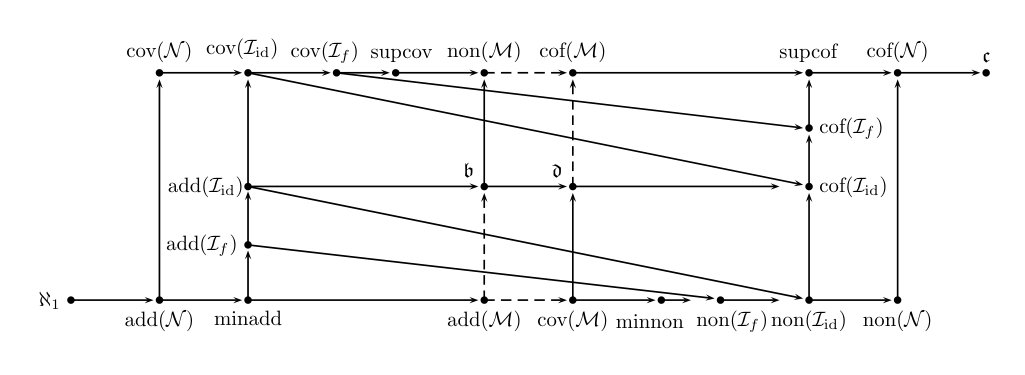 Figure 1
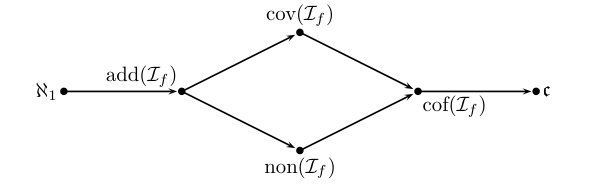 Figure 2
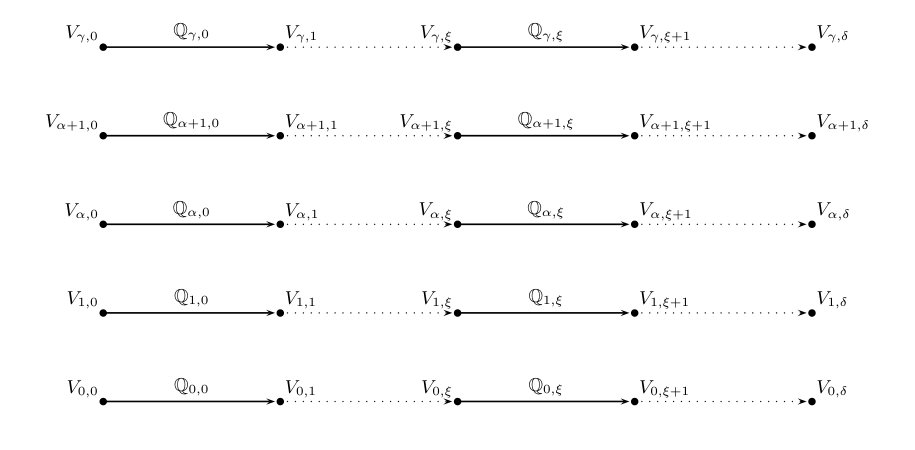 Figure 3