Collinear factorization violation and effective field theory
Matthew D. Schwartz, Kai Yan, Hua Xing Zhu

TL;DR
This paper demonstrates how effective field theory with Glauber operators can reproduce and analyze the violation of collinear factorization in scattering amplitudes, confirming results at one- and two-loop levels.
Contribution
It introduces an EFT framework with Glauber operators to systematically study and reproduce factorization-violating effects in collinear scattering processes.
Findings
Glauber contributions are contained in the soft sector when initial and final states are not collinear.
Glauber operators are non-analytic functions of external momentum due to the rapidity regulator.
The EFT approach confirms factorization violation at one- and two-loop levels.
Abstract
The factorization of amplitudes into hard, soft and collinear parts is known to be violated in situations where incoming particles are collinear to outgoing ones. This result was first derived by studying limits where non-collinear particles become collinear. We show that through an effective field theory framework with Glauber operators, these factorization-violating effects can be reproduced from an amplitude that is factorized before the splitting occurs. We confirm results at one-loop, through single Glauber exchange, and at two-loops, through double Glauber exchange. To approach the calculation, we begin by reviewing the importance of Glauber scaling for factorization. We show that for any situation where initial state and final state particles are not collinear, the Glauber contribution is entirely contained in the soft contribution. The contributions coming from Glauber operators…
Click any figure to enlarge with its caption.
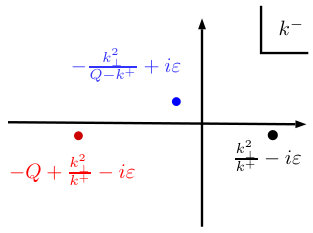 Figure 1
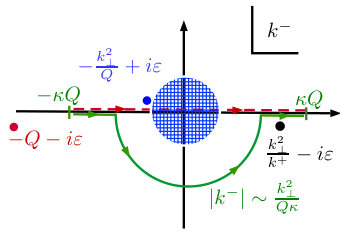 Figure 1
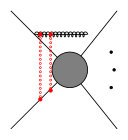 Figure 3
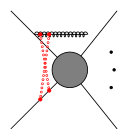 Figure 4
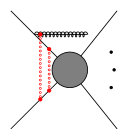 Figure 5
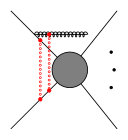 Figure 6
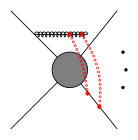 Figure 7
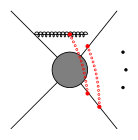 Figure 8
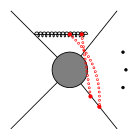 Figure 9
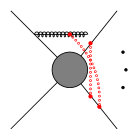 Figure 10
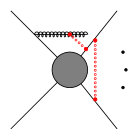 Figure 11
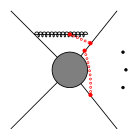 Figure 12
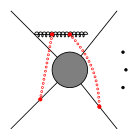 Figure 13
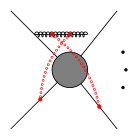 Figure 14
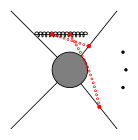 Figure 15
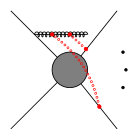 Figure 16
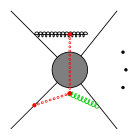 Figure 17
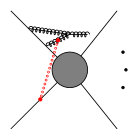 Figure 18
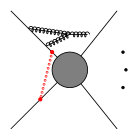 Figure 19
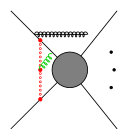 Figure 20
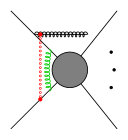 Figure 21
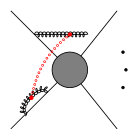 Figure 22
Peer Reviews
No public reviews on file for this paper yet. If you reviewed it on a platform where reviews are public (OpenReview, ICLR, NeurIPS, ICML), you can paste yours below so the community can read it here.
Videos
No videos yet. Explain this paper in a talk, walkthrough, or lecture? Add one.
Taxonomy
TopicsSpectroscopy and Quantum Chemical Studies · Cold Atom Physics and Bose-Einstein Condensates · Quantum Information and Cryptography